
BAAM AI Blog
Most Selling Products Online: A Practical Framework for Choosing Products That Actually Sell
The phrase most selling products online sounds simple, but it can be dangerously misleading if you treat it like a shortcut. A product can be popular and still be a bad product to sell. It can have huge demand and...
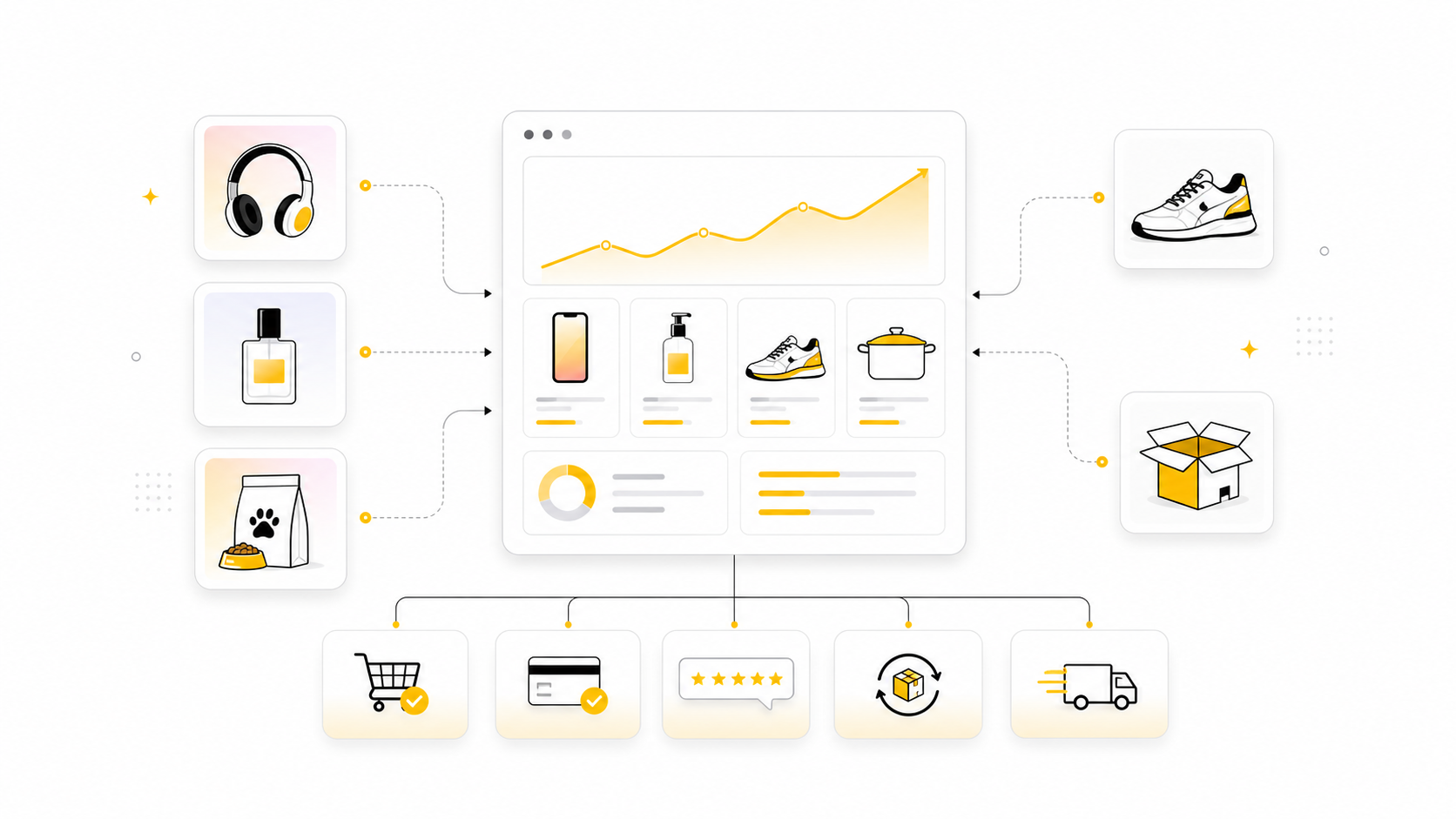
The phrase most selling products online sounds simple, but it can be dangerously misleading if you treat it like a shortcut. A product can be popular and still be a bad product to sell. It can have huge demand and still destroy your margin through returns, ad costs, shipping problems, weak differentiation, or brutal competition.
The more carefully question is not just “What sells the most online?” The better question is: which online product categories have proven demand, repeat buying behavior, manageable fulfillment, strong positioning angles, and enough room for a new seller to win? That is where the real opportunity is.
Online selling is still growing, but it is no longer easy mode. U.S. ecommerce sales reached $1.2337 trillion in 2025, growing faster than total retail sales, while ecommerce accounted for 16.4% of total retail sales in the year, based on the latest U.S. Census Bureau ecommerce sales report. That growth creates opportunity, but it also raises the bar. The best sellers now think less like product hunters and more like operators.
this guide breaks the topic into a practical decision framework, not a random list of trending items. You will see the major product categories that dominate online sales, why they keep selling, where the hidden risks are, and how to choose products that fit your business model. The goal is to help you avoid the trap of chasing whatever looks hot this month and instead build around demand that can actually be converted into profit.
Why Most Selling Products Online Matter
Knowing the most selling products online matters because demand is the first filter in ecommerce. If people are already spending heavily in a category, you do not need to educate the market from zero. You still need positioning, offer strength, trust, fulfillment, and retention, but you are starting with existing buying behavior instead of wishful thinking.
The biggest online categories are not random. Consumer electronics, fashion, food, DIY and hardware, furniture, beauty, personal care, and household products consistently appear near the top because they connect to daily needs, identity, convenience, replacement cycles, or lifestyle improvement. A recent Shopify category analysis using Statista market data lists consumer electronics, fashion, food, DIY and hardware, furniture, and beauty among the top online shopping categories by revenue.
But demand alone is not enough. Apparel sells heavily online, yet sizing and fit can create expensive returns. Electronics can generate high order values, but competition, warranties, and price comparison are intense. Beauty can be powerful because it supports repeat purchases and creator-led discovery, but trust, formulation claims, and brand credibility matter more than ever.
The Market Reality Behind Online Bestsellers
The current ecommerce market rewards products that are easy to compare, easy to understand, easy to reorder, or emotionally easy to justify. That is why shoppers continue buying practical categories like groceries and personal care while also spending on identity-driven products like fashion, beauty, tech accessories, and home upgrades. Adobe’s Digital Economy Index tracks online transactions across 100 million SKUs and 18 categories, giving a useful view into how broad and mature online demand has become through its digital economy research.
The strongest categories also benefit from habit. Groceries are a clear example because the category is moving from occasional online ordering into regular ecommerce behavior. NielsenIQ reported that online grocery contributed close to 75% of total grocery dollar growth in 2025, showing how even traditionally offline categories are becoming digital-first for many shoppers through online grocery growth research.
At the same time, sellers must be realistic about operational friction. Returns remain one of the biggest profit leaks in ecommerce, especially in categories like apparel, footwear, accessories, and home goods. The National Retail Federation projected that 19.3% of online sales would be returned in 2025, which means product choice has to account for fit, expectation gaps, shipping damage, and post-purchase support from the beginning, not after the store is already live through the 2025 Retail Returns Landscape.
The Product Selection Framework
The best way to evaluate the most selling products online is to separate popularity from business quality. A product with massive search volume may still be a weak choice if it has low margin, high return risk, fragile shipping, unclear differentiation, or no reason for a customer to buy from you instead of Amazon, Walmart, Temu, Shein, or a category leader. A boring product with repeat demand and strong bundling potential can often beat a flashy trend.
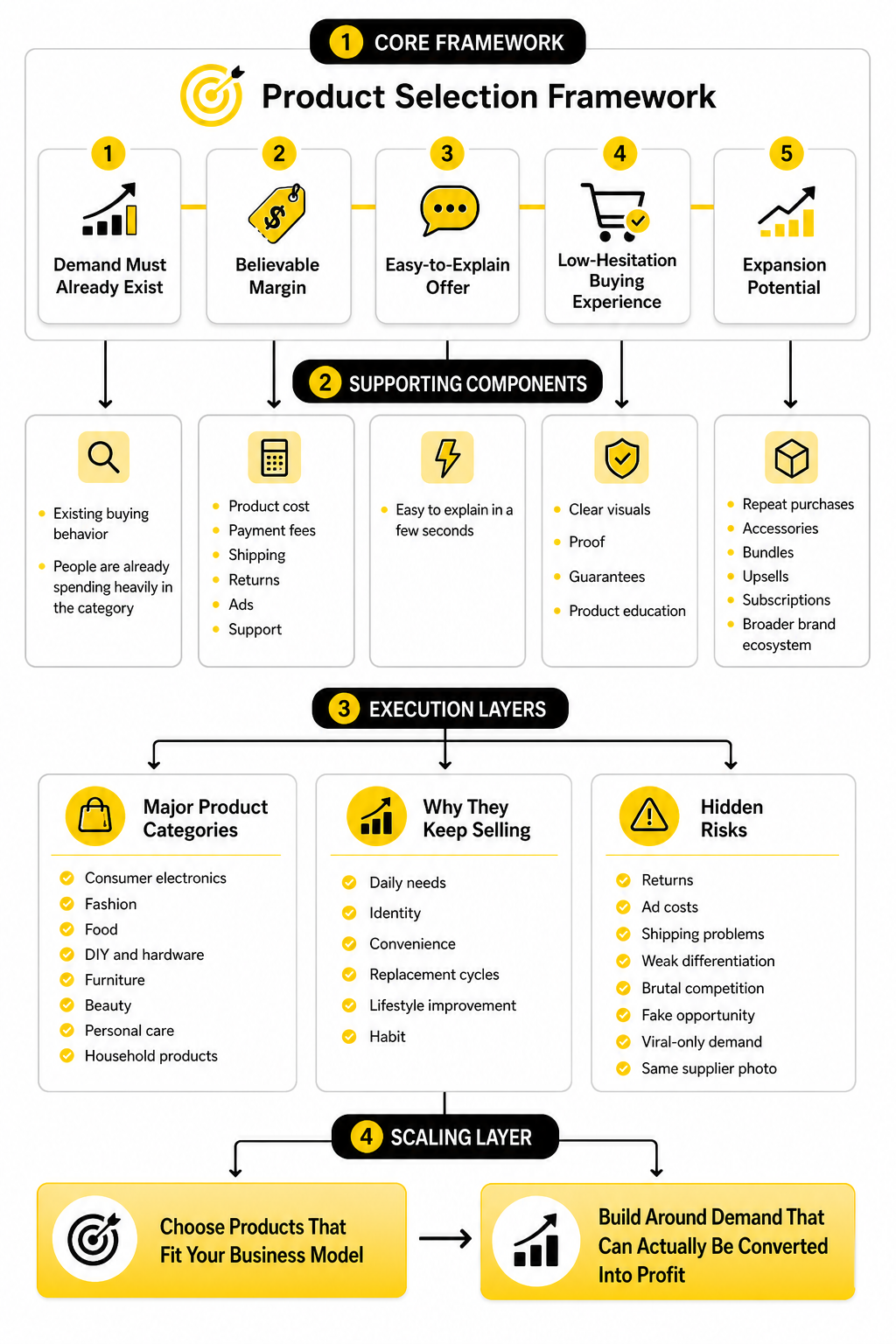
A practical framework looks at five things. First, demand must already exist. Second, the product must have a believable margin after product cost, payment fees, shipping, returns, ads, and support. Third, the offer must be easy to explain in a few seconds. Fourth, the buying experience must reduce hesitation with clear visuals, proof, guarantees, and product education. Fifth, the product should support either repeat purchases, accessories, bundles, upsells, subscriptions, or a broader brand ecosystem.
This framework also helps you avoid fake opportunity. If a product only looks good because one TikTok went viral, that is not enough. If everyone sells the same supplier photo with the same promise, that is not enough either. A sellable product needs a reason to exist in the customer’s mind and a reason to be bought from your store specifically.
The Product Selection Framework
The fastest way to make a bad ecommerce decision is to confuse sales volume with seller opportunity. The most selling products online are usually surrounded by aggressive competitors, strong marketplaces, copycat suppliers, thin margins, and customers who already know how to compare prices. That does not mean you should avoid popular categories. It means you need a stricter filter before you commit.
A good product has to pass more than one test. Demand matters, but so do margin, customer urgency, shipping practicality, return risk, content potential, trust requirements, and the strength of the offer around the product. When those pieces line up, you are no longer guessing. You are building a business case.
The framework below is simple on purpose. You can use it whether you are selling through a Shopify store, Amazon, Etsy, TikTok Shop, a funnel, or a niche landing page. The channel may change, but the fundamentals do not.
Demand That Already Exists
Start with existing demand because creating demand from scratch is expensive. Products that already sell online usually have clear search behavior, marketplace activity, social discovery, review volume, and repeat content being made around them. That is why categories like apparel, electronics, beauty, grocery, home goods, pet products, and fitness accessories keep showing up in ecommerce reports.
Demand can show up in different ways. Search demand means people are actively looking for the product. Social demand means people discover the product through creators, short videos, recommendations, or visual proof. Marketplace demand means shoppers are already comparing options on Amazon, Walmart, Etsy, eBay, or category-specific retailers.
The mistake is assuming that demand automatically belongs to you. It does not. If a product has strong demand, you still need a reason for someone to buy from your store instead of a cheaper marketplace listing, a trusted retailer, or the brand they already know.
Margin After the Real Costs
A product is only attractive if the numbers still work after the real costs. That means product cost, packaging, shipping, payment processing, discounts, returns, customer support, ad spend, damaged inventory, and taxes all need to be considered before you celebrate the gross margin. Many beginners stop at “I can buy it for $12 and sell it for $39,” but that is not how ecommerce profit works.
Returns are especially important because they can quietly destroy profitable-looking products. Online returns were expected to reach 19.3% of online sales in 2025, based on the NRF 2025 Retail Returns Landscape, and that risk is not spread evenly across every category. Fashion, footwear, accessories, and fit-dependent products can be painful if your sizing, photos, descriptions, or customer expectations are weak.
This is why low-ticket, fragile, bulky, or high-return products need extra caution. A product that looks easy to sell can become a nightmare when shipping costs rise, customers order multiple variants to compare, or paid ads force you to discount too aggressively. Profit is not what is left after the sale. Profit is what survives the full customer journey.
Clear Buying Intent
The best products are easy for customers to understand quickly. A shopper should be able to see the product, understand the use case, and know why it matters without reading a wall of text. If the product needs too much explanation, education, or belief-building, the offer must be much stronger.
Clear intent usually comes from one of four triggers. The customer has a problem they want solved, a desire they want fulfilled, a routine they want improved, or an identity they want reinforced. A kitchen organizer solves a visible problem. A skincare product promises a desired outcome. A pet subscription fits a routine. A premium gym accessory reinforces identity.
This is where product pages and funnels matter. If you are selling a product that needs demonstration, comparison, bundles, or a stronger landing page than a basic product template can provide, tools like Replo can help build more focused ecommerce pages. The point is not to make the page flashy. The point is to make the buying decision obvious.
Fulfillment That Does Not Create Chaos
A product can be popular and still be operationally weak. Heavy items, breakable items, products with complex variants, regulated goods, seasonal inventory, and items with unclear sizing can create problems fast. Every fulfillment issue becomes a customer support issue, and every support issue takes time away from growth.
Good ecommerce products are usually simple to store, simple to pack, simple to ship, and simple for the customer to understand when they receive them. That is one reason accessories, consumables, small home products, beauty tools, digital add-ons, and compact lifestyle products can be attractive. They are not always glamorous, but they often avoid the worst operational traps.
You should also think about supplier reliability before you test demand too aggressively. If the product depends on inconsistent stock, unstable quality, slow shipping, or unclear packaging standards, you are building on sand. A product that sells well for one week and creates chargebacks the next week is not a winner.
Differentiation Beyond the Product Itself
Most sellers cannot rely on product uniqueness for long. If a product starts selling, competitors can copy it, marketplaces can undercut it, and customers can compare alternatives in seconds. That is why differentiation must come from the full offer, not just the item.
Differentiation can come from bundling, positioning, education, audience focus, packaging, guarantees, community, content, support, or a more specific use case. A generic resistance band is easy to copy. A resistance band kit for busy parents rebuilding strength at home is more specific. The product may be similar, but the offer is not.
This matters even more when selling the most selling products online because high-demand categories attract lazy copycats. If your entire strategy is “same product, same supplier photo, same description, slightly lower price,” you are competing on the weakest possible ground. You want the customer to feel like your product fits them better, not just costs a few dollars less.
Repeat Purchase or Expansion Potential
One-time purchases can work, but repeat purchase potential makes the economics much easier. If a customer can buy again, subscribe, reorder, upgrade, or add related products, your customer acquisition cost has more room to breathe. That is why beauty, supplements, pet care, grocery, cleaning products, stationery, hobby supplies, and personal care often attract serious ecommerce operators.
Online grocery is a useful signal here because it shows how repeat behavior can reshape a category. Online sales contributed close to 75% of total grocery dollar growth in 2025, with digital grocery expected to keep expanding through 2028 in NielsenIQ and FMI’s online grocery research. Grocery is not attractive only because people need food. It is attractive because the buying cycle repeats.
The same logic applies in smaller niches. A customer who buys a dog grooming brush might later buy shampoo, supplements, treats, travel accessories, or replacement parts. A customer who buys a planner might later buy inserts, pens, templates, stickers, or a digital course. The product is the entry point, but the business is built around the relationship after the first purchase.
Content Potential
Products that sell well online usually have a natural content angle. They can be demonstrated, compared, reviewed, styled, tested, unboxed, transformed, or explained. That content gives you more ways to reach shoppers without relying only on paid ads.
This is one reason beauty, home organization, gadgets, kitchen tools, fitness gear, baby products, pet products, and fashion accessories perform so well on visual platforms. The product can be shown in motion. The customer can imagine the result. The value becomes easier to feel before the purchase.
Content potential also affects conversion. If your product page can include short videos, before-and-after visuals, customer questions, comparison tables, and clear use cases, the buying decision becomes easier. If you plan to turn comments, DMs, and product questions into automated conversations, ManyChat can fit naturally into that workflow, especially for sellers using Instagram, Messenger, or WhatsApp to move shoppers closer to purchase.
Trust Requirements
Some products need much more trust than others. A phone case is low risk. A skincare serum, baby product, supplement, expensive appliance, or health-related device carries a higher trust burden. The more personal, expensive, technical, or outcome-driven the product is, the more proof you need.
Trust can come from reviews, certifications, transparent ingredients, founder credibility, expert input, strong policies, real product photography, customer education, and clear support. It can also come from removing vague claims. If you cannot prove a promise, do not build the product around that promise.
This is especially important in high-volume categories. Beauty and personal care sell heavily online, but customers are more skeptical than they used to be. Electronics sell heavily online, but buyers compare specs, warranties, and reviews. The most selling products online are often trust-sensitive because people have been burned by bad versions before.
Core Product Categories That Sell Online
Once the framework is clear, the next step is to look at the categories where online demand is already proven. This is where many sellers get too emotional. They either chase whatever looks exciting on social media, or they dismiss strong categories because they seem “too competitive.”
Competition is not automatically bad. In many cases, competition proves that buyers are active, suppliers exist, content angles are available, and customers already understand the product. The real question is whether you can enter the category with a sharper angle, cleaner offer, better experience, or more carefully execution than the average seller.
Consumer Electronics and Tech Accessories
Consumer electronics remain one of the strongest ecommerce categories because shoppers are comfortable researching, comparing, and buying tech online. Phones, laptops, headphones, smartwatches, chargers, gaming accessories, smart home devices, and portable gadgets all benefit from clear use cases and high online search behavior. Adobe tracks ecommerce spending across 100 million SKUs and 18 product categories, which shows how mature and data-rich the online electronics market has become through its Digital Economy Index.
The opportunity for smaller sellers is usually not in competing directly with the biggest brands on core devices. Selling laptops, phones, and premium electronics requires capital, warranty handling, trust, and price competitiveness that most new sellers cannot match. The better entry point is often accessories, add-ons, protection, organization, charging, cases, mounts, desk upgrades, or niche tech tools that support the main device.
This category works best when the product solves a clear friction point. A cable organizer, magnetic mount, desk charging station, travel adapter, webcam light, tablet stand, or gaming grip can be easier to sell than a high-ticket electronic device. The customer already owns the expensive product, and your product improves the experience around it.
Fashion, Apparel, and Accessories
Fashion is one of the most selling products online because it combines identity, trend cycles, visual content, and frequent purchasing. Apparel, shoes, bags, jewelry, sunglasses, watches, and small accessories are easy to discover through social media and easy to position around style, occasion, lifestyle, or community. The category is massive for a reason.
But fashion is also one of the easiest categories to underestimate. Sizing issues, material expectations, fit differences, color accuracy, and return behavior can crush margins if the store is not built carefully. The online return rate problem matters here because ecommerce returns were expected to reach 19.3% of online sales in 2025, and fit-dependent products are naturally more exposed to that risk through the NRF retail returns research.
If you enter fashion, do not rely on generic supplier photos and vague size charts. You need real measurements, clear fit guidance, better product photography, model context, review prompts, and strong expectation-setting. Accessories can be a cleaner starting point because they often carry less sizing risk while still giving you visual appeal and style-based positioning.
Beauty and Personal Care
Beauty and personal care sell online because the category sits at the intersection of routine, aspiration, identity, and repeat purchase. Skincare, haircare, grooming products, beauty tools, cosmetics, fragrance, oral care, and personal care accessories can all support strong content and recurring demand. This is one of the best categories for education-led selling, but only if the claims are responsible and believable.
Trust is the barrier. Customers want proof, ingredient clarity, reviews, usage guidance, and realistic expectations. If the product touches the body or promises a visible result, you need to be careful with claims and avoid exaggeration. A simple beauty tool or organizer may be easier to launch than a formula-heavy skincare product because the trust burden is lower.
The category also performs well with creator content and social discovery. DHL’s 2025 social commerce research found that 82% of shoppers say trending or viral products influence their purchases, while 62% say social media customer reviews influence buying decisions, making visual, review-driven categories especially important in social commerce trends. Beauty fits that environment naturally because customers want to see texture, application, routines, results, and real customer reactions before they buy.
Home, Kitchen, and Organization Products
Home and kitchen products keep selling because they solve visible everyday problems. People want cleaner spaces, easier cooking, better storage, nicer rooms, faster routines, and small upgrades that make daily life feel more controlled. This category is practical, visual, and broad enough to support many niches.
The strongest products in this space usually have a clear before-and-after effect. Drawer organizers, under-sink storage, spice racks, pantry containers, cleaning tools, countertop gadgets, lighting, bedding accessories, pet-friendly furniture covers, and compact appliances can all be demonstrated quickly. That matters because a product that shows its value in five seconds is much easier to sell online.
The caution is shipping and durability. Bulky furniture, fragile glassware, heavy cookware, and low-quality plastic products can create refund requests, damaged shipments, and bad reviews. The sweet spot is often compact, useful, demonstrable, and durable enough to survive fulfillment without creating support chaos.
Pet Products
Pet products sell well online because pet owners buy emotionally and repeatedly. Food, treats, grooming tools, toys, beds, walking accessories, travel products, cleaning products, health-adjacent items, and enrichment products all connect to a strong owner identity. People do not just buy for a pet. They buy to feel like they are taking better care of a family member.
This category has strong expansion potential. A customer who buys one grooming product may later need shampoo, brushes, wipes, supplements, storage, travel accessories, or replacement parts. That gives sellers more room to build bundles and follow-up offers instead of depending on a single one-time transaction.
The risk is quality and safety. Anything a pet eats, chews, wears, or sleeps on has to be selected carefully. Cheap products with poor materials, weak stitching, unsafe ingredients, or unclear sizing can create real problems. Pet buyers are loyal when they trust you, but they are unforgiving when a product feels unsafe.
Fitness, Wellness, and Hobby Products
Fitness and wellness products remain attractive because they connect to self-improvement. Resistance bands, yoga accessories, recovery tools, massage devices, water bottles, gym bags, grip trainers, posture accessories, and home workout equipment can all be sold with clear outcomes. Hobby products work similarly because buyers already care deeply about the activity.
The best angle in this category is specificity. A generic fitness product is easy to ignore, but a product positioned for runners, desk workers, beginners, travelers, postpartum training, golfers, climbers, cyclists, or home gym owners becomes easier to understand. The more specific the use case, the easier it is to write the page, create content, and build bundles.
You must be careful with health-related claims. Do not promise medical outcomes, pain cures, weight-loss guarantees, or transformation results you cannot support. Sell the product around practical use, comfort, consistency, convenience, or training support. That keeps the offer persuasive without crossing into weak or risky claims.
Baby, Kids, and Family Products
Baby and kids products can sell strongly online because parents constantly need solutions. Storage, feeding accessories, travel helpers, clothing, toys, educational products, room organization, safety accessories, and routine-building tools all fit real household needs. The category has emotional urgency because parents are often trying to solve a problem quickly.
Trust is extremely important here. Parents care about materials, safety, reviews, durability, age suitability, and whether the product actually makes life easier. If the product looks cheap or vague, it will struggle no matter how useful it seems.
This category is strongest when the product removes friction from a daily routine. A travel organizer, snack container, bath toy storage system, stroller accessory, label pack, or bedtime helper can be easier to sell than a broad “cute baby product.” Parents are busy. The offer should show the problem, the practical benefit, and the reason the product is safe enough to trust.
Digital Products and Productized Knowledge
Digital products are not always included when people search for the most selling products online, but they deserve attention because they avoid many physical-product problems. Templates, planners, spreadsheets, presets, swipe files, Notion systems, training, printables, design assets, and niche guides can be delivered instantly. There is no shipping, no inventory, and no warehouse.
The challenge is perceived value. Digital products are easy to create badly, which means customers are skeptical. A strong digital product needs a clear outcome, professional packaging, useful examples, and a specific audience. “Business templates” is vague. “Client onboarding templates for freelance designers” is much stronger.
This category also pairs well with physical products. A fitness brand can sell workout plans. A planner brand can sell digital planning systems. A home organization store can sell printable labels or checklists. The goal is not to replace physical products, but to increase customer value without adding fulfillment complexity.
Professional Implementation for Online Sellers
Choosing a product is only the start. The execution process is where most ecommerce ideas either become real businesses or die as scattered tests. You need a repeatable system for validating demand, shaping the offer, building the page, launching traffic, capturing follow-up, and improving the numbers.
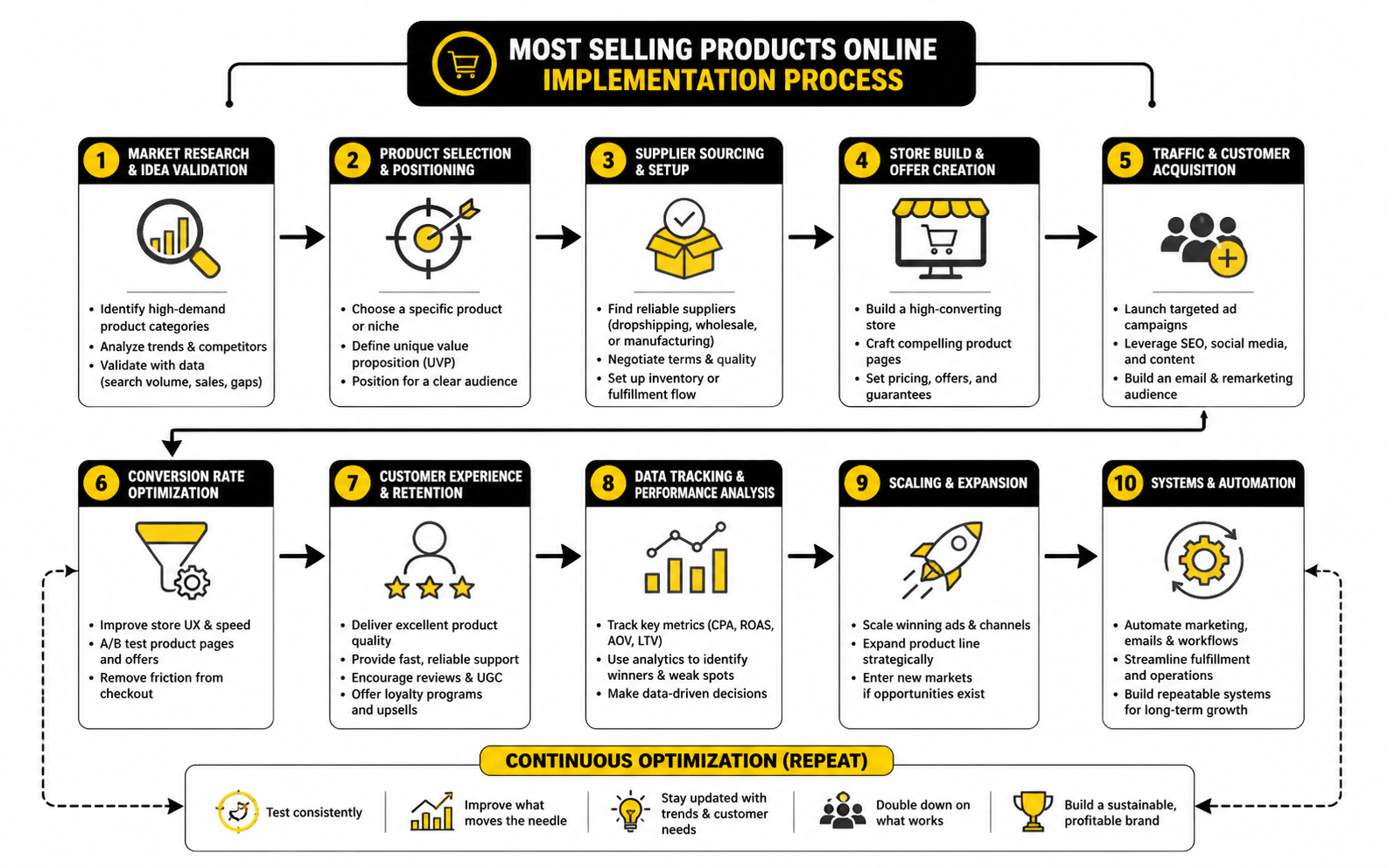
The process below keeps things practical. It does not require a huge team or a massive budget, but it does require discipline. You are not trying to prove that your idea is brilliant. You are trying to let the market show you what is worth scaling.
Step 1: Shortlist Products by Category and Problem
Start with categories that already have proven online demand, then narrow them by problem. Do not begin with “I want to sell something viral.” Begin with “What specific customer problem, desire, or routine can I improve?” That shift immediately makes your research more useful.
Create a shortlist of 10 to 20 product ideas across categories like beauty, home, pet, accessories, fitness, family, or digital products. For each one, write down the buyer, the pain point, the visible benefit, the likely price range, the main objection, and the reason someone would buy today. If you cannot explain those pieces clearly, the product is not ready for testing.
Then remove weak ideas quickly. Cut products that are too fragile, too heavy, too regulated, too easy to compare only on price, or too dependent on unrealistic claims. The goal is not to keep the biggest list. The goal is to keep the cleanest list.
Step 2: Validate Demand Across Multiple Signals
Do not rely on one platform. A product that looks popular on TikTok may have weak search demand. A product that has high search volume may be dominated by established brands. A product with marketplace sales may still be hard to differentiate in your own store.
Look for demand across search engines, marketplaces, social platforms, review sections, forums, creator content, and competitor stores. You want to see people asking questions, comparing options, complaining about existing products, posting demonstrations, and leaving detailed reviews. Those signals tell you what customers actually care about.
Pay close attention to negative reviews. They often reveal the opening for your offer. If customers complain that a product breaks, smells bad, fits poorly, arrives late, lacks instructions, or looks different from the photos, that is valuable. Your product and page can be built to address those objections directly.
Step 3: Build the Offer Before the Store
Most sellers build a store too early. They choose a theme, upload products, write basic descriptions, and hope traffic converts. That is backwards. The offer should come first.
A strong offer includes the product, the promise, the audience, the bundle, the guarantee, the proof, the urgency, and the reason to buy from you. If you cannot make the offer compelling in plain language, a better logo will not save it. The customer does not care that you launched a store. The customer cares whether the product solves their problem better than the alternatives.
For offer-heavy products, a focused funnel can work better than a generic product page. ClickFunnels can be useful when you want to test a product with a dedicated landing page, order bump, upsell, and follow-up sequence instead of sending everyone into a broad catalog. The tool is not the strategy, but the right structure can make testing cleaner.
Step 4: Create a Product Page That Reduces Doubt
A product page has one job: reduce doubt until buying feels reasonable. That means the page must answer the customer’s practical questions before they become reasons to leave. What is it? Who is it for? How does it work? What is included? How big is it? How long does shipping take? What happens if it is not right?
Use simple language and strong sequencing. Start with the clearest benefit, show the product in context, explain the main use cases, address objections, show proof, clarify shipping and returns, and make the next step obvious. Do not hide important details in tabs nobody reads.
Visual proof matters here. Product photos, short videos, size references, comparison graphics, ingredient or material details, and customer-generated content can all improve confidence. If the product is one of the most selling products online in a crowded category, your page needs to make the difference obvious faster than the customer can open three competitor tabs.
Step 5: Launch With Controlled Traffic
The first launch should be a controlled test, not a giant bet. Send traffic from one or two channels where the product naturally fits. That might be TikTok content, Instagram Reels, Google Shopping, Pinterest, influencer seeding, email, marketplace listings, or paid ads. Do not spread your attention across every channel at once.
The goal of early traffic is learning. You want to know whether people click, stay, add to cart, buy, ask questions, abandon checkout, or complain about the price. Those behaviors are more useful than opinions from friends or random comments.
Track the basics from day one. Watch click-through rate, product page conversion rate, add-to-cart rate, checkout completion, cost per purchase, refund requests, support questions, and average order value. If the product attracts attention but does not convert, the issue may be the offer or page. If it converts but loses money, the issue may be margin, pricing, traffic cost, or order value.
Step 6: Build Follow-Up Into the System
Most sellers lose money because they treat every visitor as one chance. People click, browse, hesitate, leave, and disappear. That is expensive. Follow-up gives you more chances to convert the attention you already paid for.
Email and SMS can recover abandoned carts, answer objections, introduce bundles, collect reviews, and bring customers back for repeat purchases. For ecommerce sellers who want a straightforward email and automation platform, Brevo can fit the early-stage workflow without overcomplicating the stack. The point is to capture demand instead of constantly renting it from ad platforms.
Follow-up is not just promotional. It should improve the customer experience. Send usage tips, setup instructions, care guidance, reorder reminders, and helpful content that makes the product easier to enjoy. Better customers create better reviews, fewer support tickets, and stronger repeat buying behavior.
Statistics and Data
Data should not be used to decorate an ecommerce article. It should help you make better decisions. When you are researching the most selling products online, the numbers only matter if they tell you what to sell, what to avoid, where to test, and what to improve after the first traffic starts coming in.
A category can look attractive because revenue is huge, but that does not automatically mean it is a good entry point. A high-volume category might be dominated by brands with deeper inventory, lower shipping rates, better supplier terms, and stronger customer trust. Your job is to interpret the data through the lens of action, not ego.
Market Size Shows Demand, Not Your Opportunity
The first number to understand is overall ecommerce growth. U.S. retail ecommerce sales reached $1.2337 trillion in 2025, while ecommerce accounted for 16.4% of total retail sales in the full year, based on the U.S. Census Bureau ecommerce report. That matters because online buying is no longer a side channel. It is a normal buying behavior across everyday categories.
But market size is not a green light by itself. If electronics, apparel, beauty, grocery, and home goods generate huge online revenue, that proves shoppers are buying. It does not prove that your version of the product will be profitable.
Use market size as the first filter, not the final decision. A large market tells you there is demand to study. From there, you still need to inspect margins, customer intent, traffic cost, return risk, supplier reliability, and whether you can make the offer different enough to win.
Category Growth Reveals Where Behavior Is Shifting
Growth data is more useful than static popularity because it shows where customer behavior is changing. A category that is already huge but flat may still be good, but a category with rising online adoption can create more room for new brands. That is especially true when shoppers are still forming habits and are not fully loyal to one seller yet.
Online grocery is a good example. Digital grocery has moved from convenience add-on to a serious growth driver, with online sales contributing close to 75% of total grocery dollar growth in 2025 in NielsenIQ and FMI’s online grocery research. The action is not necessarily “start a grocery store.” The action is to notice how repeat buying, convenience, subscriptions, delivery expectations, and household replenishment are shaping ecommerce behavior.
That same pattern can apply to smaller niches. If customers are getting comfortable ordering refills, bundles, routine products, pet supplies, household consumables, wellness accessories, and personal care items online, your product strategy should think beyond one sale. Repeat behavior is where the numbers become much more forgiving.
Returns Tell You Where Profit Leaks
Returns are one of the most important ecommerce metrics because they expose hidden weakness. A product may generate strong sales but still be a poor business if too many customers send it back. This is why you cannot evaluate the most selling products online only by revenue.
Online returns were expected to reach 19.3% of online sales in 2025, while free returns remained an important shopping consideration for many customers in the NRF 2025 Retail Returns Landscape. That number should immediately change how you think about apparel, shoes, home goods, accessories, fragile products, and anything where expectations can easily be wrong.
The action is simple: measure return risk before scaling. Watch return rate by product, reason for return, refund cost, exchange rate, damaged shipment rate, and support volume. If customers keep returning the same item because of size, quality, color, missing information, or unclear expectations, your page, product, supplier, or category choice needs work.
Social Signals Show Discovery, Not Guaranteed Buyers
Social commerce data is useful because many products are discovered before they are searched. Shoppers often see a product in a short video, creator review, livestream, or customer post before they ever type it into Google. That is why visual categories like beauty, fashion accessories, gadgets, home organization, pet products, and fitness tools can move quickly.
DHL’s 2025 social commerce research found that 82% of shoppers say trending or viral products influence their purchases, and 62% say customer reviews on social media influence buying decisions in its social commerce trends report. That matters because social proof is no longer optional for many product categories. Customers want to see the product used by real people, not only described by the seller.
But social signals need caution. Viral attention can create a spike without durable demand. A product that gets views but no repeat purchases, no search activity, no reviews, and no clear use case may disappear as fast as it arrived. Treat social data as a discovery signal, then validate it with conversion, margin, and retention.
Your Analytics System Should Connect the Whole Journey
The best sellers do not look at one dashboard and call it strategy. They connect product research, traffic, page behavior, checkout performance, customer support, returns, repeat purchases, and profit. That is how you spot whether the problem is the product, the offer, the traffic source, the page, the price, or the post-purchase experience.
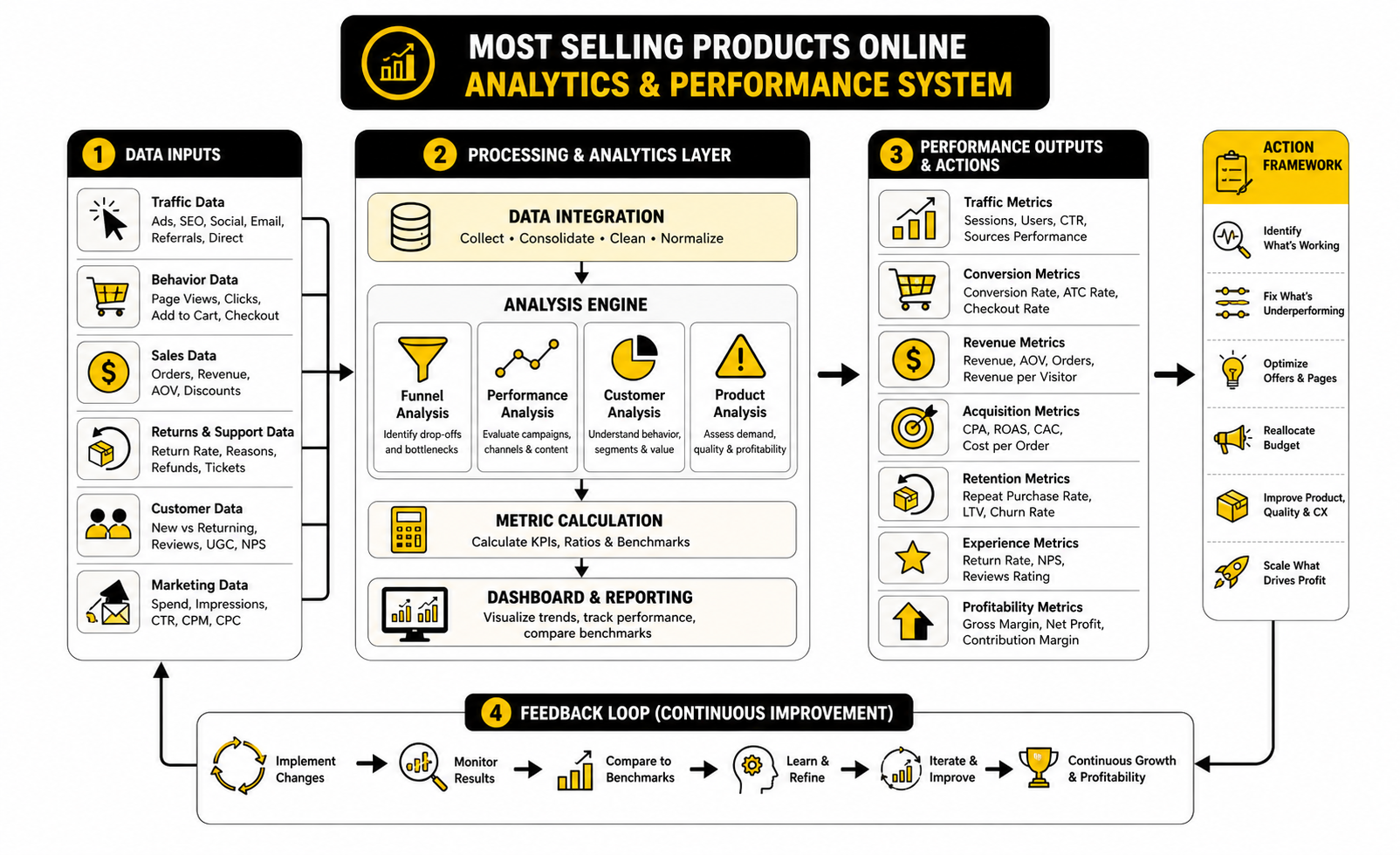
A useful analytics system does not need to be complicated. It needs to answer the right questions consistently. Are people interested enough to click? Are they staying long enough to understand the offer? Are they adding to cart? Are they finishing checkout? Are they asking the same questions? Are they returning the product? Are they buying again?
This is where many sellers get distracted by surface metrics. Views, likes, and traffic are not useless, but they are not the business. The business is profitable orders, low refund friction, repeat purchase potential, and customer trust that compounds over time.
The Metrics That Actually Matter
For product testing, focus on a small set of numbers that tell you what to do next. Too many metrics create noise. Too few metrics make you blind.
The most useful metrics are:
Each metric should trigger a practical action. If clicks are weak, improve the hook, angle, image, or audience. If add-to-cart is decent but checkout is weak, inspect shipping cost, delivery time, payment options, trust badges, and surprise fees. If conversion is strong but profit is weak, improve average order value, supplier cost, pricing, bundles, or retention.
Benchmarks Are Starting Points, Not Rules
Benchmarks can help you understand whether your store is obviously broken, but they should not become your strategy. Different categories behave differently. A low-ticket impulse product, a high-ticket appliance, a fashion accessory, a skincare product, and a digital template will not have the same conversion rate, return rate, or customer acquisition cost.
This is why you should compare products inside your own store over time. Product A may have lower traffic but better conversion. Product B may get more attention but more returns. Product C may look average at first purchase but create repeat buyers. Your internal comparison often becomes more useful than broad industry averages.
Use benchmarks to ask better questions, not to make lazy decisions. If your conversion rate is weak, investigate the offer. If your return rate is high, investigate expectation gaps. If your repeat purchase rate is low, investigate product type, follow-up, and customer experience.
Profit Data Beats Revenue Data
Revenue can make a product look successful before the costs are counted. This is one of the most common traps in ecommerce. A product can produce impressive sales screenshots while quietly losing money through ads, discounts, shipping, refunds, payment fees, and customer support.
Profit data forces honesty. You need to know contribution margin per order, net margin after returns, customer acquisition cost, average order value, and expected lifetime value. Without those numbers, you are not measuring a business. You are measuring movement.
This is especially important with popular products because competition can push sellers into discounts and expensive ads. If everyone is selling a similar product, the seller with better economics survives longer. Better economics can come from bundles, subscription options, email follow-up, stronger sourcing, improved conversion, or a clearer niche.
Customer Questions Are Data Too
Not all useful data comes from analytics dashboards. Customer questions, live chat logs, DMs, reviews, refund messages, and support tickets often reveal the real reason people hesitate or leave. This qualitative data is incredibly valuable because it tells you what your page failed to explain.
If customers keep asking about sizing, materials, shipping time, compatibility, care instructions, ingredients, warranty, or what is included, your page needs to answer those questions earlier. If customers keep comparing your product to a competitor, your positioning needs to be clearer. If customers keep asking whether the product works for their specific situation, your use cases need to be more precise.
For sellers managing multiple conversations across leads, customers, and follow-ups, GoHighLevel can help centralize pipelines, automations, and customer communication. The important part is not the software itself. The important part is turning repeated customer questions into better pages, better offers, and better products.
Measurement Should Decide What Happens Next
The point of measurement is action. If the numbers do not change what you do next, you are just collecting data for comfort. Every product test should end with a decision: cut, fix, retest, scale, bundle, reposition, or replace.
A simple decision process works best. If a product has weak clicks and weak conversion, cut it or rebuild the angle. If it gets clicks but does not convert, improve the page, proof, offer, or price. If it converts but returns are high, fix expectations or stop scaling. If it converts profitably and customers are satisfied, then you can increase traffic and build the backend.
That is the professional way to handle the most selling products online. You do not chase numbers because they look exciting. You use numbers to remove guesswork, protect margin, and scale only what the market has already proven.
Strategic Tradeoffs Before You Scale
This is where product selection gets serious. After you have demand signals, category context, and early performance data, the next job is to decide what kind of ecommerce business you are actually building. Selling the most selling products online can mean chasing fast-moving trends, building a focused niche brand, creating a repeat-purchase catalog, or using a product as the front end for a larger offer.
None of those paths is automatically right. Each one has different cash needs, risk, speed, margin profile, and operational pressure. The mistake is mixing strategies without realizing it. You cannot run a trend store, a premium brand, a subscription business, and a deep marketplace catalog with the same decision rules.
Trend Products Versus Evergreen Products
Trend products can move fast because social attention does part of the selling for you. A product catches attention, creators demonstrate it, shoppers share it, and demand spikes before the market fully matures. That can be profitable if your sourcing, page, fulfillment, and content are ready before the wave gets crowded.
The downside is speed cuts both ways. Trend products attract copycats quickly, and the margin window can close before slower sellers even understand why the product was selling. DHL’s social commerce research found that 82% of shoppers say trending or viral products influence purchases, which is powerful, but it also means the same demand can shift quickly when the feed moves on through 2025 social commerce trends.
Evergreen products are slower but usually healthier. These are products tied to ongoing needs, habits, routines, hobbies, or household problems. They may not explode overnight, but they give you more time to improve the offer, build reviews, develop content, negotiate with suppliers, and create repeat purchase paths.
Broad Demand Versus Niche Positioning
Broad demand feels safer because the market is bigger. Everyone needs storage, skincare, pet products, phone accessories, clothing, kitchen tools, or fitness gear. The problem is that broad products often create broad competition, and broad competition usually pushes you toward weaker pricing power.
Niche positioning gives you a sharper entry point. You are no longer selling “a water bottle.” You are selling a desk-friendly hydration bottle for remote workers, a leakproof bottle for school backpacks, or a gym bottle for people who track supplements and electrolytes. The product may be similar, but the buying context becomes more specific.
This matters because customers buy faster when they feel understood. A niche offer can speak directly to the use case, objections, lifestyle, and desired outcome. You do not need to own the entire category. You need to own a clear buying moment.
Marketplace Selling Versus Owned Store Selling
Marketplaces give you access to existing traffic, built-in buyer trust, and fast demand validation. Amazon, Walmart Marketplace, Etsy, eBay, and TikTok Shop can help prove whether people want a product before you invest heavily in an owned store. That is useful, especially when you are still testing product-market fit.
But marketplace selling has limits. You are often competing beside similar listings, under platform rules, with limited customer ownership and constant price comparison. Your product can sell, but your brand may not become memorable.
An owned store gives you more control over positioning, customer data, bundling, email follow-up, landing pages, and brand experience. The tradeoff is that you must create or buy the traffic yourself. For sellers who want a simple all-in-one funnel and checkout path, Systeme.io can be a practical starting point, especially when the goal is to test one offer before building a bigger catalog.
Paid Traffic Versus Organic Content
Paid traffic gives you speed. You can test hooks, audiences, product pages, prices, and offers quickly if the economics allow it. That makes it useful for products with clear margins, strong visuals, and a page built to convert.
Organic content gives you leverage. Short videos, product demos, comparison posts, search content, creator partnerships, and customer-generated content can keep working after the first post is published. The downside is that organic content is less predictable and requires consistent output before results become stable.
The best operators usually combine both. Organic content discovers angles and creates proof. Paid traffic amplifies what already works. If you start with paid traffic before the offer is clear, you pay for confusion. If you rely only on organic content without measuring conversion, you can become popular without building a profitable business.
Single Product Versus Product Line
A single-product store is focused. The message is cleaner, the page is easier to optimize, and the offer can be tested faster. This works well when the product has a strong problem-solution angle, clear demonstration, and room for bundles or upsells.
A product line is more durable if the products belong together. The customer can buy multiple related items, return for more, and trust the brand as a category specialist. This works best in niches like pet care, beauty routines, home organization, planner systems, fitness accessories, craft supplies, or personal care.
The danger is launching too many products too early. A large catalog can look professional, but it often spreads attention across weak listings. Start with a tight product cluster. Then expand only when the data shows which customer, use case, and buying path deserve more products.
Low Ticket Versus High Ticket
Low-ticket products are easier for customers to buy impulsively, but they leave less room for ads, support, shipping, and discounts. If your average order value is too low, even strong conversion may not create enough profit. This is why low-ticket products usually need bundles, quantity breaks, subscriptions, or post-purchase upsells.
High-ticket products create more revenue per order, but the trust burden is higher. Customers compare more, ask more questions, read more reviews, and hesitate longer. You need better proof, stronger support, clearer guarantees, and a more polished buying experience.
Neither model is automatically better. Low ticket needs volume and efficiency. High ticket needs trust and patience. The right choice depends on margin, traffic source, buying urgency, and how much customer education the product requires.
Private Label Versus Reselling
Reselling is faster because the product already exists. You can test demand, learn the category, and avoid product development risk. The downside is that other sellers may offer the same item, making price comparison brutal.
Private label gives you more control over packaging, positioning, bundle structure, customer experience, and long-term brand value. It can also make your offer harder to compare directly. But private label requires more upfront work, better supplier relationships, stronger quality control, and more careful inventory planning.
A practical path is to validate first, customize second, and brand deeper only when the numbers support it. Do not spend months designing packaging for a product the market has not accepted. But once a product proves itself, improving packaging, instructions, inserts, variants, bundles, and quality can turn a simple item into a stronger brand asset.
Inventory Risk and Cash Flow
Inventory is where ecommerce gets real. A product can look great in testing, but scaling requires cash before the revenue comes back. You may need to pay suppliers, freight, warehousing, packaging, ads, software, and support before customers repay that investment.
Stockouts hurt momentum, but overstock can trap cash. Seasonal products, trend products, and products with fast-changing styles are especially risky because timing matters. If demand cools while inventory sits, discounts may become your only exit.
Build cash flow assumptions before scaling. Know your reorder point, supplier lead time, expected sales velocity, return rate, and how much capital is tied up in inventory. The most selling products online are not always the safest products to stock heavily. Sometimes the winning move is slower inventory expansion with cleaner cash control.
Compliance, Claims, and Platform Risk
Some categories carry more compliance risk than others. Beauty, supplements, baby products, electronics, health-adjacent products, toys, food-contact items, and anything making performance claims need extra care. A product that sells well is not worth much if it creates legal, platform, payment processor, or customer safety problems.
Be careful with claims. Do not promise medical results, guaranteed weight loss, pain relief, financial outcomes, or unrealistic transformations unless the claim is properly supported and legally safe. In many cases, better positioning comes from practical benefits, clearer use cases, and stronger education instead of exaggerated promises.
Platform risk matters too. A marketplace can suspend a listing, an ad account can reject claims, a payment processor can hold funds, and a supplier can change quality without warning. The more your business depends on one channel, one product, or one supplier, the more fragile it becomes.
Brand Moat and Customer Ownership
Long-term ecommerce is not just about finding products. It is about building something competitors cannot copy overnight. That can be an audience, a customer list, stronger creative, better supplier access, original packaging, proprietary bundles, useful education, community, reviews, or a better post-purchase experience.
Customer ownership is central. If every sale depends on renting attention from ads or marketplaces, growth becomes more expensive over time. Email, SMS, content, loyalty, subscriptions, and customer support all help turn one purchase into a relationship.
This is why follow-up systems matter more as you scale. For brands managing leads, customers, automations, and pipelines across multiple offers, GoHighLevel can support the operational side of customer ownership. But the real moat is not the software. The real moat is knowing your customer better than the generic seller does.
When to Cut a Product
Cutting products is part of the job. A product that fails is not a personal insult. It is market feedback. The faster you accept that, the faster you protect cash and attention.
Cut a product when the economics do not work after reasonable improvements. If the page has been clarified, the offer has been adjusted, the price has been tested, traffic quality has been checked, and returns or support issues remain ugly, move on. Do not keep scaling a product just because it gets attention.
Also cut products that damage the brand. If customers feel misled, quality is inconsistent, shipping is unreliable, or complaints keep repeating, the hidden cost is bigger than the refund number. Bad products train customers not to trust you again.
When to Scale a Product
A product is ready to scale when the numbers and customer experience both support it. You want profitable acquisition, manageable returns, positive customer feedback, reliable fulfillment, and a clear path to increasing average order value or repeat purchases. Sales alone are not enough.
Scale by strengthening the system, not just increasing ad spend. Improve sourcing, product page assets, support documentation, packaging, bundles, email flows, review collection, and inventory planning. The goal is to make the business more stable as volume increases.
This is where advanced sellers separate themselves. Beginners look for the most selling products online and hope the product carries everything. Professionals build the product, offer, page, traffic, support, analytics, and retention into one machine. That machine is what actually scales.
Building the Final Ecommerce System
At this stage, the product is no longer the only thing that matters. The real advantage comes from the system around the product: research, positioning, offer, page, traffic, follow-up, fulfillment, support, analytics, and customer retention. That is what turns the most selling products online from a search phrase into a serious business strategy.
A strong ecommerce system also protects you from overreacting. If one product slows down, the customer data still helps you choose the next offer. If one traffic channel becomes expensive, your email list, social proof, customer reviews, and organic content still have value. If one supplier becomes unreliable, your category knowledge helps you replace the product without starting from zero.
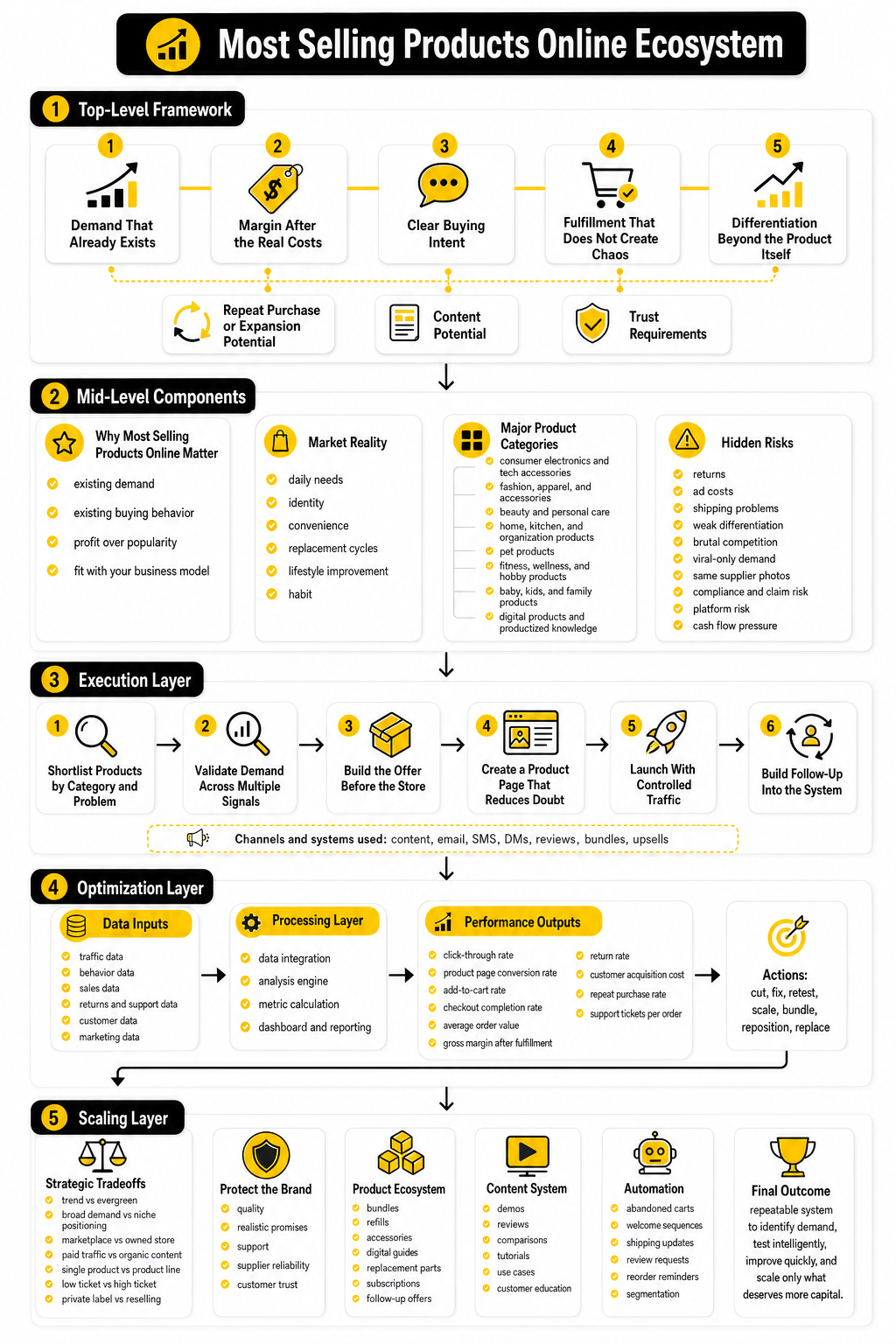
The final goal is not to find one magic product. The goal is to build a repeatable way to identify demand, test intelligently, improve quickly, and scale only what deserves more capital. That is how professional sellers stay calm while beginners keep chasing the next shiny item.
Turn Products Into Product Ecosystems
A product ecosystem gives customers more than one reason to buy from you. Instead of selling one isolated item, you build around a connected set of needs. That might mean bundles, refills, accessories, digital guides, care kits, replacement parts, subscriptions, or related products that solve the next problem.
This matters because customer acquisition keeps getting harder. If every order depends on finding a brand-new buyer, your growth is fragile. A product ecosystem gives you more ways to increase average order value, improve retention, and make the first customer worth more over time.
Start small. One hero product can lead into one bundle, one upsell, one follow-up offer, and one reorder reminder. You do not need a bloated catalog. You need a logical path from the first purchase to the next useful purchase.
Build Content Around Buying Moments
Content should not exist only to get views. It should support the buyer’s decision process. The best ecommerce content answers the questions people ask before they buy, shows the product in real use, compares options honestly, and makes the outcome easier to imagine.
For products driven by visual discovery, short-form content is especially important. DHL’s 2025 social commerce research found that 82% of shoppers say trending or viral products influence purchases, while 62% say social media customer reviews influence buying decisions in its social commerce trends report. That does not mean every product needs to go viral. It means customers increasingly expect proof, demonstration, and social validation before they act.
A practical content system includes product demos, objection-handling posts, customer review clips, comparison content, setup tutorials, use-case examples, and post-purchase education. If you schedule and distribute this across multiple channels, Buffer can help keep the publishing rhythm organized. The real win is consistency, not random posting when you feel motivated.
Use Automation Without Losing the Human Touch
Automation can make ecommerce more efficient, but bad automation makes a brand feel cold. The goal is not to replace the customer experience. The goal is to remove delays, answer repeated questions, recover missed revenue, and make customers feel supported faster.
Use automation for abandoned carts, welcome sequences, shipping updates, review requests, reorder reminders, product education, and customer segmentation. These are repetitive moments where speed and consistency matter. But keep the tone human. Customers should feel guided, not trapped in a machine.
This is where conversation-based systems can help. ManyChat can support social DMs and automated product conversations, while Brevo can support email and lifecycle messaging. Use tools to make the customer journey smoother, not louder.
Protect the Brand as You Grow
Growth creates pressure. You may be tempted to lower quality, overpromise in ads, delay support, hide shipping issues, or push products that should have been cut. That is how a fast-growing store becomes a refund machine.
Protecting the brand means saying no to weak products even when they look profitable for a moment. It means monitoring reviews, support tickets, damaged shipments, supplier changes, refund reasons, and customer sentiment. It also means keeping the promise on the page aligned with the product that arrives at the door.
The long game is simple. Customers remember whether the product matched the promise. If it did, you get reviews, referrals, repeat purchases, and stronger trust. If it did not, no amount of clever marketing will fix the damage forever.
What Are the Most Selling Products Online?
The most selling products online usually come from categories with broad demand, frequent buying behavior, or strong visual appeal. Common examples include consumer electronics, fashion, beauty and personal care, home and kitchen products, groceries, pet products, fitness accessories, baby products, and digital products. These categories keep performing because they connect to daily needs, identity, convenience, hobbies, or repeat purchase behavior.
The important point is that “most selling” does not always mean “best to sell.” A category can be huge and still be difficult for a new seller because of competition, return rates, supplier issues, or low margins. Use popularity as a starting point, then evaluate the product through margin, fulfillment, trust, differentiation, and retention.
What Is the Best Product to Sell Online for Beginners?
The best product for beginners is usually small, simple, easy to explain, and not heavily regulated. Home organization products, accessories, pet tools, simple beauty accessories, fitness accessories, hobby supplies, and digital templates can be easier starting points than fragile, bulky, expensive, or claim-heavy products. Beginners need fast feedback, not complex operations.
Avoid products that require complicated sizing, medical claims, safety certifications, refrigeration, expensive warranties, or large upfront inventory. You want a product that can be tested quickly with a clear page, simple offer, and manageable fulfillment. The cleaner the operation, the easier it is to learn from the market.
Are Trending Products Better Than Evergreen Products?
Trending products can be great for fast tests, but they are risky if you are late. The window can close quickly as copycats enter, ad costs rise, and customer attention moves to the next viral item. They work best when you can source quickly, create content fast, and avoid overstocking inventory.
Evergreen products are usually better for building a durable business. They are tied to ongoing needs, habits, routines, hobbies, or lifestyle problems. They may grow slower, but they give you more time to improve the offer, collect reviews, build search traffic, and create repeat purchases.
How Do I Validate Product Demand Before Selling?
Validate demand by checking multiple signals, not just one platform. Look at marketplace reviews, search behavior, social content, competitor stores, customer complaints, ad activity, and whether people are already comparing products. If the product appears across several channels, the demand signal is stronger.
Do not ignore negative reviews. They often show what customers dislike about existing options and what your offer can improve. If many buyers complain about poor instructions, cheap materials, weak packaging, bad sizing, or slow shipping, those gaps can become your positioning advantage.
What Products Should I Avoid Selling Online?
Avoid products that are fragile, heavy, unsafe, legally complicated, hard to explain, or likely to create high returns unless you have the experience to manage them. Be especially careful with supplements, medical claims, baby safety products, electronics with warranty issues, food-contact items, counterfeit-prone goods, and products with unclear compliance requirements. A product is not worth scaling if it creates legal, payment, platform, or customer safety problems.
You should also avoid products where your only advantage is a lower price. That is a weak position because someone can always undercut you. If you cannot improve the offer, niche, content, bundle, service, or customer experience, the product may not be worth entering.
How Important Is Product Margin?
Margin is critical because revenue is not profit. You need enough room to cover product cost, shipping, packaging, payment fees, returns, support, advertising, discounts, and taxes. A product with weak margin can look successful in sales reports while quietly losing money.
Do not judge a product only by gross markup. Judge it by contribution margin after fulfillment and realistic customer acquisition costs. If the product cannot survive the full cost of selling online, it is not a strong product.
How Do Returns Affect Ecommerce Profit?
Returns can turn a winning-looking product into a weak business. Online returns were expected to reach 19.3% of online sales in 2025 in the NRF retail returns research, which means sellers need to measure return risk before scaling. This is especially important for fashion, footwear, accessories, home goods, fragile products, and items where customer expectations can easily be wrong.
Track return reasons, not just return volume. If customers return because of sizing, material, color, missing details, quality, or shipping damage, that tells you exactly what to fix. Sometimes the answer is better page content. Sometimes the answer is a better supplier. Sometimes the answer is cutting the product.
Should I Sell on Marketplaces or My Own Store?
Marketplaces are useful for demand validation because shoppers are already there. They provide traffic, trust, and comparison behavior that can help you learn fast. The downside is that you compete directly beside similar products and have limited control over the customer relationship.
An owned store gives you more control over branding, landing pages, bundles, email follow-up, customer data, and long-term retention. The tradeoff is that you must bring traffic yourself. Many sellers use both: marketplaces for validation and owned stores for brand building.
How Many Products Should I Launch With?
Most new sellers should start with a focused product cluster instead of a giant catalog. One strong hero product with a few related add-ons, bundles, or upsells is easier to test than dozens of disconnected products. A tight catalog also makes messaging clearer.
Large catalogs can look impressive, but they often hide weak strategy. If products do not serve the same customer or buying moment, they create confusion. Start focused, learn what works, then expand around proven demand.
What Metrics Should I Track First?
Track click-through rate, product page conversion rate, add-to-cart rate, checkout completion rate, average order value, customer acquisition cost, return rate, support tickets per order, and repeat purchase rate. These numbers show where the business is working and where it is leaking. You do not need a hundred metrics. You need the few that drive decisions.
The key is interpretation. If people click but do not buy, the issue may be the page, offer, trust, price, or product clarity. If people buy but return often, the issue may be expectations or quality. If people buy profitably and come back, you may have something worth scaling.
Can Digital Products Be Among the Most Selling Products Online?
Digital products can be extremely attractive because they avoid shipping, inventory, and physical returns. Templates, planners, spreadsheets, presets, courses, swipe files, design assets, and niche guides can all work when they solve a specific problem. The challenge is trust and perceived value.
A strong digital product must be clear, useful, and specific. Generic “templates” are easy to ignore. A focused product for a defined audience with a clear outcome is much stronger. Digital products also pair well with physical products because they can increase value without adding fulfillment complexity.
How Do I Scale After Finding a Winning Product?
Scale by improving the system, not just increasing ad spend. Strengthen supplier reliability, product assets, page clarity, bundles, email flows, review collection, support documentation, and inventory planning. More traffic only helps if the rest of the machine can handle it.
A winning product should have profitable acquisition, manageable returns, reliable fulfillment, positive customer feedback, and expansion potential. If those pieces are in place, scale gradually and watch the data. If scaling makes the customer experience worse, slow down and fix the system first.
Build a stronger local presence with BAAM AI
Turn your website, Google profile, social channels, and AI visibility into one growth engine
Most businesses do not need more random marketing activity. They need a consistent presence system that helps the right people find them, trust them, and take action. BAAM AI brings strategy, local SEO, website updates, Google Maps visibility, social content, AI-search readiness, media production, and reporting into one practical monthly engine.
If you want your marketing to keep working after the campaign ends, start with a free BAAM AI presence audit. See how your business shows up today and where the fastest visibility wins are at BAAM AI.