
BAAM AI Blog
Moosend Email Marketing: A Practical Guide To Building Campaigns That Actually Convert
Moosend email marketing is best understood as a practical system for turning subscribers into customers through campaigns, automations, forms, landing pages, segmentation, and reporting. It is not just a newsletter...
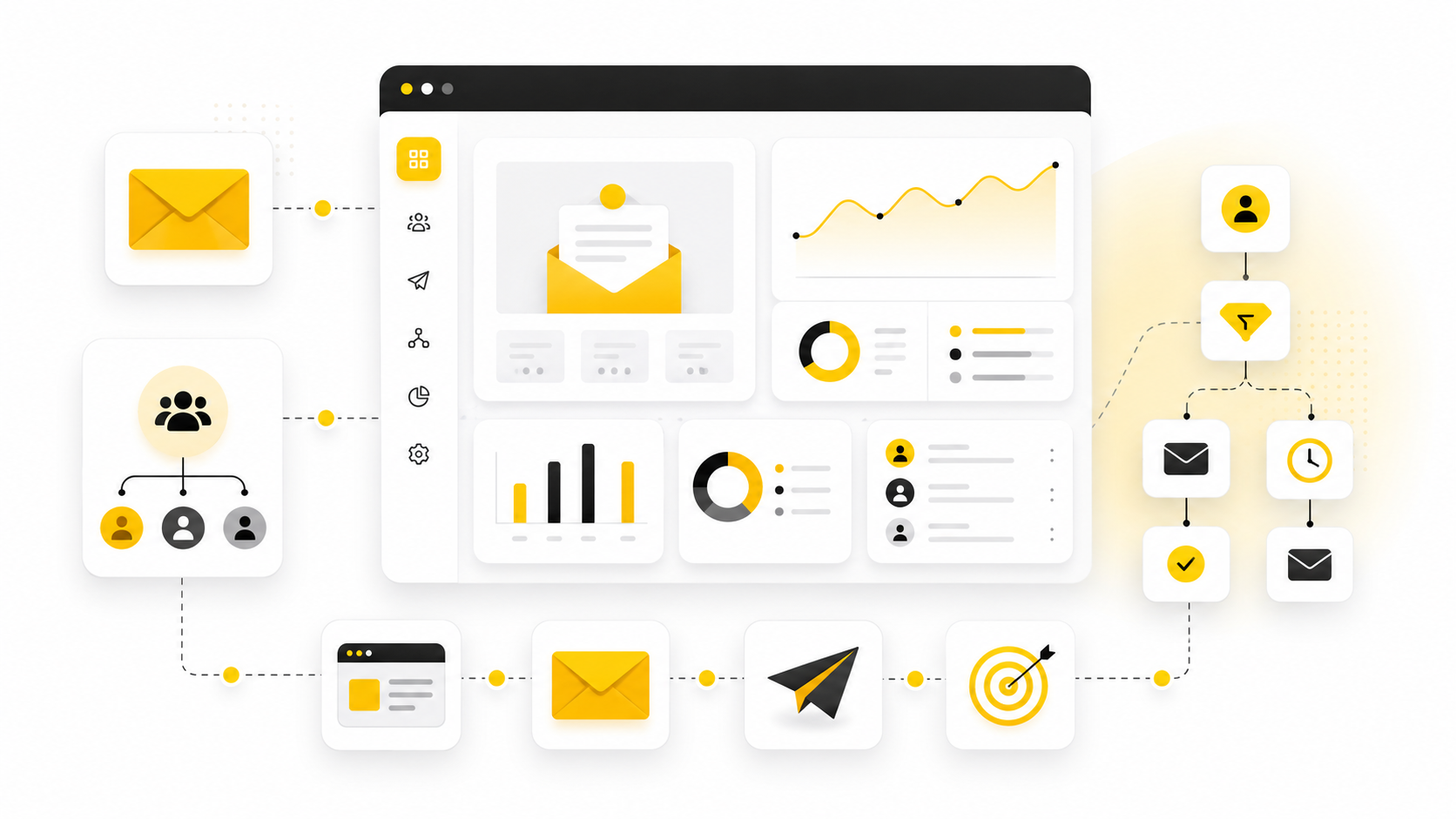
Moosend email marketing is best understood as a practical system for turning subscribers into customers through campaigns, automations, forms, landing pages, segmentation, and reporting. It is not just a newsletter tool. Used well, it becomes the operating layer between your audience, your offers, and the moments when people are most likely to act.
That matters because email is one of the few marketing channels you can still own directly. Social reach changes, ad costs move, algorithms shift, and platform rules can change overnight. Your email list gives you a more stable asset, but only if your setup is clean, your message is relevant, and your automation does not feel robotic.
Moosend fits especially well for creators, ecommerce brands, service businesses, agencies, and small teams that want serious email marketing without building a complicated enterprise stack. Its core appeal is that you can manage campaigns, audience segments, automation workflows, subscription forms, landing pages, and reporting from one place through Moosend’s email marketing platform. The opportunity is not just sending more emails. The real opportunity is sending better-timed emails to better-defined groups of people.
Why Moosend Email Marketing Matters
The biggest mistake people make with email marketing is treating it like a broadcast channel only. They collect subscribers, send occasional newsletters, and wonder why the list does not produce consistent revenue. Moosend email marketing becomes more useful when you treat it as a relationship system: capture the right people, understand what they care about, send relevant messages, and automate the obvious follow-ups.
This is where the platform’s combination of email campaigns, segmentation, personalization, forms, landing pages, and automation starts to matter. You are not simply writing one message for everyone. You are building paths for different types of subscribers based on what they clicked, joined, bought, ignored, or showed interest in.
The practical value is speed with control. A small team can launch a campaign, build a form, create a landing page, trigger a welcome sequence, and review performance without waiting on developers or stitching together too many tools. That does not remove the need for strategy, but it removes a lot of friction from execution.
Moosend Framework Overview
A strong Moosend setup starts with the customer journey, not the email editor. Before you build anything, you need to know how someone enters your list, what promise brought them there, what they should receive first, and what action you want them to take next. That journey becomes the structure for your campaigns, automations, and segments.
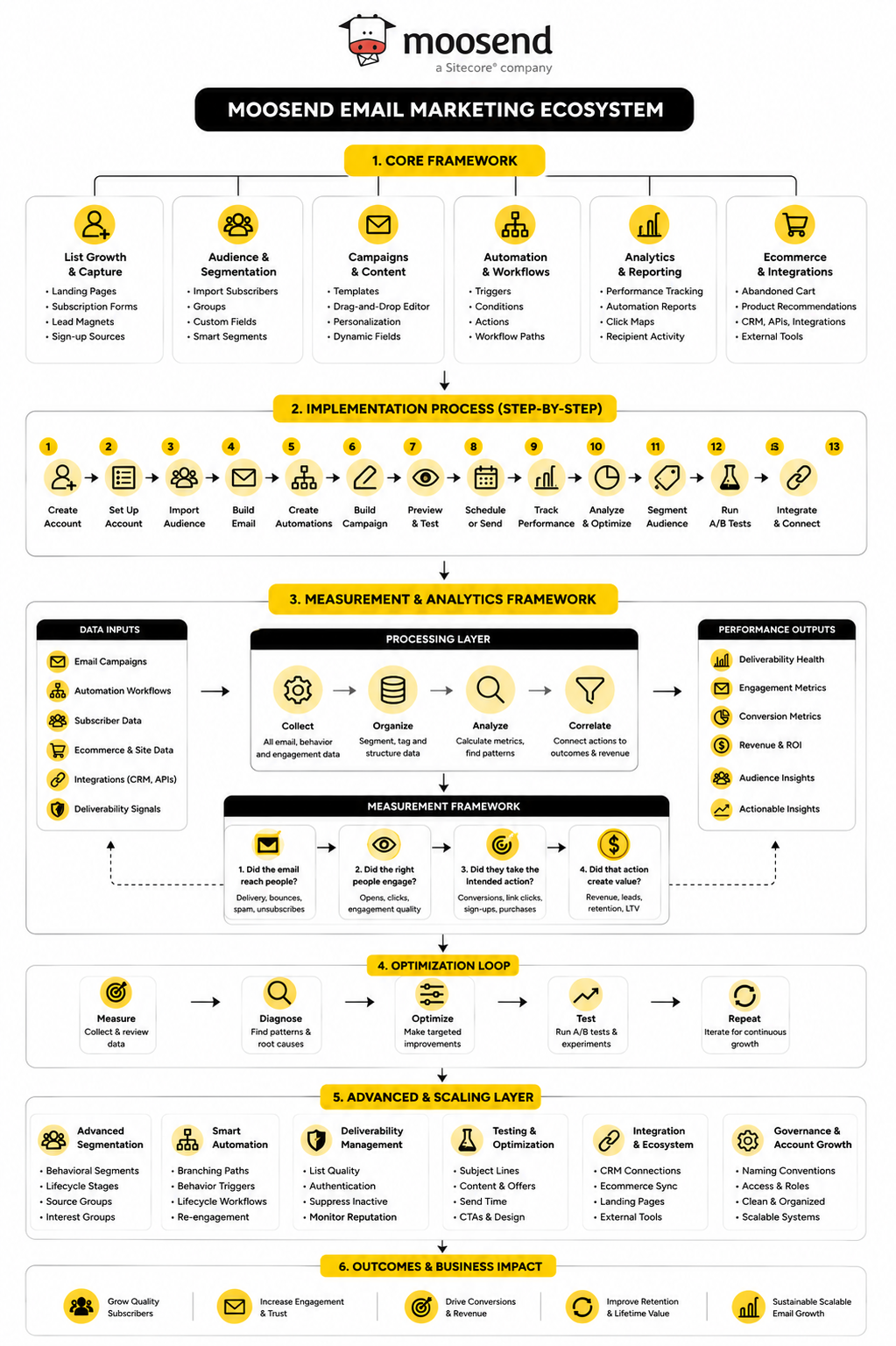
The framework is simple: capture, classify, communicate, convert, and improve. You capture subscribers through forms and landing pages. You classify them with list data, behavior, and segments. You communicate through campaigns and automated sequences. You convert with relevant offers, reminders, and follow-ups. Then you improve the whole system through reporting and testing.
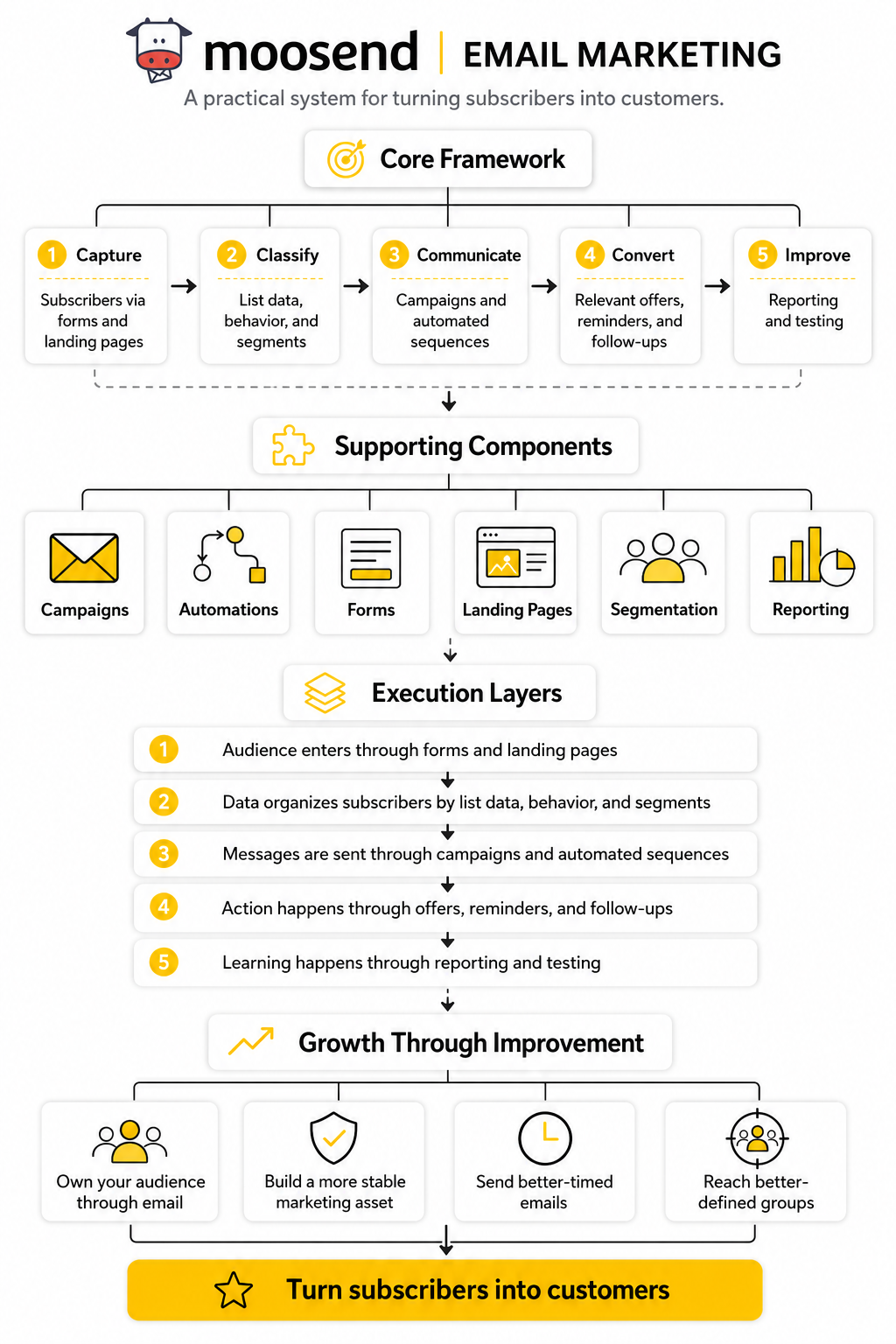
This framework keeps Moosend email marketing from becoming random activity. Instead of asking, “What email should we send this week?” you start asking better questions. Which audience needs a message, what stage are they in, what data do we have, and what would be the most useful next step for them?
Moosend Framework Overview
The best way to use Moosend email marketing is to think in systems, not isolated campaigns. A campaign is one send. A system keeps working after the send is over because it captures subscribers, stores useful data, triggers relevant follow-ups, and shows you what to improve next.
Moosend gives you the main pieces of that system in one platform: campaigns, automation workflows, landing pages, subscription forms, segmentation, personalization, analytics, and ecommerce-focused tools. That matters because every tool in the stack should have a clear job. When those jobs are connected, your email marketing becomes easier to manage and more likely to produce consistent results.
The framework below keeps the setup practical. You do not need to build everything on day one. You need a clean starting structure that lets you grow without turning your account into a messy pile of lists, tags, drafts, and half-finished automations.
Capture The Right Subscribers
Every Moosend email marketing system starts with capture. This is where people join your list through a form, landing page, checkout process, lead magnet, webinar registration, or other opt-in point. The goal is not to collect as many random contacts as possible. The goal is to attract people who actually want the promise you are making.
Moosend includes subscription forms and landing pages, which means you can create simple entry points without relying on a separate page builder for every small campaign. For many teams, that is enough to move faster because the opt-in experience and the email follow-up can be managed in the same place. If your funnel is more advanced, a dedicated funnel platform like ClickFunnels or an all-in-one system like GoHighLevel may still make sense around it.
The important part is that every capture point should set clear expectations. Tell people what they are signing up for, what they will receive, and why it matters. A vague “join our newsletter” form usually attracts weaker intent than a specific promise tied to a useful outcome.
Classify Subscribers With Useful Data
Once someone joins, you need to know enough about them to communicate intelligently. This is where segmentation, custom fields, and behavioral data become important. Moosend supports list segments based on subscriber data, campaign activity, custom fields, and other conditions, which makes it possible to send more relevant emails instead of treating every subscriber the same.
This does not mean you should create a complicated segmentation plan from day one. Start with the data you will actually use. For example, you might track subscriber source, interest category, customer status, product interest, location, or engagement level.
The rule is simple: collect data only when it improves the message or the decision. If a field will not change what you send, when you send it, or how you measure performance, it is probably not needed yet. Clean data beats excessive data every time.
Communicate With Campaigns And Automations
Campaigns and automations serve different jobs, and confusing them creates weak email strategy. Campaigns are best for timely messages, announcements, promotions, newsletters, product updates, and content drops. Automations are best for predictable moments, such as welcome sequences, abandoned cart reminders, post-purchase follow-ups, re-engagement flows, lead nurturing, and customer education.
Moosend email marketing works best when these two layers support each other. Your automations handle the essential follow-up that should happen every time. Your campaigns handle the timely messages that depend on what is happening now in your business.
This balance matters because manual sending does not scale well. If every subscriber depends on you remembering to follow up, opportunities will slip through the cracks. Automation fixes that, but only when the messages still feel helpful, relevant, and human.
Convert With A Clear Next Step
Email marketing should not end with opens and clicks. Those metrics are useful, but they are not the business outcome. The real question is whether your emails move people toward a meaningful next step, such as buying, booking, replying, registering, downloading, upgrading, or returning to a cart.
That is why every campaign and automation should have one dominant action. When an email tries to do five things at once, the reader has to work too hard. Strong Moosend campaigns usually make the next step obvious and remove unnecessary choices.
For ecommerce, that next step might be viewing a product, completing a purchase, using a discount, or returning to an abandoned cart. For service businesses, it might be booking a consultation, replying with a problem, or watching a short training. For creators, it might be consuming content, joining a paid community, or buying a digital product.
Improve The System With Reporting
The final layer is improvement. Moosend gives you reporting and analytics so you can review how campaigns and automations perform over time. The point is not to stare at dashboards for entertainment. The point is to find the few changes that can improve results.
Start by looking for patterns. Which subject lines get attention from the right subscribers? Which emails earn clicks? Which segments respond better? Which automation emails create drop-off? Which offers produce action?
This is where a practical marketer separates opinion from evidence. You might love a clever subject line, but if it attracts weak clicks or the wrong audience, it is not helping. You might dislike a simple direct offer, but if it consistently drives qualified action, keep it and improve around it.
How The Moosend System Fits Together
A clean Moosend email marketing setup should feel like one connected flow. A subscriber enters through a form or landing page. Their source and interests are stored. They receive the right welcome or nurture sequence. Their behavior updates what they receive next. Campaigns are sent to the right segments. Reporting shows what to improve.
That connected flow is the difference between using software and building an asset. Software gives you buttons. A real system gives you repeatable movement from attention to trust to action.
For most businesses, the first version should be intentionally simple. Build one strong capture point, one welcome sequence, a few meaningful segments, and a basic campaign rhythm. Once that works, you can add more advanced workflows, deeper personalization, ecommerce triggers, and cross-channel tools like ManyChat for conversational follow-up where it fits.
What To Set Up Before You Build
Before building campaigns inside Moosend, decide what the system needs to accomplish. This prevents random setup decisions that later become hard to clean up. The platform can support many use cases, but your first setup should serve your highest-value journey.
Start with your main audience and offer. Know who you are trying to attract, what problem they care about, and what action creates value for the business. Then map the moments where email can help: after signup, before purchase, after purchase, after inactivity, or after a specific behavior.
You should also decide your naming structure early. Use clear names for lists, segments, forms, campaigns, and automations so anyone on your team can understand the account later. Boring names are usually better than clever names because they make maintenance easier.
The Practical Starting Point
The strongest starting point is a simple welcome system. Someone subscribes, receives the promised value, gets introduced to your brand, and is guided toward one logical next step. This is basic, but it is also where many businesses leave money on the table.
A good welcome sequence does not need to be long. It needs to be clear. The first email should deliver what was promised. The next messages should build trust, explain the useful context, and point toward a relevant action.
Once that works, build outward. Add segmentation based on interest. Add campaign sends for timely content or offers. Add automations for abandoned carts, inactive subscribers, post-purchase education, or lead qualification. That is how Moosend email marketing becomes a system instead of another tool you log into when you remember.
Core Components Of A High-Performing Moosend Setup
A strong Moosend email marketing setup has four core components: audience structure, capture points, campaign systems, and automation workflows. These pieces should not be built randomly. They should connect around one clear journey, so every subscriber has a logical path from signup to trust to action.
Think of this as the foundation before the more advanced optimization work begins. If your lists are messy, your forms are vague, and your automations are patched together without a clear purpose, reporting will not save you. Clean implementation gives you cleaner data, better decisions, and fewer problems later.
Moosend gives you the tools to build this structure inside one platform, including email campaigns, landing pages, subscription forms, segmentation, personalization, automation, reporting, and ecommerce tools through Moosend’s email marketing platform. The key is not using every feature immediately. The key is using the right features in the right order.
Build The Audience Structure First
Start with your audience structure before you design emails. This means deciding how your lists, segments, and custom fields will be organized. It sounds boring, but this is where many email systems either become scalable or become painful.
A practical setup usually starts with one primary mailing list and then uses segments to separate people by behavior, interest, lifecycle stage, or source. Moosend supports segmentation based on subscriber data and campaign behavior, which means you can create more targeted groups without creating a separate list for every small difference. That keeps the account easier to manage as your database grows.
Custom fields should be used for information you plan to act on. For example, a business might store product interest, lead source, customer type, preferred topic, or lifecycle stage. Do not collect random data just because the platform allows it. Every field should help you send a more relevant message, trigger a better workflow, or understand performance more clearly.
Create Capture Points That Match Intent
After the audience structure is clear, build the places where people enter the system. These might include embedded forms, pop-ups, landing pages, checkout opt-ins, lead magnet pages, webinar registrations, or consultation request forms. Each capture point should match the reason someone is joining.
This is where Moosend email marketing becomes practical. You can use Moosend’s forms and landing pages for straightforward list-building campaigns, then connect those subscribers directly into welcome or nurture workflows. That shortens the distance between interest and follow-up, which is exactly what you want.
The message on the form matters more than the design. A clear promise will usually outperform a pretty but vague opt-in. Tell people what they get, who it is for, and why it is worth their email address. That simple clarity improves both subscriber quality and future engagement.
Map The First Subscriber Journey
Before you create automation steps, map the journey in plain language. What happens the moment someone subscribes? What should they receive first? What should happen if they click? What should happen if they do nothing? What is the next business outcome you want?
This does not need to be complex. A first journey can be as simple as signup, delivery email, trust-building email, helpful education, relevant offer, and follow-up. The point is to build with intention instead of throwing random messages into a sequence.
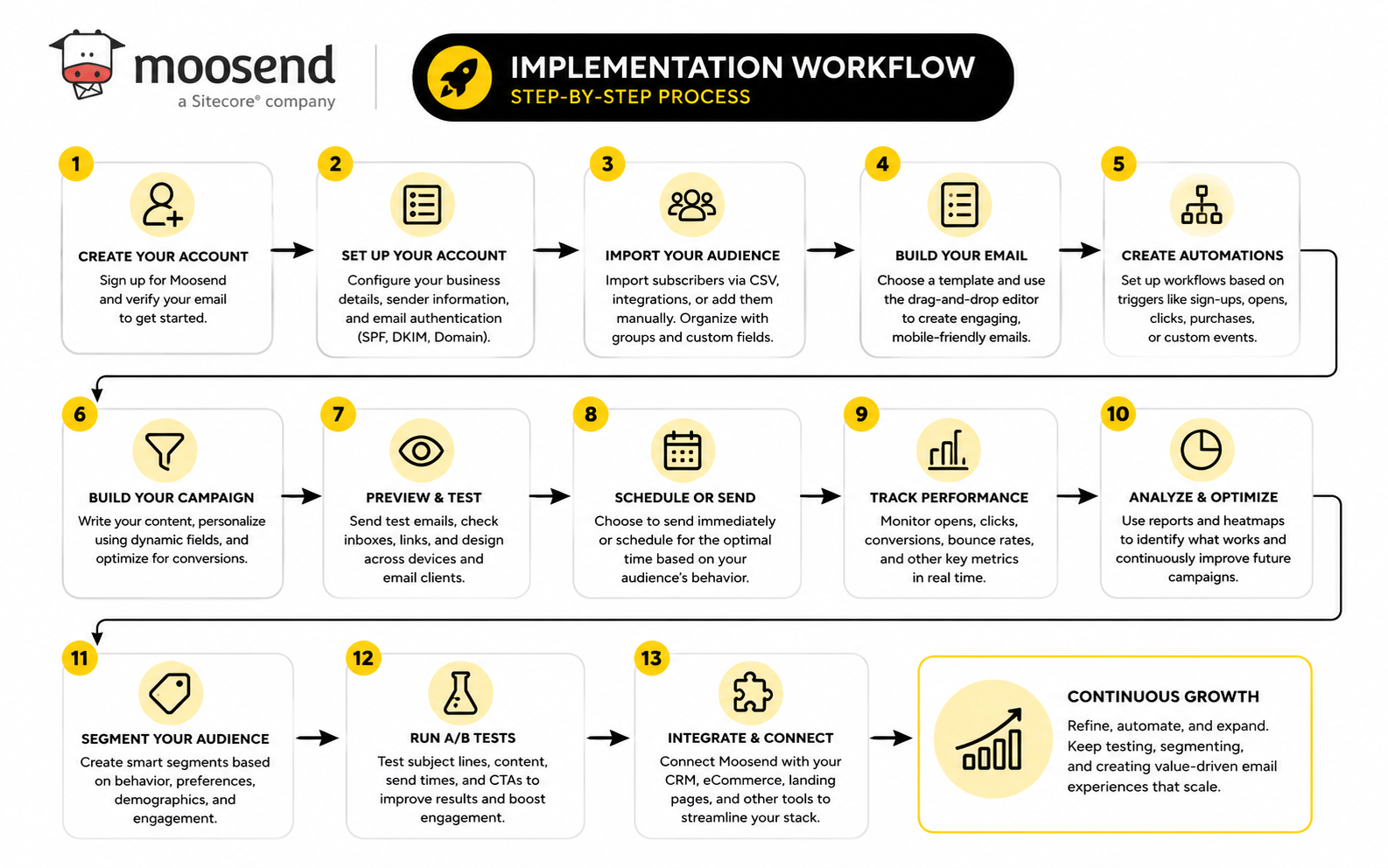
A practical execution process can look like this:
This step-by-step structure keeps your Moosend email marketing setup grounded. You are not just building a sequence because automation sounds impressive. You are building a path that helps the subscriber move forward while giving the business a measurable outcome.
Design Campaigns Around One Main Action
Every campaign should have one main action. This is one of the simplest ways to make email marketing better fast. When an email asks readers to read three articles, buy two products, follow four social channels, and book a call, most people do none of it.
Moosend’s campaign builder gives you room to create branded, polished emails, but the strategy still has to be sharp. The design should support the message, not bury it. The call to action should feel like the obvious next step, not a random button added at the end.
For a product business, the action might be viewing a collection, using a limited offer, or returning to a product page. For a service business, it might be booking a consultation or replying with a specific problem. For a creator, it might be reading a new resource, joining a waitlist, or buying a digital product. One email, one job.
Use Automation For Predictable Moments
Automation should handle moments that happen repeatedly. Welcome sequences, abandoned cart reminders, lead nurturing, post-purchase onboarding, review requests, renewal reminders, and re-engagement campaigns are all good candidates. These are moments where waiting for manual action creates lost opportunities.
Moosend automation workflows can be used to trigger emails based on subscriber actions and conditions. That means your follow-up can respond to behavior instead of relying only on fixed broadcast schedules. This is where email starts to feel more relevant to the reader because the timing is connected to something they actually did.
Keep early workflows simple. A messy automation with too many branches is harder to troubleshoot and often performs worse than a clean sequence with a clear purpose. Start with the highest-value workflow, prove that it works, and then expand carefully.
Connect Email With The Rest Of The Funnel
Email rarely works alone. It usually supports a broader funnel that may include landing pages, checkout pages, webinars, sales calls, social content, paid traffic, retargeting, chat, or CRM follow-up. Moosend can handle the email marketing layer, but the full customer journey may require other tools depending on the business model.
For example, a creator selling a simple digital product may only need Moosend plus a checkout tool. A service business with pipeline management might pair email with GoHighLevel when CRM, calls, calendars, and sales automation are part of the process. A business using dedicated funnel pages may prefer ClickFunnels around the offer while keeping Moosend focused on email follow-up.
The right stack depends on the job. Do not add tools just because they are popular. Add tools only when they remove friction, improve tracking, increase conversion, or make the customer journey easier to manage.
Set Up Reporting Before You Need Answers
Reporting should not be an afterthought. If you wait until performance drops to decide what to measure, you will not have clean enough data to understand what happened. Set up campaigns, segments, and naming conventions so performance can be reviewed without detective work.
At minimum, track campaign performance, automation performance, list growth, unsubscribes, click behavior, and conversions where possible. Opens can still be useful directionally, but privacy changes and inbox behavior mean they should not be treated as perfect truth. Clicks, replies, purchases, bookings, and form completions usually tell you more about real intent.
This is why implementation quality matters. A clean Moosend email marketing system makes it easier to spot what is working and what is weak. A messy system hides the signal in noise, and then every decision becomes a guess.
Statistics And Data
Measurement is where Moosend email marketing becomes honest. A campaign can look polished, the copy can feel strong, and the offer can make sense, but the numbers will show whether subscribers actually cared enough to act. That does not mean you should worship every metric. It means you should understand what each number is really telling you.
The problem is that email data is easy to misread. Opens can be inflated or distorted by privacy features. Clicks can look strong while conversions stay weak. Revenue can rise from a single campaign while long-term list quality slowly declines. Good measurement is not about collecting more numbers. It is about connecting the right signals to the right decisions.
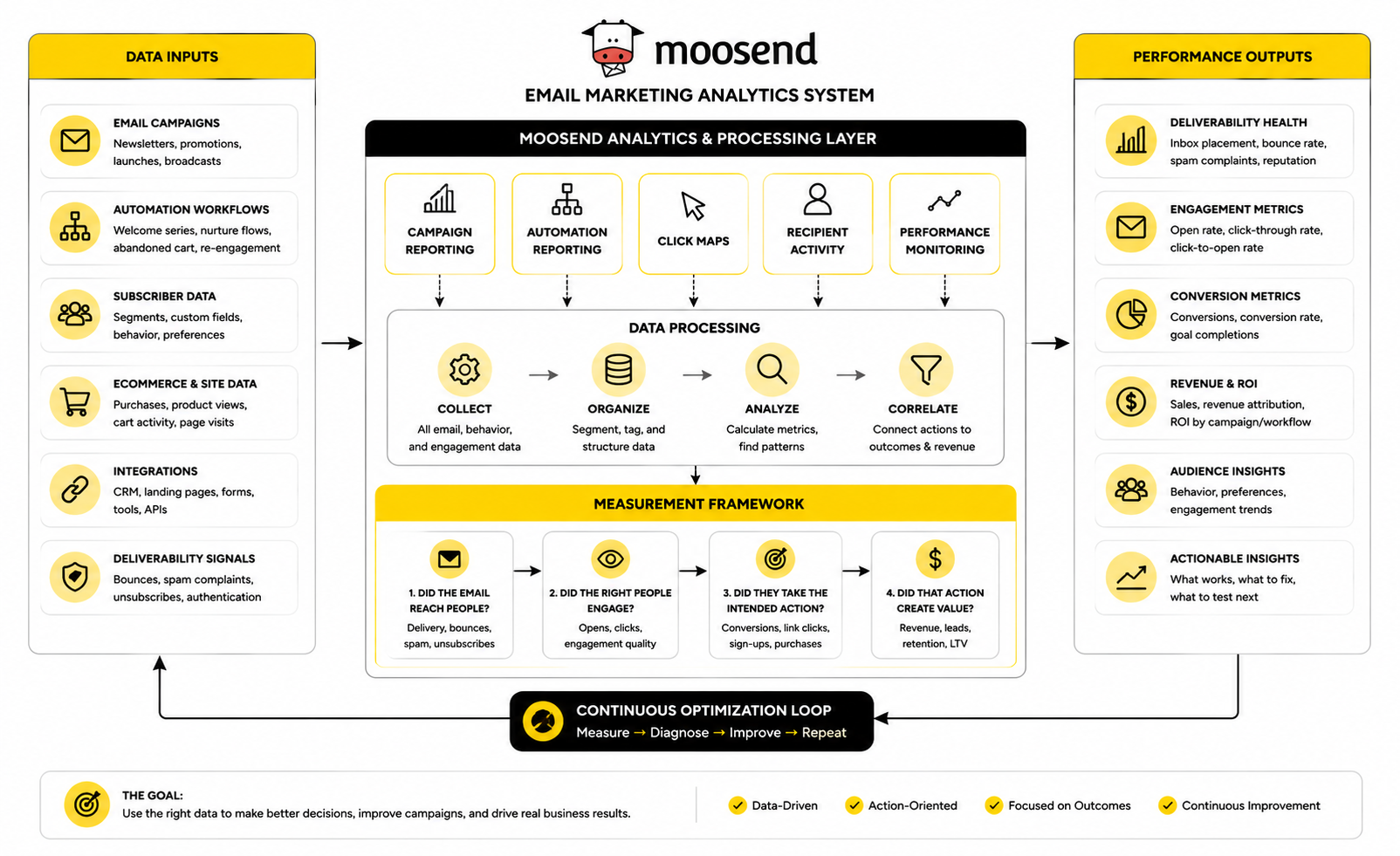
A practical analytics system should answer four questions. Did the email reach people? Did the right people engage? Did they take the intended action? Did that action create value for the business? If your reporting cannot answer those questions, you are not measuring performance yet. You are just looking at activity.
Start With Delivery Before Engagement
Delivery is the first performance signal because nothing else matters if your emails do not reach subscribers. A high open rate looks nice, but it means very little if your list is small, your audience is unqualified, or your deliverability is unstable. Start with the basics: bounces, spam complaints, unsubscribes, inactive subscribers, and whether your sending domain is properly authenticated.
Moosend supports campaign reporting, automation reporting, click maps, recipient activity tracking, and performance monitoring inside its platform through email marketing reporting and analytics. That gives you a useful view of how campaigns perform, but the interpretation still has to be disciplined. A report is only valuable when it changes what you do next.
Use delivery data to protect the list. If bounces rise, clean the source of bad contacts. If unsubscribes jump, review the promise that brought people in and the message you sent. If spam complaints appear, stop and fix expectation-setting immediately. Deliverability problems are not just technical. They are usually a strategy warning.
Treat Open Rates As Directional, Not Absolute
Open rates can still help you compare subject lines, audience interest, timing, and general list health, but they are not a perfect measure of human attention. Privacy tools and automated inbox behavior have made opens less reliable than they used to be. That is why a smart Moosend email marketing setup uses opens as a directional signal rather than the final verdict.
Recent benchmark data shows why context matters. The DMA Email Benchmarking Report 2025 reported an open rate of 35.9% and a unique click rate of 2.3% in 2024, while also noting strong delivery performance across measured campaigns. Those figures are useful as a reference point, but they should not become your only target.
A lower open rate is not automatically a disaster, and a higher open rate is not automatically a win. A smaller, more qualified segment may produce fewer opens but more sales. A curiosity-driven subject line may produce more opens but weaker clicks. The action is simple: use opens to spot patterns, then use clicks and conversions to confirm whether the interest was real.
Clicks Show Intent More Clearly
Clicks are usually a stronger signal than opens because they require more effort from the subscriber. Someone saw the email, found something relevant enough, and chose to move forward. That is why click-through rate and click-to-open rate are useful when judging message-market fit.
Moosend’s click maps can help show which parts of an email attract attention. This matters because you may discover that subscribers are clicking secondary links instead of the main call to action. You may also find that a button near the top performs better than a button buried under too much explanation. These are not cosmetic details. They tell you how people are actually navigating your message.
Use click data to simplify. If readers ignore most of the email and click one specific idea, make the next version sharper around that idea. If they click educational content but not offers, the offer may be too early, unclear, or misaligned. If they click product pages but do not buy, the problem may be on the landing page, checkout flow, pricing, trust layer, or offer structure.
Conversions Are The Real Performance Layer
Conversions are where email earns its place in the business. A conversion may be a purchase, booking, reply, trial signup, demo request, webinar registration, content download, or upgrade. The exact action depends on the business model, but the principle stays the same: email should move subscribers toward meaningful outcomes.
This is where many teams get uncomfortable because conversions reveal the gap between engagement and revenue. A campaign can have decent opens and clicks while still producing weak sales. That does not mean email failed. It means the journey needs diagnosis.
Look at the full path. Was the audience segment right? Was the offer relevant to that stage? Was the email clear? Was the landing page consistent with the email? Was the checkout or booking process easy? Moosend email marketing can drive the click, but the entire conversion path has to support the decision.
Automation Reports Need A Different Reading
Automation reports should be read differently from campaign reports because automated workflows are part of a journey, not one-off sends. A welcome sequence, abandoned cart flow, or re-engagement workflow should be judged across the full path. One weak email may not matter if the sequence as a whole moves people forward.
Moosend’s automation reports are useful because they help you monitor recipient activity, clicks, and workflow performance. The goal is to identify where attention drops, where subscribers hesitate, and where the next step becomes unclear. That lets you improve the workflow instead of guessing.
Review automation data by stage. The first email should usually perform strongly because intent is fresh. Middle emails should build trust and reduce friction. Later emails should move toward action or gracefully exit the subscriber from that path. If the drop-off happens early, the promise or first message is weak. If it happens late, the offer or timing may need work.
Benchmarks Are Useful, But Your Baseline Matters More
Benchmarks help you avoid flying blind, but they are not the scoreboard. Different industries, list sources, purchase cycles, price points, and audience types produce different results. A newsletter for loyal readers will not behave like a cold lead nurture sequence. An ecommerce flash sale will not behave like a B2B consultation offer.
Use benchmarks as a reality check, then build your own baseline inside Moosend. Your baseline should show typical open rates, click rates, conversion rates, unsubscribe rates, and revenue or lead outcomes for each major campaign type. Once you have that, improvement becomes much easier to judge.
For example, compare welcome emails against other welcome emails, not against promotional campaigns. Compare abandoned cart emails against abandoned cart emails, not newsletters. Compare segments by intent, not just list size. That is how data becomes useful instead of noisy.
What To Do When The Numbers Are Weak
Weak numbers are not a reason to panic. They are a reason to diagnose. The mistake is changing everything at once, because then you never know what actually made the difference.
If delivery is weak, fix list quality, authentication, sending frequency, and acquisition sources. If opens are weak, improve the subject line, sender name, timing, and audience match. If clicks are weak, improve the message, offer clarity, layout, and call to action. If conversions are weak, inspect the landing page, checkout, sales process, pricing, and trust signals.
This is the practical loop: measure, diagnose, change one meaningful variable, and review again. Moosend email marketing gives you the reporting layer, but disciplined interpretation is what turns the data into better campaigns. The numbers are not there to make you feel good. They are there to make the next decision clearer.
Optimization, Reporting, And Growth Workflows
Once the foundation is working, Moosend email marketing becomes a scaling problem. Not scaling in the loud, hype-driven sense. Scaling in the practical sense: more subscribers, more journeys, more offers, more segments, more reporting needs, and more chances to make the system messy if you do not manage it carefully.
This is where advanced email marketing becomes less about adding features and more about making tradeoffs. You can segment more deeply, but too much segmentation can create operational drag. You can automate more follow-up, but too much automation can make the brand feel mechanical. You can send more often, but sending more without stronger relevance usually damages the list.
The goal is controlled growth. You want a Moosend setup that becomes more useful as your business grows, not more confusing. That means improving the system in layers instead of constantly rebuilding it from scratch.
Scale Segmentation Without Creating Chaos
Segmentation is powerful because it helps you match messages to subscriber intent. Moosend’s segmentation tools can use subscriber data, custom fields, campaign behavior, and real-time updates through Moosend segmentation features. That is useful, but only if you keep the segmentation model understandable.
A good advanced setup separates stable segments from temporary segments. Stable segments include customers, leads, inactive subscribers, product interest groups, source groups, and lifecycle stages. Temporary segments are built for specific campaigns, seasonal offers, launches, or tests.
Do not create a new permanent segment every time you have a new idea. That is how accounts become impossible to manage. Use permanent segments for business logic and temporary segments for campaign execution.
Use Automation Branches Only When They Improve The Journey
Automation branches can make email feel more relevant, but they can also make workflows harder to maintain. A branch should exist because subscriber behavior meaningfully changes the next message. If the next message would be almost the same either way, the branch is probably unnecessary.
Moosend automation can support triggers, conditional steps, and actions, which makes it possible to build workflows around signups, engagement, product views, scheduled dates, and other behaviors through email marketing automation workflows. The temptation is to build a huge decision tree. Resist it until you have enough behavior data to justify the complexity.
The best workflow branches usually come from clear intent signals. Someone clicked a pricing link. Someone viewed a product category. Someone abandoned a cart. Someone became inactive. Those actions suggest a different next step, so branching makes sense.
Protect Deliverability As The List Grows
Deliverability becomes more important as your email list grows because small problems get amplified. A few bad acquisition sources, too many inactive contacts, or unclear opt-in promises can drag down performance across the account. This is not just a technical issue. It is a trust issue.
Moosend email marketing should be supported by healthy list practices. Use clear opt-ins, avoid purchased lists, remove or suppress contacts who never engage, and keep your sending frequency consistent enough that subscribers remember who you are. Authentication, domain reputation, bounce handling, and complaint monitoring all matter, but the quality of your subscriber relationship matters too.
The strategic tradeoff is list size versus list quality. A bigger list can look impressive in a dashboard, but a cleaner list usually performs better and costs less to maintain. If subscribers never open, never click, never buy, and never reply, keeping them active in your main sending pool is not a growth strategy.
Match Workflow Depth To Business Value
Not every workflow deserves the same level of effort. A high-value abandoned cart workflow deserves more attention than a low-intent content download sequence. A sales consultation nurture path may deserve more personalization than a general newsletter welcome series. Advanced implementation means allocating effort where the upside is highest.
For ecommerce, Moosend’s ecommerce features can support welcome emails, cart abandonment flows, segmentation, personalization, product recommendation blocks, and AI-driven audience tools through Moosend ecommerce email marketing. That makes ecommerce one of the clearest use cases for deeper automation because subscriber behavior can connect directly to revenue events.
For service businesses, the value may come from lead qualification, consultation booking, proposal follow-up, and long-cycle nurture. In that case, Moosend may handle the email layer while a CRM or appointment workflow handles the sales process. If pipeline tracking, calendars, SMS, and client follow-up are central to the business, GoHighLevel can make sense beside or instead of a simpler email-only stack.
Avoid Over-Automating The Relationship
Automation is useful because it creates consistency. It becomes dangerous when it removes judgment. A subscriber should never feel like they are trapped in a machine that ignores what they already did, what they ignored, or what they clearly do not want.
This is especially important with promotional workflows. If someone buys, stop sending them the “buy now” sequence. If someone clicks a high-intent link, move them into a more relevant path. If someone ignores multiple messages, reduce pressure instead of increasing it.
The best Moosend email marketing systems use automation to support human intent, not replace it. They deliver the right message faster, but they still respect timing, context, and behavior. That is the difference between smart automation and noise.
Build A Testing System, Not Random Tests
Testing is valuable only when it produces learning you can reuse. Random subject line tests may improve one campaign, but a structured testing system improves the whole account. Decide what you are testing, why it matters, and what action you will take based on the result.
Start with high-leverage variables. Test offer framing, audience segment, send timing, call to action, email length, landing page alignment, and workflow order. Subject lines matter, but they should not be the only thing you test.
Keep the test clean. If you change the subject line, layout, offer, timing, and audience all at once, you will not know what caused the result. One meaningful variable per test is slower, but it gives you better judgment over time.
Know When Moosend Should Stay Focused
Moosend is strongest when it is used as a focused email marketing and automation platform. That includes newsletters, promotional campaigns, welcome sequences, segmentation, landing pages, forms, ecommerce follow-up, and performance reporting. It is not always the best place to manage every part of the business.
For example, if your growth system depends heavily on sales calls, pipeline stages, client onboarding, review management, SMS, and agency-style account management, a broader CRM stack may be needed. If your main challenge is building complex funnel pages and checkout paths, a funnel builder like ClickFunnels may be the better front-end layer. If you need a simpler all-in-one starting point for pages, email, and basic funnels, Systeme.io may also be worth comparing.
That does not make Moosend weaker. It makes the role clearer. The smartest stack is not the one with the most tools. It is the one where every tool has a job and the customer journey feels smooth.
Create Governance Before The Account Gets Busy
Governance sounds corporate, but it simply means rules that keep the account clean. Decide who can create lists, who can publish campaigns, who can edit automations, and how naming conventions should work. This becomes more important when multiple people touch the account.
Use consistent naming for campaigns, automations, forms, segments, and landing pages. Include the audience, purpose, date, or funnel stage where helpful. A team should be able to understand what something does without opening every asset.
Also create a review rhythm. Check active automations regularly, archive old campaign assets, update outdated links, and remove segments that are no longer useful. A clean Moosend email marketing account is easier to optimize, easier to hand off, and easier to trust.
Make Growth Feel Personal
Scaling email does not mean sending colder messages to more people. It means using the data you have to stay relevant as the audience grows. That can be as simple as separating customers from non-customers, sending product-specific follow-ups, or changing the message based on what someone clicked.
Personalization should feel useful, not creepy. Use subscriber behavior to reduce friction and increase relevance. Do not overuse personal details just because they are available.
The best version of Moosend email marketing feels calm from the outside and disciplined behind the scenes. Subscribers receive timely, useful messages that make sense for where they are. The business gets a repeatable system that can grow without becoming chaotic.
Moosend Fit, Alternatives, FAQs, And Final Recommendations
At this point, the decision is not whether Moosend email marketing can work. It can. The better question is whether it fits the way your business actually sells, follows up, and grows.
Moosend is a strong fit when you want focused email campaigns, practical automation, segmentation, landing pages, forms, reporting, and ecommerce-friendly workflows without turning your marketing stack into a complicated enterprise project. It is especially useful for small teams that want to move quickly but still need structure. You can build the capture layer, follow-up layer, and measurement layer inside one system through Moosend without needing a heavy technical setup.
The platform may be less ideal if your main need is full CRM pipeline management, deep sales-team operations, complex client account management, or a complete agency operating system. In those cases, a broader platform like GoHighLevel may be more practical. If your main bottleneck is funnel building and checkout flow design, ClickFunnels may be a better front-end layer while Moosend handles the email side.
When Moosend Makes The Most Sense
Moosend makes the most sense when email is a central part of your growth system, but you do not want to overbuild. If you need newsletters, lead nurturing, ecommerce reminders, launch campaigns, welcome sequences, and basic landing pages, the fit is clear. You get enough power to build real marketing systems without forcing your team into unnecessary complexity.
It is also a good fit when budget predictability matters. Many small businesses do not need a giant platform with features they will never touch. They need a tool that can send well-designed campaigns, automate key moments, segment the audience, and report performance clearly.
The smartest use case is a focused one. Use Moosend email marketing as the relationship and retention layer. Then connect it with the right funnel, checkout, CRM, analytics, or social tools only when those tools clearly improve the customer journey.
When To Consider Another Tool
You should consider another tool if your marketing operation depends heavily on channels outside email. If SMS, WhatsApp, sales pipelines, appointment booking, reputation management, and client accounts are the core of your system, Moosend may not be the main operating hub. It can still play a role, but it may not be the center.
You may also want to compare alternatives if your business needs highly advanced ecommerce personalization, enterprise CRM integrations, complex data modeling, or large-team permission controls. Those needs can push you toward more specialized or enterprise-grade platforms. That is not a criticism of Moosend. It is simply about matching the tool to the job.
For lean businesses, the decision often comes down to focus. If you want email marketing done well, Moosend is worth testing. If you want an all-in-one business command center, compare it against broader platforms before committing.
What Is Moosend Email Marketing?
Moosend email marketing is the use of Moosend to create, send, automate, segment, and measure email campaigns. The platform includes tools for newsletters, automation workflows, landing pages, subscription forms, personalization, reporting, and ecommerce follow-up. In simple terms, it helps businesses turn subscribers into customers through structured email communication.
Is Moosend Good For Beginners?
Yes, Moosend can be a good choice for beginners because the core workflow is approachable. You can create a form, build a list, design an email, and send a campaign without needing advanced technical skills. The important part is not to start with every feature at once, but to build one useful subscriber journey first.
Is Moosend Only For Newsletters?
No, Moosend is not only for newsletters. Newsletters are one use case, but the platform can also support welcome sequences, lead nurturing, ecommerce follow-up, abandoned cart reminders, promotional campaigns, re-engagement workflows, and landing-page-based list building. That makes it more useful than a simple broadcast tool.
Who Should Use Moosend?
Moosend is a practical fit for creators, ecommerce stores, service businesses, agencies, SaaS startups, educators, and small teams that need focused email marketing. It works best when your goal is to communicate with subscribers, segment them intelligently, and automate predictable follow-up. It is especially useful when you want capability without unnecessary complexity.
What Are The Main Benefits Of Moosend?
The main benefits are campaign creation, automation, segmentation, forms, landing pages, personalization, and reporting in one place. That combination helps teams avoid stitching together too many tools for basic email marketing. The biggest practical benefit is that you can move from subscriber capture to automated follow-up faster.
Does Moosend Support Automation?
Yes, Moosend supports marketing automation workflows. You can build sequences based on subscriber actions, conditions, timing, and other triggers. This is useful for welcome emails, lead nurturing, ecommerce follow-up, abandoned cart reminders, re-engagement campaigns, and customer education.
Does Moosend Work For Ecommerce?
Yes, Moosend can work well for ecommerce businesses. Ecommerce brands can use it for product promotions, cart abandonment emails, customer segmentation, post-purchase follow-up, product recommendations, and retention campaigns. The key is to connect email behavior with shopping behavior so messages feel relevant instead of generic.
How Should I Start With Moosend?
Start with one clear use case. Build a subscription form or landing page, connect it to a primary list, create a welcome sequence, and send campaigns to a clean segment. Once that first journey works, you can add more advanced automations, deeper segmentation, and ecommerce or sales workflows.
What Metrics Should I Track In Moosend?
Track delivery health, bounces, unsubscribes, spam complaints, opens, clicks, conversions, automation drop-off, list growth, and revenue or lead outcomes where possible. Opens can be useful, but clicks and conversions usually tell you more about real intent. The best reporting setup connects email activity to business outcomes.
Is Moosend Better Than Mailchimp?
Moosend may be better than Mailchimp for users who want a simpler, budget-conscious email marketing platform with strong automation and fewer distractions. Mailchimp may still appeal to teams already invested in its ecosystem or needing specific integrations. The better choice depends on your list size, feature needs, budget, and workflow preferences.
Is Moosend Better Than Brevo?
Moosend and Brevo serve overlapping but different needs. Moosend is a strong fit for focused email marketing, automation, landing pages, forms, and campaign management. Brevo can be attractive if you want broader multi-channel messaging options, so the decision depends on whether your priority is email-focused execution or a wider communication stack.
Can Moosend Replace A CRM?
Moosend should not be treated as a full CRM replacement for every business. It can manage subscribers, segments, campaigns, and automations, but a sales-heavy business may still need pipeline management, deal tracking, task management, call tracking, or appointment workflows. If CRM operations are central, consider pairing Moosend with a dedicated CRM or using a broader platform like GoHighLevel.
How Often Should I Email My List?
There is no universal sending frequency that works for every business. A weekly newsletter may be perfect for one brand, while an ecommerce store may send more often during launches, holidays, or promotions. The right frequency is the one your audience continues to engage with and your business can sustain without lowering message quality.
What Is The Biggest Mistake With Moosend Email Marketing?
The biggest mistake is building campaigns before understanding the subscriber journey. If you do not know who is joining, why they joined, what they need next, and what action matters, the platform cannot fix the strategy. Start with the journey, then build the emails, segments, and automations around it.
Is Moosend Worth It?
Moosend is worth considering if you want a focused email marketing platform that can handle campaigns, automation, segmentation, forms, landing pages, and reporting without unnecessary complexity. It is not the right answer for every business, but it is a strong option for teams that want practical email marketing infrastructure. The best move is to test it against one real business use case, not just compare feature lists.
Build a stronger local presence with BAAM AI
Turn your website, Google profile, social channels, and AI visibility into one growth engine
Most businesses do not need more random marketing activity. They need a consistent presence system that helps the right people find them, trust them, and take action. BAAM AI brings strategy, local SEO, website updates, Google Maps visibility, social content, AI-search readiness, media production, and reporting into one practical monthly engine.
If you want your marketing to keep working after the campaign ends, start with a free BAAM AI presence audit. See how your business shows up today and where the fastest visibility wins are at BAAM AI.