
BAAM AI Blog
Megashift, Global Christianity, and the Claims That Need Discernment
Jim Rutz became even more controversial when he moved from open church practice into broader claims about global Christianity. In Megashift, he argued that the center of Christian vitality was moving away from formal...

Jim Rutz became even more controversial when he moved from open church practice into broader claims about global Christianity. In Megashift, he argued that the center of Christian vitality was moving away from formal institutions and toward fast-moving, grassroots expressions of faith. That idea was not completely detached from reality, because global Christianity has clearly changed shape, but the way those changes are measured matters a lot.
The danger is simple. If leaders only look for dramatic growth claims, they may become impressed by numbers they cannot verify. If they dismiss every growth claim because some are overstated, they may miss real movement happening outside familiar Western structures. The mature approach is neither hype nor cynicism. It is disciplined measurement.
Statistics and Data
The strongest data point supporting the broad direction of Rutz’s concern is the geographic shift of Christianity. Pew Research Center’s analysis of Christian population change found that many countries where the Christian share declined were in Europe and other Western or English-speaking regions, while major growth and population strength increasingly sit outside the old Western center of gravity through global demographic change and regional expansion in the Global South Pew Research Center.
That matters because Rutz was not writing in a vacuum. The old assumption that Christianity is primarily a Western institutional story no longer holds. The Center for the Study of Global Christianity’s 2025 statistical table places world Christianity in a long-range 1900–2050 context and continues tracking the major regional, denominational, and mission trends that show Christianity as a global, fragmented, and highly diverse movement Gordon-Conwell Center for the Study of Global Christianity.
But this is where interpretation has to be careful. Global growth does not automatically validate every claim made in Megashift. A real macro-trend can be true while specific anecdotes, miracle reports, or movement-size claims still need verification. Serious leaders should separate three categories: confirmed demographic data, plausible movement reports, and claims that remain too thinly sourced to build strategy around.
What the Numbers Can Actually Tell You
Good measurement does not start with the most exciting number. It starts with the right question. If the question is “Is Christianity still globally significant?” then broad demographic sources can help. If the question is “Is a specific house church movement multiplying in a specific country?” then broad global statistics are not enough.
That distinction matters because Jim Rutz often wrote with movement language. Movement language is inspiring, but it can blur the difference between attendance, affiliation, conversion, participation, leadership development, and long-term discipleship. Those are not the same metric. A person can attend without joining, join without serving, serve without being formed, and appear in a growth report without being deeply rooted.
For a modern leader applying Rutz’s ideas, the goal is not to collect impressive totals. The goal is to understand whether the church or ministry is producing active, durable disciples. That requires measuring behavior, responsibility, and reproduction, not just interest.
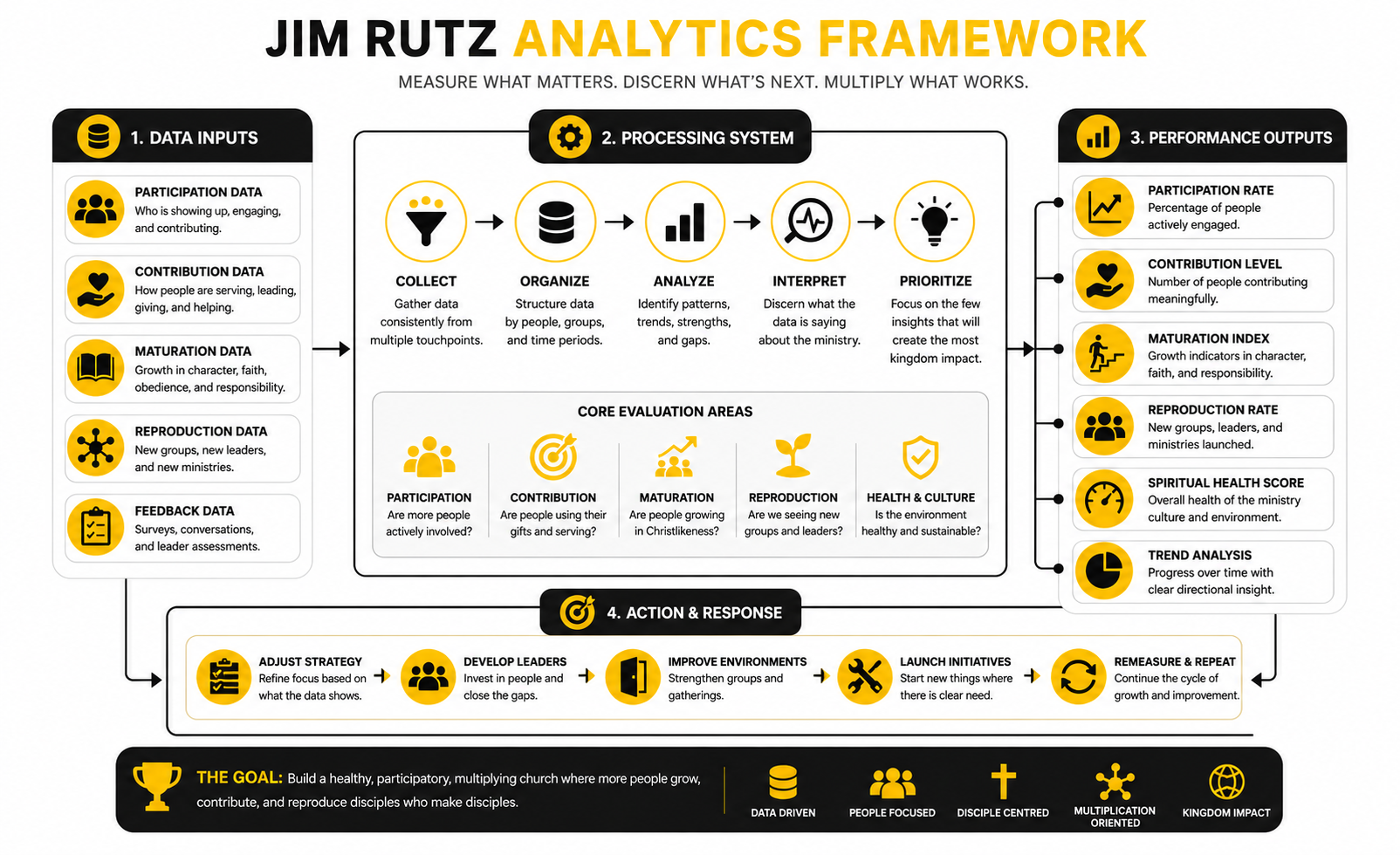
The Measurement System Leaders Should Use
A practical analytics system should track movement from passive contact to active contribution. That is the part most churches and ministries miss. They count who came, but they do not always measure who became more responsible.
Start with participation signals. Track how many people are known by name, connected to a smaller relational environment, serving in a meaningful role, praying with others, hosting, discipling, or initiating care. These signals are not perfect, but they are closer to Rutz’s concern than attendance alone.
Then track reproduction signals. Ask how many groups are producing new facilitators, how many members are becoming capable of leading prayer or discussion, and how often care happens without staff intervention. This is where the framework becomes measurable. If participation rises but responsibility never multiplies, the system may be friendly but not formative.
Benchmarks That Matter More Than Vanity Metrics
Vanity metrics make leaders feel successful without telling them what is really happening. Total attendance, email list size, livestream views, and social reach can be useful context, but they are weak indicators of body life. They show exposure. They do not prove maturity.
Stronger benchmarks are more practical. A healthy implementation should show growth in the percentage of regular participants who contribute in some meaningful way. It should show more people moving from being served to serving others. It should show leaders spending less time pushing people into activity and more time coaching people who are already taking initiative.
For ministries that use digital systems, tools can help make those benchmarks visible. A platform like GoHighLevel can organize follow-up, group pipelines, and communication workflows, while Fillout can collect simple participation check-ins or ministry feedback. The point is not to turn discipleship into a dashboard. The point is to keep leaders from guessing.
How to Interpret Growth Without Getting Fooled
Growth should always be interpreted through fruit, time, and transferability. Fruit asks whether people are actually becoming more faithful, mature, generous, prayerful, and useful. Time asks whether the change lasts beyond the excitement of a new format. Transferability asks whether the model can be practiced by ordinary believers without constant expert control.
This is especially important with Jim Rutz because his writing often emphasized dramatic movement. Dramatic movement can be real, but it can also attract exaggeration. Leaders should celebrate growth only after asking what kind of growth it is. Is it numerical growth, relational depth, leadership multiplication, mission activity, or simply curiosity around something new?
The action step is straightforward: never let one metric carry the whole story. Attendance without participation is thin. Participation without accountability is risky. Multiplication without formation is fragile. The healthiest signal is when ordinary believers become more capable, more grounded, and more responsible over time.
What the Data Should Drive
The data should drive better decisions, not bigger claims. If people attend but do not join smaller relational environments, the next move is not another sermon about community; it is a simpler on-ramp. If people join groups but never contribute, the next move is facilitator training. If people contribute but the same few voices dominate, the next move is stronger room leadership.
This is where Rutz’s ideas become operational. His critique gives leaders a reason to measure participation. The data then shows where the system is stuck. Once the stuck point is visible, leaders can make practical changes instead of guessing based on mood, anecdotes, or Sunday energy.
The best use of statistics is not to prove that Jim Rutz was right about everything. It is to test whether a church is becoming the kind of body he believed was possible. That is a much better standard: less hype, more fruit, and a clearer path from passive attendance to shared responsibility.
Build a stronger local presence with BAAM AI
Turn your website, Google profile, social channels, and AI visibility into one growth engine
Most businesses do not need more random marketing activity. They need a consistent presence system that helps the right people find them, trust them, and take action. BAAM AI brings strategy, local SEO, website updates, Google Maps visibility, social content, AI-search readiness, media production, and reporting into one practical monthly engine.
If you want your marketing to keep working after the campaign ends, start with a free BAAM AI presence audit. See how your business shows up today and where the fastest visibility wins are at BAAM AI.