
BAAM AI Blog
Media Strategy: How to Build a Clear Plan for Attention, Trust, and Growth
A strong media strategy is not a content calendar with nicer labels. It is the operating system behind how a brand earns attention, chooses channels, allocates budget, measures performance, and turns scattered...
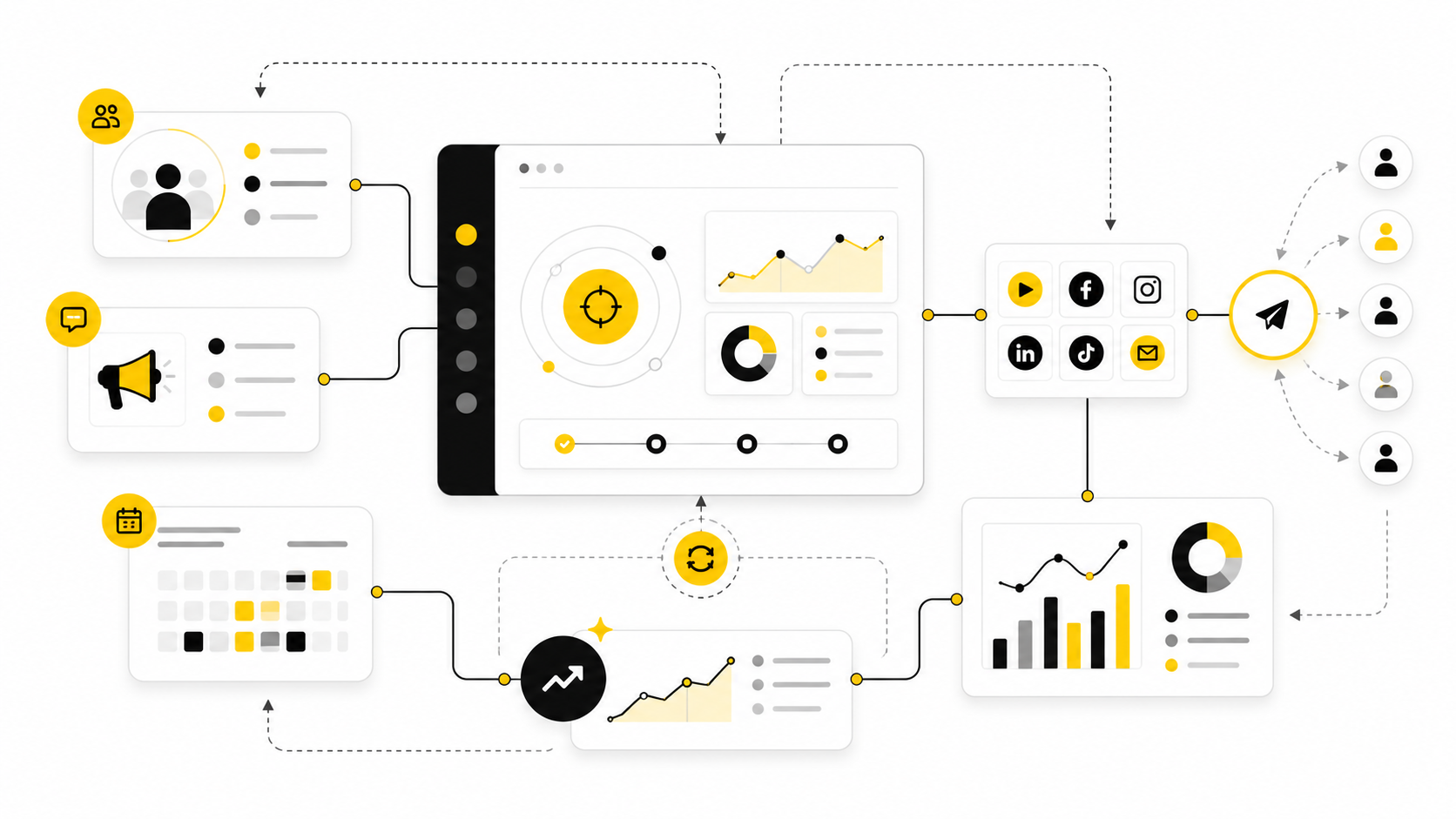
A strong media strategy is not a content calendar with nicer labels. It is the operating system behind how a brand earns attention, chooses channels, allocates budget, measures performance, and turns scattered activity into compounding growth.
That matters more now because media is more fragmented, more expensive, and more automated than it used to be. Digital channels now account for 61.1% of total marketing spend, while U.S. internet advertising revenue reached nearly $300 billion in 2025. More money is flowing into media, but that does not mean more clarity is flowing into decisions.
The brands that win are not simply posting more, buying more ads, or chasing every new platform. They understand where their audience pays attention, what role each channel should play, and how every campaign connects back to business goals. That is the practical difference between “doing marketing” and running a real media strategy.
Why Media Strategy Matters Now
Media strategy matters because attention is no longer concentrated in a few predictable places. People move between search, social feeds, creator content, newsletters, podcasts, private communities, comparison sites, and brand-owned experiences before they ever talk to sales. Deloitte’s 2025 Digital Media Trends research shows how social video platforms, creators, user-generated content, and algorithmic recommendations are reshaping where audiences spend time and where brands compete for attention.
That shift creates a simple problem: activity is easy, coherence is hard. A company can publish on LinkedIn, run Meta ads, send email campaigns, sponsor creators, host webinars, and still have no real strategy if those moves are not connected by a clear audience, message, and measurement model. More channels do not automatically create more growth.
Budgets are also under pressure. Gartner’s 2025 CMO Spend Survey found that marketing budgets remained flat at 7.7% of overall company revenue, which means teams are expected to create more impact without simply spending their way out of confusion. That is why media strategy has become a leadership discipline, not just a marketing department document.
Media Strategy Framework Overview
A useful media strategy starts with the business objective, not the channel. The first question is not “Should we be on TikTok?” or “How much should we spend on ads?” The better question is: what market outcome are we trying to create, and what kind of media system gives us the best chance of creating it?
From there, the strategy needs to connect four decisions: who the brand must reach, what the audience needs to believe, where the message should appear, and how success will be measured. That sounds basic, but it prevents one of the most common mistakes in modern marketing: treating every channel like it has the same job. Search captures intent, social builds familiarity, email deepens relationships, creators transfer trust, and landing pages convert attention into action.
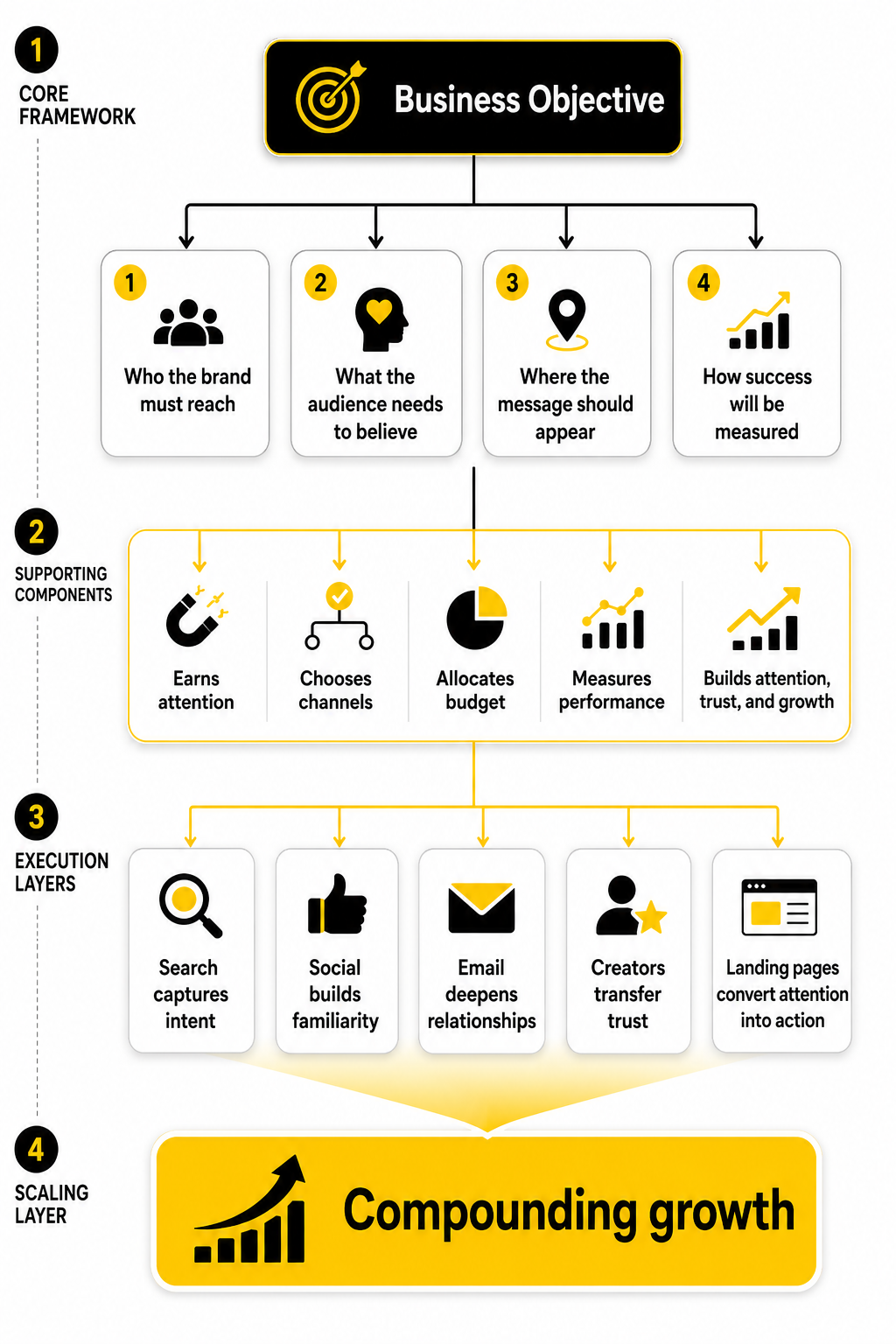
The framework used throughout this guide is intentionally practical. It can work for a founder building a lean acquisition engine, a marketing manager cleaning up scattered campaigns, or an agency creating a media plan for clients. Tools can help with execution, whether that means using Buffer for social publishing, ManyChat for messaging automation, or GoHighLevel for campaign and CRM workflows, but the strategy has to come first.
Audience, Positioning, and Message Fit
A media strategy gets weak when it starts with channels before it understands people. The audience is not just a demographic label like “small business owners” or “women aged 25 to 44.” That kind of targeting can help with buying media, but it rarely gives you enough insight to build messages that make people stop, care, and act.
A stronger audience definition explains what the buyer is trying to solve, what they already believe, what alternatives they compare you against, and what would make them trust you faster. This is where strategy becomes useful. You are not just deciding who should see the message; you are deciding what must change in their mind before they move forward.
Media planning has become harder because audiences are spread across more environments than ever. Nielsen’s 2025 media planning work describes the ecosystem as more fragmented and multifaceted, which is exactly why brands need sharper audience logic before they choose channels. A good media strategy gives each channel a job based on audience behavior, not internal preference.
Define the Audience by Behavior, Not Just Identity
The easiest audience mistake is describing people by who they are instead of what they do. Identity tells you something, but behavior tells you what to plan around. Someone who reads comparison articles, watches founder interviews, saves LinkedIn posts, and asks for recommendations in private communities is giving you a much clearer map than a basic age range ever could.
This matters because different behaviors signal different levels of intent. A person searching for “best CRM for agencies” is in a different state of mind than someone casually watching short-form marketing tips. Both people might fit the same customer profile, but they need different messages, different media formats, and different calls to action.
A practical audience profile should include:
This is also where first-party data becomes extremely valuable. Email engagement, CRM notes, sales calls, website behavior, support questions, and form responses all reveal what real buyers care about. If you are collecting leads through forms, quizzes, or onboarding flows, a tool like Fillout can help turn those touchpoints into cleaner audience insight instead of letting useful data sit in random spreadsheets.
Clarify the Position Before You Scale the Message
Positioning is the strategic answer to a simple question: why should this audience choose you instead of everything else competing for their attention? It is not a slogan. It is the logic behind the slogan.
Weak positioning creates expensive media because every campaign has to work too hard. If the audience cannot quickly understand what you do, who it is for, and why it matters now, more impressions will not fix the problem. Paid media may generate clicks, but unclear positioning leaks trust before conversion ever happens.
Strong positioning usually has three parts. First, it names the audience clearly enough that the right person feels recognized. Second, it frames the problem in language the audience already uses. Third, it makes the brand’s advantage obvious without sounding inflated or generic.
For example, “we help businesses grow online” is not a position. It is background noise. “We help local service businesses turn missed calls, form fills, and old leads into booked appointments through automated follow-up” is much sharper because it names the audience, the pain, and the value in one practical frame.
Match the Message to the Buyer’s Stage
A media strategy should not use the same message everywhere. That is one of the fastest ways to make marketing feel flat. Someone meeting the brand for the first time needs a different message than someone comparing pricing, reading reviews, or deciding whether to book a call.
At the top of the journey, the message should create recognition. The audience should feel, “Yes, that is exactly the problem I am dealing with.” In the middle, the message should build confidence by explaining the approach, showing proof, and reducing confusion. Near conversion, the message should remove friction and make the next step feel obvious.
This is why a good media plan maps message types to intent levels:
The mistake is trying to force decision-ready content onto a cold audience. A cold buyer usually does not want a demo, a sales call, or a long feature breakdown yet. They need relevance first, then trust, then proof, then action.
Build Message Pillars That Can Travel Across Channels
Message pillars keep your media strategy consistent without making every post, ad, email, or landing page sound identical. Think of them as the main themes your brand can return to again and again. They give the strategy structure while still leaving room for creativity.
A simple media strategy might use three to five message pillars. One pillar could focus on the pain your audience wants to escape. Another could explain your method or point of view. Another could highlight proof, customer outcomes, product education, or category insight.
The key is that each pillar should be strong enough to support many formats. A single pillar can become a short-form video, a LinkedIn post, an email, a paid ad, a webinar topic, a landing page section, and a sales enablement asset. That is how media becomes more efficient: one strategic idea gets adapted across the system instead of every channel inventing its own message from scratch.
This also helps teams avoid random content. Random content usually happens when the calendar is driving the strategy. Message pillars flip that around by making the strategy drive the calendar.
Choose the Right Level of Personalization
Personalization is useful, but it can also become a distraction. Not every media strategy needs dozens of segments, dynamic pages, and hyper-specific nurture paths on day one. The goal is not to personalize everything; the goal is to make the audience feel understood at the moments that matter.
For smaller teams, the best starting point is usually segmentation by intent or use case. A high-intent lead who requested pricing should not receive the same follow-up as someone who downloaded an educational checklist. A founder comparing funnel platforms should not see the same message as an agency owner trying to centralize client campaigns.
This is where tools can support the strategy when the fundamentals are already clear. A landing page builder like Replo can help teams create more focused campaign pages. An email platform like Brevo can help segment and follow up with different audience groups. A CRM and automation platform like GoHighLevel can connect leads, pipelines, campaigns, and follow-up into one workflow.
But again, do not let the software become the strategy. Tools amplify the thinking you put into them. If the audience, positioning, and message are unclear, automation only helps you send the wrong message faster.
Core Media Channels: Paid, Owned, Earned, and Shared
Once the audience and message are clear, the next step is choosing the media channels that can actually carry the strategy. This is where many teams get messy. They treat every channel as a separate campaign instead of building a system where each channel has a specific role.
A strong media strategy usually works across four channel types: paid, owned, earned, and shared media. Paid media gives you speed and targeting. Owned media gives you control. Earned media gives you borrowed credibility. Shared media gives your audience a way to participate, respond, and spread the message.
The goal is not to be everywhere. The goal is to make the right channels work together. That means each channel should have a clear job, a clear message angle, and a clear next step.
Paid Media Creates Controlled Reach
Paid media is the channel category you can turn on, scale, test, and measure with the most control. It includes search ads, social ads, display, connected TV, sponsored newsletters, creator partnerships, native ads, and retargeting. It is useful when you need predictable reach or faster feedback than organic channels can provide.
But paid media is also unforgiving. If the positioning is weak, the offer is unclear, or the landing page does not match the promise of the ad, budget disappears fast. This is why paid media should never be treated as a magic growth button. It is a distribution lever, not a substitute for strategy.
Digital video is a good example of how paid media is changing. U.S. digital video ad spend grew to $64 billion in 2024 and was projected to reach $72 billion in 2025, driven by connected TV, social video, and online video. That does not mean every brand should suddenly spend heavily on video ads. It means video has become a serious paid media environment, so brands need to decide whether it fits their audience, message, and funnel.
Owned Media Builds Compounding Control
Owned media includes the assets a brand controls directly: website pages, email lists, newsletters, blogs, podcasts, communities, webinars, landing pages, customer education, and product content. This is where the brand can shape the full experience without depending completely on rented algorithms. It is also where long-term trust usually gets built.
Owned media matters because paid attention often needs somewhere better to land. A great ad that sends people to a weak page wastes money. A strong social post that leads nowhere wastes momentum. A useful article with no email capture, follow-up path, or next step leaves value on the table.
This is where your media strategy becomes more than visibility. It becomes infrastructure. You need pages that explain the offer, emails that continue the conversation, and conversion paths that match the buyer’s stage. For teams building funnels around campaigns, tools like ClickFunnels, Systeme.io, or GoHighLevel can help turn owned media into a working acquisition path instead of a loose collection of pages.
Earned Media Transfers Trust
Earned media is attention you do not directly buy or fully control. It includes press coverage, podcast features, organic reviews, analyst mentions, unpaid creator discussion, community recommendations, backlinks, and word of mouth. It is powerful because the credibility comes from someone else.
The catch is that earned media is harder to force. You can pitch, build relationships, publish original research, create useful assets, and give people a reason to talk about you, but you cannot control the final outcome the way you can with a paid campaign. That is exactly why it can be so valuable when it works.
A practical media strategy treats earned media as trust acceleration. If a buyer sees your ad, reads your website, and then finds credible third-party validation, the decision feels safer. Earned media should not sit in a PR silo; it should feed paid ads, landing pages, email sequences, sales decks, and retargeting campaigns.
Shared Media Turns Attention Into Participation
Shared media includes the places where audiences interact with, remix, comment on, and distribute your message. Social platforms sit here, but shared media is bigger than posting. It includes community discussion, user-generated content, customer comments, reposts, creator collaborations, and conversations happening around your category.
This channel type is important because people do not just consume brand messages anymore. They react to them, question them, compare them, screenshot them, and bring them into private conversations. That can be uncomfortable, but it is also a huge opportunity for brands with a clear point of view.
Shared media works best when the brand gives people something easy to engage with. That might be a strong opinion, a useful framework, a simple before-and-after insight, a customer win, or a practical breakdown. The format changes by platform, but the core idea stays the same: make the message easy to understand and easy to pass along.
Turn Channels Into a Working Execution Process
The implementation step is where the strategy becomes real. This is not about creating a beautiful document that nobody uses. It is about turning decisions into a repeatable process the team can actually follow.
A simple execution process keeps everyone aligned on what gets created, where it goes, how it is measured, and what happens next. Without that process, the team ends up making channel decisions in isolation. The social team posts one thing, the paid team promotes another, the email team says something else, and the website quietly becomes outdated.
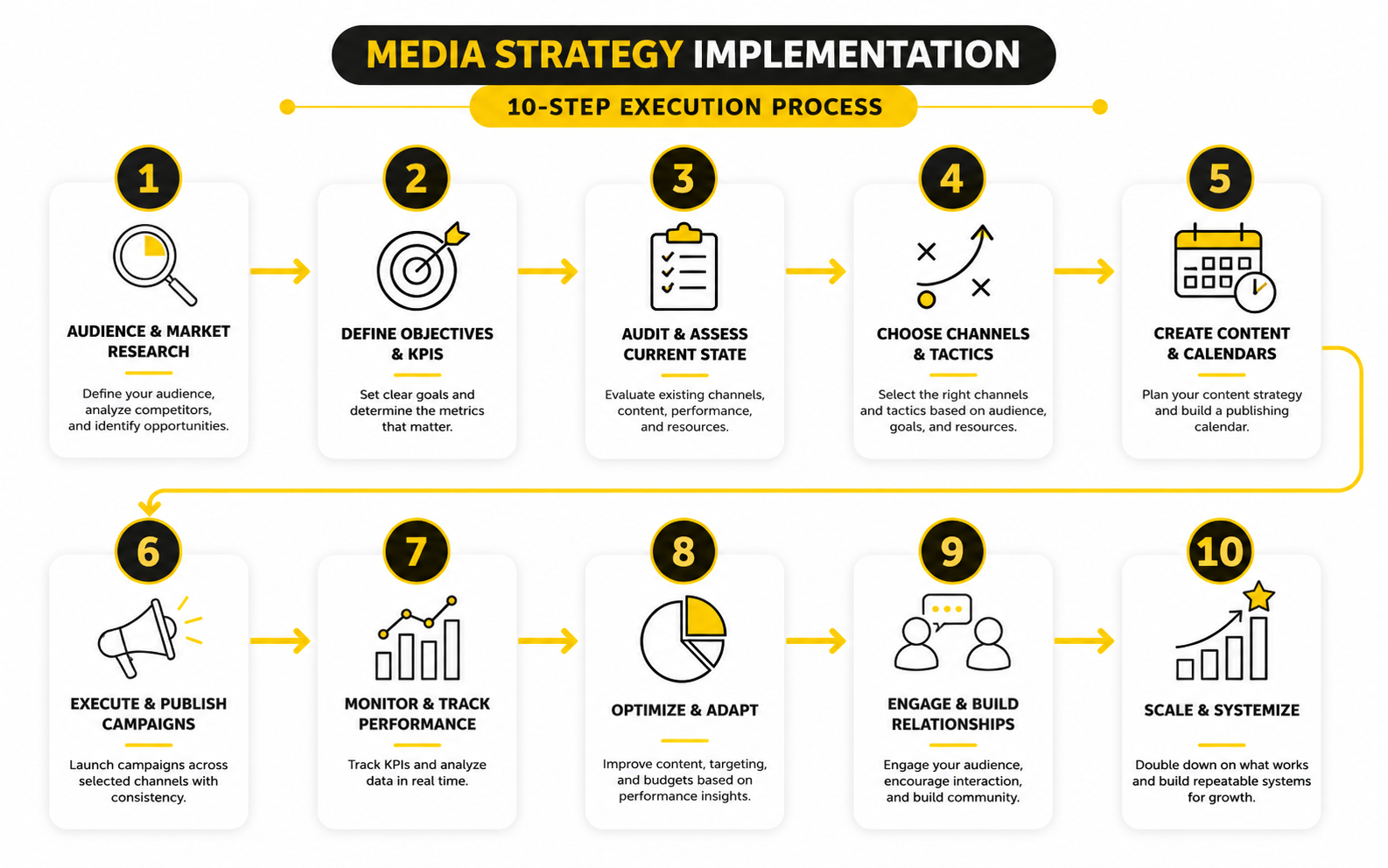
Use this process to make the media strategy tangible:
This process keeps the work grounded. It also stops the team from confusing production with progress. Publishing more content is not automatically a win; moving the right audience toward the right action is the win.
Build Around One Core Asset First
One of the cleanest ways to implement a media strategy is to start with a core asset. This asset becomes the center of the campaign, and every channel supports it in a different way. That is far more efficient than trying to create separate ideas for every channel from scratch.
For example, the core asset could be a detailed comparison page, a webinar, a research report, a product demo page, a buyer’s guide, or a long-form article. Paid media can drive targeted traffic to it. Email can follow up with people who engaged. Social can break the idea into smaller pieces. Sales can use the same asset to answer objections in conversations.
This approach creates consistency without making the campaign repetitive. The audience hears the same strategic message in different formats, which increases clarity. The team also gets more mileage from each idea, which matters when budget, time, and attention are all limited.
Connect Channel Choice to Buyer Intent
Not every channel should be judged by the same metric. Search might be evaluated by conversion intent. Social might be evaluated by qualified engagement and audience growth. Email might be evaluated by clicks, replies, booked calls, or repeat purchases. Earned media might be evaluated by referral traffic, authority, or assisted conversions.
The mistake is expecting every channel to behave like bottom-of-funnel paid search. Some channels create demand before people know what to search for. Others capture demand that already exists. A mature media strategy knows the difference and avoids killing useful channels just because they do not convert instantly.
This is especially important when media budgets are being scrutinized. The more fragmented the media environment becomes, the more important cross-channel planning and measurement become. Nielsen’s 2025 work on cross-media campaign planning highlights the challenge clearly: marketers need to understand how channels work together, not just how each one performs alone.
Keep the Workflow Simple Enough to Use
The best media strategy is the one your team can actually execute. A complex plan with twenty audience segments, nine channel priorities, and endless reporting layers might look impressive, but it usually breaks down in real life. Simple beats sophisticated when simple gets used every week.
A practical workflow should define who owns the strategy, who creates the assets, who approves the message, who launches the campaign, and who reviews performance. It should also define the rhythm. Weekly execution, monthly performance review, and quarterly strategic adjustment is enough for many teams.
For lean teams, the workflow can be supported by a smaller stack. Buffer can help manage social publishing. Moosend can support email campaigns. Cal.com can make booked calls easier to capture from high-intent media. The stack does not need to be huge; it needs to support the process without slowing the team down.
Statistics and Data
Data should make a media strategy sharper, not heavier. The point is not to collect every metric available inside every platform. The point is to understand which signals show attention, which signals show trust, which signals show intent, and which signals show revenue impact.
This matters because media performance is easy to misread. A campaign can get cheap clicks and still attract the wrong audience. A social post can get high engagement and still do nothing for pipeline. A search campaign can look expensive on a cost-per-click basis but still produce the highest-quality leads in the whole system.
Good measurement turns raw numbers into decisions. It tells you where to invest more, where to fix the message, where to improve the offer, and where to stop spending. Without that layer, reporting becomes decoration.
Start With the Decision the Data Should Support
Before choosing metrics, decide what decision the data needs to help you make. If the objective is awareness, you need to understand reach, frequency, attention, recall, and qualified traffic. If the objective is lead generation, you need to understand conversion rate, cost per lead, lead quality, and sales acceptance. If the objective is revenue, you need to understand pipeline, payback period, customer acquisition cost, and lifetime value.
This prevents one of the biggest measurement mistakes: using one metric to judge every channel. A brand campaign should not be judged only by last-click conversions. A retargeting campaign should not be praised just because it reaches people who were already close to buying. A newsletter should not be dismissed because it does not behave like paid search.
The cleanest media strategy reporting usually separates metrics into three layers:
The deeper the signal, the more business value it usually carries. But the earlier signals still matter because they help explain why the later signals are moving. If booked calls are down, the cause might be weak traffic, poor landing page fit, low message relevance, or a broken follow-up path.
Know Which Benchmarks Actually Matter
Benchmarks are useful only when they give context. They are not commandments. A “good” conversion rate depends on the offer, price point, market maturity, channel, audience temperature, and sales cycle.
That said, the market data does show why measurement discipline has become more important. Marketing budgets have been tight, with 2025 budgets remaining at 7.7% of company revenue, while digital channels now represent 61.1% of total marketing spend. That combination creates pressure: more of the budget is measurable, but teams still need to prove that measurable activity is producing real business outcomes.
The broader advertising market shows the same pattern. U.S. internet advertising revenue reached nearly $300 billion in 2025, and IAB’s 2025 outlook pointed to growth in retail media, connected TV, and social. Bigger digital investment means more competition in the same auctions, feeds, and audience segments. So the question is not just whether a campaign performed; it is whether it performed well enough to deserve the next dollar.
Benchmarks should guide questions, not replace judgment. If your cost per lead is rising, ask whether competition increased, the audience got saturated, creative fatigue set in, or the offer stopped matching the market. If your email click rate drops, ask whether the segment is wrong, the promise is weak, or the next step is unclear. The benchmark points to the issue, but strategy explains it.
Build a Measurement System Around the Funnel
A real analytics system follows the buyer journey from first exposure to business outcome. It does not stop at platform dashboards. Platform dashboards are useful, but they usually show the platform’s version of success, not the full customer journey.
The most practical setup is to track the path from channel to page to capture to follow-up to sales outcome. That might mean using UTM parameters, conversion events, CRM stages, call booking data, email engagement, and revenue reporting together. The goal is not perfect attribution. The goal is decision-quality visibility.
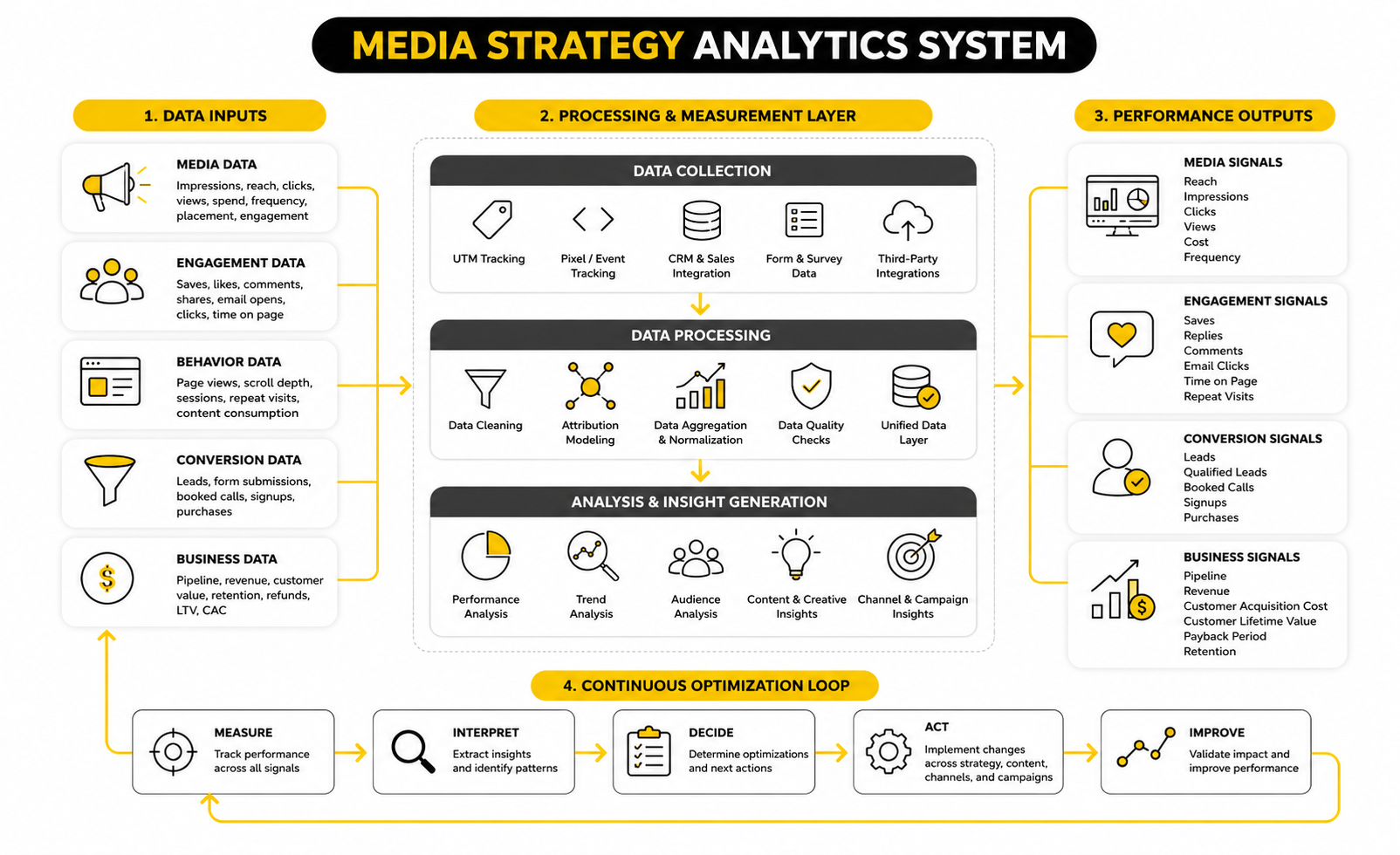
For most teams, the measurement system should answer five questions:
This is where CRM and automation setup becomes important. If leads come in from ads, forms, webinars, social, and referrals, but the data never connects inside one workflow, the team will keep guessing. A platform like GoHighLevel can help connect campaigns, pipelines, conversations, and follow-up so media performance is not trapped in separate tools.
Measure Quality, Not Just Quantity
Volume can be seductive. More impressions, more clicks, more leads, and more followers all look good in a report. But if those numbers do not connect to qualified demand, they can quietly pull the media strategy in the wrong direction.
Lead quality is especially important. A campaign with a low cost per lead can still be a bad campaign if the sales team cannot convert those leads. A campaign with a higher cost per lead can be more profitable if it attracts buyers with urgency, budget, and strong fit. This is why lead source reporting should be connected to pipeline quality, not just form submissions.
The same logic applies to content. A post that gets broad engagement may be useful for awareness, but a lower-reach post that attracts the exact buyers you want may be more valuable. The right question is not “Did this get attention?” The better question is “Did this get the right kind of attention for the job this channel is supposed to do?”
Read Performance Signals by Channel Role
Each channel should be measured based on its role in the strategy. Paid search should often be judged by intent capture, conversion quality, and acquisition efficiency. Organic social should often be judged by audience relevance, message resonance, and assisted demand. Email should often be judged by relationship depth, clicks, replies, reactivation, and revenue from existing contacts.
This is why channel-level reporting needs context. A social video may not create direct sales immediately, but it can make retargeting cheaper, increase branded search, improve email signups, or make sales conversations warmer. A search campaign may not create new demand, but it can capture demand at the exact moment a buyer is comparing solutions.
Cross-media measurement has become more important because audiences move across channels before converting. Nielsen’s 2025 guidance on planning and measuring cross-media campaigns focuses on this exact challenge: marketers need to understand how channels work together, not just how each channel performs in isolation. That is the right mindset. Your media strategy should measure contribution, not just isolated clicks.
Watch for Creative Fatigue and Audience Saturation
Performance does not usually collapse overnight. It drifts. Click-through rates soften, cost per result rises, frequency climbs, comments become less relevant, and conversion quality gets weaker.
Those are not just reporting details. They are signals that the audience may be saturated, the creative may be tired, or the message may need a sharper angle. If the team only checks final conversions, it may notice the problem too late.
Creative fatigue is especially common in paid social, retargeting, and creator-style ads. The fix is not always a totally new campaign. Sometimes the core offer is still strong, but the hook, format, proof point, or audience segment needs to change.
A practical review should look at:
These signals tell you where to act. Sometimes the answer is better creative. Sometimes it is a new audience segment. Sometimes it is a stronger landing page. Sometimes it is simply time to stop pushing a campaign that has already done its job.
Turn Reporting Into a Weekly Operating Rhythm
Reporting should create action, not just documentation. A weekly media review is usually enough to catch tactical issues, while a monthly review is better for budget shifts, channel performance, and campaign-level decisions. Quarterly reviews should look at the bigger strategy: audience assumptions, positioning, offer performance, and channel mix.
The weekly review should stay practical. Look at what launched, what changed, what is underperforming, what is outperforming, and what decision needs to be made before the next cycle. Do not turn it into a dashboard tour.
A useful weekly media strategy review can follow this format:
This rhythm keeps measurement connected to execution. It also builds strategic memory. Over time, the team learns which messages travel, which channels produce quality, which offers convert, and which assumptions were wrong. That learning is one of the most valuable outputs of a mature media strategy.
Professional Implementation: Strategic Tradeoffs and Scaling
A media strategy gets more complicated as it starts working. That sounds strange, but it is true. When a campaign is small, the main challenge is getting traction; when it grows, the challenge becomes protecting quality while adding reach, speed, budget, people, and complexity.
This is where advanced media strategy becomes less about choosing channels and more about managing tradeoffs. You cannot maximize everything at once. You have to decide what matters most right now: reach, efficiency, speed, learning, brand trust, sales quality, or long-term market position.
The better your strategy becomes, the more honest those decisions need to be. Scaling a weak system only makes the weakness more expensive. Scaling a strong system gives every part of the business more leverage.
Balance Brand Building and Demand Capture
One of the biggest strategic tradeoffs is brand building versus demand capture. Demand capture focuses on people who are already looking, comparing, or ready to buy. Brand building creates familiarity and trust before that buying moment happens.
A lot of teams overinvest in demand capture because it feels easier to measure. Search ads, retargeting, comparison pages, and direct-response campaigns can show clear numbers quickly. The problem is that demand capture alone does not create enough future demand, especially in markets where buyers take time to trust a brand.
Brand activity can feel softer, but it often supports the entire system. It can increase branded search, improve paid conversion rates, make outbound feel warmer, and help sales conversations move faster. The practical move is not to choose one side forever; it is to decide the right balance for your category, stage, cash position, and sales cycle.
Avoid Over-Reliance on One Channel
A media strategy becomes fragile when one channel carries too much of the business. If most leads come from one ad platform, one search ranking, one creator relationship, one marketplace, or one algorithmic feed, growth can look strong while the underlying risk is high. That is not a strategy; that is dependency.
Channel concentration is especially dangerous because platforms change incentives without asking your permission. Organic reach can fall. Ad costs can rise. Tracking can change. Search results can shift. A creator partnership can stop performing. A media plan that looked efficient last quarter can become unstable very quickly.
The solution is not to spread budget randomly across every possible channel. The solution is to build controlled diversification. Keep investing in what works, but use part of the budget and team capacity to develop the next reliable channel before you desperately need it.
Decide What Should Be Centralized and What Should Stay Flexible
As media operations grow, teams need more structure. But too much structure can slow down creative learning. The goal is to centralize the parts that protect quality while leaving enough flexibility for channel-specific execution.
Positioning, audience definitions, message pillars, campaign objectives, compliance rules, and measurement standards should usually be centralized. These are the pieces that keep the brand coherent. If every team defines the audience differently, every channel starts drifting.
Creative formats, hooks, posting cadence, testing angles, creator briefs, and platform-specific execution often need more flexibility. What works in a newsletter may not work in a short-form video. What works in paid search may not work in a podcast sponsorship. A mature media strategy creates shared direction without flattening every channel into the same voice and format.
Use AI Without Letting It Flatten the Brand
AI can speed up research, content repurposing, creative testing, reporting, and campaign analysis. That is useful. But it can also make a brand sound generic if teams use it to produce more output without sharpening the thinking behind the output.
The real advantage of AI in media strategy is not “make more content.” The advantage is faster learning. AI can help summarize customer feedback, identify patterns in comments, generate creative variations, analyze call transcripts, cluster objections, draft campaign briefs, and turn one core asset into multiple channel-specific formats.
But human judgment still matters. AI does not know your category nuance, your customer tension, your brand taste, or your commercial priorities unless you feed it the right context and review the output carefully. IAB Europe’s 2025 research on AI in digital advertising shows how quickly AI is moving into planning, creative, optimization, and governance, but that also makes brand control more important, not less.
Protect Trust as You Scale Personalization
Personalization can improve relevance, but it can also feel creepy when it crosses the line. The best media strategy uses customer data to be helpful, not invasive. That distinction matters more as privacy expectations rise and brands rely more heavily on first-party data.
A healthy personalization strategy starts with permission and usefulness. If someone gives you information through a form, quiz, chat, purchase, or sales conversation, use that information to make the next interaction more relevant. Do not use it to make the person feel watched.
This is where restraint becomes strategic. You do not need to personalize every sentence, headline, and offer. You need to personalize the moments where relevance reduces friction: the landing page, the follow-up sequence, the product recommendation, the sales handoff, or the onboarding path.
Treat Creative Testing as a Learning System
Creative testing is not just a way to find a winning ad. It is one of the fastest ways to learn what the market actually responds to. Every hook, angle, format, offer, and proof point gives you feedback about the audience’s priorities.
The problem is that many teams test creative randomly. They launch five versions, pick the one with the best click-through rate, and call it learning. That is not enough. A useful test should isolate what you are trying to understand.
For example, you might test whether the audience responds better to cost savings, speed, risk reduction, status, convenience, or control. You might test whether founder-led content outperforms product-led content. You might test whether a direct pain-point hook works better than a contrarian point of view. Each result should improve the next campaign, not just the current ad set.
Build Feedback Loops Between Media and Sales
Media teams often see clicks, views, leads, and cost. Sales teams hear objections, urgency, confusion, and buying criteria. A strong media strategy connects those two worlds.
If sales keeps hearing the same objection, the media team should turn that objection into content, ads, landing page copy, and email follow-up. If a campaign produces lots of leads that never become real opportunities, sales feedback should shape the next audience and offer. If a certain message makes calls easier, that message should be promoted harder across media.
This loop is especially important for high-ticket, B2B, agency, SaaS, and service businesses. The conversion does not happen only on the landing page. It happens across multiple touches, and the sales conversation often reveals what the reporting dashboard cannot.
A CRM such as Copper can help teams keep relationship history visible, while a platform like GoHighLevel can connect campaigns, follow-up, pipeline stages, and appointment workflows. The tool choice matters less than the loop itself. Media should inform sales, and sales should make media more carefully.
Plan for Platform Risk and Policy Risk
Every media strategy needs a risk layer. This is not fear-based thinking; it is responsible planning. If a channel is important enough to drive growth, it is important enough to protect.
Platform risk can come from algorithm changes, account restrictions, rising auction costs, moderation decisions, tracking limitations, content policy shifts, or changes in how people use the platform. Policy risk can come from regulated claims, privacy rules, industry restrictions, brand safety issues, or partner compliance requirements. The more serious the category, the more carefully the team needs to review what gets published and promoted.
A practical risk plan should answer a few simple questions:
This is not about slowing everything down. It is about avoiding the kind of preventable mistakes that erase months of momentum.
Scale Budget in Stages, Not Emotionally
When a campaign starts working, the temptation is to pour money into it fast. Sometimes that is the right move. But reckless scaling can break performance because the new spend reaches colder audiences, weaker placements, or less qualified segments.
A cleaner approach is staged scaling. Increase budget in controlled steps, watch the quality of conversions, and compare marginal performance against the original baseline. The question is not only “Can we spend more?” The better question is “Does the next dollar still produce acceptable quality?”
This matters because efficiency often changes at scale. The first audience segment may be highly responsive. The second may be decent. The third may be expensive and weak. A professional media strategy protects the blended economics instead of celebrating top-line volume.
Know When to Simplify
Advanced strategy does not always mean adding more. Sometimes the smartest move is subtraction. Remove channels that no longer have a clear role. Cut reports nobody uses. Merge overlapping campaigns. Retire weak message pillars. Simplify the funnel when buyers are getting lost.
Complexity usually creeps in slowly. A team adds a new platform, a new campaign, a new audience, a new automation, a new dashboard, and a new approval step. None of those decisions seem bad on their own. Together, they can make the media system slower, harder to understand, and more expensive to manage.
A strong media strategy should be reviewed with one brutal question: what can we remove without hurting growth? If the answer is “nothing,” the strategy is either extremely disciplined or nobody has looked closely enough. Most teams can simplify more than they think.
Measurement, Optimization, and FAQ
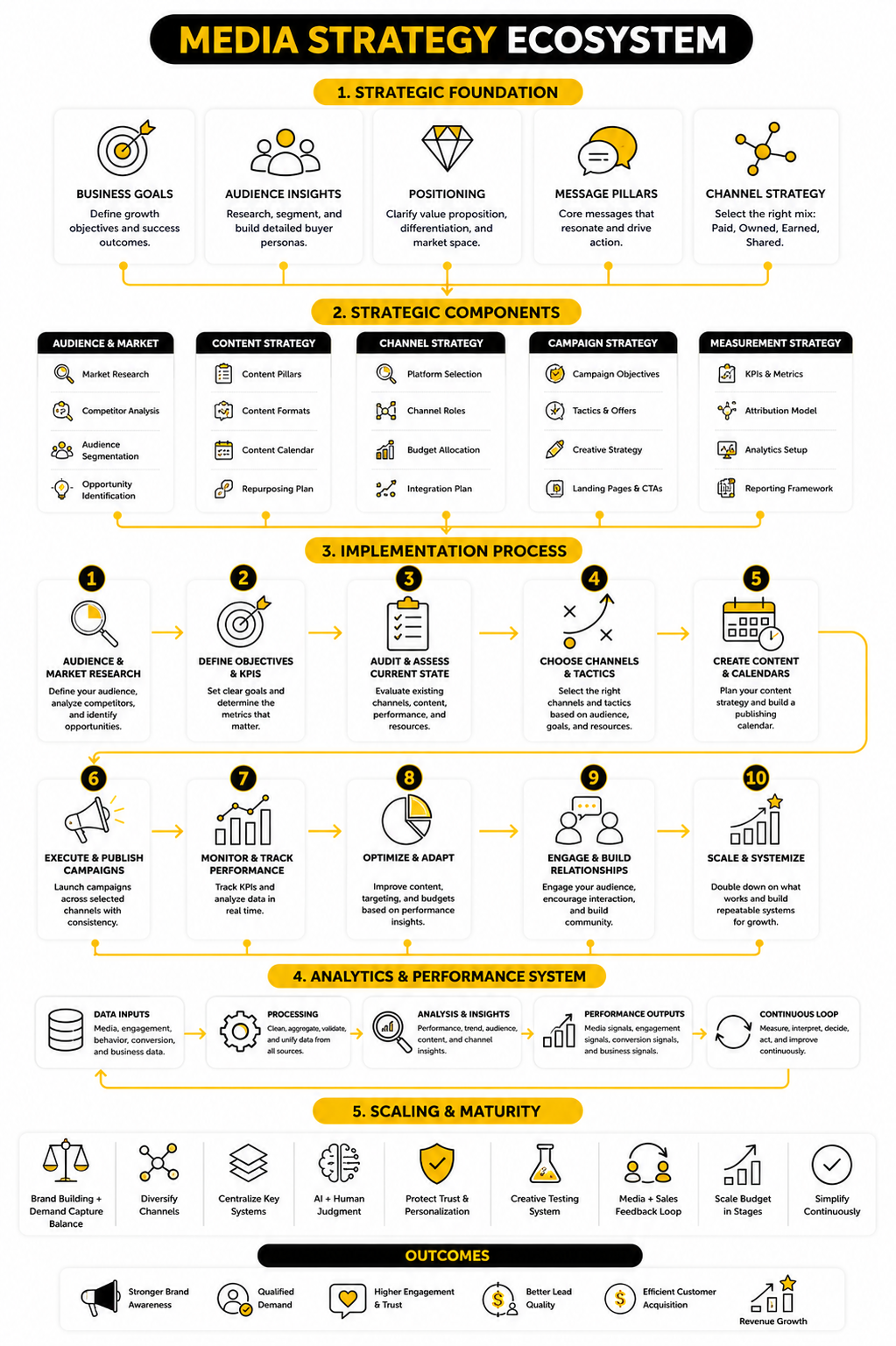
A complete media strategy is not a static plan. It is a living system that connects audience insight, channel selection, creative testing, measurement, and business learning. The final job is to keep that system improving without turning it into a bloated process nobody wants to use.
This is where the strategy becomes operationally valuable. Every campaign should teach the team something useful about the market. Every report should lead to a decision. Every channel should either create attention, build trust, capture demand, convert interest, or strengthen customer relationships.
The best media strategy is not the one with the most channels. It is the one that helps the right audience understand the right message at the right moment, then gives the business enough visibility to improve the next decision.
What a Strong Media Strategy Looks Like in Practice
A strong media strategy has a clear business objective, a defined audience, a focused position, and a channel mix that makes sense for the buyer journey. It does not depend on random posting, disconnected campaigns, or platform trends alone. It gives the team a simple way to decide what to create, where to publish it, how to promote it, and how to measure it.
In practice, this usually means the team has a few core message pillars, a few priority channels, a consistent campaign rhythm, and a measurement system that connects media activity to qualified demand. The strategy should be specific enough to guide daily work but flexible enough to adapt when the market changes. That balance is important because media moves fast, but brand trust is built slowly.
The final test is simple: can someone on the team explain what each channel is supposed to do? If they cannot, the media strategy is probably still too vague. If they can explain it clearly, the team has a better chance of making smart decisions under pressure.
What is a media strategy?
A media strategy is the plan for how a brand uses media channels to reach the right audience, communicate the right message, and create a measurable business outcome. It covers audience targeting, positioning, channel selection, campaign planning, budget allocation, content distribution, and performance measurement. A good media strategy gives every channel a purpose instead of treating marketing as random activity.
Why is media strategy important?
Media strategy is important because attention is fragmented and budgets are not unlimited. Without a clear plan, teams often spread themselves across too many channels, create inconsistent messages, and measure the wrong things. A strong strategy helps the business focus resources where they are most likely to create trust, demand, and revenue.
What is the difference between media strategy and content strategy?
Media strategy focuses on where, when, and how messages reach the audience across paid, owned, earned, and shared channels. Content strategy focuses more on what is created, why it is created, and how the message supports audience needs. They overlap heavily, but media strategy is broader because it includes distribution, budget, channel roles, and measurement.
What are the main parts of a media strategy?
The main parts of a media strategy are business goals, audience definition, positioning, message pillars, channel mix, budget allocation, campaign workflow, and measurement. Each part should connect to the next. If the audience is unclear, the channel mix will be weak; if the message is unclear, the budget will work harder than it should.
How do you choose the right media channels?
Choose media channels based on audience behavior, buyer intent, message fit, and the role each channel should play in the journey. Search may be useful for capturing existing demand, while social can help build familiarity and test ideas. Email can deepen relationships, and earned media can add credibility. The right mix depends on the market, offer, budget, and sales cycle.
What is the difference between paid, owned, earned, and shared media?
Paid media is distribution you pay for, such as ads, sponsorships, and paid placements. Owned media is what the brand controls, such as websites, newsletters, blogs, landing pages, and customer education. Earned media is third-party attention, such as press, reviews, backlinks, and unpaid mentions. Shared media is audience participation and conversation, usually through social platforms, communities, and user-generated content.
How often should a media strategy be reviewed?
A media strategy should be reviewed at different levels. Weekly reviews should focus on tactical campaign performance and execution issues. Monthly reviews should look at channel performance, budget movement, and campaign learning. Quarterly reviews should challenge bigger assumptions about audience, positioning, offers, and the overall channel mix.
What metrics should a media strategy track?
A media strategy should track media signals, engagement signals, and business signals. Media signals include reach, impressions, clicks, views, and cost. Engagement signals include saves, replies, comments, email clicks, time on page, and repeat visits. Business signals include qualified leads, booked calls, pipeline, revenue, retention, customer acquisition cost, and payback period.
How do you know if a media strategy is working?
A media strategy is working when the right audience is becoming easier to reach, the message is becoming clearer, and performance is improving against the business objective. That does not always mean every channel produces direct conversions immediately. Some channels create trust or demand before buyers are ready to act. The key is knowing what each channel is supposed to contribute and measuring it accordingly.
What is the biggest mistake companies make with media strategy?
The biggest mistake is starting with channels before clarifying the audience, positioning, and message. Teams often ask whether they should be on a platform before they know what they need the platform to accomplish. That leads to scattered execution and weak measurement. Strategy should decide the channel role, not the other way around.
How much budget should go into paid media?
There is no universal percentage that works for every business. Paid media budget should depend on the objective, offer economics, audience size, conversion rate, sales cycle, and acceptable customer acquisition cost. A smart approach is to start with controlled tests, prove the message and funnel, then scale spend in stages while watching lead quality and revenue impact.
How does AI affect media strategy?
AI can help with research, segmentation, creative variation, reporting, content repurposing, and campaign optimization. The risk is that it can also make marketing sound generic if teams use it only to produce more output. The best use of AI is to speed up learning and execution while keeping human judgment in control of positioning, taste, brand voice, and strategic tradeoffs.
Should small businesses build a full media strategy?
Yes, but it should be simple. A small business does not need a huge deck, ten channels, or advanced attribution modeling to start. It needs a clear audience, a practical offer, a few strong message pillars, one or two priority channels, and a way to track whether attention is turning into real opportunities. Simple and consistent beats complex and unused.
What tools help with media strategy execution?
The best tools depend on the workflow. A team might use Buffer for social scheduling, Brevo for email, ManyChat for messaging automation, ClickFunnels for funnels, or GoHighLevel for CRM, automation, and campaign management. Tools should support the strategy, not replace it.
How do you improve an underperforming media strategy?
Start by finding where the system is breaking. The issue could be weak audience targeting, unclear positioning, poor creative, mismatched channel selection, a bad landing page, slow follow-up, or low offer demand. Fix the weakest link first instead of changing everything at once. A disciplined diagnosis usually saves more money than another random campaign refresh.
Build a stronger local presence with BAAM AI
Turn your website, Google profile, social channels, and AI visibility into one growth engine
Most businesses do not need more random marketing activity. They need a consistent presence system that helps the right people find them, trust them, and take action. BAAM AI brings strategy, local SEO, website updates, Google Maps visibility, social content, AI-search readiness, media production, and reporting into one practical monthly engine.
If you want your marketing to keep working after the campaign ends, start with a free BAAM AI presence audit. See how your business shows up today and where the fastest visibility wins are at BAAM AI.