
BAAM AI Blog
Maturity Stage Examples
The maturity stage is where a product has already earned market acceptance. Customers know what it is, competitors know how to attack it, and growth usually becomes harder to create through awareness alone. That does...
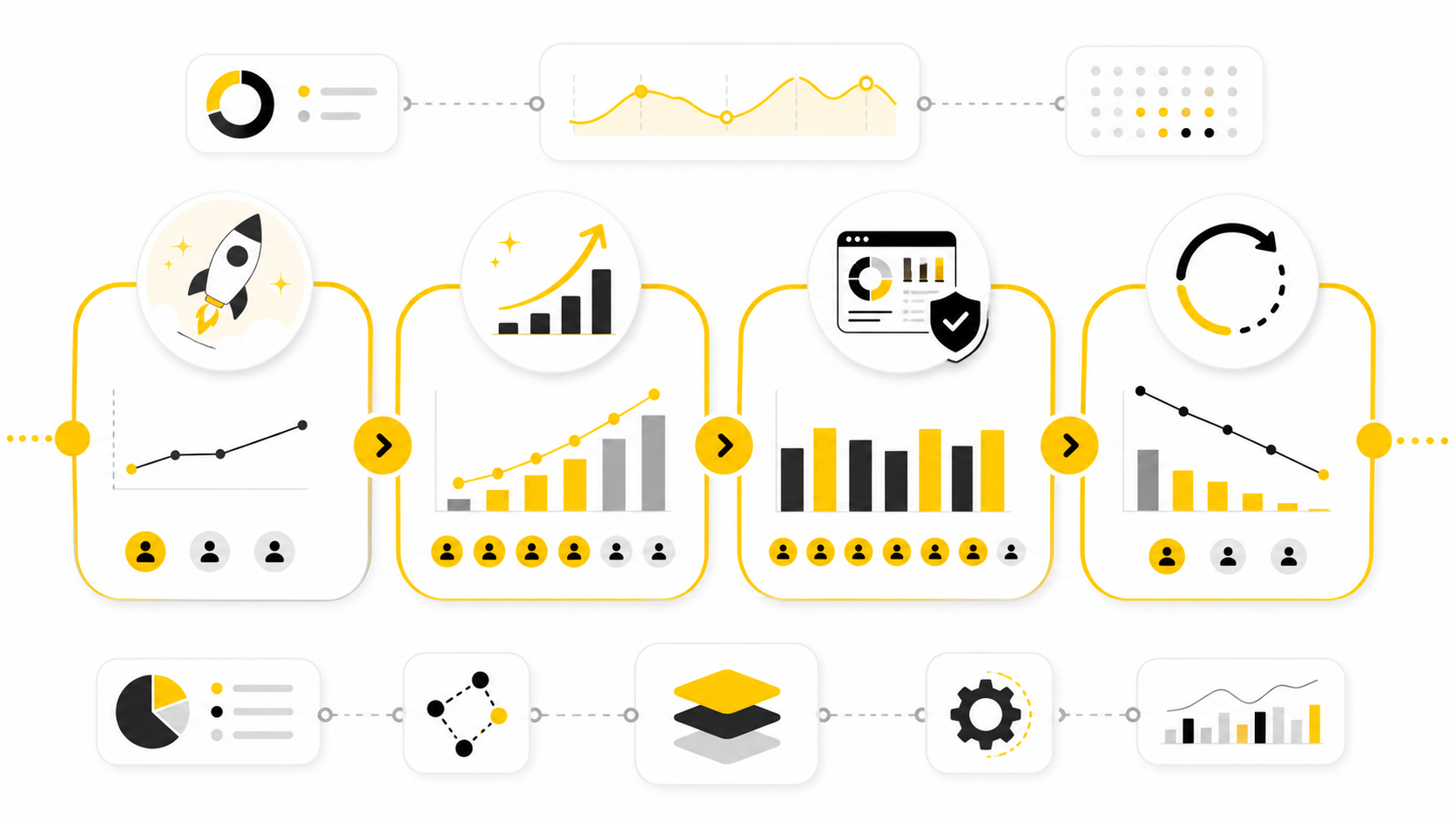
The maturity stage is where a product has already earned market acceptance. Customers know what it is, competitors know how to attack it, and growth usually becomes harder to create through awareness alone. That does not make the product weak; in many cases, maturity is where the product becomes most profitable because the company has brand equity, distribution, customer habits, and operating leverage.
Mature products need a different kind of discipline. The company cannot rely on novelty forever, so it has to defend the brand, improve the offer, refresh demand, and protect margins. This is where product life cycle examples become especially useful, because many of the world’s most valuable products are not new at all; they are mature products managed extremely well.
Coca-Cola
Coca-Cola is one of the clearest maturity-stage examples because the product is globally familiar, widely distributed, and still commercially powerful more than a century after launch. The Coca-Cola Company continues to describe Coca-Cola, Sprite, Fanta, Coca-Cola Zero Sugar, and Diet Coke as some of the world’s largest nonalcoholic sparkling soft drink brands in its annual filings: The Coca-Cola Company 2024 Form 10-K. That is not introduction-stage behavior; that is category leadership in a mature market.
The strategy is not to explain what cola is. Everyone already understands the product. The job is to defend preference, expand occasions, manage packaging, adjust pricing, support retailers and bottlers, and keep the brand culturally visible.
This is why mature products often invest heavily in brand building even when they already have awareness. Awareness alone is not enough in a crowded category. A mature product has to stay easy to buy, easy to recognize, and emotionally relevant.
The iPhone
The iPhone is another mature product, even though Apple still improves it every year. It has moved far beyond the original “what is a smartphone?” stage and now competes through camera quality, chips, ecosystem lock-in, privacy positioning, services, accessories, and upgrade cycles. Apple’s 2024 annual report still shows the iPhone as the company’s largest product category by net sales, which is exactly what a powerful mature product can look like: Apple 2024 Form 10-K.
The iPhone also shows why maturity does not mean stagnation. Apple keeps refreshing the product, but the strategic challenge is different from the launch era. The company is not trying to convince the world that smartphones matter; it is trying to keep customers upgrading, staying in the ecosystem, and choosing Apple when alternatives are good enough for many basic use cases.
For operators, this is a useful distinction. A mature product can still deserve major investment. The question is whether the investment protects the base, improves monetization, opens adjacent revenue, or creates enough differentiation to justify another buying cycle.
Nintendo Switch
Nintendo Switch is a good example of late maturity because the product enjoyed a long, unusually strong life cycle before its successor entered the market. Nintendo’s annual reporting for the fiscal year ended March 31, 2024 showed the company still managing Switch hardware, software, and related demand years after the console’s 2017 launch: Nintendo Annual Report 2024. That longevity matters because consoles often peak and then decline as the next generation approaches.
Nintendo extended the Switch life cycle with strong first-party software, the Switch Lite, the OLED model, family-friendly positioning, and a hybrid form factor that remained distinct from competing consoles. The product did not need to be the most powerful console to stay relevant. It needed a clear reason to exist, and it had one.
This is an important lesson for mature products. Differentiation does not always mean winning every specification battle. Sometimes it means owning a use case, a customer habit, or a context that competitors cannot easily copy.
Decline Stage Examples
The decline stage begins when demand falls because the market has moved on, alternatives have become stronger, or the product is no longer the best way to solve the original problem. Decline can be slow and profitable, or it can be sudden and brutal. The key is to identify whether the product is declining because of poor execution or because the category itself has structurally changed.
This is where companies need honesty. A declining product can still produce cash, serve loyal customers, and support a niche. But if the company keeps treating it like a growth product, it may waste money chasing demand that has already migrated somewhere else.
DVDs And Blu-Ray Discs
DVDs and Blu-ray discs are strong decline-stage examples because the customer need did not disappear, but the preferred format changed. People still watch movies and shows at home. They just increasingly do it through digital rental, digital purchase, and subscription streaming rather than physical discs.
The Digital Entertainment Group reported that U.S. consumer spending across digital and physical home entertainment formats exceeded $57 billion in 2024, while physical disc sales continued falling and dropped below $1 billion: DEG 2024 home entertainment report. That is decline in a practical sense. The entertainment demand remains huge, but the legacy format has lost mainstream buying behavior.
The product is not dead, though. Collectors, cinephiles, special editions, 4K releases, and ownership-focused buyers still create demand. That is why decline-stage strategy is not always “shut it down.” Sometimes the better move is to narrow the audience, raise the quality of the offer, and serve the niche profitably.
Digital Music Downloads
Digital music downloads are another useful decline-stage example because they were once the modern replacement for CDs. For a period, buying individual tracks online felt like the future. Then streaming changed the default behavior again.
The RIAA’s 2024 year-end revenue report shows the broader U.S. recorded music market continued growing, while digital downloads remained a much smaller format compared with streaming: RIAA 2024 year-end music revenue report. That is the product life cycle in motion. One innovation can mature and decline when a more convenient model becomes normal.
The practical takeaway is uncomfortable but useful. A product can be disrupted even if it was once the disruptor. Market leadership at one stage does not guarantee protection when customer behavior shifts to a simpler, cheaper, or more convenient alternative.
IBM Mainframes
IBM mainframes are a more nuanced example because they do not fit the lazy version of decline. Mainframes are not a mass-market growth product, but they remain important in specific enterprise environments where reliability, security, transaction processing, and legacy infrastructure matter. IBM’s 2024 annual report described infrastructure performance as following product cycle expectations while noting the strength of the z16 mainframe program: IBM 2024 Annual Report.
This makes mainframes a useful reminder that decline is not always a straight line to zero. Some products move from broad relevance into specialized, high-value use cases. The market may shrink, but the remaining customers can be deeply committed because switching costs, compliance needs, and operational risk are real.
That is why product life cycle analysis should avoid lazy labels. A product in late maturity or managed decline may still deserve investment if it protects profitable relationships. The decision should come from customer economics, replacement risk, and strategic fit, not from whether the product sounds modern.
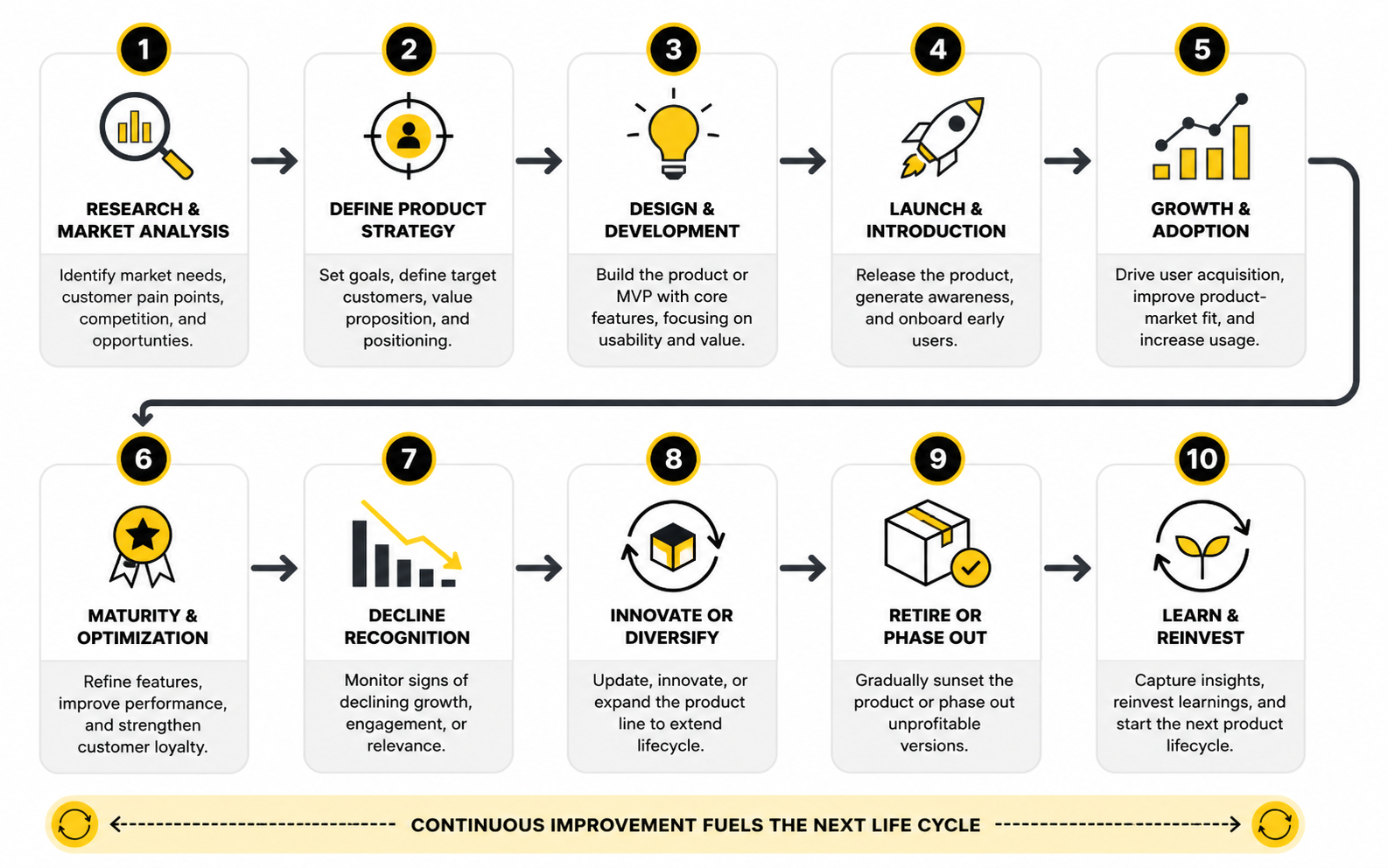
How To Identify A Product’s Current Stage
The easiest mistake is to label a product based on age. A new product can fail before it ever reaches growth. An old product can remain mature and profitable for decades. A product’s stage is not determined by the calendar; it is determined by market behavior.
A better process is to look at evidence from customers, competitors, channels, revenue quality, and replacement pressure. This keeps the conversation practical. Instead of arguing whether a product “feels mature,” you can look at signals that show what is actually happening.
Step 1: Look At Customer Awareness
Start with awareness because it tells you whether the market understands the category. If customers still need basic education before they can evaluate the offer, the product is probably in introduction or early growth. If customers already understand the category and mainly compare brands, features, price, and trust, the product is likely in growth or maturity.
This matters because awareness changes the message. Introduction-stage messaging should explain the problem, the use case, and the product’s role. Mature-stage messaging can be more direct because the customer already understands the category.
Do not confuse brand awareness with category awareness. A company can be famous while launching a product that still needs education. Apple Vision Pro is the obvious example: Apple is globally known, but spatial computing still requires explanation for many buyers.
Step 2: Review Revenue Growth And Revenue Quality
Revenue growth is useful, but it is not enough by itself. A product can grow because of discounts, channel stuffing, one-time hype, or a short-term trend. You want to know whether growth is repeatable, profitable, and supported by retention.
Revenue quality includes renewal behavior, repeat purchases, cohort performance, gross margin, payback period, and customer concentration. A product with slower growth but strong retention may be healthier than a product with fast acquisition and weak repeat usage. This is especially true in software, subscriptions, ecommerce, and agency-style offers.
For a practical setup, track a small set of lifecycle metrics each month. Use lead source, conversion rate, activation rate, repeat purchase rate, churn, average order value, gross margin, and support load. If you are managing funnels or client campaigns, a platform like GoHighLevel can help centralize the CRM, pipeline, follow-up, and reporting side of that process.
Step 3: Watch Competitor Behavior
Competitors reveal a lot about the product life cycle. In introduction, there may be few direct competitors because the category is still forming. In growth, competitors enter quickly because demand is becoming obvious. In maturity, the market gets crowded and companies fight harder over positioning, price, features, and distribution.
In decline, competitor behavior often splits. Some competitors exit because the opportunity is no longer attractive. Others specialize, consolidate, or serve a smaller audience with higher-margin offers.
This is why competitive research should not just list alternatives. You want to understand what competitors are doing differently now compared with a year ago. More discounting, more bundles, less innovation, fewer launches, or heavier retention offers can all signal that the market is moving into a different stage.
Step 4: Check Distribution And Channel Performance
Distribution often changes before the broader market notices. In introduction, distribution is limited and often hands-on. In growth, more channels start working because demand is easier to capture. In maturity, distribution is broad, but efficiency becomes harder to improve.
Channel performance tells you whether the product still has room to expand. If new channels are opening profitably, the product may still be in growth. If most channels are saturated and growth depends on stealing share, upselling, or improving conversion, the product is more likely mature.
This is where implementation gets practical. Use landing pages, email flows, retargeting, sales scripts, demos, and customer feedback loops to test whether the market still responds. For ecommerce campaigns where speed matters, Replo can be useful because teams can launch and test product-specific pages without turning every campaign into a development project.
Step 5: Measure Replacement Pressure
Replacement pressure is one of the clearest signs that a product is moving toward decline. Customers may still like the product, but they begin using something else to solve the same problem. That replacement can be a new technology, a new business model, a cheaper substitute, or a simpler habit.
DVDs did not decline because people stopped watching films. Digital downloads did not decline because people stopped listening to music. Both declined because the customer behavior moved to more convenient alternatives.
This is the question to ask directly: what would make customers need this product less next year? If the answer is obvious and already happening, you need a decline or extension strategy. If the answer is vague and demand is still expanding, the product may have more growth ahead.
Statistics And Data That Actually Matter
The product life cycle gets useful when you stop treating it like a theory and start measuring the signals behind it. A product is not in growth because the team feels excited. It is not in maturity because it has been around for a long time. It is not in decline because one campaign had a bad month.
The data has to show what customers are doing, how the market is shifting, and whether the business model still makes sense. That is why good product life cycle examples need more than revenue screenshots. Revenue tells you what happened, but lifecycle analysis explains why it happened and what to do next.
Revenue Growth Is Only The Starting Point
Revenue growth is the first number most people check, and that makes sense. If sales are rising quickly, the product may be moving through growth. If sales are flat, the product may be mature. If sales keep falling, the product may be in decline.
But revenue alone can lie. A product can grow because of discounting, paid acquisition spikes, one-time bulk orders, or seasonal demand. That does not mean the product has healthy momentum.
Look at Apple’s iPhone as a mature product example. Apple’s 2024 annual filing shows iPhone net sales of $201.2 billion, down from $205.5 billion in 2023, while the product still remained Apple’s largest revenue category: Apple 2024 Form 10-K. That is what maturity can look like in the real world: not collapse, not explosive growth, but massive scale with pressure to defend demand, improve upgrade reasons, and monetize the surrounding ecosystem.
Market Share Shows Whether Growth Is Real Or Just Internal
A product can grow while losing market share if the whole category is expanding faster. A product can also decline in revenue while gaining share if the category is shrinking. That is why market share matters: it gives revenue context.
For example, a streaming platform, ecommerce tool, or marketing automation product might show strong year-over-year growth. But if the category is growing even faster, the company may actually be losing competitive position. That changes the interpretation completely.
This is where benchmarks become useful, but only if they are relevant. A B2B SaaS product should not compare itself with a consumer hardware product. A physical retail product should not use the same lifecycle signals as a subscription platform. The benchmark has to match the business model, sales cycle, margin profile, and customer behavior.
Adoption Metrics Reveal The Stage Earlier Than Revenue
Adoption often changes before revenue does. A product may still have decent sales while engagement quietly weakens. That is dangerous because revenue can stay stable for a while even after customer enthusiasm has started to fade.
For software, adoption metrics include activation rate, weekly or monthly active usage, feature adoption, seats used, expansion rate, and churn. For ecommerce, they include repeat purchase rate, product page conversion rate, reorder timing, returns, subscription retention, and customer support issues. For hardware, they include preorders, sell-through, replacement cycles, channel inventory, warranty claims, and accessory attachment.
The key is to match the metric to the stage. Introduction-stage products need proof of activation and early satisfaction. Growth-stage products need repeatable acquisition and retention. Mature products need loyalty, margin, and repeat purchase strength. Declining products need replacement signals and customer migration data.
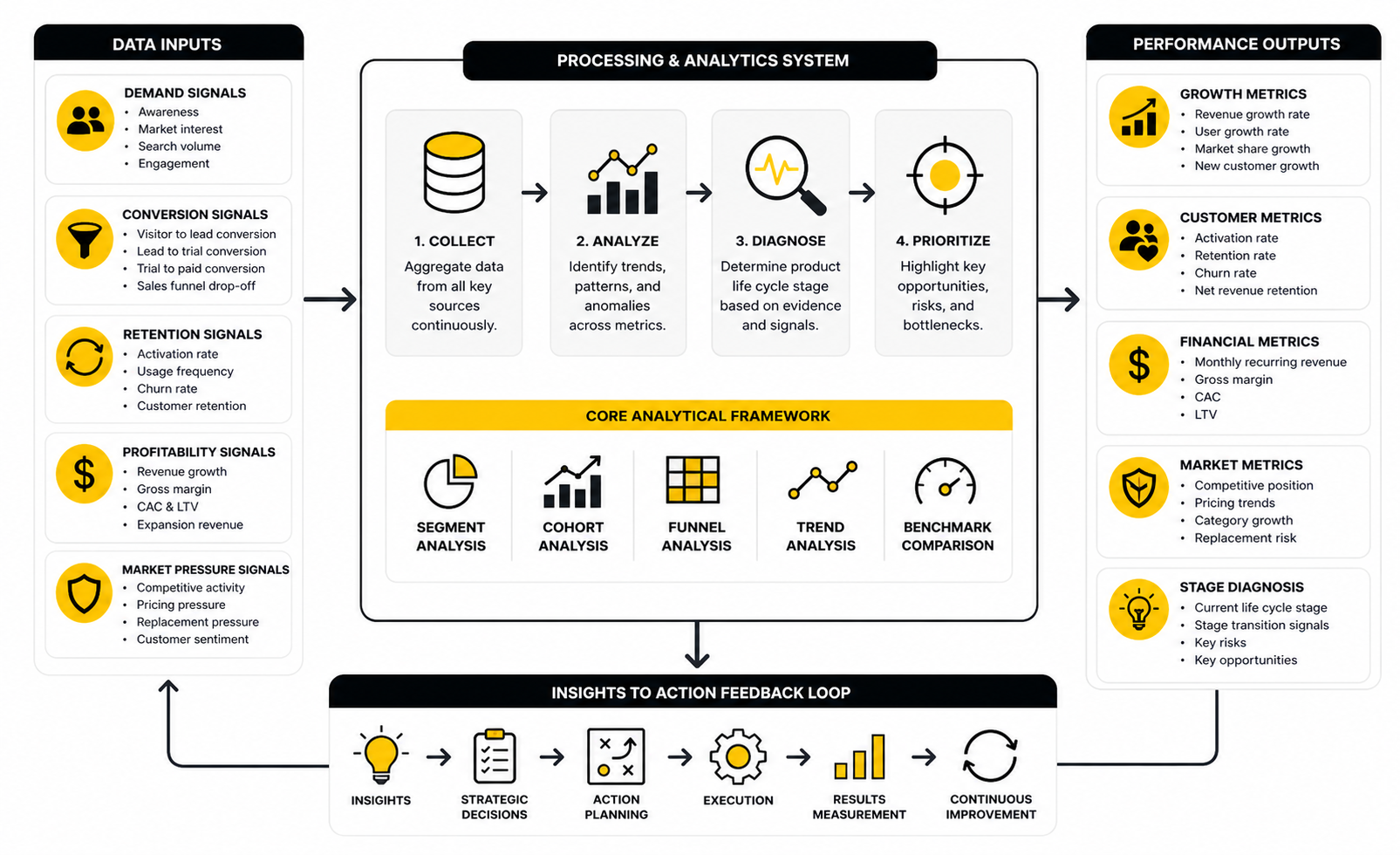
A Simple Lifecycle Analytics System
A practical lifecycle dashboard should not be bloated. You need enough data to make decisions, not so many charts that nobody knows what matters. The best setup is a small system that tracks demand, conversion, retention, profitability, and market pressure together.
Use this as a simple structure:
This system works because it stops teams from overreacting to one number. If revenue is flat but retention is strong and margins are improving, the product may still be a healthy mature product. If revenue is rising but churn is getting worse and acquisition costs are climbing, the product may be scaling with weak fundamentals.
Customer Acquisition Cost Shows How Hard The Market Is Becoming
Customer acquisition cost is one of the clearest signals that a product is moving from easy growth into tougher growth. In the early growth stage, good positioning and rising category demand can make acquisition feel efficient. As more competitors enter, ad costs rise, conversion rates get harder to improve, and customers compare more options before buying.
This is why mature markets often require better funnels, better segmentation, and stronger retention. The answer is not always “spend more.” Sometimes the answer is to fix the offer, improve the page, sharpen the follow-up, or focus on higher-intent audiences.
For businesses that sell through funnels, this is where tools like ClickFunnels or Systeme.io can fit naturally. The tool is not the strategy, but a cleaner funnel can make the strategy easier to test, measure, and improve.
Retention Tells You Whether The Product Deserves More Investment
Retention is the truth serum of the product life cycle. If customers keep buying, renewing, using, or recommending the product, the business has something worth building around. If customers leave quickly, growth may only be hiding a product or positioning problem.
This matters most in the growth stage. Fast acquisition can create the illusion of product-market fit, but retention shows whether the product is becoming part of the customer’s routine. A product that brings in new buyers but fails to keep them is not truly scaling; it is renting attention.
For mature products, retention becomes a defensive weapon. The company may not be able to double the market, but it can increase customer lifetime value, reduce churn, improve upsells, and protect loyalty. That is often where the profit is.
Category-Level Data Explains Decline Better Than Internal Reports
Decline is easiest to misunderstand when you only look at internal data. A company might blame its sales team, ad account, pricing, or creative when the bigger issue is that the category is shrinking. That does not mean execution is irrelevant, but it does mean the diagnosis has to include the market.
DVDs and Blu-ray discs make this obvious. U.S. consumer spending on digital home entertainment reached $56.2 billion in 2024, while subscription streaming represented more than 91% of home entertainment spending tracked in the DEG report: DEG 2024 digital media entertainment report. If you sell physical discs, weak sales are not just a campaign problem; they reflect a structural shift in how people consume entertainment.
Digital music downloads show the same pattern. Downloads accounted for just 2% of U.S. recorded music revenue in 2024, far below their 2012 peak share of 43%, while streaming dominated the market: RIAA 2024 year-end revenue report. That kind of data tells you the product format has moved into decline, even if a loyal niche still exists.
Benchmarks Should Drive Decisions, Not Vanity Reporting
Benchmarks are useful when they change what you do next. If a benchmark only makes a slide look more impressive, it is not helping. The goal is to decide whether to invest, reposition, optimize, harvest, or retire.
For introduction-stage products, benchmark against early adoption quality. Are customers activating, finishing onboarding, using the product again, and explaining it back in their own words? If not, the product probably needs clearer positioning or a simpler first-use experience.
For growth-stage products, benchmark acquisition efficiency and retention together. A product with strong conversion but poor retention needs product or audience work. A product with strong retention but weak conversion may need better messaging, proof, or channel fit.
For mature products, benchmark margin, loyalty, market share, and expansion revenue. This is where small improvements can create serious impact because the base is already large. For declining products, benchmark cash flow, customer concentration, support burden, and replacement risk so the company does not overinvest in a shrinking opportunity.
How To Read Conflicting Lifecycle Signals
Real products rarely send perfectly clean signals. Revenue may be growing while engagement weakens. Market share may be stable while acquisition costs rise. Customer satisfaction may be strong while the category slowly loses relevance.
When signals conflict, prioritize behavior over opinion. Customers saying they like a product matters less than whether they keep using it, keep buying it, and choose it over alternatives. Competitor noise matters less than whether customers are actually switching.
A useful rule is to look for the pattern across three layers: customer behavior, financial performance, and market movement. If all three point in the same direction, the lifecycle stage is usually clear. If they disagree, dig deeper before making big strategic decisions.
What The Data Should Make You Do
The point of measurement is action. Introduction-stage data should help you clarify the offer, narrow the audience, improve onboarding, and validate willingness to pay. Growth-stage data should help you scale channels, improve retention, and build systems that can handle demand.
Maturity-stage data should push you toward differentiation, bundling, margin improvement, customer expansion, and lifecycle marketing. Decline-stage data should force a harder choice: reposition, niche down, harvest, sell, or retire. Avoiding that decision is usually more expensive than making it.
This is where product life cycle examples become practical instead of academic. The examples show the pattern, but your own data tells you what stage your product is actually in. Once you know that, the next move becomes much clearer.
Build a stronger local presence with BAAM AI
Turn your website, Google profile, social channels, and AI visibility into one growth engine
Most businesses do not need more random marketing activity. They need a consistent presence system that helps the right people find them, trust them, and take action. BAAM AI brings strategy, local SEO, website updates, Google Maps visibility, social content, AI-search readiness, media production, and reporting into one practical monthly engine.
If you want your marketing to keep working after the campaign ends, start with a free BAAM AI presence audit. See how your business shows up today and where the fastest visibility wins are at BAAM AI.