
BAAM AI Blog
Mass Marketing: A Practical Guide To Broad-Reach Growth
Mass marketing gets misunderstood because people often treat it like an old-school tactic: one generic message blasted everywhere, usually through TV, radio, billboards, or print. That version still exists, but it is...
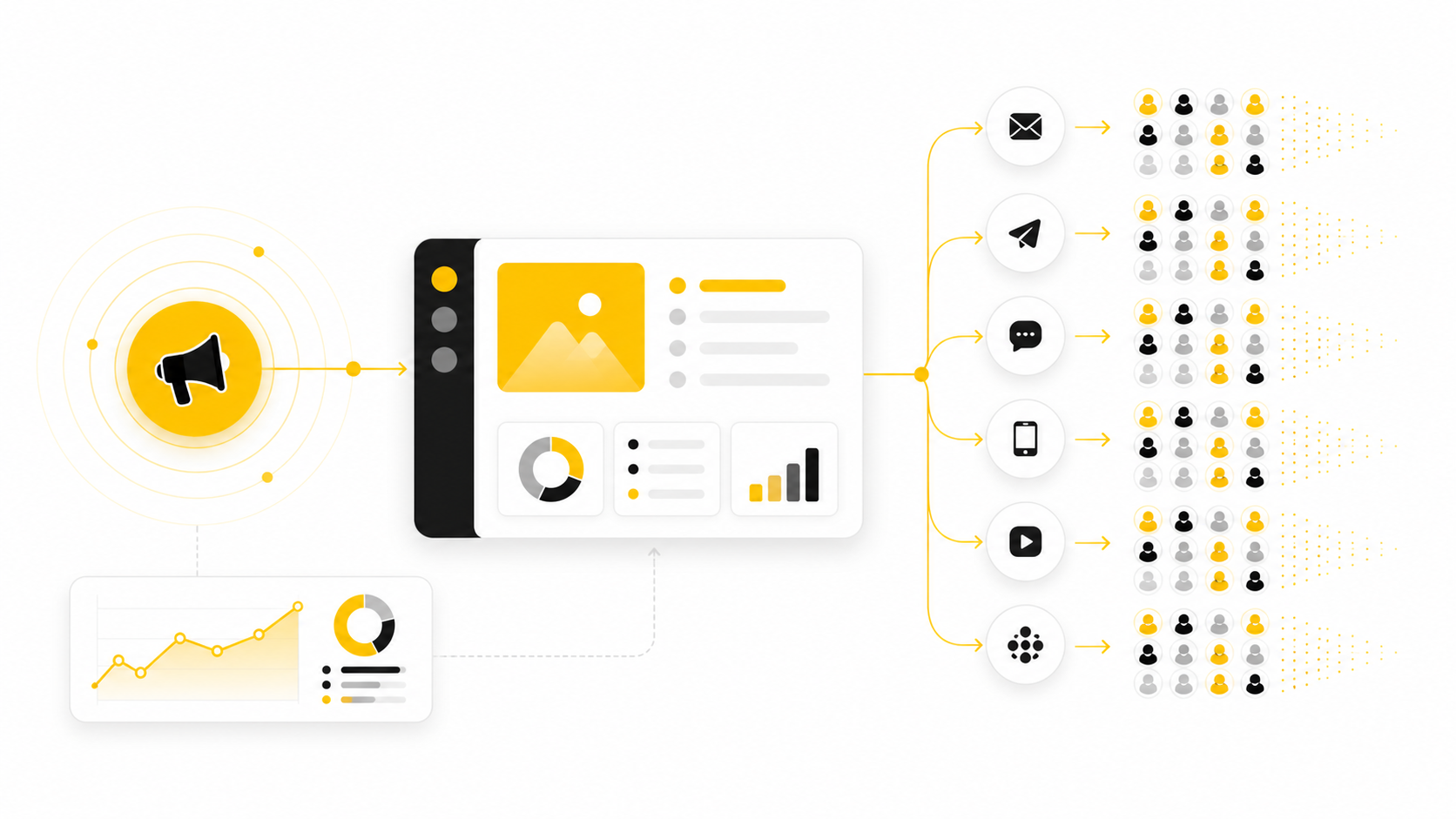
Mass marketing gets misunderstood because people often treat it like an old-school tactic: one generic message blasted everywhere, usually through TV, radio, billboards, or print. That version still exists, but it is not the full picture anymore. Modern mass marketing is really about building a message, offer, and media system that can reach a large audience without depending on narrow personalization for every sale.
That matters because most growth does not come from squeezing more value out of the same tiny audience forever. A brand eventually has to reach people who are not already searching, not already subscribed, and not already deep in the funnel. Research from the IPA’s effectiveness work on Les Binet and Peter Field keeps pointing back to the same uncomfortable truth: long-term growth depends heavily on broad-reach brand building, not just short-term conversion campaigns.
Mass marketing is not the opposite of performance marketing. It is the layer that makes performance marketing work better over time. A company that only targets high-intent buyers may get efficient clicks for a while, but it can also cap its future demand, overpay for the same audiences, and become invisible to everyone who will enter the market later.
this guide will break mass marketing down in a practical way: what it is, why it still matters, where it fails, and how to use it without wasting budget.
Mass Marketing In The Modern Growth Stack
Mass marketing is a strategy built around reaching a broad market with a unified message. Instead of designing a separate campaign for every small customer segment, the brand creates one strong positioning idea that can travel across a large audience. The goal is not to speak to “everyone” in a lazy way, but to make the brand easy to notice, remember, and choose across a wide market.
This is why mass marketing is closely tied to mental availability. A buyer may not need your product today, but when the need appears, the brand that comes to mind first has a real advantage. That is the part many performance-heavy teams miss: demand is not only captured at the bottom of the funnel; it is also created before people are ready to click.
A practical mass marketing strategy usually combines broad media, simple positioning, memorable creative, and enough repetition to build recognition. It can include TV, YouTube, podcasts, out-of-home, radio, paid social, creator partnerships, sponsorships, email, and landing pages. The channel mix changes by business model, but the principle stays the same: one clear market-facing idea, distributed at scale.
Why The Definition Needs Updating
The classic definition of mass marketing was simple: sell the same product to the entire market with the same message. That worked especially well in eras where a few media channels controlled attention. Today, attention is fragmented, so mass marketing has to be more flexible.
Modern mass marketing does not mean ignoring customer differences. It means choosing the few differences that matter and refusing to over-segment everything else. A brand can still use audience data, creative testing, CRM insights, and automation while keeping one recognizable message at the center.
This is an important distinction. Personalization can improve relevance, but too much micro-targeting can make a brand feel scattered. Mass marketing gives the business a shared public identity, while targeted marketing adapts that identity for specific moments.
Why It Matters
Mass marketing matters because large-scale awareness still affects future sales. Nielsen’s work on marketing effectiveness warns that advertisers often shift too much money toward lower-cost, performance-oriented channels while underestimating the value of high-reach media. That is a strategic problem, not just a media-planning problem.
Broad reach also helps brands escape the limits of existing demand. Search, retargeting, and direct-response ads are useful, but they mostly reach people already showing signals. Mass marketing reaches the larger group of future buyers who are not yet shopping but will be influenced by memory, familiarity, category cues, and trust.
There is also a cost advantage when the message works. A strong mass marketing campaign can spread one idea across millions of impressions instead of rebuilding the entire message for every niche. That does not guarantee efficiency, but it creates the possibility of scale in a way narrow campaigns often cannot.
The Main Trade-Off
The biggest strength of mass marketing is reach. The biggest weakness is waste. You will always reach people who are not ready, not interested, or not in the category at all.
That is why mass marketing needs discipline. The message must be simple enough to travel, but specific enough to mean something. The media plan must be broad enough to build memory, but not so broad that the budget disappears into irrelevant exposure.
This is where many teams get it wrong. They confuse mass marketing with vague marketing. A broad campaign still needs a clear customer problem, a distinctive promise, a reason to believe, and a path from awareness to action.
Framework Overview
A useful mass marketing framework has four layers: market, message, media, and measurement. Each layer protects the campaign from a different kind of failure. If the market is too vague, the campaign becomes generic; if the message is weak, reach only amplifies confusion; if the media plan is poor, the message never lands; if measurement is shallow, the team kills long-term value too early.
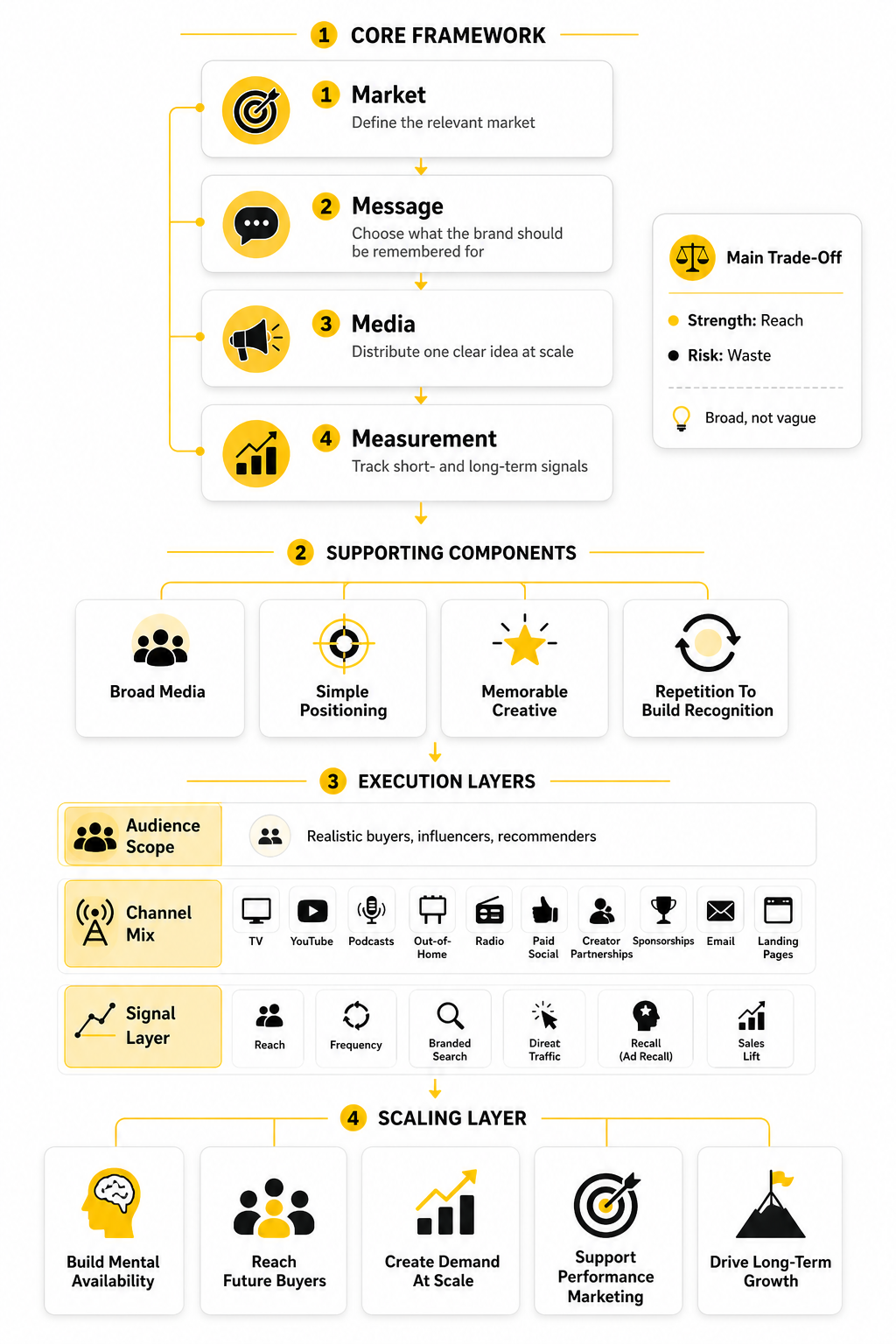
The framework starts with the market because mass marketing still needs boundaries. A brand selling accounting software does not need to reach every human being; it needs to reach enough of the business market to become familiar before purchase intent appears. A consumer brand may define the market more broadly, but it still needs to know who can realistically buy, influence, or recommend the product.
The second layer is the message. This is where the brand decides what it wants to be remembered for. In mass marketing, a message should be easy to repeat, easy to recognize, and connected to a real buying situation.
The third layer is media. Broad reach does not require one specific channel, but it does require consistency across channels. For example, a brand might use paid social for reach, YouTube for demonstration, podcasts for trust, and a simple funnel builder like ClickFunnels to turn broad attention into a focused campaign path.
The fourth layer is measurement. Mass marketing should not be judged only by immediate clicks. It needs a mix of short-term and long-term signals, including reach, frequency, branded search, direct traffic, recall, customer acquisition cost trends, and sales lift where the data allows.
What Mass Marketing Is Not
Mass marketing is not lazy targeting. It is not pretending every buyer is identical. It is not buying the biggest audience possible and hoping something happens.
It is also not a replacement for segmentation. Segmentation helps you understand the market, while mass marketing helps you build a message that can scale across it. The best teams use segmentation privately and simplicity publicly.
Mass marketing is not anti-digital either. Digital channels can support broad reach when they are used for attention and memory, not only clicks. A mass marketing campaign can run through connected TV, YouTube, Meta, TikTok, newsletters, influencers, podcasts, and email systems like Brevo, as long as the message remains coherent.
How this guide Will Approach The Topic
The rest of this guide will treat mass marketing as a growth system, not a nostalgia play. The goal is not to argue that every company needs a Super Bowl ad or a national TV campaign. The goal is to show when broad reach makes sense, how to structure it, and how to avoid the common mistakes that make mass marketing look expensive and outdated.
Part 2 will go deeper into why mass marketing still matters, especially in categories where trust, familiarity, and memory shape buying decisions before the sales conversation begins. Part 3 will unpack the full framework in more detail, so the strategy has a repeatable structure instead of becoming a collection of disconnected campaigns.
From there, the article will move into core components, professional implementation, measurement, and practical tools. By the end, mass marketing should feel less like a blunt instrument and more like what it actually is when done well: a disciplined way to build demand at scale.
Why Mass Marketing Still Matters
Mass marketing matters because most buyers are not ready to buy right now. That sounds obvious, but it changes how you think about growth. If your entire strategy is built around people who are already searching, comparing, or clicking, you are fighting over the small active slice of the market while ignoring the much larger group of future buyers.
That future-buyer group is where brand memory gets built. The Ehrenberg-Bass Institute’s work on mental and physical availability is useful here because it explains growth in plain terms: buyers need to think of the brand easily, recognize it quickly, and be able to buy it when the need appears. Mass marketing helps with the first two jobs because it increases the number of people who have heard of the brand before they are in-market.
This is the part that performance-only teams often underestimate. A direct-response campaign can harvest existing demand, but it usually does not create enough future demand by itself. Mass marketing gives the brand a wider memory footprint, which can make every later channel easier to run.
The Market Is Bigger Than Today’s Buyers
In almost every category, the people ready to buy today are a minority. Most potential customers are either not aware of the problem, not feeling enough urgency, already using another solution, or simply not paying attention yet. That does not make them useless; it makes them future demand.
Mass marketing gives a brand a way to reach those people before the buying moment. The goal is not to force an immediate purchase from someone who is not ready. The goal is to make the brand familiar enough that when the trigger appears, the buyer does not start from zero.
This is especially important in categories with long buying cycles. B2B software, financial services, home improvement, education, healthcare, and high-consideration consumer products all depend on trust before action. If the first time someone sees your brand is at the exact moment you ask for the sale, you are making the job harder than it needs to be.
Reach Creates The Conditions For Demand
Reach does not automatically create growth, but growth usually becomes harder without it. A small audience can be optimized, retargeted, and nurtured only so many times. At some point, the business needs new people entering the demand pool.
That is why broad reach still has strategic value. The IPA’s effectiveness research from Les Binet and Peter Field has become influential because it separates short-term activation from long-term brand building. The exact budget split changes by category, but the principle is clear: campaigns that only chase immediate response often miss the compounding effect of brand investment.
Mass marketing supports that compounding effect because it gives the brand repeated exposure across a larger market. People may not click the first time. They may not even consciously remember the ad. But repeated, distinctive exposure can make the brand feel more familiar when a real buying situation arrives.
Familiarity Reduces Friction
Buyers rarely make decisions in a perfectly rational spreadsheet. They use shortcuts. Familiarity is one of those shortcuts, especially when the options look similar, the risk feels high, or the buyer has limited time.
This does not mean mass marketing replaces product quality, pricing, proof, or sales process. It means familiarity can reduce the perceived risk around all of them. A known brand often gets more patience, more consideration, and more benefit of the doubt than a brand the buyer has never seen before.
That has practical consequences. Sales teams get warmer conversations. Paid search campaigns can benefit from stronger branded demand. Landing pages can convert better because the visitor is not meeting the company cold.
Performance Marketing Works Better When The Brand Is Known
Performance marketing is easier when people already recognize the name. A search ad, retargeting ad, landing page, or email does not carry the full burden of trust when the brand has already been seen in the market. This is why mass marketing and performance marketing should not be treated like enemies.
The more carefully view is simple: mass marketing builds memory, and performance marketing converts moments of intent. One creates future demand; the other captures active demand. When both are aligned, the business is not choosing between long-term brand and short-term revenue.
This is also where channel planning becomes more realistic. Digital ad spending is still huge, with the IAB’s 2024 Internet Advertising Revenue Report showing continued growth across online advertising. But digital reach alone is not the same as strategic reach. The channel matters less than whether the campaign builds a memorable association that can survive beyond the click.
The Attention Market Is Fragmented
Mass marketing used to be easier to define because attention was concentrated. A national TV buy, a print campaign, radio, and outdoor advertising could cover a huge part of the market. Today, attention is split across streaming, short-form video, podcasts, newsletters, social platforms, retail media, search, creators, communities, and private messaging.
That fragmentation does not kill mass marketing. It makes the discipline more important. The brand needs a consistent idea that can move across channels without becoming unrecognizable.
The scale is still there, but it is distributed differently. The Digital 2025 global report shows how deeply social platforms are embedded into daily behavior, while The Infinite Dial 2025 shows how podcast and digital audio consumption keep expanding. A modern mass marketing plan has to understand these behaviors instead of assuming that broad reach only means traditional media.
Broad Does Not Mean Generic
The biggest objection to mass marketing is that it sounds wasteful. That objection is fair when the message is vague. A weak campaign shown to a huge audience only spreads confusion faster.
Good mass marketing is broad in reach, not bland in meaning. It still needs a sharp promise, a clear category connection, and distinctive brand assets. The message should be simple enough for a large audience to understand quickly, but specific enough to create memory.
This is where the craft matters. The best broad campaigns do not try to say everything. They choose the one thing the brand wants to be known for and repeat it with enough variation to stay interesting.
Mass Marketing Protects Against Over-Targeting
Over-targeting feels efficient because dashboards make it look precise. You can define narrow audiences, track clicks, and optimize campaigns quickly. The problem is that precision in the ad platform does not always equal growth in the market.
A brand can become too dependent on the same small group of high-intent users. Costs rise, frequency gets annoying, and the company starts mistaking retargeting activity for real demand creation. That is a dangerous loop because it can make the marketing team feel productive while the brand’s future customer base stays flat.
Mass marketing breaks that loop by expanding the top of the market. It forces the business to ask a bigger question: are more people becoming aware of us, remembering us, and considering us when the category matters? That is a healthier question than only asking whether this week’s cost per lead went down.
It Helps Brands Stay Visible Between Buying Moments
Most categories have long gaps between purchases. People do not constantly buy insurance, software, cars, mattresses, agencies, courses, or home services. If the brand disappears between buying moments, it gives competitors a chance to own the next trigger.
Mass marketing keeps the brand present during those gaps. It does not need to scream all the time, but it does need enough continuity to remain mentally available. The Nielsen 2024 Annual Marketing Report reinforces the same idea from a measurement angle: upper-funnel marketing has a role in long-term ROI, not just awareness for awareness’s sake.
This is why stopping all broad marketing during a slow period can be risky. It may improve short-term margin on paper, but it can weaken the brand’s future pipeline. When demand returns, the companies that stayed visible often have an easier path back into the buyer’s mind.
Mass Marketing Builds Shared Meaning
There is another underrated advantage: mass marketing creates shared meaning. When many people see the same brand idea, the brand becomes easier to talk about, recommend, and recognize socially. That matters because buyers are influenced by what colleagues, friends, creators, reviewers, and communities already understand.
Shared meaning is hard to build with only private, hyper-targeted messages. If every audience sees a different version of the brand, the market may never form one clear impression. That can be a problem when the brand needs credibility beyond one campaign.
A strong mass marketing platform gives everyone the same reference point. Sales teams, partners, customers, creators, and internal teams can all point to the same idea. That consistency makes the brand feel bigger and more stable than a collection of disconnected ads.
The Real Reason Mass Marketing Fails
Mass marketing usually fails for one of three reasons. The audience is too broad for the budget, the message is too weak to remember, or the company measures it too narrowly and gives up too early. None of those problems mean the strategy is dead; they mean the execution is poor.
A campaign can reach millions of people and still fail if it does not create a clear mental link. It can also be creatively strong but fail because the media plan does not repeat the message enough. Or it can start working slowly, then get killed because the team expected bottom-of-funnel results from an upper-funnel investment.
That is the key lesson for the next section. Mass marketing needs a framework, not just a media budget. Without structure, broad reach becomes expensive noise; with structure, it becomes one of the most powerful ways to build future demand.
The Mass Marketing Framework
The practical framework for mass marketing has four layers: market, message, media, and measurement. Part 1 introduced those layers at a high level, but this is where they become operational. If you want broad reach without broad waste, you need to move through the layers in order.
The order matters because each layer depends on the one before it. You cannot choose the right media mix until you know the market you are trying to reach. You cannot measure properly until you know what the message was supposed to build in the buyer’s mind.
This is also where mass marketing becomes less abstract. It is not “run a big campaign and hope people remember us.” It is a repeatable process for deciding who should know you, what they should remember, where they should encounter you, and how you will know whether the strategy is working.
Start With The Market
The first question is not “Which channel should we use?” The first question is “What market are we trying to become known in?” That sounds simple, but many campaigns fail because the team defines the audience either too widely or too narrowly.
A useful market definition should include who can realistically buy, who influences the buying decision, and which buying situations matter most. For a consumer brand, that could mean households in a specific lifestyle category. For a B2B company, it could mean founders, operators, department heads, agencies, or internal champions who help move a deal forward.
Mass marketing does not mean every person on earth is your audience. It means your campaign is designed to reach a large enough portion of the relevant market to build memory at scale. That distinction protects the budget from becoming scattered.
Define The Buying Situations
Once the market is clear, the next job is to map the situations where the category becomes relevant. People do not wake up wanting “a brand.” They hit a moment, feel a problem, notice a gap, or get triggered by a goal.
These moments are important because they give the campaign context. A project management tool may matter when a team misses deadlines. A meal delivery brand may matter when someone is too tired to cook. A marketing automation platform may matter when leads are coming in, but follow-up is messy.
This is where mass marketing gets sharper. Instead of trying to make people remember every feature, the campaign links the brand to a specific moment of need. When that moment happens later, the brand has a better chance of being recalled.
Choose One Memory To Build
A broad campaign needs a tight message. If the campaign tries to say five things, most people will remember none of them. Mass marketing works best when the brand chooses one main association and commits to building it consistently.
That association can be based on speed, simplicity, status, confidence, affordability, expertise, taste, reliability, or a specific outcome. The right choice depends on the category and the company’s actual strengths. The point is not to invent a clever line; the point is to decide what the market should connect with the brand.
This is where discipline matters. Teams often want to include every benefit because they are close to the product. Buyers are not that close. They need a simple idea they can understand quickly and recall later.
Build Distinctive Brand Assets
A message becomes stronger when people can recognize it before they fully read or hear it. That is why distinctive brand assets matter in mass marketing. Colors, sounds, visual style, characters, packaging, phrases, formats, and recurring creative devices help the brand show up consistently across different channels.
This is not just design polish. It is memory infrastructure. If every campaign looks and sounds different, the brand keeps resetting the learning curve for the audience.
The goal is to make recognition easier over time. A buyer should be able to identify the brand even when the logo is small, the ad is skipped quickly, or the message appears in a crowded feed. That is a major advantage in a fragmented attention market.
Turn The Framework Into A Process
At this point, the framework can become a practical workflow. The campaign moves from market clarity into message development, then into channel selection, then into measurement. Each stage should produce a specific decision, not just a discussion.
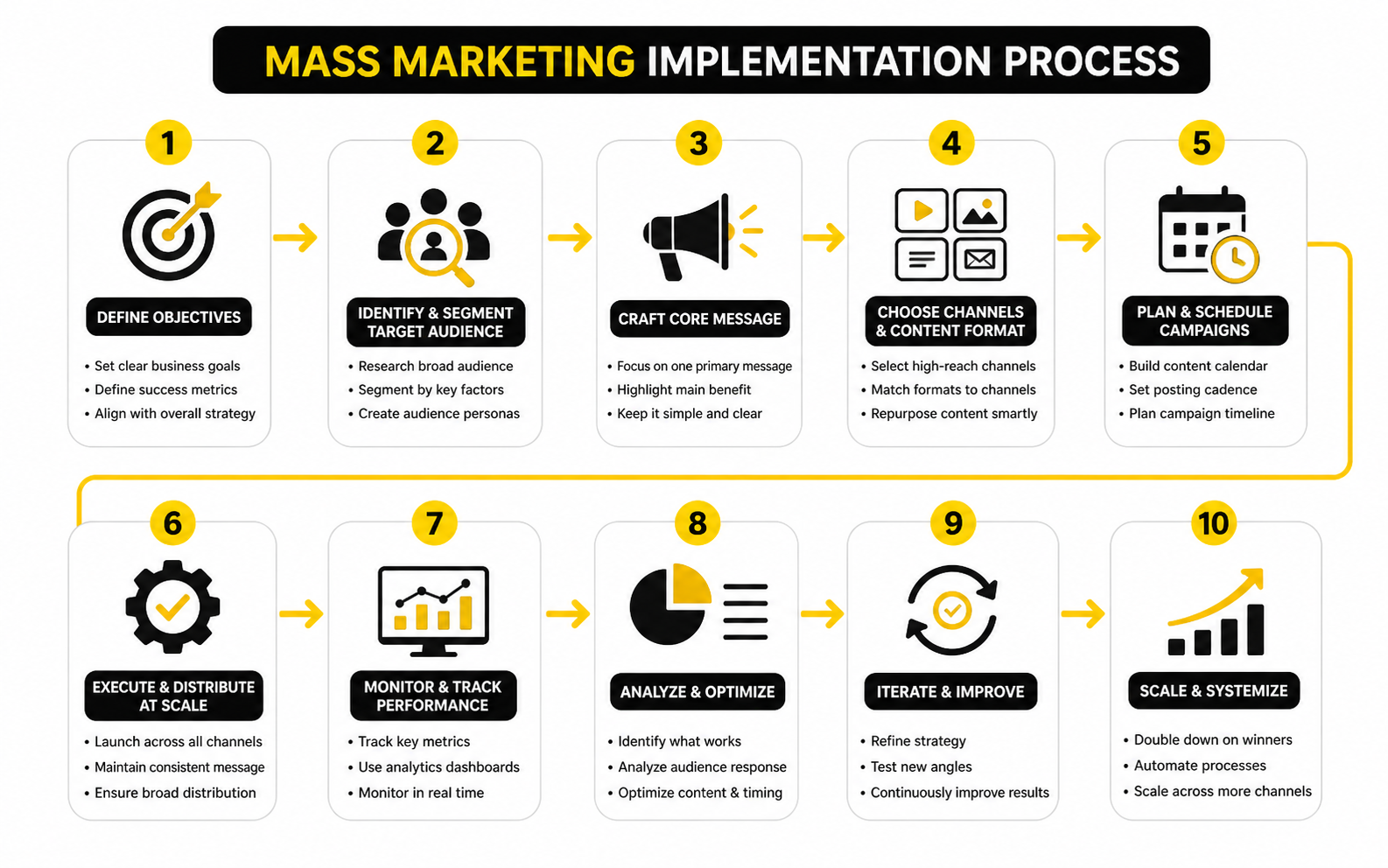
A simple execution process looks like this:
This process keeps the work grounded. It prevents the team from jumping straight into ad formats, influencer lists, or media buys before the strategy is clear. It also gives every person involved a shared language for making decisions.
Match The Message To The Channel
The same campaign idea should not be copied blindly into every format. A 30-second video, a podcast read, a billboard, a creator post, a landing page, and an email sequence all create attention differently. The message should stay consistent, but the execution should fit the channel.
For example, video can demonstrate emotion, contrast, and product use quickly. Podcasts can build trust through host familiarity. Out-of-home can create simple public visibility. Paid social can test creative angles and scale reach fast when the message is clear.
The mistake is treating channels as isolated campaigns. In mass marketing, every channel should reinforce the same memory. The buyer may see a short video first, hear a podcast mention two weeks later, search the brand later, and finally land on a conversion page built with a tool like ClickFunnels. The experience should feel connected.
Create A Clear Path After Awareness
Mass marketing should not end with attention. If someone becomes curious, the next step needs to be obvious. That does not mean every broad-reach ad should push a discount or hard CTA, but the campaign should make it easy for interested people to move closer.
This usually means having simple landing pages, strong search visibility, clear product pages, useful lead magnets, and follow-up systems ready before the campaign scales. Broad reach can expose operational gaps very quickly. If the message works but the destination is confusing, you lose momentum.
For service businesses, agencies, and local operators, a platform like GoHighLevel can be useful when the campaign needs CRM, funnels, forms, follow-up, and automation in one place. The tool is not the strategy, but the infrastructure matters. Attention becomes more valuable when the business can capture, route, and follow up with demand properly.
Build Frequency Without Becoming Annoying
Mass marketing needs repetition because memory needs repetition. A single exposure rarely does enough. The campaign has to appear often enough for people to recognize the brand, understand the promise, and connect it to a buying situation.
But frequency can become a problem when the creative is too narrow or the audience pool is too small. People get tired of seeing the exact same asset again and again. That is why the campaign should have creative variety built around the same core idea.
Think of it as consistency without sameness. The brand association stays stable, while the executions vary by format, angle, proof point, or context. This keeps the campaign recognizable without making it feel stale.
Separate Brand Signals From Sales Signals
A mass marketing campaign should create more than one type of result. Some signals will show up quickly, such as direct traffic, branded search, social engagement, video completion, landing page visits, and new email subscribers. Other signals take longer, such as improved recall, lower acquisition costs, higher close rates, and stronger category recognition.
The problem is that teams often judge broad-reach campaigns only by immediate sales. That can lead to bad decisions. A campaign designed to build future demand may be killed before its effect appears in the business.
The solution is not to ignore revenue. The solution is to use the right measurement for the right job. Mass marketing should still connect to commercial outcomes, but it needs a wider scoreboard than last-click conversions.
Use Testing Without Shrinking The Strategy
Testing is useful, but it can quietly damage mass marketing if the team only optimizes for instant response. The ad that gets the fastest click is not always the ad that builds the strongest memory. The subject line that drives a spike today may not support the brand association the company needs long term.
A better approach is to test within strategic boundaries. Test hooks, formats, proof points, and creative variations, but do not keep changing the core brand idea every week. The market needs time to learn what the brand stands for.
This is especially important when using social scheduling, content distribution, or campaign coordination tools like Buffer. Consistency across posts and channels is easier when the team has a clear campaign platform. Without that platform, publishing more content can simply create more noise.
Make The Campaign Easy To Execute Internally
A strategy that only exists in a slide deck is not a strategy yet. The team needs practical rules for how the campaign should show up. That includes approved messages, visual assets, channel roles, landing page paths, reporting cadence, and decision rights.
Internal clarity matters because mass marketing touches more teams than a narrow performance campaign. Creative, media, sales, partnerships, customer support, analytics, and leadership may all influence how the brand appears in the market. If they are not aligned, the campaign fragments.
A simple internal playbook can prevent that. It does not need to be complicated. It just needs to answer what the campaign is trying to build, what it should never say, which assets are mandatory, which channels are active, and how performance will be judged.
Decide What Not To Do
One of the most practical parts of the framework is exclusion. Mass marketing does not mean saying yes to every channel with reach. It means choosing the few channels that can repeatedly expose the right market to the right message.
This is where budget discipline comes in. A smaller brand may not be able to run TV, connected TV, YouTube, podcasts, creators, outdoor, and paid social all at once. That is fine. The better move is to choose fewer channels and execute them with enough consistency to matter.
The same applies to creative. Do not build ten unrelated campaign ideas just because different teams want different angles. Choose the strongest idea, adapt it intelligently, and give it enough time to work.
The Framework Only Works With Commitment
Mass marketing is not a one-week experiment. It needs enough time, reach, and consistency to build memory. If the business changes the message every month, the market never gets the chance to learn it.
That does not mean ignoring data. It means knowing what should change and what should stay stable. Creative details can improve, media allocation can shift, and landing pages can be optimized, but the core association needs continuity.
This is the bridge into the next part of the article. Once the framework is clear, the next question is what actually makes the strategy strong. The answer lives in the core components: positioning, creative, channel mix, consistency, distribution, and the systems that turn broad attention into business growth.
Statistics And Data
The data side of mass marketing is where teams either become disciplined or lose the plot. Broad-reach campaigns create effects across awareness, search, direct traffic, sales conversations, conversion rates, customer acquisition costs, and long-term brand strength. If the measurement system only looks at last-click conversions, it will miss most of what mass marketing is designed to create.
The point is not to collect random statistics and decorate the strategy with numbers. The point is to understand which numbers reveal whether the market is starting to recognize, remember, and trust the brand. Good measurement helps you decide whether to keep scaling, adjust the message, change the channel mix, or fix the conversion path after people become interested.
This is why mass marketing needs a layered analytics model. One layer tracks exposure. One layer tracks memory. One layer tracks behavior. One layer tracks commercial outcomes. When those layers are read together, the team can make better decisions than it would from a single dashboard.
Measure Reach Before You Judge Response
Reach is the first measurement layer because mass marketing cannot work if enough relevant people never see the message. It is not the final goal, but it is the starting condition. A campaign with weak reach may have good creative and still fail simply because the market never gets enough exposure to learn anything.
The important question is not just “How many impressions did we buy?” The better question is “How many people in the relevant market did we reach, and how often did they encounter the campaign?” Impressions can inflate quickly, especially in digital media, while real unduplicated reach may be smaller than it looks.
This matters because the advertising market keeps getting more fragmented. U.S. internet advertising reached a record $259 billion in 2024, which shows how much money has moved into digital channels. But more spend does not automatically mean better reach; it means teams need cleaner planning, deduplication, and cross-channel reporting so they know whether they are reaching new people or repeatedly paying to reach the same ones.
Frequency Needs Context
Frequency is one of the most misunderstood metrics in mass marketing. Too little frequency means people may not remember the campaign. Too much frequency can waste budget, irritate the audience, or make the creative feel stale.
The right frequency depends on the category, creative quality, channel, buying cycle, and how distinctive the brand already is. A new brand usually needs more repetition because the market has not learned its assets yet. A well-known brand may need less repetition to refresh memory, especially if its distinctive assets are already strong.
The practical move is to watch frequency alongside creative fatigue signals. If reach is flat, frequency is rising, and engagement quality is dropping, the campaign may be over-serving the same people. If reach is growing, branded search is increasing, and direct traffic is moving up, frequency may be doing its job.
Brand Search Is A Useful Middle Signal
Branded search is one of the clearest behavioral signals that mass marketing is creating curiosity. When people see or hear a campaign, they may not click immediately, but they often search the brand later. That makes branded search a useful bridge between awareness and conversion.
It is not perfect, because search volume can be affected by seasonality, PR, product launches, category demand, and competitor activity. Still, when branded search rises during or after a broad campaign, it often tells you that more people are actively trying to understand the company. That is a meaningful signal because it shows movement from passive exposure into active investigation.
The action is simple: protect the search path before the campaign scales. Make sure the brand owns its search results, product pages are clear, comparison pages are accurate, and landing pages match the campaign promise. If a campaign creates interest and the search experience is weak, the brand leaks demand it already paid to create.
Direct Traffic Shows Memory In Motion
Direct traffic can be messy, but it is still useful when interpreted carefully. People may type the URL, use bookmarks, return from dark social, click from untagged sources, or arrive through apps that strip referral data. That means direct traffic should not be treated as a pure channel, but it can still show whether more people are coming to the brand without a trackable ad click.
In mass marketing, rising direct traffic can suggest that the campaign is making the brand easier to remember. This is especially relevant when direct traffic increases alongside branded search, organic homepage visits, and higher engagement on core product pages. One signal alone can mislead; several aligned signals are harder to ignore.
The action is to compare direct traffic against the campaign timeline. Look at baseline traffic before launch, movement during media bursts, and whether traffic remains higher after spend slows down. A temporary spike may show curiosity; a sustained lift may show stronger brand memory.
Brand Lift Connects Exposure To Perception
Brand lift studies help answer a different question: did the campaign change what people know, feel, or remember about the brand? This matters because mass marketing often works before revenue appears. If the campaign improves awareness, recall, consideration, or message association, it may be building the conditions for future sales.
The useful metrics are usually aided awareness, unaided awareness, ad recall, consideration, preference, and association with the intended buying situation. The key is to choose the metrics before the campaign starts. Otherwise, the team can cherry-pick whatever moved and call it success.
Nielsen’s 2025 marketing effectiveness work highlights the need to balance short-term performance with long-term brand presence and to use clearer cross-media measurement rather than relying on isolated channel reports. That is the right mindset for mass marketing because the campaign’s impact is rarely contained inside one platform dashboard. Measurement should reveal whether the market is learning the intended memory, not just whether one ad placement generated a cheap click.
Sales Lift Is Stronger Than Platform Attribution
Sales lift is more useful than platform attribution when the campaign is big enough to affect business outcomes. Platform attribution can over-credit the last interaction because it sees only its own environment. Sales lift tries to compare what happened with the campaign against what likely would have happened without it.
That can be done through geo tests, holdout groups, matched markets, incrementality testing, media mix modeling, or controlled experiments where the business has enough data. Smaller brands may not have perfect conditions, but they can still compare markets, campaign windows, branded demand, and conversion behavior carefully. The goal is not academic purity; the goal is better decision-making.
This matters because mass marketing can influence people who later convert through search, direct, referral, retail, sales calls, or another channel entirely. If you only credit the final touch, the broad campaign looks weaker than it really is. If you measure incrementality, you get closer to the truth.
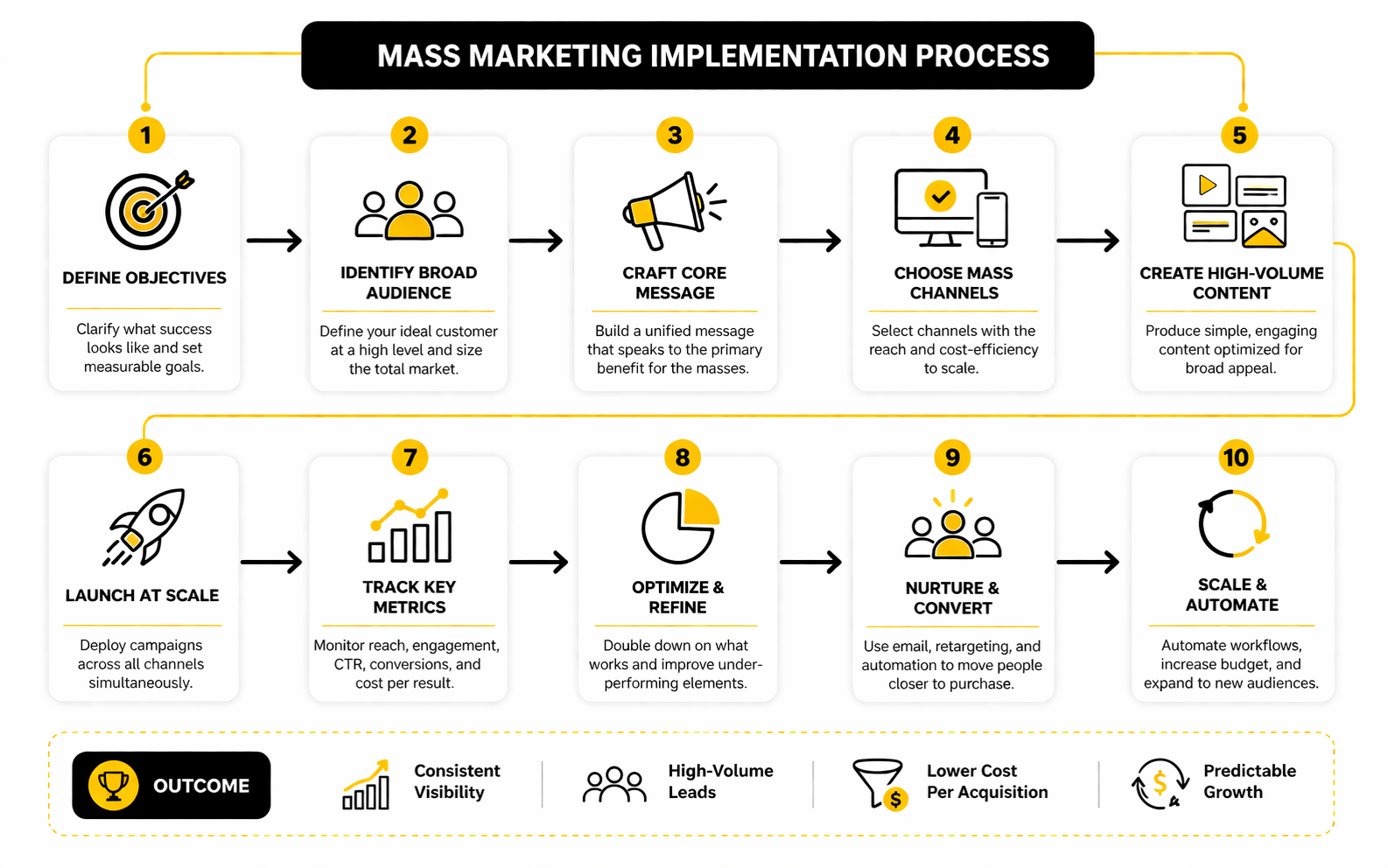
Build A Practical Analytics System
The analytics system should match the way mass marketing actually works. It should not force every result into one number too early. Broad-reach campaigns create a chain of effects, and each stage needs its own signal.
A practical measurement stack can be organized like this:
This structure makes the campaign easier to manage. If exposure is weak, fix the media plan. If exposure is strong but memory is weak, fix the creative. If memory is improving but sales are not moving, inspect the conversion path, offer, pricing, follow-up, and sales process.
Benchmarks Should Guide, Not Control
Benchmarks are useful, but they can become dangerous when teams treat them like universal laws. A good click-through rate in one category may be weak in another. A healthy frequency level on one platform may be excessive somewhere else. A strong brand lift result for a new brand may look different from a strong result for a household name.
The better use of benchmarks is directional. They help you spot obvious problems, set expectations, and compare performance against similar campaigns. They should not replace the business’s own baseline.
Your internal baseline is usually more valuable than a generic industry average. What was branded search before the campaign? What was direct traffic before the media launched? What was the normal close rate before the brand push? Those numbers make the campaign easier to judge because they reflect your real market, not someone else’s dashboard.
Creative Quality Changes The Meaning Of The Numbers
A low response rate does not always mean the channel is bad. Sometimes the creative is forgettable. Sometimes the message is unclear. Sometimes the brand assets are too weak to connect the impression to memory.
That is why creative diagnostics should sit next to media metrics. If people remember the ad but not the brand, the campaign has an attribution problem in the buyer’s mind. If people remember the brand but not the message, the campaign may be visible without being meaningful. If people remember the message and the brand, but do not take action, the issue may be timing, offer, trust, or category readiness.
This is where qualitative feedback helps. Surveys, comments, sales-call notes, customer interviews, and social listening can explain what dashboards only hint at. Mass marketing is still about humans, and humans do not always behave in neat attribution paths.
Watch For The Lag
Mass marketing often has a lag between exposure and revenue. That lag can be days in a low-consideration category, weeks in ecommerce, months in B2B, and even longer in expensive or infrequent purchase categories. If the reporting window is too short, the campaign may look weaker than it really is.
This is one reason the IPA’s long-term effectiveness work remains useful. Its research around brand building and sales activation is a reminder that short-term response and long-term growth do not follow the same timeline. The practical lesson is simple: do not judge a memory-building campaign with only a direct-response clock.
That does not mean waiting forever. Set expected reporting windows before launch. Review early exposure and behavior signals quickly, then judge brand and commercial effects over a longer period that fits the buying cycle.
Use Attribution Carefully
Attribution is helpful when it is treated as a tool, not the truth. Last-click attribution is easy to understand, but it often undervalues mass marketing because broad campaigns influence people before they enter a trackable conversion path. Multi-touch attribution can add nuance, but it still depends on the data it can see.
Platform-reported conversions are especially tricky. Each platform has an incentive to show its own value, and different attribution windows can make the same campaign look better or worse depending on the settings. If the team does not understand those settings, it can make expensive decisions from misleading numbers.
A stronger approach is to combine attribution with incrementality. Use platform data for operational optimization, but use lift testing, market comparisons, and business-level reporting to decide whether the campaign is truly creating additional demand. That balance is much safer.
Connect Analytics To Follow-Up
Measurement should not stop at the ad or the landing page. If mass marketing creates interest, the business needs to know what happens after that interest appears. Leads, inquiries, demo requests, email signups, chatbot conversations, and sales calls should all connect back to the campaign where possible.
This is where operational systems matter. A CRM and automation platform like GoHighLevel can help teams capture leads, trigger follow-up, track pipeline, and see whether broad attention is turning into qualified opportunities. For simpler email-led journeys, a tool like Brevo can support list growth, segmentation, and campaign follow-up after someone raises their hand.
The important thing is not the specific tool. The important thing is that the business can see the path from attention to relationship to revenue. Without that path, teams end up arguing about media metrics while real opportunities sit untouched.
What Good Performance Looks Like
Good mass marketing performance rarely looks like one perfect chart. It looks like a pattern. Reach expands, frequency stays controlled, brand recall improves, branded search grows, direct traffic rises, conversion rates hold or improve, and acquisition costs become more stable over time.
Not every metric has to move at once. Early in a campaign, exposure and engagement signals may move first. Later, memory and consideration may become clearer. Commercial impact may take longer, especially if the buying cycle is slow.
The mistake is expecting every campaign to produce immediate revenue and long-term brand growth in the same week. That is not how markets usually work. A better standard is whether the campaign is moving the right signals in the right sequence.
What Bad Performance Looks Like
Bad performance also has patterns. Reach may look large, but the same audience is being overexposed. Branded search stays flat. Direct traffic does not move. Brand lift shows weak recall. Sales teams report that prospects still do not recognize the company.
Another warning sign is a campaign that gets engagement without building the brand. People may watch, like, or comment because the creative is entertaining, but they do not remember who it was for. That is not a small problem. In mass marketing, attention without brand linkage is wasted opportunity.
A third warning sign is a campaign that creates curiosity but loses people after the click. Landing pages may be slow, offers may be unclear, sales follow-up may be weak, or the next step may feel too aggressive. In that case, the media may not be the problem; the demand-capture system may be broken.
The Action Behind The Data
Every metric should lead to a decision. If reach is too low, increase distribution or narrow the relevant market. If frequency is too high, expand the audience, refresh creative, or rebalance channels. If awareness rises but consideration does not, sharpen the promise or add stronger proof.
If branded search rises but conversions do not, fix the website, offer, comparison content, and follow-up. If leads rise but pipeline quality is poor, the message may be attracting the wrong people or setting the wrong expectation. If sales improve but acquisition cost remains unstable, the campaign may need more consistency before the efficiency gains show up.
This is the real value of measurement. It turns mass marketing from a vague brand exercise into a managed growth system. The numbers do not make the strategy for you, but they show where the next smart move should happen.
Professional Implementation Across Channels
At this stage, mass marketing becomes a management problem, not just a creative problem. The strategy has to survive handoffs between brand, paid media, content, sales, analytics, leadership, and sometimes agencies. If each team interprets the campaign differently, the market sees fragments instead of one clear brand idea.
Professional implementation starts with channel roles. Every channel should have a job beyond “get impressions.” One channel may build emotional memory, another may create repeated visibility, another may explain the offer, and another may capture demand when people finally act.
This is where mass marketing becomes more strategic than simply buying reach. A strong implementation plan decides what each channel is supposed to contribute, how the message adapts there, and how all of it connects back to the same core association. Without that discipline, the campaign may look busy while doing very little.
Build Around Channel Roles, Not Channel Hype
New channels always create pressure. A platform grows, a format gets attention, a competitor launches there, and suddenly the team wants to move budget. That can be useful, but it can also turn mass marketing into random channel chasing.
The better approach is to assign each channel a role. Connected TV may be useful for high-attention storytelling. YouTube may support both reach and product explanation. Podcasts may build trust through host familiarity. Paid social may help test creative variations and scale repeat exposure quickly.
A channel should earn its place because it supports the campaign objective, not because it is popular. The Kantar Media Reactions 2025 report points to the growing importance of cross-channel integration, with Kantar’s LIFT+ database showing that multiple channels working together can drive a large share of brand KPI impact. The lesson is practical: do not treat channels as separate islands when the buyer experiences them as one market.
Balance Consistency And Adaptation
Mass marketing needs consistency, but consistency does not mean copying the same asset everywhere. A billboard, podcast ad, TikTok video, email campaign, and landing page should not feel identical. They should feel like they belong to the same brand.
The core message should stay stable while the execution adapts to the environment. A short-form video needs a fast hook. A podcast integration needs a credible spoken explanation. A landing page needs clarity and proof. An email sequence needs progression, not just repetition.
The mistake is either extreme. Some teams over-standardize and make the campaign feel stiff. Others over-adapt and lose the brand completely. The winning version is recognizable across formats while still native enough to work inside each channel.
Keep Creative Assets Distinctive
Distinctive assets are not decoration. They are what help people connect scattered exposures into one memory. If the market cannot recognize the brand quickly, mass marketing loses a major part of its advantage.
This includes visual assets, audio cues, recurring phrases, characters, product shots, layout patterns, packaging, and tone of voice. The Ehrenberg-Bass Institute’s work on distinctive asset measurement treats these assets as part of building mental and physical availability. That matters because buyers often notice brands quickly, imperfectly, and in crowded contexts.
The practical rule is simple: do not redesign the campaign every time you launch a new wave. Refresh the execution, but protect the memory structures. If every new campaign looks like a different company, the market has to relearn the brand from scratch.
Use Performance Data Without Letting It Take Over
Performance data is useful, but it can push a mass marketing campaign in the wrong direction if the team optimizes too narrowly. The ad that gets the cheapest click may not be the ad that builds the strongest brand memory. The channel that reports the most conversions may not be the channel creating the demand that later converts elsewhere.
This is why implementation needs two operating modes. One mode improves the short-term mechanics: hooks, landing pages, forms, email follow-up, retargeting, and sales routing. The other protects the long-term brand idea: recognition, message consistency, reach, and association with the buying situation.
Both matter. If you only protect brand, you may underuse useful response signals. If you only chase response, you may shrink the campaign until it stops building future demand.
Manage The Budget Like A Portfolio
A mass marketing budget should not be treated as one big spend line. It should be managed like a portfolio with different jobs. Some budget builds reach, some develops creative, some tests new channels, some captures demand, and some measures incrementality.
This makes budget conversations more productive. Instead of asking whether brand or performance “wins,” the team asks whether the portfolio has the right balance for the business stage. A young company may need more demand capture while it proves the offer. A larger company may need more reach to keep growing beyond its existing audience.
The IPA’s effectiveness research from Les Binet and Peter Field is useful because it frames brand building and sales activation as different but connected jobs. The exact mix should change by category, margin, buying cycle, and maturity. The principle stays the same: do not starve future demand just because short-term metrics are easier to defend.
Scaling Changes The Risk Profile
Small campaigns usually fail quietly. Large campaigns fail loudly. That is why scaling mass marketing requires more pressure-testing before spend increases.
The first risk is message risk. If the core message is unclear, more budget only spreads confusion faster. The second risk is operational risk. If the campaign works and demand rises, the business needs enough sales capacity, inventory, onboarding, support, and follow-up to handle it.
The third risk is reputation risk. Broad campaigns invite broader scrutiny. Claims, comparisons, pricing, guarantees, and category promises need to be accurate because a large audience includes competitors, regulators, journalists, customers, and skeptics.
Do Not Scale Before The Conversion Path Is Ready
A mass marketing campaign can create curiosity faster than the business can convert it. That sounds like a good problem, but it is still a problem. If people search the brand, click through, and hit a weak page, the campaign leaks value.
Before scaling, the conversion path should be simple and aligned with the campaign promise. The homepage should make the category and offer obvious. Landing pages should match the message people saw in market. Sales pages should answer the questions that naturally appear after broad awareness.
For teams that need campaign-specific funnels, ClickFunnels can help turn attention into a focused path. For agencies, local businesses, and service teams that need CRM, follow-up, pipeline tracking, and automation around that path, GoHighLevel can support the operational side. The tool choice matters less than the principle: do not buy broad attention and send it into a confusing system.
Protect The Brand From Message Drift
Message drift happens slowly. A sales team adjusts the language to close deals. A paid media buyer changes the hook to improve click-through rate. A content team creates educational posts that sound more generic. A founder adds new claims because they want the campaign to say more.
None of those changes may look dangerous in isolation. Together, they can dilute the campaign. The market stops hearing one idea and starts hearing a pile of disconnected messages.
The fix is to define non-negotiables. The team should know the core promise, the buying situation, the approved language, the distinctive assets, the proof points, and the claims that should not be made. That gives people room to execute without letting the strategy drift.
Plan For Creative Wearout
Creative wearout is not always a sign that the campaign idea is bad. Sometimes the idea is strong, but the execution has been seen too many times by the same people. This is especially common when the media plan has high frequency or the audience pool is limited.
The solution is to build creative depth before the campaign needs it. Create multiple executions around the same core association. Vary the opening, proof point, format, and context while keeping the brand assets and message structure recognizable.
This is where content planning tools can help keep the system organized. A team using Buffer can coordinate recurring campaign themes across social channels without reinventing the message every day. That matters because consistency is easier when the campaign has planned variations instead of last-minute content improvisation.
Handle The Tradeoff Between Reach And Relevance
Mass marketing always faces the same tension: the more broadly you reach, the less perfectly relevant each impression may be. Narrow targeting can feel more efficient, but it can also limit growth. Broad reach can build future demand, but it can also create waste if the audience definition is careless.
The answer is not to choose one forever. The answer is to decide where relevance matters most. At the awareness stage, the message can be broader because the goal is memory. At the action stage, the message should become more specific because the person is closer to a decision.
This is why the campaign needs a connected journey. Broad media introduces the brand. Search, landing pages, email, remarketing, sales content, and product education help different buyers move at their own pace. Relevance increases as intent becomes clearer.
Build A System For Learning
A professional mass marketing program should get more carefully over time. Every campaign wave should teach the team something about the market, the message, the channels, and the conversion path. If the team only reports results without learning from them, it will keep paying for the same lessons.
The learning system should capture both quantitative and qualitative feedback. Numbers show what moved. Customer comments, sales calls, survey responses, search queries, and support questions help explain why it moved. Together, they create better judgment.
This is also where teams should document decisions. What was tested? What was changed? What was protected? What did the market seem to understand? A clear record prevents the next campaign from starting from zero.
Avoid The Trap Of False Precision
Mass marketing attracts messy data because it influences people across time and channels. That does not mean measurement is useless. It means the team should avoid pretending the numbers are more precise than they are.
A dashboard can show clicks, conversions, impressions, frequency, and attributed revenue with clean decimals. But the real world is not that clean. People see ads on one device, discuss brands privately, search later, compare options, return through another channel, and buy when timing changes.
The expert move is to use multiple imperfect signals together. Platform data, lift studies, sales trends, branded search, direct traffic, CRM data, and customer feedback all reveal different parts of the picture. None of them is the whole truth alone.
Know When Mass Marketing Is Not The Right Move
Mass marketing is powerful, but it is not always the next best move. If the product is not clear, the offer is weak, the market is tiny, the business cannot fulfill demand, or the budget is too small for meaningful reach, broad campaigns can waste money. Sometimes the right move is to fix positioning, sales process, retention, or unit economics first.
It is also risky when leadership expects instant direct-response results from an awareness-led investment. That expectation creates pressure to judge the campaign too early and optimize it into mediocrity. A broad campaign needs a realistic time horizon before it can be judged fairly.
The practical test is simple. If the business knows who it wants to reach, what it wants to be remembered for, and how it will capture demand, mass marketing can make sense. If those answers are still vague, scaling reach will only make the vagueness more expensive.
Build Internal Alignment Before External Reach
Before the market hears the campaign, the company needs to understand it internally. Everyone does not need to be involved in every decision, but the main teams need alignment. Marketing, sales, leadership, customer support, product, and analytics should all understand what the campaign is trying to build.
This prevents unnecessary friction. Sales knows how to explain the promise. Support knows what expectations the campaign may create. Analytics knows which signals matter. Leadership knows why the campaign should not be judged only by immediate leads.
Internal alignment is not glamorous, but it is one of the hidden differences between amateur and professional implementation. The market can feel when a company is speaking with one voice. It can also feel when every touchpoint sounds like it came from a different strategy.
Prepare For The Final Layer
By now, mass marketing should look less like a blunt broadcast tactic and more like a structured growth system. The strategy starts with market clarity, turns into a memorable message, expands through coordinated channels, and gets managed through layered measurement. The advanced work is protecting that system as it scales.
The final part brings the article to ground level. It will cover the common mistakes, practical tools, decision criteria, and FAQ that help teams apply mass marketing without overcomplicating it. That is where the strategy becomes easier to use in real campaigns, not just easier to understand in theory.
Common Mistakes That Make Mass Marketing Expensive
Mass marketing becomes expensive when teams confuse reach with strategy. Buying attention is not the same as building memory. A campaign can reach a huge audience and still fail if the brand, message, offer, and follow-up system are not clear.
The most common mistake is starting with media instead of positioning. Teams choose platforms, formats, creators, placements, and budgets before deciding what the market should remember. That usually creates scattered execution because every channel starts optimizing for its own surface-level result.
Another mistake is expecting a broad-reach campaign to behave like a bottom-funnel ad. Mass marketing can absolutely support revenue, but it usually does that through a chain of effects: visibility, familiarity, trust, search, consideration, and then conversion. If leadership only looks for instant lead volume, the campaign gets judged by the wrong standard.
The Tools Behind A Modern Mass Marketing System
A modern mass marketing system needs more than ads. It needs campaign planning, creative production, landing pages, CRM, email, automation, reporting, and follow-up. The tools do not replace strategy, but they make the strategy easier to execute without dropping opportunities.
For campaign paths and conversion pages, ClickFunnels can help teams turn broad attention into focused offers, opt-ins, webinars, or sales flows. For businesses that need CRM, automation, pipeline management, forms, calendars, and follow-up in one place, GoHighLevel can support the operational layer after awareness starts creating demand.
For email and lifecycle marketing, Brevo can help with newsletters, automated sequences, and segmented follow-up. For social planning and campaign consistency, Buffer can help teams coordinate recurring messages across platforms. The tool stack should be simple enough to manage, but strong enough to capture the demand that mass marketing creates.
The Final Mass Marketing System
A complete mass marketing system connects strategy, creative, distribution, conversion, and measurement. It starts with a clear market, a memorable message, and distinctive assets. Then it uses coordinated channels to build reach while giving interested people a simple path to act.
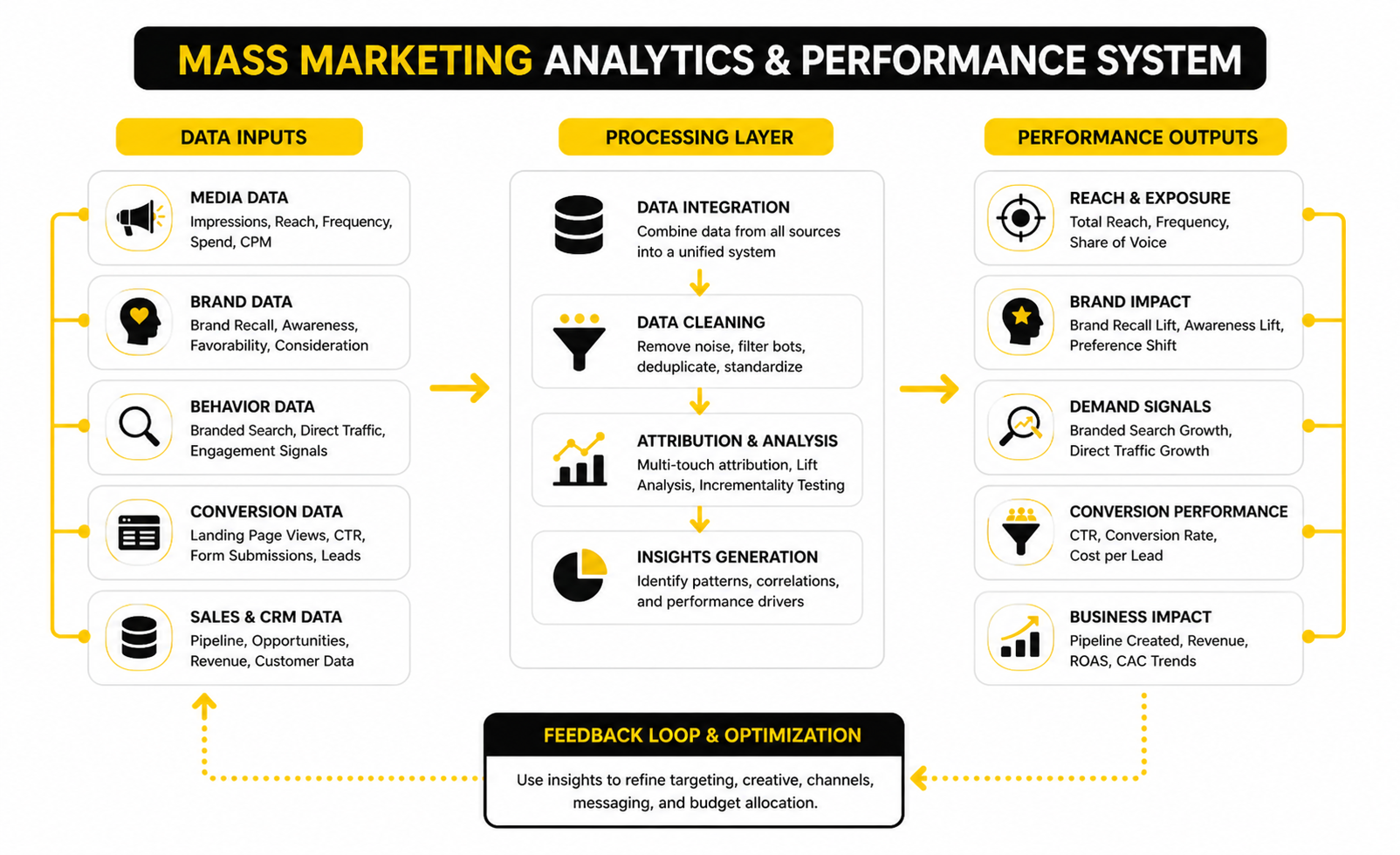
The system should also include feedback loops. Media data shows where exposure is happening. Brand data shows whether people remember the right thing. Behavior data shows whether interest is rising. Sales and CRM data show whether the campaign is turning into real business.
This is the big shift. Mass marketing should not be treated as a one-way broadcast. It should work like an ecosystem where broad attention feeds owned channels, sales conversations, search demand, community signals, and long-term brand strength.
What Is Mass Marketing?
Mass marketing is a strategy where a brand reaches a broad market with one clear message instead of building a separate campaign for every small segment. The goal is to make the brand widely recognizable, easy to remember, and connected to a specific buying situation. It works best when the message is simple, distinctive, and repeated consistently across channels.
Is Mass Marketing Still Effective?
Yes, mass marketing can still be effective when it is built around strategy, not just reach. The advertising environment has changed, but broad visibility still matters because most buyers are not ready to buy immediately. The IAB’s 2024 revenue report shows that digital advertising reached $259 billion in the U.S., which reinforces how much broad media investment has moved into digital environments.
How Is Mass Marketing Different From Targeted Marketing?
Mass marketing focuses on reaching a large relevant market with a consistent message. Targeted marketing focuses on adapting messages to narrower groups based on behavior, demographics, intent, or customer data. A strong strategy can use both: mass marketing builds memory across the market, while targeted marketing captures and nurtures people closer to action.
Does Mass Marketing Mean Ignoring Segmentation?
No, and this is an important distinction. Segmentation is useful for understanding the market, identifying buying situations, and shaping the offer. Mass marketing simply avoids turning every small segment into a completely separate public identity for the brand.
What Are The Main Benefits Of Mass Marketing?
The main benefits are reach, familiarity, brand recall, category recognition, and future demand creation. It can also make performance marketing more efficient because people are more likely to click, search, and convert when they already recognize the brand. Over time, a strong mass marketing strategy can make the business feel more established and easier to trust.
What Are The Biggest Risks Of Mass Marketing?
The biggest risks are wasted media spend, vague messaging, weak measurement, creative fatigue, and poor follow-up. Broad reach amplifies whatever is already there, whether that is clarity or confusion. If the message is weak or the conversion path is broken, mass marketing can become expensive very quickly.
What Metrics Should A Mass Marketing Campaign Track?
A serious campaign should track reach, frequency, brand recall, branded search, direct traffic, landing page engagement, leads, pipeline, sales lift, and customer acquisition cost trends. No single metric tells the full story. The best approach is to read exposure, memory, behavior, and revenue signals together.
How Long Does Mass Marketing Take To Work?
The timeline depends on the category, budget, buying cycle, creative quality, and existing brand awareness. Some behavior signals can appear quickly, such as branded search or direct traffic. Deeper effects like consideration, preference, pipeline quality, and acquisition efficiency usually need more time because the market has to repeatedly encounter and remember the brand.
Is Mass Marketing Only For Big Companies?
No, but smaller companies need to define “mass” more carefully. A local business, niche SaaS company, ecommerce brand, or agency does not need national reach to use the principles of mass marketing. It needs broad enough reach inside its relevant market to build recognition and trust.
Can Digital Channels Be Used For Mass Marketing?
Yes, digital channels can support mass marketing when they are used for reach, repetition, memory, and brand consistency. YouTube, connected TV, paid social, podcasts, newsletters, creator campaigns, and display can all play a role. The key is not whether the channel is digital or traditional; the key is whether it helps the brand become more memorable across the relevant market.
How Much Budget Should Go To Mass Marketing?
There is no universal budget split that works for every company. The right mix depends on growth stage, category maturity, margins, sales cycle, and existing demand. A company with weak awareness may need more brand investment, while a company with strong awareness but poor conversion may need to fix the capture system first.
What Makes A Mass Marketing Message Strong?
A strong message is easy to understand, easy to repeat, and connected to a real customer need. It should give the market one clear idea to remember. The message should also be supported by distinctive assets so people can recognize the brand quickly across different channels.
How Do You Know If Mass Marketing Is Working?
You know it is working when the right signals move in sequence. Reach expands, brand recall improves, branded search grows, direct traffic rises, sales conversations become warmer, and commercial metrics start improving over time. The exact pattern depends on the business, but the campaign should create visible movement beyond vanity impressions.
What Is The Best Channel For Mass Marketing?
There is no single best channel. The best channel is the one that reaches the relevant market with enough attention, frequency, and credibility to build memory. For some brands, that may be YouTube and paid social; for others, it may be podcasts, out-of-home, connected TV, creators, newsletters, or a combination.
Should Mass Marketing Include A Call To Action?
Yes, but the call to action should match the buyer’s stage. A broad awareness campaign does not always need an aggressive sales push, but it should make the next step easy for people who become curious. That could mean visiting the site, searching the brand, joining an email list, booking a demo, downloading a guide, or viewing a focused offer.
What Is The Difference Between Mass Marketing And Brand Marketing?
Mass marketing describes the reach strategy: speaking to a broad market with a unified message. Brand marketing describes the work of shaping perception, memory, trust, and preference. They often overlap because mass marketing is one of the ways brand marketing gets distributed at scale.
Can Mass Marketing Work In B2B?
Yes, especially in categories where buying cycles are long and multiple people influence the decision. B2B buyers are still people, and they still rely on memory, familiarity, trust, and reputation. Mass marketing in B2B usually means reaching the relevant professional market broadly, not trying to reach the entire population.
What Should A Company Fix Before Running Mass Marketing?
A company should fix its positioning, offer clarity, conversion path, follow-up process, and measurement setup before scaling broad reach. If the campaign creates interest but the website, sales process, or CRM cannot handle it, the business will waste demand. Mass marketing works best when the entire system is ready for attention.
Final Thoughts On Mass Marketing
Mass marketing is not outdated. Lazy mass marketing is outdated. The difference matters.
A strong mass marketing strategy is not about shouting at everyone. It is about choosing a relevant market, building one memorable association, distributing it consistently, and measuring the full chain from attention to revenue. Done well, it creates familiarity before the buying moment and makes every later conversion effort easier.
The companies that win with mass marketing are not always the ones with the biggest budgets. They are the ones with the clearest message, the strongest consistency, the best creative discipline, and the patience to build demand before they need to capture it. That is the professional way to use broad reach.
Build a stronger local presence with BAAM AI
Turn your website, Google profile, social channels, and AI visibility into one growth engine
Most businesses do not need more random marketing activity. They need a consistent presence system that helps the right people find them, trust them, and take action. BAAM AI brings strategy, local SEO, website updates, Google Maps visibility, social content, AI-search readiness, media production, and reporting into one practical monthly engine.
If you want your marketing to keep working after the campaign ends, start with a free BAAM AI presence audit. See how your business shows up today and where the fastest visibility wins are at BAAM AI.