
BAAM AI Blog
Marketing Mix 4P: A Practical Guide To Product, Price, Place, And Promotion
The marketing mix 4P framework is simple on the surface: product, price, place, and promotion. That simplicity is exactly why it has lasted. It gives marketers, founders, and operators a clean way to think through...
Affiliate disclosure: this article may include compensated links. Recommendations should still be evaluated against your use case, budget, and current provider terms.
Should you choose this tool?
this tool is worth considering when the use case, budget, and implementation effort match what you actually need to do next.
teams that want a practical tool decision without reading another generic feature list
Check this toolThe marketing mix 4P framework is simple on the surface: product, price, place, and promotion. That simplicity is exactly why it has lasted. It gives marketers, founders, and operators a clean way to think through what they are selling, who it is for, how it reaches the market, and why people should care.
The problem is that many teams treat the 4Ps like a classroom definition instead of a working decision system. They write down a product, pick a price, choose a few channels, run some ads, and call it strategy. That is where the framework gets misunderstood, because the marketing mix only works when all four parts support the same customer promise.
The original idea of the marketing mix was popularized by Neil Borden, then simplified into the four Ps by E. Jerome McCarthy in his 1960 book Basic Marketing: A Managerial Approach. Modern marketers still use it because the core business questions have not disappeared, even though the channels have changed. The American Marketing Association still frames the four Ps as product, price, place, and promotion, while newer research shows the mix has expanded in practice through personalization, digital distribution, and more fragmented customer journeys.
this guide will use the classic framework, but not in a dusty textbook way. We will connect the marketing mix 4P model to how people actually buy today: through search, marketplaces, ecommerce stores, social content, email, comparison pages, referrals, communities, sales calls, and in-person experiences. The point is not to worship the model. The point is to make better marketing decisions.
The full article is split into six parts:
Why The Marketing Mix 4P Still Matters
The marketing mix 4P framework matters because it forces you to connect strategy with execution. A brand can have beautiful creative, but if the product is unclear, the price feels wrong, or the buying path is painful, promotion will only expose the weakness faster. That is why the 4Ps are still useful: they make you inspect the whole offer, not just the campaign.
Customer behavior has also become more demanding. In PwC’s 2025 customer experience research, 52% of consumers said they stopped buying from a brand because of a bad product or service experience, and 29% stopped because of poor online or in-person customer experience. That is not just a customer service issue; it is a marketing mix issue because product quality, channel experience, pricing expectations, and communication all shape whether people stay or leave.
The framework also helps teams avoid random marketing. Without it, one team optimizes landing pages, another changes pricing, another runs ads, and another negotiates distribution without a shared logic. With it, every decision has to answer the same basic question: does this make the offer more desirable, accessible, credible, and profitable for the right customer?
The Marketing Mix 4P Framework At A Glance
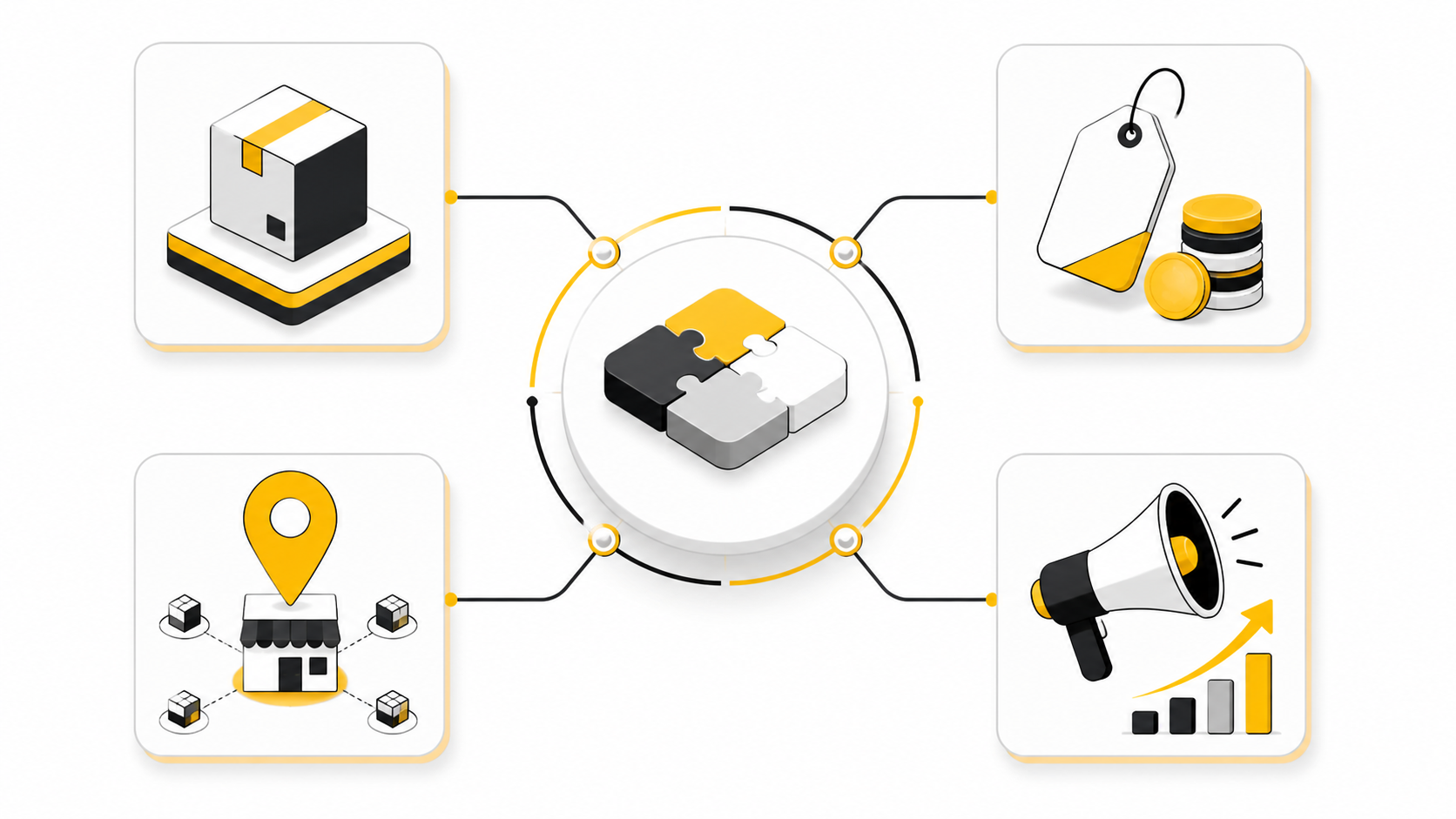
The four Ps are best understood as connected decisions, not separate boxes. Product defines what the customer gets and why it solves a meaningful problem. Price defines how value is exchanged, how the offer is positioned, and what kind of customer expectations the business creates.
Place defines where and how the customer can discover, evaluate, buy, receive, and use the offer. In modern marketing, that might include a retail shelf, a Shopify store, a marketplace, a booking page, a sales pipeline, or a landing page built with a tool like Replo. Promotion defines how the business communicates value through content, ads, email, messaging, partnerships, events, sales conversations, and follow-up.
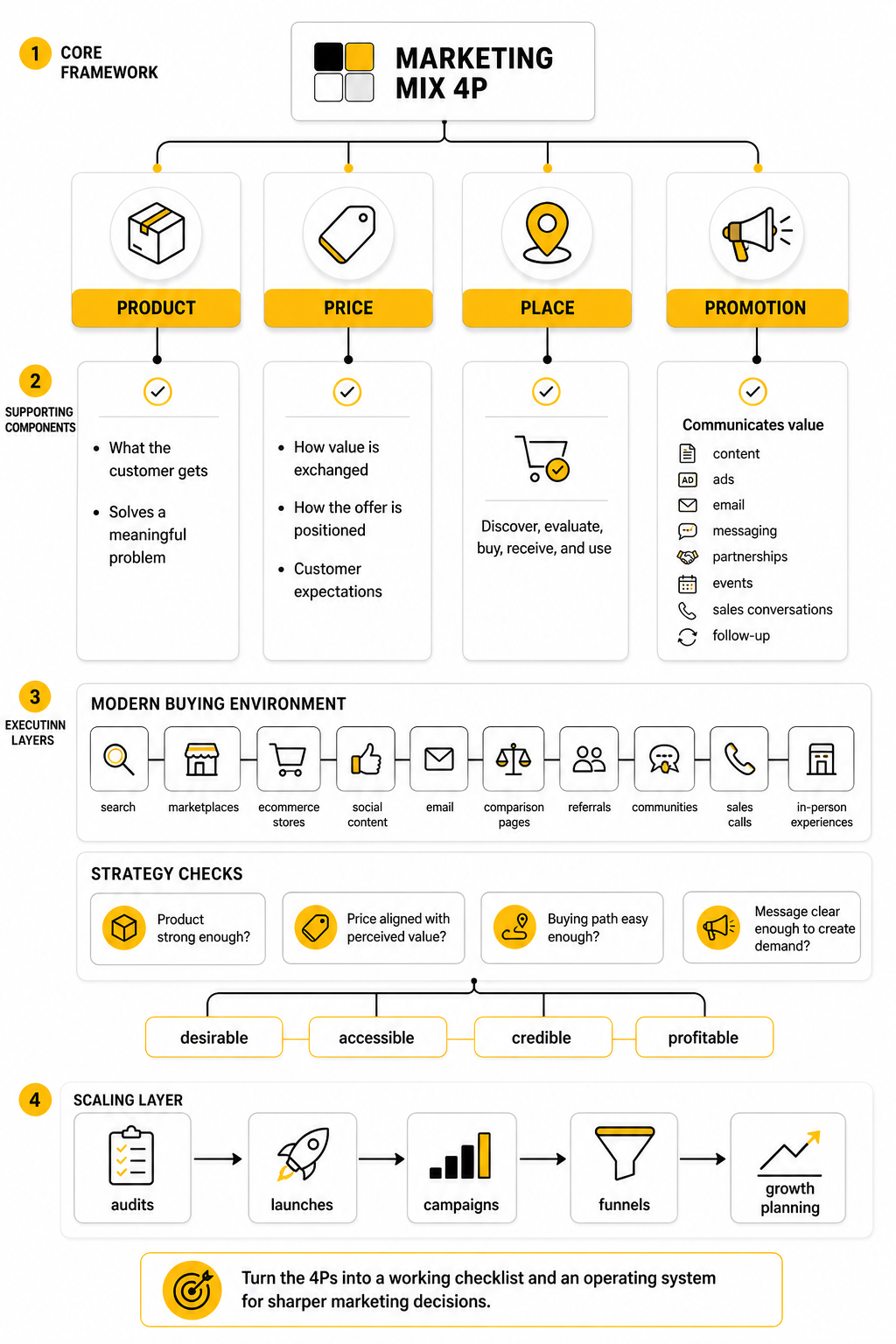
The reason the framework works is that it keeps marketing grounded in the offer itself. You are not just asking, “What should we post?” You are asking, “Is the product strong enough, is the price aligned with perceived value, is the buying path easy enough, and is the message clear enough to create demand?”
How The Six-Part Structure Will Build The Argument
This first part sets up the foundation: what the marketing mix 4P framework is, why it still matters, and how the rest of the article will use it. The next parts will go deeper into each decision area without repeating the same surface-level definitions. Each section will focus on how the framework works in practical marketing planning.
The product section will look at positioning, customer need, differentiation, packaging, and offer clarity. The price section will cover perceived value, pricing models, discounting, margins, and the way price changes the story customers tell themselves about a brand. The place and promotion sections will then connect distribution and demand generation, because modern buyers rarely move through one clean channel.
The final part will turn the framework into an implementation process. That is where the 4Ps become a working checklist for audits, launches, campaigns, funnels, and growth planning. The goal is simple: by the end, the marketing mix should feel less like a theory and more like a practical operating system for making sharper marketing decisions.
How The Four Ps Work Together
The marketing mix 4P framework works because each part changes the meaning of the others. A premium product with bargain pricing sends one message, while a premium product with controlled distribution and polished promotion sends another. A strong offer can still underperform if the place strategy makes it hard to buy, or if promotion creates expectations the product cannot meet.
That is why the four Ps should not be planned in isolation. Product decisions shape what people believe they are getting, price decisions shape how they judge value, place decisions shape convenience and trust, and promotion decisions shape attention and desire. When those decisions point in different directions, the customer feels the gap even if they cannot name it.
This is also why the 4Ps still fit modern marketing. The American Marketing Association describes the four Ps as the key factors in a marketing strategy: product, price, place, and promotion. The channels have changed, but the logic is still useful because every campaign still needs an offer, a value exchange, a route to market, and a message.
Product Sets The Promise
Product is not just the physical item, software feature, service package, or deliverable. It is the promise the customer believes they are buying. That promise includes the outcome, the quality, the positioning, the brand experience, the support, and the level of risk the buyer feels before saying yes.
This is where weak marketing usually starts. A team may think it has a promotion problem, but the real issue is often that the product is hard to understand, poorly differentiated, or not packaged around a clear customer need. When the product is vague, every other part of the marketing mix has to work harder.
A practical product question is simple: what must the customer believe this will help them do? If that answer is fuzzy, promotion becomes noisy and price becomes harder to defend. Strong marketing starts when the product promise is specific enough that the right customer can quickly recognize themselves in it.
Price Shapes Perceived Value
Price is not just a number on a checkout page or proposal. It tells the customer how to interpret the offer. A low price can reduce friction, but it can also make the product feel less serious if the market expects depth, quality, or expert support.
A high price can increase perceived value, but only when the product, proof, buying experience, and brand trust support it. Otherwise, the customer sees a mismatch. This is why pricing strategy belongs inside the marketing mix 4P conversation instead of being treated as a finance-only decision.
Price also affects who enters the customer base. Discounts may increase short-term conversions, but they can attract customers who are less committed, less profitable, or more likely to leave when the next cheaper option appears. A better question is not “What price will get the most clicks?” It is “What price supports the business model and still feels fair to the customer we actually want?”
Place Defines Access And Convenience
Place used to be easier to picture because it often meant retail shelves, distributors, sales reps, catalogs, or physical locations. Now it can mean search results, marketplaces, social commerce, landing pages, booking links, app stores, partner channels, affiliate programs, sales funnels, and automated follow-up. The principle is the same: customers must be able to find, evaluate, and buy the offer in a way that matches how they prefer to act.
This matters because convenience has become part of the product experience. A buyer may like the offer, understand the value, and trust the brand, but still leave if the path to purchase feels clunky. Research from Salesforce highlights how customer expectations now include consistent interactions across departments and personalized offers, which makes distribution and customer experience much harder to separate from marketing strategy: State of the Connected Customer.
For digital businesses, place often includes the systems that connect the customer journey. A service business might use GoHighLevel to manage funnels, forms, booking, follow-up, and pipeline stages in one environment. An ecommerce team might use Replo to build more focused landing pages for paid campaigns. The tool is not the strategy, but the right tool can make the place strategy easier to execute.
Promotion Turns The Offer Into Demand
Promotion is the visible part of the marketing mix, so it gets most of the attention. It includes advertising, content, email, social media, influencer partnerships, PR, webinars, sales outreach, retargeting, messaging, and launch campaigns. But promotion only works well when the other three Ps give it something real to say.
This is where many teams make expensive mistakes. They try to fix weak demand with more content, more ads, more posts, or more aggressive follow-up. Sometimes that works for a short burst, but it usually exposes the deeper issue: the product is not clear enough, the price does not match perceived value, or the buying path is not smooth enough.
Good promotion translates the product promise into language the customer already understands. It does not simply shout features. It connects the problem, the desired outcome, the reason to believe, and the next step in a way that feels obvious rather than forced.
Why Balance Matters More Than Volume
The marketing mix 4P framework is useful because it pulls teams away from volume thinking. More traffic does not automatically fix a weak offer. More discounts do not automatically create loyal customers. More content does not automatically create trust.
Balance matters because each P creates leverage for the others. A clearer product makes promotion easier. A more carefully price makes the offer easier to position. A better place strategy reduces friction. Better promotion brings the right people into the system instead of attracting anyone who will click.
That is the practical value of the framework. It gives you a way to diagnose marketing problems without guessing. Before increasing ad spend, changing creative, lowering prices, or rebuilding a website, you can ask which part of the mix is actually holding the strategy back.
Product: What You Sell And Why People Want It
Product is the first serious test of the marketing mix 4P framework because it defines the value the rest of the strategy has to carry. If the product is weak, unclear, or poorly matched to the market, the other three Ps become expensive compensation. Promotion may create attention, price may create urgency, and place may create access, but none of that fixes a product people do not understand or do not want enough.
A useful product strategy starts with the customer’s problem, not the company’s feature list. The question is not only “What does this product do?” The better question is “What progress does the customer believe this will help them make?” That shift matters because customers do not buy a product in isolation; they buy relief, status, speed, certainty, convenience, control, or a better version of their current situation.
This is where the 4Ps become practical instead of academic. Product decisions affect positioning, naming, packaging, guarantees, onboarding, customer support, and even the kind of content a brand should publish. If those choices are made casually, the business ends up with a product that may technically work but still feels hard to sell.
Start With The Customer Problem
A strong product strategy begins by naming the problem in the customer’s words. Not internal language. Not vague category language. The customer’s actual words, frustrations, doubts, and buying triggers.
This matters because clear demand usually forms around a specific pain or desire. A business owner does not wake up wanting “marketing automation.” They want missed leads followed up with, appointments booked, prospects nurtured, and sales conversations organized. That is why a platform like GoHighLevel fits naturally into the conversation when the customer problem is scattered lead management rather than software for its own sake.
The same applies to ecommerce. A shopper does not care that a landing page has a clever layout if the offer is confusing, the product benefits are buried, or the page fails to answer buying objections. Tools such as Replo can help teams build sharper product pages and campaign pages, but the strategic work still starts with understanding what the buyer needs to believe before they act.
Turn Features Into Customer Value
Features are important, but features are not the same as value. A feature describes what the product has. Value explains why that feature matters to the customer right now.
This distinction is where many product pages, pitch decks, and ads lose people. They list capabilities before they create relevance. The customer is left doing the translation alone, and that is risky because most buyers will not work that hard unless they already trust the brand.
A simple way to improve the product part of the marketing mix 4P framework is to translate every major feature into a practical outcome. “Automated follow-up” becomes “fewer leads slipping through the cracks.” “Drag-and-drop landing pages” becomes “faster campaign launches without waiting on developers.” “AI chat support” becomes “quicker answers for visitors who are not ready to book a call yet.” That is clearer, more useful, and much easier to promote.
Build The Product Around Proof
A product claim becomes stronger when the buyer can see proof before taking the risk. Proof can come from reviews, demos, comparisons, screenshots, certifications, case studies, samples, guarantees, transparent policies, or a clear explanation of how the product works. The format matters less than the job it does: reducing doubt.
This is not a small detail. PwC’s 2025 customer experience research found that 52% of consumers stopped buying from a brand because of a bad product or service experience, which means product trust is not just a conversion issue; it is a retention issue too. If the product experience disappoints after the sale, promotion has created a future churn problem instead of a growth engine.
Proof also has to match the buyer’s risk level. A low-cost impulse purchase may only need clear photos, reviews, and a simple return policy. A high-ticket service, SaaS platform, or B2B offer usually needs deeper evidence, better onboarding, and stronger sales enablement because the buyer is making a more consequential decision.
Make Packaging Easy To Understand
Product packaging is not only about physical boxes. It is also about plans, bundles, tiers, service levels, deliverables, onboarding paths, and the way the offer is presented. Good packaging makes the buying decision easier because the customer can quickly understand what they get, who it is for, and what to do next.
Bad packaging creates friction even when the product itself is good. Too many plans confuse buyers. Too few details create uncertainty. Vague bundles make people wonder whether the offer was built around their needs or simply assembled from whatever the business wanted to sell.
The goal is not to simplify everything into one generic package. The goal is to create enough clarity that each customer segment can recognize the best-fit option without needing a long explanation. That is especially important when promotion sends traffic to a landing page, pricing page, booking page, or funnel where the customer has limited patience.
A Practical Product Audit
The product part of the marketing mix becomes much easier to improve when you audit it in a structured way. Instead of debating opinions, walk through the customer’s decision path and look for weak points. The best audit asks whether the product is clear, desirable, believable, and easy to choose.
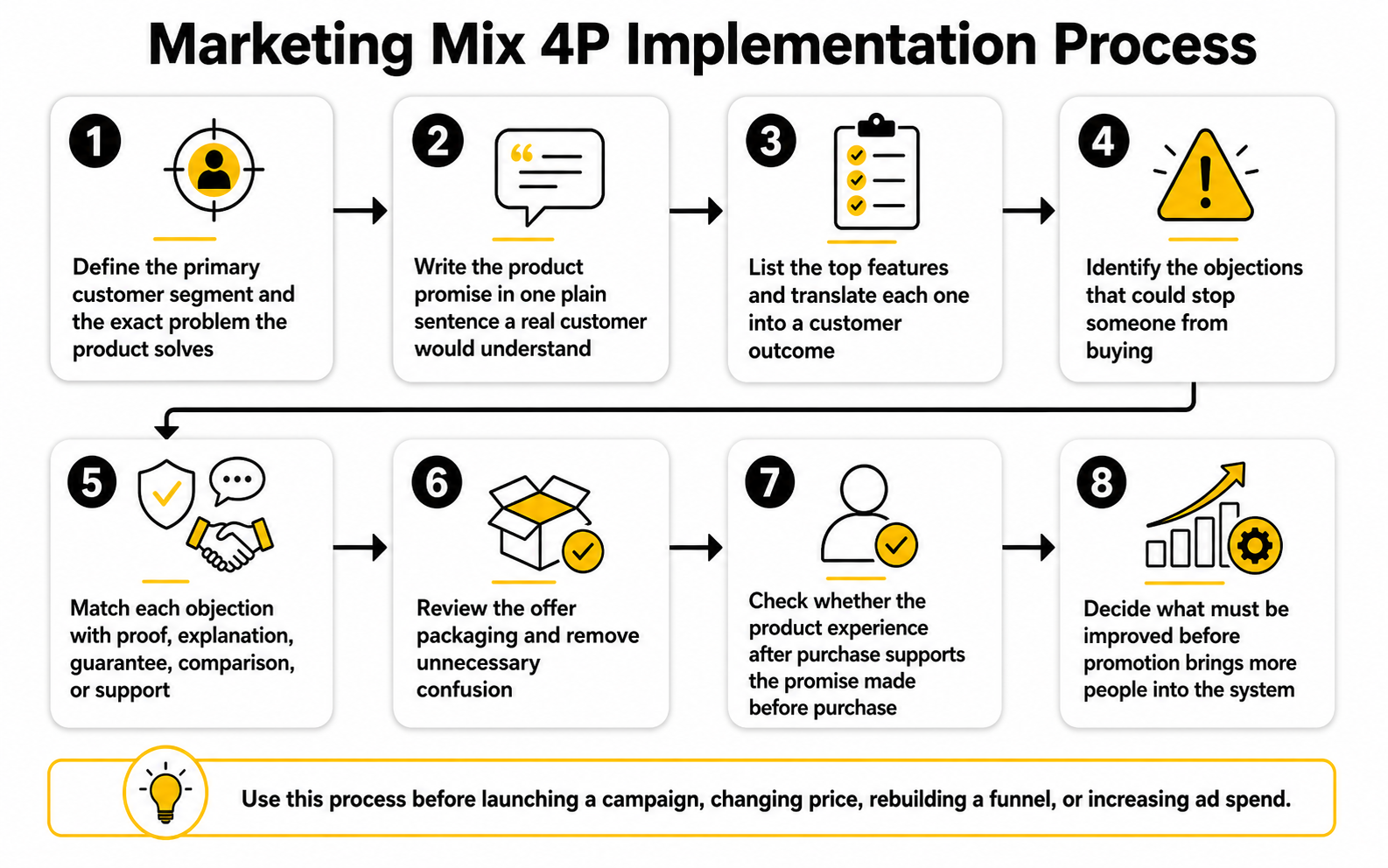
Use this process before launching a campaign, changing price, rebuilding a funnel, or increasing ad spend:
This process is useful because it keeps the team honest. It prevents promotion from becoming a cover-up for weak product clarity. It also gives marketers better raw material for ads, emails, landing pages, sales scripts, content, and onboarding because the core value is finally defined.
Connect Product Decisions To The Rest Of The Mix
Product decisions should immediately influence price, place, and promotion. If the product is positioned as premium, the pricing, sales experience, page design, support, and proof must support that premium claim. If the product is positioned as fast and simple, the buying path and onboarding should feel fast and simple too.
That alignment is where the marketing mix 4P framework becomes powerful. Product is not just the thing being marketed. It is the foundation that determines what kind of price feels reasonable, what channels make sense, and what message will feel believable.
The next step is price, because once the product promise is clear, the business has to decide how value will be exchanged. Price is where positioning becomes financially real. It tells the customer what kind of offer this is, and it tells the business what kind of growth model it can actually sustain.
Statistics And Data
Measurement is where the marketing mix 4P framework becomes real. Before this point, a team can still hide behind opinions: the product feels strong, the price seems fair, the channel looks promising, and the campaign sounds good. Data removes some of that comfort because it shows where customers actually move, hesitate, convert, complain, repeat, or disappear.
The mistake is treating marketing data like a pile of disconnected numbers. A conversion rate, click-through rate, refund rate, churn rate, cart abandonment rate, or sales close rate does not mean much by itself. The number only becomes useful when it is tied back to one of the four Ps and used to decide what to improve next.
That is the main job of analytics in the marketing mix. It should not just prove whether marketing “worked.” It should show whether the product promise is landing, whether the price matches perceived value, whether the buying path is easy enough, and whether promotion is attracting the right people.
Measure The Four Ps Separately Before You Judge The Whole Strategy
A weak result does not automatically mean the entire strategy is broken. If traffic is high but conversion is low, promotion may be creating attention while product clarity, price, or place is creating friction. If conversion is strong but retention is weak, the promotion may be promising more than the product experience can deliver.
Product measurement should focus on signals such as activation, repeat purchase, usage, reviews, support tickets, refund reasons, onboarding completion, and retention. These numbers show whether the offer is actually doing the job customers expected it to do. A strong product does not just sell once; it creates enough satisfaction that people continue, return, recommend, or expand.
Price measurement should look at conversion by price point, discount dependency, average order value, gross margin, sales cycle length, payment objections, and customer lifetime value. A cheap offer that converts but attracts low-quality customers may look good in a campaign dashboard and still damage the business. A premium offer that converts more slowly may still be healthier if it produces better margins, stronger retention, and higher customer commitment.
Benchmarks Are Useful, But Context Matters More
Benchmarks can help you spot whether a number is wildly off, but they should not become the strategy. A “good” conversion rate depends on the category, traffic source, price point, buyer intent, brand trust, sales process, and how much education the customer needs before buying. Comparing a high-ticket B2B service to a low-cost ecommerce product is not analysis; it is noise.
The same is true for channel benchmarks. Email, paid search, organic search, paid social, referrals, webinars, affiliates, and marketplace traffic all behave differently because they capture different levels of intent. A lower conversion rate from cold social traffic may still be profitable if the acquisition cost is low and the follow-up system is strong.
This is why a marketing mix 4P dashboard should separate diagnostic metrics from final business metrics. Diagnostic metrics show where friction is happening. Business metrics show whether the system is profitable and sustainable.
Build A Measurement System Around Customer Decisions
The cleanest way to measure the 4Ps is to map the customer journey from first contact to repeat purchase. At each stage, ask what the customer must believe or do before moving forward. Then connect that moment to the part of the marketing mix most responsible for it.
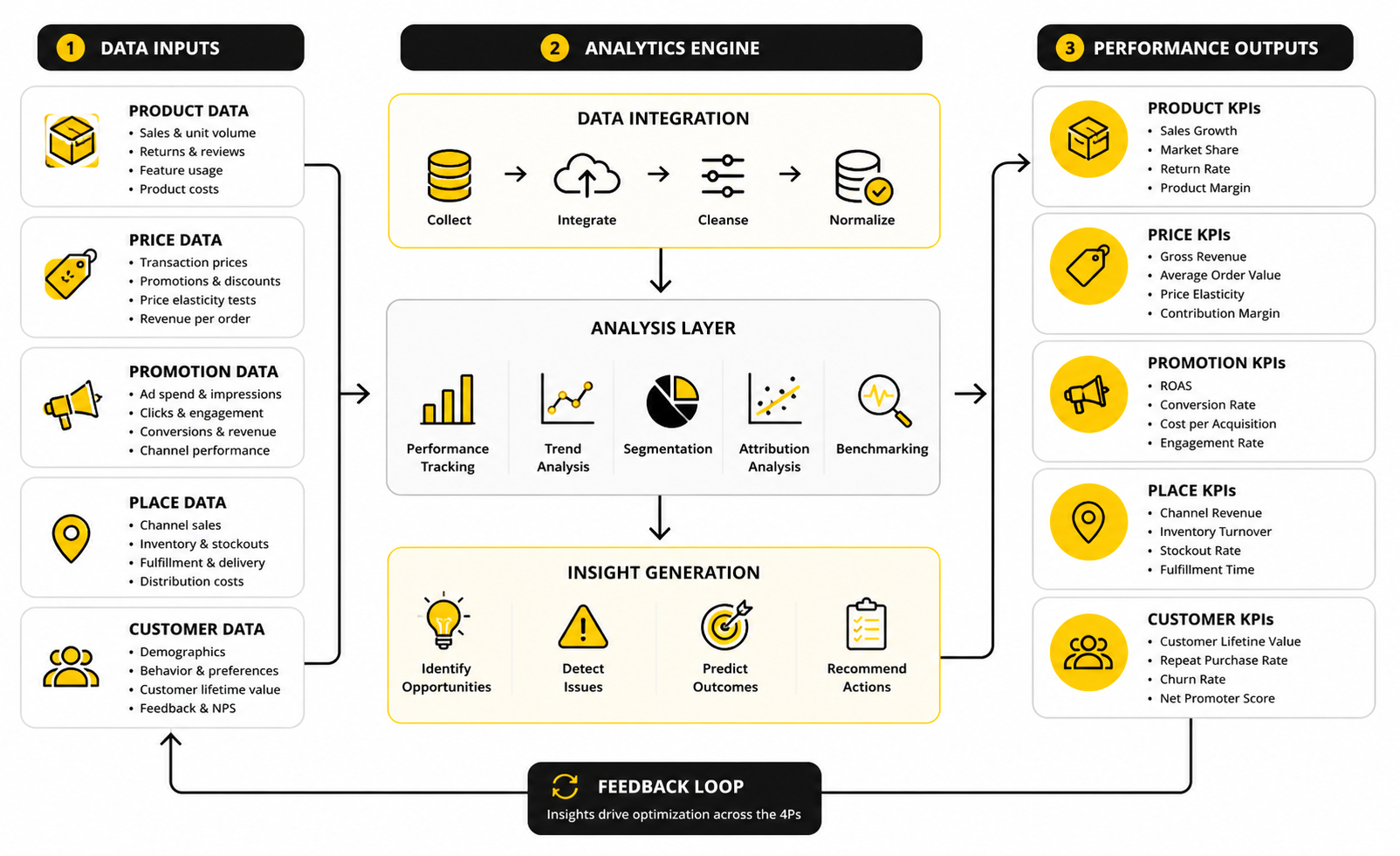
A practical measurement system can follow this sequence:
This approach prevents shallow reporting. Instead of saying “conversion is down,” the team can ask where the conversion drop is happening and which P is likely responsible. That is a much better conversation because it leads to action instead of blame.
What Product Data Usually Tells You
Product data shows whether the market believes the offer is valuable after the first impression. If people click, read, and ask questions but do not buy, the product promise may be unclear or poorly differentiated. If people buy but quickly complain, refund, or churn, the product experience may not match the promise.
Customer experience data matters here because product disappointment is expensive. In PwC’s 2025 customer experience research, 52% of consumers said they stopped buying from a brand because of a bad product or service experience. That number matters because it shows that product performance is not just an operations issue; it directly affects marketing efficiency.
The action is simple but not always easy. If product metrics are weak, do not rush to increase promotion. Fix the promise, packaging, onboarding, support, proof, or product experience first, because more traffic will only create more disappointed customers faster.
What Price Data Usually Tells You
Price data shows whether customers believe the value exchange is fair. If prospects engage deeply but stop at the pricing page, the issue may be perceived value, not the number itself. If discounts dramatically increase sales but reduce margins and retention, the business may be training buyers to wait rather than creating real demand.
The key is to compare price behavior against customer quality. A lower price that brings more buyers may look attractive until you measure support load, refund rate, churn, fulfillment cost, and repeat purchase. A higher price may reduce total conversions but improve profit if it attracts customers who are more serious, better fit, and easier to serve.
Price testing should be handled carefully because price changes can affect brand perception. Do not test price in a vacuum. Test the full value presentation: offer structure, guarantee, proof, bonus, payment terms, onboarding, comparison, and the language used to explain the outcome.
What Place Data Usually Tells You
Place data shows whether customers can access the offer without unnecessary friction. In digital marketing, this often means landing page speed, navigation, checkout completion, form completion, booking rate, sales handoff, delivery experience, and channel fit. The buyer may want the product and accept the price, but still leave if the path feels slow, confusing, or risky.
Digital friction is not a minor issue. Contentsquare’s 2025 digital experience benchmark reporting warns that almost half of online visits continue to be affected by preventable friction. That matters because paid traffic becomes more expensive when the journey wastes attention that already cost money to acquire.
The action is to inspect the path like a customer, not like a marketer. Remove unnecessary fields. Clarify the next step. Make the page answer the obvious objections. If the offer depends on appointments, make scheduling easy with a tool such as Cal.com. If the offer depends on lead capture, use a cleaner form flow with a tool such as Fillout.
What Promotion Data Usually Tells You
Promotion data shows whether the message is reaching the right people and creating the right kind of demand. Clicks, impressions, views, open rates, replies, booked calls, trial starts, and assisted conversions all help explain how attention is turning into action. But promotion metrics can easily mislead when they are separated from revenue and customer quality.
A campaign with a high click-through rate may still attract the wrong people. A campaign with fewer leads may be stronger if those leads close faster, buy higher-value offers, and stay longer. This is why promotion should be measured beyond top-of-funnel engagement.
Email is a good example. MoEngage’s 2025 email benchmark research notes that event-triggered and personalized emails can materially outperform generic batch campaigns. The lesson is not “send more emails.” The lesson is to connect promotion to customer behavior, timing, and intent so the message feels useful instead of random.
The Metrics That Actually Deserve Attention
The best 4P measurement setup keeps the dashboard tight. Too many metrics create false sophistication and slow decisions. The goal is to track enough to diagnose the system without drowning the team in reports.
For most businesses, these signals matter more than vanity numbers:
These metrics work because they connect behavior to decisions. They show whether people understand the offer, trust the value, can buy easily, and respond to the message. That is what measurement should do.
Turn Data Into Action
Data only matters when it changes what you do next. If the product has weak retention, improve the experience before scaling traffic. If price objections are common, strengthen proof and value framing before cutting the price. If place metrics show friction, fix the buying path before blaming the ads.
This is where the marketing mix 4P framework becomes a practical operating rhythm. Review the numbers, identify the weakest part of the mix, make one focused improvement, and measure again. Do not change everything at once unless the system is clearly broken across the board.
The best teams use measurement to make calmer decisions. They do not panic when one campaign dips, and they do not celebrate too early when one metric rises. They look for the pattern behind the numbers, connect it to the right part of the mix, and improve the system one decision at a time.
Advanced Tradeoffs In The Marketing Mix
Once the basics are working, the marketing mix 4P framework becomes less about definitions and more about tradeoffs. You are no longer asking whether you have a product, price, place, and promotion. You are asking which choices create leverage and which choices quietly create risk.
That is where the framework becomes more valuable for serious operators. Growth usually creates pressure on the mix. A channel that worked early may become too expensive, a price that helped win first customers may limit profitability, and a product that felt focused may become bloated after too many customer requests.
The advanced work is not to optimize every part equally. The advanced work is knowing which P deserves attention right now, which one should stay stable, and which one should not be touched because changing it would confuse the market.
The Risk Of Optimizing One P Too Hard
Every part of the mix can become dangerous when it is optimized in isolation. A product team can add features until the offer becomes harder to explain. A pricing team can raise margins until the sales process becomes heavier. A channel team can chase distribution until the brand appears in places that reduce trust.
Promotion creates the same risk. If the business pushes too aggressively into paid traffic, affiliate campaigns, discounts, or automation before the offer is stable, it may scale the wrong behavior. More reach does not automatically mean stronger positioning.
This is why advanced marketing mix 4P strategy requires constraint. Do not ask each team to maximize its own metric. Ask whether the combined system creates profitable customers who understand the offer, buy for the right reason, and stay long enough for the business model to work.
Scaling Changes The Meaning Of Product
At a small scale, product feedback is often close and personal. Founders, marketers, and customer-facing teams can hear objections directly and adjust fast. As the business grows, the same product has to communicate value through pages, onboarding flows, help docs, demos, reviews, and customer success systems.
That shift changes the role of product marketing. The product can no longer depend on one strong salesperson, founder explanation, or manual onboarding call to make sense. The promise has to be embedded into the experience itself.
This is especially important for software, ecommerce, and service businesses where customers compare alternatives quickly. If the product needs too much explanation before the value is clear, the business will struggle as traffic becomes colder and the audience becomes less forgiving.
Pricing Becomes A Positioning Decision
Price becomes more strategic as the business matures. Early pricing often exists to create momentum, win proof, or reduce friction. Later pricing has to support margin, service quality, acquisition costs, retention, and the brand’s long-term position.
This is where discounting deserves real caution. Discounts can be useful for launches, seasonal campaigns, bundles, and specific segments, but they can also train customers to wait. Once buyers learn that urgency is artificial, promotion loses power and full-price demand becomes harder to rebuild.
A better advanced pricing move is often to improve the value architecture instead of simply lowering the number. That can mean stronger guarantees, clearer tiers, better onboarding, annual plans, premium support, usage-based options, or bundles that make the offer easier to justify. For funnel-driven offers, tools like ClickFunnels or Systeme.io can help test offer structure, but the strategic decision is still about value, not just page mechanics.
Channel Expansion Can Dilute The Offer
Place becomes more complicated when the business adds channels. A brand may start with direct sales, then add partners, marketplaces, affiliates, retailers, social commerce, or automated funnels. Each new channel increases reach, but it also changes how the customer experiences the offer.
The risk is inconsistency. Different channels may explain the product differently, promote different incentives, serve different customer expectations, or create different levels of support burden. If the same offer feels premium in one channel and cheap in another, the market gets mixed signals.
Channel expansion should therefore be treated as a controlled strategic move. Before adding a new place to sell or distribute, ask whether the channel matches the product promise, supports the price, and gives promotion a believable context. If not, reach may increase while brand clarity decreases.
Promotion Gets Harder When Attention Gets More Expensive
Promotion is usually the first lever teams want to scale, but it becomes harder as attention gets more competitive. The easy audience gets reached early. The next layer may need more education, better proof, stronger creative, sharper segmentation, and a more patient follow-up system.
That pressure is showing up in budgets too. Gartner’s 2025 CMO Spend Survey found that marketing budgets remained flat at 7.7% of overall company revenue, which means many teams are expected to create growth without simply adding more spend. That matters because weak promotion cannot always be solved with bigger budgets anymore.
The more carefully move is to improve promotion quality before increasing volume. Better segmentation, stronger offers, clearer landing pages, triggered email, lifecycle messaging, retargeting, and sales follow-up can make the same traffic more productive. Tools such as Brevo, Moosend, or ManyChat can support that system when the strategy is clear.
When Automation Helps And When It Hurts
Automation can make the marketing mix more efficient, but it can also make bad decisions happen faster. Automated follow-up is useful when the message is relevant, the timing is right, and the customer has shown real intent. It becomes annoying when it pushes the same generic pitch to everyone.
The same logic applies to AI, chatbots, enrichment tools, and campaign workflows. They should reduce friction, improve response time, personalize the journey, or help the team act on signals faster. They should not replace the hard thinking behind product positioning, pricing logic, channel fit, or message quality.
A practical rule is simple: automate the repeatable parts of a strategy that already works. Do not automate confusion. If the offer is unclear, the audience is poorly defined, or the follow-up message is weak, automation only turns small problems into larger ones.
The Hidden Risk Of Misalignment
The most dangerous marketing mix problem is not always poor performance. It is misalignment that still produces some sales. That kind of problem can hide for months because the business is growing, but the quality of growth is getting worse.
For example, a brand may attract customers through heavy discounts while trying to build a premium position. A SaaS company may promote simplicity while onboarding requires too many manual steps. A service business may promise high-touch support while using systems that make clients feel ignored.
These gaps matter because they weaken trust. The customer does not care which department caused the mismatch. They only experience the brand as one system, so the marketing mix has to be managed as one system too.
How To Make Better Strategic Decisions
Advanced use of the 4Ps is about sequencing. Do not try to fix everything at once. Decide which part of the mix has the biggest constraint on growth, then focus there until the constraint moves.
Use this decision path:
This sequence keeps the work grounded. It prevents teams from jumping straight to ads when the product needs clarity, cutting prices when proof is weak, or rebuilding the website when the real problem is poor channel fit.
Protect The Core While Testing The Edges
Scaling a marketing mix does not mean changing everything. The strongest brands protect the core promise while testing around it. They may test new messages, channels, offers, bundles, pages, and follow-up sequences, but they do not constantly reinvent what the brand stands for.
That balance matters because markets need consistency before they build memory. If the product promise changes every month, customers cannot easily explain why the brand matters. If pricing changes constantly, customers may stop trusting the offer.
The better approach is disciplined experimentation. Keep the strategic foundation stable, then test specific variables with a clear reason. That is how the marketing mix 4P framework stays useful as the business grows: it gives you enough structure to scale without losing the customer’s trust.
How To Implement The 4Ps In A Real Marketing Strategy
The final step is turning the marketing mix 4P framework into a system the team can actually use. Not a slide deck. Not a vague brand workshop. A practical operating rhythm that connects decisions, execution, measurement, and improvement.
Start by treating the four Ps as one connected ecosystem. Product defines the promise, price defines the value exchange, place defines access, and promotion defines demand. When those parts support each other, marketing feels coherent to the customer and easier to manage for the team.
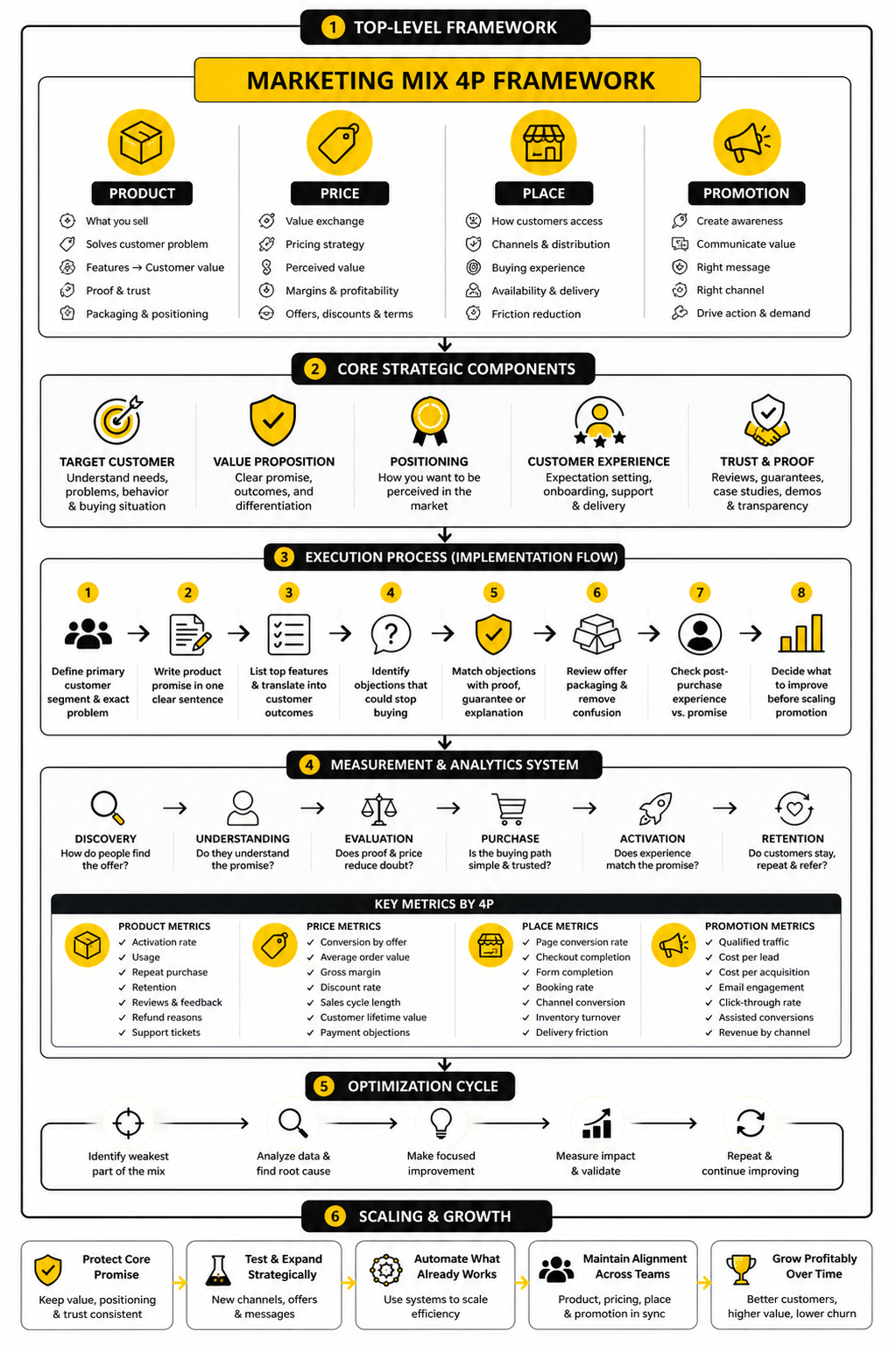
A useful implementation rhythm looks like this:
This is the practical version of the 4Ps. It gives you a way to make decisions without guessing, and it helps teams avoid the classic trap of solving every marketing problem with more traffic.
Make The 4Ps A Team Habit
The marketing mix should not live only with the marketing team. Product, sales, customer success, leadership, finance, and operations all affect the way customers experience the offer. If each team makes decisions separately, the customer ends up feeling the gaps.
A simple quarterly review can keep the mix aligned. Ask what changed in the market, what changed in customer behavior, what changed in the economics, and what changed in performance. Then decide whether the next improvement belongs to product, price, place, or promotion.
This is also where tools should support the system instead of replacing it. A CRM, funnel builder, email platform, landing page builder, chatbot, or analytics tool can make execution cleaner. But the strategy still has to come first, because software cannot fix a confused offer.
What is the marketing mix 4P framework?
The marketing mix 4P framework is a classic marketing model built around product, price, place, and promotion. It helps businesses decide what they sell, how they price it, where customers can buy it, and how they communicate its value. The framework is useful because it connects strategy with execution instead of treating marketing as only advertising.
Why is the marketing mix 4P still relevant today?
The 4Ps are still relevant because every business still has to manage an offer, a value exchange, a distribution path, and a message. Digital channels have changed how those decisions are executed, but they have not removed the decisions themselves. In fact, the framework can be even more useful now because customer journeys are more fragmented.
What are the four Ps in marketing?
The four Ps are product, price, place, and promotion. Product is what the customer receives and the problem it solves. Price is how value is exchanged, place is how the customer accesses the offer, and promotion is how the business creates awareness, interest, and action.
Which of the four Ps is most important?
No single P is always the most important. The priority depends on the constraint in the business. If customers do not understand the offer, product positioning may matter most; if they hesitate at checkout, price or proof may be the issue; if they cannot buy easily, place needs work; and if not enough qualified people enter the system, promotion may be the bottleneck.
How do you use the marketing mix 4P in a real campaign?
Use the framework before building the campaign. Define the product promise, confirm the target customer, check whether the price fits the value, choose the right channel, and then write the promotion around the customer’s problem. A campaign performs better when the offer, price, buying path, and message all support the same idea.
How does product affect the rest of the marketing mix?
Product affects everything because it defines the promise the business is making. If the product is unclear, price becomes harder to justify, promotion becomes harder to write, and place becomes harder to optimize. A strong product strategy gives the rest of the mix better raw material.
How does price influence customer perception?
Price tells customers how to interpret the offer. A low price can reduce friction, but it can also make the product feel less valuable if the market expects quality, depth, or expert support. A high price can support premium positioning, but only when the product, proof, brand, and buying experience justify it.
What does place mean in digital marketing?
In digital marketing, place means every environment where the customer can discover, evaluate, buy, receive, or use the offer. That can include a website, marketplace, landing page, app, booking page, sales funnel, partner channel, email flow, or social commerce experience. The goal is to make access feel natural and low-friction.
What is the role of promotion in the 4Ps?
Promotion turns the offer into demand. It includes advertising, content, email, social media, partnerships, webinars, PR, sales outreach, and follow-up. Promotion works best when it communicates a clear product promise to the right audience through the right channel at the right moment.
How often should a business review its marketing mix?
A business should review its marketing mix whenever performance changes, a new product launches, pricing changes, a major channel is added, or customer behavior shifts. A quarterly review is a practical rhythm for most teams. Fast-moving businesses may need a lighter monthly check to catch friction earlier.
What is the biggest mistake businesses make with the 4Ps?
The biggest mistake is treating the four Ps as separate tasks. A team may improve ads while ignoring product clarity, cut prices while ignoring proof, or add channels while ignoring customer experience. The framework works best when the four parts are managed as one system.
How do analytics fit into the marketing mix 4P framework?
Analytics show which part of the mix needs attention. Product data can reveal satisfaction or retention issues, price data can show value objections, place data can expose buying friction, and promotion data can show whether the right people are entering the journey. The point is not to collect more numbers; it is to make better decisions.
Can small businesses use the marketing mix 4P framework?
Small businesses can use the 4Ps very effectively because the framework keeps decisions focused. A small team may not need a complicated strategy document, but it still needs clarity around the offer, price, channel, and message. The framework helps avoid scattered marketing and wasted effort.
Is the marketing mix 4P enough for modern marketing?
The 4Ps are a strong foundation, but they are not the whole picture. Modern marketing also needs customer experience, data, retention, personalization, brand trust, and lifecycle strategy. The 4Ps work best when they are used as the base layer for a broader customer-centered system.
How do you know which P to fix first?
Look for the strongest evidence of friction. If people do not understand the offer, fix product positioning. If they understand but hesitate, inspect price and proof. If they want to buy but drop off, improve place. If the system converts well but lacks volume, improve promotion.
Build a stronger local presence with BAAM AI
Turn your website, Google profile, social channels, and AI visibility into one growth engine
Most businesses do not need more random marketing activity. They need a consistent presence system that helps the right people find them, trust them, and take action. BAAM AI brings strategy, local SEO, website updates, Google Maps visibility, social content, AI-search readiness, media production, and reporting into one practical monthly engine.
If you want your marketing to keep working after the campaign ends, start with a free BAAM AI presence audit. See how your business shows up today and where the fastest visibility wins are at BAAM AI.