
BAAM AI Blog
Marketing Digital Marketing: A Practical Framework For Modern Growth
Marketing digital marketing is not a separate universe from traditional marketing. It is the part of marketing where strategy, customer research, positioning, content, paid media, data, automation, and conversion...
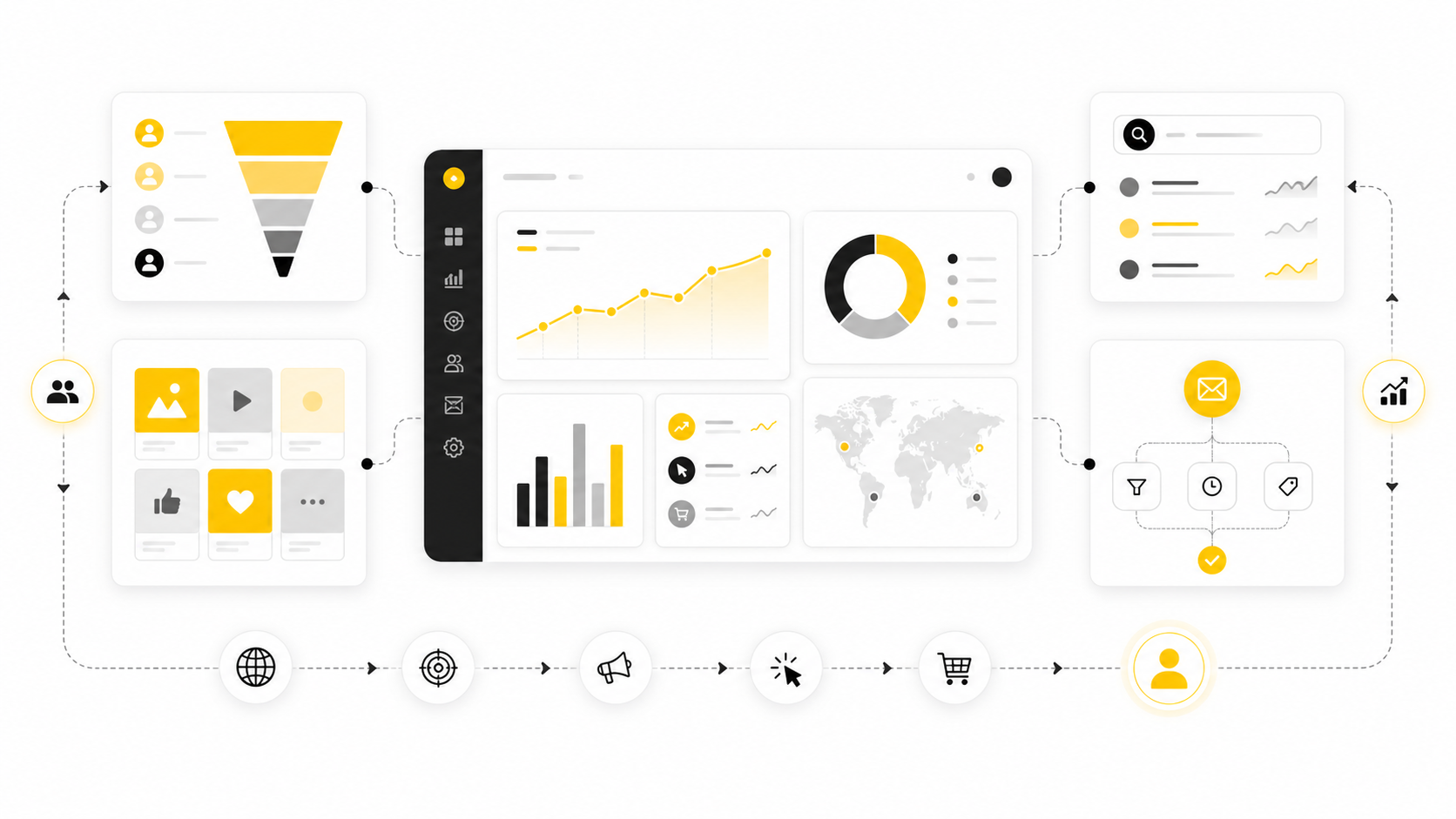
Marketing digital marketing is not a separate universe from traditional marketing. It is the part of marketing where strategy, customer research, positioning, content, paid media, data, automation, and conversion systems all meet inside digital channels. Done well, it helps a business become easier to discover, easier to trust, and easier to buy from.
The problem is that most teams do not fail because they ignore digital channels. They fail because they treat every channel as a separate tactic. Search gets one plan, social gets another, email gets another, ads get another, and the customer gets a fragmented experience that feels inconsistent from the first click to the final purchase.
That gap matters because digital is now where a huge share of attention, research, and buying intent lives. Global internet use has passed 5 billion people, social platforms remain deeply embedded in daily discovery, and U.S. internet advertising revenue reached a record $294.6 billion in 2025. Meanwhile, Gartner’s 2025 CMO Spend Survey found that digital channels account for 61.1% of total marketing spend, which means this is not a side activity anymore.
this guide breaks marketing digital marketing into a practical operating system, not a pile of random tactics. The goal is simple: understand what digital marketing is, why it matters, how the main components fit together, and how professionals build campaigns that actually support revenue. If you want a clean mental model before choosing tools, channels, budgets, or content formats, start here.
Why Marketing Digital Marketing Matters Now
Marketing digital marketing matters because buyer behavior has become more connected, more impatient, and more research-driven. People do not move neatly from awareness to purchase in a straight line. They search, compare, watch videos, read reviews, ask communities, click ads, abandon carts, come back through email, and sometimes make a decision weeks after the first interaction.
That creates a major advantage for businesses that build a coherent digital system. A strong digital marketing setup lets you show up when someone is problem-aware, educate them when they are comparing options, capture demand when they are ready to act, and continue the relationship after the sale. This is why digital marketing should not be reduced to “posting content” or “running ads.”
It also creates pressure. Paid online channels now dominate many marketing budgets, and Gartner reported that paid online channels account for 69% of total digital spend. That means the average business is not competing against amateurs anymore; it is competing against teams that use data, creative testing, automation, landing pages, CRM workflows, and measurement systems to improve every step of the funnel.
The Digital Marketing Framework
The simplest way to understand marketing digital marketing is to see it as four connected layers: strategy, traffic, conversion, and retention. Strategy defines who you serve, what problem you solve, why you are different, and what offer should be presented. Traffic brings the right people into the system through channels like search, social, email, paid media, creators, partnerships, and referrals.
Conversion turns attention into action. That includes landing pages, lead magnets, product pages, checkout flows, sales calls, forms, chat, email sequences, and follow-up systems. Retention keeps the relationship alive through onboarding, customer education, lifecycle email, community, upsells, reviews, loyalty, and referrals.
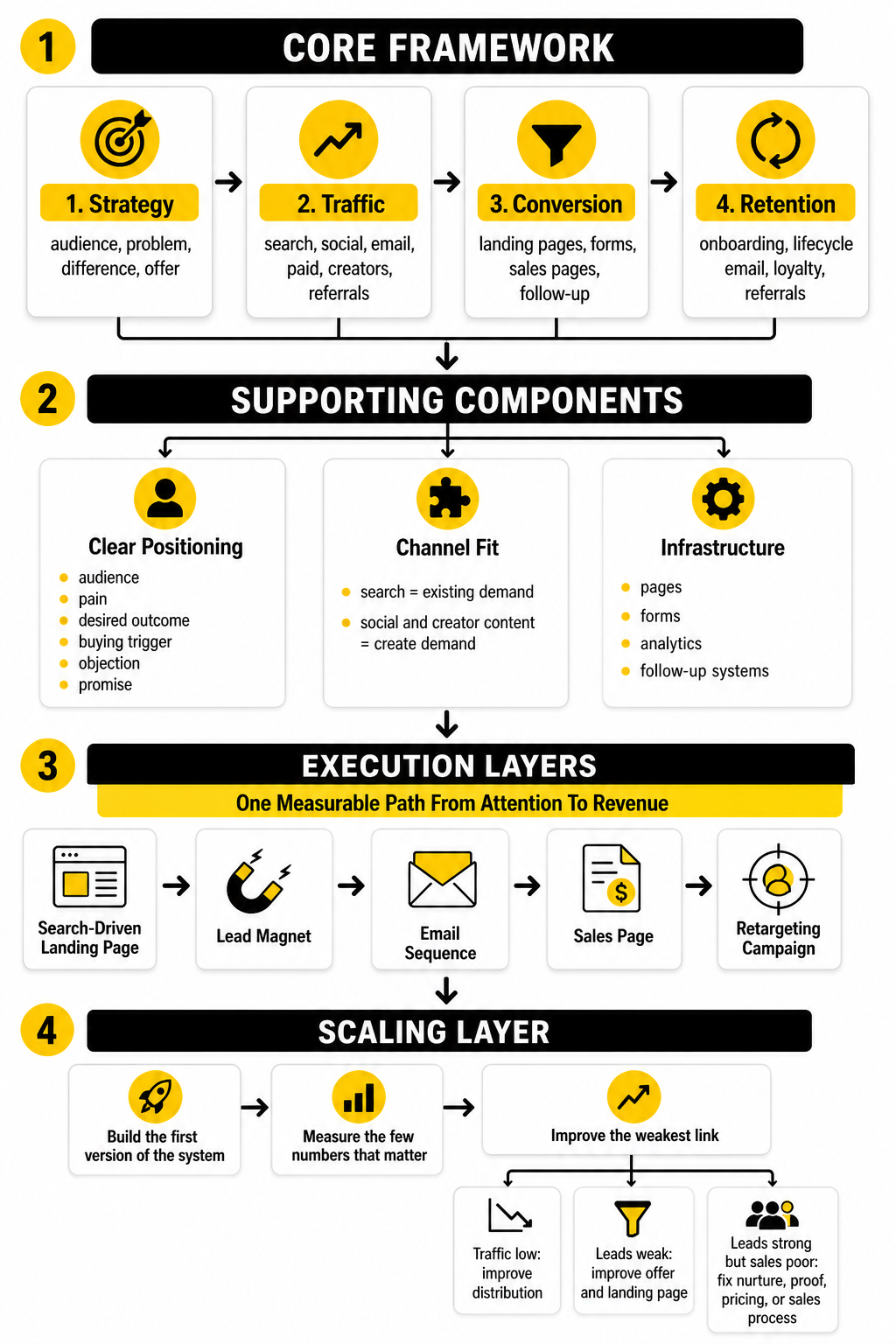
This framework is useful because it stops you from overvaluing one channel. A business can have great traffic and weak conversion, which usually creates expensive growth. It can have strong conversion and weak retention, which creates constant pressure to acquire new customers. It can also have good tools but weak strategy, which turns the whole system into organized noise.
Core Components Of A Modern Digital Marketing System
A modern digital marketing system starts with clear positioning. Before choosing platforms or tools, you need to know the audience, the pain, the desired outcome, the buying trigger, the objection, and the promise your brand can make honestly. Without that foundation, every campaign becomes harder because the message is vague.
The second component is channel fit. Search works well when people already know they have a problem and are actively looking for answers. Social and creator-led content often work better when demand needs to be created, reframed, or made more emotionally visible, which is why creator marketing has become a serious media channel rather than a novelty.
The third component is infrastructure. You need pages that load well, forms that capture leads, analytics that explain what is happening, and follow-up systems that keep prospects moving. Tools can help here, but they should support the system rather than replace strategy; for example, a CRM and automation platform like GoHighLevel only becomes valuable when the offers, pipeline stages, messages, and follow-up logic are already thought through.
Professional Implementation Starts With One Clear System
Professional implementation is not about doing everything at once. It is about building one measurable path from attention to revenue, then improving it deliberately. That might mean one search-driven landing page, one lead magnet, one email sequence, one sales page, and one retargeting campaign before expanding into more channels.
This is where many businesses get digital marketing wrong. They add more activity before they understand what is already working. More posts, more ads, more tools, and more dashboards do not automatically create growth if the core path from visitor to customer is unclear.
A better approach is to build the first version of the system, measure the few numbers that matter, and improve the weakest link. If traffic is low, work on distribution. If leads are weak, improve the offer and landing page. If leads are strong but sales are poor, fix the nurture, proof, pricing, or sales process before blaming the channel.
Advanced Strategy, Tradeoffs, And Scaling Risks
Once the basic system is working, the hard part changes. Early marketing digital marketing is about finding a path that can create leads, sales, or pipeline. Advanced digital marketing is about deciding what to scale, what to protect, what to automate, and what to deliberately ignore.
This is where discipline matters. A campaign can look promising and still break when you increase spend. A channel can produce leads and still attract the wrong customers. Automation can save time and still damage trust if it makes the brand feel lazy, generic, or too aggressive.
Scaling is not just doing more. Scaling means increasing output without lowering quality, increasing reach without weakening targeting, and increasing automation without losing the human judgment that made the system work in the first place.
The Tradeoff Between Brand And Performance
Performance marketing gives fast feedback. You can see clicks, conversions, costs, and revenue quickly, which makes it tempting to put every dollar into channels that show immediate results. That is useful, but it can also make the business too dependent on short-term demand capture.
Brand marketing works differently. It builds memory, trust, preference, and familiarity before the buyer is ready to act. Nielsen’s 2025 Annual Marketing Report emphasizes the need to balance short-term performance goals with a stronger long-term brand presence, especially as marketers try to measure campaigns across fragmented media environments Nielsen.
The practical answer is not “brand or performance.” It is both, with clear roles. Performance channels should convert active demand efficiently, while brand and education channels should make future demand easier to win. If you only harvest existing demand, you eventually run into a ceiling.
The Risk Of Over-Automation
Automation is useful when it removes repetition, speeds up follow-up, and keeps the customer journey consistent. It becomes dangerous when it replaces relevance. A fast bad message is still a bad message.
AI has made this tradeoff sharper. McKinsey has described how AI-driven personalization and generative AI can help marketers create more relevant promotions, messages, and experiences at greater speed McKinsey. That is powerful, but it also raises the standard because buyers are now surrounded by more automated content than ever.
The rule is simple: automate the process, not the thinking. Use automation for routing, reminders, segmentation, reporting, lead nurturing, and operational consistency. Keep human judgment in the offer, positioning, proof, tone, and customer insight.
Privacy And First-Party Data Are Strategic Issues
Privacy is no longer a legal footnote. It affects targeting, attribution, personalization, retargeting, analytics, and the way brands build trust. If your growth system depends entirely on borrowed platform data, you are exposed.
The IAB’s 2025 State of Data report describes how signal loss has pushed the industry toward first-party data, alternative IDs, and data clean rooms IAB. Even when platform policies change or timelines shift, the strategic direction is clear: businesses need stronger direct relationships with their audiences.
That means email lists, customer accounts, CRM data, purchase history, surveys, preference centers, community engagement, and direct conversations matter more than ever. A platform can help you reach people. First-party data helps you understand them and continue the relationship without starting from zero every time.
Scaling Content Without Diluting Trust
Content scaling sounds simple until quality drops. Publishing more articles, posts, emails, or ads can create reach, but volume without judgment creates sameness. The internet already has enough generic advice.
The better approach is to scale from a strong content system. Start with core ideas that come from real customer questions, sales objections, product insights, market shifts, and campaign data. Then turn those ideas into multiple formats without changing the underlying point.
For example, one strong customer objection can become a short social post, a sales enablement note, a landing page section, an email, a comparison angle, and a retargeting ad. That is smart repurposing. Copying the same thin idea across every channel is not.
Scaling Paid Media Without Burning Budget
Paid media is one of the fastest ways to expose a weak system. When spend is low, mistakes can hide. When spend rises, weak creative, broad targeting, poor landing pages, slow follow-up, and unclear offers become expensive very quickly.
The first scaling question should be whether the unit economics work. You need to understand cost per acquisition, close rate, average order value, gross margin, payback period, retention, and lifetime value. Without those numbers, increasing spend is not scaling; it is gambling with a dashboard.
Creative also becomes a scaling constraint. Paid channels often fatigue faster than teams expect, especially when the same angles are shown repeatedly to the same audience. A mature system needs a creative testing rhythm, not a one-time ad launch.
When To Add More Channels
Adding channels feels like growth, but it often creates complexity before the business is ready. Every new channel needs strategy, content, creative, measurement, operations, and review. If the current channel is not understood, adding another one usually spreads the team thinner.
A new channel makes sense when one of three things is true. First, your current channel is working and you have the capacity to expand. Second, your buyer journey clearly shows a gap that the current channel cannot fill. Third, platform risk is too high and you need more diversified acquisition.
Do not add channels just because competitors are there. Competitors can be wrong, under-measured, or operating with different economics. Your channel mix should come from customer behavior, business model, and execution capacity.
Tool Stack Decisions Should Follow The Operating Model
A tool stack should support the way the business sells, not force the business into someone else’s workflow. Before choosing tools, define the operating model. How do leads enter the system? Who follows up? What happens after a booking? Where does customer data live? What reports are needed every week?
For a service business, an all-in-one CRM and automation platform like GoHighLevel can make sense when lead capture, pipeline management, follow-up, reputation, and reporting need to live close together. For funnel-led campaigns, ClickFunnels or Systeme.io can be practical when the priority is launching offers quickly.
The danger is buying tools to feel productive. A new platform will not fix weak positioning, unclear offers, poor follow-up, or messy measurement. Tools should reduce friction in a system that already makes sense.
AI Should Improve Workflow, Not Replace Strategy
AI is becoming part of the marketing workflow, but the best use cases are not magic. They are practical. AI can help with research synthesis, first-draft copy, segmentation ideas, customer support flows, reporting summaries, creative variations, and faster testing cycles.
Salesforce’s State of Marketing research highlights how marketers are adapting around AI, data, personalization, and changing customer expectations Salesforce. The opportunity is real, but AI works best when it has strong inputs: clear positioning, useful customer data, specific prompts, brand standards, and human review.
The risk is that everyone starts sounding the same. If AI is used to generate generic content from generic prompts, it creates generic marketing. The advantage goes to teams that feed AI real customer insight, sharp positioning, strong examples, and a clear editorial standard.
The Strategic Risk Of Platform Dependence
Every digital marketing channel has platform risk. Search algorithms change. Social reach shifts. Ad costs rise. Email deliverability changes. Marketplace rules tighten. A channel that works today can become harder tomorrow.
That does not mean you should avoid platforms. It means you should avoid being trapped by them. The safest growth systems turn rented attention into owned relationships whenever possible.
This is why email lists, CRM records, customer communities, direct traffic, brand search, referrals, and repeat purchases are so valuable. They reduce dependence on one algorithm or ad account. A mature marketing digital marketing system uses platforms for reach, but builds assets the business can keep.
Expert-Level Guidance For Sustainable Growth
The strongest digital marketing teams make fewer random moves. They know what audience they serve, what promise they make, what channels matter, what numbers define progress, and what constraints are currently limiting growth. That clarity is a competitive advantage.
They also know when not to scale. If the offer is still unclear, do not scale traffic. If the sales team cannot handle lead volume, do not scale lead generation. If retention is poor, do not celebrate acquisition. Growth that exposes operational weakness is not real growth yet.
The next level is simple, but not easy: improve the system before you increase pressure on it. Better positioning makes every channel work harder. Better pages make every click more valuable. Better follow-up makes every lead less fragile. Better retention makes every acquisition dollar more powerful.
Build a stronger local presence with BAAM AI
Turn your website, Google profile, social channels, and AI visibility into one growth engine
Most businesses do not need more random marketing activity. They need a consistent presence system that helps the right people find them, trust them, and take action. BAAM AI brings strategy, local SEO, website updates, Google Maps visibility, social content, AI-search readiness, media production, and reporting into one practical monthly engine.
If you want your marketing to keep working after the campaign ends, start with a free BAAM AI presence audit. See how your business shows up today and where the fastest visibility wins are at BAAM AI.