
BAAM AI Blog
Marketing Collateral: The Practical Guide To Assets That Help Buyers Say Yes
Marketing collateral is every asset your business uses to explain value, build trust, answer objections, and move a prospect closer to action. It can be a landing page, sales deck, case study, product one-pager...
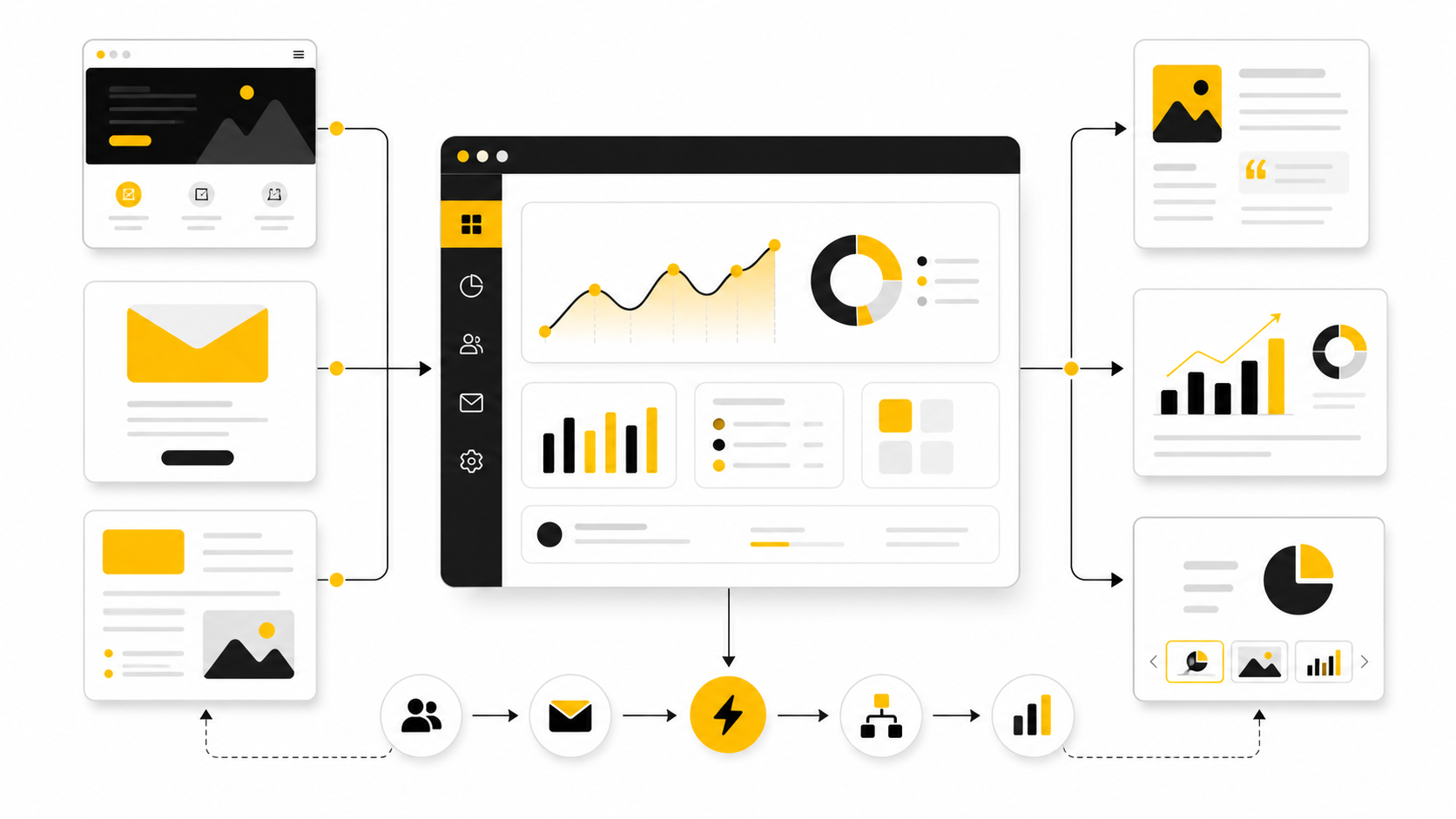
Marketing collateral is every asset your business uses to explain value, build trust, answer objections, and move a prospect closer to action. It can be a landing page, sales deck, case study, product one-pager, comparison page, email sequence, brochure, demo script, webinar, proposal, or onboarding guide. The format matters, but the job matters more: strong marketing collateral makes the buying decision easier.
That matters because buyers do not wait for sales teams to educate them anymore. Modern B2B buyers are increasingly self-directed, and Forrester’s research on business buying shows that large purchase decisions now involve more people, more digital research, and more dissatisfaction when the buying process feels hard to navigate: Forrester’s State of Business Buying research. In plain English, your collateral is often doing the selling before your sales team ever gets a meeting.
Good collateral is not “more content.” More content can actually make the buyer’s job harder if every asset says the same thing in a slightly different way. The goal is a connected system of assets that gives the right person the right proof at the right moment, whether they are discovering the problem, comparing options, getting internal approval, or trying to justify the purchase.
Marketing Collateral And Why It Matters
Marketing collateral matters because trust is now built across many small interactions, not one perfect pitch. A buyer might read a blog post, scan a pricing page, download a checklist, watch a short demo, compare alternatives, and forward a one-page summary to their team before they ever book a call. If those assets feel disconnected, the buyer has to do the work your marketing should have done.
The best collateral reduces friction. It clarifies the problem, explains the solution, supports the claim with proof, and makes the next step obvious. That is why high-performing content teams focus less on random publishing and more on useful assets tied to business goals, a pattern reflected in the Content Marketing Institute’s latest B2B benchmark research: B2B Content Marketing Benchmarks, Budgets, and Trends.
It also matters because AI has made average content easier to produce. Salesforce’s current marketing research highlights how teams are pushing harder into AI, data, and personalization: State of Marketing Report. That raises the bar, because buyers will see more assets, more messages, and more automated follow-up than ever. Your collateral has to be sharper, more specific, and more useful than the generic material flooding the market.
The Real Job Of Marketing Collateral
The real job of marketing collateral is not to make the company look busy. It is to move a buyer from confusion to clarity. Every asset should answer a question the buyer already has or remove a reason they might delay the decision.
That means collateral should be built from buyer intent, not internal preference. A founder might want a beautiful brochure, while the sales team actually needs a comparison sheet that explains why the product is different. A marketing team might want more lead magnets, while prospects may need a better demo page, clearer pricing context, or stronger proof that the solution works.
This is where many businesses waste time. They create assets because competitors have them, not because the buyer journey requires them. Strong marketing collateral starts with the buying decision and works backward.
Framework Overview
A useful marketing collateral framework has four layers: message, asset, journey stage, and distribution. The message defines what the buyer needs to believe. The asset packages that message into a format the buyer can use. The journey stage determines when the asset should appear. Distribution makes sure it actually reaches the buyer instead of sitting forgotten in a folder.
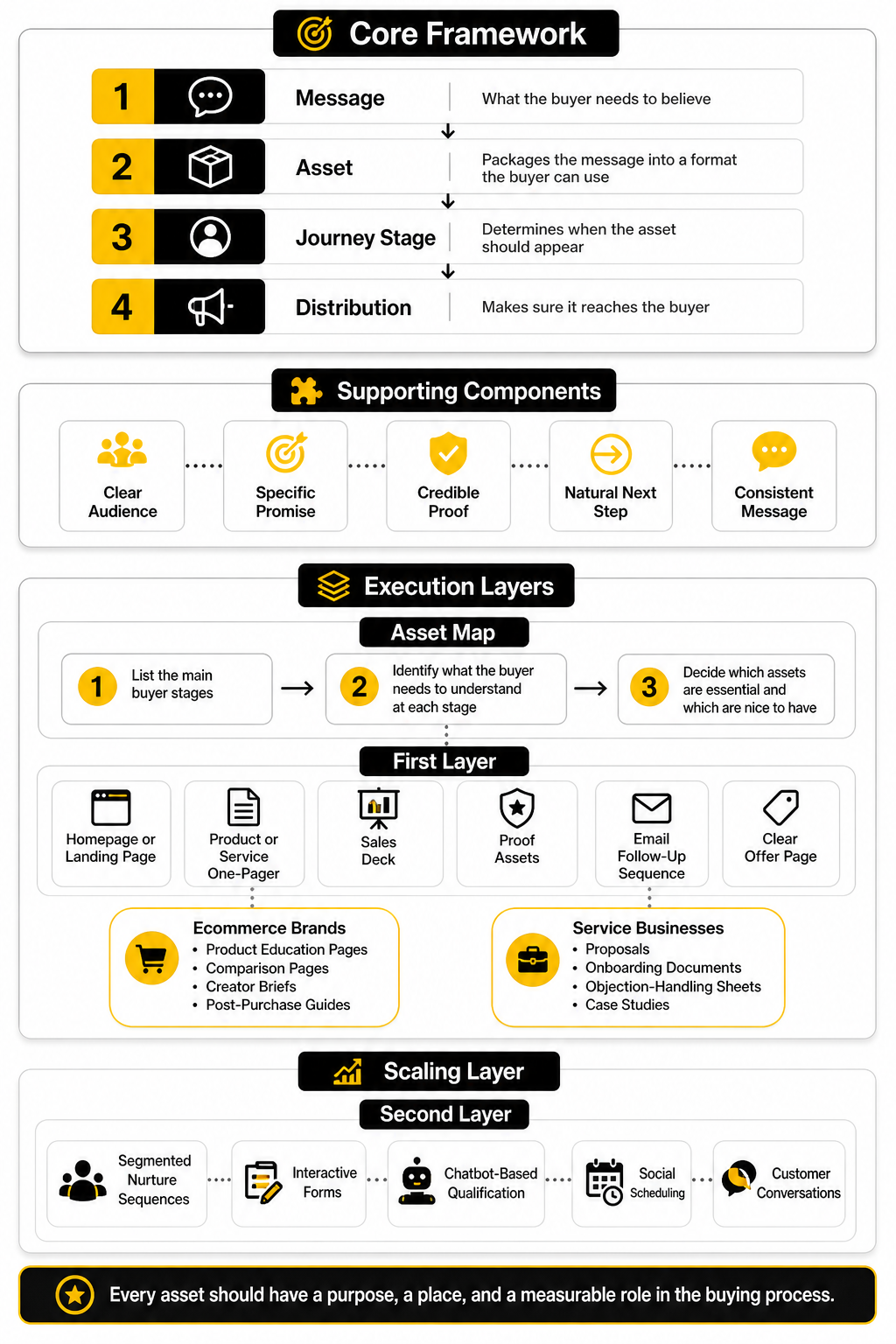
This framework keeps collateral practical. A case study is not automatically valuable; it is valuable when it helps a skeptical buyer believe the outcome is possible. A landing page is not automatically strategic; it is strategic when it speaks to a specific audience, offers a clear promise, and creates a clean path to the next action.
The same logic applies to tools. A funnel builder like ClickFunnels, an all-in-one CRM and automation platform like GoHighLevel, or an email platform like Brevo can help distribute collateral, but the tool cannot fix weak positioning. The asset has to be useful before automation can make it perform.
Core Components Of Effective Marketing Collateral
Effective marketing collateral has five core components: a clear audience, a specific promise, credible proof, a natural next step, and a consistent message. When one of those pieces is missing, the asset usually feels vague. It may look polished, but it will not help the buyer make progress.
The audience must be specific enough that the asset can speak directly to real concerns. A CFO, marketing manager, agency owner, and ecommerce founder may all care about growth, but they do not evaluate risk in the same way. The best collateral respects those differences instead of forcing everyone through the same generic message.
The promise and proof must work together. A bold claim without evidence feels like hype, while proof without a clear promise feels like a random fact. HubSpot’s 2025 marketing research points to the same broader shift: marketers are trying to combine AI, content, and more human messaging because attention is harder to earn and generic content is easier to ignore: 2025 State of Marketing.
Professional Implementation
Professional implementation starts with an asset map. List the main buyer stages, then identify what the buyer needs to understand at each stage. From there, decide which assets are essential and which ones are just “nice to have.”
For most businesses, the first layer should include a strong homepage or landing page, a product or service one-pager, a sales deck, a few proof assets, an email follow-up sequence, and a clear offer page. Ecommerce brands might also need product education pages, comparison pages, creator briefs, and post-purchase guides. Service businesses may need proposals, onboarding documents, objection-handling sheets, and case studies.
The second layer is where teams can get more sophisticated. They can build segmented nurture sequences, interactive forms through tools like Fillout, chatbot-based qualification with Chatbase, social scheduling through Buffer, or customer conversations through ManyChat. The principle stays the same: every asset should have a purpose, a place, and a measurable role in the buying process.
The Marketing Collateral Framework
A strong marketing collateral system starts before the asset is created. Most weak collateral fails because the team jumps straight into format: “We need a deck,” “We need a PDF,” or “We need a new landing page.” That skips the real question, which is what the buyer needs to understand before they can confidently take the next step.
The framework is simple: define the buyer, define the decision, define the proof, define the asset, then define the handoff. This keeps collateral grounded in the buying process instead of internal guessing. It also prevents teams from producing polished material that nobody uses because it does not answer a real question.
This matters even more in self-directed buying environments. Gartner’s B2B buying research highlights that many buyers prefer a rep-free experience, but purely digital self-service journeys can increase purchase regret when buyers do not get enough guidance: B2B buying journey research. That is exactly where marketing collateral should work hardest. It should make the buyer feel informed, not abandoned.
Step 1: Define The Buyer
The first step is deciding who the asset is really for. Not the broad audience. Not “small businesses” or “marketing teams” or “founders.” The asset needs to speak to a specific buyer with a specific pressure.
A founder wants speed, leverage, and clarity. A marketing manager wants campaign performance, brand consistency, and fewer bottlenecks. A sales leader wants assets that help reps handle objections, shorten cycles, and keep deals moving. The same product can serve all three, but the same collateral rarely convinces all three equally well.
This is why audience research is not a nice extra. It is the foundation. The Content Marketing Institute’s 2025 B2B research found that the most successful B2B content marketers are far more likely to credit their results to understanding their audience: B2B content marketing benchmarks. Good collateral starts with that understanding and turns it into useful buying support.
Step 2: Define The Decision
Every piece of marketing collateral should connect to a decision. The decision might be small, like whether to keep reading, download a guide, compare pricing, book a demo, or reply to an email. It might also be bigger, like whether to shortlist your company, recommend it internally, or approve the budget.
This is where teams often get too vague. “Educate the market” sounds strategic, but it is not specific enough to shape a useful asset. A better goal would be: help ecommerce founders understand why their product pages are not converting, then show them what a stronger page structure looks like.
Once the decision is clear, the asset gets easier to build. A landing page can focus on one promise. A sales deck can follow the buyer’s real objection path. A one-pager can give internal champions the exact language they need to explain the value to someone else.
Step 3: Define The Proof
Proof is what turns marketing collateral from opinion into confidence. It can come from customer results, product data, testimonials, third-party research, screenshots, demos, benchmarks, certifications, or transparent process explanations. The right proof depends on the buyer’s risk.
A buyer making a low-risk decision may only need a clear benefit and a simple next step. A buyer making a high-risk decision needs more support. They need to know whether the solution works, whether the company is credible, whether implementation will be painful, and whether they can defend the choice internally.
Trust is not automatic. Edelman’s 2025 brand trust research shows that people increasingly use generative AI tools to research brands, compare options, and summarize reviews before making decisions: 2025 Brand Trust report. That means your proof assets need to be clear enough for humans and structured enough to survive the way buyers now research.
Step 4: Define The Asset
Only after the buyer, decision, and proof are clear should you choose the format. This keeps the team from creating assets because they look impressive instead of because they solve a real problem. Format follows function.
If the buyer needs a quick internal explanation, a one-page summary may beat a long report. If they need confidence before a demo, a focused comparison page may work better than a generic brochure. If they need to understand a process, a short walkthrough video or annotated landing page can make the message easier to absorb.
This is also where the tech stack should support the strategy. A page builder such as Replo can help ecommerce teams create sharper landing pages, while ClickFunnels can help package offers into guided funnel flows. Those tools are useful when the message is already strong. They are not a substitute for knowing what the buyer needs to believe.
Step 5: Define The Handoff
Marketing collateral does not live in isolation. It usually moves between channels, people, and moments. A prospect might first see a social post, then land on a page, then receive an email, then join a call, then forward a PDF to a colleague.
That handoff needs to feel smooth. The language should stay consistent, the promise should not change, and each asset should build on the previous one instead of starting from scratch. When the handoff is messy, buyers feel like they are dealing with different versions of the same company.
This is where many revenue teams lose momentum. Marketing creates assets that sales cannot find. Sales creates their own materials that drift away from the brand message. Customer success sends onboarding content that does not match what was promised during the sale. A professional collateral system closes those gaps.
How The Framework Works In Practice
The practical version of the framework is a simple planning sequence. Start with the buyer’s stage, then write the question they are asking, then choose the asset that answers it best. This gives every asset a reason to exist.
For example, early-stage buyers may ask, “Do I even have this problem?” That calls for educational content, diagnostic checklists, explainer pages, or short videos. Mid-stage buyers may ask, “Which solution should I trust?” That calls for comparison pages, case studies, product walkthroughs, and proof assets. Late-stage buyers may ask, “Can I justify this decision?” That calls for ROI summaries, implementation plans, security information, pricing clarity, and internal buy-in documents.
The point is not to create all of these at once. The point is to stop treating marketing collateral like a random content library. Build the assets that remove the biggest buying friction first.
Awareness Assets
Awareness assets help people recognize a problem, name it clearly, and understand why it matters. These assets should not rush the sale. They should make the buyer feel more carefully and more aware of what is costing them time, money, attention, or growth.
Strong awareness collateral includes practical guides, short educational videos, social posts, checklists, research-backed articles, and diagnostic tools. The tone should be helpful, not desperate. At this stage, the buyer is often not ready for a hard pitch, so the asset earns attention by being useful.
This is a good place for simple distribution tools. Teams can use Buffer to keep educational content moving across social channels, or Flick Social to support social planning and hashtag research. The asset still needs substance, but consistent distribution helps the right people actually see it.
Consideration Assets
Consideration assets help buyers compare options. This is where clarity becomes more important than volume. The buyer is now asking whether your approach is credible, different, and relevant to their situation.
Strong consideration collateral includes comparison pages, product sheets, case studies, webinars, buyer guides, demo pages, and objection-handling content. The mistake here is pretending competitors do not exist. Buyers are comparing you anyway, so you may as well help them compare honestly.
Good consideration collateral should make tradeoffs clear. Who is the product best for? Who is it not best for? What does it replace? What does it integrate with? What does success look like after 30, 60, or 90 days?
Decision Assets
Decision assets help the buyer feel safe saying yes. These assets are less about broad education and more about removing risk. The buyer may already like the offer, but they still need confidence before committing.
This is where proposals, pricing explainers, ROI summaries, implementation timelines, onboarding previews, security documents, and internal business cases become useful. The asset should give the buyer language they can use with other stakeholders. It should also reduce the fear that the purchase will create unexpected work.
For service businesses and agencies, tools like GoHighLevel can support this stage by connecting CRM follow-up, proposals, appointment booking, and automated nurture in one place. For simpler funnel and email setups, Systeme.io can be a practical option. The important thing is that the system supports the decision instead of overwhelming the buyer.
The Framework Test
A marketing collateral asset should pass five tests before it goes live. First, it should be clear who it is for. Second, it should answer a real buyer question. Third, it should include enough proof for the level of risk involved. Fourth, it should tell the buyer what to do next. Fifth, it should fit naturally into the larger journey.
If an asset fails one of these tests, fix it before publishing. Do not rely on design to cover weak thinking. A beautiful PDF that does not help the buyer decide is still a weak asset.
This is the standard that keeps collateral useful. Not every asset needs to be long, expensive, or heavily produced. But every asset needs a job.
Core Marketing Collateral Assets
Once the framework is clear, the next step is building the actual collateral library. This is where strategy becomes practical. You are no longer asking, “Should we make content?” You are asking, “Which assets will help buyers move forward with less doubt?”
The strongest collateral libraries are not huge. They are focused. They cover the moments where buyers need clarity, proof, comparison, reassurance, or a clean next step. That is the standard to use when deciding what to create first.
A good implementation process starts with the assets closest to revenue. Build the pages, decks, one-pagers, emails, and proof materials that support active buying conversations before spending weeks on lower-priority content. This keeps the work tied to outcomes instead of turning marketing collateral into a design exercise.
The Implementation Process
A professional collateral process should feel boring in the best way. It should be clear, repeatable, and easy for the team to follow. Creative work still matters, but the process stops every asset from becoming a custom project with no structure.
The basic process has six steps. Audit what already exists, map the buyer journey, prioritize the highest-friction moments, create or improve the assets, connect them to distribution, then measure how they perform. That gives the team a practical loop instead of a one-time content push.
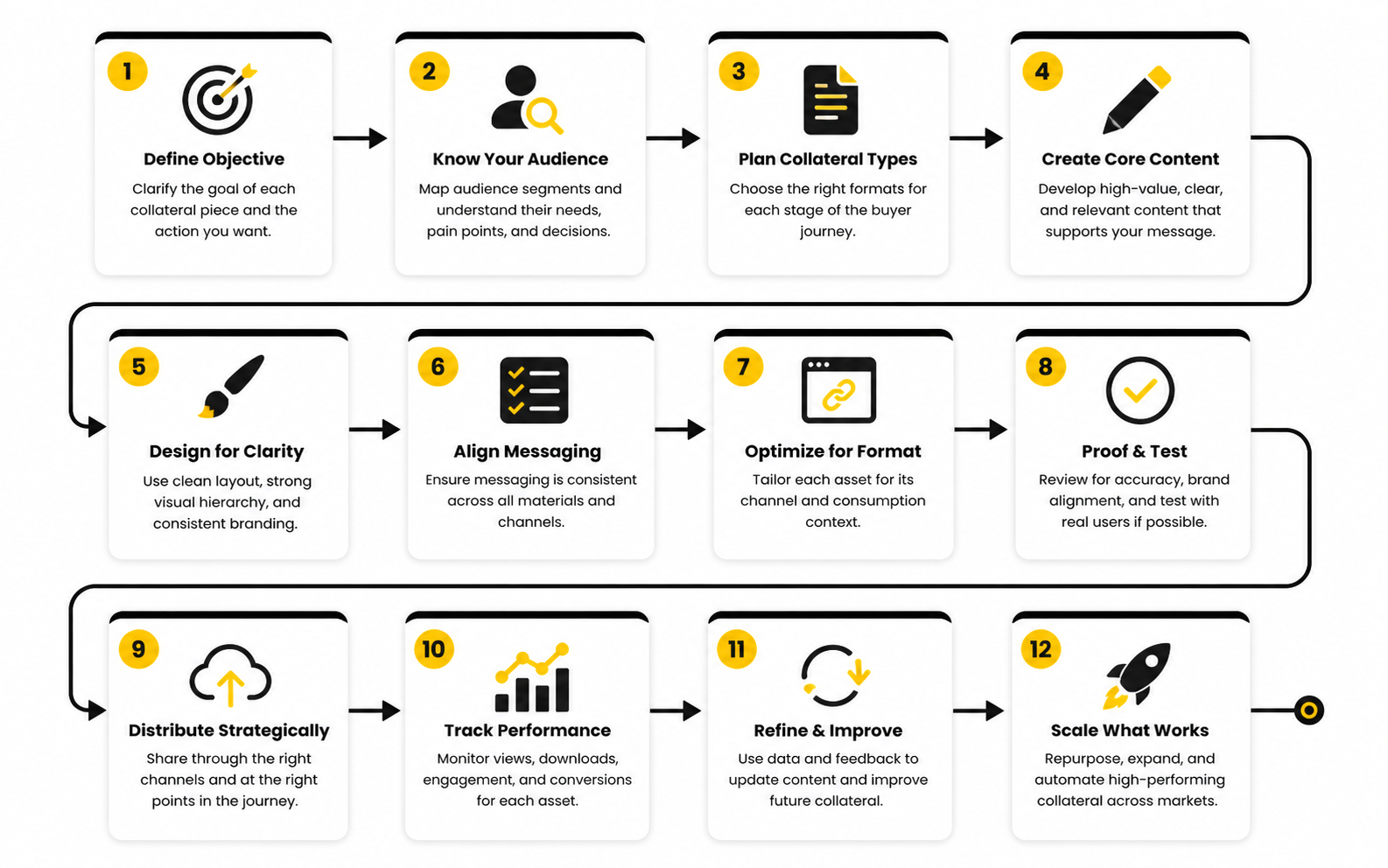
This process also protects the team from overbuilding. You do not need twenty assets if five strong ones would remove the biggest bottlenecks. Start where the buying process is weakest, then expand from there.
Step 1: Audit What Already Exists
Most businesses already have more collateral than they think. The problem is that it is scattered across folders, landing pages, email drafts, old decks, sales notes, proposal templates, social posts, and internal documents. Before creating anything new, collect the assets that are already being used.
The audit should be practical, not academic. For each asset, ask whether it is current, accurate, on-brand, useful, and tied to a real buyer moment. If the asset does not help a buyer understand, compare, trust, or act, it should either be improved or removed.
This step often reveals the real issue. The company may not have a content shortage. It may have a clarity shortage. When every asset explains the offer differently, buyers have to connect the dots themselves, and that creates friction.
Step 2: Map The Buyer Journey
The buyer journey map turns collateral into a system. It shows what the buyer needs before they are ready to move from awareness to consideration, from consideration to decision, and from decision to onboarding. Without this map, assets tend to pile up without a clear role.
Start with the questions buyers ask at each stage. Early on, they may ask what is broken, why it matters, and what options exist. Later, they may ask how your solution works, whether it fits their use case, what implementation looks like, and how they can justify the cost.
This is also where marketing and sales should work together. Sales teams hear objections directly, while marketing teams often see search behavior, page performance, email engagement, and campaign data. When both sides contribute, the resulting marketing collateral becomes much more useful.
Step 3: Prioritize The Highest-Friction Moments
Not every buyer question deserves a new asset immediately. Prioritize the moments where confusion creates the most lost revenue. That might be a pricing objection, a weak demo follow-up, unclear implementation expectations, or a lack of proof for a specific audience segment.
This is where direct buyer behavior matters more than internal opinion. If prospects keep asking the same question on calls, that question needs collateral. If leads visit the pricing page but do not convert, the page may need clearer framing. If proposals stall after being shared internally, the buyer may need a stronger business-case asset.
B2B buying is not always linear, and recent Gartner research shows buyers often move between digital research and human interaction depending on the complexity of the task: B2B buyer preferences research. That makes friction mapping important. Your collateral should support both self-serve research and sales-assisted decisions.
Step 4: Create The Essential Assets First
The first assets should support the most important buying decisions. For many businesses, that means a strong offer page, a short sales deck, a product or service one-pager, a comparison asset, a proof asset, and a follow-up email sequence. These are not glamorous, but they do a lot of heavy lifting.
The offer page explains what is being sold, who it is for, what outcome it supports, and what happens next. The deck helps sales communicate the same message consistently. The one-pager gives buyers something easy to forward. The comparison asset helps them evaluate options. The proof asset reduces perceived risk.
For teams building landing pages or funnels, Replo, ClickFunnels, and Systeme.io can all fit different levels of complexity. Use them to publish the collateral, test the offer, and guide the next action. Do not use them as an excuse to skip positioning.
Step 5: Connect Collateral To Distribution
An asset that nobody sees is not collateral. It is storage. Distribution has to be planned at the same time as creation, because the channel affects the format, length, timing, and call to action.
A sales one-pager might belong inside a CRM sequence. A product guide might work best after a demo. A checklist might perform well as a lead magnet. A short explainer might support paid social, organic posts, onboarding, and retargeting if it is built cleanly.
Marketing teams are putting more pressure on personalization and channel relevance, with Salesforce reporting that marketers recognize the shift toward more personalized two-way engagement while many still struggle to use data well enough to power it: State of Marketing report. That makes distribution discipline essential. The right asset has to reach the right buyer at the right moment.
Step 6: Measure And Improve
Marketing collateral should not be treated as finished forever. Buyer questions change, competitors change, pricing changes, product positioning changes, and channels change. If the asset matters, it needs a review cycle.
The metrics depend on the asset. A landing page can be judged by conversion rate, scroll depth, form completion, and qualified pipeline. A sales deck can be judged by usage, deal progression, and feedback from reps. An email sequence can be judged by replies, clicks, meetings booked, and unsubscribe behavior.
The key is to measure the asset against its job. Do not judge every piece of collateral by the same metric. A comparison page, onboarding guide, sales proposal, and awareness checklist are doing different work, so they need different performance signals.
The Core Asset Library
A useful collateral library should be easy to navigate. Nobody should need to ask where the latest deck lives or which one-pager is approved. If the team cannot find the asset, they will either ignore it or create their own version.
Start with a simple structure based on buyer stage and asset type. Awareness assets can live together, consideration assets can live together, and decision assets can live together. Within each section, label assets by audience, use case, and last updated date.
This structure matters because marketing collateral gets stale quietly. A small pricing change, new product feature, old screenshot, or outdated claim can weaken trust. A clean library reduces that risk and makes it easier to keep the whole system current.
Sales Decks
A sales deck should not be a company autobiography. Buyers do not need twenty slides about your mission before they understand why the conversation matters. They need a clear path from problem to outcome.
A strong deck usually covers the buyer’s current pain, the cost of staying the same, the new way forward, the product or service, proof, implementation, and the next step. It should leave enough room for conversation instead of forcing the rep to narrate every detail. The best decks support the sale without replacing the salesperson.
This is also why sales decks should be version controlled. When every rep edits their own copy, the message starts drifting. A central approved deck keeps the core story consistent while still allowing room for personalization.
One-Pagers
A one-pager is the asset people underestimate until they need one. It helps a buyer explain the offer quickly to a colleague, manager, partner, or client. That makes it especially useful in deals with multiple stakeholders.
The one-pager should include the audience, problem, solution, key benefits, proof points, and next step. It should not try to explain everything. Its job is to make the offer easy to understand and easy to share.
The best one-pagers are specific. A generic company overview is usually less useful than a one-pager for a particular industry, use case, or buyer role. Specificity makes the asset feel relevant instead of interchangeable.
Case Studies And Proof Assets
Proof assets help buyers believe the promise. They can include case studies, testimonials, review snapshots, before-and-after examples, product usage data, awards, certifications, or expert validation. The format depends on the market and the type of risk the buyer feels.
A good case study is not just a success announcement. It should explain the context, the problem, the decision, the implementation, and the outcome. It should also be honest about what changed and why the result mattered.
If full case studies are hard to produce, start with smaller proof assets. A short testimonial, a clear screenshot, a quantified result, or a customer quote can still support the buying process when used responsibly. Just do not invent proof. Weak proof is better than fake proof, and fake proof destroys trust.
Comparison Assets
Comparison collateral helps buyers evaluate alternatives without forcing them to do all the research alone. This can include competitor comparison pages, feature matrices, “best for” guides, migration explainers, or internal decision checklists. The goal is not to attack competitors. The goal is to make the tradeoffs clear.
The strongest comparison assets are confident and fair. They explain where your solution fits best and where another option may fit better. That honesty can actually build trust because buyers know every product has tradeoffs.
Comparison pages also work well for high-intent traffic. People searching for alternatives are usually closer to a decision than people reading broad educational content. That makes comparison collateral one of the most valuable assets in many marketing systems.
Email Sequences
Email sequences turn collateral into a guided conversation. They can educate new leads, follow up after demos, support abandoned forms, onboard customers, re-engage old prospects, and distribute proof over time. The mistake is treating email as a dumping ground for every message at once.
Each email should have one job. One email can clarify the problem. Another can show proof. Another can answer an objection. Another can invite the next action. This keeps the sequence readable and useful.
Platforms like Brevo, Moosend, and GoHighLevel can help manage this flow. The sequence still needs strong thinking behind it. Automation only scales what you put into it.
Landing Pages
Landing pages are often the most visible form of marketing collateral. They turn positioning, proof, offer structure, and conversion strategy into one experience. A weak landing page can waste traffic, while a strong one can make every campaign work harder.
A good landing page should make the audience, promise, mechanism, proof, and next step obvious. It should not make the visitor hunt for the point. Every section should reduce uncertainty or increase motivation.
This is especially important as AI tools make content production faster. HubSpot’s marketing research shows teams are using AI to repurpose content, accelerate campaigns, and support broader marketing workflows: 2025 marketing trends report. Faster production is useful, but landing pages still win on clarity, relevance, and proof.
The Asset Creation Brief
Before creating any new collateral, write a short brief. This does not need to be complicated. It just needs to stop the team from starting with a blank page and guessing their way through the asset.
The brief should answer these questions:
This brief makes creation faster because it gives writers, designers, sales teams, and stakeholders the same starting point. It also makes feedback cleaner. Instead of debating personal preferences, the team can ask whether the asset does its job.
Statistics And Data
Marketing collateral should be measured by what it helps the buyer do next. That sounds obvious, but many teams still measure collateral like generic content. They look at views, downloads, likes, or opens without asking whether the asset actually reduced friction in the buying process.
The numbers matter only when they explain buyer behavior. A landing page with high traffic and low conversion may have a message problem, an offer problem, a trust problem, or a traffic quality problem. A sales deck that gets used often but does not improve deal progression may be easy for reps to find but weak at helping buyers understand value. Data is useful when it tells you what to fix.
This is why marketing collateral needs a measurement system, not a random dashboard. Each asset should have a job, a primary signal, a secondary signal, and a decision rule. Without that, the team collects numbers but does not know what action to take.
The Analytics System
A practical analytics system connects four things: the asset, the buyer stage, the intended action, and the performance signal. This keeps measurement tied to the real purpose of the collateral. It also stops the team from judging every asset with the same metric.
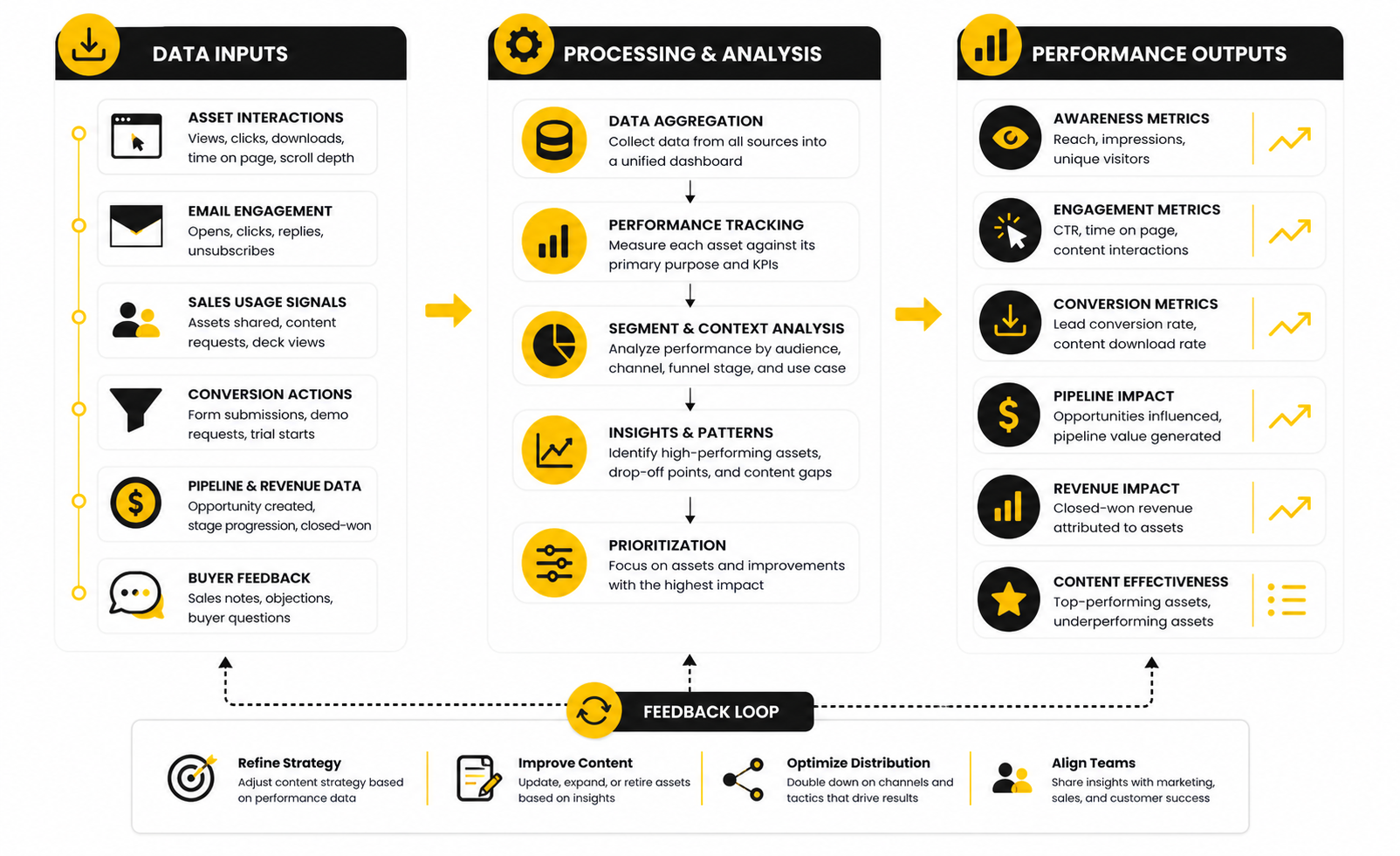
For example, an awareness checklist should not be judged the same way as a pricing explainer. The checklist may be doing its job if it earns qualified opt-ins and starts useful follow-up conversations. The pricing explainer may be doing its job if it reduces repeated pricing questions, improves demo-to-proposal conversion, or helps buyers move faster after they understand the offer.
The cleanest way to track this is to assign each asset a measurement role before launch. Do not publish first and decide later. If the asset exists to generate demand, measure qualified engagement. If it exists to support sales, measure usage and deal movement. If it exists to reduce risk, measure objections, approval speed, and conversion at the decision stage.
Primary Signals
Primary signals are the numbers closest to the asset’s purpose. For a landing page, that might be qualified conversion rate. For a demo follow-up email, it might be replies or booked next steps. For a case study, it might be influenced pipeline or usage in late-stage deals.
The mistake is picking the easiest number instead of the most useful one. Pageviews are easy to collect, but they do not prove the asset is persuasive. Downloads look nice in a report, but they may mean very little if the leads are unqualified or never move forward.
Good primary signals force better decisions. If a product one-pager is meant to help internal champions explain the offer, the real question is whether it gets shared and whether deals progress after it is sent. That is more useful than simply counting how many times the file was opened.
Secondary Signals
Secondary signals add context. They help explain why the primary signal is moving. These can include scroll depth, time on page, click-through rate, email engagement, form completion rate, source quality, sales feedback, and repeated buyer questions.
A low-converting page with strong scroll depth may suggest the offer is interesting but the call to action is weak. A page with poor scroll depth may suggest the opening message is not clear enough. An email sequence with solid opens but weak clicks may suggest the subject line is working but the body or next step is not compelling.
This is where interpretation matters. Do not treat secondary signals like final verdicts. They are clues. The job is to combine them with buyer feedback, sales input, and pipeline data so the team can make a smart update.
Decision Rules
Every important asset should have a decision rule. A decision rule says what the team will do when performance is strong, weak, or unclear. This prevents endless reporting with no action.
For example, if a landing page receives enough qualified traffic but converts below target, the team can review the headline, offer clarity, proof, and call to action. If a case study is rarely used by sales, the team can check whether reps know it exists, whether the story matches active deals, and whether the format is easy to send. If a nurture sequence gets opens but no replies, the team can rewrite the ask and test a more specific next step.
Decision rules keep measurement practical. The point is not to admire the dashboard. The point is to improve the collateral.
Benchmarks Without Blind Copying
Benchmarks are useful, but they are not commandments. They help you understand whether performance is obviously weak, unusually strong, or somewhere in the normal range. They should not replace context.
A B2B software landing page, an ecommerce product page, a service-business proposal, and a webinar registration page will not perform the same way. Traffic source, buyer intent, brand awareness, offer strength, pricing, market maturity, and audience fit all change the numbers. That is why benchmarks should guide questions, not dictate conclusions.
Recent research supports the need for better interpretation. The Content Marketing Institute’s 2025 B2B research shows that successful content marketers are more likely to have clear strategy, audience understanding, and performance discipline, not just more content volume: B2B content marketing benchmarks. That is the lesson. Benchmarks help, but the system behind the collateral matters more.
Engagement Benchmarks
Engagement tells you whether people are interacting with the asset, but it does not automatically prove buying intent. A blog post can get strong engagement from people who will never buy. A technical one-pager can get lower engagement but still influence serious prospects.
Use engagement metrics to diagnose attention and clarity. For pages, look at scroll depth, time on page, clicks, form starts, and form completions. For PDFs or decks, look at opens, page-level viewing behavior when available, and follow-up actions. For emails, look at opens carefully, but pay more attention to clicks, replies, meetings booked, and downstream movement.
Email opens are especially imperfect because privacy changes and inbox behavior can distort the number. Treat opens as a light signal, not the truth. If an email is meant to drive action, the action matters more than the open.
Conversion Benchmarks
Conversion benchmarks are more useful when the audience and offer are similar. A cold traffic lead magnet should not be compared to a warm demo page. A pricing-page conversion should not be compared to a newsletter signup.
For marketing collateral, conversion should be defined by the asset’s job. A lead magnet converts when the right person opts in. A sales page converts when the right person starts the buying process. A proposal converts when it turns interest into commitment. Each asset needs its own conversion definition.
This is also where funnel tools can help. ClickFunnels, Systeme.io, and GoHighLevel can make it easier to track steps, test offers, and see where people drop off. The tool is not the strategy, but it can make the strategy measurable.
Sales Impact Benchmarks
Sales impact is where collateral measurement becomes more serious. The question is not only whether people consume the asset. The question is whether the asset helps qualified opportunities move forward.
Useful sales signals include asset usage by reps, stage progression, deal velocity, win rate, objection frequency, proposal acceptance, and follow-up response rate. If the same asset appears repeatedly in won deals, it may deserve more visibility. If an asset is sent often but deals still stall, the content may need stronger proof, clearer framing, or a better next step.
This is where CRM hygiene matters. If sales activity is not logged cleanly, collateral influence becomes guesswork. A platform like Copper can help teams manage relationship and pipeline data, while GoHighLevel can support agencies and service businesses that want CRM, automation, and follow-up in one system.
What The Data Actually Means
Data should lead to interpretation, not panic. A weak number does not always mean the asset is bad. It may mean the wrong audience is seeing it, the CTA is too early, the offer is unclear, or the asset is being used at the wrong stage.
A high number can also be misleading. A checklist with thousands of downloads may look successful, but if those leads never become qualified conversations, the asset may be attracting curiosity instead of intent. A niche comparison page with lower traffic may be far more valuable if it brings in buyers who are actively evaluating alternatives.
This is why the best teams look at patterns. One metric gives a clue. Several metrics across the journey tell a story. The job is to understand that story and decide what to improve next.
When Traffic Is High But Conversions Are Low
High traffic and low conversion usually means there is a mismatch somewhere. The audience may not be the right fit. The promise may not match the traffic source. The page may be interesting but not persuasive enough to earn action.
Start by checking the source. If visitors are coming from broad social traffic, the conversion rate will likely behave differently than search traffic with clear buying intent. Then check the above-the-fold message, proof, offer clarity, page speed, form friction, and next step.
Do not rewrite the entire asset immediately. Fix the highest-likelihood issue first, then test. Good optimization is disciplined, not emotional.
When Engagement Is Strong But Pipeline Is Weak
Strong engagement with weak pipeline usually means the asset is useful but not commercially sharp enough. People may like it, save it, or share it, but it may not guide them toward a buying conversation. That is common with educational content.
The fix is not to turn every asset into a hard pitch. The fix is to add a stronger bridge. That could be a diagnostic CTA, a comparison guide, a webinar, a consultation offer, a product demo, or a follow-up sequence that moves from education to evaluation.
This is where tools like Fillout can help qualify interest without forcing every visitor into the same form. A smart form can ask the right questions, segment the lead, and route people toward the most relevant next asset. The more relevant the next step, the less pushy the collateral feels.
When Sales Uses An Asset But Deals Still Stall
If sales uses an asset frequently and deals still stall, the asset may be easy to send but weak at reducing risk. It might explain features when buyers need proof. It might describe benefits when buyers need implementation clarity. It might look professional but fail to answer the objection that is actually blocking the deal.
Start by asking sales where deals stall after the asset is shared. Then review the asset through the buyer’s eyes. Does it make the decision easier? Does it give the buyer language to use internally? Does it explain what happens after purchase? Does it address the cost of doing nothing?
Late-stage collateral should be practical. Buyers close when confidence becomes stronger than hesitation. The asset should help create that shift.
The Measurement Dashboard
A simple dashboard is better than a bloated one. Track the numbers that help the team make decisions, then ignore the noise. The dashboard should show which assets are being used, which assets are driving action, and which assets need improvement.
A practical dashboard can include:
The last field matters more than most teams think. A dashboard without a next action becomes a reporting ritual. A dashboard with a next action becomes a management tool.
Review Cadence
Important marketing collateral should be reviewed on a schedule. High-traffic landing pages may need monthly review. Sales decks and one-pagers may need quarterly review. Case studies, comparison pages, and pricing explainers should be reviewed whenever the market, offer, or product changes.
Review cadence keeps the system alive. It also prevents embarrassing mistakes, like old pricing, outdated screenshots, retired features, or claims that no longer match the offer. Collateral ages quietly, so someone has to own maintenance.
Ownership should be clear. If nobody owns the asset after launch, nobody will fix it when performance drops. The best collateral systems assign responsibility before problems appear.
Data Quality
Measurement depends on clean data. If UTMs are inconsistent, CRM stages are messy, forms are unclear, or sales activity is not logged, the team will struggle to understand what is working. Bad tracking leads to bad decisions.
Keep naming conventions simple and consistent. Use clear campaign tags, standardized asset names, and agreed definitions for qualified leads, meetings, opportunities, and wins. This is not glamorous work, but it is what makes performance analysis trustworthy.
Salesforce’s latest marketing research emphasizes how heavily modern marketing depends on data, AI, and personalization, based on insights from nearly 4,500 marketers worldwide: State of Marketing report. That only works when the underlying data is usable. Better dashboards start with better inputs.
Turning Insights Into Better Collateral
The best measurement system ends in better assets. If the data does not change what the team creates, edits, removes, or promotes, then the reporting process is too passive. Measurement should create action.
Start with the assets closest to revenue. Improve the landing page that gets qualified traffic. Rewrite the follow-up sequence that gets opens but no replies. Strengthen the case study that sales sends most often. Clarify the proposal section that buyers keep questioning.
This is the practical rhythm: publish, measure, interpret, improve. Do that consistently, and marketing collateral becomes an asset base that compounds over time. Do it randomly, and the team keeps creating new material while the old material quietly leaks revenue.
Professional Implementation And Distribution
At this stage, marketing collateral becomes an operating system. The team is no longer just making assets. It is deciding how the message should stay consistent across channels, how sales should use the material, how content should scale without becoming generic, and how the whole system should stay useful as the market changes.
This is where advanced teams separate themselves. They do not simply produce more collateral because the calendar says so. They build a controlled, flexible asset system that supports demand generation, sales conversations, customer onboarding, retention, and expansion without turning every team into its own mini marketing department.
That balance is important. Too much control slows everyone down. Too much freedom creates message drift. Professional implementation is about giving teams enough structure to stay aligned and enough flexibility to adapt to real buyer conversations.
Centralize The Source Of Truth
The first scaling problem is ownership. If nobody knows where the latest asset lives, the collateral system starts breaking. Sales reps use old decks, marketers reuse outdated claims, customer success sends stale onboarding files, and buyers receive slightly different versions of the same promise.
A central source of truth fixes that. It should include approved assets, usage notes, audience fit, funnel stage, owner, last updated date, and any restrictions around claims or compliance. This does not need to be complicated at first. A clean folder structure or shared workspace can work if the rules are clear.
The key is that every important asset has one approved version. Teams can personalize how they use it, but the core message, proof, and positioning should stay consistent. This is especially important in B2B environments where buyers often interact with multiple touchpoints before making a decision, and McKinsey’s B2B Pulse research continues to show that winning companies are investing in coordinated omnichannel selling rather than relying on one channel alone: B2B Pulse research.
Build Modular Assets
Modular collateral is easier to scale than one-off collateral. Instead of creating every asset from scratch, the team builds reusable pieces: positioning blocks, proof points, product descriptions, objection responses, customer quotes, feature explanations, offer summaries, and calls to action. These pieces can then be assembled into landing pages, decks, email sequences, proposals, and sales follow-ups.
This approach saves time, but that is not the only benefit. It also keeps the message consistent. If the value proposition changes, the team can update the core module and then refresh every asset that depends on it.
Modular assets are especially useful when selling to multiple segments. A company may need one version of a deck for agencies, another for ecommerce brands, and another for local service businesses. The structure can stay the same while the examples, proof, objections, and calls to action change for each audience.
Create Rules For Personalization
Personalization can make marketing collateral more relevant, but it can also make the message messy. If every rep, partner, or account manager rewrites the asset freely, the collateral library slowly loses its strategic value. The buyer gets a custom version, but not always a better one.
Set clear rules for what can be personalized. Audience examples, intro slides, industry context, proposal details, and next steps are usually safe to adapt. Core positioning, pricing language, compliance claims, product promises, and proof statements should be controlled more tightly.
This matters more as AI-assisted workflows become normal. Salesforce’s latest marketing research points to a market where AI, data, and personalization are central priorities for marketing leaders: State of Marketing report. That does not mean every message should be generated from scratch. It means teams need stronger guardrails so personalization improves relevance without weakening trust.
Align Marketing, Sales, And Customer Success
Marketing collateral should not stop at the lead handoff. The same story that attracts the buyer should continue through sales, onboarding, adoption, and renewal. When those stages feel disconnected, trust drops because the buyer feels like the promise changed after they said yes.
Marketing usually owns the message. Sales owns live buyer feedback. Customer success owns the reality of delivery. Strong collateral systems use all three perspectives. That way, assets are not just persuasive; they are accurate.
This alignment can create practical improvements fast. Sales can flag objections that need better proof. Customer success can identify expectations that need clearer pre-sale framing. Marketing can turn those insights into better pages, decks, onboarding guides, and follow-up sequences.
Plan For Multi-Stakeholder Buying
Many buying decisions are not made by one person. Even when one buyer starts the conversation, they may need approval from finance, leadership, operations, legal, IT, or another department. That means your collateral has to support the person who is selling your solution internally.
This is where internal champion assets matter. A buyer may understand your value, but they still need help explaining it to someone who was not on the call. A short business-case summary, ROI explanation, security overview, implementation plan, or comparison sheet can make that internal conversation easier.
Gartner’s research on B2B buying behavior shows that buyers often combine digital self-service with seller interaction depending on the task, especially when they need contextual support: B2B buyer preferences research. That is the practical takeaway. Marketing collateral should not only convince the first buyer. It should help that buyer convince the room.
Strategic Tradeoffs
The hard part is not knowing that collateral matters. The hard part is deciding what not to create. Every asset has a cost: strategy time, writing time, design time, review time, implementation time, and maintenance time.
Advanced teams make tradeoffs deliberately. They do not chase every format, platform, or campaign idea. They prioritize the assets that improve conversion, shorten sales cycles, strengthen positioning, or reduce support friction.
The best question is simple: will this asset make a meaningful buyer decision easier? If the answer is no, it is probably not a priority. Nice-to-have collateral can wait until the essential system is working.
Depth Versus Speed
Some assets need depth. A detailed comparison page, technical guide, implementation plan, or case study should not be rushed if buyers rely on it to make a serious decision. Weak depth creates more questions than it answers.
Other assets need speed. A campaign-specific landing page, event follow-up email, short social proof post, or quick sales enablement sheet may be useful even if it is not perfect. Waiting too long can cost momentum.
The tradeoff is deciding where quality risk matters most. Late-stage assets deserve more precision because they influence high-intent decisions. Early-stage assets can often be tested faster, as long as the claims are accurate and the message is clear.
Brand Consistency Versus Channel Fit
Brand consistency matters, but every channel has its own rhythm. A sales deck should not sound like a blog post. A LinkedIn carousel should not sound like a proposal. A chatbot flow should not sound like a legal document.
The message should stay consistent while the delivery changes. The promise, proof, and positioning should feel familiar across channels. The format, pace, and wording can adapt to the buyer’s context.
This is where teams often get too rigid or too loose. If every asset sounds identical, it can feel unnatural. If every channel invents its own version of the story, the brand feels fragmented. The goal is recognizable, not robotic.
Automation Versus Human Judgment
Automation can make collateral distribution much more efficient. It can trigger follow-ups, segment leads, route prospects, send reminders, deliver guides, and keep conversations moving. Used well, it prevents good assets from sitting unused.
But automation should not replace judgment where the buyer needs context. A complex prospect may need a tailored follow-up, not a generic sequence. A high-value lead may need a thoughtful explanation, not another automated PDF.
Tools like GoHighLevel, Brevo, ManyChat, and Chatbase can help operationalize the system. The important thing is to automate the repeatable parts and keep human attention where nuance matters.
Common Risks As Collateral Scales
The bigger the collateral system gets, the easier it is to lose control. Assets duplicate. Messages drift. Data gets messy. Teams keep creating new material because they cannot find what already exists.
This is not a content problem. It is a governance problem. Scaling marketing collateral requires rules, ownership, and regular cleanup.
If that sounds unsexy, good. The unsexy parts are often what protect performance. A clean asset system beats a chaotic library with twice as many files.
Message Drift
Message drift happens when different teams explain the offer in different ways over time. One page promises speed. A deck emphasizes cost savings. A proposal focuses on customization. A sales email leans into features. None of those messages may be wrong, but together they can confuse the buyer.
The fix is a clear messaging hierarchy. Define the core promise, supporting pillars, proof points, audience-specific angles, and words the team should avoid. Then review key assets against that hierarchy.
This does not mean every asset has to use the exact same sentence. It means every asset should reinforce the same strategic position. Buyers should feel like each touchpoint adds clarity, not contradiction.
Outdated Proof
Proof ages. A testimonial from five years ago may still be valid, but it may not reflect the current product, market, or customer expectation. A screenshot from an old interface can make the company look careless. A case study with outdated metrics can create unnecessary questions.
Proof assets need a review cycle. Check whether the customer is still active, whether the claim is still accurate, whether the result is framed responsibly, and whether the asset still matches the current offer. If something is uncertain, update it or remove it.
Trust is too important to gamble with. Edelman’s 2025 brand trust research shows that people are using generative AI tools to research brands, compare products, and summarize reviews: 2025 Brand Trust report. If your proof is inconsistent across the web, sales materials, and owned assets, buyers may notice faster than your team does.
Overproduction
Overproduction is one of the most common collateral mistakes. The team keeps creating because creation feels productive. But every new asset adds maintenance work, review work, and potential confusion.
More assets do not automatically mean better coverage. Sometimes the more carefully move is to consolidate three weak assets into one strong one. Sometimes the best improvement is rewriting a core landing page instead of launching another lead magnet.
A simple rule helps: every new asset should replace, improve, or clearly add something. If it does not, it probably belongs in the backlog. Collateral should compound, not clutter.
Tool Sprawl
Tool sprawl happens when the team uses too many platforms to create, store, send, track, and update collateral. One team builds pages in one tool. Another stores PDFs somewhere else. Sales sends files manually. Marketing tracks performance in a separate dashboard. Nobody has the full picture.
The fix is not always fewer tools. The fix is clearer roles. Decide which tools are used for creation, distribution, CRM tracking, analytics, and asset management. Then document the workflow so people know where each asset belongs.
For example, ClickFunnels may handle funnel pages, Fillout may handle qualification forms, Buffer may handle social distribution, and Copper may handle CRM activity. That can work if the workflow is intentional. It breaks when tools are added without ownership.
Advanced Collateral Strategy
Advanced strategy is about sequencing. The right asset at the wrong time can underperform. The right message in the wrong format can get ignored. The right proof shown too early can feel irrelevant, while the same proof shown later can close the gap.
This is why mature teams think in paths, not isolated assets. They design the experience from first touch to decision and then decide where each asset belongs. The buyer should feel guided without feeling pushed.
The best collateral paths are simple on the surface and thoughtful underneath. Each step should make the next step feel natural. That is what good strategy does.
Build Content Paths
A content path is a planned sequence of assets for a specific audience or use case. It may start with an article, move into a checklist, continue through an email sequence, send the buyer to a comparison page, and then invite them to a demo or consultation. The path gives the buyer a logical progression.
This is different from throwing assets into every channel and hoping something works. A path has intent. It respects the buyer’s awareness level and gives them the next useful thing.
Content paths also make measurement easier. Instead of asking whether one asset worked in isolation, you can study how buyers move through the sequence. That helps you improve the whole journey, not just one page.
Use Collateral To Shape Demand
Marketing collateral should not only capture existing demand. It can also shape how buyers understand the problem. This is where thought leadership, original research, frameworks, diagnostic tools, and category education become powerful.
The goal is not to publish vague opinions. The goal is to help buyers see the cost of the old way and understand the value of a better approach. When done well, the collateral changes the criteria the buyer uses to evaluate solutions.
This is especially important in crowded markets. If every competitor sounds the same, the buyer defaults to price, familiarity, or convenience. Strong educational collateral gives them a better way to think.
Support Post-Purchase Momentum
The buyer journey does not end at purchase. The first weeks after purchase shape trust, adoption, referrals, expansion, and retention. That means onboarding collateral is part of the marketing collateral system too.
Welcome guides, implementation checklists, training videos, success plans, usage tips, and expectation-setting emails all help the customer feel confident after the sale. They also reduce support load because customers know what to do next.
This matters because the promise made before purchase has to match the experience after purchase. If the sales collateral creates excitement but onboarding feels confusing, trust drops quickly. Strong post-purchase collateral protects the relationship.
The Expert Standard
The expert standard is simple: every asset should be accurate, useful, findable, measurable, and maintained. If it is not accurate, it creates risk. If it is not useful, it creates noise. If it is not findable, it will not be used. If it is not measurable, the team cannot improve it. If it is not maintained, it will decay.
That standard sounds strict because it should be. Marketing collateral touches revenue, trust, brand perception, sales efficiency, and customer expectations. Treating it casually is expensive.
The companies that win are not always the ones with the most assets. They are the ones with the clearest buying support. Their collateral helps people understand the problem, trust the solution, explain the decision, and take the next step with confidence.
Optimizing The Marketing Collateral Ecosystem
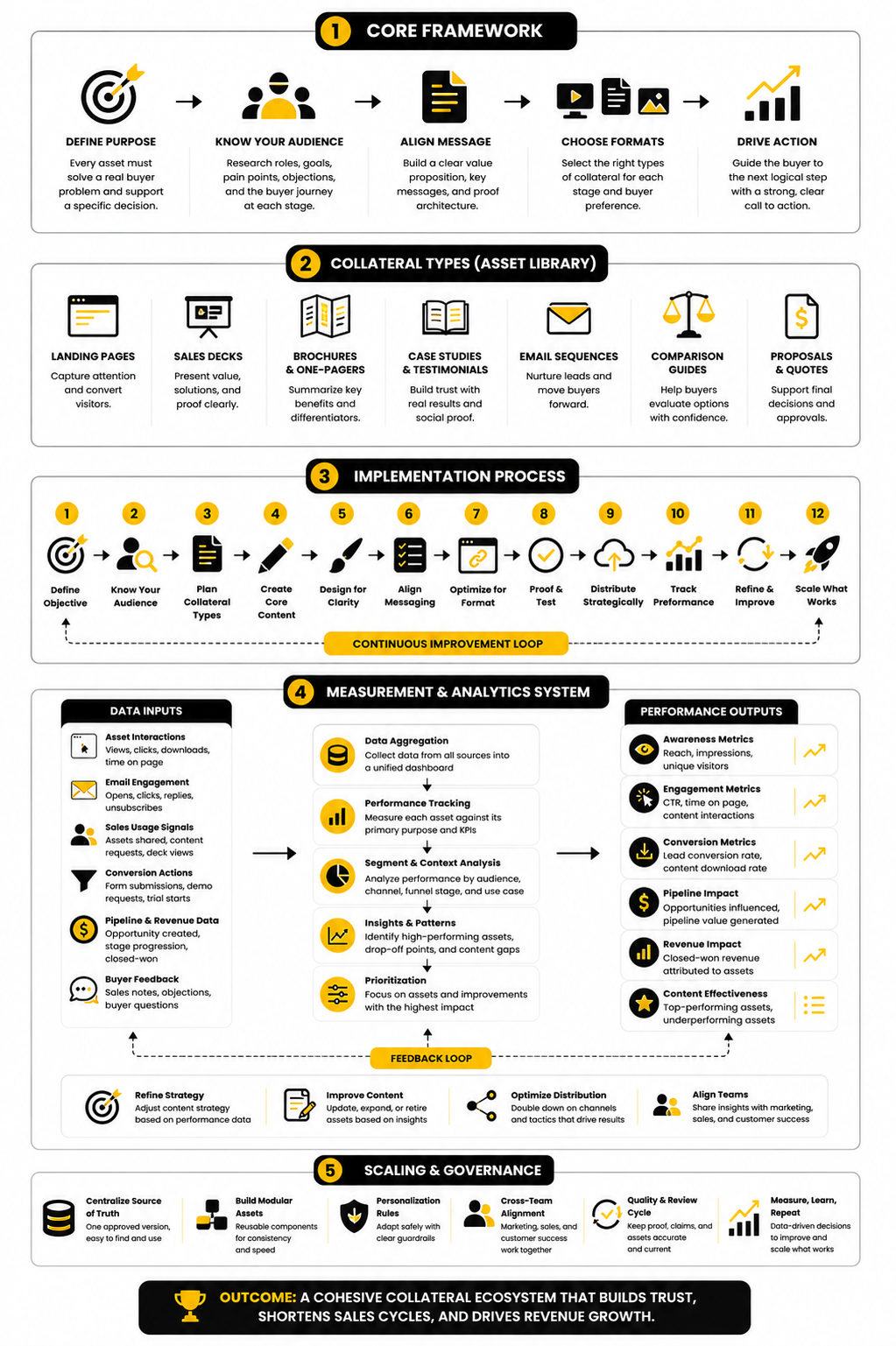
The final step is turning individual assets into a complete ecosystem. That means every major touchpoint should have a clear role, every role should support a buyer decision, and every decision should move the person closer to confidence. When the system works, marketing collateral stops feeling like scattered content and starts feeling like a guided buying experience.
This is where the earlier pieces come together. The framework defines the purpose. The asset library gives the team the right formats. Measurement shows what is working. Governance keeps the message clean. The ecosystem connects all of it into one practical system.
The most important idea is simple: buyers should never feel lost. Whether they find you through search, social, email, a referral, a webinar, a sales call, or a comparison page, the next useful step should be obvious. That is what a mature collateral system does.
Keep The System Buyer-Led
A buyer-led collateral system starts with the questions people actually ask. It does not force every prospect through the same path. It gives them the right asset based on their awareness level, urgency, role, and risk.
Some buyers need education before they can even understand the offer. Others already know the problem and want to compare options. Some are ready to buy but need proof, pricing clarity, implementation details, or internal approval support. The ecosystem should serve all of those moments without making the experience feel heavy.
This is why self-service and sales support need to work together. Gartner’s B2B buyer research found that many buyers prefer rep-free experiences, but that does not mean they want to be unsupported: B2B buyer preferences research. They want useful guidance on their terms.
Build For Search, Sales, And AI Discovery
Marketing collateral now has to work in more places than before. It has to help human buyers, support sales teams, rank in search, perform in social feeds, and remain understandable when AI tools summarize brand information. That changes how assets should be written.
Clear structure matters. Specific claims matter. Consistent language matters. If your product page says one thing, your sales deck says another, and your comparison page frames the offer differently again, buyers and AI tools both get mixed signals.
Edelman’s 2025 brand trust research found that among people using generative AI platforms, 91 percent use them for shopping-related behavior such as researching brands, comparing products, and summarizing reviews: 2025 Brand Trust report. That is a big deal. Your marketing collateral needs to be clear enough to persuade buyers directly and structured enough to be interpreted correctly when someone researches you through AI.
Protect Quality As You Scale
Scaling collateral does not mean publishing faster at any cost. It means building repeatable quality. Templates, briefs, approved messaging, proof libraries, review cycles, and clear ownership all help the team move faster without making the brand feel careless.
AI can help with drafts, repurposing, research organization, summaries, and versioning. But AI should not own strategy, proof, or final judgment. Those parts still need human thinking because the collateral represents the business in front of real buyers.
Salesforce’s current marketing research shows how central AI, data, and personalization have become for marketers, based on insights from nearly 4,500 marketing leaders worldwide: State of Marketing report. The takeaway is not “automate everything.” The takeaway is to build a system where technology supports sharper, more relevant buyer communication.
What is marketing collateral?
Marketing collateral is any asset used to communicate value, educate buyers, support sales, or help someone take the next step toward a purchase. It includes landing pages, brochures, sales decks, case studies, one-pagers, email sequences, comparison pages, product sheets, proposals, webinars, and onboarding materials. The format can vary, but the purpose is always to make the buying decision easier.
Why is marketing collateral important?
Marketing collateral matters because buyers often research, compare, and evaluate options before speaking to a company directly. Strong collateral helps them understand the problem, trust the solution, and feel confident about the next step. Weak collateral creates confusion, slows down sales, and makes the buyer work harder than they should.
What are the most common types of marketing collateral?
The most common types include landing pages, sales decks, brochures, product one-pagers, case studies, testimonials, email sequences, comparison guides, white papers, pricing explainers, demo pages, and proposals. Service businesses may also use onboarding guides, diagnostic checklists, and consultation follow-up assets. Ecommerce brands often rely on product pages, collection pages, quizzes, comparison tables, and creator briefs.
What makes marketing collateral effective?
Effective marketing collateral has a specific audience, a clear promise, credible proof, and a natural next step. It should answer a real buyer question instead of simply describing the company. The best assets feel useful because they reduce uncertainty and help the buyer move forward.
How do you create marketing collateral?
Start by defining the buyer, the decision they need to make, and the question the asset must answer. Then choose the format that fits that moment, write the message, add proof, design the asset, connect it to the right channel, and measure performance after launch. A simple brief makes the process much easier because it keeps the team focused on the asset’s job.
What is the difference between marketing collateral and sales collateral?
Marketing collateral usually supports broader education, awareness, demand generation, and brand trust. Sales collateral is more focused on helping active prospects evaluate, justify, and buy. In practice, the two overlap because many assets support both marketing and sales, especially case studies, one-pagers, comparison pages, and pitch decks.
How often should marketing collateral be updated?
Important assets should be reviewed regularly. High-traffic landing pages and funnel pages may need monthly review, while decks, one-pagers, and case studies can often be reviewed quarterly. Any asset with pricing, product screenshots, feature claims, customer proof, or competitive positioning should be updated whenever the offer or market changes.
How do you measure marketing collateral performance?
Measure each asset based on its purpose. A landing page might be measured by qualified conversion rate, while a case study might be measured by sales usage and influenced pipeline. Useful signals include traffic quality, conversion rate, engagement, replies, meetings booked, deal progression, sales feedback, and the frequency of buyer objections.
What marketing collateral should a small business create first?
A small business should start with the assets closest to revenue. That usually means a clear offer page, a simple service or product one-pager, a short sales deck, a proof asset, and a follow-up email sequence. Once those are working, the business can add lead magnets, comparison pages, educational content, and more advanced nurture flows.
What tools help with marketing collateral?
The right tool depends on the asset and workflow. ClickFunnels and Systeme.io can help build funnels, while Replo can support ecommerce landing pages. GoHighLevel can help agencies and service businesses manage CRM, automation, and follow-up, while Brevo and Moosend can support email distribution.
How can AI be used in marketing collateral?
AI can help summarize research, repurpose long assets, draft variations, structure briefs, generate first drafts, analyze patterns, and speed up production. It should not replace human review, buyer insight, proof verification, or final positioning decisions. The strongest use of AI is as a production assistant, not as the owner of the marketing strategy.
What are the biggest mistakes businesses make with marketing collateral?
The biggest mistakes are creating assets without a clear buyer decision, using outdated proof, measuring the wrong metrics, letting teams create off-brand versions, and producing too much content without maintaining it. Another common mistake is choosing tools before clarifying the message. Better software cannot fix weak positioning.
How do you organize marketing collateral?
Organize assets by buyer stage, audience, use case, and asset type. Add ownership, last updated dates, usage notes, and approved versions so the team knows what to use and when. A clean system prevents outdated files, duplicate decks, and inconsistent messaging from spreading across the business.
Is marketing collateral only for B2B companies?
No. B2C, ecommerce, creators, agencies, SaaS companies, local businesses, and service providers all use marketing collateral. The difference is usually the buying journey. B2B collateral often supports longer evaluation and internal approval, while B2C collateral may focus more on product education, trust, urgency, and conversion.
What is the best way to improve existing marketing collateral?
Start with the assets closest to revenue and review them against one question: does this help the buyer make a decision? Improve clarity, proof, structure, call to action, and distribution before creating something new. Often, one strong rewrite of a key page or deck does more than adding five new assets to the library.
Build a stronger local presence with BAAM AI
Turn your website, Google profile, social channels, and AI visibility into one growth engine
Most businesses do not need more random marketing activity. They need a consistent presence system that helps the right people find them, trust them, and take action. BAAM AI brings strategy, local SEO, website updates, Google Maps visibility, social content, AI-search readiness, media production, and reporting into one practical monthly engine.
If you want your marketing to keep working after the campaign ends, start with a free BAAM AI presence audit. See how your business shows up today and where the fastest visibility wins are at BAAM AI.