
BAAM AI Blog
Looking For Copywriter: How To Hire The Right Writer Without Wasting Time Or Budget
Looking for copywriter support sounds simple until you actually start the search. You post a job, ask around, browse portfolios, compare rates, and suddenly every candidate seems to offer the same thing: emails...

Looking for copywriter support sounds simple until you actually start the search. You post a job, ask around, browse portfolios, compare rates, and suddenly every candidate seems to offer the same thing: emails, landing pages, ads, websites, content, strategy, conversions, brand voice, and “AI-enhanced workflows.”
That is where most businesses make the wrong hire. They look for a writer before they define the job the copy needs to do. A copywriter for paid ads is not the same as a copywriter for a SaaS homepage, a launch sequence, a sales page, a brand voice refresh, or a founder-led LinkedIn funnel.
The demand is real, but the market is messy. Employment for writers and authors is projected to grow about as fast as the average occupation from 2024 to 2034, with roughly 13,400 openings per year, while B2B marketers continue investing in content formats like video, thought leadership, paid advertising, and AI-supported content workflows, based on 2025 benchmark research. At the same time, marketers using AI report major speed gains, with many using it to generate content faster and make decisions faster, based on AI marketing statistics.
That creates the real hiring challenge. You are not just choosing between a human copywriter and AI. You are choosing between vague content production and a clear revenue-focused writing system where strategy, messaging, offer clarity, research, and execution work together.
Why Looking for a Copywriter Matters Now
Looking for copywriter talent matters because words still carry the offer. Your page design can be beautiful, your funnel can be technically solid, and your traffic source can be dialed in, but weak copy makes the whole system feel unclear. People do not buy because a sentence sounds clever; they buy because the message makes the next step feel obvious, relevant, and worth taking.
This is even more important now because content volume has exploded. AI tools make it easy to produce drafts, headlines, captions, email ideas, and page sections quickly, but speed does not automatically create trust. If every competitor can publish more, the advantage shifts toward sharper positioning, stronger insight, and copy that sounds like it came from someone who understands the customer.
A good copywriter helps you turn scattered business knowledge into market-facing clarity. They ask what the offer is, who it is for, why now, why you, what the buyer already believes, and what must be true before the buyer says yes. That is why the best hire is rarely just “someone who writes well”; it is someone who can connect writing to the commercial job behind it.
The Copywriter Hiring Framework
The simplest way to hire well is to stop treating copywriting as one generic service. Instead, think in terms of four layers: business goal, copy asset, message strategy, and working process. When those four layers are clear, your search becomes much easier because you know what kind of writer you actually need.
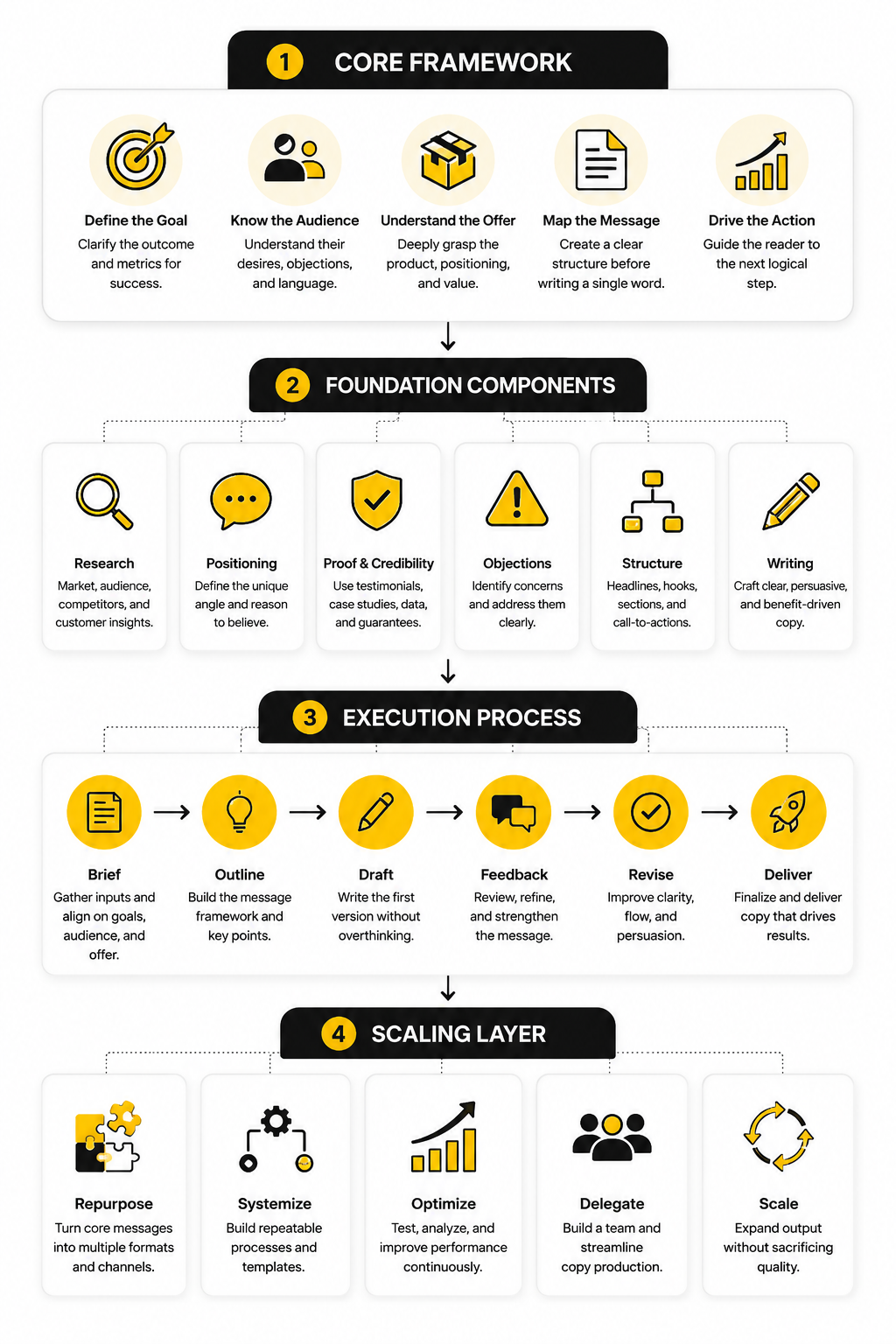
The business goal tells you what the copy must accomplish. That could be more demo bookings, more email replies, higher landing page conversion, better ad click-through, stronger product education, or a clearer homepage. Without that goal, you can only judge copy by taste, and taste is a dangerous hiring filter.
The copy asset tells you what the writer is producing. A homepage, cold email sequence, webinar registration page, ecommerce product page, lead magnet funnel, and nurture sequence all require different instincts. A writer who is excellent at short-form paid social may not be the right person to rebuild your core website messaging.
The message strategy tells you how the copy will become persuasive. This includes customer research, competitor research, offer positioning, objections, proof, voice, and the emotional logic of the buying decision. Strong copy usually looks simple at the end because the thinking underneath it is not simple.
The working process tells you whether the engagement will actually function. You need to know how the writer handles briefs, interviews, drafts, revisions, approvals, deadlines, performance feedback, and collaboration with designers, media buyers, founders, or sales teams. This is where many promising hires break down, not because they cannot write, but because the project has no operating system.
Core Components of a Strong Copywriter Search
A strong search starts with the outcome, not the title. Instead of saying “I am looking for copywriter help,” define the result you want in plain language. For example, you might need a clearer landing page for paid traffic, a sales email sequence for warm leads, or a website rewrite that explains your offer faster.
Next, match the copywriter to the buying environment. Some copy needs urgency because the reader is already problem-aware and close to action. Other copy needs education because the buyer does not yet understand the cost of the problem or the value of solving it.
Then look for evidence that the writer can think before they write. Portfolios are useful, but polished samples alone are not enough. You want to see whether they understand research, structure, customer language, offer mechanics, and the difference between sounding persuasive and actually helping someone make a decision.
Professional Implementation Starts Before the First Draft
Professional implementation begins with a clean brief. The brief should explain the business, offer, audience, stage of awareness, traffic source, desired action, proof points, objections, competitors, brand voice, and constraints. A copywriter can improve a messy message, but they should not have to guess the entire business model from a few bullet points.
The best projects also include access to real inputs. That can mean sales call notes, customer reviews, survey responses, support tickets, demo recordings, ad performance data, existing pages, email metrics, and product documentation. The more useful raw material the writer has, the less likely the final copy will sound generic.
This is where tools can help, but they should support the process rather than replace it. A funnel builder, CRM, email platform, chatbot, form tool, or social scheduler can make implementation smoother, but none of them fix unclear positioning by themselves. The copy still has to carry the message, and the system around it has to deliver that message at the right moment.
The Copywriter Hiring Framework
Once you understand why the hire matters, the next step is building a simple framework for deciding who you actually need. This is where most businesses overcomplicate the process. They compare portfolios, rates, niches, and testimonials before they have defined the work clearly enough to judge any of those things.
When you are looking for copywriter support, start by separating the role into four practical questions. What result do you want? What asset needs to be written? What level of strategy is required? What kind of collaboration will make the project work? Those questions protect you from hiring someone talented for the wrong job.
A strong framework also helps you avoid the biggest trap in modern marketing: mistaking content output for copywriting performance. More drafts, more hooks, more posts, and more emails do not automatically create better results. The real value comes from matching the message to the buyer’s awareness, objections, urgency, and desired next step.
Start With the Business Outcome
The business outcome should come before the deliverable. A landing page is not the outcome. More qualified booked calls, more trial signups, more purchases, or better lead quality are outcomes.
This matters because the same type of copy asset can serve very different jobs. A homepage for a bootstrapped service business may need to clarify the offer fast and build trust. A homepage for a funded SaaS company may need to align multiple buyer personas, support sales conversations, and explain category positioning.
When you define the outcome first, the copywriter can think like a growth partner instead of a word vendor. They can ask better questions about traffic quality, offer strength, proof, friction, and conversion paths. That is the level of thinking you want if the copy is tied to revenue.
Match the Writer to the Asset
Not every copywriter should write every asset. Some writers are strongest at direct-response sales pages. Others are better at lifecycle emails, product messaging, ads, website positioning, ecommerce product pages, or founder-led content.
This does not mean specialists are always better than generalists. It means the type of project should shape the type of writer you search for. If your biggest bottleneck is cold outbound replies, you need someone who understands short-form persuasion and buyer relevance, not someone whose best work is long-form SEO content.
The easiest way to filter candidates is to ask what they have written that is closest to your current need. A writer who has built email sequences for a similar sales motion will usually ramp faster than someone with a beautiful but unrelated portfolio. Relevance is not everything, but it reduces risk.
Separate Strategy From Execution
Some copywriters execute from a clear brief. Others help create the strategy before writing anything. Both can be valuable, but they are not the same service.
If you already have strong positioning, customer research, proof points, and offer clarity, you may only need a sharp executor. That person can turn your inputs into polished, persuasive copy without rebuilding the whole strategy. This can be efficient when your team already knows the market well.
If your message is unclear, the cheaper executor often becomes expensive. They may produce clean copy that still does not solve the real problem. In that case, you need someone who can help diagnose positioning gaps, uncover customer language, and shape the message before writing the final asset.
Understand the Buyer’s Stage of Awareness
The best copywriters do not write every page with the same level of urgency. They adjust the message based on how aware the buyer already is. A buyer who knows the problem and is comparing vendors needs different copy from someone who is still trying to understand why the problem matters.
This is where many businesses weaken their own copy brief. They ask for punchy, conversion-focused copy when the buyer actually needs education. Or they ask for educational content when the buyer is ready for a direct offer and a clear next step.
A practical copywriter will ask where the reader is entering from, what they already believe, and what must happen before they take action. That is not academic theory. It changes the headline, proof, offer framing, objections, call to action, and page structure.
Decide How Much Research Is Needed
Research is one of the biggest differences between average copy and strong copy. A writer can only do so much with a vague product description and a few competitor links. If the copy needs to persuade real buyers, it should be built from real buyer insight.
Useful research can come from customer interviews, reviews, sales calls, support tickets, surveys, competitor pages, ad comments, onboarding notes, and CRM data. For marketing teams using a platform like GoHighLevel, the CRM and pipeline data can help reveal where leads are dropping off and what messages may need strengthening. That kind of input gives the writer more than opinions to work with.
This does not mean every project needs weeks of research. A small email rewrite may only need a focused brief and a few examples. A full website repositioning project, on the other hand, should not be treated like a quick writing task.
Choose the Right Level of AI Involvement
AI has changed how copy gets produced, but it has not removed the need for judgment. Many marketers now use AI for ideation, drafting, summarizing research, repurposing content, and speeding up production. The useful question is not whether a copywriter uses AI, but how they use it.
A good writer may use AI to explore angles, organize notes, create draft variations, or pressure-test headlines. That can make the process faster and sometimes stronger. But the final judgment still needs to come from a human who understands the market, offer, brand, and buyer.
Be careful with anyone who treats AI output as the product instead of a tool. AI can imitate persuasive language, but it does not automatically know what is true, differentiated, compliant, or commercially useful for your specific business. The copywriter’s value is in direction, selection, editing, and strategic thinking.
Look for Process, Not Just Talent
Talent matters, but process is what makes a project predictable. A skilled writer with a messy process can still create delays, confusion, and weak revisions. A clear process helps both sides know what is happening, what is needed, and how decisions will be made.
Ask how the copywriter moves from brief to draft. Ask what they need from you, how they handle revisions, how they present strategic choices, and how they prefer to collaborate with designers or funnel builders. These questions reveal whether the engagement will feel professional or chaotic.
This is especially important when copy is part of a larger launch or funnel build. If the copywriter is working alongside designers, media buyers, developers, or automation specialists, the writing cannot live in isolation. It has to fit the full customer journey.
Define the Job Before You Search
Before you start looking for copywriter candidates, slow down and define the job in a way a strong writer can actually respond to. “I need better copy” is not a brief. It is a symptom.
A useful brief explains what the copy has to accomplish, where it will live, who will read it, what the reader already knows, and what action should happen next. This sounds basic, but it separates serious projects from vague requests immediately. Good copywriters can work with complexity, but they cannot read your mind.
This step also protects your budget. If the problem is weak positioning, hiring someone to rewrite a few paragraphs will not fix it. If the problem is simply that your current landing page is confusing, you may not need a full brand strategy project.
Turn the Business Problem Into a Copy Problem
Start with the business problem, then translate it into the copy problem. For example, “our ads are not converting” may actually mean the landing page does not match the promise in the ad. “Our sales calls are low quality” may mean the page attracts the wrong buyer or fails to pre-frame price, fit, and urgency.
The copy problem should be specific enough that the writer can make decisions. A vague goal like “make it sound better” leads to subjective revisions. A clear goal like “help qualified visitors understand the offer and book a call without needing three follow-up explanations” gives the writer something useful to aim at.
This is especially important when your marketing system has multiple moving parts. If you use a funnel platform such as ClickFunnels, the copy needs to match the page structure, offer, checkout flow, upsell logic, and follow-up sequence. The writer is not just filling empty sections; they are shaping the path a buyer takes.
Build the Brief Around the Reader
The reader is the center of the project. Not the founder. Not the designer. Not the internal team that has heard the offer explained a hundred times.
Your brief should explain who the reader is in practical terms. What are they trying to fix? What have they already tried? What do they misunderstand? What makes them hesitate? What would make them feel like this offer was built for them?
This is where real customer language matters. Pull phrases from reviews, sales calls, support emails, survey responses, chat transcripts, and onboarding conversations. A copywriter can polish the message, but the raw material should come from the people you are trying to persuade.
Gather the Inputs Before the Project Starts
A strong copy project becomes easier when the writer has the right inputs upfront. Do not wait until draft two to send the most important sales call, the best testimonial, or the competitor page you secretly care about. Put the useful material in one place before the engagement begins.
The goal is not to overwhelm the writer with a messy folder. The goal is to give them enough signal to understand the offer, the buyer, the proof, and the constraints. A focused set of inputs is usually better than a giant archive nobody can process.
Useful inputs often include:
Use a Simple Copy Project Workflow
Once the inputs are ready, the project needs a workflow. This does not have to be complicated. It just needs to prevent random feedback, unclear ownership, and endless revisions.
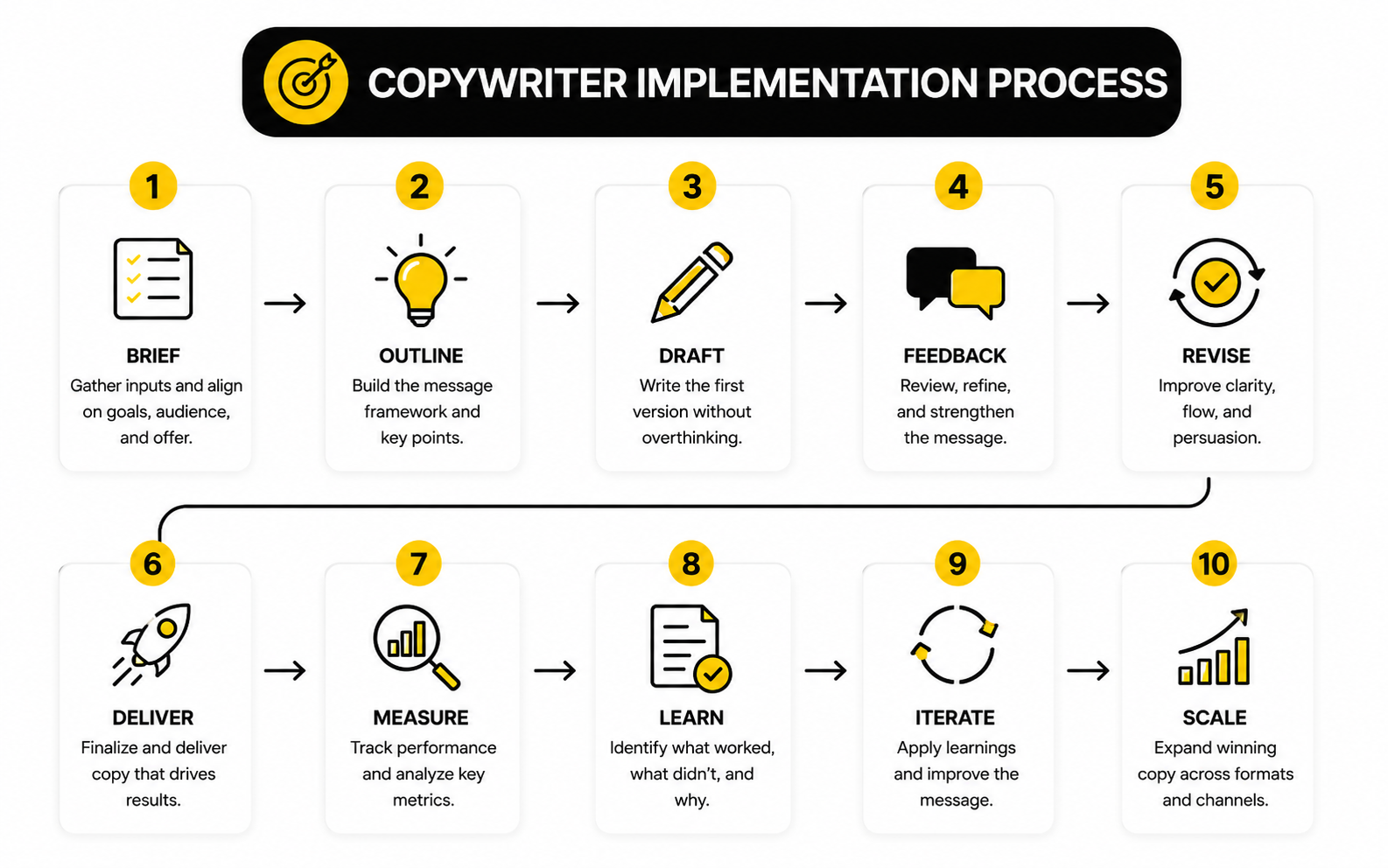
A practical workflow might look like this:
That sequence gives the writer room to think before writing. It also gives your team a clear moment to approve direction before everyone starts reacting to sentences. This matters because rewriting structure after the final draft is much more expensive than fixing the structure early.
Create Feedback Rules Before Revisions Begin
Feedback can improve copy, or it can destroy it. The difference is usually how the feedback is collected. If five people leave disconnected comments based on personal preference, the final draft becomes a compromise nobody loves and no buyer understands.
Set feedback rules before the first draft arrives. One person should own final approval. Internal comments should be consolidated. Feedback should be tied to the brief, the customer, the offer, or factual accuracy, not vague reactions like “make it pop.”
Good feedback explains the concern behind the comment. Instead of saying “this headline feels off,” explain whether it is inaccurate, too broad, too aggressive, too soft, or misaligned with the buyer. That gives the copywriter a real problem to solve instead of forcing them to guess.
Connect Copy to the Tools That Will Deliver It
Copy does not perform in a vacuum. It appears inside pages, emails, ads, forms, chat flows, onboarding sequences, and sales follow-up. The implementation environment affects what the writer should produce.
If the copy will live inside email automation, the writer needs to understand the trigger, timing, segmentation, and goal of each message. If the copy will live on a landing page built with a tool like Replo, the writer needs to think in sections, hierarchy, scannability, and mobile readability. If the copy supports conversations through a tool like ManyChat, the message must feel natural in short, decision-based steps.
This is why implementation should be discussed before the copy is final. A beautiful long-form section may fail if the page layout cannot support it. A clever email may fail if the automation sends it to the wrong segment or at the wrong moment.
Define What Success Looks Like After Launch
The project should not end emotionally with “we like the copy.” That is a weak finish. The better question is whether the copy supports the business outcome it was hired to improve.
Success metrics depend on the asset. A landing page might be judged by conversion rate, qualified form submissions, booked calls, or checkout completion. An email sequence might be judged by replies, clicks, booked calls, purchases, or movement to the next lifecycle stage.
Do not expect every copy project to produce a clean, instant win. Traffic quality, offer strength, pricing, brand trust, page speed, sales process, and follow-up all affect performance. But when you define success before launch, the copywriter can make better choices and your team can learn from the result instead of guessing.
Statistics and Data That Actually Matter
Data is useful when it changes what you do next. It is useless when it becomes a pile of random benchmarks that make you feel either behind or falsely confident. When you are looking for copywriter support, the point of measurement is not to prove whether the writer is “good” in a vacuum; it is to understand whether the message is helping the right buyer move forward.
Benchmarks can give you context, but they should not become your strategy. A landing page converting at 4% may be excellent for an expensive B2B offer and weak for a simple lead magnet. An email with a lower open rate can still outperform if it drives better replies, better-fit calls, or higher revenue.
The right way to use data is to connect each metric to a decision. If a page gets traffic but no clicks, the problem may be clarity, offer fit, proof, or call-to-action friction. If people click but do not submit the form, the issue may be form length, perceived risk, weak qualification, or a mismatch between promise and next step.
Use Benchmarks as Context, Not Judgment
Benchmark data helps you avoid guessing, but it does not know your offer, audience, traffic source, price point, or sales cycle. The 2025 Unbounce conversion benchmark analyzed 41,000 landing pages, 464 million pageviews, and 57 million conversions, with a reported median conversion rate of 6.6% across industries. That is useful context, but it does not mean every landing page below 6.6% has bad copy.
A better question is whether your current copy is improving the conversion path for your specific audience. For cold traffic, you may need more education and trust-building before the call to action. For warm traffic, you may need sharper proof, clearer differentiation, and less explanation.
This is why copy performance should be compared against your own baseline first. If your current page converts at 2% and the new version reaches 3%, that can be meaningful even if an industry report shows higher medians elsewhere. The improvement matters because it came from your market, your offer, and your traffic.
Track the Full Buyer Journey
Copy rarely wins or loses in one isolated metric. A headline can increase clicks but attract the wrong people. A shorter form can increase submissions but lower sales quality. A stronger sales page can reduce support questions even if the conversion rate stays flat.
You need to track the full buyer journey, not just the first visible conversion. That means looking at what happens from impression to click, click to page view, page view to lead, lead to booked call, booked call to show-up, and show-up to purchase. The deeper the offer, the more important this becomes.
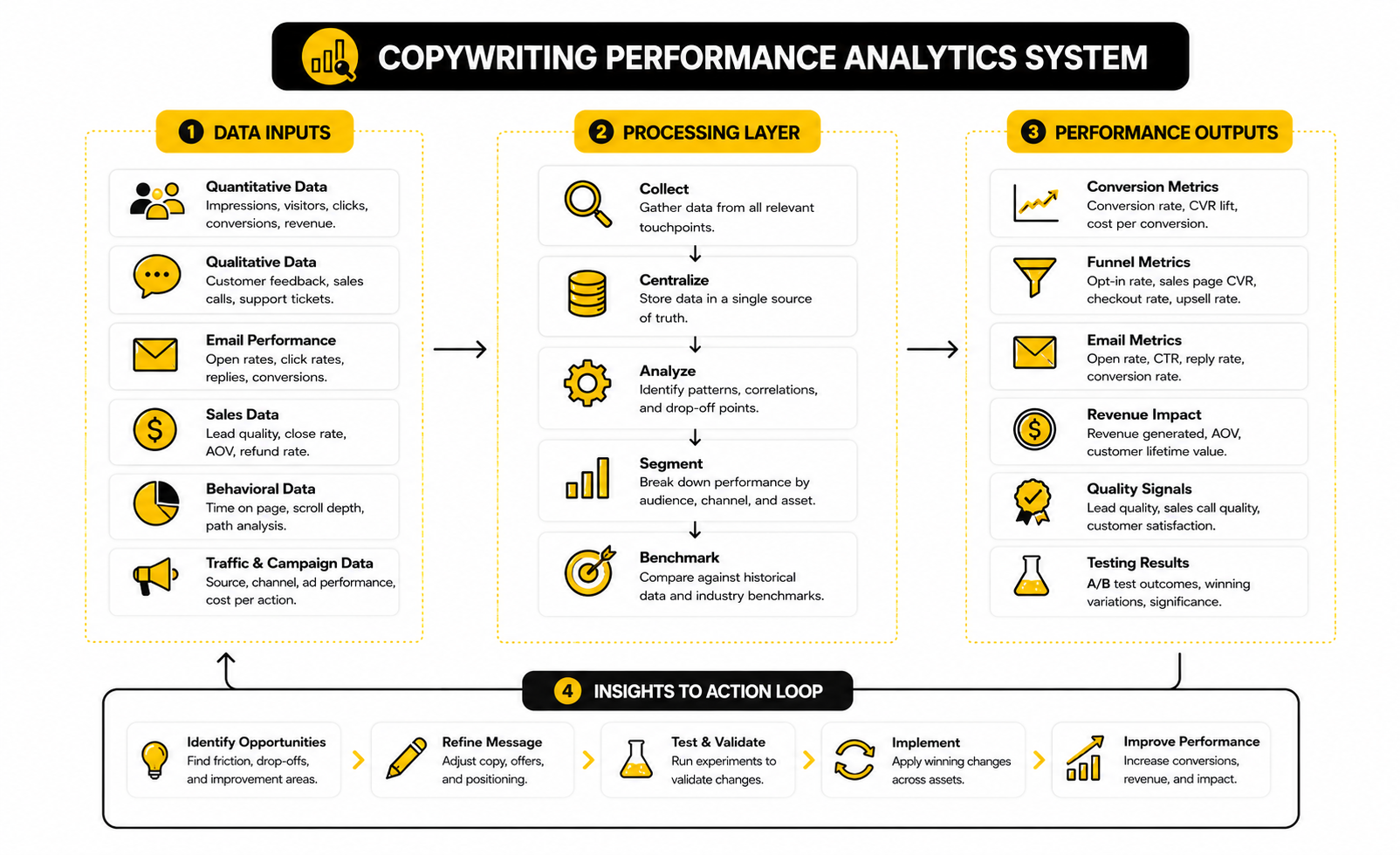
A tool like GoHighLevel can be useful when copy is tied to pipelines, forms, calendars, automations, and follow-up because the message does not stop at the landing page. If the page copy promises one thing and the follow-up sequence says something generic, performance leaks after the first conversion. Measurement should expose those leaks instead of hiding them behind a single top-line number.
Choose Metrics Based on the Copy Asset
Different assets need different metrics. A homepage should not be judged the same way as a cold email, product page, webinar registration page, or nurture sequence. The copywriter should know what success looks like before they write, because the measurement plan affects the message structure.
For a landing page, useful signals may include conversion rate, scroll depth, button clicks, form starts, form completions, cost per lead, and lead quality. For email, useful signals may include open rate, click rate, reply rate, unsubscribe rate, booked calls, purchases, and downstream revenue. For a sales page, useful signals may include checkout starts, checkout completion, average order value, refund rate, and customer quality.
Email benchmarks show why interpretation matters. The MailerLite 2025 email benchmark reported an average open rate of 43.46%, click rate of 2.09%, click-to-open rate of 6.81%, and unsubscribe rate of 0.22%. Those numbers can help you spot unusual performance, but they do not tell you whether the email attracted the right action from the right people.
Look for Performance Signals Before You Rewrite Everything
Do not rewrite an entire funnel just because one number looks weak. Start by identifying where the drop-off happens. The right fix depends on the location of the friction.
If people are not clicking the ad or email, the first message may not be relevant or specific enough. If people click but leave the page quickly, the page may fail to confirm the promise they expected. If people read but do not act, the offer, proof, objection handling, or call to action may be too weak.
This is where a good copywriter becomes more valuable than a fast writer. They can look at the numbers and ask what the behavior suggests. The goal is not to produce new copy for the sake of activity; the goal is to make the next version more precise.
Measure Clarity, Not Just Conversion
Some of the most important copy improvements are not immediately obvious in a headline conversion rate. Clearer copy can reduce bad-fit leads, shorten sales conversations, improve demo quality, lower support volume, and make your team more consistent when explaining the offer. Those outcomes matter, even when they are harder to measure.
For example, if your sales team keeps answering the same basic questions, the page may not be doing enough education before the call. If leads regularly misunderstand the pricing model, the copy may be avoiding a point that should be addressed earlier. If customers arrive with unrealistic expectations, the message may be overselling the outcome or hiding key conditions.
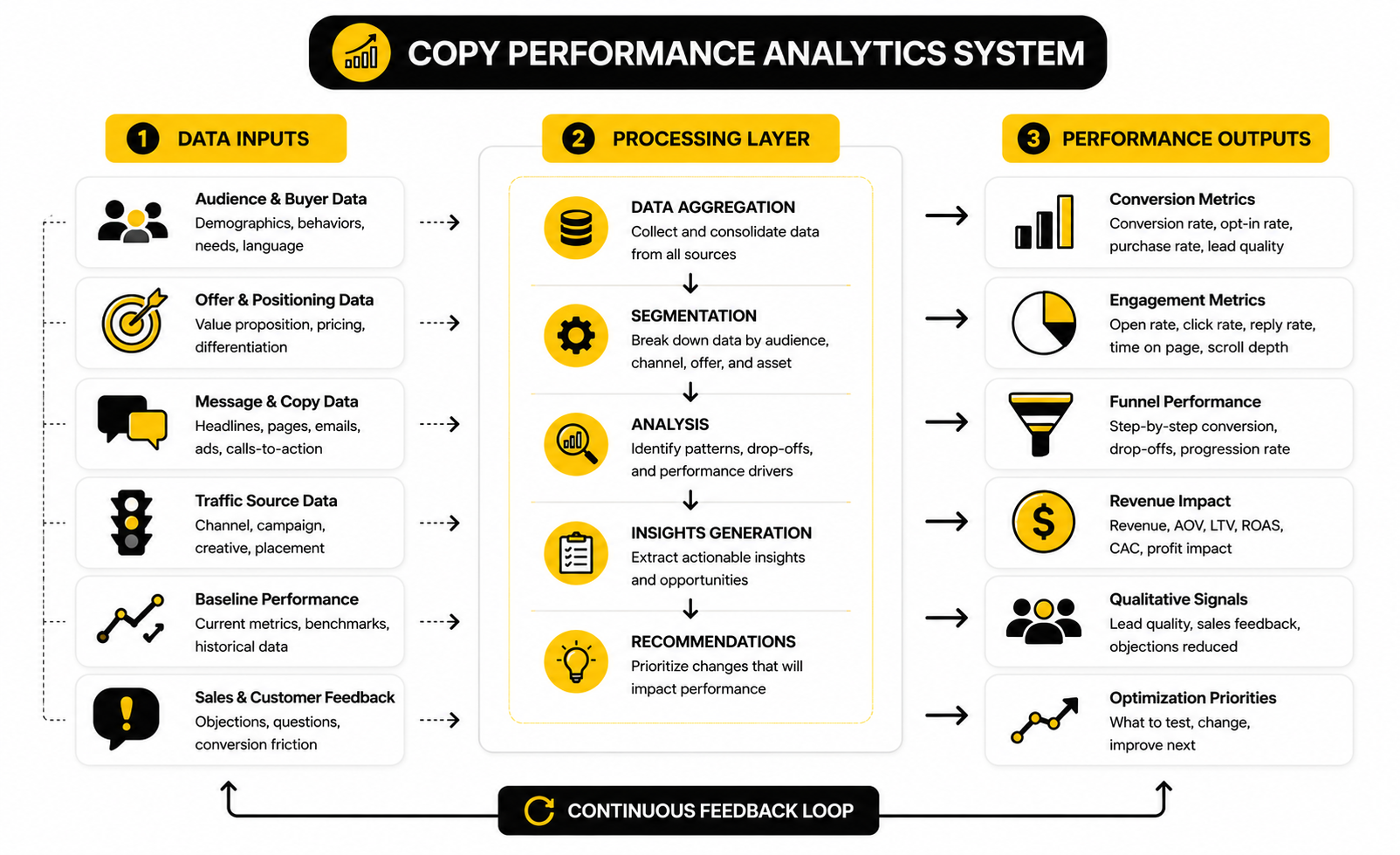
This is why qualitative feedback belongs next to quantitative analytics. Sales notes, customer objections, chat transcripts, form responses, and support tickets can reveal what the numbers cannot explain. The best measurement system listens to both behavior and language.
Build a Simple Copy Performance Dashboard
You do not need a complicated dashboard to measure copy effectively. You need a small set of numbers that connects the asset to the buyer journey. Keep it simple enough that your team will actually review it.
A practical copy performance dashboard can include:
Google Analytics 4 is built around event-based measurement, with Google describing GA4 as using event-based data instead of session-based data. That matters because modern copy performance often depends on smaller actions across the journey, not just a single pageview or final purchase. Button clicks, form starts, video engagement, checkout steps, and key events can all help you understand how the message is working.
Read the Numbers Like a Strategist
A low conversion rate is not automatically a copy problem. It may be a traffic problem, offer problem, audience problem, pricing problem, trust problem, or technical problem. A strong copywriter should be able to discuss those possibilities instead of pretending every issue can be fixed with a better headline.
A high conversion rate is not automatically a win either. If the copy brings in leads who cannot afford the offer, misunderstand the service, or waste the sales team’s time, the message is doing the wrong job well. Better copy is not just more persuasive; it is more selective.
When you are looking for copywriter help, pay attention to how candidates talk about performance. The best ones will not promise magic numbers without context. They will ask what is being measured, where the traffic comes from, what happens after conversion, and what kind of buyer the business actually wants.
Build a Practical Hiring and Collaboration Process
At this stage, the goal is not just finding a writer who can produce a good draft. The goal is building a working relationship that can survive real business pressure. Deadlines move, offers change, stakeholders disagree, launches get messy, and performance data rarely tells a perfectly clean story.
This is where the search becomes more strategic. When you are looking for copywriter support, you are really deciding how much responsibility you want the writer to carry. Some projects only need execution, while others need diagnosis, prioritization, research, messaging, testing, and cross-functional collaboration.
The mistake is hiring for one level of responsibility while expecting another. If you pay for a fast executor, do not expect a full positioning consultant. If you need someone to challenge the offer, reshape the page, and guide the message, do not treat the work like a commodity writing task.
Decide Between Freelance, Agency, and In-House Support
A freelance copywriter is often the best fit when you have a defined project, a focused funnel, or a specific asset that needs expert attention. Freelancers can be flexible, specialized, and fast to onboard when the scope is clear. The tradeoff is that you may need to manage strategy, design, implementation, and measurement separately.
An agency can make sense when copy is part of a broader growth system. If you need strategy, design, ads, funnels, automation, analytics, and ongoing optimization, an agency model may reduce coordination headaches. The tradeoff is that you need to understand who is actually doing the copywriting, not just who sold you the engagement.
An in-house copywriter is usually the right move when messaging is constant and deeply connected to your product, sales team, campaigns, and brand. This works best when the company has enough volume and strategic need to justify the role. The tradeoff is that one in-house writer may still need outside specialists for launches, conversion projects, or high-stakes sales assets.
Watch for Red Flags Before You Hire
The biggest red flags usually show up before the contract is signed. If a writer promises specific conversion lifts without seeing your offer, traffic, baseline, or funnel, be careful. Confidence is useful; fake certainty is not.
Another red flag is a writer who only talks about words and never asks about the buyer. Strong copy depends on audience awareness, objections, proof, offer structure, traffic source, and the desired action. If those questions never come up, the project may stay at the surface.
You should also be cautious when someone has no revision process, no clear deliverables, no defined timeline, and no boundaries around feedback. Creative work needs room, but professional work needs structure. Without structure, even a talented writer can become hard to collaborate with.
Avoid Hiring Based on Voice Alone
Voice matters, but it is not the whole job. A writer who sounds clever, bold, or polished may still miss the buyer’s real motivation. Strong copy is not just personality on the page; it is structured persuasion with a clear commercial purpose.
This is especially important for founder-led brands. A copywriter may need to capture your tone, but they should not simply imitate your favorite phrases. They should understand what your audience needs to believe before your voice becomes persuasive.
A useful test is to ask how the writer would adapt voice across different funnel stages. The top of the funnel may need clarity and curiosity. The sales page may need proof and specificity. The follow-up sequence may need reassurance, urgency, and objection handling.
Protect Strategy From Too Many Opinions
Copy gets weaker when every stakeholder tries to make it safer. Sales wants more detail. Brand wants more polish. Product wants more features. Leadership wants bigger claims. Legal wants less risk.
None of those perspectives are automatically wrong. The problem happens when nobody owns the final message strategy. The copywriter ends up stitching together competing preferences instead of writing for the buyer.
Before the project starts, decide who has final approval and what criteria will guide decisions. The criteria should include accuracy, buyer clarity, offer strength, proof, tone, and action. This keeps feedback from becoming a taste contest.
Scale Copy With Systems, Not Chaos
If copy is becoming a recurring need, you need a system. Otherwise, every project starts from scratch. That creates inconsistent messaging, slower production, and unnecessary revision cycles.
A scalable copy system can include:
This is where tools can help your team stay organized. A CRM like Copper can keep customer and sales context closer to the marketing process, while a form builder like Fillout can help collect structured inputs from leads, customers, or internal stakeholders. The point is not to add more software; the point is to make the next copy project more carefully than the last one.
Know When Cheap Copy Becomes Expensive
Cheap copy is not always bad. A simple internal email, short announcement, or low-risk content update may not need a premium specialist. Spending heavily on every small writing task is not strategic.
But cheap copy becomes expensive when the asset sits close to revenue. A weak sales page, unclear homepage, generic outbound sequence, or confusing checkout flow can quietly drain money every day. In those cases, the real cost is not the writer’s fee; it is the missed opportunity.
The more leverage the asset has, the more careful the hire should be. Copy that touches paid traffic, sales calls, launches, high-ticket offers, or customer activation deserves stronger thinking. That does not mean overpay blindly, but it does mean judging cost against impact.
Treat AI as Leverage, Not a Replacement for Judgment
AI can help a copywriter move faster, but it should not become the strategist by default. It can summarize inputs, generate variations, create rough drafts, and help explore angles. That is useful leverage.
The risk appears when businesses accept AI-generated copy because it sounds fluent. Fluent does not mean accurate. Fluent does not mean differentiated. Fluent does not mean aligned with your offer, your proof, your compliance boundaries, or your buyer’s real objections.
When discussing AI with a copywriter, ask how they use it in their workflow. A good answer will include human review, research validation, strategic editing, and brand-specific judgment. A weak answer will make the tool sound like the whole process.
Build a Long-Term Feedback Loop
The best copywriter relationships improve over time. The first project teaches the writer how your market talks, what your audience responds to, where your offer is strong, and where the message needs more proof. That learning becomes an asset if you capture it.
After each project, review what worked and what did not. Look at performance data, sales feedback, customer questions, support notes, and team observations. Then update your messaging system so future projects start with better inputs.
This is how copy becomes a compounding advantage. You stop treating every page, email, and campaign as a separate creative task. Instead, each one adds to a clearer understanding of what your buyers need to hear before they trust you enough to act.
Frequently Asked Questions About Hiring a Copywriter
A copywriter is not just a person who makes your business sound better. The right copywriter helps turn your offer, audience insight, proof, and positioning into words that move people toward a decision. That decision might be booking a call, starting a trial, joining a list, buying a product, replying to an email, or understanding why your solution is worth paying attention to.
When you are looking for copywriter support, the smartest move is to treat the hire like a business decision, not a creative gamble. You want clarity before style, strategy before polish, and process before promises. The more precise you are about the job, the easier it becomes to find someone who can actually do it.
How Do I Know If I Need a Copywriter?
You probably need a copywriter if people are seeing your offer but not taking the next step. That could mean low landing page conversions, weak email replies, poor ad performance, unclear website messaging, or sales calls filled with basic questions your marketing should have answered earlier. A copywriter helps close the gap between what you mean and what your buyer understands.
You may also need a copywriter when your business has grown beyond founder-written messaging. Early on, you can often get away with explaining the offer manually. But once you want scalable pages, emails, ads, and follow-up systems, the message needs to work without you personally clarifying every detail.
What Type of Copywriter Should I Hire?
The type of copywriter depends on the asset and the business goal. A direct-response copywriter may be best for sales pages, funnels, paid traffic, and conversion-focused campaigns. A product copywriter may be better for SaaS messaging, onboarding, feature pages, and in-app experiences.
For websites, launches, or complex offers, look for someone who can handle messaging strategy as well as writing. For smaller tasks, a strong execution-focused writer may be enough. The key is matching the writer’s strengths to the job instead of hiring the most impressive-sounding generalist.
What Should I Prepare Before Contacting a Copywriter?
Prepare the basics before you reach out. You should know the asset you need, the goal of the project, the target audience, the offer details, the deadline, and any existing performance data. You do not need a perfect brief, but you do need enough context for a professional to understand the project.
It also helps to gather customer language, testimonials, objections, competitor examples, and existing copy. These inputs make the discovery process faster and the final copy stronger. A copywriter can help organize the message, but they need real material to work with.
How Much Should I Pay for a Copywriter?
Copywriting rates vary because the work varies. A short execution task is not priced the same as a full funnel, website rewrite, launch sequence, or strategic messaging project. The closer the copy sits to revenue, the more important it is to evaluate price against potential impact.
Do not judge the fee in isolation. A cheap page that fails to convert can cost more than an expensive page that improves lead quality or sales performance. At the same time, a high price does not automatically mean better strategy, so look for process, relevant experience, and clear thinking.
Should I Hire a Copywriter or Use AI?
Use AI for leverage, not as a full replacement for judgment. AI can help with brainstorming, outlining, summarizing research, generating draft variations, and speeding up production. It is useful when a human knows what to ask for and what to reject.
A copywriter brings the strategic filter AI does not reliably provide on its own. They can judge what is true, relevant, differentiated, compliant, emotionally believable, and aligned with your buyer. If the copy is close to revenue, you want human accountability in the process.
What Makes a Copywriter Good?
A good copywriter understands the buyer before trying to impress the reader. They ask about the offer, the audience, the problem, the objections, the proof, the traffic source, and the desired action. Their work should feel clear, intentional, and grounded in the decision the reader needs to make.
Good copywriters also know how to simplify. They do not add cleverness just to sound creative. They remove friction, sharpen the message, and make the next step feel natural.
What Are the Biggest Mistakes Businesses Make When Hiring a Copywriter?
The biggest mistake is hiring before defining the job. Businesses often ask for “better copy” without explaining the outcome, asset, audience, or sales context. That forces the writer to guess, which usually leads to vague drafts and messy revisions.
Another mistake is choosing based only on portfolio style. A polished sample does not prove the writer can solve your specific problem. Look for relevant thinking, not just beautiful sentences.
How Long Does a Copywriting Project Usually Take?
The timeline depends on the scope, research depth, feedback process, and number of stakeholders. A focused email sequence or landing page can move faster than a full website, launch funnel, or messaging strategy project. The more strategic the work, the more time should be allowed for discovery and direction before drafting.
The biggest delays usually come from unclear feedback, missing inputs, and too many decision-makers. A clean brief and one final approver can make the project much smoother. Speed is useful, but rushing the thinking stage often creates slower revisions later.
Should a Copywriter Understand My Industry?
Industry knowledge helps, but it is not always mandatory. A writer with direct experience in your niche may ramp faster and understand buyer language sooner. That can be valuable in technical, regulated, or highly specialized markets.
However, a strong copywriter can often learn a market through research, interviews, and good source material. The real question is whether they can understand your buyer’s decision process. Niche familiarity is useful, but buyer insight is essential.
How Do I Test a Copywriter Before Hiring?
Start with a conversation about strategy, not a free writing test. Ask how they would approach the project, what inputs they need, what risks they see, and how they would measure success. Their answers will often reveal more than a quick sample assignment.
If you do use a paid test project, keep it focused and realistic. Ask for a small piece of work tied to your actual business, such as a landing page section, email draft, or message audit. Pay for the test because professional judgment has value.
What Should Be Included in a Copywriting Contract?
A copywriting contract should define the scope, deliverables, timeline, payment terms, revision rounds, ownership rights, confidentiality, cancellation terms, and what happens if the project expands. This protects both sides. It also prevents vague expectations from becoming conflict later.
Make sure the contract explains what is not included. Strategy, interviews, extra pages, implementation, design direction, analytics review, and ongoing optimization may require separate scope. Clear boundaries make collaboration easier, not colder.
How Do I Give Better Feedback on Copy?
Give feedback against the goal, not personal taste. Instead of saying a line feels wrong, explain whether it is inaccurate, unclear, too aggressive, too soft, too broad, or misaligned with the buyer. That gives the writer something useful to solve.
Consolidate feedback before sending it. Multiple people commenting separately can pull the copy in different directions. One clear round of focused feedback is usually better than ten scattered opinions.
Can One Copywriter Handle My Whole Funnel?
One copywriter can often handle a full funnel if they understand the strategy and the funnel is within their skill set. A simple lead magnet funnel, webinar funnel, or service-business funnel may be realistic for one strong writer. For larger projects, the writer may need to collaborate with designers, automation specialists, ad buyers, and sales teams.
If you use a platform like Systeme.io or ClickFunnels, the copy should be planned around the whole journey, not just one page. The headline, opt-in, sales page, checkout, upsell, emails, and follow-up all need to feel connected. A funnel does not work because it has steps; it works because each step gives the buyer a good reason to continue.
How Do I Know If the Copy Is Working?
Start by comparing performance against the goal you set before the project began. For a landing page, that may mean conversion rate, qualified leads, cost per lead, or booked calls. For email, it may mean replies, clicks, purchases, appointments, or movement to the next stage.
Also look at qualitative signals. Are leads better informed? Are sales calls smoother? Are fewer people confused about price, process, or fit? Strong copy often improves the quality of conversations, not just the number of clicks.
Build a stronger local presence with BAAM AI
Turn your website, Google profile, social channels, and AI visibility into one growth engine
Most businesses do not need more random marketing activity. They need a consistent presence system that helps the right people find them, trust them, and take action. BAAM AI brings strategy, local SEO, website updates, Google Maps visibility, social content, AI-search readiness, media production, and reporting into one practical monthly engine.
If you want your marketing to keep working after the campaign ends, start with a free BAAM AI presence audit. See how your business shows up today and where the fastest visibility wins are at BAAM AI.