
BAAM AI Blog
Local Digital Marketing: The Practical Framework for Winning Nearby Customers
Local digital marketing is the work of making a business visible, trusted, and easy to choose when people nearby are ready to buy. It connects search, maps, reviews, social content, paid ads, local landing pages...
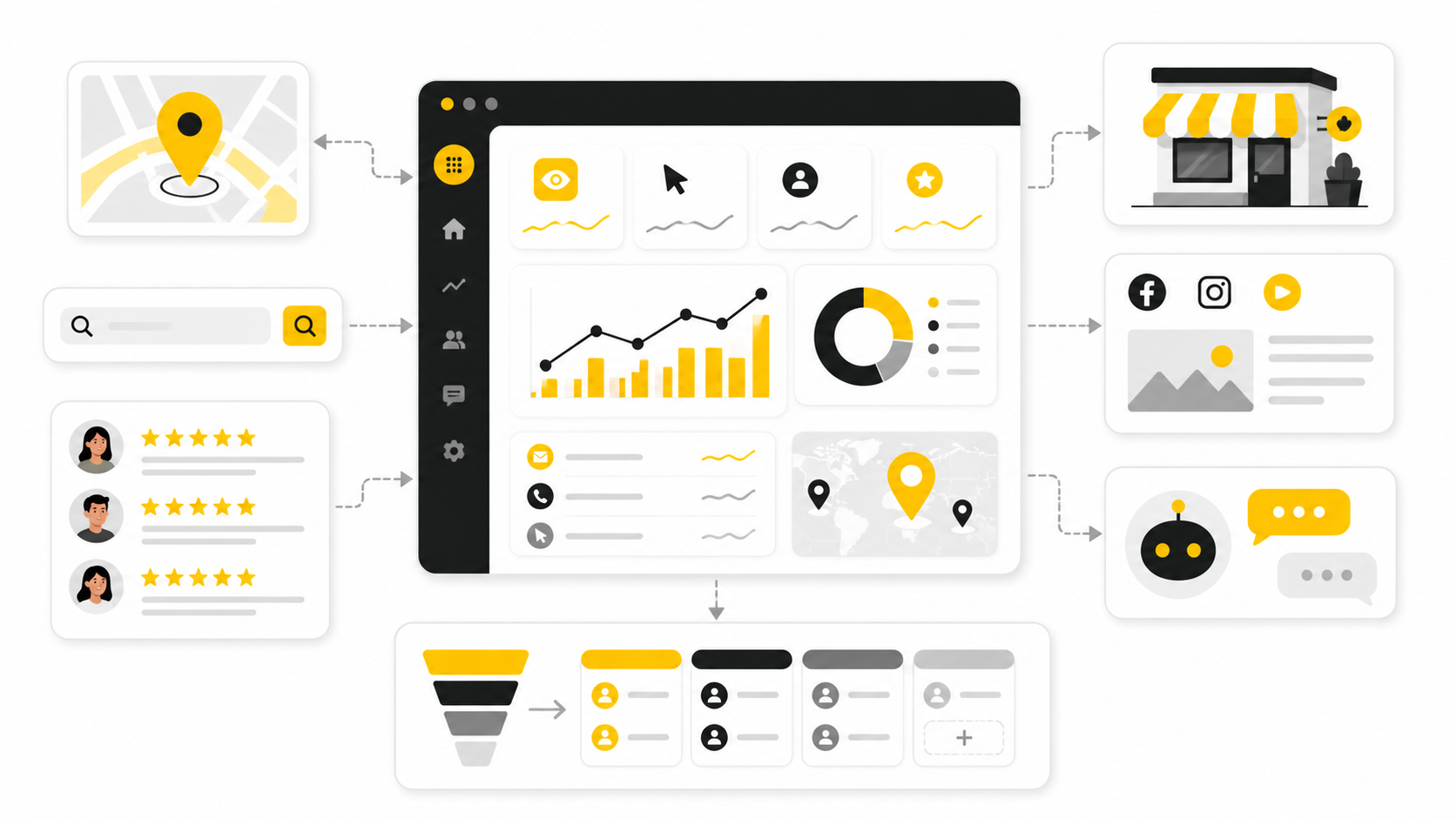
Local digital marketing is the work of making a business visible, trusted, and easy to choose when people nearby are ready to buy. It connects search, maps, reviews, social content, paid ads, local landing pages, email, SMS, and follow-up into one practical system. The goal is not to “be everywhere” for the sake of it; the goal is to show up in the right local moments and turn attention into calls, bookings, visits, quotes, and repeat customers.
That matters because local buying behavior has become deeply digital even when the final purchase happens offline. People compare businesses before they call, check reviews before they visit, and often judge credibility from a Google Business Profile, website, social page, or message response before speaking to anyone. Google’s own guidance says local visibility is shaped by relevance, distance, and prominence, which means a business cannot rely on one tactic alone if it wants consistent local demand through search and maps Google Business Profile Help.
Local digital marketing is also more competitive than it looks. BrightLocal’s 2025 consumer review research shows that reviews remain a major part of how people evaluate local businesses, while newer discovery paths like social platforms, maps, and AI search are changing how customers compare options BrightLocal Local Consumer Review Survey. That is why the strongest local businesses do not treat marketing as a pile of random posts, ads, and SEO tasks. They build a simple local growth engine that can be measured, improved, and repeated.
this guide is split into six parts so each piece of the system can be explained without rushing. The structure starts with the big picture, then moves into the specific channels, implementation details, measurement, and long-term scaling decisions. The same section names below will carry through the full article so the strategy feels like one connected framework.
Why Local Digital Marketing Matters
Local digital marketing matters because local intent is usually close to revenue. Someone searching for a dentist, plumber, gym, restaurant, accountant, med spa, or repair service near them is not casually browsing in the same way they might browse general content. They are often comparing available options, checking trust signals, and deciding who gets the next call.
This is where many local businesses lose money quietly. They may have a decent service, fair pricing, and loyal customers, but their online presence does not communicate that clearly enough to new buyers. If the business profile is incomplete, reviews are weak, the website is slow, the offer is vague, or follow-up is inconsistent, competitors with a cleaner digital path can win the customer before the business ever gets a chance to prove itself.
The practical point is simple: local digital marketing is not just a visibility game. Visibility gets you considered, but trust and conversion get you chosen. A strong local strategy must therefore answer three questions at the same time: can people find you, do they trust you, and is it easy for them to take the next step?
The Local Digital Marketing Framework
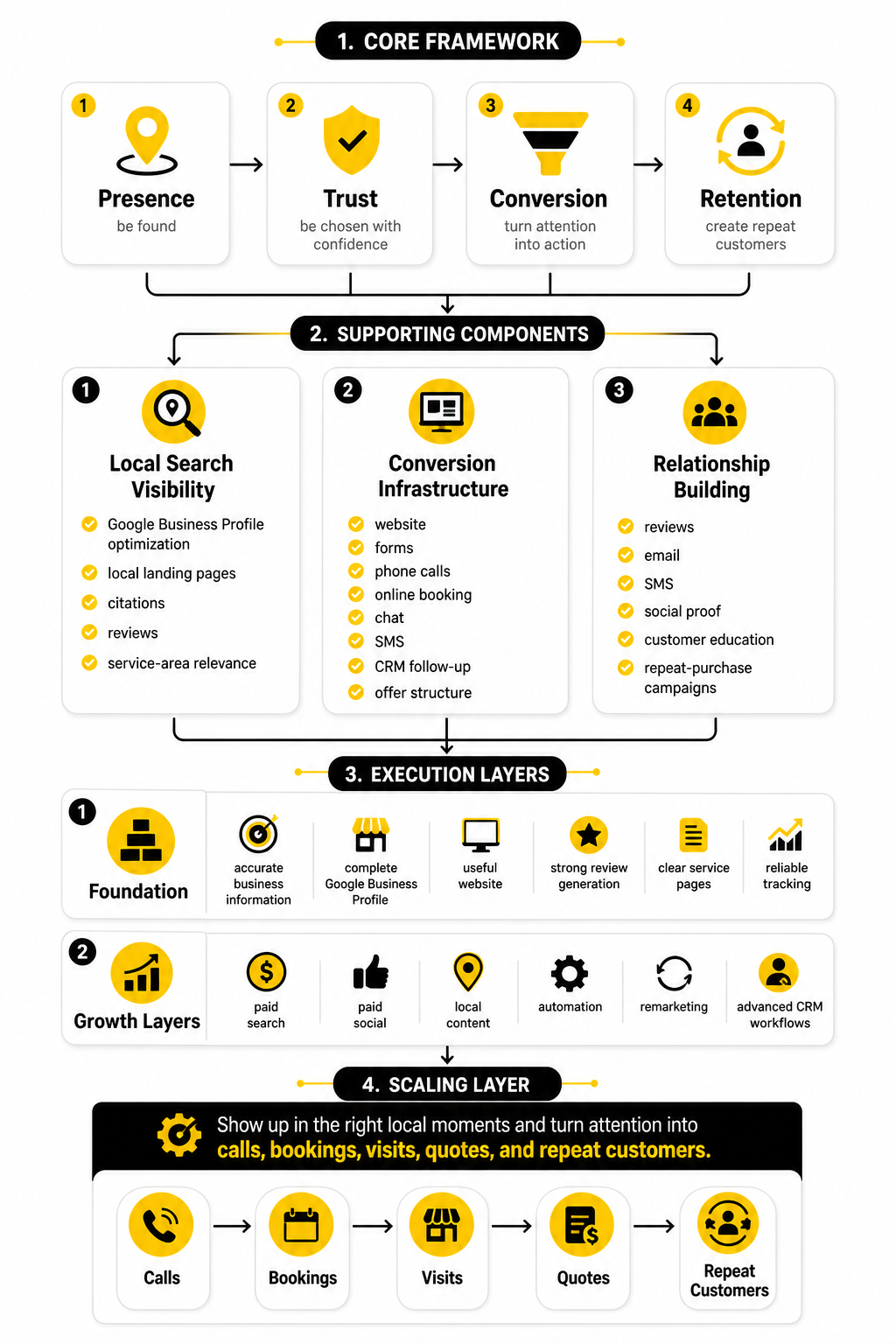
A useful local digital marketing framework has four layers: presence, trust, conversion, and retention. Presence means people can find the business across search, maps, directories, social platforms, and relevant local pages. Trust means the business has strong reviews, clear proof, accurate information, useful content, and a consistent brand experience.
Conversion is where attention becomes action. This includes landing pages, call tracking, booking forms, quote forms, messaging, offers, paid campaigns, and follow-up workflows. Retention then turns one-time customers into repeat buyers, reviewers, referrers, and local advocates through email, SMS, loyalty campaigns, remarketing, and service experience.
This framework prevents a common mistake: investing heavily in one channel while ignoring the rest of the customer journey. Local SEO can bring demand, but a weak website can waste it. Paid ads can generate leads, but poor response time can kill them. Social content can build awareness, but without a clear path to book, buy, or request a quote, it often stays as attention instead of revenue.
Core Components of Local Digital Marketing
The core components of local digital marketing are not complicated, but they need to work together. The first component is local search visibility, especially Google Business Profile optimization, local landing pages, citations, reviews, and service-area relevance. Google is clear that local results are influenced by how well a business matches the search, how close it is to the searcher, and how prominent it appears online Google Business Profile Help.
The second component is conversion infrastructure. This includes the website, forms, phone calls, online booking, chat, SMS, CRM follow-up, and the offer structure that helps someone move from “I’m interested” to “I’m ready.” For many local businesses, the fastest improvement is not more traffic; it is fixing the gaps that stop existing traffic from turning into leads or appointments.
The third component is relationship building. Reviews, email, SMS, social proof, customer education, and repeat-purchase campaigns all help a business stay visible after the first interaction. Local marketing gets much more profitable when the business does not need to keep paying to reacquire the same type of customer over and over again.
Professional Implementation
Professional implementation means turning local digital marketing from a checklist into an operating system. A business should know which channels create qualified demand, which pages or profiles convert that demand, how fast leads are handled, and what happens after the first inquiry. Without that discipline, marketing becomes a guessing game.
The best implementation starts with the basics: accurate business information, a complete Google Business Profile, a useful website, strong review generation, clear service pages, and reliable tracking. After that, the business can layer in paid search, paid social, local content, automation, remarketing, and more advanced CRM workflows. This order matters because advanced tactics perform poorly when the foundation is messy.
Professional local digital marketing also requires restraint. Not every business needs every platform, every automation, or every trend. The right strategy depends on the market, competition, buying cycle, margins, team capacity, and how customers actually choose providers in that category.
The Local Buying Journey Has Changed
The biggest shift in local digital marketing is not that people use the internet more. That part is obvious. The real shift is that local buyers now build confidence across several small touchpoints before they ever call, book, visit, or request a quote.
A customer might discover a business on Google Maps, check recent reviews, compare photos, visit the website, scan social proof, and then return later through a branded search. For younger buyers, that path can also include TikTok, Reddit, Instagram, YouTube, and review platforms before Google Maps becomes the final decision point. SOCi’s 2025 consumer research describes this as a fragmented discovery journey, where local buyers move across multiple platforms instead of trusting one single source SOCi Consumer Behavior Index.
That means a local business cannot think of marketing as one isolated channel. A Google Business Profile may create the first impression, but the website has to confirm the offer. Reviews may create trust, but the booking process has to remove friction. Social content may create familiarity, but follow-up has to turn that familiarity into action.
Local Intent Is Closer To Revenue
Local intent is powerful because it usually carries urgency. Someone searching for “emergency plumber near me,” “best dentist in Prague,” or “wedding photographer near me” is not just consuming content. They are looking for a provider, comparing options, and deciding who deserves the next step.
This is why local digital marketing should be judged differently from broad brand awareness. A small increase in the right local visibility can have a direct impact on calls, appointments, store visits, and quote requests. Rio SEO’s local consumer research found that Google Search remains a frequent place for local business discovery, with 77% of surveyed consumers using Google weekly to find local businesses and 21% using it daily Rio SEO local search research.
The mistake is treating that demand like generic traffic. Local visitors often need practical confirmation, not clever persuasion. They want to know whether the business serves their area, solves their problem, looks trustworthy, answers quickly, and gives them a simple next step.
Trust Signals Now Do More Of The Selling
In local markets, trust is not a soft metric. It is a conversion asset. Before someone contacts a business, they often judge reviews, star ratings, response quality, photos, opening hours, service descriptions, and the overall professionalism of the online presence.
Reviews are especially important because they act like public proof at the exact moment a buyer is comparing nearby options. BrightLocal’s 2025 review research shows that consumers still rely heavily on reviews when evaluating local businesses, while also checking more than one platform before making a decision BrightLocal Local Consumer Review Survey. That makes reputation management part of the revenue system, not just a nice branding task.
A strong local business does not need perfect reviews, but it does need a credible pattern. Recent reviews, specific customer language, thoughtful owner responses, accurate business details, and real photos all reduce doubt. When those signals are missing, the buyer does not always complain; they simply choose someone else.
Search, Maps, And Reputation Work Together
Local search is not just about ranking for a keyword. It is about matching intent, location, and credibility in a way that makes the business feel like the safest choice. Google explains local visibility through relevance, distance, and prominence, which is why complete business information, service accuracy, and broader reputation all matter Google Business Profile Help.
Relevance tells Google whether the business fits the search. Distance helps determine whether the business is physically or operationally close enough to the customer. Prominence reflects how well-known and trusted the business appears across signals such as links, reviews, mentions, and overall online presence.
This is why shortcuts usually fail. Adding keywords to a profile will not fix weak reviews. Running ads will not fix a confusing website. Posting on social media will not fix incorrect business hours, thin service pages, or a slow response process.
The Website Still Has A Serious Job
A local website is not just a brochure. It is the place where uncertainty should disappear. When someone lands on the site, they should quickly understand what the business does, who it serves, where it operates, why it is credible, and what to do next.
For local digital marketing, service pages matter because they connect search intent to a specific offer. A general homepage might help someone understand the brand, but a clear service page helps someone decide whether the business can solve their exact problem. The more competitive the market, the more important this becomes.
The website also needs to support conversion, not just information. Phone numbers, forms, booking links, quote requests, location details, reviews, guarantees, pricing guidance, and frequently asked pre-sale questions all play a role. If the site makes the buyer work too hard, the marketing budget is quietly leaking.
Speed Of Response Can Decide The Winner
Local buyers often contact more than one business. That creates a simple but uncomfortable truth: the fastest credible response can win before the “best” provider even replies. This is especially true in categories where the customer has urgency, anxiety, or a clear deadline.
A missed call, slow form reply, or unanswered message is not just an operational issue. It is a marketing problem because the lead was already created and then wasted. Local digital marketing only becomes profitable when the business can handle demand quickly and consistently.
This is where follow-up systems become valuable. A CRM, call tracking, automated SMS, email reminders, appointment confirmations, and missed-call workflows can protect opportunities that would otherwise disappear. For businesses that want one platform for pipelines, forms, SMS, email, calendars, and lead follow-up, GoHighLevel fits naturally into this part of the local marketing stack.
Local Competition Is Often Won In The Details
Many local markets are not won because one business has a genius marketing strategy. They are won because one business handles the details better than everyone else. The profile is complete, the reviews are current, the website is clear, the offer is easy to understand, and the team responds quickly.
That sounds basic, but basic does not mean easy. Most local businesses are busy serving customers, managing staff, handling operations, and putting out fires. Marketing slips because nobody owns the system from first impression to booked appointment.
The opportunity is that local competitors often leave obvious gaps. Some have weak service pages. Some ignore reviews. Some run ads without tracking calls. Some post content but never build follow-up. A business that fixes these gaps methodically can outperform competitors without needing to outspend them.
Why Random Tactics Are Not Enough
Random tactics feel productive because they create activity. A business posts on Instagram, boosts a Facebook post, updates a listing, runs a small ad, sends an email, or rewrites a page. Each action might be useful, but scattered effort does not automatically create a reliable growth system.
The better approach is to connect every tactic to a role. Search and maps create local discovery. Reviews and proof build trust. Landing pages and offers convert interest. Follow-up turns missed opportunities into booked work. Retention campaigns bring customers back and generate referrals.
That is the real reason local digital marketing matters. It gives a business control over the customer journey instead of leaving growth to luck, referrals, or whoever happens to rank above them this week. When the system is built properly, local marketing becomes less chaotic, more measurable, and much easier to improve.
The Local Digital Marketing Framework
A strong local digital marketing strategy works best when it follows a clear sequence. You do not start by asking, “What should we post this week?” or “Should we run ads?” You start by mapping how a nearby customer discovers the business, decides whether to trust it, and takes the next step.
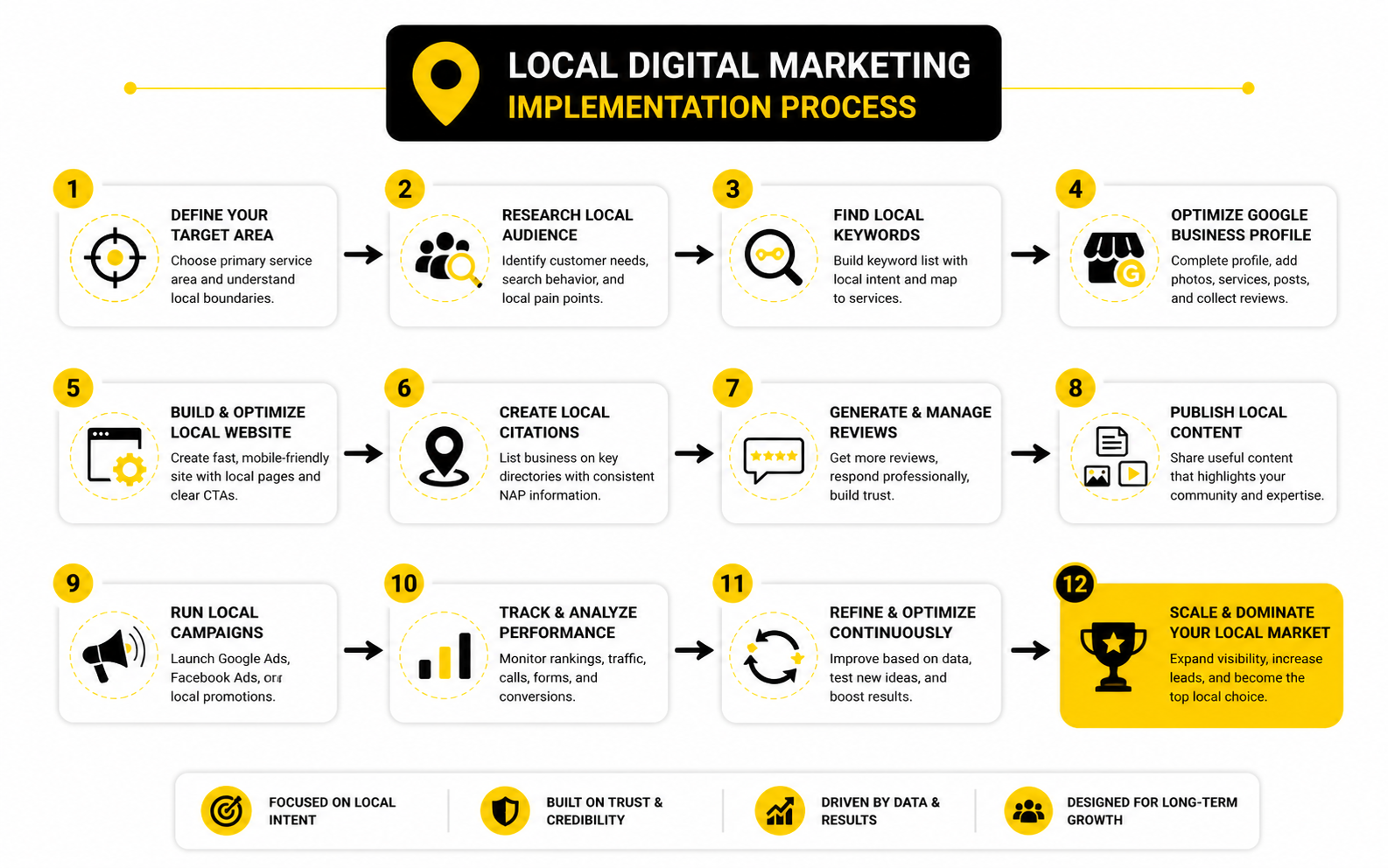
The framework is simple: audit, position, build, promote, capture, follow up, and improve. Each stage solves a different problem in the local customer journey. When one stage is weak, the whole system becomes less reliable, even if the business is doing plenty of marketing activity.
This is why process matters. Local buyers are moving through search, maps, reviews, websites, social platforms, and messages before making a decision, and newer research shows that discovery is becoming more fragmented across platforms BrightLocal consumer search behavior research. A framework keeps that journey organized so the business can improve the right things in the right order.
Step 1: Audit The Current Local Presence
The first step is to understand what the business already looks like from the customer’s point of view. Search the brand name, service keywords, location keywords, and common “near me” phrases. Check the Google Business Profile, website, review profiles, directories, social pages, ads, and any landing pages currently being used.
This audit should not be a vanity exercise. The goal is to find friction: missing services, outdated hours, weak photos, inconsistent business information, slow pages, thin service descriptions, confusing offers, poor mobile layout, or review gaps. Google’s own local ranking guidance still points to relevance, distance, and prominence as the core factors behind local visibility, so incomplete or inconsistent information can directly weaken discoverability Google Business Profile Help.
A good audit also looks at competitors. Not to copy them, but to understand what customers are comparing. If competing businesses have clearer service pages, stronger review volume, better photos, faster booking, or more useful local content, those are not abstract marketing details; they are reasons a buyer may choose them instead.
Step 2: Define The Local Positioning
Local positioning answers one practical question: why should someone nearby choose this business instead of the other visible options? The answer cannot be “quality service” or “friendly team” because nearly every local business says that. The positioning has to be specific enough to shape the website, business profile, ads, content, and sales follow-up.
This includes the main service categories, service area, ideal customer types, urgency level, price positioning, proof points, guarantees, availability, and strongest differentiators. A med spa, family dentist, emergency plumber, boutique gym, and commercial cleaning company should not sound the same. Their customers have different fears, buying timelines, trust signals, and decision triggers.
Clear positioning also prevents local digital marketing from becoming generic. If the business serves premium buyers, the proof and messaging need to support that. If it competes on convenience, the booking process and response speed need to be obvious. If it wins through technical expertise, the content and service pages should show depth without becoming confusing.
Step 3: Build The Local Visibility Foundation
Once the positioning is clear, the foundation needs to be built or cleaned up. This usually starts with the Google Business Profile, because it is often the first serious local touchpoint. Categories, services, descriptions, hours, photos, products, posts, questions, booking links, and review responses should all support the same positioning.
The website foundation comes next. Each important service needs a clear page that explains the problem, the service, the location relevance, proof, process, and next step. The homepage should guide broad visitors, but service pages should help high-intent visitors make a decision.
Directory consistency still matters because local visibility depends partly on trust and accuracy across the web. Business name, address, phone number, website URL, opening hours, and service details should match wherever customers might find the brand. This is not exciting work, but it protects the rest of the system.
Step 4: Create A Practical Execution Process
Execution becomes much easier when the work is turned into a repeatable process. A local business does not need a complicated corporate marketing calendar, but it does need a rhythm for updates, content, reviews, campaigns, and follow-up. Without that rhythm, marketing usually happens only when things get quiet, which is exactly when the business wants results fastest.
A practical monthly process can look like this:
This process keeps local digital marketing grounded in revenue instead of noise. It also makes performance easier to diagnose. If visibility is weak, the business works on search, maps, content, and citations. If leads are coming in but not closing, the business works on response speed, offer clarity, booking friction, and follow-up.
Step 5: Promote The Right Offers In The Right Channels
Promotion should follow intent. High-intent services usually deserve search ads, local SEO, Google Business Profile optimization, and strong service pages because people are actively looking for help. Lower-urgency services often need education, social proof, email, retargeting, and content because the customer may need more time before taking action.
The mistake is pushing every offer through the same channel. A same-day repair service behaves differently from a cosmetic consultation, a legal inquiry, or a fitness membership. The channel mix should reflect how the buyer thinks, how quickly they decide, and how much trust they need before they commit.
For businesses running local campaigns with forms, landing pages, SMS, email, pipelines, and appointment booking, a system like GoHighLevel can help connect the promotion side with the follow-up side. That matters because local marketing is not finished when the lead arrives. The lead still needs to be contacted, qualified, scheduled, reminded, and moved toward a real sale.
Step 6: Capture Demand Without Creating Friction
A customer who is ready to act should not have to hunt for the next step. Phone numbers, forms, booking buttons, quote requests, maps, hours, and service-area details should be easy to find on mobile. If the buyer has to zoom, scroll endlessly, copy details manually, or wait too long for a reply, conversion drops before the business even knows what happened.
Demand capture also means matching the call to action to the buyer’s level of commitment. Some people are ready to book now. Others want a quote, a consultation, a callback, a menu, directions, or a simple answer. The page should support the next logical action instead of forcing every visitor into the same path.
This is especially important for paid traffic. Ads can create attention quickly, but weak capture turns that attention into expensive leakage. Before increasing ad spend, the business should confirm that landing pages, forms, tracking, calls, messages, and follow-up workflows are actually ready.
Step 7: Follow Up Until The Decision Is Made
Follow-up is where many local businesses leave money on the table. A person who submits a form, calls after hours, asks a question, or clicks a booking link is already warmer than a cold audience. If the business does not respond quickly and consistently, that opportunity can disappear to a competitor.
Good follow-up does not mean spamming people. It means confirming the request, answering the obvious question, making the next step clear, and staying present while the person decides. For appointment-based businesses, reminders and no-show prevention can be just as important as the initial lead response.
This is also where email and SMS become practical instead of theoretical. A local business can send estimate reminders, appointment confirmations, review requests, reactivation campaigns, seasonal offers, and post-service education. The goal is not to automate everything; the goal is to make sure good opportunities do not slip through cracks.
Step 8: Improve One Bottleneck At A Time
The final step is optimization, but optimization should be focused. Too many businesses try to fix everything at once, then lose track of what actually changed. A better approach is to identify the biggest bottleneck and improve that first.
If the business is invisible, work on local relevance, content depth, Google Business Profile quality, reviews, and citations. If the business is visible but not getting enough actions, work on calls to action, service pages, proof, offers, and mobile usability. If leads are coming in but not turning into customers, work on speed, follow-up, qualification, reminders, and sales process.
This is where the framework becomes powerful. Local digital marketing stops being a random collection of tasks and becomes a system that can be diagnosed. Every improvement has a purpose, every channel has a role, and every month gives the business a clearer view of what to do next.
Statistics And Data
Measurement is where local digital marketing becomes honest. It shows whether the business is actually becoming easier to find, easier to trust, and easier to buy from. Without measurement, a local marketing plan can look busy while quietly failing in the places that matter most.
The important thing is not to dump every possible metric into a dashboard. The important thing is to connect each number to a decision. A rise in profile views means one thing, a rise in calls means another, and a rise in booked appointments means something much more valuable.
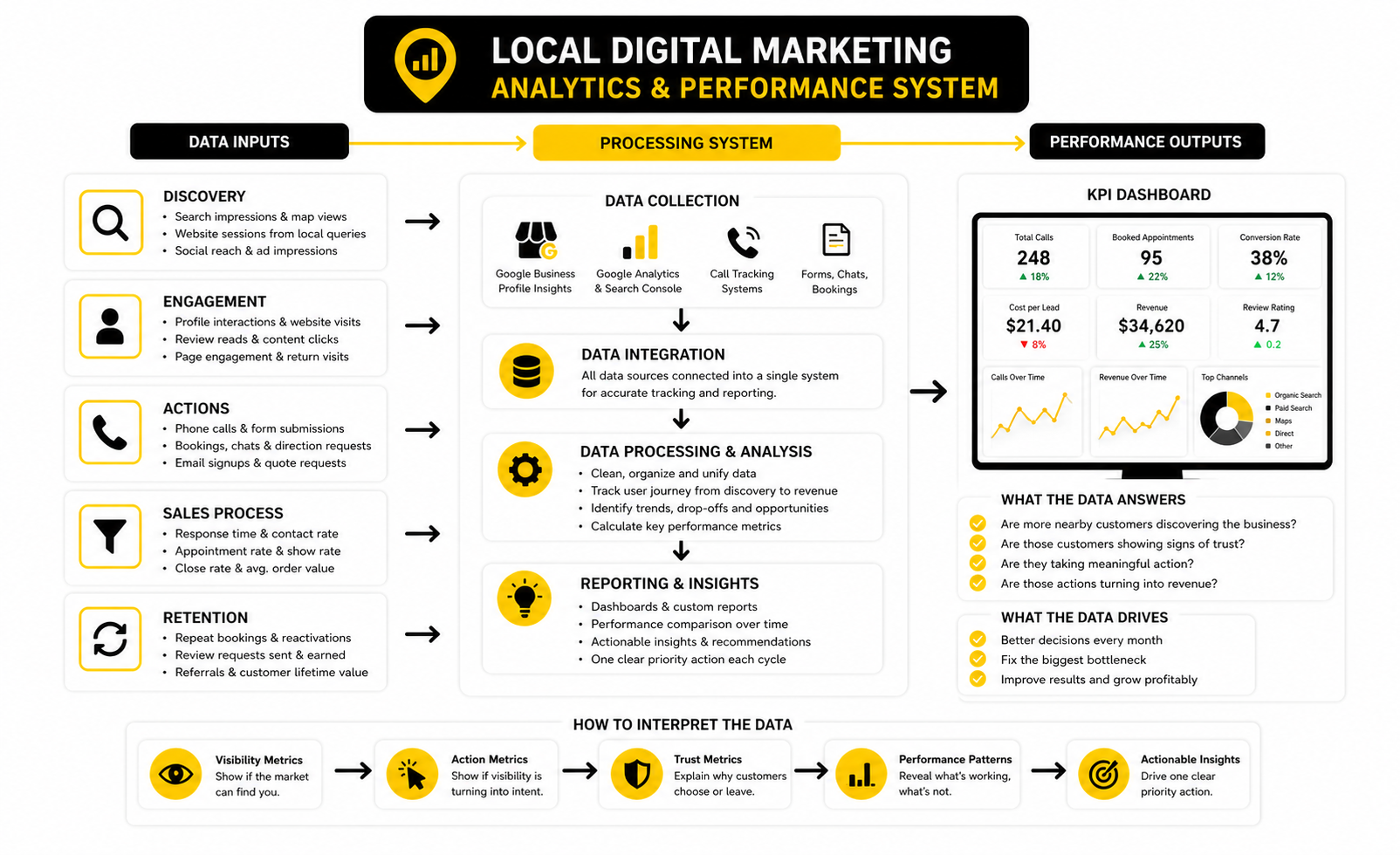
Local data should answer four practical questions:
Visibility Metrics Show Whether The Market Can Find You
Visibility metrics tell you whether the business is showing up often enough in the places where local buyers search. This includes Google Business Profile impressions, map views, search views, website sessions from local queries, rankings for service-and-location keywords, and traffic from local landing pages. These numbers matter because they show whether the business is even entering the customer’s consideration set.
A visibility problem usually means the business needs better local relevance, stronger service pages, more complete profile information, better category alignment, stronger location signals, or more credible mentions across the web. Google’s local ranking guidance still centers on relevance, distance, and prominence, so visibility should be interpreted through those three lenses Google Business Profile Help. If the business is relevant but not prominent, the action is different from a business that is prominent but poorly matched to the actual search intent.
Do not obsess over rankings in isolation. Local rankings can change by searcher location, device, query wording, and map behavior. A better question is whether visibility is increasing for the services that produce real customers, in the locations the business actually wants to serve.
Action Metrics Show Whether Visibility Is Turning Into Intent
Action metrics are more important than surface-level exposure. These include calls, direction requests, website clicks, booking clicks, form submissions, chat starts, message requests, coupon redemptions, and quote requests. They show whether people are moving from awareness into intent.
Rio SEO’s local consumer research found that Google is still a weekly discovery channel for most surveyed consumers, with 77% using it weekly and 21% using it daily to find local businesses Rio SEO local consumer search behavior. That matters because a Google Business Profile should not be measured only as a listing. It should be treated as a conversion point where real buyers decide whether to call, visit, book, or keep comparing.
When action metrics are weak, the issue is often not traffic volume. It may be weak photos, vague services, poor reviews, unclear calls to action, outdated hours, low trust, or a website that fails on mobile. The fix is not always “more marketing.” Sometimes the fix is making the next step obvious.
Trust Metrics Explain Why Customers Choose Or Leave
Trust metrics are harder to reduce to one clean number, but they are critical. Review volume, review recency, average rating, response rate, review keywords, photo quality, social proof, and brand search growth all tell you whether the market sees the business as credible. These signals often influence the buyer before the first call happens.
BrightLocal’s 2025 consumer review research shows that reviews remain a major part of how people evaluate local businesses, while consumers increasingly compare signals across multiple platforms BrightLocal Local Consumer Review Survey. The action from that data is simple: reviews should be managed as part of the sales system, not as a random afterthought. A steady review request process, thoughtful responses, and recent customer proof can directly support conversion.
Trust metrics should also be read by category. A restaurant, clinic, lawyer, home service provider, and fitness studio do not need identical proof. Some buyers need safety and credentials. Others need photos, speed, convenience, pricing clarity, or evidence of consistent service.
The Analytics System Should Follow The Customer Journey
A clean analytics system follows the customer from discovery to revenue. It starts with visibility, moves into engagement, tracks actions, and then connects those actions to qualified leads, bookings, sales, repeat purchases, and reviews. This keeps the dashboard focused on decisions instead of decoration.
The simplest useful structure is:
This structure makes the next move clearer. If discovery is growing but action is flat, conversion needs work. If action is growing but revenue is flat, lead quality or sales follow-up needs attention. If sales are healthy but repeat business is low, the business needs retention campaigns and post-purchase communication.
Benchmarks Are Useful, But Context Matters More
Benchmarks can help a business understand whether performance is unusually weak or strong, but they should never replace context. A local emergency service, elective health provider, restaurant, real estate agent, and B2B service company will naturally have different conversion rates, sales cycles, and customer expectations. Comparing them as if they are the same creates bad decisions.
Use benchmarks as a starting point, then build internal baselines. The business should know its normal call volume, form volume, booking rate, close rate, cost per qualified lead, and revenue per customer. Once those baselines exist, improvement becomes much easier to measure.
The most useful comparison is often the business against itself over time. Did local visibility grow for priority services? Did profile actions increase after review velocity improved? Did landing page conversion improve after the offer was clarified? Those answers are more actionable than chasing generic averages from another industry.
What Good Performance Signals Look Like
Good performance is not one perfect number. It is a pattern. A healthy local digital marketing system usually shows improving visibility for priority services, stronger engagement from nearby users, more high-intent actions, faster lead handling, and better conversion from inquiry to booked customer.
For example, more map views are useful only if they lead to more calls, directions, bookings, or website visits from relevant customers. More website traffic is useful only if the traffic reaches service pages, understands the offer, and takes the next step. More reviews are useful only if they are recent, credible, specific, and connected to the services the business wants to sell.
This is where local analytics must stay practical. The business should not celebrate a vanity metric if revenue is flat. It should not panic over a ranking dip if qualified calls and booked appointments are improving. Data matters because it helps the business act with discipline.
What Weak Performance Signals Usually Mean
Weak performance signals often point to a specific leak in the system. Low impressions can mean poor relevance, weak content, incomplete profile information, or limited local authority. Low clicks can mean the business appears but does not look compelling enough to investigate further.
Low calls or bookings can mean the offer is unclear, reviews are weak, the page is slow, the contact options are hidden, or the buyer does not feel enough trust. Low close rates can mean poor lead quality, slow response time, weak qualification, inconsistent follow-up, or a mismatch between the marketing promise and the actual service conversation.
This is why measurement has to include both marketing and operations. Local digital marketing does not stop when the lead is generated. If calls are missed, forms are ignored, appointments are not confirmed, or reviews are never requested, the dashboard will eventually show it.
Tracking Should Be Simple Enough To Maintain
The best tracking system is the one the business will actually use. A small local company does not need a bloated reporting setup with dozens of disconnected tools. It needs clean source tracking, call tracking where appropriate, form tracking, booking tracking, profile insights, website analytics, and a reliable way to connect leads to outcomes.
For many local businesses, the core stack can include Google Business Profile insights, Google Search Console, Google Analytics, call tracking, a CRM, and a simple reporting dashboard. If the business also runs paid ads, every campaign should be connected to real lead and revenue outcomes, not just clicks and impressions. A platform like GoHighLevel can be useful when the business wants forms, calls, SMS, email, pipelines, calendars, and reporting closer together.
The goal is not perfect attribution. Perfect attribution is rare, especially in local buying journeys where people switch devices, compare platforms, call directly, and return through branded search. The goal is enough clarity to make better decisions every month.
The Data Should Drive One Clear Action
Every reporting cycle should end with one clear action. Not ten vague ideas. One priority that would remove the biggest bottleneck. This keeps local digital marketing focused and prevents the team from drowning in dashboards.
If the biggest issue is discovery, the next action might be improving service pages or profile completeness. If the biggest issue is trust, the action might be a review request workflow and better response process. If the biggest issue is conversion, the action might be rewriting the main offer, simplifying forms, or improving call handling.
That is how the numbers become useful. They are not there to impress anyone. They are there to show where the system is leaking and what to fix next.
Professional Implementation And Optimization
At this stage, local digital marketing becomes less about adding more activity and more about making better strategic choices. The business already has visibility, trust, conversion, follow-up, and measurement in place. The next challenge is deciding what to scale, what to protect, and what to stop doing.
This is where inexperienced teams often make expensive mistakes. They see one good month and immediately increase ad spend. They see one weak channel and abandon it too early. They chase new tools before fixing operational gaps that are already visible in the data.
Professional implementation is slower, cleaner, and more deliberate. It asks whether the business can handle more demand, whether the lead quality is strong enough, whether the customer experience matches the marketing promise, and whether growth will improve profit instead of just increasing workload.
Scaling Starts With Capacity
Scaling local digital marketing without checking capacity is risky. More leads are not automatically good if the team cannot answer calls, handle bookings, deliver the service, or maintain quality. A business can damage its reputation quickly when marketing grows faster than operations.
Capacity includes staff availability, appointment slots, service delivery speed, response time, inventory, geographic coverage, and management attention. It also includes emotional capacity, because overwhelmed teams often start cutting corners. That eventually shows up in reviews, cancellations, refunds, and weak repeat business.
Before increasing spend or expanding into new locations, the business should ask a blunt question: can we serve more customers well right now? If the answer is no, the next marketing move may be operational. Fixing scheduling, onboarding, call handling, and customer communication can create more growth than another campaign.
Not Every Channel Deserves Equal Attention
Local businesses often feel pressure to be active on every channel. That sounds modern, but it is usually a trap. A business with limited time should not treat Google Search, Google Maps, Instagram, TikTok, Facebook, YouTube, email, SMS, paid ads, directories, and AI search as equal priorities.
The right channel mix depends on intent. High-urgency services usually need strong search, maps, reviews, landing pages, and fast response systems. Visual or lifestyle-driven businesses may need more social proof, short-form content, creator-style assets, and before-and-after storytelling. Appointment-based businesses often benefit from email, SMS, booking reminders, and reactivation campaigns because the money is in the follow-up.
The tradeoff is simple: every channel added creates more work. If the business cannot maintain quality, it is better to dominate a few important touchpoints than appear weakly everywhere. Local digital marketing rewards consistency more than scattered ambition.
Organic And Paid Should Support Each Other
Organic visibility and paid advertising should not fight for budget like separate departments. In a mature local system, they support each other. Organic search, maps, reviews, and content build durable trust, while paid campaigns help create faster demand for priority services, offers, or seasonal opportunities.
Paid search is especially useful when the business needs immediate visibility for high-intent services. But paid ads expose weaknesses quickly. If the landing page is vague, the reviews are weak, the phone experience is poor, or the offer does not match the query, the campaign becomes expensive feedback.
Organic work compounds more slowly, but it can reduce dependence on paid traffic over time. Google’s local ranking guidance still points to relevance, distance, and prominence, which means stronger service pages, complete business profiles, credible reviews, and broader online prominence can support long-term discoverability Google Business Profile Help. The best strategy usually uses paid to learn and accelerate, while organic builds resilience.
Reputation Becomes Harder To Manage As You Grow
A small business can sometimes manage reputation manually. The owner knows the customers, notices issues quickly, and can personally respond when something goes wrong. As the business grows, that informal system starts to break.
More customers means more review opportunities, but also more chances for inconsistent experiences. More locations or team members create more variation in service quality. More marketing creates higher expectations, and higher expectations make small operational mistakes feel bigger to the customer.
This is why reputation management needs a process before the business is under pressure. Review requests should happen consistently after successful service moments. Negative feedback should be routed internally before it becomes a public pattern. Review responses should sound human, specific, and calm, not like copied customer support templates.
AI Search Raises The Standard For Clean Information
AI-powered search is changing local discovery because customers may receive summarized answers before they click a website. That does not make local SEO irrelevant. It makes accurate, structured, consistent information more important.
If search engines, maps, directories, review platforms, and websites all show different details, the business becomes harder to trust and harder to summarize correctly. Rio SEO’s 2025 research frames AI-powered search, reputation, and customer experience as major forces in the local journey, which reinforces the need for accurate local data and action-ready experiences Rio SEO 2025 Local Search Consumer Behavior Study. The practical action is not to panic about AI. The practical action is to make the business easier for both humans and systems to understand.
This means service pages should be clear, profiles should be complete, reviews should mention real services naturally, and location information should be consistent. It also means businesses should avoid thin, generic content that says nothing specific. AI search may change the interface, but it does not remove the need for trustworthy information.
Automation Should Protect The Customer Experience
Automation is useful when it makes the customer experience faster, clearer, and more reliable. It is harmful when it makes the business feel careless. The line between those two outcomes is thinner than many businesses think.
Good automation confirms appointments, follows up on missed calls, sends reminders, asks for reviews at the right moment, reactivates past customers, and routes leads to the right person. Bad automation sends generic messages, ignores context, over-messages people, or keeps pushing after the customer has already taken action. That is not efficient. That is annoying.
A local business should automate the predictable parts of the journey while keeping human judgment where it matters. For example, a missed-call text can save a lead, but a complex complaint should get personal attention. A review request can be automated, but the response to a detailed negative review should not feel robotic.
Multi-Location Marketing Needs Local Control
Multi-location local digital marketing is a different game from single-location marketing. The brand needs consistency, but each location also needs local relevance. If every page, profile, photo, post, and review response looks identical, the business can feel disconnected from the community it claims to serve.
Each location should have accurate details, local photos, unique service information where relevant, review generation, and a clear understanding of the local competitive set. A national or regional brand can provide the framework, but the local page still needs to answer local buyer questions. That includes parking, service area, staff, appointment availability, nearby landmarks, local regulations, or market-specific service needs when they matter.
The risk is centralizing everything so heavily that local teams cannot keep information fresh. The opposite risk is giving every location full freedom and losing brand quality. The right model usually combines central standards with local input, local proof, and location-level accountability.
Compliance And Trust Cannot Be An Afterthought
Some local categories carry higher trust requirements than others. Healthcare, legal, finance, home services, childcare, real estate, and regulated industries cannot treat marketing claims casually. The more sensitive the service, the more careful the business must be with proof, guarantees, testimonials, pricing, and performance claims.
This matters because aggressive marketing can create short-term leads and long-term risk. Overpromising results, hiding fees, misusing reviews, making unsupported claims, or using misleading urgency can damage trust and invite regulatory problems. Good local digital marketing should make the business more credible, not just louder.
The safest approach is to keep claims specific and supportable. Use real service information, real credentials, real reviews, real process explanations, and clear next steps. If a claim cannot be backed up, it does not belong in the marketing.
Tool Choice Should Follow The Workflow
Tools should support the local marketing process, not define it. A business should not choose software because it looks impressive in a demo. It should choose software because it solves a real workflow problem: lead capture, booking, call tracking, review requests, CRM follow-up, email, SMS, reporting, or landing page creation.
A lean stack is usually better than a bloated one. Too many disconnected tools create messy data, duplicated work, missed follow-ups, and unclear ownership. The team should know where leads enter, who responds, what happens next, and how outcomes are tracked.
For businesses that need a connected local marketing operating system, GoHighLevel can fit well because it brings CRM, funnels, forms, calendars, automation, SMS, email, and pipelines into one environment. For simpler content scheduling, a focused social tool like Buffer may be enough. The point is not to collect tools; the point is to remove friction from the customer journey.
The Biggest Risk Is Optimizing The Wrong Thing
The most dangerous local marketing mistake is improving the wrong metric. A business can increase impressions without increasing qualified leads. It can increase leads without increasing booked work. It can increase booked work while lowering profit because the wrong services are being promoted.
This is why advanced local digital marketing has to stay tied to business strategy. Which services have the best margins? Which customer types stay longest? Which locations have the most capacity? Which offers create good-fit customers instead of constant headaches? Those answers should influence content, ads, landing pages, follow-up, and budget.
Growth is not just more. Better growth means attracting the right local customers, serving them well, and building a system that can keep doing it without burning out the team. That is the level where local digital marketing becomes a real business asset.
Scaling, Ecosystem, And Final Decisions
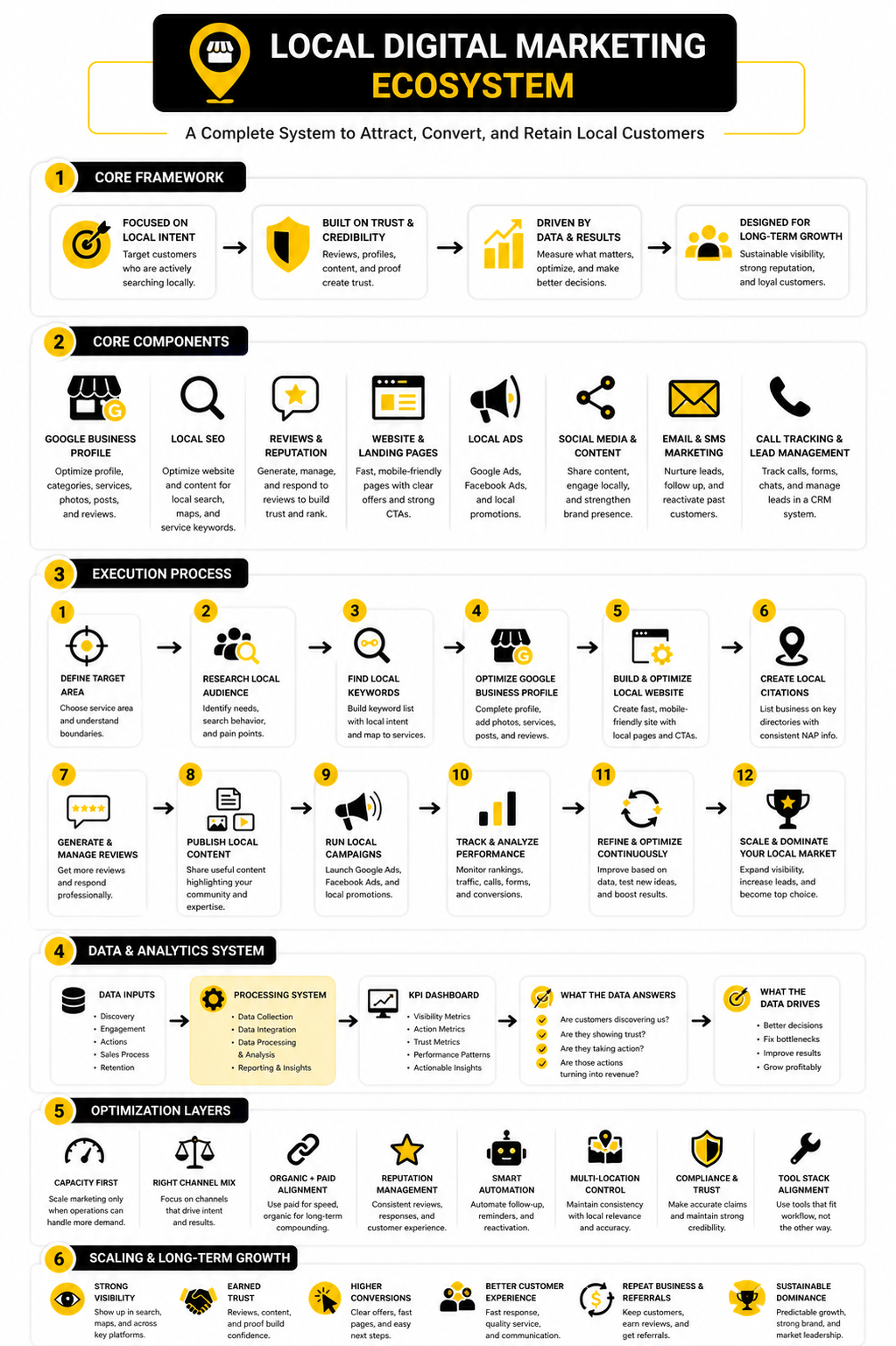
By this point, the lesson should be clear: local digital marketing works best as a connected ecosystem. Search helps people discover the business. Reviews and proof help them trust it. The website and offers help them act. Follow-up, service quality, and retention turn that first action into long-term value.
The final decision is not whether a business should “do local marketing.” Any serious local business already is doing it, even if nobody has organized it properly yet. The real decision is whether the business wants a controlled system or a collection of disconnected tactics.
A complete local marketing ecosystem should make the business easier to find, easier to understand, easier to contact, easier to choose, and easier to return to. When those pieces work together, growth becomes more predictable. When they are scattered, the business keeps paying for attention it cannot fully convert.
What is local digital marketing?
Local digital marketing is the process of using online channels to attract customers in a specific geographic area. It includes local SEO, Google Business Profile optimization, reviews, local landing pages, paid ads, social media, email, SMS, and follow-up systems. The purpose is to help nearby customers discover the business, trust it, and take action.
Why is local digital marketing important for small businesses?
Local digital marketing matters because customers now research local businesses before they call, book, visit, or buy. A small business can have excellent service and still lose customers if its online presence looks weak or incomplete. Strong local marketing makes the business visible in the moments when nearby customers are actively comparing options.
What is the difference between local SEO and local digital marketing?
Local SEO is one part of local digital marketing. It focuses on improving visibility in local search results, maps, and service-related searches. Local digital marketing is broader because it also includes ads, social media, reputation management, landing pages, email, SMS, analytics, and customer retention.
How long does local digital marketing take to work?
Some improvements can create results quickly, especially fixing calls to action, improving follow-up, running paid ads, or updating incomplete business information. Organic local search and reputation improvements usually take longer because they depend on content, reviews, relevance, and prominence building over time. A serious business should measure early activity within weeks, but judge deeper performance over months.
What should a local business measure first?
Start with the numbers closest to revenue. Track calls, forms, bookings, direction requests, quote requests, response time, appointment rate, close rate, and revenue by source when possible. Visibility metrics still matter, but they should be interpreted through the question that matters most: is this attention turning into qualified customer action?
Is Google Business Profile still important?
Yes, Google Business Profile is still one of the most important assets in local digital marketing. Google explains local results through relevance, distance, and prominence, which means the profile needs accurate categories, services, hours, photos, reviews, and business details Google Business Profile Help. A weak profile can make a strong business look less credible than it really is.
Do reviews really affect local marketing performance?
Reviews matter because they influence trust at the exact moment buyers are comparing local options. BrightLocal’s consumer review research continues to show that people use reviews to evaluate local businesses and often check more than one platform before making a decision BrightLocal Local Consumer Review Survey. The practical move is to request reviews consistently, respond thoughtfully, and treat reputation as part of the sales system.
Should local businesses run paid ads?
Paid ads can work very well when the offer, landing page, tracking, and follow-up are already strong. They are especially useful for high-intent services, seasonal campaigns, new locations, or competitive markets where organic visibility takes time. But paid ads should not be used to cover up a broken customer journey because weak conversion makes every click more expensive.
What channels matter most for local digital marketing?
The most important channels depend on the business model and buyer intent. Most local businesses should start with Google Business Profile, local service pages, reviews, website conversion, and reliable follow-up. After that, paid search, social media, email, SMS, and content marketing can be added based on the customer journey and available capacity.
How often should a local business update its marketing?
A local business should review performance monthly and update critical information whenever something changes. Business hours, services, pricing guidance, offers, photos, team details, and location information should stay current. Content, reviews, ads, and campaigns should follow a steady rhythm rather than being handled only when sales slow down.
What is the biggest mistake in local digital marketing?
The biggest mistake is treating local digital marketing as random activity instead of a system. Posting more, spending more, or chasing new tools will not fix unclear positioning, weak reviews, slow response time, poor landing pages, or bad tracking. The business needs to find the bottleneck and fix the part of the journey that is actually limiting growth.
Can automation help local businesses?
Automation can help when it protects speed, consistency, and follow-up. Missed-call texts, appointment reminders, review requests, reactivation campaigns, and lead nurture workflows can prevent good opportunities from slipping away. Tools like GoHighLevel can be useful when a business wants CRM, calendars, forms, SMS, email, funnels, and pipelines in one place.
How should a local business choose marketing tools?
Choose tools based on workflow, not hype. The right tool should make it easier to capture leads, respond quickly, manage follow-up, track outcomes, or publish consistently. A simple setup that the team actually uses is better than a complicated stack that creates confusion.
Is social media necessary for every local business?
Social media is useful for many local businesses, but it should not automatically become the center of the strategy. Visual, lifestyle, hospitality, fitness, beauty, and community-driven businesses often benefit heavily from social proof and frequent content. Urgent service businesses may get more immediate value from search, maps, reviews, and fast lead handling before investing heavily in social.
What role will AI play in local digital marketing?
AI will make clean information, strong reviews, and structured local content more important. As local discovery becomes more influenced by AI summaries and recommendation tools, businesses need accurate profiles, clear service pages, credible proof, and consistent details across platforms. Rio SEO’s 2025 local search research highlights AI, accuracy, reputation, and customer experience as major forces shaping the local customer journey Rio SEO 2025 Local Search Consumer Behavior Study.
When should a business hire a local digital marketing professional?
A business should consider hiring help when marketing is becoming too complex, performance is unclear, or growth is being limited by weak execution. A professional can audit the system, identify bottlenecks, prioritize channels, improve tracking, and build a repeatable process. The best time to get help is before wasted spend and missed leads become normal.
Build a stronger local presence with BAAM AI
Turn your website, Google profile, social channels, and AI visibility into one growth engine
Most businesses do not need more random marketing activity. They need a consistent presence system that helps the right people find them, trust them, and take action. BAAM AI brings strategy, local SEO, website updates, Google Maps visibility, social content, AI-search readiness, media production, and reporting into one practical monthly engine.
If you want your marketing to keep working after the campaign ends, start with a free BAAM AI presence audit. See how your business shows up today and where the fastest visibility wins are at BAAM AI.