
BAAM AI Blog
Local Digital Marketing Services: A Practical Guide For Local Growth
Local digital marketing services are no longer just a nice add-on for local businesses. They are the system that helps people find you, trust you, contact you, visit you, and buy from you when they are already close...
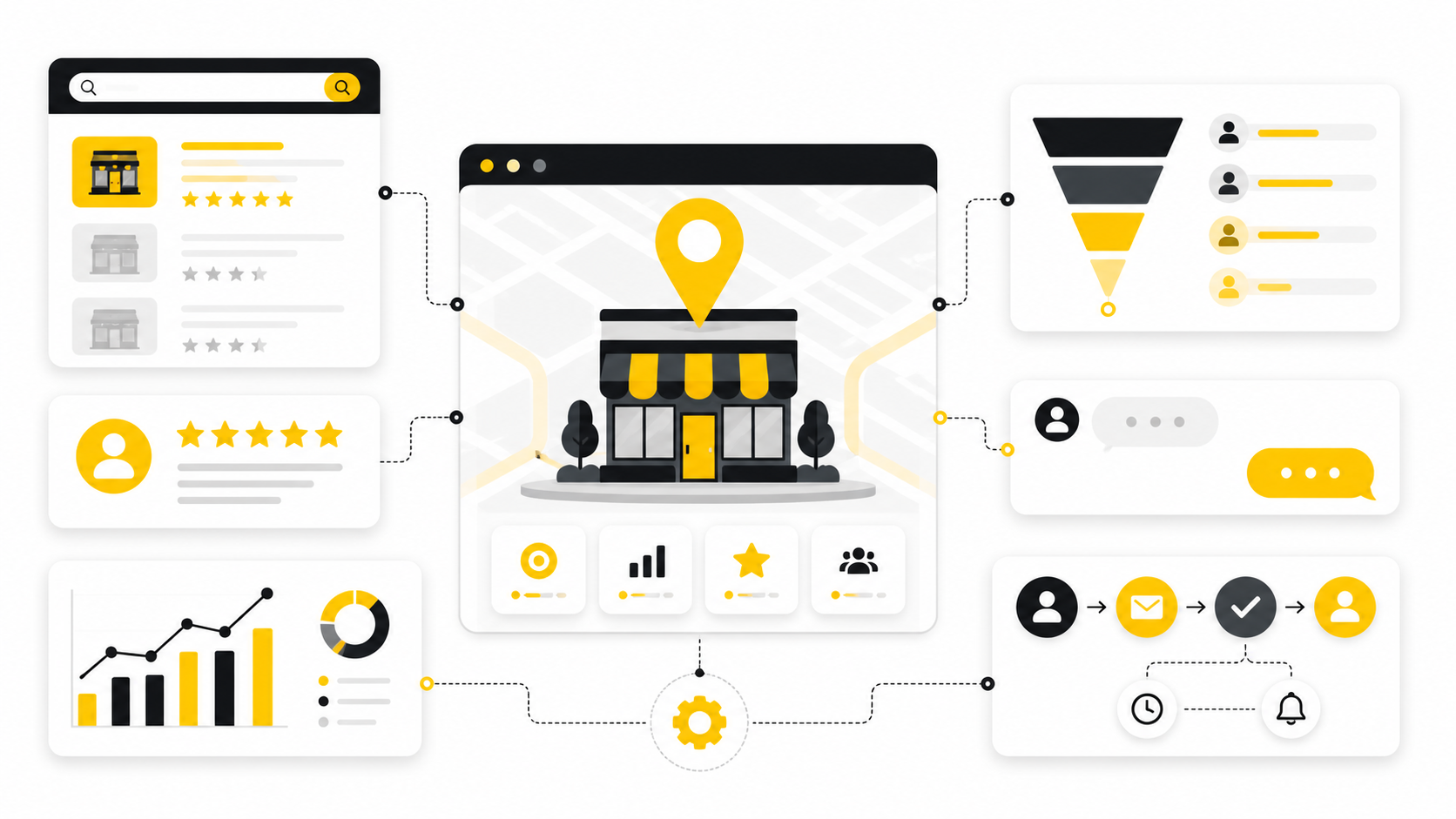
Local digital marketing services are no longer just a nice add-on for local businesses. They are the system that helps people find you, trust you, contact you, visit you, and buy from you when they are already close to making a decision. That matters whether you run a dental clinic, roofing company, restaurant, med spa, law firm, gym, repair shop, local franchise, or home service business.
The real problem is not that local business owners ignore marketing. It is that too many are stuck with scattered activity: a Google Business Profile here, a few boosted posts there, maybe an old website, maybe some reviews, maybe a campaign that once worked but is now impossible to track. Local digital marketing services bring those pieces together so the business is not just visible online, but consistently turning local attention into booked jobs, calls, appointments, walk-ins, and repeat customers.
This guide breaks the topic down in a practical way. We are not going to treat local marketing like a pile of buzzwords. We are going to look at the full operating system: search visibility, website conversion, paid traffic, reputation, local content, social proof, automation, measurement, and the professional implementation needed to make it all work together.
Why Local Digital Marketing Services Matter Now
Local buying behavior has changed because customers now check the internet before they check the street. Even when they plan to buy offline, they often start with search, maps, reviews, social feeds, short-form videos, business profiles, and comparison pages. That is why local digital marketing services have become the bridge between “people nearby need this” and “people nearby choose you.”
The urgency is easy to see in local search behavior. SOCi’s consumer research found that 80% of U.S. consumers search online for local businesses at least weekly, and 32% search daily or multiple times daily through search, social, recommendations, or local discovery channels in its Consumer Behavior Index recap. That means your next customer may not be driving around looking for signage first; they may be comparing you against three nearby options before they ever leave the couch.
Reviews have become part of that decision, not a separate reputation issue. BrightLocal’s 2025 Local Consumer Review Survey shows how deeply consumers rely on reviews when evaluating local businesses, which is why review volume, freshness, response quality, and platform coverage now influence both trust and conversion. A business with weak reviews is not just dealing with a branding problem; it is leaking demand at the exact moment buyers are trying to decide.
The same pattern shows up in measurement. Google’s Business Profile performance reporting tracks how people discover a profile and what actions they take after seeing it, including interactions from Search and Maps through its Business Profile performance documentation. In plain English, local marketing can be measured by the actions that matter: calls, direction requests, website clicks, bookings, messages, and other customer interactions.
That is the core reason this topic deserves a full framework. Local digital marketing services are not one tactic. They are the coordinated work of making a business visible, credible, easy to contact, easy to choose, and easy to measure.
The Local Growth Framework
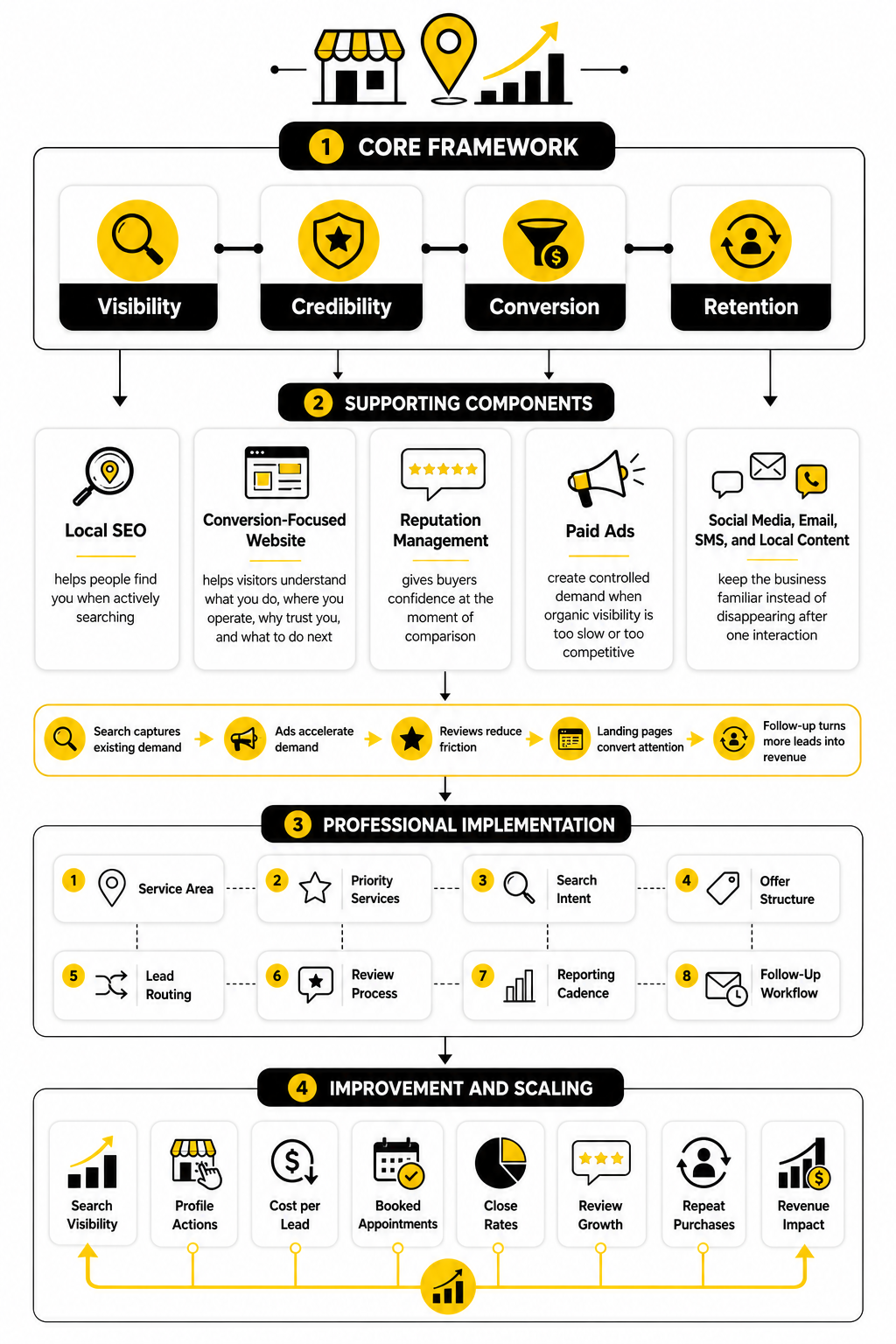
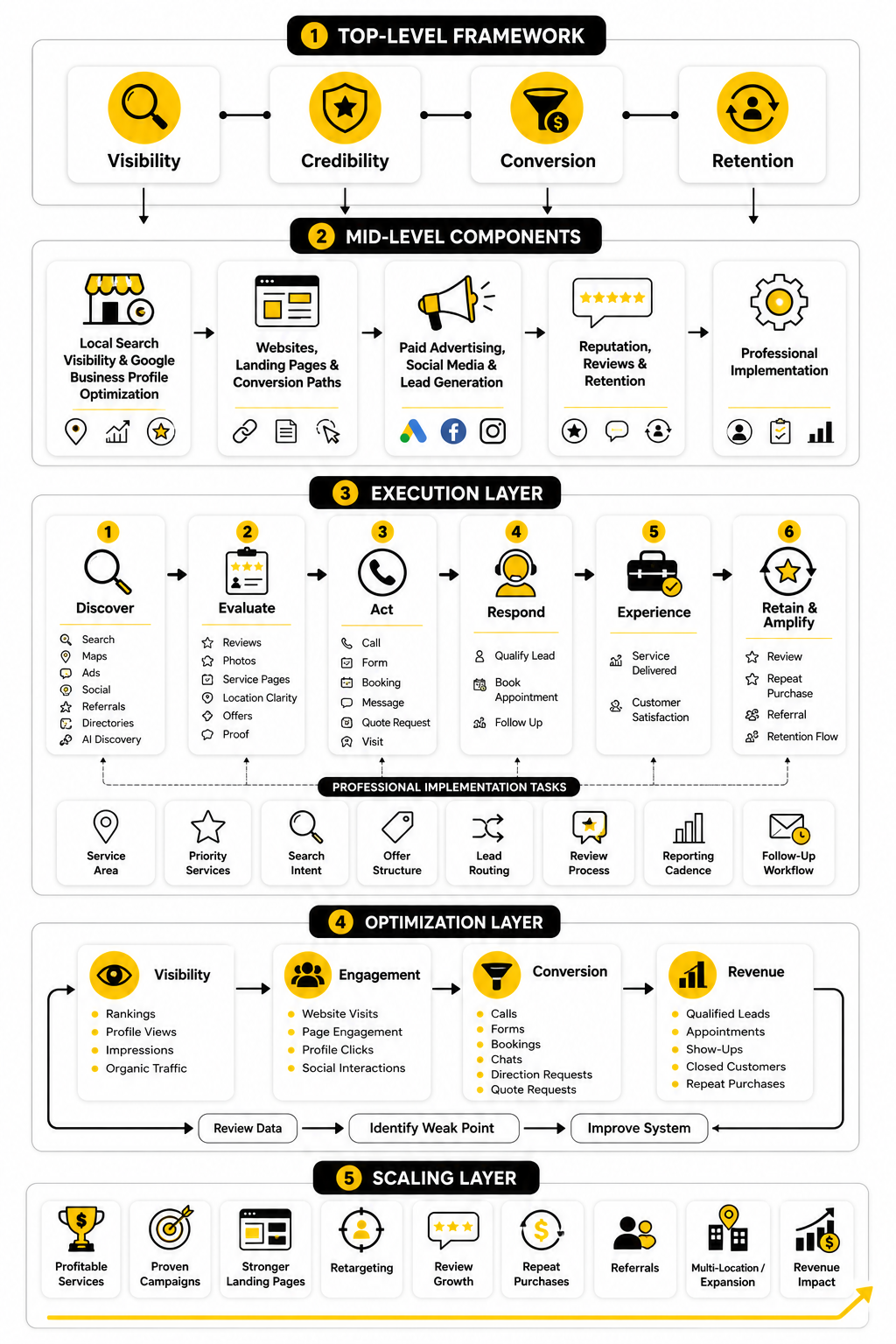
A strong local growth framework starts with visibility, but it cannot stop there. Visibility gets the business found, credibility helps the customer trust it, conversion turns attention into action, and retention increases the value of every customer acquired. If one of those layers is missing, the whole system becomes weaker.
The simplest way to think about local digital marketing services is as a connected pipeline. First, people discover the business through Google, maps, organic search, paid ads, directories, social content, referrals, or AI-assisted discovery. Then they judge the business through reviews, photos, service pages, offers, response speed, and proof that the company can solve their problem.
After that, the conversion layer takes over. A good website, focused landing page, booking flow, phone process, contact form, live chat, or CRM follow-up system turns interest into a real opportunity. For many local businesses, this is where tools such as HighLevel can fit naturally, because the gap is not just generating leads; it is following up fast enough and tracking what happens after the lead comes in.
The final layer is improvement. Local marketing should not run on vibes, ego, or vanity metrics. It should be reviewed through search visibility, profile actions, cost per lead, booked appointments, close rates, review growth, repeat purchases, and revenue impact.
Core Components Of Local Digital Marketing Services
The core components are easier to understand when you stop treating them as separate services. Local SEO helps people find you when they are actively searching. A conversion-focused website helps those visitors understand what you do, where you operate, why they should trust you, and what to do next.
Reputation management gives buyers confidence at the moment of comparison. Paid ads create controlled demand when organic visibility is too slow or too competitive. Social media, email, SMS, and local content help the business stay familiar instead of disappearing after one interaction.
The professional version of this is not “post more” or “rank higher” in isolation. It is building a practical local acquisition system where every channel has a job. Search captures existing demand, ads accelerate demand, reviews reduce friction, landing pages convert attention, and follow-up turns more leads into revenue.
Professional Implementation
Professional implementation matters because local marketing usually fails in the handoffs. The ad gets the click, but the landing page is weak. The profile gets seen, but the reviews are stale. The form gets submitted, but nobody follows up for six hours.
A proper local digital marketing services plan fixes those handoffs. It defines the service area, priority services, search intent, offer structure, lead routing, review process, reporting cadence, and follow-up workflow before throwing more money at campaigns. That is how a business moves from random marketing activity to a system that can be improved month after month.
The rest of this guide will unpack each layer in detail. We will start with local search visibility and Google Business Profile optimization, because that is where many local buying journeys begin. Then we will move into websites, paid traffic, social channels, reputation, retention, and the operational details that separate a professional local marketing system from a collection of disconnected tactics.
Local Search Visibility And Google Business Profile Optimization
Local search visibility is the first major battlefield for local digital marketing services because it captures people when their intent is already active. Someone searching for a plumber, dentist, personal injury lawyer, med spa, accountant, landscaper, or “near me” service is not browsing for entertainment. They are usually trying to solve a problem soon.
That is why local SEO cannot be treated like general website SEO with a city name added to the page title. Local visibility depends on how well the business matches the search, how close or relevant it is to the searcher’s location, and how trusted it appears compared with nearby competitors. Google describes local ranking around relevance, distance, and prominence in its local ranking documentation, and that simple framework still matters because it reflects how real customers make decisions too.
A local business does not need to be everywhere online with equal intensity. It needs to be findable in the places that influence action. For most local companies, that means Google Search, Google Maps, their website, review platforms, key directories, and the handful of social or vertical platforms their customers actually use.
Start With Search Intent, Not Keywords Alone
The primary keyword may be local digital marketing services, but a real local strategy has to go deeper than one phrase. Customers search by problem, service, location, urgency, price, trust signal, and comparison. A homeowner might search “emergency AC repair near me,” while another searches “best HVAC company in Austin,” and another searches the company name after seeing a truck or referral.
Those searches do not all deserve the same page or the same message. Emergency intent needs speed, phone visibility, availability, and proof that the company can respond quickly. Comparison intent needs reviews, service area clarity, photos, guarantees, credentials, and enough detail to make the business feel safer than the alternatives.
This is where many local campaigns go wrong. They collect keywords, but they do not organize them into customer situations. Professional local digital marketing services turn search terms into a practical map of buyer intent, then build pages, profiles, ads, and content around the moments that actually lead to revenue.
Build A Google Business Profile That Helps Customers Choose
A Google Business Profile is not just a listing. It is often the first conversion page a local customer sees. Google’s own Business Profile performance documentation focuses on discovery and customer actions from Search and Maps, which is exactly why the profile should be managed like a living sales asset rather than a one-time setup task.
The basics still matter. The business name, primary category, secondary categories, address or service area, phone number, website, opening hours, services, attributes, photos, and description should be accurate and consistent. If these details are wrong, vague, or outdated, the business creates friction before the customer even reaches the website.
The more advanced work is about making the profile answer the customer’s next question. What services do you offer? Do you serve my area? Are you open now? Do people like me trust you? Can I see real work, real premises, real staff, or real product photos? A complete profile reduces hesitation because it gives the customer enough confidence to click, call, book, or ask for directions.
Use Categories And Services Carefully
Categories are one of the most important parts of Google Business Profile optimization because they help Google understand what the business actually is. The primary category should match the main commercial identity of the business, not a broad idea that sounds impressive. A dental clinic, roofing contractor, HVAC contractor, personal injury attorney, or restaurant should choose the category that most directly reflects what customers are searching for.
Secondary categories can support the profile, but they should not turn the business into a confusing list of everything it might possibly do. Relevance matters. If the business provides multiple services, those services should also be supported by clear website pages and consistent language across the profile.
Service descriptions should be written for humans, not stuffed with city names. A customer should immediately understand what the service includes, who it is for, and when they should contact the business. That clarity helps both search visibility and conversion because the profile becomes easier to understand.
Keep Name, Address, And Phone Data Consistent
Local search depends heavily on trust signals, and consistency is one of the simplest trust signals to control. The business name, address, phone number, website URL, and core service details should match across the website, Google Business Profile, major directories, social profiles, and industry-specific platforms. Small inconsistencies can confuse customers, and at scale they can weaken the overall local presence.
This does not mean every directory deserves equal effort. Most local businesses should focus first on the platforms customers actually see and the platforms search engines are likely to trust. Google, Apple Maps, Bing Places, Facebook, Yelp, TripAdvisor for hospitality, Healthgrades for healthcare, Avvo for legal, or relevant trade directories may matter depending on the industry.
The practical goal is simple. When a customer sees the business anywhere online, the information should feel current and reliable. If the phone number is different, the hours conflict, or the website link is broken, the business looks less dependable before the conversation even starts.
Treat Reviews As A Search And Sales Asset
Reviews influence visibility, trust, and conversion at the same time. BrightLocal’s Local Consumer Review Survey 2025 shows that reviews remain a major part of how people evaluate local businesses, especially when they are comparing similar options. That means reviews should not sit in a separate “reputation” bucket; they belong inside the local growth system.
A strong review process is not complicated, but it must be consistent. Ask happy customers at the right moment, make the process easy, respond to reviews professionally, and never buy fake reviews or pressure customers into dishonest feedback. Google’s review policies continue to target fake engagement, and shortcuts can damage the exact trust the business is trying to build.
The best review profiles usually have three things working together. They have enough volume to look credible, enough recency to feel active, and enough detail to help future customers understand what the business is good at. A five-star rating with thin, old, generic reviews is weaker than a steady stream of specific reviews that describe real experiences.
Create Location And Service Pages That Match Real Demand
A local website should support the search profile instead of sitting disconnected from it. That means building useful service pages and location pages around real customer demand, not spinning out thin pages for every suburb with the same text copied over and over. Thin local pages may look like SEO work, but they rarely build lasting trust.
A good service page explains the problem, the service, the process, the area served, proof of credibility, and the next step. A good location page adds local relevance without pretending to have an office where the business does not operate. It should help a customer in that area understand whether the company serves them and why they should choose it.
This is also where internal linking matters. The Google Business Profile should point to the most useful page for the customer, not always the homepage by default. A service-area business may need links to booking pages, quote pages, or specific service pages depending on the customer journey.
Make Photos And Visual Proof Part Of The System
Photos are one of the most underused parts of local digital marketing services. They help customers confirm that the business is real, active, professional, and relevant to their needs. For restaurants, gyms, salons, med spas, contractors, clinics, venues, and retail locations, visual proof can affect the decision before a customer reads much text.
The business should use real photos whenever possible. Exterior photos help people recognize the location. Interior photos reduce uncertainty. Team photos create familiarity. Project photos show quality. Product photos help customers understand the offer.
This is not about making everything look overly polished. It is about making the business feel trustworthy and current. A profile with no recent photos can feel abandoned, while a profile with steady visual updates signals that the company is active and worth considering.
Track Profile Actions Instead Of Guessing
Local search work should be measured by customer behavior, not just rankings. Rankings matter, but they do not tell the whole story. A business also needs to know whether people are calling, clicking, requesting directions, booking, messaging, or visiting the website after finding the profile.
Google Business Profile performance reporting can show how people interact with a profile across Search and Maps through profile performance data. That data should be reviewed alongside website analytics, call tracking, CRM data, booking data, and actual revenue. Otherwise, the business might celebrate visibility that does not produce meaningful action.
This is where implementation becomes important. If profile views rise but calls do not, the issue may be reviews, photos, offer clarity, hours, or competitor strength. If calls rise but sales do not, the issue may be response speed, phone handling, pricing, qualification, or follow-up. Local marketing gets better when the numbers are used to diagnose the real constraint.
The Local Search Checklist That Actually Matters
Local search can become overwhelming if every task feels equally important. It is better to focus on the work that improves visibility, trust, and conversion together. The checklist below is simple, but it covers the foundation most local businesses need before they chase more advanced tactics.
This foundation is not glamorous, but it is powerful. Local search rewards businesses that are clear, trusted, active, and easy to choose. Once that foundation is in place, the next step is making sure the website and landing pages can actually convert the attention local search creates.
Websites, Landing Pages, And Conversion Paths
Local search creates attention, but the website decides what happens next. This is where many local digital marketing services either become profitable or fall apart. A business can rank well, get profile clicks, and run ads successfully, but if the website is confusing, slow, vague, or hard to act on, the demand leaks out of the system.
A local website has one main job: help the right person take the next step with confidence. That may be calling, booking, requesting a quote, sending a message, visiting the location, starting a consultation, or checking availability. The design can look beautiful, but if the customer cannot quickly understand the offer, service area, proof, and next action, the site is not doing its job.
This matters even more on mobile. Local customers often search while they are busy, distracted, traveling, comparing options, or dealing with an urgent problem. Google’s page experience guidance continues to emphasize real user experience signals like loading performance, responsiveness, and visual stability through its Core Web Vitals documentation, and those basics are not just SEO details; they affect whether people stay long enough to contact the business.
Build The Website Around The Customer’s Next Step
A local business website should not read like a brochure that was uploaded and forgotten. It should guide the visitor from problem to decision. The homepage should quickly explain who the business helps, what it does, where it operates, why it can be trusted, and how to take action.
Service pages should go deeper. They need to explain the specific service, the situations where someone needs it, the process, the service area, common concerns, proof of quality, and the next step. This is especially important for higher-value local services where the customer needs reassurance before they call.
The mistake is making every page generic. A page for emergency plumbing should not feel like a page for bathroom remodeling. A page for Invisalign should not feel like a page for dental cleanings. Each page should match the intent, urgency, objections, and decision process behind that service.
Make The First Screen Obvious
The first screen of a local website should remove confusion immediately. Visitors should know what the business does, where it serves customers, and what action to take without hunting around. This is not about cramming every detail above the fold; it is about making the core decision path obvious.
A strong first screen usually includes a clear headline, a short supporting statement, a primary call to action, a trust signal, and location or service-area clarity. For service businesses, the phone number should be easy to tap on mobile. For appointment-based businesses, booking should be visible without forcing the visitor through unnecessary steps.
The language should be specific, not clever for the sake of being clever. “Fast AC repair in Phoenix with same-day availability” is more useful than “Comfort solutions for modern living.” Local customers are not grading your poetry. They are trying to decide whether you can help them.
Turn Service Pages Into Decision Pages
A good service page should answer the questions a serious buyer is already asking. What exactly is included? How does the process work? How soon can the business help? What areas are covered? What proof shows the company is reliable? What happens after the customer contacts you?
This is where local digital marketing services become more than design and copywriting. The marketer needs to understand the sales conversation. If customers always ask about pricing, timelines, insurance, guarantees, financing, preparation, or eligibility, those concerns should appear on the page naturally.
The goal is not to replace the sales call. The goal is to make the sales call easier. A visitor who already understands the process, trusts the business, and knows what to expect is more likely to become a qualified lead instead of a hesitant browser.
Use Landing Pages When The Traffic Has A Specific Purpose
Not every visitor should land on the homepage. Paid ads, seasonal campaigns, referral partnerships, and specific promotions often need focused landing pages. A landing page should match the exact promise that brought the visitor there, then make the next step easy.
For example, a med spa running ads for laser hair removal should not send traffic to a general homepage full of unrelated treatments. A roofing company promoting storm damage inspections should not send people to a generic services page. The page should continue the same message, remove distractions, answer the key objections, and drive one primary action.
Tools such as Replo can make sense when a business or agency needs to build campaign-specific pages without turning every test into a slow development project. The tool is not the strategy, though. The strategy is matching the page to the visitor’s intent.
The Website Implementation Process
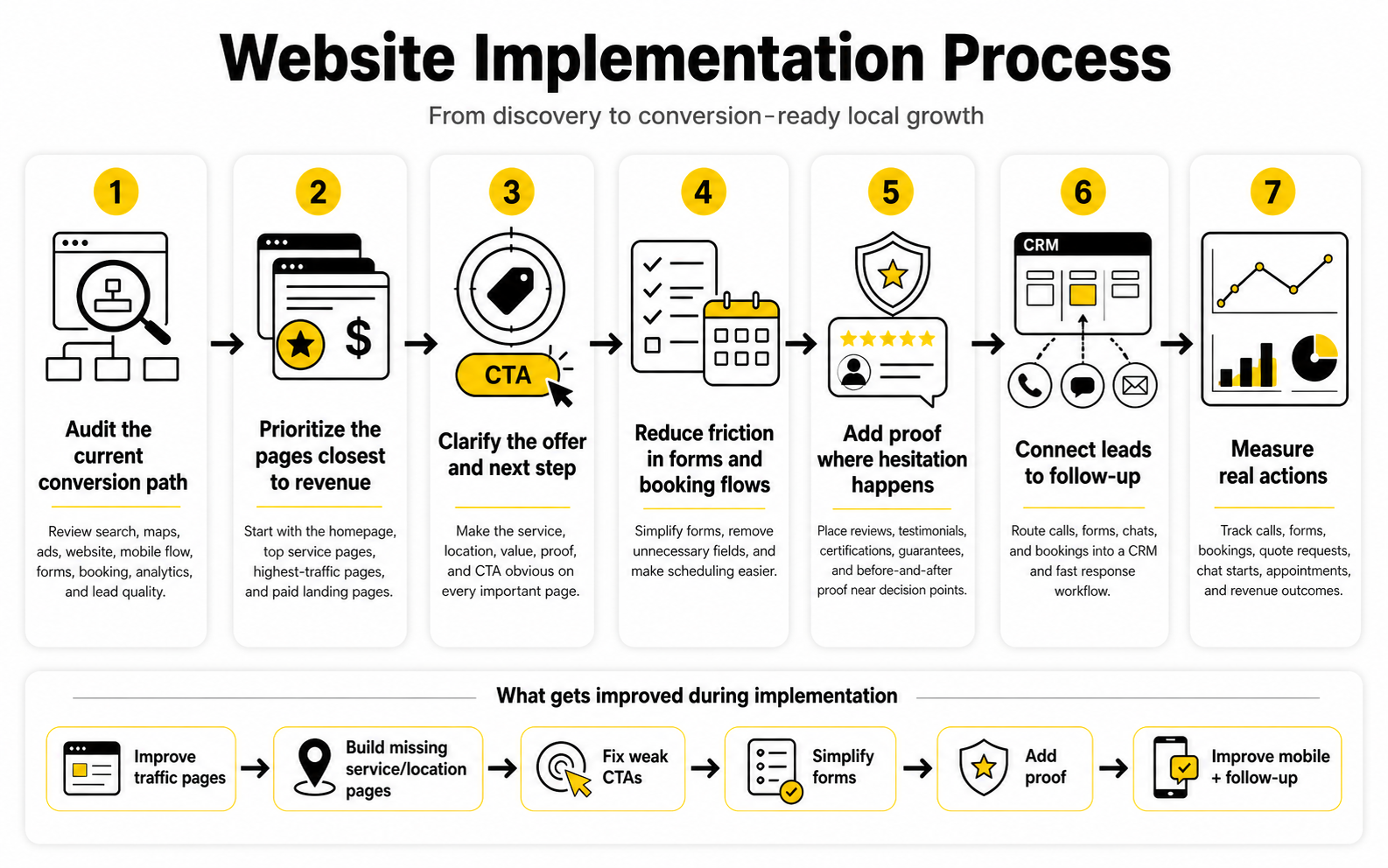
The website implementation process should be simple enough to follow and serious enough to produce measurable improvement. Most local businesses do not need a massive redesign before they can grow. They need a cleaner path from discovery to conversion.
The process starts with the current reality. Review the website, Google Business Profile, top service pages, analytics, call tracking, forms, booking flow, page speed, mobile usability, and lead quality. Then identify where people are dropping off or getting confused.
After that, implementation becomes practical. You improve the pages that already receive traffic, build missing service or location pages, fix weak calls to action, simplify forms, add proof, improve mobile experience, and connect the site to a follow-up system. This is where local digital marketing services should feel operational, not theoretical.
Forms, Booking, And Call Tracking
The conversion path should match how customers actually want to contact the business. Some people want to call immediately. Some want to book online. Some want to ask a quick question first. Some want a quote without speaking to anyone yet.
That means a local website should usually offer more than one conversion option, but not so many that the page becomes messy. A phone-first emergency service may need sticky call buttons and fast mobile tap-to-call. A clinic, consultant, salon, or studio may benefit from online scheduling through a tool such as Cal.com, especially when customers are ready to choose a time without waiting for a callback.
Forms also matter more than most businesses think. A short, clear form can increase lead volume, while a long and confusing one can silently kill demand. For quote requests, intake forms, surveys, or lead qualification flows, Fillout can be useful because it makes it easier to create structured forms without making the experience feel heavy.
Call tracking should be handled carefully. The business needs to know which campaigns and pages generate calls, but it should not create messy business information across the web. Use tracking numbers in controlled environments like ads and landing pages, while keeping core name, address, and phone consistency stable on major local listings.
Speed, Mobile Experience, And Trust
Speed is not a luxury for local websites. A slow mobile page gives the customer time to leave, compare another provider, or return to the search results. When the visitor has urgent intent, even small delays can damage the experience.
Mobile design should be treated as the default experience, not a smaller version of desktop. Buttons should be easy to tap, forms should be simple, text should be readable, and key actions should not be buried under sliders, popups, or oversized images. The easier the path feels, the more likely a customer is to complete it.
Trust also needs to be visible. Real reviews, licenses, awards, insurance details, service guarantees, transparent process explanations, and real photos can all reduce doubt. A local website does not need to look like a national brand, but it does need to feel credible enough for someone to take the next step.
Content That Supports Conversion
Content for local businesses should not exist just to fill a blog calendar. It should help customers make decisions, understand services, compare options, and feel confident contacting the business. That means service pages, location pages, pricing explainers, process pages, FAQs for later in the article, and practical guides can all have a role.
The best content answers real sales questions. How long does the service take? What affects the price? What should the customer prepare before the appointment? What are the signs they need help now? How does the business handle follow-up, warranties, emergencies, or special cases?
This kind of content supports SEO, but it also supports sales. When a customer has already read a useful page, the conversation starts with more trust and less confusion. That is the difference between content that ranks and content that helps the business grow.
What To Fix Before Spending More On Traffic
Many local businesses jump to ads too quickly because traffic feels like progress. More traffic can help, but only if the business is ready to convert it. Sending paid clicks into a weak website is one of the fastest ways to waste budget.
Before increasing ad spend, the business should fix the basic conversion path. The offer should be clear, the page should load quickly, the call to action should be obvious, the form should work, the phone number should be clickable, and the follow-up process should be ready. If those basics are broken, ads simply expose the weakness faster.
This is the practical sequence: make the business findable, make the website usable, make the next step easy, then scale attention. Once the website and conversion path are strong enough, paid advertising, social media, and lead generation can work with much less waste.
Statistics And Data That Actually Guide Decisions
Data only matters when it changes what the business does next. Local digital marketing services should not bury owners in dashboards full of impressions, clicks, rankings, reach, and engagement without explaining what those numbers mean. A useful reporting system connects marketing activity to customer actions, sales opportunities, and revenue.
The first mistake is treating every metric as equally important. A Google Business Profile view is not the same as a phone call. A website visit is not the same as a quote request. A lead is not the same as a booked appointment, and a booked appointment is not the same as a closed customer.
The second mistake is judging performance from one number in isolation. A campaign with a high cost per lead may still be profitable if the leads close at a strong rate and the customer lifetime value is high. A campaign with cheap leads may be useless if the calls are low quality, outside the service area, or never turn into revenue.
Start With The Local Customer Journey
The customer journey gives the data structure. A local buyer usually discovers the business, checks credibility, compares options, takes an action, receives follow-up, and then either buys or disappears. Each step has different metrics, and each metric answers a different question.
Discovery metrics show whether enough people are finding the business. These include local rankings, Google Business Profile views, map visibility, organic traffic, paid impressions, social reach, and directory visibility. They matter because a business cannot convert demand it never reaches.
Conversion metrics show whether attention is turning into action. These include calls, form submissions, booked appointments, direction requests, website clicks from Google Business Profile, chat starts, quote requests, and online bookings. Google’s Business Profile reporting is useful here because it shows how people discover a profile and what they do afterward through profile performance data.
Revenue metrics show whether the actions are worth pursuing. These include qualified leads, show-up rate, close rate, average order value, customer acquisition cost, repeat purchase rate, and lifetime value. This is where local digital marketing services become business growth work instead of activity reporting.
The Core Measurement System
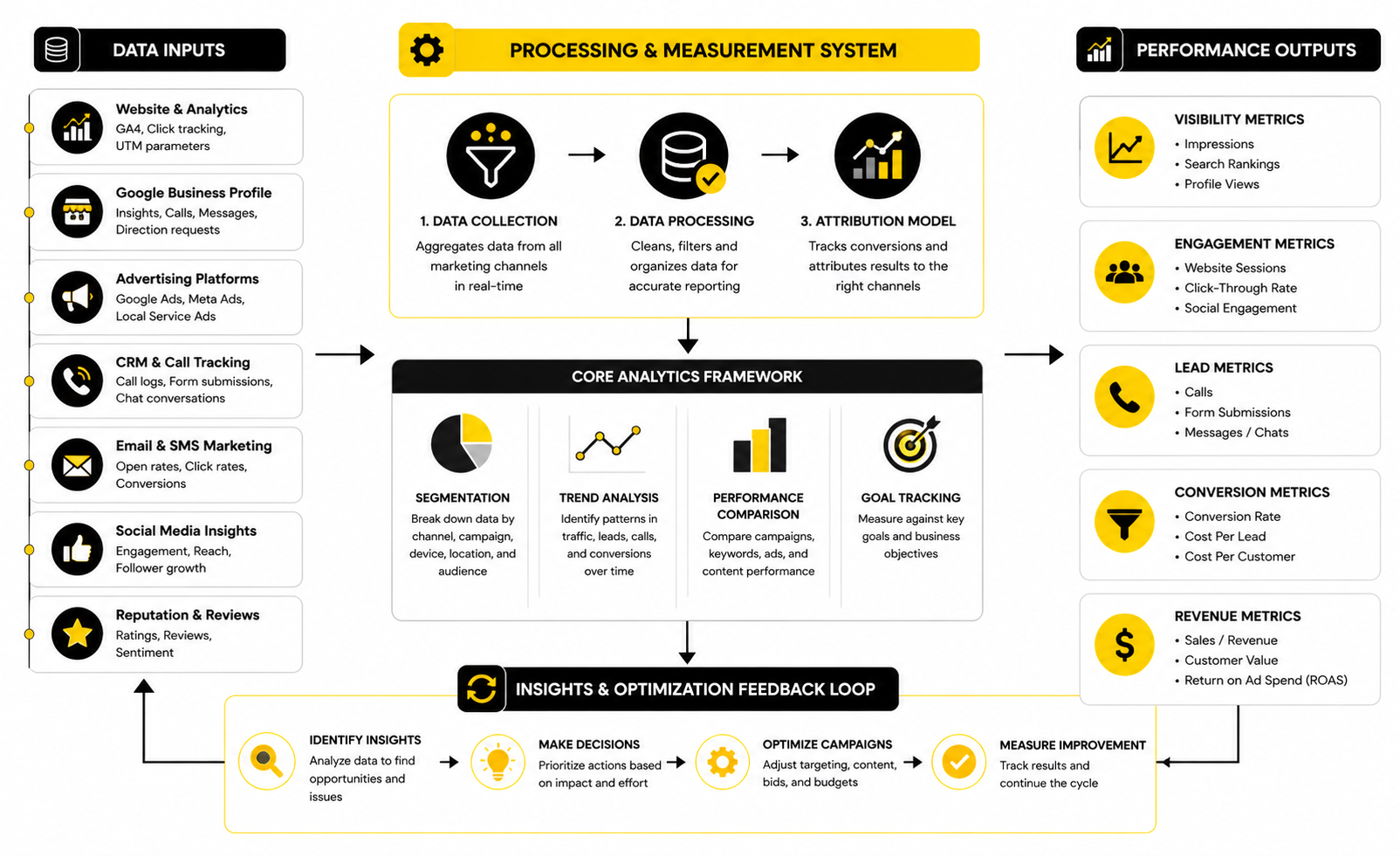
A practical analytics system does not need to be complicated. It needs to show the path from channel to lead to sale. That means the business should know where inquiries came from, what happened after the inquiry, and whether the result justified the spend.
The core system starts with source tracking. Organic search, Google Maps, paid search, paid social, referral traffic, email, SMS, social profiles, and direct visits should be separated clearly enough to see patterns. Perfect attribution is rarely possible, but useful attribution is absolutely possible.
Then the system needs lead tracking. Calls, forms, booking requests, chats, and messages should be captured in one place when possible. A CRM such as HighLevel can be useful here because local businesses often need one view of pipelines, conversations, missed calls, follow-up, appointments, and campaign performance.
Finally, the system needs outcome tracking. A lead should not be marked as a win just because someone filled out a form. The business should track whether the lead was qualified, contacted, booked, showed up, purchased, and returned.
Benchmarks Are Context, Not The Scoreboard
Benchmarks can help a business understand whether performance is wildly off, but they should not become the only target. Local industries vary too much by location, urgency, ticket size, competition, seasonality, and sales process. A personal injury attorney, emergency plumber, dentist, gym, restaurant, and wedding venue should not expect the same cost per lead or conversion rate.
Search advertising is a good example. WordStream and LocaliQ’s 2025 benchmark data shows that paid search performance varies widely by industry, including click-through rate, cost per click, conversion rate, and cost per lead in their search advertising benchmarks. That is useful for perspective, but the business should still judge results against its own economics.
The better question is not “Are we above the average?” The better question is “Can we acquire customers profitably and predictably at this number?” If the answer is yes, the campaign may be worth scaling even if a generic benchmark looks uncomfortable.
What Google Business Profile Metrics Mean
Google Business Profile metrics are especially important for local businesses because they sit close to buying intent. Views show that the profile is being seen, but views alone do not prove that the profile is persuasive. The real value comes from comparing views with customer actions.
Website clicks can show that people want more information before deciding. Calls can show stronger intent, especially for urgent or service-based categories. Direction requests matter more for restaurants, retail stores, clinics, gyms, venues, and other location-based businesses where foot traffic is part of the business model.
The interpretation depends on the business type. If a restaurant gets high direction requests but low website clicks, that may be perfectly fine. If a home service company gets many profile views but few calls, the issue may be reviews, service area clarity, business hours, photos, pricing anxiety, or weak differentiation.
What Website Metrics Mean
Website analytics should explain whether the site is helping or blocking the customer. Traffic tells you how many people arrived. Engagement shows whether they found the page useful enough to continue. Conversion data shows whether they took a meaningful next step.
A high-traffic page with a low conversion rate is not automatically bad. It may be an educational page serving early-stage visitors. But if a high-intent service page gets traffic and produces no calls, forms, bookings, or quote requests, something is wrong.
The most useful website metrics for local digital marketing services are usually:
The action should come from the pattern. If mobile phone clicks are high but booked jobs are low, the phone process may be the bottleneck. If form starts are high but completions are low, the form may be too long or confusing. If a service page ranks but does not convert, the page may attract the wrong intent or fail to answer the buyer’s real concerns.
What Review Data Means
Review data should be read as both a trust signal and a conversion signal. BrightLocal’s 2025 research shows that local consumers continue using reviews heavily when evaluating businesses through its Local Consumer Review Survey. That makes review quality part of the marketing funnel, not just a customer service afterthought.
The important review metrics are rating, volume, recency, response rate, platform mix, and review content. A strong average rating helps, but it is not enough if the latest review is old or the written reviews are thin. Customers want signs that the business is active, reliable, and consistently delivering good experiences.
Review content can also reveal operational issues. If customers repeatedly mention slow replies, unclear pricing, missed appointments, or poor communication, the marketing report is showing a service problem. If customers repeatedly mention speed, professionalism, cleanliness, kindness, quality, or convenience, those themes should influence website copy, ads, and sales messaging.
What Paid Advertising Metrics Mean
Paid ads make measurement more direct, but they can also create false confidence. A campaign can show a strong click-through rate and still fail because the landing page is weak. Another campaign can show an expensive cost per click but still work because the leads are valuable and close well.
The paid advertising metrics that matter most are cost per qualified lead, cost per booked appointment, cost per customer, conversion rate by landing page, search term quality, call quality, and revenue return. Clicks and impressions are supporting numbers. They explain the path, but they are not the destination.
This is why the landing page and follow-up process from the previous section are so important. Paid traffic exposes the strength or weakness of the whole system. If the page, offer, tracking, and follow-up are poor, the ad account will get blamed for a problem it cannot solve alone.
What Social And Content Metrics Mean
Social media data can be useful, but it is often misunderstood. Likes, views, and comments can show attention, but they do not automatically equal revenue. For local businesses, social performance should be judged by whether it supports trust, familiarity, discovery, retargeting, community relevance, and direct inquiries.
A tool like Buffer can help keep social publishing organized, but the calendar still needs a business reason. Content should answer customer questions, show real work, demonstrate expertise, highlight the team, explain services, feature customer proof where appropriate, and support campaigns. Posting just to keep the feed alive is not a strategy.
The most useful social and content metrics are profile visits, website clicks, message starts, saved posts, shares, local engagement quality, assisted conversions, and performance by content theme. A local business should look for the topics that consistently create useful action. Then it should create more of those, not more random filler.
The Reporting Cadence That Keeps Marketing Honest
Reporting should be frequent enough to catch problems and slow enough to avoid panic. Weekly checks are useful for campaigns, lead flow, missed calls, spend, and tracking issues. Monthly reviews are better for trends, channel performance, conversion rates, content growth, and revenue impact.
Quarterly reviews should look at bigger decisions. Which services are most profitable? Which locations or service areas are growing? Which channels are producing qualified customers? Which offers should be improved, paused, or scaled?
This cadence keeps local digital marketing services grounded. The goal is not to produce a pretty report. The goal is to make better decisions with less guessing.
The Metrics That Should Trigger Action
Good measurement creates action. If a number changes, the team should know what to inspect. Otherwise, the report becomes decoration.
If impressions rise but clicks do not, the offer, title, profile, ranking position, or ad message may be weak. If clicks rise but leads do not, the page, form, call to action, mobile experience, or proof may need work. If leads rise but sales do not, the problem may be qualification, response speed, sales process, pricing, or follow-up.
The cleanest local marketing reports usually group metrics into four buckets:
That structure makes the data easier to use. It shows where the system is strong, where it is weak, and what should be improved next.
Data Is Only Useful When Someone Owns It
The final issue is ownership. A business can have analytics installed, call tracking running, CRM fields created, and dashboards built, but none of it matters if nobody reviews the numbers and acts on them. Measurement needs a clear owner.
That owner does not have to be the business owner personally. It can be an internal marketer, operations manager, agency partner, or sales lead. What matters is that someone checks the data, spots problems, asks better questions, and pushes improvements forward.
This is where professional local digital marketing services separate themselves from vendors who only report activity. The professional version does not just say, “Traffic went up.” It says, “Traffic went up, calls stayed flat, the mobile service page has low engagement, and the next move is to test a clearer offer with stronger proof near the call button.” That is the kind of measurement that actually grows a local business.
Paid Advertising, Social Media, And Lead Generation
Once the local search foundation, website, and measurement system are working, paid traffic becomes much easier to judge. Paid advertising should not be used to hide weak positioning or a broken conversion path. It should be used to accelerate a system that already has a clear offer, a focused landing page, reliable tracking, and a follow-up process that can handle the leads.
This is where local digital marketing services need discipline. A local business can waste a lot of money by running ads too broadly, targeting the wrong area, sending traffic to the wrong page, or optimizing for cheap leads instead of qualified customers. The question is not “Can we get clicks?” The question is “Can we generate the right inquiries at a cost the business can actually support?”
Paid traffic, social media, and lead generation should work together instead of competing for attention. Search ads capture people who are already looking. Social ads create awareness, retarget warm audiences, and promote specific offers. Organic social, email, SMS, and CRM follow-up keep the business visible after the first touch.
Paid Search Works Best When Intent Is Clear
Paid search is powerful because it lets a business appear when someone is actively looking for a service. That makes it especially useful for urgent, high-intent, or competitive categories where organic visibility takes time. A dentist promoting emergency appointments, a lawyer targeting specific case types, or an HVAC company during peak seasonal demand can use search ads to reach people who are already close to action.
The tradeoff is cost. WordStream’s 2025 Google Ads benchmark report shows that search advertising costs have continued rising across many industries, which means businesses need tighter targeting, better landing pages, and stronger lead qualification to protect profitability through its Google Ads benchmarks. Rising costs do not mean paid search is bad. They mean lazy paid search is expensive.
The best campaigns are built around commercial intent, not vanity traffic. That means separating emergency searches from research searches, branded searches from non-branded searches, and high-value services from low-margin services. When everything is thrown into one campaign, the business loses control over what it is really buying.
Local Services Ads Require Operational Readiness
For eligible industries, Google Local Services Ads can be a serious lead source because they appear in a high-intent area of search and are built around calls or messages. But they also require accurate business information, verification, review quality, responsiveness, and service-area discipline. They are not a set-and-forget shortcut.
This became even more important after Google moved toward requiring a verified Google Business Profile for Local Services Ads in many regions, with coverage noting that mismatched profile information could cause ads to be suspended through the AP report on Google’s Local Services Ads change. That matters because advertising and local profile management are now tied together more tightly than many business owners realize.
The strategic point is simple. A business that wants to scale lead generation cannot treat verification, reviews, service categories, hours, and response quality as admin tasks. They are growth infrastructure.
Paid Social Is Better For Demand Creation Than Emergency Intent
Paid social can work extremely well for local businesses, but it usually plays a different role from search. People scrolling Instagram, Facebook, TikTok, or other social platforms may not be actively searching for a provider at that exact second. The ad has to create interest, interrupt the scroll, and make the offer feel relevant.
That makes paid social useful for visual, seasonal, emotional, or offer-driven local categories. Med spas, gyms, restaurants, events, beauty services, home improvement, education, childcare, pet services, and local retail can all benefit when the creative is strong. The ad needs to show the outcome, explain the offer, and give the viewer a simple next step.
The risk is mistaking engagement for demand. A post can get likes and comments without producing qualified leads. Paid social should be judged by message starts, booking requests, offer claims, website conversions, retargeting performance, and eventual revenue, not just surface-level engagement.
Retargeting Should Support Trust, Not Annoy People
Retargeting is useful because local buyers often need multiple touches before they act. Someone may visit a service page, check reviews, compare competitors, ask a spouse, wait until payday, or come back when the problem becomes urgent. Retargeting keeps the business visible during that decision window.
But retargeting should not just repeat the same ad endlessly. It should answer the next objection. One ad can show reviews, another can explain the process, another can highlight availability, and another can present a clear offer. That sequence feels more helpful than being chased around the internet by the same generic banner.
The budget does not need to be huge. For many local businesses, retargeting is more about efficiency than scale. It helps recover warm attention that would otherwise disappear.
Social Media Needs A Local Purpose
Organic social should not be treated like a national creator strategy unless the business truly has that kind of audience. For most local businesses, the purpose is simpler. Show that the business is active, credible, human, useful, and connected to the local market.
That means the content should not be random. A strong local social plan might include real work, customer questions, team introductions, behind-the-scenes process, service education, seasonal reminders, community involvement, promotions, and proof of results where appropriate. The point is not to go viral. The point is to make the business easier to recognize and trust.
Tools such as Buffer can help keep posting consistent, but consistency alone is not enough. The content still needs a job. If a post does not support discovery, trust, education, offer awareness, hiring, retention, or conversion, it probably does not belong in the plan.
Messaging And Automation Can Recover Lost Leads
Lead generation does not end when someone submits a form or sends a message. In many local businesses, the real failure happens after the lead arrives. The business responds too slowly, misses the call, forgets to follow up, or leaves the customer waiting while a competitor replies faster.
This is where automation can help, but only when it supports a real process. Automated replies, missed-call text backs, appointment reminders, quote follow-ups, review requests, and reactivation campaigns can all improve results. The key is to make the communication feel useful, timely, and human.
A platform such as HighLevel can fit naturally here because local teams often need CRM, messaging, pipelines, calendars, automations, and reporting connected in one place. For businesses that rely heavily on social messaging, ManyChat can also be useful for structured conversations and follow-up flows. The technology is not magic, but it can prevent good leads from slipping through the cracks.
AI Search And Recommendation Engines Are Changing Discovery
Local discovery is starting to move beyond the traditional search results page. AI assistants, review summaries, map features, and recommendation engines are making it easier for customers to ask more specific questions and compare businesses faster. Yelp recently introduced an AI chatbot designed to help users sort through local recommendations and review data, with AP coverage noting Yelp’s focus on tying recommendations back to real reviews through its AI local recommendation update.
This does not mean local businesses should abandon SEO and chase every AI trend. It means the source material needs to be stronger. Accurate business data, detailed service pages, fresh reviews, useful photos, consistent listings, clear offers, and trustworthy content all become more important when search engines and AI tools summarize information for users.
The strategic takeaway is practical. If AI systems are going to describe, compare, or recommend local businesses, then businesses need cleaner public information. Confusing service descriptions, thin reviews, inconsistent listings, and outdated websites make the business harder to understand and easier to overlook.
The Tradeoff Between Niching Down And Expanding
Scaling local digital marketing services always creates a choice between focus and expansion. A business can go deeper into a profitable service, expand into more services, target more locations, or open new channels. Each path has upside, but each path also adds complexity.
Going deeper usually means improving authority around the services that already convert well. That may include better pages, stronger reviews for that service, more specific ads, dedicated landing pages, and sharper follow-up. This is often the safest scaling move because the business is building on proof.
Expanding wider can work, but it requires more caution. Adding new service pages, new ad groups, new locations, new offers, or new audiences without operational readiness can dilute quality. If the team cannot deliver the service well, answer inquiries quickly, or track the results cleanly, expansion creates noise instead of growth.
The Risk Of Over-Automating A Local Business
Automation is valuable, but local customers still want to feel handled by a real business. This is especially true for high-trust categories like healthcare, legal services, home services, finance, childcare, and professional services. People may accept automation for reminders and confirmations, but they do not want to feel trapped in a system when they need help.
Bad automation creates frustration. It sends irrelevant messages, repeats questions the customer already answered, hides the phone number, or pushes people through a chatbot when they need a human. That does not improve marketing. It damages trust.
Good automation removes friction. It confirms appointments, reminds customers, follows up after missed calls, sends useful instructions, asks for reviews at the right time, and alerts the team when a serious lead needs attention. The rule is simple: automate the repetitive parts, not the relationship.
Multi-Location Marketing Needs Control And Flexibility
Multi-location businesses have a different challenge. They need brand consistency across locations while still allowing local relevance. A franchise, clinic group, restaurant group, gym chain, or service company with multiple branches cannot let every location create its own disconnected marketing system.
The central team should control the brand standards, tracking setup, offer logic, review process, reporting structure, and website architecture. Local teams can contribute local photos, staff updates, community involvement, location-specific offers, and operational details. That balance keeps the brand coherent without making every location feel generic.
The data also needs to be location-specific. A campaign that works in one city may fail in another because of competition, demographics, pricing, seasonality, or staff performance. Multi-location reporting should show performance by location, not just one blended average that hides the real issues.
Compliance, Privacy, And Platform Risk
Local marketing gets more serious when customer data, reviews, regulated industries, and paid platforms are involved. Businesses need to understand what they can claim, what they can collect, what they can automate, and how customer information is handled. This matters even more for healthcare, legal, finance, insurance, home services, and any industry with licensing or advertising rules.
Privacy expectations are also rising. Customers may be willing to share information when it helps them get a quote, appointment, or answer, but they do not want to feel exploited. Forms, chat systems, CRM workflows, and email or SMS campaigns should collect only what is useful and follow applicable consent rules.
Platform risk is another real issue. A business that depends entirely on one ad account, one profile, one social platform, or one lead vendor is vulnerable. The safer strategy is to build owned assets and diversified demand: a strong website, email and SMS lists with consent, reviews, local SEO, paid campaigns, referral relationships, and direct customer follow-up.
When To Hire Help And When To Keep It In-House
Not every local business needs a full agency from day one. Some should keep the basics in-house: taking photos, asking for reviews, responding to messages, updating hours, collecting customer questions, and making sure leads are handled properly. Those tasks are close to the customer and often work best when the business participates directly.
Outside help becomes more valuable when the work requires strategy, technical setup, advertising management, website improvement, analytics, content planning, automation, or ongoing optimization. A business owner can learn all of that, but the opportunity cost is real. At some point, doing everything manually becomes more expensive than hiring expertise.
The best setup is usually a partnership. The business provides operational truth, customer insight, service quality, and fast follow-up. The marketer provides structure, implementation, measurement, and growth strategy. Local digital marketing services work best when both sides own their part of the system.
What Scaling Should Look Like
Scaling should feel controlled, not chaotic. The business should know which services produce the best customers, which channels generate the best leads, which pages convert, which locations are profitable, and which follow-up steps improve close rates. Without that clarity, scaling usually means spending more and hoping harder.
A controlled scaling plan might increase budget only on campaigns with proven lead quality, expand content around profitable services, create stronger landing pages for high-intent offers, add retargeting for warm traffic, and improve review velocity before entering a more competitive market. That is boring in the best possible way. It is how growth becomes repeatable.
The goal is not to do every tactic. The goal is to build a local marketing system that can absorb more attention without breaking. When the search presence, website, advertising, follow-up, reviews, and reporting all support each other, local growth becomes much less random.
Reputation, Reviews, Retention, And Professional Implementation
By this point, the full system is clear. Local search gets the business found. The website turns interest into action. Paid traffic and social campaigns create more controlled demand. Measurement shows what is working, what is broken, and what should happen next.
The final layer is what keeps the system healthy: reputation, retention, and professional implementation. This is where local digital marketing services stop being a collection of tactics and start becoming a growth engine. A business that earns trust, follows up well, keeps customers engaged, and improves from real data is much harder to beat than a business that only chases the next campaign.
Reputation and retention are connected because trust does not end after the first sale. A happy customer can come back, refer others, leave a review, respond to future offers, and become part of the business’s local proof. That is why the best local marketing systems do not stop at lead generation. They build the loop that turns customers into more customers.
Build The Local Marketing Ecosystem
A local marketing ecosystem works when every part supports the others. Reviews strengthen search visibility and conversion. Website content supports search and sales. Ads test offers that can later influence organic pages. CRM follow-up improves lead conversion and creates more review opportunities.
This is the part most businesses miss. They treat each channel like a separate vendor task, then wonder why results feel inconsistent. The real value comes from connecting the pieces so the business learns faster and wastes less.
A strong ecosystem usually includes clear local positioning, optimized search assets, a conversion-focused website, paid campaigns for priority services, review generation, customer follow-up, retention campaigns, and reporting. The system does not have to be complicated. It just has to be connected.
Use Reviews To Improve The Business, Not Just The Rating
Reviews should not be collected only for the star average. They are feedback, proof, objection handling, and market research. BrightLocal’s Local Consumer Review Survey 2025 shows how important reviews remain in local decision-making, but the deeper value is in what customers actually say.
If customers consistently mention fast response times, friendly staff, clean facilities, careful workmanship, or clear communication, those themes should appear in the website and ads. If customers mention delays, confusion, poor updates, or inconsistent service, the marketing team should not ignore it. That is operational data.
Responding to reviews also matters. A calm, specific response shows future customers that the business pays attention. Even a negative review can become less damaging when the response is professional, honest, and focused on resolving the issue.
Retention Is The Cheapest Growth Lever Most Local Businesses Underuse
Most local businesses focus heavily on new leads, then ignore past customers until they need more revenue. That is expensive. If someone already trusted the business once, they are usually easier to reach again than a cold prospect who has never heard of the company.
Retention can be simple. Send reminders, seasonal check-ins, maintenance notices, rebooking prompts, service follow-ups, educational emails, loyalty offers, or referral requests. The key is relevance. A useful reminder feels helpful; a random blast feels lazy.
Email and SMS tools can support this, but the message still needs to make sense. Platforms such as Brevo can help businesses manage campaigns, while HighLevel can tie retention more directly into pipelines, appointments, conversations, and customer follow-up. The tactic is not the point. The point is staying useful after the first transaction.
Professional Implementation Needs Ownership
Professional implementation starts with ownership. Someone must own the strategy, someone must own the assets, someone must own the data, and someone must own the follow-up. If everything belongs to everyone, nothing improves consistently.
The business should know who is responsible for Google Business Profile updates, website changes, ad performance, review requests, CRM hygiene, reporting, and lead handling. These responsibilities do not all need to sit with one person. But they do need to be clear.
This is also where agencies, freelancers, and internal teams need better communication. The marketer cannot fix slow response times alone. The business cannot judge campaign quality without clean tracking. Growth requires both marketing execution and operational follow-through.
The Final Local Growth System
The final system is not complicated in theory, but it requires discipline in practice. The business needs to be discoverable, trustworthy, easy to contact, fast to respond, and measured against real outcomes. Those basics beat shiny tactics more often than people want to admit.
The system should work like this:
That is what local digital marketing services are supposed to do. Not just “get more traffic.” Not just “post more content.” Not just “run ads.” The goal is to create a repeatable path from local attention to real business growth.
What are local digital marketing services?
Local digital marketing services are marketing services designed to help businesses attract customers in a specific city, region, or service area. They usually include local SEO, Google Business Profile optimization, website improvement, paid ads, review generation, social media, content, analytics, and CRM follow-up. The goal is not just online visibility; the goal is more calls, bookings, visits, leads, and sales from nearby customers.
Why do local businesses need digital marketing?
Local businesses need digital marketing because customers now research, compare, and contact businesses online before they buy. Even offline purchases often begin with a search, map result, review platform, social profile, or website visit. If the business is not visible and credible during that decision process, competitors get the opportunity instead.
What is the most important local digital marketing channel?
For many local businesses, Google Search and Google Maps are the most important starting points because they capture high-intent demand. A strong Google Business Profile, local SEO foundation, and useful website can produce leads from people who are already searching for a provider. That said, the best channel depends on the business model, location, competition, margins, and customer behavior.
How long does local SEO take to work?
Local SEO usually takes time because trust, content quality, review growth, authority, and profile strength build gradually. Some improvements, such as fixing profile information or improving a high-traffic page, can create faster gains. Bigger ranking and traffic improvements often require consistent work over several months.
Are paid ads worth it for local businesses?
Paid ads can be worth it when the offer, targeting, landing page, tracking, and follow-up process are strong. They are risky when the business sends traffic to a weak website or measures success only by cheap leads. Paid ads should be judged by qualified lead cost, booked appointments, customer acquisition cost, and revenue, not just clicks.
What should a local business track every month?
A local business should track visibility, engagement, conversion, and revenue metrics. That includes Google Business Profile actions, website traffic from key sources, phone calls, forms, bookings, chats, qualified leads, close rate, customer acquisition cost, reviews, and repeat business. The exact dashboard should match the business model, not a generic template.
How important are reviews for local marketing?
Reviews are extremely important because they affect trust at the moment customers are comparing options. They can also support local visibility, conversion, and sales messaging. A strong review process should focus on honest customer feedback, steady review growth, professional responses, and using review themes to improve the business.
Should local businesses use automation?
Local businesses should use automation where it removes friction and improves speed. Missed-call text backs, appointment reminders, review requests, lead follow-up, and reactivation campaigns can all be useful. The mistake is using automation to replace human service when the customer needs real help.
What makes a local landing page effective?
A local landing page is effective when it matches the visitor’s intent and makes the next step obvious. It should explain the service, location or service area, offer, proof, process, and call to action without unnecessary distractions. The page should also load quickly, work well on mobile, and connect cleanly to tracking and follow-up.
How do social media and local SEO work together?
Social media supports familiarity, proof, community presence, and retargeting, while local SEO captures active search demand. A customer may first notice the business on social, then search for it later, read reviews, and visit the website. The channels work best when they share consistent messaging and support the same business goals.
When should a business hire local digital marketing professionals?
A business should consider hiring professionals when growth depends on work it cannot execute consistently in-house. That might include SEO strategy, ads, analytics, website conversion, CRM automation, content planning, or multi-location management. The best results usually happen when the business still contributes customer insight, operational follow-through, and service quality.
What is the biggest mistake local businesses make with digital marketing?
The biggest mistake is treating marketing like disconnected tasks. A business might run ads, post on social, ask for reviews, and update its website, but none of it connects to a clear system. Local digital marketing services work best when discovery, trust, conversion, follow-up, retention, and measurement all support each other.
Build a stronger local presence with BAAM AI
Turn your website, Google profile, social channels, and AI visibility into one growth engine
Most businesses do not need more random marketing activity. They need a consistent presence system that helps the right people find them, trust them, and take action. BAAM AI brings strategy, local SEO, website updates, Google Maps visibility, social content, AI-search readiness, media production, and reporting into one practical monthly engine.
If you want your marketing to keep working after the campaign ends, start with a free BAAM AI presence audit. See how your business shows up today and where the fastest visibility wins are at BAAM AI.