
BAAM AI Blog
Leads In Digital Marketing: A Practical Framework For Turning Attention Into Revenue
Leads in digital marketing are not just email addresses, form fills, demo requests, or names sitting inside a CRM. A lead is a person or company that has shown enough interest, intent, or fit to be worth a next step...
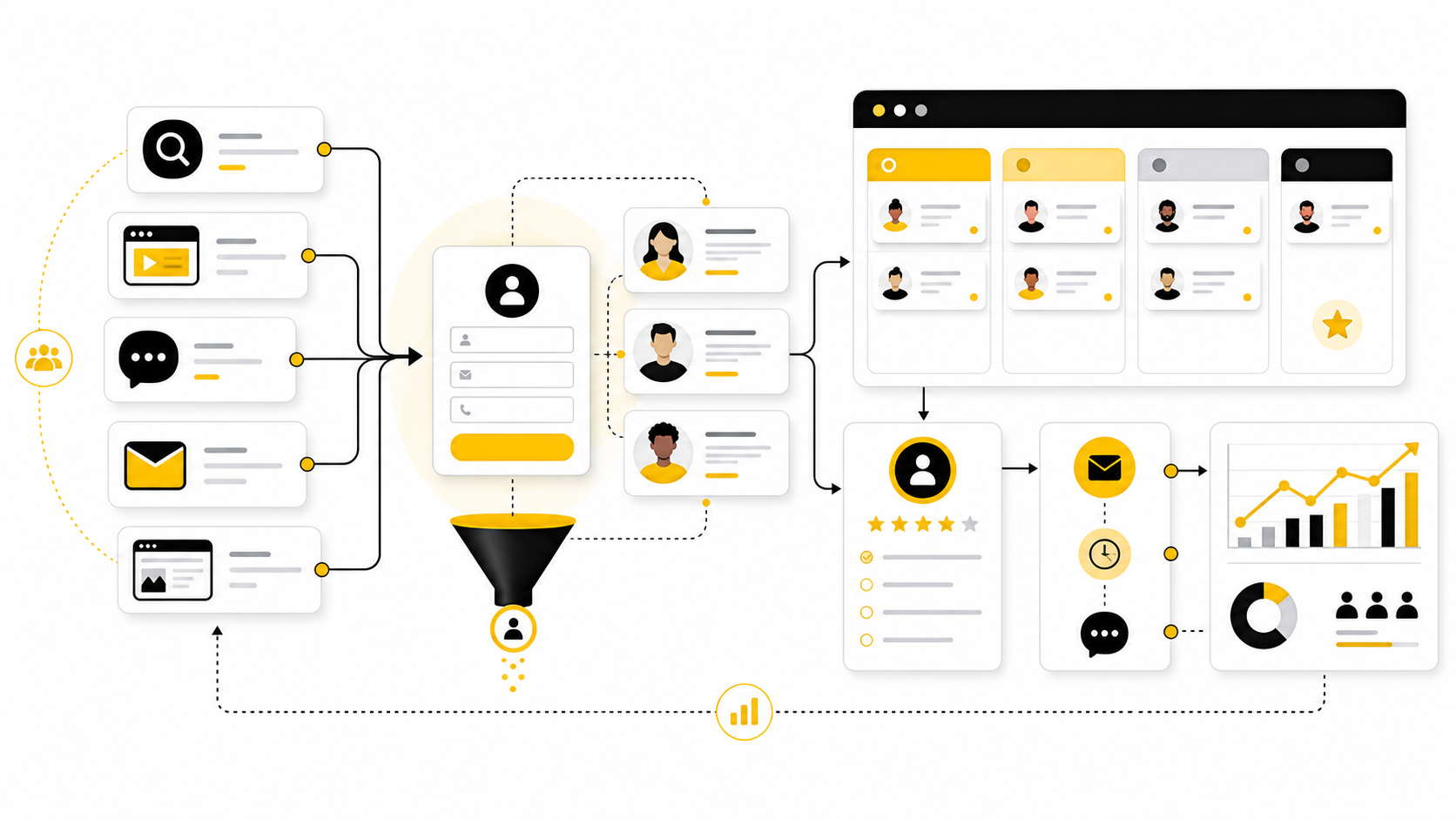
Leads in digital marketing are not just email addresses, form fills, demo requests, or names sitting inside a CRM. A lead is a person or company that has shown enough interest, intent, or fit to be worth a next step. That next step might be education, qualification, nurturing, sales outreach, a free trial, a consultation, or a direct offer.
That distinction matters because digital marketing has made lead volume easier to manufacture and lead quality easier to misunderstand. You can run ads, collect gated content downloads, build chatbot flows, scrape intent signals, launch landing pages, and automate follow-up faster than ever. But none of that means much if the people entering the system are not likely to buy, not ready to move, or not being handled properly after they raise their hand.
The smartest way to think about leads in digital marketing is simple: they are the bridge between attention and revenue. Content creates awareness, ads create demand, landing pages capture interest, automation keeps the conversation moving, and sales or conversion systems turn qualified interest into money. When one part of that chain is weak, the business does not have a lead generation problem; it has a lead management problem.
This is why the modern lead generation conversation has shifted from “How do we get more leads?” to “How do we attract the right people, understand their intent, and move them through the right next step?” B2B buyers increasingly prefer digital-first research, with Gartner reporting that 61% of B2B buyers prefer a rep-free buying experience. At the same time, McKinsey’s B2B research shows that data-driven commercial teams combining personalized customer experiences with generative AI are 1.7 times more likely to increase market share.
That creates a very clear reality. Your future customers are already researching, comparing, filtering, and judging you before they ever talk to you. So your lead generation system has to do more than collect contact details; it has to help people make progress.
this guide is structured as a six-part guide so each section builds on the last one without jumping around. Part 1 sets the foundation and gives you the full map. The later parts will go deeper into lead types, acquisition channels, qualification, nurturing, technology, measurement, and professional implementation.
What Leads In Digital Marketing Really Mean
A lead in digital marketing is created when someone gives you a signal that they may be interested in what you sell. That signal can be explicit, like filling out a form, booking a call, subscribing to a newsletter, starting a trial, or asking for pricing. It can also be behavioral, like visiting a pricing page multiple times, engaging with product content, clicking an email, or returning after comparing alternatives.
The important part is that not every signal has the same value. A newsletter subscriber may want education, while a demo request may indicate active buying intent. Someone downloading a checklist may be useful for long-term nurturing, but they should not automatically be treated like someone asking to speak with sales.
This is where many digital marketing systems break. They capture leads, but they do not classify them properly. Then sales teams waste time on weak-fit contacts, marketing teams celebrate vanity metrics, and the business struggles to understand why “more leads” did not turn into more revenue.
Why Leads Matter More Than Ever
Leads matter because most businesses cannot rely on random attention alone. Website traffic, social reach, impressions, and video views can create momentum, but they do not automatically create pipeline. A lead gives the business a way to continue the conversation after the first touch.
That matters even more now because buying journeys are less linear. People discover brands through search, social media, creators, paid ads, communities, AI tools, referrals, and comparison content. The same person might see a LinkedIn post, read a blog article, watch a YouTube review, check pricing, and only then submit a form.
The market is also more cautious. Demand Gen Report’s 2024 buyer research found that B2B purchase decisions were being affected by budget freezes, delayed purchases, and a need for more hands-on vendor engagement. That means lead generation cannot only be about capture; it has to build confidence before and after conversion.
The Lead Generation Framework
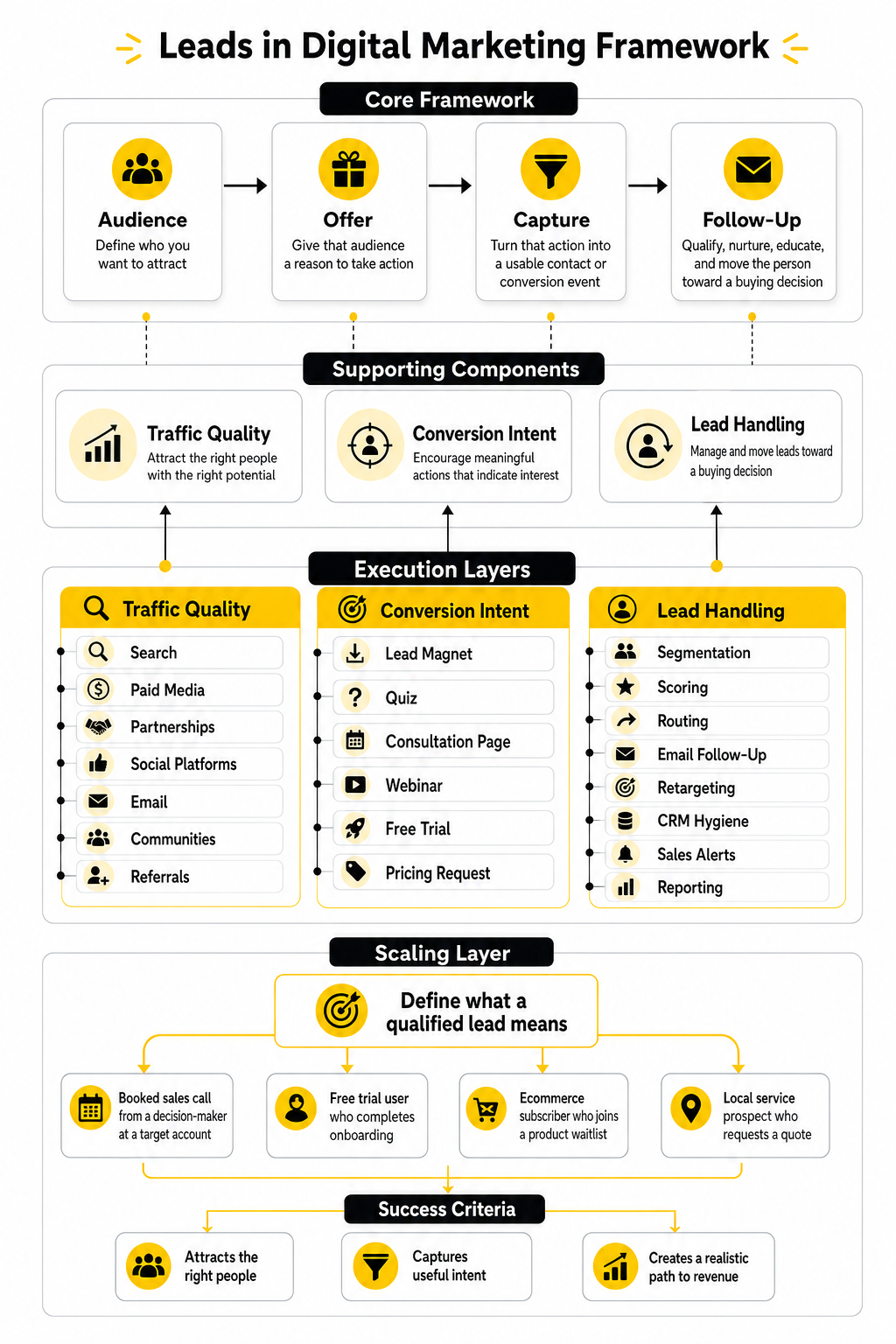
A strong lead system has four connected layers: audience, offer, capture, and follow-up. The audience defines who you want to attract. The offer gives that audience a reason to take action.
The capture mechanism turns that action into a usable contact or conversion event. The follow-up system then qualifies, nurtures, educates, and moves the person toward a buying decision. If any layer is weak, the system leaks.
This is why the best lead generation strategy is not built around one magic channel. It is built around a clear buyer, a clear promise, a clear next step, and a consistent process after the conversion. Tools like GoHighLevel, ManyChat, Brevo, and Fillout can help manage parts of that process, but they only work when the strategy underneath them is solid.
The Core Components Of A Digital Lead System
The first component is traffic quality. You need the right people discovering your brand through search, paid media, partnerships, social platforms, email, communities, or referrals. Bad-fit traffic creates bad-fit leads, and bad-fit leads create wasted follow-up.
The second component is conversion intent. A lead magnet, quiz, consultation page, webinar, free trial, or pricing request should match where the person is in the buying journey. A high-friction offer shown too early will underperform, while a low-friction offer shown to a high-intent buyer may slow them down.
The third component is lead handling. This includes segmentation, scoring, routing, email follow-up, retargeting, CRM hygiene, sales alerts, and reporting. Content Marketing Institute’s B2B research shows that many teams still struggle with scalable content models, clear goals, technology, and resources, which is exactly why lead systems often fail after the first conversion point in its 2025 B2B content marketing benchmarks.
Professional Implementation Starts With Clarity
Professional lead generation starts by defining what a qualified lead actually means for the business. For some companies, that might be a booked sales call from a decision-maker at a target account. For others, it might be a free trial user who completes onboarding, an ecommerce subscriber who joins a product waitlist, or a local service prospect who requests a quote.
Once that definition is clear, every campaign becomes easier to judge. You are no longer asking whether a campaign produced cheap leads. You are asking whether it attracted the right people, captured useful intent, and created a realistic path to revenue.
That is the standard the rest of this guide will use. Leads in digital marketing are not trophies for dashboards. They are living opportunities that need the right promise, the right timing, the right follow-up, and the right measurement.
Why Lead Quality Matters More Than Lead Volume
Lead volume feels good because it is easy to count. A campaign produced 800 form fills, the cost per lead dropped, the dashboard went green, and everyone gets a little dopamine hit. But if those people are not a fit, not reachable, not interested enough, or not ready for the offer, the number is mostly decoration.
This is where leads in digital marketing can become misleading. A cheap lead is not automatically a good lead, and an expensive lead is not automatically a bad one. The real question is whether the lead has a realistic path to revenue.
Quality matters because every lead creates downstream work. Someone has to store it, segment it, score it, follow up with it, retarget it, route it, report on it, and sometimes sell to it. When the top of the funnel is full of weak-fit leads, the whole system becomes slower, noisier, and more expensive.
The Hidden Cost Of Bad Leads
Bad leads do not just fail to convert. They actively damage the performance of the system around them. Sales teams stop trusting marketing, nurture sequences get built around the wrong assumptions, and reporting becomes harder because the business is measuring activity instead of progress.
The cost is especially painful in B2B, where buying cycles are often longer and multiple people influence the final decision. Research from 6sense found that nearly 70% of B2B buyers said economic concerns affected vendor choice, often pushing them toward safer, more conservative decisions. That makes poor qualification even more dangerous because cautious buyers need clarity, relevance, and confidence, not generic follow-up.
There is also a morale cost. Sales reps who constantly receive low-fit contacts become slower to respond, even when a good lead finally arrives. Marketing teams then try to fix the problem by increasing volume, which usually makes the quality problem worse.
What Makes A Lead High Quality
A high-quality lead usually has four things working in its favor: fit, intent, timing, and accessibility. Fit means the person or company matches the type of customer you can actually help. Intent means they have shown behavior that suggests real interest, not just casual curiosity.
Timing matters because even a perfect-fit prospect may not be ready right now. They may be researching for next quarter, waiting on budget approval, comparing internal options, or trying to understand the problem before choosing a solution. Accessibility matters because a lead you cannot reach, identify, or properly route is not useful yet.
This is why quality cannot be judged from one field on a form. A business email, job title, company size, source channel, landing page, content consumed, and follow-up behavior can all change how that lead should be treated. The goal is not to make qualification complicated; the goal is to avoid pretending every lead is equal.
Why Volume Alone Creates False Confidence
Volume can hide weak strategy because large numbers make campaigns look successful before revenue is visible. A lead magnet can attract thousands of people who like free resources but have no serious intent to buy. A broad paid campaign can generate low-cost contacts that never open another email, never book a call, and never move beyond the first touch.
That does not mean low-intent leads are worthless. They can still become customers later if the audience is relevant and the follow-up is useful. The problem starts when a business treats early-stage interest like late-stage demand.
This is one reason revenue teams are becoming more focused on pipeline contribution, conversion quality, and buyer engagement instead of raw lead counts. Demand Gen Report’s 2025 benchmark coverage highlighted that marketing teams are putting more emphasis on personalization, operational efficiency, and tying strategy to revenue. That shift is healthy because it forces marketers to ask whether leads are moving the business forward, not just filling a database.
The Difference Between Interest And Intent
Interest is when someone pays attention. Intent is when their behavior suggests they may be moving toward a decision. This difference sounds simple, but it changes how you build every part of a digital lead generation system.
A person reading a beginner blog post may be interested in the topic. A person comparing pricing, reading case studies, returning to a demo page, or asking implementation questions is showing stronger intent. Both matter, but they should not receive the same message.
This is where many teams lose money. They send hard sales messages to people who only wanted education, then send slow educational sequences to people who are already evaluating vendors. Strong lead systems match the follow-up to the level of intent, not just the fact that someone converted.
Why Sales And Marketing Alignment Changes Lead Quality
Lead quality improves when marketing and sales agree on what should happen after a conversion. Marketing should know which leads sales actually wants, and sales should know what promise, page, ad, or content brought the lead in. Without that context, follow-up feels disconnected.
Alignment also protects the business from lazy definitions. “Qualified” should not mean “filled out a form.” It should mean the lead meets agreed criteria that make the next step worthwhile. That might include company size, role, urgency, problem awareness, budget range, geography, source, or behavior.
This does not require a complicated enterprise process. Even a simple shared definition of a marketing-qualified lead, sales-qualified lead, and sales opportunity can clean up reporting fast. Once everyone uses the same language, it becomes much easier to see which campaigns are creating real opportunities and which ones are just creating noise.
How To Judge Lead Quality In Practice
The practical way to judge lead quality is to look beyond the first conversion. Start by tracking whether leads are reachable, whether they engage with follow-up, whether they match your customer profile, and whether they move to the next meaningful stage. A campaign that produces fewer leads but more qualified calls can easily beat a campaign that produces hundreds of weak contacts.
You also need to separate channel performance from offer performance. Search leads may convert differently from social leads because the intent is different. Webinar leads may need more nurturing than pricing page leads because the level of readiness is different.
The best reporting connects source, offer, qualification, pipeline, and revenue. That does not mean every small business needs a perfect attribution model. It means you should be able to answer a basic question: which lead sources are producing people who are actually likely to buy?
The Role Of Speed And Relevance
Lead quality is not only about who the lead is. It is also about how quickly and intelligently the business responds. A good lead can cool down fast if the follow-up is late, generic, or disconnected from what the person asked for.
Speed matters most when the lead has high intent. Someone requesting a quote, booking a consultation, or asking for a demo should not receive the same slow nurture path as someone downloading a broad educational guide. High-intent actions deserve immediate, relevant follow-up.
Relevance matters just as much. If someone converts on a page about lead nurturing, the next message should not sound like a generic company brochure. It should continue the conversation they already started.
Better Leads Create Better Data
High-quality leads improve more than sales results. They also improve the data that powers future marketing decisions. When the CRM contains cleaner records, clearer source data, and more accurate qualification stages, the business can see what is actually working.
Poor data creates bad decisions. If a campaign gets credit for leads that never had a chance to convert, budgets move in the wrong direction. If sales teams update stages inconsistently, marketing cannot learn which audiences and offers deserve more investment.
This is why lead quality and data quality are connected. Integrate and Demand Metric’s 2025 research framed lead data quality as a major barrier to B2B marketing growth, with the issue tied directly to validation, compliance, conversion, and sales trust in the lead process through its lead data quality research. Better inputs create better follow-up, better reporting, and better decisions.
The Quality-First Mindset
A quality-first mindset does not mean you ignore volume. You still need enough leads to learn, test, and grow. But volume should come after message-market fit, offer clarity, and qualification discipline.
The better question is not “How many leads did we get?” The better question is “How many of the right people took the right next step?” That question forces the business to think like a revenue team instead of a traffic team.
This is the foundation for the next part of the article. Before choosing channels or tools, you need to understand the different types of leads you are trying to create. A subscriber, a content lead, a chatbot lead, a trial user, and a sales-ready prospect can all be valuable, but they are not the same thing.
The Main Types Of Digital Marketing Leads
Once you stop treating every lead as equal, the next step is to separate leads by intent and stage. This makes the whole system easier to manage. It also stops you from sending the wrong message to the right person at the wrong time.
The most useful way to classify leads in digital marketing is not by the tool that captured them. It is by what the person’s behavior tells you. A chatbot subscriber, a webinar attendee, a pricing-page form fill, and a free trial user can all enter the same CRM, but they are clearly not saying the same thing.
This part of the process is where lead generation becomes more professional. You are no longer just collecting names. You are building a system that knows what each lead probably needs next.
Awareness Leads
Awareness leads are people who are early in the journey. They may have downloaded a guide, joined a newsletter, saved a checklist, entered a giveaway, or subscribed after reading an educational article. They are interested in the topic, but they may not yet understand the problem clearly enough to compare solutions.
These leads can be valuable, but they require patience. Pushing them straight into a hard sales pitch usually feels too aggressive because they did not raise their hand for that kind of conversation. They need education, examples, clarity, and a reason to keep paying attention.
The main job with awareness leads is to earn the next interaction. That might mean sending a useful email sequence, inviting them to a deeper resource, asking one smart segmentation question, or showing content that helps them recognize the cost of the problem. If the audience is relevant, this early-stage pool can become a strong future pipeline.
Content Leads
Content leads come from a specific resource, such as a report, template, webinar, calculator, quiz, checklist, or gated training. They usually tell you more than a generic subscriber because the content topic reveals what they care about. Someone downloading a lead scoring template is giving a very different signal from someone downloading a beginner guide to social media posting.
The strength of content leads depends on how closely the asset connects to a commercial problem. A broad trend report may attract a large audience, while a pricing calculator or implementation checklist may attract fewer people with stronger intent. Neither is automatically better; they simply belong in different follow-up paths.
This is where segmentation matters. If someone converts on an asset about CRM cleanup, send them follow-up that continues that problem thread. Do not dump them into a generic newsletter and hope they figure out the next step themselves.
Marketing-Qualified Leads
A marketing-qualified lead is someone who has shown enough fit and engagement to deserve more focused follow-up. That does not always mean they are ready for sales. It means marketing has enough evidence to treat them as more serious than a casual visitor or one-time content downloader.
The criteria should be specific to the business. A software company might look at company size, role, product page visits, trial behavior, and email engagement. A local service business might care more about location, service need, urgency, and whether the person requested a quote.
The danger is making this definition too loose. If every form fill becomes an MQL, the label loses meaning fast. Strong teams use the MQL stage to separate promising leads from general interest, not to make dashboards look busy.
Sales-Qualified Leads
A sales-qualified lead is ready for direct sales attention because there is enough evidence of fit, need, and intent. This might come from a demo request, consultation booking, pricing inquiry, product-qualified behavior, or a clear reply to a nurturing sequence. The key point is that the lead has moved beyond passive interest.
Sales-qualified leads need fast, relevant handling. The follow-up should reference the exact action they took and make the next step easy. If someone asked for pricing, they should not receive a vague “learn more about us” email.
This stage is also where sales and marketing alignment becomes visible. If marketing sends leads too early, sales wastes time. If sales ignores qualified demand, marketing loses trust in the process. A clean SQL definition protects both teams.
Product-Qualified Leads
Product-qualified leads are especially important for software, SaaS, and digital product businesses. These are people who have used a product, trial, demo environment, freemium account, or interactive feature in a way that suggests buying intent. Their behavior inside the product becomes part of the qualification process.
For example, a trial user who invites teammates, completes onboarding, connects integrations, or reaches a usage threshold is giving stronger intent than someone who signs up and never logs in again. That kind of behavior can help teams prioritize follow-up without relying only on forms. It also gives the sales or success team a more useful conversation starter.
Product-qualified leads work best when the onboarding path is intentional. The product should guide users toward the actions that reveal real value. If the activation path is messy, the business may miss strong leads simply because the user never reached the moment where intent becomes visible.
Service-Qualified Leads
Service-qualified leads often appear when an existing contact, customer, or user asks about an upgrade, expansion, custom package, add-on, or additional service. These leads are valuable because trust already exists. The person is not starting from zero.
This category matters for agencies, consultants, SaaS companies, coaches, ecommerce brands, and service businesses. A current customer asking about another offer is usually easier to convert than a cold lead who has never interacted with the brand. But the follow-up still has to be handled carefully because the existing relationship can be damaged by pushy or irrelevant selling.
The right move is to connect the new offer to the customer’s current goal. If someone is already using one service, show how the next step improves their result. Do not treat them like a brand-new lead who needs the whole origin story again.
Chatbot And Messenger Leads
Chatbot and messenger leads come through platforms like Instagram, Facebook Messenger, WhatsApp, website chat, or automated conversation flows. These leads can feel more personal because the interaction happens inside a conversational channel. They can also move quickly when the flow is built around clear choices instead of generic prompts.
Tools like ManyChat are useful when the lead capture process depends on quick responses, simple qualification questions, content delivery, or social media engagement. The important part is to design the conversation like a helpful path, not a gimmick. People should know what they are getting, why you are asking questions, and what happens after they respond.
Messenger leads are strongest when they are routed properly. Someone asking a support-style question should not be thrown into a sales flow. Someone asking about pricing or availability should not be left inside a casual nurture sequence.
Event And Webinar Leads
Event and webinar leads are people who registered for or attended a live or recorded session. They can be powerful because the person has given you more time than a typical content download. Time is a meaningful signal.
The quality of these leads depends heavily on the topic. A broad inspirational webinar may attract attention but low buying intent. A tactical workshop focused on a painful business problem may attract fewer people but produce stronger conversations.
The follow-up should reflect attendance and engagement. A person who registered but did not attend needs a different message from someone who stayed until the end and clicked the offer. Treating every registrant the same wastes the behavioral data the event created.
Referral And Partner Leads
Referral and partner leads often arrive with built-in trust. They may come from affiliates, agencies, consultants, customers, creators, marketplaces, integration partners, or professional networks. Because someone else created the introduction, the first touch usually starts warmer.
That trust is useful, but it is not a replacement for qualification. A referred lead can still be a poor fit, too early, or unclear on the offer. The system still needs to capture the source, context, and recommended next step.
Partner-led growth works best when the handoff is clean. The landing page, form, sales message, and follow-up should match the promise made by the partner. If the partner frames the offer one way and your funnel says something completely different, conversion drops because the experience feels disconnected.
Implementation: How To Classify Leads Properly
Lead classification should be simple enough that the team will actually use it. Start with the buying journey, not the software. Then map each lead type to the next action that makes sense.
A practical process looks like this:
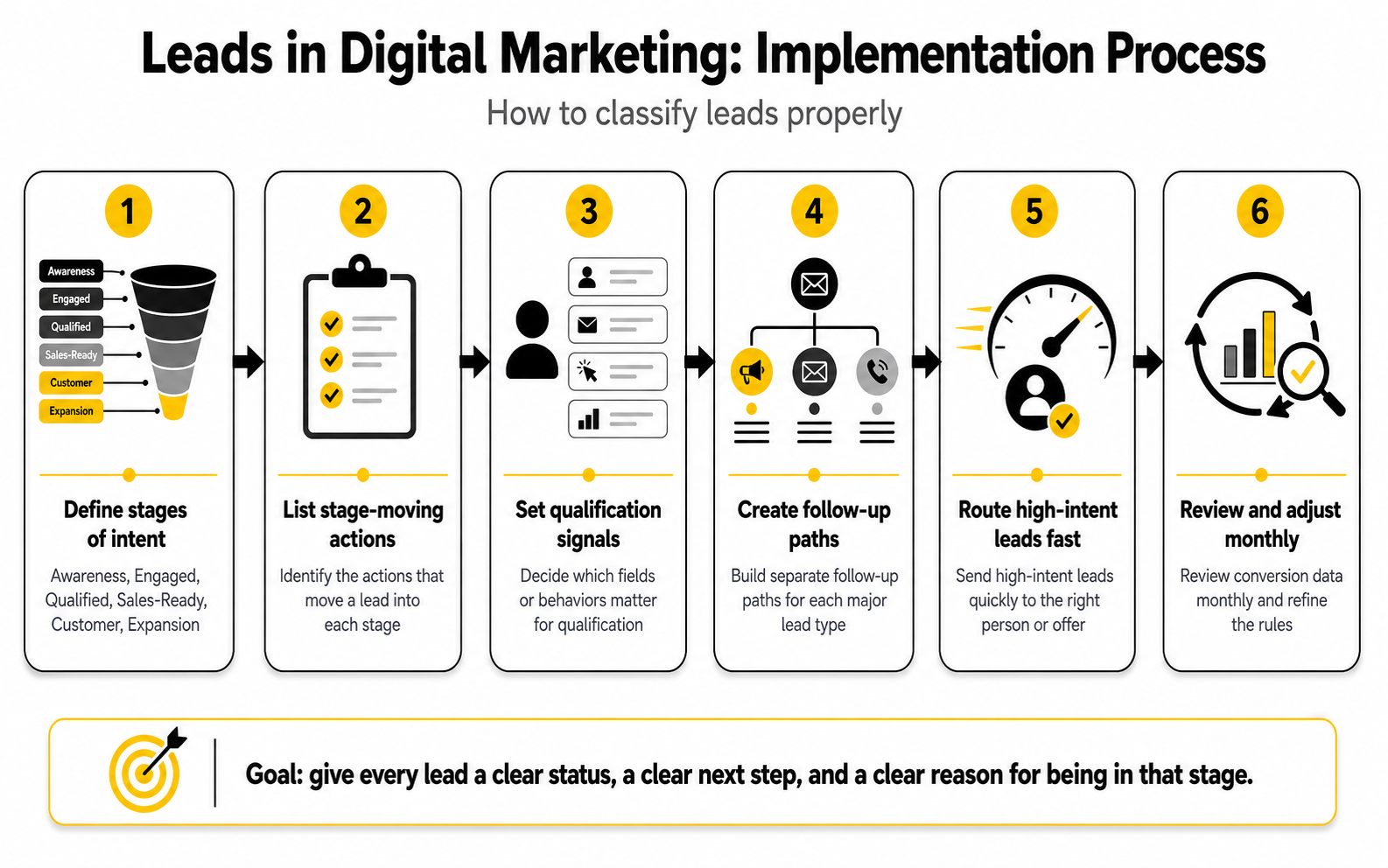
This is the moment where leads in digital marketing become operational. You are not guessing from a messy list of contacts anymore. You are giving every lead a clear status, a clear next step, and a clear reason for being in that stage.
A tool like GoHighLevel can help if you need CRM pipelines, forms, calendars, automations, and follow-up in one place. A simpler setup using Fillout, Brevo, and a clean CRM can also work. The tool matters less than the discipline behind the stages.
What To Do With Each Lead Type
Each lead type should have a job. Awareness leads should be educated. Content leads should be segmented by topic. Marketing-qualified leads should receive stronger offers or deeper proof.
Sales-qualified leads should get fast human or high-intent automated follow-up. Product-qualified leads should be guided toward activation, upgrade, or sales assistance. Service-qualified leads should be offered the most relevant next step based on what they already use or need.
This sounds basic, but it is where many campaigns fall apart. The lead capture page promises one thing, the email says something generic, the CRM stage is unclear, and sales has no context. Good implementation removes that friction.
The Mistake To Avoid
The biggest mistake is building too many lead categories before the business has enough volume or operational discipline. A complex scoring model looks impressive, but it becomes useless if nobody trusts it, updates it, or acts on it. Start with simple categories that change what happens next.
A small business might only need three groups at first: early-stage leads, qualified leads, and sales-ready leads. A larger B2B company may need more detail because the buying process is longer and more people are involved. The right structure is the one that improves decisions without slowing the team down.
Lead classification should make action easier. If it only creates more labels, dashboards, and internal debates, it is not helping. The whole point is to move the right people toward the right next step with less confusion.
Statistics And Data
Data is where lead generation gets honest. Opinions are useful when you are shaping the message, but numbers show whether the system is actually creating movement. If the data only tells you how many leads you collected, it is not enough.
The point of measurement is not to dump every metric into a dashboard. The point is to understand where people are dropping off, which sources produce serious opportunities, and what actions should happen next. Good analytics should make decisions easier, not make the team argue over five versions of the truth.
For leads in digital marketing, the most useful data usually sits across four layers: acquisition, capture, qualification, and revenue. Acquisition shows where people came from. Capture shows whether the offer and page worked. Qualification shows whether those people were actually useful. Revenue shows whether the entire system was worth the spend.
Why Benchmarks Need Context
Benchmarks can help you understand whether your numbers are unusually weak, average, or strong. But they can also mislead you if you copy them without context. A 3% landing page conversion rate may be poor for a warm retargeting campaign and excellent for a cold, high-ticket B2B audience.
Industry, price point, buying cycle, channel, traffic temperature, brand trust, and offer type all affect the numbers. A free checklist will usually convert at a higher rate than a consultation request because the commitment is lower. That does not mean the checklist is better.
The right way to use benchmarks is as a reference point, not a target carved into stone. If your conversion rate is below market norms, investigate the page, offer, traffic quality, and follow-up. If your conversion rate is high but revenue is low, the problem may be lead quality rather than lead capture.
The Metrics That Actually Matter
A basic lead generation dashboard should show more than traffic and form fills. You need to see how each stage connects to the next one. Otherwise, you will keep optimizing the easiest number instead of the most valuable one.
The most useful metrics are:
These numbers should not be treated equally. Cost per lead is useful, but it is not the final truth. A campaign with a higher CPL can still win if it creates better-fit leads, faster sales conversations, larger deals, or stronger retention.
What Conversion Rates Really Tell You
Conversion rates tell you where the system is creating friction. If traffic is strong but visitor-to-lead conversion is weak, the issue may be the offer, landing page, message match, form length, proof, or call to action. If leads are coming in but few become qualified, the targeting or promise may be attracting the wrong people.
Ruler Analytics’ conversion benchmark data shows that conversion rates vary widely by industry and marketing source, which is why comparing one business to another without context is risky. Its 2025 benchmark resource is useful because it breaks performance down by industry and marketing source, instead of pretending one universal conversion rate applies to everyone. That is the right mindset.
The real action is to compare each campaign against itself over time. Look at last month, last quarter, and the same period last year. If the conversion rate improves while qualified pipeline also improves, you are probably making real progress.
The Difference Between Leading And Lagging Indicators
Not every metric tells you the same kind of truth. Some metrics are leading indicators, which means they show early signs of future performance. Others are lagging indicators, which means they confirm what already happened.
Clicks, page visits, form starts, quiz completions, chatbot replies, webinar registrations, and email clicks are leading indicators. They help you see whether the market is responding. Revenue, closed deals, retention, and lifetime value are lagging indicators because they take longer to show up.
You need both. If you only look at leading indicators, you may celebrate activity that never becomes revenue. If you only look at revenue, you may discover problems too late to fix the campaign efficiently.
Building A Simple Analytics System
A practical analytics system connects the first touch to the final outcome as clearly as possible. It does not need to be perfect on day one. It does need to be consistent.
Start by making sure every lead source is tagged properly. Use UTMs for campaigns, keep landing page names consistent, and make sure forms pass the right fields into your CRM or email platform. Then define the stages a lead can move through so reporting does not depend on random notes or memory.
A simple setup might track the path like this:
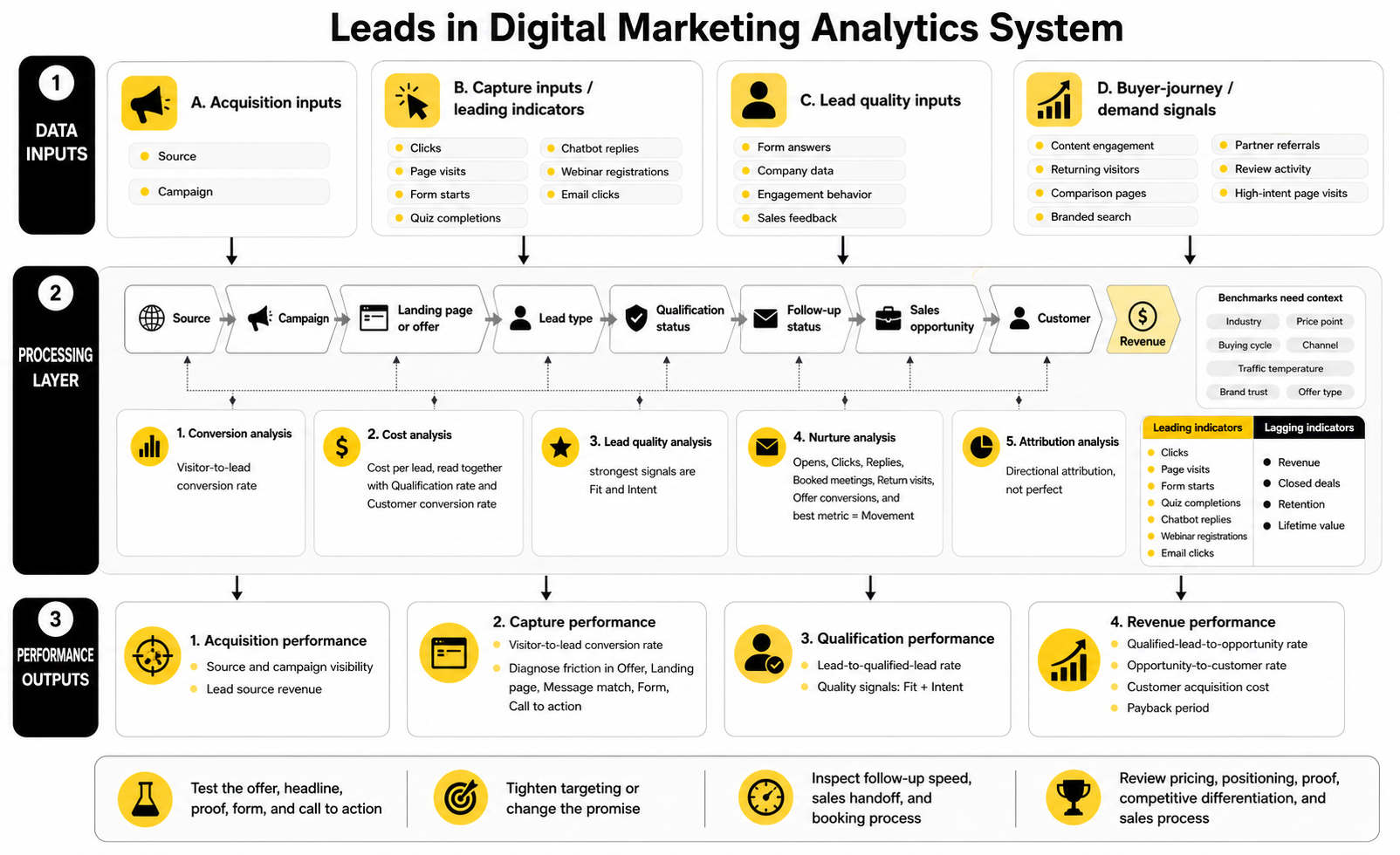
This is where measurement becomes useful. You can see whether paid search creates fewer but stronger leads, whether organic content produces delayed pipeline, whether webinars create sales conversations, or whether social traffic needs a softer offer before it converts. The data starts telling you what to improve next.
How To Read Cost Per Lead
Cost per lead is one of the most popular metrics because it is simple. Spend $1,000, get 100 leads, and the CPL is $10. Easy.
But easy does not mean complete. A $10 lead that never qualifies is more expensive than a $100 lead that becomes a serious opportunity. That is why CPL should always be read together with qualification rate and customer conversion rate.
The practical question is not “How low can we get CPL?” The practical question is “How much can we afford to pay for a lead that has a realistic chance of becoming a customer?” That answer depends on your close rate, average order value, gross margin, retention, and customer lifetime value.
How To Read Lead Quality Data
Lead quality data shows whether the campaign is attracting the right people. You can measure this through form answers, company data, engagement behavior, sales feedback, CRM stage movement, and eventual revenue. This is where marketing stops guessing.
The strongest quality signals are usually tied to fit and intent. A lead from a target industry who visits the pricing page, replies to an email, and books a call is very different from a generic content download with no further engagement. Both may sit in the database, but they should not receive the same priority.
Norwest’s 2025 B2B benchmark research emphasizes the importance of clear sales-ready criteria, because standardized qualification reduces handoff friction and focuses resources on leads most likely to drive revenue. That lines up with what strong operators already know: the definition of a qualified lead has to be specific enough to change behavior, not vague enough to keep everyone comfortable.
How To Read Email And Nurture Metrics
Email metrics are useful when they are interpreted correctly. Opens show attention, but they are not a reliable buying signal by themselves. Clicks, replies, booked meetings, return visits, and offer conversions tell you much more.
Brevo’s email benchmark research shows how email performance differs across industries and regions, which is useful when judging nurture engagement against realistic expectations. The key lesson from its email marketing benchmarks is not that everyone should chase the same open rate. It is that email performance needs a relevant comparison point.
For lead nurturing, the best metric is movement. Did the lead consume the next piece of content, answer a segmentation question, visit a commercial page, request help, start a trial, or book a call? If nothing moves after several touches, the nurture sequence may be too generic or the original lead source may be too weak.
How To Read Attribution Data
Attribution helps you understand which touchpoints influenced a lead before conversion. That matters because buyers rarely move in a straight line. They may discover you through search, return through retargeting, subscribe through a lead magnet, attend a webinar, and convert after a sales email.
The mistake is expecting attribution to be perfectly clean. It rarely is. Privacy changes, dark social, multi-device behavior, word of mouth, and offline conversations all create gaps in the data.
The best use of attribution is directional. If several data sources show that certain channels keep appearing before qualified pipeline, those channels deserve attention. If a channel produces lots of last-click leads but weak revenue, you need to look deeper before increasing spend.
What Buyer Data Means For Lead Generation
Buyer behavior data matters because it tells you how much of the decision happens before a lead ever speaks to you. 6sense’s 2025 buyer research found that buyers initiated 79% of B2B engagements, which reinforces a critical point: many prospects are already deep into research before they become visible in your system.
That means your measurement cannot only start at the form fill. You should also pay attention to content engagement, returning visitors, comparison pages, branded search, partner referrals, review activity, and high-intent page visits. These signals help you understand demand before it turns into a direct conversion.
The action is clear. Build measurement around the full journey, not just the final form. If you only track the moment someone becomes a lead, you miss the marketing that created the confidence to convert.
Turning Data Into Action
Data only matters if it changes what you do next. If a landing page gets traffic but does not convert, test the offer, headline, proof, form, and call to action. If a source produces cheap leads but weak qualification, tighten the targeting or change the promise.
If leads qualify but do not become opportunities, inspect the follow-up speed, sales handoff, booking process, and message relevance. If opportunities are created but do not close, the issue may be pricing, positioning, proof, competitive differentiation, or sales process. Each metric should point to a practical next move.
This is the difference between reporting and optimization. Reporting tells you what happened. Optimization uses that information to make the next campaign stronger.
The Measurement Mistakes To Avoid
The first mistake is tracking too many metrics too early. A dashboard with 40 numbers can look professional while hiding the one problem that actually matters. Start with the stages that show movement from traffic to revenue.
The second mistake is treating every lead source the same. Organic search, paid social, referral traffic, webinars, affiliates, and outbound campaigns usually behave differently. They need different expectations, different timelines, and sometimes different offers.
The third mistake is changing campaigns before enough data exists. Small sample sizes can create false conclusions. If only 20 people visited a page, the conversion rate is not stable enough to make a big strategic decision.
The Practical Measurement Standard
A lead generation system is healthy when you can answer five questions without digging through chaos. Where did the lead come from? What did they respond to? Are they a good fit? What happened after they converted? Did they create revenue or meaningful pipeline?
If you cannot answer those questions, the system is still too blurry. That does not mean the marketing is bad. It means the measurement layer is not mature enough yet.
The goal is not perfect attribution or a beautiful dashboard. The goal is better decisions. When your data helps you invest more in what works, fix what leaks, and stop chasing vanity metrics, your lead generation system becomes a real growth asset.
Advanced Lead Strategy: What Changes When You Scale
A small lead generation system can survive with simple rules. A founder, marketer, or salesperson can manually check new leads, spot obvious opportunities, and follow up with a personal message. But once volume increases, manual judgment starts to break down.
Scaling leads in digital marketing introduces new problems. You get more channels, more campaigns, more segments, more automation, more handoffs, and more room for bad data to spread. The system that worked at 50 leads per month may become chaotic at 500 or 5,000.
This is where advanced strategy becomes less about doing more and more about protecting quality while you grow. The goal is not to add complexity for the sake of looking sophisticated. The goal is to make sure scale does not turn a clean lead system into a noisy database.
The Tradeoff Between Automation And Human Judgment
Automation is powerful when the rules are clear. It can tag leads, send follow-ups, route sales-ready contacts, trigger reminders, update CRM stages, and keep the process moving without relying on memory. That matters because slow or inconsistent follow-up kills good opportunities.
But automation becomes dangerous when it replaces judgment too early. If the system sends every new lead into the same sequence, scores people based on shallow activity, or pushes high-intent buyers through slow nurture flows, it creates friction instead of efficiency. A person asking for implementation help should not feel like they are trapped inside a generic email machine.
The best systems use automation for speed and consistency, then bring in human judgment at key moments. Use automation to identify intent, prepare context, and make the next step easy. Use people when the lead is valuable, complex, strategic, or close to a buying decision.
Segmentation Has To Stay Practical
Segmentation helps you make follow-up more relevant. You can segment by lead source, industry, role, company size, behavior, problem, offer, lifecycle stage, location, or product interest. Done well, segmentation makes the experience feel sharper and more useful.
The risk is over-segmentation. Too many segments create too many workflows, too many emails, too many reports, and too many places for mistakes to hide. A complicated segmentation model that nobody maintains is worse than a simple model the team actually uses.
A practical rule is to create a segment only when it changes the next action. If a segment gets a different message, route, offer, score, or sales process, it probably has a reason to exist. If it only sits in the CRM as another label, it is probably clutter.
Lead Scoring Should Not Pretend To Be Magic
Lead scoring can help prioritize follow-up, but it should never be treated as absolute truth. A score is only as good as the assumptions behind it. If those assumptions are weak, the score gives false confidence.
Good scoring usually combines fit and behavior. Fit might include job role, company size, industry, location, budget range, or use case. Behavior might include page visits, form submissions, email clicks, webinar attendance, trial actions, chatbot replies, or repeat engagement.
The mistake is giving too much weight to easy activity. Someone clicking five emails is not automatically more valuable than someone visiting a pricing page once and booking a call. Lead scoring should help sales and marketing make better decisions, not hide buying intent behind a neat number.
First-Party Data Is Becoming More Important
First-party data is information people give you directly or generate through their interactions with your owned channels. That includes form answers, email engagement, CRM history, website behavior, product usage, survey responses, purchase history, and customer feedback. It is becoming more important because marketers can no longer depend as heavily on loose third-party tracking.
This matters for leads in digital marketing because consent, trust, and data quality now shape how well your system performs. The strongest lead systems collect useful information directly, explain the value clearly, and avoid asking for data they do not need. Cleaner first-party data also makes segmentation, personalization, and attribution more reliable.
Privacy-first marketing is not just a legal issue. It is a conversion issue. If the experience feels invasive, vague, or manipulative, people hesitate; if the value exchange is clear, they are more willing to share useful information.
Compliance Cannot Be An Afterthought
Lead generation touches personal data, so compliance needs to be part of the system from the beginning. Consent, unsubscribe options, data storage, cookie behavior, regional privacy rules, and communication permissions all matter. This is especially true if you run campaigns across multiple countries.
The practical point is simple: do not collect more than you need, do not hide what people are signing up for, and do not make opting out difficult. A larger database is not worth much if it creates risk or damages trust. Strong lead generation should feel transparent.
This also affects tool choice. If you use platforms for forms, chat, email, CRM, calendars, or analytics, make sure they support the privacy and consent workflows your business needs. A messy compliance setup becomes much harder to fix after thousands of contacts are already inside the system.
AI Can Improve Lead Generation, But Only With Guardrails
AI can help with lead generation in useful ways. It can summarize sales notes, personalize email drafts, classify form responses, score intent signals, generate content variations, analyze call transcripts, and suggest next-best actions. HubSpot’s 2025 marketing AI research surveyed nearly 1,900 marketing and business leaders and shows how quickly AI is becoming part of everyday marketing workflows through its State of Marketing AI Report.
The risk is using AI to create more noise. More emails, more landing pages, more chat flows, and more content do not automatically create better leads. If the strategy is weak, AI simply helps you scale the weakness faster.
Use AI where it improves relevance, speed, analysis, or consistency. Do not use it to fake personalization, invent claims, or replace real customer understanding. The best AI-supported lead systems still depend on clear positioning, honest offers, clean data, and human review.
Channel Expansion Requires Discipline
At some point, every growing business wants more channels. Search is working, so it adds paid social. Paid social produces leads, so it adds webinars. Webinars create pipeline, so it adds affiliates, partners, outbound, communities, and retargeting.
Expansion is healthy, but it can also dilute focus. Each channel has its own intent level, creative requirements, follow-up rhythm, and measurement window. Treating every channel the same usually leads to bad conclusions.
Before adding a new channel, make sure the current one is understood. Know the audience, offer, conversion rate, qualification rate, follow-up process, and revenue contribution. Then expand with a specific hypothesis instead of copying tactics because they look popular.
The Risk Of Misaligned Offers
An offer is the reason someone becomes a lead. It might be a checklist, audit, quote, webinar, trial, demo, consultation, discount, calculator, template, quiz, or buyer guide. The offer sets expectations for the entire relationship.
If the offer is too broad, it attracts people who are curious but not serious. If the offer is too aggressive, it scares away people who need education first. If the offer does not match the channel, the lead quality will suffer even if the campaign technically converts.
This is why offer strategy matters so much. A high-intent search campaign can usually support a stronger commercial offer. A cold social campaign may need a lower-friction step first. The offer should match the buyer’s awareness level, not the marketer’s desire to collect sales-ready leads immediately.
Funnel Tools Are Not The Strategy
Tools can make execution easier, but they do not replace thinking. A landing page builder, chatbot platform, email tool, CRM, or automation system will not fix a weak offer or unclear audience. It will only make the weakness easier to publish.
That said, the right tools can reduce friction when the strategy is already clear. ClickFunnels can help build funnel flows and lead capture paths. Systeme.io can work for simpler funnels, email, and digital offers when you want fewer moving parts.
The tool decision should come after the process decision. Decide what the lead needs to experience, what data must be captured, what follow-up should happen, and how success will be measured. Then choose the platform that supports that system with the least unnecessary complexity.
Scaling Follow-Up Without Losing Relevance
Follow-up is where many lead systems win or lose. A person may convert because the offer was interesting, but they keep moving because the next message feels relevant. If the follow-up feels generic, trust drops quickly.
Scaling follow-up means building reusable paths without making every person feel like a number. You can do this by referencing the source offer, segmenting by problem, changing messages based on behavior, and giving people clear next steps. The language should sound like a continuation of the original promise.
A strong nurture system does not just “stay in touch.” It helps the lead make progress. Each touch should reduce confusion, answer an objection, show proof, clarify fit, or make the next action easier.
When To Use Retargeting
Retargeting is useful when people have shown meaningful interest but have not converted yet. It can remind visitors about an offer, bring back abandoned form users, promote proof, answer objections, or move warm audiences toward a stronger next step. Used well, it supports the journey without feeling intrusive.
The mistake is retargeting everyone with the same message. A homepage visitor, pricing page visitor, webinar registrant, and cart abandoner should not all see the same ad. Their behavior suggests different levels of intent.
Retargeting should also respect timing. Someone who read one beginner article may need education, while someone who viewed a demo page twice may need a direct call to action. Matching the message to behavior is what makes retargeting useful.
Sales Handoffs Need Clear Rules
The handoff from marketing to sales is one of the most important moments in the lead process. If the handoff is slow, vague, or missing context, a qualified lead can lose momentum. If it happens too early, sales spends time chasing people who were never ready.
A good handoff includes the lead source, offer, form answers, relevant behavior, qualification reason, and recommended next step. Sales should know why the lead matters before starting the conversation. That context makes outreach sharper and more human.
The handoff should also have a service-level agreement. For example, high-intent demo or consultation requests should be handled quickly, while lower-intent content leads can stay in nurture. Clear rules prevent good leads from getting buried.
The Danger Of Scaling A Broken System
Scaling does not fix leaks. It exposes them. If your offer is vague, your qualification is weak, your CRM is messy, or your follow-up is slow, more traffic will only make the problem louder.
This is why the best time to fix the system is before you increase spend. Audit the path from first click to sales outcome. Look for unclear promises, unnecessary form fields, missing source data, weak segmentation, delayed follow-up, and disconnected reporting.
The goal is not perfection. The goal is to remove the obvious friction before you amplify the campaign. Once the foundation is clean, more traffic has a much better chance of becoming more revenue.
Expert-Level Lead Generation Is Mostly Restraint
Beginners usually ask what else they can add. Experts ask what they can remove, simplify, clarify, or prioritize. That is a very different mindset.
Advanced lead generation is not about having the most complicated funnel. It is about knowing which audience matters, which signals count, which offers create real intent, which channels deserve budget, and which leads should be ignored. Sometimes the smartest move is to stop chasing a source that looks good in top-line metrics but produces poor-fit conversations.
This is the difference between activity and strategy. A business can run many campaigns and still have no real lead system. A professional system is focused, measurable, compliant, scalable, and honest about what the data says.
Bringing The Lead System Together
By this point, the pattern should be clear. Leads in digital marketing are not created by one tactic, one channel, one tool, or one clever form. They come from a connected system that attracts the right people, captures the right signals, and moves each person toward the right next step.
The final system has to balance strategy and execution. You need traffic, but not just traffic. You need conversion, but not just form fills. You need automation, but not at the cost of relevance. You need data, but not so much reporting that nobody knows what to do next.
The strongest lead systems are built around a simple operating rhythm: attract, capture, qualify, nurture, convert, measure, and improve. Each stage has a job. When every stage is clear, lead generation stops feeling random and starts becoming a predictable growth function.
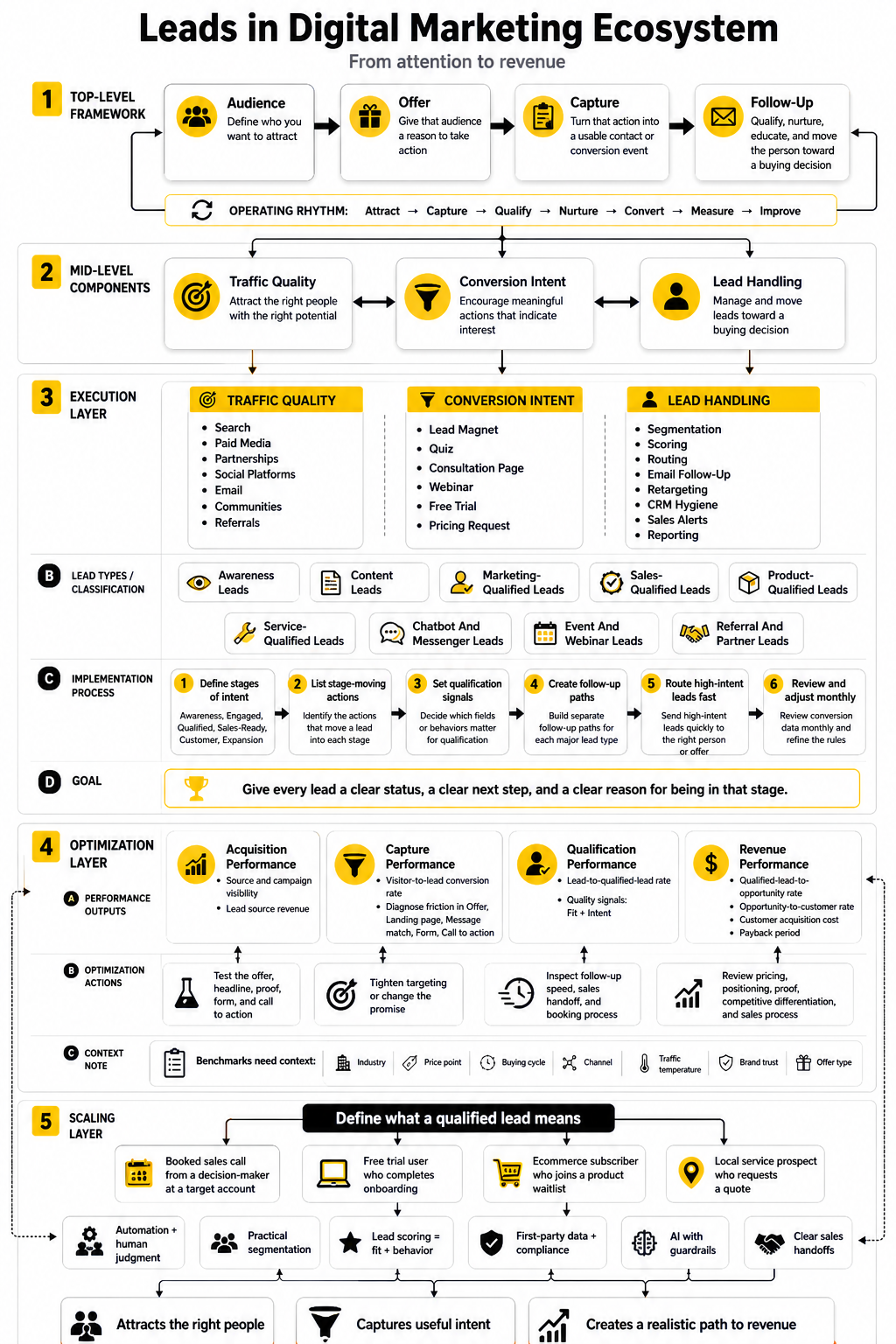
The Complete Lead Generation Ecosystem
A complete ecosystem connects the buyer’s journey with your internal process. The buyer sees helpful content, useful offers, relevant proof, clear next steps, and timely follow-up. Your team sees source data, qualification status, lifecycle stage, sales context, and revenue outcomes.
That ecosystem should also make decision-making easier. If a campaign attracts weak leads, you know whether to fix the targeting, offer, page, or qualification rules. If leads are strong but sales outcomes are weak, you know to inspect the handoff, follow-up speed, positioning, pricing, or close process.
This is what separates professional lead generation from random campaign activity. Random activity asks, “Can we get more leads?” A professional system asks, “Which leads are worth pursuing, what do they need next, and how do we turn that movement into revenue?”
How To Build A Lead System From Scratch
Start with the buyer, not the platform. Define who you want to reach, what problem they are trying to solve, how urgent that problem is, and what level of awareness they already have. This gives every later decision a cleaner foundation.
Then choose one primary offer for one clear stage of intent. A beginner audience may need a guide, checklist, quiz, or email course. A high-intent audience may need a consultation, demo, quote, trial, pricing path, or implementation call.
Once the offer is clear, build the capture path and follow-up path together. Do not launch a form first and figure out the nurture later. The moment someone becomes a lead, the system should already know what happens next.
The Practical Stack For Managing Leads
A practical lead stack usually includes a landing page or funnel builder, a form or quiz tool, an email platform, a CRM, analytics, and scheduling. Some businesses prefer one connected platform. Others prefer a lean stack of specialized tools.
For an all-in-one setup, GoHighLevel can make sense because it brings CRM, automations, forms, calendars, funnels, and follow-up into one environment. For funnel-heavy businesses, ClickFunnels can help structure offer paths and conversion flows. For simpler digital offers and lean campaigns, Systeme.io can be enough without adding unnecessary complexity.
Specialized tools can also fit specific gaps. Fillout is useful for cleaner forms and qualification flows. Brevo can support email marketing and nurture campaigns. ManyChat can help when social messaging and chatbot lead capture are central to the strategy.
What To Optimize First
The first thing to optimize is not always the ad. In many lead systems, the biggest leak is the offer. If people see the page but do not want the next step, better targeting will only help so much.
After the offer, look at message match. The ad, post, email, search result, landing page, form, and follow-up should feel like one continuous conversation. If each touchpoint sounds like it was written by a different team, trust drops.
Then inspect the handoff and follow-up. A good lead can be lost by slow response, vague messaging, missing context, or too much friction. Fixing those basics often improves revenue faster than launching another campaign.
What A Mature Lead System Looks Like
A mature lead system is not necessarily complicated. It is clear. Everyone knows what counts as a lead, what counts as a qualified lead, when sales should step in, and which numbers define success.
It also improves over time. The team reviews lead sources, qualification rates, funnel conversion, sales outcomes, and revenue contribution regularly. Campaigns are not judged only by the number of contacts collected.
Most importantly, the buyer experience feels coherent. People get useful content when they are learning, proof when they are comparing, and direct help when they are ready. That is the standard to aim for.
What Are Leads In Digital Marketing?
Leads in digital marketing are people or companies that show interest in your offer through an online action. That action might be filling out a form, subscribing to an email list, booking a call, starting a trial, downloading a resource, replying to a chatbot, or requesting pricing. The key is that the person has created a signal your business can act on.
A lead is not automatically a buyer. Some leads are early in the journey and need education. Others are actively comparing options and need fast, relevant follow-up.
Why Are Leads Important In Digital Marketing?
Leads matter because they give you a way to continue the conversation after someone discovers your brand. Traffic, impressions, and views are useful, but they disappear quickly if you do not capture interest. A lead turns anonymous attention into a relationship you can nurture, qualify, and measure.
They also help connect marketing activity to revenue. When leads are tracked properly, you can see which channels, offers, and messages are creating real opportunities. That makes marketing less about guessing and more about improving the system.
What Is The Difference Between A Lead And A Prospect?
A lead has shown some level of interest, but they may not be fully qualified yet. A prospect is usually a better-fit person or company that has been identified as a realistic potential customer. In simple terms, a lead is an initial signal, while a prospect is a more qualified opportunity.
The exact definitions can vary by company. What matters most is that your team uses the same language internally. If marketing and sales define these terms differently, reporting and follow-up become messy.
What Makes A Digital Marketing Lead High Quality?
A high-quality lead usually has fit, intent, timing, and reachability. Fit means they match your ideal customer profile. Intent means their behavior suggests they may be moving toward a decision.
Timing and reachability matter just as much. A perfect-fit lead who is not ready may need nurturing, while a high-intent lead who cannot be contacted may not be useful yet. Quality is about the realistic chance of movement, not just the fact that someone submitted a form.
What Is A Marketing-Qualified Lead?
A marketing-qualified lead is someone who has shown enough fit and engagement to deserve more focused marketing or sales attention. They may have visited important pages, downloaded specific resources, engaged with emails, answered qualifying questions, or matched a target profile. The exact criteria should be defined by the business.
An MQL should not simply mean “anyone who filled out a form.” That definition is too loose. A useful MQL definition helps the team prioritize people who are more likely to move forward.
What Is A Sales-Qualified Lead?
A sales-qualified lead is a lead that appears ready for direct sales follow-up. This may be someone who requests a demo, asks for pricing, books a consultation, replies with clear interest, or shows strong product behavior. Sales-qualified leads should be handled quickly because intent can fade.
The handoff should include context. Sales should know where the lead came from, what they asked for, what they viewed, and why they are considered qualified. That makes the first conversation more relevant.
What Is The Best Channel For Generating Leads?
There is no universal best channel. Search, paid ads, organic social, email, partnerships, webinars, referrals, affiliates, communities, and outbound can all work. The best channel depends on your audience, offer, price point, buying cycle, and ability to follow up.
A high-intent service business may do well with search and local landing pages. A B2B software company may need content, comparison pages, product-led trials, retargeting, and sales outreach. The channel should match how your buyers actually make decisions.
How Do You Generate Leads Online?
You generate leads online by attracting the right audience and giving them a clear reason to take action. That reason might be a lead magnet, webinar, audit, consultation, quote, trial, discount, calculator, quiz, or demo. The offer should match the buyer’s stage of awareness.
The process usually includes traffic, a landing page, a capture mechanism, a follow-up system, qualification rules, and measurement. If any of those pieces are missing, the campaign may still collect contacts but struggle to create revenue.
How Do You Measure Lead Generation Performance?
Start by measuring the full path from traffic to revenue. Track visitor-to-lead conversion rate, cost per lead, lead-to-qualified-lead rate, qualified-lead-to-opportunity rate, close rate, customer acquisition cost, and revenue by source. These numbers show where the system is working and where it is leaking.
Do not judge campaigns by cost per lead alone. A cheap lead can be expensive if it never qualifies. A more expensive lead can be profitable if it becomes a strong customer.
How Fast Should You Follow Up With Leads?
High-intent leads should be followed up with as quickly as possible. Someone who requests pricing, books a demo, asks for a quote, or fills out a consultation form is actively raising their hand. Slow follow-up gives them time to lose interest, find another provider, or forget why they contacted you.
Lower-intent leads can enter a nurture sequence instead. The key is to match response speed to intent. Not every lead needs instant human contact, but every lead needs an appropriate next step.
What Is Lead Nurturing?
Lead nurturing is the process of helping leads move from initial interest toward a buying decision. This can happen through email, retargeting, content, webinars, chatbot flows, sales outreach, product onboarding, or personalized recommendations. The goal is to make the next step easier and more relevant.
Good nurturing does not spam people with random promotions. It answers questions, handles objections, builds trust, and shows why the offer matters. Each touch should help the lead make progress.
What Is Lead Scoring?
Lead scoring is a method for ranking leads based on fit and behavior. Fit can include role, industry, company size, location, budget, or use case. Behavior can include page visits, email clicks, form submissions, webinar attendance, trial activity, or chatbot replies.
Lead scoring is useful when it helps prioritize action. It becomes a problem when teams treat the score as perfect truth. The score should support judgment, not replace it.
What Is The Biggest Mistake In Digital Lead Generation?
The biggest mistake is chasing volume without understanding quality. Many businesses celebrate lead counts while ignoring whether those leads are qualified, reachable, interested, or likely to buy. That creates busy dashboards and weak revenue.
The better approach is to define what a good lead means before scaling campaigns. Once the definition is clear, you can improve the offer, targeting, qualification, follow-up, and measurement. More leads only matter when the system can turn them into real opportunities.
How Can Small Businesses Improve Lead Generation?
Small businesses should keep the system simple. Choose one clear audience, one strong offer, one primary lead capture path, and one follow-up sequence. Then measure whether the leads are turning into conversations and customers.
Do not start with a complex funnel unless the basics already work. A clear landing page, useful form, fast follow-up, and consistent tracking can beat a complicated setup with ten disconnected tools. Simplicity makes improvement easier.
Are AI Tools Useful For Lead Generation?
AI tools can be useful when they improve speed, personalization, analysis, and consistency. They can help write follow-up drafts, summarize lead context, classify form answers, identify patterns, and support content production. They are especially helpful when the system already has clean data and clear rules.
AI is not a substitute for strategy. If your audience, offer, and qualification process are unclear, AI will simply help you create more noise. Use it to support a strong system, not to cover up a weak one.
Build a stronger local presence with BAAM AI
Turn your website, Google profile, social channels, and AI visibility into one growth engine
Most businesses do not need more random marketing activity. They need a consistent presence system that helps the right people find them, trust them, and take action. BAAM AI brings strategy, local SEO, website updates, Google Maps visibility, social content, AI-search readiness, media production, and reporting into one practical monthly engine.
If you want your marketing to keep working after the campaign ends, start with a free BAAM AI presence audit. See how your business shows up today and where the fastest visibility wins are at BAAM AI.