
BAAM AI Blog
Lead Copywriting: How To Turn Attention Into Qualified Leads
Lead copywriting is not just writing a catchy headline for a landing page. It is the process of using clear, persuasive, buyer-aware messaging to move the right person from casual interest to a meaningful next step...
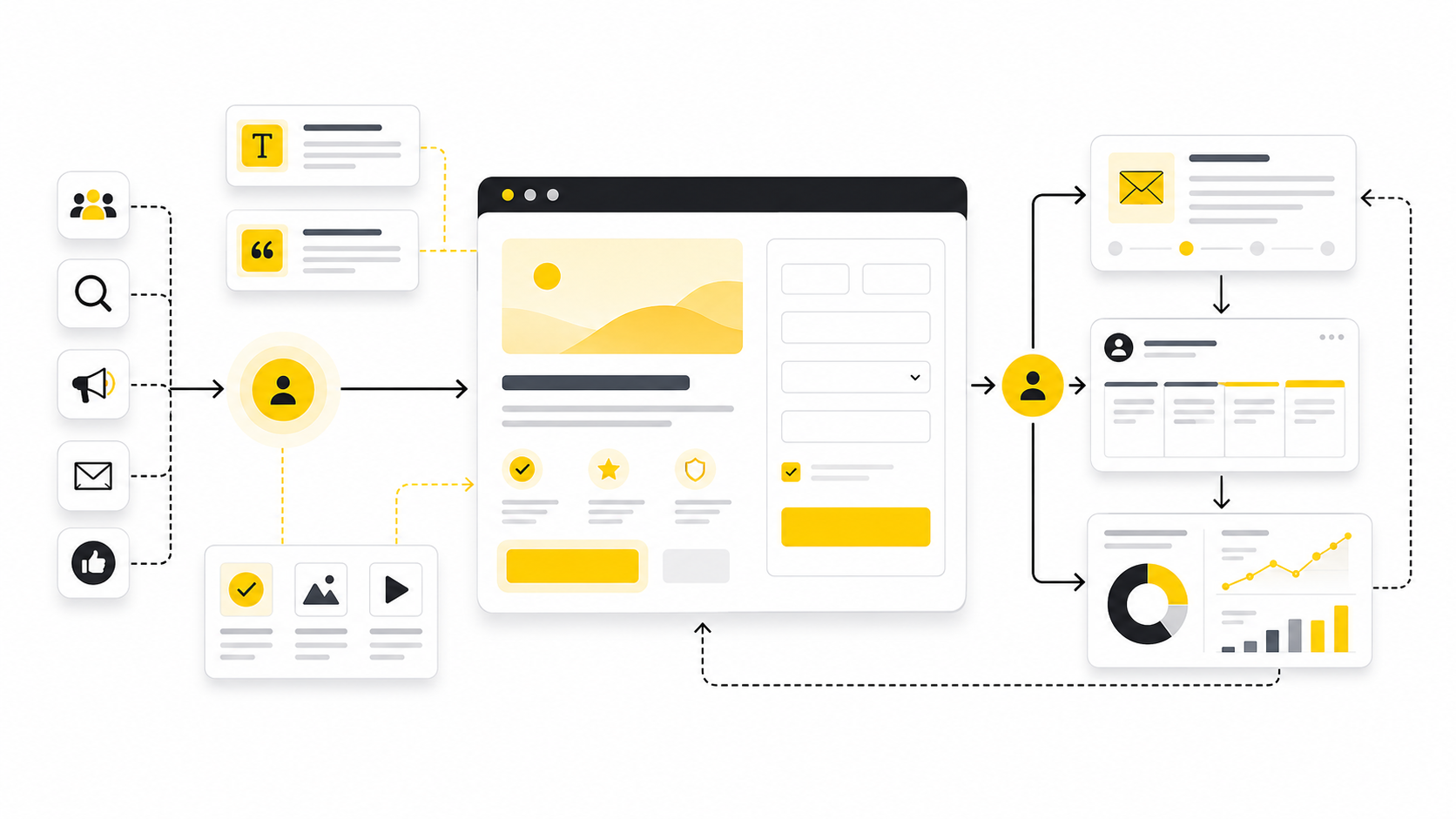
Lead copywriting is not just writing a catchy headline for a landing page. It is the process of using clear, persuasive, buyer-aware messaging to move the right person from casual interest to a meaningful next step. That next step might be booking a call, joining a waitlist, requesting a quote, downloading a guide, starting a trial, or entering an automated follow-up sequence.
The mistake most businesses make is treating lead copy like decoration. They polish slogans, add urgency, and hope the form fill improves. But strong lead copywriting starts much earlier than the final words on the page because the copy has to understand the buyer’s problem, their level of awareness, the offer’s promise, the trust gap, and the exact action being requested.
This matters because people do not calmly read every word before deciding what to do. Nielsen Norman Group’s classic web usability research found that 79% of users scanned new web pages while only 16% read word by word, which means your lead copy has to communicate value fast without becoming shallow. A lead page, email, ad, or chatbot message has a very small window to prove relevance.
this guide is split into six parts so each piece of the lead copywriting process gets enough room. The goal is not to hand you random tips, but to build a practical system you can use across landing pages, funnels, emails, ads, forms, and follow-up messages. Each section continues from the previous one, so the article moves from strategy to execution without repeating the same advice.
Why Lead Copywriting Matters
Lead copywriting matters because lead generation is no longer just a traffic problem. More traffic can expose weak messaging faster, but it will not fix unclear value, vague offers, poor qualification, or slow follow-up. If the copy does not make the next step feel relevant, safe, and worthwhile, the visitor simply leaves.
The gap between attention and action is where most lead funnels lose money. Unbounce analyzed more than 57 million conversions across over 41,000 landing pages, which shows how much conversion performance depends on what happens after the click. The headline, offer framing, page structure, proof, form language, and call to action all shape whether a visitor becomes a lead or remains anonymous traffic.
Speed also changes the value of the lead after the copy does its job. InsideSales research reviewing over 55 million sales activities and 5.7 million inbound leads found that conversion rates dropped sharply after the first five minutes. That does not mean copy alone closes the deal, but it does mean lead copywriting should connect smoothly to the next step instead of creating interest that the business cannot handle.
Framework Overview
Good lead copywriting works best when it follows a simple order: understand the buyer, define the promise, reduce the risk, ask for the action, and support the follow-up. This order matters because a lead is not only a conversion metric. A lead is a person deciding whether sharing their information is worth the possible benefit.
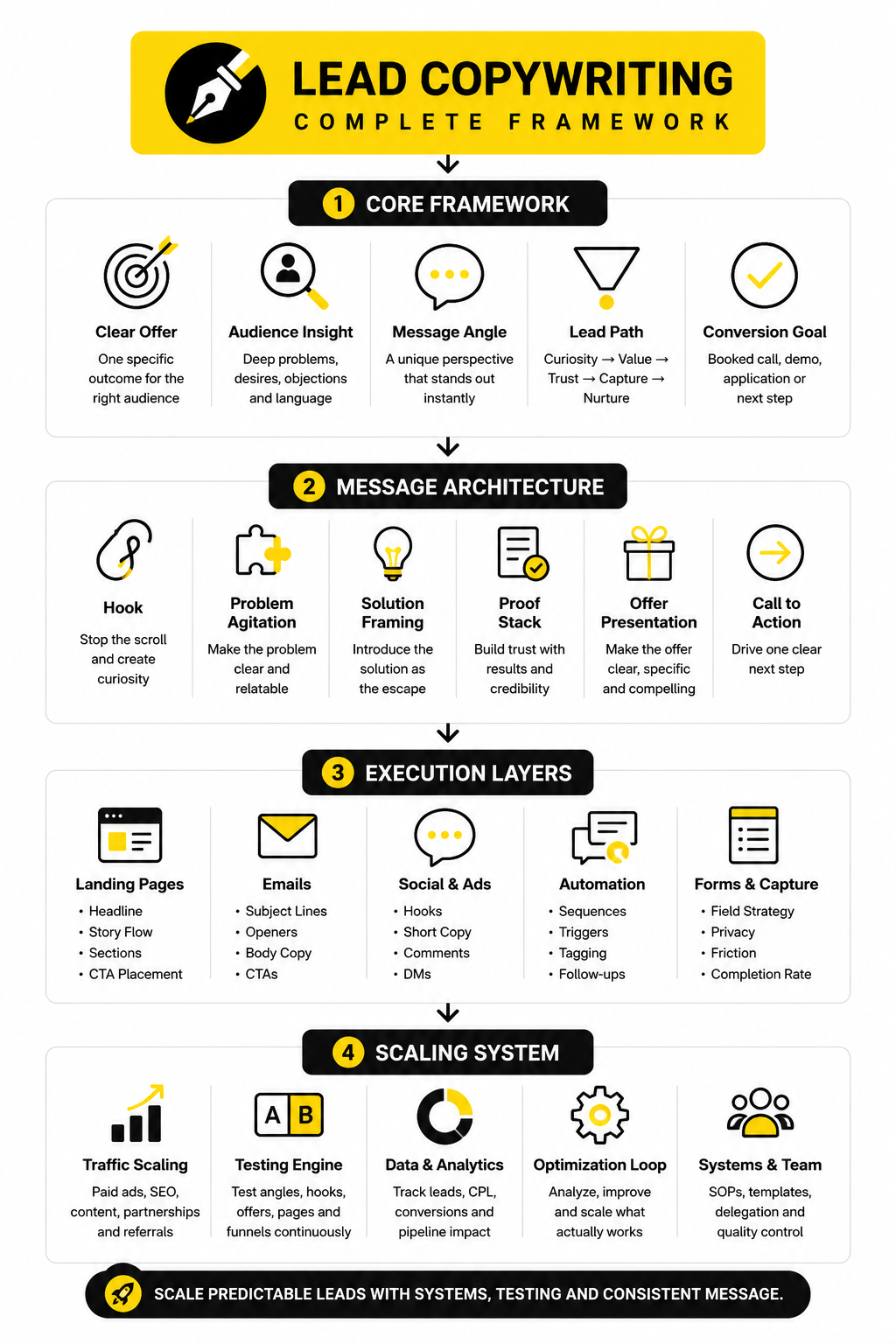
The framework starts with relevance because people need to recognize themselves in the copy before they care about the offer. It then moves into value because the reader needs to understand what they gain by taking action. After that, the copy has to build enough trust to overcome hesitation, especially when the form asks for personal or business information.
Privacy and trust are not minor details anymore. Pew Research Center found that 56% of Americans frequently click “agree” without reading privacy policies, which points to a bigger issue: people are tired of confusing data exchanges. Lead copywriting has to make the exchange feel fair by being specific about what the person gets, what happens next, and why the request is reasonable.
Core Components Of Lead Copywriting
The first core component is the audience insight behind the message. You need to know what the buyer is trying to solve, what they already believe, what alternatives they are considering, and what would make them hesitate. Without that, the copy usually becomes generic and starts saying things like “grow your business” or “save time” without explaining why this offer is the obvious next step.
The second component is the offer. A lead offer can be a consultation, demo, checklist, trial, quote, calculator, webinar, audit, or email sequence, but the format matters less than the perceived value. The copy has to make the offer feel concrete enough that the reader can instantly understand why it is worth their email address, phone number, time, or attention.
The third component is conversion structure. This includes the headline, subheadline, body copy, proof, objection handling, form copy, CTA, thank-you page, and follow-up message. If one of these pieces feels disconnected, the lead journey becomes weaker because the reader gets mixed signals right when confidence should be increasing.
Professional Implementation
Professional lead copywriting is not about writing one perfect page and hoping it works forever. It is about building a message system that can be reused, tested, and improved across channels. The same core promise might appear in an ad, a landing page, an email subject line, a chatbot opener, a booking page, and a sales follow-up, but each version has to match the context.
This is where many teams accidentally create friction. The ad promises one thing, the landing page says another, the form asks for too much, and the follow-up email sounds like it came from a different company. Lead copywriting fixes this by making the entire path feel consistent from first click to first conversation.
Personalization can help, but only when it supports clarity instead of becoming creepy. McKinsey’s research on personalization found that 71% of consumers expect personalized interactions and 76% get frustrated when they do not get them, yet personalization still has to respect the reader’s trust. The best lead copy feels specific because it understands the buyer, not because it tries too hard to prove how much data it has.
Buyer Awareness And Message Strategy
Lead copywriting gets easier when you stop writing for “traffic” and start writing for a specific stage of awareness. A visitor who knows they need a CRM does not need the same message as a visitor who only knows their follow-up is messy. A founder comparing funnel builders does not need the same copy as a local service business that just wants more booked appointments.
This is why buyer awareness comes before headlines, hooks, CTAs, and clever angles. If the copy speaks too far ahead of the reader, it feels pushy. If it speaks too far behind the reader, it feels obvious and wastes the moment.
The job is to meet the reader where they are and move them one step forward. Not ten steps. One clear step.
Start With The Reader’s Current Belief
Every lead starts with a belief. They believe they have a problem, they believe they might have a problem, or they believe everything is fine until something makes the cost of inaction visible. Your copy has to identify that belief before it can change it.
For example, a business owner may not think, “I need better lead copywriting.” They may think, “People visit my page but do not book,” or “Our ads are getting clicks but the leads are weak,” or “The form gets submissions, but sales says most of them are useless.” That language is much closer to the real problem, and real problem language usually beats polished marketing language.
This is also where weak copy breaks. It jumps straight into the solution before the reader has agreed with the diagnosis. When your copy names the problem in the way the reader already experiences it, the offer feels relevant before you even start selling.
Match The Message To Awareness Level
A cold visitor needs context. They need to understand why the problem matters, why now is a good time to fix it, and why the next step is not risky. A warm visitor needs comparison, proof, and a reason to choose your offer over the alternatives they are already considering.
A hot visitor needs less education and more confidence. They are closer to action, so the copy should remove friction instead of adding more explanation. That might mean a sharper CTA, a clearer form, a stronger guarantee, better proof, or a more specific description of what happens after they submit.
This matters because modern buyers often research before they talk to sales. Gartner reported that 61% of B2B buyers prefer a rep-free buying experience, which means your copy has to answer more questions before a conversation ever happens. If your message only works after a salesperson explains it, the page is not doing its job.
Build A Message Around The Trigger Event
A strong lead message usually starts with a trigger event. Something happened that made the reader pay attention. Maybe ad costs increased, referrals slowed down, a competitor launched a better offer, a sales team complained about lead quality, or the founder finally realized the current funnel cannot scale.
The trigger event gives your copy urgency without fake urgency. You do not need countdown timers or dramatic pressure if the reader already feels a real consequence. You simply need to connect the current pain to the cost of waiting.
This is where practical lead copywriting becomes more strategic than “write a better headline.” The headline should reflect the moment that caused the reader to look for help. The body copy should explain why that moment matters. The CTA should offer a logical next step that fits the level of urgency.
Separate Pain From Motivation
Pain gets attention, but motivation creates movement. If the copy only talks about what is broken, it can feel negative or exhausting. If the copy only talks about the dream outcome, it can feel fluffy because it skips the reason the reader cares right now.
Good message strategy uses both. It shows the reader the real cost of the current situation, then points toward a better future that feels believable. The balance depends on the market, the offer, and the reader’s awareness level.
For lead copy, the motivation is often not just “more leads.” It may be more qualified leads, cleaner handoff to sales, faster response time, lower wasted ad spend, better booked-call quality, or a funnel that can run without constant manual chasing. Specific motivation is stronger because it gives the reader a more concrete reason to act.
Use The Buyer’s Language, Not Internal Language
Most companies describe their offer from the inside out. They talk about features, workflows, integrations, proprietary systems, and internal labels. The buyer is usually thinking in simpler terms: what is broken, what they want, what they fear, and what would make the next step worth it.
This does not mean you should dumb down the copy. It means you should remove the language that only makes sense to people inside the business. The clearer the message, the easier it is for the reader to connect the offer to their own situation.
Nielsen Norman Group’s research on information scent explains that people choose what to click based on the cues they get from labels, surrounding context, and previous experience. That applies directly to lead copywriting. If your CTA, headline, or form label does not smell like the thing the reader came for, they hesitate.
Create One Primary Message
A lead page should not try to sell every possible benefit at once. When every feature becomes equally important, nothing feels important. The reader has to work too hard to understand why they should care.
The primary message should connect one audience, one painful problem, one valuable outcome, and one next step. You can still support that message with proof, details, objections, and secondary benefits. But the page needs a clear center of gravity.
This is especially important when the business serves multiple audiences. Agencies, consultants, SaaS companies, coaches, and service businesses often want one page to speak to everyone. That usually makes the copy weaker because the message becomes broad enough to be ignored by each specific buyer.
Make The Value Exchange Obvious
A lead capture moment is an exchange. The reader gives attention, time, personal information, or business details. In return, they expect something useful enough to justify that exchange.
The copy must make that trade feel fair. A vague “Get started” button does not explain much. A specific CTA like “Get the free audit checklist” or “Book a 15-minute funnel review” gives the reader a clearer picture of what they are agreeing to.
This is why lead magnets, demos, audits, and booking pages need different copy. A checklist needs fast utility. A demo needs relevance and proof. A consultation needs trust. A quote request needs clarity around timing, process, and what information is required.
Avoid Clever Copy When Clarity Is Needed
Clever copy can work when the audience already understands the offer and the risk is low. But in lead generation, cleverness often creates friction. If the reader has to decode the message, the copy is making them do work before they have agreed the offer is worth it.
Clarity does not mean boring. It means the reader can immediately understand who the offer is for, what problem it solves, why it is useful, and what to do next. That is the standard.
The best lead copywriting often feels simple after it is finished. Not because it was easy to write, but because all the unnecessary ideas were removed. Strong strategy usually looks obvious in hindsight.
Turn Strategy Into A Working Message Map
A message map helps keep the copy consistent across the full lead journey. It gives you a practical reference before writing the page, ad, email, chatbot flow, or follow-up sequence. Without it, every asset starts drifting into a slightly different promise.
A useful message map should include:
This does not need to become a complicated brand document. It just needs to make the message clear enough that every piece of copy points in the same direction. Once that is in place, the next step is shaping the offer itself so the reader actually wants to become a lead.
Offer Positioning And Lead Magnet Copy
Once the message strategy is clear, the next job is shaping the offer. This is where lead copywriting becomes practical because the copy can only convert well if the offer feels worth the action. A weak offer with polished copy is still a weak offer.
The lead offer has to answer one quiet question in the reader’s head: “Is this worth giving my information for?” If the answer is not obvious, the reader will hesitate, skim, leave, or look for a lower-friction alternative. That is why offer positioning matters before you write the landing page.
A good lead offer does not need to be huge. It needs to be specific, useful, timely, and connected to the problem the reader already wants solved. The more clearly the offer connects to a painful moment, the easier the copy becomes.
Make The Lead Offer Specific
Specificity is the fastest way to make a lead offer feel valuable. “Download our free guide” is weak because it says almost nothing. “Get the 12-point checklist for fixing low-quality booked calls” is stronger because the reader can picture the problem, the asset, and the result.
This matters even more in crowded markets. Buyers are surrounded by free PDFs, webinars, templates, calculators, audits, and trial offers. If your lead magnet sounds generic, it gets mentally filed with everything else the reader has ignored.
A specific offer should make three things clear:
The format matters less than the promise. A short checklist can beat a long ebook if it helps the reader solve a more urgent problem faster. In lead copywriting, perceived usefulness usually beats size.
Connect The Offer To The Next Step
A lead magnet should not be a random freebie. It should create a natural bridge between the reader’s current problem and the paid solution, consultation, demo, or sales conversation that comes next. If the gap is too wide, the lead may convert on the free asset but never become commercially useful.
For example, a “social media content calendar” might attract a broad audience. But if the business sells lead generation funnels, that asset may create weak intent unless the content calendar is positioned around turning content engagement into booked calls. The lead magnet has to attract the right problem, not just a lot of downloads.
This is why many teams confuse lead volume with lead quality. NetLine’s 2025 B2B content consumption report is based on 7.9 million first-party content registrations, which shows how much content is used as a lead-generation mechanism. But a registration is only valuable if the content topic, timing, and follow-up path attract people who could realistically become buyers.
Choose The Right Lead Magnet Format
The best lead magnet format depends on the buyer’s awareness level and the complexity of the decision. A beginner may need a checklist or explainer. A more advanced buyer may want a calculator, teardown, benchmark, template, comparison, or diagnostic tool.
The format should also match the effort required from the reader. A busy founder may not want a 60-page report when a scorecard gives them a faster answer. A marketing manager comparing vendors may want deeper proof, examples, or a structured evaluation guide because the risk of choosing the wrong solution is higher.
Useful formats include:
The key is not to choose the trendiest format. The key is to choose the format that makes the next step feel obvious.
Build The Offer Around A Clear Promise
Every lead offer needs a promise. Not hype. Not a miracle claim. A concrete promise that tells the reader what useful outcome they can expect.
A weak promise says, “Improve your marketing.” A stronger promise says, “Find the gaps that are stopping your landing page from turning paid traffic into qualified leads.” The second version works better because it has a clearer problem, a clearer context, and a clearer reason to act.
The promise should be narrow enough to believe and valuable enough to care about. If it is too broad, it feels generic. If it is too small, it feels unworthy of the form submission. Good lead copywriting sits in that middle zone where the offer feels both realistic and desirable.
Turn The Offer Into An Execution Process
This is where the process becomes tangible. Before writing the full page, map the lead offer from problem to action. This prevents the copy from drifting into vague benefits and keeps every section connected to the reader’s decision.
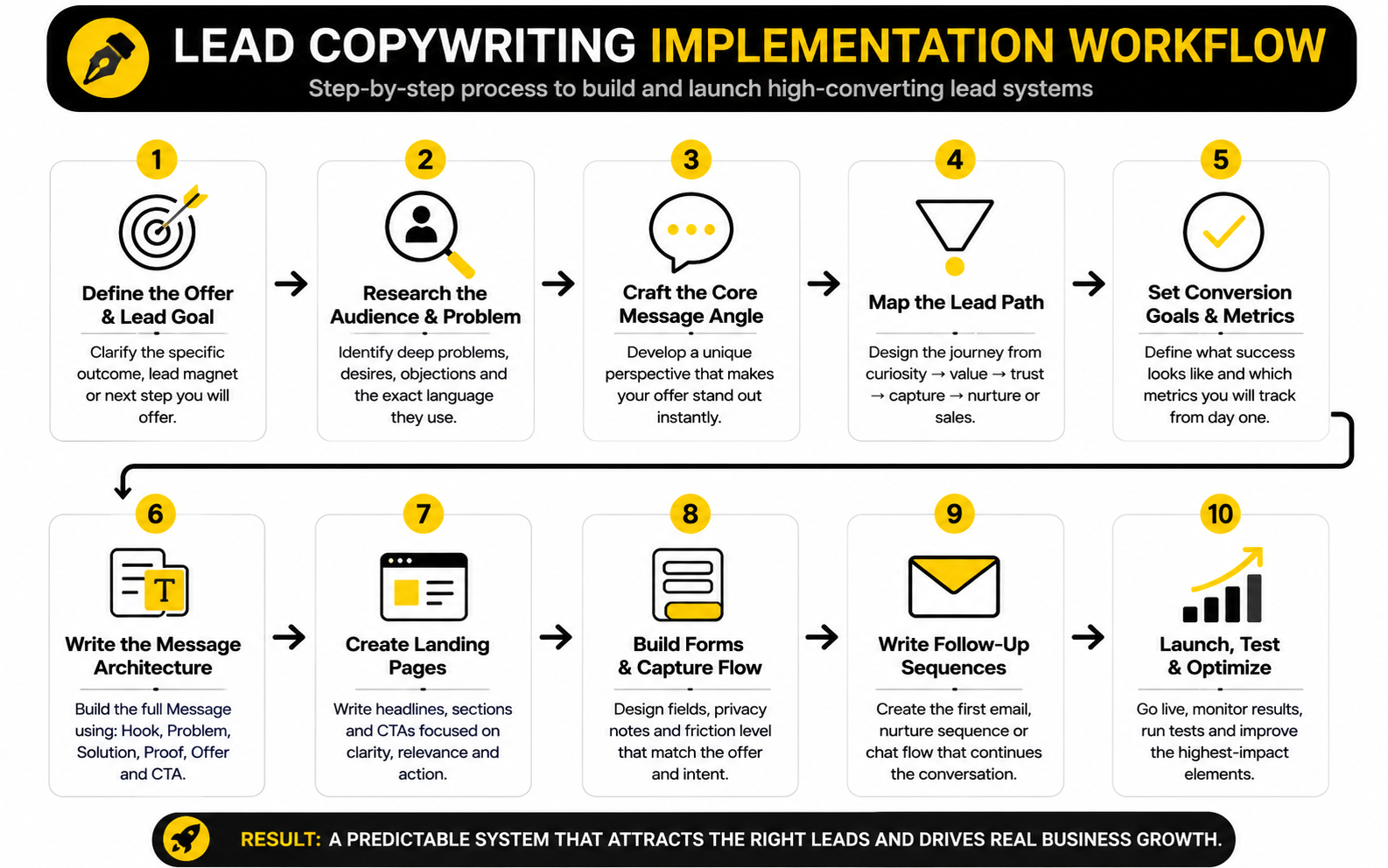
A practical implementation process looks like this:
This sequence matters because a lead funnel is not just the visible page. It is the promise, the form, the confirmation, the routing, the sales handoff, and the follow-up. If one piece is missing, the copy may still generate leads, but the business may struggle to turn them into revenue.
Write Lead Magnet Copy Around Usefulness
Lead magnet copy should focus on what the reader can use, not just what they will receive. “Get the guide” is passive. “Use this checklist to find the three points where your lead funnel is leaking qualified prospects” is more useful because it connects the asset to an action.
This is especially important when the offer is free. Free does not automatically mean attractive. People still pay with attention, time, inbox space, and trust.
Strong lead magnet copy should explain:
That last point is underrated. If someone requests an audit, demo, or consultation, they want to know whether they will be contacted, when it will happen, and what they need to prepare. Clear expectations reduce anxiety and make the conversion feel safer.
Keep The Form Aligned With The Offer
The form should match the value of the offer. If the asset is a simple checklist, asking for a phone number, company size, budget, and timeline may feel excessive. If the offer is a custom audit or quote, more fields can make sense because the reader understands why the business needs more information.
This is not about making every form as short as possible. It is about making every field feel justified. A longer form can work when it improves lead quality and the offer is valuable enough, but an unnecessary field can quietly kill momentum.
Baymard Institute’s large-scale checkout research found that 18% of U.S. online shoppers abandoned an order because checkout was too long or complicated. That research is ecommerce-focused, but the principle applies to lead capture too. When the process feels harder than the expected value, people leave.
Use Tools To Support The Copy, Not Replace It
Funnels, forms, chatbots, calendars, and automation tools can make lead capture smoother. But they do not fix a vague offer. The technology should support the promise and reduce friction after the reader decides to act.
For example, a business using GoHighLevel can connect landing pages, forms, pipelines, SMS, email, and booking workflows around one lead journey. That is useful when the copy creates demand and the business needs fast follow-up. But the system still needs clear messaging, a strong offer, and a reason for the reader to take the first step.
The same principle applies to form tools. A tool like Fillout can help build cleaner forms and qualification flows, but the form questions still need strategy behind them. Ask only what helps the reader move forward or helps the business respond properly.
Position The CTA Around The Outcome
The CTA is not just a button. It is the final moment where the reader decides whether the promise is worth action. Weak CTAs focus on the action itself, while stronger CTAs focus on the value behind the action.
“Submit” is rarely the best option. “Get the checklist,” “Book the review,” “See the audit results,” or “Start the free assessment” gives the reader a clearer reason to click. The CTA should feel like the next step in solving the problem, not like a demand from the business.
This is where the earlier message strategy pays off. If the page has already made the problem clear, positioned the offer well, handled the main objections, and explained what happens next, the CTA does not need to shout. It just needs to be specific and easy to trust.
Prepare The Follow-Up Before Publishing
Lead copywriting does not end at the form submission. The moment someone becomes a lead, the copy has to continue the conversation. The thank-you page, confirmation email, booking reminder, sales notification, and first follow-up message all affect whether the lead turns into an opportunity.
The biggest mistake is treating the conversion as the finish line. It is not. It is the handoff point.
A strong follow-up sequence should confirm the action, restate the value, set expectations, and guide the reader to the next useful step. If the lead requested a checklist, send it clearly and suggest how to use it. If they booked a call, confirm the time and explain what will happen. If they requested an audit, tell them what you are reviewing and when they can expect the result.
That continuity is what makes the whole system feel professional. The reader should never feel like they entered a black hole after submitting the form. They should feel like the next step has already started.
Landing Page And Form Copy That Converts
At this point, the strategy and offer are in place. Now the copy has to perform in the real world, where people skim, compare, hesitate, click away, come back later, and sometimes submit a form for reasons that are not obvious from the surface data. This is where lead copywriting has to be measured properly.
A landing page is not successful because it “sounds good.” A form is not successful because it looks clean. The only useful question is whether the page creates the right kind of action from the right kind of visitor at an acceptable cost.
That means the numbers matter, but they only matter when they are interpreted correctly. A high conversion rate can still produce bad leads. A lower conversion rate can still be profitable if the leads are more qualified, easier to close, and more aligned with the offer.
Statistics And Data That Actually Matter
The first number most people check is conversion rate. That makes sense because it tells you what percentage of visitors took the desired action. But conversion rate by itself does not tell you whether the copy is attracting the right people, whether the form is qualifying them properly, or whether the sales team can actually turn those leads into revenue.
Unbounce’s landing page benchmark data is useful because it draws from more than 57 million conversions across over 41,000 landing pages, but the real lesson is not that every page should chase one universal benchmark. The real lesson is that performance depends heavily on industry, offer type, traffic source, page intent, and visitor awareness. Your own baseline matters more than a generic average.
Lead copywriting should be judged by a set of connected metrics, not one isolated number. The page is only one part of the system. The better question is whether the copy attracts visitors who are likely to become qualified opportunities, customers, and repeat buyers.
Build A Simple Measurement System
A useful measurement system tracks the full path from visitor to qualified lead. It should show where people arrive, what they see, what they click, what they submit, and what happens after the submission. Without that chain, you are guessing.
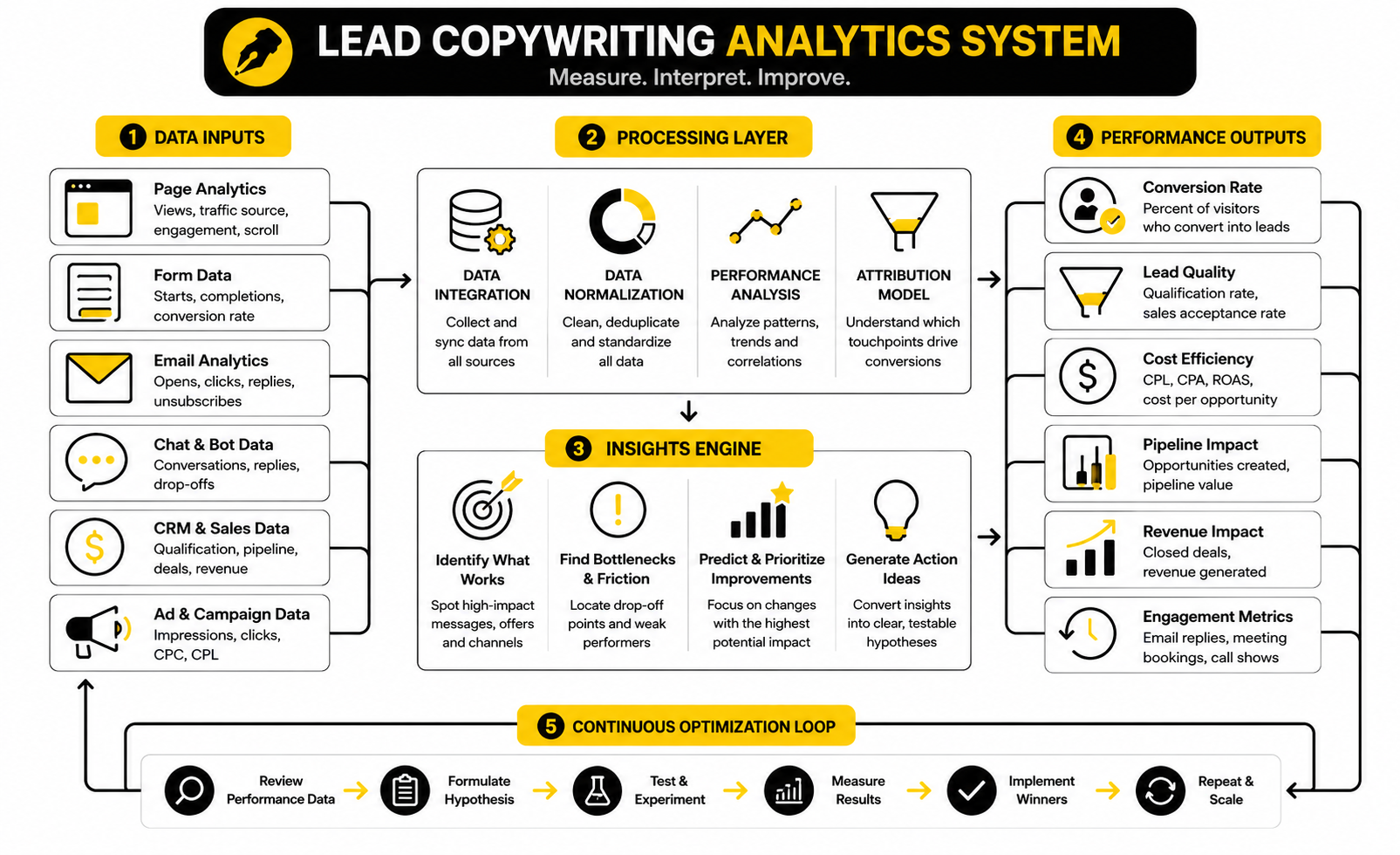
The basic system should track:
This does not need to be complicated at the beginning. A funnel platform like GoHighLevel can help connect forms, landing pages, pipelines, booking flows, and follow-up automation in one place. The tool is not the strategy, but having the data connected makes it much easier to see whether the copy is creating real pipeline or just collecting names.
Read Conversion Rate In Context
A 12% conversion rate sounds better than a 4% conversion rate until you inspect the leads. If the 12% page attracts low-intent visitors who never respond, the number is mostly noise. If the 4% page attracts serious buyers who book calls and close, that page may be the better business asset.
This is why form intent matters. A free checklist usually converts at a different rate than a demo request because the commitment level is different. A quiz, calculator, audit, consultation, newsletter signup, trial, and quote request should not all be judged by the same standard.
The action should match the buyer’s stage. If the visitor is early in the decision process, asking for a sales call may suppress conversions because the request feels too heavy. If the visitor is already evaluating vendors, a shallow lead magnet may feel like a detour instead of a useful next step.
Track Lead Quality, Not Just Lead Volume
Lead volume is easy to celebrate because it looks good in a report. Lead quality is harder because it requires follow-through. But if the goal is revenue, quality cannot be optional.
A lead quality system can be simple. You can score leads by fit, intent, urgency, budget range, company type, problem clarity, and engagement after submission. The goal is not to create a perfect scoring model on day one. The goal is to separate leads that look good in analytics from leads that actually create sales conversations.
This is where the copy often reveals the truth. If the page generates too many unqualified leads, the message may be too broad, the promise may be too vague, or the lead magnet may be attracting curiosity instead of intent. Better lead copywriting is not always about increasing conversions. Sometimes it is about reducing the wrong conversions.
Watch The Form Drop-Off
Form data shows you where interest turns into hesitation. If many people click the CTA but do not start the form, the CTA may be stronger than the offer explanation. If many people start but do not complete the form, the form may be asking too much too early.
Baymard’s checkout research found that 18% of U.S. online shoppers abandoned an order because checkout was too long or complicated. That research is based on ecommerce behavior, but the same friction principle applies to lead forms. When the effort feels higher than the expected value, people stop.
Look closely at every field. Does the business truly need the phone number at this stage? Does the reader understand why budget is being asked? Would a multiple-choice field reduce effort? Would a two-step form feel easier? Small copy and structure changes can make the form feel less like a barrier and more like part of the process.
Measure Message Match
Message match tells you whether the promise that brought the visitor in is the same promise they see on the page. If the ad says “Get more qualified booked calls,” but the landing page opens with “Scale your business with better marketing systems,” the reader has to reconnect the dots. Many will not bother.
This matters because people arrive with expectations. The headline, hero copy, offer, CTA, and form should all confirm that they are in the right place. When the page matches the click intent, the visitor feels immediate relevance.
You can measure message match by segmenting performance by traffic source. Paid search visitors, organic visitors, email subscribers, social traffic, and retargeting audiences may all respond differently. If one source has high bounce and low conversion, the problem may not be the whole page. It may be the mismatch between that source’s promise and the page’s first screen.
Use Benchmarks Without Becoming Lazy
Benchmarks are useful for orientation, not for decision-making by themselves. They can tell you whether your page is wildly underperforming or roughly in range. They cannot tell you whether your audience, offer, price point, sales cycle, or traffic quality is healthy.
NetLine’s 2025 report was built from 7.9 million first-party B2B content registrations, which shows that gated content still plays a serious role in B2B demand generation. But that does not mean every business should gate everything. It means buyers will exchange information when the content is relevant enough and the value is clear enough.
The action is simple. Use benchmarks to ask better questions, not to copy someone else’s target. If your conversion rate is low, inspect the promise, traffic source, awareness level, page clarity, proof, and form friction. If your conversion rate is high but sales hates the leads, inspect the offer, qualification copy, and follow-up path.
Diagnose The Page By Performance Signal
Different performance problems point to different copy problems. This is where measurement becomes useful because the data tells you where to look. You do not need to rewrite the whole page every time a number looks bad.
If the bounce rate is high, the first screen may not be relevant enough. The headline may be vague, the offer may be unclear, or the page may not match the traffic source. Start with the promise before touching smaller details.
If CTA clicks are low, the page may not be building enough desire or confidence. The reader may understand the offer but not feel enough reason to act. Strengthen the outcome, proof, objection handling, and urgency around the next step.
If form starts are strong but completions are weak, the form is probably creating friction. Reduce unnecessary fields, improve field labels, explain sensitive questions, or make the form feel more connected to the value of the offer. A form should not feel like paperwork unless the value clearly justifies it.
If leads convert but do not respond later, the follow-up expectation may be unclear. The thank-you page and confirmation email should tell the reader what happens next, when it happens, and why they should pay attention. The copy after conversion is part of the conversion system.
Test One Meaningful Change At A Time
Testing only works when you know what you are testing. Changing the headline, CTA, form length, proof section, and offer framing all at once may improve results, but you will not know which change mattered. That makes the next decision weaker.
Start with the biggest uncertainty. If the problem is low engagement, test the headline and first-screen promise. If the problem is weak lead quality, test the offer positioning or qualification copy. If the problem is form abandonment, test the number of fields, field labels, or step structure.
A platform like ClickFunnels can be useful when you want to build and test funnel pages quickly, especially when the campaign depends on offer flow and follow-up rather than one standalone page. But the testing tool does not decide what to test. The data does.
Know When A Metric Is Misleading
Some metrics look useful but can send you in the wrong direction. Time on page can be high because people are engaged, or because they are confused. A high click-through rate can mean the CTA is strong, or it can mean the page is attracting people who are curious but not qualified. A low form conversion rate can mean friction, or it can mean the form is filtering for better-fit leads.
This is why qualitative review still matters. Read the page like a real buyer. Compare the copy against sales call notes, chat logs, customer objections, email replies, and CRM outcomes. The numbers show where something is happening, but buyer language often explains why.
Strong lead copywriting uses both. Data tells you what to inspect. Buyer insight tells you what to change.
Turn The Data Into Copy Decisions
Measurement is only useful if it changes the next draft. If the headline is not holding attention, make the problem more specific. If visitors click but do not submit, make the offer and form feel more aligned. If leads are weak, tighten the promise so it attracts the right intent.
The best copy decisions usually come from connecting analytics to buyer behavior. You are not just optimizing buttons. You are removing uncertainty from the reader’s decision.
That is the standard for this stage of the article. The copy should be clear enough to create action, the analytics should be connected enough to explain performance, and the follow-up should be strong enough to turn the lead into a real opportunity.
Email, Chat, And Follow-Up Copy
The lead is not won when the form is submitted. That is the point where the next layer of lead copywriting starts. The reader has raised their hand, but they have not yet become a real sales conversation, customer, or retained buyer.
This stage is where many funnels quietly waste the work already done. The page creates interest, the form captures the lead, and then the follow-up feels slow, generic, or disconnected from the original promise. That gap can make a strong campaign look weaker than it really is.
Follow-up copy has one job: continue the same conversation the visitor already agreed to have. If the page promised a checklist, audit, quote, demo, or review, the first follow-up should honor that promise clearly. Do not suddenly switch into a hard pitch before the reader receives the value they requested.
Keep The First Follow-Up Immediate And Specific
The first follow-up should arrive quickly because attention fades fast. The person who submitted the form may still have the problem open in another tab, but that window does not stay open forever. If the next message arrives too late, the context is gone.
Workato’s 2026 analysis of 114 B2B companies found that many companies still respond slowly to inbound leads, which creates a simple advantage for businesses that treat follow-up as part of the conversion system. The lesson is not that every lead needs a pushy sales call in 30 seconds. The lesson is that the first response should confirm the action, restate the value, and make the next step obvious while the buyer still remembers why they converted.
A strong first message should include:
This sounds basic, but basic is exactly where a lot of money leaks out. If the reader has to wonder whether the form worked, whether the asset is coming, or whether someone will call them, the experience already feels less trustworthy.
Match The Follow-Up To Lead Intent
Not every lead deserves the same follow-up path. A person who downloaded a beginner checklist should not receive the same sequence as someone who requested a custom audit. A demo request, quote request, webinar signup, calculator result, and free trial all carry different levels of intent.
This is where segmentation matters. The copy should adjust based on the action the person took, the source they came from, and the information they gave you. If someone says their biggest problem is low-quality booked calls, the follow-up should not talk broadly about “marketing growth.”
The mistake is treating automation like a broadcast tool. Automation should make the follow-up more relevant, not more robotic. A platform like GoHighLevel can help route leads into different follow-up paths based on forms, tags, pipelines, and booking behavior, but the copy still needs a clear reason for each message to exist.
Write Nurture Copy For The Buyer’s Next Question
Good nurture copy does not randomly “stay in touch.” It answers the next question the buyer is likely to ask. That question changes depending on the offer and the buyer’s awareness level.
After a lead magnet, the next question may be, “How do I use this?” After a demo request, it may be, “Is this worth my time?” After a quote request, it may be, “Will this be expensive or complicated?” After an audit, it may be, “What will they actually look at?”
Each follow-up email or chat message should reduce one specific uncertainty. That is how you avoid writing empty nurture content. The reader should finish each message with a clearer understanding of the problem, the path forward, or the reason to take the next step.
Use Email For Depth And Chat For Momentum
Email and chat do different jobs. Email is better for context, proof, explanations, resources, and longer nurture. Chat is better for quick qualification, routing, reminders, and simple next-step prompts.
Trying to make one channel do everything usually creates friction. Long chatbot messages feel annoying. Thin email sequences feel forgettable. The channel should match the job.
ManyChat can be useful when the lead journey includes conversational touchpoints, especially for social or messenger-based campaigns where the next step needs to feel quick and interactive. If that fits the funnel, a tool like ManyChat can support the handoff between interest and action. But the same rule still applies: do not automate weak messaging and expect the tool to fix it.
Avoid The Over-Follow-Up Problem
More follow-up is not automatically better. At some point, persistence becomes noise. The goal is to stay useful long enough to earn the next action, not to prove you can send ten emails because the automation allows it.
Belkins’ 2025 research across more than 16 million B2B emails shows that follow-up performance changes across touches, industries, and company sizes. The useful takeaway is not “send this exact number of emails.” The useful takeaway is that follow-up should be judged by response quality, unsubscribe risk, audience tolerance, and channel fit.
A practical sequence can be short and strong:
That final step matters. If someone does not engage after a reasonable sequence, continuing to hammer them usually weakens trust. Put them into a slower educational path or let them go quiet until they show intent again.
Protect Trust With Clear Expectations
Lead copywriting can become aggressive when teams chase short-term numbers. They add urgency where there is none, hide what happens after the form, or make the offer sound more personalized than it really is. That may lift clicks temporarily, but it can damage trust fast.
Trust is especially important when personal data is involved. Pew Research Center’s work on how Americans view data privacy shows that people are uneasy about how companies use their information, even when they still share it in daily online interactions. That tension affects lead generation because every form creates a small trust decision.
Be clear about what happens next. If someone is joining an email list, say that. If someone will receive a call, say that. If a form submission creates a sales follow-up, do not pretend it is only a free resource with no next step.
Scale Without Losing Message Quality
Scaling lead copywriting is not just writing more pages and more emails. It is building repeatable message assets without flattening everything into generic copy. The more channels you add, the easier it becomes for the message to drift.
At scale, you need a shared message system. The ad, landing page, form, confirmation email, sales notification, CRM note, chatbot prompt, and nurture sequence should all reflect the same core promise. If each asset is written separately, the buyer experiences inconsistency.
The message system should include:
This is not bureaucracy. It is how you stop campaigns from becoming a pile of disconnected assets. Good systems protect clarity when volume increases.
Use AI Carefully In Lead Copywriting
AI can speed up drafts, variations, summaries, and research organization. It can help turn sales notes into message angles or generate multiple CTA options from a clear brief. Used well, it gives a copywriter more surface area to evaluate.
But AI can also make bad lead copywriting look polished. It often produces sentences that sound confident but say very little. If the strategy is weak, AI simply scales the weakness faster.
The smart approach is to use AI after the message strategy is clear. Give it the audience, trigger event, offer, objections, proof, and desired next step. Then judge the output against buyer clarity, not against how smooth it sounds.
Handle Personalization Without Becoming Creepy
Personalization works when it helps the reader feel understood. It fails when it makes them feel watched. That difference is subtle, but it matters.
McKinsey’s personalization research found that 71% of consumers expect personalized interactions and 76% get frustrated when they do not receive them, but personalization should still be earned. A relevant message based on the lead magnet someone requested feels useful. A message that overuses personal data can feel invasive.
Use personalization to improve relevance, timing, and next-step guidance. Do not use it to show off everything you know about the person. The best personalized copy often feels simple because it reflects the reader’s situation without drawing attention to the data behind it.
Align Sales And Marketing Language
Lead copywriting breaks when marketing and sales use different language. Marketing promises one outcome, then sales opens the conversation with a different angle. The buyer senses the mismatch even if they cannot name it.
Sales teams hear the raw objections, hesitations, and buying language that copywriters need. Marketing teams see which messages attract attention and which offers generate action. The best lead systems use both.
A simple feedback loop can improve the copy quickly:
This is where copy becomes a revenue asset instead of a creative asset. The message is no longer based on guesses. It is shaped by what buyers actually say and do.
Know The Strategic Tradeoff: Volume Or Intent
Every lead funnel makes a tradeoff between volume and intent. A low-friction checklist may generate more leads, but many will be early-stage. A consultation request may generate fewer leads, but those leads may be closer to buying.
Neither option is automatically better. The right choice depends on your sales cycle, offer value, traffic source, follow-up capacity, and revenue model. A business with strong nurture can afford more early-stage leads. A small team with limited sales capacity may need fewer, higher-intent leads.
This is why lead copywriting should never be judged only by top-line conversions. The copy should support the business model. If the company cannot follow up with 500 low-intent leads, a high-volume lead magnet may create operational noise. If the company needs a larger audience before sales conversations happen, a high-friction demo request may be too narrow.
Build A Follow-Up System Before You Add More Traffic
More traffic makes every weakness louder. If the follow-up is slow, more leads will go cold. If the message is broad, more unqualified people will enter the pipeline. If sales and marketing are misaligned, more conversations will start with confusion.
Before scaling traffic, review the full lead path from first click to first human or automated response. Make sure the page promise, form, thank-you page, first email, chat message, booking flow, and sales handoff all work together. This is the unglamorous part, but it is where serious gains often come from.
The advanced move is simple: stop treating lead copywriting as page copy. Treat it as the language layer across the entire lead journey. Once that layer is consistent, every campaign becomes easier to measure, improve, and scale.
Optimization, Testing, And Lead Copywriting FAQs
The final layer of lead copywriting is optimization. Not random tweaking. Not changing button colors because a blog post said it worked. Real optimization means improving the message, offer, form, follow-up, and sales handoff based on what buyers actually do.
By this stage, the funnel should have a clear promise, a relevant offer, measurable conversion points, and a follow-up path that keeps the conversation alive. Now the goal is to make the system sharper without breaking what already works. That takes discipline because the easiest thing to change is not always the thing that matters.
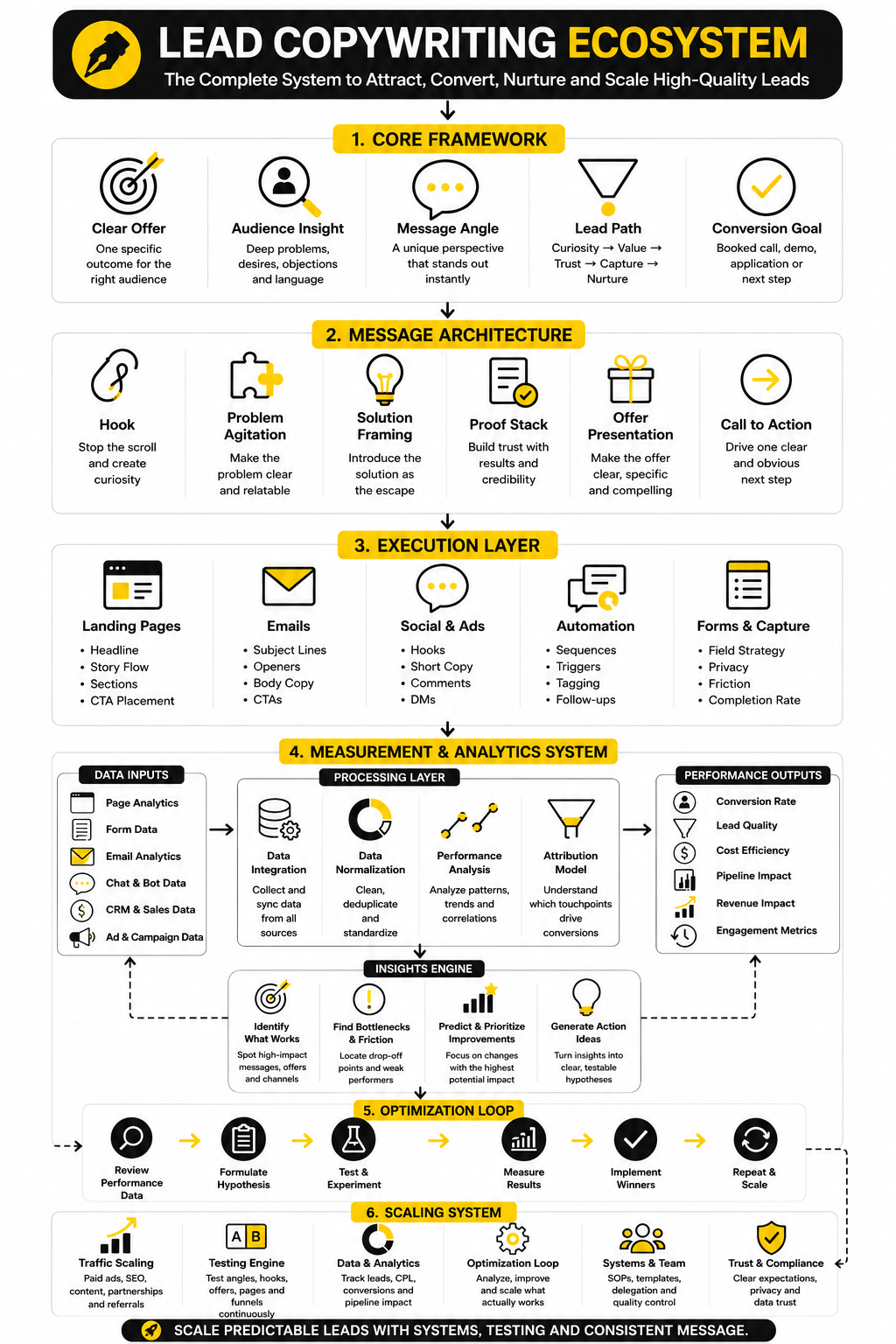
Build The Final Lead Copywriting System
A complete lead copywriting system connects every touchpoint around one buyer decision. The reader sees a promise, understands the value, trusts the next step, submits their information, receives a useful follow-up, and moves toward the right sales or nurture path. When those pieces work together, the funnel feels smooth instead of stitched together.
The system should be reviewed as a whole before any single page is rewritten. If the lead magnet attracts the wrong audience, the landing page cannot fully fix it. If the form asks for too much too early, stronger headlines may not solve the drop-off. If the follow-up is slow or generic, higher conversion rates may only create more wasted opportunities.
This is why the best optimization work starts with the full journey. Look at the page, the form, the thank-you message, the first email, the CRM routing, the sales handoff, and the nurture sequence. The weak point is often not where the team first assumes it is.
Prioritize The Biggest Constraint First
Every lead funnel has a constraint. Sometimes it is traffic quality. Sometimes it is the offer. Sometimes it is the copy. Sometimes it is the follow-up speed, sales process, or lack of trust.
Do not optimize everything at once. If the page gets traffic but no one clicks, work on relevance and desire. If people click but do not submit, work on form friction and value exchange. If leads submit but never become qualified opportunities, work on offer positioning, qualification copy, and follow-up.
This is the part where discipline matters. It is tempting to rewrite the whole funnel because it feels productive. But expert-level lead copywriting improves the highest-leverage constraint first, then moves to the next one.
Create A Testing Rhythm
Testing should become a rhythm, not a panic response. A healthy lead system should have a regular review cycle where the team checks performance, identifies one meaningful bottleneck, forms a clear hypothesis, and tests a change. That makes optimization calmer and more useful.
A simple testing rhythm can look like this:
The documentation step is boring, but it is important. Without it, the team keeps relearning the same lessons. A lead copywriting system gets stronger when every test adds to the company’s understanding of the buyer.
Know What Not To Optimize
Not every number deserves attention. A small dip in one campaign may not mean the message is broken. A sudden spike in conversions may not mean the new copy is brilliant if the traffic source changed at the same time.
The danger is overreacting to weak signals. If you change the page too often, you may never know what actually worked. If you judge too quickly, you may remove a message that needed more traffic, better targeting, or a longer sales cycle to prove its value.
Optimization should be driven by patterns, not moods. Look for repeated friction across analytics, form behavior, email replies, sales notes, and CRM outcomes. When multiple signals point to the same issue, the copy decision becomes much clearer.
What Is Lead Copywriting?
Lead copywriting is the process of writing persuasive, buyer-aware copy that encourages the right people to take a lead-generating action. That action could be filling out a form, booking a call, requesting a quote, joining a list, starting a trial, or downloading a resource. The goal is not just to get more submissions, but to attract leads that are relevant, qualified, and worth following up with.
How Is Lead Copywriting Different From Sales Copywriting?
Sales copywriting usually pushes toward a purchase, while lead copywriting pushes toward a smaller but still meaningful commitment. The reader may not be ready to buy yet, so the copy has to make the next step feel useful and low-risk. Strong lead copywriting creates momentum toward a future sale without pretending every visitor is ready to become a customer immediately.
What Makes Lead Copywriting Effective?
Effective lead copywriting is specific, relevant, and easy to act on. It names the reader’s problem clearly, positions a valuable next step, reduces hesitation, and explains what happens after the conversion. The best version feels simple to the reader because the strategy underneath has already done the hard work.
What Should A Lead Generation Page Include?
A lead generation page should include a clear headline, a useful promise, a short explanation of the offer, proof or credibility signals, objection handling, a focused form, and a specific CTA. It should also explain what happens after submission so the reader does not feel uncertain. The page does not need to be long, but it does need to answer the questions that stand between interest and action.
How Long Should Lead Copy Be?
Lead copy should be as long as the decision requires and no longer. A simple checklist may only need a short page because the commitment is low. A custom audit, demo, consultation, or high-ticket service may need more explanation, proof, and objection handling because the reader is making a bigger decision.
What Is The Best CTA For Lead Copywriting?
The best CTA describes the value of the action instead of the mechanics of the action. “Submit” is usually weak because it focuses on the form, not the result. Better CTAs use language like “Get the checklist,” “Book the review,” “Start the assessment,” or “Request the quote” because the reader understands what they are getting.
Should Lead Forms Be Short Or Long?
Lead forms should be as short as possible while still collecting the information needed for the next step. A short form can increase volume, but it may reduce qualification. A longer form can improve lead quality, but it must feel justified by the value of the offer.
How Do You Improve Lead Quality With Copy?
You improve lead quality by making the promise more specific, clarifying who the offer is for, naming the problem accurately, and using form questions that filter for fit and intent. Broad copy attracts broad leads. Specific copy may reduce total submissions, but it can increase the percentage of leads that actually belong in the pipeline.
How Often Should Lead Copy Be Tested?
Lead copy should be reviewed regularly, but not changed randomly. The right testing pace depends on traffic volume, sales cycle length, and how quickly the team can collect meaningful data. A practical approach is to review performance monthly, then test the highest-leverage issue instead of making cosmetic changes.
What Metrics Matter Most For Lead Copywriting?
The most useful metrics are conversion rate, form completion rate, lead source, lead quality, booking rate, sales acceptance rate, opportunity creation, close rate, and revenue by campaign. Conversion rate alone is not enough because a page can generate many weak leads. The real goal is to understand whether the copy creates qualified action that moves the business forward.
Can AI Write Good Lead Copy?
AI can help with drafts, variations, outlines, summaries, and message experiments. It is useful when the strategy is already clear. But AI should not replace buyer research, offer positioning, sales insight, or human judgment because polished language is not the same as persuasive lead copywriting.
What Is The Biggest Mistake In Lead Copywriting?
The biggest mistake is asking for action before the reader understands the value of the next step. Many pages push the form too early, explain the offer too vaguely, or use a CTA that does not match the buyer’s intent. The fix is to make the value exchange clear before asking for information.
How Do You Write Lead Copy For Cold Traffic?
Cold traffic needs more context, more problem framing, and a lower-friction next step. The reader may not know the brand or fully understand the solution yet, so the copy should focus on relevance and trust before asking for a bigger commitment. A useful lead magnet, assessment, checklist, or educational resource often works better than immediately pushing for a sales call.
How Do You Write Lead Copy For Warm Traffic?
Warm traffic already has some awareness, so the copy can move faster. These readers may need proof, comparison, reassurance, or a clearer reason to act now. The copy should focus on why this offer is the right next step and why delaying the decision may keep the same problem in place.
How Do You Know When Lead Copywriting Is Working?
Lead copywriting is working when the funnel consistently attracts the right people, creates clear action, supports fast follow-up, and produces qualified opportunities. The page may not always have the highest possible conversion rate, and that is fine. The better test is whether the leads match the business goal and move through the next stages with less friction.
Build a stronger local presence with BAAM AI
Turn your website, Google profile, social channels, and AI visibility into one growth engine
Most businesses do not need more random marketing activity. They need a consistent presence system that helps the right people find them, trust them, and take action. BAAM AI brings strategy, local SEO, website updates, Google Maps visibility, social content, AI-search readiness, media production, and reporting into one practical monthly engine.
If you want your marketing to keep working after the campaign ends, start with a free BAAM AI presence audit. See how your business shows up today and where the fastest visibility wins are at BAAM AI.