
BAAM AI Blog
Lead Copywriter: The Role, Skills, Framework, And Career Path Behind High-Converting Brand Messaging
A lead copywriter is not just the person who writes the sharpest headline in the room. The role sits closer to strategy than most people realize, because every campaign, landing page, email sequence, sales page, ad...

A lead copywriter is not just the person who writes the sharpest headline in the room. The role sits closer to strategy than most people realize, because every campaign, landing page, email sequence, sales page, ad, and brand message needs one clear voice behind it. When that voice is inconsistent, the market feels it immediately.
That is why strong companies treat copy as more than decoration. Nielsen’s 2025 marketing research shows how much pressure marketers face to balance performance, brand building, measurement, and channel complexity in the same budget cycle, while the U.S. Bureau of Labor Statistics projects steady demand for writers and authors through 2034. The best lead copywriter helps turn that pressure into a system: clearer positioning, sharper offers, stronger creative direction, and copy that gives the buyer a reason to act.
This role matters even more now because AI has made average copy easier to produce. That does not make senior copy judgment less valuable. It makes it more valuable. Salesforce’s latest marketing research is built around data, AI, personalization, and changing customer expectations, which means the lead copywriter increasingly has to understand both human persuasion and the systems that deliver messages at scale through modern marketing teams.
In this guide, we will break down what a lead copywriter actually does, how the role differs from a regular copywriter, what skills matter most, and how to build a practical framework for copy leadership. We will also cover hiring, portfolio expectations, workflows, performance measurement, and the career path for writers who want to move from execution into ownership.
Why A Lead Copywriter Matters
A lead copywriter matters because messaging gets messy fast. One team wants punchy ads, another wants SEO content, another wants lifecycle emails, and sales wants sharper objection handling. Without someone owning the connective tissue, the customer sees fragments instead of a clear reason to believe.
The lead copywriter keeps the message consistent while still adapting it to different formats. A homepage headline should not sound exactly like a sales email, but both should come from the same strategic spine. That is the difference between “writing copy” and leading copy: one produces assets, the other protects the argument.
This is especially important when companies are under pressure to prove marketing impact. The 2025 Nielsen Annual Marketing Report focuses heavily on clarity, measurement, and balancing brand with performance, which is exactly where copy leadership becomes practical. Better words alone do not fix weak strategy, but weak words can absolutely bury a strong one.
The Lead Copywriter Framework
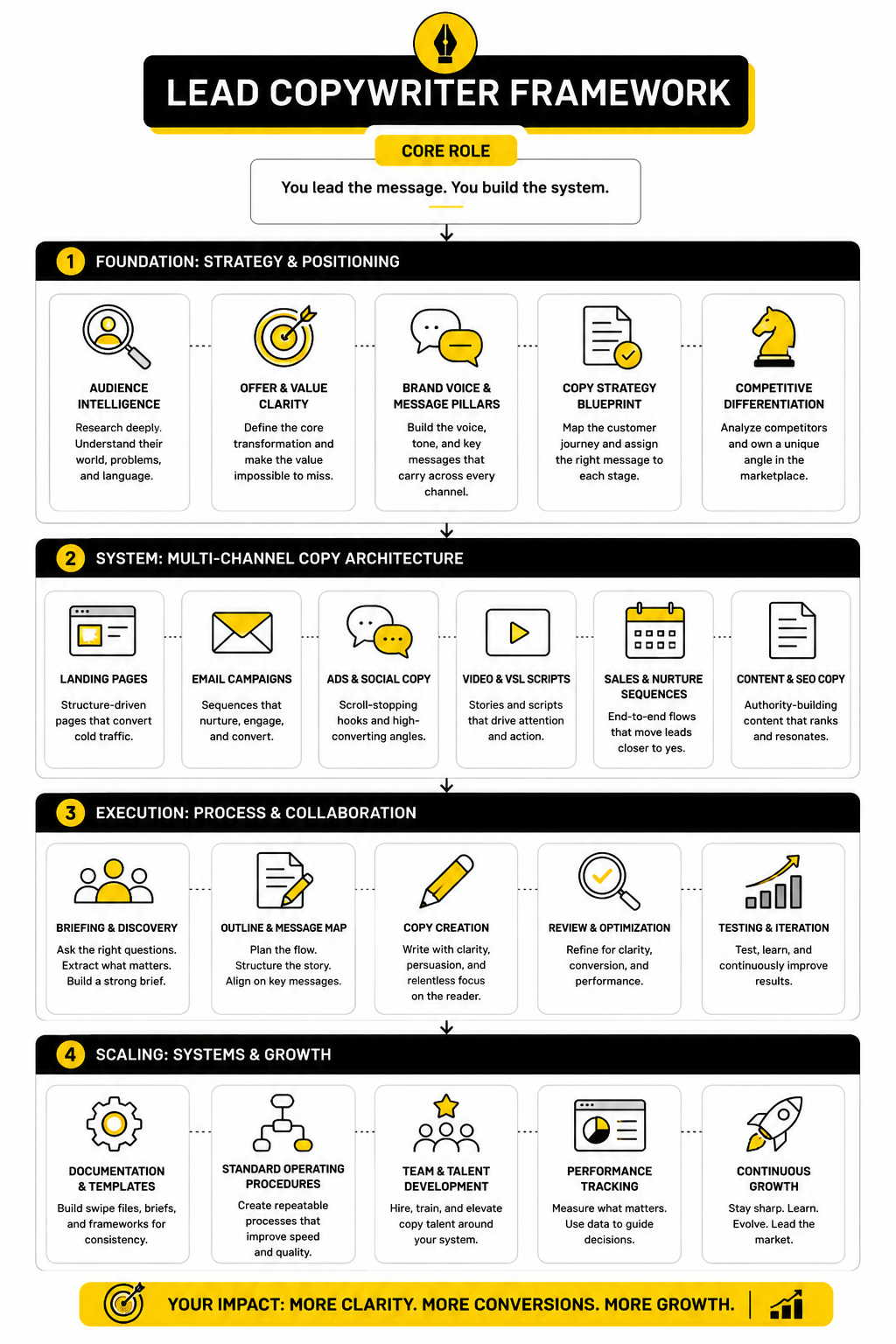
The simplest way to understand the lead copywriter role is through four layers: market, message, mechanism, and measurement. The market layer asks who the buyer is, what they already believe, what they misunderstand, and what pain is urgent enough to move. The message layer turns that understanding into positioning, promises, proof, objections, and voice.
The mechanism layer is where the copy becomes assets. This includes landing pages, email flows, ads, sales decks, product pages, scripts, nurture sequences, and launch campaigns. The lead copywriter does not always write every single asset, but they make sure each one supports the same strategic direction.
The measurement layer closes the loop. A lead copywriter should care about conversion rates, qualified leads, reply rates, demo bookings, sales feedback, retention signals, and message clarity, not just whether a sentence sounds good. McKinsey’s research on personalization has long shown that getting relevance right can create meaningful revenue lift, with personalization often driving 10 to 15 percent revenue lift, but relevance only works when the underlying message is strong.
Core Responsibilities Of A Lead Copywriter
A lead copywriter usually owns the messaging system, not just the writing queue. That means they translate strategy into copy guidelines, campaign concepts, offer angles, editorial standards, and review processes. They are often the person who decides whether a piece of copy is merely polished or actually persuasive.
They also guide other writers. That can mean editing drafts, giving feedback, improving briefs, creating swipe files, documenting voice rules, and helping junior copywriters understand why a change matters. The goal is not to make every writer sound identical. The goal is to make every writer serve the same commercial and brand strategy.
A strong lead copywriter also works across departments. Product teams bring features, sales teams bring objections, customer support brings friction, and marketing brings channel goals. The lead copywriter turns those inputs into language customers can understand quickly, trust more easily, and act on with less hesitation.
Skills That Separate A Lead Copywriter From A Copywriter
A good copywriter can take a brief and write something useful. A lead copywriter can question the brief before it turns into wasted work. That distinction matters because weak copy often starts before anyone writes a sentence: unclear positioning, vague audience assumptions, missing proof, or an offer that sounds better internally than it does to the buyer.
The lead copywriter needs taste, but taste is not enough. They need research discipline, commercial awareness, editorial judgment, and the ability to explain why one message is stronger than another. When teams are using AI, templates, and automation more aggressively, the lead copywriter becomes the person who decides what should be scaled and what should be killed.
Content teams are already feeling that pressure. The Content Marketing Institute’s 2025 B2B research highlights how marketers are using generative AI while still wrestling with strategy, differentiation, and content quality in B2B content marketing programs. That is exactly where copy leadership earns its keep: not by writing more words, but by making the right words easier for the whole team to produce.
Strategic Research
A lead copywriter should be deeply uncomfortable with guessing. They should want to know what customers say before they decide what the brand should say. That means reading reviews, sales calls, support tickets, surveys, competitor pages, search results, forums, product feedback, and customer interviews with a sharp eye for repeated language.
The best research is not just demographic. It captures tension. What does the buyer want, what are they afraid of, what have they already tried, what do they secretly doubt, and what would make them feel safe enough to act now?
This is where a lead copywriter starts building copy that sounds obvious to the customer, not clever to the company. A weak writer tries to invent desire from scratch. A strong lead copywriter finds the desire that is already there and gives it a sharper shape.
Positioning Judgment
Positioning is where many copy projects win or lose. If the product is framed poorly, the copy has to work too hard. A lead copywriter should be able to look at a product, offer, or campaign and ask whether the angle is actually compelling before polishing the language.
This includes knowing when a message is too broad. “Save time” is not always wrong, but it is rarely enough on its own. Better positioning explains who saves time, where the time is currently being wasted, what changes after the product is adopted, and why this solution is more believable than the alternatives.
The lead copywriter also needs the confidence to push back. If the sales page is trying to speak to five audiences at once, they should say so. If the ad angle is built around a feature nobody cares about, they should redirect the team before media spend turns a messaging problem into a reporting problem.
Offer And Funnel Awareness
Copy does not live in isolation. A lead copywriter has to understand where the reader is in the funnel and what kind of commitment the page, email, ad, or script is asking for. Asking someone to book a demo, start a free trial, buy now, join a webinar, or reply to an email all require different levels of trust.
This is why lead copywriters need offer awareness. They should be able to spot when the copy is fine but the offer is weak, confusing, or poorly timed. Sometimes the fix is not a better headline; it is a stronger guarantee, a clearer next step, a better bonus, a more specific promise, or a lower-friction call to action.
For funnel-heavy businesses, this skill becomes especially practical. Tools like ClickFunnels, GoHighLevel, and systeme.io can help teams build pages, automations, and customer journeys, but the lead copywriter still has to make the offer make sense.
Editorial Leadership
A lead copywriter is often the final filter between a draft and the market. That means editing for clarity, persuasion, accuracy, brand voice, and commercial intent at the same time. It is not enough to fix grammar or make sentences shorter.
Good editorial leadership makes the writer better, not just the draft cleaner. The lead copywriter should explain why a headline lacks tension, why a proof point needs context, why a paragraph is doing too much, or why a CTA feels premature. Over time, this builds a stronger copy culture inside the company.
The best editors are direct without being vague. “Make this punchier” is not useful. “Lead with the buyer’s current pain before introducing the product, because the reader does not yet understand why this feature matters” is useful.
Brand Voice Control
Brand voice is not a list of adjectives in a document nobody reads. It is the repeated experience of how a company sounds when it explains, sells, teaches, apologizes, launches, follows up, and asks for action. A lead copywriter makes that experience feel consistent without making every channel sound identical.
Voice control becomes harder as teams grow. One freelancer writes ads, a content marketer writes SEO articles, a lifecycle marketer writes emails, and a product marketer writes launch copy. Without a lead copywriter setting standards, the brand slowly becomes a collection of disconnected tones.
A practical voice system should include examples, banned phrases, preferred sentence rhythms, positioning rules, proof standards, and before-and-after edits. This gives writers something real to follow. It also keeps brand voice from becoming a taste debate in every review meeting.
Conversion Thinking
A lead copywriter should care about performance, but they should not reduce copywriting to button color thinking. Conversion is about the whole decision path. The reader must understand the promise, believe the proof, feel the relevance, trust the next step, and know what happens after they click.
This requires a mix of psychology and measurement. The lead copywriter should understand friction, specificity, risk reversal, urgency, social proof, objections, and clarity. They should also know that not every conversion lift is meaningful if it attracts the wrong audience or damages long-term trust.
The strongest copy leaders are calm around data. They do not treat one test as universal truth, and they do not ignore patterns just because they prefer the original line. They use performance signals to refine the message while protecting the bigger strategic goal.
How Lead Copywriters Work With Marketing, Product, Sales, And Creative Teams
A lead copywriter does not work well in a silo. The role depends on inputs from the people closest to the customer, the product, and the revenue target. When those inputs are missing, copy becomes decorative instead of decisive.
The practical job is to turn scattered knowledge into a clear message system. Marketing may know the campaign goal, sales may know the objections, product may know the feature logic, and customer success may know where users get stuck. The lead copywriter connects those pieces so the customer gets one coherent argument instead of four internal perspectives competing for attention.
This is where the role becomes operational. A lead copywriter needs meetings, briefs, research habits, review loops, and feedback systems that make better copy repeatable. Not complicated. Repeatable.
Start With The Brief Before The Draft
The brief is where copy quality is usually decided. If the brief is vague, the draft becomes a guessing game. A lead copywriter should treat the brief as a strategic checkpoint, not an administrative form.
A strong brief should clarify the audience, offer, promise, proof, objections, tone, channel, conversion goal, and approval path. It should also explain what the reader already knows before they encounter the copy. That last part is critical because cold traffic, warm leads, existing customers, and sales-qualified prospects do not need the same message.
The lead copywriter should be willing to slow the team down here. One extra hour sharpening the brief can save days of revisions later. It also prevents the classic problem where everyone reacts to the draft based on opinions they never shared upfront.
Build A Research System That Feeds Every Project
Research should not restart from zero every time a landing page, email sequence, or campaign is needed. A lead copywriter should build a reusable research bank that stores customer language, objections, proof points, competitor claims, offer angles, and approved messaging decisions. This gives the team a shared memory.
The research bank can include sales call notes, review snippets, survey responses, CRM notes, support tickets, product release notes, and previous winning copy. The point is not to collect information for the sake of it. The point is to make the next draft more grounded than the last one.
This becomes even more important as AI-generated content becomes normal inside marketing teams. The 2025 State of Marketing AI Report surveyed 1,882 respondents and shows how quickly AI is becoming embedded in marketing workflows through content creation, automation, and analysis. A lead copywriter can use AI to move faster, but the research system is what keeps the output from becoming generic.
Turn Strategy Into A Message Map
A message map is the bridge between strategy and execution. It gives writers, designers, marketers, and salespeople a shared source of truth for what the company should say and how it should say it. Without one, every asset becomes a fresh debate.
A useful message map usually includes the main promise, secondary benefits, proof points, common objections, audience segments, emotional triggers, competitor contrasts, banned claims, and preferred phrasing. It should be simple enough for the team to use without needing a workshop every time. If the map is too complex, it will be ignored.
The lead copywriter owns this document because they understand both persuasion and language. Product can contribute technical accuracy. Sales can contribute objections. Marketing can contribute channel context. But the lead copywriter turns all of it into a message that can survive contact with the market.
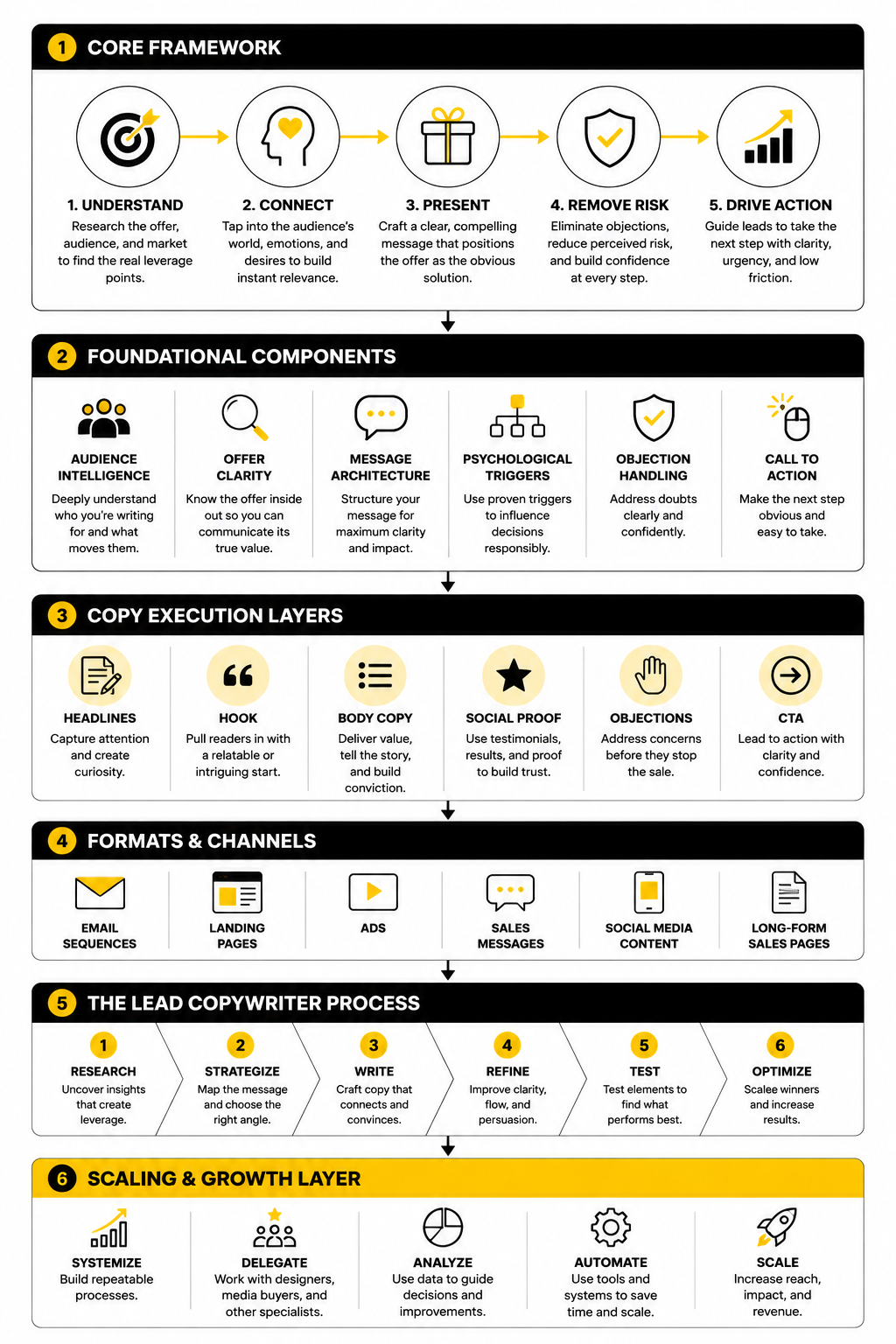
Use A Clear Copy Production Process
Once the brief and message map are clear, execution should follow a simple process. The goal is not bureaucracy. The goal is fewer messy handoffs, fewer subjective revisions, and fewer last-minute rewrites.
A practical copy production process looks like this:
This process works because it forces sequence. You do not pick a headline before you know the angle. You do not polish body copy before you know the proof. You do not test a CTA before you understand whether the reader believes the offer.
Collaborate With Design Without Letting Design Lead The Argument
Design makes copy easier to understand, but it should not replace the argument. A beautiful page with unclear positioning still loses. A clean ad with weak tension still gets ignored.
A lead copywriter should work with designers early enough to shape the experience together. The copywriter brings the message hierarchy: what the reader needs to understand first, what needs proof, what needs emphasis, and where the CTA should feel natural. The designer brings layout, flow, visual contrast, and scannability.
This partnership is strongest when neither side treats the other as a production function. The copy should not be dumped into a finished layout. The layout should not force the message into tiny boxes that weaken the argument. Both sides are building the same persuasion path.
Work With Sales To Capture Real Objections
Sales teams hear the truth that polished surveys often miss. They know which claims prospects doubt, which competitors come up repeatedly, which pricing concerns are real, and which phrases make buyers lean forward. A lead copywriter should actively mine that information.
This does not mean copying sales language blindly. Sales conversations can be messy, reactive, and specific to one buyer. The lead copywriter’s job is to find patterns and turn them into sharper public-facing messaging.
Useful sales inputs include lost-deal reasons, call transcripts, proposal feedback, demo questions, and objections that appear late in the buying process. These inputs can improve landing pages, nurture emails, case study angles, webinar scripts, sales enablement decks, and retargeting ads. When copy and sales are aligned, the buyer hears a more consistent story from first click to final decision.
Keep Product Messaging Customer-Led
Product teams often explain features from the inside out. That is natural because they know how much work went into the feature. Customers, however, care less about the internal logic and more about what changes for them.
A lead copywriter helps translate product detail into customer meaning. A feature is not the message. The message is the valuable outcome the feature makes easier, faster, safer, cheaper, or more believable.
This is especially important in SaaS and technical categories where teams can accidentally bury the benefit under product language. The lead copywriter should stay close to product, but not become trapped in product vocabulary. The customer’s language wins. Always.
Statistics And Data
A lead copywriter should not measure copy by whether the team likes it in a review meeting. That is useful feedback, but it is not the market. The market responds through attention, clicks, replies, conversions, sales conversations, retention, and the quality of people who take the next step.
This does not mean every copy decision should be reduced to a dashboard. Data can tell you what happened, but it does not automatically tell you why it happened. The lead copywriter’s job is to connect performance signals with message quality, audience intent, channel context, and the business goal behind the asset.
Benchmarks help, but they are not commandments. Unbounce’s conversion benchmark research is built from over 57 million conversions across more than 41,000 landing pages, which makes it useful for context, but a “good” conversion rate still depends on the offer, traffic source, buying stage, price point, and conversion action. A demo request, newsletter signup, free trial, and paid purchase should not be judged with the same expectation.
What Copy Metrics Actually Measure
Most teams track metrics too literally. An email open rate does not prove the email persuaded anyone; it mostly shows whether the sender, subject line, timing, and audience relevance earned the first look. A click-through rate gets closer to intent, but even that can be misleading if the click attracts the wrong people.
For a lead copywriter, every metric should answer a specific question. Opens ask whether the message earned attention. Clicks ask whether the promise created enough curiosity or desire. Conversions ask whether the page, offer, proof, and CTA created enough confidence to act.
The deeper question is always quality. A landing page that doubles conversion rate but cuts lead quality in half may not be a win. A sales email that gets fewer replies but more qualified buying conversations may be much stronger than the louder version.
Landing Page Benchmarks Need Context
Landing page benchmarks are useful because they remind teams that conversion rates vary heavily by category. A SaaS landing page should not be casually compared with a legal lead generation page or an ecommerce product page. The buyer intent, risk level, price, urgency, and trust requirement are completely different.
Search Engine Land’s discussion of Unbounce data notes that industry medians can range from 3.8 percent in SaaS to 12.3 percent in legal, which is a perfect example of why lazy benchmarking creates bad decisions. If a SaaS team sees a 5 percent conversion rate, that may be strong in context. If a legal campaign sees the same number, the copy or offer may need serious work.
The action is simple: compare like with like. A lead copywriter should benchmark by industry, traffic temperature, page type, conversion action, and campaign goal. Then they should look for the message-level reason behind the number: unclear promise, weak proof, wrong CTA, missing objection handling, poor offer fit, or traffic mismatch.
Email Metrics Show Where The Message Breaks
Email is one of the cleanest places to diagnose copy because each step has a visible signal. The subject line and sender influence opens. The first few lines and body message influence reading depth. The offer, CTA, and trust level influence clicks and replies.
MailerLite’s 2025 benchmark report is based on over 3.6 million campaigns from 181,000 approved accounts, which gives teams a better reference point than guessing. But the lead copywriter should still avoid using one average as the goal for every campaign. A customer onboarding email, cold outreach sequence, product launch, newsletter, and win-back email all carry different intent.
The useful move is to diagnose by stage. Low opens usually point to targeting, sender trust, timing, or subject line relevance. Low clicks with healthy opens usually point to weak body copy, unclear value, poor CTA fit, or a mismatch between the subject line promise and the email itself.
Conversion Rate Is Not The Whole Scoreboard
Conversion rate is important, but it is not the full truth. A lead copywriter should also look at the downstream impact of copy: lead quality, sales acceptance, pipeline created, purchase intent, customer fit, refund rate, churn risk, and objections that appear after conversion. This is where copy moves from marketing decoration to business infrastructure.
For example, a page can improve conversions by making a promise broader or more aggressive. That may look good in the first report. But if sales starts hearing more confused prospects, or customer success starts dealing with expectation gaps, the copy did not improve the business.
Strong copy creates the right action from the right person for the right reason. That is the standard. Anything else is just a prettier number.
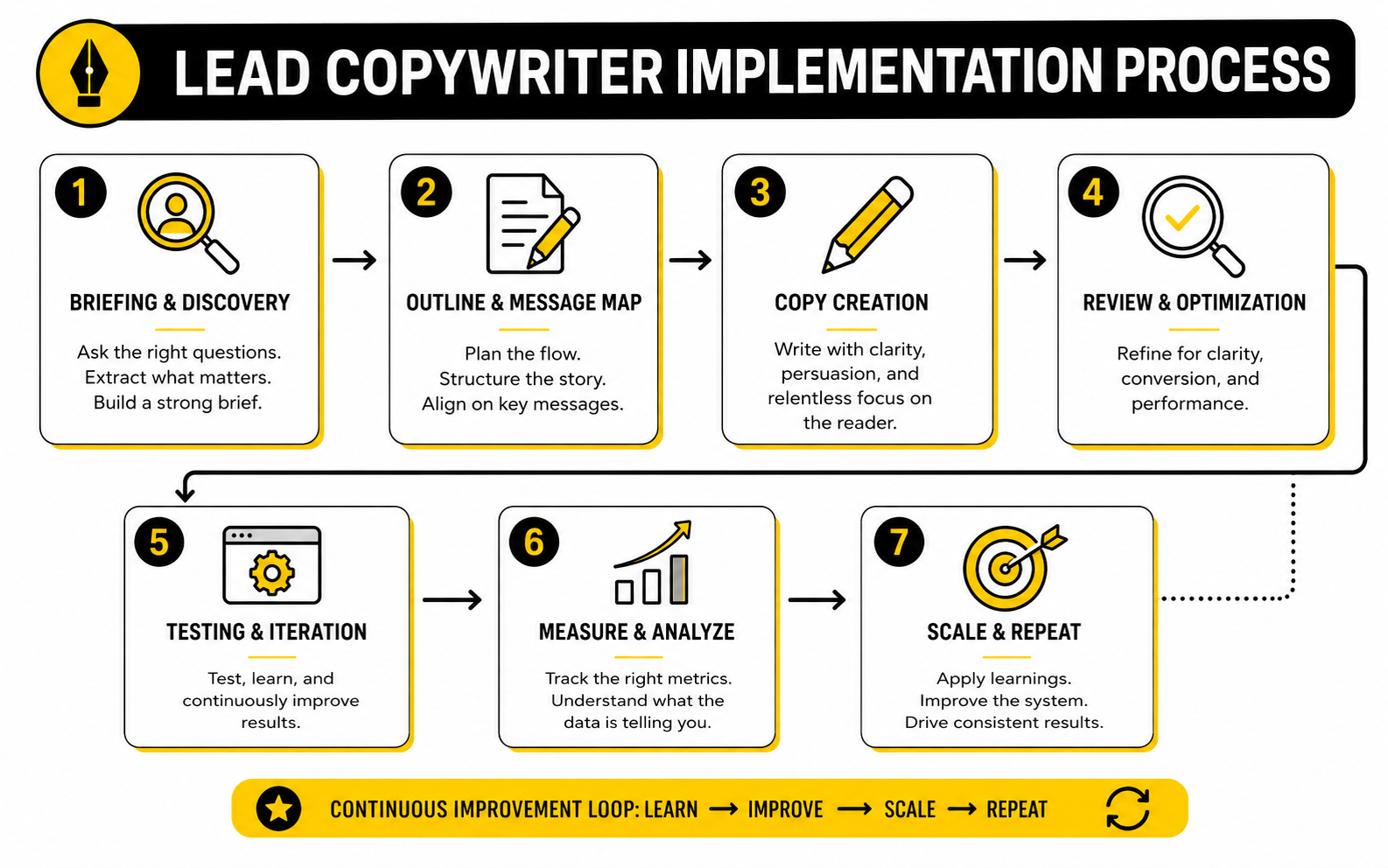
A Practical Measurement System For Lead Copywriters
A lead copywriter needs a measurement system that is simple enough to use every week. Complicated dashboards often look impressive and change nothing. The system should connect each copy asset to a business goal, a primary metric, a secondary quality signal, and the next decision.
For a landing page, the primary metric might be form conversion rate, while the quality signal might be sales-qualified lead percentage. For an email sequence, the primary metric might be reply rate or click rate, while the quality signal might be booked calls or revenue influenced. For a paid ad, the primary metric might be click-through rate, but the quality signal should include landing page conversion and customer acquisition cost.
A clean measurement system can follow this structure:
This matters because random optimization creates noise. A lead copywriter should not test five copy ideas at once and then pretend to know which change worked. The goal is controlled learning, not constant tinkering.
Performance Signals Worth Watching
The most useful copy signals are the ones that reveal friction. High traffic with low engagement usually means the hook is weak or the audience is wrong. Strong engagement with low conversion usually means the promise is interesting but the proof, offer, or next step is not strong enough.
Scroll depth can help identify where the argument loses people, especially on long-form landing pages or sales pages. Form starts and form completions can show whether the CTA is appealing but the ask feels too heavy. Sales call notes can reveal whether the copy answered the wrong objections or created expectations the product cannot support.
Qualitative signals matter too. If prospects repeat the headline language on calls, the message is sticking. If sales keeps explaining the same thing after a prospect converts, the copy left a gap. If customers describe the value in words the team never uses, the lead copywriter may have found better language than the brand already has.
How To Interpret A Failed Test
A failed test is not a personal insult. It is information. A lead copywriter who treats every losing variation as embarrassment will stop taking useful creative risks.
The first question after a failed test should be whether the test was clean. Was the traffic stable? Was the audience comparable? Did the page get enough volume? Was only one meaningful variable changed? If not, the result may be noise rather than insight.
The second question is what the market rejected. Maybe the headline was clear but not urgent. Maybe the proof was credible but not emotionally relevant. Maybe the CTA asked for too much too soon. Good measurement does not just say “this lost.” It helps the lead copywriter decide what to try next.
Benchmarks Should Guide Decisions, Not Replace Judgment
Benchmarks are useful when they create perspective. They are dangerous when teams use them to avoid thinking. Averages can show whether performance is unusually weak or unusually strong, but they cannot tell you whether your offer is positioned correctly for your market.
This is why a lead copywriter should combine external benchmarks with internal baselines. External benchmarks show the wider landscape. Internal baselines show whether the team is improving its own message, audience targeting, and funnel quality over time.
The best question is not “Are we above average?” The better question is “What does this number tell us about the buyer’s belief, doubt, or readiness to act?” That is where data becomes useful. That is where a lead copywriter turns reporting into better copy.
Advanced Lead Copywriter Decisions
At a certain level, the lead copywriter is no longer judged only by how well they write. They are judged by the quality of decisions they help the company make. That means knowing when to simplify, when to specialize, when to push for a stronger offer, and when to protect the brand from short-term copy tricks that create long-term distrust.
This is where the role becomes more strategic. A junior writer may ask, “How do we make this sound better?” A lead copywriter asks, “Should we be saying this at all?” That question can save a company from vague positioning, overpromising, weak launches, confusing funnels, and campaigns that look busy but do not build momentum.
The hard part is that advanced copy leadership often involves tradeoffs. More urgency can increase action but damage trust if it feels fake. More personalization can improve relevance but feel invasive if the data use is clumsy. More AI can increase output but flatten the voice if nobody is protecting taste, accuracy, and customer empathy.
Scaling Copy Without Losing The Message
Scaling copy is not the same as producing more copy. A team can publish more emails, more ads, more landing pages, more articles, and more social posts while still becoming less clear. Volume without message discipline creates noise.
A lead copywriter should scale the system before scaling the output. That means creating repeatable briefs, message maps, review standards, voice examples, proof libraries, objection banks, and tested offer angles. Once those pieces exist, more writers and tools can contribute without pulling the brand in different directions.
AI makes this even more important. The 2025 State of Marketing AI Report shows how quickly marketers are using AI for content creation, automation, and analysis through AI-supported marketing workflows. The opportunity is speed, but the risk is sameness. A lead copywriter has to make sure the company is not just publishing faster versions of average thinking.
Protecting Trust In An AI-Saturated Market
Trust is becoming a bigger copy problem, not a smaller one. Buyers know that companies can generate polished claims quickly. They are also more alert to vague expertise, generic thought leadership, and content that sounds confident without proving anything.
Gartner reported that 53 percent of consumers distrust or lack confidence in AI-powered search results and summaries, while also warning marketers to build authority through accurate, in-depth, well-researched content. That matters for a lead copywriter because the job is no longer just to sound persuasive. The job is to make persuasion feel earned.
Trust is built through specificity. Clear claims, real proof, named mechanisms, honest limitations, transparent next steps, and copy that does not pretend every product is perfect. The lead copywriter should be the person in the room who removes the fluff before the market punishes it.
Balancing Brand Voice And Performance Copy
Brand copy and performance copy are often treated like enemies. They should not be. Brand without conversion discipline becomes vague. Performance without brand discipline becomes pushy, forgettable, and easy to copy.
A lead copywriter has to hold both sides at once. They need to write copy that gets action now while still making the company more recognizable over time. That means using direct-response principles without sounding like every other funnel in the market.
The tradeoff is usually most obvious in CTAs, urgency, and proof. A discount-led message may convert, but it can train buyers to wait. A bold claim may win attention, but it can create skepticism if the proof is thin. A strong lead copywriter knows when the short-term lift is not worth the long-term cost.
Managing Stakeholders Without Weakening The Copy
Copy often gets worse when too many people edit it without a shared standard. One stakeholder wants it softer. Another wants it more exciting. Another wants three product features added above the fold. By the end, the piece says everything and lands nothing.
The lead copywriter has to manage this without becoming defensive. The best approach is to bring the conversation back to the reader and the job of the asset. If a suggestion improves clarity, proof, relevance, or action, it deserves consideration. If it only reflects internal preference, it should not automatically win.
This is why review criteria matter. Before feedback starts, the team should know what the copy is being judged against: audience fit, message clarity, evidence, brand voice, channel context, and conversion goal. Strong criteria protect the work from becoming a taste contest.
Knowing When Not To Optimize
Not every underperforming asset needs copy optimization. Sometimes the traffic is wrong. Sometimes the product is not ready. Sometimes the offer is too weak. Sometimes the page is fine, but the campaign is reaching people who do not have the problem yet.
A lead copywriter should be honest about this. Copy can sharpen demand, clarify value, and reduce friction, but it cannot permanently compensate for a bad offer or poor targeting. Pretending otherwise wastes time and makes copy responsible for problems it cannot solve alone.
The better move is diagnosis. Before rewriting, ask whether the issue is audience, offer, proof, timing, channel, product-market fit, or message. Then fix the highest-leverage problem first. That is how a lead copywriter protects both the work and the business.
Building A Copy Operating System
As teams grow, copy needs an operating system. Not a dusty brand book. A living system that helps people make better messaging decisions without asking the lead copywriter to personally rewrite everything.
This system can include core positioning, voice rules, headline formulas, offer templates, CTA guidance, approved claims, proof standards, objection responses, email frameworks, landing page structures, and examples of strong before-and-after edits. Tools like Buffer, Brevo, ManyChat, and Chatbase can support distribution, automation, and customer interaction, but the operating system still needs human judgment behind it.
The goal is leverage. A lead copywriter should not become the bottleneck for every subject line, product blurb, and ad variation. They should build the standards that help the team move faster without watering down the message.
Hiring And Developing Better Copywriters
A lead copywriter also has to recognize writing potential in others. That does not mean hiring only people with flashy portfolios. It means looking for clear thinking, curiosity, research ability, editing discipline, and the ability to explain why a piece of copy works.
A useful hiring test should not be a vague “write an ad for us” exercise. It should give the candidate context, constraints, audience information, and a clear objective. The real signal is not only the final copy, but how they think through the problem.
Development works the same way. Junior writers improve faster when feedback is specific, practical, and tied to business outcomes. Show them what changed, why it changed, and what principle they can use next time. That is how a lead copywriter builds a team instead of just correcting drafts.
Avoiding The Biggest Leadership Mistakes
The first mistake is becoming a bottleneck. If every piece of copy needs the lead copywriter’s personal rewrite, the system is broken. The fix is better training, clearer standards, and more useful briefs.
The second mistake is confusing personal taste with strategy. A lead copywriter should have strong opinions, but those opinions need to be anchored in audience understanding, brand direction, and performance evidence. “I like this better” is not a strategy.
The third mistake is chasing cleverness at the expense of clarity. Clever copy can work when the audience already understands the category and the offer. But when the buyer is confused, skeptical, or busy, clarity wins. Most of the time, it wins by a lot.
Professional Implementation: Growing Into The Role
Becoming a lead copywriter is not about waiting for a better title. It starts when you begin thinking beyond the asset in front of you. You stop asking only whether the copy sounds good and start asking whether the message is useful, believable, measurable, and aligned with the business.
The writers who grow into this role usually become stronger at diagnosis first. They can spot when a weak headline is really a positioning issue, when a poor-performing email is really an offer issue, and when a messy landing page is really a lack of message hierarchy. That judgment is what separates an experienced writer from someone who can lead copy across a team.
The next step is ownership. A lead copywriter owns the standards, not just the sentences. They build the systems that help the company communicate clearly even when campaigns, channels, products, and stakeholders keep changing.
Build A Portfolio Around Business Problems
A lead copywriter portfolio should not feel like a gallery of clever lines. It should show how the writer thinks. The strongest samples explain the context, audience, problem, approach, and result without turning the portfolio into a bloated case study.
This matters because senior copy work is rarely judged in isolation. A hiring manager or client wants to know whether you can understand messy inputs, make strategic decisions, and produce copy that supports a commercial goal. A clean before-and-after can be useful, but the reasoning behind the improvement is often the real proof.
If performance data is available, include it carefully. If it is not available, explain the strategic purpose of the work and the constraints you were working within. Never invent numbers. A credible explanation beats a fake metric every time.
Learn To Present Copy Clearly
A lead copywriter has to sell the work internally before the market ever sees it. That does not mean being theatrical. It means presenting the logic behind the copy so stakeholders understand why the message is structured the way it is.
Before showing a draft, frame the objective, audience, awareness level, key objection, and intended action. Then explain the message path. This lowers subjective feedback because people are not reacting to isolated sentences without context.
This skill is especially important when the copy makes a bold choice. If you lead with pain, explain why the reader needs urgency before product detail. If you remove feature-heavy language, explain why the buyer needs clarity before complexity. Good presentation protects good strategy.
Develop Commercial Range
A lead copywriter should understand more than one type of asset. Sales pages, ads, lifecycle emails, product pages, onboarding messages, SEO content, webinar scripts, and sales enablement all have different jobs. The more formats you understand, the better you can see how the full customer journey fits together.
This does not mean you must become equally specialized in everything. It means you should know enough to prevent copy from breaking between channels. A promise made in an ad should feel connected to the landing page, the follow-up email, and the sales conversation that comes after it.
Commercial range also helps you choose the right level of persuasion. A cold ad may need sharper contrast. A product page may need clearer comparison. A customer email may need reassurance and momentum. The lead copywriter adjusts the message without losing the core idea.
What Does A Lead Copywriter Do?
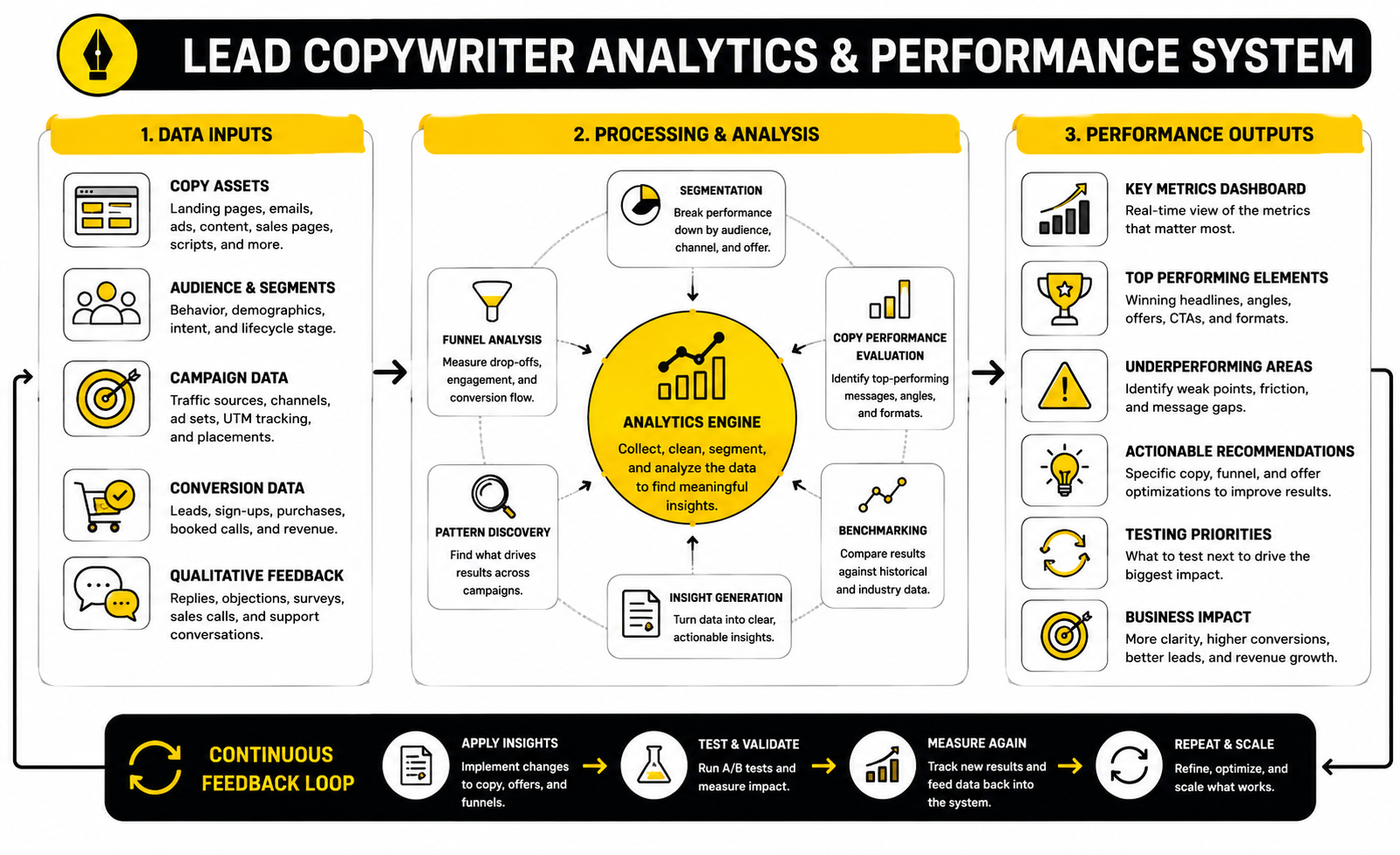
A lead copywriter owns the quality and direction of copy across campaigns, channels, and teams. They may write important assets themselves, but their bigger job is to make sure the message is clear, persuasive, consistent, and aligned with the business goal. They often handle strategy, editing, briefs, voice guidelines, campaign concepts, and copy reviews.
How Is A Lead Copywriter Different From A Copywriter?
A copywriter usually focuses on producing assigned copy assets. A lead copywriter also shapes the strategy behind those assets and guides other writers through the process. The difference is not just seniority; it is ownership of the message system.
What Skills Does A Lead Copywriter Need?
A lead copywriter needs research ability, positioning judgment, editing skill, conversion awareness, brand voice control, and stakeholder management. They also need enough business understanding to connect copy decisions with revenue, retention, or demand generation goals. The role rewards writers who can think clearly before they write beautifully.
Does A Lead Copywriter Manage Other Writers?
Often, yes, but not always in a formal people-management role. Some lead copywriters manage a team directly, while others guide freelancers, agencies, content marketers, or cross-functional contributors. Even without direct reports, they usually set standards and give feedback that shapes the work of other writers.
Is A Lead Copywriter The Same As A Creative Director?
No, although the roles can overlap. A creative director usually owns the broader creative concept, visual direction, campaign idea, and creative team output. A lead copywriter focuses more specifically on language, messaging, persuasion, voice, and the copy system behind the campaign.
Can A Lead Copywriter Use AI?
Yes, but AI should support the process, not replace judgment. A lead copywriter can use AI for research organization, angle exploration, outline development, variation drafting, and workflow speed. The final responsibility still sits with the human who understands the customer, the brand, the offer, and the risk of saying the wrong thing too confidently.
What Should A Lead Copywriter Measure?
A lead copywriter should measure the performance signal that matches the asset’s job. For landing pages, that may include conversion rate and lead quality. For emails, that may include clicks, replies, booked calls, purchases, or retention behavior depending on the purpose of the sequence.
What Makes Someone Ready For A Lead Copywriter Role?
A writer is usually ready when they can diagnose copy problems, explain strategic decisions, improve other writers’ work, and connect copy to business outcomes. They should also be comfortable pushing back when the brief, offer, or positioning is weak. The role requires confidence, but it also requires humility because the market will not always agree with your favorite idea.
How Do You Hire A Good Lead Copywriter?
Look for clear thinking before clever writing. A good hiring process should test how the candidate understands the audience, interprets the offer, handles objections, and explains their copy choices. Their portfolio should show strategy, range, and business context, not just polished taglines.
What Should Be In A Lead Copywriter Job Description?
A strong job description should include strategy, writing, editing, research, messaging, collaboration, and performance responsibilities. It should explain which channels the role owns, who they work with, and whether they manage other writers. It should also clarify whether the company needs a hands-on writer, a copy strategist, an editorial lead, or a mix of all three.
Can A Freelancer Become A Lead Copywriter?
Yes, and many freelancers already operate like lead copywriters for their clients. The key is moving from asset delivery to strategic ownership. Instead of only writing the landing page, the freelancer starts improving the brief, sharpening the offer, mapping the funnel, and advising on what should be tested next.
What Is The Biggest Mistake Lead Copywriters Make?
The biggest mistake is becoming the person who fixes every sentence instead of building a better system. That creates a bottleneck and keeps the team dependent on one person. A strong lead copywriter improves the process, the standards, and the team’s judgment so better copy can happen more consistently.
Build a stronger local presence with BAAM AI
Turn your website, Google profile, social channels, and AI visibility into one growth engine
Most businesses do not need more random marketing activity. They need a consistent presence system that helps the right people find them, trust them, and take action. BAAM AI brings strategy, local SEO, website updates, Google Maps visibility, social content, AI-search readiness, media production, and reporting into one practical monthly engine.
If you want your marketing to keep working after the campaign ends, start with a free BAAM AI presence audit. See how your business shows up today and where the fastest visibility wins are at BAAM AI.