
BAAM AI Blog
Largest Social Media Company In The World: The Practical Guide To Who Really Leads Social Media
The largest social media company in the world is not a simple one-line answer anymore. If you measure by daily users across social apps, Meta is the clear leader because Facebook, Instagram, WhatsApp, and Messenger...
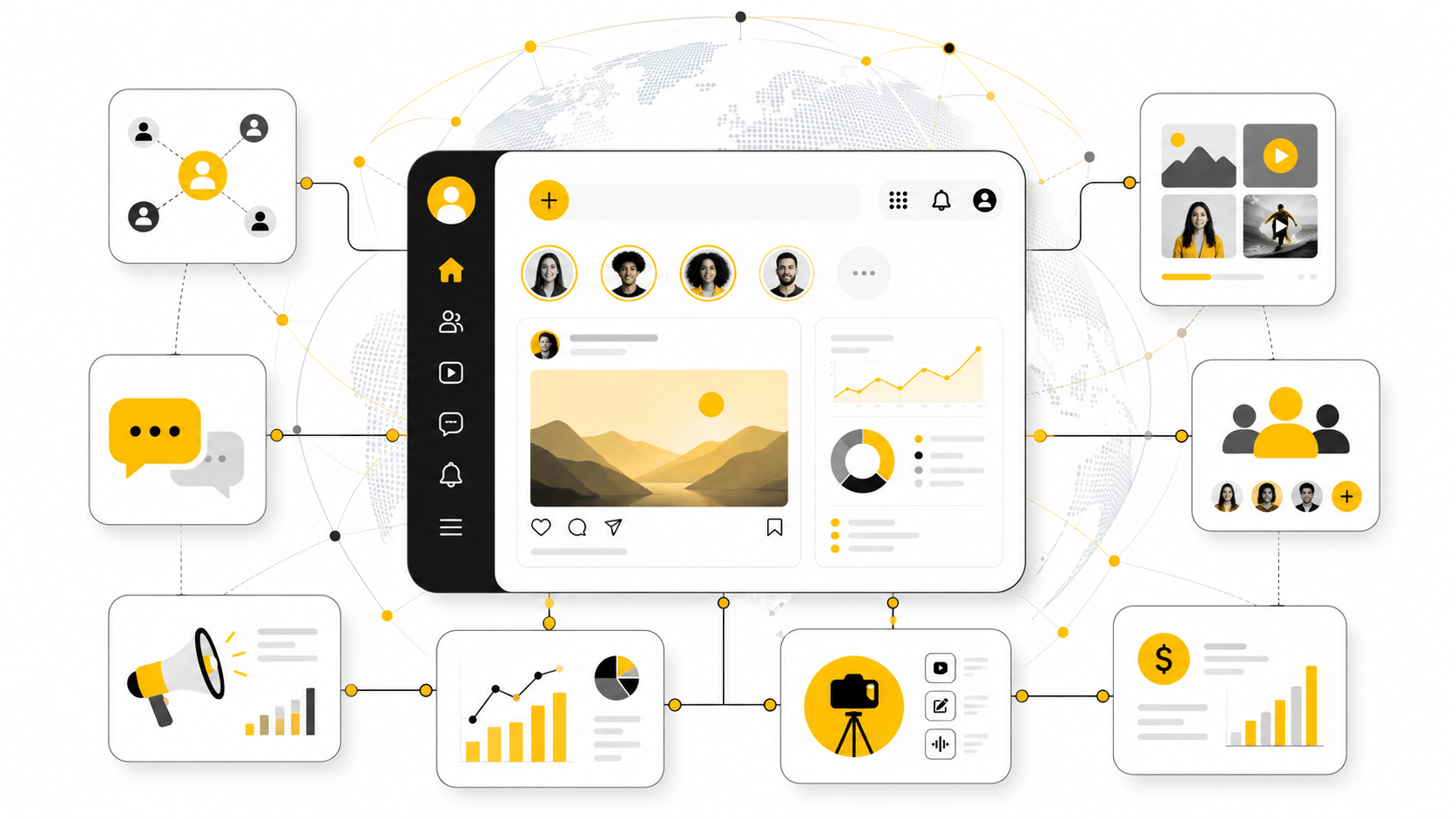
The largest social media company in the world is not a simple one-line answer anymore. If you measure by daily users across social apps, Meta is the clear leader because Facebook, Instagram, WhatsApp, and Messenger together reached 3.56 billion family daily active people in March 2026. That is an absurd level of reach, and it is why Meta still sits at the center of most serious social media strategy.
But the keyword largest social media company in the world needs a careful answer because “largest” can mean different things. It can mean the biggest audience, the most revenue, the highest market value, the strongest ad platform, the deepest creator ecosystem, or the most important role in culture. Meta wins several of those categories, but YouTube, TikTok, Tencent, and ByteDance all matter depending on the lens you use.
So this guide will not just throw out a name and move on. We are going to define what “largest” actually means, compare the real contenders, and then translate that into practical decisions for marketers, creators, founders, and operators. The goal is simple: understand who leads social media, why that leadership matters, and how to make more carefully decisions because of it.
The Practical Answer: Who Is The Largest Social Media Company In The World?
Meta is the largest social media company in the world when you measure the company by daily active people across its owned social and messaging platforms. Its “Family” includes Facebook, Instagram, Messenger, and WhatsApp, and Meta explains in its annual filings that it counts a daily active person as someone who visits at least one of those products during the day rather than simply adding up duplicate accounts across apps. That distinction matters because the company is trying to estimate real people, not inflate the number by counting the same user several times.
Meta’s scale is also financial, not just social. The company reported $200.97 billion in full-year 2025 revenue, and then reported $56.31 billion in Q1 2026 revenue. That combination of massive audience reach and massive monetization is what makes Meta the default answer when people ask for the biggest social media company.
Still, the honest answer has nuance. YouTube is part of Alphabet, TikTok is part of ByteDance, WeChat is part of Tencent, and each of those ecosystems can dominate specific behaviors or regions. If you are asking “which company reaches the most people every day across social apps,” Meta is the answer. If you are asking “which platform shapes video culture most aggressively,” YouTube and TikTok immediately enter the conversation.
Why The Ranking Matters For Marketers, Creators, And Businesses
This question is not trivia. Knowing the largest social media company in the world helps you understand where attention, advertising infrastructure, creator distribution, customer messaging, and commerce behavior are concentrating. When one company controls several of the world’s most-used communication surfaces, the strategic impact is bigger than any single app.
For marketers, this affects budget allocation. Meta’s advertising system reaches users across Facebook and Instagram while its messaging ecosystem creates follow-up opportunities through WhatsApp and Messenger. That means a business can run awareness, retargeting, direct response, community building, and customer conversations inside one broader company ecosystem.
For creators and founders, the ranking helps separate platform hype from durable infrastructure. A platform can feel culturally loud while still being smaller, less monetized, or less useful for a specific business model. The smartest operators do not chase the loudest app blindly; they understand where audience scale, intent, content format, and conversion paths overlap.
The Framework For Measuring Social Media Scale
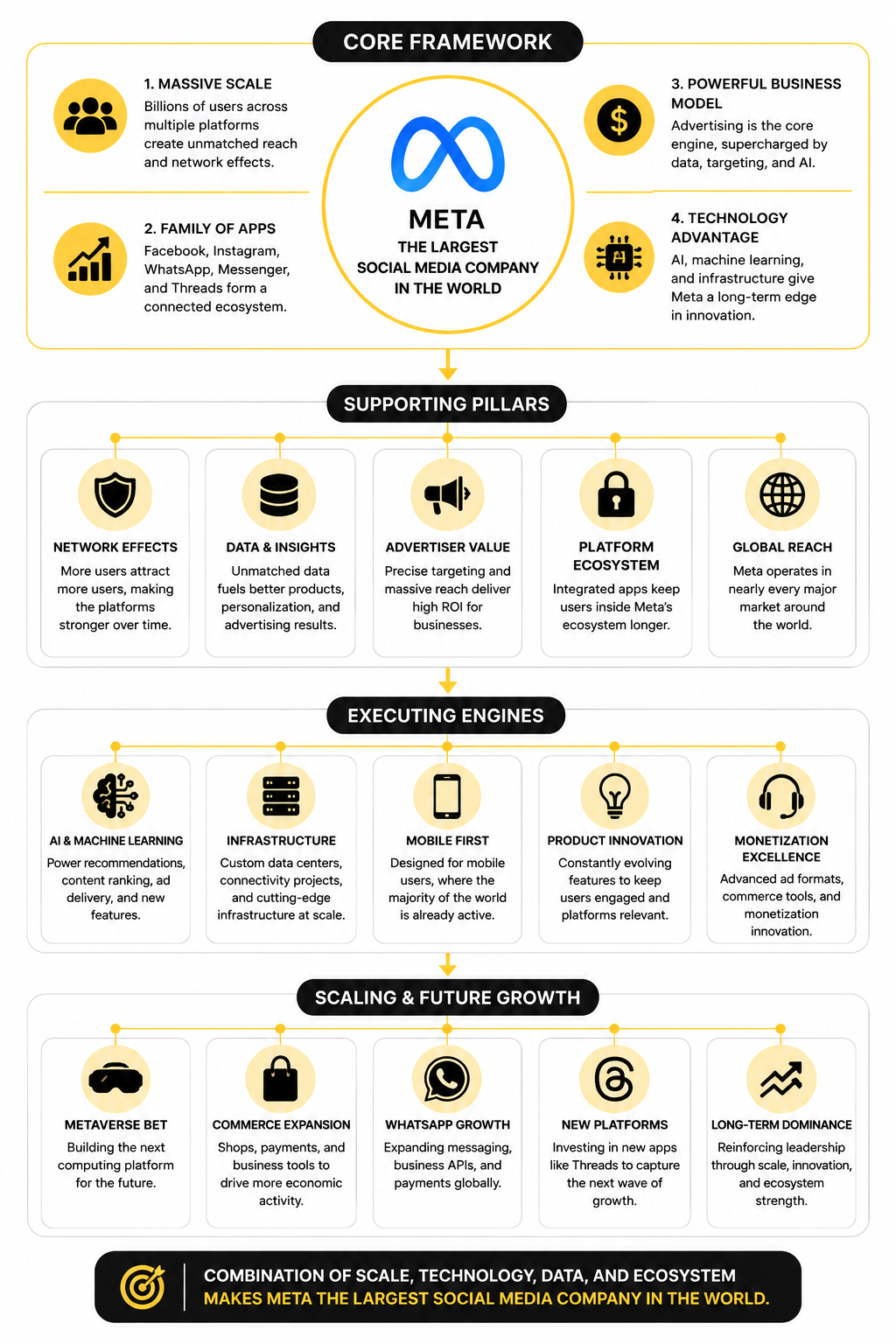
There are four useful ways to measure the largest social media company in the world: people, money, control, and influence. People means active users, daily behavior, geographic reach, and whether the company owns multiple apps that serve different use cases. Money means revenue, advertising share, margins, cash flow, and the ability to keep investing when competitors slow down.
Control is about the ecosystem. Meta does not just own one feed; it owns social networking, photo and video discovery, private messaging, group communication, creator tools, ads, analytics, and an expanding AI layer. That makes the company more durable than a single-app competitor because users can move between formats without leaving the broader network.
Influence is harder to measure, but it matters. TikTok can set culture faster than Meta in some categories, YouTube can dominate long-form and short-form video discovery, and WeChat can function as social infrastructure in China in ways Western apps do not. This is why the full article will use a framework instead of pretending one metric answers everything.
What We Mean By “Social Media Company”
A social media company is not just a company with a comment section. For this guide, the term means a company whose core products help users create, share, discover, message, follow, react to, or distribute content through networked profiles and communities. That includes social networks, video platforms, messaging apps, creator platforms, and hybrid ecosystems where communication and media blend together.
This definition is important because the category has changed. Facebook started as a social network, Instagram became a visual discovery engine, WhatsApp became private communication infrastructure, and TikTok made algorithmic entertainment feel like social media even when users were not following friends. The modern social media market is not one format; it is a stack of attention, identity, messaging, advertising, and commerce.
That is also why Meta stays so powerful. It does not need every user to behave the same way on every app. One person may use WhatsApp for family, Instagram for creators, Facebook for groups, and Messenger for local communication, and Meta still owns the relationship across the stack.
The next parts will move from the answer into the proof. First, we will look at why the ranking matters in practical terms, especially for businesses deciding where to invest time and budget. Then we will break down the measurement framework so the comparison is not based on vague platform popularity.
After that, we will go through Meta’s core components and explain how Facebook, Instagram, WhatsApp, Messenger, and Threads contribute to the company’s scale. This matters because Meta’s strength is not just one product; it is the way the products reinforce each other. A company with several massive apps has different advantages than a company depending on one feed or one content format.
Then we will compare the main challengers. YouTube, TikTok, Tencent, Snapchat, Pinterest, and X each have real strengths, but they do not all compete with Meta in the same way. By the end, the article will connect the ranking to professional implementation: how to use this knowledge in channel strategy, paid media, creator partnerships, customer acquisition, and long-term platform risk planning.
Why The Ranking Matters For Marketers, Creators, And Businesses
The largest social media company in the world matters because social platforms are no longer just places where people post updates. They are distribution systems, advertising networks, customer support channels, creator economies, search engines, messaging layers, and commerce surfaces all at once. When one company owns several of those layers, it can shape how attention moves from discovery to trust to purchase.
This is why Meta’s scale is so important. Its family of apps reached 3.56 billion daily active people in March 2026, which means a serious percentage of the connected world touches at least one Meta product on a normal day. That does not mean every business should put all of its effort into Facebook or Instagram, but it does mean Meta cannot be ignored when building a modern acquisition system.
The mistake is treating social media as a popularity contest. The better question is practical: where can your business reach the right people, educate them, capture demand, and follow up without losing momentum? That is where the size of the company becomes useful, because a large ecosystem usually gives you more formats, more data signals, more retargeting paths, and more ways to turn attention into revenue.
Scale Changes The Cost Of Customer Acquisition
A huge social media ecosystem gives advertisers more room to test. You can test audiences, creative angles, placements, product offers, landing pages, and retargeting sequences without rebuilding the entire machine each time. That is one reason Meta remains so important for performance marketers even when newer platforms generate more cultural buzz.
The practical advantage is not just reach. It is the combination of reach and feedback. A brand can launch a campaign, see which creative earns attention, retarget people who engaged, and move them into a funnel or direct message flow. Tools like ManyChat fit naturally into this world because Instagram and Messenger conversations can become part of the follow-up system instead of being treated as random comments or inbox noise.
That matters because customer acquisition has become more expensive and less forgiving. A weak campaign does not get saved by a big platform. But a strong offer, strong creative, and clean follow-up system can compound faster when the platform has enough people, placements, and conversion data to work with.
Creators Need Distribution, Not Just Followers
Creators often talk about audience size, but distribution is the real asset. A creator with 50,000 followers on the right platform can outperform someone with 500,000 passive followers on the wrong one. The platform’s recommendation system, content format, monetization options, and audience intent all change the outcome.
Meta has an advantage because creators can use different surfaces for different jobs. Instagram Reels can drive discovery, Stories can build daily familiarity, broadcast channels can create a tighter relationship, and direct messages can move high-intent conversations forward. Facebook can still matter for groups, local communities, older demographics, and topic-based discussion, even if it does not feel as culturally shiny as TikTok.
This is where the idea of the largest social media company in the world becomes more useful than a vanity ranking. A creator does not need to “be everywhere” just because Meta is huge. They need to understand which part of the ecosystem matches their content, their audience, and their business model.
Businesses Should Think In Systems, Not Single Posts
A single post is not a strategy. A single viral video is not a business model. The strongest brands use social media as part of a system that includes content, paid distribution, lead capture, email, retargeting, sales pages, and customer communication.
That is why the biggest platforms matter for operators. They are not just places to publish content; they are infrastructure for building repeatable demand. For example, a brand might use Instagram or Facebook ads to promote an offer, send visitors to a landing page built with a tool like ClickFunnels, and then follow up through email, SMS, or a CRM.
This is also where smaller teams need to be careful. Big platforms make it easy to spend money, but they do not automatically create a profitable engine. The business still needs a clear offer, a useful message, a reason to trust the brand, and a conversion path that does not leak attention at every step.
The Framework For Measuring Social Media Scale
The right way to compare social media companies is to use a framework instead of arguing from one headline number. A company can be huge by monthly users and still weak in revenue. Another can be smaller by users but stronger in purchase intent, ad pricing, or regional dominance.
For the keyword largest social media company in the world, the cleanest framework has four parts: audience reach, monetization power, ecosystem control, and cultural influence. Each part tells you something different. Together, they give you a much more useful answer than “which app has the most users?”
The reason this framework matters is simple. A business does not win by picking the biggest logo. It wins by matching the platform’s strengths to the job it needs done.
Audience Reach
Audience reach is the most obvious measurement. It answers the basic question: how many people can this company touch through its social products? Meta leads here because its family of apps combines massive global communication habits across Facebook, Instagram, WhatsApp, and Messenger.
But reach needs context. Monthly active users, daily active users, logged-in users, account counts, and duplicated cross-platform users are not the same thing. Meta’s daily active people metric is especially useful because it is designed to count people who used at least one app in its family during the day, rather than simply stacking Facebook users on top of Instagram users on top of WhatsApp users.
This matters when comparing Meta to other giants. YouTube may dominate video viewing, TikTok may dominate short-form culture in many markets, and WeChat may be deeply embedded in Chinese daily life. But if the question is company-level social reach across multiple global products, Meta’s audience footprint remains extremely hard to beat.
Monetization Power
Reach is only half the story. The largest social media company in the world also needs to turn attention into money at enormous scale. Meta’s Q1 2026 revenue reached $56.31 billion, which shows how powerful its advertising engine remains even after years of privacy changes, competition, regulation, and shifts in user behavior.
Monetization power comes from more than ad inventory. It comes from targeting signals, auction density, measurement tools, advertiser trust, creative formats, and the ability to optimize campaigns toward business outcomes. This is why Meta is not just a large social company; it is one of the most important advertising companies in the world.
For marketers, this is the part that matters most. A platform with huge attention but weak commercial intent may be useful for awareness. A platform with strong ad tools, retargeting paths, and conversion optimization can become a revenue channel.
Ecosystem Control
Ecosystem control means the company owns multiple parts of the user journey. Meta has feeds, stories, short-form video, messaging, groups, creator tools, business pages, ad accounts, pixels, conversion APIs, shops, and AI features. That creates a deep operating environment for businesses and creators.
This is where Meta separates itself from many single-platform competitors. If one format weakens, another can grow. If feed posts decline, Reels can rise. If public sharing slows, private messaging can become more important. If one market changes, another region or app can carry more weight.
For a business, ecosystem control creates both opportunity and dependency. The opportunity is obvious: more tools in one place. The risk is also obvious: when a company controls that much distribution, a policy change, algorithm shift, account issue, or ad cost increase can hit hard.
Cultural Influence
Cultural influence is the hardest metric to measure, but it cannot be ignored. TikTok can make songs, products, memes, creators, and search behaviors explode quickly. YouTube can shape education, entertainment, product research, podcasting, and long-form creator businesses. Instagram still has enormous power in lifestyle, fashion, beauty, fitness, travel, food, and personal branding.
Meta’s cultural influence is broad, but not always the loudest. Facebook may be less trend-setting among younger audiences, while Instagram still drives visual identity and creator commerce. WhatsApp may not look like a traditional social feed, but in many countries it is where conversations, communities, family updates, business communication, and local trust actually happen.
That is the key point. The largest company by scale is not always the strongest company in every cultural moment. Smart strategy separates size from influence and then uses both correctly.
How To Use This Framework Without Overcomplicating Strategy
You do not need a 40-tab spreadsheet to make this useful. Start by asking what job the platform needs to do. Are you trying to create awareness, generate leads, close sales, support customers, build community, recruit talent, or establish authority?
Once the job is clear, the ranking becomes more practical. Meta’s scale may make it a strong default for paid acquisition, retargeting, and creator-style content distribution. YouTube may be stronger for evergreen education and search-driven discovery. TikTok may be stronger for trend velocity and creative testing. LinkedIn may matter more for B2B authority, even though it is not close to Meta in consumer reach.
The best companies do not worship the largest platform. They use the largest platform where it gives them leverage, then build owned assets around it. That can mean email lists, CRM data, landing pages, community spaces, and booking flows through tools like GoHighLevel, Systeme.io, or Buffer when those tools fit the actual workflow.
Meta’s Core Components: Facebook, Instagram, WhatsApp, Messenger, And Threads
Meta is the largest social media company in the world because it does not depend on one app doing one job. It owns a family of products that cover public posting, private messaging, visual discovery, short-form video, community discussion, creator distribution, customer communication, and now AI-powered recommendations. That mix is what makes Meta different from a company that has one dominant platform but fewer ways to keep users inside the same broader ecosystem.
The key is that each app plays a different role. Facebook still carries groups, marketplace behavior, local discovery, events, pages, and older social graph activity. Instagram handles visual identity, creators, Reels, Stories, shopping behavior, brand discovery, and lifestyle-driven content. WhatsApp and Messenger handle private communication, which is where a lot of real trust and buying intent quietly happens.
This is why Meta’s size is not just about audience totals. Its family of apps reached 3.56 billion daily active people in March 2026, but the more important point is how many different behaviors happen inside that reach. A user may discover a brand through Instagram, talk to a friend about it on WhatsApp, see a retargeting ad on Facebook, and message the business directly before buying.
Facebook Still Matters More Than People Think
Facebook is not the trendiest part of Meta, but dismissing it is lazy strategy. It still matters for groups, local communities, events, older demographics, marketplace behavior, business pages, and many paid advertising placements. For certain industries, especially local services, communities, events, hobbies, and family-oriented products, Facebook can still be one of the most practical platforms in the mix.
The mistake is judging Facebook only by whether it feels culturally exciting. A platform can be less fashionable and still commercially useful. In many markets, Facebook remains a place where people join groups, ask for recommendations, follow local businesses, discuss purchases, and discover offers through ads.
For marketers, the role of Facebook is often less about “posting daily updates” and more about using its placements and communities intelligently. Organic posting alone may not carry the strategy, but Facebook groups, retargeting, events, and paid campaigns can still support a serious acquisition system. That is why Facebook remains part of the answer when people ask about the largest social media company in the world, even if Instagram gets more attention from younger creators.
Instagram Is Meta’s Creator And Discovery Engine
Instagram is one of Meta’s most important growth and influence engines because it sits at the intersection of creators, brands, short-form video, direct messages, and visual search behavior. Reels competes for short-form attention, Stories create daily familiarity, posts support identity and proof, and DMs move conversations into a more personal channel. That makes Instagram especially powerful for brands that need trust before conversion.
Instagram also has a useful mix of organic and paid potential. A brand can publish short-form video, test hooks, build proof through creator partnerships, run ads, retarget engaged viewers, and start conversations through comments or direct messages. When this is connected to a proper follow-up system, Instagram becomes more than a content app.
This is where practical tools matter. If a business gets leads from comments, story replies, or direct messages, it needs a way to respond quickly and consistently. A tool like ManyChat can help turn Instagram conversations into structured follow-up instead of letting interest disappear in the inbox.
WhatsApp Turns Social Reach Into Private Conversation
WhatsApp is one of the most underappreciated reasons Meta has such a strong global position. It is not a traditional feed, but it is deeply embedded in daily communication across many regions. For many users, WhatsApp is where family, friends, communities, customers, and businesses actually talk.
That makes WhatsApp strategically different from Instagram or Facebook. It is less about broadcasting content and more about trust, support, updates, and direct communication. For businesses, that can mean appointment reminders, customer support, order updates, community broadcasts, consultations, and high-intent sales conversations.
The practical point is simple. Public social media creates attention, but private messaging often closes the gap between curiosity and action. A business that understands this can use Meta’s public platforms to generate demand and Meta’s messaging products to handle follow-up in a more personal way.
Messenger Still Supports Customer Communication
Messenger does not always get the spotlight, but it still matters inside the Meta ecosystem. It connects Facebook pages, ads, customer inquiries, marketplace conversations, and direct business communication. For local businesses and service providers, that can be extremely useful because people often prefer asking a quick question before filling out a form or booking a call.
Messenger also shows why Meta’s ecosystem is hard to compare against single-platform competitors. A user may not think of Messenger as “social media” in the same way they think of Instagram, but Meta can still use it as part of the communication layer. That gives businesses more ways to respond to buyer intent once attention has been created.
The danger is treating Messenger as an afterthought. If a business runs ads that invite people to message but nobody responds quickly, the channel becomes a leak. If the business builds a clean response process, Messenger can become a simple but effective bridge between social attention and revenue.
Threads Is Still A Strategic Bet
Threads is not the reason Meta is the largest social media company in the world, but it is part of Meta’s broader strategy. It gives the company a text-first public conversation product that can compete for real-time commentary, creator discussion, and interest-based communities. That matters because Meta already has visual content, messaging, and legacy social networking covered.
Threads also gives Meta another surface where its existing Instagram identity layer can be useful. Users do not need to start from zero in the same way they might on a completely separate platform. That lowers friction and gives Meta a better shot at building a durable conversation network.
The bigger point is not whether Threads defeats every text-based competitor. The point is that Meta can keep adding surfaces around its existing audience graph. When a company already has billions of daily users across its family of apps, even a secondary product can become strategically meaningful.
Professional Implementation: Turning Platform Scale Into A Working System
Knowing that Meta is the largest social media company in the world does not automatically make your strategy better. The value comes from turning that knowledge into a process. You need to decide which part of the ecosystem does which job, how users move from one step to the next, and where the business captures value.
This is where many teams get it wrong. They post randomly, boost a few pieces of content, run disconnected ads, reply late to messages, and then blame the platform when results are weak. The platform is not the strategy. The system is the strategy.
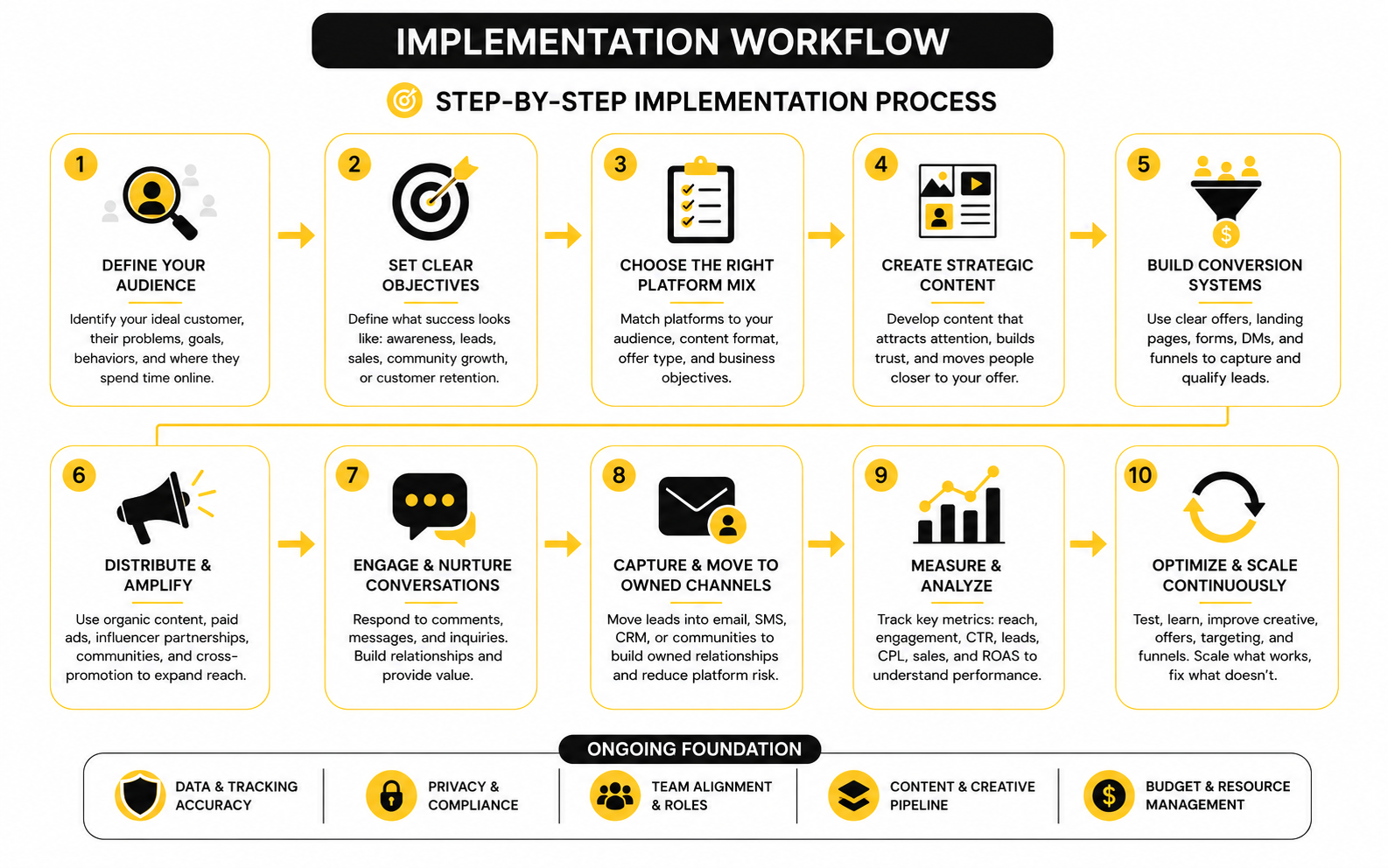
A practical Meta-based process has five stages: define the audience, choose the right surface, create content for that surface, capture intent, and follow up. Each stage has to be clear enough that a team can repeat it. If the process depends on luck, virality, or one person remembering to check the inbox, it is not a real system yet.
Step 1: Define The Audience Before Choosing The Platform
Start with the buyer, not the app. Who are you trying to reach, what do they already believe, what problem are they trying to solve, and what would make them trust you enough to take the next step? Without those answers, the largest platform in the world will only help you waste money faster.
Audience clarity also prevents shallow channel decisions. A B2B consultant, a local dentist, a fitness creator, a beauty brand, and a SaaS company may all use Meta, but they should not use it the same way. Their content, targeting, offer, landing page, and follow-up should match the buyer’s situation.
This is where the first strategic filter comes in. If the audience needs education, use content that explains and demonstrates. If the audience already has demand, use stronger offers and clearer conversion paths. If trust is the blocker, use proof, testimonials, founder content, community, and direct conversation.
Step 2: Match Each Meta Surface To One Job
Each Meta surface should have a job. Instagram Reels can create discovery. Stories can build familiarity. Facebook groups can support community and discussion. Ads can scale what already works. WhatsApp and Messenger can handle direct conversations.
This stops the strategy from becoming messy. Instead of asking “what should we post today,” the better question is “what job does this asset need to do?” A Reel designed for cold discovery should not be judged the same way as a retargeting ad. A Messenger conversation should not be treated like a public awareness post.
When each surface has a job, execution gets cleaner. The team knows what to create, what to measure, and what to improve. That is how platform scale becomes operational leverage instead of noise.
Step 3: Build A Content System Around Buyer Intent
Content should not be random. It should map to the buyer’s journey from problem awareness to trust to action. A simple content system can include education, proof, comparison, objection handling, product demonstration, behind-the-scenes credibility, and direct offer content.
This works especially well on Meta because the ecosystem supports multiple formats. Short-form video can introduce the problem. Carousel-style posts can explain details. Stories can show day-to-day proof. Ads can retarget people who engaged. Messages can answer specific questions before the buyer disappears.
The goal is not to become a content machine for the sake of posting. The goal is to build a library of assets that moves people forward. If a piece of content does not help someone understand, trust, compare, decide, or act, it needs a clearer purpose.
Step 4: Capture Demand Before Attention Gets Wasted
Attention is fragile. Someone can watch a video, like a post, visit a profile, and vanish in less than a minute. If there is no next step, the business loses the value of the attention it just earned.
That next step can be a lead magnet, a booking page, a product page, a quiz, a direct message flow, a newsletter, or a consultation request. The format depends on the business model. A simple offer can go straight to a sales page, while a complex service may need a call, a form, or a nurture sequence first.
This is where conversion infrastructure matters. A funnel builder like ClickFunnels, an all-in-one system like GoHighLevel, or a lean platform like Systeme.io can make sense when the business needs landing pages, forms, email sequences, pipelines, or follow-up automations connected to social traffic.
Step 5: Follow Up Like The Money Is In The Follow-Up
Most social media strategies lose money after the click. The ad may be good, the content may be good, and the offer may be good, but the follow-up is slow, generic, or nonexistent. That is a brutal way to waste demand.
A serious follow-up process should include speed, relevance, and context. If someone asked a question in DMs, the reply should not feel like a cold email. If someone downloaded a guide, the next message should connect to the problem that made them download it. If someone booked a call, reminders and pre-call education should reduce no-shows and improve close rates.
This is also why email and CRM still matter in a social-first strategy. Meta may create and capture attention, but the business should not depend entirely on rented distribution. Tools like Brevo, Moosend, or Copper can support the back end when the business needs better lead management and nurturing.
A Simple Execution Model For Teams
A team does not need to make this complicated. The process can be run as a weekly operating rhythm: review performance, choose one growth priority, create assets for that priority, launch or update campaigns, check conversations, and improve the conversion path. The key is to make the work repeatable.
The most useful weekly questions are direct. Which content created qualified attention? Which ads produced useful leads or sales? Which messages revealed buyer objections? Which landing pages leaked traffic? Which follow-up steps were too slow or too weak?
Once those answers are visible, the strategy improves quickly. The team stops debating vague opinions and starts fixing the actual bottleneck. That is how you use the scale of the largest social media company in the world without becoming dependent on guesswork.
Statistics And Data: What The Numbers Actually Mean
Data matters here because the phrase largest social media company in the world can become slippery fast. One company may have the biggest daily audience, another may have the strongest video revenue, another may dominate one country, and another may be culturally louder for a specific demographic. The numbers only help when they are tied to a decision.
Meta still has the clearest claim at the company level. Its family of apps reached 3.56 billion daily active people in March 2026, while full-year 2025 revenue reached $200.97 billion. Those two figures matter together because they show both reach and monetization, not just popularity.
The action from this is not “put everything into Meta.” The action is to treat Meta as a benchmark for scale, then compare every other platform against the job you need done. A platform can be smaller and still be better for search intent, B2B authority, youth culture, high-consideration education, or regional trust.
The Core Benchmark: Daily Reach Across A Family Of Apps
Daily active people is one of the most useful measurements because it shows habit, not just account ownership. Monthly users can include people who open an app once and disappear. Daily users tell you which platforms are woven into ordinary behavior.
Meta’s daily active people metric is especially important because it covers multiple apps rather than one feed. The user may be on Instagram for Reels, WhatsApp for private messages, Facebook for groups, or Messenger for customer communication. Meta still owns the relationship somewhere inside that daily behavior.
That is why the number is strategically powerful. A business using Meta is not only buying access to one content format. It is entering a system where attention, social proof, retargeting, private conversation, and advertising can connect across several surfaces.
Revenue Shows The Strength Of The Advertising Machine
Audience size is impressive, but revenue shows whether attention can be monetized. Meta’s Q1 2026 revenue reached $56.31 billion, which proves that advertisers are still spending heavily across its platforms. That is the clearest commercial signal behind Meta’s leadership.
Revenue should not be interpreted as “Meta ads will work for everyone.” It means the marketplace is deep, mature, and highly competitive. If your offer is weak, your creative is generic, or your landing page is confusing, a large ad system can punish you quickly because better advertisers are also bidding for attention.
The action is to use revenue as a seriousness signal. Meta is not a side channel for most consumer brands. It is a major paid media environment where creative testing, conversion tracking, audience quality, and follow-up systems need to be treated professionally.
The Competitor Numbers Create Context
YouTube is the most important comparison because it is not just a social platform; it is a video search engine, creator economy, streaming destination, and entertainment network. Alphabet said YouTube’s annual revenue surpassed $60 billion across ads and subscriptions in 2025. That does not make Alphabet a pure social media company in the same way Meta is, but it shows why YouTube is one of the most serious challengers by media power.
Tencent is a different kind of comparison. Weixin and WeChat are deeply embedded in Chinese digital life, and Tencent’s investor materials place its social ecosystem inside a wider company that includes games, payments, cloud, ads, and digital services. That means Tencent is not directly comparable to Meta in the Western social feed sense, but it is a reminder that social media scale can look very different outside the U.S. and Europe.
Snap and Pinterest show another useful lesson. Snapchat reached 946 million monthly active users in Q4 2025, while Pinterest reached 619 million monthly active users and $4.2 billion in 2025 revenue. These platforms are much smaller than Meta by company-level scale, but they can still be valuable when the audience, format, and buying behavior fit the business.
The Analytics System Behind A Serious Social Strategy
Most teams measure social media too shallowly. They look at likes, reach, and follower growth, then wonder why the business result is unclear. Those numbers are not useless, but they are not enough.
A serious analytics system connects platform signals to business outcomes. It should show whether content creates qualified attention, whether ads produce profitable demand, whether landing pages convert, whether conversations move forward, and whether follow-up turns interest into revenue. Without that chain, you are only measuring noise.
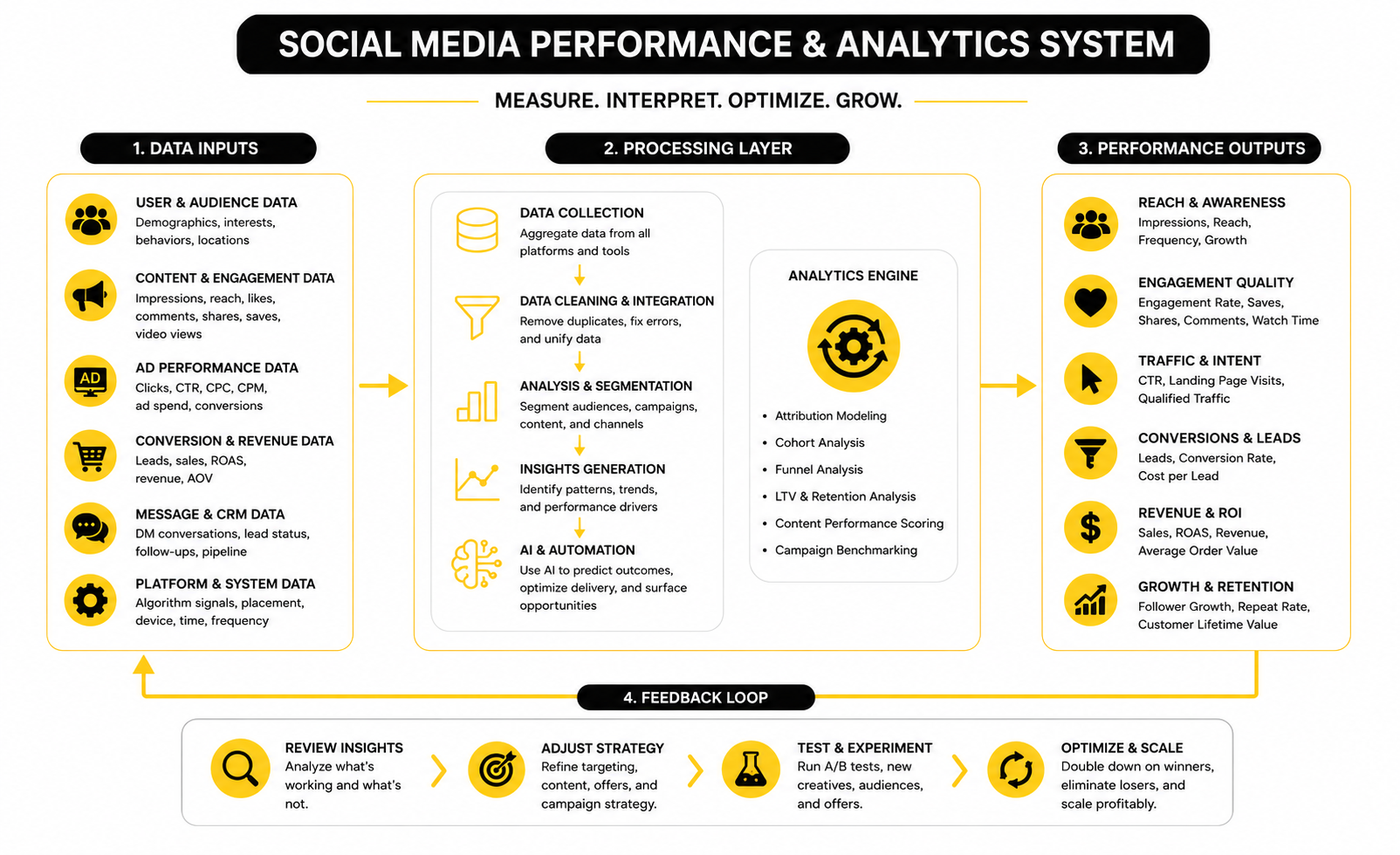
The simplest way to build the system is to separate metrics into four layers: attention, intent, conversion, and retention. Attention tells you whether people notice. Intent tells you whether the right people care. Conversion tells you whether the offer works. Retention tells you whether the relationship keeps producing value after the first action.
Attention Metrics Tell You What Earned The First Look
Attention metrics include reach, impressions, video views, watch time, hook retention, profile visits, and engagement rate. These numbers are useful because they show whether the market is stopping long enough to notice the message. If the first three seconds of a video fail, the rest of the funnel never gets a fair chance.
But attention metrics can be deceptive. A funny video can get reach without attracting buyers. A controversial post can create engagement without building trust. A broad-interest topic can inflate visibility while bringing in people who will never buy.
The action is to compare attention metrics against audience quality. If reach grows but leads get worse, the content is probably too broad. If reach is smaller but profile visits, saves, replies, and qualified clicks improve, the content may be doing the right job.
Intent Metrics Show Whether The Right People Care
Intent metrics are more valuable than vanity engagement. Saves, shares, comments with buying questions, direct messages, link clicks, form starts, webinar registrations, and product page views all suggest a deeper level of interest. These are the signals that a person is not just entertained but is actively considering the next step.
This matters on Meta because the platform gives businesses several ways to capture intent. Someone may click an ad, reply to a Story, comment on a Reel, message a page, save a post, or visit a profile before converting. Those behaviors should not be treated as random activity.
The action is to tag and organize intent signals. If comments repeatedly ask the same question, turn that question into content, ads, and landing page copy. If direct messages reveal the same objection, fix the offer explanation. If many people click but few convert, the problem may be the page, not the platform.
Conversion Metrics Prove Whether The System Works
Conversion metrics include leads, booked calls, purchases, trials, checkout starts, cost per lead, cost per acquisition, return on ad spend, and revenue per visitor. This is where social media stops being entertainment and becomes a business channel. It is also where many weak strategies get exposed.
A low cost per lead can still be bad if the leads are unqualified. A strong engagement rate can still be bad if nobody takes action. A campaign can look expensive at the top of the funnel but profitable after follow-up, upsells, retention, or repeat purchases are included.
The action is to measure conversion by source, offer, and follow-up path. Do not just ask whether Meta worked. Ask which creative, audience, placement, landing page, and sequence created profitable customers. That level of detail is where the real improvement happens.
Retention Metrics Keep You From Overvaluing The First Sale
Retention metrics include repeat purchase rate, customer lifetime value, churn, email engagement, message response rate, subscription renewal, community participation, and referral behavior. These numbers matter because social media acquisition is only one part of the economics. If customers do not stay, buy again, or refer others, the front-end campaign has to work much harder.
This is especially important when ad costs rise. A business with strong retention can afford to pay more to acquire a customer because the customer is worth more over time. A business with weak retention needs cheaper acquisition, which usually creates pressure to chase low-quality leads.
The action is to connect social acquisition to the back end. A CRM or email platform can help track what happens after the lead comes in, and tools like GoHighLevel, Brevo, or Moosend can support that when the business needs cleaner follow-up and lifecycle tracking.
Benchmarks Are Useful Only When They Change Decisions
Benchmarks are tempting because they feel objective. The problem is that average engagement rates, average CPMs, average CPCs, and average conversion rates can hide more than they reveal. A benchmark from another industry, country, price point, or funnel type may have almost no relevance to your business.
The better use of benchmarks is directional. If your ad costs are rising but conversion quality is improving, that may be acceptable. If your reach is falling but sales are stable, the algorithm may be sending fewer but better users. If your CPM is low but your leads are terrible, cheap attention is not helping you.
The action is to create internal benchmarks. Track your own baseline by platform, offer, audience, creative type, and funnel stage. After 30 to 90 days, your own numbers are usually more useful than generic industry averages.
What To Measure Weekly
Weekly measurement should focus on the bottleneck, not every possible metric. If the business needs more attention, look at reach, watch time, hook performance, and creative output. If the business gets attention but not leads, look at profile visits, clicks, landing page conversion, and message prompts.
If leads are coming in but sales are weak, look at lead quality, booking rate, show rate, sales call outcomes, objections, and follow-up speed. If sales are happening but profit is weak, look at acquisition cost, refund rate, repeat purchases, and lifetime value. Each stage has a different problem, so each stage needs different data.
A simple weekly review can use five questions:
What To Measure Monthly
Monthly measurement should zoom out. The goal is to see whether the overall system is getting stronger or just generating random spikes. A viral post can distort one week, but a month shows whether the strategy is building consistent demand.
Useful monthly metrics include revenue by channel, customer acquisition cost, lead-to-customer rate, return on ad spend, repeat purchase rate, content output, best-performing creative themes, and audience growth quality. The focus should be on patterns, not isolated wins. If the same message keeps producing better leads, that is a strategic insight.
The action is to turn monthly findings into operating decisions. Increase spend behind proven creative. Cut channels that create activity but not revenue. Improve the landing page where traffic leaks. Build more content around objections that keep appearing in comments, DMs, and sales calls.
What The Data Says About Meta’s Real Advantage
Meta’s real advantage is not just that it is big. It is that it combines reach, monetization, advertiser tools, multiple content surfaces, private messaging, and a long operating history at global scale. That is why it remains the strongest answer when people ask for the largest social media company in the world.
The data also shows why the answer should not make marketers lazy. YouTube is enormous in video revenue and long-form attention. TikTok and Douyin are powerful in short-form culture. Tencent dominates a different kind of social infrastructure in China. Snap and Pinterest prove that smaller platforms can still matter when they own a specific behavior.
So the smart move is not blind dependence on Meta. The smart move is disciplined measurement. Use Meta where its scale gives you leverage, compare challengers by the job they do better, and build an analytics system that tells you what to fix next.
The Main Challengers: YouTube, TikTok, Tencent, Snapchat, Pinterest, And X
Meta is the strongest answer to the question of the largest social media company in the world, but it is not the only company that matters. The advanced view is more useful: Meta leads at the company level, while different challengers own specific behaviors, regions, formats, and cultural moments. If you ignore those challengers, your strategy becomes too narrow.
The mistake is comparing every platform as if it does the same job. YouTube is not TikTok. WeChat is not Instagram. Pinterest is not X. Each platform creates a different kind of attention, and different attention produces different business outcomes.
This is where strategy gets more serious. The winning move is not to pick a favorite platform and defend it emotionally. The winning move is to understand which platform has the strongest fit for your audience, offer, content format, and conversion path.
YouTube Is The Strongest Video Challenger
YouTube is the most important challenger because it combines entertainment, education, search, creator monetization, and long-term content discovery. It is not just a feed where content disappears after a few days. A strong video can keep attracting viewers through search, recommendations, playlists, embeds, and external links for months or years.
That makes YouTube strategically different from most social platforms. A product review, tutorial, comparison, case breakdown, podcast clip, or educational video can meet users while they are actively trying to understand something. That is a different kind of intent than scrolling through a feed.
The challenge is that YouTube requires more depth. Short-form platforms reward speed and volume, while YouTube often rewards retention, structure, authority, and topic selection. For businesses with complex offers, YouTube can be one of the best platforms for trust-building, even if Meta remains stronger for broad paid distribution and retargeting.
TikTok And ByteDance Own Trend Velocity
TikTok changed the social media market by making interest-based recommendations feel more powerful than the old follower graph. A creator did not need years of audience building to reach people. A strong video could travel because the algorithm understood behavior faster than the social graph could.
That is why TikTok and ByteDance matter so much, even when the company-level comparison depends on region, ownership structure, and which products are included. TikTok can shape music, product discovery, memes, consumer language, and creator formats at incredible speed. For some categories, it is the first place where demand becomes visible.
The tradeoff is volatility. Trend velocity can create sudden growth, but it can also produce shallow attention. A brand can get millions of views and still fail to build durable demand if the content does not connect to a clear offer, owned audience, or follow-up system.
Tencent Shows That Social Scale Can Look Completely Different
Tencent is a reminder that Western assumptions about social media do not apply everywhere. WeChat and Weixin are not just social apps in the familiar feed-based sense. They sit inside a broader ecosystem that can include messaging, payments, mini programs, business services, gaming, media, and daily utility.
That matters because “largest” depends partly on geography and use case. In China, social media is often connected more tightly to payments, commerce, services, and everyday infrastructure than it is in many Western markets. A company can be socially powerful without looking like Facebook, Instagram, or TikTok.
For global companies, the lesson is practical. Do not copy a U.S.-centric social strategy into every market. The right platform mix depends on local behavior, regulation, payment habits, messaging norms, and whether people expect to discover brands through feeds, search, creators, marketplaces, or private groups.
Snapchat, Pinterest, And X Are Smaller But Still Strategically Useful
Snapchat, Pinterest, and X are not the largest social media companies in the world, but they can still be useful in the right strategy. Snapchat can matter for younger audiences, direct communication, camera-first behavior, and augmented reality formats. Pinterest can matter when people are planning purchases, collecting ideas, and searching visually with future intent.
X is more complicated. It can still shape news cycles, founder visibility, finance conversations, technology debates, politics, media commentary, and real-time discussion. But it is also more volatile for brand safety, tone, moderation, and advertiser confidence than many other platforms.
The advanced point is simple. Smaller does not mean useless. Smaller means you need a sharper reason to be there.
Revenue, Advertising Power, And Market Value
Scale without monetization is fragile. A platform can have attention, but if advertisers do not trust it, creators cannot earn from it, or the company cannot reinvest profitably, the platform’s long-term position is weaker. That is why revenue and market power matter in this discussion.
Meta’s financial strength is one reason it remains the default answer. The company reported $200.97 billion in 2025 revenue, and its Q1 2026 revenue reached $56.31 billion. Those numbers give Meta room to keep funding AI infrastructure, recommendation systems, ad tools, creator features, safety work, and new products.
But financial strength also creates new pressure. Meta said it expects 2026 capital expenditures, including principal payments on finance leases, to reach $115 billion to $135 billion. That tells you the next phase of social media leadership will not be cheap. AI, data centers, infrastructure, and automation are becoming part of the competitive moat.
Ad Power Comes From Signals, Not Just Inventory
The biggest ad platforms win because they understand users, predict behavior, and optimize delivery. Inventory matters, but signals matter more. A platform with massive reach but weak signals will struggle to produce predictable results for advertisers.
Meta’s advantage is the amount of behavior happening across its ecosystem. People watch videos, like posts, join groups, follow creators, send messages, click ads, browse products, and interact with businesses. Those signals help the ad system decide which creative to show, where to show it, and who is most likely to act.
That is also why privacy changes and regulation matter so much. If a platform loses access to signals or has to change how it uses data, ad performance can shift. Smart advertisers do not panic over every change, but they do build stronger first-party data, better creative, and cleaner conversion tracking so they are not fully dependent on any one platform’s black box.
Market Value Reflects Expectations, Not Just Current Size
Market value can be useful, but it should not be treated as the same thing as social media dominance. Investors price future growth, margins, risk, AI potential, regulatory pressure, and capital spending. A company may be enormous by user reach while its stock still moves sharply because investors are worried about future costs or competition.
This is especially important with Meta because its future is increasingly tied to AI infrastructure. The company is investing heavily to improve recommendations, advertising automation, business tools, content systems, and consumer AI products. If those investments improve ad performance and user engagement, Meta’s leadership becomes stronger. If they fail to produce enough return, the cost side becomes a real strategic concern.
For businesses using Meta, the action is not to predict the stock price. The action is to watch product direction. If Meta keeps pushing AI-assisted ad creation, automated campaign optimization, AI chat experiences, and recommendation-driven feeds, marketers need to adapt their creative, tracking, and offer testing around that reality.
Risks, Regulation, AI, And The Future Of Social Media Leadership
The largest social media company in the world also faces the largest set of risks. Scale attracts regulators, lawsuits, media scrutiny, privacy pressure, creator backlash, advertiser concerns, and political attention. That is not a side issue. It is part of the strategy.
Meta has already had to navigate major privacy changes, antitrust pressure, platform safety debates, youth protection concerns, misinformation issues, and competition from TikTok, YouTube, and emerging AI products. The company’s size gives it resources, but size also makes it a permanent target. Every serious operator should understand both sides.
The future of social media leadership will likely be shaped by three forces: regulation, AI, and user behavior. Regulation determines what platforms are allowed to do with data and competition. AI changes content creation, recommendations, ads, search, and customer support. User behavior decides which products stay part of daily life.
Regulation Can Change The Economics
Regulation is one of the biggest strategic risks for any dominant social media company. In Europe, Meta has had to respond to the Digital Markets Act and privacy requirements around personalized advertising, including commitments to offer EU users Facebook and Instagram options with less personalized ads. That matters because personalization is a major part of social advertising performance.
Antitrust pressure is also part of the picture. Meta won a major U.S. antitrust case focused on Instagram and WhatsApp in 2025, but regulatory scrutiny did not disappear just because one case went Meta’s way. Large platforms will continue to face pressure around acquisitions, data usage, self-preferencing, interoperability, youth safety, and competition.
For marketers, the action is not to become a legal expert. The action is to avoid building a business that collapses if one platform loses targeting precision, changes consent flows, limits tracking, or adjusts how ads are measured. Platform risk is not theoretical anymore.
AI Is Becoming The New Competitive Layer
AI is changing social media from the inside. Recommendation systems are becoming more carefully, ad creation is becoming more automated, customer conversations are becoming more AI-assisted, and content production is getting faster. This benefits platforms with huge data, huge infrastructure budgets, and enough users to train and improve systems continuously.
Meta is clearly pushing in this direction. Its 2026 spending guidance shows how expensive the AI race has become, and that spending is tied to both its core business and its broader AI ambitions. The company is not just defending Facebook and Instagram as old social networks; it is trying to rebuild large parts of discovery, advertising, communication, and creation around AI.
For businesses, this creates a tradeoff. AI tools can speed up campaign creation, content production, customer support, and testing. But if everyone can create more content faster, differentiation shifts back to strategy, taste, positioning, proof, and offer quality. More output will not save boring marketing.
Platform Dependence Is The Hidden Scaling Problem
The biggest strategic mistake is building everything on rented attention. Meta can be a powerful growth channel, but it should not be the only place where the business owns demand. Algorithms change, accounts get restricted, ad costs rise, policies shift, and audience behavior moves.
A stronger model uses social platforms to create and capture demand, then moves qualified attention into owned systems. That can include email, SMS, CRM, community, booked calls, customer databases, content libraries, and direct relationships. The point is not to avoid social media. The point is to avoid being helpless without it.
This is where operational infrastructure becomes part of risk management. A business can use Meta for discovery, ManyChat for social conversations, ClickFunnels or Systeme.io for conversion paths, and a CRM or email system for follow-up. The tools matter less than the principle: do not let the platform own the whole relationship.
Advanced Strategy: How To Scale Without Getting Trapped
Scaling on major social platforms requires discipline. Early growth often comes from creative wins, founder energy, or a few campaigns that hit at the right time. Later growth requires systems, testing, governance, measurement, and risk control.
The first advanced principle is creative diversification. If one hook, format, influencer, or angle drives most of the results, the business is fragile. Algorithms fatigue creative quickly, competitors copy what works, and audiences get bored. A serious team builds a creative pipeline that tests new angles before the old winners collapse.
The second principle is channel role clarity. Meta might be the best acquisition engine, YouTube might be the best trust engine, TikTok might be the best trend discovery engine, and email might be the best retention engine. When every channel has a job, the team stops expecting one platform to do everything.
Build A Portfolio Instead Of A Platform Addiction
A platform portfolio does not mean posting everywhere. It means choosing a small number of channels that support different parts of the business. One channel may create reach, another may build trust, another may capture demand, and another may retain customers.
This approach protects the business from overreacting to short-term volatility. If Meta ad costs rise, YouTube content may still support organic demand. If TikTok reach drops, email and search may still convert warm buyers. If a platform changes tracking, first-party data can still help the team understand customer behavior.
The right portfolio depends on the business model. A local service company may need Meta, Google search, reviews, and SMS follow-up. A creator business may need Instagram, YouTube, email, and a checkout system. A SaaS company may need LinkedIn, YouTube, SEO, retargeting, and lifecycle email.
Separate Brand Metrics From Performance Metrics
Brand metrics and performance metrics are both useful, but mixing them creates confusion. Brand metrics show whether people recognize, trust, and remember you. Performance metrics show whether a campaign creates measurable action. They support each other, but they should not be judged by the same standard.
A founder-led video may not produce instant sales, but it can increase trust and improve the conversion rate of later campaigns. A direct-response ad may not build much brand equity, but it can produce profitable acquisition. A comparison article may not go viral, but it can help high-intent buyers decide.
The action is to define the role before measuring the asset. If the asset is built for awareness, measure attention quality and audience growth. If it is built for demand capture, measure leads, calls, purchases, and pipeline. If it is built for retention, measure repeat engagement, renewals, referrals, and lifetime value.
Create A Decision Rule For Every Channel
Every active channel should have a decision rule. Without one, teams keep doing work because it feels familiar, not because it is producing value. That is how social media becomes busywork.
A good decision rule might be simple. Keep scaling a channel if it produces qualified leads within target acquisition cost for three consecutive testing cycles. Keep publishing long-form content if it contributes to assisted conversions, sales call quality, or branded search growth. Keep a community active if it reduces churn, creates referrals, or improves customer success.
This brings discipline to the strategy. The largest social media company in the world can provide enormous leverage, but only if the business knows what success looks like. Without decision rules, more scale just creates more noise.
The Final System: How To Think About Social Media Leadership
At this point, the answer is clear: Meta is the strongest company-level answer to the question of the largest social media company in the world, especially when you measure daily reach across a family of social and messaging apps. But the more useful conclusion is not just “Meta is biggest.” The more useful conclusion is that social media leadership now depends on ecosystems, not isolated apps.
The next decade will reward companies that can connect content discovery, private communication, AI recommendations, advertising tools, creator monetization, and business messaging. Meta already has many of those pieces. YouTube, TikTok, Tencent, and other challengers have different strengths, but they each prove the same point: social media is becoming infrastructure.
For marketers, creators, and business owners, this should change how decisions are made. Do not pick platforms based on hype. Pick them based on what they do inside the full customer journey.
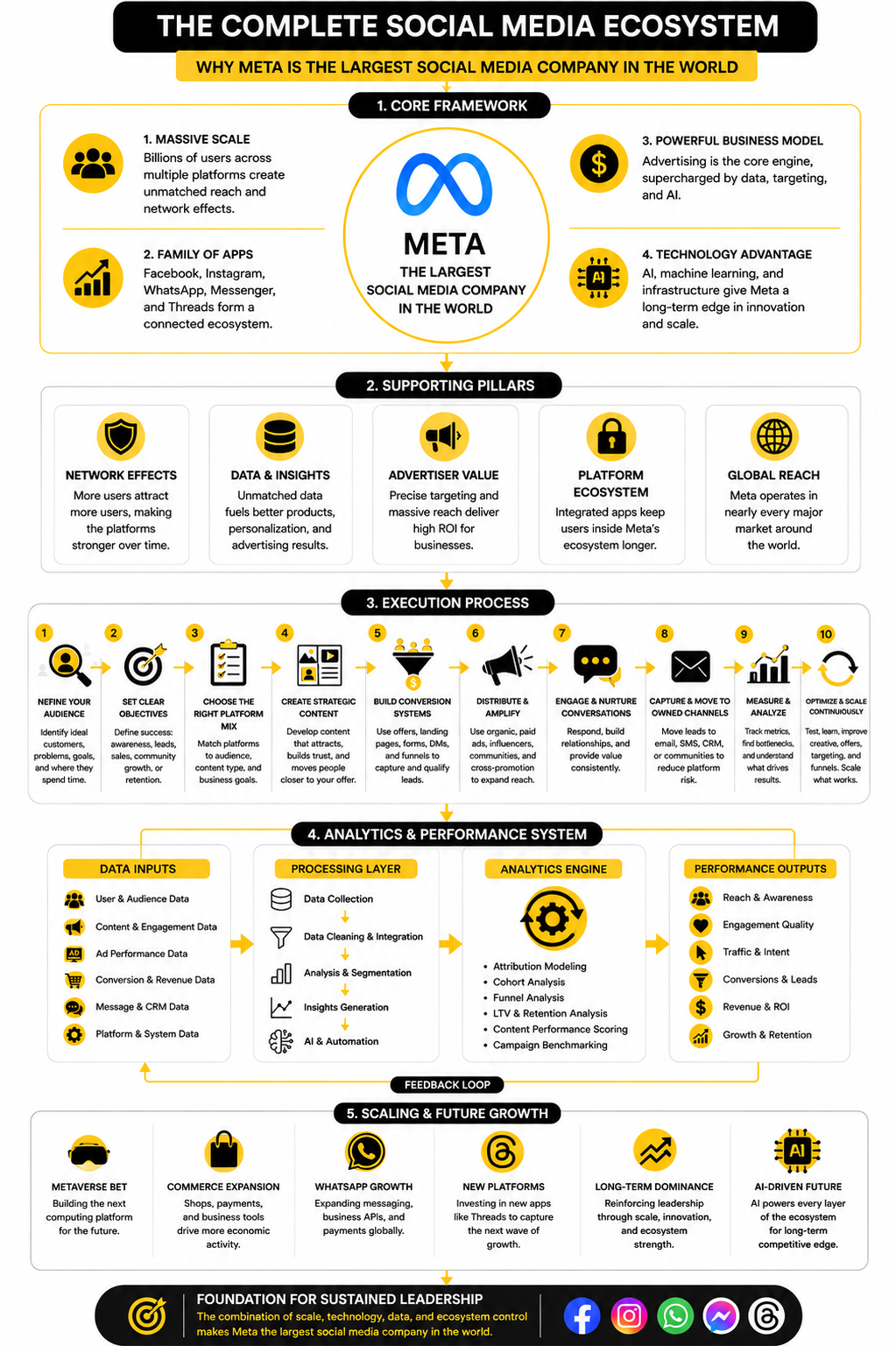
The Smart Way To Use The Biggest Platforms
The smartest strategy is to use the largest platforms for leverage while building assets the business controls. Meta can help you create reach, test creative, retarget buyers, and start conversations. YouTube can build long-term trust. TikTok can expose new angles quickly. Email, CRM, owned content, communities, and direct customer relationships protect the business from platform dependency.
That is the real balance. You want the speed of rented attention and the stability of owned systems. One without the other is fragile.
A simple version of the final system looks like this:
This is why the largest social media company in the world matters, but it should not become the whole strategy. Meta’s size gives you opportunity. Your system turns that opportunity into results.
What Businesses Should Do Next
A small business should start by choosing one primary platform and one follow-up path. For many consumer, creator, local service, and direct-response brands, Meta is still a practical first choice because Instagram, Facebook, Messenger, and WhatsApp can support discovery, retargeting, and conversation. But the goal should be focus, not random activity.
A growing business should build a stronger measurement layer. That means knowing which content creates qualified attention, which ads create profitable demand, which pages convert, and which follow-up steps turn leads into customers. Without that, the team is just guessing with prettier dashboards.
A mature business should build a platform portfolio. It should know where Meta fits, where YouTube fits, where search fits, where email fits, and where community fits. This is how serious companies scale without letting one algorithm control the whole business.
What Is The Largest Social Media Company In The World?
Meta is the largest social media company in the world when measured by company-level reach across major social and messaging apps. Its family of apps includes Facebook, Instagram, WhatsApp, and Messenger, and Meta reported 3.56 billion daily active people in March 2026. That makes Meta the clearest answer when the question is about daily social ecosystem scale.
The answer can change depending on the metric. YouTube is massive in video, Tencent is extremely powerful in China through WeChat and Weixin, and TikTok has major cultural influence. But for global company-level social media reach, Meta remains the strongest answer.
Is Facebook Still The Biggest Social Media Platform?
Facebook remains one of the biggest social platforms, but the bigger story is Meta’s family of apps. Facebook alone is no longer the whole answer because Instagram, WhatsApp, Messenger, and Threads all contribute to Meta’s overall social footprint. The company’s strength comes from the ecosystem, not just one app.
Facebook still matters for groups, local communities, events, marketplace behavior, ads, and older demographics. It may not feel as culturally dominant as it once did, but it remains commercially useful. That is especially true when Facebook is used as part of a broader Meta strategy instead of treated as a standalone posting channel.
Is Meta Bigger Than YouTube?
Meta is bigger at the company-level social ecosystem measurement because it owns multiple large social and messaging products. YouTube, owned by Alphabet, is one of the strongest video platforms in the world and has enormous influence over entertainment, education, creator monetization, and product research. Alphabet said YouTube annual revenue surpassed $60 billion across ads and subscriptions in 2025, which shows how powerful YouTube is as a media business.
The comparison depends on what you are measuring. Meta is stronger as a multi-app social company. YouTube is stronger for evergreen video, search-based discovery, long-form education, and creator-led media.
Is TikTok The Largest Social Media Company In The World?
TikTok is not the largest social media company in the world by company-level global social reach. It is one of the most influential social platforms, especially for short-form video, trend creation, music discovery, and creator culture. Its parent company, ByteDance, is a major global technology company, but TikTok alone does not make it larger than Meta’s combined family of social apps.
That said, TikTok should not be underestimated. In many categories, it is where new demand appears first. A smart business watches TikTok for trend signals, creative formats, language, hooks, and emerging customer behavior even if Meta remains the larger social ecosystem overall.
Why Is Meta Considered The Largest Social Media Company?
Meta is considered the largest social media company because it combines enormous audience reach with massive revenue and multiple social products. Its family of apps reached 3.56 billion daily active people in March 2026, and the company reported $200.97 billion in full-year 2025 revenue. That combination is difficult for any single-platform competitor to match.
The deeper reason is ecosystem control. Meta owns public feeds, short-form video, private messaging, creator tools, business pages, ads, analytics, and AI-driven recommendations. That gives the company more ways to shape how people discover, communicate, and buy.
What Is The Difference Between A Social Platform And A Social Media Company?
A social platform is usually one product, like Instagram, TikTok, YouTube, Snapchat, Pinterest, or X. A social media company can own several platforms and support multiple types of user behavior. Meta is the best example because it owns Facebook, Instagram, WhatsApp, Messenger, and Threads.
This distinction matters because company-level scale is different from app-level scale. An individual platform can dominate one format while a company dominates the broader ecosystem. That is why Meta can be the largest social media company even when another platform leads in a specific behavior like long-form video, short-form trends, or real-time news discussion.
Which Social Media Company Is Best For Advertisers?
Meta is one of the best social media companies for advertisers because it combines massive reach, mature ad tools, multiple placements, retargeting options, and strong conversion optimization. Its Q1 2026 revenue reached $56.31 billion, showing that advertisers still spend heavily across its platforms. That does not mean Meta ads work automatically, but it does mean the platform has a deep advertising marketplace.
The best platform depends on the business. YouTube can be better for education and intent. TikTok can be better for trend testing and low-friction creative reach. Pinterest can work well for planning and visual purchase discovery. Meta is often strongest when the business needs a mix of awareness, retargeting, lead generation, and direct response.
Should Businesses Focus Only On Meta Because It Is The Largest?
No. Businesses should not focus only on Meta just because it is the largest social media company in the world. Size creates opportunity, but it does not remove the need for strategy. A company still needs the right audience, offer, creative, landing page, tracking, and follow-up system.
A better approach is to use Meta where its scale gives you leverage, then build owned assets around it. That might include email lists, CRM data, customer communities, search content, YouTube videos, sales pages, and direct customer relationships. The biggest mistake is letting one platform own the entire relationship with your audience.
What Metrics Matter Most When Comparing Social Media Companies?
The most useful metrics are daily active users, monthly active users, revenue, ad revenue, engagement quality, geographic reach, creator monetization, cultural influence, and ecosystem depth. Daily active users show habit. Revenue shows monetization power. Ecosystem depth shows how many parts of the user journey the company controls.
But the metric should match the decision. If you are choosing where to advertise, revenue and ad tools matter. If you are choosing where to publish educational content, search behavior and watch time matter. If you are choosing where to build community, messaging, groups, and interaction quality matter more than raw reach.
How Should Creators Use The Largest Social Media Platforms?
Creators should use large platforms for discovery, but they should not rely on one algorithm for their whole business. Instagram and Facebook can help with reach, proof, and community. YouTube can help with long-term authority and search. TikTok can help with creative testing and trend discovery.
The key is to move attention into a stronger relationship. That can mean email, a paid community, a newsletter, a product, a service, a booking page, or a direct message system. Followers are useful, but owned relationships are more durable.
How Does AI Affect The Future Of Social Media Companies?
AI is becoming one of the main competitive layers in social media. It affects recommendations, ad delivery, content creation, moderation, customer support, search, and business messaging. Companies with large audiences, large datasets, and large infrastructure budgets have an advantage because they can improve these systems faster.
Meta is investing heavily in AI infrastructure, and its 2026 capital expenditure guidance shows how expensive that race has become. For marketers, the lesson is clear: AI can help with speed and testing, but it will not replace positioning, proof, taste, and offer quality. When everyone can produce more content, better strategy becomes more valuable.
What Are The Biggest Risks Of Depending On Meta?
The biggest risks are algorithm changes, ad cost increases, account restrictions, policy updates, privacy regulation, tracking limitations, and platform competition. Meta is powerful, but it is still rented distribution. A business that depends entirely on Meta can get hurt quickly if performance changes or access is disrupted.
The practical solution is not to avoid Meta. The solution is to build resilience. Use Meta for reach and demand capture, but also build email, CRM, search visibility, customer relationships, direct traffic, and repeat purchase systems.
Is The Largest Social Media Company Always The Best Platform To Use?
No. The largest social media company is not always the best platform for every business. Meta’s scale is valuable, but a smaller platform may have stronger intent, better audience fit, lower competition, or a more useful content format. The best platform is the one that matches the business goal.
For example, a visual planning brand may get strong results from Pinterest. A technical educator may get better long-term value from YouTube. A B2B founder may need LinkedIn more than Instagram. The right decision is based on audience behavior, not platform ego.
What Is The Best Practical Strategy For 2026?
The best practical strategy is to build a platform system instead of chasing isolated posts. Use Meta when you need broad reach, paid acquisition, retargeting, and social conversations. Use YouTube or search content when you need long-term trust and educational depth. Use email, CRM, and direct relationships to protect the business from platform risk.
The simple rule is this: social media creates attention, but the business must own the relationship. That is the strategy that still works when platforms change, costs rise, and new competitors appear.
Build a stronger local presence with BAAM AI
Turn your website, Google profile, social channels, and AI visibility into one growth engine
Most businesses do not need more random marketing activity. They need a consistent presence system that helps the right people find them, trust them, and take action. BAAM AI brings strategy, local SEO, website updates, Google Maps visibility, social content, AI-search readiness, media production, and reporting into one practical monthly engine.
If you want your marketing to keep working after the campaign ends, start with a free BAAM AI presence audit. See how your business shows up today and where the fastest visibility wins are at BAAM AI.