
BAAM AI Blog
Largest Social Media Companies: The Practical Guide To Who Really Controls Social Media
The phrase largest social media companies sounds simple until you try to rank them properly. Are we talking about the companies with the most users, the most revenue, the highest market value, the strongest...
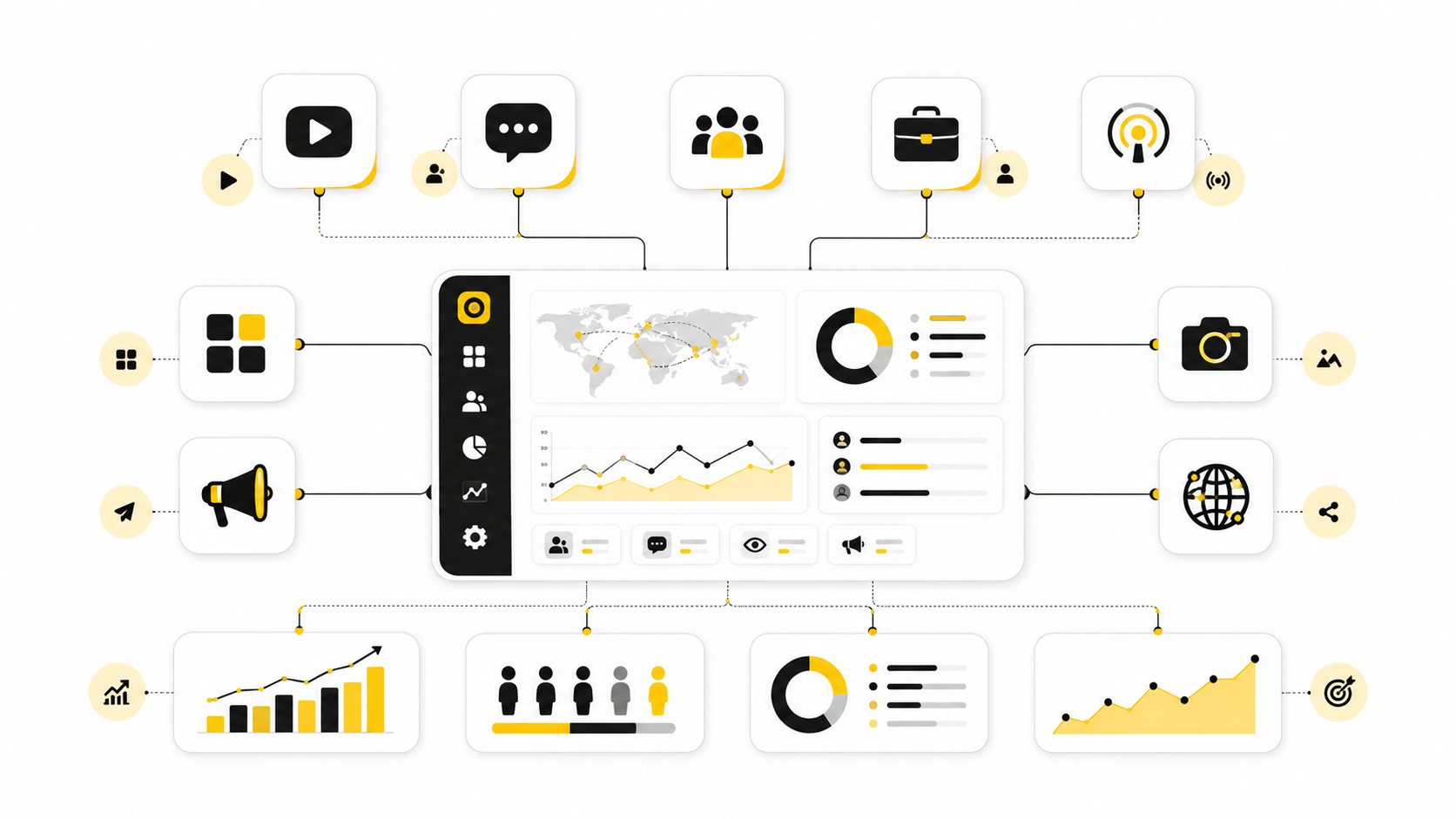
The phrase largest social media companies sounds simple until you try to rank them properly. Are we talking about the companies with the most users, the most revenue, the highest market value, the strongest advertising machine, or the deepest cultural influence? The answer changes depending on the lens.
Meta is the obvious starting point because its family of apps reached 3.58 billion daily active people in December 2025, while full-year revenue reached $200.97 billion. But that does not mean every other company is playing the same game. Tencent’s Weixin and WeChat ecosystem reached 1.418 billion combined monthly active accounts, YouTube passed $60 billion in annual revenue across ads and subscriptions, and companies like Snap, Pinterest, Reddit, Kuaishou, Weibo, and ByteDance each dominate very different slices of attention.
That is why this guide will not treat social media as one flat leaderboard. A company can be huge because it owns the identity layer, like Meta. It can be huge because it owns communication and payments, like Tencent. It can be huge because it owns video attention and creator monetization, like YouTube and TikTok. Or it can be huge because it owns intent-rich communities, discovery behavior, or professional networking.
This matters because marketers, founders, creators, investors, and operators make bad decisions when they confuse platform size with business usefulness. A platform with fewer users can outperform a giant if it has stronger buying intent, better community depth, or a clearer conversion path. At the same time, ignoring the giants is usually a mistake because their distribution power shapes ad costs, content formats, creator behavior, and even how smaller platforms position themselves.
This guide is split into six parts so the argument stays clean and practical. Part 1 sets up the ranking framework and explains why “largest” needs more than one definition. The remaining parts will continue the same structure and use the same section names, so the full article reads like one continuous guide rather than a disconnected list.
Largest Social Media Companies: The Market At A Glance
The largest social media companies are not just websites where people post updates. They are distribution systems, advertising networks, entertainment engines, messaging layers, commerce channels, and increasingly AI data environments. That is why a serious comparison needs to look at both the parent company and the platform portfolio underneath it.
Meta includes Facebook, Instagram, WhatsApp, Messenger, and Threads, which gives it reach across public sharing, private messaging, short-form video, creator discovery, and business communication. Alphabet’s YouTube sits inside a much broader search, cloud, and AI company, but as a media platform it is one of the most powerful social video ecosystems in the world. Tencent, ByteDance, Snap, Pinterest, Reddit, Kuaishou, Weibo, Microsoft’s LinkedIn, and X all compete in social media, but they do not compete with the same business model.
That difference is the whole point. Some platforms are built around friends and family. Some are built around creators. Some are built around public conversation. Some are built around shopping, search, work, communities, or entertainment. A useful ranking has to respect those differences instead of pretending that every company is chasing the same user behavior.
Why The Largest Social Media Companies Matter
The biggest social media companies matter because they control where attention starts, how it moves, and how it gets monetized. When Meta changes its recommendation systems, millions of creators and advertisers feel it. When YouTube pushes Shorts, TikTok reacts, Instagram reacts, creators react, and brands eventually have to adjust their production process.
They also matter because social media is no longer only a top-of-funnel marketing channel. WhatsApp is becoming more important for business messaging, YouTube is a search engine and entertainment platform at the same time, Reddit influences purchase research, Pinterest sits close to planning and shopping intent, and LinkedIn shapes B2B reputation. If you only think of social media as “posting content,” you miss most of the business value.
The financial scale makes this even clearer. Snap reached 946 million global monthly active users in Q4 2025, Pinterest reached 619 million monthly active users in 2025, and Reddit reported 121.4 million daily active uniques in Q4 2025. These are not small niche channels. They are major attention markets with different strengths, weaknesses, and commercial use cases.
The Framework For Ranking Social Media Companies
A ranking of the largest social media companies should start with four practical questions. First, how many people use the company’s platforms? Second, how much money does the company generate from social, advertising, subscriptions, commerce, or related services? Third, how defensible is the ecosystem? Fourth, how useful is the platform for professionals trying to grow an audience, acquire customers, or build a brand?
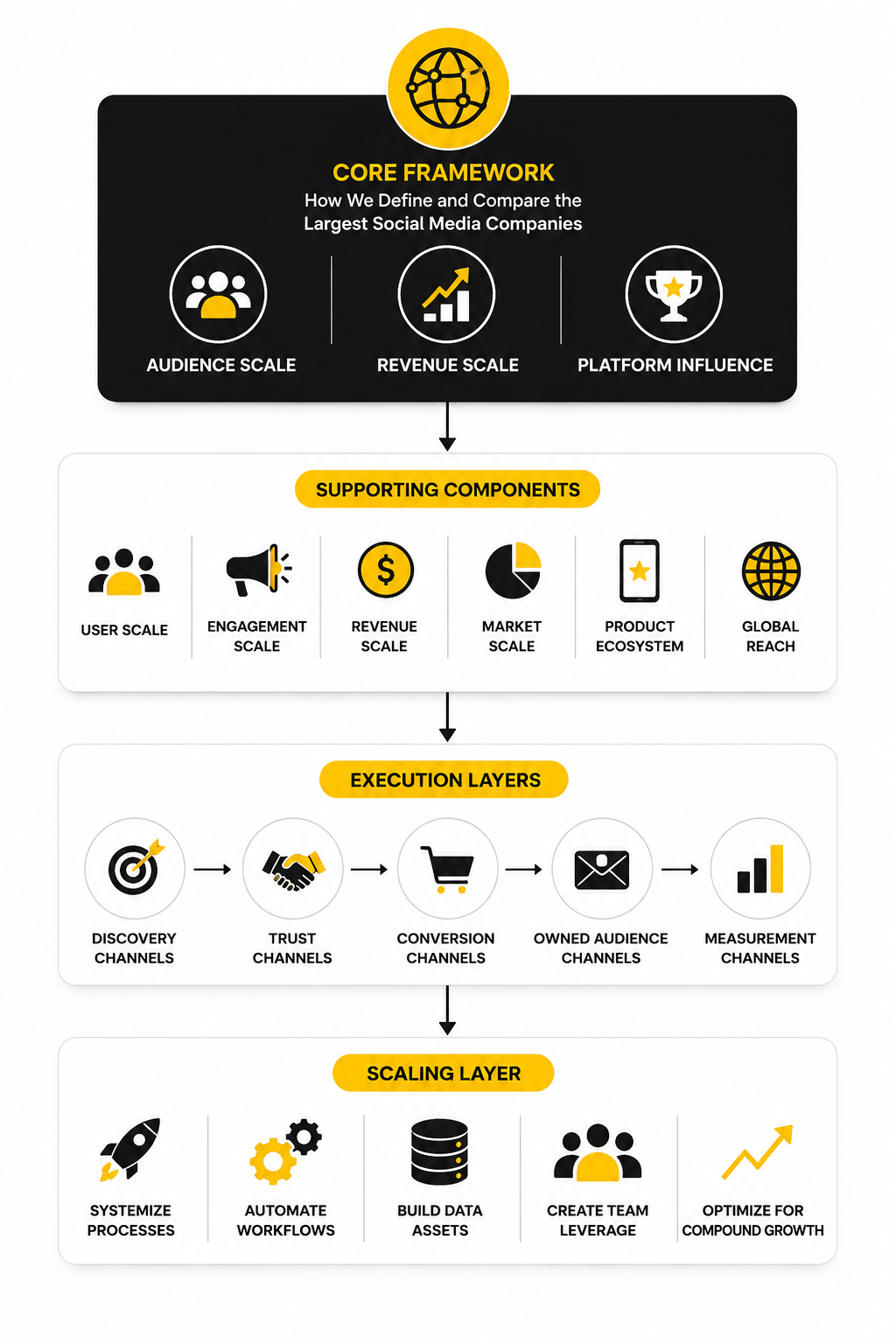
User count is important, but it is not enough. A billion passive accounts are less useful than a smaller base of active buyers, creators, or decision-makers. Revenue is also important, but it can hide what is really happening if the company earns money from cloud, games, search, or enterprise software in addition to social media.
The strongest framework combines reach, monetization, engagement, ecosystem control, and professional utility. Reach tells you how many people the company can touch. Monetization tells you whether that attention turns into durable revenue. Engagement tells you whether users keep coming back. Ecosystem control tells you whether the company owns the full loop from discovery to communication to purchase. Professional utility tells you whether a marketer, creator, founder, or sales team should actually spend time there.
The Core Components We Will Compare
The first component is audience scale, because size still matters. Meta’s daily family audience, Tencent’s WeChat ecosystem, YouTube’s global video reach, TikTok’s cultural force, and LinkedIn’s professional graph all create different forms of leverage. A company with massive audience scale can push new formats quickly, attract creators, and keep advertisers inside its ecosystem.
The second component is business model strength. Meta and Snap rely heavily on advertising. YouTube combines ads and subscriptions. Tencent blends social, games, fintech, business services, subscriptions, and ads. Reddit is building a stronger advertising business around community and search-like behavior, with 2025 revenue rising to $2.2 billion. Weibo, meanwhile, remains heavily tied to advertising and marketing services, with 567 million monthly active users in December 2025.
The third component is platform role. Facebook and Instagram are not used the same way as Reddit. TikTok and YouTube are not the same kind of video platforms, even if they overlap in short-form content. Pinterest is not just a social network; it is a visual discovery and planning engine. LinkedIn is not just a feed; it is a professional identity database, recruiting layer, and B2B content network.
Professional Implementation: How To Use This Guide
For a professional, the goal is not to memorize a list of giant companies. The goal is to understand which company matters for your specific strategy. A local service business, a SaaS founder, an ecommerce brand, a creator, and a media company should not all make the same platform choices.
Use the largest social media companies as a map of attention, not as a command to be everywhere. Meta may be the strongest paid distribution machine for many consumer brands, but YouTube may be better for evergreen authority. Reddit may matter when buyers research problems honestly, while LinkedIn may matter more when the customer is a professional or company decision-maker.
The rest of this guide will break down the companies one by one, but the principle is already clear. The winner is not always the platform with the biggest logo or the highest user count. The winner is the company whose audience, business model, and user behavior match what you are trying to achieve.
Why The Largest Social Media Companies Matter
The largest social media companies matter because they are no longer just places where people talk. They shape news discovery, entertainment habits, product research, creator careers, advertising economics, political conversations, customer support, and even how small businesses build trust. When a platform changes what it rewards, entire industries adjust their content, budgets, and workflows around it.
This is why size cannot be treated as vanity. Meta’s family of apps reached 3.58 billion daily active people in December 2025, which means its decisions affect a meaningful share of the connected world every single day. Alphabet said YouTube passed $60 billion in annual revenue across ads and subscriptions, which shows that social video is not just a content format anymore; it is one of the strongest media businesses on the planet.
The same pattern shows up outside the Western platform stack. Tencent’s Weixin and WeChat reached 1.418 billion monthly active accounts at the end of 2025, and that ecosystem is far more than messaging. It blends communication, payments, mini programs, gaming, content, commerce, and services into a single daily habit, which makes it one of the clearest examples of how social platforms can become operating systems for modern life.
The Attention Layer Controls The Market
Every business wants attention, but the largest social media companies decide how attention is packaged and sold. Meta sells it through feeds, stories, reels, messaging surfaces, and increasingly AI-assisted ad delivery. YouTube sells it through long-form video, Shorts, creator channels, search behavior, connected TV, and subscriptions.
This changes the way companies compete. A brand no longer competes only with similar brands; it competes with creators, memes, news clips, group chats, short videos, livestreams, and algorithmic recommendations. The feed is crowded because the feed is where consumer attention, entertainment, and discovery now collide.
That is also why advertising costs and content expectations keep shifting. If short-form video becomes the dominant discovery format, brands need faster production cycles. If communities become more influential in purchase research, polished ads are not enough. If private messaging becomes the conversion layer, the winning company is not always the one with the biggest public audience; it may be the one that makes follow-up and relationship-building easier.
The Biggest Platforms Set User Expectations
The largest social media companies train users to expect certain behaviors everywhere else. TikTok trained people to swipe through algorithmic video without needing to follow anyone first. Instagram normalized visual identity, creator commerce, and short-form discovery inside a social graph. YouTube trained people to search, learn, subscribe, compare, review, and spend long sessions with individual creators.
That expectation then spreads across the internet. Product pages become more visual. Newsletters become more personality-driven. B2B founders post like creators. Ecommerce brands build content engines instead of relying only on paid traffic. Even tools that are not social networks now add profiles, comments, reactions, sharing, collaboration, and AI-driven recommendations because users already understand those patterns.
This is easy to underestimate. The largest platforms do not just capture attention; they teach the market what digital interaction should feel like. Once a behavior becomes normal on Instagram, YouTube, TikTok, Reddit, LinkedIn, or WeChat, businesses outside social media eventually adapt to it.
Scale Creates Distribution Power
Scale gives a social media company an unfair distribution advantage. A new feature can be placed in front of hundreds of millions of people quickly. A new ad format can become standard because advertisers are already spending there. A new creator tool can change how content gets made because creators cannot ignore the platform where their audience already lives.
Snap is a useful example because it is not as financially dominant as Meta or Alphabet, but its audience is still massive. Snapchat reached 946 million global monthly active users in Q4 2025, which gives the company real cultural weight with younger audiences and visual communication habits. Pinterest also sits in a different category, but its 619 million monthly active users and $4.2 billion in 2025 revenue show how valuable planning and discovery behavior can be when it is attached to shopping intent.
Reddit proves a different point. Its 121.4 million daily active uniques and $2.2 billion in 2025 revenue are smaller than the biggest social networks, but Reddit’s influence is stronger than raw user count suggests because people use it when they want honest opinions, niche knowledge, and real community context. That kind of intent is powerful, especially when users are researching products, software, health questions, financial decisions, hobbies, and career moves.
The Business Models Are Not Equal
The largest social media companies may all compete for attention, but they do not all make money the same way. Meta is still primarily an advertising machine, with social identity, messaging, and recommendation systems feeding its ad products. YouTube combines advertising with subscriptions, music, connected TV, creator monetization, and search-like discovery.
Tencent is more diversified because social communication sits beside games, fintech, business services, subscriptions, and advertising. Kuaishou blends short video, livestreaming, advertising, ecommerce, and AI-driven content tools, with reports showing 740.7 million average monthly active users on the Kuaishou app in Q4 2025. That makes it closer to a social commerce and entertainment ecosystem than a simple video app.
This matters for strategy. A platform built mainly on ads will optimize differently than a platform built around commerce, subscriptions, messaging, or enterprise use. If you are choosing where to publish, advertise, hire, sell, or build community, the monetization model tells you what the platform is likely to prioritize next.
Platform Power Creates Risk Too
The bigger a social media company becomes, the more risk it creates for businesses that depend on it too heavily. Algorithm changes can wipe out reach. Policy updates can limit ad targeting. Account suspensions can cut off customer acquisition. A change in search visibility, feed ranking, or recommendation logic can move revenue without warning.
This is why professional operators should never confuse platform reach with platform ownership. You can borrow distribution from Meta, YouTube, TikTok, Reddit, LinkedIn, Pinterest, Snap, or X, but you do not own the rules. The platform owns the ranking system, the ad auction, the user interface, the enforcement process, and the data access.
That does not mean you should avoid the largest social media companies. It means you should use them with discipline. Build reach where attention already exists, but convert that reach into assets you control: email lists, customer relationships, owned communities, CRM data, direct traffic, and brand search demand.
The Real Advantage Is Matching Platform Behavior To Business Goals
The practical mistake is asking, “Which social media company is the biggest?” The better question is, “Which platform behavior matches the outcome I want?” A huge entertainment platform may be excellent for awareness but weak for direct B2B lead quality. A smaller community platform may be harder to scale but stronger for trust and intent.
For ecommerce, visual discovery and creator-led video may matter more than professional identity. For B2B, LinkedIn and Reddit can be more useful than broad consumer reach because the context is closer to decision-making. For local businesses, Meta’s advertising tools and messaging surfaces can still be extremely practical because they connect discovery, targeting, retargeting, and follow-up in one ecosystem.
That is the lens the rest of this guide will use. The largest social media companies are important, but size alone does not tell you where to invest. The real work is understanding what each company controls, how it makes money, what behavior it rewards, and where that behavior overlaps with your market.
The Framework For Ranking Social Media Companies
A serious ranking of the largest social media companies needs more than a popularity contest. User count matters, but it only tells you how wide the platform can reach. It does not tell you whether people are buying, learning, comparing, messaging, hiring, watching, sharing, or simply scrolling.
The better approach is to score each company through a practical business lens. You want to know how much audience it controls, how deeply people use it, how the company earns money, how strong its ecosystem is, and whether the platform gives professionals a real path to growth. That is where the ranking becomes useful instead of just impressive.
This is also where many articles get lazy. They list the biggest apps, throw in monthly active users, and stop there. But if you are deciding where to invest time, content, ad budget, or partnerships, the real question is not just “who is biggest?” It is “biggest for what?”
Start With Audience Scale
Audience scale is the first filter because the largest social media companies have distribution power that smaller platforms cannot easily copy. Meta’s family of apps reached 3.58 billion daily active people in December 2025, which gives it unmatched reach across Facebook, Instagram, WhatsApp, Messenger, and Threads. Tencent’s Weixin and WeChat ecosystem reached 1.418 billion monthly active accounts, but that audience behaves differently because the product is tied more deeply to messaging, payments, services, and daily utility.
The mistake is assuming all audience numbers mean the same thing. A monthly active user on a messaging super app is not identical to a monthly active user on a visual discovery platform. A daily active user on Reddit does not behave like a YouTube viewer, a LinkedIn professional, or a Snapchat user sending private messages.
So the first step is simple: separate raw reach from useful reach. Raw reach tells you how many people may be accessible. Useful reach tells you whether those people are in the right mindset for your offer, category, or content.
Measure Engagement Quality
Engagement quality is where the largest social media companies start to separate from each other. Some platforms are built around fast entertainment, while others are built around research, conversation, identity, work, or private communication. Those differences determine what kind of content performs and what kind of business result is realistic.
YouTube is powerful because people often arrive with intent. They search, compare, learn, subscribe, and spend longer sessions with creators. Alphabet said YouTube’s annual revenue passed $60 billion across ads and subscriptions, which reflects not just scale, but the strength of video attention as a monetizable habit.
Reddit is different. Its value is less about polished creator content and more about community context, authentic discussion, and problem-specific research. That is why 121.4 million daily active uniques in Q4 2025 can carry more influence than the number alone suggests.
Look At Monetization Strength
Monetization strength shows whether attention can turn into durable business value. A platform can be culturally loud but financially weak. Another platform can be less talked about and still produce strong revenue because its users have clear commercial intent or because advertisers can measure outcomes well.
Meta remains one of the strongest examples of monetization at scale because its ad system connects massive reach with targeting, conversion tracking, creative testing, and AI-assisted delivery. Snap has a different challenge because it reaches a large younger audience, with 946 million monthly active users in Q4 2025, but its revenue per user and advertiser demand do not match Meta’s level. Pinterest sits closer to purchase planning, which gives its ad business a different kind of commercial logic.
This is important for implementation. If your goal is direct response, you need a platform where the ad system, landing page flow, retargeting, and follow-up process can work together. If your goal is authority, you may care more about evergreen discovery and trust than immediate conversion.
Judge Ecosystem Control
Ecosystem control is one of the biggest advantages held by the largest social media companies. A company with multiple surfaces can move users from discovery to messaging, from content to commerce, or from entertainment to payment without sending them elsewhere. That control makes the platform more valuable and makes businesses more dependent on it.
Meta has ecosystem control through identity, social graphs, creators, messaging, advertising, and business tools. Tencent has ecosystem control through WeChat’s role in communication, payments, mini programs, services, and content. YouTube has ecosystem control through creators, search behavior, subscriptions, recommendations, connected TV, and Google’s broader advertising infrastructure.
This is where platform risk becomes part of the ranking. The more complete the ecosystem, the more useful it can be. But the more complete the ecosystem, the more power the company has over your visibility, data access, ad costs, and customer path.
Professional Implementation: Turning The Framework Into A Platform Plan
The framework only matters if it changes what you do. Most teams do not fail because they ignore social media completely. They fail because they treat every platform like the same content calendar with different image sizes.
That is not strategy. That is busywork.
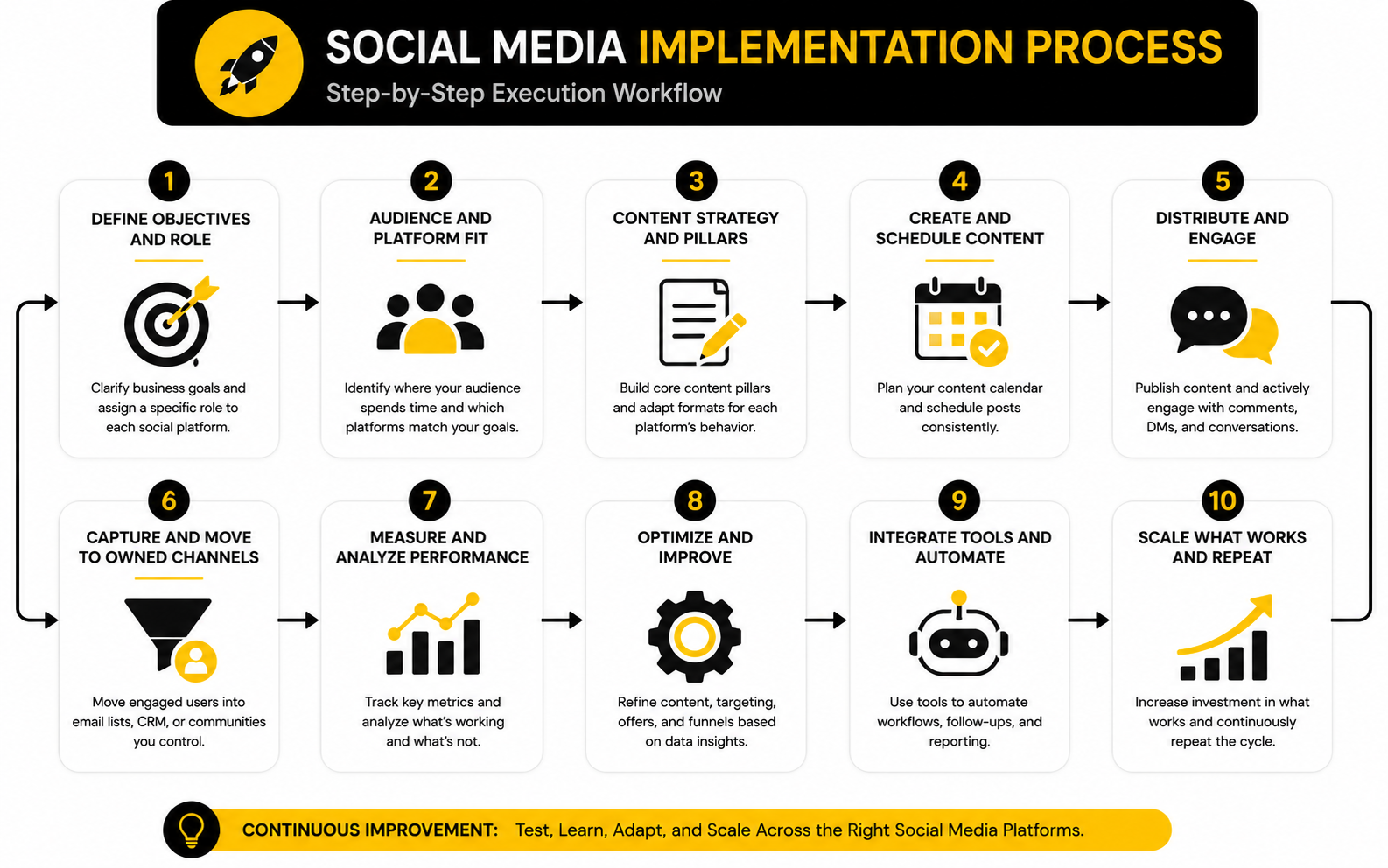
The implementation process should begin with the business goal, not the platform. Decide whether you are trying to create awareness, generate leads, build trust, drive ecommerce sales, recruit talent, support customers, or build a creator-led media asset. Once the goal is clear, the largest social media companies become tools with different strengths instead of shiny objects competing for your attention.
Step 1: Define The Commercial Outcome
Start by writing down the outcome you want from social media in plain language. Not “grow online.” Not “post more.” Something specific, such as generating booked calls, increasing email subscribers, driving product trials, building authority in a niche, improving customer support, or increasing repeat purchases.
This matters because each outcome points to a different platform mix. A B2B consulting firm may care more about LinkedIn, YouTube, Reddit, and email capture. A consumer beauty brand may care more about TikTok, Instagram, YouTube Shorts, Pinterest, and creator partnerships. A local service business may care more about Facebook, Instagram, Google search behavior, messaging, and reviews.
The largest social media companies are only useful when their user behavior matches the commercial job. If the job is wrong, the platform will feel frustrating even when the audience is massive.
Step 2: Match Platform Behavior To Funnel Stage
Next, match each platform to the stage of the customer journey where it naturally performs. TikTok, Instagram Reels, Snapchat Spotlight, and YouTube Shorts can be strong for discovery because the format is built for fast recommendations. YouTube long-form can support education, comparison, and trust because people spend more time with specific topics and creators.
Reddit can be valuable when buyers want unfiltered discussion. Pinterest can support planning and product discovery. LinkedIn can help with professional credibility, recruiting, partnerships, and B2B demand. WhatsApp, Messenger, and Instagram DMs can support follow-up because private conversation often becomes more important after the first touch.
This keeps your strategy grounded. You do not need every platform to do everything. You need each platform to do the job it is naturally good at.
Step 3: Build A Content Operating System
Once the platform roles are clear, build a content operating system instead of improvising every week. Start with one core idea, then adapt it based on how each platform works. A strong YouTube video might become short clips, LinkedIn posts, Reddit discussion prompts, Instagram carousels, newsletter sections, and sales enablement material.
This is where tools can help, but only if the strategy comes first. A team managing multiple channels may use Buffer to plan and schedule content, while a business that depends on Instagram or Facebook messaging may use ManyChat to turn comments and DMs into structured conversations. If the follow-up needs to connect social leads with email and CRM workflows, GoHighLevel can make sense for agencies and service businesses.
The key is not the tool itself. The key is turning attention into a repeatable process. Publish, capture, follow up, measure, improve.
Step 4: Separate Owned Assets From Borrowed Reach
Every platform audience is borrowed until you create an owned relationship. Followers are useful, but they are not the same as customers, subscribers, contacts, or community members you can reach directly. The largest social media companies can change the rules at any time, so your implementation should always include a path from platform attention to owned assets.
That usually means email, SMS where appropriate, CRM records, private communities, first-party customer data, and direct website traffic. If social content creates interest, the next step should be easy: subscribe, book, download, request a quote, join, buy, or reply. A simple email tool like Brevo can be enough for many teams that need to turn social attention into direct communication.
This is not optional if social media is part of your acquisition strategy. You can use the largest platforms aggressively, but you should not let them become your only customer database. Borrow reach, then convert it into something you control.
Step 5: Track Platform-Specific Metrics
Do not measure every platform with the same scoreboard. Reach matters when you are testing awareness. Watch time matters when you are building authority with video. Saves and clicks matter when users are researching or planning. Replies and booked calls matter when social media is supporting sales.
A practical dashboard should separate leading indicators from business outcomes. Leading indicators include impressions, engagement rate, completion rate, saves, comments, shares, profile visits, and direct messages. Business outcomes include subscribers, qualified leads, booked appointments, trial starts, sales, retention, and customer lifetime value.
This helps you avoid false wins. A post can get attention and still fail commercially. Another post can look modest publicly but produce strong leads because it reached the right people with the right intent.
Step 6: Review The Platform Mix Quarterly
The largest social media companies evolve quickly, so your platform plan should not be frozen for a year. Algorithms shift, ad costs change, creator behavior moves, audience habits mature, and new features appear. A quarterly review is enough for most teams to stay disciplined without constantly chasing trends.
During the review, ask three questions. Which platforms created measurable business value? Which platforms created useful attention but weak conversion? Which platforms consumed time without a clear return? The answers should shape your next quarter’s budget, content volume, creative testing, and follow-up systems.
This is where mature operators gain an edge. They do not worship platforms. They use them, measure them, and adjust when the numbers show that attention is moving somewhere else.
Statistics And Data
The data behind the largest social media companies only becomes useful when you know what each number is trying to tell you. A user count tells you reach. Revenue tells you monetization strength. Daily activity tells you habit. Average revenue per user tells you how efficiently the company turns attention into money.
That is why you should never read social media statistics as isolated trivia. A platform with huge reach but weak monetization may still be useful for awareness. A platform with a smaller audience but higher commercial intent may be better for sales. A platform with strong daily behavior may be valuable for community and retention, even if it is not the first place you would run direct-response ads.
For professionals, the job is to translate the numbers into decisions. Which platform deserves content volume? Which platform deserves paid budget? Which platform deserves a conversion system? Which platform is mostly useful for research, credibility, or support? The data should answer those questions, not just decorate a report.
The Numbers That Actually Matter
The first number to watch is active audience, but it needs context. Meta’s family of apps reached 3.58 billion daily active people in December 2025, which makes it the broadest daily social ecosystem in this comparison. Tencent’s Weixin and WeChat reached 1.418 billion monthly active accounts, but its value is not only audience size; it is the way messaging, services, payments, content, and mini programs are bundled into one daily environment.
The second number is revenue, because revenue shows whether attention has business value at scale. Meta reported $200.97 billion in 2025 revenue, while YouTube passed $60 billion in annual revenue across ads and subscriptions. Those numbers matter because they show that social media is not a side channel; it is a core part of the global advertising, entertainment, and creator economy.
The third number is engagement depth. Reddit’s 121.4 million daily active uniques in Q4 2025 is much smaller than Meta’s audience, but daily community participation has a different kind of value. Reddit can influence buying decisions, product research, software comparisons, health questions, career decisions, and niche hobbies because users often show up with a problem they want solved.
Benchmarks Need A Job
Benchmarks are useful only when they are connected to a goal. If your goal is awareness, you care about reach, impressions, frequency, video views, and audience growth. If your goal is lead generation, you care about click quality, cost per lead, booked calls, form completion rate, and sales conversion.
This is where many teams misread the largest social media companies. They compare Instagram likes to YouTube watch time, LinkedIn comments to Reddit threads, or Pinterest saves to TikTok views as if those actions mean the same thing. They do not. Each platform creates different behaviors, so each platform needs its own performance interpretation.
A good benchmark answers one question: “Is this platform doing the job we assigned to it?” If TikTok is your discovery engine, measure discovery. If YouTube is your authority engine, measure search visibility, watch time, subscriber quality, and assisted conversions. If LinkedIn is your B2B trust channel, measure profile visits, qualified conversations, referral traffic, and pipeline influence.
Build A Measurement System Before You Scale
Measurement should not start after the campaign is already running. Before you publish heavily or increase budget, decide what each platform is responsible for. Then build a simple reporting system that shows whether the platform is creating the right kind of movement.
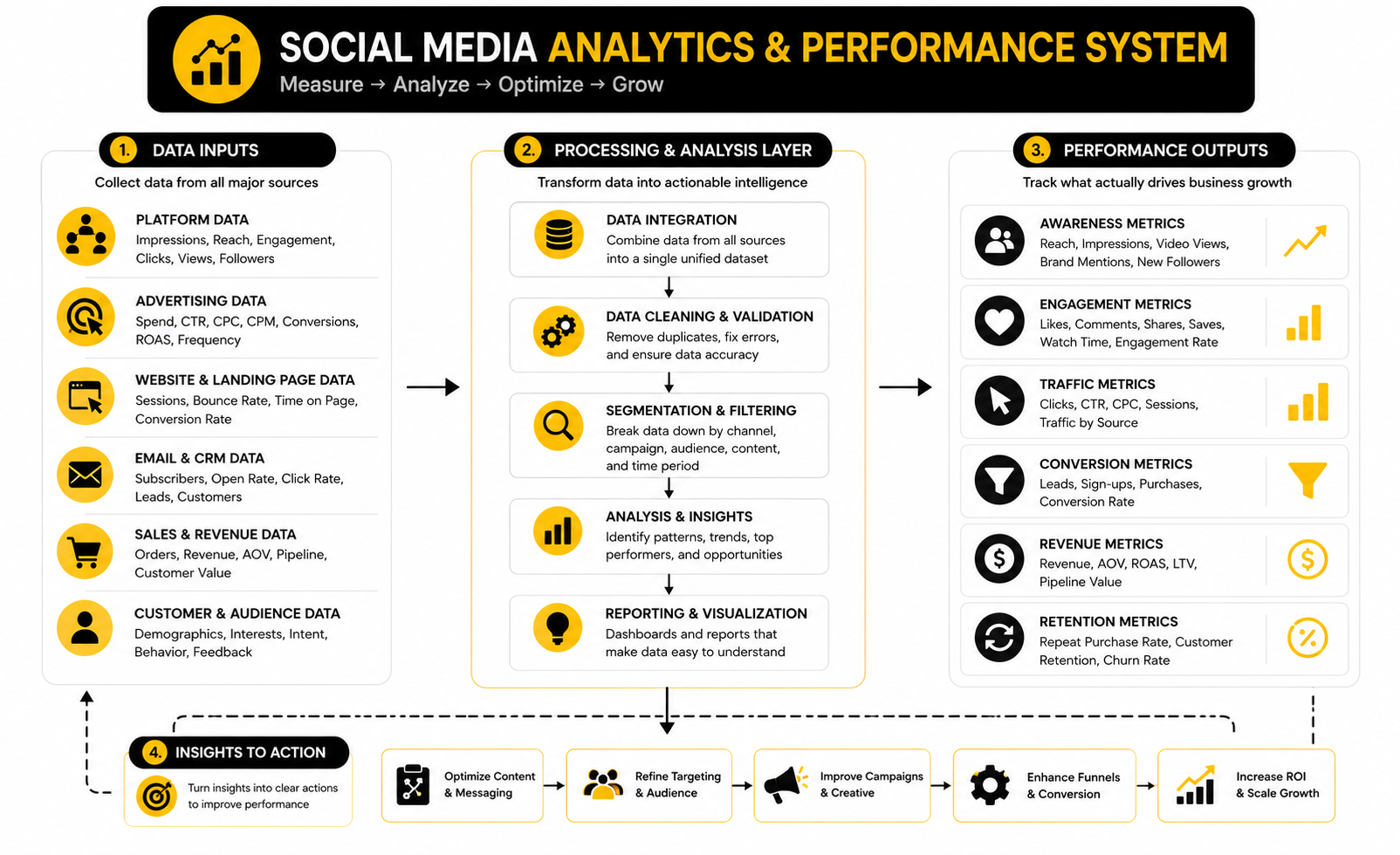
A practical measurement system has four layers. The first layer is platform activity: posts, videos, comments, messages, ad spend, and creative tests. The second layer is platform response: impressions, views, watch time, saves, shares, comments, click-through rate, direct messages, and follower growth. The third layer is owned conversion: email subscribers, CRM contacts, booked calls, product trials, purchases, and repeat visits. The fourth layer is business outcome: revenue, pipeline, customer acquisition cost, retention, and lifetime value.
This structure stops you from overvaluing surface-level engagement. A viral post is nice, but it is not automatically a business win. A smaller post that drives qualified inquiries, newsletter subscribers, demos, or purchases may be far more valuable.
How To Read Platform Performance Signals
Performance signals should be read as clues about user intent. A save usually means the content has future utility. A share usually means the content carries identity, emotion, usefulness, or social currency. A comment can signal interest, disagreement, community energy, or confusion, depending on the platform and topic.
Video retention is one of the most useful signals because it shows whether the promise of the content matched the viewer’s expectation. If viewers drop quickly, the hook, format, pacing, or audience targeting is off. If viewers stay but do not click, the content may be valuable but disconnected from the next step.
Direct messages and replies are different again. They often signal higher intent because the user is moving from public consumption to private interaction. That is why businesses using Instagram, Facebook, WhatsApp, or Messenger should treat conversation volume and conversation quality as serious metrics, not just customer support noise.
Compare Companies By Monetization Efficiency
When comparing the largest social media companies, monetization efficiency is more revealing than raw size. Pinterest reached 619 million monthly active users and $4.2 billion in 2025 revenue, which tells you it has meaningful commercial value but still monetizes differently from Meta. Snap reached 946 million monthly active users in Q4 2025, but its business depends on improving ad performance, subscriptions, augmented reality, and engagement quality.
Weibo’s 567 million monthly active users and 252 million daily active users in December 2025 show strong scale in China’s public conversation layer. Kuaishou’s full-year results showed RMB142.8 billion in revenue and 410.2 million average daily active users in 2025, which makes it important to read as a video, livestreaming, commerce, and AI-enhanced content ecosystem rather than a simple social app.
The action point is straightforward. Do not assume the company with more users is automatically better for advertisers, creators, or brands. Look at how the company converts attention into revenue, how strong the commercial moments are, and whether the platform gives your business a clear path from discovery to conversion.
Separate Leading Indicators From Lagging Indicators
Leading indicators tell you whether your strategy is gaining traction before revenue fully shows up. These include reach, watch time, search visibility, saves, shares, comments, direct messages, click-through rate, email signups, and profile visits. They are useful because they help you adjust content and targeting early.
Lagging indicators tell you whether the strategy created business value. These include revenue, profit, sales-qualified leads, pipeline, customer acquisition cost, customer lifetime value, retention, and repeat purchase rate. They are slower, but they are the metrics that decide whether the channel deserves more investment.
The problem starts when teams confuse the two. A high-engagement post is not the same as a profitable channel. A low-engagement post is not automatically a failure if it reaches a high-value audience and creates qualified conversations.
Use Data To Decide What To Stop Doing
Analytics are not only for finding winners. They are also for cutting waste. If a platform consistently consumes time without producing useful reach, qualified attention, owned audience growth, or revenue influence, it should not stay in the plan just because it is popular.
This is especially important with the largest social media companies because their scale creates pressure to participate everywhere. Everyone feels like they should be on Instagram, TikTok, YouTube, LinkedIn, Reddit, Pinterest, X, Facebook, and whatever is rising next. That is how teams become busy and ineffective.
Use the data to make sharper choices. Keep the platforms that create strategic value. Reduce the platforms that only create vanity metrics. Test new formats with discipline, but do not let platform hype replace measurement.
Turn Analytics Into A Monthly Decision Rhythm
A useful analytics process should end with decisions, not screenshots. Once a month, review each platform against the job it was assigned. Ask whether it improved reach, trust, conversion, retention, or customer learning.
Then decide what changes next. Increase production where the numbers show repeatable traction. Improve creative where retention is weak. Strengthen calls to action where engagement is strong but conversion is poor. Fix follow-up where leads are coming in but sales are not closing.
This rhythm keeps social media practical. The largest social media companies will keep changing their algorithms, formats, and monetization systems. Your advantage comes from reading the signals faster, acting on them calmly, and building a measurement system that turns attention into business learning.
Advanced Strategy For The Largest Social Media Companies
Once the basics are working, the strategy becomes less about choosing platforms and more about managing tradeoffs. The largest social media companies give you reach, targeting, creative feedback, audience learning, and conversion opportunities. They also create dependency, complexity, rising costs, and constant pressure to keep producing.
That is the tension professionals have to manage. You want the upside of massive platforms without letting your business become fragile. You want content that can travel across Meta, YouTube, LinkedIn, Reddit, TikTok, Pinterest, Snap, and X, but you also need systems that turn that attention into owned demand.
This is where mature teams separate themselves. They do not chase every new feature. They build a platform portfolio, assign each channel a job, protect the business from single-platform risk, and scale only when the economics are clear.
The Platform Portfolio Mindset
A platform portfolio means you stop asking one channel to do everything. One platform can drive discovery, another can build trust, another can support research, another can handle retargeting, and another can convert through private conversation. That is a much healthier way to use the largest social media companies than treating every platform like a place to repost the same content.
For example, YouTube can support long-term authority because videos can keep being discovered after the publish date. Instagram and TikTok can create fast awareness through short-form content. Reddit can reveal what people actually say when they are not talking to a brand. LinkedIn can build professional trust and relationship depth in B2B markets.
The key is assigning roles before assigning budget. If a platform’s role is awareness, do not judge it only by last-click sales. If a platform’s role is conversion, do not celebrate reach while ignoring lead quality. Each channel needs a job, a metric, and a reason to stay in the portfolio.
The Risk Of Platform Dependency
The largest social media companies are powerful because they own the rules. They decide how content ranks, what ads cost, which accounts are trusted, which formats get pushed, and what data is available to marketers. That is useful when the system is working in your favor, but dangerous when your entire business depends on one feed, one ad account, or one algorithm.
This risk is not theoretical. Reddit noted in its 2024 results that a Google Search algorithm change created user-growth volatility before traffic normalized, showing how even a major platform can be affected by another major platform’s distribution decisions. Reddit still grew strongly afterward, but the example is useful because it shows how interconnected the attention ecosystem has become.
The practical response is simple. Use borrowed reach, but build owned assets. Every serious social strategy should move some portion of attention into email lists, CRM records, community membership, direct search demand, sales conversations, and repeat customer relationships.
Scaling Content Without Killing Quality
Scaling social media content is not just posting more. More volume can help, but only if the ideas are strong and the feedback loop is clear. Weak content at scale just creates more noise, more production cost, and more confusing analytics.
The better approach is to scale from proven themes. Find the topics, angles, hooks, objections, comparisons, tutorials, stories, and offers that already show signs of working. Then adapt those ideas to the format and psychology of each platform instead of copying them blindly.
This matters because the largest social media companies reward different behaviors. A YouTube title needs to earn a click and support watch time. A LinkedIn post needs a strong point of view and professional relevance. A Reddit contribution needs to feel useful inside the community, not like a brand trying to sneak in a pitch.
Paid And Organic Should Not Fight Each Other
Paid and organic social should work together, not live in separate worlds. Organic content helps you discover what people care about, which hooks create attention, which objections appear repeatedly, and which messages earn trust. Paid campaigns can then amplify the strongest angles with more precision and speed.
This is especially important on platforms where ad systems are expensive and competitive. Meta’s 2025 revenue reached $200.97 billion, which reflects how mature and heavily used its advertising ecosystem has become. You do not want to enter that kind of auction with random creative, weak landing pages, and no follow-up system.
A practical setup is to use organic content as a research engine and paid media as a scaling engine. When a message works organically, test it in ads. When paid ads reveal a high-converting promise, turn it into more organic content. The loop gets stronger when creative, media buying, landing pages, email, and sales follow-up share the same learning.
Conversion Infrastructure Becomes The Bottleneck
As traffic grows, the bottleneck often moves away from content and into conversion infrastructure. A business can generate attention from the largest social media companies and still lose money if the landing page is slow, the offer is unclear, the follow-up is weak, or the sales process is messy. Attention is only valuable when the next step is obvious.
This is where the stack matters. A creator or small business may only need a clean landing page, an email tool, and a simple booking flow. A service business or agency may need CRM automation, pipeline tracking, appointment reminders, missed-call text-back, and multi-channel follow-up through a tool like GoHighLevel. An ecommerce team may need better product pages, post-click testing, email segmentation, and retargeting before spending more on social ads.
Do not scale traffic into a broken funnel. Fix the offer, page, follow-up, and measurement first. Otherwise, the platform gets blamed when the real problem is the business system after the click.
AI Will Change The Cost Of Content
AI is already changing how the largest social media companies rank, create, recommend, moderate, and monetize content. Meta has tied its growth plans heavily to AI infrastructure, while Tencent’s 2025 results highlighted AI improvements in ad targeting, games, cloud, and Weixin services. Alphabet’s YouTube is also part of a broader AI-driven company where recommendations, creator tools, search behavior, and advertising products keep evolving together.
For operators, the big shift is not just faster content creation. The bigger shift is that more companies will produce more content, which makes originality and distribution strategy more valuable. AI can help with research, repurposing, editing, scripting, workflows, and customer support, but it cannot replace a sharp point of view or real customer understanding.
The winners will use AI to increase speed without becoming generic. They will produce more variations, test faster, summarize customer language, improve workflows, and support creators. But they will still need taste, judgment, positioning, and a real reason for people to care.
Community Is Harder To Fake Than Content
Content can be scaled with systems. Community is harder. The largest social media companies can bring people together, but real community depends on repeated interaction, shared identity, trust, moderation, and a reason to return.
This is why Reddit remains strategically interesting even though its audience is smaller than Meta, YouTube, or Tencent. Reddit’s 121.4 million daily active uniques in Q4 2025 matter because the platform organizes attention around topics, problems, and communities rather than only personalities or feeds. That structure can influence what people believe, compare, buy, avoid, and recommend.
Brands should be careful here. Community platforms punish lazy promotion faster than feed-based platforms. The right move is to listen first, understand the norms, contribute real value, and use insights from the community to improve products, messaging, support, and content.
International Strategy Changes The Ranking
The list of the largest social media companies looks different when you think globally. Meta and YouTube have huge international reach, but Tencent, ByteDance, Kuaishou, Weibo, Line, Kakao, and regional platforms can be far more important in specific markets. A global strategy cannot assume the same platform mix works everywhere.
Tencent’s Weixin and WeChat reached 1.418 billion monthly active accounts, but its importance is concentrated around a very different ecosystem than Facebook or Instagram. Kuaishou’s 2025 revenue reached RMB142.8 billion, and its role in short video, livestreaming, ecommerce, and AI content makes it much more relevant in China than many Western marketers realize.
The lesson is practical. If you sell in one country, prioritize the platforms that shape buyer behavior in that country. If you sell globally, build regional platform maps instead of forcing one universal social strategy across every market.
Regulation And Trust Will Shape The Next Phase
The largest social media companies are now big enough to attract constant regulatory attention. Privacy, children’s safety, competition, AI-generated content, political advertising, data access, copyright, and platform accountability are not side issues anymore. They affect product design, targeting, measurement, ad performance, creator monetization, and brand safety.
For businesses, this means platform strategy needs a trust layer. Do not build growth on tactics that depend on unclear consent, misleading creative, spammy automation, or fragile data access. Those shortcuts tend to break when platforms tighten enforcement or regulators increase pressure.
The safer long-term move is to build transparent funnels, clear opt-ins, honest creative, useful content, strong first-party data, and better customer experiences. That may sound less exciting than a growth hack, but it survives platform changes much better.
Expert-Level Platform Selection
At an advanced level, platform selection should be based on fit, not fashion. The largest social media companies are not interchangeable, and the biggest one is not always the best one for your business. The right platform is where your audience, message, format, economics, and follow-up process line up.
A strong selection process looks at five questions. Where does the audience already spend meaningful time? What behavior are they showing on that platform? Can the business create native content for that environment? Can the platform drive a measurable next step? Can the company keep learning and improving without burning out the team?
If the answer is yes, the platform deserves serious investment. If the answer is no, keep it as a listening channel, a light presence, or a future test. Focus is not a weakness in social media; it is usually the only way to win.
The Final System For Using The Largest Social Media Companies
At this point, the big picture should be clear. The largest social media companies are not just ranked by audience size; they are ranked by the kind of behavior they control. Some control entertainment, some control messaging, some control professional identity, some control communities, and some control discovery before a purchase.
The final system is to treat social media as an ecosystem, not a checklist. You need discovery channels, trust channels, conversion channels, owned audience channels, and measurement channels working together. When those pieces connect, the platform mix becomes a growth system instead of a random posting schedule.
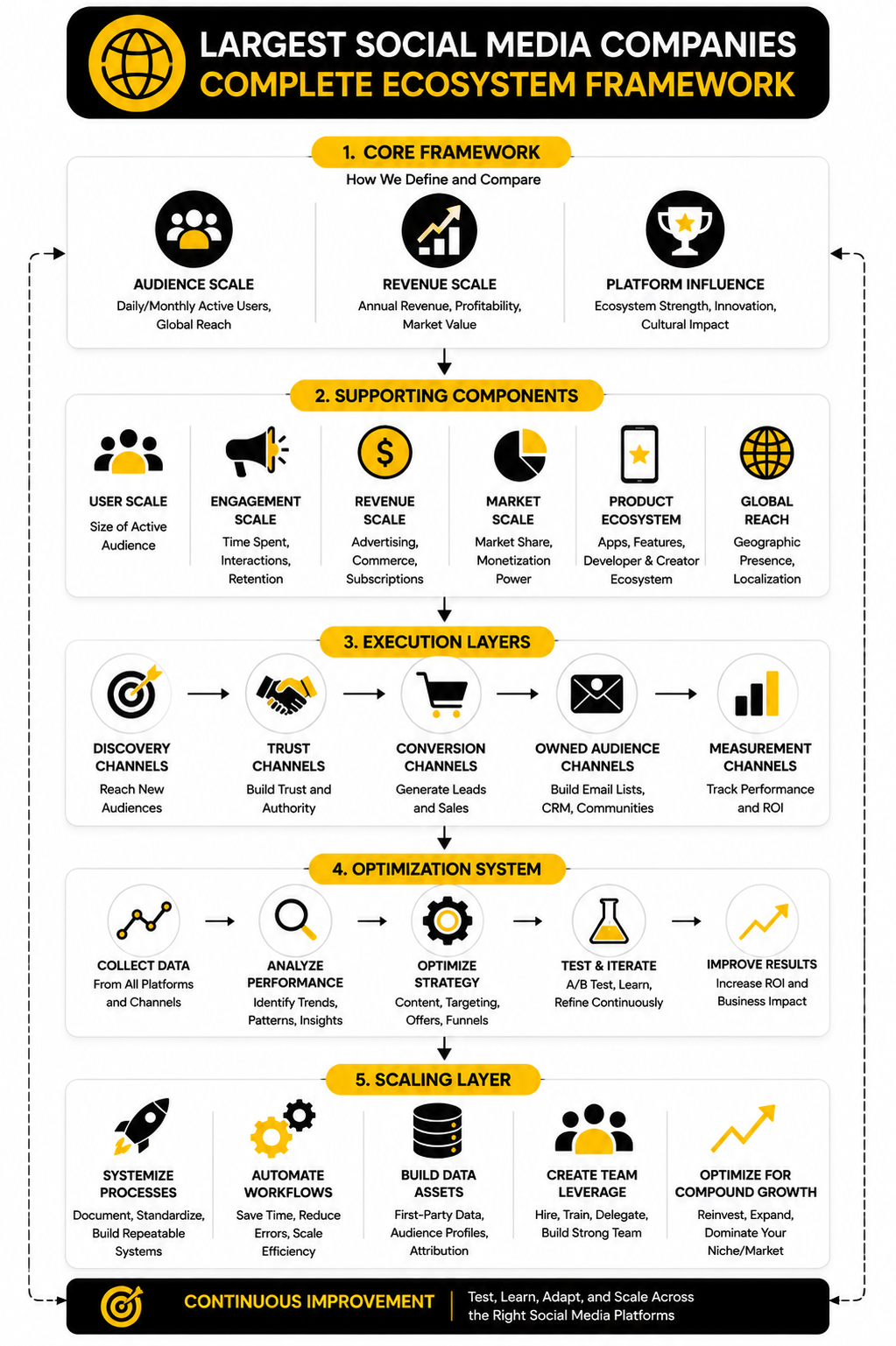
The best teams make this boring in the right way. They know which platforms create reach, which platforms create intent, which platforms create conversations, and which platforms create revenue. Then they review the system regularly, cut what is not working, and double down where the data proves there is a real business case.
What Are The Largest Social Media Companies?
The largest social media companies include Meta, Alphabet through YouTube, Tencent, ByteDance, Snap, Pinterest, Reddit, Microsoft through LinkedIn, Kuaishou, Weibo, and X. The ranking depends on whether you measure by users, revenue, market value, platform influence, or business model strength. Meta is usually the clearest leader by family reach, with 3.58 billion daily active people across its apps in December 2025.
Which Company Owns The Most Social Media Platforms?
Meta owns several of the most important social platforms, including Facebook, Instagram, WhatsApp, Messenger, and Threads. That gives it a broader social portfolio than most competitors because it covers public posting, private messaging, creator discovery, short-form video, groups, and business communication. This is why Meta often sits at the center of any serious discussion about the largest social media companies.
Is YouTube A Social Media Company?
Yes, YouTube should be treated as a major social media platform, even though it is also a video search engine, streaming platform, creator economy, and advertising network. Users subscribe, comment, share, follow creators, build communities, and discover content through recommendations. YouTube’s annual revenue passed $60 billion across ads and subscriptions, which makes it one of the most important social media businesses in the world.
Why Is Tencent Included In A Social Media Company Ranking?
Tencent belongs in the ranking because Weixin and WeChat are massive social communication ecosystems, not just messaging apps. They combine chat, content, payments, services, mini programs, games, and business tools in one daily environment. Tencent’s Weixin and WeChat reached 1.418 billion monthly active accounts, which makes the company impossible to ignore in a global view of social media.
Is TikTok One Of The Largest Social Media Platforms?
TikTok is one of the most culturally important social platforms, and ByteDance is one of the most important private technology companies connected to social media. The challenge is that ByteDance does not report public financials in the same way as listed companies such as Meta, Snap, Pinterest, Reddit, Tencent, or Alphabet. That means TikTok is clearly part of the discussion, but its exact ranking depends on which verified data points are available.
Which Social Media Company Is Best For Advertising?
Meta is usually the strongest all-around advertising machine because of its reach, targeting infrastructure, conversion tools, and advertiser adoption. YouTube is extremely strong for video advertising, search-driven discovery, creator partnerships, and connected TV reach. Pinterest, Reddit, LinkedIn, Snap, TikTok, and X can also be valuable, but each needs to be judged by audience behavior, creative fit, and conversion quality.
Which Platform Is Best For B2B Marketing?
LinkedIn is often the most obvious B2B platform because it is built around professional identity, career context, recruiting, and business relationships. YouTube can be powerful for B2B education because buyers research problems, tutorials, comparisons, and expert opinions there. Reddit can also matter when buyers want honest peer discussion before trusting a vendor or product category.
Which Platform Is Best For Ecommerce Brands?
Ecommerce brands usually benefit from visual and video-first platforms because products need to be seen, demonstrated, compared, and remembered. Instagram, TikTok, YouTube, Pinterest, and Facebook can all play different roles in an ecommerce system. The best choice depends on whether the brand needs awareness, product discovery, creator content, retargeting, shopping intent, or direct conversion.
Why Do User Numbers Not Tell The Whole Story?
User numbers show potential reach, but they do not show intent, trust, monetization, or buying behavior. A platform with fewer users can outperform a larger platform if those users are closer to a purchase or more engaged with the topic. That is why Reddit, Pinterest, LinkedIn, and YouTube can be strategically valuable even when they are smaller than Meta’s full family of apps.
How Should A Business Choose Between The Largest Social Media Companies?
A business should start with the goal, not the platform. If the goal is awareness, short-form video and broad-feed platforms may be useful. If the goal is trust, YouTube, LinkedIn, Reddit, and strong community channels may be better. If the goal is conversion, the business needs a clean path from content or ads into email, CRM, messaging, booking, checkout, or sales follow-up.
What Metrics Matter Most When Comparing Social Platforms?
The most useful metrics are active audience, engagement quality, revenue strength, ad performance, conversion rate, retention, and owned-audience growth. Surface-level metrics like likes and impressions can help, but they should not be treated as final proof of success. A strong measurement system connects platform activity to real business outcomes such as leads, sales, pipeline, customers, and repeat purchases.
How Often Should A Company Review Its Social Media Strategy?
A quarterly review is practical for most businesses because it gives enough time for useful data to accumulate. Monthly reviews are better for content performance, ad testing, and creative iteration. Annual reviews are too slow because the largest social media companies change their algorithms, ad products, formats, and user behavior much faster than that.
Should Small Businesses Use The Largest Social Media Companies?
Yes, but small businesses should not try to use all of them at once. The better move is to choose one or two platforms where the audience already has the right behavior, then build a simple system for publishing, capturing leads, following up, and measuring results. Small businesses usually win with focus, speed, and consistency rather than trying to copy enterprise social media teams.
What Is The Biggest Risk Of Relying On Social Media?
The biggest risk is building the entire business on borrowed reach. A platform can change its algorithm, suspend an account, raise ad costs, restrict targeting, or reduce organic visibility with little warning. The safest strategy is to use social platforms for reach while moving serious relationships into assets the business controls, such as email, CRM, direct customer data, communities, and repeat purchase systems.
Will AI Change The Largest Social Media Companies?
AI is already changing how content is ranked, created, moderated, recommended, translated, and monetized. The largest social media companies are investing heavily in AI because better recommendations and ad targeting can increase engagement and revenue. For marketers, the practical point is simple: AI can speed up production and analysis, but it does not replace positioning, taste, customer insight, or a strong offer.
Build a stronger local presence with BAAM AI
Turn your website, Google profile, social channels, and AI visibility into one growth engine
Most businesses do not need more random marketing activity. They need a consistent presence system that helps the right people find them, trust them, and take action. BAAM AI brings strategy, local SEO, website updates, Google Maps visibility, social content, AI-search readiness, media production, and reporting into one practical monthly engine.
If you want your marketing to keep working after the campaign ends, start with a free BAAM AI presence audit. See how your business shows up today and where the fastest visibility wins are at BAAM AI.