
BAAM AI Blog
Landing Page Copywriting Services: The Practical Guide To Pages That Convert
A landing page does not win because it sounds clever. It wins because the right person lands on it, understands the offer fast, believes the promise, and feels safe enough to take the next step.
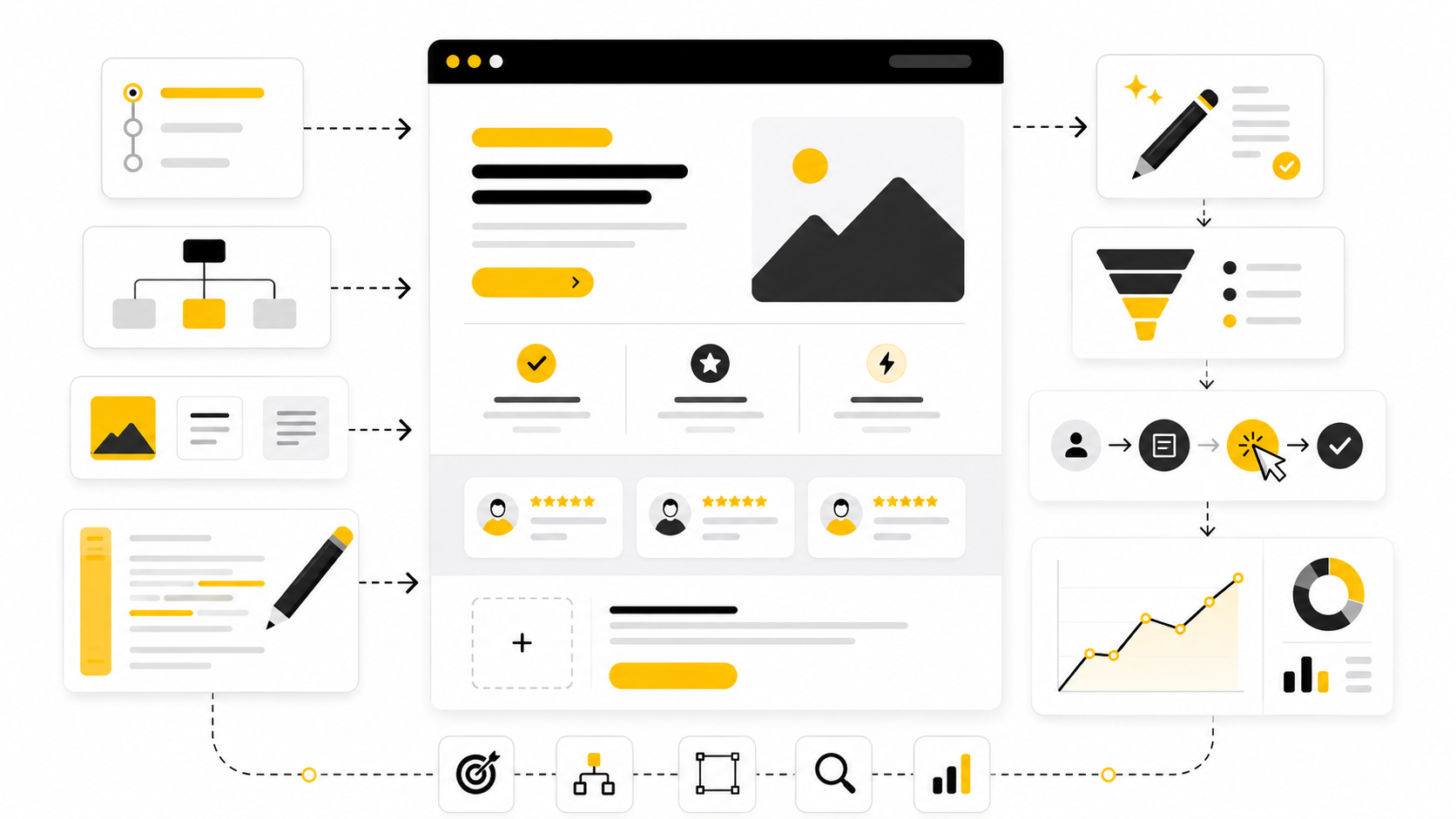
A landing page does not win because it sounds clever. It wins because the right person lands on it, understands the offer fast, believes the promise, and feels safe enough to take the next step.
That is why landing page copywriting services are not just “writing a page.” Good copywriting connects positioning, customer research, offer clarity, page structure, conversion psychology, and sales logic into one focused experience. The words matter, but the sequence of those words matters just as much.
This guide breaks down how professional landing page copy is planned, written, reviewed, and improved. The full article is split into six parts so each section can go deeper without turning into a generic checklist.
Why Landing Page Copywriting Services Matter
Most landing pages fail before the visitor even reaches the form, button, or checkout. The offer may be good, the traffic may be expensive, and the design may look polished, but the page still leaks conversions because the message is unclear. A visitor should not have to work out what you sell, who it is for, why it matters, and what to do next.
That is the real value of landing page copywriting services. They turn scattered product notes, customer pain points, feature lists, testimonials, objections, and campaign goals into one persuasive path. The page becomes less of a brochure and more of a guided sales conversation.
This matters even more when paid traffic is involved. The median landing page conversion rate was around 6.6% across industries in Unbounce’s analysis of 464 million visits, 41,000 landing pages, and 57 million conversions from its 2024 conversion benchmark data. That benchmark is useful, but it also shows the bigger point: small improvements in message clarity, offer framing, and conversion flow can have a direct impact on the economics of a campaign.
A strong landing page also reduces the burden on the rest of the funnel. If the page explains the value clearly, handles the obvious objections, and makes the next step feel natural, sales calls improve, lead quality improves, and follow-up sequences have less heavy lifting to do. Tools like ClickFunnels, Replo, and GoHighLevel can help build and launch pages, but the tool does not fix weak positioning or vague copy.
That is the part many businesses miss. A builder gives you sections, blocks, templates, and forms. A copywriting process decides what those sections should say, what order they should appear in, and what the visitor needs to believe before they click.
Framework Overview
Professional landing page copy usually follows a simple but disciplined framework: understand the audience, clarify the offer, structure the argument, write the page, then improve it with evidence. The page should move from relevance to desire to trust to action. Each section should answer a real question in the visitor’s mind.
The first question is, “Is this for me?” The copy must make the target audience feel recognized without becoming cheesy or over-personalized. This is where research matters because vague language like “grow your business faster” is usually weaker than specific language tied to a real problem, situation, or buying trigger.
The second question is, “Why should I care now?” The page needs to show the cost of inaction, the benefit of solving the problem, and the reason this offer is different from other options. That does not mean hype. It means making the business case obvious.
The third question is, “Can I trust this?” Credibility can come from proof, specificity, demonstrations, testimonials, guarantees, comparisons, process explanations, or transparent expectations. Baymard’s ecommerce UX research shows how much friction can come from trust, payment, and checkout concerns, with its checkout research library built from 30,000+ checkout elements and 26,000+ examples across ecommerce sites in its cart and checkout usability research. The lesson applies beyond ecommerce: people do not convert when they feel uncertain.
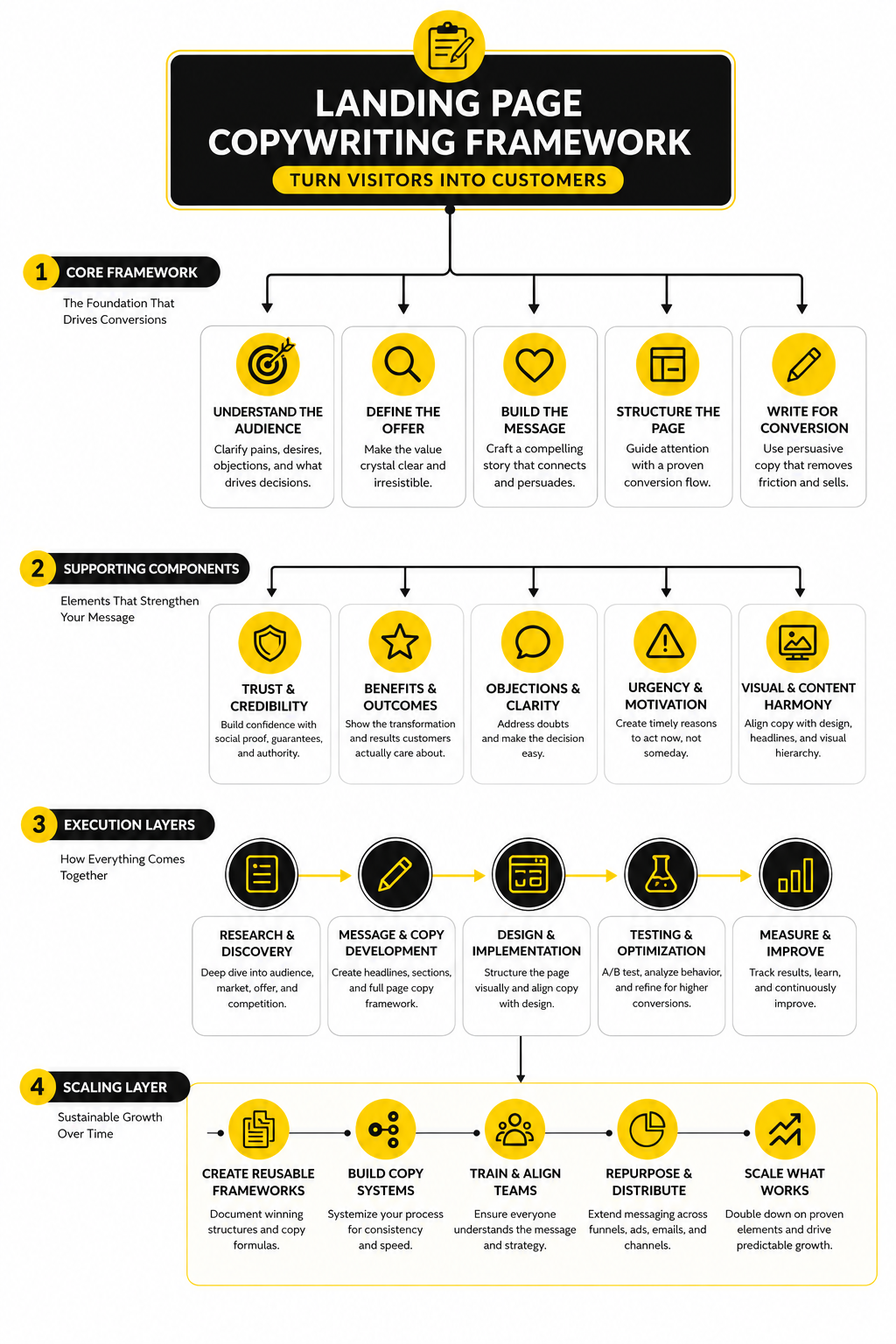
A landing page copywriter’s job is to reduce that uncertainty. The copy should not push harder than the offer can support. It should make the next step feel logical, low-friction, and worth taking.
Core Components Of The Copywriting Process
Every serious landing page project starts with research. This usually includes audience pain points, current customer language, competitor positioning, offer details, objections, traffic source, buying stage, and the desired conversion action. Without that input, the page becomes guesswork dressed up as marketing.
Next comes messaging strategy. This is where the writer decides the primary promise, the main angle, the proof points, the offer hierarchy, and the objections that need to be handled before the call to action. The goal is not to say everything. The goal is to say the right things in the right order.
Then comes the page structure. A strong landing page usually needs a clear hero section, problem framing, value proposition, benefits, mechanism or process, proof, offer details, objection handling, and calls to action. The exact structure changes depending on whether the page is for SaaS, ecommerce, coaching, agency services, local services, lead generation, webinars, or product launches.
Finally, the copy has to work with design. The best landing page copy is scannable, specific, and easy to place into sections. Nielsen Norman Group’s usability research library has long emphasized web usability, content strategy, and writing for the web through its UX research reports, which reinforces a practical point: visitors skim before they commit.
Professional Implementation
Professional implementation is where landing page copywriting services become more valuable than a document full of nice sentences. The writer has to think about how the page will actually be built, how each section will appear on mobile, how calls to action repeat, and how the copy supports the campaign source. A page written for cold paid traffic should not sound the same as a page written for warm email traffic.
This is also where collaboration matters. Designers need section-level copy that can be laid out cleanly. Media buyers need message match between ad and landing page. Founders, marketers, or sales teams need copy that reflects the real offer without creating promises the business cannot keep.
The practical goal is simple: launch a page that is clear enough to test. Once the page is live, performance data can show where visitors hesitate, where the message may be too weak, and where the offer needs a better explanation. Copywriting is not magic, but when it is done properly, it gives the page a much better starting point.
The Landing Page Copywriting Framework
A landing page is not a random stack of sections. It is a controlled argument. The visitor arrives with a problem, a goal, a doubt, or a half-formed interest, and the page has to move them from attention to action without making them feel pushed.
That is why professional landing page copywriting services usually start with the framework before writing the first headline. The framework decides what the page must prove, what it can safely ignore, and what needs to appear early because the visitor will not wait forever. The copy is not just there to sound persuasive. It is there to remove confusion in the right order.
A useful landing page framework has four jobs:
This sounds simple, but it is where many pages break. They start with a clever slogan instead of a clear promise. They explain features before the visitor understands the problem. They bury proof near the bottom. They ask for the conversion before the person has enough reason to trust the offer.
Start With The Visitor’s Intent
The first step is understanding why someone is landing on the page in the first place. A visitor from a comparison ad is not thinking the same way as a visitor from an educational email. A person searching for landing page copywriting services already has a different level of intent than someone who only clicked a broad marketing tip.
This matters because intent changes the copy. Cold traffic usually needs more context, more problem framing, and more trust-building. Warm traffic may need sharper offer details, pricing clarity, proof, and a clear call to action.
Search intent also affects how direct the page can be. If someone is actively looking for a service, the page should not spend five paragraphs explaining that landing pages are important. It should quickly show who the service is for, what outcome it helps create, how the process works, and why the provider is credible.
That is also why message match matters. If an ad, email, or search result promises help with SaaS landing page copy, the landing page should not open with generic agency language. CXL’s landing page optimization guidance emphasizes that traffic source and page message have to work as one system, especially when paid campaigns are involved through message continuity and intent alignment.
Define The One Conversion Goal
A landing page should have one main job. That job might be booking a call, starting a trial, joining a waitlist, downloading a lead magnet, buying a product, or submitting a form. The page can support that goal in several ways, but the primary action should stay clear.
This is where many businesses accidentally weaken the page. They add a contact form, a newsletter signup, a webinar link, a pricing page link, a homepage link, a social icon row, and three different calls to action. The visitor is not guided anymore. They are being asked to choose their own journey.
Professional landing page copywriting services should define the main conversion action before writing the copy. If the action is high-commitment, like booking a sales call, the page needs more proof and objection handling. If the action is low-commitment, like downloading a checklist, the page can be shorter and more direct.
The offer also needs to match the stage of awareness. A visitor who already knows they need help may be ready for a consultation. A visitor who is still diagnosing the problem may need a lower-friction next step first, such as a page audit, checklist, or workshop registration.
Build The Page Around A Clear Promise
The core promise is the center of the page. It tells the visitor what they can expect to gain, avoid, improve, or understand. Without a clear promise, the rest of the copy becomes decoration.
A strong promise is specific enough to be meaningful but not so exaggerated that it loses trust. “Get better landing page copy” is too weak. “Turn paid traffic into qualified leads with a research-backed landing page message” is stronger because it connects the service to a business result and a method.
The promise should also be believable. If the page claims instant growth, guaranteed revenue, or effortless conversions, skeptical visitors will pull back. Real buyers have seen enough hype. They respond better to copy that is confident, specific, and grounded.
This is where the best copywriters separate themselves from template writers. They do not just fill in a headline formula. They find the promise the market actually cares about, then support it with proof, process, and sharp explanation.
Structure The Argument Before Writing The Page
Once the promise is clear, the next job is sequencing. The page needs to answer the visitor’s questions in the order they are likely to appear. Good structure makes the copy feel easy to read because each section arrives when the reader is ready for it.
A simple service landing page might follow this flow:
That is not a rigid template. It is a starting point. A high-ticket service page may need deeper proof and a stronger process section. A simple productized offer may need pricing, deliverables, timeline, and examples much earlier.
The key is that every section must earn its place. If a section does not answer a real question, build trust, increase desire, or support the conversion goal, it probably does not belong on the page.
Match The Copy To The Offer Type
Landing page copywriting services should never treat every offer the same. A SaaS demo page, ecommerce product page, agency service page, coaching application page, and webinar registration page all need different levels of detail. The psychology overlaps, but the buying context changes.
For example, a SaaS landing page often needs to explain the problem, show the workflow, reduce perceived switching costs, and make the product feel easy to adopt. A service landing page usually needs to prove expertise, define the process, reduce risk, and help the buyer feel confident that the provider understands their situation.
A funnel page built in ClickFunnels may need more direct-response structure, especially if it is selling a course, webinar, or productized offer. A Shopify landing page built with Replo may need tighter product messaging, visual proof, comparison sections, and conversion-focused ecommerce blocks. A local service or agency page built inside GoHighLevel may need stronger lead capture, appointment booking, and follow-up alignment.
The tool is not the strategy. The tool supports the strategy. The copywriter still has to decide what the buyer needs to understand before they act.
Use Proof Where Doubt Naturally Appears
Proof should not be dumped into one testimonial section and forgotten. It should appear where the visitor is most likely to hesitate. If the headline makes a bold claim, nearby proof can make it feel credible. If the page explains a process, a short result, credential, or customer quote can make that process feel real.
Proof can take many forms:
Not every page needs all of these. In fact, using too much proof can make a page feel cluttered. The job is to choose the proof that matches the visitor’s biggest doubt.
This is especially important for service pages. The buyer is not only asking, “Can this work?” They are also asking, “Can this person or company do it for my situation?” The more complex or expensive the offer, the more the page needs proof that feels relevant, not generic.
Keep The Path To Action Obvious
A landing page can have great copy and still lose people if the next step is unclear. The call to action should be specific, visible, and consistent with the offer. “Submit” is rarely as strong as a button that explains what happens next.
The page should also make the conversion feel safe. If someone is booking a call, tell them what the call is for. If someone is downloading a resource, tell them what they will get. If someone is starting a trial, make the next step clear.
This becomes even more important on mobile. Visitors scan quickly, sections stack vertically, and forms can feel heavier than they look on desktop. Baymard’s checkout research shows that friction in forms and checkout flows can directly damage completion, with its 2025 checkout benchmark finding that 64% of desktop sites and 63% of mobile sites had “mediocre” or worse checkout UX performance in its checkout UX benchmark.
For landing pages, the lesson is direct. Do not make people hunt for the action. Do not ask for more information than you need. Do not create uncertainty at the moment when the visitor is ready to move.
Write For Scanners First, Then Readers
Most visitors do not read a landing page from top to bottom like a book. They scan, pause, compare, and decide whether the page deserves more attention. That means the structure has to work before the paragraph copy does.
Strong landing page copy uses headlines, subheadlines, bullets, short paragraphs, and clear section logic to help scanners understand the page quickly. The visitor should be able to skim the page and still understand the offer, the value, the proof, and the next step.
Then the deeper copy supports the people who need more detail. Some buyers will read everything before they convert. Others only need the hero section, a proof point, and a clear button. The page has to serve both without becoming bloated.
That is the balance. Write too little and the page feels thin. Write too much without structure and the page feels exhausting. Good copy gives the reader enough to decide, without forcing them to dig for the point.
Core Components Of High-Converting Landing Page Copy
A landing page becomes easier to write when you stop treating it as one big piece of copy. It is really a set of smaller persuasion jobs. Each component has a role, and when one role is weak, the whole page feels less convincing.
This is where landing page copywriting services can create a clear difference. A good writer does not simply polish the words. They identify what each section must accomplish, what the visitor needs to believe at that point, and what friction might stop the next click.
The goal is not to cram every possible selling point onto the page. The goal is to build a clean path from first impression to conversion. That path usually starts with the hero section and becomes more detailed as the visitor moves down the page.
The Hero Section
The hero section has to do the hardest job on the page. It must quickly show the visitor that they are in the right place, that the offer is relevant, and that the next few seconds are worth their attention. If the hero section is vague, the rest of the page has to fight uphill.
A strong hero section usually includes a clear headline, a supporting subheadline, a primary call to action, and sometimes one credibility cue. The headline should communicate the main value, not just name the category. “Landing page copywriting services” can appear naturally, but the visitor still needs to understand the outcome behind the service.
The subheadline should make the promise more concrete. It can explain who the service is for, what kind of page is being written, or what business goal the page supports. This is not the place for cleverness that makes the reader pause and decode the message.
The button copy should also be specific. “Get started” can work in some cases, but “Book a landing page copy audit” or “Request a quote” often gives the visitor a clearer expectation. The more expensive or consultative the offer is, the more important this clarity becomes.
Problem Framing
Problem framing is where the page shows that it understands the visitor’s situation. This section should not exaggerate pain or talk down to the reader. It should name the real friction that makes the offer necessary.
For landing page copy, the problem is often not “bad writing” in a general sense. The real issue is usually unclear positioning, weak offer explanation, poor message match, thin proof, confusing structure, or a page that was designed before the sales argument was defined. That is more specific and more useful.
This section works best when it reflects the buyer’s actual context. A SaaS founder may be struggling with demo page clarity. An ecommerce team may be sending paid traffic to a page that looks good but does not explain the product well enough. An agency may need a landing page that qualifies leads instead of simply generating more form fills.
Strong problem framing creates recognition. The visitor should feel, “Yes, that is exactly what is happening.” Once that happens, the solution section becomes much easier to believe.
The Value Proposition
The value proposition explains why this offer is worth choosing. It is not a slogan, and it is not a list of generic benefits. It is the clearest answer to the question, “Why should I care about this service instead of solving the problem another way?”
For landing page copywriting services, the value proposition often combines research, strategy, writing, conversion structure, and implementation support. The buyer is not just paying for words. They are paying for a page message that can support ads, email campaigns, sales calls, launches, and funnel performance.
This section should connect the service to practical outcomes. Better clarity can improve lead quality. Better structure can reduce hesitation. Better objection handling can help the visitor feel safer taking the next step.
The value proposition should also explain what makes the process different. If the service includes customer research, competitor analysis, offer positioning, wireframe copy, or post-launch revisions, say that clearly. Specificity builds trust faster than vague claims.
Benefits And Features
Features explain what is included. Benefits explain why those features matter. A good landing page needs both, but it should not confuse them.
For example, “wireframe copy” is a feature. The benefit is that the designer gets section-ready copy instead of a loose document that still needs to be interpreted. “Voice-of-customer research” is a feature. The benefit is that the page uses language closer to how buyers already describe their problem.
This distinction matters because visitors do not always understand why a deliverable is valuable. If the page only lists features, it may feel like a menu. If it only lists benefits, it may feel fluffy. The best copy pairs them together.
A simple way to do this is to write each feature with a short “so you can” explanation. That keeps the page grounded. It also helps the reader connect the service to the work they actually need done.
The Execution Process
The process section makes the service feel tangible. This is especially important for consulting, agency, and copywriting offers because the buyer cannot see the final result before they buy. A clear process reduces uncertainty.
The process should show what happens from first contact to final delivery. It does not need to reveal every internal detail, but it should make the working relationship easy to understand. People are more comfortable buying when they know what happens next.
A strong process section might include research, strategy, copy direction, draft creation, review, revisions, and handoff. If the page is being built in a funnel platform, the process may also include page setup, form connection, CRM routing, analytics checks, or launch support. This is where tools like GoHighLevel, ClickFunnels, or Replo can fit naturally, depending on the type of page being launched.
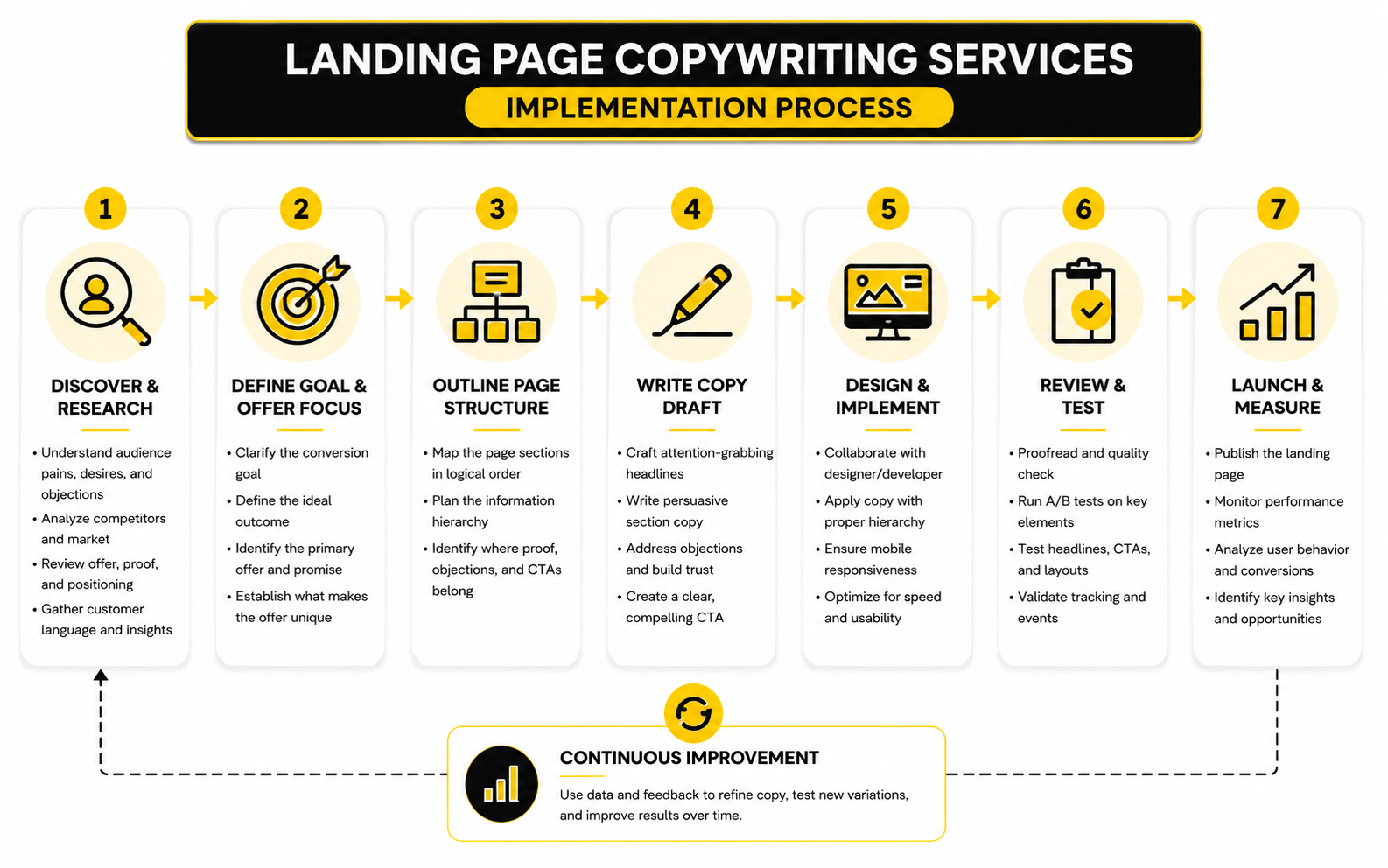
A practical implementation flow can look like this:
This process is not there to look sophisticated. It is there to prevent random execution. When the copywriter, designer, media buyer, and business owner all understand the same path, the page becomes much easier to launch and improve.
Proof And Credibility
Proof is what stops the page from sounding like an opinion. The more serious the claim, the more proof the visitor needs. This does not mean every page needs a long case study, but it does mean the page should support its promises.
Proof can come from testimonials, recognizable clients, screenshots, quantified outcomes, before-and-after examples, review snippets, credentials, media mentions, or clear explanations of the method. For new offers, process proof can help when outcome proof is still limited. Showing how the work gets done can still reduce doubt.
The strongest proof is specific. “Great service” is nice, but it does not tell the visitor much. A testimonial that explains the problem, the work done, and the result is more useful because it mirrors the buyer’s decision-making process.
Proof should also appear close to the claim it supports. If the page says the service helps improve paid traffic performance, the proof should be near that claim. Do not make visitors scroll to the bottom to find the reason they should believe you.
Objection Handling
Every serious buyer has objections. They may not say them out loud, but they are thinking them. A good landing page handles those objections before they become exit points.
Common objections for landing page copywriting services include:
The page should not hide from these questions. It should answer them plainly. Sometimes that means adding a short FAQ-style objection block later in the article or page, but in this guide, the full FAQ belongs in Part 6.
Good objection handling is not defensive. It is helpful. It shows the buyer that the service has been built around real working conditions, not an idealized version of the project.
Calls To Action
A call to action is not just a button. It is the moment where the page asks for movement. That moment has to feel earned.
The CTA should match the offer and the stage of the visitor. For a high-ticket landing page copy project, “Book a strategy call” may feel appropriate. For a productized service, “View packages” or “Request availability” may work better. For a lower-friction diagnostic offer, “Get a page audit” can feel easier to say yes to.
The copy around the CTA matters too. A short line above or below the button can reduce uncertainty by explaining what happens next. For example, the page can say that the call will review the offer, traffic source, current page, and best next step.
Form friction also matters. Baymard’s checkout research has repeatedly found that unnecessary form complexity can damage completion, and one published Baymard presentation notes that many sites can reduce visible form fields by 20–60% through better defaults and field handling in checkout flow testing. Landing pages are not always checkout pages, but the same principle applies: ask only for what you need at that moment.
Page Copy That Works With Design
Copy and design should not compete. The copy gives the page its argument. The design makes that argument easier to consume.
This is why implementation-ready copy is different from a normal sales document. The writer needs to consider section length, headline hierarchy, button placement, proof blocks, mobile scanning, and how each paragraph will look once it is inside a real page builder. Long blocks of clever copy may look impressive in a document and terrible on a phone.
Nielsen Norman Group’s research on web reading behavior has consistently shown that users scan pages rather than read every word, with one widely cited finding showing that 79% of test users scanned new pages while only 16% read word by word in its web reading research. That makes section design and copy structure part of the persuasion, not a cosmetic afterthought.
A good handoff helps the designer build faster. It also protects the strategy. When the copy is already organized into clean sections, the design is less likely to bury the strongest message or separate proof from the claim it supports.
Conversion Tracking And Post-Launch Learning
The page is not finished the moment it goes live. It is finished enough to learn from. That distinction matters.
At launch, the business should know what conversion action is being tracked, where the traffic is coming from, and what success looks like. Without that, everyone ends up arguing from opinion. The copywriter thinks the message is clear, the designer thinks the layout works, and the media buyer thinks the traffic is fine, but no one has enough evidence.
Post-launch learning can come from conversion rate, form starts, form completions, scroll depth, heatmaps, session recordings, call quality, lead quality, and sales feedback. Not every business needs a complex analytics stack on day one. But every landing page should have enough tracking to show whether the page is doing its job.
This is where professional implementation becomes practical. The copy gives the page a strong starting argument. The data shows which parts of that argument need to be sharpened.
Statistics And Data
Numbers are useful only when they help you make a better decision. A landing page with a 4% conversion rate might be underperforming badly, or it might be doing extremely well. It depends on the industry, traffic source, offer price, buying stage, and what the conversion actually means.
That is why measurement should not be treated as a scoreboard for vanity metrics. It should be treated as a diagnostic system. The right data tells you where the page is creating confidence, where it is creating friction, and where the copy needs to work harder.
For landing page copywriting services, this matters because copy performance is rarely visible through one number alone. Conversion rate is important, but it does not tell the whole story. A page can generate more leads while lowering lead quality, or generate fewer leads while producing better sales conversations.
Start With The Real Conversion Goal
The first measurement decision is simple: define the conversion that actually matters. For a lead generation page, that may be a form submission or booked call. For a SaaS page, it may be a trial signup, demo request, or product-qualified action. For ecommerce, it may be add to cart, checkout started, or completed purchase.
Google Analytics defines a landing page as the first page a visitor lands on during a session, and its landing page report can show how many visitors entered through each page in GA4 landing page reporting. That sounds basic, but it is essential. If you do not know which page began the journey, you cannot fairly judge whether that page did its job.
The main conversion should also match the promise of the page. If the page is built to book sales calls, tracking only page views is almost useless. If the page is built to sell a low-ticket offer, tracking only email opt-ins may hide the actual revenue performance.
This is where good implementation becomes practical. Before rewriting copy, decide what action proves the page is working. Then measure the steps that lead to that action.
Use Benchmarks Carefully
Benchmarks are helpful, but only when they are interpreted correctly. Unbounce’s conversion benchmark data is based on 57 million conversions across more than 41,000 landing pages in its industry conversion benchmark report. That scale makes the data useful as a reference point, but it still does not replace your own funnel economics.
A benchmark tells you what is common. It does not tell you what is profitable. A 3% conversion rate can be excellent if the leads are high-value and the close rate is strong. A 15% conversion rate can be weak if most leads are unqualified or never respond.
Industry differences also matter. A legal lead generation page, a SaaS demo page, and a newsletter signup page should not be judged by the same standard. Search Engine Land’s coverage of Unbounce’s benchmark report notes that industry medians can range from 3.8% in SaaS to 12.3% in Legal in its discussion of what counts as a good conversion rate in 2025.
The practical takeaway is clear. Use benchmarks to set expectations, not to make lazy decisions. Your real target should come from revenue, margins, traffic cost, lead quality, and sales capacity.
Track The Signals That Explain Behavior
Conversion rate tells you what happened. Supporting signals help explain why it happened. This is where landing page analytics become more useful for copy decisions.
The most useful signals usually include:
These signals should not be read in isolation. A low scroll depth is not automatically bad if the call to action is above the fold and people convert quickly. A long time on page is not automatically good if visitors are confused and rereading sections because the offer is unclear.
Good measurement looks for patterns. If paid search visitors convert better than social visitors, the copy may match search intent more clearly. If mobile visitors drop before the form, the issue may be page layout, form length, loading speed, or weak above-the-fold clarity. If leads convert but sales says they are low quality, the page may be promising too broadly or failing to qualify the buyer.
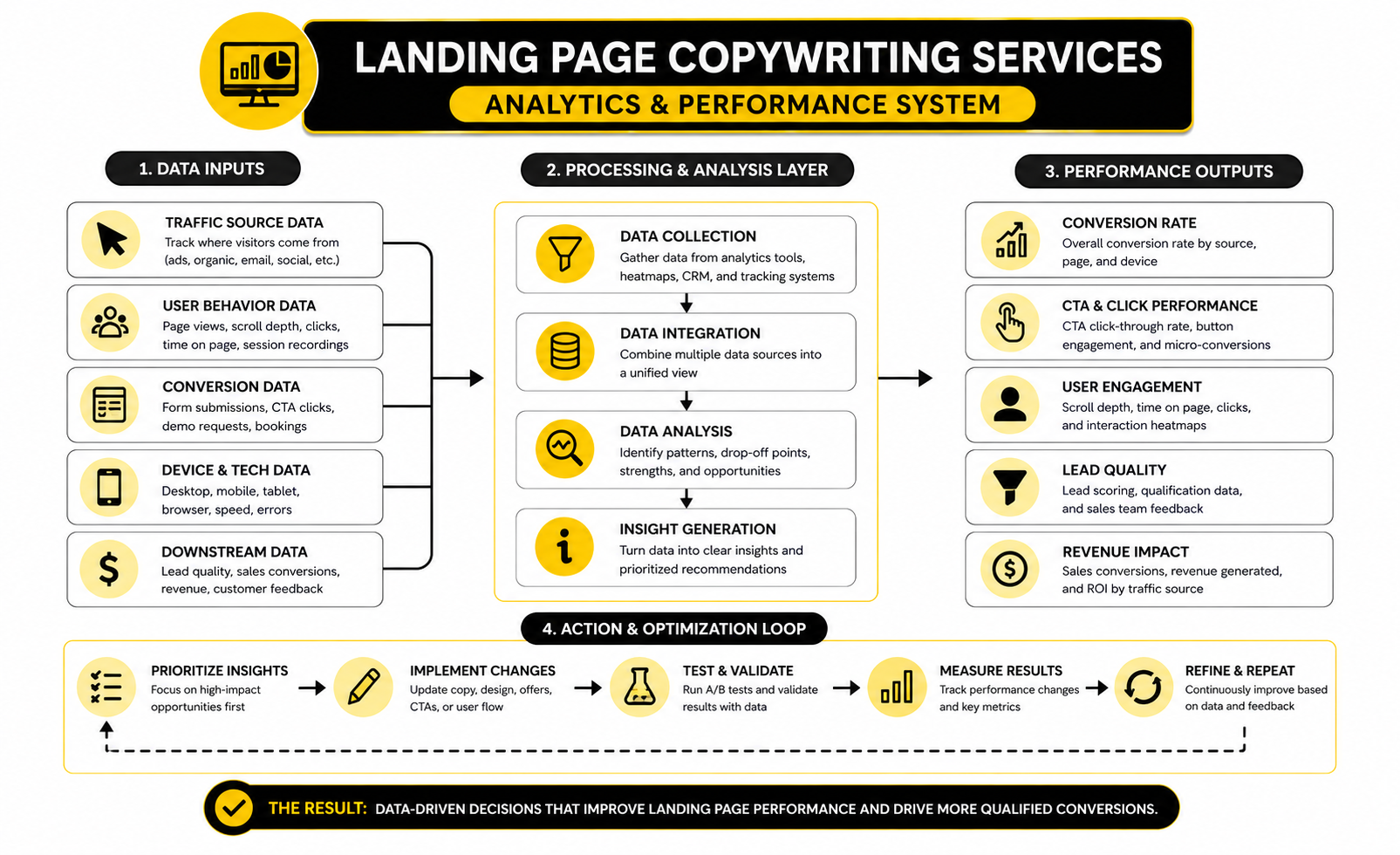
This is the point where analytics becomes a copywriting tool. The data does not write the page for you. It tells you which part of the sales argument deserves attention.
Measure Message Match
Message match is one of the most important performance signals because it connects traffic intent to page experience. If the visitor clicks an ad about landing page copywriting services for SaaS companies and lands on a generic copywriting page, the page creates doubt immediately. The visitor has to work too hard to connect the click with the offer.
You can measure message match by comparing performance across traffic sources and campaigns. If one campaign has a strong click-through rate but weak page conversions, the ad may be attracting interest that the page fails to continue. If one keyword group converts much better than another, the page may be better aligned with one type of intent.
Qualitative review matters here too. Look at the ad promise, email subject, search query, page headline, hero subheadline, proof, and CTA. They should feel like one continuous conversation. When they do not, the visitor feels the gap even if they cannot explain it.
This is why copy cannot be separated from acquisition. A landing page written without knowing the traffic source is missing context. The same page can perform very differently depending on whether the visitor came from Google search, a retargeting ad, a cold social campaign, an email list, or a partner referral.
Read Form And CTA Data Closely
Forms and calls to action are where hesitation becomes visible. If visitors click the button but do not finish the form, the page may have created enough interest but not enough confidence. If visitors scroll through the page but never click, the offer may not feel urgent, clear, or relevant enough.
Form length matters because every field asks for effort and trust. Baymard’s checkout UX research is ecommerce-focused, but the principle applies to lead forms too: friction near the point of action can break the conversion flow. Its checkout benchmark found that 64% of desktop sites and 63% of mobile sites had “mediocre” or worse checkout UX performance in Baymard’s 2025 checkout UX findings.
That does not mean every form should be as short as possible. High-ticket service pages may need qualifying questions to protect sales time. But every field should earn its place. If a field does not help qualify, route, personalize, or complete the next step, it may be creating unnecessary friction.
CTA copy should be tested with the same discipline. A button that says “Submit” gives no context. A button that says “Request landing page copy help” or “Book a page review” tells the visitor what they are doing. Small wording changes can matter because they affect perceived risk at the exact moment of action.
Separate Lead Volume From Lead Quality
More conversions are not always better. This is one of the biggest traps in landing page optimization. A page can increase form submissions by making the promise broader, reducing friction, or lowering the perceived commitment, but that may also bring in weaker leads.
For service businesses, lead quality often matters more than raw form volume. If the page attracts people who cannot afford the service, do not understand the offer, or are not ready to buy, the conversion rate is misleading. The page is producing activity, not revenue.
This is why landing page copywriting services should consider downstream performance. Look beyond the form. Track how many leads respond, book, show up, qualify, receive a proposal, and become customers. The copy may need to qualify harder, clarify pricing expectations, or explain who the service is not for.
A lower-converting page can be the better page if it produces stronger opportunities. That is not a theory. It is how real funnels work.
Diagnose Copy Problems From Performance Patterns
Data becomes useful when it points to action. Different patterns suggest different copy problems, and each problem needs a different fix. Randomly rewriting headlines without a diagnosis is just guessing.
If visitors leave quickly, the hero section may not be clear, relevant, or credible enough. If visitors scroll but do not click, the page may explain the offer but fail to create urgency or desire. If visitors click but do not submit, the form, CTA, trust cues, or perceived commitment may be the issue.
If leads are low quality, the page may need stronger qualification copy. That can include clearer audience fit, better pricing context, more specific outcomes, or a sharper explanation of what the service does and does not include. If sales calls are good but close rates are weak, the page may need to better prepare buyers for scope, process, timeline, or investment.
This is where the earlier framework becomes measurable. Each page section has a job. When the data shows where visitors hesitate, you can improve the section responsible for that job.
Use Testing Without Worshipping Testing
Testing is useful, but it is not magic. A/B testing works best when you have enough traffic, a clear hypothesis, and a meaningful difference between variants. Testing tiny headline tweaks on low traffic can waste time and create false confidence.
Before testing, fix obvious problems. If the headline is unclear, the offer is vague, or the page has no proof, you do not need a test to know the page can improve. Use judgment first. Then use testing to compare serious alternatives.
A useful test might compare two different angles, two different offers, or a shorter page against a more detailed page. The test should be tied to a real question, not just curiosity. For example, “Do visitors respond better to a speed-focused promise or a lead-quality promise?” is better than “Which headline sounds nicer?”
Testing should also respect business reality. A variant that wins on form submissions but loses on sales quality is not a real winner. The best landing page tests connect front-end conversion data with downstream customer value.
Turn Measurement Into Copy Decisions
The point of analytics is not to build a dashboard that nobody uses. The point is to create better decisions. For landing page copy, that means turning measurement into specific edits.
A simple review process can work like this:
This process keeps optimization focused. It also prevents the common mistake of changing too much at once. If you rewrite the headline, offer, proof, CTA, and form all at the same time, you may improve the page, but you will not know what caused the change.
Measurement works best when it is tied to a clear learning loop. The page makes a promise. Visitors respond. The data shows what needs to be clarified, strengthened, removed, or reframed. That is how a landing page becomes sharper over time.
Strategic Tradeoffs In Landing Page Copy
Once the basic framework, components, and measurement system are in place, the harder decisions begin. This is where landing page copywriting services become more strategic than tactical. The question is no longer “What should the headline say?” but “What kind of buyer are we trying to attract, qualify, and move?”
Every landing page makes tradeoffs. A page can be broader and attract more people, or narrower and attract better-fit people. It can be shorter and easier to scan, or longer and better at handling objections. It can ask for a quick opt-in, or it can ask for a higher-commitment sales action.
None of these choices are automatically right or wrong. The right choice depends on the offer, traffic source, buying stage, price point, sales process, and follow-up system. That is why advanced landing page copy is not about copying a template. It is about making smart tradeoffs on purpose.
Broad Appeal Versus Strong Qualification
A broad landing page usually converts more visitors on the front end because it creates less resistance. The copy feels inclusive, the promise is general, and the form may ask for very little. That can be useful when the goal is list growth, low-ticket sales, or early market testing.
The problem is that broad copy can attract the wrong people. If the page does not clearly state who the offer is for, what the service includes, and what kind of buyer is a good fit, the sales team may end up filtering out weak leads manually. That creates hidden costs.
A more qualified page may convert fewer people, but those people are often closer to the real buying profile. This is especially important for higher-ticket landing page copywriting services because the goal is not to maximize every form submission. The goal is to generate conversations that have a realistic chance of becoming revenue.
Qualification can be handled through copy before it is handled through forms. You can make the audience clear, explain the ideal situation, mention what the service is best suited for, and set expectations around process or investment. Done well, this does not feel exclusionary. It feels professional.
Short Pages Versus Long Pages
Short landing pages work when the offer is simple, the audience is warm, the risk is low, and the conversion action is easy. A simple lead magnet page may not need ten sections. A retargeting page for people who already know the brand may only need a strong reminder, a clear benefit, and a fast action path.
Longer pages are useful when the offer is complex, expensive, unfamiliar, or emotionally risky. A buyer considering a copywriting service for a paid campaign may need to understand the process, deliverables, research depth, collaboration requirements, timelines, and expected next steps. That cannot always be handled in a few lines.
The mistake is choosing length based on preference instead of buying context. Some teams say, “Nobody reads long pages,” but Nielsen Norman Group’s long-running research shows the more accurate point: people scan online content and look for the parts that matter to them in web reading behavior research. That does not mean long pages fail. It means long pages need strong structure.
A long page should never feel long because it is padded. It should feel complete because every section answers a real question. If a section repeats an earlier point, cut it. If it handles a meaningful hesitation, keep it.
Conversion Rate Versus Revenue Quality
A higher conversion rate is not always the win. This is uncomfortable, but it is true. A page can improve the visible metric while damaging the business result.
For example, removing pricing context might increase form submissions because fewer people are scared away. But if those extra leads cannot afford the service, the sales team loses time. The dashboard looks better while the business gets worse.
The same thing can happen when the page overpromises. If the copy makes the outcome feel too easy, more people may convert. Then they enter the sales process with unrealistic expectations, which creates poor calls, lower close rates, and weaker customer relationships.
The better question is not, “How do we get more conversions?” The better question is, “How do we get more of the right conversions?” That is the difference between copy that chases numbers and copy that supports growth.
Speed, UX, And Copy Have To Work Together
Copy cannot save a slow, clunky, or frustrating page. If the page loads poorly, shifts around, or feels hard to use on mobile, visitors may leave before the message gets a fair chance. This is especially painful when traffic is paid.
Google’s Core Web Vitals focus on real-world user experience signals such as loading performance, interactivity, and visual stability in its Core Web Vitals documentation. For landing pages, that matters because the copy only works after the visitor can actually experience the page. A strong headline does not help if the hero section loads too late or the button is difficult to tap.
This creates a practical tradeoff between richness and speed. Videos, animations, image-heavy sections, and complex builders can make a page feel more premium, but they can also slow it down if implemented poorly. A conversion-focused page needs enough design to build trust, but not so much that it weakens usability.
The copywriter does not need to be a developer. But they should understand that implementation affects persuasion. If a section is critical to the argument, it should be easy to load, easy to scan, and easy to use on mobile.
AI Can Help, But It Cannot Replace The Strategy
AI can speed up parts of the landing page process. It can help summarize research, generate headline directions, restructure rough notes, draft variations, and explore objections. Used well, it can make a copywriter faster.
But AI is weak when the inputs are weak. If the offer is unclear, the customer research is thin, and the positioning is generic, AI will usually produce generic copy faster. That is not a strategy. That is acceleration without direction.
This matters because landing page copywriting services are often bought at moments when the business already has uncertainty. The founder may not know which angle matters most. The team may disagree on the audience. The product may have too many features and not enough clarity. AI can assist the work, but it cannot take responsibility for the commercial judgment.
Tools like GoHighLevel AI, Chatbase, and Wispr Flow can support workflow, content capture, and customer interaction. The strategic layer still needs human judgment: what to promise, what to avoid promising, what proof is strong enough, and what the buyer must understand before acting.
Compliance, Claims, And Trust Risk
Landing page copy should be persuasive, but it should not create legal, ethical, or trust problems. This is especially important in health, finance, business opportunity, education, SaaS security, and any offer tied to income claims or regulated outcomes. The more sensitive the promise, the more careful the copy needs to be.
Strong copy does not need fake urgency, fake scarcity, exaggerated guarantees, or unsupported claims. Those tactics may increase short-term clicks, but they can damage the brand and create problems later. Trust is not just a design element. It is a business asset.
A professional copy process should review the claims before launch. If the page says “proven,” there should be proof. If it says “guaranteed,” the guarantee should be real and clearly explained. If it implies a specific result, the business should be able to support that result with evidence.
This is one reason service pages should avoid sounding like every other aggressive funnel on the internet. Confidence is good. Overclaiming is not. The best pages make the offer feel credible because they are specific, clear, and honest about what the service can and cannot do.
Scaling Landing Pages Across Campaigns
A single landing page can work well for one campaign and fail when copied across five others. Scaling requires more than duplicating the same layout. It requires adapting the message to each audience, traffic source, and offer angle.
This becomes important when a business runs multiple campaigns. A SaaS company may need pages for different use cases. An agency may need separate pages for niches, audits, workshops, and consultations. An ecommerce brand may need different pages for cold traffic, influencer traffic, product launches, and retargeting.
The risk is message drift. As more pages are created, the brand can become inconsistent, proof can become outdated, and offers can start competing with each other. That is why scaled landing page copy needs a messaging system, not just more pages.
A practical system includes:
This is where platforms matter operationally. ClickFunnels can be useful for funnel-based offers, Replo can support ecommerce landing page builds, and GoHighLevel can help service businesses connect landing pages to CRM, follow-up, and appointment booking. But the message system has to come first.
When Personalization Helps And When It Hurts
Personalization can improve relevance, but it can also make a page feel messy or gimmicky. The goal is not to personalize everything. The goal is to make the visitor feel that the offer fits their situation.
Useful personalization might mean separate pages for different industries, use cases, campaign angles, or awareness stages. A page for SaaS demo copy should not say the same thing as a page for ecommerce product page copy. The underlying service may be similar, but the buyer’s concerns are different.
Personalization becomes risky when it fragments the message too much. If every audience gets a slightly different promise, the business can lose clarity internally. Sales, marketing, and delivery may start speaking different languages.
The smart approach is controlled personalization. Keep the core promise stable. Adjust the examples, proof, use cases, objections, and CTA context for the audience. That gives the page relevance without turning the brand into a collection of disconnected messages.
The Handoff Between Copy, Design, And Sales
Advanced landing page work usually fails at the handoff. The copywriter writes a strong document, the designer interprets it differently, the developer compresses sections to fit the layout, and sales later says the leads are confused. Nobody intended to break the page, but the strategy gets diluted.
The fix is not more meetings for the sake of meetings. The fix is a clearer handoff. The copy should explain section purpose, priority, proof placement, CTA logic, and which lines should not be weakened. Design should support the argument instead of treating copy as filler text.
Sales feedback should also be part of the loop. If buyers repeatedly ask the same question after converting, the page probably failed to answer it clearly. If prospects arrive with the wrong expectation, the page may need stronger qualification or more accurate framing.
This is where landing page copywriting services become part of a revenue system. The page is not isolated. It connects traffic, design, CRM, follow-up, sales calls, and customer expectations.
When A Landing Page Is Not The Real Problem
Sometimes the landing page is not the main issue. This matters because rewriting a page cannot fix a weak offer, poor traffic, unclear pricing, bad product-market fit, or a follow-up system that does not respond quickly. Copy can improve communication, but it cannot manufacture demand that is not there.
If traffic quality is poor, the page may look like the problem because conversion rate is low. If the offer is too vague, the page may struggle no matter how good the writing is. If the sales team does not follow up, the page may generate leads that never become revenue.
A good copywriter should be willing to say this. The page may need better copy, but the bigger bottleneck might be the offer, audience, traffic source, or sales process. That diagnosis is valuable because it prevents wasted effort.
This is also why the best projects start with strategy instead of writing. Before changing the page, clarify the offer. Before testing headlines, check the traffic. Before blaming the form, review lead quality. Good copy works best when the rest of the system gives it something solid to sell.
Choosing The Right Landing Page Copywriting Service
The final decision is not whether landing page copywriting services are useful. The better question is what kind of service fits the page you need, the offer you sell, and the system around it. A cheap page written from a template may be fine for a simple lead magnet, but it will not carry a complex offer, a high-ticket sales process, or paid traffic with real money behind it.
The right provider should understand more than copy. They should understand positioning, traffic intent, offer structure, proof, user experience, analytics, and the handoff between marketing and sales. If they only ask, “How many words do you need?” that is a warning sign.
A serious landing page copy project should feel like a business conversation first and a writing project second. The writer should want to know what the page must accomplish, who will see it, where those visitors come from, what they already believe, what they doubt, and what happens after they convert.
What To Look For Before Hiring
A good landing page copywriter asks sharp questions before giving sharp answers. They should not need a 50-page brief, but they should care about the offer, audience, traffic source, conversion goal, and sales process. If they skip discovery, they are probably guessing.
Look for a provider who can explain their process clearly. They should be able to show how they move from research to messaging to structure to copy to implementation support. The best fit is usually someone who can think strategically without disappearing into theory.
You should also look at how they handle proof and claims. Strong copywriters do not inflate results, invent urgency, or make unsupported promises. They know that credibility is part of conversion, especially when the buyer is comparing multiple options.
The clearest signs of a strong provider include:
What A Professional Brief Should Include
A better brief creates a better page. This does not mean you need to write the copywriter’s strategy for them. It means you should give them enough context to make good decisions.
At minimum, the brief should explain the offer, target audience, main conversion action, traffic source, competitors, proof assets, objections, brand voice, and technical constraints. If you have an existing page, analytics, heatmaps, ads, sales call notes, reviews, or customer interviews, those can be extremely useful. They help the writer understand what is happening in the real funnel instead of relying on assumptions.
For a service business, the brief should also explain what happens after someone converts. If the visitor books a call, what kind of call is it? If they submit a form, who follows up? If they request a quote, what information does the team need to qualify them?
This is where the ecosystem view matters. The landing page does not stand alone. It connects traffic, offer, page copy, page design, forms, CRM, follow-up, sales, delivery, and optimization.
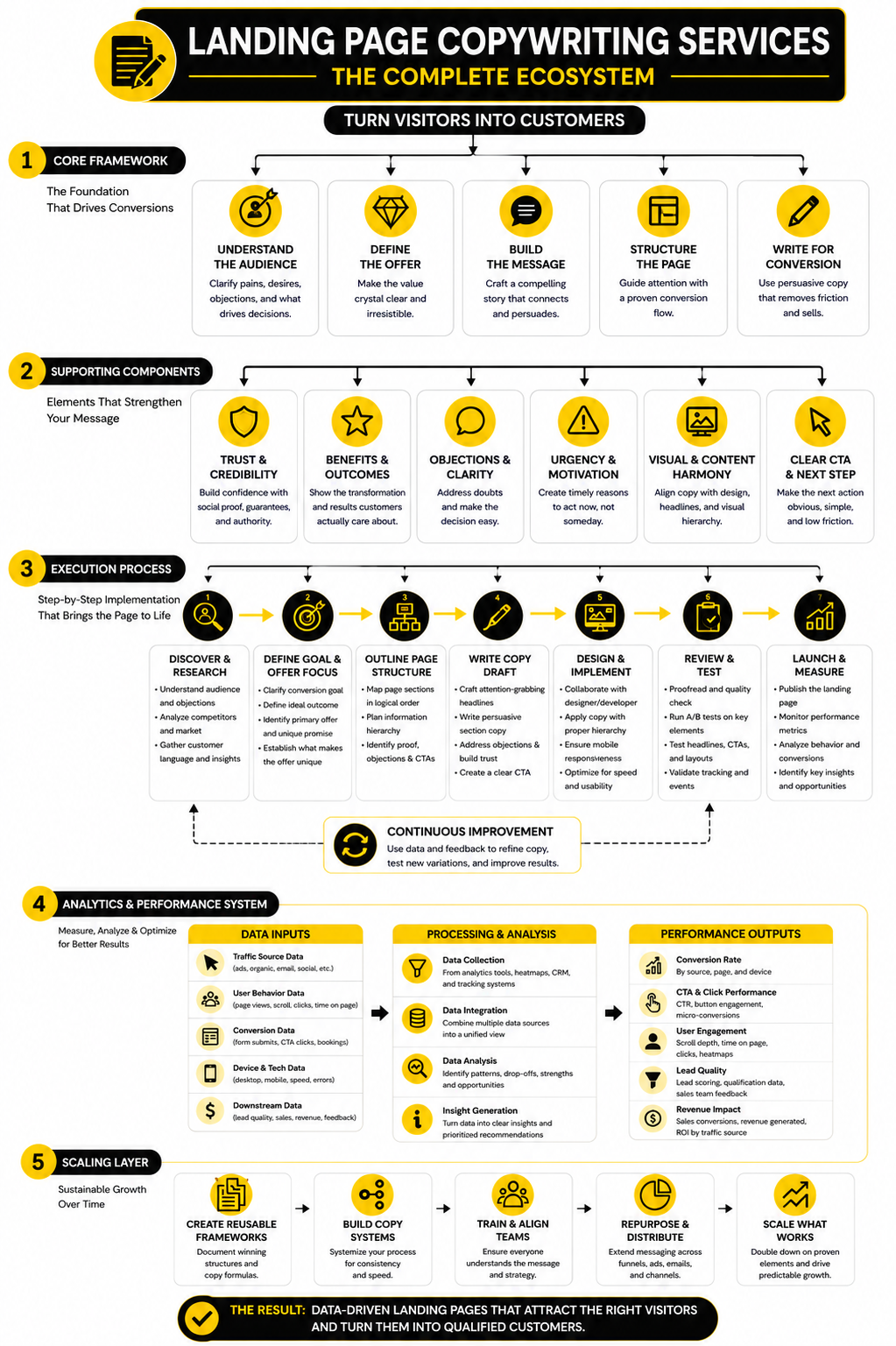
Pricing And Scope Expectations
Landing page copywriting services can vary widely in price because the scope varies widely. A simple rewrite is not the same as a full strategy, research, wireframe copy, design collaboration, and post-launch optimization. When comparing quotes, compare the actual work included, not just the final deliverable.
A lower-priced service may only provide copy in a document. That can work if your team already has strategy, design, and implementation covered. A higher-end service may include discovery, customer research, competitive review, messaging strategy, page structure, copywriting, revisions, and implementation guidance.
The biggest mistake is buying the wrong level of help. If the offer is unclear, do not only buy copy polish. If the traffic source is new, do not ignore message match. If the sales team is complaining about lead quality, do not focus only on increasing form submissions.
Good scope should answer these questions clearly:
Red Flags To Avoid
The biggest red flag is a copywriter who promises a guaranteed conversion rate without understanding your offer, traffic, price point, and sales process. Nobody can responsibly guarantee that from copy alone. A landing page can influence performance, but it does not control every variable.
Another red flag is generic copy that could fit any business. If the page sounds like “save time, grow faster, scale more carefully,” the visitor has learned almost nothing. Good copy should feel specific to the buyer’s situation and the offer’s real value.
Be careful with providers who focus only on clever headlines. Headlines matter, but they cannot carry a weak page. The structure, proof, offer clarity, friction points, and CTA all matter too.
Also watch for services that ignore mobile experience, analytics, or design handoff. Research from Nielsen Norman Group has long shown that users scan web pages instead of reading them word for word, with one classic study finding that 79% of test users scanned new pages while only 16% read word by word in its web reading research. If the copy is not built for scanning, the page may look finished while still being hard to use.
When To Hire A Specialist Instead Of A Generalist
A general copywriter can be useful for many projects, but a landing page specialist is often better when the page has a direct revenue goal. That is especially true when paid traffic, launch campaigns, high-ticket services, SaaS demos, or ecommerce product pages are involved. The stakes are higher because weak conversion affects the entire campaign.
A specialist is more likely to think about the page as a conversion asset. They will care about message match, section sequence, CTA friction, proof placement, and post-launch learning. They will also understand that the page has to work with design and analytics, not just read well in a document.
That does not mean every project needs the most expensive expert. A simple opt-in page may only need clean, clear copy. But if the page is expected to support sales calls, paid acquisition, or serious revenue, specialist help is usually easier to justify.
The decision comes down to risk. If a weak page would waste meaningful traffic spend, confuse buyers, or slow a launch, it is worth hiring someone who understands the whole landing page system.
What are landing page copywriting services?
Landing page copywriting services help businesses plan, write, and improve the words on a landing page so visitors understand the offer and take action. The work often includes research, messaging strategy, page structure, headlines, body copy, proof sections, calls to action, and revision support. Strong services focus on conversion logic, not just nicer wording.
Why should I hire a landing page copywriter?
You should hire a landing page copywriter when the page needs to sell, qualify, explain, or convert more effectively than a generic template can. A specialist can help clarify the offer, organize the message, and reduce friction before the visitor reaches the CTA. This is especially useful when traffic costs money or the offer has a meaningful revenue impact.
What makes landing page copy different from website copy?
Website copy often explains a broader brand, while landing page copy is built around one conversion goal. A landing page has to keep the visitor focused, answer objections quickly, and make the next step obvious. The structure is usually tighter, more direct, and more connected to a specific campaign.
How long should a landing page be?
A landing page should be as long as it needs to be to help the right visitor decide. Short pages work for simple offers, warm traffic, and low-friction actions. Longer pages work better when the offer is expensive, complex, unfamiliar, or requires more trust.
What should a landing page copywriter ask before starting?
A copywriter should ask about the audience, offer, traffic source, conversion goal, proof, competitors, objections, sales process, and implementation platform. They should also ask what happens after the conversion because the page should support the next step. If they do not ask these questions, the copy may be based on assumptions.
Can better landing page copy improve conversion rates?
Better copy can improve conversion rates when the main problem is unclear messaging, weak proof, poor structure, vague CTAs, or visitor hesitation. But copy is not the only factor. Traffic quality, offer strength, design, page speed, form friction, follow-up, and sales process also affect results.
How do I know if my current landing page copy is weak?
Your copy may be weak if visitors leave quickly, click but do not submit, ask basic questions after converting, or become poor-fit leads. It may also be weak if the headline could apply to almost any competitor. A useful test is whether a stranger can understand the offer, audience, value, proof, and next step within a few seconds.
Should landing page copy include pricing?
Pricing depends on the offer and sales process. Transparent pricing can filter poor-fit leads and reduce wasted calls, but some complex services need a conversation before giving an accurate quote. If pricing is not included, the page should still set expectations clearly enough that the wrong buyers do not flood the pipeline.
What tools are best for building landing pages?
The best tool depends on the business model. ClickFunnels can fit funnel-based offers, Replo can fit ecommerce teams, and GoHighLevel can fit agencies and service businesses that need landing pages connected to CRM and follow-up. The tool matters, but the strategy still comes first.
How should landing page performance be measured?
Landing page performance should be measured through conversion rate, traffic source, form completion, CTA clicks, device performance, lead quality, and downstream sales results. Benchmarks can help set context, and Unbounce’s report uses 57 million conversions across more than 41,000 landing pages in its conversion benchmark data. The real test is whether the page creates profitable, qualified action.
Can AI write landing page copy?
AI can help draft ideas, summarize research, generate variations, and speed up the writing process. It still needs strong human direction because the hardest parts are strategy, positioning, judgment, proof selection, and claim control. If the inputs are generic, the output will usually be generic too.
What is the biggest mistake businesses make with landing page copy?
The biggest mistake is writing the page before clarifying the offer and visitor intent. When the strategy is unclear, the copy becomes a collection of nice-sounding sections instead of a persuasive path. Fixing the page usually starts by fixing the message.
Build a stronger local presence with BAAM AI
Turn your website, Google profile, social channels, and AI visibility into one growth engine
Most businesses do not need more random marketing activity. They need a consistent presence system that helps the right people find them, trust them, and take action. BAAM AI brings strategy, local SEO, website updates, Google Maps visibility, social content, AI-search readiness, media production, and reporting into one practical monthly engine.
If you want your marketing to keep working after the campaign ends, start with a free BAAM AI presence audit. See how your business shows up today and where the fastest visibility wins are at BAAM AI.