
BAAM AI Blog
Klaviyo Sunset Flow: The Practical Framework For Cleaning Your Email List Without Killing Revenue
A Klaviyo sunset flow is not just a “good hygiene” automation. It is the system that decides when a subscriber has stopped helping your email program and starts quietly hurting it.
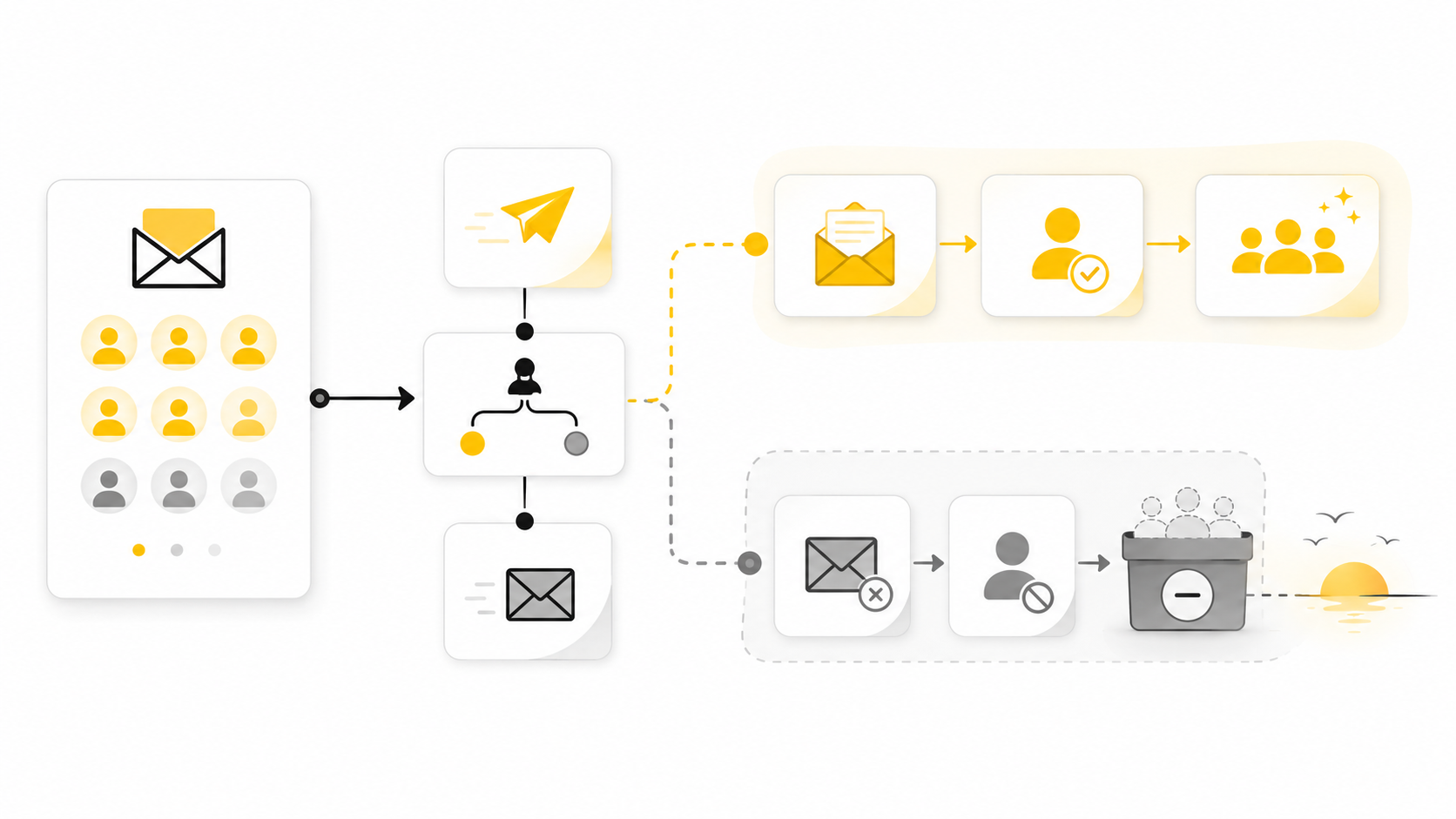
A Klaviyo sunset flow is not just a “good hygiene” automation. It is the system that decides when a subscriber has stopped helping your email program and starts quietly hurting it.
That sounds harsh, but it is the reality of modern email marketing. Gmail wants senders to keep user-reported spam rates below 0.1% and avoid reaching 0.3% or higher, while Yahoo also pushes senders toward easier unsubscribe paths and lower complaint risk. When inactive subscribers keep receiving campaigns they no longer want, they do not just ignore you. They can drag down engagement, increase complaint risk, and make your best customers harder to reach.
Klaviyo’s own sunset flow guidance frames the flow as a last attempt to re-engage inactive subscribers before suppressing or removing people who still do not respond. That is the right mindset. A sunset flow is not a punishment for inactive contacts. It is a controlled exit ramp that protects deliverability, reduces waste, and keeps your email strategy focused on people who still want to hear from you.
this guide is split into six parts so the strategy builds in the right order. We will start with the business case and the framework, then move into segmentation, flow design, implementation, measurement, and common questions. The goal is to help you build a Klaviyo sunset flow that is practical, defensible, and easy to maintain.
Why A Klaviyo Sunset Flow Matters
Most ecommerce brands do not have an email list problem at first. They have a discipline problem. They keep sending to people who stopped opening, stopped clicking, and stopped showing purchase intent because a bigger list feels more valuable than a cleaner one.
That mindset becomes expensive over time. Klaviyo’s list-cleaning guidance is clear that brands should identify unengaged contacts, exclude them from sends, and suppress people who never engage because list quality affects deliverability, engagement rates, unsubscribes, complaints, and sender reputation. In simple terms, your inactive audience is not neutral. It is part of the signal mailbox providers use to judge whether your emails deserve the inbox.
The danger is that the damage usually arrives slowly. One campaign underperforms, then another, then your engaged segment gets smaller, your open rates look weaker, and your promotional calendar starts working harder for the same revenue. A Klaviyo sunset flow gives you a repeatable way to deal with that before it turns into a deliverability fire drill.
The Real Job Of A Sunset Flow
A sunset flow has one core job: decide who should stay on your active list and who should be removed from regular sending. It gives inactive subscribers one final, clear chance to show interest before you stop emailing them. That makes it different from a normal win-back flow, which is usually focused on getting another purchase.
This distinction matters because a buyer can still be valuable while being bad for email engagement. Klaviyo notes that sunset flows should focus mainly on email opens and clicks, not just site activity or purchase history, because sender reputation is built around how people interact with your emails. A customer who buys through paid search but never opens your campaigns may still be a great customer, but they are not helping your email deliverability.
That is why the best Klaviyo sunset flow is calm, simple, and deliberate. It does not beg. It does not blast discounts forever. It asks for a meaningful signal, gives the subscriber a graceful way out, and then suppresses the people who remain silent.
Framework Overview
A strong Klaviyo sunset flow has four layers. First, you need a clear definition of “unengaged” based on email behavior, list age, and purchase context. Second, you need a flow trigger that brings people in only when they truly meet that definition.
Third, you need a short sequence of messages that gives subscribers a real choice. They can click to stay subscribed, update preferences, shop if they are still interested, or unsubscribe if the relationship is over. Fourth, you need a suppression step so people who ignore the entire sequence are removed from future marketing sends.
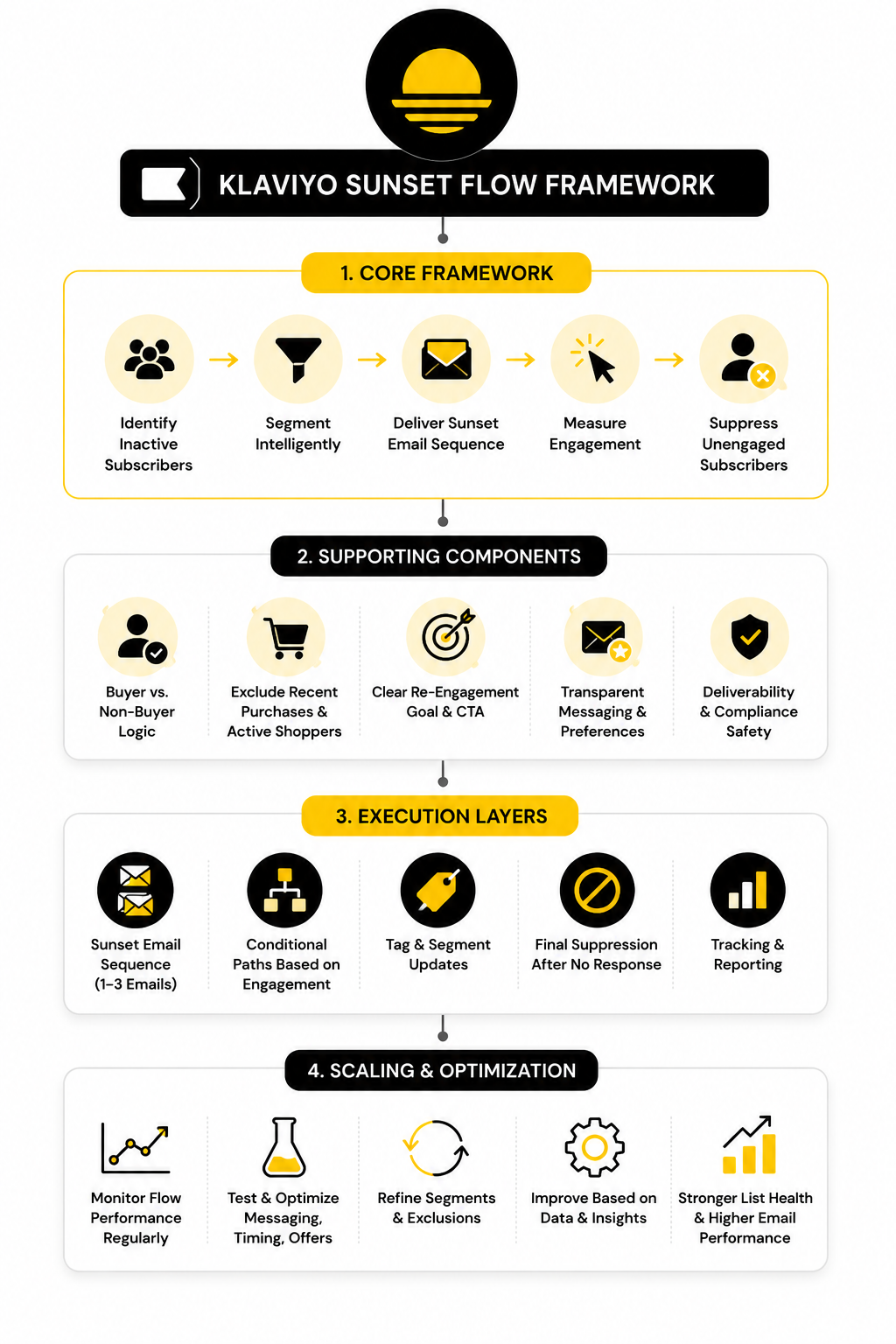
This framework keeps the automation from becoming emotional or random. You are not guessing who should be removed. You are creating a fair process where the subscriber’s behavior makes the decision.
Core Components Of The Flow
The first core component is the sunset segment. This is the audience that enters the flow, and it needs to be strict enough to avoid removing people too early. A common mistake is using one weak signal, such as no opens in 30 days, without considering list age, recent purchases, or whether the person has had enough chances to engage.
The second component is the re-engagement message. This email should be direct and easy to act on. The subscriber should immediately understand that they are receiving it because they have not engaged in a while, and they should have a clear way to stay on the list.
The third component is the final action. If the subscriber clicks, they stay. If they does nothing after the flow finishes, they should be suppressed or moved out of regular marketing. Without this final action, the sunset flow becomes theater instead of an operating system.
Professional Implementation Starts With Restraint
The biggest difference between an amateur sunset flow and a professional one is restraint. A weak setup tries to win everyone back with aggressive discounts, too many emails, and vague copy. A stronger setup respects the subscriber, protects the sender reputation, and removes people who no longer want the emails.
This is especially important because Gmail and Yahoo have made sender quality harder to ignore. Google’s sender guidance emphasizes low spam rates, authentication, and easy unsubscribe expectations, while Yahoo’s sender guidance also supports easy opt-out paths when complaint risk is high. A sunset flow will not fix broken authentication or bad acquisition, but it does reduce the number of uninterested people receiving your campaigns.
That is why the Klaviyo sunset flow should sit inside your larger lifecycle system. Welcome flows bring in new subscribers. Browse, cart, post-purchase, and win-back flows respond to buying intent. The sunset flow protects the whole system by making sure your regular campaigns are not being dragged down by people who have already tuned out.
The Klaviyo Sunset Flow Framework
A good Klaviyo sunset flow is built around one uncomfortable truth: not every subscriber should keep receiving your campaigns forever. Some people are temporarily inactive. Some are still interested but need a different message. Others have clearly moved on, and continuing to email them only creates deliverability risk.
The framework is simple, but the discipline behind it matters. You need to decide who qualifies as unengaged, give those people a clear chance to stay, and then remove the contacts who do not respond. Klaviyo describes this type of flow as a way to give inactive subscribers one last opportunity to re-engage before you suppress profiles that remain unresponsive.
That is the whole game. A sunset flow should not become a complicated maze of discounts, emotional subject lines, and endless reminders. It should be a clean decision system that protects the health of your email program.
Start With The Subscriber’s Intent
The first mistake brands make is treating inactivity as one flat category. Someone who joined your list 45 days ago and missed two campaigns is not the same as someone who has ignored every email for 240 days. A Klaviyo sunset flow needs to separate weak engagement from true disengagement.
Intent shows up in different ways. Opens can be useful, but they are less reliable than they used to be because privacy features can affect open tracking. Clicks, purchases, preference updates, form submissions, and recent site behavior can give you stronger signals about whether someone still has a relationship with your brand.
This does not mean you should keep everyone who once clicked something three years ago. It means your sunset logic should be fair. The goal is not to shrink the list aggressively for the sake of looking clean. The goal is to identify people who have had enough chances to engage and still show no meaningful interest.
Separate Buyers From Non-Buyers
Your sunset flow should treat customers and non-customers differently. A subscriber who has never purchased and has not clicked in months is usually easier to suppress. A past buyer deserves more context because they may still be valuable even if they are not currently engaging with campaigns.
That does not mean buyers should stay on your active campaign list forever. If they never open, never click, and never respond to re-engagement, they can still hurt your sender reputation. Klaviyo’s list-cleaning guidance recommends finding unengaged profiles and suppressing people who do not engage, because poor engagement can affect deliverability and list performance over time.
A practical approach is to use different inactivity windows. Non-buyers can usually enter the sunset flow sooner, while buyers may get a longer window or a softer message. This keeps the system commercially sensible without letting old customer data become an excuse for poor list hygiene.
Use Engagement Tiers Instead Of One Hard Cutoff
A professional Klaviyo sunset flow works better when it uses engagement tiers. Instead of asking, “Has this person opened recently?” ask, “How cold is this person, and what should happen next?” That small shift creates a much more carefully structure.
You can think of the audience in three groups. Warm subscribers are still opening, clicking, purchasing, or showing recent intent. Cooling subscribers have slowed down but may still be worth re-engaging through better segmentation or lighter campaign frequency.
Cold subscribers are the sunset audience. They have crossed the point where normal marketing is no longer appropriate, so they need a dedicated sequence with a clear stay-or-go action. This tiered thinking helps you avoid two bad outcomes: suppressing people too early or waiting so long that the damage is already done.
Match The Flow To Deliverability Reality
Mailbox providers are not judging your email program based on how hard you worked on the campaign. They are looking at signals from recipients. If people ignore, delete, unsubscribe, or mark emails as spam, those signals shape how future emails are treated.
That is why sunset flows became more important after the 2024 bulk sender changes. Google tells senders to keep spam rates below 0.1% and avoid ever reaching 0.3% or higher in its email sender guidelines FAQ, and Yahoo’s sender requirements emphasize authentication, lower complaint risk, and easier unsubscribe paths in its sender best practices. These rules are not abstract compliance details. They directly affect whether your campaigns keep reaching the inbox.
A Klaviyo sunset flow helps because it reduces the number of low-intent people receiving regular campaigns. It will not save a bad acquisition strategy or fix spammy copy. But when paired with proper authentication, clean signup sources, and sensible segmentation, it becomes one of the strongest list-health automations you can run.
Build The Flow Around A Clear Decision
Every sunset flow should answer one question: should this person remain marketable? If the subscriber clicks to stay, updates preferences, or otherwise shows meaningful engagement, they should exit the sunset path and return to the right active segment. If they ignore the entire sequence, they should stop receiving normal marketing emails.
The cleanest version is usually a short flow. One email can work for smaller brands or very cold audiences. Two or three emails can work when you want to give subscribers a softer reminder, explain the value of staying subscribed, and then send a final notice before suppression.
What you should avoid is the never-ending sunset flow. If someone has ignored months of campaigns and then ignores your re-engagement sequence, the answer is clear. At that point, continuing to send is not persistence. It is poor email management.
Keep The Message Human And Direct
Sunset emails do not need to be clever. In fact, clever often makes them weaker. The subscriber should immediately understand why they are receiving the email and what action they need to take if they still want to hear from you.
A strong message usually does three things. It acknowledges that they have not engaged in a while, reminds them what they will continue receiving if they stay, and gives them a simple button or link to remain subscribed. You can also offer a preference-center option if your brand sends different types of emails and the subscriber may only want some of them.
The tone should be calm, not desperate. You are not trying to guilt people into staying. You are making the relationship cleaner for both sides, which is exactly why a Klaviyo sunset flow should feel more like a respectful checkpoint than a sales campaign.
Decide What Counts As Re-Engagement
Before you build anything, define what action saves someone from suppression. A click is usually the cleanest signal because it shows intentional engagement. A purchase is obviously strong. A preference update can also count because the subscriber is actively telling you they still want some kind of relationship.
Opens are trickier. They can still be useful as part of a broader engagement model, but they should not be the only signal you trust. Apple’s Mail Privacy Protection and similar privacy changes can make open data less reliable, so the strongest sunset strategies lean more heavily on clicks and other intentional actions.
This decision has to be made before the flow goes live. If you do not define re-engagement clearly, the sunset flow becomes messy later. You will end up manually debating who should stay, which defeats the purpose of building an automation in the first place.
Make Suppression Part Of The System
The suppression step is where many brands hesitate. They like the idea of a Klaviyo sunset flow, but they do not like watching the active list get smaller. That reaction is normal, but it is also the reason inactive lists become a problem.
Suppression does not erase the customer from your business. It simply removes the profile from regular marketing sends so your campaigns are not weighed down by people who no longer engage. Klaviyo’s active profile management guidance frames sunset flows as a way to win back inactive profiles and then suppress those who remain unresponsive.
This is the part to take seriously. A sunset flow without suppression is just another re-engagement campaign. A sunset flow with suppression becomes a real deliverability safeguard.
The Framework In Practice
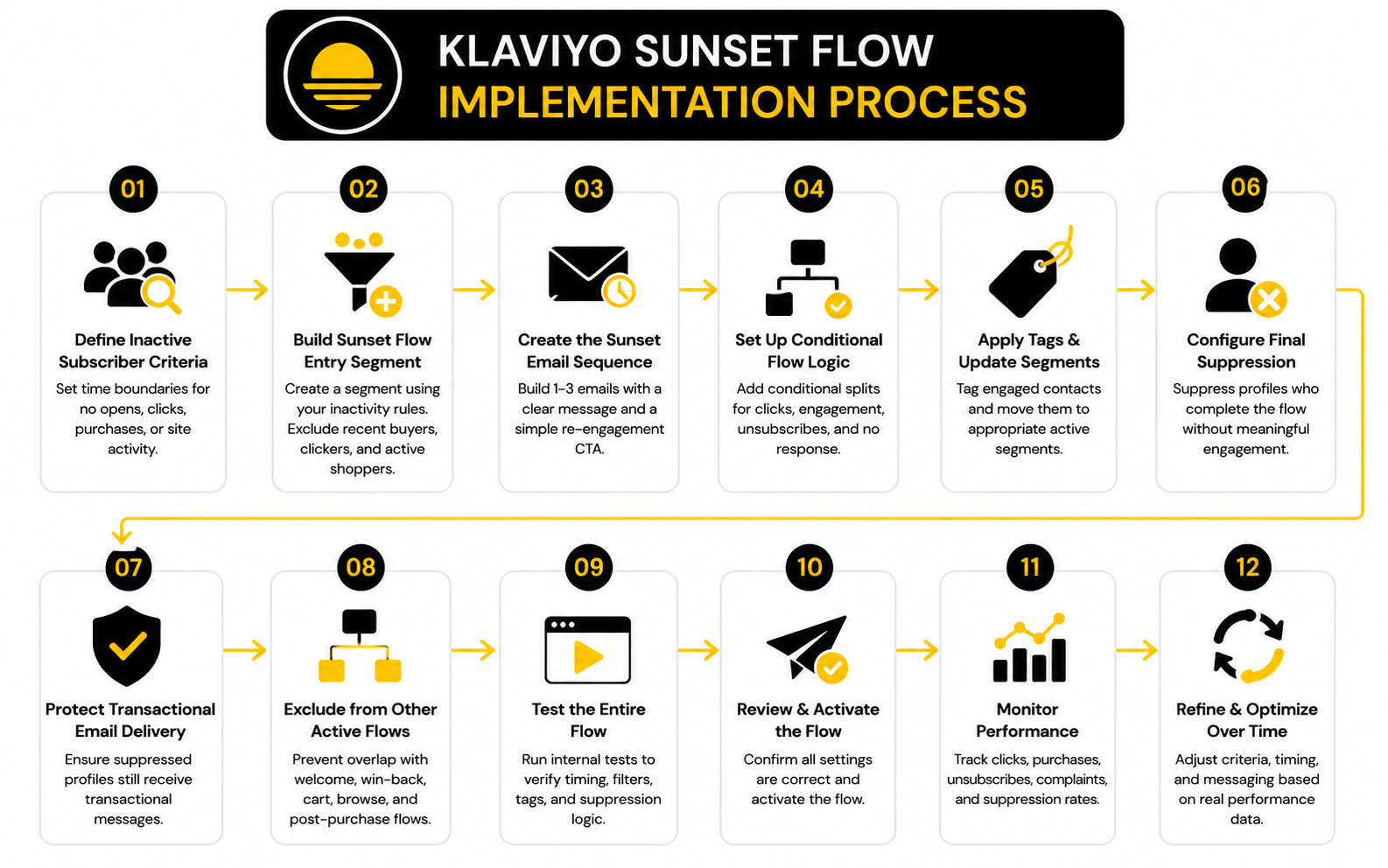
The practical version of the framework looks like this. First, define the cold audience based on enough time and enough missed engagement. Second, trigger the flow when someone enters that audience. Third, send a clear re-engagement message that asks for a meaningful action.
Fourth, wait long enough for the subscriber to respond. Fifth, check whether they clicked, purchased, updated preferences, or otherwise re-engaged. Sixth, suppress the people who did nothing.
That structure is intentionally boring. Boring is good here. The more complicated the framework becomes, the harder it is to trust, maintain, and explain when deliverability starts to matter.
Measurement, Analytics, And What The Data Actually Means
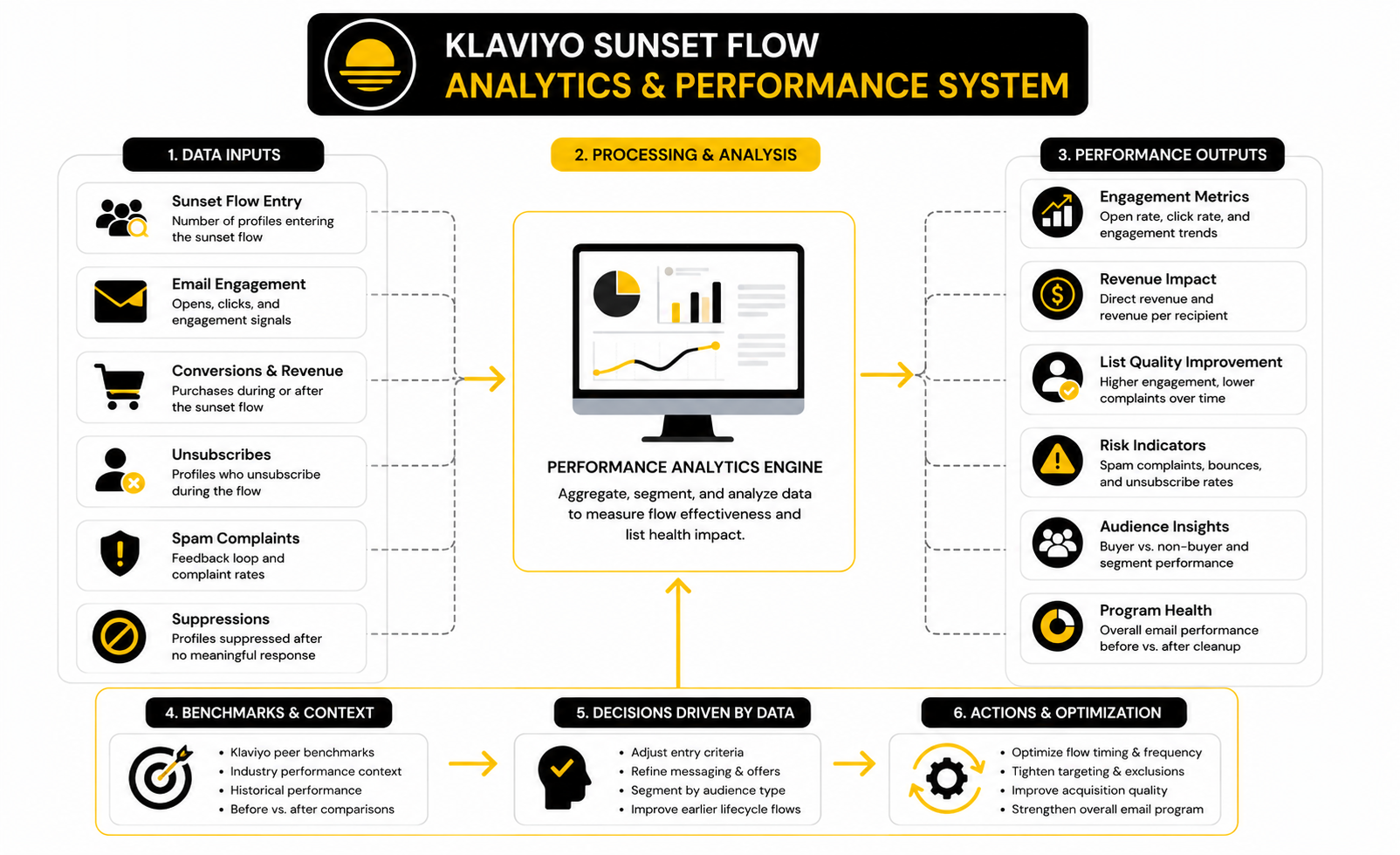
A Klaviyo sunset flow is only useful if you can read the signals correctly. The goal is not to celebrate a high open rate, panic over a low conversion rate, or copy someone else’s benchmark blindly. The goal is to understand whether the flow is protecting deliverability, identifying real re-engagement, and removing people who no longer belong in regular campaign sends.
This is where many brands get the analysis wrong. They judge a sunset flow like a sales flow, then assume it failed because it did not produce much revenue. That is the wrong lens. A sunset flow is partly a revenue recovery tool, but it is mostly a list-quality control system.
The right question is not, “Did this flow make a lot of money?” The better question is, “Did this flow help us separate subscribers who still want emails from subscribers who should stop receiving them?” When you measure it that way, the data becomes much more useful.
The Metrics That Actually Matter
The first metric to watch is the entry volume. If too many people are entering your Klaviyo sunset flow every week, the problem may not be the flow itself. It may be your acquisition quality, campaign frequency, welcome flow, offer strategy, or segmentation.
The second metric is the click rate. Clicks matter more than opens because they show intentional behavior. Privacy changes have made opens less dependable as a decision-making signal, so a subscriber who clicks to stay subscribed, updates preferences, or visits a key page is giving you a stronger reason to keep them active.
The third metric is the suppression rate. This tells you how many people reached the end of the flow without taking meaningful action. A high suppression rate is not automatically bad. In many cases, it means the flow is doing its job by removing people who were already disengaged.
Statistics And Data
Email benchmarks are useful only when they give you context. Klaviyo’s benchmark tools compare performance against peer groups rather than generic industry averages, which matters because a small apparel brand, a mature beauty brand, and a subscription consumables brand should not judge performance from the same baseline. Klaviyo describes its benchmarks as being based on peer groups of similar companies, which makes them more useful than broad averages when you are evaluating campaigns and flows through Klaviyo benchmarks.
For sunset flows, you should use benchmarks carefully. A normal campaign benchmark tells you what healthy engaged-audience performance might look like. A sunset flow is sent to people who are already cold, so it should usually perform worse than your engaged campaigns.
That does not make the flow weak. It means the audience is doing exactly what the segment definition said they would do. The more important comparison is not sunset flow versus newsletter. It is sunset flow performance over time, before and after list cleaning, and against the health of your broader email program.
Read Open Rates With Caution
Open rate can still be useful as a directional metric, but it should not be the foundation of your sunset decision. If a subscriber opens but never clicks, never buys, never updates preferences, and never shows other intent, that is not the same as true re-engagement. It may be curiosity, accidental behavior, or distorted tracking.
This is especially important because Apple’s Mail Privacy Protection can affect open tracking by preloading email content through proxy servers. Apple explains that Mail Privacy Protection helps prevent senders from learning when users open an email and masks IP address information in its Mail Privacy Protection overview. That does not make open rate useless, but it does make it less reliable as a hard rule.
Use opens as a supporting signal, not the deciding signal. If opens rise after you clean the list, that can suggest healthier engagement. But when deciding whether a specific subscriber should stay marketable, clicks and other intentional actions deserve more weight.
Clicks Are The Cleanest Re-Engagement Signal
A click is simple. The subscriber saw the email, made a choice, and took action. That is why the main call to action in a Klaviyo sunset flow should be easy to understand and easy to measure.
You can use a “keep me subscribed” button, a preference-center link, a product category link, or a content link if it fits your brand. The key is that the click should mean something. Do not make the only clickable option a discount code unless you are comfortable treating bargain-seeking behavior as your re-engagement signal.
This is where clean tracking matters. Use one primary CTA when possible, keep the email focused, and avoid filling the message with too many competing links. The easier the action is to interpret, the easier it is to decide what should happen next.
Watch Complaint Rate Like A Risk Signal
Spam complaints are not just another dashboard number. They are one of the clearest signs that your list, message, or frequency is misaligned with recipient expectations. Google’s sender guidance says senders should keep spam rates below 0.1% and avoid ever reaching 0.3% or higher in its email sender guidelines FAQ.
That matters directly for sunset strategy. If complaints rise when you send to older, colder segments, those segments should be tightened or removed from normal campaign sending faster. A sunset flow gives those people one controlled path to re-engage instead of letting them sit inside your main audience indefinitely.
You should monitor complaints at the domain and campaign level, not just inside Klaviyo. Google Postmaster Tools, Yahoo Sender Hub, and your Klaviyo reporting can show different parts of the picture. If complaint risk is climbing, do not solve it with prettier design. Solve it with stricter targeting, cleaner acquisition, and faster suppression of disengaged profiles.
Unsubscribe Rate Is Not Always Bad
Unsubscribes can feel negative, but they are often healthier than silence or spam complaints. If someone no longer wants emails from your brand, a clean unsubscribe is the best outcome. It protects the subscriber experience and removes future complaint risk.
Yahoo’s sender best practices specifically encourage senders to remove invalid recipients, consider reconfirmation emails for inactive subscribers, and use complaint feedback data to maintain a clean list through Yahoo Sender Hub best practices. That aligns perfectly with the purpose of a sunset flow. You are not trying to trap people on the list. You are making the relationship honest.
So do not panic if the sunset flow generates unsubscribes. That can mean the email is doing its job. The number to worry about is not unsubscribes alone. The number to worry about is unsubscribes plus complaints plus falling engagement across the rest of your program.
Revenue Should Be Measured, But Not Worshipped
Yes, you should track revenue from the sunset flow. Some inactive subscribers will come back and buy, especially if they were distracted rather than truly done with the brand. But revenue is not the main success metric here.
A sunset flow that makes modest revenue and removes thousands of dead profiles can still be extremely valuable. It can improve campaign engagement rates, lower billable profile counts, reduce deliverability risk, and make your reporting cleaner. Klaviyo’s sunset flow guidance explicitly connects the flow to suppressing profiles that do not respond and maintaining a cleaner list through its sunset flow setup process.
That means you should measure both direct and indirect value. Direct value is revenue from people who re-engage and buy. Indirect value is the improvement in list quality after the wrong people stop receiving campaigns.
Compare Before And After List Health
The best measurement window is not just the flow report. Look at what happens to your broader email program after the sunset flow has been running for a few weeks or months. Your campaign performance should become easier to interpret because you are no longer sending to as many people who were never going to engage.
Track open rate, click rate, unsubscribe rate, spam complaint rate, bounce rate, revenue per recipient, and active profile count before and after implementation. Do not expect every number to improve instantly. Deliverability changes can take time, and campaign content still matters.
What you want is a cleaner trend. If engagement quality improves while your reachable audience becomes smaller, that is usually a good trade. A smaller list that responds is more valuable than a bigger list that trains inbox providers to ignore you.
Segment The Reporting By Audience Type
Do not measure all sunset subscribers as one group forever. Buyers, non-buyers, high-LTV customers, discount-only subscribers, and old giveaway leads can behave very differently. When you segment reporting, you see which audiences are worth saving and which audiences should be suppressed faster.
For example, past customers may show lower email engagement but higher recovery value if they do click. Non-buyers from low-intent lead sources may produce almost no recovery and a higher unsubscribe rate. Those patterns should change how you define entry criteria in future versions of the flow.
This is how the Klaviyo sunset flow becomes more carefully over time. You are not just looking at one blended report. You are learning which types of inactivity deserve patience and which ones deserve a clean exit.
Know When The Data Is Telling You To Tighten The Flow
If your sunset flow gets very few clicks and almost no purchases, that does not always mean the emails need better copy. It may mean people are entering too late, after they have already emotionally disconnected from the brand. In that case, you should test an earlier re-engagement stage before the final sunset sequence.
If complaints or unsubscribes spike, the audience may be too cold or the message may feel too aggressive. Tighten the entry criteria, reduce the number of emails, and make the opt-out path clearer. Do not try to pressure cold subscribers into staying.
If many people click to stay but then ignore future campaigns, your re-engagement action may be too weak. A curiosity click is not the same as renewed interest. In that case, consider requiring a stronger signal, such as a preference update, product click, or purchase behavior before returning someone to broad campaign sends.
Build A Simple Sunset Dashboard
You do not need an overbuilt reporting system to manage this well. You need a simple dashboard that shows whether the flow is improving list quality. Keep it focused enough that you can actually use it every month.
Track these metrics together:
The dashboard should drive decisions, not just reporting. If entry volume is rising, investigate acquisition and engagement earlier in the lifecycle. If suppression is high but complaint rate falls and campaign engagement improves, the system is probably working.
Turn Measurement Into Better Decisions
The data from a Klaviyo sunset flow should change how you operate. If the flow shows that subscribers from one signup source go cold quickly, fix that source. If buyers stay more responsive than non-buyers, separate their inactivity windows. If people click preference links more than discount links, your audience may want relevance more than another promotion.
This is the real value of measurement. You stop guessing. You stop treating inactive subscribers as a vague problem and start seeing the specific points where your lifecycle marketing needs work.
A sunset flow is not just an automation at the end of the journey. It is a diagnostic tool for the entire email program. When the numbers are read properly, they show you where trust is fading, where engagement is still recoverable, and where it is time to let people go.
Advanced Strategy For Scaling A Klaviyo Sunset Flow
Once the basic Klaviyo sunset flow is working, the next question is not “How do we make it more complex?” The better question is “How do we make it safer, more carefully, and easier to scale?” A sunset flow should become part of the operating rhythm of your email program, not a one-time cleanup project you remember only when deliverability starts to slip.
This is where advanced strategy matters. At a small list size, you can get away with rough rules and manual reviews. As the list grows, those rough rules start creating expensive mistakes because every bad segment, weak trigger, or unclear suppression rule affects more people.
The goal is to build a system that can handle growth without becoming reckless. That means using better audience logic, protecting valuable customer relationships, and making sure the flow supports the rest of your lifecycle marketing instead of fighting it.
Balance List Growth Against List Quality
Most brands love acquisition because it feels productive. More subscribers, more leads, more potential buyers. But if the acquisition engine brings in people who never engage, the email program eventually pays the price.
This is especially true with giveaways, aggressive discounts, low-intent popups, and partner promotions. These sources can grow the list quickly, but the subscribers may not have strong buying intent. If a large share of those contacts later enters the sunset flow, the problem is not only at the end of the lifecycle. The problem started at signup.
A mature Klaviyo sunset flow should feed insight back into acquisition. If one form, offer, landing page, or traffic source produces unusually high sunset entry rates, that source needs review. Do not just clean the list downstream while continuing to fill it with the same low-quality contacts upstream.
Do Not Treat Every Inactive Subscriber The Same
Advanced sunset strategy depends on context. A first-time visitor who joined for a discount and never clicked again is not the same as a repeat customer who has gone quiet after several purchases. Both may be inactive, but they should not always receive the same timing, copy, or suppression logic.
High-value customers often deserve a longer runway. They may buy seasonally, purchase only during launches, or engage heavily with product drops but ignore normal newsletters. Suppressing them too quickly can reduce future revenue and weaken your customer relationship.
Low-intent subscribers should usually move through the system faster. If someone has never bought, never clicked, and came from a weak acquisition source, there is no reason to keep giving them unlimited chances. The more precise your segmentation becomes, the less your sunset flow feels like a blunt instrument.
Use Customer Value Without Letting It Override Engagement
Customer value should influence the flow, but it should not become an excuse to ignore email engagement forever. A high-LTV customer who has stopped interacting with marketing emails can still remain valuable to the business. But from an email deliverability perspective, they are not helping if they ignore every campaign.
This is why suppression needs to be understood correctly. Suppressing someone from marketing emails does not mean deleting the customer relationship. Klaviyo notes that suppressed profiles can still receive transactional emails, which is important because transactional messages serve a different purpose from promotional marketing.
That distinction gives you room to be disciplined. You can stop sending broad campaigns to unresponsive customers while still preserving essential customer communication. That is the professional move, especially for brands with repeat purchase cycles, subscriptions, replenishment windows, or high-ticket products.
Build A Pre-Sunset Layer Before The Final Sunset Flow
One advanced move is to create a pre-sunset stage before the true sunset flow. This is not the final goodbye. It is a softer intervention for subscribers who are cooling down but not fully cold yet.
The pre-sunset layer can reduce frequency, shift the content angle, or ask people what they want to receive. It gives the brand a chance to fix relevance before the relationship becomes too cold. This is useful because some subscribers disengage not because they hate the brand, but because the content no longer matches their intent.
The final Klaviyo sunset flow should be reserved for people who have already passed that softer stage or have been inactive long enough to justify a clear decision. This keeps the final flow cleaner. It also prevents the sunset message from doing work that should have been handled earlier in the lifecycle.
Watch The Tradeoff Between Revenue Recovery And Reputation Protection
There is always a tradeoff in sunset strategy. If you wait longer before suppressing people, you may recover a few more purchases. If you suppress faster, you may protect engagement and reputation sooner.
Neither approach is automatically right. The decision depends on your purchase cycle, average order value, repeat purchase behavior, seasonality, and deliverability risk. A brand selling replenishable products may use a different inactivity window than a brand selling high-consideration items people buy once or twice a year.
The mistake is pretending there is no tradeoff. There is. The best approach is to make the tradeoff intentionally, then review the data over time instead of copying a generic rule from another account.
Keep Compliance And Consent Separate From Engagement
Consent and engagement are related, but they are not the same thing. Someone may have legally opted in and still be bad for deliverability if they never engage. Someone may be engaged with the brand through purchases or support interactions but not subscribed to marketing emails.
This distinction matters when your Klaviyo account becomes more complex. You need to know whether a person is subscribed, suppressed, unsubscribed, or simply inactive. Klaviyo’s consent documentation explains that email and SMS consent have different rules and profile records, so consent logic should be handled carefully when building automated marketing systems.
A sunset flow should never be used as a sloppy replacement for consent management. It is a list-health mechanism, not a legal compliance engine. Keep those systems cleanly separated, and your account will be much easier to manage as it grows.
Coordinate Sunset Logic With Other Flows
Your sunset flow should not operate in isolation. It needs to work with welcome flows, abandon cart flows, browse abandonment, post-purchase flows, win-back flows, replenishment flows, and campaign segmentation. If those systems are not coordinated, subscribers can receive mixed signals.
For example, someone should not receive a “Do you still want to hear from us?” email while also receiving aggressive promotional campaigns from another segment. That creates a confusing experience and weakens the purpose of the sunset flow. Flow filters and segment exclusions are not optional here.
The clean approach is to define priority. Transactional emails come first because customers expect them. High-intent behavioral flows come next when someone is actively shopping. The sunset flow should apply when the subscriber is genuinely inactive, not when they are already showing fresh intent elsewhere.
Be Careful With Discounts In Sunset Emails
Discounts can work, but they can also teach the wrong lesson. If every sunset email offers a coupon, some subscribers learn that ignoring you is the path to a better deal. That might recover a short-term purchase while weakening your long-term pricing discipline.
A better approach is to use the first sunset message to confirm interest rather than immediately discount. Ask the subscriber to stay, update preferences, or choose what they want to hear about. If a discount fits your brand, use it intentionally, not as the default answer to every inactivity problem.
This is especially important for premium brands. A clean, respectful sunset email can strengthen the brand’s positioning. A desperate coupon-heavy goodbye sequence can do the opposite.
Manage Seasonal Buyers Differently
Seasonality can distort inactivity rules. A customer who buys holiday gifts every November may look inactive for most of the year. A swimwear buyer may disappear during winter. A tax-related product, school product, or event-driven item may naturally have long quiet periods.
If your brand has seasonal demand, your sunset logic should reflect that. Do not suppress people simply because they are outside the buying season. Instead, use purchase timing, product category, and previous seasonal behavior to decide when inactivity really matters.
This is where generic sunset templates fall short. They often assume all brands have the same buying rhythm. Your Klaviyo sunset flow should match the actual customer journey, not an arbitrary calendar.
Use Suppression Rules That Your Team Can Explain
A suppression rule should be easy to defend. If someone asks why a profile was suppressed, the answer should be clear: they met the inactive criteria, received the sunset sequence, did not take the required action, and were removed from marketing sends. That explanation should not require a detective.
As the account grows, unclear rules become dangerous. Teams change. Agencies change. Flows get duplicated. Segments are edited. If the logic is too clever, nobody trusts it later.
Document the criteria in plain language. Name the segments clearly. Keep the flow notes current. A sunset system that your team understands will outperform a sophisticated mess that everyone is afraid to touch.
Scale With Fewer Exceptions, Not More
It is tempting to create endless exceptions. Exclude VIPs. Exclude wholesale buyers. Exclude anyone who bought a certain product. Exclude people who joined from a specific launch. Some exceptions make sense, but too many exceptions break the system.
Every exception should earn its place. If a segment has a real business reason to be treated differently, separate it. If the exception only exists because someone feels nervous about suppressing contacts, remove it.
The more exceptions you add, the harder it becomes to know whether the Klaviyo sunset flow is actually working. Clean strategy beats fragile complexity. Keep the logic tight, then improve it based on evidence.
Prepare For Platform And Privacy Changes
Email measurement will keep changing. Privacy features, inbox filtering, authentication requirements, and mailbox provider policies are not static. A sunset strategy that relies too heavily on one fragile metric will become weaker over time.
That is why intentional actions matter. Clicks, purchases, preference updates, and direct replies are more useful than passive signals alone. They show that the subscriber made a choice.
Your sunset flow should be built for that future. Do not design it around perfect tracking. Design it around clear subscriber behavior, conservative assumptions, and rules you can keep improving as the data environment changes.
The Expert Mindset
The expert mindset is simple: protect the relationship and protect the channel. You are not trying to squeeze one more send out of every profile. You are trying to build an email program that stays healthy enough to keep reaching the people who actually care.
That means accepting that list size is not the trophy. A responsive list is the trophy. A clean sender reputation is the trophy. A lifecycle system where subscribers receive relevant emails at the right stage is the trophy.
A Klaviyo sunset flow helps you get there because it forces a decision. Keep the people who show intent. Respectfully release the people who do not. Then use what you learn to make the whole email program stronger.
Mistakes To Avoid Before You Finalize The System
The final version of your Klaviyo sunset flow should feel boring in the best possible way. The criteria should be clear, the message should be direct, and the final action should be easy to understand. If the system needs constant explanation, manual judgment, or exceptions every week, it is not ready to scale.
The first mistake is waiting until the list is already in bad shape. A sunset flow is easier to manage when deliverability is stable, campaign engagement is still healthy, and the team is not panicking. If you only build it after inbox placement drops, you are cleaning up damage that could have been prevented earlier.
The second mistake is trying to win back every cold subscriber at any cost. Some people are not coming back, and that is fine. A clean exit is often better than a desperate offer, especially when mailbox providers are watching recipient behavior, complaint signals, and list quality more closely than ever.
Final Checklist Before Turning The Flow Live
A strong sunset system is not just the flow itself. It is the combination of segment rules, flow filters, message logic, reporting, and suppression discipline. Before activating the flow, review the full path from entry to exit so you know exactly what will happen to every subscriber.
The most important test is simple: can your team explain why someone entered the flow, what action would save them, and what happens if they do nothing? If the answer is yes, the system is probably clean enough to launch. If the answer is vague, keep simplifying.
Use this checklist before the Klaviyo sunset flow goes live:
This checklist is not busywork. It protects you from the small errors that become expensive later. A sunset flow touches real subscribers, real revenue, and real sender reputation, so it deserves the same discipline as your best revenue automations.
How The Sunset Flow Fits Into The Email Ecosystem
A Klaviyo sunset flow should sit at the edge of your email ecosystem, not in the center of it. It catches people when other lifecycle paths have stopped working, then makes a final decision about whether they should keep receiving marketing emails. That makes it a protective layer around your campaigns, not a replacement for better segmentation.
The healthier your earlier flows are, the less pressure the sunset flow has to carry. A strong welcome flow sets expectations. Good campaign segmentation keeps content relevant. Post-purchase flows maintain the customer relationship. Win-back flows respond to purchase inactivity before the subscriber becomes completely cold.
The sunset flow is the final checkpoint. It does not fix weak offers, poor acquisition, or irrelevant campaigns by itself. But it does force the email program to be honest about who is still engaged and who should be removed from regular sending.
What is a Klaviyo sunset flow?
A Klaviyo sunset flow is an automated email sequence that targets subscribers who have stopped engaging with your emails. It gives them one final chance to show interest before they are suppressed or removed from regular marketing sends. Klaviyo’s own sunset flow guidance describes it as a way to phase out customers who are no longer engaging and suppress people who remain unresponsive through its sunset flow setup guide.
Why do ecommerce brands need a sunset flow?
Ecommerce brands need a sunset flow because inactive subscribers can reduce engagement rates, increase complaint risk, and make campaign reporting less reliable. A large list is not automatically a strong list. If thousands of people are ignoring your emails, they are not helping the business.
A sunset flow protects the quality of the list. It gives people a fair chance to stay, but it also removes subscribers who no longer want to hear from the brand. That makes future campaigns cleaner, easier to measure, and safer to send.
When should someone enter a Klaviyo sunset flow?
Someone should enter a Klaviyo sunset flow when they have had enough opportunities to engage and still show no meaningful activity. The exact timing depends on your business model, purchase cycle, and email frequency. A brand that sends weekly campaigns will usually have a different inactivity window than a brand that sends only during seasonal launches.
The key is to avoid using one lazy rule. Do not trigger the flow just because someone missed a few emails. Use a combination of time, email engagement, purchase behavior, and recent site activity so the flow targets truly cold subscribers.
Should buyers and non-buyers use the same sunset rules?
Usually, no. Buyers and non-buyers should often have different sunset rules because their relationship with the brand is different. A customer who has purchased before may deserve more context, especially if the product has a long buying cycle or seasonal demand.
That does not mean buyers should stay on the active marketing list forever. If they stop opening, clicking, purchasing, and responding to re-engagement, they can still become a deliverability risk. The better move is to give buyers a more thoughtful path while still keeping the final decision clear.
How many emails should a sunset flow include?
Most sunset flows should be short. One to three emails is usually enough because the audience is already inactive. If someone has ignored months of normal campaigns, they probably do not need a long sequence of reminders.
A shorter flow also reduces risk. The more emails you send to cold subscribers, the more chances you create for complaints, unsubscribes, or negative engagement. Keep the message focused, give them a real choice, and move on if they do not respond.
What should the main call to action be?
The main call to action should create a clear engagement signal. A “keep me subscribed” button is simple and effective because the intent is obvious. A preference-center link can also work well if your brand sends different types of emails and subscribers may want fewer messages rather than no messages at all.
Product links can work when they are relevant, but they are not always the cleanest signal. A discount link can recover revenue, but it may also attract people who only respond to offers. Choose the CTA based on what you want the action to mean after the click.
Should a sunset flow include a discount?
A discount is optional, not mandatory. Some brands can use a small incentive to recover subscribers who still have buying intent. Other brands should avoid discounts because they weaken positioning or train subscribers to wait for better offers.
If you use a discount, do it intentionally. Do not make the entire flow depend on price. The purpose of the sunset flow is to confirm interest, not to bribe every cold subscriber into clicking once.
What happens after someone ignores the entire flow?
If someone ignores the entire flow, they should usually be suppressed from email marketing. Klaviyo’s suppression documentation explains that suppressed profiles cannot receive email marketing, regardless of consent status, through its developer suppression reference. This is the step that turns the flow from a soft re-engagement campaign into a real list-health system.
Suppression should not be treated as a dramatic failure. It is often the correct outcome. The subscriber had a chance to stay, did not respond, and no longer needs to receive regular promotional emails.
Can suppressed contacts still receive transactional emails?
Suppression is about marketing email, not necessarily every possible customer communication. Klaviyo’s suppression reference states that suppressed profiles cannot receive email marketing, which is different from essential transactional communication tied to an order or customer action. This distinction matters because you can clean your marketing list without deleting the customer relationship.
That is why suppression is usually better than deleting profiles too aggressively. You preserve useful customer history while stopping unnecessary promotional sends. For many brands, that is the right balance between data retention and list hygiene.
How often should a sunset flow be reviewed?
Review the sunset flow at least monthly when it is new. Once it is stable, a quarterly review may be enough for many brands. The review should look at entry volume, clicks, unsubscribes, complaints, suppression rate, purchases, and downstream campaign performance.
Do not review the flow in isolation. If the number of people entering the flow rises sharply, look upstream at lead sources, signup offers, campaign relevance, and email frequency. The sunset flow often reveals problems that started much earlier in the subscriber journey.
What spam complaint rate should brands watch?
Google’s sender guidance says senders should keep spam rates below 0.1% and avoid ever reaching 0.3% or higher in its email sender guidelines FAQ. That gives brands a practical risk threshold to monitor, especially when sending to colder audiences. If complaints rise when older segments are included, the sunset strategy needs to become stricter.
Do not wait for complaints to become a crisis. Cold subscribers are more likely to ignore, unsubscribe, or complain because the relationship has weakened. A sunset flow gives you a controlled way to reduce that exposure.
Is a sunset flow the same as a win-back flow?
No, a sunset flow and a win-back flow are related but different. A win-back flow usually focuses on recovering a customer or encouraging another purchase. A sunset flow focuses on deciding whether someone should remain on the active marketing list.
The difference matters because the success metrics are different. A win-back flow is judged heavily on revenue. A sunset flow should be judged on re-engagement, suppression quality, complaint risk, and list health.
Can a sunset flow improve deliverability?
A sunset flow can support deliverability by reducing sends to subscribers who no longer engage. It will not fix every deliverability issue by itself. Authentication, complaint management, acquisition quality, content relevance, and unsubscribe handling still matter.
Yahoo’s sender best practices recommend removing invalid recipients promptly, considering reconfirmation emails for inactive subscribers, and using complaint feedback to maintain a clean list through Yahoo Sender Hub. That is exactly the environment where a sunset flow makes sense. It is one part of a broader deliverability system.
What is the biggest mistake with Klaviyo sunset flows?
The biggest mistake is building the flow but avoiding the final suppression step. Without suppression, the flow becomes another message sent to inactive people. It may create a few clicks, but it does not solve the underlying list-quality problem.
The second biggest mistake is judging the flow only by direct revenue. Revenue is nice, but list health is the real reason the automation exists. If the flow removes dead weight, lowers risk, and makes future campaigns cleaner, it is doing valuable work.
How do you know if the flow is working?
You know the flow is working when it creates clearer separation between active and inactive subscribers. Some people should click, update preferences, or purchase. Others should quietly leave the active list after ignoring the sequence.
The broader email program should also become easier to read. Campaign engagement should be more meaningful, complaint risk should be easier to manage, and your active audience should better reflect people who actually want your emails. That is the real win.
Build a stronger local presence with BAAM AI
Turn your website, Google profile, social channels, and AI visibility into one growth engine
Most businesses do not need more random marketing activity. They need a consistent presence system that helps the right people find them, trust them, and take action. BAAM AI brings strategy, local SEO, website updates, Google Maps visibility, social content, AI-search readiness, media production, and reporting into one practical monthly engine.
If you want your marketing to keep working after the campaign ends, start with a free BAAM AI presence audit. See how your business shows up today and where the fastest visibility wins are at BAAM AI.