
BAAM AI Blog
Klaviyo Subscription: A Practical Framework for Ecommerce Retention
A Klaviyo subscription strategy is not just a set of reminder emails for people who already joined your subscription program. It is the lifecycle system that helps subscribers understand what they bought, remember...
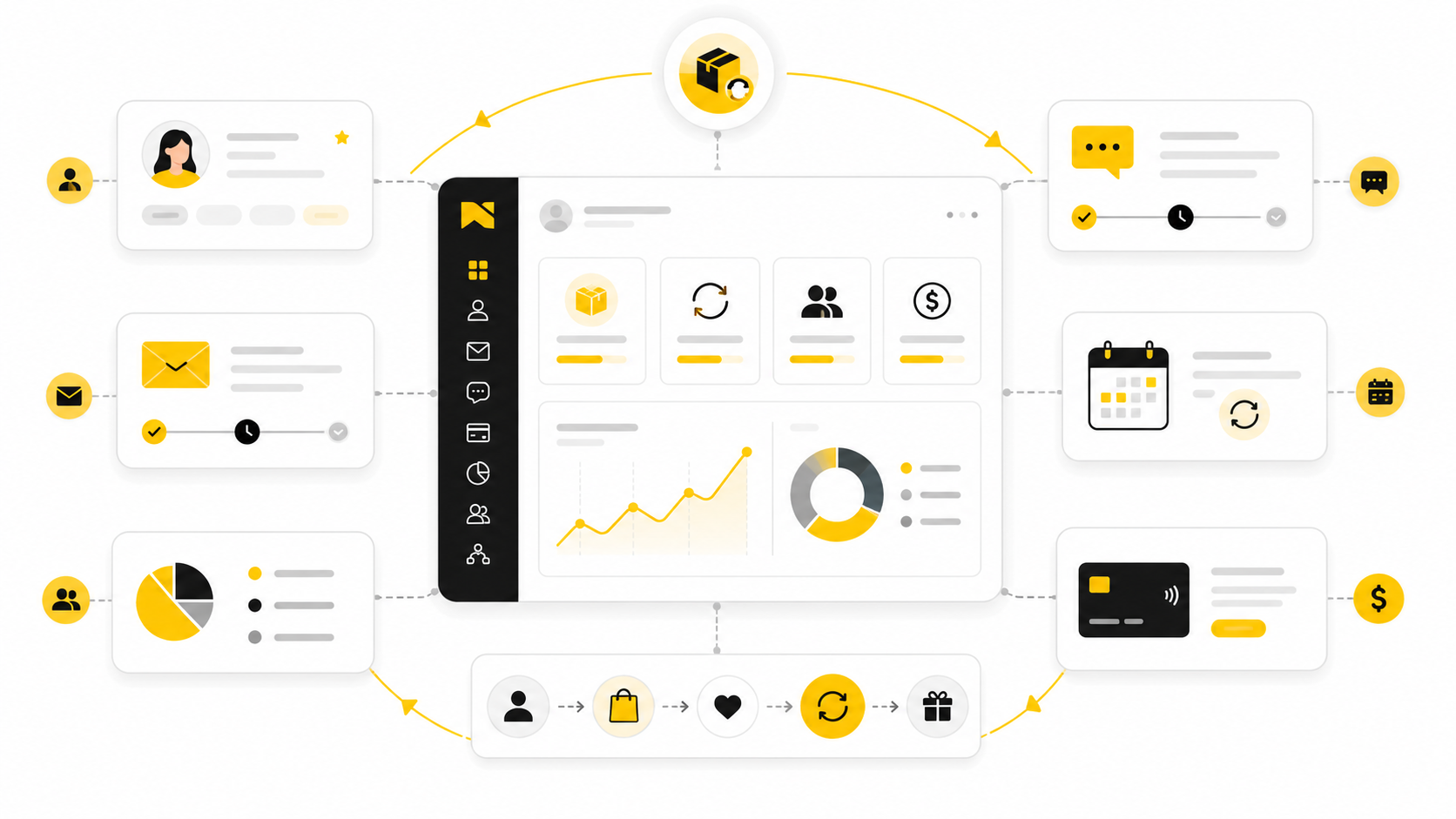
A Klaviyo subscription strategy is not just a set of reminder emails for people who already joined your subscription program. It is the lifecycle system that helps subscribers understand what they bought, remember why they signed up, stay engaged between orders, manage upcoming shipments, avoid failed-payment churn, and come back after cancellation. That matters because subscription revenue only becomes predictable when the customer experience is predictable too.
For ecommerce brands, the real problem is usually not “we need more flows.” The real problem is that subscription customers behave differently from one-time buyers, but many stores still message both groups the same way. A subscriber has different timing, different objections, different support needs, and a different definition of value.
Klaviyo is useful here because it can connect customer behavior, purchase history, subscription events, email, SMS, segmentation, and analytics into one operating system. But the tool does not create retention by itself. The money is in the structure: what data you bring in, what moments you trigger, what messages you send, and how cleanly the experience works when the customer wants to skip, pause, swap, upgrade, or cancel.
Why Klaviyo Subscription Marketing Matters
Subscription customers are not simply repeat customers with a recurring payment attached. They are customers who have made a stronger commitment, which means they also carry higher expectations. When the brand fails to communicate clearly, the subscription can quickly shift from convenience to annoyance.
That is why a good Klaviyo subscription setup focuses on control, confidence, and timing. Customers need to know what is coming, when they will be charged, how to change their order, and why staying subscribed still makes sense. The better those touchpoints feel, the less pressure you put on discounts, support tickets, and last-minute cancellation saves.
This is also where many brands get subscription marketing wrong. They obsess over acquisition, offer a strong first-order incentive, then go quiet until the next charge. A more carefully approach treats the subscription journey as a sequence of trust-building moments, not just a billing cycle.
The Klaviyo Subscription Framework
A strong Klaviyo subscription framework has four layers: data, segmentation, flows, and measurement. Data tells Klaviyo what happened. Segmentation decides who should hear from you. Flows deliver the right message at the right moment. Measurement tells you whether the system is actually improving retention.
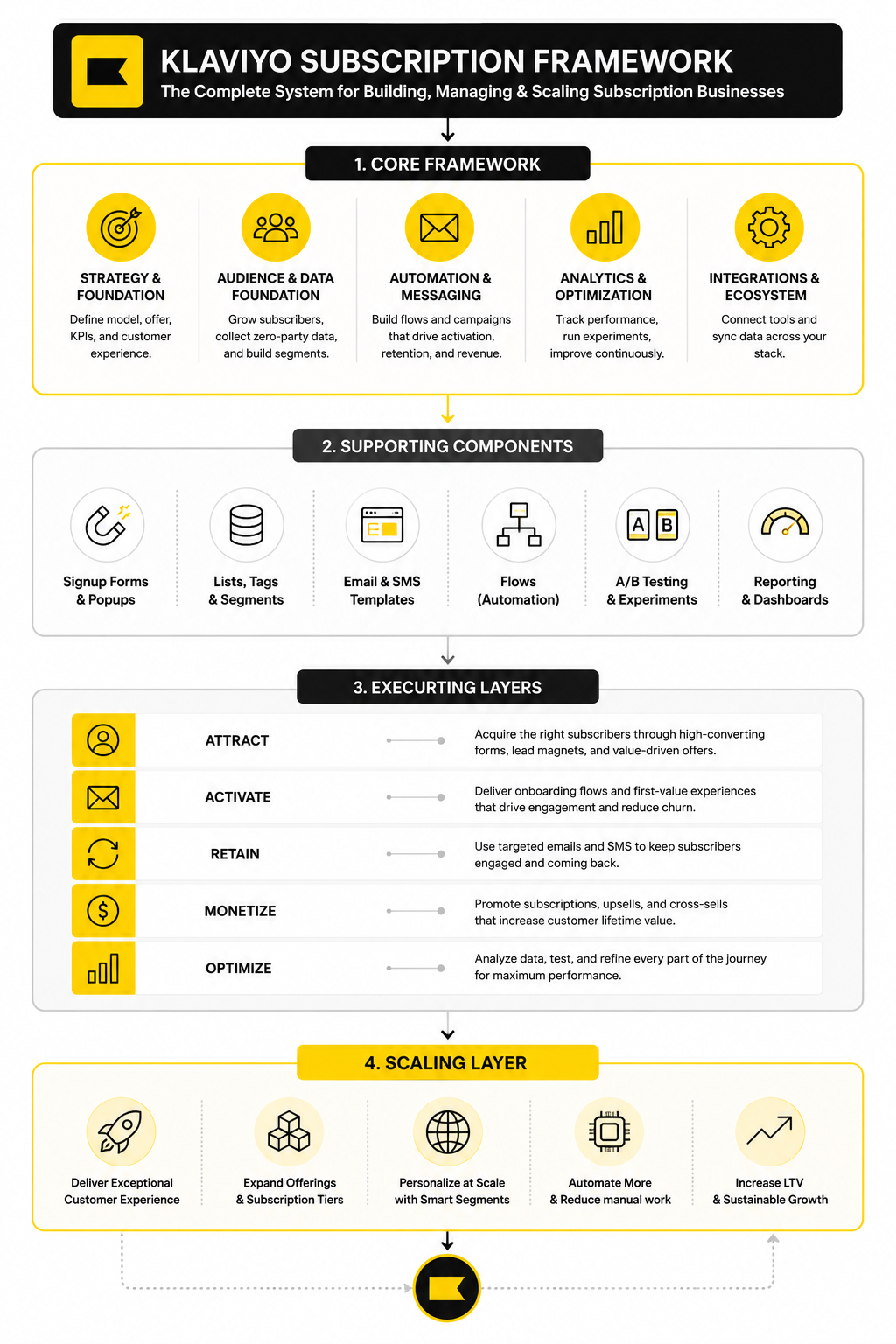
The framework starts with clean subscription events and profile properties. You need to know whether someone is an active subscriber, what product they receive, how often they receive it, when the next order is coming, whether payment failed, and whether they cancelled. Without that foundation, every automation becomes guesswork.
Once the data is reliable, the strategy becomes much easier to manage. You can separate new subscribers from loyal subscribers, high-risk subscribers from healthy subscribers, and cancelled subscribers from one-time buyers. That is the difference between sending generic email campaigns and running a real subscription retention engine.
Core Components of a Subscription Lifecycle
The first core component is the subscriber welcome experience. This is where you confirm the customer made a smart decision, explain how the subscription works, and reduce buyer’s remorse before it appears. The goal is not to oversell them again; the goal is to make the next renewal feel expected and easy.
The second component is pre-renewal communication. A good upcoming-order message can prevent surprise charges, reduce support volume, and give customers a chance to adjust their shipment before frustration builds. For many brands, this one flow alone can make the subscription experience feel more transparent and professional.
The third component is retention recovery. That includes failed-payment flows, cancellation flows, win-back campaigns, product education, replenishment logic, and personalized cross-sells. These messages should not feel desperate. They should feel useful, timely, and connected to the customer’s actual subscription history.
Professional Implementation
Professional implementation is mostly about removing gaps. You want the subscription platform, ecommerce store, Klaviyo account, forms, lists, segments, flows, and reporting to speak the same language. If one system says a customer is active and another says they cancelled, your marketing will create confusion.
A clean implementation also respects consent. Email and SMS are not interchangeable channels, and subscription updates should be handled carefully depending on whether the message is promotional, transactional, or account-related. This is especially important when brands combine subscription reminders with offers, upsells, or win-back incentives.
The best Klaviyo subscription setups feel boring in the best possible way. The right people enter the right flows, customers receive clear messages, support teams deal with fewer avoidable tickets, and marketers can see what is working. That is the foundation the rest of this guide will build on.
Why Klaviyo Subscription Marketing Matters
Subscription ecommerce is attractive because it can smooth revenue, increase purchase frequency, and make inventory planning less chaotic. But the model only works when customers keep feeling in control. The moment a subscriber feels surprised, trapped, overstocked, or ignored, the recurring order becomes a cancellation risk.
This is why Klaviyo subscription marketing should not be treated like a normal email calendar. Campaigns are useful, but subscriptions need event-based communication tied to the customer’s real account status. A subscriber who is three days away from renewal does not need the same message as a shopper who abandoned checkout yesterday.
The most important shift is simple: retention is not one flow. It is a system of small, well-timed touchpoints that remove friction before it turns into churn. That includes education after signup, reminders before renewal, support during payment issues, and relevant offers when the customer is ready for something more.
The Subscriber Mindset Is Different
A one-time buyer is deciding whether to buy again. A subscriber is deciding whether to keep a commitment. That difference changes the tone, timing, and purpose of every message you send.
For a one-time buyer, the next best action might be a product recommendation or a replenishment reminder. For a subscriber, the next best action might be confirming the next charge date, showing how to skip a shipment, explaining how to swap products, or reminding them of the value they are still getting. The Klaviyo subscription experience should make the customer feel informed, not chased.
This is where many brands accidentally create churn. They hide account-management options because they fear cancellations, then customers cancel anyway because the experience feels rigid. A better strategy gives subscribers more control earlier, because control often keeps people subscribed longer than pressure does.
Retention Starts Before the First Renewal
The first renewal is one of the most important moments in a subscription journey. If the customer does not understand the product, has not used enough of it, or forgot they subscribed, the next charge can feel like a problem instead of a benefit. That risk starts right after the first order, not right before the second one.
Your post-purchase and subscription welcome flows need to do more than say thank you. They should reinforce the customer’s decision, explain what happens next, and set expectations around renewal timing. This is where plain language wins: tell people when they will receive reminders, how to manage their account, and what support options are available.
Klaviyo helps because behavior-based automations can respond to what customers actually do. If someone opens education emails but does not engage with account-management content, that tells you something. If someone clicks skip, cancel, or support links before the second charge, that tells you even more.
Surprise Is the Enemy
Most subscription frustration comes from a few predictable situations. The customer receives too much product. The charge arrives before they expected it. The card fails and the brand communicates poorly. Or the customer wants to change something but cannot find the right place to do it.
A strong Klaviyo subscription setup reduces those moments with clear lifecycle messaging. Upcoming-order notifications, failed-payment flows, and cancellation-prevention flows are not “nice to have” automations. They are the guardrails that protect the recurring customer experience.
This is also why subscription messaging should be direct. Do not bury the important details under promotional copy. When the message is about an upcoming shipment, the charge date, product details, and management link should be easy to find.
The Klaviyo Subscription Framework
The framework for Klaviyo subscription marketing is built around four questions. What does Klaviyo know about the subscriber? What stage is the subscriber in? What action should happen next? How will you know whether that action worked?
Those questions keep the strategy grounded. Without them, teams usually build too many flows, send too many overlapping messages, and still miss the moments that actually affect retention. The point is not to automate everything; the point is to automate the right things with the right data.
Klaviyo can support this framework because it is designed around profiles, events, segments, flows, and performance reporting. Subscription platforms such as Recharge can send Klaviyo events for actions like checkout activity, upcoming orders, cancellations, and other subscription moments, which can then trigger email and SMS flows inside Klaviyo. That event layer is what turns a basic newsletter tool into a subscription lifecycle system.
Layer 1: Subscription Data
The first layer is subscription data. At minimum, you need to know whether the customer has an active subscription, what product they subscribed to, how often it ships, when the next order is expected, and whether anything has gone wrong. If this data is missing or inconsistent, the rest of the strategy will feel messy.
Good data also lets you avoid embarrassing messages. You do not want to send a “manage your subscription” email to someone who already cancelled. You do not want to push a subscription upgrade to someone with a failed payment. You definitely do not want to send a win-back message while an active order is already processing.
This is why the integration between Klaviyo and your subscription platform matters so much. Recharge, for example, documents subscription event metrics that can be used as Klaviyo flow triggers, including custom metric activity and event properties for personalization. That gives marketers more useful trigger points than a generic “placed order” event alone.
Layer 2: Lifecycle Segments
The second layer is segmentation. A practical Klaviyo subscription system separates customers by lifecycle stage, not just by product interest. New subscribers, active subscribers, prepaid subscribers, at-risk subscribers, failed-payment subscribers, cancelled subscribers, and loyal long-term subscribers should not all receive the same messaging.
Segmentation also protects your campaign strategy. When you send a broad promotion, active subscribers may need a different version of the message than non-subscribers. They may already be receiving the product, so the better angle might be an add-on, a bundle, a giftable option, or a subscription-exclusive perk.
The goal is relevance without overcomplication. You do not need hundreds of segments to start. You need a clean set of segments that match real business decisions, because every segment should change what you send, suppress, offer, or measure.
Layer 3: Lifecycle Flows
The third layer is lifecycle automation. These are the flows that respond to subscription moments automatically, instead of relying on manual campaigns. The core set usually includes subscriber welcome, upcoming order, product education, failed payment, cancellation follow-up, win-back, and loyalty expansion.
Each flow should have one clear job. The welcome flow builds confidence. The upcoming-order flow prevents surprise. The failed-payment flow recovers revenue without making the customer feel blamed. The cancellation flow learns why people leave and gives them a sensible next step.
This is where Klaviyo subscription flows become powerful. You can use event filters, profile properties, conditional splits, and message timing to create a customer journey that feels personal without being manually managed. Done well, the automation feels less like marketing and more like service.
Layer 4: Measurement and Improvement
The fourth layer is measurement. You need to look beyond open rates and revenue attribution, because subscription performance depends on behavior after the message. A reminder email is not successful just because it gets clicks; it is successful if it reduces surprise, lowers support pressure, or helps the customer manage the subscription instead of cancelling.
Useful metrics include renewal rate, cancellation rate, failed-payment recovery, skip rate, pause rate, product-swap usage, support tickets around billing, and repeat subscription revenue. These metrics show whether your messaging is making the subscription easier to keep. They also reveal where the customer journey is breaking.
The best teams treat the Klaviyo subscription system as an operating loop. Data triggers the message, the customer responds, the behavior is measured, and the journey improves. That loop is what turns subscription marketing from a set of flows into a durable retention asset.
Core Components of a Subscription Lifecycle
Once the framework is clear, the next step is execution. A Klaviyo subscription system should be built around the actual moments that decide whether a subscriber stays, skips, pauses, upgrades, or cancels. That means the lifecycle should be mapped before anyone starts building flows.
The easiest mistake is to open Klaviyo, create a few automations, and hope the customer journey somehow works. Do the opposite. Start with the subscriber’s path, identify the decision points, then build Klaviyo around those moments.
A practical subscription lifecycle has five core components: signup, onboarding, renewal, recovery, and expansion. Each component has a different job. When those jobs are separated clearly, your messages become sharper and your reporting becomes easier to trust.
Signup and First Commitment
The signup moment is where the customer chooses convenience, savings, consistency, or all three. Your job is to confirm that decision immediately. A Klaviyo subscription welcome message should make the customer feel like they joined something useful, not like they accidentally entered a billing agreement.
This first message should explain what happens next in plain language. Tell them when the first order is expected, how the subscription works, where they can manage it, and what kind of reminders they will receive. Do not make the customer search for basic account information after they have already paid.
This is also the right place to set expectations around product usage. If the product needs education, dosage, setup, storage, or habit-building, start there. The first subscription cycle is fragile, so clarity matters more than cleverness.
Onboarding and Product Adoption
Onboarding is where the customer moves from “I bought this” to “I actually use this.” That shift is critical because unused products create cancellation pressure. If a customer has not built the product into their routine before the next charge, the renewal can feel unnecessary.
A good onboarding sequence should help the subscriber get value before the next billing event. This can include usage tips, product education, comparison guidance, routine-building content, or answers to the most common support questions. The content should be useful enough that the customer would still want it even if it did not come from a marketing automation.
Klaviyo makes this stronger when the onboarding path changes based on customer behavior. Someone who clicks educational content may need deeper guidance. Someone who ignores everything may need a shorter, more direct reminder before renewal. The point is not to send more email; the point is to send the right support before the customer starts doubting the subscription.
Renewal and Upcoming Order Communication
Renewal communication is where trust is either reinforced or damaged. The customer should never feel blindsided by a recurring charge. A simple upcoming-order reminder can do more for retention than a flashy promotional campaign because it makes the subscription feel transparent.
For many subscription platforms, upcoming-order events can be sent into Klaviyo and used to trigger reminder flows. Recharge, for example, documents that its Klaviyo integration can send subscription event metrics into Klaviyo so brands can trigger email and SMS messages from customer subscription actions. It also notes that upcoming order notifications are commonly sent before the charge, with Recharge’s default timing listed as three days before the upcoming charge.
The best renewal messages are clear, not cute. Show the product, the expected charge or shipment timing, and the account-management options. If the customer wants to skip, swap, pause, or add something, make the next step obvious.
Recovery and Risk Moments
Recovery starts when the subscriber shows signs of friction. That might be a failed payment, repeated skips, a cancellation visit, a support ticket, or a lack of engagement before renewal. These are not just operational problems; they are retention signals.
A failed-payment flow should be direct and respectful. Tell the customer what happened, explain how to update payment details, and avoid language that sounds accusatory. The customer may still want the product, so the message should feel like help, not pressure.
Cancellation follow-up should be handled with the same discipline. If the customer cancels, ask why when the data is available, then match the next message to that reason. A customer cancelling because they have too much product does not need the same win-back message as someone cancelling because the product did not meet expectations.
Expansion and Long-Term Value
Expansion is where subscription marketing becomes more than churn prevention. Once a customer is active and satisfied, Klaviyo can help introduce add-ons, bundles, prepaid options, higher-frequency plans, complementary products, or giftable offers. This should happen only after the customer has enough context to make the offer relevant.
The strongest expansion offers are tied to the subscriber’s current product and timing. A customer approaching a shipment may be open to a one-time add-on. A long-term subscriber may be ready for a larger bundle or prepaid plan. A customer who buys related products between subscription orders may be a good fit for a cross-sell sequence.
This is also where brands need restraint. Active subscribers are valuable because they already trust the brand. Do not burn that trust by treating every renewal window like a sales blast.
Building the Essential Klaviyo Subscription Flows
The implementation process starts by turning the lifecycle into specific Klaviyo flows. Each flow needs a trigger, entry rules, message timing, suppression logic, and a clear success metric. If you cannot define those five things, the flow is not ready to build.
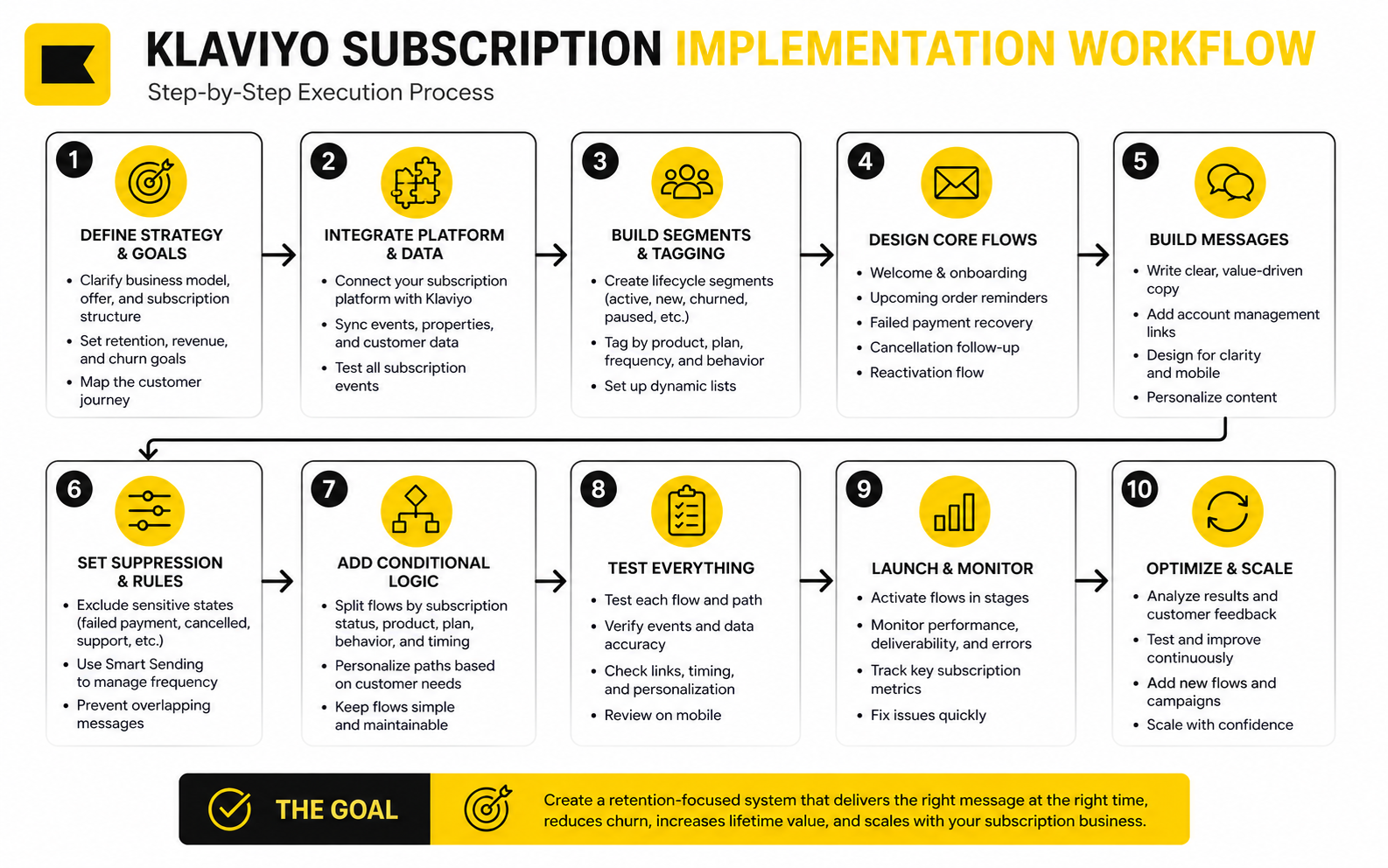
A clean build usually starts with the flows closest to revenue protection. That means subscriber welcome, upcoming order, failed payment, cancellation follow-up, and win-back. After those are stable, you can add deeper education, cross-sell, loyalty, review, and referral flows.
The sequence matters because every flow interacts with the others. If someone has a failed payment, they should not also receive a cheerful upgrade offer at the same time. If someone just cancelled, they should not be treated like an active subscriber in a campaign two hours later.
Step 1: Confirm the Data Source
Before building anything, confirm where the subscription data comes from. For Shopify brands, that usually means Klaviyo receives ecommerce data from Shopify and subscription data from a subscription platform such as Recharge, Skio, Loop, Ordergroove, Bold, or another provider. The exact events and profile properties depend on the integration.
You are looking for reliable triggers such as subscription started, upcoming order, order processed, payment failed, subscription cancelled, subscription paused, subscription reactivated, or similar events. Klaviyo’s developer documentation describes events as actions connected to profiles, with each event tied to a metric and timestamp. That structure is what allows subscription actions to become flow triggers.
Do not assume the data is working because an integration is connected. Test it. Place a test subscription, check the Klaviyo profile, review the event timeline, and confirm that the properties you need are actually available inside flow filters and email personalization.
Step 2: Map the Subscriber Journey
Next, map the customer journey from subscription signup to long-term retention. Keep it practical. You need to know what the customer experiences after purchase, before renewal, after renewal, during payment issues, and after cancellation.
This map should include customer questions, brand goals, Klaviyo triggers, and message purpose. For example, before renewal the customer question is “What is coming and how do I change it?” The brand goal is to prevent surprise and preserve the order. The Klaviyo trigger is the upcoming-order event, and the message purpose is clarity.
This process prevents random automation. Every flow earns its place because it supports a real customer moment. That is how you build a Klaviyo subscription setup that feels intentional instead of noisy.
Step 3: Build the Subscriber Welcome Flow
The subscriber welcome flow should trigger when a new subscription starts. The first message should arrive quickly and confirm the subscription details, the value of staying subscribed, and the account-management path. Keep it clean and useful.
The second message can focus on product adoption. This is where you explain how to get the best result from the product, how often to use it, or how to avoid common mistakes. The content should reduce the chance that the customer reaches the first renewal without feeling real value.
The third message can introduce support and flexibility. Remind subscribers that they can manage their plan, adjust timing, or contact support if something feels off. This is not inviting churn; it is building confidence.
Step 4: Build the Upcoming Order Flow
The upcoming order flow should trigger before the next charge or shipment. The timing depends on your product, shipping cycle, and subscription platform. A supplement brand may need more lead time than a coffee brand, while a high-ticket replenishment product may need more explanation than a low-ticket consumable.
The message should include the essential details first. What product is coming? When is it expected? What can the customer change? Where do they manage the subscription? Make the action path obvious.
You can also use this flow for careful add-ons. If the customer is already receiving a shipment, a one-time complementary product can make sense. But keep the main message focused on the upcoming order, because trust is the priority.
Step 5: Build the Failed Payment Flow
The failed payment flow should trigger when the subscription platform sends a payment failure event into Klaviyo. This flow needs to be fast, clear, and respectful. Customers often miss payment updates because cards expire, banks decline charges, or billing details change.
The first message should explain the issue and link directly to the place where the customer can update payment information. The second message can remind them what they will miss if the subscription does not renew. The final message should create urgency without sounding dramatic.
This flow should also suppress people who successfully update payment or whose subscription is no longer recoverable. Otherwise, the customer may keep receiving failure messages after the problem is already fixed. That is exactly the kind of automation mistake that damages trust.
Step 6: Build the Cancellation Follow-Up Flow
The cancellation follow-up flow should trigger after a subscription is cancelled. The goal is not to beg. The goal is to understand the reason, offer the right next step, and leave the relationship in good shape.
If cancellation reason data is available, use it. Too much product can lead to a pause or lower frequency offer. Price sensitivity can lead to a lighter plan or bundle explanation. Product dissatisfaction should lead to education, support, or a different recommendation only when that recommendation is honest.
The best cancellation flow feels calm. Thank the customer, acknowledge the decision, and make the next step useful. A customer who cancels today can still become a future buyer if the experience remains respectful.
Measurement, Analytics, and Performance Signals
A Klaviyo subscription system is only as strong as the numbers behind it. You can have beautiful flows, clean design, and strong copy, but if you are not measuring the right behavior, you will optimize the wrong things. Subscription marketing needs analytics that connect messages to retention outcomes, not just email engagement.
This is where many brands get misled. Open rate, click rate, and revenue per recipient are useful, but they do not tell the full subscription story. A pre-renewal email can have modest revenue attribution and still be extremely valuable if it reduces surprise charges, prevents cancellations, or moves customers into skips instead of full churn.
The goal is to build a measurement system that answers one practical question: did this message make the subscription easier to keep? If the answer is yes, the flow is doing its job. If the answer is unclear, the data model needs work before the campaign needs more copy.
Statistics and Data
Klaviyo’s ecommerce benchmark data gives useful context for email performance, but it should not be treated like a universal scorecard. Klaviyo lists average ecommerce email benchmarks such as a 39.74% open rate, 1.47% click rate, $0.11 revenue per recipient, and 0.09% placed order rate. Those numbers help you understand channel health, but they are not enough to judge a Klaviyo subscription strategy.
For subscription flows, the more important question is what happens after the click. Did the customer update payment? Did they skip instead of cancel? Did they keep the next renewal? Did they add a one-time product to the shipment? These actions show whether the message improved the customer journey.
Subscription benchmarks also need careful interpretation. Recurly’s 2025 subscription research highlights a shift toward retention, with acquisition rates dropping from 4.1% in 2021 to 2.8%, which signals a broader move away from growth at any cost. For ecommerce subscription brands, that matters because better lifecycle communication can protect the revenue you already paid to acquire.
The Metrics That Actually Matter
The first metric to watch is active subscriber retention. This tells you how many subscribers continue across billing cycles, and it is the cleanest high-level signal of subscription health. If retention is weak, your Klaviyo subscription flows should be reviewed by lifecycle stage, not just by individual email performance.
The second metric is churn by cycle. First-cycle churn usually points to expectation, onboarding, product fit, or discount-driven acquisition issues. Later-cycle churn often points to overstock, fatigue, pricing sensitivity, or lack of ongoing value.
The third metric is involuntary churn. Failed payments are different from voluntary cancellations because the customer may still want the product. That means payment recovery flows should be measured by recovery rate, time to recovery, recovered revenue, and the number of subscribers who remain active after the payment issue is resolved.
Why Benchmarks Can Mislead You
Benchmarks are useful when they give you a starting point. They are dangerous when they become the goal. A beauty subscription, pet food subscription, supplement subscription, and coffee subscription can all have very different buying rhythms, price sensitivity, and replenishment logic.
Even inside the same category, customer behavior can vary by acquisition source. A subscriber who joined through a heavy first-order discount may behave differently from someone who subscribed after three full-price purchases. If you only look at blended churn, you miss the reason behind the number.
That is why your own cohort data matters more than a broad industry average. Klaviyo’s cohort analysis guidance explains that cohort analysis groups customers by when and how they converted so brands can identify repeat purchase trends over time. For subscriptions, that same logic helps you see whether retention is improving for newer subscriber groups or whether problems are being hidden by older loyal customers.
The Subscription Analytics System
A practical analytics system should connect four layers: channel metrics, flow metrics, subscription metrics, and business metrics. Channel metrics show email and SMS engagement. Flow metrics show how each automation performs. Subscription metrics show renewal, churn, skip, pause, and recovery behavior. Business metrics show margin, lifetime value, and recurring revenue impact.
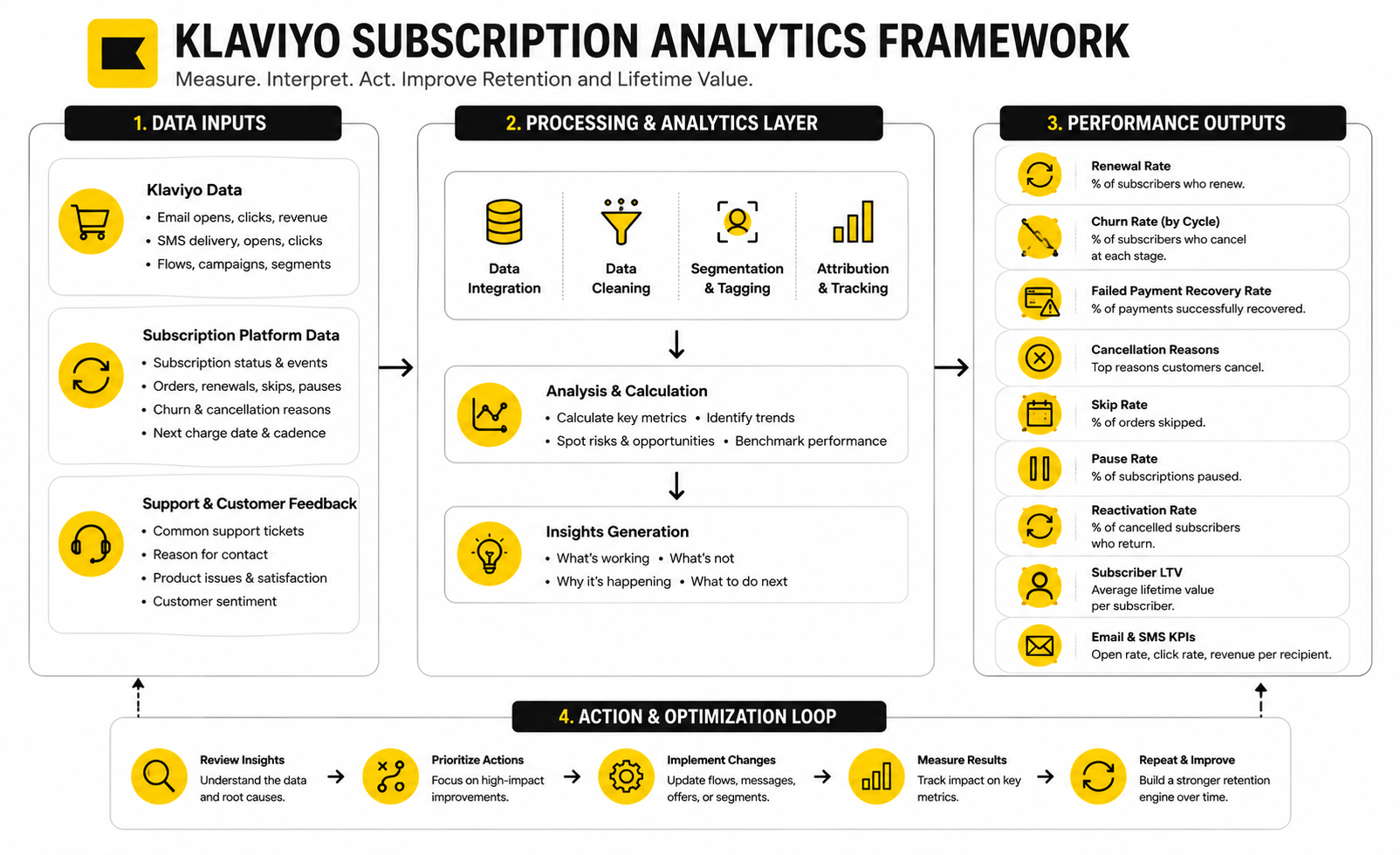
The mistake is looking at these layers separately. A failed-payment flow may have a low click rate but still recover high-value subscribers. An upcoming-order flow may generate little immediate revenue but reduce support tickets and prevent cancellations. A cross-sell flow may look profitable in Klaviyo but hurt retention if it pushes too hard before the customer trusts the subscription.
The cleanest way to read the system is to move from outcome backward. If churn increased, look at which cycle it increased in. If second-cycle churn increased, check onboarding, product education, and first renewal reminders. If involuntary churn increased, check payment retries, dunning timing, and the clarity of the update-payment path.
Flow-Level Performance Signals
Subscriber welcome performance should be judged by early engagement and first renewal behavior. Opens and clicks matter, but they are leading indicators. The real question is whether subscribers who engage with welcome content renew at a higher rate than those who do not.
Upcoming-order performance should be judged by clarity and control. Useful signals include skip rate, pause rate, account-management clicks, support tickets, and cancellation rate after the reminder. A higher skip rate is not automatically bad if it replaces cancellations and keeps customers active longer.
Failed-payment performance should be judged by recovered subscriptions, not email revenue alone. A good failed-payment sequence helps customers fix a billing issue quickly and stay active. If the recovery rate is weak, the issue may be timing, deliverability, payment-link friction, or the subscription platform’s retry logic.
Campaign Performance for Subscribers
Campaign reporting should separate active subscribers from non-subscribers. If you send the same promotion to everyone, the blended numbers can hide what is happening to your most valuable customers. Active subscribers may not need the same discount, urgency, or product pitch as people who have never subscribed.
For active subscribers, campaign success might mean adding a one-time product, upgrading a plan, trying a complementary item, or staying engaged between renewals. These are different outcomes from normal ecommerce campaign revenue. A Klaviyo subscription campaign should respect the existing relationship instead of pretending every customer is starting from zero.
This is also where suppression matters. Subscribers in failed-payment, cancellation, or customer-support moments should not be hit with generic promotions. If your analytics show strange drops in engagement or unexpected unsubscribes, overlapping campaigns are one of the first things to check.
What Good Performance Looks Like
Good performance is not one magic benchmark. It looks like improving retention by cycle, fewer billing-related complaints, higher payment recovery, more customers choosing skip or pause instead of cancellation, and stronger revenue from active subscribers over time. Those are the signals that the subscription experience is getting healthier.
Klaviyo’s benchmark feature is useful because it compares performance against peer groups rather than only broad industry averages, using anonymous data from similar companies. That can help you spot whether your email and SMS performance is unusually weak or simply normal for your category. But the final judgment should still come from your own subscription economics.
A simple rule works well here: use benchmarks to diagnose channel performance, and use subscription metrics to diagnose business performance. If both are improving, the system is moving in the right direction. If email metrics improve but churn does not, the messaging may be getting attention without solving the customer problem.
Turning Data Into Action
Every metric should lead to a decision. If first-cycle churn is high, improve onboarding and expectation-setting. If renewal complaints are high, make upcoming-order messages clearer. If failed-payment recovery is weak, shorten the path to update billing and test stronger reminders.
If long-term subscribers are cancelling because they have too much product, do not blast them with win-back discounts. Offer frequency changes, pauses, swaps, or lower-volume options. If subscribers are cancelling because they do not understand the product, improve education before the renewal instead of trying to save them at the cancellation page.
The best Klaviyo subscription reporting is not a dashboard full of numbers. It is a decision system. It tells you where customers lose confidence, where automation removes friction, and where the brand should focus next.
Professional Implementation and Optimization
At this stage, the Klaviyo subscription setup becomes less about building flows and more about controlling the whole customer experience. That is where advanced implementation matters. The difference between an average setup and a professional one is usually not one clever email; it is the way the system handles edge cases.
Subscriptions create more edge cases than normal ecommerce. Customers skip, pause, cancel, reactivate, change products, update payment details, move addresses, stack discounts, contact support, and receive campaigns while all of that is happening. If Klaviyo does not understand those states clearly, your messaging can become confusing fast.
The goal is to make the system resilient. A resilient Klaviyo subscription setup sends useful messages when things go right, but it also behaves intelligently when things go wrong. That is where brands protect trust at scale.
Start With Suppression Logic
Suppression logic is one of the most underrated parts of subscription marketing. It decides who should not receive a message, which is just as important as deciding who should. A subscriber with a payment issue, cancellation request, or unresolved support problem should not receive the same campaign as a happy active subscriber.
This is especially important when campaigns and flows overlap. Klaviyo’s Smart Sending feature is designed to limit how many emails, SMS messages, or push notifications someone receives within a set period, which helps prevent over-messaging when many campaigns and flows are active. But Smart Sending is not a full strategy by itself.
You still need intentional exclusions. For example, exclude active failed-payment profiles from promotional campaigns, exclude recently cancelled subscribers from standard subscriber campaigns, and exclude people inside sensitive support journeys from aggressive upsells. This keeps the subscription experience from feeling tone-deaf.
Separate Transactional, Educational, and Promotional Intent
Every subscription message should have a clear intent. Some messages are operational, like upcoming-order reminders or billing updates. Some are educational, like product usage guidance. Some are promotional, like add-ons, bundles, or upgrades.
Mixing those intents too heavily creates problems. If an upcoming-order reminder becomes a discount-heavy sales pitch, the customer may miss the account-management information they actually needed. If a failed-payment message feels like a promotional blast, it can damage trust at the exact moment the customer needs clarity.
This also matters for consent and compliance. Klaviyo’s SMS guidance makes clear that people must explicitly agree to receive SMS messages from a brand, and SMS consent must be collected separately from other marketing channels. For subscription brands using both email and SMS, that means channel strategy has to respect consent instead of treating every phone number as automatically reachable.
Build Around Customer Control
Control is one of the strongest retention levers in subscription ecommerce. Customers are more likely to stay when they can easily skip, pause, swap, delay, or change frequency. The irony is that some brands hide those options because they fear losing revenue, but hiding flexibility often creates more frustration.
The Klaviyo subscription journey should make control visible at the right moments. Before renewal, show the customer how to manage the next shipment. After repeated skips, offer a better cadence. After cancellation, make reactivation easy without forcing the customer through unnecessary friction.
This is not softness. It is smart retention. A skipped order is usually better than a cancellation, and a paused subscriber is often easier to reactivate than a lost customer who feels trapped.
Use Conditional Splits With Discipline
Conditional splits are powerful, but they can also turn a flow into a maze. Use them when the customer experience genuinely needs to change. Do not create a new branch for every tiny behavior unless that branch leads to a meaningfully different message.
Good conditional splits usually separate customers by subscription status, product type, renewal timing, payment status, cancellation reason, engagement level, or purchase history. Those conditions change what the customer needs to hear. A new subscriber to a replenishment product needs different guidance from a prepaid subscriber who has already completed several cycles.
The key is to keep the flow readable. If a marketer, support lead, or founder cannot understand the flow map in a few minutes, the system is probably too complex. Complexity that no one can maintain eventually becomes broken automation.
Protect Deliverability While Scaling
Subscription brands can become heavy senders quickly. Welcome messages, onboarding emails, renewal reminders, payment recovery, campaigns, launches, review requests, and win-backs can all stack on the same customer. Without list hygiene, engagement controls, and frequency planning, performance can degrade quietly.
Klaviyo’s deliverability best practices recommend sending to engaged segments, cleaning outdated subscriber lists, and suppressing unengaged profiles when deliverability risk is present. That guidance matters even more for subscription brands because active customers may still ignore marketing emails while needing operational communication. You do not want poor campaign discipline to hurt the messages subscribers actually need to receive.
A practical scaling rule is simple: separate essential lifecycle communication from optional promotional pressure. Essential messages should be clear and reliable. Promotional campaigns should be targeted, timed, and suppressed when the customer is in a sensitive subscription moment.
Design for Support, Not Just Marketing
A professional Klaviyo subscription implementation should help the support team, not create more tickets. If customers keep asking the same subscription questions after receiving your emails, the emails are not clear enough. If support sees confusion after campaigns, the segmentation is probably off.
Support teams can also reveal retention patterns that dashboards miss. They hear when customers feel overstocked, surprised by billing, confused about account access, disappointed by product results, or frustrated with cancellation steps. Those insights should feed directly into Klaviyo flow improvements.
This is where the best brands get practical. They add clearer manage-subscription links, rewrite renewal reminders, improve help content, and create better post-cancellation paths because support conversations show where customers struggle. Marketing should not operate in a vacuum.
Match Offers to Churn Reasons
Discounts are easy. That is why they get overused. But in subscription marketing, the wrong discount can train customers to cancel or threaten cancellation whenever they want a better price.
A better approach is to match the save offer to the churn reason. If the customer has too much product, offer a skip, pause, or lower frequency. If the customer is price-sensitive, a smaller plan or prepaid savings may make sense. If the customer is not getting the result they expected, education or product support is more honest than a discount.
This is where cancellation data becomes valuable. A cancellation reason is not just a reporting field; it is a routing signal. Use it to decide whether the next message should offer flexibility, education, support, a product alternative, or a clean exit.
Avoid Over-Automating Sensitive Moments
Not every customer moment should be automated aggressively. Cancellation, billing issues, complaints, and product dissatisfaction need a lighter touch. Automation can help, but it should not make the brand feel robotic.
For high-value subscribers, it may be worth routing certain actions to support or customer success instead of relying only on flows. A long-term subscriber who cancels after a failed delivery may deserve a human response. A wholesale, VIP, or high-LTV customer may need a different recovery path than a low-engagement discount buyer.
The point is not to remove automation. The point is to know where automation should assist the relationship and where it should step back. That judgment becomes more important as the subscription program grows.
Plan for Platform Changes and Data Drift
Subscription setups are not permanent. Apps update integrations, Shopify themes change, checkout logic evolves, discount rules get edited, and customer portals are redesigned. Any of those changes can affect the data Klaviyo receives or the links customers use.
That is why a Klaviyo subscription system needs regular audits. Test subscription events, review flow filters, check personalization variables, confirm account-management links, and inspect segment logic. Small technical changes can create large customer-facing mistakes if no one checks the system after updates.
A good audit also looks at dead branches and outdated assumptions. Some flows stay live long after the business model changes. If the subscription offer, pricing, cadence, or product mix has shifted, the automation should be updated too.
Scale With a Simple Operating Rhythm
The best subscription teams follow a rhythm. They review retention metrics, inspect flow performance, read support themes, test the customer journey, and prioritize one or two improvements at a time. This keeps the system improving without turning every week into a rebuild.
A simple monthly review can cover the essentials: active subscriber count, churn by cycle, failed-payment recovery, skip and pause behavior, cancellation reasons, campaign overlap, deliverability health, and top support issues. That gives the team enough signal to make smart decisions. It also prevents the Klaviyo account from becoming a pile of forgotten automations.
This is how the setup matures. First you build the core flows. Then you improve the logic. Then you connect measurement to action. Over time, the Klaviyo subscription system becomes a retention engine that is easier to manage, easier to diagnose, and harder for competitors to copy.
Measurement, Troubleshooting, and FAQ
The final stage of a Klaviyo subscription system is making sure the whole machine keeps working as the brand grows. Flows, segments, consent rules, customer portals, and subscription events all change over time. If nobody owns the system, it slowly becomes outdated.
The fix is not complicated, but it does require discipline. Review the customer journey regularly, test the key subscription events, check suppression logic, and compare performance against real retention outcomes. A Klaviyo subscription setup should never be treated as a one-time build.
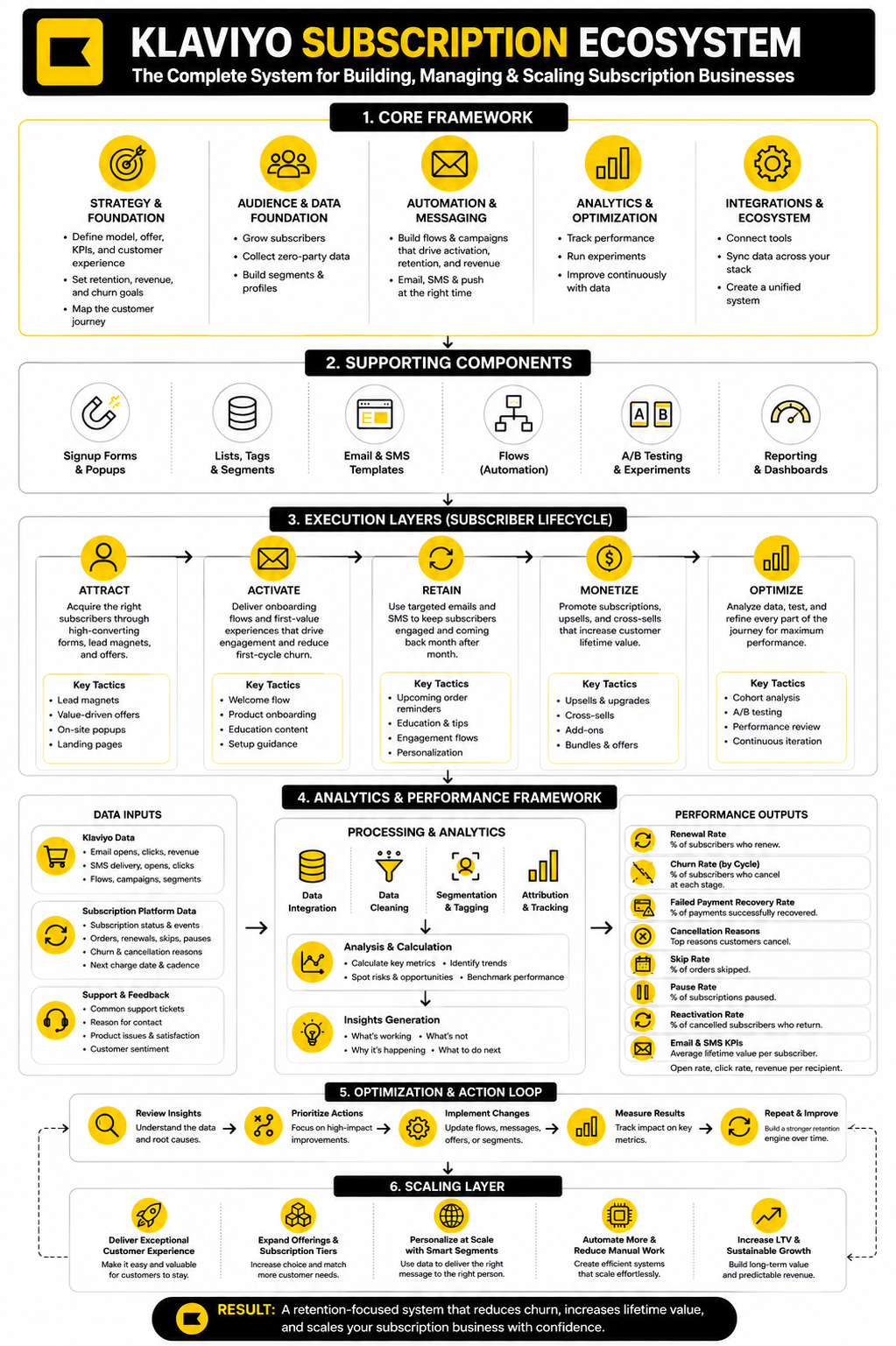
A strong final system has three parts working together: lifecycle automation, analytics, and operational feedback. Klaviyo shows what customers do inside email and SMS. The subscription platform shows what customers do with their plans. Support and customer service show what customers actually struggle with.
When those three sources agree, decisions become much easier. If churn is rising and support tickets mention too much product, the answer is probably cadence flexibility, not a bigger discount. If failed payments are rising and customers are clicking but not recovering, the payment update path needs work, not more urgency.
Common Troubleshooting Issues
The first issue is missing or unreliable event data. If subscription started, upcoming order, payment failed, cancelled, paused, or reactivated events are not showing consistently in Klaviyo, your flows cannot behave correctly. Always test the source event before blaming copy, design, or timing.
The second issue is overlap. A customer can receive a welcome flow, campaign, renewal reminder, and failed-payment message in a short window if the account is not managed carefully. Frequency controls help, but sensitive subscription states still need intentional exclusions.
The third issue is weak message hierarchy. If the email is about an upcoming charge, the charge timing and account-management link need to be obvious. If the email is about a failed payment, the payment update action needs to be obvious. Clever copy should never hide the action the customer needs most.
What to Improve First
Start with the moments closest to churn. Upcoming-order reminders, failed-payment recovery, cancellation follow-up, and first-cycle onboarding usually deserve attention before advanced personalization. These flows influence whether subscribers keep the relationship alive.
Then improve segmentation. Separate new subscribers from long-term subscribers, active subscribers from cancelled subscribers, and high-risk customers from healthy customers. This makes every campaign and flow easier to control.
Finally, improve offers and content. Once the system is stable, you can test add-ons, prepaid plans, product education, replenishment timing, and subscriber-only perks. Optimization works best after the basics are already clean.
What is a Klaviyo subscription flow?
A Klaviyo subscription flow is an automated email or SMS sequence triggered by a subscription-related event. That event might be a new subscription, an upcoming order, a failed payment, a cancellation, a pause, or a reactivation. The purpose is to send timely messages based on the customer’s actual subscription status instead of relying only on general campaigns.
Does Klaviyo manage subscriptions directly?
Klaviyo does not usually replace a subscription management platform. It works alongside tools such as Recharge, Skio, Loop, Ordergroove, and other subscription platforms that manage billing, plans, customer portals, and recurring orders. Klaviyo’s role is to use that subscription data for segmentation, automation, email, SMS, and reporting.
What subscription events should I send into Klaviyo?
The most useful events are subscription started, upcoming order, order processed, payment failed, subscription skipped, subscription paused, subscription cancelled, and subscription reactivated. You may also want product-specific subscription data, next charge date, cancellation reason, delivery frequency, and subscription status. The exact fields depend on your subscription platform and integration.
What is the most important Klaviyo subscription flow?
The upcoming-order flow is often one of the most important because it prevents surprise. It reminds the customer what is coming, when the next charge or shipment will happen, and how to manage the subscription. That single message can reduce confusion, support tickets, and cancellation pressure.
How many Klaviyo subscription flows should a brand build?
Most brands should start with five core flows: subscriber welcome, product onboarding, upcoming order, failed payment, and cancellation follow-up. After those are working, you can add reactivation, cross-sell, review, loyalty, referral, and win-back flows. Building too many flows too early usually creates overlap and makes reporting harder.
Should subscription emails include discounts?
Discounts should be used carefully. They can work when price is the real churn reason, but they are a poor fix for overstock, confusion, failed product adoption, or poor timing. A customer with too much product usually needs a skip, pause, or frequency change more than a coupon.
Can Klaviyo send subscription SMS messages?
Klaviyo can support SMS messaging when the account is set up for SMS and the customer has given proper consent. SMS consent must be handled carefully because customers need to explicitly agree to receive text messages from the brand. For subscription use cases, SMS works best for urgent or highly useful moments such as payment issues, upcoming orders, or time-sensitive account actions.
How do I measure Klaviyo subscription performance?
Measure subscription performance with renewal rate, churn by cycle, failed-payment recovery, cancellation reasons, skip rate, pause rate, reactivation rate, and subscriber lifetime value. Email metrics such as open rate, click rate, and revenue per recipient still matter, but they are not enough on their own. A Klaviyo subscription flow is successful when it improves the customer’s ability to stay subscribed.
Why are active subscribers cancelling after the first renewal?
First-renewal churn usually means the customer did not reach enough value before the next billing moment. The issue may be weak onboarding, unclear expectations, product overstock, discount-driven acquisition, or poor renewal communication. Review the first 30 to 60 days of the subscriber journey before changing the cancellation offer.
How should I segment subscription customers in Klaviyo?
Start with simple lifecycle segments. Use active subscribers, new subscribers, cancelled subscribers, failed-payment subscribers, paused subscribers, long-term subscribers, and subscribers by product or frequency. These segments are useful because they change what you should send, suppress, offer, or measure.
What should I do when Klaviyo subscription data looks wrong?
Start by checking the subscription platform integration and the customer profile event timeline in Klaviyo. Confirm that the right event is firing, the event properties are available, and the profile status matches what your subscription platform shows. If the data is inconsistent, fix the integration before editing the flow.
Should campaigns go to active subscribers?
Yes, but not every campaign should go to every active subscriber. Active subscribers may need a different angle, such as add-ons, bundles, prepaid plans, gifts, or subscriber education. Suppress subscribers in sensitive states like failed payment, recent cancellation, or active support issues so campaigns do not feel careless.
How often should I audit Klaviyo subscription flows?
A monthly review is a good baseline for active subscription brands. Check event triggers, flow filters, suppression logic, account-management links, deliverability, cancellation reasons, and performance by lifecycle stage. Also run an audit after changing subscription apps, checkout settings, customer portals, pricing, products, or discount rules.
What makes a Klaviyo subscription setup professional?
A professional setup is clean, measurable, and easy to maintain. It uses reliable data, clear lifecycle segments, well-timed flows, careful suppression, and reporting that connects automation to retention. Most importantly, it makes the subscription easier for the customer to keep.
Build a stronger local presence with BAAM AI
Turn your website, Google profile, social channels, and AI visibility into one growth engine
Most businesses do not need more random marketing activity. They need a consistent presence system that helps the right people find them, trust them, and take action. BAAM AI brings strategy, local SEO, website updates, Google Maps visibility, social content, AI-search readiness, media production, and reporting into one practical monthly engine.
If you want your marketing to keep working after the campaign ends, start with a free BAAM AI presence audit. See how your business shows up today and where the fastest visibility wins are at BAAM AI.