
BAAM AI Blog
Klaviyo Segmentation: A Practical Framework For Smarter Ecommerce Growth
Klaviyo segmentation is where email and SMS marketing starts to feel less like blasting a list and more like building a real customer system. Instead of sending the same campaign to everyone, you group people by what...
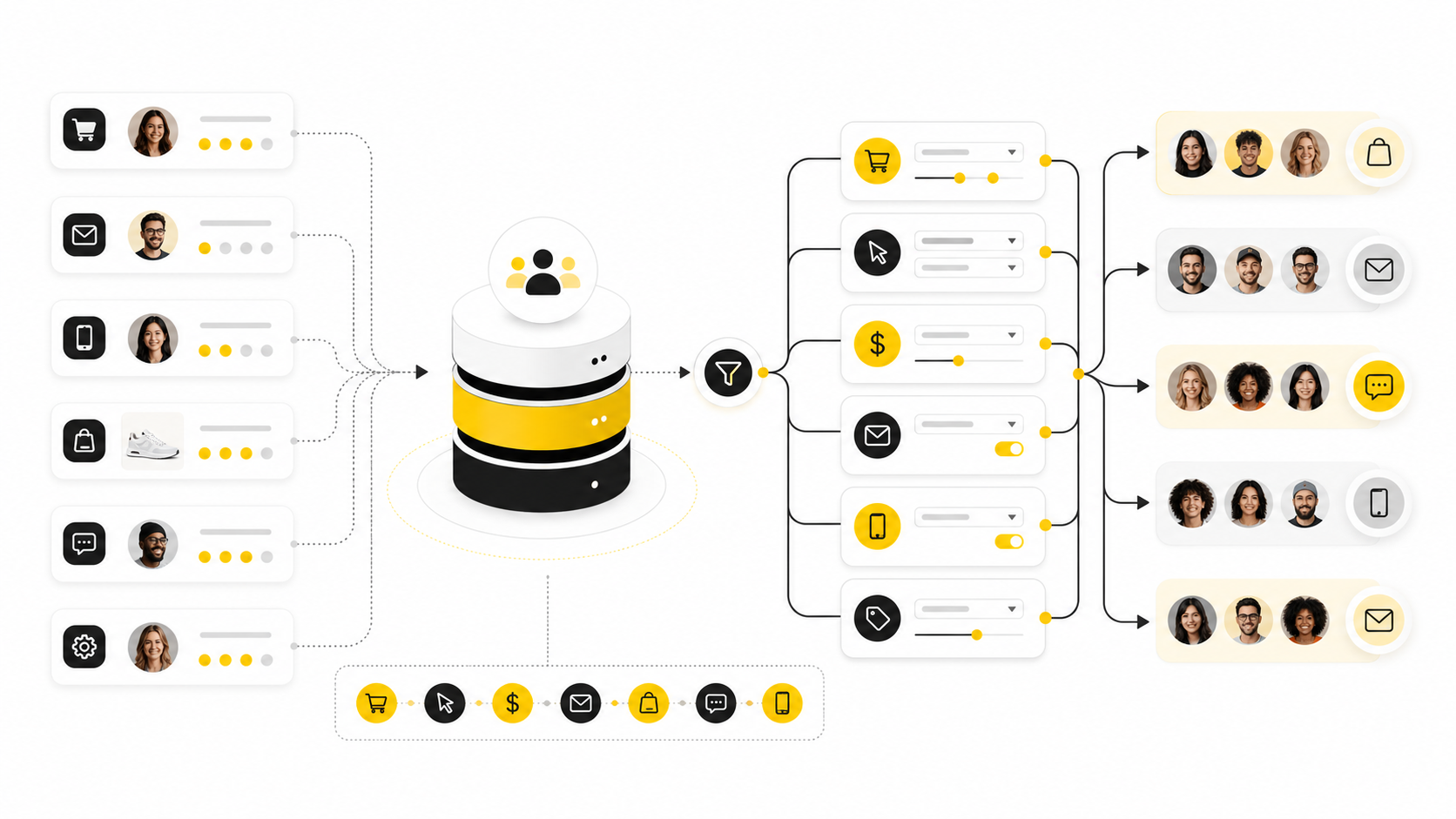
Klaviyo segmentation is where email and SMS marketing starts to feel less like blasting a list and more like building a real customer system. Instead of sending the same campaign to everyone, you group people by what they did, what they bought, how engaged they are, where they are in the customer journey, and what they are likely to do next.
That matters because ecommerce growth usually breaks when the list gets bigger but the messaging stays generic. Early on, a simple newsletter can work because the audience is small and forgiving. As the store grows, the same approach starts creating fatigue, lower engagement, weaker deliverability, and missed revenue from customers who needed a more specific message.
The goal of this guide is not to make segmentation sound complicated. The goal is to give you a practical structure you can actually use inside Klaviyo: what segments matter, when to use them, how to avoid overbuilding, and how professional operators turn customer data into better campaigns, flows, and retention systems.
this guide is split into six parts so the strategy builds in the right order. We will start with the business reason behind Klaviyo segmentation, then move into the framework, the core segment types, the implementation process, and the optimization layer. By the end, you should have a clear operating system for segmentation instead of a random collection of audience filters.
Why Klaviyo Segmentation Matters
Klaviyo segmentation matters because customers do not all need the same message at the same time. A first-time visitor who joined through a form, a loyal customer who buys every month, and a lapsed customer who has not purchased in 180 days are not the same audience. Treating them the same usually creates lazy marketing, even when the copy looks polished.
Good segmentation gives your campaigns and flows a sharper job. A campaign can focus on engaged subscribers instead of dragging inactive contacts into every send. A winback flow can speak differently to someone who bought once and disappeared than to someone who used to buy repeatedly and then stopped.
This is also where profitability comes in. Paid acquisition keeps getting harder, so brands need more revenue from the customers they already have. Klaviyo segmentation helps you make better use of owned data, especially when paired with stronger landing pages, forms, and post-purchase paths built through tools like Replo or Fillout where the customer journey starts before the email ever lands.
The Klaviyo Segmentation Framework
A useful Klaviyo segmentation framework starts with one simple question: what decision should this segment help us make? If the segment does not change the message, offer, timing, channel, or reporting, it probably does not need to exist. Segments should make marketing easier to execute, not harder to maintain.
The cleanest framework uses four layers: lifecycle stage, engagement level, purchase behavior, and customer value. Lifecycle tells you where someone is in the journey. Engagement tells you how safe and relevant it is to contact them. Purchase behavior tells you what they have already shown interest in. Customer value helps you decide how much attention, incentive, and personalization each group deserves.
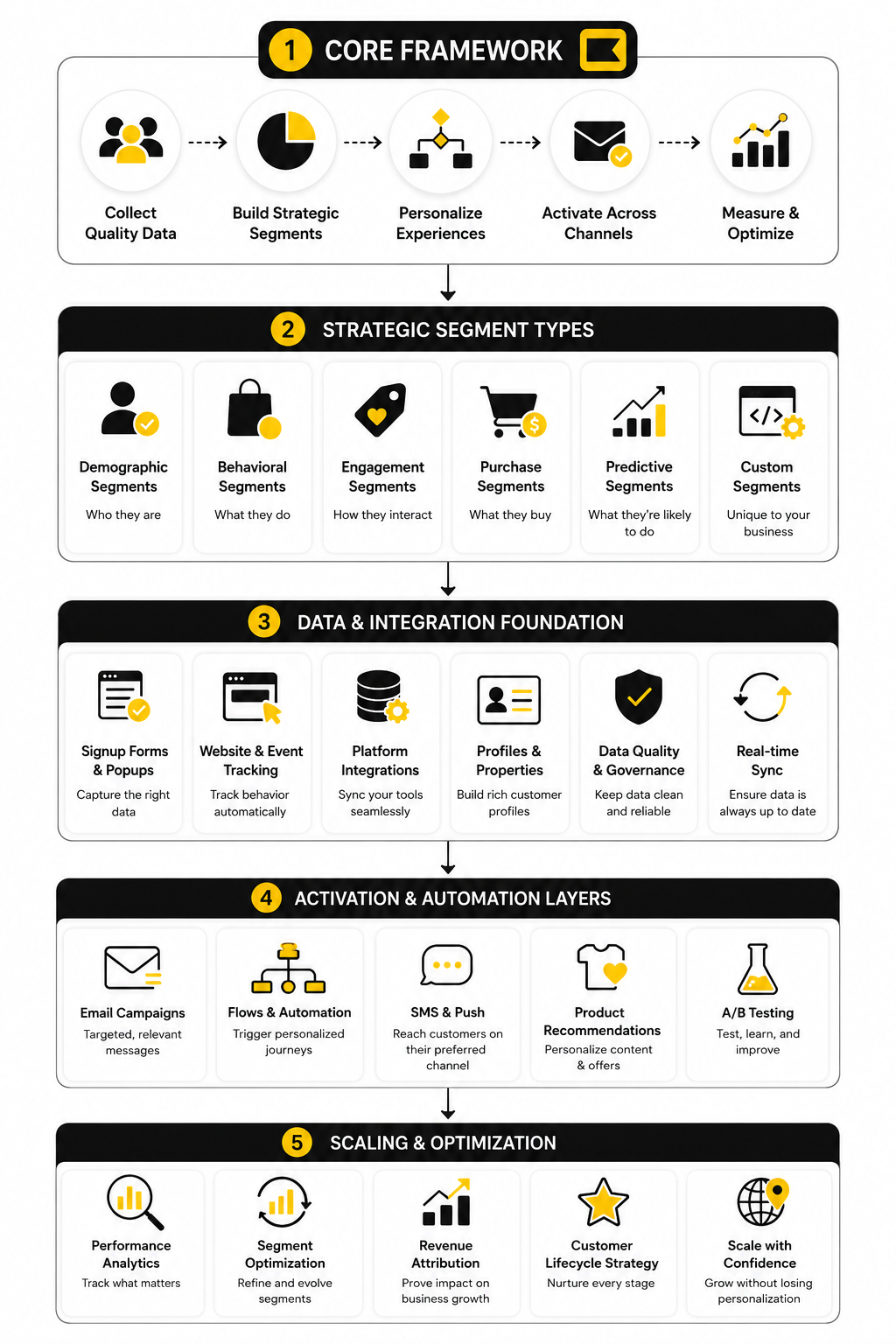
This framework keeps segmentation grounded. You are not building segments just because Klaviyo gives you many conditions to choose from. You are building a system that helps you decide who gets a campaign, who enters a flow, who should be excluded, who deserves a stronger offer, and who should be protected from unnecessary discounting.
Core Segments Every Ecommerce Brand Should Build
The framework is useful, but it only becomes valuable when it turns into real working segments. For most ecommerce brands, Klaviyo segmentation should start with a small set of practical groups that support better campaigns, better flows, and better reporting. You do not need fifty segments on day one. You need the right ones.
The biggest mistake is building segments based on curiosity instead of action. “People who viewed product X on a Tuesday and live in this city” might look interesting, but it only matters if you will actually send them something different. Start with segments that help you decide who should receive a message, who should be excluded, and what kind of message makes sense.
Engaged Subscribers
Your engaged subscriber segment is the foundation for campaign sending. These are people who recently opened, clicked, subscribed, purchased, or otherwise showed enough interest to make them a safer audience for regular campaigns. This segment protects your sender reputation because you are not constantly pushing campaigns to people who have ignored you for months.
The exact time window depends on your brand, list size, and sending frequency. A store that sends several times per week may need a tighter engagement window than a store that only sends twice per month. The point is not to copy a random rule from someone else; it is to define engagement in a way that reflects how your audience actually behaves.
This segment should usually be your default campaign audience before you start expanding. You can still send broader campaigns when there is a good reason, such as a major launch or seasonal event, but engaged subscribers should get priority. They are more likely to interact, more likely to buy, and less likely to drag down deliverability signals.
Recent Buyers
Recent buyers are customers who purchased within a defined time frame, often the last 30, 60, or 90 days. This segment is powerful because the customer has already crossed the hardest line: they trusted the brand enough to buy. That changes the entire conversation.
You should not treat recent buyers like cold prospects. They may need education, onboarding, product usage tips, replenishment reminders, cross-sell recommendations, or reassurance that they made the right choice. When your Klaviyo segmentation separates recent buyers from non-buyers, your post-purchase messaging becomes much more relevant.
This segment also helps you avoid awkward campaigns. For example, sending a heavy first-purchase discount to someone who just paid full price can create frustration. Excluding recent buyers from acquisition-style promotions is often just as important as targeting them with retention messages.
First-Time Customers
First-time customers deserve their own segment because their second purchase is a major milestone. A person who buys once has shown intent, but they have not yet built a habit with the brand. Your job is to reduce buyer’s remorse, create product satisfaction, and give them a clear reason to come back.
This is where segmentation should support customer experience, not just revenue extraction. A first-time customer may need a different tone than a loyal VIP. They may need help choosing the next product, understanding the brand’s best sellers, or learning how to get the most value from what they already bought.
A clean first-time customer segment also improves reporting. Instead of looking at total campaign revenue and guessing what happened, you can see how new customers respond compared with returning customers. That gives you a much clearer view of whether your retention strategy is actually working.
Repeat Customers
Repeat customers are the people who have purchased more than once, and they should be treated as a stronger relationship segment. They have already shown that the first order was not a one-off accident. That gives you more room to build loyalty, introduce higher-value products, and invite them deeper into the brand.
The message here should feel different from the message to first-time customers. Repeat customers often respond better to recognition, early access, bundles, replenishment paths, and content that makes them feel like insiders. They do not always need the steepest discount, and over-discounting this group can quietly train your best customers to wait.
This segment is also where you start spotting the gap between repeat customers and truly loyal customers. Someone who bought twice is valuable, but someone who bought five times behaves differently. Klaviyo segmentation lets you separate those levels so your best buyers are not hidden inside one broad “customers” group.
VIP Customers
VIP customers are your highest-value buyers, usually defined by total revenue, number of orders, average order value, or a combination of those signals. This segment matters because not every customer deserves the same level of incentive or attention. Your best customers should feel seen.
A VIP segment can be used for early access, private offers, product feedback, loyalty moments, or higher-touch customer experiences. The key is to avoid making every VIP message feel like a sale. If someone is already highly committed, the better strategy is often recognition and relevance before another discount.
This is also where customer lifetime value becomes more useful. Klaviyo can support segmentation around customer value and predictive behavior, which helps you think beyond the last transaction. A strong VIP strategy gives your best customers more reasons to stay, while helping you avoid wasting premium offers on people who would have bought anyway.
At-Risk Customers
At-risk customers are people who used to show buying or engagement signals but have started to drift. This is one of the most important segments because it catches the customer before they become fully inactive. Waiting until someone has ignored you for a year is usually too late.
The definition depends on your product cycle. A skincare brand, supplement brand, fashion brand, and furniture brand will not have the same purchase rhythm. You need to define “at risk” based on what a normal reorder or repeat-purchase window looks like for your category.
The message should not feel desperate. Good at-risk messaging reminds customers why they bought, helps them solve a next-step problem, or gives them a timely reason to return. This is where a thoughtful winback flow can outperform random discount campaigns because the message is tied to behavior, not panic.
Unengaged Subscribers
Unengaged subscribers are contacts who have received messages but have not opened, clicked, purchased, or otherwise interacted within your chosen time window. This segment is uncomfortable because it forces you to admit that list size is not the same as list quality. But it is necessary.
Keeping unengaged people in every campaign can damage performance over time. It can lower average engagement, make reporting harder to trust, and increase the chance that your emails feel unwanted. A bigger list is not automatically better if a large portion of it is dead weight.
This does not mean you should instantly delete everyone. A better approach is to use the segment for re-engagement, sunset flows, and suppression decisions. Give people a clear chance to stay, then stop forcing messages on contacts who have shown they are not interested.
Product Interest Segments
Product interest segments group people based on what they viewed, added to cart, bought, or clicked. These segments help you match the message to the category or problem the customer has already shown interest in. This is where Klaviyo segmentation starts to feel more personal without needing creepy or overcomplicated tactics.
For example, a customer who repeatedly views one collection is giving you useful intent data. A customer who bought from a specific category may be a good fit for related products, replenishment reminders, or educational content. The segment helps your campaigns move from “here is our sale” to “this is probably what you came here for.”
You still need restraint. Product interest segments are useful when they support a clear message, not when they create dozens of tiny audiences that are too small to learn from. Build the segments around meaningful product categories, buying patterns, or customer problems rather than every single SKU.
How To Build Better Segments Inside Klaviyo
Once the main segment types are clear, the next step is turning them into a repeatable process. This is where many brands overcomplicate Klaviyo segmentation. They jump straight into conditions, filters, and exclusions before deciding what the segment is supposed to accomplish.
Start with the business use case, then build the segment around that use case. A campaign segment, a flow trigger segment, a suppression segment, and a reporting segment can all look similar at first glance, but they do different jobs. When you know the job first, the filters become much easier to choose.
Start With The Message
Before touching the segment builder, write the basic message idea in plain English. Are you trying to welcome someone, convert them, cross-sell them, win them back, protect deliverability, or reward loyalty? That one sentence will stop you from building vague segments that look clever but never get used.
For example, “send a replenishment reminder to customers who bought a consumable product long enough ago that they may be ready to reorder” is a useful message idea. It gives you the audience, the timing, and the reason for the send. From there, the segment logic becomes practical instead of theoretical.
This also keeps your copy aligned with the audience. A segment is not just a technical filter. It is a promise that the message will match the customer’s situation, and that is the whole point of segmentation.
Choose The Right Data Signals
Klaviyo segmentation can use profile properties, list membership, consent status, email and SMS engagement, purchase events, product events, predictive analytics, location, and custom data. That flexibility is powerful, but it also creates noise if you use every available signal just because it exists. The best segments usually combine a small number of reliable signals.
For ecommerce, the strongest signals are usually behavioral. Purchase history, product viewed, added to cart, checkout started, email clicked, SMS clicked, and time since last activity tend to say more than broad demographic assumptions. Demographic and profile data can still help, but it should not carry the whole strategy unless it directly changes the message.
Klaviyo’s own segmentation resources separate behavioral segmentation around interactions like purchases, product page visits, email engagement, SMS engagement, product types, and discount behavior. That is the right mindset. Use the signals that show what the customer actually did, then layer in profile data only when it improves relevance.
Define The Segment Logic Clearly
A good segment should be understandable without needing a technical translator. If someone on the team cannot explain who is included and who is excluded, the segment is probably too messy. Clean logic is easier to QA, easier to report on, and easier to improve later.
Most ecommerce segments use three basic logic blocks: inclusion rules, exclusion rules, and time windows. Inclusion rules define who belongs. Exclusion rules remove people who should not receive the message. Time windows make the segment current instead of permanently collecting people who no longer fit the intent.
For example, a recent buyer segment might include customers who placed an order in the last 60 days, exclude refunded or canceled orders if that data is available, and exclude people currently in a customer service issue segment if the brand tracks that. The exact logic depends on the store, but the structure is simple: include the right people, remove the wrong people, and keep the timing fresh.
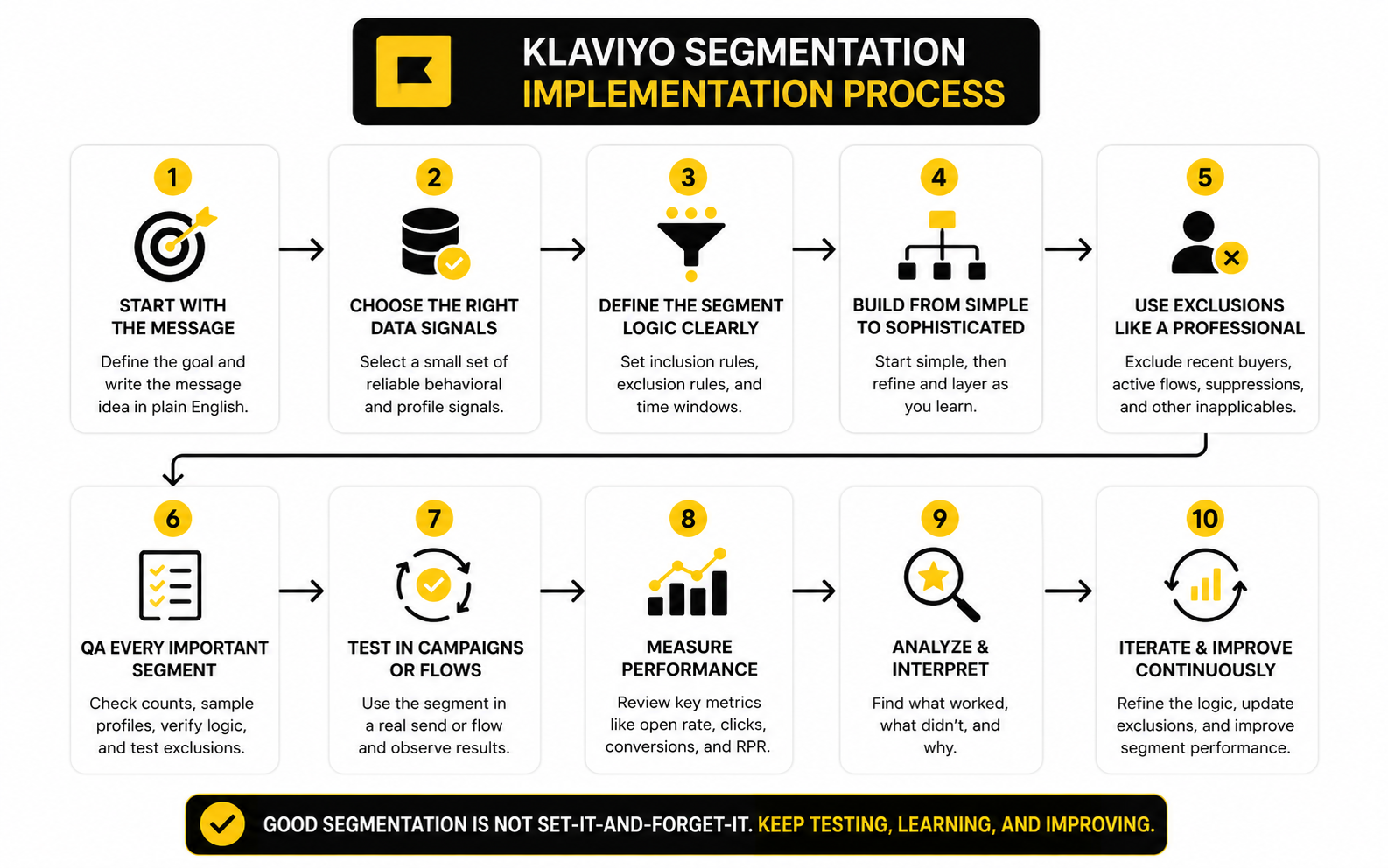
Build From Simple To Sophisticated
Do not start with the most advanced version of a segment. Start with the smallest version that can produce a better marketing decision, then improve it once you see how it performs. This keeps the system moving and prevents segmentation from becoming a never-ending setup project.
A simple engaged segment might begin with people who opened or clicked recently, purchased recently, or subscribed recently. Later, you may split that into highly engaged, moderately engaged, and cooling-off groups. That is a natural progression because each new layer creates a clearer sending decision.
The same applies to customer value. You can start with total orders or total revenue, then later use predictive analytics and customer lifetime value when there is enough data to trust those signals. Klaviyo supports CLV-based segments through predictive analytics, but those segments work best when they support a real retention or VIP strategy rather than existing as a vanity dashboard.
Use Exclusions Like A Professional
Exclusions are where segmentation becomes sharper. Many brands think only about who should receive a message, but professional operators also think carefully about who should not receive it. That is how you avoid awkward customer experiences and unnecessary list fatigue.
Common exclusions include recent purchasers, people already in a flow, suppressed contacts, unengaged subscribers, customers who bought the promoted product, VIPs who should not receive heavy discounts, and anyone who has already received a similar campaign recently. These exclusions make campaigns feel more intentional. They also protect the business from training customers to expect irrelevant or repetitive offers.
This matters even more when you run multiple channels. If a customer is receiving email, SMS, paid retargeting, and onsite messaging at the same time, sloppy segmentation can make the brand feel pushy. A clean exclusion strategy helps each channel play its role instead of piling on.
QA Every Important Segment
Segmentation mistakes are easy to miss because the audience can look reasonable at a glance. A segment may have the expected size but still include the wrong people. That is why every important segment needs a basic QA process before it controls campaigns or flows.
Check the segment count, sample individual profiles, confirm the event history, review consent status, and test whether the exclusions are working. Look at a few people who are included and a few who are excluded. You are not trying to make the system perfect; you are trying to catch obvious logic errors before customers see them.
This step is not glamorous, but it matters. A broken segment can send winback emails to recent buyers, discounts to people who already purchased, or loyalty messages to subscribers who never became customers. When your Klaviyo segmentation starts driving real revenue, QA is not optional.
Statistics And Data
The data side of Klaviyo segmentation is not about collecting pretty numbers. It is about deciding what to change next. If a segment performs well, you want to understand whether the lift came from the audience, the offer, the timing, the creative, or the channel.
Benchmarks are useful, but only when you treat them as context. Klaviyo’s 2026 email benchmarks are based on data from over 183,000 Klaviyo customers, which makes them helpful for seeing where your program sits compared with similar ecommerce brands. Still, your own baseline matters more than a broad industry average because your product cycle, price point, list quality, and customer intent can change the numbers dramatically.
The older but still useful Klaviyo segmentation benchmark study analyzed 2,619,441,297 emails sent by US-based customers and found that highly segmented sends beat unsegmented sends across open rate, click-through rate, and revenue per recipient. The important takeaway is not just “segmentation works.” The real takeaway is that better audience selection changes the economics of every campaign.
The Metrics That Actually Matter
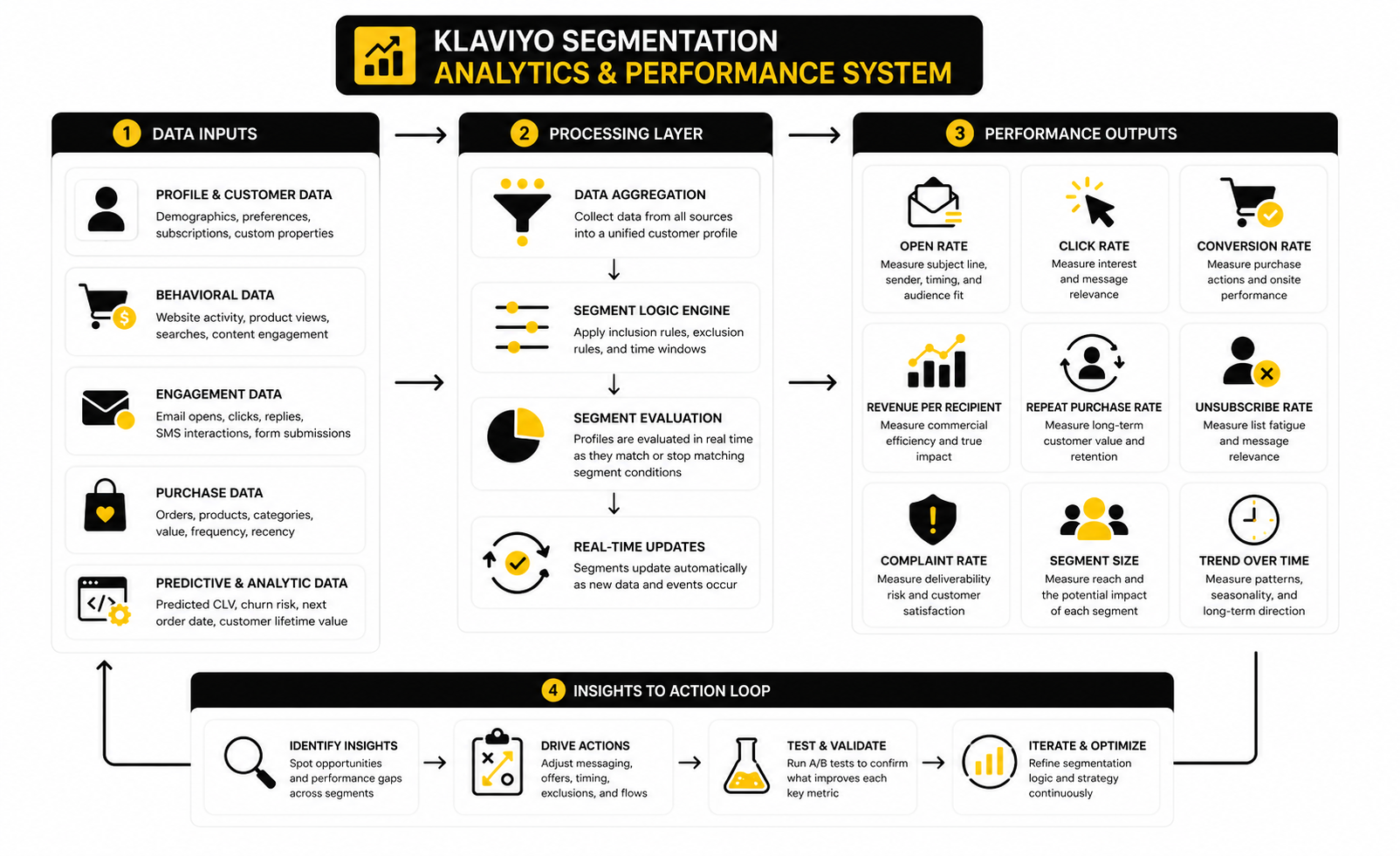
Open rate can tell you whether the subject line, sender name, timing, and audience fit were strong enough to earn attention. It should not be treated as the final measure of success because privacy changes and inbox behavior can make opens imperfect. Still, when one segment consistently opens more than another, that is a useful signal that the audience is warmer or the message is more relevant.
Click rate is usually more useful because it shows active interest. If an engaged segment opens but does not click, the message may be too broad, the offer may be weak, or the call to action may not match the customer’s intent. If a product-interest segment clicks strongly but does not buy, the issue may be landing page friction, pricing, inventory, or a mismatch between the email promise and the onsite experience.
Revenue per recipient is the metric that connects segmentation to business value. Klaviyo describes RPR as a way to measure how much revenue each message generates across email, SMS, or flows, which makes it especially useful when comparing segments of different sizes through revenue per recipient reporting. A smaller segment with higher RPR can be more valuable than a large blast that looks impressive but produces weak economics.
How To Read Segment Performance
A good segment should improve at least one major performance signal without creating a hidden downside. If your VIP segment drives high revenue but also receives too many discounts, the short-term campaign may look good while margin suffers. If your unengaged segment produces a few extra orders but increases unsubscribes and spam complaints, the cost may not be worth it.
This is why you should read metrics together instead of one at a time. Open rate shows attention, click rate shows intent, conversion rate shows buying action, RPR shows commercial efficiency, unsubscribe rate shows fatigue, and complaint rate shows risk. No single number tells the whole story.
The simplest way to interpret segment performance is to ask what the metric should make you do. Low opens usually point toward audience quality, subject line, timing, or deliverability. Low clicks usually point toward message-market fit or creative. Low conversion with strong clicks usually points toward the offer, product page, checkout path, or price-value equation.
Benchmarks Should Guide Decisions, Not Replace Judgment
Benchmarks are most useful when they help you spot unusual performance. If your engaged segment is far below your normal open and click baseline, something is wrong with the message, send timing, audience definition, or deliverability. If your first-time customer segment is clicking but not buying again, the problem may be trust, product education, replenishment timing, or the next offer.
Broad benchmarks can also stop you from overreacting. A campaign sent to a cold reactivation segment will usually perform worse than a campaign sent to recent buyers, and that does not automatically mean the campaign failed. Different segments have different jobs, so they need different expectations.
This is especially important with Klaviyo segmentation because the best segment is not always the biggest or highest-converting audience. A re-engagement segment may be valuable because it identifies who should stay on the list and who should be suppressed. A VIP segment may be valuable because it protects margin and loyalty, not because it produces the highest volume every week.
What Healthy Segment Reporting Looks Like
Healthy reporting starts with consistent naming. If every segment is named randomly, your reports become hard to read and your team starts guessing what each audience means. Use names that describe the audience, the time window, and the purpose when needed.
A clean reporting view should compare your core segments against each other over time. You want to see how engaged subscribers, recent buyers, repeat customers, VIPs, at-risk customers, and unengaged subscribers behave across campaigns and flows. The pattern matters more than a single send.
Your reporting should also separate campaign performance from flow performance. Campaigns usually depend on calendar, offer, and audience selection, while flows depend on behavior, timing, and lifecycle logic. Mixing the two together can hide what is actually working.
The Data Signals That Should Trigger Action
If engaged subscribers are declining, tighten your sending strategy and review how often you contact the list. You may need better exclusions, cleaner content planning, or a stronger preference capture system. Do not keep increasing send volume just because revenue looks acceptable for another week.
If recent buyers are not moving into repeat purchase, review your post-purchase flow and product education. The issue may not be that customers dislike the brand. They may simply not know what to buy next, when to reorder, or why another product makes sense.
If at-risk customers keep growing, your retention system is leaking. That can point to weak onboarding, poor replenishment timing, product satisfaction issues, or campaigns that focus too heavily on acquisition-style discounts. Klaviyo segmentation helps you see the leak earlier, but the fix usually requires better customer experience, not just another coupon.
Why Segment Size Can Be Misleading
A huge segment can feel powerful because the send number looks impressive. But if that segment is too broad, you may be paying for scale with weaker engagement, lower relevance, and more unsubscribes. Bigger is not automatically better in owned marketing.
Small segments can be extremely profitable when they carry strong intent. Cart abandoners, high-value repeat buyers, category browsers, and replenishment-ready customers may all be smaller than the main list, but their behavior gives you a better reason to send. That is why segment quality often matters more than raw audience size.
The best way to balance this is to match the segment size to the purpose. Use broader engaged segments for general campaigns, tighter behavioral segments for specific offers, and strict exclusion segments for protection. That keeps your Klaviyo segmentation system commercially useful without turning it into a maze.
Professional Implementation And Workflow Design
At this stage, Klaviyo segmentation stops being a set of audience filters and starts becoming an operating system. The difference is simple. Beginners build segments when they need to send something, while professionals build a structure that decides who should receive what before the campaign calendar gets chaotic.
This matters more as the brand scales. More products, more campaigns, more flows, more channels, and more customer types create more ways to send the wrong message. A strong segmentation system gives the team guardrails so growth does not turn into noise.
Build A Segment Hierarchy
A segment hierarchy helps you decide which customer status matters most when someone qualifies for multiple groups. That will happen constantly. A customer can be a VIP, a recent buyer, a product browser, an email clicker, and an at-risk subscriber at the same time.
The hierarchy should reflect business priority. For example, consent and suppression rules should sit at the top because they control whether someone can be contacted at all. Then lifecycle status, customer value, engagement level, and product interest can sit underneath because they shape the message.
This prevents messy overlap. If a VIP customer also becomes at risk, you may want a different recovery message than you would send to a low-value one-time buyer. If a recent buyer also browses a product, you may want education or cross-sell messaging instead of a first-purchase discount.
Separate Campaign Segments From Flow Logic
Campaign segmentation and flow logic are related, but they should not be treated as the same thing. Campaigns are usually planned around timing, launches, promos, content, and merchandising goals. Flows are triggered by behavior and should respond to what the customer just did or failed to do.
If you use the same logic everywhere, the customer experience can become clumsy. Someone might enter a browse abandonment flow, receive a campaign about the same category, and then get an SMS reminder within a short window. Individually, each message may make sense. Together, they can feel excessive.
Professional Klaviyo segmentation uses exclusions and flow filters to reduce that collision. Campaigns should respect major active flows when needed, and flows should use smart filters to avoid sending messages that no longer fit. The goal is not to silence the brand; the goal is to make the timing feel intentional.
Watch For Segment Decay
A segment that was useful six months ago can become misleading if the business changes. Product cycles shift, campaigns increase, acquisition sources change, and customer behavior moves with seasonality. Segmentation is not a one-time setup.
Segment decay usually shows up as weaker engagement, strange audience sizes, or campaign results that no longer match the segment’s original purpose. For example, an “engaged 180-day” segment might work for a low-frequency brand but become too loose for a brand sending several times per week. A VIP definition based on order count may become outdated if average order value changes significantly.
Review your core segments on a schedule. Monthly is usually enough for active campaign audiences, while deeper lifecycle and value segments can be reviewed quarterly. The point is to keep the definitions connected to current customer behavior, not to preserve old logic just because it once worked.
Protect Deliverability Before Chasing Reach
One of the biggest strategic tradeoffs in Klaviyo segmentation is reach versus deliverability. Sending to a larger audience can create more short-term revenue, but it can also weaken long-term inbox placement if the list contains too many inactive or low-quality contacts. That tradeoff gets expensive when ignored.
Engaged segments should carry most campaign volume because they protect the health of the account. Broader sends can still make sense, but they should be intentional and monitored closely. If a campaign needs to reach colder contacts, the message should have a strong reason to exist, not just another generic promotion.
This is especially important during high-volume periods. Holiday campaigns, major launches, and sale windows create pressure to send to everyone. That is exactly when segmentation discipline matters most, because a deliverability issue during a peak revenue window can cost far more than the extra revenue from one broad send.
Avoid Over-Segmentation
Over-segmentation looks sophisticated from the outside, but it often creates operational drag. The team ends up with too many tiny audiences, too many copy variations, and too little data to make confident decisions. More segments do not automatically mean more personalization.
A segment deserves to exist when it changes the strategy. That could mean a different offer, different timing, different creative angle, different product recommendation, different channel, or different exclusion rule. If none of those change, the segment may be unnecessary.
The better approach is modular. Keep a stable set of core segments, then create temporary tactical segments for launches, seasonal events, or specific merchandising pushes. After the campaign is done, retire what is no longer needed so the account does not become a graveyard of old ideas.
Make Segmentation Useful Across The Customer Journey
Klaviyo segmentation should not live only inside email campaigns. The same thinking can improve forms, landing pages, customer support, product education, and retention planning. When the audience definition is clear, the rest of the customer journey becomes easier to align.
For example, a quiz, survey, or lead capture form can collect preference data that later improves segmentation. A tool like Fillout can support cleaner preference capture when the brand needs more structured customer inputs. A landing page builder like Replo can help match acquisition traffic to more specific post-click experiences before those profiles ever receive a campaign.
This is where segmentation becomes more than a Klaviyo feature. It becomes a way to organize the whole revenue system around customer intent. The email is only one touchpoint; the segment should influence what the customer sees, receives, and is asked to do next.
Use Predictive Data Carefully
Predictive data can make Klaviyo segmentation more powerful, but it should not replace judgment. Predicted lifetime value, churn risk, expected next order date, and similar signals are useful when the store has enough quality data behind them. They are not magic.
Use predictive data as a prioritization layer. A high-value customer with rising churn risk may deserve a stronger save strategy than a low-value customer with the same inactivity window. A customer with a likely upcoming purchase window may need a timely reminder instead of a broad discount.
The risk is treating predictions as certainty. They are directional signals, not guarantees. The safest approach is to combine predictive analytics with behavior you can directly observe, such as purchase history, engagement, product interest, and time since last order.
Document The System
Documentation sounds boring until the person who built the account leaves, the campaign calendar gets busy, or a segment breaks before a big launch. Then it becomes priceless. A professional segmentation system needs a simple source of truth.
Document each core segment with its purpose, audience definition, main use cases, exclusions, owner, and review schedule. Keep it plain. The goal is not to create a giant internal wiki; the goal is to make the system understandable enough that another operator can maintain it.
This also makes testing easier. When a segment has a written purpose, you can judge performance against that purpose instead of arguing from memory. Strong Klaviyo segmentation is not just built in the platform. It is maintained through clear decisions, clean ownership, and regular review.
Measurement, Optimization, And FAQ
By now, the full Klaviyo segmentation system should be clear. You define the business reason, build the core segments, connect them to campaigns and flows, measure how they behave, and keep refining the system as the customer base changes. The work is not about making the account look complex. It is about making every message easier to justify.
The final layer is ecosystem thinking. Email, SMS, forms, landing pages, customer support, ads, loyalty, and post-purchase education should not behave like separate departments. Your segments should help all of those touchpoints understand where the customer is, what they have shown interest in, and what the next useful action should be.
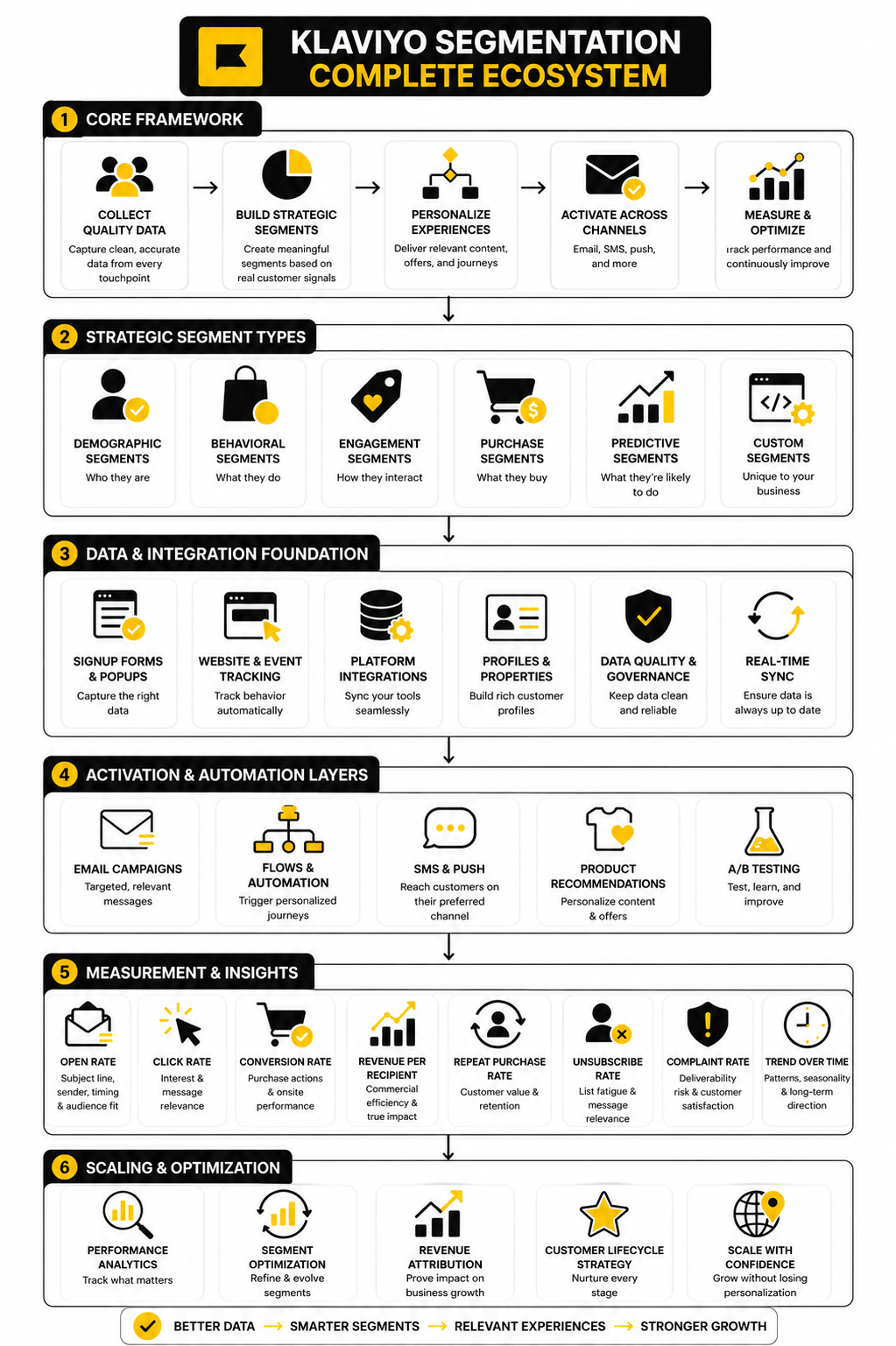
That is the point where segmentation becomes a growth asset. A customer who is highly engaged should not receive the same journey as someone who is unresponsive. A loyal buyer should not be treated like a new lead. A person who is likely to reorder should not be forced through the same broad promotion as someone who has never purchased.
What Is Klaviyo Segmentation?
Klaviyo segmentation is the process of grouping profiles based on shared conditions, such as purchase history, email engagement, SMS consent, product interest, profile properties, location, or predicted customer value. These groups update dynamically when customers meet or stop meeting the rules. That makes segmentation more flexible than a static list because the audience changes as customer behavior changes.
Why Is Klaviyo Segmentation Important?
Klaviyo segmentation matters because it helps you send more relevant messages to different customer groups. A new subscriber, recent buyer, repeat customer, and unengaged contact all need different communication. When you segment properly, your campaigns and flows become more useful, easier to measure, and less likely to create list fatigue.
What Is The Difference Between A List And A Segment In Klaviyo?
A list is usually a more fixed group of people, often based on where or how they subscribed. A segment is rule-based and updates automatically as people match or stop matching the conditions. In practice, lists are useful for consent and subscription sources, while segments are better for targeting, exclusions, reporting, and lifecycle messaging.
What Are The Best Klaviyo Segments To Start With?
The best starting segments are engaged subscribers, recent buyers, first-time customers, repeat customers, VIP customers, at-risk customers, unengaged subscribers, and product-interest groups. These cover the main decisions most ecommerce brands need to make. You can always add more later, but those segments give you a practical operating base without overcomplicating the account.
How Often Should I Update My Klaviyo Segments?
Dynamic segments update automatically, but the logic behind them still needs review. Campaign engagement segments should usually be reviewed at least monthly because sending frequency and audience behavior can shift quickly. Lifecycle, VIP, and retention segments can often be reviewed quarterly unless the brand is changing fast.
How Many Klaviyo Segments Should A Brand Have?
There is no perfect number because the right answer depends on product range, order frequency, list size, and marketing complexity. A small brand may only need a handful of core segments, while a mature ecommerce brand may need a larger system. The rule is simple: every segment should support a different decision, message, offer, exclusion, or report.
What Is An Engaged Segment In Klaviyo?
An engaged segment is a group of subscribers who have shown recent interest through actions like opening, clicking, subscribing, purchasing, or interacting with the brand. The exact time window depends on how often you send and how your customers buy. This segment is usually the safest audience for regular campaigns because it filters out people who have gone quiet.
Should I Suppress Unengaged Subscribers?
You should not suppress every unengaged subscriber immediately, but you should manage them carefully. A good process is to identify unengaged contacts, run a re-engagement or sunset strategy, and then suppress people who still show no interest. This protects deliverability and keeps your reporting focused on people who actually want to hear from the brand.
Can Klaviyo Segmentation Improve Deliverability?
Yes, Klaviyo segmentation can support better deliverability when it helps you send more often to engaged contacts and less often to people who ignore or reject your messages. It also helps you avoid over-sending to broad, low-quality audiences. Segmentation is not the only deliverability factor, but it is one of the most practical levers marketers can control.
How Should I Use Segments In Flows?
Segments can trigger flows, filter flow entry, split customers into different paths, or exclude people who no longer match the message. For example, you can build a different experience for first-time buyers, repeat customers, VIPs, or people at risk of lapsing. The key is to make the segment logic match the customer’s current situation, not just their historical label.
How Should I Use Segments In Campaigns?
For campaigns, segments help you choose who should receive the message and who should be excluded. A general product launch may go to engaged subscribers, while a replenishment campaign may only go to customers who bought a specific product long enough ago. Strong campaign segmentation improves relevance and prevents the same generic message from hitting every contact.
What Is The Biggest Klaviyo Segmentation Mistake?
The biggest mistake is creating segments that do not change the marketing decision. If the copy, offer, timing, channel, or exclusion logic stays the same, the segment may not need to exist. Segmentation should simplify execution and improve relevance, not create a confusing account full of unused audience groups.
How Do I Know If My Segments Are Working?
Look at segment performance across open rate, click rate, conversion rate, revenue per recipient, unsubscribe rate, complaint rate, repeat purchase behavior, and flow revenue. Do not judge a segment from one send. Watch patterns over time and compare each segment against its purpose.
Should I Use Predictive Analytics For Klaviyo Segmentation?
Predictive analytics can be useful when the account has enough reliable customer data. Signals like predicted CLV, expected next order date, and churn risk can help you prioritize who needs attention and what kind of message they should receive. Use those signals as a strategic layer, not as blind automation.
Can I Use Klaviyo Segmentation With SMS?
Yes, but SMS needs tighter discipline because it is a more personal and interruptive channel. Only message people with proper SMS consent, keep the message relevant, and avoid sending SMS just because someone qualifies for an email segment. A strong SMS segment should have clear intent, strong timing, and a reason the message deserves to be a text.
What Should I Do Before Building Advanced Segments?
Before building advanced segments, clean up the basics. Confirm consent, review core lifecycle groups, define engagement windows, document naming conventions, and make sure major exclusions are working. Advanced segmentation only works when the foundation is stable.
Build a stronger local presence with BAAM AI
Turn your website, Google profile, social channels, and AI visibility into one growth engine
Most businesses do not need more random marketing activity. They need a consistent presence system that helps the right people find them, trust them, and take action. BAAM AI brings strategy, local SEO, website updates, Google Maps visibility, social content, AI-search readiness, media production, and reporting into one practical monthly engine.
If you want your marketing to keep working after the campaign ends, start with a free BAAM AI presence audit. See how your business shows up today and where the fastest visibility wins are at BAAM AI.