
BAAM AI Blog
Klaviyo Rebrand: What Changed, Why It Matters, And How To Implement It
The Klaviyo rebrand was not just a logo refresh. It was a positioning move from “email and SMS tool for ecommerce brands” toward a bigger idea: owned customer relationships, unified data, and growth that does not...
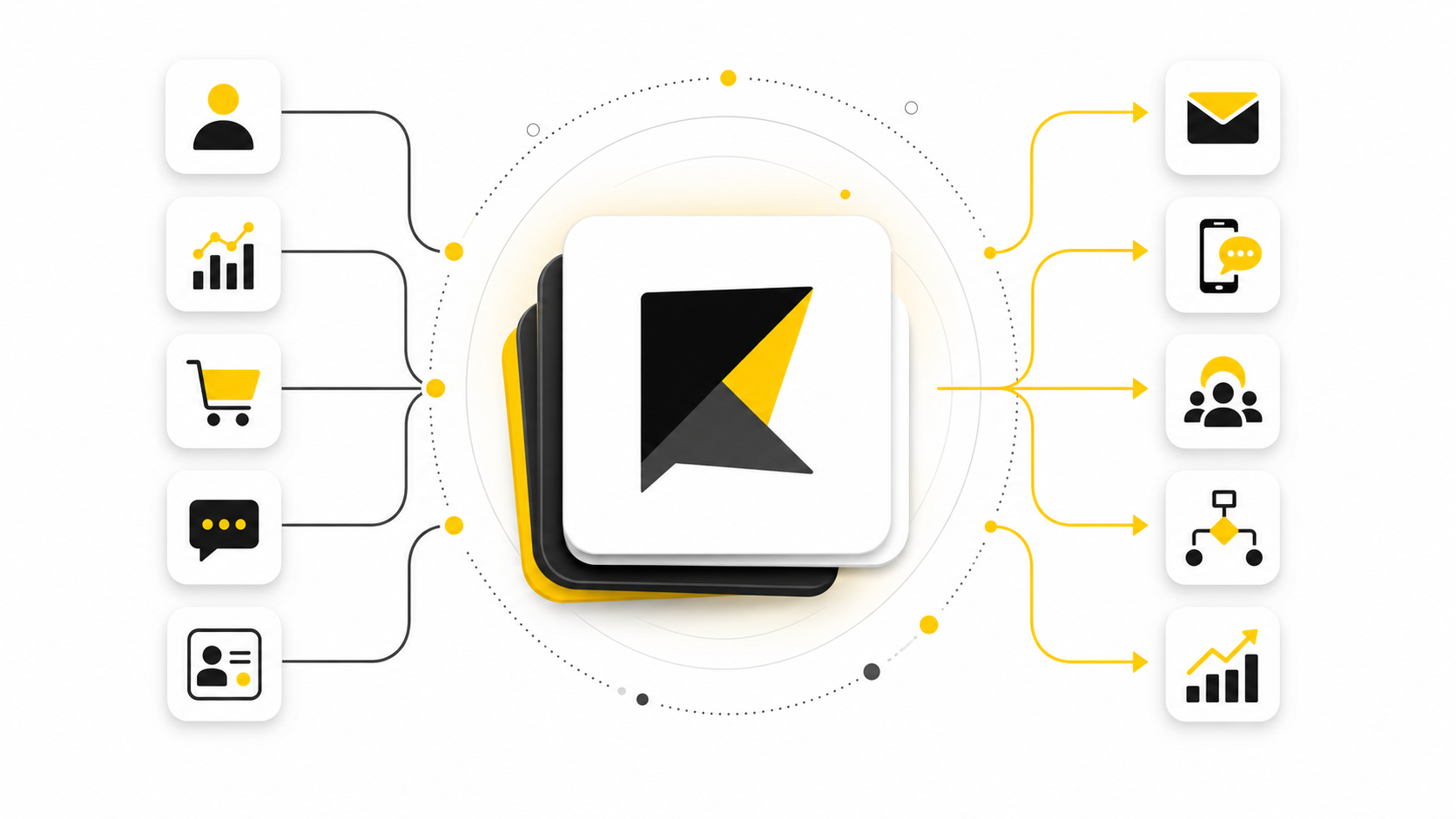
The Klaviyo rebrand was not just a logo refresh. It was a positioning move from “email and SMS tool for ecommerce brands” toward a bigger idea: owned customer relationships, unified data, and growth that does not depend entirely on marketplaces, ad platforms, or rented audiences.
That distinction matters because Klaviyo has changed a lot since the visual identity was introduced in 2022. The company’s own rebrand announcement framed the new identity around ownership, customer data, relationships, and long-term growth, while its current platform messaging now describes Klaviyo as an AI-first B2C CRM that combines marketing automation, analytics, customer service, customer data, and AI insights in one system. You can see the shift clearly when comparing the original Klaviyo visual identity announcement with Klaviyo’s current B2C CRM positioning.
So this guide will not treat the Klaviyo rebrand like a design critique. The useful question is more practical: what changed, why did it change, and what can ecommerce, SaaS, agency, and lifecycle marketing teams learn from it? If you are updating your own brand, repositioning a product, or trying to make your marketing stack feel more strategic, Klaviyo is a strong case to study because the rebrand connects visual identity, category positioning, product expansion, and customer ownership.
Klaviyo Rebrand Overview And Why It Matters
The Klaviyo rebrand matters because it shows what happens when a company outgrows the category people originally put it in. Klaviyo started with a strong association around ecommerce email marketing, but the company’s current story is much broader: customer data, automation, analytics, AI, service, SMS, WhatsApp, mobile push, and real-time personalization. That is not a small messaging adjustment; it is a category expansion.
Klaviyo’s 2022 announcement described the new identity as a “comprehensive rebrand effort” built around brands owning their data, relationships, customer experience, growth, success, and destiny. The same announcement said the updated identity introduced a new logo, iconography, type, imagery, and color palette, with the flag mark representing ownership, community, guidance, speed, and success. That gives the rebrand a clear strategic job: make Klaviyo look and feel like a long-term growth platform, not just another marketing automation vendor.
The timing also makes sense. In its original announcement, Klaviyo said customers had used the platform to generate over $28 billion in revenue, and the company described more than 90,000 paying users at the time. Today, Klaviyo’s homepage says more than 193,000 customers are growing with the platform, while its investor relations page highlights 196K+ customers and $358M in Q1 FY26 revenue. A brand built for one stage of growth often starts to feel too narrow once the company enters a much larger stage.
The Real Shift: From Tool To Operating Layer
The practical lesson is that the Klaviyo rebrand was about more than aesthetics. A logo can signal change, but positioning has to carry the weight. Klaviyo’s current language focuses on being a B2C CRM powered by a built-in data platform and AI insights, which is a much more ambitious promise than simply helping brands send better emails.
That shift matters for marketers because the center of gravity in lifecycle marketing has moved. Teams do not just need templates, campaigns, and flows. They need usable customer data, segmentation, predictive signals, channel coordination, attribution, and faster execution across the full customer journey.
This is where the rebrand becomes useful as a framework. If a company wants to be seen as a strategic system, the brand has to explain the system clearly. The product, website, visual identity, sales narrative, customer stories, and implementation process all need to point in the same direction.
Framework Overview
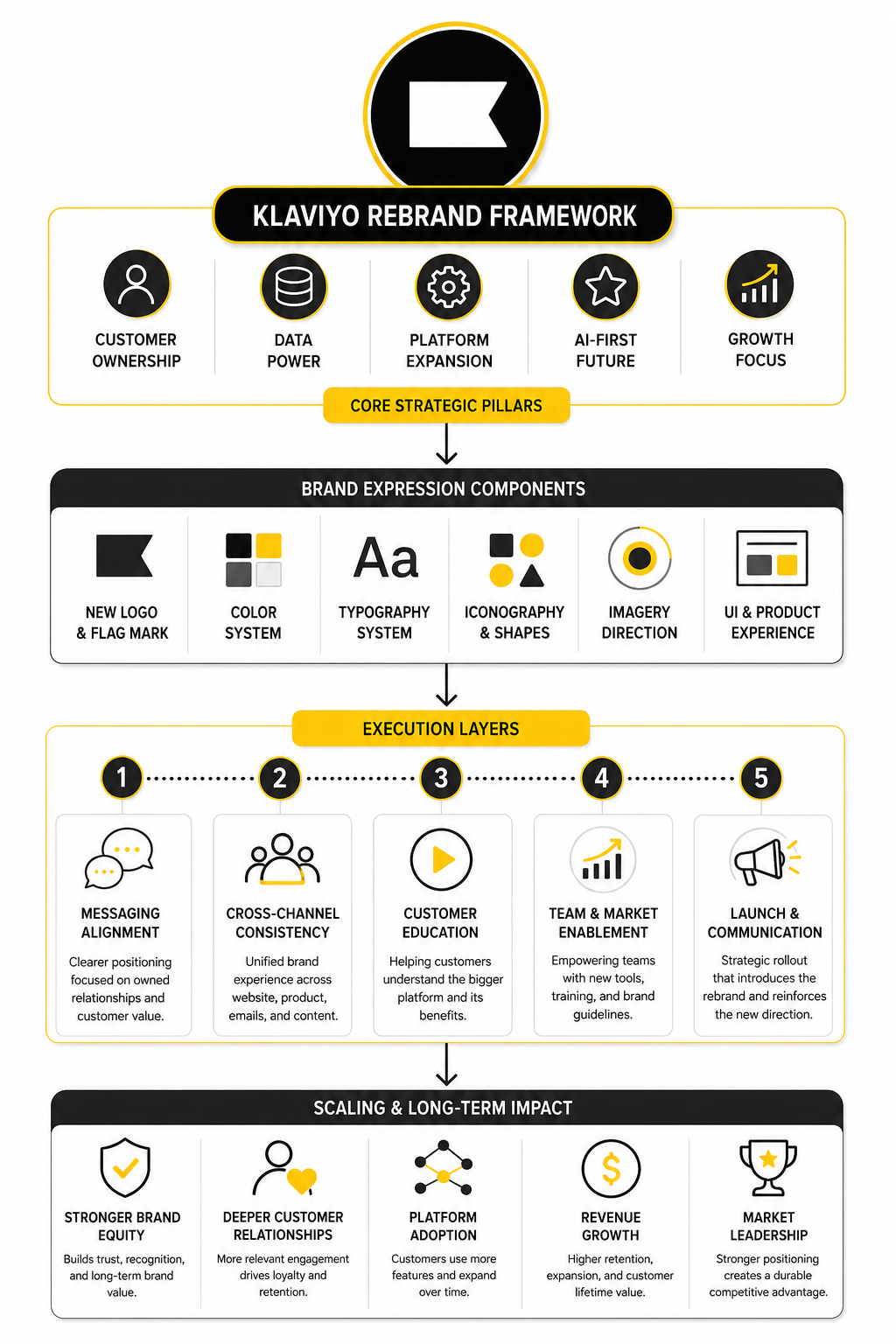
A strong rebrand needs a framework, not just a creative refresh. The Klaviyo rebrand is useful because it can be broken into a simple sequence: define the larger category, clarify the customer’s deeper problem, update the visual system, connect the story to product reality, and make implementation repeatable. That sequence is what turns a rebrand from a campaign into an operating asset.
The first layer is category clarity. Klaviyo’s evolution from email marketing language toward B2C CRM language gives the brand more room to cover data, AI, service, analytics, and omnichannel execution. That does not mean every company should invent a bigger category, but it does mean your brand should not trap you in a smaller one if the product has already moved beyond it.
The second layer is customer ownership. Klaviyo’s rebrand announcement repeatedly emphasized owned data and owned relationships, which is powerful because it speaks to a real business concern rather than a cosmetic preference. When acquisition costs rise, privacy rules change, and third-party platforms become less predictable, brands care more about direct customer relationships.
The third layer is operational proof. A rebrand only works if the product experience supports the claim. Klaviyo can talk about unified profiles, automation, AI, and cross-channel messaging because those ideas are tied to actual platform capabilities described across its product pages and investor materials.
The first core component is positioning. In the next part, we will look at how Klaviyo’s rebrand reframed the company from a channel-specific marketing tool into a broader growth platform for B2C brands. That matters because positioning decides what buyers compare you against, what budget you can access, and how much strategic value your product appears to have.
The second component is identity. Visual design matters, but only when it reinforces the business strategy. Klaviyo’s flag mark, serif direction, warmer imagery, and customer-centered storytelling all support the idea that the customer is the hero and Klaviyo is the catalyst.
The third component is implementation. A rebrand does not become real until teams use it consistently across the website, lifecycle emails, sales decks, onboarding, partner materials, help content, paid ads, and customer communications. That is where most rebrands either become durable or slowly fall apart.
The Strategy Behind Klaviyo’s New Positioning
The most important part of the Klaviyo rebrand is the strategic move underneath it. Klaviyo did not simply say, “We have a cleaner logo now.” It used the rebrand to make a bigger claim about what the company helps brands do: own customer relationships, use first-party data better, and turn scattered interactions into a coordinated growth system.
That is a different promise from traditional email marketing software. Email is still a major part of Klaviyo’s value, but the brand now points toward a broader operating role inside the business. Klaviyo’s current platform messaging describes it as an AI-first B2C CRM that brings together marketing, service, analytics, customer data, and AI in one place, which gives the rebrand a much larger strategic container than “email and SMS automation.”
This is why the Klaviyo rebrand is worth studying carefully. A good rebrand does not just make a company look more modern. It helps the market understand what the company has become.
From Ecommerce Email Platform To B2C CRM
Klaviyo’s original market strength came from ecommerce marketing automation, especially for Shopify-driven brands that needed better segmentation, flows, and revenue attribution. That association was valuable because it made the product easy to understand. The risk, though, is that a company can become trapped by the exact category that helped it grow.
That is the wall Klaviyo had to move past. If buyers only saw Klaviyo as an email tool, the brand would struggle to fully communicate the value of customer data, analytics, AI, customer service, mobile channels, and broader customer lifecycle orchestration. The rebrand created room for that expansion by anchoring the story around ownership and customer relationships instead of only campaign execution.
The company’s public filings support that strategic direction. Klaviyo’s annual report describes growth priorities that include moving up-market, expanding into enterprise and larger customers, launching new products, adding product capabilities, using artificial intelligence and machine learning, expanding internationally, and adding more use cases across verticals. That is not the roadmap of a narrow email vendor; it is the roadmap of a company trying to become a deeper customer relationship platform.
Why Ownership Became The Core Message
Ownership is a smart theme because it connects directly to the pressure modern brands feel. Paid acquisition is expensive, privacy rules have changed how customer data moves, and marketplace dependency can make brands vulnerable. When a business cannot reliably reach its own customers, growth becomes fragile.
That is why the Klaviyo rebrand leaned so heavily into owned data and direct relationships. The original rebrand announcement described Klaviyo as a unified customer platform that helps online brands take direct ownership of consumer data and interactions. The updated visual identity used a flag mark to represent data ownership, community, guidance, speed, and success, which made the brand idea visible instead of leaving it buried in copy.
The message works because it is practical. Brands do not want “more software” for the sake of software. They want better access to customer behavior, better timing, better personalization, and more control over the revenue they already have the right to earn.
The Product Had To Support The Positioning
A rebrand collapses fast when the product cannot back it up. This is where Klaviyo had a stronger foundation than a purely cosmetic refresh would have had. Its current platform pages describe Klaviyo as both a system of record and a system of action, combining a customer data platform, real-time signals, and AI agents to power automated insights and execution.
That matters because positioning has to match what teams actually experience after they sign in. If the brand says “customer relationship platform,” users should feel that in segmentation, profiles, flows, analytics, support context, and channel coordination. If they only see a campaign sender with a nicer homepage, the promise breaks.
Klaviyo’s newer product direction reinforces the repositioning. Its B2C CRM announcement describes a platform that combines marketing automation, analytics, and customer service, while its AI-focused launches around Marketing Agent and Customer Agent point to a future where customer data, campaign execution, and service interactions are more tightly connected. The rebrand gave Klaviyo a narrative broad enough to carry those product moves.
Growth Made The Old Box Too Small
The numbers also explain the strategy. Klaviyo said it had more than 90,000 paying users when the 2022 visual identity was announced. By the end of fiscal year 2025, Klaviyo reported more than 193,000 customers, and in Q1 FY26 it reported more than 196,000 customers. That kind of growth changes how a company needs to explain itself.
A smaller company can afford to be known for one clear feature set. A larger public company needs a brand that can speak to executives, operators, agencies, partners, developers, investors, and enterprise buyers without losing the original user base. That is a harder communication problem.
The Klaviyo rebrand solved part of that problem by making the story more durable. Instead of centering the brand around one channel, it centered the brand around a business outcome: stronger customer relationships powered by owned data. That is a bigger, more expandable idea.
The Strategic Pattern Other Brands Can Use
The lesson is not “copy Klaviyo’s colors” or “use a flag symbol.” That would miss the point. The useful pattern is to identify where your product has outgrown your old category, then rebuild the brand around the bigger customer problem you now solve.
For a software company, that might mean moving from “landing page builder” to “conversion infrastructure.” For an agency, it might mean moving from “email marketing service” to “retention growth partner.” For an ecommerce brand, it might mean moving from “product seller” to “customer experience brand” with a clearer promise across purchase, post-purchase, support, and loyalty.
The key is discipline. A bigger position only works when it is supported by real product capability, real customer proof, and a clear operating model. Klaviyo had the advantage of a growing platform, public momentum, and a customer-data story that matched where the market was already going.
What This Means For Marketers
For marketers, the Klaviyo rebrand is a reminder that positioning should evolve before the market forces you to explain yourself defensively. If your product, service, or brand has expanded, but your message still sounds like the old version, buyers will underestimate you. They will compare you to smaller alternatives, assign you to the wrong budget, and miss the strategic value you are trying to create.
This is especially important for lifecycle and retention teams. The work is no longer just newsletters, abandoned cart flows, and discount campaigns. The real work is building a customer data engine that improves timing, segmentation, personalization, service, and repeat purchase behavior across the full customer journey.
That is why the strategy behind the Klaviyo rebrand matters. It shows how a company can move from a feature-led identity to a platform-led identity without abandoning the practical use cases that made people trust it in the first place.
Visual Identity, Messaging, And Brand System Changes
The Klaviyo rebrand worked because the visual identity and the positioning moved in the same direction. The company was not trying to look trendy for the sake of it. It needed a brand system that could carry a larger story about data ownership, customer relationships, and long-term growth.
That is the part many teams get wrong. They update colors, fonts, and templates before they have clarified what the brand is supposed to mean. Klaviyo did the more useful thing: it used the identity system to make the business strategy easier to understand.
The original rebrand announcement described a new logo, iconography, type, imagery, and color palette, with the flag mark representing ownership, community, guidance, speed, and success. That is important because every serious rebrand needs symbols that reinforce the strategy. Otherwise, the design system becomes decoration.
The Logo Became A Strategic Signal
The flag mark is the most obvious visual change because it gives the brand a simple symbol to rally around. A flag is not just a shape. It suggests direction, territory, movement, belonging, and ownership, which lines up with the rebrand’s central idea that brands should own their customer relationships.
That matters because a rebrand should make the company easier to remember. Most buyers will not read every line of positioning copy. They will remember a repeated visual cue, a consistent tone, and a clear association between the brand and the problem it solves.
For Klaviyo, the flag gave the company a mark that could work across product UI, campaigns, social assets, partner materials, events, and investor communications. That kind of flexibility is practical, especially when a company is scaling across more products, more channels, and more customer segments.
The Messaging Moved From Features To Control
The messaging shift is just as important as the design shift. Earlier category language around email and SMS was easy to understand, but it did not fully explain the strategic value of Klaviyo’s customer data layer. The rebrand made control the bigger idea.
Control is a stronger message because it speaks to business risk. If a brand relies too heavily on paid traffic, marketplaces, or rented audiences, it can lose leverage fast. If it owns customer data and can activate that data across channels, it has more room to improve retention, repeat purchase, and lifetime value.
That is why the Klaviyo rebrand keeps coming back to owned relationships. It gives the platform a business-level argument instead of only a marketing-team argument. A lifecycle marketer may care about segmentation and flows, but a founder or executive cares about margin, customer retention, and predictable growth.
The Brand System Had To Scale Across More Use Cases
A rebrand becomes harder when the company has more audiences to serve. Klaviyo now has to speak to small ecommerce brands, larger retail teams, agencies, developers, partners, investors, and enterprise buyers. Those groups do not all care about the same details, but they do need to recognize the same brand.
That is why the system matters. A strong brand system lets the company adapt without becoming inconsistent. The homepage can speak broadly, the product pages can get specific, the investor materials can stay credible, and the help content can remain practical.
This is also why visual consistency is not just a design-team concern. When a company grows, brand drift becomes expensive. Sales decks, lifecycle emails, webinar slides, customer stories, app screens, and ads can slowly start to look like they belong to different companies unless the system is built to travel.
The Implementation Process Behind A Rebrand
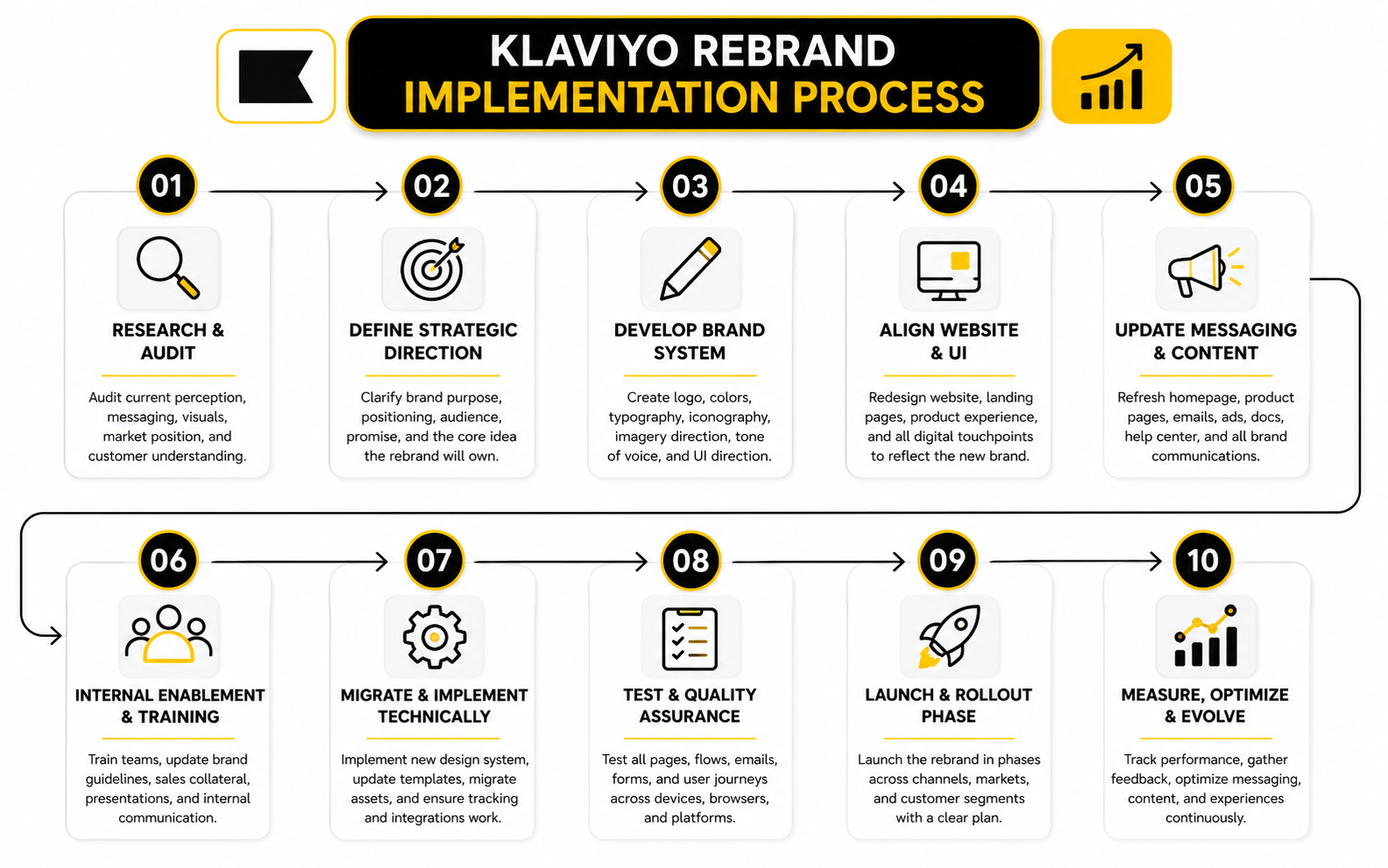
The cleanest way to think about implementation is simple: strategy first, system second, rollout third. If the order gets flipped, the rebrand usually becomes messy. Teams start redesigning surfaces before they know what the new brand must communicate.
A practical implementation process should begin with the positioning decision. What is the company now? What market does it want to be judged in? What customer problem is now big enough to define the brand? For Klaviyo, that answer moved toward owned customer relationships and an AI-first B2C CRM, not just email automation.
Then the team needs to translate that strategy into a usable system. That means messaging pillars, visual rules, product-language rules, proof points, channel guidelines, and examples for real teams. The goal is not to create a beautiful brand PDF that nobody uses. The goal is to make better execution easier.
Step-By-Step Rebrand Execution
What Teams Should Copy From Klaviyo
The useful thing to copy is the connection between strategy and execution. Klaviyo did not treat the rebrand as a separate creative project. It tied the identity to a larger market move, then supported that move with product language and platform expansion.
That is the right lesson for any business considering a rebrand. Your new identity should make your future easier to explain. It should help customers understand where you are going without making existing customers feel like you abandoned what they already value.
For ecommerce and B2C teams, the same logic applies internally. If you are changing your own brand, do not start with colors. Start with the customer relationship you want to own, the value you can prove, and the system you need to build around that promise.
Core Components Of A Klaviyo-Inspired Rebrand Framework
A serious rebrand needs more than a better story. It needs measurement. If the market does not understand the new position, if sales conversations do not improve, if customer behavior does not move, and if internal teams cannot explain the brand consistently, the rebrand is not working yet.
That is especially true with the Klaviyo rebrand because the company did not move from one design style to another. It moved from a narrower email and SMS perception toward a broader B2C CRM story. That kind of shift has to be measured through business signals, not personal opinions about the logo.
The point is not to dump a dashboard full of vanity metrics. The point is to ask a sharper question: is the rebrand helping the company earn more trust, explain more value, expand into more use cases, and retain more revenue over time?
Statistics And Performance Signals
The clearest signal behind Klaviyo’s repositioning is customer growth. Klaviyo said it served more than 90,000 paying users when the rebrand was announced in 2022, and the company later reported more than 193,000 customers at the end of fiscal year 2025. In Q1 2026, Klaviyo reported more than 196,000 customers, which shows the brand had to serve a much larger and more diverse audience than it did at the time of the original identity launch.
That number matters because customer count is not just a growth trophy. It changes the communication challenge. A company with nearly 200,000 customers needs a brand that can stay simple for smaller teams while still feeling credible to larger organizations with more complex data, service, analytics, and governance needs.
Revenue tells the same story from a different angle. Klaviyo reported fiscal year 2025 revenue of $1.234 billion, up 32% year over year, and Q1 2026 revenue of $358 million, up 28% year over year. For a rebrand analysis, the takeaway is not “growth happened, so the design worked.” The more carefully read is that Klaviyo’s broader platform story lined up with a business that was already expanding across products, customer types, and international markets.
What The Numbers Actually Mean
The most useful metric for understanding the Klaviyo rebrand is not only new customer acquisition. It is expansion inside the existing customer base. Klaviyo reported a dollar-based net revenue retention rate of 110% at the end of 2025 and again 110% in Q1 2026. That matters because a platform rebrand should help customers see more reasons to expand, not just more reasons to sign up.
Net revenue retention is a strong signal because it reflects whether existing customers are staying, growing, and adopting more value over time. If a company claims to be a broader operating platform but customers only use it for the original narrow use case, the positioning is weak. If customers expand usage across more channels, products, and teams, the positioning becomes more believable.
Klaviyo’s cross-sell data makes this more concrete. The company reported that SMB+ customers using text messaging and WhatsApp grew to 29.6% at the end of fiscal 2025, up from 26.1% at the end of fiscal 2024. That is a practical sign that customers are not only thinking of Klaviyo as an email platform. They are increasingly using it as a multi-channel customer engagement system.
The Analytics System A Rebrand Needs
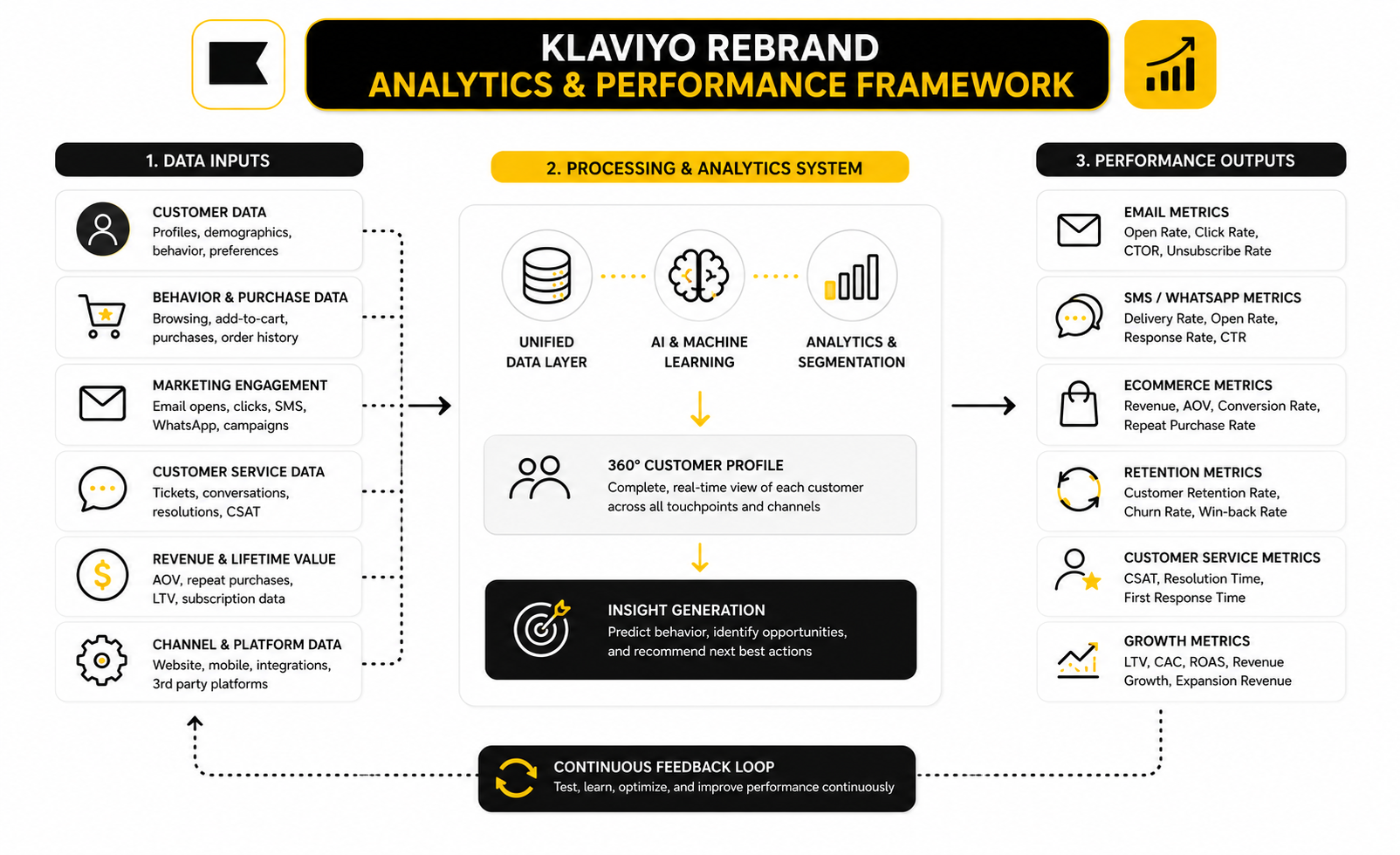
A rebrand should be measured in layers. Brand teams often look at awareness and sentiment. Marketing teams look at traffic, conversion, and engagement. Sales teams look at pipeline quality and deal velocity. Customer teams look at adoption, retention, and expansion.
The mistake is treating those layers separately. A rebrand only becomes useful when the metrics connect. If awareness improves but product adoption stays flat, the message may be attractive but not operational. If conversion improves but retention weakens, the promise may be oversold. If expansion improves but new buyers are confused, the brand may be too complex at the top of the funnel.
For a Klaviyo-style rebrand, the measurement system should track the full path from perception to performance. That means measuring whether people understand the new category, whether they believe the proof, whether they adopt the right features, and whether those features create measurable revenue or retention improvements.
Benchmarks That Matter For Teams Using Klaviyo
For ecommerce and B2C teams, benchmarks should not be treated as bragging material. They should be used as a diagnostic tool. Klaviyo’s benchmark resources compare performance across email, SMS, and industries, including metrics like click rates, conversion rates, revenue per recipient, and unsubscribe rates in its 2026 marketing benchmarks and SMS benchmark data.
The key is to interpret benchmarks by intent. A welcome flow should not be judged the same way as a winback campaign. A browse abandonment email should not be compared casually against a monthly newsletter. SMS should not be measured only by clicks if the bigger goal is incremental purchase behavior, opt-in quality, and long-term list health.
A useful benchmark review should ask three questions. First, are we below, near, or above the industry range? Second, is the gap caused by audience quality, offer, timing, creative, deliverability, or segmentation? Third, what action will we take based on the answer? Without that third question, analytics becomes decoration.
The Metrics To Watch After A Rebrand
After a rebrand, the most important metrics are the ones that show whether the market understands the new promise. Website conversion rate can show whether the new positioning is clearer. Demo request quality can show whether the brand is attracting the right buyers. Search behavior can show whether people are still looking for the old category or starting to associate the company with the new one.
For a platform like Klaviyo, product adoption is even more important. If customers adopt more channels, connect more data sources, use more automation, and rely more heavily on analytics, the platform story becomes real. If they keep using only the old core workflow, the rebrand may have improved perception without changing behavior.
Revenue expansion then becomes the business-level proof. This is why net revenue retention, large customer growth, and cross-sell adoption are so useful in Klaviyo’s case. The company reported that customers generating over $50,000 in ARR grew 37% year over year to 3,912 at the end of fiscal 2025, then increased to 4,175 in Q1 2026. That suggests the broader positioning is not only useful for small brands; it also supports a stronger up-market story.
Turning Data Into Action
The practical move is to build a measurement rhythm before the rebrand launches. Decide which metrics prove clarity, which prove adoption, which prove commercial impact, and which warn that the message is not landing. Then review those metrics on a schedule instead of waiting for vague feedback from the market.
For a brand following the Klaviyo rebrand playbook, the dashboard should include brand search demand, homepage conversion, product page engagement, lead quality, sales objections, feature adoption, channel expansion, retention, and expansion revenue. Those numbers will not all move at once. Some are early signals, while others take months to show real movement.
The action step is simple but demanding: connect every metric to a decision. If the new category language increases traffic but lowers conversion, tighten the explanation. If sales teams hear the same objection repeatedly, update the proof. If customers understand the promise but do not adopt the supporting features, improve onboarding and lifecycle education.
The Real Measurement Lesson
The real lesson from the Klaviyo rebrand is that a brand system should be judged by how well it helps the business scale. Better design is nice. Clearer positioning is better. Measurable expansion is the part that actually matters.
Klaviyo’s public numbers show a company growing revenue, adding customers, expanding larger accounts, and increasing multi-channel adoption. Those signals do not prove that every design decision was perfect, but they do show that the broader platform story had room to support real business momentum.
That is the standard worth using. A rebrand should make the company easier to understand, easier to trust, and easier to expand with. If the data does not show progress in those areas, the work is not finished.
Professional Implementation For Ecommerce And B2C Teams
The advanced part of the Klaviyo rebrand is not the design system. It is the discipline required to make a bigger promise without making the brand vague. Moving from a familiar category into a broader platform story creates more room for growth, but it also creates more room for confusion.
That is the tradeoff every serious rebrand has to manage. If the positioning stays too narrow, the company gets boxed into old comparisons. If the positioning becomes too broad, buyers stop understanding what the product actually does. The strongest rebrands find the middle: a bigger strategic story that still connects to clear use cases.
For Klaviyo, that means the B2C CRM story has to stay attached to practical outcomes like segmentation, automation, customer service context, analytics, AI-driven recommendations, SMS, WhatsApp, and revenue expansion. The brand can stretch, but it cannot float.
The Risk Of Overexpanding The Message
The first risk is trying to make the brand mean everything at once. “AI-first B2C CRM” is a powerful category move, but it also asks buyers to update their mental model of Klaviyo. Some people still know the company primarily as an email and SMS platform, so the new message has to educate without making the familiar use case feel less important.
That is a delicate balance. If Klaviyo talks only about the future platform, it risks creating distance from the marketers who use it every day for campaigns and flows. If it talks only about email and SMS, it undercuts the larger product direction described in its B2C CRM announcement, where Klaviyo combines marketing automation, analytics, and customer service into one unified solution.
The right move is not to abandon the old association. It is to use it as the entry point. Email may be where many teams start, but the rebrand should help them see the next layer: data, lifecycle intelligence, service visibility, cross-channel orchestration, and customer-level growth.
The Platform Story Has To Stay Operational
A platform rebrand only works when the day-to-day user experience supports it. This is where implementation gets serious. The website can say “B2C CRM,” but the product, onboarding, lifecycle education, sales demos, help docs, and customer success motions have to teach customers how to use the platform that way.
That means teams need to map the new positioning to actual workflows. A customer should be able to see how a unified profile improves segmentation, how analytics changes campaign planning, how service context affects retention, and how AI helps prioritize the next action. Without that operational bridge, the new category language becomes impressive but abstract.
This is also where agencies and consultants can add real value. They should not just “set up Klaviyo flows.” They should help brands design a customer relationship system: capture better data, structure better segments, connect more channels, measure retention properly, and improve the moments that drive repeat revenue.
Scaling Creates Internal Brand Pressure
The bigger a company gets, the harder brand consistency becomes. Klaviyo’s growth from more than 90,000 paying users at the time of the rebrand to more than 196,000 customers in Q1 2026 means the brand has to work across far more customer types, product surfaces, regions, and teams. That kind of scale makes loose messaging expensive.
Internal teams need rules they can actually use. Sales needs a simple explanation of the new category. Marketing needs proof points and campaign angles. Product needs naming and UX language that support the same story. Customer success needs onboarding paths that move customers from basic adoption to broader platform value.
This is where many rebrands quietly break. The launch looks good, but six months later every department has created its own version of the message. A professional implementation needs governance, not just guidelines.
The Shopify Dependency Question
There is also a strategic risk that should not be ignored. Klaviyo has deep roots in ecommerce, and its relationship with Shopify has been a major advantage. That connection helped Klaviyo become a default choice for many Shopify merchants, but concentration can become a risk when one ecosystem represents a large share of the business.
Klaviyo’s own filings have historically discussed dependence on Shopify-related customers as a risk factor, and independent analysis of its 2025 annual report has highlighted Shopify ecosystem concentration as a structural issue. That does not make the rebrand weaker. It makes the broader positioning more important.
A successful B2C CRM story gives Klaviyo more ways to expand beyond one platform association. It can still be excellent for Shopify brands, but the long-term brand has to feel credible for larger retailers, multi-platform operators, international businesses, and teams that want more than a storefront integration. The rebrand helps create that room, but execution has to earn it.
AI Raises The Stakes
AI makes the Klaviyo rebrand more ambitious and more difficult. Klaviyo’s 2025 launches for Marketing Agent and Customer Agent were positioned as part of an AI-first B2C CRM vision, unifying data, marketing, service, and analytics in one platform. That gives the brand a modern edge, but it also raises buyer expectations quickly.
The risk is overpromising autonomy before customers are ready to trust it. Marketers want speed, but they also care about brand voice, compliance, revenue quality, customer experience, and deliverability. If AI suggestions feel generic or unsafe, teams will treat them like toys instead of operating leverage.
The stronger path is to position AI as guided execution, not magic. AI should help teams find segments, identify opportunities, create better campaign drafts, answer customer questions faster, and prioritize actions from real data. That is far more believable than pretending the system can replace strategy.
What Advanced Teams Should Do Differently
Advanced teams should use the Klaviyo rebrand as a reason to rethink their operating model, not just their templates. If Klaviyo is becoming more of a customer relationship platform, then the team using it needs to behave less like a campaign desk and more like a lifecycle growth function. That shift changes planning, ownership, measurement, and execution.
Start by separating channel work from customer journey work. Channel work asks, “What email or SMS should we send?” Customer journey work asks, “What does this customer need next, and which channel should carry that message?” That second question is where the real value sits.
Then build stronger feedback loops. Customer service insights should influence retention campaigns. Product behavior should influence segmentation. Purchase history should influence offer strategy. Analytics should influence creative direction. The point is to stop treating Klaviyo as an output tool and start treating it as a customer intelligence layer.
When A Rebrand Should Not Happen Yet
Not every company is ready for a Klaviyo-style rebrand. If the product has not actually expanded, a bigger category story will feel fake. If the team cannot explain the new position in one sentence, the market will not understand it either. If customer proof is thin, the rebrand may create pressure the business cannot handle.
A rebrand should happen when there is a real gap between what the company has become and what the market still thinks it is. That gap is painful, but it is also useful. It gives the rebrand a clear job.
For smaller brands, the move may be less dramatic. You may not need a full identity overhaul. You may only need sharper positioning, cleaner messaging, a stronger homepage, better proof, and a more consistent lifecycle experience. The principle is the same: do not change the wrapper unless you are ready to clarify the substance.
The Expert-Level Takeaway
The Klaviyo rebrand shows that the hardest part of repositioning is not announcing the new idea. It is making the new idea operational across the business. The brand has to be simple enough for the market to remember and strong enough to support future product expansion.
That is why the best rebrands feel obvious after they happen. They do not invent a new company out of nowhere. They reveal the company that was already emerging.
For Klaviyo, the emerging company is not just an email platform with a better visual identity. It is a broader customer relationship system for B2C brands. That is a bigger promise, and it comes with bigger execution demands.
Risks, Practical Takeaways, And Final Lessons
The Klaviyo rebrand is strong because it connects visual identity, product expansion, customer ownership, and platform strategy. But it is not risk-free. The bigger the promise, the more pressure the company has to make every part of the experience feel connected.
That is the real closing lesson. A rebrand is not the moment when the work is finished. It is the moment when the company publicly commits to a sharper direction, then has to keep proving that direction through product, support, content, sales, onboarding, and customer outcomes.
For brands studying Klaviyo, the practical takeaway is simple. Do not rebrand to look different. Rebrand when the market’s understanding of you is smaller than what you actually help customers do.
The Ecosystem View
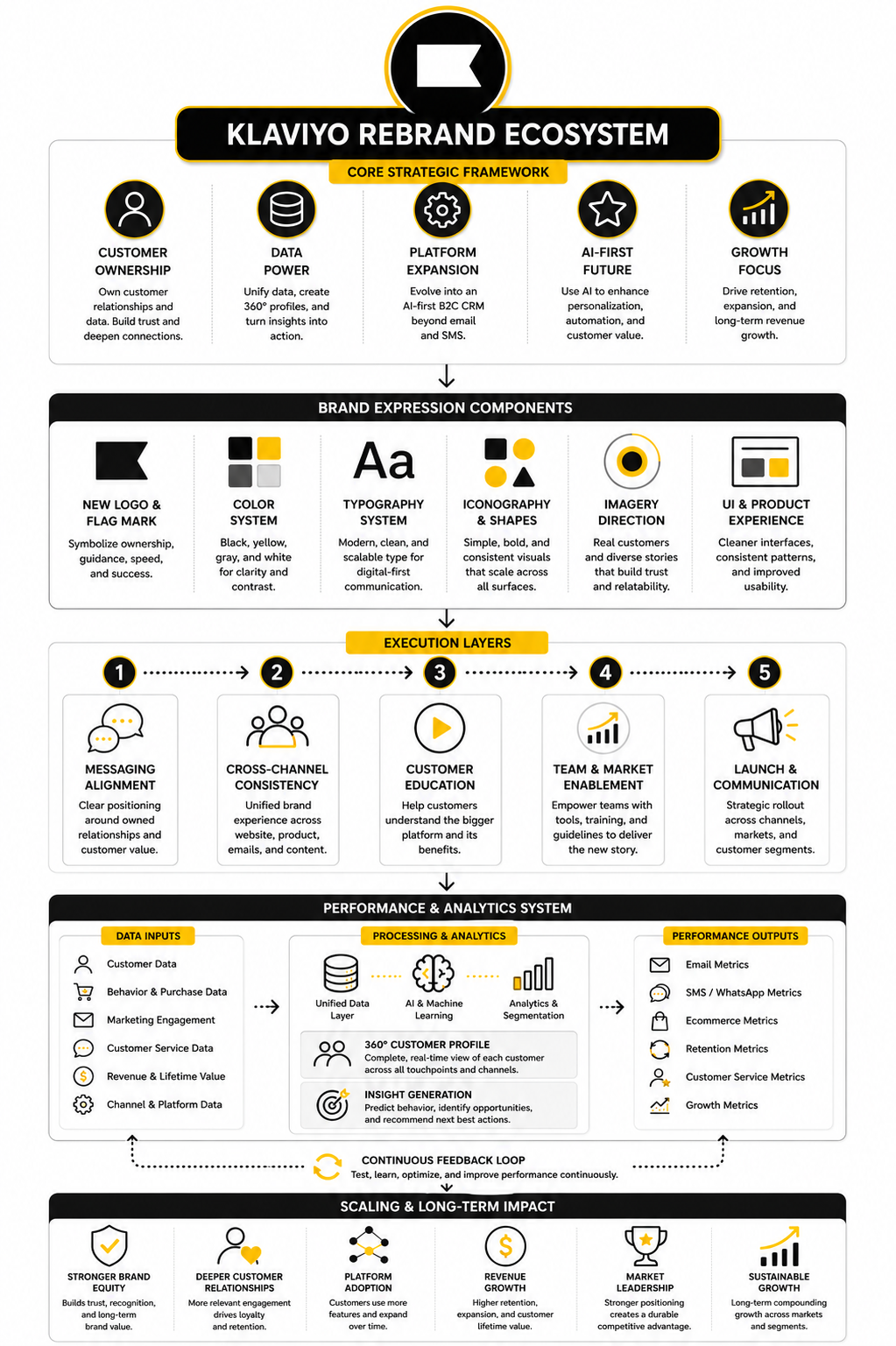
A mature rebrand should create a full ecosystem, not a prettier homepage. The brand story should connect the audience, product, data, channels, proof, and commercial model into one understandable system. That is what makes the Klaviyo rebrand useful as a reference point for marketers and founders.
The ecosystem view also prevents a common mistake. Teams often focus too much on external launch assets and not enough on how the new story will live inside the business. The website may change in one week, but customer education, sales enablement, partner materials, lifecycle messaging, product language, and reporting habits usually take longer.
This is where execution becomes the moat. If every team understands the same promise and can translate it into their own work, the rebrand compounds. If every team improvises, the rebrand slowly fragments.
How To Apply The Klaviyo Rebrand Lessons
The first move is to audit the gap between perception and reality. Ask what customers currently think you do, then compare that with what your product, service, or brand actually enables today. If the gap is small, you may need sharper messaging. If the gap is large, you may need a deeper repositioning.
The second move is to define the one strategic idea the brand should own. For Klaviyo, that idea centers on owned customer relationships powered by data and automation. For another company, the idea might be speed, trust, category expertise, simplicity, profitability, compliance, or customer experience.
The third move is to make the idea operational. Every claim should connect to a workflow, proof point, customer outcome, product capability, or measurable behavior. If the idea cannot be implemented, trained, sold, supported, and measured, it is not a brand strategy yet.
What To Avoid
Avoid rebranding around language that sounds bigger but does not help buyers make a decision. Terms like “platform,” “AI,” “ecosystem,” and “operating system” can be useful, but only when they clarify the value. If they make the company harder to understand, they are hurting the brand.
Avoid treating customer familiarity as a weakness. Klaviyo’s email and SMS association still has value because it gives buyers a clear entry point. The stronger move is to expand from that association, not erase it.
Avoid launching without a measurement plan. The rebrand should be judged through clarity, adoption, expansion, and retention signals, not just brand sentiment. Klaviyo’s public growth metrics, including more than 196,000 customers in Q1 2026, show why scale creates a bigger need for disciplined messaging and platform-level clarity.
Final Takeaway
The Klaviyo rebrand is not interesting because of one logo or one color system. It is interesting because it shows a company moving from a narrower category association into a broader strategic role. That is the kind of rebrand that can actually change how buyers think.
For marketers, the lesson is to connect brand work with business reality. Your positioning should explain the value you already deliver, the future you are building toward, and the reason customers should trust the transition. Anything less is just a cosmetic update.
For ecommerce and B2C teams, the deeper lesson is to think in systems. Customer relationships, data, messaging, service, analytics, and AI are no longer separate conversations. The brands that connect them clearly will have a much easier time earning attention, trust, and repeat revenue.
What was the Klaviyo rebrand?
The Klaviyo rebrand was a visual and strategic identity update that introduced a new logo, flag mark, color system, typography, iconography, and customer-centered imagery. The original announcement framed the change around ownership, especially customer data ownership and direct brand relationships. Strategically, the rebrand helped Klaviyo move beyond a narrow email marketing perception toward a broader customer platform and B2C CRM story.
Why did Klaviyo rebrand?
Klaviyo rebranded because the company had outgrown the way many people understood it. It was no longer only an email and SMS automation tool for ecommerce brands. Its product direction expanded into customer data, analytics, AI, service, and multi-channel customer engagement, so the brand needed to support that larger role.
Is Klaviyo still mainly an email marketing platform?
Email remains one of Klaviyo’s most recognizable and important use cases, but the company now positions itself more broadly. Its current messaging focuses on an AI-first B2C CRM that connects marketing automation, customer data, analytics, service, and channels such as SMS and WhatsApp. That means email is still a core entry point, but it is no longer the full story.
What does the Klaviyo flag logo mean?
Klaviyo’s rebrand announcement described the flag mark as a symbol connected to ownership, community, guidance, speed, and success. That makes the mark more than a decorative logo choice. It supports the larger brand idea that companies should own their customer relationships and use their data to grow more directly.
What can ecommerce brands learn from the Klaviyo rebrand?
Ecommerce brands can learn that a rebrand should clarify a bigger business promise, not just update the look. If a brand has moved from selling products to creating a broader customer experience, the messaging should reflect that. The strongest rebrands help customers understand why the company matters more now than it did before.
How should a company measure whether a rebrand worked?
A company should measure a rebrand through both perception and performance. Useful signals include brand search demand, homepage conversion, lead quality, sales objections, product adoption, customer retention, expansion revenue, and customer understanding of the new position. The goal is to know whether the rebrand made the business easier to trust, easier to understand, and easier to buy from.
What is the biggest risk in a rebrand like Klaviyo’s?
The biggest risk is making the message too broad. When a company moves from a specific category into a larger platform story, buyers can become confused if the new language is not tied to clear use cases. Klaviyo reduces that risk by keeping the broader B2C CRM story connected to practical outcomes like segmentation, automation, analytics, customer service, and owned customer relationships.
Does the Klaviyo rebrand mean smaller brands should also reposition?
Not automatically. Smaller brands should reposition when there is a real gap between what customers think the business does and what it actually helps them achieve. If the gap is mostly cosmetic, a full rebrand may be unnecessary. If the gap affects pricing, sales conversations, customer trust, or category perception, repositioning may be worth it.
How does AI fit into the Klaviyo rebrand?
AI fits into the Klaviyo rebrand because the company now presents itself as an AI-first B2C CRM. That makes AI part of the platform story, not just a feature add-on. The strongest use of AI in this context is helping teams turn customer data into faster decisions, better campaign planning, more carefully service interactions, and more relevant customer experiences.
What is the difference between a cosmetic refresh and a strategic rebrand?
A cosmetic refresh changes how the brand looks. A strategic rebrand changes how the market understands the company. The Klaviyo rebrand is closer to a strategic rebrand because it connects identity changes to a broader shift in product scope, category positioning, and customer value.
Should agencies talk about Klaviyo differently after the rebrand?
Yes, especially if they want to sell higher-value lifecycle and retention work. Instead of describing Klaviyo only as a tool for flows and campaigns, agencies can frame it as part of a customer relationship system. That creates room to discuss data quality, segmentation, customer journeys, retention strategy, analytics, multi-channel messaging, and long-term revenue growth.
What is the most practical takeaway from the Klaviyo rebrand?
The most practical takeaway is that a rebrand should make the company’s future easier to explain. Klaviyo’s rebrand gave the company more room to talk about data, AI, service, analytics, and customer relationships without abandoning its original strengths. That is exactly what a strong rebrand should do.
Build a stronger local presence with BAAM AI
Turn your website, Google profile, social channels, and AI visibility into one growth engine
Most businesses do not need more random marketing activity. They need a consistent presence system that helps the right people find them, trust them, and take action. BAAM AI brings strategy, local SEO, website updates, Google Maps visibility, social content, AI-search readiness, media production, and reporting into one practical monthly engine.
If you want your marketing to keep working after the campaign ends, start with a free BAAM AI presence audit. See how your business shows up today and where the fastest visibility wins are at BAAM AI.