
BAAM AI Blog
Klaviyo List Cleaning: A Practical Framework for Healthier Email Revenue
Klaviyo list cleaning is not about deleting people because a dashboard looks messy. It is about protecting the part of your email program that actually makes money: engaged subscribers, reliable inbox placement, and...
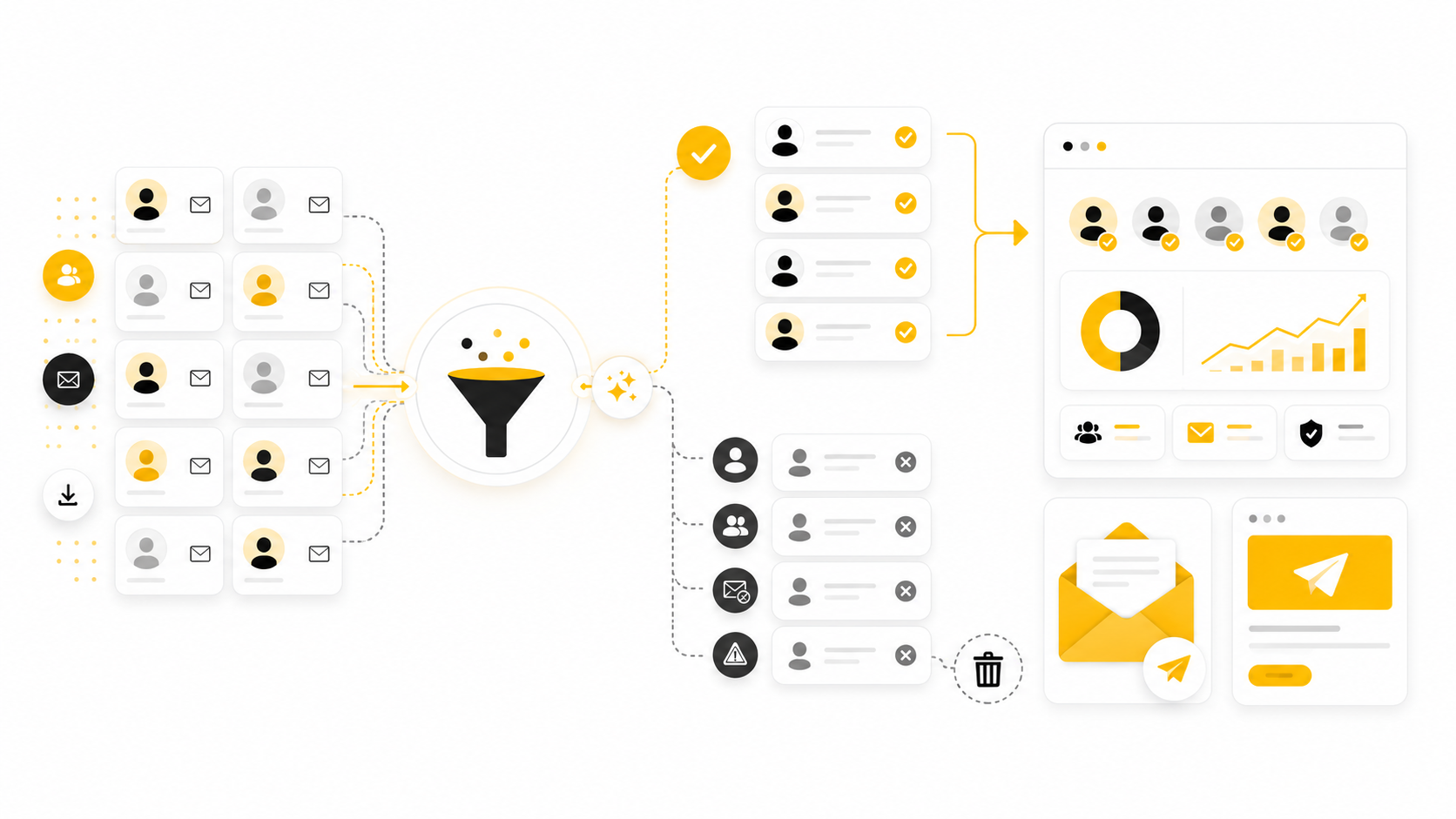
Klaviyo list cleaning is not about deleting people because a dashboard looks messy. It is about protecting the part of your email program that actually makes money: engaged subscribers, reliable inbox placement, and campaigns that do not get punished by mailbox providers because too many cold contacts ignore, bounce, or complain.
The mistake most brands make is waiting until open rates collapse, flows slow down, or campaign revenue starts looking random. By then, the problem usually is not one bad subject line. It is months of sending to people who stopped showing intent, mixed with a few risky addresses, stale profiles, and segments that kept growing without any hygiene system behind them.
Klaviyo gives ecommerce teams the tools to fix this properly. You can identify never-engaged profiles, exclude unengaged segments, build sunset flows, suppress people who do not respond, and keep valuable customer data without continuing to email every profile forever. Klaviyo’s own guidance recommends regularly excluding unengaged subscribers and suppressing never-engaged profiles when they meet the right criteria, because list quality directly affects deliverability and sender reputation Klaviyo’s list cleaning guidance.
this guide breaks Klaviyo list cleaning into a practical six-part system. Not a panic cleanup. Not a one-time export. A repeatable framework you can use to keep your list profitable, protect deliverability, and avoid paying for profiles that no longer deserve a place in your active marketing audience.
Why Klaviyo List Cleaning Matters
List cleaning matters because email performance is not judged only by what you send. It is judged by who receives it, how they react, and whether mailbox providers believe your brand deserves the inbox. Gmail tells senders to keep spam rates below 0.1% and avoid ever reaching 0.3% or higher, which makes audience quality a real deliverability issue rather than a vague best practice Google’s sender guideline FAQ.
That is why a bloated Klaviyo account can look healthy from the outside while quietly getting weaker. The list count goes up, the brand feels like it has more reach, and campaign sends look bigger. But if a growing share of that list no longer opens, clicks, buys, or recognizes the brand, every campaign sends a negative signal.
The financial side matters too. Klaviyo’s active profile management guidance points brands toward sunset flows, suppression, and profile management when people stop engaging, because inactive profiles can affect both performance and account costs Klaviyo’s active profile management guide. In plain English: if someone is not opening, clicking, buying, or responding after a reasonable window, they should not automatically keep receiving every campaign forever.
The Klaviyo List Cleaning Framework
Klaviyo list cleaning works best when you stop thinking in one big bucket called “subscribers.” A healthy account separates people by intent, recency, permission, purchase behavior, and engagement. Someone who bought last week, someone who subscribed two years ago and never opened, and someone who bounced three times should not be treated like the same type of profile.
The framework here uses four practical layers: diagnose, segment, re-engage, and suppress. Diagnosis shows whether the problem is list quality, deliverability, offer fatigue, or weak segmentation. Segmentation separates valuable people from risky ones so you can make decisions based on behavior instead of guesswork.
Re-engagement gives inactive subscribers a fair final chance before you remove them from regular sends. Klaviyo calls this a sunset flow, and its help center describes it as a final attempt to win back inactive profiles before suppressing those who do not respond Klaviyo’s sunset flow guidance. Suppression then protects the account by keeping those profiles out of future marketing sends while preserving the profile data you may still need for reporting, customer history, or future segmentation.
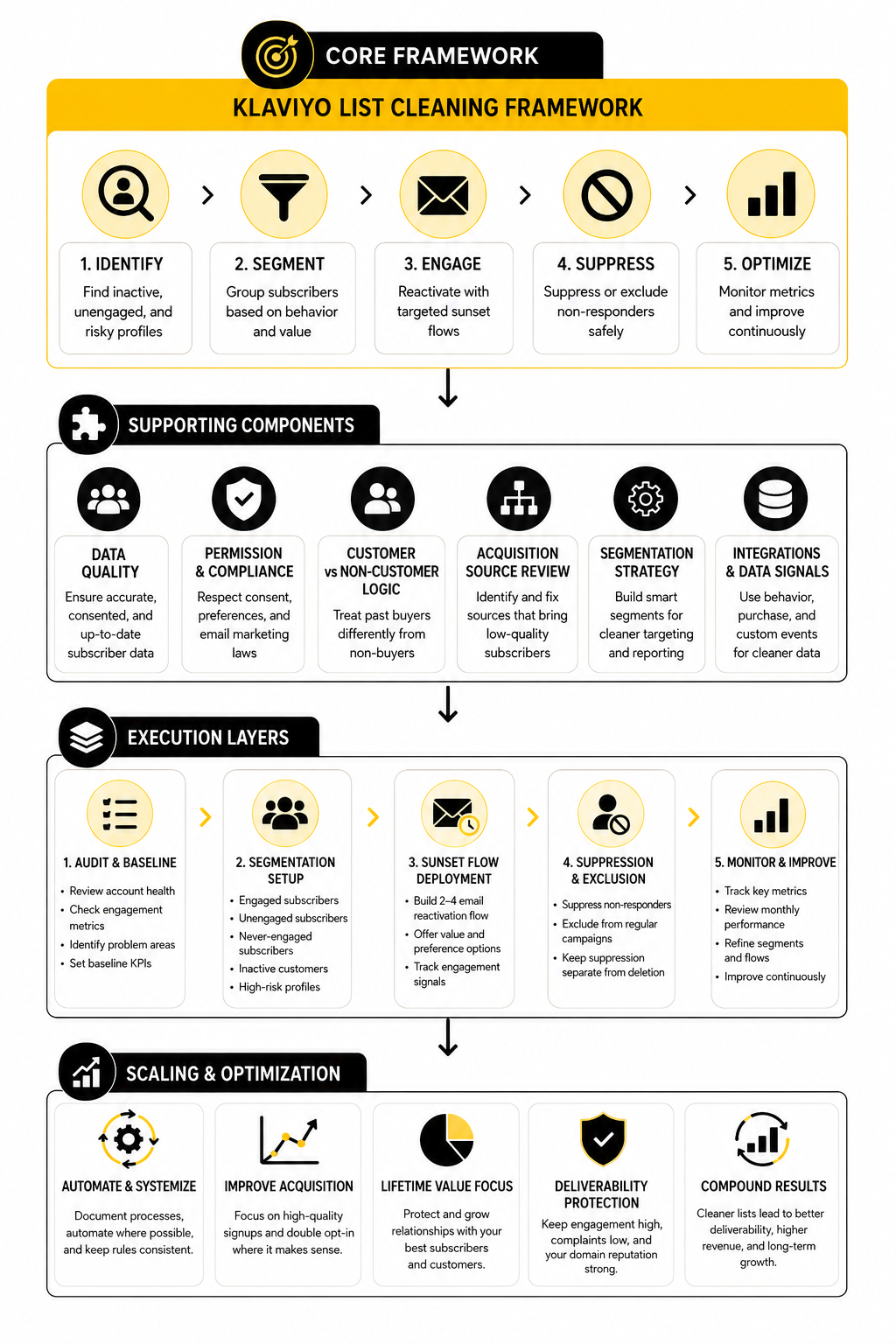
Core Components of a Clean Klaviyo Account
A clean Klaviyo account starts with clear definitions. You need to know what “engaged,” “unengaged,” “never engaged,” “inactive customer,” “recent buyer,” and “suppressed” mean for your brand. Those definitions should depend on your buying cycle, send frequency, and customer behavior, not a random rule copied from another store.
The first component is engagement-based segmentation. This includes people who opened, clicked, purchased, viewed products, started checkout, or otherwise showed recent intent. The exact lookback window can vary, but the point is simple: people who recently interacted with your brand deserve a different sending strategy than people who have ignored you for months.
The second component is risk control. This includes bounced emails, spam complaints, suspicious signups, very old inactive profiles, and contacts who never engaged after joining. Industry anti-abuse groups such as M3AAWG publish guidance around spam traps and sender best practices because bad or stale addresses can damage sender reputation far beyond the value of a few extra names on a list M3AAWG sender and ESP resources.
The third component is automation. Manual cleanups are useful when the account is already messy, but they are not enough by themselves. A serious Klaviyo setup should use segments, sunset flows, suppression rules, campaign exclusions, and regular reporting so list hygiene becomes part of the operating system instead of an emergency chore.
Professional Implementation Starts With Restraint
The professional version of Klaviyo list cleaning is not aggressive deletion on day one. It starts with restraint. You look at the data, define engagement windows, separate subscribers from customers, and avoid removing people who still have meaningful commercial value.
That matters because not all silence means the same thing. A customer who bought an expensive product six months ago may not need weekly emails to remain valuable. A lead who joined 18 months ago, never opened, never clicked, and never purchased is a very different profile.
Good implementation also avoids the other extreme: keeping everyone because “they might buy someday.” That mindset is expensive and risky. Mailbox providers care about recipient behavior, and your best subscribers should not have to share sender reputation with people who have shown no interest in hearing from you.
Part 2 will move from the big picture into the first real section: Why Klaviyo List Cleaning Matters. That is where the article will unpack deliverability, sender reputation, Klaviyo billing, customer experience, and the hidden cost of sending to people who stopped paying attention.
Why Klaviyo List Cleaning Matters
Klaviyo list cleaning matters because email marketing is not a pure volume game anymore. Bigger lists only help when the people on those lists still want to hear from you. When too many inactive, invalid, or uninterested profiles stay in your regular campaign audience, the whole account starts carrying unnecessary risk.
The risk shows up in three places: deliverability, cost, and decision-making. Deliverability suffers because mailbox providers see low engagement and complaints as signals that your messages may not belong in the inbox. Cost suffers because you can end up paying for profiles that are not producing revenue. Decision-making suffers because your campaign data gets diluted by people who were never likely to respond in the first place.
This is why list cleaning should be treated as a revenue protection system, not a cosmetic cleanup. A brand with a smaller but engaged audience usually has a stronger email program than a brand with a massive list full of dead weight. The goal is not to make the list look impressive. The goal is to make every send more trustworthy, more measurable, and more likely to reach people who still care.
Deliverability Depends on Recipient Behavior
Mailbox providers do not only look at your domain setup. Authentication matters, but behavior matters too. If people open, click, reply, move emails out of spam, and keep receiving your messages without complaints, those signals help your sender reputation over time.
The opposite is also true. When a large share of recipients ignores your campaigns, deletes without reading, complains, or bounces, your future sends can become harder to place. Google’s sender guidance tells senders to keep spam rates below 0.1% and avoid ever reaching 0.3% or higher, which makes complaint prevention a practical operating requirement, not a nice-to-have Google’s email sender guideline FAQ.
That is where Klaviyo list cleaning becomes useful. You are not trying to trick Gmail, Yahoo, Outlook, or Apple Mail. You are trying to send more mail to people who have shown interest and less mail to people who have shown none.
Unengaged Profiles Make Good Campaigns Look Worse
A campaign can have a strong offer, a clean design, and a good subject line while still underperforming because the audience is too cold. This is one of the most frustrating parts of email marketing. The creative gets blamed, but the real problem is often the segment.
If you send to everyone, the most inactive profiles drag down the average. Opens look weaker, clicks look weaker, conversion rate looks weaker, and the team starts making the wrong changes. Instead of improving the real bottleneck, they rewrite subject lines, change templates, discount harder, or send more often.
That is backwards. Klaviyo list cleaning gives you cleaner data because it separates audience quality from message quality. Once you remove or exclude subscribers who have clearly stopped engaging, your campaign reports become easier to trust.
Dirty Lists Increase the Cost of Running Klaviyo
Klaviyo pricing and account management are tied to active profiles and usage, so keeping inactive profiles active forever can create avoidable cost. Klaviyo’s active profile management guidance specifically recommends excluding unengaged recipients from regular campaigns, running sunset flows, and suppressing long-term inactive profiles to improve deliverability and avoid paying for contacts that do not generate revenue Klaviyo’s active profile management guidance.
This does not mean every inactive profile should be deleted immediately. Customer history, order data, consent records, and segmentation context can still matter. Suppression is often the better move because it stops marketing sends without wiping useful profile information from the account.
That distinction is important. Professional Klaviyo list cleaning is not reckless deletion. It is controlled access: the right people keep receiving regular marketing, risky profiles are excluded, and long-term inactive profiles stop costing the account more attention than they deserve.
List Cleaning Protects Your Best Subscribers
The best subscribers are not the problem, but they pay the price when the list is neglected. If your sender reputation weakens because you keep emailing people who never engage, even your most interested customers can be less likely to see your campaigns in the inbox. That is the part many brands miss.
A clean list makes it easier for your strongest audience to receive the messages they actually want. Product launches, replenishment reminders, VIP offers, winback campaigns, and educational content all perform better when they are not dragged down by uninterested recipients. You are not only removing risk. You are protecting the people who already trust you.
This is especially important for ecommerce brands with seasonal buying patterns. A subscriber may not buy every week, but they still need to be treated differently from someone who joined years ago and never interacted once. Good list cleaning respects that difference instead of using one blunt rule for everyone.
Compliance Pressure Has Raised the Standard
The inbox has become stricter. Google and Yahoo’s bulk sender requirements pushed brands to take authentication, easy unsubscribe, and complaint monitoring more seriously. Yahoo’s sender FAQ also emphasizes complaint handling and one-click unsubscribe expectations for promotional messages, which reinforces the same basic point: recipients need a clear way to say no, and senders need to respect that signal Yahoo’s sender FAQ.
Klaviyo list cleaning fits into this bigger shift. If someone has not engaged for a long time, forcing more campaigns into their inbox is not a growth strategy. It is a reputation risk. If someone unsubscribes, complains, bounces, or never confirms meaningful interest, the account should respond cleanly.
Good hygiene also makes compliance easier to operationalize. You can maintain clear suppression logic, reduce unnecessary promotional sends, and avoid relying on last-minute manual cleanup when deliverability issues appear. That is far better than trying to fix reputation after the damage is already visible.
Revenue Attribution Gets Cleaner
Email revenue reporting can become misleading when the audience is too broad. A campaign sent to a highly engaged segment tells you something useful about offer strength and customer intent. A campaign sent to a bloated list tells you much less because the results are mixed with people who were unlikely to act anyway.
Cleaner lists make attribution more honest. You can compare engaged subscribers, recent customers, lapsed customers, and reactivation audiences without pretending they are the same. This helps you understand whether the issue is timing, offer, product-market fit, lifecycle stage, or list quality.
That matters because Klaviyo is not just a sending tool. It is a customer data and lifecycle marketing platform. The cleaner your segments are, the easier it becomes to make decisions that actually improve revenue instead of just increasing send volume.
More Sending Is Not Always More Growth
It is tempting to solve weak campaign revenue by sending more. Sometimes that works in the short term, especially during major sales periods. But if the list is already tired, more sending can accelerate the problem.
Sending more often to people who are engaged is different from sending more often to people who are ignoring you. The first can increase revenue when the content and offer are relevant. The second can increase fatigue, complaints, unsubscribes, and deliverability pressure.
Klaviyo list cleaning gives you the confidence to send with more intent. You can mail engaged segments more strategically, reserve broader sends for moments that justify the reach, and stop treating every profile like it has equal value. That is how email becomes sharper instead of louder.
List Hygiene Supports Better Lifecycle Marketing
A clean Klaviyo account makes every lifecycle flow more accurate. Welcome flows, abandoned checkout flows, browse abandonment, post-purchase sequences, winback campaigns, and sunset flows all depend on profile behavior. If your account is full of stale or poorly segmented contacts, those automations become less precise.
List cleaning improves the inputs. Recent buyers can receive post-purchase education instead of generic discounts. Long-term inactive subscribers can enter a re-engagement path instead of staying in normal campaigns forever. People who show fresh intent can be treated as active again.
This is where list cleaning becomes more than maintenance. It becomes part of the customer journey. You are matching communication to behavior, which is exactly what lifecycle marketing is supposed to do.
The Real Goal Is Quality, Not Shrinkage
Some teams resist Klaviyo list cleaning because they think it means making the list smaller. Technically, it often does. Strategically, that is not the goal.
The goal is to make the reachable audience healthier. If a profile is engaged, profitable, or recently active, it should be protected. If a profile is inactive but still commercially plausible, it may deserve a re-engagement attempt. If a profile is long-term inactive, invalid, risky, or clearly uninterested, it should not keep receiving regular campaigns.
That is the mindset shift. You are not cleaning the list because small lists are better. You are cleaning the list because clear intent is better than inflated reach.
The Klaviyo List Cleaning Framework
A good Klaviyo list cleaning process should not start with suppression. It should start with diagnosis. If you jump straight into removing profiles, you can accidentally cut people who still have buying intent, especially if your product has a longer buying cycle or a seasonal purchase pattern.
The clean way to do this is to work through the account in layers. First, understand what kind of inactivity you are dealing with. Then build segments that separate healthy subscribers from risky ones. After that, run a final re-engagement process for the people who still deserve one more chance.
This is the framework that keeps list cleaning practical. You are not making emotional decisions based on a scary open rate. You are using behavior, time, consent, and customer value to decide who should keep receiving campaigns and who should be moved out of regular marketing.
Step 1: Audit the Current List Before Changing Anything
Start by looking at the size and behavior of your reachable audience. Check how many profiles are active, how many are suppressed, how many are subscribed to email, and how many have not engaged for a meaningful period. Klaviyo’s active profile guidance recommends managing inactive profiles because long-term unengaged contacts can affect both deliverability and account costs Klaviyo’s active profile management guidance.
The audit should also separate subscribers from customers. A non-customer who joined eighteen months ago and never clicked is not the same as a customer who bought twice and has been quiet for a few months. If you treat both groups the same, your cleanup will be too blunt.
This is also where you look for list acquisition problems. If one popup, giveaway, import, or partner campaign produced a large number of profiles that never engaged, that source needs to be reviewed. Klaviyo list cleaning fixes the current list, but the real win is preventing low-quality contacts from entering the system again.
Step 2: Define Engagement Windows That Match the Business
There is no universal engagement window that works for every store. A fast-moving apparel brand sending multiple campaigns per week can usually judge inactivity faster than a brand selling expensive products with a longer consideration cycle. The point is to define rules that reflect how customers actually buy.
A practical starting point is to group subscribers by recent activity, moderate inactivity, and long-term inactivity. Recent activity may include opens, clicks, purchases, viewed products, started checkouts, or site visits. Long-term inactivity usually means the profile has not shown meaningful email or buying behavior for months.
Klaviyo notes that sending to unengaged profiles who have not interacted with emails in three to six months can lead inbox providers to place messages in spam, which makes the engagement window more than an internal reporting choice Klaviyo’s unengaged segment guidance. That does not mean every profile goes straight to suppression after three months. It does mean your campaign exclusions should get stricter as inactivity grows.
Step 3: Build the Core Cleaning Segments
Once the engagement rules are clear, build the segments that will drive the cleanup. Do not rely on one giant “inactive” segment. You need a few different views so the account can make more carefully decisions.
Useful Klaviyo list cleaning segments usually include:
These segments are the foundation of the process. Klaviyo’s segment conditions work as building blocks that let you include or exclude people based on profile properties, events, consent, and behavior Klaviyo’s segment conditions reference. The cleaner your segment logic is, the less you have to rely on guesswork later.
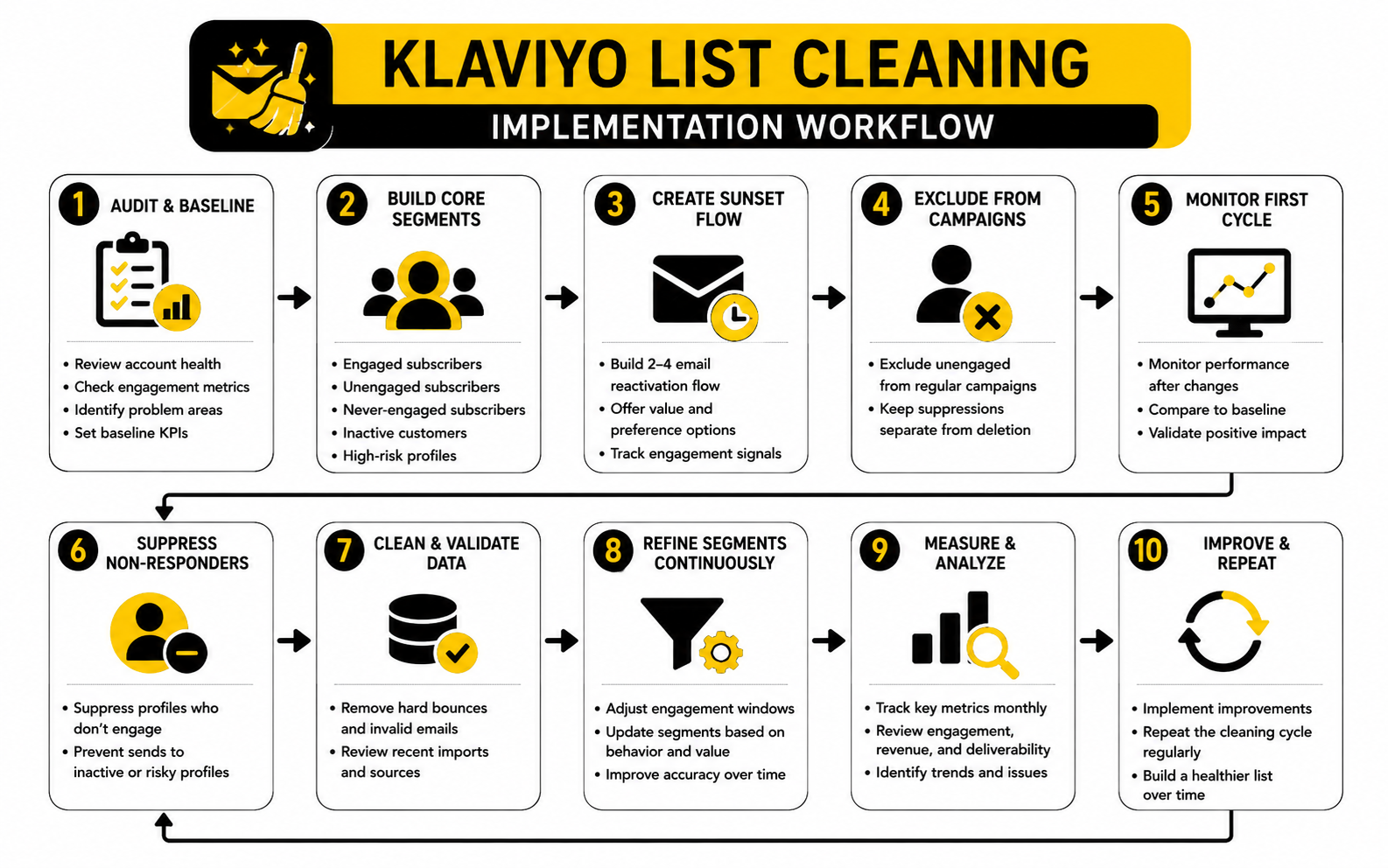
Step 4: Exclude Unengaged Segments From Regular Campaigns
Before suppressing anyone, tighten campaign sending. This is the safer first move because it reduces deliverability risk without immediately removing profiles from the account. For most regular campaigns, exclude the unengaged and never-engaged segments unless there is a specific reason to contact them.
This one change often reveals the real health of the email program. Campaigns may go to fewer people, but the audience becomes more intentional. Open rates, click rates, and revenue per recipient become easier to interpret because you are no longer sending every campaign to people who have already stopped responding.
This is where discipline matters. Do not rebuild the same messy audience every time revenue pressure rises. If a subscriber belongs in a re-engagement path, send them there. If they belong in regular campaigns, their behavior should prove it.
Step 5: Create a Sunset Flow for Final Re-Engagement
A sunset flow gives inactive subscribers one final chance before suppression. This is better than quietly removing people without any attempt to regain attention. It also gives you a clean operational process instead of manually deciding profile by profile.
Klaviyo describes a sunset flow as a final outreach sequence for inactive customers before suppressing profiles that do not respond Klaviyo’s sunset flow guidance. The flow should be simple, direct, and honest. The subscriber should understand that they will stop receiving emails unless they show interest.
A practical sunset flow can include:
The key is not to overcomplicate it. A sunset flow is not a normal promo sequence with heavier discounts. It is a permission and intent check.
Step 6: Suppress Profiles That Do Not Respond
Suppression is the point where Klaviyo list cleaning becomes real. The profile may still exist in the account, but it stops receiving marketing emails. This helps protect deliverability while preserving useful customer and profile history.
Klaviyo’s bulk suppression guidance explains that suppression and deletion are different actions, and the suppression workflow is designed to help avoid suppressing recently active or high-intent profiles by mistake Klaviyo’s suppression and bulk profile management guidance. That distinction matters. In most list cleaning situations, suppression is the responsible default because it stops marketing without erasing context.
You should be especially careful with past customers. A buyer who has not clicked recently may still be worth keeping in customer-specific segments, depending on buying cycle and product category. The cleanup should be firm, but it should not punish customer value just because someone skipped a few campaigns.
Step 7: Keep New Low-Quality Contacts Out
List cleaning is not finished when the first suppression batch is complete. If the same acquisition sources keep feeding poor contacts into Klaviyo, the list will get dirty again. That is why the process needs a prevention layer.
Review every signup source that sends profiles into the account. Look at popups, embedded forms, checkout consent, giveaways, landing pages, third-party integrations, and imported lists. If a source generates subscribers who never engage, it needs better targeting, clearer expectations, stronger consent language, or removal.
This also applies to tools connected around the funnel. If you use landing pages, forms, or CRM workflows outside Klaviyo, keep the handoff clean and intentional. Platforms like GoHighLevel can be useful for broader funnel and lead management workflows, but the quality of what enters Klaviyo still depends on your consent, tagging, and segmentation discipline.
Step 8: Create a Monthly List Health Routine
Klaviyo list cleaning works best when it becomes a monthly routine. You do not need to rebuild the entire system every time. You need a repeatable check that catches risk early.
The monthly routine should review engagement trends, new unengaged profiles, sunset flow exits, suppression volume, spam complaints, bounce patterns, and campaign exclusions. If the numbers are stable, the account is probably in good shape. If unengaged profiles are growing faster than engaged subscribers, the acquisition or sending strategy needs attention.
This routine keeps the account calm. Instead of waiting for deliverability problems, you see the warning signs early. That is the whole point of the process: fewer surprises, cleaner campaigns, and a list that stays useful over time.
Statistics and Data
The numbers behind Klaviyo list cleaning only matter when they change what you do next. A benchmark is not a trophy. It is a diagnostic tool that tells you whether the list, the offer, the creative, or the sending strategy needs attention.
This is where many brands get messy. They look at open rate, panic, and start changing subject lines. Or they look at revenue, feel good, and ignore the fact that complaints, bounces, and inactive profiles are quietly getting worse.
A better approach is to read email performance in layers. First, check whether the account is safe to send from. Then check whether the audience is engaged. Then check whether the campaign is making money from the right people. That order matters because revenue from a few strong buyers can hide a weak and risky list underneath.
Start With Deliverability Health
Deliverability metrics are the early warning system. Before you obsess over conversion rate, look at spam complaints, bounce rate, unsubscribe rate, open rate, and click rate together. Klaviyo’s deliverability monitoring guidance points users toward these exact performance signals because they show whether recipients are accepting, ignoring, rejecting, or actively pushing back against your emails Klaviyo’s deliverability monitoring guide.
Spam complaints deserve special attention because they can hurt faster than most other metrics. Google tells senders to keep spam rates below 0.1% and avoid ever reaching 0.3% or higher Google’s sender guideline FAQ. That should shape how aggressively you exclude cold audiences from normal campaigns.
Bounces matter for a different reason. A rising bounce rate usually means the list contains invalid, mistyped, abandoned, or poorly sourced addresses. If bounces are concentrated around a specific signup source, import, or campaign segment, Klaviyo list cleaning should start there before you blame the creative.
Read Benchmarks as Context, Not Absolute Truth
Benchmarks help you understand whether your performance is unusual, but they do not replace account-specific diagnosis. Klaviyo’s email benchmarks let brands compare open rates, click rates, conversion rates, order rates, and revenue per recipient by industry Klaviyo’s email marketing benchmarks. That is useful, but it should not become the only scorecard.
A brand selling low-cost consumables may naturally see different engagement patterns than a brand selling premium furniture. A weekly newsletter audience behaves differently from a discount-driven flash sale list. A newly cleaned engaged segment should not be judged against the same expectations as a broad reactivation campaign.
Use benchmarks to ask better questions. If your click rate is weak compared with similar brands, check whether the audience is too broad, the offer is weak, or the email is not clear enough. If revenue per recipient is strong but complaints are rising, the campaign may be profitable today while damaging future inbox placement.
Track Engagement by Segment, Not Just Account Average
Account-wide averages are useful, but they can hide the real story. A Klaviyo account may look stable overall while one segment is healthy and another is dragging the sender reputation down. That is why measurement should be segmented by audience quality.
At minimum, compare performance across engaged subscribers, recent customers, inactive customers, unengaged subscribers, and re-engagement audiences. The same campaign can perform very differently across each group. That difference tells you who deserves regular campaign access and who should be moved into a narrower path.
This is also where you can prove whether list cleaning worked. After excluding long-term inactive profiles, campaign volume may drop, but open rate, click rate, conversion rate, and revenue per recipient should become easier to interpret. The list did not magically become more valuable overnight. The reporting simply stopped being diluted by people who were no longer participating.
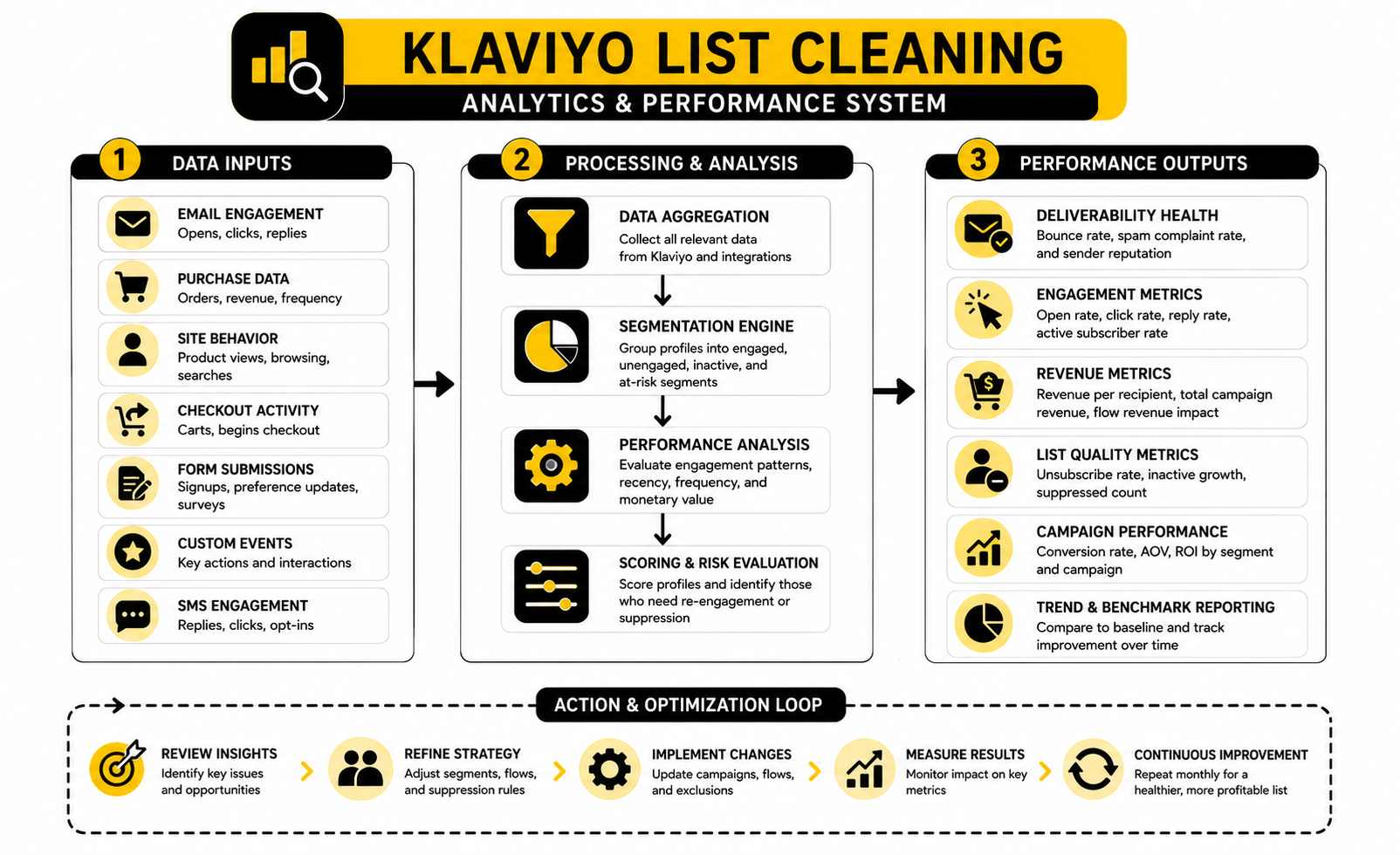
Watch Revenue Per Recipient Closely
Revenue per recipient is one of the most useful metrics for Klaviyo list cleaning because it connects audience quality to money. Total campaign revenue can be misleading when send volume changes. Revenue per recipient helps you see whether the people receiving the email are actually worth sending to.
If total revenue drops slightly after cleaning but revenue per recipient rises, that is not automatically bad. It may mean the account stopped spending impressions on people who were unlikely to buy. The cleaner audience is producing more value per send, which is usually healthier than chasing reach for its own sake.
The opposite pattern is a warning. If you keep expanding send volume and revenue per recipient falls, the added audience may be lower quality. That does not mean you should never send broader campaigns, but it does mean broader sending needs a clear reason, tighter monitoring, and stronger exclusions.
Use Click Rate to Judge Intent
Open rate has become harder to interpret because privacy features can inflate or distort opens. Apple’s Mail Privacy Protection changed how many marketers read open data, so opens are still useful but should not be treated as perfect proof of intent. Clicks are usually a stronger signal because they show that someone took an active step.
For Klaviyo list cleaning, click behavior should carry more weight than opens alone. Someone who clicked recently is showing clearer interest than someone whose profile only has opens. A subscriber who opened but never clicked, never viewed a product, and never purchased may still need a softer classification than someone with no engagement at all, but the distinction matters.
This is why the best cleaning segments use multiple behaviors. Clicks, purchases, checkout activity, product views, site activity, and email engagement all help build a more accurate picture. The more meaningful the behavior, the more confidence you can have before keeping that profile in campaign audiences.
Measure Complaints and Unsubscribes as Feedback
Unsubscribes are not always bad. A normal unsubscribe is a clean exit. It tells you someone does not want the emails anymore, and it is far better than a spam complaint.
Complaints are different. When someone reports spam, they are not just leaving the list. They are sending a negative reputation signal to the mailbox provider. Yahoo’s sender best practices recommend removing invalid recipients promptly, sending reconfirmation emails to inactive subscribers periodically, and using complaint feedback loops to maintain a clean mailing list Yahoo’s sender best practices.
This is why list cleaning should make unsubscribing easy and suppression logic strict. If someone wants out, let them out. If someone has ignored you for long enough that they are more likely to complain than buy, stop treating them like a normal campaign recipient.
Compare Campaigns Before and After Cleaning
A proper Klaviyo list cleaning project should have a before-and-after view. Before cleaning, record your baseline for campaign volume, open rate, click rate, conversion rate, revenue per recipient, unsubscribe rate, spam complaint rate, bounce rate, and active profile count. After cleaning, compare those same metrics over several sends instead of judging one campaign in isolation.
One send can be noisy. A weak offer, holiday timing, product availability, or creative change can distort the result. A trend across several campaigns gives you a more reliable read.
The goal is not perfection. The goal is cleaner signal. If complaint and bounce risk goes down, engagement becomes easier to read, and revenue per recipient stabilizes or improves, the cleaning process is doing its job.
Build a Simple Klaviyo List Health Dashboard
You do not need an overbuilt analytics setup to manage list hygiene. You need a simple view that shows whether the account is getting healthier or dirtier over time. The dashboard should help you make decisions quickly.
Track these metrics monthly:
This dashboard becomes more useful when you review it against acquisition sources. If engaged subscribers are growing from checkout opt-ins but unengaged profiles are growing from a giveaway, the answer is obvious. Do more of what attracts buyers and less of what attracts dead weight.
Know Which Numbers Should Trigger Action
Measurement is only useful when it creates decisions. If spam complaints rise, tighten campaign audiences and inspect the segments that generated the complaints. If bounces rise, review recent imports, forms, and list sources. If click rate falls while open rate stays flat, the issue may be message relevance, offer strength, or audience fatigue.
If revenue per recipient falls after expanding the audience, pull back and compare engaged versus unengaged performance. If unsubscribes rise after increasing send frequency, review cadence before assuming the offer is the problem. If the sunset flow saves very few subscribers, that may not mean the flow failed. It may mean those people were already gone.
The strongest Klaviyo list cleaning systems are calm and mechanical. They do not wait for a crisis. They watch the numbers, interpret what changed, and adjust the audience before the account gets damaged.
Professional Implementation and Ongoing Maintenance
Professional Klaviyo list cleaning is where the simple rules meet real business tradeoffs. It is easy to say “remove inactive subscribers.” It is harder to decide what inactive means when you have seasonal buyers, high-ticket products, wholesale customers, gift purchasers, and people who only buy during major launches.
That is why mature implementation needs more than a suppression segment. It needs a governance system. The brand should know who gets emailed, who gets excluded, who gets re-engaged, who gets suppressed, and who should be protected because their customer value is higher than their recent email activity suggests.
The practical goal is control. You want the account clean enough to protect deliverability, but not so aggressive that you remove valuable customers too early. Strong Klaviyo list cleaning lives in that balance.
Do Not Treat Every Inactive Profile the Same
The biggest advanced mistake is using one inactivity rule for every profile. A person who has never bought, never clicked, and never opened is clearly different from a customer who bought three times and has been quiet for a few months. Both may be inactive, but they do not deserve the same next step.
Past buyers should usually be handled with more nuance. Their purchase history, average order value, product category, replenishment timing, and seasonality should influence how quickly they enter a sunset path. A customer who buys a mattress, appliance, premium jacket, or annual subscription does not behave like someone buying skincare refills every month.
This is why a serious cleaning process separates non-buyers, first-time buyers, repeat buyers, VIP customers, and lapsed customers. The email engagement window still matters, but customer value changes the decision. In practice, that means some subscribers move quickly to suppression while others move into slower winback or education paths before you stop marketing to them.
Protect High-Intent Behavior From Over-Cleaning
Email engagement is useful, but it is not the only form of intent. A subscriber may not click campaigns often, but they may browse products, start checkout, submit forms, or purchase through other channels. If your Klaviyo list cleaning process ignores those behaviors, it can become too aggressive.
This matters because Klaviyo profiles can contain more than email activity. Site behavior, checkout activity, order history, SMS consent, form submissions, and custom events can all change how you interpret inactivity. A profile that has not clicked an email recently but viewed products this week should not be treated like a dead lead.
The safest approach is to build suppression logic around multiple signals. Do not use “has not opened” as the only rule. Combine email inactivity with no recent purchases, no recent site behavior, no checkout activity, and no meaningful events before moving someone out of regular marketing.
Use Suppression Before Deletion in Most Cases
Suppression and deletion are not the same thing. Suppression stops marketing sends to a profile. Deletion removes the profile data from the account, which can affect history, reporting, segmentation, and future customer context.
For most Klaviyo list cleaning work, suppression is the cleaner default. Klaviyo’s own list cleaning guidance focuses on identifying unengaged contacts, excluding them from sends, and suppressing profiles that never engage rather than treating deletion as the first move Klaviyo’s list cleaning guidance. That keeps the account safer without throwing away useful context.
Deletion may still make sense in some cases, especially for data minimization, privacy requests, duplicate cleanup, or records that have no meaningful value. But it should be intentional. Do not delete profiles just because a list looks large.
Make Acquisition Quality Part of the Cleaning Strategy
List cleaning will never work if low-quality acquisition keeps feeding the account. You can suppress thousands of inactive profiles and still be back in trouble if the next giveaway, poorly targeted popup, or imported list adds the same problem again. Hygiene has to start before the profile enters Klaviyo.
This is where signup intent matters. A customer who opts in during checkout has a different relationship with the brand than someone who joined only for a sweepstakes. A visitor who signs up for a specific product drop is different from someone who came through a broad lead magnet with weak buying intent.
Review each acquisition source by downstream engagement, not just raw subscriber volume. If a form produces a lot of addresses but very few clicks, orders, or repeat interactions, the form is not “growing the list” in a useful way. It is creating future cleanup work.
Be Careful With Imports and Legacy Lists
Old lists are dangerous because they often look like opportunity. Someone finds a CSV from a past platform, wholesale event, contest, or retail campaign and wants to upload it into Klaviyo. On paper, that can look like instant audience growth.
In reality, old or poorly sourced imports can create hard bounces, spam complaints, and low engagement fast. Klaviyo’s deliverability best practices warn against purchasing or renting lists and recommend organic acquisition and double opt-in to reduce unengaged or invalid profiles Klaviyo’s deliverability best practices. That guidance is especially important when a list has unclear consent or no recent relationship with the brand.
If a legacy list is legitimate, warm it carefully. Segment it by source, age, and customer status. Send a permission-based reconfirmation or very small reactivation campaign before treating those profiles like normal subscribers.
Scale Cleaning Rules as Send Volume Grows
A small brand can sometimes get away with loose list hygiene for longer because the volume is lower. As send volume grows, mistakes get louder. More sends mean more opportunities for complaints, bounces, disengagement, and mailbox provider scrutiny.
Google’s bulk sender requirements apply additional expectations when senders reach large daily volumes to Gmail accounts, including authentication, easy unsubscribe, and low spam rates Google’s email sender guidelines FAQ. That should influence how ecommerce teams think about growth. Scaling email is not just sending more campaigns. It is tightening the operating system behind those campaigns.
As volume increases, segmentation should become stricter, not looser. Engaged audiences can receive regular campaigns. Moderately inactive profiles should receive selective campaigns or lifecycle-specific messages. Long-term inactive profiles should not be part of normal promotional sends.
Build Different Rules for Campaigns and Flows
Campaigns and flows should not always follow the same cleaning logic. Campaigns are usually broader and easier to over-send. Flows are behavior-triggered, which means the recipient often has a more recent reason to receive the message.
For example, a subscriber who is excluded from regular campaigns may still deserve an abandoned checkout email if they just started checkout. A lapsed customer may not belong in weekly promos, but they may belong in a carefully timed replenishment or winback flow. The distinction matters because intent changes quickly when someone takes a fresh action.
This is why Klaviyo list cleaning should focus on access levels. Some profiles should receive all relevant campaigns and flows. Some should receive only behavior-triggered flows. Some should receive only re-engagement messages. Some should receive no marketing at all.
Keep SMS and Email Consent Separate
Many ecommerce brands use both email and SMS, but consent should never be blurred. A profile may be suppressed from email while still having valid SMS consent, or the reverse. Klaviyo list cleaning should respect each channel separately.
This matters for both compliance and performance. Email inactivity does not automatically mean SMS inactivity. SMS engagement does not automatically justify continued email sends. Each channel has its own permission, expectations, fatigue risk, and measurement.
A good account structure makes those differences clear. Email suppression should not accidentally remove people from SMS unless that is the intended action. Channel-specific hygiene keeps the customer experience cleaner and avoids unnecessary loss of reachable audience.
Document the Rules So the Team Does Not Break Them
The more people touch the Klaviyo account, the more important documentation becomes. If one person builds the cleaning system but another person sends campaigns without using the right exclusions, the system fails. This is not a technical problem. It is an operating problem.
Document the main segments, exclusion rules, sunset flow logic, suppression criteria, import policy, and monthly review process. Keep the language plain enough that a marketer, founder, assistant, or agency partner can understand it. The point is not to create a beautiful internal wiki. The point is to prevent accidental damage.
This is especially important during sales periods. Black Friday, product launches, and seasonal campaigns create pressure to “just send to everyone.” A documented list cleaning policy makes it easier to protect the account when short-term revenue pressure is high.
Use Re-Engagement Sparingly
Re-engagement is useful, but it should not become a loophole for constantly emailing people who have already ignored the brand. A sunset flow is a final check, not a second newsletter. If someone does not respond, respect the signal.
Klaviyo’s sunset flow guidance frames the sequence as a final attempt before suppressing inactive profiles that do not respond Klaviyo’s sunset flow guidance. That is the right mindset. The goal is to identify people who still want the emails, not to pressure everyone back onto the main list.
Keep re-engagement direct and limited. Ask for a click, preference update, purchase, or other meaningful action. If they do nothing, suppress them and move on.
Know When to Slow Down Sending
Sometimes the right advanced move is not a bigger cleanup. It is slower sending. If spam complaints, bounce issues, or engagement drops appear suddenly, aggressive campaign volume can make the problem worse.
Yahoo’s sender best practices recommend monitoring hard and soft bounces, removing invalid recipients promptly, considering reconfirmation for inactive subscribers, and using complaint feedback loops to maintain a clean list Yahoo’s sender best practices. That is a reminder that list hygiene and sending cadence work together. You cannot clean the list once and then keep sending carelessly.
If the account shows warning signs, narrow sends to the most engaged segments first. Fix authentication, review acquisition sources, suppress obvious risk, and rebuild from a healthier audience. Deliverability recovery is usually easier when you stop adding pressure to the system.
Treat List Cleaning as a Revenue Discipline
The best teams do not see Klaviyo list cleaning as housekeeping. They see it as revenue discipline. They know that a clean audience makes every campaign easier to read, every flow more precise, and every deliverability decision less emotional.
That discipline becomes more valuable as the account grows. A small amount of list decay is normal. Unchecked decay is not. The difference is whether the brand has a system that catches inactive, risky, and low-intent profiles before they damage performance.
At this stage, the framework is complete: understand why cleaning matters, build the process, measure the right signals, and manage the tradeoffs with care. The final step is turning that into clear answers and a practical checklist the team can actually use.
Klaviyo List Cleaning FAQs and Final Checklist
By this point, the full system is clear. Klaviyo list cleaning is not one button, one segment, or one panic cleanup after deliverability drops. It is a repeatable operating system for deciding who should receive regular marketing, who should be re-engaged, who should be suppressed, and who should be protected because their behavior still shows value.
The best version of this system connects acquisition, segmentation, campaign exclusions, sunset flows, suppression, and monthly reporting. Each part supports the next. Clean acquisition reduces future decay, clean segmentation improves send quality, clean reporting makes decisions easier, and clean suppression protects the account from long-term risk.
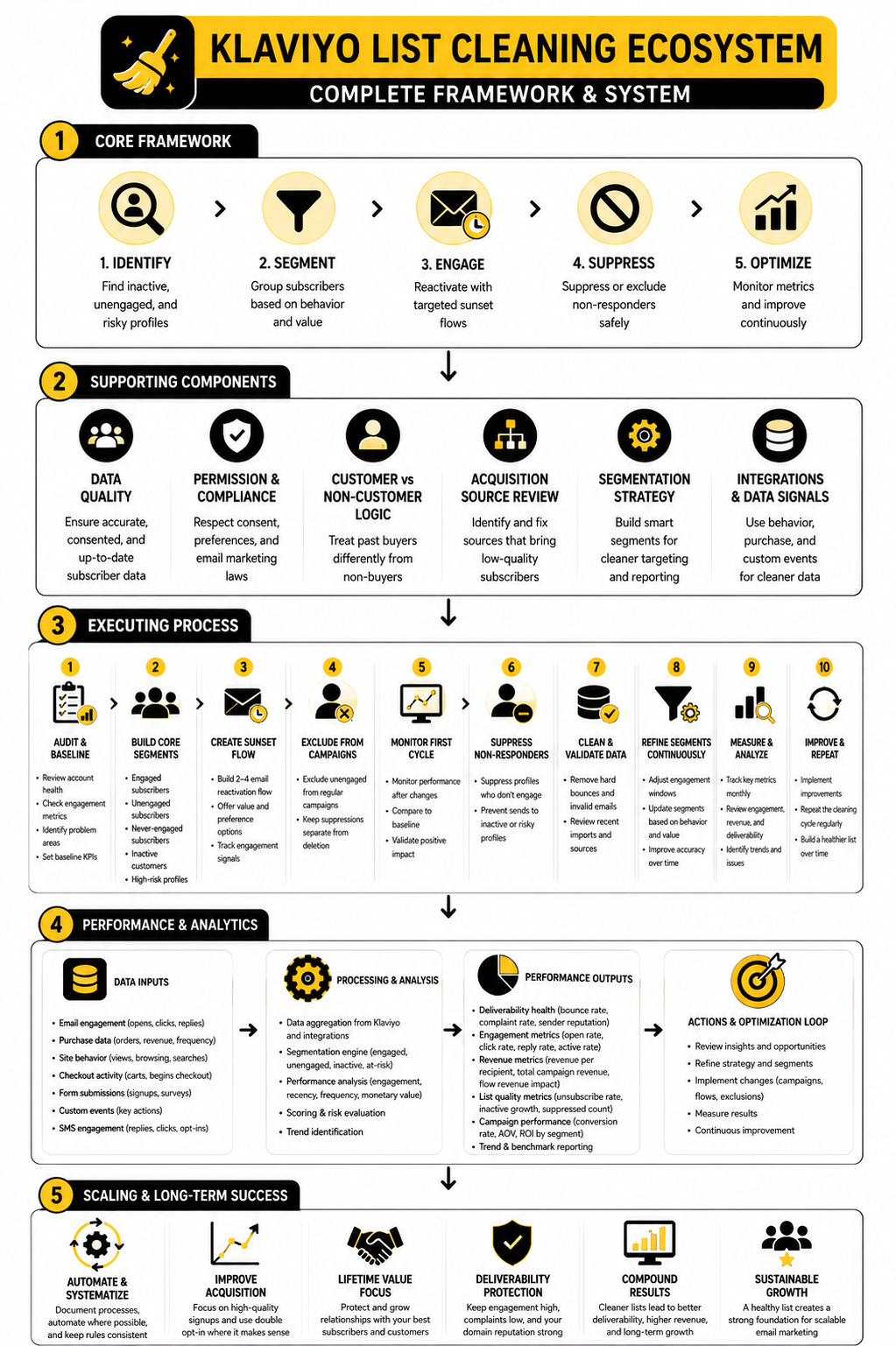
Before the final FAQ, here is the practical closeout checklist. Use it as a plain-English review before making large changes inside Klaviyo.
What is Klaviyo list cleaning?
Klaviyo list cleaning is the process of identifying inactive, risky, invalid, or low-intent profiles and removing them from regular marketing sends. In most cases, that means excluding them from campaigns, sending them through a sunset flow, and suppressing them if they do not re-engage. The goal is not to shrink the list for the sake of it, but to protect deliverability, reduce wasted sending, and make campaign performance easier to trust.
How often should I clean my Klaviyo list?
Most brands should review list health monthly and run deeper cleanup work quarterly. Monthly reviews help catch rising bounces, spam complaints, inactive growth, and weak acquisition sources before they become serious. Quarterly reviews are useful for refining segments, checking sunset flow performance, and adjusting engagement windows based on buying cycles.
Should I delete or suppress inactive Klaviyo profiles?
In most cases, suppression is safer than deletion. Suppression stops a profile from receiving marketing emails while keeping useful profile history, purchase data, and segmentation context inside Klaviyo. Deletion should be reserved for situations where profile data truly has no value, where privacy or data minimization rules require it, or where duplicate and junk records need to be removed intentionally.
What is the difference between an unengaged profile and a never-engaged profile?
An unengaged profile had some relationship with your brand but has stopped showing recent activity. A never-engaged profile joined the list but never opened, clicked, purchased, viewed products, or showed meaningful intent. Never-engaged profiles are usually riskier because there is no evidence that they ever wanted ongoing communication beyond the original signup.
What should count as engagement in Klaviyo?
Engagement should include more than opens alone. Clicks, purchases, checkout starts, product views, site activity, form submissions, and meaningful custom events can all show intent. Opens can still be useful, but privacy features and automated opens make them less reliable as the only cleaning signal.
How long should I wait before suppressing inactive subscribers?
The right window depends on your business model, product category, and send frequency. A brand with short purchase cycles and frequent campaigns can usually act faster than a brand selling high-ticket or seasonal products. A practical approach is to first exclude inactive subscribers from regular campaigns, send them through a sunset flow, and only suppress them after they ignore that final re-engagement sequence.
Will Klaviyo list cleaning lower my revenue?
It can lower total campaign revenue temporarily if you were sending to a very large audience, but that does not mean the cleanup failed. The better question is whether revenue per recipient, click rate, complaint rate, bounce rate, and engaged subscriber quality improve after cleaning. A smaller audience that produces cleaner engagement and safer deliverability is usually more valuable than a larger audience that quietly damages the account.
Can I still email inactive customers?
Yes, but they should not be treated the same as inactive non-buyers. Past customers may deserve a longer evaluation window, a customer-specific winback flow, replenishment messaging, or product education before suppression. The more customer value someone has shown, the more careful you should be before removing them from all marketing paths.
Should sunset flows include discounts?
They can, but discounts should not be the default answer. A sunset flow is primarily an intent check, not a normal promotional campaign. In many cases, a direct “do you still want to hear from us?” message, preference update, or simple reason to stay subscribed is cleaner than training inactive subscribers to wait for bigger discounts.
Why did my list size drop after cleaning?
Your reachable list size dropped because profiles that were not helping the email program were moved out of regular marketing. That can feel uncomfortable, especially if the list count was treated as a growth metric. But list size without engagement is vanity. A healthier sending audience gives you better deliverability signals, cleaner reporting, and stronger long-term control.
What metrics should I watch after Klaviyo list cleaning?
Watch spam complaint rate, bounce rate, unsubscribe rate, click rate, revenue per recipient, conversion rate, engaged subscriber count, suppressed profile count, and campaign performance by segment. Do not judge the cleanup from one campaign. Review several sends so you can separate normal campaign variation from real list-health changes.
Can list cleaning fix deliverability problems immediately?
Sometimes it helps quickly, but deliverability recovery is not always instant. If mailbox providers have already seen weeks or months of poor engagement, high complaints, or poor list quality, reputation can take time to rebuild. The safest path is to narrow sending to engaged segments, suppress obvious risk, fix authentication and acquisition issues, and gradually rebuild trust through consistent recipient behavior.
Does Klaviyo list cleaning affect flows?
It can, depending on how your exclusions and suppression rules are built. Some inactive profiles should stop receiving normal campaigns but may still qualify for behavior-triggered flows if they take a fresh action, like starting checkout or viewing a product. This is why campaign rules and flow rules should be designed separately instead of using one blunt exclusion everywhere.
Should I use double opt-in?
Double opt-in can improve list quality because subscribers confirm that they really want to join. It may reduce raw signup volume, but the people who make it through are often cleaner and more intentional. For brands dealing with fake signups, giveaway abuse, or weak engagement from forms, double opt-in is worth testing.
What is the biggest Klaviyo list cleaning mistake?
The biggest mistake is waiting until deliverability is already damaged. The second biggest mistake is cleaning too aggressively without separating customer value, buying cycle, and real intent. Good list cleaning is firm, but it is not careless. It removes risk while protecting the subscribers and customers who still matter.
Build a stronger local presence with BAAM AI
Turn your website, Google profile, social channels, and AI visibility into one growth engine
Most businesses do not need more random marketing activity. They need a consistent presence system that helps the right people find them, trust them, and take action. BAAM AI brings strategy, local SEO, website updates, Google Maps visibility, social content, AI-search readiness, media production, and reporting into one practical monthly engine.
If you want your marketing to keep working after the campaign ends, start with a free BAAM AI presence audit. See how your business shows up today and where the fastest visibility wins are at BAAM AI.