
BAAM AI Blog
Klaviyo Deliverability: The Practical Guide To Getting More Emails Into The Inbox
Klaviyo deliverability is not one setting, one DNS record, or one “warm-up hack.” It is the combined result of your sending domain, authentication, list quality, engagement, campaign behavior, content, and how...
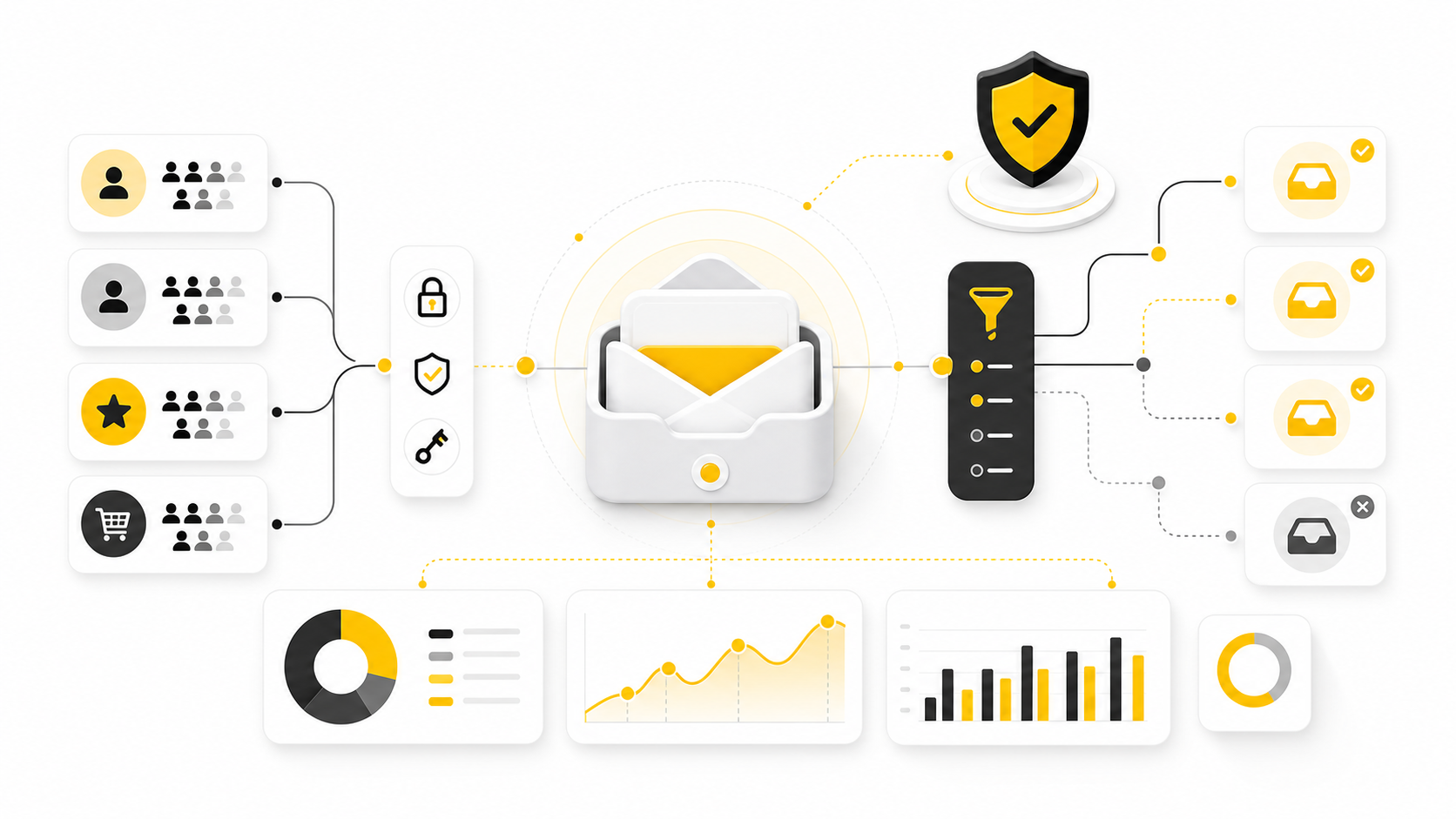
Klaviyo deliverability is not one setting, one DNS record, or one “warm-up hack.” It is the combined result of your sending domain, authentication, list quality, engagement, campaign behavior, content, and how mailbox providers interpret your reputation over time.
That matters because inbox providers have become stricter. Gmail now tells bulk senders to keep user-reported spam rates below 0.1% and avoid reaching 0.3% or higher, while also requiring proper authentication and easy unsubscribe for high-volume senders. Yahoo’s sender guidance also focuses on authenticated mail, low complaints, and clear unsubscribe paths. In other words, deliverability is no longer something you fix after Black Friday goes badly. It is infrastructure.
For Klaviyo users, the good news is that the platform gives you a strong base: branded sending domains, deliverability reporting, guided warming, suppression tools, segmentation, flows, and campaign-level diagnostics. The bad news is that none of those features save a messy sender. If you email everyone, ignore engagement, skip DNS setup, and treat every campaign like a revenue emergency, Klaviyo will not magically protect your inbox placement.
This guide breaks Klaviyo deliverability into a simple operating system. We will cover the technical setup first, then the sending behavior that determines whether Gmail, Yahoo, Outlook, and Apple Mail continue trusting you. The goal is practical: fewer spam-folder surprises, cleaner reporting, stronger campaign performance, and a Klaviyo account that can scale without constantly fighting reputation problems.
Why Klaviyo Deliverability Matters
Deliverability is the difference between “Klaviyo sent the email” and “the customer actually had a fair chance to see it.” Delivery only means the message was accepted by the receiving server. Deliverability is about where that message lands: primary inbox, promotions tab, updates tab, spam folder, or nowhere useful at all.
That distinction is important because ecommerce brands often misread the problem. They see a campaign marked as delivered, assume the email channel is healthy, and then blame subject lines or discounts when revenue drops. In reality, inbox placement may already be weakening because mailbox providers are seeing lower engagement, higher complaints, too many inactive recipients, or authentication gaps.
Klaviyo deliverability also affects more than campaigns. If your sender reputation gets damaged, your welcome flow, abandoned cart flow, browse abandonment flow, replenishment flow, and post-purchase emails can all suffer. That is where the pain gets real, because flows are usually the highest-intent emails in the account.
The rules have tightened because inbox providers are defending users from abuse. Google’s sender guidance now places heavy emphasis on authentication, low spam complaints, and easy unsubscribing for bulk senders. Klaviyo’s own deliverability resources also push brands toward branded sending domains, list cleaning, engaged sending, and active monitoring through the Deliverability hub.
The Klaviyo Deliverability Framework
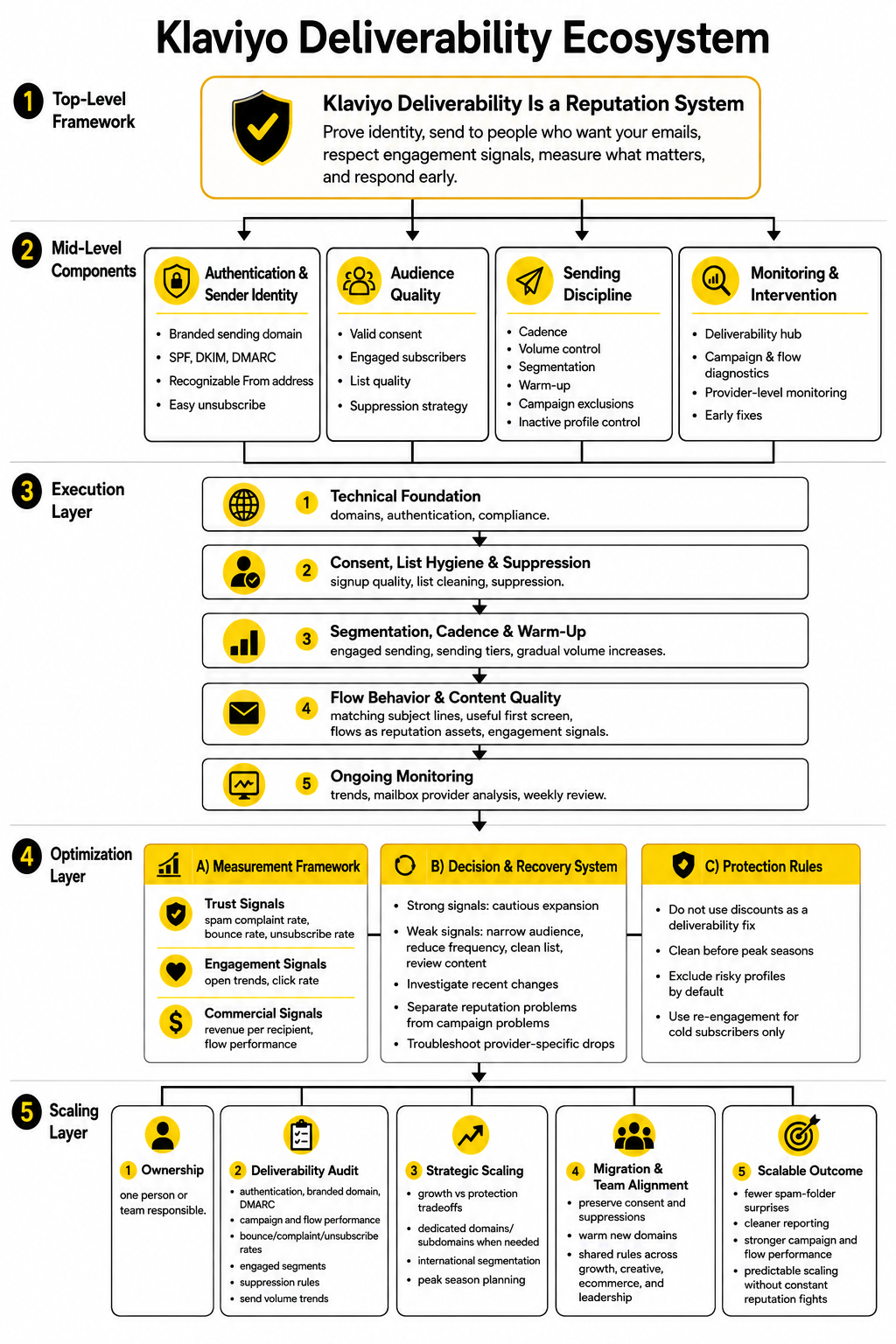
Klaviyo deliverability works best when you stop treating it as a technical checklist and start treating it as a reputation system. Mailbox providers do not evaluate your brand based on one campaign. They evaluate patterns: who you send to, how those people respond, whether your domain is authenticated, how often people complain, and whether your volume changes look normal.
A useful framework has four layers. First, your infrastructure must prove that your email is legitimate. Second, your list must prove that people actually asked to hear from you. Third, your sending behavior must prove that you respect attention. Fourth, your reporting process must catch problems before they become expensive.
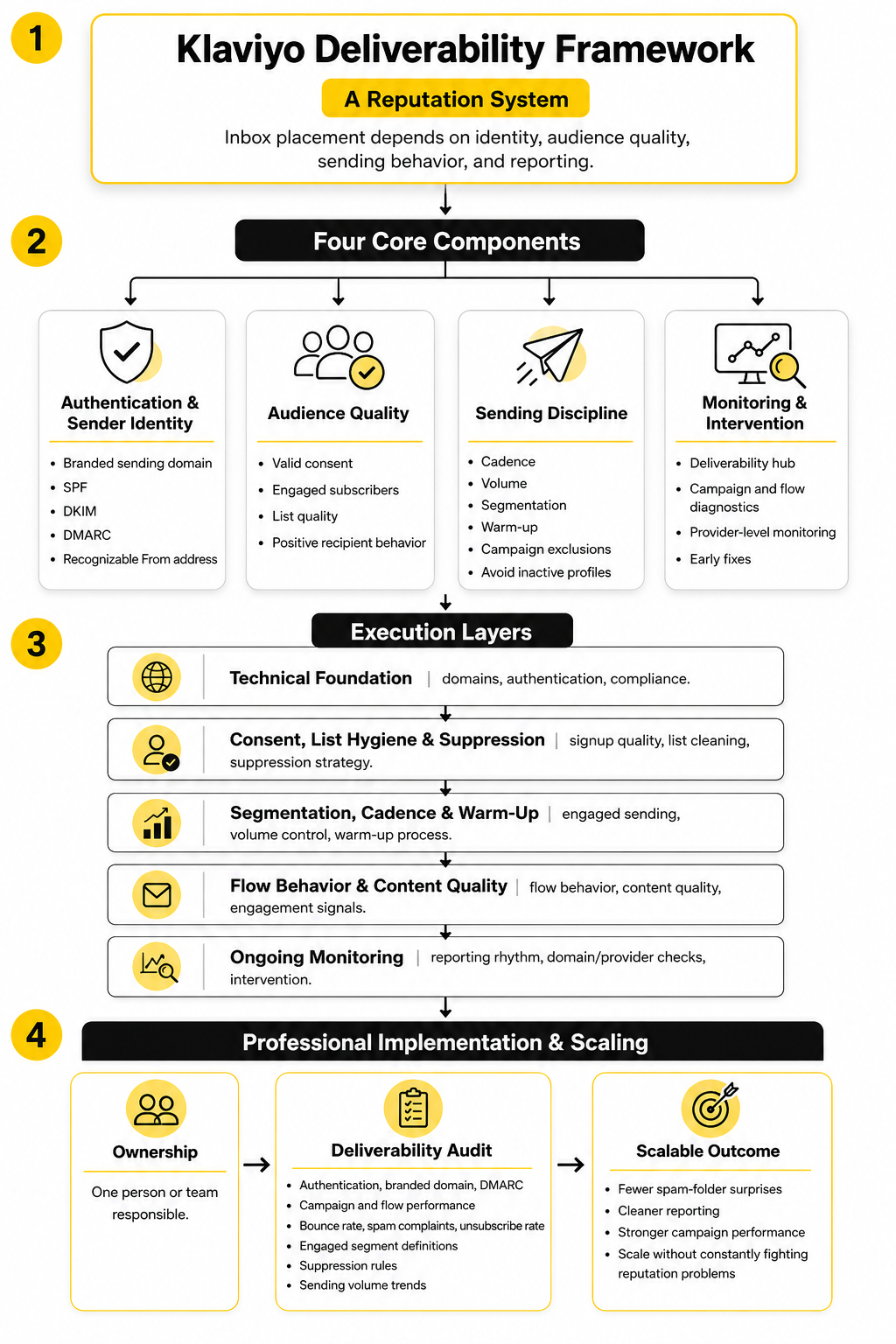
The simplest way to think about it is this: Klaviyo gives you the sending engine, but your brand creates the reputation. A branded sending domain can help you build your own identity instead of relying on shared defaults. Segmentation can protect you from emailing cold subscribers. Suppression rules can remove profiles that are no longer helping. Reporting can show when Gmail, Yahoo, Outlook, or another mailbox provider starts pushing back.
This is also why quick fixes are usually disappointing. Changing a subject line will not repair a damaged domain. Resending to non-openers will not solve list fatigue. Adding more campaigns will not fix weak consent. Strong Klaviyo deliverability comes from making the whole system cleaner, not from squeezing one more send out of a tired audience.
The Four Core Components
The first component is authentication and sender identity. This includes your branded sending domain, SPF, DKIM, DMARC, alignment, and the visible From address your subscribers recognize. Klaviyo’s help center explains that a branded sending domain lets emails appear to come from your brand rather than Klaviyo’s default sending infrastructure, which is an important step for reputation ownership.
The second component is audience quality. Inbox providers care how recipients behave after your email arrives. If people open, click, reply, move messages out of spam, and continue engaging, that helps. If they ignore you, delete without reading, unsubscribe in frustration, or hit spam, that hurts.
The third component is sending discipline. This includes cadence, volume, segmentation, warm-up, campaign exclusions, and how aggressively you email inactive profiles. Klaviyo’s list cleaning guidance recommends excluding unengaged segments from regular campaigns and suppressing profiles that have never engaged, which is a practical way to reduce negative signals before they stack up.
The fourth component is monitoring and intervention. Klaviyo’s Deliverability hub gives account-level visibility into sender health, while the deliverability tab in campaigns and flows helps identify weak performance by domain and geography. That matters because deliverability problems rarely hit every mailbox provider equally at the same time. Gmail can be struggling while Yahoo looks fine, or Outlook can start soft-bouncing while Apple Mail still appears stable.
Professional Implementation Starts With Ownership
Professional Klaviyo deliverability is not about randomly installing tools or copying someone else’s DNS records. It starts with ownership: one person or team needs to be responsible for the sending domain, the Klaviyo account, the suppression strategy, the campaign calendar, and the reporting rhythm. Without that ownership, deliverability becomes everyone’s problem and nobody’s job.
A good implementation also separates urgent revenue pressure from sender reputation decisions. There will always be a reason to send one more campaign. There will always be a holiday, a launch, a slow sales week, or leftover inventory. The discipline is knowing when another send helps revenue and when it quietly taxes your future inbox placement.
For most brands, the first professional move is a full Klaviyo deliverability audit. That means checking authentication, branded domain status, DMARC, recent campaign performance, flow performance, bounce rates, spam complaints, unsubscribe rates, engaged segment definitions, suppression rules, and sending volume trends. Only after that should you change cadence, rebuild flows, or warm a domain.
The rest of this guide will walk through that system in order. We will start with the technical foundation because it sets the trust layer for everything else. Then we will move into the parts that usually determine long-term performance: consent, list hygiene, segmentation, sending cadence, flow behavior, content quality, and ongoing monitoring.
Technical Setup: Domains, Authentication, And Compliance
The technical side of Klaviyo deliverability is not glamorous, but it decides whether mailbox providers can trust that your emails are really coming from you. Before Gmail, Yahoo, Outlook, or Apple Mail even think about engagement, they look at identity. If your setup is loose, inconsistent, or partially authenticated, you are asking inbox providers to trust a sender that has not properly introduced itself.
This is where many brands make the first mistake. They assume that because Klaviyo can send email, the domain setup is automatically handled. Klaviyo gives you the tools, but your DNS, From address, sending domain, authentication records, and compliance setup still need to be configured correctly.
A clean technical foundation does not guarantee perfect inbox placement. Nothing does. But a weak foundation makes every other deliverability effort harder, because even good content and strong engagement are fighting against preventable trust issues.
Set Up A Branded Sending Domain
A branded sending domain is one of the first serious steps in Klaviyo deliverability. Instead of sending through Klaviyo’s default shared sending setup, your emails are associated with your own brand domain. That helps mailbox providers connect your sending behavior to your business instead of treating you like a generic sender.
In Klaviyo, this usually means creating DNS records with your domain provider and verifying them inside your Klaviyo account. Once verified and applied, your sending identity becomes more consistent across campaigns and flows. That consistency matters because reputation builds over time, not from one isolated send.
Do not rush this step five minutes before a big campaign. A branded sending domain should be configured, verified, monitored, and warmed before you depend on it for serious revenue. If you switch infrastructure right before a launch or seasonal push, mailbox providers may see a sudden change in sending identity and volume at the same time, which is exactly the kind of pattern you want to avoid.
Understand SPF, DKIM, And DMARC
SPF, DKIM, and DMARC are the core authentication layers behind modern email trust. SPF helps receiving servers check whether a mail server is allowed to send on behalf of a domain. DKIM adds a cryptographic signature that proves the message was not altered and connects it back to the signing domain. DMARC tells mailbox providers what to do when authentication fails and helps align the visible From domain with authenticated sending.
For Klaviyo deliverability, the key is not just having these records somewhere in DNS. They need to be correct, aligned, and connected to the domain your subscribers actually see. A brand can technically “pass” one check while still creating alignment problems if the visible From domain and the authenticated domain do not match cleanly enough.
This matters more now because major mailbox providers have formalized stricter requirements for bulk senders. Gmail’s sender rules say bulk senders should keep user-reported spam rates below 0.1% and avoid reaching 0.3% or higher, while also meeting authentication and unsubscribe requirements through its email sender guidelines. Those numbers are small for a reason. Complaints are one of the clearest signals that recipients did not want, expect, or value the email.
Use A Recognizable From Address
Your From address is not just a branding detail. It is part of the trust signal. Subscribers should instantly recognize who is emailing them, especially when they are scanning a crowded inbox on mobile.
Avoid strange sender names, vague brand variations, and throwaway-looking addresses. A simple structure like your brand name, or a humanized version that still clearly includes the brand, usually works better than trying to be clever. The goal is recognition, not novelty.
The domain behind the From address should also match the broader sending setup. If your store is built around one brand domain, your Klaviyo emails should not look like they are coming from a disconnected or suspicious domain. Consistency helps subscribers trust the message, and subscriber behavior feeds directly into inbox provider decisions.
Configure DMARC Before You Need It
DMARC is often treated like an advanced deliverability task, but it should be part of the early setup. At minimum, a DMARC record gives receiving servers a policy for unauthenticated mail and can provide reporting that helps you understand who is sending on behalf of your domain. Over time, that visibility becomes important because many brands have more sending systems than they realize.
For example, your ecommerce emails may come from Klaviyo, transactional receipts may come from your store platform, support messages may come from a helpdesk, and internal team mail may come from Google Workspace or Microsoft 365. If those systems are not accounted for, tightening DMARC later can break legitimate mail. That is why the right approach is careful and staged.
Start with visibility, fix authentication gaps, then move toward stronger enforcement only when you understand your mail streams. Do not blindly copy a strict DMARC policy from another brand. Their sending stack is not your sending stack, and a policy that protects one domain can disrupt another if the groundwork is different.
Make Unsubscribing Easy
Easy unsubscribe is not a weakness. It is a deliverability protection mechanism. When people cannot quickly leave your list, they often take the faster route and hit the spam button, which is far worse for your sender reputation.
Klaviyo gives you unsubscribe options inside email templates, and you should use them clearly. Do not hide unsubscribe links in tiny text, bury them behind confusing wording, or make the preference process feel like a trap. A clean unsubscribe is better than a complaint every single time.
This is especially important for high-volume senders because Gmail and Yahoo have pushed easy unsubscribe into the compliance layer, not just the user experience layer. If someone no longer wants your emails, your job is to let them leave without friction. That sounds simple, but plenty of brands still damage deliverability by treating every unsubscribe like a personal insult.
List Quality, Consent, And Suppression Strategy
Once the technical setup is in place, list quality becomes the next major lever. Klaviyo deliverability is heavily shaped by who you send to, how those people got on your list, and whether they still care. A clean domain cannot carry a dirty audience forever.
This is the part many ecommerce brands resist because list size feels like an asset. In reality, an email list is only valuable when it contains people who gave valid consent and continue showing some level of interest. A large list full of cold, scraped, mistyped, or disengaged contacts is not an asset. It is drag.
The practical mindset is simple: every campaign teaches mailbox providers something about your sender reputation. When you send to people who want your emails, you create better signals. When you keep pushing to people who ignore or reject you, you train inbox providers to become less generous with your future sends.
Build Consent Into The Front End
Consent starts before a profile ever reaches Klaviyo. Your popup, embedded form, checkout opt-in, quiz, giveaway, landing page, or lead magnet sets the expectation for the relationship. If the signup moment is unclear, the deliverability problem shows up later as low engagement, unsubscribes, and complaints.
Make the offer specific. Tell people what they are signing up for, whether that is product drops, discounts, educational content, replenishment reminders, or brand updates. Vague language may increase form submissions in the short term, but it often creates weaker subscribers who do not remember why they joined.
Double opt-in can also be useful when list quality matters more than raw growth. It may reduce the number of profiles entering the list, but it helps confirm that the address is real and that the person actually wants to hear from you. For brands struggling with fake signups, spam traps, or low-quality giveaway leads, that tradeoff can be worth it.
Stop Treating Every Profile The Same
Not every subscriber deserves the same send frequency. Someone who clicked last week is not the same as someone who has ignored every campaign for nine months. Klaviyo makes this distinction easy with segments, but the account strategy has to actually use them.
Your engaged audience should get your regular campaigns. Your less engaged audience should get fewer, more selective sends. Your deeply unengaged audience should usually be excluded, moved into a re-engagement path, or suppressed if they never respond.
This is one of the cleanest ways to improve Klaviyo deliverability without changing your creative. You are not begging inbox providers for better placement. You are changing the recipient mix so your sends generate healthier signals in the first place.
Use Suppression Strategically
Suppression is not just for unsubscribes. It is a deliverability control layer. In Klaviyo, suppressed profiles are blocked from receiving marketing emails, which helps prevent repeated sending to people who have bounced, complained, unsubscribed, or become harmful to your sender reputation.
A smart suppression strategy removes profiles that are clearly not helping the account. That can include hard bounces, spam complaints, invalid addresses, and contacts who have never engaged after a meaningful period. The exact rules depend on your brand’s buying cycle, price point, and customer behavior, but the principle stays the same: do not keep paying to email people who are training inbox providers to ignore you.
Manual suppression should be handled carefully. You need to know why a profile is being suppressed and whether it should ever be reactivated. Suppressing inactive subscribers can protect deliverability, but suppressing the wrong profiles without documentation can create reporting confusion later.
Clean The List Before Peak Seasons
List cleaning is not something you do after deliverability collapses. It should happen before big sending periods, especially before Black Friday, Cyber Monday, major product launches, seasonal sales, and aggressive promotional calendars. If you wait until a revenue push is already live, you are cleaning while under pressure, and pressure usually leads to bad decisions.
The best time to clean is when there is still room to test and recover. Build unengaged segments, review recent campaign metrics, check bounce and complaint patterns, and exclude risky profiles before you ramp volume. That gives Klaviyo and mailbox providers a cleaner set of signals before the account starts sending harder.
This is also where discipline beats ego. A smaller engaged list often outperforms a larger exhausted one. If removing cold profiles hurts your pride but improves inbox placement, revenue per recipient, and long-term sender health, it is the right move.
Sending Strategy, Segmentation, And Warm-Up
After your technical setup and list quality are under control, the next question is simple: how do you actually send without damaging reputation? This is where Klaviyo deliverability becomes operational. You are no longer just configuring records or cleaning profiles. You are making weekly decisions about volume, audience selection, cadence, exclusions, and risk.
The biggest mistake is treating every campaign like an isolated event. Mailbox providers see the pattern. If you send carefully for two weeks and then blast every inactive profile during a sale, the pattern still counts. If you warm a domain properly and then immediately spike volume without engagement discipline, the warm-up work gets wasted.
A healthy sending strategy gives your strongest subscribers the most consistent attention and gives colder subscribers fewer chances to hurt your reputation. That does not mean you never email less engaged people. It means you do it deliberately, with a clear reason, a controlled segment, and a willingness to stop when the signals are bad.
Start With Your Most Engaged Segment
Your most engaged segment should be the safest audience in the account. These are people who recently opened, clicked, purchased, viewed products, started checkout, or otherwise showed active interest. When you are protecting Klaviyo deliverability, this group becomes the base layer for regular campaign sending.
The exact definition depends on your brand. A fast-moving apparel store might define engagement over 30, 60, or 90 days. A higher-consideration brand with a longer buying cycle may need a wider window. What matters is that the segment reflects real activity, not wishful thinking.
Do not build the engaged segment only around opens. Apple Mail Privacy Protection can inflate or blur open data, so clicks, purchases, site behavior, and zero-party data should matter too. Opens still have practical value, but they should not be the only signal deciding who gets regular campaigns.
Create Sending Tiers Instead Of One Giant List
A tiered sending model makes campaign decisions cleaner. Instead of asking, “Should we send this to everyone?” you ask, “Which tier deserves this message?” That one shift can prevent a lot of deliverability damage.
A simple tier structure might look like this:
This structure gives you control. Your regular campaigns go to the first tier or two. Bigger launches may include the third tier if recent performance supports it. Re-engagement campaigns stay separate, so a risky audience does not quietly contaminate the performance of your normal sends.
Warm New Sending Domains Gradually
When you move to a new branded sending domain, mailbox providers need time to learn whether that domain behaves like a trustworthy sender. Klaviyo’s own warming guidance is built around gradual volume increases, engaged audiences, and close performance monitoring during the transition. That is the right mindset: earn trust before you ask for scale.
A warm-up should begin with people most likely to engage. Sending first to your best subscribers gives the new domain a stronger opening pattern. From there, volume can expand in controlled steps as long as bounce rates, spam complaints, unsubscribes, and engagement remain healthy.
Do not warm a domain by blasting your full historical list. That is not warming. That is gambling. A proper warm-up is boring on purpose, because boring means predictable, and predictable is exactly what inbox providers prefer.
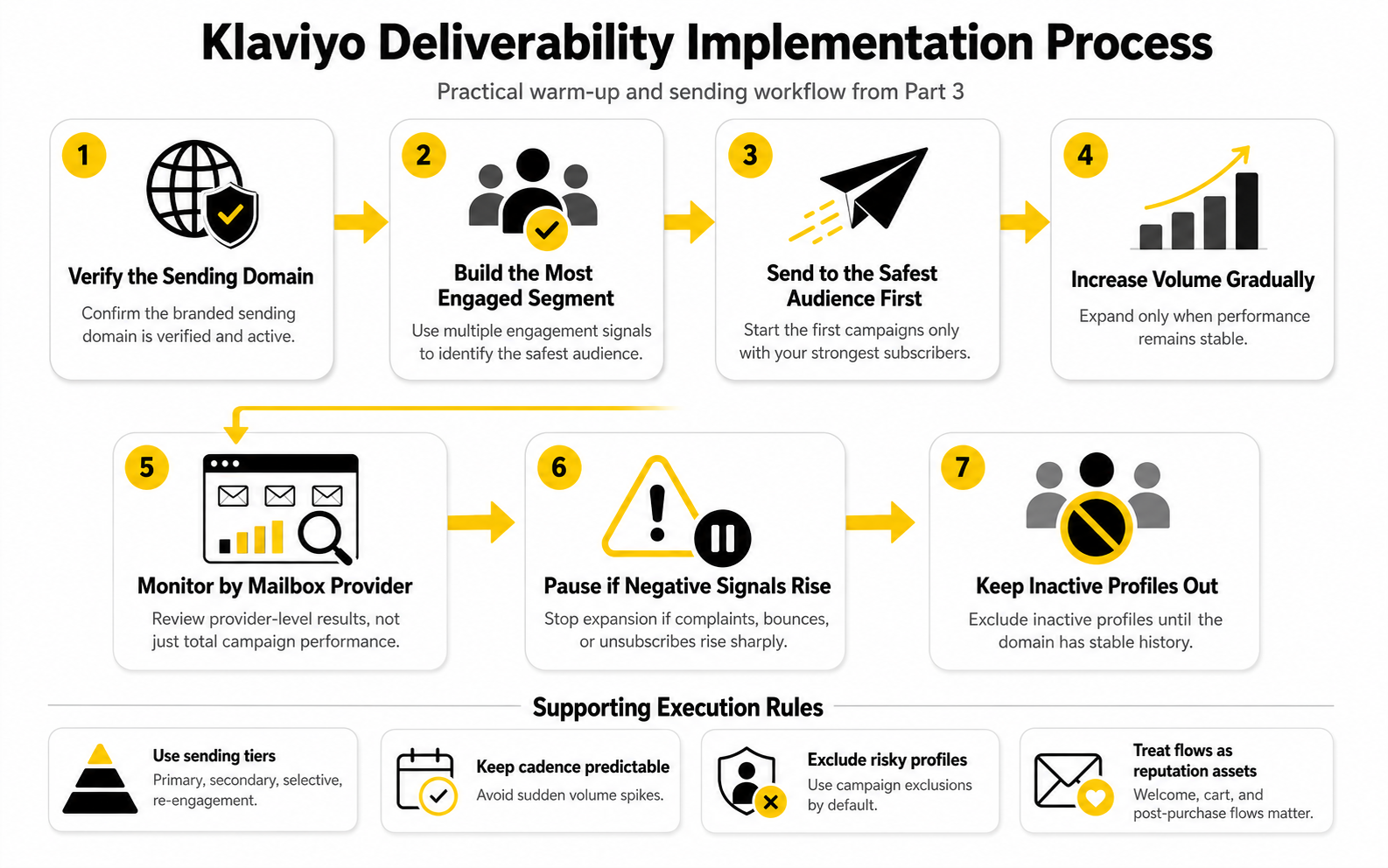
Use A Practical Warm-Up Process
The warm-up process should be documented before the first campaign goes out. If the team is deciding the audience five minutes before every send, the process will drift. Write the plan, define the segments, set the daily or campaign-level volume limits, and agree on the stop conditions.
A practical process looks like this:
The point is not to follow a universal volume chart blindly. The point is to react to your own data. A brand with strong engagement can usually scale more confidently than a brand moving from weak list quality, inconsistent cadence, or a recently damaged reputation.
Keep Campaign Cadence Predictable
Cadence affects deliverability because sudden changes in volume can look risky. If a brand normally sends twice per month and then sends five times in one week, mailbox providers may treat that behavior differently. The more aggressive the jump, the more important segmentation becomes.
Predictable does not mean boring. You can still run promotions, launches, editorial campaigns, product education, and seasonal pushes. The discipline is building a rhythm that subscribers recognize and mailbox providers can understand.
If you need to increase cadence for a peak period, ramp into it. Do not go from quiet to loud overnight. Start with your engaged audience, monitor the signals, and only widen reach when the previous sends justify it.
Exclude Risky Profiles By Default
Every campaign should have exclusions. This is one of the easiest process improvements in Klaviyo, and it is also one of the most ignored. If you are sending a regular campaign, there is usually no good reason to include recent complainers, hard bounces, unsubscribed users, suppressed profiles, or deeply unengaged subscribers.
You should also exclude people who are in sensitive flows when the campaign would create a bad experience. Someone in a customer support issue, refund process, or very recent post-purchase window may not need another aggressive promotion. Deliverability is partly technical, but customer experience still drives the signals that technical systems measure.
Good exclusions make campaigns smaller but healthier. That is the tradeoff. You may sacrifice some theoretical reach, but you protect engagement quality, reputation, and the long-term value of the channel.
Campaign Content, Flows, And Engagement Signals
Once the audience and cadence are right, content becomes the next lever. Content alone rarely fixes a damaged Klaviyo deliverability problem, but bad content can absolutely make one worse. If emails look misleading, feel irrelevant, load poorly, or push people into frustration, the negative signals show up fast.
The best email content earns interaction without tricking the subscriber. That means the subject line matches the body. The offer is clear. The brand is recognizable. The call to action makes sense. The email gives people a reason to click, buy, reply, save, or at least continue accepting your messages.
This is where professional email marketing separates itself from lazy blasting. You are not just sending “an email.” You are creating a recipient reaction. Inbox providers are watching those reactions at scale.
Write Subject Lines That Match The Email
A subject line can improve opens, but it can also create complaints if it overpromises. Do not use fake urgency, fake personalization, misleading “RE:” formatting, or bait that the email body does not satisfy. You may get a short-term lift, but the long-term cost is not worth it.
A good subject line creates a clear expectation. If the email is about a product launch, say that. If it is about a limited offer, make the offer honest. If it is educational, lead with the useful outcome instead of forcing drama where none exists.
Klaviyo deliverability benefits from trust. When subscribers repeatedly get what they expected after opening, they are more likely to keep engaging. When they feel tricked, they unsubscribe, ignore future emails, or mark messages as spam.
Make The First Screen Useful
Most subscribers decide quickly whether an email is worth their time. The first screen should confirm who sent the email, why it matters, and what the reader can do next. If the top of the email is cluttered, vague, or slow to load, you lose attention before the message has a chance.
Avoid relying only on giant image blocks. Image-heavy emails can look beautiful, but they can also create accessibility issues, slow loading, and weak context when images are blocked. Use real text for important copy, especially headlines, offers, product explanations, and calls to action.
This does not mean plain emails are always better than designed emails. It means design should support comprehension. A beautiful email that nobody understands is not a deliverability asset.
Treat Flows As Reputation Assets
Flows are not separate from deliverability. They send from the same account, reach the same mailbox providers, and shape the same subscriber expectations. A strong welcome flow can improve early engagement, while a messy flow can train new subscribers to ignore you from day one.
The welcome flow is especially important because it sets the first pattern. If someone signs up and immediately receives a clear, useful, expected email, that is a positive start. If they receive too many emails too quickly, or content that feels disconnected from the signup promise, the relationship weakens before it begins.
Abandoned cart, browse abandonment, post-purchase, replenishment, win-back, and sunset flows should all be reviewed through a deliverability lens. Ask whether each flow is timely, relevant, and respectful. If a flow keeps sending to people who never engage, it needs tighter filters or a cleaner exit condition.
Use Engagement Signals To Guide Content Decisions
Engagement is not just a reporting metric. It should guide what you send next. If subscribers consistently click product education but ignore generic discounts, that is a signal. If buyers engage with replenishment reminders but ignore broad newsletters, that is also a signal.
Look beyond total revenue. Revenue can hide quality problems, especially when a campaign goes to a large audience. Review clicks, placed orders, unsubscribes, spam complaints, bounce behavior, and performance by domain. A campaign that makes money while damaging reputation may not be as successful as it looks.
This is why Klaviyo deliverability work should sit close to campaign strategy, not far away in a technical corner. The people planning content need to understand the signals their campaigns create. The people watching deliverability need to understand the commercial context behind each send.
Monitoring Deliverability Inside Klaviyo
Klaviyo deliverability should be measured inside Klaviyo first because that is where your campaigns, flows, segments, suppressions, and revenue data live together. External tools can help, but they are not a replacement for reading the actual performance patterns in your account. The most useful view is not one single metric. It is the relationship between engagement, negative signals, sending volume, and mailbox provider performance.
Klaviyo’s Deliverability hub is designed for this exact job. It gives you a sender health view based on signals like opens, clicks, bounces, unsubscribes, and spam complaints, and it helps you identify whether campaigns or flows are creating reputation pressure. The useful part is not just seeing a score. The useful part is knowing which behavior caused the score to move.
Do not treat deliverability reporting like a monthly dashboard nobody acts on. Review it before major sends, after major sends, and during any period where volume or audience strategy changes. If the data says reputation is weakening, the answer is not to send harder. The answer is to diagnose the signal and reduce the behavior causing damage.
Look At Trends, Not Isolated Sends
One campaign can perform strangely for reasons that are not catastrophic. A weak subject line, a narrow audience, a poor offer, or bad timing can all create a dip. The real concern is when the same negative pattern repeats across multiple sends.
For Klaviyo deliverability, trend lines matter more than single-day panic. If bounce rate is rising across campaigns, something may be wrong with list quality, imports, forms, or authentication. If unsubscribe rate climbs after cadence increases, the issue may be audience fatigue. If click rate falls while send volume expands, the list may be getting too cold.
The goal is to separate normal variation from reputation pressure. A single underperforming campaign deserves review. A repeated pattern deserves action. That distinction keeps you from overreacting to noise while still catching real problems early.
Measure By Mailbox Provider
Average account performance can hide where the real problem is. Gmail, Yahoo, Outlook, Apple Mail, and other providers do not always react the same way at the same time. A campaign can look acceptable overall while one provider is clearly deteriorating underneath the surface.
This is why provider-level analysis matters. If Gmail engagement drops while other providers remain stable, you should not assume the entire list is broken. If Outlook starts showing more bounces or lower placement signals, you need to isolate what changed for that audience. The action should match the affected provider, not the blended average.
Mailbox-provider analysis is especially important during warm-up, peak season, domain changes, and recovery periods. Those are the moments when reputation signals are more sensitive. If you only look at total open rate or total revenue, you may miss the early warning signs.
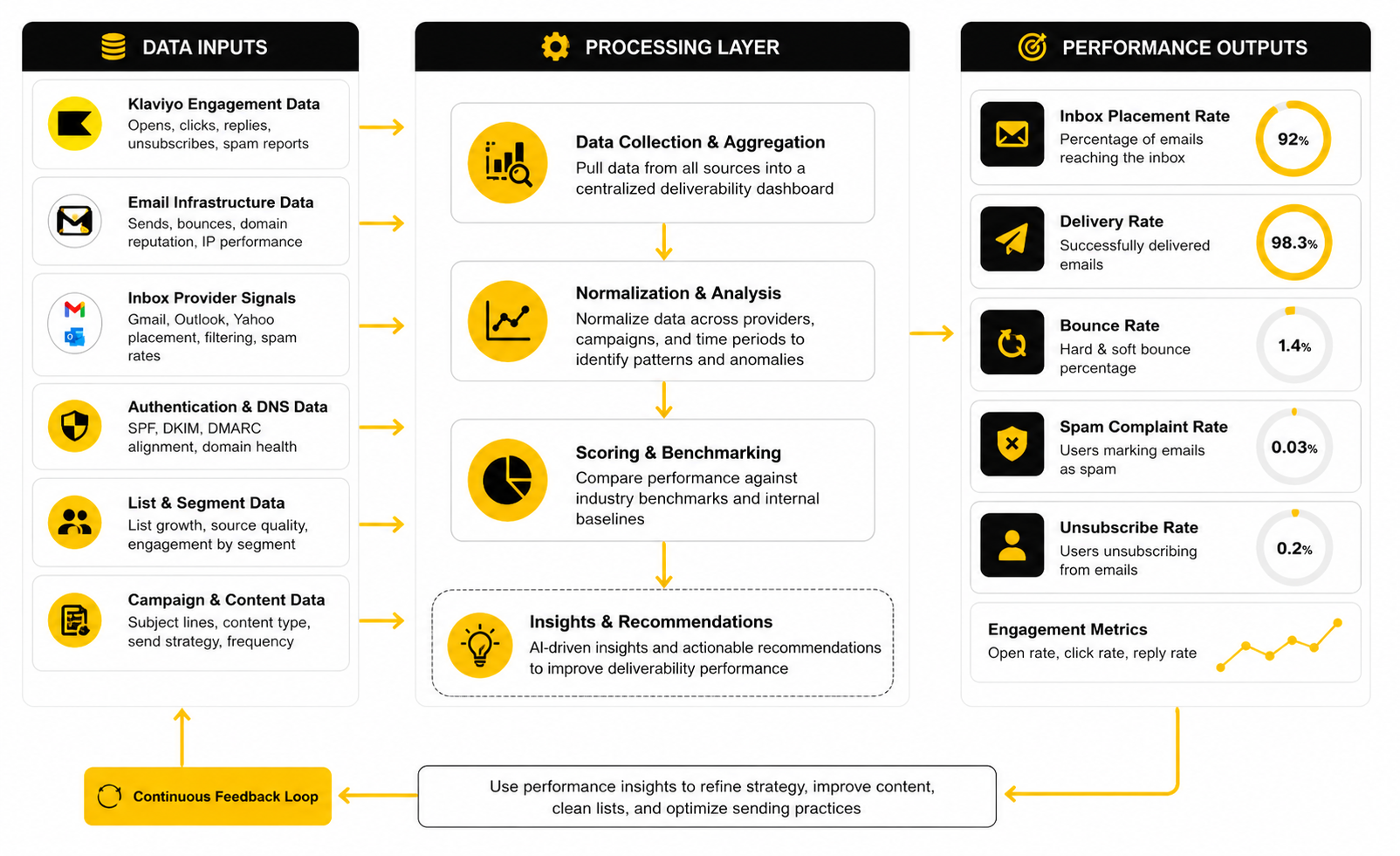
Build A Weekly Deliverability Review
A weekly review keeps Klaviyo deliverability from turning into emergency work. It does not need to be complicated. It needs to be consistent, honest, and tied to decisions.
A practical weekly review should answer these questions:
This review should influence the next campaign calendar. If the data is strong, you may have room to test broader segments or a higher cadence. If the data is weak, you tighten the audience, reduce risky sends, clean segments, and fix the cause before chasing more revenue.
Statistics And Data That Actually Matter
Deliverability data is useful only when it drives better decisions. Random benchmark chasing does not help much because every brand has a different list source, product category, buying cycle, price point, sending frequency, and customer relationship. A luxury furniture brand and a fast-fashion store should not interpret the same open rate the same way.
The better approach is to use benchmarks as guardrails, then judge your account against its own trend. External numbers help you understand what is clearly dangerous or clearly healthy. Internal history tells you whether your own sender reputation is getting better or worse.
For Klaviyo deliverability, the most important metrics usually fall into three groups: trust signals, engagement signals, and commercial signals. Trust signals tell you whether mailbox providers and recipients are rejecting your mail. Engagement signals tell you whether subscribers are interested. Commercial signals tell you whether the email program is creating revenue without abusing the list.
Spam Complaint Rate
Spam complaint rate is one of the most important negative signals because it is a direct user rejection. Gmail’s sender guidance says senders should keep spam rates below 0.1% and avoid reaching 0.3% or higher in Google’s email sender guidelines. That is a tiny margin, and it should change how you think about risky campaigns.
A complaint rate that looks small can still be serious. If you send to 100,000 people, a 0.1% complaint rate means 100 people reported the message as spam. That is enough signal for mailbox providers to care, especially if it repeats.
The action is straightforward. When complaints rise, narrow the audience, review the campaign promise, check whether the segment expected that message, and remove people who have not engaged in a long time. Do not explain complaints away as “just a few people.” Complaints are expensive.
Bounce Rate
Bounce rate tells you how much of your mail is failing before engagement can even happen. Hard bounces usually point to invalid, fake, abandoned, or mistyped addresses. Soft bounces can come from temporary mailbox issues, throttling, full inboxes, or provider-level filtering.
A rising bounce rate is often a list quality problem. It can happen after importing old lists, running low-quality giveaways, using unclear signup forms, or failing to validate addresses before they enter Klaviyo. It can also show up when you suddenly send to subscribers who have not heard from you in a long time.
The action depends on the cause. Suppress hard bounces, review acquisition sources, remove risky imports, and stop sending regular campaigns to very old inactive profiles. If soft bounces cluster around a specific provider, look for provider-level reputation or authentication issues before assuming the whole list is bad.
Unsubscribe Rate
Unsubscribes are not automatically bad. In fact, a clean unsubscribe is much better than a spam complaint. The problem is when unsubscribe rate rises sharply after specific campaign types, audience expansions, or cadence increases.
A healthy unsubscribe pattern often means people are self-selecting out. A concerning pattern means your message, frequency, or audience match is off. If every broad promotional campaign creates a spike, the issue is probably not the unsubscribe link. It is the decision to send that campaign to people who did not want it.
Use unsubscribe data to tune segmentation and cadence. If newer subscribers unsubscribe quickly, the signup promise and welcome flow may be mismatched. If long-time subscribers unsubscribe after frequency increases, the calendar may be too aggressive. If one campaign angle creates unusually high exits, stop repeating it blindly.
Open Rate
Open rate still has directional value, but it should not be treated as perfect truth. Apple Mail Privacy Protection changed how opens are recorded for many users, which means open data can be inflated or less precise in some contexts. That does not make opens useless. It means they need to be interpreted with caution.
For Klaviyo deliverability, open rate is best used as a trend signal. If opens decline across several campaigns, especially for a stable audience, something may be weakening. If opens vary by subject line or send time, that may be normal campaign performance rather than a reputation issue.
Do not make major deliverability decisions using open rate alone. Pair it with clicks, conversion, complaints, unsubscribes, bounces, and provider-level performance. A high open rate with low clicks and high complaints is not a win. It may mean the subject line got attention but the email failed the trust test.
Click Rate
Click rate is usually a stronger engagement signal than open rate because it requires an intentional action. A click means the subscriber saw enough value to move from the inbox into your site, product page, article, quiz, form, or offer. That makes it one of the clearest ways to judge whether your email content is actually doing its job.
A declining click rate can mean the audience is too broad, the offer is weak, the creative is unclear, or the campaign is not aligned with subscriber intent. It can also mean you are sending too often and people are becoming numb to your emails. The number itself is not the answer. The pattern is the clue.
Use click rate to decide where to invest more attention. If educational emails get strong clicks, send more useful education. If product launches outperform generic discounts, lean into launches. If one segment clicks consistently and another does not, stop treating them like the same audience.
Revenue Per Recipient
Revenue per recipient is more useful than total revenue when evaluating campaign quality. Total revenue rewards list size. Revenue per recipient shows whether the audience actually responded well relative to how many people received the email.
This matters because a campaign can make more total money by sending to a much larger audience while producing weaker engagement and more negative signals. That may look good in a quick revenue screenshot, but it can be bad for long-term Klaviyo deliverability. The account gets paid today and taxed tomorrow.
Use revenue per recipient alongside complaint rate, unsubscribe rate, bounce rate, and click rate. The best campaigns do not just generate revenue. They generate revenue from the right audience without creating reputation damage.
Flow Performance
Flows need their own measurement because they behave differently from campaigns. A welcome flow, abandoned cart flow, browse abandonment flow, and post-purchase flow all reach people at different moments of intent. Comparing them as if they are the same type of email leads to bad decisions.
A welcome email should usually create strong early engagement because the subscriber just joined. An abandoned cart email should usually have higher purchase intent because the shopper recently considered buying. A win-back flow will usually have weaker engagement because the audience is colder. Context matters.
For deliverability, watch whether flows are creating healthy signals over time. If a flow keeps sending multiple emails to people who never click, never buy, and keep unsubscribing, tighten the trigger, filters, timing, or exit rules. Automated does not mean untouchable.
What The Numbers Should Make You Do
The purpose of measurement is action. If the data does not change what you send next, you are not doing analytics. You are collecting decorations.
When Klaviyo deliverability data is strong, your next move might be controlled expansion. You can test a broader audience, add one more campaign, or include a secondary engaged segment. You still watch the signals, but you do not need to operate from fear.
When the data is weak, your next move should be protection. Narrow the audience, reduce frequency, suppress harmful profiles, review recent creative, check authentication, and look for provider-specific problems. The worst move is to keep sending the same way because the calendar says so.
Use A Simple Decision Matrix
A simple matrix keeps the team from arguing based on opinions. If engagement is strong and negative signals are low, you can keep sending normally. If engagement is strong but complaints rise, the message may be too aggressive or mismatched. If engagement is weak and negative signals rise, you should immediately narrow the audience.
A practical decision matrix looks like this:
This kind of process keeps deliverability calm. You are not guessing. You are reading the signal and choosing the next move.
Do Not Let Benchmarks Replace Judgment
Benchmarks are useful, but they are not the boss. A brand with a loyal community may outperform average engagement numbers because subscribers genuinely want the emails. A discount-heavy store may generate short-term clicks but also train subscribers to wait for promotions. Both accounts need different decisions.
Use benchmarks to catch extremes. If complaints are near dangerous levels, act. If bounces rise above your normal range, investigate. If clicks fall for several weeks, review content and audience quality. But do not blindly chase someone else’s average open rate as if it proves your strategy is healthy.
Klaviyo deliverability improves when your team understands what the data means in context. The real question is not, “Is this number good?” The real question is, “What is this number telling us to change before the next send?”
Troubleshooting Drops In Klaviyo Deliverability
A deliverability drop is not a reason to panic, but it is a reason to stop guessing. The wrong reaction can make the problem worse. If you keep sending broadly while trying random fixes, you create more weak signals and make it harder to identify what actually changed.
The first step is to define the drop clearly. Are opens down across all providers, or only Gmail? Are clicks down but revenue stable? Are bounces rising, complaints rising, or unsubscribes spiking? A vague statement like “deliverability is bad” does not help anyone fix the issue.
Good troubleshooting starts with containment. Narrow your next sends to highly engaged subscribers, pause cold audience expansion, review recent changes, and isolate whether the problem came from infrastructure, audience quality, cadence, content, or a specific mailbox provider. That is not glamorous, but it works because it turns a messy problem into a sequence of checks.
Check What Changed First
Most deliverability problems have a trigger. It might be a new sending domain, a larger campaign audience, a list import, a popup change, a more aggressive promotional calendar, a flow update, or a sudden increase in send volume. If you can identify the change, you can usually find the path back.
Start by looking at the last two to four weeks of activity. Compare send volume, segments, campaign types, flow edits, template changes, subject line style, acquisition sources, and suppression rules. If the problem appeared after a specific change, do not ignore the timing.
This is where a simple change log becomes valuable. Every serious Klaviyo account should document major changes to domains, DNS, forms, imports, flows, cadence, and segmentation. When performance drops, that log saves hours of speculation.
Separate Reputation Problems From Campaign Problems
Not every bad campaign is a deliverability crisis. Sometimes the offer is weak. Sometimes the creative is confusing. Sometimes the audience was too narrow or the timing was poor. You need to separate a campaign-level miss from a sender-level problem.
A campaign problem usually appears in one send or one campaign type. A reputation problem tends to show up across multiple campaigns, multiple flows, or one specific mailbox provider over time. The difference matters because the fixes are different.
If one campaign underperforms, review the message and audience. If multiple sends underperform after a volume spike, review sender reputation and cadence. If one provider drops sharply, review domain-level and provider-level signals before changing the entire program.
Investigate Provider-Specific Issues
Mailbox providers do not grade you as one universal audience. Gmail, Yahoo, Outlook, Apple Mail, and other providers use their own systems and signals. That means your Klaviyo deliverability can weaken in one place while appearing fine elsewhere.
If Gmail performance drops, review spam complaints carefully because Gmail’s sender guidance tells senders to keep spam rates below 0.1% and avoid reaching 0.3% or higher in its email sender guidelines. If Yahoo weakens, review authentication, unsubscribe handling, complaint behavior, and engagement for Yahoo-heavy segments. If Outlook is the issue, look closely at bounce patterns, throttling signals, and whether recent sends created unusual volume.
Do not apply one broad fix to every provider without evidence. If the problem is concentrated, the response should be concentrated too. That may mean temporarily narrowing campaigns for one domain group, reviewing engagement by provider, or slowing volume increases until the affected provider stabilizes.
Review Recent List Growth Sources
Fast list growth can quietly damage deliverability when the new subscribers are low quality. Giveaways, sweepstakes, co-registration, old customer imports, unclear checkout opt-ins, and aggressive popups can all increase list size while lowering intent. The list looks bigger, but the inbox signals get weaker.
When performance drops, compare new subscriber sources against engagement. If one form, campaign, partner source, or lead magnet is producing profiles that never click, never buy, and unsubscribe quickly, that source needs to be fixed or stopped. More contacts are not valuable if they train mailbox providers to ignore you.
This is also where validation and consent quality matter. If fake addresses, typo addresses, or low-intent signups are entering Klaviyo, the problem will eventually appear in bounces, weak engagement, or complaints. The cleanest fix is upstream: improve the signup promise, reduce bad acquisition sources, and stop importing contacts that cannot prove consent.
Do Not Use Discounts As A Deliverability Fix
Discounts can lift revenue, but they do not automatically fix reputation. A strong offer may get clicks from people who already trust you. It can also annoy cold subscribers who did not want another sales email in the first place.
This is a common trap. A brand sees performance falling, so it sends a bigger discount to a broader audience. Revenue may temporarily improve, but complaints, unsubscribes, and fatigue can rise too. That is not recovery. That is borrowing from future inbox placement.
Use discounts carefully during a deliverability recovery. Send them to people with recent engagement or clear purchase intent. Do not use a desperate promotion as an excuse to email profiles that your data already says are risky.
Advanced Deliverability Tradeoffs
Klaviyo deliverability gets more nuanced as the account grows. Small brands can often make big improvements by fixing the basics: authentication, list hygiene, segmentation, cadence, and monitoring. Larger brands need to think more carefully about scale, multiple domains, international audiences, product cycles, and how different teams influence the same sender reputation.
The hard part is that the right choice is not always the most aggressive choice. More volume can create more revenue, but it can also increase risk. Tighter segmentation can protect reputation, but it can also leave short-term money on the table. Strong deliverability work means understanding the tradeoff and choosing deliberately.
There is no universal answer for every account. A daily-deal brand, a luxury skincare brand, a subscription supplement company, and a B2B ecommerce brand should not use the same cadence or suppression logic. The principles are consistent, but the implementation has to match the business.
Growth Versus Reputation Protection
Every email program has tension between growth and protection. The growth side wants larger audiences, more campaigns, and more revenue moments. The protection side wants stronger engagement, fewer complaints, and cleaner sender signals. Both sides are valid, but one cannot completely ignore the other.
The practical answer is not to stop selling. The answer is to create rules for when expansion is allowed. If recent campaigns show strong clicks, low complaints, stable bounces, and healthy revenue per recipient, you can test a broader audience. If signals weaken, you pull back before reputation damage compounds.
This is where leadership discipline matters. If the only goal is this week’s revenue, deliverability will eventually suffer. If the only goal is perfect sender health, the channel may become too timid. The best operators protect reputation while still giving the business room to grow.
Dedicated Domains And Subdomains
As brands scale, they often need a more thoughtful domain structure. Marketing emails, transactional emails, support emails, sales emails, and internal company emails may all come from different systems. If everything is tangled together, one bad sending stream can create risk for others.
A common approach is to use subdomains for different mail streams. For example, marketing emails may use one branded sending subdomain, transactional emails may use another, and corporate email may stay separate. This can make reputation easier to monitor and reduce the chance that a risky marketing push affects critical operational mail.
Do not overcomplicate this too early. More domains and subdomains also mean more DNS records, more monitoring, more warming, and more room for mistakes. The structure should solve a real operational need, not exist because it sounds advanced.
International Sending And Regional Expectations
International audiences can behave differently. Time zones, language, promotional expectations, privacy rules, seasonal calendars, and mailbox provider mix all affect performance. A campaign that works well in one region may create weaker signals in another.
For Klaviyo deliverability, this means international segmentation should go beyond translation. Send time, offer type, frequency, and consent expectations may need to change by market. If one region consistently underperforms, do not let it drag down the whole account.
Regional compliance also matters. Privacy and marketing consent rules can vary, and the safest approach is to keep consent records clean, make preferences easy to manage, and avoid sending to people whose permission is unclear. Deliverability and compliance are not the same thing, but sloppy compliance often creates sloppy deliverability signals.
Promotional Pressure During Peak Season
Peak season is where weak deliverability habits get exposed. Brands send more often, expand audiences, react to competitors, and push harder when revenue targets are tight. The problem is that mailbox providers also see the sudden increase in volume and recipient fatigue.
The best peak-season deliverability work happens before peak season. Clean the list early, warm any domain changes ahead of time, test creative formats before volume spikes, and define which segments are eligible for aggressive promotional sending. Waiting until the busiest week of the year is too late.
During peak season, separate your audiences by intent. Recent buyers, cart abandoners, active browsers, and recent clickers can usually handle more relevant email. Cold subscribers should not receive every single promotion just because the calendar is intense. The more aggressive the season, the more disciplined the segmentation needs to be.
Migration Risk When Moving Into Klaviyo
Moving into Klaviyo from another email platform can improve your marketing operation, but migration is also a deliverability risk if it is rushed. You are changing systems, tracking, templates, segments, and sometimes sending infrastructure. Mailbox providers may see that change even if subscribers do not.
A safe migration starts with clean data. Do not bring every historical contact into active sending just because the export file exists. Import only what you can justify, preserve unsubscribe and suppression status, map consent correctly, and rebuild engagement segments before your first major campaign.
Klaviyo’s warming guidance emphasizes gradual reputation building when using a new sending domain or moving sending behavior, and that matters because mailbox providers need stable signals before they trust higher volume. A migration should feel controlled, not chaotic. The goal is to arrive in Klaviyo with a cleaner program than the one you left behind.
Shared Responsibility Across Teams
Deliverability is not only the email marketer’s job. The growth team affects it through acquisition quality. The creative team affects it through message clarity. The ecommerce team affects it through offers and landing pages. The leadership team affects it through revenue pressure and campaign expectations.
If these teams do not communicate, Klaviyo deliverability gets pulled in different directions. One person cleans the list while another launches a low-quality giveaway. One person tightens segmentation while another demands a full-list blast. One person monitors complaint rate while another rewrites subject lines to be more aggressive.
The fix is simple but not always easy: define shared rules. Agree on what counts as an engaged subscriber, when cold segments can be used, who approves imports, how often deliverability is reviewed, and what happens when negative signals rise. Once the rules are clear, the channel becomes easier to protect.
Professional Implementation Checklist
A professional Klaviyo deliverability setup is not about perfection. It is about having a system that prevents obvious damage, catches problems early, and supports growth without constantly putting the domain at risk. The checklist below is the practical version of everything covered so far.
Use it as an operating checklist, not a one-time setup task. Some items only need occasional review, like DNS and domain structure. Others should be part of your weekly rhythm, like campaign performance, provider-level trends, and segment quality.
The real value is consistency. Deliverability improves when good decisions become the default. It gets worse when every campaign is treated like an exception.
Technical Foundation
Your technical setup should prove that your brand is a legitimate sender. That means the domain, authentication records, From identity, and unsubscribe handling all work together. If this layer is weak, every other improvement has less leverage.
Check these items first:
This layer should be reviewed before migration, before peak season, after major DNS changes, and anytime deliverability suddenly weakens. Do not assume it is fine forever because it worked once. Domains, platforms, and mail streams change.
Audience And Consent
Your list quality determines how much trust your emails can earn over time. Strong consent and clean acquisition create better engagement before the first campaign is even sent. Weak acquisition creates deliverability debt that shows up later.
Review these items regularly:
The goal is not to make the list as large as possible. The goal is to make the reachable audience as responsive as possible. That is the audience that protects Klaviyo deliverability and produces better revenue over time.
Segmentation And Sending Rules
Segmentation is where strategy becomes execution. If the account has no clear rules, campaign decisions become emotional. If the rules are defined, the team can move faster without taking unnecessary risks.
Set rules for these areas:
These rules should not be frozen forever. They should evolve as the brand grows, the buying cycle changes, and the data becomes clearer. But they should exist, because “send to everyone” is not a strategy.
Campaign And Flow Quality
Campaigns and flows should support subscriber trust. That means the content is relevant, the promise is honest, and the timing makes sense. A technically perfect setup still struggles if the emails themselves create weak reactions.
Review these items:
Automations deserve special attention because they can quietly run for months without anyone questioning them. A flow that was smart last year may be too aggressive today. Review them like active assets, not background plumbing.
Reporting And Response
Reporting only matters when it changes behavior. A deliverability dashboard that nobody uses is just decoration. The account needs a rhythm for reviewing signals and deciding what happens next.
Track these areas:
Then connect the metrics to actions. Strong signals can justify careful expansion. Weak signals should trigger tighter segmentation, lower volume, list cleaning, creative review, or provider-specific investigation. The faster you respond, the less painful the recovery usually is.
The Strategic Risk Of Ignoring Deliverability
Ignoring deliverability rarely creates one dramatic failure at first. It usually creates a slow decline. Opens get softer, clicks get weaker, revenue per recipient drops, and the team compensates by sending more. That extra volume creates more fatigue, which creates worse signals, which creates even more pressure to send again.
That loop is dangerous because it feels rational in the moment. Revenue is down, so the team sends another campaign. The campaign makes some money, so the behavior gets repeated. Eventually, the account depends on higher volume just to maintain weaker results.
Strong Klaviyo deliverability breaks that loop. It forces the brand to earn attention instead of extracting it. It protects the sending domain, improves the quality of campaign decisions, and keeps flows from being dragged down by poor audience management.
The Real Goal Is Predictability
The goal is not to obsess over every tiny metric movement. The goal is predictable performance. You want to know which audiences are safe, which campaigns can scale, which segments need caution, and which signals mean it is time to pull back.
Predictability gives the team confidence. Marketing can plan campaigns without gambling the domain. Leadership can understand why some audiences should not be emailed constantly. Operators can spot problems early instead of waiting for a major revenue drop.
That is the professional standard. Not perfection. Not fear. A repeatable system that keeps the inbox channel healthy while still letting the brand grow.
Bringing The Full Klaviyo Deliverability System Together
At this point, the pattern should be clear. Klaviyo deliverability is not one feature inside Klaviyo. It is the way your technical setup, list quality, segmentation, cadence, content, flows, monitoring, and recovery process work together.
That is why the strongest email programs feel calm. They are not constantly reacting to every dip with panic sends, emergency discounts, or random template changes. They have a system. When the data is healthy, they scale carefully. When the data weakens, they protect reputation before the damage spreads.
The final version of the system is simple: prove your identity, send to people who want your emails, respect engagement signals, measure what matters, and respond quickly when the account shows stress. If you do that consistently, Klaviyo becomes much more than an email platform. It becomes a controlled revenue channel instead of a reputation gamble.
What Is Klaviyo Deliverability?
Klaviyo deliverability is the ability of emails sent through Klaviyo to reach a subscriber’s inbox instead of being blocked, bounced, filtered, or sent to spam. It depends on your domain authentication, sender reputation, list quality, engagement, complaints, bounce rate, unsubscribe behavior, and sending consistency. Klaviyo gives you tools to manage these areas, but the account owner still has to send responsibly.
Is Klaviyo Good For Email Deliverability?
Klaviyo can be strong for deliverability when it is set up and managed correctly. The platform includes branded sending domains, authentication support, segmentation, suppression management, deliverability reporting, campaign diagnostics, and flow performance tools. The real result depends on how clean your list is, how carefully you segment, and whether your campaigns create positive or negative subscriber signals.
Why Are My Klaviyo Emails Going To Spam?
Klaviyo emails can go to spam because of weak sender reputation, poor engagement, high complaint rates, authentication issues, aggressive sending volume, cold audience blasting, misleading content, or low-quality list sources. The first step is to check whether the problem affects all mailbox providers or one specific provider. Then review recent changes to domains, segments, imports, cadence, flows, and campaign content.
How Do I Improve Klaviyo Deliverability Quickly?
The fastest safe improvements usually come from narrowing your audience, excluding inactive profiles, checking authentication, suppressing risky contacts, and sending your next campaigns only to engaged subscribers. This does not “hack” inbox placement, but it immediately improves the quality of signals your account sends to mailbox providers. Avoid broad sends while investigating the issue because more volume can make a reputation problem worse.
Do I Need A Branded Sending Domain In Klaviyo?
A branded sending domain is strongly recommended for serious Klaviyo senders because it connects your email reputation to your own brand domain. It also helps align your From domain with your authenticated sending identity, which matters for modern authentication expectations. Set it up before major volume increases, then warm it gradually instead of switching right before an important promotion.
How Long Does Klaviyo Domain Warming Take?
Domain warming depends on list size, engagement quality, sending history, and how aggressive your volume plan is. Klaviyo’s deliverability FAQ recommends warming branded sending domains over a minimum of 30 days for stronger performance in its deliverability guidance. The safer approach is to start with your most engaged subscribers, increase volume gradually, and slow down if bounces, unsubscribes, or complaints rise.
What Is A Good Spam Complaint Rate In Klaviyo?
A good spam complaint rate is as close to zero as possible. Gmail’s sender guidance tells senders to keep spam rates below 0.1% and avoid reaching 0.3% or higher in its email sender guidelines. If complaints rise, narrow the audience, review the campaign promise, remove cold subscribers, and check whether people clearly expected that message.
What Klaviyo Metrics Should I Watch For Deliverability?
Watch spam complaint rate, bounce rate, unsubscribe rate, click rate, open trends, revenue per recipient, flow performance, segment performance, and mailbox provider performance. Klaviyo’s Deliverability hub uses metrics like open rate, click rate, bounce rate, unsubscribe rate, and spam complaint rate to help assess sender health in its deliverability hub documentation. Do not judge deliverability from one metric alone because the pattern matters more than any single number.
Should I Delete Inactive Subscribers From Klaviyo?
You do not always need to delete inactive subscribers, but you should stop treating them like active buyers. Many brands exclude deeply inactive profiles from regular campaigns, move them into a controlled re-engagement sequence, and suppress them if they never respond. Keeping inactive profiles in your normal campaign audience can lower engagement and create reputation drag.
How Often Should I Clean My Klaviyo List?
Review list quality at least monthly, and always before peak sending periods, big launches, major sales, or domain changes. You should also clean after suspicious list growth, poor campaign performance, rising bounces, or higher complaints. List cleaning is not a punishment for your list. It is basic maintenance for your sender reputation.
Can Too Many Klaviyo Flows Hurt Deliverability?
Yes, too many flows can hurt deliverability if they create excessive frequency, irrelevant timing, or repeated sends to people who are not engaging. Flows should have clear triggers, filters, exit conditions, and suppression logic. A welcome flow, abandoned cart flow, post-purchase flow, and win-back flow can all be valuable, but only when they respect the customer’s current stage and intent.
Does Email Design Affect Klaviyo Deliverability?
Email design can affect deliverability indirectly because it shapes subscriber behavior. If the email is confusing, too image-heavy, slow to load, misleading, or hard to act on, people may ignore it, unsubscribe, or complain. Use real text for important information, make the first screen clear, and keep the email focused on one obvious next step.
What Should I Do If Gmail Performance Drops In Klaviyo?
If Gmail performance drops, isolate Gmail users and compare their engagement, complaints, bounces, and unsubscribe behavior against other providers. Review recent sends, volume changes, subject lines, list imports, domain changes, and cold audience expansion. Keep the next Gmail sends focused on highly engaged subscribers until performance stabilizes.
Should I Use A Dedicated IP With Klaviyo?
A dedicated IP is not automatically better. It can help certain high-volume senders, but it also means your brand carries more direct responsibility for IP reputation. Many brands are better served by a clean branded sending domain, strong segmentation, consistent volume, and good list hygiene before considering dedicated IP infrastructure.
Can I Recover Bad Klaviyo Deliverability?
Yes, but recovery usually takes discipline rather than tricks. Narrow sending to engaged subscribers, pause risky segments, fix authentication problems, suppress harmful profiles, review flow behavior, and watch provider-level signals. Recovery is not instant because mailbox providers need to see a healthier pattern over time.
Build a stronger local presence with BAAM AI
Turn your website, Google profile, social channels, and AI visibility into one growth engine
Most businesses do not need more random marketing activity. They need a consistent presence system that helps the right people find them, trust them, and take action. BAAM AI brings strategy, local SEO, website updates, Google Maps visibility, social content, AI-search readiness, media production, and reporting into one practical monthly engine.
If you want your marketing to keep working after the campaign ends, start with a free BAAM AI presence audit. See how your business shows up today and where the fastest visibility wins are at BAAM AI.