
BAAM AI Blog
Klaviyo Com: The Practical Guide To Turning Customer Data Into Email And SMS Revenue
Klaviyo com is not just a place to log in and send newsletters. For ecommerce teams, it is usually the center of the owned marketing system: customer profiles, purchase history, browsing behavior, email, SMS...
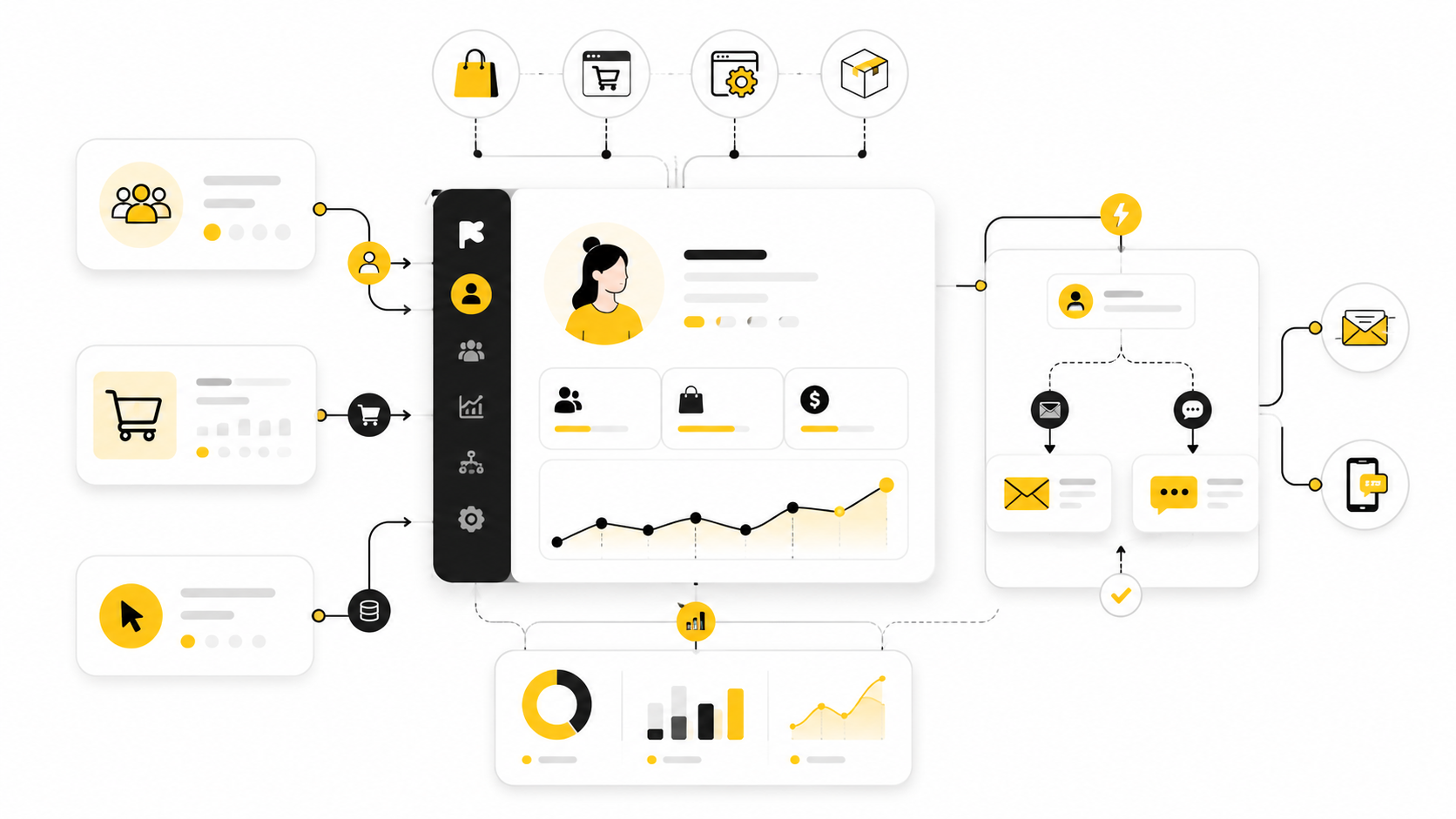
Klaviyo com is not just a place to log in and send newsletters. For ecommerce teams, it is usually the center of the owned marketing system: customer profiles, purchase history, browsing behavior, email, SMS, segmentation, automation, reporting, and increasingly AI-assisted campaign work. That is why the real question is not “What is Klaviyo?” but “How do you use it without turning it into an expensive, messy broadcast tool?”
The platform has grown far beyond basic email marketing. Klaviyo now positions itself as an AI-powered B2C CRM that connects customer data with email, SMS, WhatsApp, RCS, mobile push, and automation, and the company reported more than 193,000 customers at the end of fiscal year 2025. That scale matters because it shows where the market is going: brands want fewer disconnected tools and more systems that can act on customer behavior in real time.
Email is still a serious revenue channel when it is managed properly. Recent email marketing research found that many companies see returns in the $10 to $36 range for every $1 spent, while newer reporting on email performance shows that teams often lose money not because email is weak, but because they cannot reliably measure ROI, segment well, or protect deliverability. Klaviyo com sits directly in that gap between potential and execution.
This guide is built for the practical operator. We are not going to treat Klaviyo like magic software that fixes weak offers, poor retention, bad merchandising, or lazy list management. We are going to look at the structure behind a high-performing Klaviyo account, why the platform matters, which parts deserve attention first, and how to implement it professionally without drowning in features.
this guide is split into six parts so each layer can build naturally on the one before it. Part 1 sets the strategic frame, because Klaviyo only makes sense when you understand the role it plays in a modern ecommerce growth system. The later parts move from architecture to implementation, then into optimization and decision-making.
Why Klaviyo Com Matters For Ecommerce Growth
Klaviyo matters because ecommerce growth is becoming less about blasting campaigns and more about acting on behavior. A customer who viewed a product twice, added it to cart, skipped checkout, bought once, ignored the next three emails, and came back through SMS should not receive the same message as a brand-new subscriber. The value of Klaviyo com is that it can connect those signals and turn them into targeted flows, segments, and campaigns.
That shift is especially important as paid acquisition gets harder to rely on. When customer acquisition costs rise, owned channels become more valuable because they let a brand keep communicating with people it already paid to reach. Email and SMS are not “free,” but they are usually far more controllable than constantly buying the same attention again through ads.
The danger is that many brands buy Klaviyo and still operate like they are using a basic newsletter tool. They import a list, send campaigns, set up a few default flows, and then wonder why revenue does not scale. Klaviyo only becomes powerful when the account is built around clean data, useful segments, strong automations, disciplined testing, and clear commercial goals.
The Framework Behind A Strong Klaviyo Account
A strong Klaviyo account has a simple framework: collect the right data, organize the audience, trigger the right messages, measure what happened, and keep improving. That sounds obvious, but most weak accounts break at one of those points. They either collect messy data, build vague segments, over-message the list, ignore deliverability, or judge performance by surface metrics instead of profit and retention.
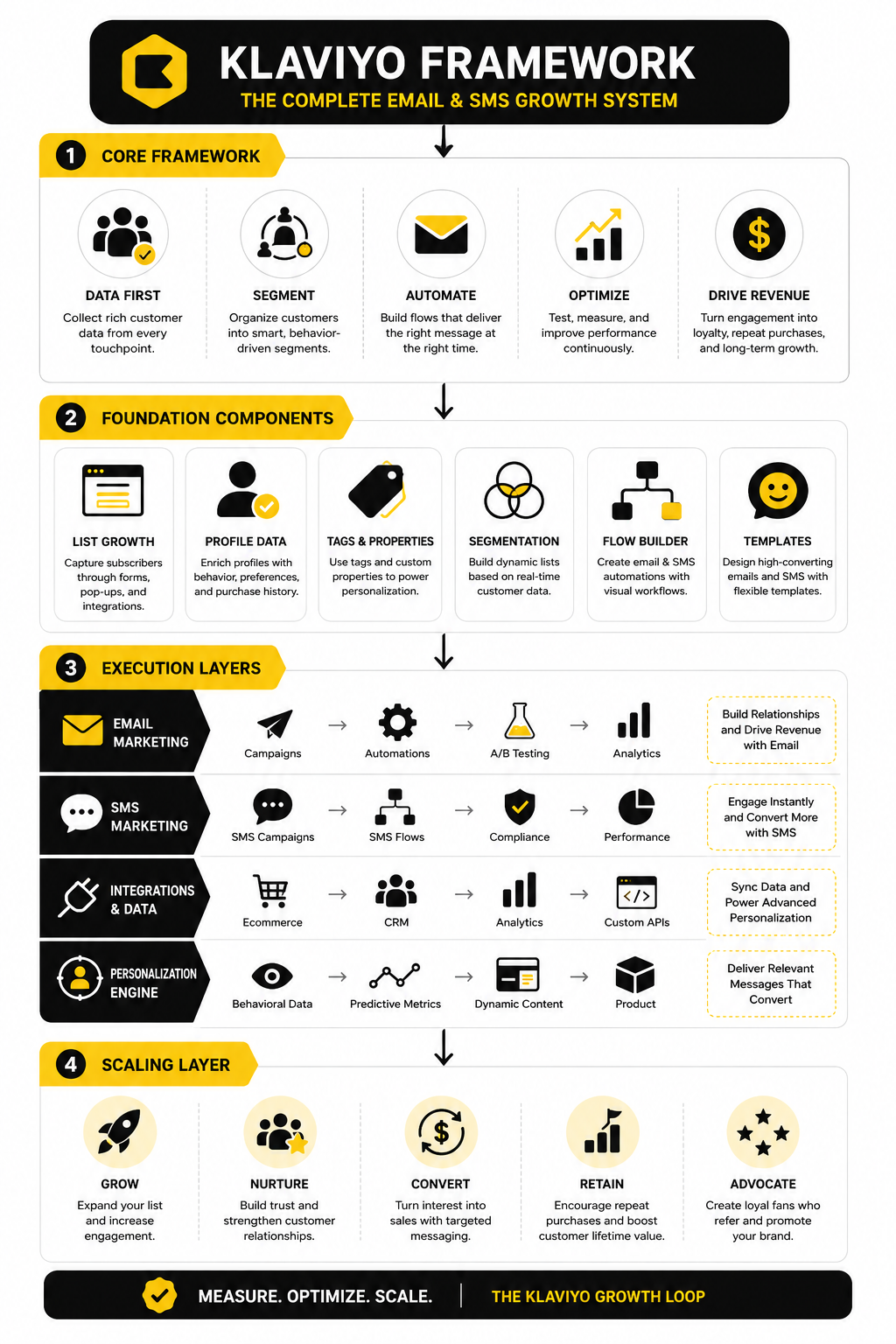
The framework starts with customer profiles. Klaviyo’s data layer is designed to store customer events, profile properties, purchase activity, and engagement signals so brands can build more precise audiences and journeys. Its customer data platform messaging highlights profiles, segments, predictive analytics, integrations, and data storage as the base layer that supports more advanced marketing work.
From there, the messaging layer turns data into action. Campaigns handle planned announcements, promotions, launches, and content. Flows handle behavior-based communication such as welcome sequences, abandoned checkout, browse abandonment, post-purchase education, winback, replenishment, review requests, and loyalty prompts.
Core Components You Need To Understand First
The first core component is the profile. In Klaviyo, the profile is where customer identity, behavior, consent, purchase history, and engagement signals come together. If profile data is inaccurate or bloated with inactive contacts, every campaign, automation, and report becomes less reliable.
The second component is segmentation. Segments let you group people based on behavior, attributes, consent, engagement, and purchase patterns. This is where Klaviyo com starts to separate itself from simpler email tools, because the point is not just sending to “the list,” but sending different messages to different customer groups based on what they have actually done.
The third component is automation. Klaviyo calls these flows, and they are often the highest-leverage part of the account because they run continuously once built. A good flow does not just remind someone to buy; it responds to the customer’s stage, intent, history, and likely next step.
The fourth component is reporting. Opens and clicks still have some diagnostic value, but they are not enough. A serious Klaviyo setup needs to look at revenue attribution, conversion rate, unsubscribes, spam complaints, deliverability, customer lifetime value, repeat purchase behavior, and whether email and SMS are creating incremental profit rather than just claiming credit for sales that would have happened anyway.
Professional Implementation Starts With Restraint
Professional Klaviyo implementation is not about turning on every feature immediately. It is about building the account in the right order so each layer supports the next one. The smartest teams start with data hygiene, consent, integrations, key flows, campaign structure, and measurement before they chase advanced AI features or complex segmentation.
This matters because Klaviyo keeps expanding. Recent product updates include more AI-assisted campaign creation, customer agent functionality, RCS messaging, and cross-channel automation capabilities, with Klaviyo describing newer AI tools as a way to create and optimize campaigns using brand and customer data. Those features can be useful, but they amplify the quality of the underlying system; they do not replace it.
A practical implementation path usually starts with the ecommerce integration, tracking, forms, consent capture, list structure, and the essential lifecycle flows. After that, the account can expand into advanced segmentation, personalized campaigns, predictive analytics, SMS, RCS, customer service workflows, and deeper reporting. The order matters because complexity without discipline creates noise.
Where Klaviyo Fits In The Marketing Stack
Klaviyo is usually the strongest fit for ecommerce brands that want email, SMS, and customer data working together. It is especially relevant for stores using platforms like Shopify, WooCommerce, and BigCommerce, because customer events can feed directly into messaging logic. For example, Klaviyo’s WooCommerce documentation explains that the integration can sync WooCommerce data to Klaviyo in real time, which is essential for behavior-based flows rather than manual list uploads.
It is not always the best fit for every business. A small service business that only needs a simple newsletter may not need the depth, cost, or setup work that Klaviyo requires. A creator or consultant might be better served by a lighter system, while a brand that needs simple email campaigns without heavy ecommerce segmentation may compare tools like Brevo or Moosend depending on their needs.
For ecommerce brands with meaningful traffic, repeat purchase potential, and enough customer behavior to personalize around, Klaviyo com can become a central growth asset. But it has to be treated like infrastructure, not a toy. The brands that win with it are the ones that build a clean foundation, use segmentation with intent, and keep improving the system based on what customers actually do.
How Klaviyo Works As A Customer Data And Messaging Platform
Klaviyo com works best when you stop thinking of it as an email sender and start seeing it as a customer data system that can send messages. The platform pulls behavior, profile, ecommerce, and consent data into one place so a brand can respond based on what a person actually did. That is the difference between sending “20% off today” to everyone and sending a specific message to someone who viewed a product, abandoned checkout, bought a related item, or has not purchased again after a reasonable window.
The official Klaviyo platform positioning is built around unifying customer data and activating it across email, SMS, RCS, WhatsApp, mobile push, and other owned channels through its B2C CRM and marketing automation platform. That matters because modern ecommerce marketing is not one channel anymore. A customer might join through a popup, browse from mobile, buy from a desktop session, reply to SMS, and later convert from an email reminder.
The core idea is simple: every meaningful customer action should either update the profile, change the segment, trigger a flow, improve reporting, or inform the next campaign. If an action does none of those things, it probably does not need to be part of the system. Clean architecture beats clever complexity every time.
Customer Profiles Are The Base Layer
Every serious Klaviyo setup starts with profiles. A profile is where Klaviyo stores information about a person, including contact details, consent status, profile properties, engagement, purchase behavior, and activity from connected integrations. Klaviyo’s profile property documentation separates platform-managed properties from custom properties, which is important because careless custom fields can quickly turn an account into a messy data warehouse with no practical marketing value.
The point of a profile is not just storage. The point is usefulness. If a customer’s profile shows that they joined through a quiz, bought a starter product, clicked content about a specific category, and has not returned in 60 days, the brand can use that context to send a better next message.
This is where many teams go wrong. They collect too much data without deciding how it will be used. A professional account keeps profile data tied to real decisions: segmentation, personalization, suppression, customer journeys, reporting, or customer support.
Events Turn Behavior Into Marketing Signals
Events are the actions that make Klaviyo useful. A placed order, started checkout, viewed product, subscribed to list, clicked email, submitted form, or received SMS can all become a signal. Klaviyo’s segmentation reference explains that event conditions let brands create audiences based on what someone has or has not done, which is the foundation of behavior-based marketing.
This is why ecommerce integrations matter so much. When Shopify data syncs into Klaviyo, the platform can use order data, product data, delivery data, onsite tracking, and customer data for targeted messaging through the Shopify data integration. BigCommerce works in a similar way, with historical ecommerce, customer, and catalog data syncing into Klaviyo through the BigCommerce integration.
The practical result is that campaigns and flows can respond to real behavior instead of assumptions. Someone who bought a premium product should not be treated the same as someone who only browsed a discount collection. Someone who buys every 45 days should not receive the same winback timing as someone who buys once a year.
Lists And Segments Do Different Jobs
Lists and segments are often confused, but they should not be used the same way. A list is usually a more stable group, such as newsletter subscribers or SMS subscribers. A segment is dynamic, meaning people enter and leave based on conditions like engagement, purchase history, location, predicted value, product interest, or consent.
Klaviyo’s developer documentation describes a segment as a dynamic list of profiles that meet a specific set of conditions, such as customers in a city who purchased within a defined time period through the Segments API overview. That dynamic behavior is powerful because your audience stays current without constant manual cleanup. If someone purchases, stops engaging, changes location, or becomes eligible for a replenishment message, their segment membership can change automatically.
For most ecommerce brands, the mistake is not having too few segments. The mistake is having too many segments with no clear purpose. Every segment should answer a useful question: who should receive this, who should not receive this, what should change in the message, and what decision will this audience help us make?
Flows Automate Customer Journeys
Flows are Klaviyo’s automation engine. A flow starts when a person meets a trigger, then moves through messages, waits, splits, filters, and conditions. The trigger might be joining a list, starting checkout, placing an order, viewing a product, reaching a date, entering a segment, or matching another behavioral condition.
Klaviyo’s flow documentation explains that triggers and filters control who enters a flow and how that flow behaves, including options for trigger filters, profile filters, and message-level filters through the flow triggers and filters guide. This is where the system becomes more than a basic autoresponder. You can separate buyers from non-buyers, VIP customers from first-time visitors, product A customers from product B customers, and engaged subscribers from people who need fewer messages.
A good flow should feel like a helpful next step, not a robotic sequence. The welcome flow should orient the subscriber. The abandoned checkout flow should remove friction. The post-purchase flow should reduce regret, improve product use, and guide the next action. The winback flow should respect timing instead of begging too early.
Campaigns Handle Planned Messaging
Campaigns are the one-time or scheduled messages you send to selected audiences. They are useful for product launches, seasonal promotions, editorial content, inventory updates, brand announcements, and sales events. In a healthy Klaviyo com account, campaigns work alongside flows rather than replacing them.
The important part is audience discipline. A campaign should not automatically go to everyone just because it is easier. The better approach is to choose the audience based on intent, engagement, margin, inventory, customer stage, and the commercial goal of the send.
This is especially true when email and SMS are both in play. A customer who is highly engaged by email may not need an SMS for every promotion. A customer who ignores email but responds to text might deserve a different cadence. The channel mix should follow behavior, not internal pressure to “send more.”
Messaging Channels Sit On Top Of The Same Data
Klaviyo’s value increases when multiple channels use the same customer data. Email, SMS, RCS, WhatsApp, and mobile push should not operate like separate islands. They should be coordinated around the profile, the customer journey, and the message priority.
RCS is a good example of where the platform is moving. Klaviyo describes RCS as an upgraded messaging format that supports verified sender identity, rich media, and interactive actions, with fallback to SMS or MMS when RCS is not available through its RCS messaging overview. That does not mean every brand needs to rush into RCS immediately, but it does show why the data layer matters. As channels expand, the account needs a single source of truth for who the customer is and what they should receive.
The wrong way to use more channels is to multiply noise. The right way is to make each channel earn its place. Email can carry depth, SMS can create urgency or short interactions, push can support app engagement, and richer messaging formats can help when visuals or interactivity genuinely improve the experience.
Attribution Shows Impact, But It Needs Context
Klaviyo reporting can show revenue connected to campaigns, flows, channels, and customer behavior. That is useful, but it should not be treated as perfect truth. Attribution helps you understand performance, but it can also overstate the role of a message if the customer was already likely to buy.
Klaviyo’s attribution documentation explains that brands can adjust lookback windows, remove bot clicks and Apple Privacy opens from attribution, and preview attribution model changes through its message attribution guide. That flexibility matters because a seven-day email attribution window can tell a very different story than a shorter or stricter model. The numbers are only useful when you understand how they are being counted.
A professional operator looks beyond attributed revenue alone. They also watch unsubscribe rate, spam complaints, deliverability, conversion quality, discount dependency, repeat purchase rate, and customer lifetime value. If attributed revenue goes up while list health gets worse, the account is not really improving.
The System Only Works When The Inputs Are Clean
Klaviyo com can do a lot, but it cannot turn bad inputs into a great retention engine. If consent is sloppy, tracking is broken, lists are bloated, templates are weak, offers are unclear, and segments are vague, the platform will simply automate the mess. That is why implementation quality matters more than feature count.
Clean inputs mean the ecommerce integration is working, onsite tracking is verified, forms collect useful consent, product data syncs correctly, suppression logic is respected, and naming conventions make sense. It also means the team knows which metrics matter before they start judging performance. Otherwise, every dashboard becomes a place to confirm bias instead of improve decisions.
The best Klaviyo accounts are boring in the right places. The data is organized. The segments are purposeful. The flows have clear jobs. The campaigns respect the customer. Once that foundation is in place, the advanced parts of the platform become much more valuable.
The Core Components Of A High-Performing Klaviyo Account
A high-performing Klaviyo com account is not built from one clever flow or one pretty campaign template. It is built from a set of connected components that work together every day: data capture, consent, segmentation, flows, campaigns, deliverability, creative, reporting, and governance. When one of those pieces is weak, the whole system becomes harder to trust.
The goal is not to make the account complicated. The goal is to make it dependable. You want a setup where the right people enter the right audiences, receive the right messages, and produce numbers you can actually use for decisions.
That is why implementation should be treated like a process, not a random setup checklist. You are building the operating system for owned marketing. If the foundation is clean, the account gets easier to scale. If the foundation is sloppy, every new flow, campaign, and test adds more confusion.
Start With The Ecommerce Integration
The first serious implementation step is connecting Klaviyo to the ecommerce store correctly. For Shopify stores, Klaviyo’s integration can sync order data, delivery data, onsite tracking data, customer data, and product-related events into the account through its Shopify data reference. That data is what allows flows and segments to react to real customer behavior instead of manual uploads.
This is where you check the boring details before touching creative. Are placed orders syncing? Are ordered products showing correctly? Is onsite tracking active? Are signup forms connected to the right lists? If those pieces are broken, the welcome flow, abandoned checkout flow, and post-purchase flow will all be weaker than they should be.
The same principle applies outside Shopify. WooCommerce, BigCommerce, Magento, custom storefronts, and headless builds all need a reliable data path into Klaviyo. The implementation method may differ, but the goal is the same: customer behavior should become usable marketing data with as little manual work as possible.
Set Up Consent Before You Scale
Consent is not a technical afterthought. It controls who you are allowed to contact, which channels you can use, and how much risk the account carries. Email consent, SMS consent, transactional messaging, unsubscribe behavior, and suppression rules all need to be clear before the brand starts sending at volume.
Klaviyo’s consent documentation separates email and SMS consent concepts, and that distinction matters because a customer can be subscribed to one channel without being subscribed to another. A customer who gives email consent has not automatically given permission for SMS. Treating those permissions casually is one of the fastest ways to create compliance risk and damage trust.
This is also where list strategy starts. You do not need a dozen lists for every source, campaign, or form. In most accounts, fewer lists and more carefully segments are cleaner. The subscriber experience should be simple on the front end and organized on the back end.
Build The Execution Process In The Right Order
Implementation becomes much easier when you follow a clean sequence. Do not start with advanced personalization or AI-generated campaign ideas before the basics are working. Start with the parts that make every future send more reliable.
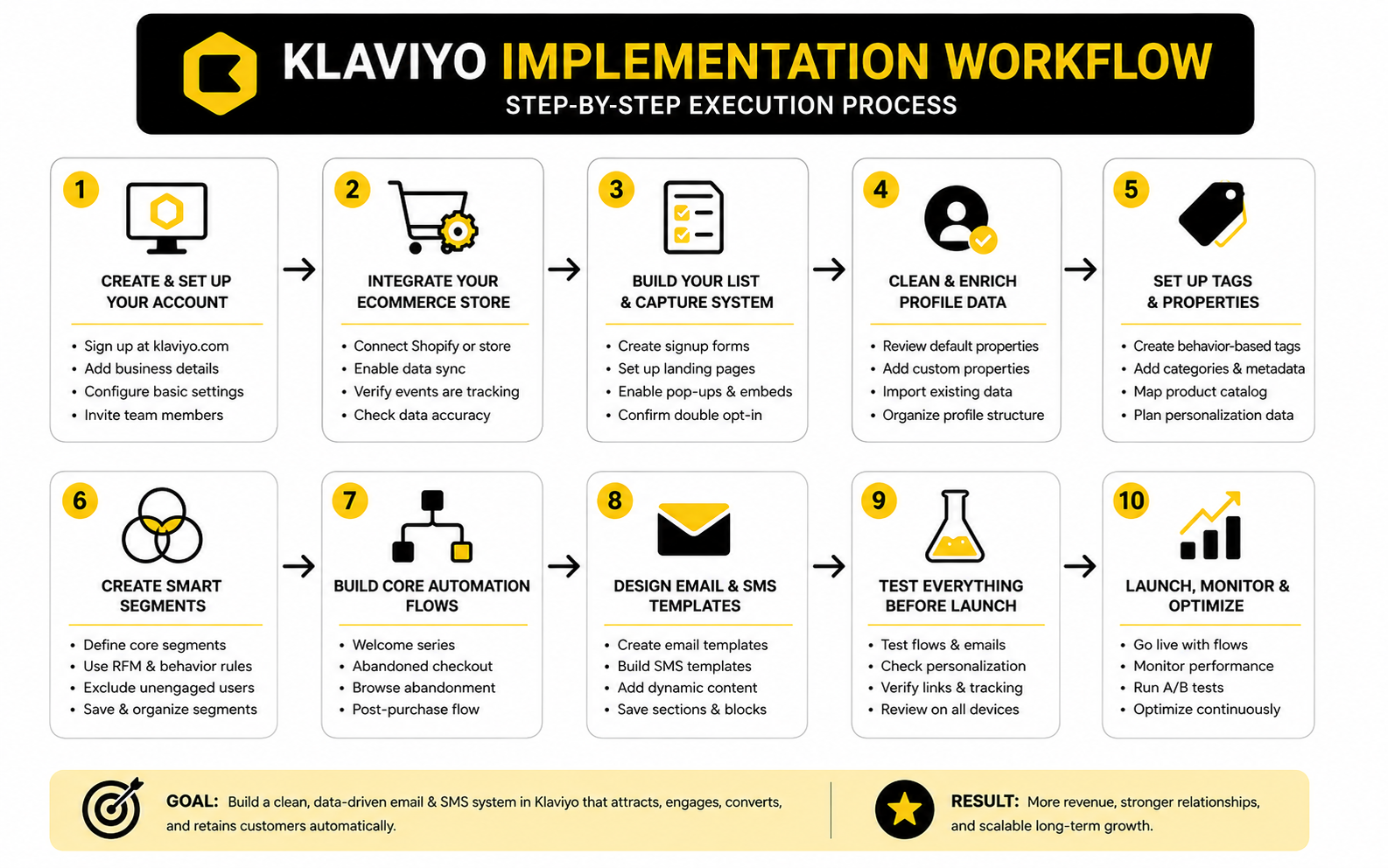
A practical execution process looks like this:
This order matters because each step depends on the one before it. If the integration is wrong, your segments will be wrong. If consent is messy, your sending strategy becomes risky. If reporting is unclear, you will not know whether your improvements are real.
Configure Deliverability Early
Deliverability should be handled before the account starts sending aggressively. Klaviyo’s deliverability guidance recommends strong sending infrastructure, including branded sending domains, email authentication, organic list acquisition, and healthy engagement practices through its email deliverability best practices reference. That is not optional housekeeping. It is the difference between messages reaching inboxes and campaigns slowly losing power.
A branded sending domain is especially important for brands that want their emails to appear as coming from their own domain rather than Klaviyo’s shared sending infrastructure. Klaviyo’s setup guide explains that a branded sending domain helps inbox providers associate sending reputation with the brand. That gives the brand more control, but it also means the brand has to protect that reputation.
Warming also matters when moving from another email service provider or increasing send volume. You do not want to dump a large list into a new setup and blast everyone immediately. Start with engaged subscribers, keep volume controlled, and let positive engagement build before expanding to colder audiences.
Create Segments That Support Real Decisions
Segments should not exist just because the platform allows them. They should support sending decisions, testing decisions, or reporting decisions. A segment that never changes a message, audience, cadence, or analysis is probably clutter.
The core segment set should cover engagement, customer stage, purchase behavior, and risk. That usually includes engaged email subscribers, unengaged subscribers, recent purchasers, first-time purchasers, repeat purchasers, high-value customers, category buyers, subscribers with no purchase, and customers who should be excluded from certain promotions. These groups give the team enough structure to send more carefully without creating an impossible maintenance burden.
Klaviyo’s segment logic can use profile properties, events, predictive data, list membership, consent status, and purchase history. That depth is useful, but it should be used with discipline. The best segments are easy to explain in plain English and tied to a clear action.
Build The Essential Flows First
Flows are where Klaviyo com usually creates the most consistent value. Klaviyo’s own getting-started guidance recommends prioritizing a welcome series, abandoned cart flow, post-purchase flow, and winback flow through its flows setup guide. That is a sensible starting point because those flows cover the biggest lifecycle moments: joining, considering, buying, and drifting away.
The welcome flow should introduce the brand, set expectations, and guide the subscriber toward a first meaningful action. The abandoned checkout or cart flow should address hesitation, answer common objections, and make it easy to complete the purchase. The post-purchase flow should help the customer succeed with the product, reduce buyer’s remorse, and create a natural path toward the next purchase.
The winback flow should be handled carefully. If it fires too soon, it feels desperate. If it fires too late, the customer may already be gone. The right timing depends on the buying cycle, product category, and historical repeat purchase behavior.
Use Campaigns To Support The Calendar, Not Replace Strategy
Campaigns are still important, but they should not become the whole Klaviyo strategy. A campaign calendar gives structure to launches, promotions, content, seasonal moments, product education, and inventory pushes. The mistake is using campaigns as a substitute for lifecycle marketing.
A practical campaign system starts with a simple planning rhythm. Decide what the business needs to communicate, who should receive it, why they should care, and what action the message should create. Then choose the segment, channel, offer, creative, and send time based on that goal.
Campaigns should also respect suppression logic. Recent purchasers may need a different message than prospects. Unengaged subscribers may need fewer sends or a re-engagement path. VIP customers may deserve early access instead of the same generic sale announcement everyone else receives.
Build Templates For Speed And Consistency
Templates matter because they protect brand consistency and reduce production time. A good template system gives the team flexible blocks for product launches, sale announcements, educational content, founder notes, replenishment reminders, review requests, and post-purchase support. The goal is not to make every email look identical; the goal is to make good execution repeatable.
Templates should be easy to edit without breaking mobile design. They should have clear hierarchy, readable copy, obvious calls to action, and enough spacing to avoid feeling cramped. A beautiful email that is hard to update will eventually become a bottleneck.
This is also where landing page quality enters the conversation. If the email is strong but the destination page is weak, the campaign leaks revenue after the click. For ecommerce teams that need faster product pages or campaign landing pages, tools like Replo can fit naturally around Klaviyo campaigns when the goal is turning traffic into a focused buying experience.
Test Before Anything Goes Live
Testing is not glamorous, but it saves accounts from embarrassing mistakes. Every flow should be checked for trigger logic, filters, timing, links, coupons, dynamic blocks, personalization, mobile rendering, unsubscribe behavior, and exclusions. Every campaign should be previewed, tested, and reviewed before it reaches the audience.
You also need to test the customer path, not just the email. Click the links. Visit the product page. Try the discount. Check the checkout experience. Make sure the message, offer, landing page, and purchase path all line up.
This is where many teams skip steps because the deadline is close. Do not do that. A rushed send can burn trust, confuse customers, and create support tickets that cost more than the campaign was supposed to make.
Document The Account So It Can Scale
A Klaviyo account should not depend entirely on one person’s memory. Naming conventions, segment definitions, flow logic, campaign rules, consent sources, offer rules, and reporting assumptions should be documented. This makes the account easier to manage, audit, hand off, and improve.
Documentation does not need to be complicated. A simple internal guide can explain how lists are used, how segments are named, which flows are live, what each flow is supposed to do, and how campaigns are planned. The point is to make the system understandable to the next person who has to work inside it.
This becomes more important as the brand grows. More campaigns, more products, more customer types, more markets, and more channels all increase complexity. Good documentation keeps the account from turning into a maze.
Statistics And Data That Actually Matter
The numbers inside Klaviyo com are only useful if they lead to better decisions. A dashboard full of opens, clicks, orders, revenue, unsubscribes, and deliverability signals can look impressive, but it can also hide the real problem. The job is not to collect more metrics. The job is to understand what each metric is telling you and what action it should trigger.
Klaviyo’s own benchmark data is useful because it separates campaigns from flows and shows how differently they behave. In its email benchmark reporting, Klaviyo notes that campaigns can drive most send volume while flows can generate a much larger share of revenue efficiency, with flows producing nearly 41% of total email revenue from just 5.3% of sends. That is a big deal because it proves a practical point: timing and relevance often beat volume.
This does not mean campaigns are bad. Campaigns still matter for launches, promotions, seasonal pushes, content, and announcements. It means you should judge campaigns and flows differently because they do different jobs.
The Measurement System Should Match The Customer Journey
A clean measurement system starts by separating lifecycle stages. New subscriber performance is not the same as first-purchase conversion. First-purchase conversion is not the same as repeat purchase behavior. Repeat purchase behavior is not the same as winback performance.
That is why the analytics setup should follow the customer journey. You want to see how people move from signup to first click, from first click to first purchase, from first purchase to second purchase, and from repeat purchase to long-term value. If every report is treated as one big blended average, the useful signals disappear.
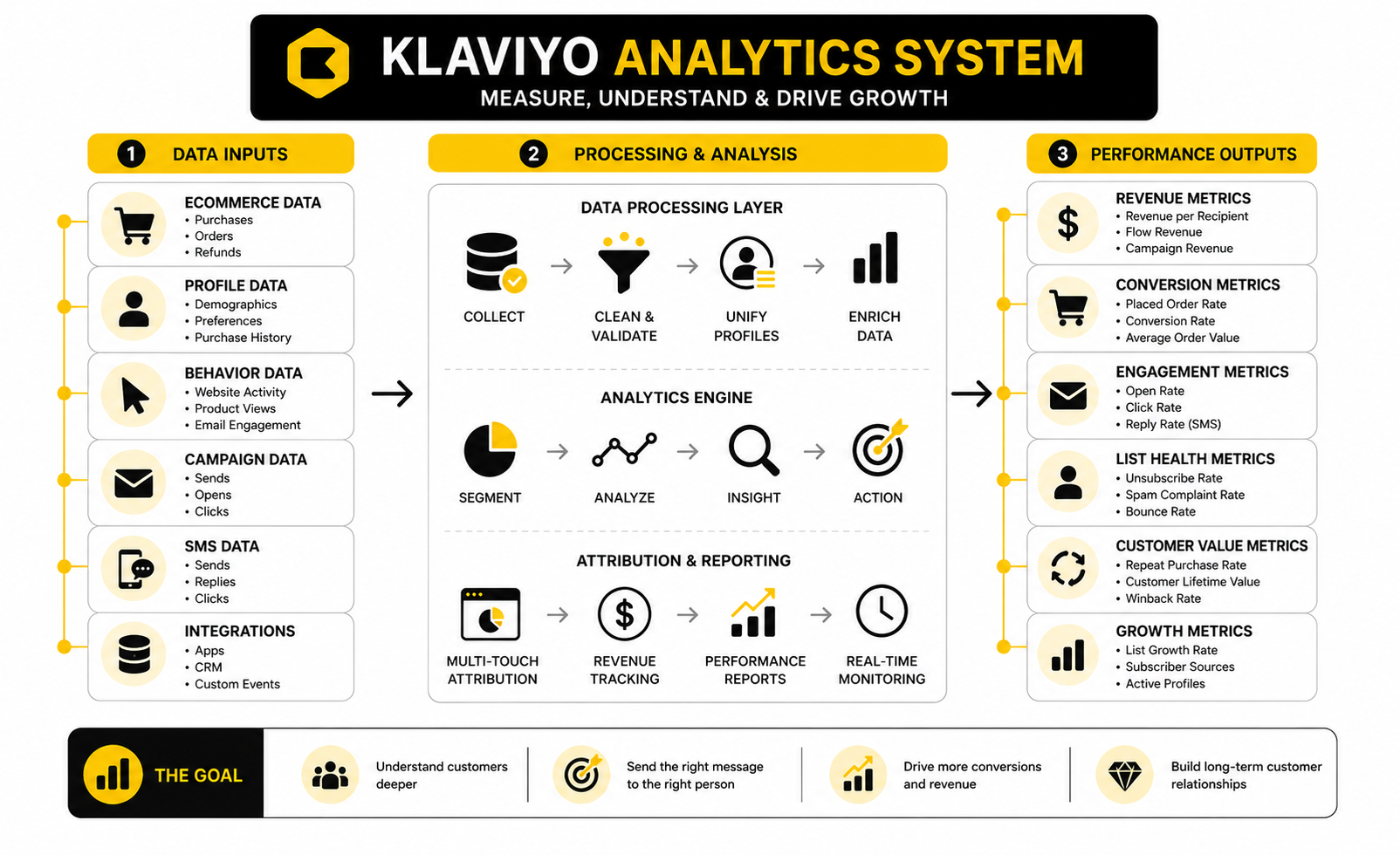
A practical Klaviyo measurement system should answer five questions:
Those questions keep the team focused. They also prevent the classic mistake of celebrating short-term attributed revenue while ignoring long-term damage to deliverability, margin, and customer trust.
Open Rates Are Diagnostic, Not The Goal
Open rates can help you spot directional changes, but they should not be treated as the main performance metric. Privacy features, inbox behavior, image loading, bot activity, and tracking limitations can all affect how opens are counted. A high open rate can still produce weak sales if the message does not create action.
That does not make opens useless. If open rates suddenly drop across engaged segments, you may have a subject line problem, a deliverability problem, a sending reputation problem, or a relevance problem. If one campaign opens strongly but earns weak clicks, the subject line may have created curiosity that the content failed to satisfy.
The right action is to use open rate as an early warning signal. Watch it by segment, campaign type, flow, and sending domain. Then look at clicks, orders, revenue per recipient, unsubscribe rate, and spam complaints before deciding what actually happened.
Click Rates Show Message Relevance
Click rate is often a stronger signal than open rate because it shows that someone moved from passive attention to active interest. Klaviyo’s benchmark data says email flows deliver over 3x higher click rates than campaigns, which makes sense because flows are triggered by behavior. A cart abandonment message is naturally more relevant than a generic sale email because the customer has already shown intent.
A low click rate does not always mean the offer is bad. It might mean the audience is too broad, the message is unclear, the creative hierarchy is weak, the product selection is wrong, or the call to action is buried. It can also mean the email is trying to do too many things at once.
The fix is not always “write a better subject line.” Sometimes the fix is tighter segmentation, a more obvious product angle, clearer copy, better creative, or a landing page that matches the promise of the email. Click rate tells you where to investigate, not exactly what to change.
Revenue Per Recipient Helps Compare Sends Fairly
Revenue per recipient is one of the most useful Klaviyo metrics because it normalizes performance across different audience sizes. A campaign sent to 200,000 people can generate more total revenue than a campaign sent to 20,000 people, but that does not mean it was more efficient. Revenue per recipient helps you compare how valuable each send was relative to the audience reached.
This is especially useful when comparing flows, campaigns, segments, and product categories. A smaller VIP segment may generate far more revenue per recipient than a huge general list. A replenishment flow may look small in total revenue but perform extremely well against the number of people who actually enter it.
Do not use revenue per recipient in isolation, though. A send can produce high revenue per recipient because it used a deep discount, targeted only people who were already ready to buy, or hit a small audience during a launch. The smart move is to read RPR alongside margin, conversion rate, order value, and customer stage.
Placed Order Rate Shows Whether Attention Became Revenue
Placed order rate tells you how many recipients ended up buying after receiving a message, based on the attribution settings used in the account. Klaviyo’s benchmark reporting highlights that flow-based email can produce placed order rates far above campaign email because the messages are behavior-based and better timed. That difference should change how you prioritize work.
If a flow has healthy opens and clicks but weak placed order rate, the issue may be after the click. The product page may not match the message. The offer may be unclear. Shipping costs, payment options, reviews, inventory, or checkout friction may be blocking conversion.
This is where ecommerce teams need to stop blaming email for everything. Klaviyo can bring the customer back to the store, but the store still has to close the sale. If landing pages are the bottleneck, improving campaign pages with a tool like Replo can be more valuable than rewriting the same email five times.
Attribution Needs Rules, Not Blind Trust
Attribution is useful, but it is not the same as truth. Klaviyo lets brands configure message attribution settings, including lookback windows and filtering rules through its message attribution settings. Those settings matter because a longer attribution window will usually assign more revenue to email and SMS than a shorter one.
This is why you should document your attribution settings before comparing performance over time. If the lookback window changes, the revenue numbers may change even if customer behavior does not. If Apple Privacy opens or bot clicks are treated differently, engagement and attribution can shift.
The right mindset is simple: attribution is a model. Use it consistently, understand its assumptions, and do not let it replace business judgment. When in doubt, compare directional trends, run controlled tests where possible, and look at customer-level behavior instead of trusting one dashboard number.
Deliverability Metrics Protect The Whole System
Deliverability is not a side metric. It is the infrastructure that allows every campaign and flow to work. If inbox placement declines, even great copy and strong offers will underperform because fewer people will actually see the message.
The most important signals are bounce rate, spam complaint rate, unsubscribe rate, engagement by segment, sending volume changes, domain reputation, and performance differences across inbox providers. Klaviyo’s deliverability guidance emphasizes practices like authenticated sending, organic list growth, engagement-based sending, and avoiding sudden volume spikes through its deliverability best practices. These are not cosmetic settings. They directly affect revenue.
A rising unsubscribe rate is not always a disaster if the campaign intentionally reached a broader or colder audience. A rising spam complaint rate is more serious because it tells inbox providers that recipients did not just ignore the email; they objected to it. That should trigger immediate review of consent sources, audience selection, frequency, and message relevance.
SMS Metrics Need A Different Standard
SMS should not be judged exactly like email. It is more immediate, more interruptive, and usually more expensive per send. That means the tolerance for weak targeting is lower.
For SMS, the most important signals are revenue per recipient, click rate, conversion rate, unsubscribe rate, opt-in growth, compliance health, and campaign frequency. If SMS drives strong short-term revenue but also creates high opt-outs, the brand may be borrowing from future performance. That tradeoff needs to be visible.
Klaviyo’s broader business updates show that cross-channel adoption is increasing, with the company reporting that 29.6% of SMB+ customers used text messaging and WhatsApp by the end of fiscal year 2025. That growth makes sense, but it also raises the bar. More channels only help if the customer experience gets better, not louder.
Benchmarks Are Useful, But Context Wins
Benchmarks help you see whether performance is roughly healthy, weak, or unusually strong. They are especially useful when comparing your account against similar brands, industries, and send types. Klaviyo’s benchmark reporting is based on performance data from more than 183,000 Klaviyo customers, which makes it a useful reference point for ecommerce teams.
But benchmarks are not your strategy. A luxury skincare brand, a subscription coffee brand, a fast-fashion store, and a high-ticket electronics brand should not expect the same buying behavior. Purchase frequency, margin, product complexity, discounting, seasonality, and customer intent all affect what “good” looks like.
Use benchmarks as a compass, not a verdict. If your account is far below the benchmark, investigate the basics first. If your account is above the benchmark, do not get lazy. The real question is whether your own numbers are improving in a way that supports profitable growth.
The Best Reports Lead To Specific Actions
A useful report does not just say what happened. It tells the team what to do next. If engaged subscribers are converting but cold subscribers are dragging down deliverability, the action is to tighten audience selection. If abandoned checkout clicks are strong but orders are weak, the action is to inspect checkout friction. If post-purchase emails get engagement but no repeat purchase lift, the action is to improve timing, product logic, or the next-purchase offer.
This is the practical reporting rhythm:
That last point matters most. Data without action is decoration. A Klaviyo com account gets stronger when the team uses measurement to make better decisions every week, not when they screenshot dashboards and call it strategy.
Optimization, Reporting, AI, And Scaling Decisions
Once the foundation is working, Klaviyo com becomes a strategy problem more than a setup problem. The question changes from “Can we send this?” to “Should we send this, to whom, through which channel, and what should happen next?” That is where stronger brands separate themselves from teams that just keep adding more campaigns.
Scaling does not mean increasing volume forever. It means increasing precision, profit, retention, and operational control. A mature Klaviyo account should make the customer journey feel more relevant while making the internal workflow easier to manage.
This is where advanced features, AI, multi-channel messaging, and deeper integrations can help. But they only help when the brand already has clean data, strong consent practices, sensible segments, and a measurement system that tells the truth. Otherwise, advanced tools just accelerate weak decisions.
Use AI As Leverage, Not As A Replacement For Strategy
Klaviyo has been moving heavily toward AI-assisted marketing. Its K:AI positioning includes campaign creation, customer support, personalization, and workflow automation, with tools like Composer for generating campaigns and flows from a prompt and Customer Agent for service and selling support. That is useful, but it does not remove the need for human judgment.
AI can help with drafts, audience suggestions, creative variations, send-time optimization, and customer service workflows. It can also make bad marketing faster if the brief is weak. If the brand positioning is unclear, the offer is lazy, or the segmentation logic is wrong, AI will not magically create a better commercial strategy.
The practical rule is simple: let AI speed up execution, but keep humans responsible for the offer, audience, timing, compliance, and brand voice. AI should help the team move faster through good decisions. It should not become a shortcut around thinking.
Personalization Has To Be Earned
Personalization sounds impressive, but most brands overuse the word. Adding a first name to a subject line is not serious personalization. Real personalization uses behavior, customer stage, product interest, purchase history, predicted needs, and channel preference to make the message more useful.
The strongest personalization in Klaviyo com usually starts with simple logic. A first-time buyer gets different education than a repeat buyer. A replenishment customer gets timing based on product usage. A VIP customer receives early access or better treatment. A category browser sees products that match demonstrated interest.
The risk is over-personalizing before the data is trustworthy. If product feeds are messy, category tags are inconsistent, or customer events are incomplete, personalization can become awkward fast. It is better to use a few reliable personalization rules than a complicated system nobody can audit.
Multi-Channel Growth Creates New Tradeoffs
Email, SMS, WhatsApp, RCS, and push messaging can all fit into a modern retention system. Klaviyo’s public company reporting shows cross-channel adoption increasing, with 29.6% of SMB+ customers using text messaging and WhatsApp at the end of fiscal year 2025. That trend makes sense because brands want more ways to reach customers outside paid ads.
But more channels also create more ways to annoy people. SMS feels more personal than email, so weak targeting hurts more. WhatsApp and RCS can support richer interactions, but they still need a strong reason to exist in the customer journey.
A good channel strategy starts with role clarity. Email is usually better for depth, storytelling, education, and product discovery. SMS is better for urgency, reminders, time-sensitive offers, and short updates. Richer messaging formats should be used when interactivity, verification, or visual context improves the customer experience.
Frequency Management Becomes A Scaling Problem
Early-stage brands often under-send because they are afraid of bothering people. Growing brands often overcorrect and start sending too much because the dashboard rewards short-term attributed revenue. The mature approach is more careful: send more to people who show intent, send less to people who show fatigue, and suppress people who should not receive a message at all.
Frequency management should be based on engagement, customer stage, purchase recency, channel consent, and campaign importance. A highly engaged subscriber who browsed yesterday can probably handle more communication than someone who has not opened, clicked, or purchased in months. A recent buyer may need onboarding instead of another discount push.
This is where smart exclusion logic matters. Campaigns should not accidentally collide with active flows in a way that creates a bad customer experience. A person in a post-purchase education flow should not necessarily receive an aggressive winback offer two days after buying. The account needs rules that protect the journey.
Discount Strategy Can Quietly Damage The Business
Klaviyo can make discounts easy to deliver, but that does not mean every message should lead with one. Discounts can lift short-term conversion, but they can also train customers to wait, reduce margin, and weaken brand perception. A revenue dashboard may celebrate the sale while the finance side absorbs the damage.
The better approach is to match incentive strength to customer behavior. A high-intent cart abandoner may need reassurance more than a bigger discount. A loyal VIP may respond better to early access than a coupon. A cold subscriber might need a compelling reason to re-engage, but even then, the discount should be measured against margin and future value.
This is especially important for automated flows. A discount hidden inside every flow can slowly become the brand’s default conversion strategy. Before adding incentives, test whether better copy, stronger product education, social proof, shipping clarity, or timing can solve the problem.
Data Governance Becomes More Important As The Account Grows
The bigger the Klaviyo account gets, the more governance matters. More forms, more integrations, more properties, more flows, and more team members create more opportunities for confusion. Without clear rules, the account slowly fills with duplicate segments, unclear properties, abandoned tests, outdated templates, and flows nobody wants to touch.
Klaviyo’s trust materials state that the platform supports privacy and compliance workflows for areas like GDPR and CCPA, including profile consent management and rights request tooling through its trust and privacy documentation. That helps, but the brand still has to operate responsibly. A tool can support compliance; it cannot make all business decisions for you.
Governance should cover naming conventions, who can publish campaigns, how forms are created, how profile properties are added, how tests are documented, and how old assets are retired. This sounds boring until the account breaks. Then everyone suddenly wishes the boring work had been done earlier.
Integrations Should Reduce Friction, Not Create Noise
Klaviyo has a broad integration ecosystem, and its platform materials reference 350+ integrations and APIs. That is valuable because ecommerce marketing touches many systems: store platform, landing pages, reviews, loyalty, subscriptions, shipping, help desk, ads, quizzes, forms, and analytics. The right integrations give the account better context and more useful triggers.
The wrong integrations create clutter. Not every app needs to dump data into Klaviyo. Not every quiz answer needs to become a permanent profile property. Not every event deserves a flow. If the team cannot explain how a data point will improve segmentation, personalization, reporting, or service, it probably does not need to be there.
For example, a quiz or form tool can be useful if it captures buying intent cleanly. A landing page tool can be useful if campaigns need focused conversion paths. A support integration can be useful if service data changes how customers should be messaged. The test is always practical: will this integration help us make better decisions or just add more fields?
When Klaviyo Starts Getting Expensive
Klaviyo pricing scales with profiles, email volume, SMS usage, and plan needs, so cost becomes a serious consideration as the list grows. This is not automatically a problem. A tool can be expensive and still be profitable if it helps generate incremental revenue, protect retention, and reduce manual work.
The problem starts when the account pays for bloated, unengaged profiles that do not create value. A large list looks good in a vanity report, but inactive subscribers can hurt deliverability and increase platform costs. Regular list cleaning, sunset flows, suppression rules, and engagement-based sending are not just deliverability tactics; they are cost-control tactics.
The right question is not “Is Klaviyo expensive?” The right question is “Are we using Klaviyo profitably?” If the account drives repeat purchase, reduces dependency on paid acquisition, and supports lifecycle revenue with healthy margins, the cost can make sense. If it is just a campaign blaster with poor hygiene, the economics get ugly fast.
Migration Requires More Than Moving Contacts
Switching to Klaviyo from another email service provider should be treated as a migration project, not a copy-paste job. Contacts, consent, suppression lists, engagement history, templates, automations, forms, attribution settings, sending domains, and ecommerce events all need attention. Moving the list is the easy part.
The real risk is losing context. If purchase history does not sync correctly, lifecycle flows will be weaker. If suppression data is missed, the brand may contact people it should not contact. If old engagement data is ignored, the warmup strategy may become too aggressive.
A smart migration starts with an audit. Decide what should be moved, what should be rebuilt, what should be deleted, and what should be improved. Do not recreate a broken account inside a better platform.
Enterprise Scaling Needs Clear Ownership
As the brand grows, Klaviyo often moves from being owned by one marketer to being touched by multiple teams. Ecommerce, lifecycle marketing, design, copy, analytics, customer support, paid media, and leadership may all care about what happens in the account. That creates more opportunity, but also more risk.
Clear ownership prevents chaos. Someone needs final responsibility for segmentation rules, campaign approvals, deliverability, reporting definitions, flow changes, and customer experience. Without that ownership, every team optimizes for its own goal and the customer gets the messy result.
This is also where permissions matter. Not every user should have the ability to publish, delete, export, or change critical flows. A mature Klaviyo com account should be managed like an important revenue system, because that is what it is.
The Expert Move Is Knowing What Not To Build
Advanced operators are not impressive because they build the most complicated Klaviyo accounts. They are impressive because they know what to ignore. They avoid pointless segments, unnecessary branches, weak tests, excessive discounts, bloated templates, and channels that do not improve the customer journey.
The best accounts often feel simple from the outside. Customers receive timely, relevant messages. The team can explain what each flow does. Reports lead to decisions. Campaigns have a clear audience and purpose. Nothing feels random.
That is the standard. Klaviyo com should help the brand become sharper, not noisier. As the article moves into the final section, the most useful question is no longer whether Klaviyo can do something. It usually can. The better question is whether doing it will make the business stronger.
Klaviyo Com FAQs, Alternatives, And Final Recommendations
By this point, the pattern should be clear. Klaviyo com is strongest when it is treated as a customer data and lifecycle marketing system, not just another place to send emails. The platform can support simple campaigns, but its real value comes from connecting behavior, consent, segmentation, automation, reporting, and multi-channel communication into one controlled system.
The final decision is not whether Klaviyo is powerful. It clearly is. The better decision is whether the brand has enough ecommerce data, repeat purchase potential, team discipline, and implementation quality to use that power well.
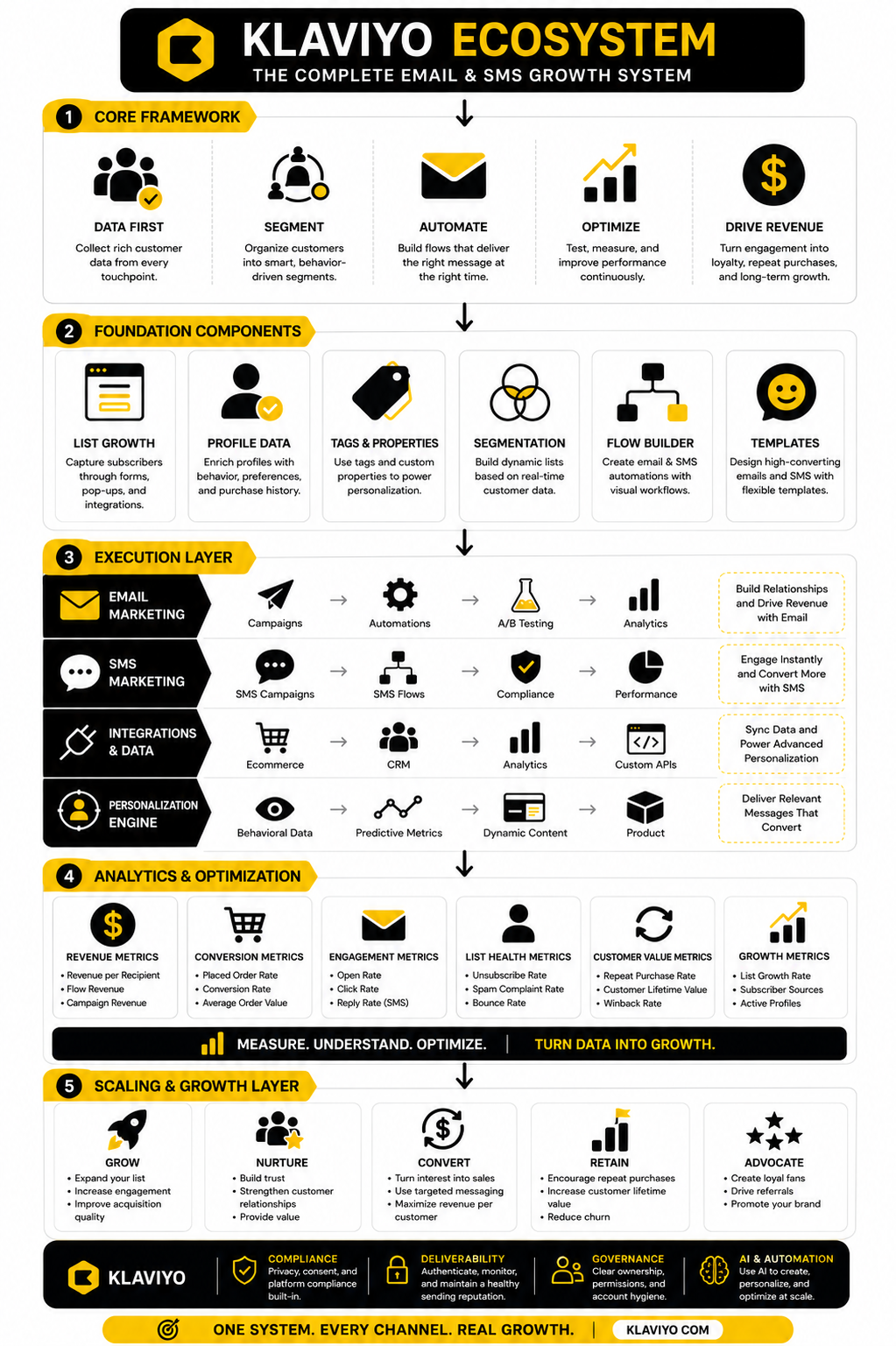
For brands that are serious about retention, Klaviyo can become one of the most important tools in the stack. But it should sit inside a larger ecosystem that includes strong product pages, clear offers, customer support, analytics, landing pages, and operational ownership. Email and SMS can drive revenue, but they work best when the whole customer experience supports the message.
How To Decide If Klaviyo Is The Right Fit
Klaviyo is usually a strong fit for ecommerce brands that have meaningful traffic, repeat purchase potential, and enough customer behavior to make segmentation useful. If your store has multiple products, different customer stages, seasonal campaigns, abandoned carts, replenishment cycles, product education needs, or VIP customer groups, Klaviyo com gives you the structure to act on those signals. It becomes especially useful when email and SMS need to work from the same customer profile instead of separate tools.
It may be too much for a business that only needs occasional newsletters. A tiny list, one simple offer, no ecommerce events, and no real lifecycle strategy may not justify the setup effort or scaling cost. In that case, a simpler email platform may be enough until the business has more customer data to work with.
The practical test is simple. If better segmentation, flows, attribution, and customer behavior tracking would change how you market, Klaviyo deserves serious consideration. If you would use it only to send the same email to everyone, you are not using the platform for what it is built to do.
When To Consider Alternatives
Alternatives make sense when the business model does not match Klaviyo’s strengths. Service businesses, agencies, coaches, local businesses, and sales-led companies may need pipeline management, appointment workflows, client follow-up, and CRM automation more than ecommerce lifecycle messaging. In that world, a platform like GoHighLevel can make more sense because it is built around funnels, CRM, automation, booking, and agency-style client workflows.
Creators and lean digital businesses may also prefer simpler funnel or email systems if they do not need deep ecommerce segmentation. Systeme.io can fit businesses that want funnels, email, courses, and automations in a simpler package. ClickFunnels can fit teams that are focused more on funnel building than ecommerce customer data.
There are also lighter email options for brands that want campaigns and automation without the same depth. Brevo and Moosend may be worth comparing when the main need is straightforward email marketing rather than a full ecommerce CRM and lifecycle engine.
Final Recommendation
Use Klaviyo if your brand has enough customer behavior to make lifecycle marketing worthwhile. That means you are not just sending promotions. You are building a system that welcomes subscribers, converts browsers, recovers checkout intent, supports buyers, encourages repeat purchases, protects deliverability, and measures performance with discipline.
Do not use Klaviyo as a shortcut. It will not fix weak positioning, bad merchandising, poor landing pages, unclear offers, or lazy list growth. It will amplify the quality of the system around it, which is great when the fundamentals are strong and painful when they are not.
The best version of Klaviyo com is not a crowded account full of complicated branches. It is a clean, practical, revenue-focused system where every list, segment, flow, campaign, report, and integration has a job. Build that, and the platform can become a serious owned-growth asset.
What Is Klaviyo Com?
Klaviyo com is the main website for Klaviyo, a B2C CRM and marketing automation platform used heavily by ecommerce brands. It brings together customer profiles, email, SMS, automation, segmentation, forms, analytics, and integrations. The main value is that brands can use customer behavior and purchase data to send more relevant messages across the customer journey.
Is Klaviyo Only For Email Marketing?
No, Klaviyo is not only for email marketing. Email is still one of its core channels, but the platform also supports SMS, mobile push, WhatsApp, RCS, customer profiles, AI tools, analytics, and ecommerce integrations. The broader direction is toward a customer data and engagement platform rather than a simple email sender.
Is Klaviyo Good For Shopify Stores?
Yes, Klaviyo is often a strong fit for Shopify stores because ecommerce events can sync into Klaviyo and power behavior-based messaging. That makes it easier to build abandoned checkout flows, post-purchase flows, winback sequences, product recommendations, and customer segments based on real store behavior. The value depends on clean setup, strong consent capture, and thoughtful lifecycle strategy.
How Does Klaviyo Use Customer Data?
Klaviyo uses customer data through profiles, events, properties, ecommerce activity, consent status, engagement signals, and connected integrations. That data can be used to build segments, trigger flows, personalize content, suppress the wrong audiences, and measure performance. The platform becomes more useful when the data is accurate and tied to clear marketing decisions.
What Are Klaviyo Flows?
Klaviyo flows are automated journeys triggered by customer behavior, list signup, segment entry, dates, or ecommerce events. Common flows include welcome series, abandoned checkout, browse abandonment, post-purchase, replenishment, winback, review request, and VIP flows. The best flows are not just reminders; they guide the customer toward the next useful step.
What Is The Difference Between Lists And Segments In Klaviyo?
Lists are usually stable groups, such as email subscribers or SMS subscribers. Segments are dynamic groups that update automatically based on rules, such as recent buyers, engaged subscribers, VIP customers, inactive profiles, or people interested in a specific product category. In most Klaviyo accounts, lists handle consent and broad subscription structure, while segments handle targeting and personalization.
How Much Does Klaviyo Cost?
Klaviyo pricing depends on active profiles, email sends, SMS usage, and plan needs. Its public pricing page shows a free starting option and paid plans that scale as the account grows through the official Klaviyo pricing page. The important question is not just monthly cost, but whether the account is driving profitable incremental revenue and keeping inactive profiles under control.
Is Klaviyo Worth It For Small Businesses?
Klaviyo can be worth it for small ecommerce businesses if they have enough traffic, subscribers, and purchase behavior to benefit from automation and segmentation. A small store with repeat purchase potential can get real value from welcome flows, abandoned checkout recovery, and post-purchase messaging. A small business that only needs a basic newsletter may be better off starting with a simpler tool.
What Metrics Should I Watch In Klaviyo?
The most important Klaviyo metrics include revenue per recipient, placed order rate, click rate, unsubscribe rate, spam complaint rate, bounce rate, deliverability trends, flow revenue, campaign revenue, repeat purchase behavior, and customer lifetime value. Open rate can be useful as a diagnostic signal, but it should not be treated as the final measure of success. The real goal is profitable customer action without damaging list health.
How Often Should I Send Campaigns In Klaviyo?
There is no universal sending frequency that works for every brand. The right cadence depends on product category, list engagement, customer stage, seasonality, content quality, and how often the brand has something genuinely useful to say. A mature account sends more often to engaged and high-intent segments while reducing frequency for cold or fatigued subscribers.
Does Klaviyo Replace A CRM?
For ecommerce and B2C lifecycle marketing, Klaviyo can function like a customer data and engagement CRM. It stores customer profiles, events, engagement, purchase history, consent, segments, and message performance. For sales-led B2B pipelines, deal management, or agency client workflows, a traditional CRM or a platform like GoHighLevel may still be a better operational fit.
Does Klaviyo Have AI Features?
Yes, Klaviyo has been expanding AI features across marketing, analytics, customer support, and campaign creation. Its newer AI direction includes tools that help generate campaigns and flows, support customer interactions, and use real-time customer context. These features can speed up execution, but they still depend on clear strategy, clean data, strong offers, and human review.
What Are The Biggest Klaviyo Mistakes?
The biggest mistakes are treating Klaviyo like a newsletter tool, sending too broadly, ignoring consent, skipping deliverability setup, building too many useless segments, overusing discounts, and trusting attribution without context. Another common mistake is launching advanced automation before the basic flows, data sync, and reporting are working properly. The fix is to build the account in layers and make every piece serve a clear purpose.
Can Klaviyo Help With SMS Marketing?
Yes, Klaviyo can support SMS marketing alongside email, which helps brands coordinate messaging from the same customer profile. SMS should be used carefully because it is more immediate and personal than email. It works best for urgent updates, reminders, time-sensitive offers, and high-intent moments rather than constant promotional noise.
What Should I Build First In Klaviyo?
Start with the ecommerce integration, consent capture, branded sending setup, core lists, essential segments, and foundational flows. The usual first flows are welcome, abandoned checkout, post-purchase, and winback. After those are working, improve campaign templates, reporting, personalization, SMS, and advanced lifecycle flows.
Build a stronger local presence with BAAM AI
Turn your website, Google profile, social channels, and AI visibility into one growth engine
Most businesses do not need more random marketing activity. They need a consistent presence system that helps the right people find them, trust them, and take action. BAAM AI brings strategy, local SEO, website updates, Google Maps visibility, social content, AI-search readiness, media production, and reporting into one practical monthly engine.
If you want your marketing to keep working after the campaign ends, start with a free BAAM AI presence audit. See how your business shows up today and where the fastest visibility wins are at BAAM AI.