
BAAM AI Blog
Klaviyo Active Profiles: What They Are, Why They Affect Your Bill, and How to Manage Them Properly
Klaviyo active profiles are one of those settings most brands ignore until the invoice suddenly jumps.
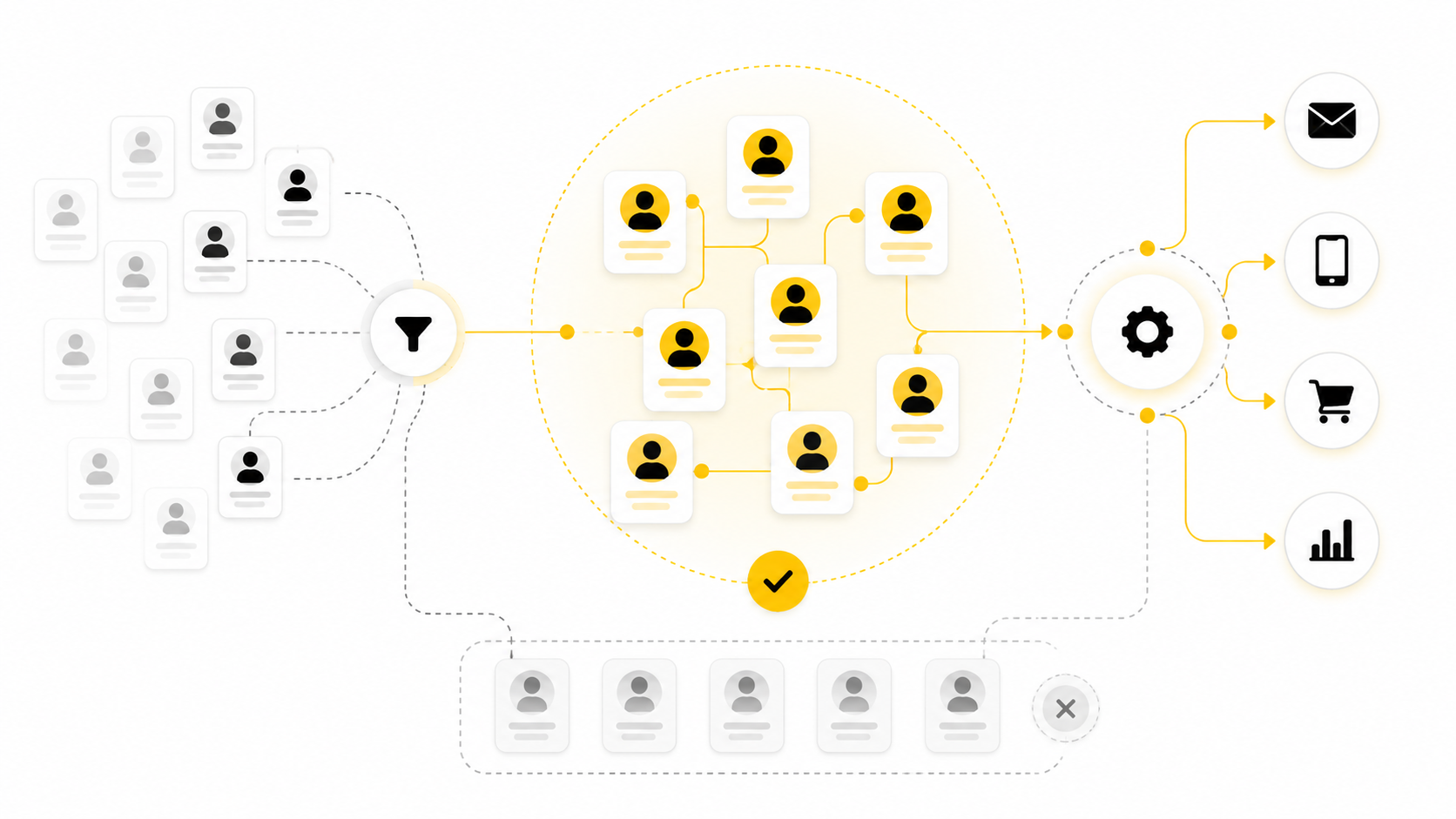
Klaviyo active profiles are one of those settings most brands ignore until the invoice suddenly jumps.
That is the problem. You can have thousands of people sitting inside your Klaviyo account who are not buying, not clicking, not opening, and not responding to your brand at all. But if those profiles can still be emailed, they may still count as active profiles, which means they can affect your Klaviyo plan.
Klaviyo defines active email profiles as profiles that can be emailed through Klaviyo, while suppressed profiles are profiles that cannot receive marketing emails. Klaviyo’s own pricing page also explains that the free tier is limited to 250 active profiles and 500 monthly email sends, which makes active profile count more than a database metric. It is a billing, deliverability, and lifecycle marketing metric all at once.
this guide breaks down Klaviyo active profiles in a practical way. Not as a glossary definition. Not as a generic “clean your list” lecture. We are going to look at what active profiles really mean, why they matter, how they affect cost and performance, and how to build a profile management system that protects revenue instead of blindly deleting contacts.
What Klaviyo Active Profiles Actually Mean
A Klaviyo active profile is not simply someone who opened your last email. It is not the same thing as a subscriber, a buyer, or a high-intent lead either. In Klaviyo’s own help documentation, active profiles are profiles that can be messaged and are not suppressed.
That distinction matters because an ecommerce brand can collect profiles from multiple places. Someone might subscribe through a popup, enter an email at checkout, abandon a cart, place an order, join an SMS list, or get imported from another platform. Some of these people gave clear marketing consent, while others may simply exist in the account because they interacted with the store.
This is why Klaviyo active profiles should be treated as an operational layer, not just a list size number. A big audience looks good in a dashboard, but a bloated active profile count can create hidden costs. If a profile is not generating revenue, not engaging, and not likely to come back, keeping it active may do more harm than good.
Klaviyo’s guidance on active profile management focuses on identifying profiles with long-term inactivity, then suppressing the ones that are unlikely to engage or generate future revenue. That is the key idea. You are not trying to make the list smaller for the sake of it. You are trying to make the reachable audience more accurate.
Why Active Profiles Matter for Cost, Deliverability, and Growth
The first reason Klaviyo active profiles matter is obvious: cost. Klaviyo’s pricing page ties plan limits to active profiles, which means profile growth can push an account into a higher tier even when part of that growth is low-quality or inactive. This is where many brands get frustrated, because their customer database grows faster than their profitable audience.
The second reason is deliverability. Sending campaigns to people who have not engaged for a long time can weaken your sender reputation, reduce inbox placement, and make your strongest customers less likely to see your emails. Email providers watch engagement signals closely, so a “send to everyone” habit usually becomes expensive twice: once in platform cost, and again in lost performance.
The third reason is strategic clarity. If your account says you have 80,000 active profiles, but only 18,000 are realistically reachable and engaged, your marketing forecasts will be distorted. Your revenue per recipient, campaign benchmarks, winback performance, and segmentation decisions all become harder to trust.
Klaviyo’s email benchmark resources are useful because they push marketers to compare performance by metrics like open rate, click rate, order rate, and revenue per recipient. But those metrics only mean something when the audience is clean enough to interpret. A bloated active profile base can make good campaigns look average and bad list hygiene look like a creative problem.
The Klaviyo Active Profile Management Framework
Good profile management starts with a simple question: who should still be reachable?
That sounds basic, but it forces the right conversation. You are no longer asking, “How do we lower the bill?” You are asking, “Which profiles still have a reasonable chance of becoming customers, returning customers, or useful audience members?”
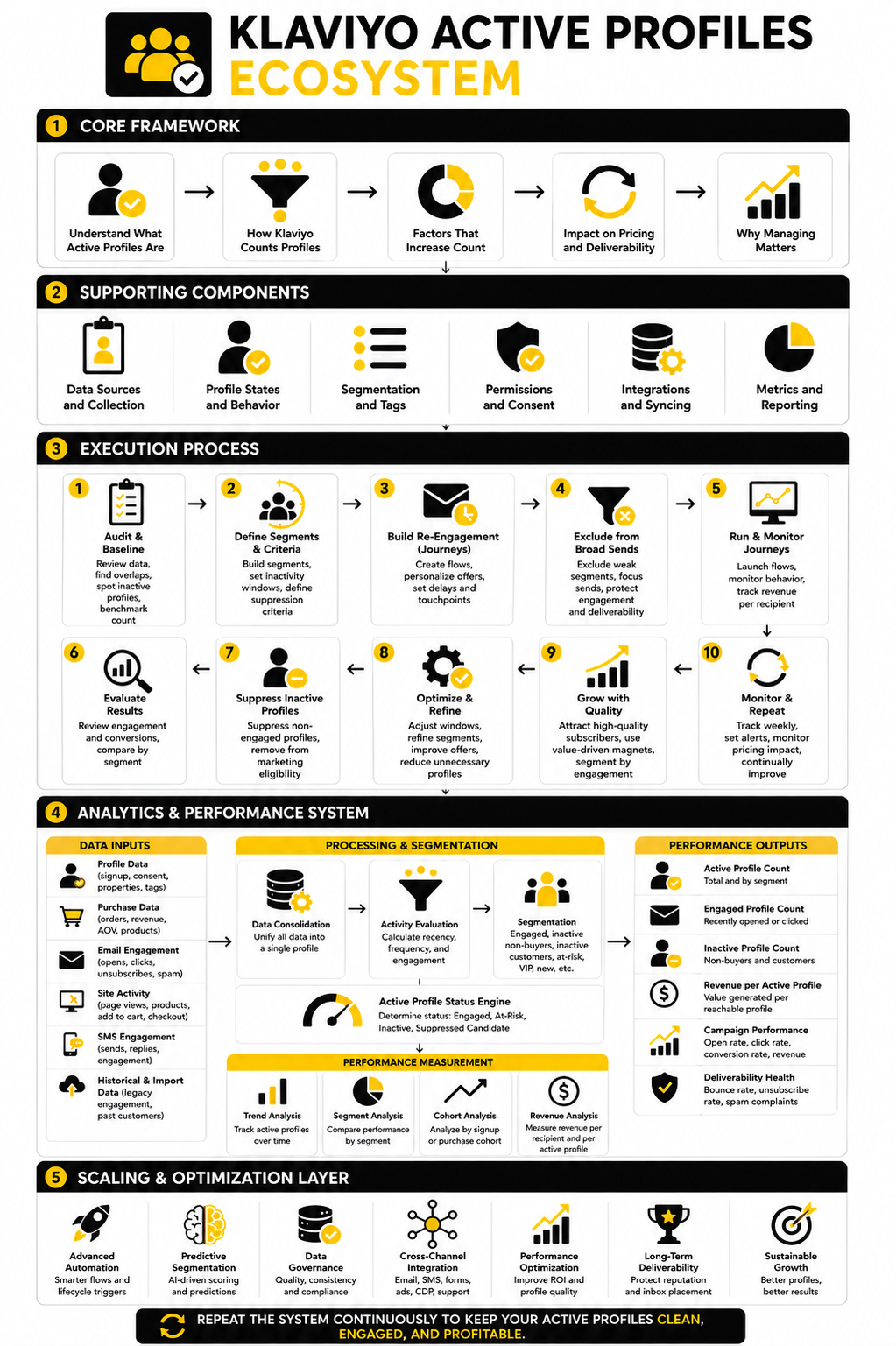
A practical Klaviyo active profiles framework has four layers:
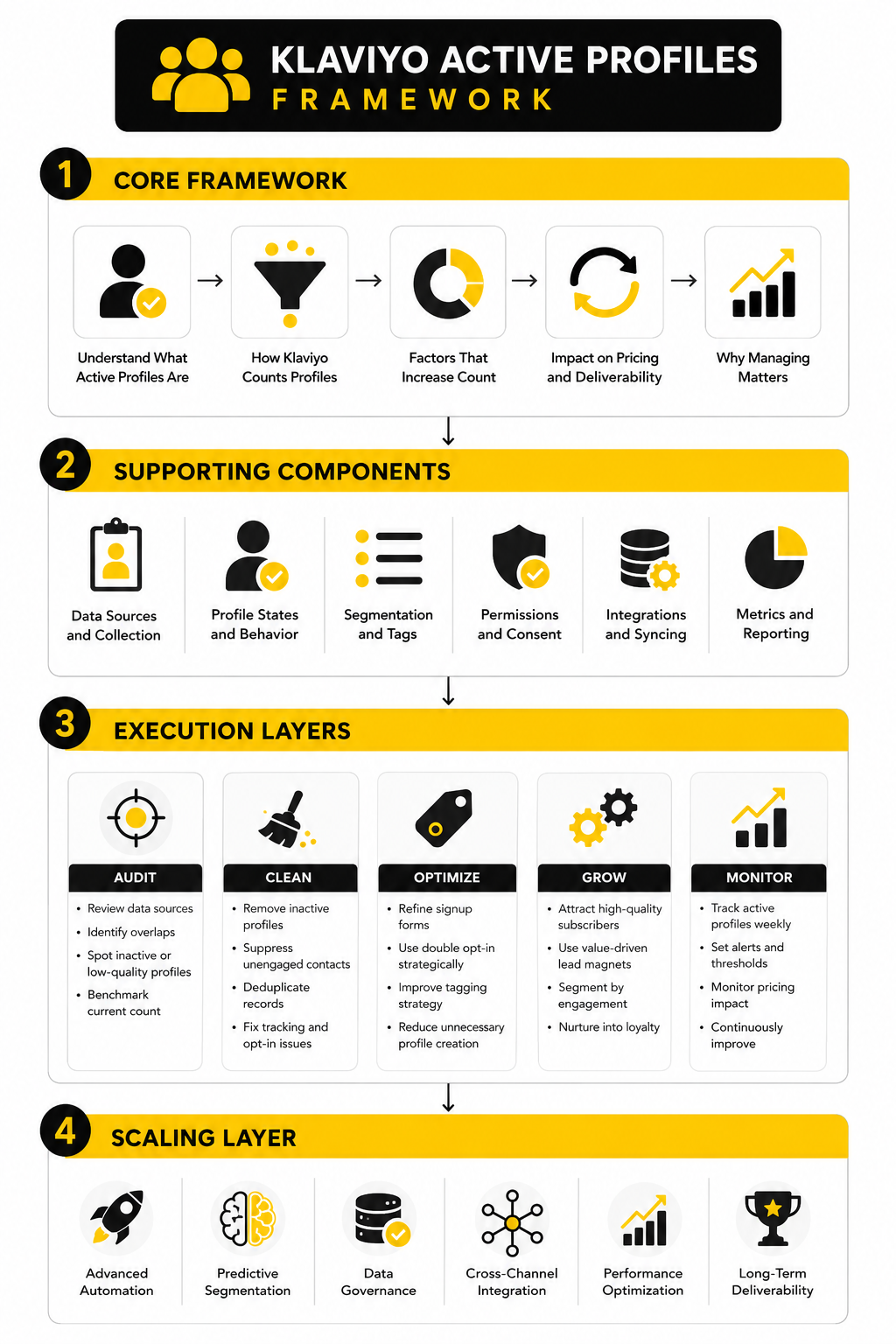
The first layer is profile status. This is where you separate active profiles from suppressed profiles and understand who can currently receive marketing. Klaviyo’s profile glossary describes active profiles as profiles that can be messaged and are not suppressed, which makes this the foundation of the whole system.
The second layer is consent and suppression state. A profile may exist in Klaviyo, but that does not automatically mean every channel should be used the same way. Email consent, SMS consent, unsubscribes, bounces, and manual suppressions all need to be respected because they determine both compliance and reachability.
The third layer is engagement and buying behavior. This is where the work becomes commercial rather than technical. A customer who bought 11 months ago may deserve a different treatment than a lead who joined a giveaway 11 months ago and never clicked anything.
The fourth layer is review and reactivation logic. Suppression should not be random, emotional, or based on a single lazy rule. It should come from a repeatable system that looks at inactivity, customer value, recent site behavior, purchase history, and whether a winback attempt still makes sense.
Core Components of a Healthy Profile System
A healthy Klaviyo profile system does not depend on one giant cleanup every year. It depends on small, consistent rules that keep the account from becoming messy in the first place. That is how you avoid panic-cleaning before a pricing threshold or a major campaign.
The first core component is segmentation. You need clear groups for engaged subscribers, recent buyers, high-value customers, non-buying leads, inactive subscribers, dormant customers, and suppression candidates. Without these groups, every campaign decision becomes guesswork.
The second component is a re-engagement path. Before suppressing people, many brands should give inactive but potentially valuable profiles one last thoughtful chance to respond. This can be a winback flow, a preference update, a plain reminder, or a stronger offer if the economics support it.
The third component is suppression criteria. This is where you define when a profile is no longer worth keeping active. Klaviyo’s active profile management guidance is built around long-term inactivity, especially when profiles show no visits, purchases, or marketing engagement over a sustained period.
The fourth component is monitoring. Every month, someone should look at active profile count, suppressed profile count, campaign engagement, flow revenue, deliverability signals, and plan thresholds. This does not need to become a huge reporting ritual, but it does need to be consistent.
Professional Implementation Starts With Better Decisions
Professional Klaviyo active profile management is not aggressive deletion. It is disciplined audience control. The goal is to keep reachable the people who still have a realistic relationship with the brand, while suppressing the profiles that are only adding noise, risk, or cost.
This is also where many teams should stop trying to manage everything manually. If your store is growing quickly, you need a repeatable operating rhythm: review segments, check inactive cohorts, run reactivation where appropriate, suppress carefully, and document the logic. That rhythm protects your account from both over-sending and over-cleaning.
Some brands may also need broader automation around forms, funnels, CRM handoff, or customer journeys outside Klaviyo. For that kind of setup, a tool like GoHighLevel can make sense when the business needs pipeline automation and multi-step follow-up beyond ecommerce email alone. The important thing is not the tool stack by itself. The important thing is that every profile has a purpose, a status, and a next logical action.
In the next part, we will go deeper into what Klaviyo active profiles include, how they differ from subscribers and suppressed profiles, and why misunderstanding that difference creates expensive mistakes.
What Klaviyo Active Profiles Actually Mean
Klaviyo active profiles are the people in your account who can still be emailed through Klaviyo. That sounds simple, but it is where a lot of brands get tripped up. Active does not mean recently engaged, recently purchased, or recently subscribed.
A profile can be active even if the person has not opened an email in months. It can also be active even if the person has never bought anything. The real question is whether Klaviyo is allowed to send email to that profile and whether the profile is not suppressed.
Klaviyo’s help center explains that any profile that can be emailed through Klaviyo is considered an active email profile. That definition is important because it separates profile status from customer quality. A profile can be technically reachable and still be commercially weak.
Active Profiles Are Not the Same as Subscribers
This is the first distinction to get right. A subscriber is someone who has opted in to receive marketing from you. An active profile is broader because it describes whether the profile can be emailed through Klaviyo, not whether the person is a fresh, enthusiastic subscriber.
That means your active profile count can include different types of contacts. It may include newsletter subscribers, customers who accepted marketing, people imported from another system, checkout contacts, and other profiles that are not currently suppressed. Some of them may be valuable. Some may be dead weight.
This is why looking only at subscriber count can be misleading. You might think your list is clean because your main newsletter list looks reasonable, while your total Klaviyo active profiles are much higher. The billing and deliverability problem often lives in the gap between those two numbers.
Active Profiles Are Not the Same as Engaged Profiles
An engaged profile is someone showing recent interest. They may open emails, click links, browse products, start checkout, place orders, or otherwise interact with the brand. That type of profile deserves more attention because there is a current signal behind it.
An active profile is different. It may simply be contactable. That person could have no recent opens, no recent clicks, no recent site activity, and no purchase intent, but still remain active inside the account.
This distinction matters because many brands accidentally treat active profiles as if they are all equally valuable. They are not. A buyer who clicked last week and a cold lead who joined two years ago are not the same asset, even if both count as active in Klaviyo.
Active Profiles Are Not the Same as Customers
Customers are people who have purchased from you. Active profiles may include customers, but they can also include leads, browsers, form submissions, giveaway entries, and imported contacts who never bought. The customer relationship is commercial. The active profile status is technical.
This is where profile management needs nuance. You probably do not want to suppress a past customer too aggressively just because they have been quiet for a while. A person who bought three times last year may still be worth a thoughtful winback attempt.
A non-buyer with no engagement history is different. If that person has not opened, clicked, browsed, purchased, or responded for a long time, keeping them active may only inflate your cost and weaken your reporting. Same status, very different business value.
How Suppressed Profiles Fit Into the Picture
Suppressed profiles are profiles that cannot receive marketing emails from Klaviyo. Klaviyo’s documentation on suppressed email profiles explains that suppression prevents marketing messages from being sent to those profiles. This is the main reason suppression matters for active profile management.
Suppression does not always mean the profile has been deleted. In fact, Klaviyo’s documentation on profiles recommends suppressing profiles rather than deleting them in many cases because suppressed profile data can still be useful. That data can help you understand purchase history, past behavior, source quality, and long-term audience patterns.
This is a key point. Suppression is not the same as destroying data. It is usually a cleaner way to stop marketing to a profile while preserving the context you may still need for analysis, compliance, segmentation, or future decision-making.
Why Suppression Is Usually Safer Than Deletion
Deleting profiles sounds clean, but it can be too blunt. Once a profile is deleted, the associated data is removed from Klaviyo, and that can create reporting gaps. For most ecommerce teams, suppression is a more controlled move.
Suppression lets you stop sending without erasing the customer record. That matters when you want to keep historical purchase context, understand where poor-quality leads came from, or avoid repeatedly re-importing the same bad contacts. It also helps teams review inactive audiences without losing the trail.
Deletion may still have a place in specific operational or compliance situations, but it should not be the default list-cleaning button. If the goal is to reduce billable, reachable, inactive profiles, suppression is usually the more practical first step.
What Makes a Profile Worth Suppressing
A profile becomes a suppression candidate when it shows a long, sustained lack of value. Klaviyo’s active profile management guidance focuses on profiles with no website visits, no purchases, and no marketing engagement over a meaningful period of time. That is a much stronger signal than simply saying, “They have not opened recently.”
The best suppression decisions combine multiple signals. Email engagement matters, but so does purchase history, browsing behavior, checkout behavior, signup source, and recency. A person who visited the site yesterday should not be treated like someone who has been invisible for 18 months.
This is why active profile cleanup should never be a single-condition rule. “Has not opened in 90 days” is too shallow by itself. Apple Mail Privacy Protection and other inbox changes have made opens less reliable, so clicks, purchases, site behavior, and customer value need to carry more weight.
Why This Difference Changes Your Klaviyo Strategy
Once you understand the difference between active, subscribed, engaged, customer, and suppressed profiles, your Klaviyo strategy becomes much sharper. You stop treating the account as one big list. You start treating it like a customer database with different levels of permission, value, and intent.
That shift changes campaign sending. Engaged profiles can receive more regular campaigns because they are showing current interest. Lower-intent active profiles may need fewer campaigns, more selective messaging, or a re-engagement sequence before you decide whether they should stay active.
It also changes reporting. If your campaign performance looks weak, the problem might not be the offer or subject line. The problem might be that the audience includes too many profiles that are technically active but commercially inactive.
Most importantly, it changes cost control. Reducing Klaviyo active profiles should not mean cutting people who might still buy. It should mean identifying the profiles that no longer have a realistic path to revenue and moving them out of the reachable audience.
The Practical Way to Think About Active Profiles
Think of every Klaviyo profile as sitting in one of four practical buckets. This is not a replacement for Klaviyo’s own profile statuses, but it helps you make better marketing decisions.
The third bucket is where most of the cleanup opportunity usually lives. These are the profiles that quietly increase cost, distort metrics, and pull campaigns toward weaker engagement. They may not cause a dramatic problem in one week, but over time they make the whole email program less efficient.
The second bucket deserves more care. These profiles may need a winback flow, a preference update, a stronger segmentation rule, or a short observation window before you suppress them. Good operators do not rush this part because a sloppy cleanup can remove future buyers.
The Mistake Most Brands Make
The common mistake is waiting until the bill becomes painful before looking at active profiles. By then, the account is already messy. The team is not calmly managing audience quality; they are trying to cut costs quickly.
That usually leads to bad decisions. Some brands suppress too aggressively and lose reachable buyers. Others get nervous, suppress almost nobody, and continue paying for a bloated database. Neither approach is professional.
The better approach is to manage Klaviyo active profiles as part of normal marketing operations. Review the account regularly. Separate subscribers from active profiles. Separate active profiles from engaged profiles. Separate inactive customers from inactive non-buyers. Then make decisions based on value, not panic.
Where Part 3 Goes Next
Now that the profile definitions are clear, the next step is the actual management framework. This is where the article moves from “what active profiles are” into “how to control them without hurting revenue.”
The right framework should help you decide who stays active, who gets re-engaged, who gets suppressed, and who needs more time before a decision. It should also connect profile cleanup to deliverability, billing, segmentation, and campaign performance. That is where Klaviyo active profiles become a system instead of a number buried in account settings.
The Klaviyo Active Profile Management Framework
The best way to manage Klaviyo active profiles is to stop treating cleanup as a one-time task. A rushed cleanup usually happens when the bill jumps, the account crosses a pricing tier, or campaign performance starts looking worse than expected. That is already too late.
A better framework gives every profile a clear next step. Some profiles should stay active and receive regular campaigns. Some should be moved into a re-engagement path. Some should be suppressed after a clear period of inactivity.
Klaviyo’s own guidance on active profile management is built around reducing billable profiles by suppressing people who have not engaged with the business for a sustained period of time. That is the practical foundation. You are not trying to “clean the list” because it sounds responsible. You are trying to protect cost, deliverability, and decision quality.
Start With a Profile Audit
The first step is to understand what is actually inside the account. Do not start by suppressing people. Start by mapping the audience.
Look at total active profiles, total suppressed profiles, email subscribers, recent purchasers, non-buyers, and people with no recent engagement. The goal is to understand where the account is carrying weight. A Klaviyo account with 40,000 active profiles and 30,000 genuinely engaged people is very different from an account with 40,000 active profiles and 8,000 people who have interacted recently.
This audit should also separate customer types. Recent buyers, repeat buyers, one-time buyers, abandoned checkout profiles, lead magnet signups, popup subscribers, and imported contacts should not be judged with the same rule. The more clearly you separate these groups, the less likely you are to suppress someone who still has real value.
Build the Segments Before You Touch Suppression
Once you understand the profile base, build the working segments. This is where the process becomes usable. You need segments that show who is engaged, who is inactive, who has purchased, who has never purchased, and who may need a sunset flow.
Klaviyo’s segment conditions reference allows segmentation based on behavior, profile properties, location, consent, and other conditions. That flexibility is powerful, but it also creates room for messy logic. Keep the first version simple enough that a marketer can understand it without needing a developer beside them.
A practical starting point is to create segments around recent engagement, long-term inactivity, purchase history, and suppression candidates. You can refine later. What matters first is building a structure that makes the audience visible.
Core Components of a Healthy Profile System
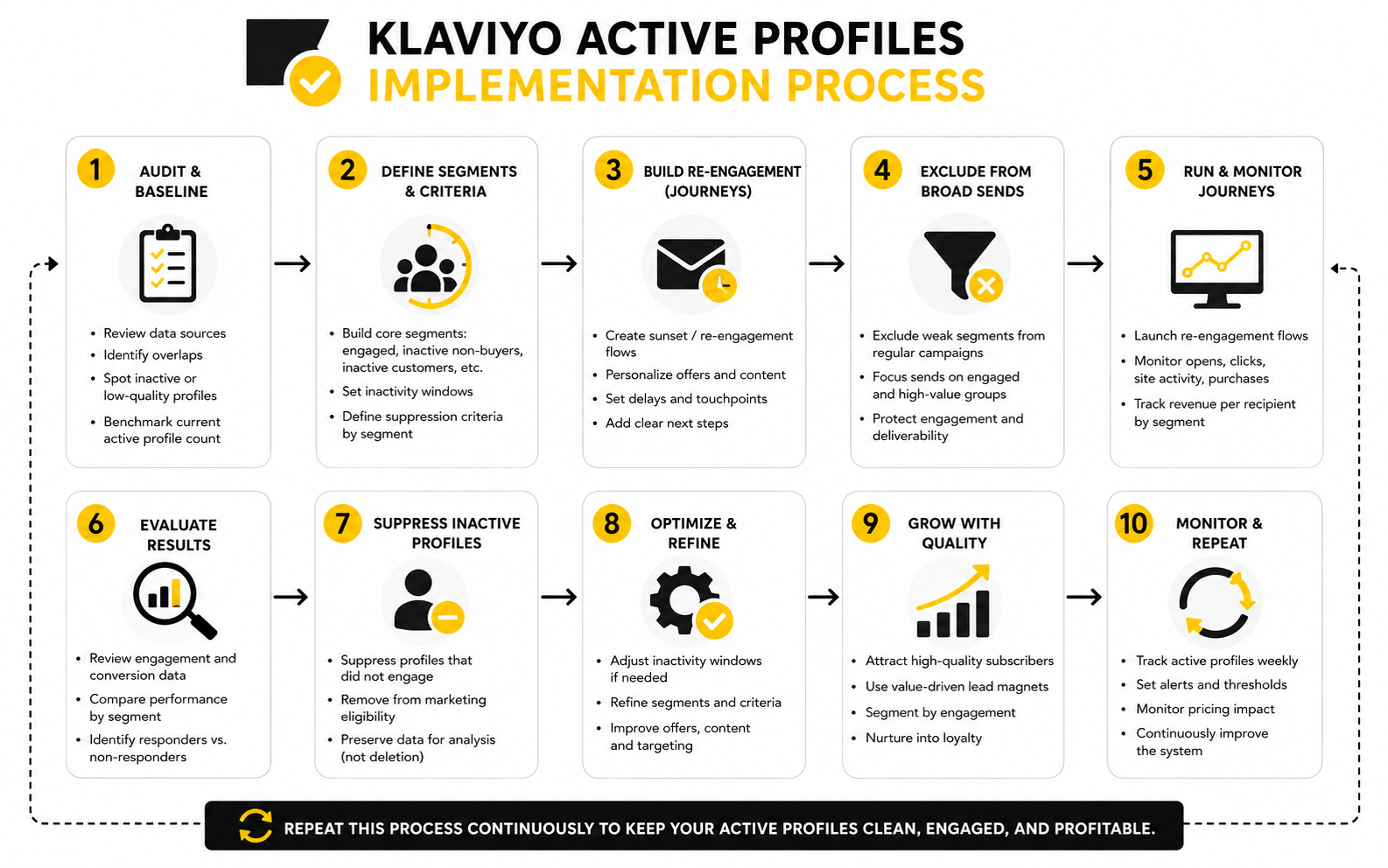
A healthy Klaviyo active profiles system has a simple operating rhythm. You identify audience quality, send based on intent, attempt re-engagement where it makes sense, and suppress profiles that remain inactive after a reasonable process. That rhythm is what keeps the account from slowly filling with unreachable or low-value contacts.
This is not just about cost control. Klaviyo’s deliverability guidance explains that sender reputation and inbox placement depend on multiple engagement and sending factors, which makes audience quality part of the deliverability system. If you keep sending to people who never interact, you are not just wasting sends. You may be training inbox providers to treat your emails as less wanted.
The core components below work together. Do not treat them as separate tactics. Segmentation, re-engagement, suppression, and review cycles all need to support the same goal: keeping the active audience commercially useful.
Component 1: Engagement Segments
Engagement segments tell you who is showing current interest. These profiles are usually safer to include in regular campaigns because they are still interacting with your brand. They may be opening, clicking, browsing, adding to cart, starting checkout, or buying.
Klaviyo has specific guidance on creating unengaged segments so brands can identify people who should be excluded from most campaign sends. That is the other side of the same system. If you know who is engaged, you also know who should not receive every broadcast.
The key is to avoid relying on opens alone. Open tracking has become less reliable because privacy features can inflate or obscure true engagement. Clicks, purchases, site activity, and checkout behavior give a stronger picture of whether someone still has real intent.
Component 2: Customer Value Segments
Customer value segments protect you from over-cleaning. A past customer should not always be judged the same way as a cold lead. Purchase behavior changes the suppression decision because it shows that the person trusted the brand enough to spend money.
Start by separating recent customers, repeat customers, high-value customers, one-time customers, and customers who have gone quiet. These groups need different messaging and different suppression timelines. A quiet repeat buyer may deserve a stronger winback path than someone who only joined a popup and never clicked again.
This is where profile management becomes revenue-aware. The goal is not to reduce Klaviyo active profiles as fast as possible. The goal is to remove low-value reachability while protecting profiles that still have realistic revenue potential.
Component 3: A Sunset Flow
A sunset flow is the bridge between inactivity and suppression. It gives people one final chance to show interest before you stop emailing them. Klaviyo’s guide on creating a sunset flow describes it as a way to phase out customers who are no longer engaging and then suppress or delete those who do not respond.
This is important because it makes suppression feel less arbitrary. Instead of suddenly removing profiles because they crossed an inactivity threshold, you give them a clear re-engagement path. If they click, browse, buy, or otherwise respond, they can stay active.
A strong sunset flow should be direct. Tell people why they are receiving the message, give them a reason to stay, and make the next action obvious. Do not bury the point under five clever emails that sound like every other campaign in the inbox.
Component 4: Suppression Criteria
Suppression criteria are the rules that decide when a profile should stop being reachable. These rules should include inactivity, lack of purchase behavior, lack of site behavior, and lack of marketing engagement. They should also account for customer status so you do not treat all quiet profiles the same.
Klaviyo’s guidance on bulk suppression and profile deletion explains that suppression tools can help avoid suppressing recently active or high-intent profiles. That matters because a blunt cleanup can create avoidable revenue loss. The process should identify low-value inactive profiles, not punish every profile that missed your last few campaigns.
A good suppression rule is strict enough to control waste but careful enough to protect opportunity. For example, a non-buyer with no clicks, no site visits, and no purchase activity for a long period is usually a stronger suppression candidate than a past buyer who recently browsed products. The difference is intent.
Professional Implementation: Segments, Suppression, and Review Cycles
Professional implementation is about turning the framework into a repeatable workflow. Someone on the team should be able to run the process without guessing. That means documented segments, clear thresholds, and a review schedule.
The process does not need to be complicated. It needs to be consistent. Most brands create problems because they let profiles pile up for months, then try to fix everything in one afternoon.
A practical monthly workflow looks like this:
This is the point where Klaviyo active profiles become manageable. You are not chasing a random number. You are operating a system that keeps reachable profiles aligned with real business value.
Review Active Profile Count Against Revenue
Profile count by itself is not the full story. A higher active profile count can be perfectly fine when those profiles are generating revenue. The problem is paying for profiles that add cost without meaningful engagement or customer value.
Compare active profile count with campaign revenue, flow revenue, revenue per recipient, conversion rate, and customer retention. If the profile count keeps growing while revenue per recipient keeps weakening, that is a warning sign. It means the account may be accumulating low-quality profiles faster than it is creating buyers.
Klaviyo’s pricing page shows why this matters operationally. As active profiles increase, the account can move into higher plan levels. A profile management process helps make sure those increases are supported by real audience value, not just database bloat.
Exclude Weak Segments Before Suppressing Them
Suppression is not always the first move. Sometimes the more carefully first move is exclusion. You can exclude weak or uncertain segments from most campaigns while you watch whether they show fresh behavior.
This is especially useful when you are not fully confident in the data. Maybe a migration happened recently. Maybe tracking was broken for a period. Maybe a segment contains customers who buy seasonally and should not be judged too quickly.
Exclusion gives you a softer step before suppression. It protects deliverability because those contacts are not receiving every campaign. It also gives the team time to confirm whether the inactivity is real before making a stronger decision.
Suppress in Batches, Not in Panic
When a brand has a large inactive audience, it is tempting to suppress everything at once. Sometimes that is appropriate, but often it is better to work in controlled batches. This gives you room to watch performance, catch mistakes, and avoid removing profiles that should have gone through a reactivation step first.
Start with the clearest low-value group. These are usually non-buyers with long-term inactivity and no recent browsing, checkout, click, or purchase behavior. After that, move into more nuanced groups, like old one-time buyers or leads from low-quality acquisition sources.
This is not about being timid. It is about being precise. Good Klaviyo active profiles management is not a mass purge. It is a controlled reduction of profiles that no longer justify being reachable.
Keep the Review Cycle Simple
The easiest process to maintain is the one your team will actually use. A monthly review is enough for many brands, while larger stores may need a tighter cadence during high-growth periods. What matters is that the review happens before the account becomes expensive and messy.
The review should answer five questions. How many active profiles do we have? How many are genuinely engaged? How many inactive profiles are non-buyers? How many inactive profiles are past customers? How many should move to re-engagement or suppression this month?
That simple rhythm prevents emotional decisions. Instead of arguing over whether the list “feels too big,” you have a profile system tied to behavior, cost, and revenue. That is the difference between list cleaning and real lifecycle management.
Statistics and Data
The data around Klaviyo active profiles only matters when it changes what you do next. A benchmark is not a trophy. A dashboard is not a strategy. The point is to understand whether your reachable audience is getting healthier, more profitable, or more expensive to maintain.
This is why active profile measurement needs to connect four things: audience size, engagement quality, revenue output, and plan cost. Looking at one number in isolation will mislead you. A growing active profile count can be excellent if revenue and engagement are rising with it, but it can be a warning sign if cost increases while revenue per recipient drops.
Klaviyo’s 2026 email marketing benchmarks are useful because they frame performance around open rate, click rate, conversion rate, order rate, and revenue per recipient. Those are the right categories to watch. But for active profile management, the real question is not just whether your campaign beat a benchmark. The real question is whether the profiles you are paying to keep active are helping you reach that benchmark in the first place.
The Active Profile Metrics That Actually Matter
Start with active profile count because it affects billing and reach. Klaviyo’s pricing page ties email plan levels to active profiles and monthly email sends, so profile growth has a direct operating cost. That does not mean profile growth is bad. It means unmanaged profile growth is expensive.
Next, measure engaged profile count. This should include people who have clicked, purchased, started checkout, viewed products, or otherwise shown meaningful activity within your chosen window. Opens can still provide context, but they should not be the only signal because privacy changes can make open data less reliable than clicks, purchase events, and onsite behavior.
Then measure the gap between active and engaged. This gap is where the money usually leaks. If active profiles are rising but engaged profiles are flat, your account is becoming less efficient even if the top-line list size looks impressive.
The fourth metric is revenue per recipient. Klaviyo’s benchmark resources include revenue per recipient because it connects sending volume to actual commercial output. That metric is especially useful when reviewing inactive segments because it shows whether the audience is producing revenue or just inflating send volume.
How to Read Campaign Performance Without Fooling Yourself
Campaign performance should be read by segment, not just account average. If you send to everyone and the results are weak, you do not know whether the creative failed or the audience was bloated. That is why one of the simplest tests is comparing your engaged segment against your broader active audience.
If the engaged segment performs well and the broad send performs poorly, the message may not be the problem. The list quality may be the problem. That is a very different diagnosis, and it leads to a very different action.
This is where Klaviyo active profiles become a measurement issue, not just a billing issue. A bloated active audience can make good campaigns look mediocre. It can also trick teams into rewriting emails, changing offers, and blaming creative when the real problem is weak audience selection.
The Measurement System to Use Every Month
A practical measurement system should be simple enough to run every month without turning into a full analytics project. You are not trying to build a finance-grade model. You are trying to spot whether your active audience is becoming more profitable or less efficient.
Track these numbers together:
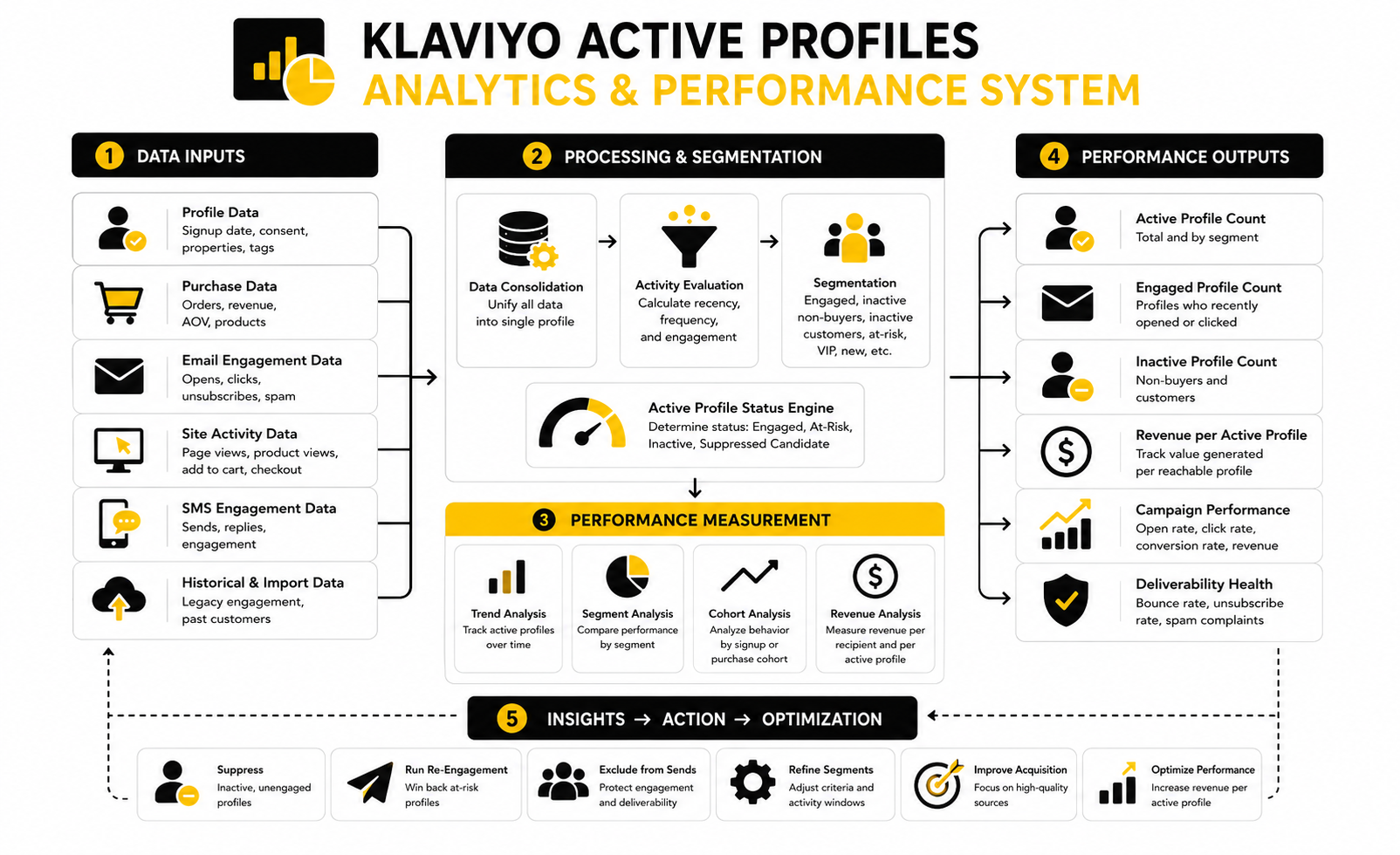
The important part is the relationship between the numbers. If total active profiles increase and revenue per recipient increases too, the growth is probably healthy. If total active profiles increase while click rate, order rate, and revenue per recipient fall, the account may be carrying too much low-intent audience.
Suppressed profile count also needs context. A rising suppressed count is not automatically bad. If suppression is removing long-term inactive profiles while engaged audience and revenue per recipient improve, it can be a sign that the account is getting cleaner.
Benchmarks Are Directional, Not Absolute
Benchmarks help you understand whether performance is roughly healthy, but they should not replace your own baseline. Industry averages can be useful, especially when Klaviyo breaks down open rates, click rates, revenue per recipient, and order rates by vertical. Still, your product price, buying cycle, discounting strategy, acquisition quality, and customer mix all affect what “good” looks like.
For example, a brand selling low-cost replenishable products may naturally see different repeat purchase behavior than a brand selling high-ticket furniture. The same active profile count could mean very different things in those two businesses. One may have frequent repeat buying, while the other may have a longer consideration cycle.
This is why the strongest benchmark is your own trend line. Are engaged profiles growing as active profiles grow? Are inactive non-buyers shrinking as a percentage of the account? Is revenue per recipient holding steady or improving after cleanup? Those answers tell you more than a generic average ever will.
What a Healthy Active Profile Trend Looks Like
A healthy trend does not always mean the active profile count goes down. In a growing business, active profiles may rise every month. That can be a good sign if the new profiles are coming from strong acquisition sources and turning into engaged subscribers or buyers.
The healthier signal is balance. Active profiles can grow, but engaged profiles should grow with them. Campaign performance should not collapse as the list expands. Flow revenue should remain strong because behavioral automation is reaching people with real intent.
A concerning trend looks different. Active profiles rise quickly, but click rate gets weaker. Revenue per recipient falls. More campaigns depend on discounts to produce the same result. The team sends more emails to make up for lower response, which creates even more fatigue.
That is the spiral you want to avoid. The earlier you catch it, the easier it is to fix. Waiting until deliverability drops or billing becomes painful turns a simple profile management issue into a larger lifecycle problem.
What the Data Should Make You Do
The point of measurement is action. If the data shows a large group of inactive non-buyers, move them into a sunset or re-engagement process. If they still do not respond, suppress them based on your defined criteria.
If the data shows inactive past customers, do not treat them like cold leads. Review purchase value, product lifecycle, and last activity before deciding what to do. Some should receive winback messaging. Some should be excluded from regular campaigns but kept under observation. Some should eventually be suppressed.
If the data shows strong engagement but weak revenue, the issue may not be active profile quality. It may be offer strength, product-market fit, landing page conversion, or campaign merchandising. That is why profile measurement should sit beside campaign analytics, not replace it.
Use Cost per Engaged Profile as a Reality Check
One useful internal metric is cost per engaged profile. Take the monthly Klaviyo cost and compare it with the number of profiles showing real engagement or purchase behavior. This gives you a sharper view than cost per active profile because it reflects the audience that is actually paying attention.
This metric will not be perfect, and it does not need to be. It is a reality check. If your active profile count is growing but cost per engaged profile is also climbing, you may be paying more to reach roughly the same useful audience.
You can also compare revenue per engaged profile with revenue per active profile. If the gap is huge, your account probably has a large inactive layer. That does not automatically mean you should suppress everyone in that layer tomorrow, but it does mean the layer needs a process.
Watch the Signals That Point to Deliverability Risk
Deliverability problems rarely appear out of nowhere. They usually build slowly through weak engagement, too much broad sending, poor acquisition quality, and repeated sends to people who do not respond. Klaviyo’s deliverability resources emphasize audience engagement because inbox providers use engagement signals to understand whether people want your emails.
The early warning signs are usually visible before the damage feels dramatic. Falling click rates, rising unsubscribes, rising spam complaints, and weaker revenue per recipient can all point to audience quality problems. If those changes happen while active profiles are increasing, profile management should be reviewed immediately.
This is where suppression becomes protective. You are not just lowering a bill. You are reducing the number of weak sends that can damage future inbox placement. That matters because deliverability affects your best customers too, not only the inactive people you keep trying to wake up.
Turn Measurement Into a Decision Table
A simple decision table keeps the team from arguing over every segment manually. The numbers should tell you the next move. That makes the process faster, calmer, and easier to repeat.
Use this logic as a starting point:
This table does not replace judgment. It gives judgment a structure. That is what good Klaviyo active profiles management should do: make the right decision easier, not create another dashboard nobody uses.
Common Mistakes, Tools, and Final Checklist
Advanced Klaviyo active profiles management is mostly about tradeoffs. You are balancing revenue opportunity against cost, deliverability, compliance, and operational complexity. Push too hard on cleanup, and you may suppress people who would have bought later. Move too slowly, and you keep paying for profiles that drag down the account.
This is where beginners look for one perfect rule. Experts build decision logic. They understand that a cold lead, a seasonal buyer, a repeat customer, and a high-value dormant customer should not all be judged by the same inactivity window.
The goal is not to make your Klaviyo account as small as possible. The goal is to make it accurate. A smaller account with the wrong people suppressed is worse than a larger account with a clean lifecycle strategy.
The Risk of Over-Suppressing Good Customers
The biggest mistake is treating inactivity as if it always means disinterest. Some products have long buying cycles. Some customers buy only during seasonal moments. Some buyers may stop clicking emails but still return through search, direct traffic, paid ads, or a bookmarked product page.
That is why customer value needs to sit above simple engagement logic. A repeat buyer who has not clicked recently should not be handled like a never-purchased giveaway lead. Their history proves a different level of trust.
Before suppressing past customers, check purchase recency, number of orders, average order value, product lifecycle, and recent site behavior. If they bought a durable product six months ago, silence may be normal. If they bought replenishable products and ignored every message for 18 months, the decision becomes different.
The Risk of Under-Suppressing Weak Profiles
The opposite mistake is just as common. Some brands are afraid to suppress anyone because the list size feels like an asset. They keep low-intent profiles active because they do not want the audience number to shrink.
That mindset is expensive. Klaviyo’s active profile management guidance is specifically designed to help brands stop paying for profiles that have not engaged with the business over a sustained period. If a profile has no purchases, no clicks, no visits, and no meaningful activity for a long time, keeping it active is not optimism. It is avoidance.
Weak profiles also create reporting noise. They make campaign performance look worse, they lower the quality of broad sends, and they can pressure the team into sending more discounts to compensate. That is how a list-size vanity metric turns into margin damage.
Scaling Changes the Rules
A small store can sometimes get away with loose profile management because the consequences are limited. Once the account grows, the same habits become expensive fast. More profiles mean higher plan sensitivity, more segmentation complexity, more deliverability exposure, and more room for bad data to hide.
Scaling also creates more profile sources. You may have Shopify checkout, popup forms, lead magnets, quizzes, giveaways, retail data, customer service tools, SMS capture, and imports from past platforms. Each source can bring in a different level of consent and intent.
That is why source quality matters. A profile captured after a purchase is not the same as a profile captured from a low-intent contest. If you do not segment by acquisition source, you may blame email performance when the real issue is weak list growth.
Watch Data Quality Before You Automate
Automation makes profile management easier, but only if the data is clean enough to trust. Bad properties, broken events, duplicate imports, missing consent fields, and inconsistent naming can make automated suppression risky. A rule is only as good as the data feeding it.
Before building aggressive automation, review the events and properties used in your segments. Make sure purchase events are flowing correctly. Confirm that site activity is tracking. Check whether old imports created profiles with missing or misleading metadata.
This matters because automated suppression should reduce manual work, not hide mistakes. If the logic is built on broken data, the system can quietly suppress the wrong people or keep the wrong people active. That is worse than doing the work manually for a little longer.
Use Suppression Rules Differently by Profile Type
The best Klaviyo active profiles systems use different rules for different groups. That does not mean the setup has to become complicated. It means the logic should respect commercial reality.
A simple version might look like this:
This kind of segmentation protects upside. It also keeps the account from making emotional decisions. You are not asking whether a profile “feels worth keeping.” You are asking which lifecycle group it belongs to and what rule applies.
Do Not Let Campaign Strategy Fight Profile Strategy
Profile management and campaign strategy need to support each other. If your segmentation says someone is inactive, but your campaign calendar keeps blasting them every week, the system is not aligned. You are saying one thing in the dashboard and doing another in the send queue.
This is especially common during promotions. A brand builds a careful inactive segment, then includes almost everyone during a sale because the revenue pressure is high. One or two exceptions may be reasonable, but constant exceptions destroy the point of the framework.
A better approach is to use campaign tiers. Your most engaged profiles can receive frequent sends. Your moderately engaged profiles can receive important campaigns. Your weak profiles should either be in re-engagement, excluded, or suppressed. That way, the campaign calendar reinforces audience quality instead of undoing it.
Be Careful With Imported Lists and Migrations
Imports are one of the fastest ways to inflate active profiles. A migration from another platform can bring over old customers, unsubscribed contacts, stale leads, test records, and contacts with incomplete consent history. If everything gets imported as reachable, your Klaviyo account can become bloated before you send a single campaign.
Before importing, clean the source file. Remove obvious junk, confirm consent, separate customers from subscribers, and tag the import source. After importing, do not immediately send to the full group unless you are confident the audience is fresh and permission-based.
Klaviyo’s documentation on list cleaning and suppression emphasizes managing unengaged profiles to protect deliverability. That is especially important after migration because the account may not yet have enough Klaviyo-native engagement data to judge everyone accurately. In that case, source quality and historical engagement become even more important.
Advanced Teams Should Track Profile Source ROI
At a certain scale, you should not only ask whether active profiles are engaged. You should ask where your best active profiles come from. This turns profile management into acquisition intelligence.
Compare acquisition sources by engagement rate, first purchase rate, repeat purchase rate, unsubscribe rate, spam complaint rate, and long-term retention. A source that adds many profiles but few buyers may look good in lead volume while quietly damaging list quality. A smaller source that produces repeat customers may be much more valuable.
This is where tools outside Klaviyo can be useful if they support cleaner capture and better journey tracking. For example, a dedicated landing page builder like Replo may help teams build higher-intent ecommerce landing experiences before sending profiles into Klaviyo. The point is not to add more software for fun. The point is to improve the quality of profiles before they ever become a lifecycle marketing problem.
Create a Governance Rule for Active Profiles
Governance sounds boring, but it saves money. Someone should own the rules for what makes a profile active, what makes it risky, and what happens when it becomes inactive. Without ownership, profile management becomes a random cleanup task that nobody wants to touch.
The rule should define review cadence, segment logic, suppression criteria, exceptions, and who approves major changes. It should also define what happens before large promotional periods, migrations, and acquisition pushes. These are the moments when profile quality can change quickly.
This does not need to become a 20-page document. A one-page operating rule is enough for many teams. The point is to make the decision process visible so the business does not rely on memory, panic, or whoever happens to be inside Klaviyo that week.
Protect Deliverability During High-Volume Periods
High-volume periods are when bad profile habits become most dangerous. Black Friday, holiday sales, launch weeks, and clearance promotions tempt brands to send to everyone. That can produce short-term revenue, but it can also increase fatigue and weaken future inbox placement.
Before a major send period, review inactive segments and decide who should be excluded. Warm up broader audiences carefully if you plan to expand reach. Keep your highest-risk inactive profiles out of the biggest sends unless there is a clear reactivation strategy.
This is not being conservative. It is protecting the revenue engine. Your best customers should not suffer because the brand wanted one more weak send to a cold segment.
Know When Not to Suppress
There are times when suppression is not the right immediate move. If tracking was recently broken, if a migration just happened, if a major product cycle is seasonal, or if a segment includes high-value buyers, you may need more context before acting. Suppression should be decisive, not careless.
In these cases, exclusion can be the safer temporary step. Keep the profiles out of regular campaigns while you observe behavior, repair tracking, or run a proper winback. Then make the suppression decision with cleaner evidence.
This is the mark of a mature system. It does not suppress blindly. It uses suppression when the profile has clearly stopped being worth reachable status.
The Expert Rule: Clean the Inputs, Not Just the Database
The most advanced profile management happens before the profile enters Klaviyo. If the business is collecting poor-quality leads, profile cleanup will never fully solve the problem. You will just keep suppressing the same type of weak contact every month.
Audit your signup sources. Look at popup targeting, offer quality, giveaway mechanics, checkout consent, lead magnet relevance, and landing page intent. A profile that joins for the wrong reason is unlikely to become a strong customer just because it enters a better email flow.
This is the real lesson. Managing Klaviyo active profiles is not only a Klaviyo task. It is a growth quality task. Better acquisition creates better profiles, better profiles create better email performance, and better email performance makes the whole account easier to scale.
Final System for Managing Klaviyo Active Profiles
By this point, the pattern should be clear. Klaviyo active profiles are not just contacts in a database. They are reachable people who affect cost, performance, deliverability, segmentation, and the way your lifecycle marketing system behaves.
The final system is simple: collect better profiles, segment them properly, measure their behavior, give uncertain profiles a fair re-engagement path, and suppress the ones that no longer justify active status. That is the whole game. Not glamorous, but extremely profitable when done consistently.
A mature profile system also creates better decision-making across the business. Acquisition teams can see which sources produce strong subscribers. Email teams can protect deliverability. Finance teams can understand whether Klaviyo cost is growing with real audience value or just database bloat.
What are Klaviyo active profiles?
Klaviyo active profiles are profiles that can be emailed through Klaviyo. They are not necessarily recent subscribers, engaged readers, or customers. The most important thing to understand is that active means reachable, not valuable by default.
Do active profiles include people who never bought?
Yes, Klaviyo active profiles can include people who have never purchased. If they are in your account and can be emailed, they may still count as active. That is why non-buyer segments are so important when reviewing profile quality.
Are active profiles the same as subscribers?
No, active profiles and subscribers are not the same thing. A subscriber is someone who opted in to marketing, while an active profile is a broader status related to whether the profile can be emailed. This is why your subscriber count and active profile count may not match.
Do suppressed profiles count as active profiles?
Suppressed profiles are not reachable through marketing email in the same way active profiles are. Klaviyo’s guidance on active profile management focuses on suppressing long-term inactive profiles so they stop contributing to billable active profile count. Suppression is usually the practical option when you want to stop emailing a profile without deleting all historical context.
Should I delete inactive profiles from Klaviyo?
In most cases, suppression is safer than deletion. Suppression stops marketing sends while preserving useful profile history, purchase data, and reporting context. Deletion may make sense in specific cleanup or compliance situations, but it should not be the default move for ordinary inactive contacts.
How often should I review Klaviyo active profiles?
Most ecommerce brands should review active profiles at least monthly. Larger stores, fast-growing brands, and accounts near a pricing threshold may need a tighter review cadence. The review should look at active profile count, engaged profile count, inactive non-buyers, inactive customers, and revenue per recipient together.
What is a sunset flow in Klaviyo?
A sunset flow is a final re-engagement sequence for people who have stopped interacting. Klaviyo’s guide on creating a sunset flow explains how to identify inactive profiles, send final outreach, and suppress profiles that still do not respond. It gives inactive contacts one last clear chance before you stop emailing them.
How do I know if a profile should be suppressed?
A profile is usually a stronger suppression candidate when it has no recent clicks, no purchases, no site activity, no checkout behavior, and no meaningful engagement over a sustained period. Non-buyers with long-term inactivity are usually easier to evaluate than past customers. Past customers deserve more careful review because purchase history can signal future value even when recent engagement is quiet.
Can suppressing profiles improve email performance?
Yes, suppressing inactive profiles can improve how your email program performs because you stop sending to people who are unlikely to engage. Klaviyo’s list cleaning guidance explains that identifying unengaged contacts, excluding them from sends, and suppressing those who never engage can help improve open rates, click rates, unsubscribe rates, spam complaint rates, and sender reputation. The key is to suppress based on clear evidence, not panic.
Should I exclude inactive profiles before suppressing them?
Often, yes. Excluding inactive profiles from regular campaigns can be a smart intermediate step when you need more confidence before suppression. This is especially useful after migrations, tracking issues, seasonal buying cycles, or major changes in acquisition sources.
How do active profiles affect Klaviyo pricing?
Klaviyo pricing is tied to active profile count and email send volume. That means unmanaged profile growth can push an account into a higher plan even if many profiles are not generating revenue. The solution is not to shrink the account blindly, but to keep active profiles aligned with real business value.
What metrics should I track with active profile count?
Track active profiles alongside engaged profiles, suppressed profiles, inactive non-buyers, inactive past customers, click rate, placed order rate, unsubscribe rate, spam complaint rate, campaign revenue per recipient, and flow revenue per recipient. Klaviyo’s email benchmark resources focus on metrics like open rate, click rate, conversion rate, order rate, and revenue per recipient because those numbers connect audience quality to business performance. Active profile count only becomes useful when you interpret it with these performance signals.
Can I automate active profile cleanup?
You can automate parts of the process, but you should not automate blindly. Segments, sunset flows, exclusions, and suppression workflows can make management much easier when the underlying data is reliable. Before relying on automation, confirm that purchase events, site tracking, consent fields, and profile properties are accurate.
What is the biggest mistake with Klaviyo active profiles?
The biggest mistake is treating every active profile as equally valuable. A repeat buyer, a seasonal customer, a cold imported lead, and a giveaway subscriber do not deserve the same rules. Strong profile management separates people by behavior, value, and intent before deciding who stays active.
What should I do first if my active profile count is too high?
Start with an audit, not a purge. Separate active profiles into engaged subscribers, recent customers, inactive customers, inactive non-buyers, and profiles with unclear data. Then exclude weak segments from broad campaigns, run re-engagement where appropriate, and suppress the profiles that remain inactive after a clear process.
Final Checklist for Klaviyo Active Profile Management
A clean Klaviyo account is not created by one big cleanup. It is created by a repeatable system that keeps profile quality visible every month. If the system is simple enough to use, it will keep working even when the business gets busier.
Use this checklist as the closing operating rhythm:
The real win is not just a lower Klaviyo bill. The real win is a cleaner audience, clearer reporting, stronger deliverability, and better lifecycle decisions. That is why Klaviyo active profiles deserve serious attention.
Build a stronger local presence with BAAM AI
Turn your website, Google profile, social channels, and AI visibility into one growth engine
Most businesses do not need more random marketing activity. They need a consistent presence system that helps the right people find them, trust them, and take action. BAAM AI brings strategy, local SEO, website updates, Google Maps visibility, social content, AI-search readiness, media production, and reporting into one practical monthly engine.
If you want your marketing to keep working after the campaign ends, start with a free BAAM AI presence audit. See how your business shows up today and where the fastest visibility wins are at BAAM AI.