
BAAM AI Blog
Kevin Rogers Copywriter: How To Use His Sales Hook Thinking Without Sounding Like A Hack
Kevin Rogers is not the typical “copywriter with a laptop and a swipe file” story. His positioning comes from a rare combination: stand-up comedy, direct response sales copy, freelance mentoring, and community...

Kevin Rogers is not the typical “copywriter with a laptop and a swipe file” story. His positioning comes from a rare combination: stand-up comedy, direct response sales copy, freelance mentoring, and community building. That matters because most people studying copywriting get trapped in templates, while Kevin’s best-known ideas push you toward something harder and more useful: finding the human tension behind the offer.
The primary reason people search for Kevin Rogers copywriter is usually simple. They want to understand why his hooks work, what the 60-Second Sales Hook is really about, and how to apply that thinking to emails, landing pages, ads, offers, and client work. this guide will not treat his work like magic. It will break the thinking down into practical parts you can actually use.
The big idea is this: strong copy does not start with clever wording. It starts with a clear person, a clear problem, a believable shift, and a reason to care now. Kevin Rogers became known for teaching that through a hook framework influenced by joke structure, but the deeper lesson is bigger than comedy. Good copy creates recognition before it asks for action.
This full article is split into six parts so each idea has room to breathe. The sections below are the real section names the article will continue using.
Why Kevin Rogers Matters In Modern Copywriting
Kevin Rogers matters because his work sits at the intersection of persuasion and personality. A lot of direct response copywriting advice teaches structure, urgency, proof, and offers, which are all useful. But without a real human hook, those pieces often feel mechanical.
His background as a stand-up comedian is not a cute origin story. Comedy forces you to understand setup, tension, timing, surprise, and audience recognition. Those same skills are useful in copy because a prospect does not respond to information alone; they respond when they feel seen.
That is why Kevin’s work has stayed relevant even as AI tools, funnel builders, and automation platforms have changed how copy gets produced. The person writing the copy still has to find the emotional entry point. Otherwise, the funnel may look professional, but the message lands flat.
For entrepreneurs, freelancers, and marketers, this is the useful part. You do not need to become a comedian. You need to understand why a good hook makes someone think, “That is exactly my problem,” before you try to sell them anything.
The Big Shift Behind His Copywriting Philosophy
The most useful shift in the Kevin Rogers copywriter approach is moving from “What should I say?” to “What does the prospect already feel but has not clearly said yet?” That change sounds small, but it affects everything. It changes your headlines, your first email line, your sales page lead, and even the way you describe your offer.
Most weak copy starts too far downstream. It talks about features, bonuses, credentials, or mechanisms before the reader has emotionally entered the conversation. A stronger hook starts where the reader already is: frustrated, skeptical, curious, stuck, or quietly hoping there is a better way.
This is where his sales hook thinking becomes useful. It gives you a way to compress identity, pain, desire, and credibility into a short message. Not a slogan. Not a hype line. A clear statement that makes the right person lean in.
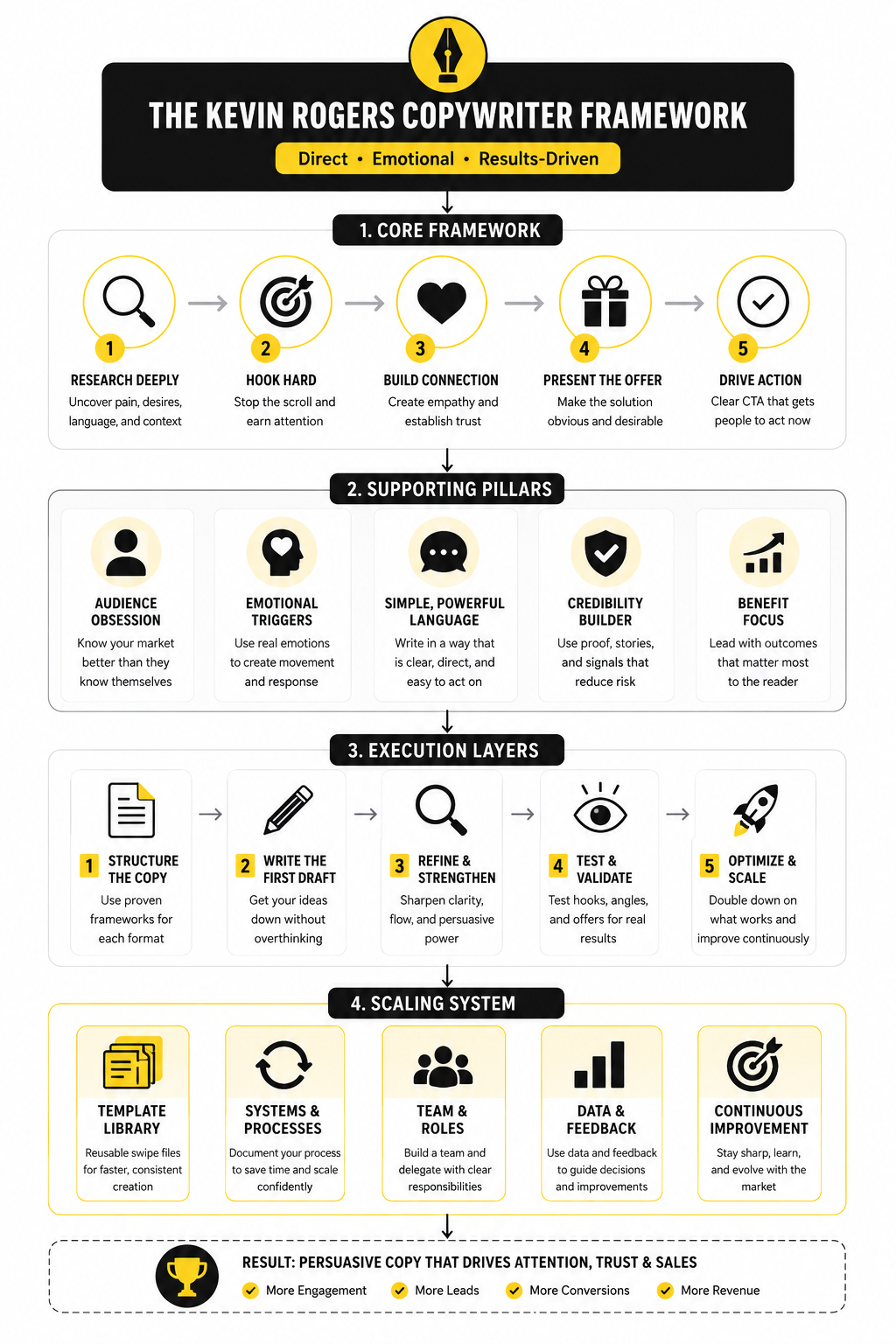
The 60-Second Sales Hook Framework
The 60-Second Sales Hook is often summarized as a way to explain who you help, what problem they face, what changed, and what outcome becomes possible. The reason it works is that it does not begin with the product. It begins with the human situation around the product.
A practical version of the framework looks like this:
That structure is simple, but simple does not mean shallow. The hard part is making each piece specific enough to feel real. “I help businesses get more leads” is forgettable. “I help booked-out consultants turn scattered referrals into a predictable email follow-up system” is much closer to something a real buyer can recognize.
This is also where many people misuse the framework. They treat it as a fill-in-the-blank script and then wonder why the result sounds stiff. The point is not to recite a formula. The point is to use the formula as a thinking tool until the message becomes clear enough to sound natural.
The Core Components Behind His Copywriting Style
The first core component is specificity. Kevin Rogers’ hook thinking works best when the audience is narrow enough to have a shared problem. If you write for “business owners,” your copy has to stay vague. If you write for course creators whose webinar attendance is dropping, you can say something much sharper.
The second component is tension. Strong copy usually contains a gap between what the reader wants and what keeps getting in the way. That gap gives the message energy. Without it, your copy becomes a list of benefits with no emotional pull.
The third component is earned credibility. The message has to make the reader believe there is a real reason this solution exists. That reason could be a discovery, a repeatable process, a hard-won lesson, a better mechanism, or a more focused way to solve the problem.
The fourth component is conversational delivery. This is where the Kevin Rogers copywriter style is especially useful for modern marketing. The copy should sound like a smart person explaining something clearly, not like a brochure trying to win an award.
How this guide Will Build From Here
The next part will go deeper into why Kevin Rogers matters in modern copywriting and why his approach still applies when AI can produce endless drafts in seconds. That distinction matters because speed is no longer the advantage. Clear thinking is.
After that, the article will unpack the 60-Second Sales Hook framework in more detail. We will look at how each piece works, where people usually go wrong, and how to make the structure sound like a natural message instead of a copied template.
Then we will move into implementation. That means applying the framework to emails, landing pages, social posts, lead magnets, sales calls, and client positioning. By the end, the goal is not to “copy Kevin Rogers.” The goal is to understand the principles well enough to write sharper, more human copy in your own voice.
Why Kevin Rogers Matters In Modern Copywriting
Kevin Rogers matters because he represents something a lot of marketers forget: persuasion is not just structure. It is timing, tension, voice, and audience awareness working together. That is why the Kevin Rogers copywriter approach still gets discussed by freelancers, founders, and marketers who want their message to sound sharper without turning into hype.
His background in stand-up comedy gives his copywriting philosophy a different flavor from the usual direct response playbook. Comedy teaches you to notice what people are already thinking, compress it into a clear setup, and then release the tension with a payoff. Copywriting works in a similar way when it is done well, because the reader needs to feel understood before they trust the offer.
This is especially important now because mediocre copy is everywhere. AI can generate a headline, a landing page, or an email sequence in seconds. But it cannot automatically know the real emotional pressure inside a specific market unless the person using it understands the audience deeply.
The Real Advantage Is Audience Recognition
The strongest copy often starts before the product ever appears. It begins with a moment of recognition where the reader feels like the writer understands the private frustration behind the public problem. That is the part many marketers skip because they are in a rush to explain features.
Kevin Rogers’ teaching is useful because it slows that process down. Instead of asking, “How do I sell this?” the better question becomes, “What does this person already believe, want, fear, or feel stuck with?” Once you answer that honestly, the copy gets less generic very quickly.
This is why the hook matters so much. A hook is not just a catchy opening line. It is the bridge between the reader’s current state and the promise your offer is making.
Why Templates Are Not Enough
Templates can help you move faster, but they cannot do the thinking for you. A template can tell you where to put the problem, the promise, and the proof. It cannot tell you which problem is emotionally strongest or which promise sounds believable to your specific audience.
This is where newer copywriters often get trapped. They collect swipe files, headline formulas, email frameworks, and sales page structures, then wonder why the final draft still feels flat. The issue is not that the framework is bad. The issue is that the framework has not been filled with real market insight.
The Kevin Rogers copywriter method pushes against that weakness. It rewards clarity over cleverness and relevance over decoration. When the hook is right, the copy does not need to shout as much because the reader already feels pulled into the conversation.
Why His Comedy Background Actually Matters
Comedy is a brutal training ground because the feedback is immediate. If the setup is unclear, the audience does not laugh. If the tension is weak, the punchline has no force. If the timing is off, even a good idea can die in the room.
That experience maps cleanly onto sales copy. If the opening does not create recognition, people leave. If the problem feels vague, the offer feels optional. If the payoff does not feel worth the attention, the reader does not keep moving.
This does not mean copy should be funny. Most sales copy should not try to be funny unless the brand voice supports it. The real lesson is that every strong message needs setup, contrast, and release.
The Difference Between A Hook And A Gimmick
A gimmick tries to grab attention without earning it. It may use shock, exaggeration, curiosity gaps, or artificial urgency to make someone stop for a second. That can work briefly, but it usually creates weak trust.
A real hook does something more useful. It makes the right person feel like the message belongs to them. It points at a real problem, frames it in a fresh way, and creates enough momentum for the reader to continue.
That distinction matters more than ever. People are tired of big claims, recycled hooks, and “secret method” language that leads nowhere. A good hook should make the reader curious, but it should also make the next paragraph feel earned.
Why This Approach Works For Freelancers
For freelancers, the Kevin Rogers copywriter approach is valuable because it improves positioning before it improves copy. A freelancer who can clearly explain who they help and why their work matters becomes easier to trust. That is true on a portfolio page, in a cold email, during a sales call, or inside a proposal.
Many freelancers describe themselves by the service they provide. They say they write emails, landing pages, websites, ads, or sales pages. That is accurate, but it is rarely compelling by itself.
The better move is to connect the service to a business problem. For example, an email copywriter is not just “writing emails.” They may be helping a course creator turn inactive subscribers into buyers, or helping a SaaS company improve trial activation through better onboarding messages.
Why This Approach Works For Founders
Founders often struggle with copy for a different reason. They know too much about the product. Because they live inside the offer every day, they explain the mechanism before the customer even cares about the problem.
That creates copy that is technically accurate but emotionally weak. The reader sees features, integrations, dashboards, workflows, or deliverables, but does not feel the urgency. The message answers questions the prospect has not asked yet.
Kevin Rogers’ hook thinking helps founders reverse that order. Start with the customer’s situation. Name the pressure. Then introduce the offer as the logical next step, not as a random product announcement.
Why This Approach Works For Agencies
Agencies also benefit from this kind of thinking because their clients often arrive with unclear positioning. The client may want a funnel, a landing page, an email campaign, or a full rebrand. But underneath that request is usually a message problem.
If the agency only executes the asset, the campaign may still underperform. The design can look polished, the automation can function perfectly, and the ads can send traffic, but the message may still fail to connect. That is expensive because the client thinks they have a traffic problem when they actually have a clarity problem.
A hook-first process gives the agency a stronger foundation. Before building the funnel, the agency can define the audience, the painful moment, the promise, the proof, and the reason the offer deserves attention now. That makes every asset easier to write and easier to evaluate.
The Modern Copywriting Problem
The modern copywriting problem is not lack of content. It is lack of resonance. Businesses can publish more than ever, but most of what gets published feels interchangeable.
This is why studying Kevin Rogers is still useful. His work reminds you that copy is not just content production. It is the disciplined act of making a specific person care about a specific outcome.
That is the thread we will keep pulling in the next section. The 60-Second Sales Hook is not powerful because it is short. It is powerful because it forces you to compress the right thinking before you start writing more words.
The 60-Second Sales Hook Framework
The 60-Second Sales Hook is useful because it forces you to stop hiding behind vague positioning. Instead of saying what you do in the broadest possible way, you explain the specific person you help, the specific problem they feel, the shift that makes your approach different, and the result they want. That is why the Kevin Rogers copywriter method works as more than a copy trick; it becomes a clarity tool.
The framework is not about making every message short. It is about making the message tight enough that the reader immediately understands why it matters. Once that core hook is clear, you can expand it into a sales page, an email sequence, a landing page, a video script, or a client pitch.
The mistake is treating the hook like a polished tagline. A tagline can sound nice and still do nothing. A sales hook has a job: it earns attention from the right person by making the problem and payoff feel obvious.
Start With The Right Person
The first step is identifying who the copy is actually for. Not a broad demographic. Not “entrepreneurs,” “coaches,” “creators,” or “business owners” unless the offer genuinely serves all of them in the same way.
You want the smallest useful audience you can write to without making the offer too narrow. A coach selling a group program may not be helping “women build confidence.” They may be helping first-time managers stop second-guessing themselves in high-pressure meetings. That level of specificity gives the copy something real to work with.
This is where a lot of copy gets weak. The writer tries to keep the message wide so nobody feels excluded. But broad copy usually excludes the people who would have cared most because it never says anything sharp enough to feel personal.
Name The Pain Without Overacting
Once the audience is clear, the next step is naming the pain in a way the reader would actually recognize. This does not mean exaggerating the problem until it sounds dramatic. It means describing the real friction that makes the current situation frustrating, costly, or emotionally tiring.
The Kevin Rogers copywriter approach is strong here because it borrows from comedy’s ability to say the quiet part out loud. The line should feel like, “Yes, that is exactly what is happening,” not like, “Wow, this marketer is trying very hard to agitate me.” There is a big difference.
Good pain language is specific, grounded, and human. Instead of saying “you are leaving money on the table,” you might say, “your leads are interested on the call, but two weeks later they have gone cold because your follow-up never gives them a clear reason to come back.” That is more useful because it points to a real moment.
Show The Shift
The shift is the moment where the message starts to move from problem to possibility. This is where you explain what changed, what you discovered, or what your process does differently. It gives the reader a reason to believe this is not just another version of what they have already tried.
The shift does not have to be revolutionary. In fact, it is often more believable when it is simple. A better sequence, a clearer offer, a tighter qualification process, a stronger sales hook, or a more consistent follow-up system can all be meaningful shifts if they solve the right problem.
The key is to avoid vague mechanism language. “A proven system” means nothing by itself. “A four-part hook that turns a scattered founder story into a clear sales message” gives the reader something they can picture.
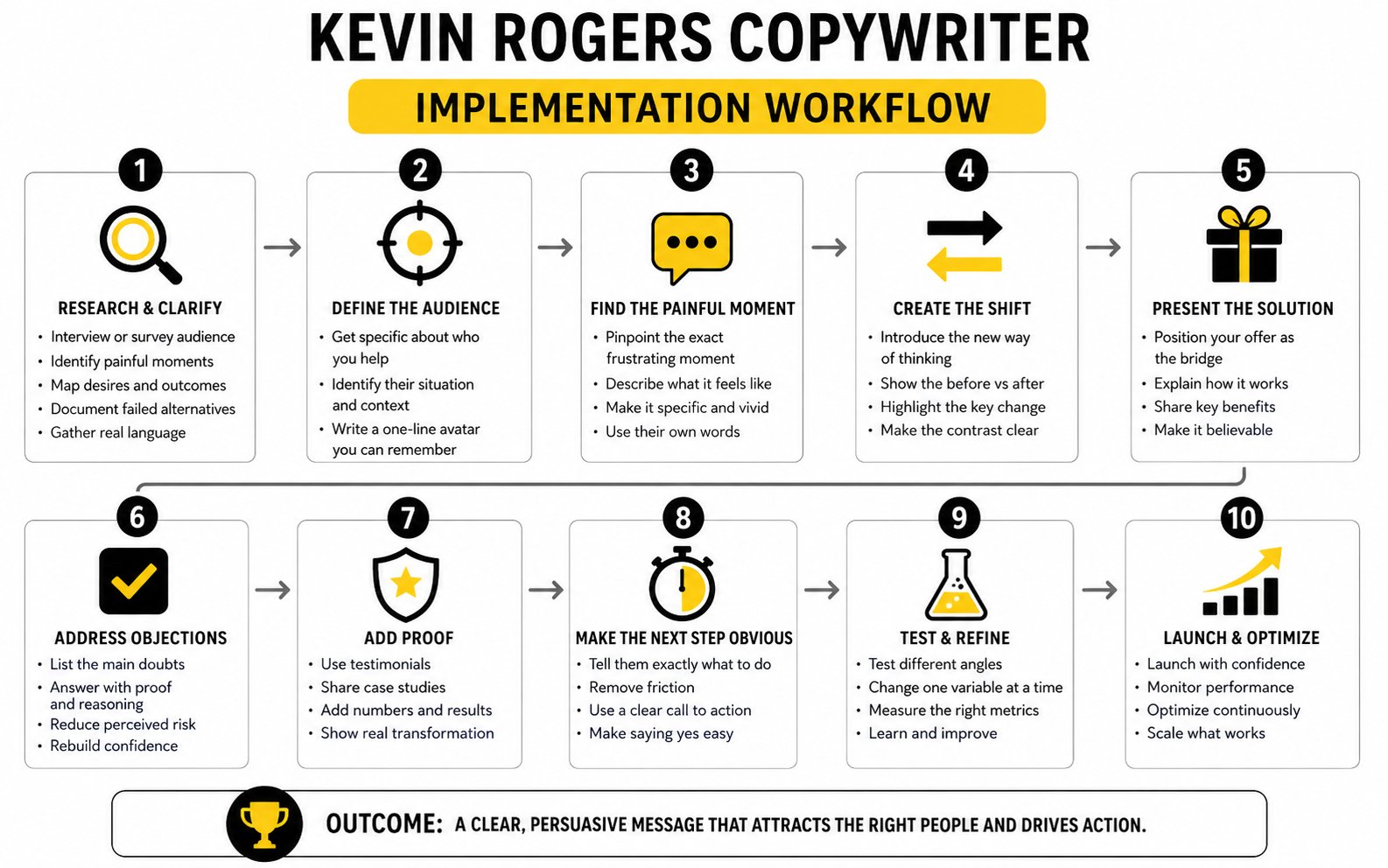
Build The Hook Step By Step
A practical implementation process should feel simple enough to use, but serious enough to expose weak thinking. You are not trying to write the perfect line on the first attempt. You are trying to gather the raw ingredients before editing them into something clean.
Use this process before writing the actual copy:
This sequence matters because it keeps the copy honest. If you cannot explain the audience, the pain, the shift, and the outcome clearly, the issue is not wording. The issue is positioning.
Turn The Framework Into A Working Draft
After the raw material is clear, write a messy version first. Do not polish too early. Polishing too early usually makes the copy sound smoother before it becomes more persuasive.
A working draft can follow this simple shape:
That structure will not always become the final copy, but it gives you a strong starting point. For example, a weak version might say, “I help founders improve their marketing.” A stronger version might say, “I help bootstrapped SaaS founders turn confusing trial follow-up into simple onboarding emails that move more users toward activation.”
The second version works better because it has edges. It tells you who the person is, where the problem happens, what type of work is involved, and what the outcome should improve. That is the point.
Test The Hook Out Loud
A hook that only looks good on the page can still fail in real conversation. Read it out loud and listen for friction. If it sounds like something nobody would say naturally, it probably needs to be simplified.
This is one of the easiest ways to keep the copy human. You should be able to say the hook on a call without feeling like you are performing. If the sentence is too long, too abstract, or too stuffed with jargon, the reader will feel that too.
The best version usually sounds almost obvious after you find it. That is not a weakness. Clear positioning often feels obvious in hindsight because it removes the fog that was making the offer hard to understand.
Apply It To A Landing Page
On a landing page, the hook usually shows up in the hero section, the opening paragraph, and the first proof section. The headline should create immediate relevance. The subhead should explain the useful shift. The first body section should make the problem feel concrete enough that the reader wants to keep going.
This is where a tool like Replo can be useful if the page needs to move from idea to execution quickly. But the tool is not the strategy. A beautiful landing page with a vague hook is still a vague landing page.
Before building the page, write the hook in plain text. Then write the page around that hook. This keeps the design from becoming a distraction and makes every section support the same core message.
Apply It To Email Copy
In email, the hook usually appears in the subject line, the opening sentence, or the first story beat. The job is not to explain everything immediately. The job is to create enough recognition and curiosity that the reader keeps moving.
A strong email hook often starts with a specific moment. For example, instead of opening with “Want more conversions?” the email might open with a situation: “A lead replies with interest, asks for details, then disappears for two weeks.” That line gives the reader a scene, not a slogan.
From there, the email can connect the scene to the larger problem. The offer then becomes the next logical step, not a hard pivot. That is how the hook improves flow.
Apply It To Funnels
Funnels become much easier to build when the hook is already clear. The ad creates the first moment of recognition. The landing page expands the problem and promise. The follow-up emails handle objections, proof, urgency, and action.
If the hook is weak, every funnel asset has to work harder. You start compensating with more bonuses, more urgency, more claims, and more design. That usually makes the funnel louder, not stronger.
For businesses that need an all-in-one system to connect pages, follow-up, CRM, and automation, GoHighLevel can fit naturally once the message is clear. But again, the order matters. Clarify the hook first, then build the machine around it.
Apply It To Client Work
For client work, the framework is especially useful during discovery. Instead of asking only what the client wants written, ask what the buyer needs to believe before the copy can work. That question changes the whole project.
A client may ask for a sales page, but the real issue may be that the offer is hard to explain. They may ask for emails, but the real issue may be that the audience does not understand the consequence of waiting. They may ask for ads, but the real issue may be that the hook sounds like every competitor.
Using the Kevin Rogers copywriter framework in client work gives you a cleaner diagnostic process. You are not just taking orders for assets. You are finding the message that makes those assets perform better.
Statistics And Data
The Kevin Rogers copywriter approach should not be judged by whether the hook sounds clever. It should be judged by whether the right people move forward. That means you need to measure behavior, not just taste.
A hook can sound strong in a Google Doc and still fail when traffic hits the page. It can also sound almost too simple and then outperform the “creative” version because it makes the buying situation clearer. Data keeps you honest because it shows what the audience actually does after reading the message.
The goal is not to drown the process in dashboards. The goal is to connect copy decisions to performance signals. When you know what each metric is telling you, you can improve the hook without guessing.
Start With The Right Baseline
Benchmarks are useful, but only when they are treated as context. A SaaS landing page, a local service page, a coaching funnel, and an ecommerce product page should not be judged by the same number. The offer, traffic temperature, price point, audience awareness, and conversion event all change what “good” looks like.
Landing page data makes this very clear. Unbounce’s conversion benchmark research is based on 57 million conversions across more than 41,000 landing pages, and its B2B conversion analysis shows a median conversion rate of 6.6% across all industries. That number is helpful, but it is not a universal target.
The better question is not, “Are we above the benchmark?” The better question is, “Are we improving against our own baseline with the same traffic source, same offer, and same conversion goal?” That is how you avoid making lazy decisions from broad averages.
Measure The Hook By The Next Action
A hook has one main job at each stage of the funnel. In an ad, it should earn the click from the right person. On a landing page, it should make the visitor keep reading. In an email, it should create enough recognition or curiosity for the reader to open, click, reply, or buy.
This is why you should measure the next action, not just the final sale. If an email subject line gets opens but the body gets no clicks, the subject may be creating curiosity without relevance. If a landing page gets scroll depth but no form submissions, the hook may be interesting but the offer may not feel urgent enough.
The Kevin Rogers copywriter framework helps here because it separates the message into parts. You can test the audience angle, the pain, the shift, and the outcome instead of randomly rewriting everything. That makes optimization much cleaner.
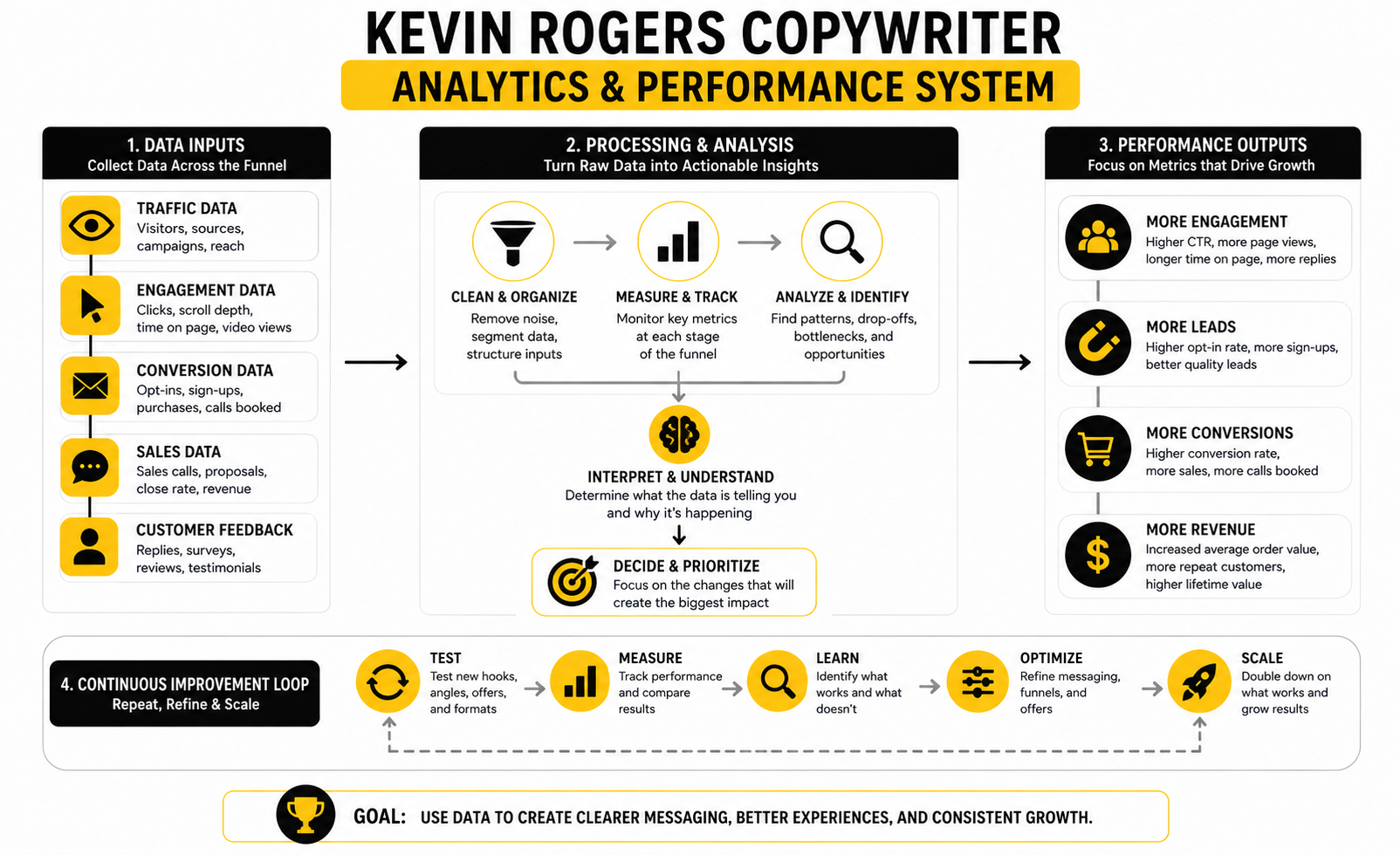
Build A Simple Analytics System
A practical analytics system should tell you where the message is losing people. You do not need fifty metrics. You need a small set of signals that match the buyer journey.
For a basic funnel, track these:
This keeps measurement tied to decisions. If clicks are low, test the front-end hook. If clicks are strong but conversions are weak, look at the page promise, proof, friction, and offer clarity. If leads come in but do not buy, the hook may be attracting curiosity instead of qualified intent.
Email Benchmarks Need Careful Interpretation
Email metrics are useful, but they can be misleading when read alone. Open rates are affected by inbox placement, subject lines, sender reputation, audience relationship, Apple Mail Privacy Protection, and list quality. Clicks and replies often tell you more about real intent.
MailerLite’s 2025 benchmark report covers more than 3.6 million campaigns from 181,000 approved accounts, which makes it useful for context across industries and regions. HubSpot’s benchmark summary shows how much performance varies by category, with examples like B2B services and SaaS showing very different average opens and click-through rates. The lesson is simple: compare against your segment, not against a random global average.
For copy decisions, watch the relationship between opens and clicks. High opens with low clicks often means the subject line is stronger than the offer. Low opens with strong click rates can mean the body is working, but the hook needs a better entry point.
Landing Page Metrics Show Message Friction
Landing pages reveal whether the hook can carry attention into action. A strong headline may get the visitor to pause, but the rest of the page has to justify the promise. If the page loses people quickly, the first screen may not be specific enough.
Look at scroll depth, time on page, form starts, form completions, call bookings, and checkout starts. Each signal tells you something different. A visitor who scrolls but does not act may understand the offer but still lack trust, urgency, proof, or a clear next step.
This is where tools like ClickFunnels or GoHighLevel can help if you need the page, follow-up, and pipeline in one place. But the numbers only become useful when you know what you are testing. Better software will not save a vague message.
The Best Test Is Usually Specificity
When a hook underperforms, many people try to make it bigger. They add stronger claims, more urgency, broader promises, or more dramatic language. That is usually the wrong move.
The better test is often specificity. Make the audience clearer. Make the problem more concrete. Make the shift easier to understand. Make the outcome more believable.
For example, “Get more clients with better copy” is broad. “Turn interested sales calls into booked clients with sharper follow-up emails” is more specific. The second version gives you a clearer metric to watch because the promise is tied to a measurable behavior.
Separate Attention Metrics From Buyer Metrics
Attention is not the same as demand. A hook can generate clicks because it is provocative, funny, or surprising. That does not mean it attracts buyers.
Buyer metrics are slower and more valuable. Look at qualified leads, booked calls that show up, trial activation, sales conversations, close rate, average order value, refund rate, and retention. These numbers tell you whether the hook is attracting people who actually fit the offer.
This matters because the Kevin Rogers copywriter method is not about cheap attention. It is about making the right person feel understood quickly. If the copy attracts the wrong person, the hook is not working even if the top-of-funnel numbers look exciting.
Use Data To Improve The Message, Not Flatten It
Data should sharpen the copy, not make it sterile. The danger is over-optimizing until every line sounds like it was written by a committee. That kills the voice that made the message interesting in the first place.
Use the numbers to find the weak point, then use judgment to fix it. If the headline is not earning attention, revisit the painful moment. If the page is not converting, strengthen the proof and clarify the next step. If emails get clicks but not sales, check whether the offer promise matches the landing page experience.
The real win is not a single winning headline. The real win is building a repeatable habit: write the hook, launch it, measure the right behavior, learn what the audience is telling you, then refine the message. That is how the framework becomes a professional process instead of a one-time copy exercise.
Where His Method Works Best
The Kevin Rogers copywriter approach works best when the buyer needs to understand the offer quickly, but the offer still has enough nuance to require trust. That is the sweet spot. If the offer is obvious and low-risk, the hook does less heavy lifting. If the offer is complex, expensive, or unfamiliar, the hook becomes critical.
This is why the framework fits so well in expert businesses, service offers, coaching programs, consulting, SaaS onboarding, workshops, newsletters, paid communities, and direct response funnels. These offers usually need more than a product description. They need a reason for the reader to believe, “This was made for someone like me.”
The key is matching the hook to the buying moment. A cold visitor needs recognition. A warm lead needs clarity. A sales-ready prospect needs confidence. If you use the same hook everywhere without adjusting the context, the message starts to feel blunt instead of precise.
High-Trust Offers
High-trust offers need more than a clever line because the buyer is taking a real risk. They may be spending meaningful money, changing a business process, choosing a consultant, joining a program, or letting someone influence their strategy. In those situations, the hook has to create relevance without overpromising.
This is where the framework is useful because it keeps the message grounded. You are not just saying, “This will change your business.” You are showing who the offer is for, what problem it solves, why the usual path is frustrating, and what better outcome becomes possible.
That kind of clarity lowers perceived risk. The buyer can see whether the offer fits their situation before they click, book, apply, or buy. That saves time for both sides.
Offers With A Strong Point Of View
The method also works well when the offer has a clear point of view. If your market already has a common way of doing things and your approach challenges that pattern, the hook can make the contrast obvious. That contrast gives the copy energy.
A weak point of view sounds like a general benefit. A stronger point of view says, “The way most people solve this problem is why they keep getting stuck.” That does not mean being contrarian for attention. It means naming the flawed assumption behind the customer’s current struggle.
This is where a Kevin Rogers copywriter-style hook becomes strategic. It does not just sell the offer. It reframes the problem so the reader understands why a different solution is needed.
Personal Brands And Founder-Led Businesses
Personal brands often benefit from this framework because the founder’s story can easily become too long, too scattered, or too self-focused. The hook forces the story to serve the reader. That matters because the audience does not care about every detail of the founder’s journey; they care about the part that helps them understand the offer.
A founder-led message should make three things clear. Why this person understands the problem. What changed their thinking. Why their process now helps the reader get a better result. When those pieces are clear, the story creates trust instead of becoming a biography.
This is also where restraint matters. Not every hardship belongs in the copy. Not every origin story improves the sale. The useful story is the one that makes the promise more believable.
Service Businesses And Agencies
Service businesses can use the framework to escape commodity positioning. Without a strong hook, most agencies sound the same. They offer strategy, content, funnels, ads, automation, branding, design, or growth, but the buyer struggles to see why one option is meaningfully different from another.
A better hook connects the service to a specific business pain. Instead of leading with “done-for-you email marketing,” the message can lead with the problem of leads going cold after a sales call, customers failing to activate after signup, or subscribers never moving from interest to purchase. That gives the service a business reason to exist.
This is also useful inside proposals. A proposal should not just list deliverables. It should restate the buyer’s problem in sharper language than they used themselves, then show how the work directly addresses it. That is how a service provider becomes a strategist instead of a vendor.
When The Framework Becomes Too Narrow
The main tradeoff is that specificity can feel scary. When you sharpen the hook, you may stop appealing to people who are technically eligible but not strongly aligned. That is usually a good thing, but it can feel uncomfortable if you are used to broad messaging.
The risk is going too narrow too early. If you define the audience around a tiny segment before validating demand, the copy may become precise but commercially weak. A specific hook still needs a market with enough buyers, urgency, and willingness to pay.
The practical move is to narrow around the problem before narrowing around identity. “Founders with low trial activation” may be more useful than “AI SaaS founders in Europe with teams under 12.” The first version is specific enough to create relevance while still leaving room for demand.
When The Hook Creates The Wrong Lead
A hook can perform well at the top of the funnel and still attract the wrong people. This happens when the pain is real, but the promise is too broad or the outcome feels too easy. The result is attention without qualification.
This is why the hook should include some signal of fit. Price point, complexity, stage, readiness, industry, or business model can all be implied without making the copy clunky. The reader should understand whether they are in the right room.
For advanced work, this is non-negotiable. The best copy does not just increase volume. It improves the quality of the people who take action.
Scaling The Message Across Channels
Once the core hook works, the next challenge is scaling it without flattening it. The same idea has to show up differently in ads, emails, landing pages, sales calls, webinars, retargeting, social posts, and onboarding. If every asset repeats the same sentence, the campaign starts to feel lazy.
Think of the hook as the source code, not the finished copy. The ad might use the pain angle. The landing page might expand the shift. The email sequence might handle failed alternatives and objections. The sales call might use the same language to diagnose fit.
This is where documentation helps. Keep a simple message map with the audience, problem, failed alternatives, shift, proof points, objections, and desired outcome. That gives everyone working on the campaign the same strategic foundation without forcing every piece of copy to sound identical.
Using AI Without Losing The Human Hook
AI can help you generate variations, organize research, summarize customer language, and pressure-test angles. It can speed up the drafting process. But it should not be trusted to invent the truth of the market from nothing.
The danger is that AI often produces copy that looks complete before the thinking is complete. It will give you polished sentences, but polished sentences are not the same as market insight. If the inputs are vague, the output will usually be vague with better grammar.
Use AI after the hook ingredients are clear. Feed it the audience, painful moment, failed alternatives, mechanism, objections, and proof. Then use your judgment to choose the version that sounds most specific, believable, and human.
Protecting The Voice While Optimizing
The more people involved in a campaign, the easier it is for the voice to get diluted. A strategist improves the hook. A designer adjusts the layout. A client adds a phrase. A legal reviewer softens a claim. A media buyer wants more urgency.
Some of that feedback is useful. Some of it slowly turns the copy into beige oatmeal. The job is to protect the core message while still improving accuracy, clarity, and compliance.
A simple rule helps: change wording freely, but do not weaken the tension. If an edit removes the real problem, hides the useful contrast, or makes the outcome vague, it probably hurts the copy even if the sentence sounds safer.
The Strategic Limit Of Any Framework
The 60-Second Sales Hook is powerful, but it is not a substitute for a good offer. No hook can permanently save weak economics, poor delivery, bad targeting, or a product people do not actually want. Copy can clarify value, but it cannot create value that is not there.
This is the expert-level distinction. Beginners use frameworks to make words sound better. Pros use frameworks to diagnose the business. If the hook keeps failing, the problem may be the audience, the offer, the proof, the pricing, the timing, or the promise itself.
That is why the Kevin Rogers copywriter approach is best treated as a strategic lens. It helps you see where the message is strong, where it is vague, and where the business needs sharper thinking before more copy gets written.
Common Mistakes, Tools, And Final Takeaways
The biggest mistake people make with the Kevin Rogers copywriter approach is turning it into a line-writing exercise. They sit down, try to write a catchy sentence, and call it a hook. That skips the real work.
A strong hook comes from diagnosis. You have to know who the buyer is, what they are tired of, what they have tried, what they secretly want, and what they need to believe before your offer makes sense. Once those pieces are clear, the copy gets easier because you are no longer guessing.
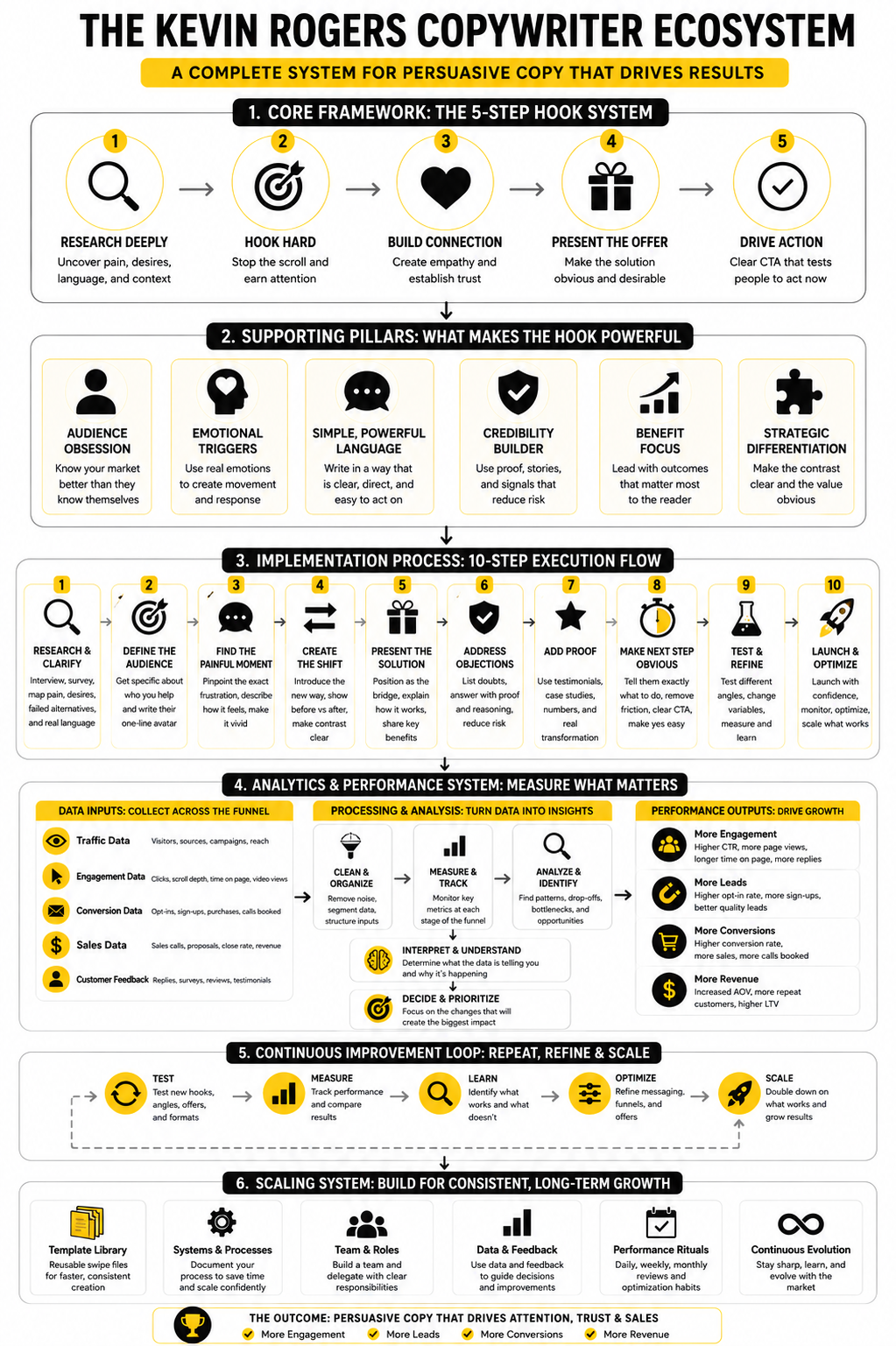
This is also where the full system comes together. The hook shapes the page. The page shapes the follow-up. The follow-up shapes the sales conversation. The sales conversation gives you the language to improve the next hook.
Mistake 1: Making The Hook Too Clever
Clever copy feels good to write, but it often makes the reader work too hard. If the reader has to decode the meaning, the hook is not doing its job. The goal is not to impress another copywriter; the goal is to create instant recognition for a real buyer.
This is where comedy can be misunderstood. Kevin Rogers’ background in stand-up does not mean every hook should sound like a joke. It means the hook should use setup, tension, and payoff with discipline.
A clear hook can still have personality. But personality should make the message sharper, not more confusing. If the clever version weakens clarity, cut it.
Mistake 2: Selling The Tool Instead Of The Shift
Many marketers rush to describe the product, platform, feature, or deliverable. That is natural because the offer is what they are selling. But the buyer usually cares more about the shift the offer creates.
A funnel builder is not exciting by itself. A CRM is not exciting by itself. An email sequence is not exciting by itself. These things become interesting when they solve a painful business problem the buyer already wants fixed.
If someone needs a practical system for funnels, automations, and follow-up, GoHighLevel can support the execution. But the message still has to explain why the system matters. Tools amplify strategy; they do not replace it.
Mistake 3: Confusing Audience Pain With Cheap Agitation
There is a difference between naming pain and manipulating emotion. Good copy helps the reader understand their problem more clearly. Bad copy tries to make them feel worse so they will act faster.
The Kevin Rogers copywriter style works best when it respects the reader. You can be direct without being cruel. You can be persuasive without inventing panic.
The best pain language sounds like something the buyer would admit privately. It should feel specific, honest, and useful. If it sounds like a scare tactic, rewrite it.
Mistake 4: Using The Same Hook Everywhere
A core hook should stay consistent, but the expression should change by channel. A landing page has room to explain. An email needs a sharper entry point. A short social post needs one clean angle.
This is why the hook should become a message system, not a sentence you paste everywhere. Keep the same audience, problem, shift, and outcome. Then adapt the wording to the reader’s awareness level.
For example, a cold audience may need the painful moment first. A warm audience may need the failed alternative. A sales-ready audience may need proof, urgency, or a clear next step.
Mistake 5: Ignoring The Offer
Sometimes the hook is not the problem. Sometimes the offer is too vague, too broad, too risky, too expensive for the perceived value, or too similar to everything else in the market. Better copy can expose that issue, but it cannot magically fix the business underneath.
This is why advanced copywriters look beyond the page. They ask whether the promise is strong enough, whether the proof supports it, whether the audience has urgency, and whether the offer removes enough friction. That is strategy, not just writing.
The hook should make the offer easier to understand. If the offer still feels weak after the hook is clear, the next move is offer improvement. More words will not solve a broken promise.
Who Is Kevin Rogers In Copywriting?
Kevin Rogers is a copywriter, author, former stand-up comedian, and founder of Copy Chief. He became known for teaching the 60-Second Sales Hook, a framework that uses story and joke structure to create sharper sales messages. His official Copy Chief site now notes that Copy Chief closed after an 11-year run, while his newer newsletter focuses on persuasive copy in the post-AI generation.
What Is The 60-Second Sales Hook?
The 60-Second Sales Hook is a framework for explaining who you help, what problem they face, what changed, and what result becomes possible. It is designed to make a message clear quickly without turning it into a generic elevator pitch. The point is not speed for its own sake; the point is compression of useful thinking.
Why Is Kevin Rogers Connected To Comedy?
Kevin Rogers spent years as a stand-up comedian before becoming known in direct response copywriting. That background matters because comedy trains a person to understand setup, tension, timing, and payoff. In copywriting, those same skills help create hooks that feel human instead of robotic.
Is The Kevin Rogers Copywriter Method Only For Sales Pages?
No, the method can work across sales pages, landing pages, email sequences, ads, proposals, webinars, sales calls, and personal brand messaging. The core idea is bigger than one asset. If a message needs to earn attention and explain value quickly, hook thinking can help.
Can Beginners Use This Framework?
Yes, beginners can use it because the structure is simple. The challenge is not understanding the steps; the challenge is filling them with real audience insight. A beginner who does the research carefully can often write a stronger hook than an experienced writer who relies on vague formulas.
What Makes A Good Sales Hook?
A good sales hook makes the right person feel understood quickly. It names a real problem, frames it in a useful way, and points toward a believable shift. It should create movement without sounding inflated, manipulative, or overly polished.
How Is A Hook Different From A Headline?
A headline is a visible piece of copy, usually at the top of a page, email, ad, or section. A hook is the underlying angle that makes the message interesting and relevant. One hook can produce many headlines, but a headline without a strong hook often feels empty.
Should Copywriters Use AI With This Method?
Yes, but AI should support the process instead of replacing the thinking. It can help create variations, organize ideas, and pressure-test wording once the audience, problem, shift, and outcome are clear. If the inputs are weak, AI will usually produce polished but generic copy.
Where Does This Framework Work Best?
It works best for offers that need trust, clarity, and differentiation. That includes consulting, coaching, freelance services, SaaS, education products, communities, workshops, and high-consideration funnels. It is especially useful when the buyer needs to understand why this solution is different from the usual options.
What Is The Biggest Mistake People Make With This Approach?
The biggest mistake is treating the framework like a fill-in-the-blank script. That creates stiff copy because the writer is trying to satisfy a formula instead of understand the buyer. The framework should guide your thinking, not replace your judgment.
How Do You Know If A Hook Is Working?
You know a hook is working when the right people keep moving forward. That might show up as better click-through rates, more qualified leads, stronger replies, improved booked-call quality, or higher conversions. The metric depends on where the hook appears in the funnel.
Can This Replace A Full Copywriting Strategy?
No, and it should not. A strong hook is a major part of the strategy, but the offer, proof, objections, pricing, traffic source, follow-up, and sales process still matter. The hook opens the door; the rest of the system has to support the promise.
Is Kevin Rogers Still Relevant With AI Changing Copywriting?
Yes, probably more than before. AI makes it easier to produce words, which makes clear human insight more valuable. The Kevin Rogers copywriter approach is useful because it focuses on the thinking behind the message, not just the output.
Build a stronger local presence with BAAM AI
Turn your website, Google profile, social channels, and AI visibility into one growth engine
Most businesses do not need more random marketing activity. They need a consistent presence system that helps the right people find them, trust them, and take action. BAAM AI brings strategy, local SEO, website updates, Google Maps visibility, social content, AI-search readiness, media production, and reporting into one practical monthly engine.
If you want your marketing to keep working after the campaign ends, start with a free BAAM AI presence audit. See how your business shows up today and where the fastest visibility wins are at BAAM AI.