
BAAM AI Blog
Kate Toon Copywriter: The Practical Brand-Building Framework Behind Her Authority
Search for Kate Toon copywriter and you quickly realise you are not just looking at a freelance writing profile. You are looking at a working example of how a copywriter can turn skill, personality, teaching, SEO...

Search for Kate Toon copywriter and you quickly realise you are not just looking at a freelance writing profile. You are looking at a working example of how a copywriter can turn skill, personality, teaching, SEO knowledge, products, community, books, and media into one coherent business. That is what makes Kate Toon useful to study, whether you are a copywriter, consultant, course creator, agency owner, or small business marketer.
Kate Toon describes herself as a digital marketing and SEO educator, copywriting coach, author, podcaster, and speaker on her official website. Her older copywriting site positions her as an experienced SEO copywriter and SEO consultant who has worked with small businesses, agencies, and larger brands through content, training, and workshops on the Kate Toon Copywriter site. That mix matters because her business is not built around one narrow offer. It is built around a clear authority ecosystem.
this guide breaks down that ecosystem in a practical way. The goal is not to copy her personality, her offers, or her exact path. The goal is to understand the structure behind the Kate Toon copywriter brand so you can see what actually makes it work.
This full article is split into six parts:
Why the Kate Toon Copywriter Model Matters
The obvious reason Kate Toon matters is that she has become known for copywriting and SEO. But the more useful reason is that her brand shows how a service professional can stop being trapped inside one-to-one client work. Her public ecosystem includes copywriting, SEO education, books, podcasts, speaking, communities, templates, courses, and consulting-style offers.
That is important because many copywriters get stuck selling words by the hour, by the page, or by the project. There is nothing wrong with client work, but it becomes fragile when every sale depends on availability. Kate Toon’s broader model shows a different path: use client-earned expertise to create education, assets, intellectual property, and audience trust.
Her work also sits at the intersection of two skills that clients already understand: better words and better visibility. Copywriting helps people communicate the offer. SEO helps people get found. When those two skills are packaged together clearly, the result is easier to value than vague “content help.”
The modern copywriter has to do more than write polished sentences. Clients want positioning, search visibility, conversion thinking, content structure, messaging clarity, and enough digital strategy to stop wasting time on pretty words nobody reads. That is why the Kate Toon copywriter model is worth studying as a business structure, not just as a personal brand.
Framework Overview
The Kate Toon framework can be understood as a simple authority flywheel. At the centre is practical expertise in copywriting, SEO, digital marketing, and small business education. Around that centre are public assets that keep reinforcing the same positioning.
Her Recipe for SEO Success brand focuses on SEO learning and positions Kate as an award-winning SEO copywriter and consultant with more than two decades of advertising and digital experience. Her Clever Copywriting School connects copywriters with training, templates, resources, and community-style support. Her podcasts extend the brand into recurring media, where trust is built through conversations rather than static sales pages.
The framework looks like this:
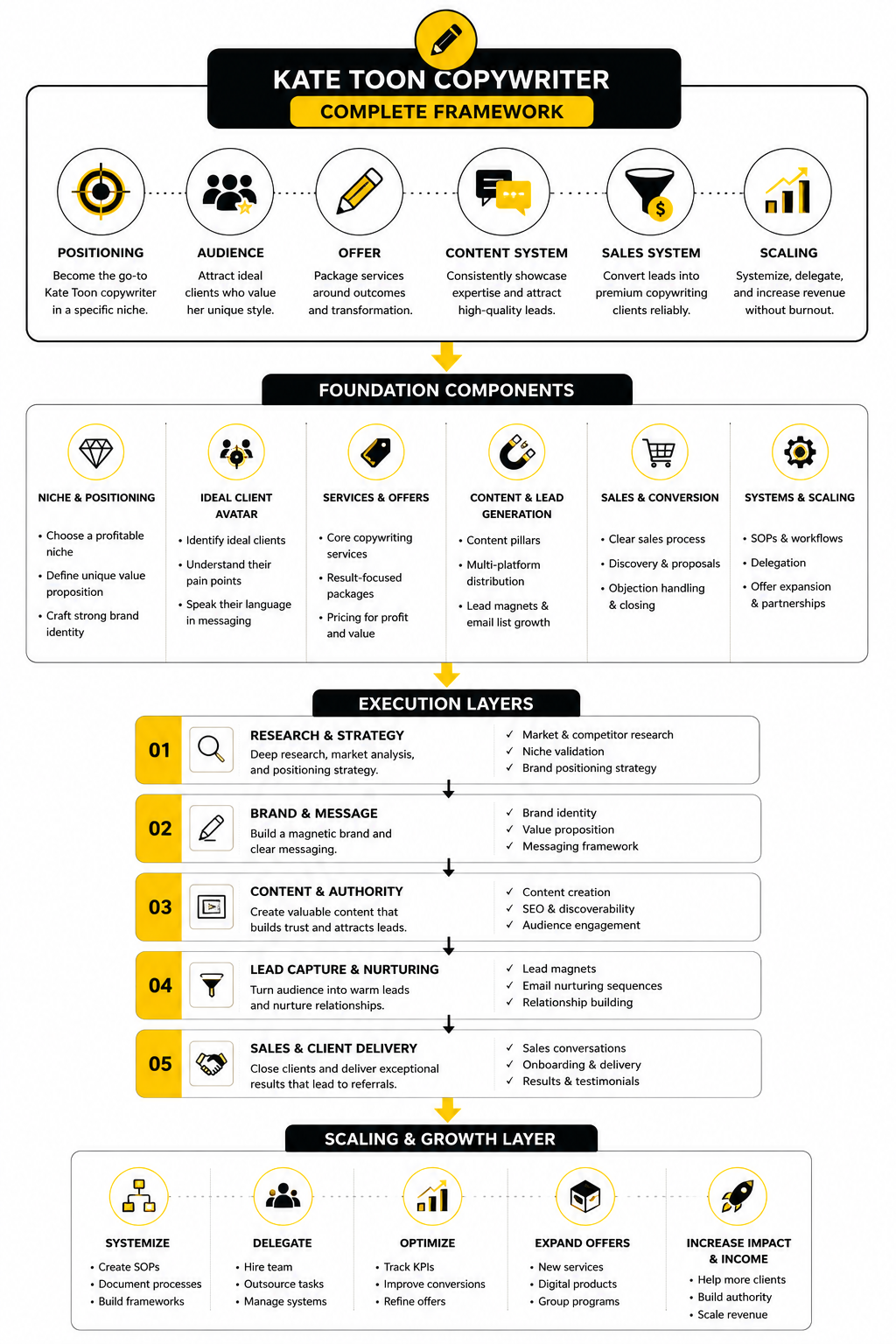
This matters because authority is rarely built by one asset alone. A good homepage helps, but it is not enough. A good course helps, but it needs trust behind it. A podcast helps, but it works better when it connects to a clear offer ladder.
Core Components of the Brand
The first core component is positioning. Kate Toon is not presented as a generic writer who can write anything for anyone. Her public positioning connects copywriting, SEO, digital marketing, and business education in a way that makes her easy to remember.
The second component is proof through publishing. Books like Six Figures While You Sleep show how her brand has expanded beyond writing services into education around digital products and scalable income. This is not a random pivot. It builds on the same theme of helping skilled service providers package what they know.
The third component is audience segmentation. Some people arrive because they want SEO help. Some arrive because they are copywriters. Some arrive because they want to build digital products, join a community, attend a workshop, or listen to a podcast. The brand gives different audiences different doors, but the house still feels connected.
The fourth component is tone. Kate Toon’s public writing and brand language avoid the stiff, corporate feel that often makes marketing education dull. The tone is direct, practical, warm, and slightly cheeky, which helps the content feel accessible even when the subject is technical.
Professional Implementation
The practical lesson is not “become Kate Toon.” That would be lazy, and frankly, impossible. The better lesson is to build a business where your expertise does not live only in your inbox, your client calls, or your project files.
For a copywriter, that could mean turning repeated client problems into templates, workshops, paid audits, diagnostic tools, or a focused email sequence. For a consultant, it could mean building a small resource hub around one painful problem your clients keep bringing up. For an agency, it could mean creating a clearer path from free education to paid implementation.
The important part is structure. A scattered personal brand creates noise. A structured authority ecosystem creates compounding trust.
A simple implementation path looks like this:
If you are building a service business around copywriting, SEO, funnels, or education, the backend matters too. A tool like GoHighLevel can make sense when you need CRM, follow-up, pipeline, and campaign management in one place. But the tool is not the strategy. The strategy is knowing what your audience needs next, then building a system that makes that next step obvious.
That is the real value of studying the Kate Toon copywriter ecosystem. It shows how a professional skill can become more than a service. With clear positioning, useful education, practical offers, and a consistent voice, a copywriter can become a trusted authority rather than just another supplier.
The Authority Stack Behind Kate Toon’s Brand
The next layer of the Kate Toon copywriter model is authority. Not vague “personal brand” authority. Real authority built from repeated proof, visible assets, specific positioning, and a clear point of view.
A lot of copywriters try to build authority by posting tips. That helps, but tips alone are thin. Kate Toon’s brand is stronger because it stacks multiple credibility signals on top of each other: client-side experience, SEO knowledge, teaching, books, podcasts, communities, courses, workshops, and a public personality that people can actually remember.
That is the part worth paying attention to. Authority is not one thing. It is a stack.
Authority Starts With a Clear Professional Identity
Kate Toon’s current public identity is not limited to “copywriter.” Her main site positions her as a digital marketing and SEO educator, copywriting coach, author, podcaster, and speaker through the Kate Toon website. That broader identity gives her more room to sell education, speak at events, publish books, and lead communities without confusing the audience.
The original copywriting foundation still matters. The Kate Toon Copywriter site presents her background in SEO copywriting, digital marketing, and consulting, which gives the broader brand a practical base. That is important because authority without a service history can feel fluffy.
For anyone studying the Kate Toon copywriter brand, the lesson is simple. Start with a skill people already value, then expand from that skill into adjacent problems your audience already has. Do not jump randomly from offer to offer because you saw someone else doing it.
The Brand Is Built Around Overlapping Audiences
Kate Toon does not speak to only one type of person. Her ecosystem reaches small business owners, copywriters, marketers, ecommerce founders, service providers, course creators, and people who want to turn expertise into digital products. That could become messy fast, but the brand holds together because the audiences overlap around a few practical needs.
Those needs are visibility, better communication, more confidence, and more carefully business systems. A copywriter wants better clients and stronger skills. A business owner wants traffic and sales. A digital product creator wants to package knowledge without disappearing into tech chaos.
This is where the authority stack becomes useful. The Recipe for SEO Success speaks to people who want to learn SEO in a practical way. The Clever Copywriting School speaks more directly to copywriters who want training, resources, tools, and community. The same person can enter through one door and later discover the rest of the ecosystem.
Expertise Is Packaged Into Recognisable Properties
One of the smartest parts of the model is that the expertise is not trapped inside one personal website. It is packaged into named properties that are easier to understand, remember, and recommend. That gives the brand more surface area without turning everything into one crowded homepage.
The Recipe for SEO Success is not just “Kate teaches SEO.” It is a named learning property with its own promise, audience, resources, and podcast presence. The Clever Copywriting School is not just “Kate has copywriting tips.” It is a dedicated space for copywriters who want courses, templates, community, and practical support.
This matters because named properties create mental shortcuts. People remember a school, a recipe, a show, a book, or a program more easily than they remember a long list of services. If you are building a copywriting or consulting business, this is a useful shift: stop thinking only in services and start thinking in assets.
Media Makes the Authority Feel Alive
Static credibility is useful, but recurring media keeps the brand active. Kate Toon’s podcast ecosystem helps her authority feel current because it creates ongoing touchpoints with her audience. Her site collects shows such as The Kate Toon Show and the SEO-focused podcast connected to Recipe for SEO Success.
This matters because trust often needs repetition. A visitor might not buy after reading one page. But if they listen to a podcast, read a blog post, download a checklist, attend a workshop, and see the same practical voice across each channel, the trust gap gets smaller.
Media also lets a brand show how it thinks. That is different from simply saying “I am an expert.” When people hear the way you explain problems, challenge assumptions, and simplify decisions, they start to understand your value before they ever speak to you.
Books Strengthen the Expert Positioning
Books add another layer to the authority stack because they turn experience into a structured argument. Kate Toon’s book Six Figures While You Sleep focuses on turning services and skills into digital products. That is a natural extension of her own business journey because the brand itself shows the move from service expertise into scalable offers.
This is not just a credibility badge. A book forces a clear framework. It gives the author a reason to talk about a bigger problem, appear on podcasts, run workshops, build programs, and attract people who want a more complete methodology.
For copywriters, the lesson is not that everyone needs a book tomorrow. The lesson is that authority grows when your thinking becomes structured enough to teach. Whether that structure becomes a book, course, workshop, playbook, or diagnostic process depends on your business model.
Personality Makes the Framework Memorable
Many experts are credible but forgettable. Kate Toon’s brand avoids that problem by using personality as part of the positioning. The tone is direct, playful, and practical, which makes technical subjects like SEO feel less intimidating.
That personality is not decoration. It helps filter the audience. The right people lean in because the brand feels human, while the wrong people can self-select out before wasting anyone’s time.
This is a big point for anyone trying to build authority. You do not need to become loud, quirky, or performative. But you do need a recognisable way of explaining things. If your content sounds like every other freelancer, consultant, or agency in your market, your expertise has to work much harder than it should.
The Stack Works Because Each Layer Supports the Others
The strongest part of the Kate Toon copywriter ecosystem is not any single asset. It is the way the assets support each other. SEO education supports copywriting credibility. Copywriting experience supports sales education. Books support workshops. Podcasts support community. Community supports product demand.
That is how authority compounds. One useful asset creates trust. Several connected assets create a market position.
For a service business, this is the real takeaway. Do not build random content, random offers, and random lead magnets because someone told you to “be everywhere.” Build a stack where each layer makes the next layer easier to trust, easier to understand, and easier to buy.
The Core Components of Her Copywriting and SEO Ecosystem
Once the authority stack is clear, the next question is execution. How does a copywriter turn expertise into a system people can understand, trust, and buy from? The Kate Toon copywriter model is useful because it shows that implementation is not just about writing more content or launching more offers.
The ecosystem works because each component has a job. Some assets attract people. Some educate them. Some help them make a decision. Some turn trust into revenue. Some keep people connected long after the first interaction.
That is the difference between a personal brand and a business system. A personal brand gets attention. A business system turns that attention into momentum.
Start With a Specific Skill Base
The foundation is still the skill. Kate Toon’s public positioning grew from copywriting and SEO, not from vague business inspiration. Her copywriting site describes her as an experienced SEO copywriter and SEO consultant who helps small businesses, agencies, and corporates produce strong content through the Kate Toon Copywriter profile.
That skill base gives the rest of the ecosystem credibility. When she teaches SEO, it connects back to practical writing and content experience. When she teaches digital products, it connects back to the process of turning a service skill into something more scalable.
This is where many copywriters get the order wrong. They try to build a course, community, or content machine before they have a clear professional centre. The better move is to identify the skill you want to be known for, then build every asset around making that skill easier to understand and easier to buy.
Turn Repeated Problems Into Repeatable Assets
A strong copywriting business creates patterns. Clients ask the same questions. Prospects raise the same objections. Beginners make the same mistakes. Over time, those patterns become the raw material for better offers.
Kate Toon’s ecosystem shows this clearly through named education brands, templates, courses, workshops, books, and podcasts. The Clever Copywriting School includes training, templates, tools, a directory, job posts, and resources for copywriters through its Start Here page. Recipe for SEO Success packages SEO learning into a dedicated education brand through The Recipe for SEO Success.
That is the move. You stop answering the same question privately every week and start turning the answer into a reusable asset. A checklist becomes a lead magnet. A workshop becomes a paid training. A client onboarding document becomes a template. A repeated explanation becomes a podcast episode, article, or course module.
Build a Clear Path From Free Help to Paid Help
The execution process becomes tangible when you map the customer journey. A visitor should not have to guess what to do next. They should be able to move from free learning to deeper support without feeling pushed, tricked, or dumped into a random sales pitch.
For a copywriter, this journey can be simple. Someone discovers your article about homepage copy. They download a checklist. They receive a short email sequence that explains the decision points. They are invited to book an audit, buy a template, join a workshop, or apply for a higher-touch service.
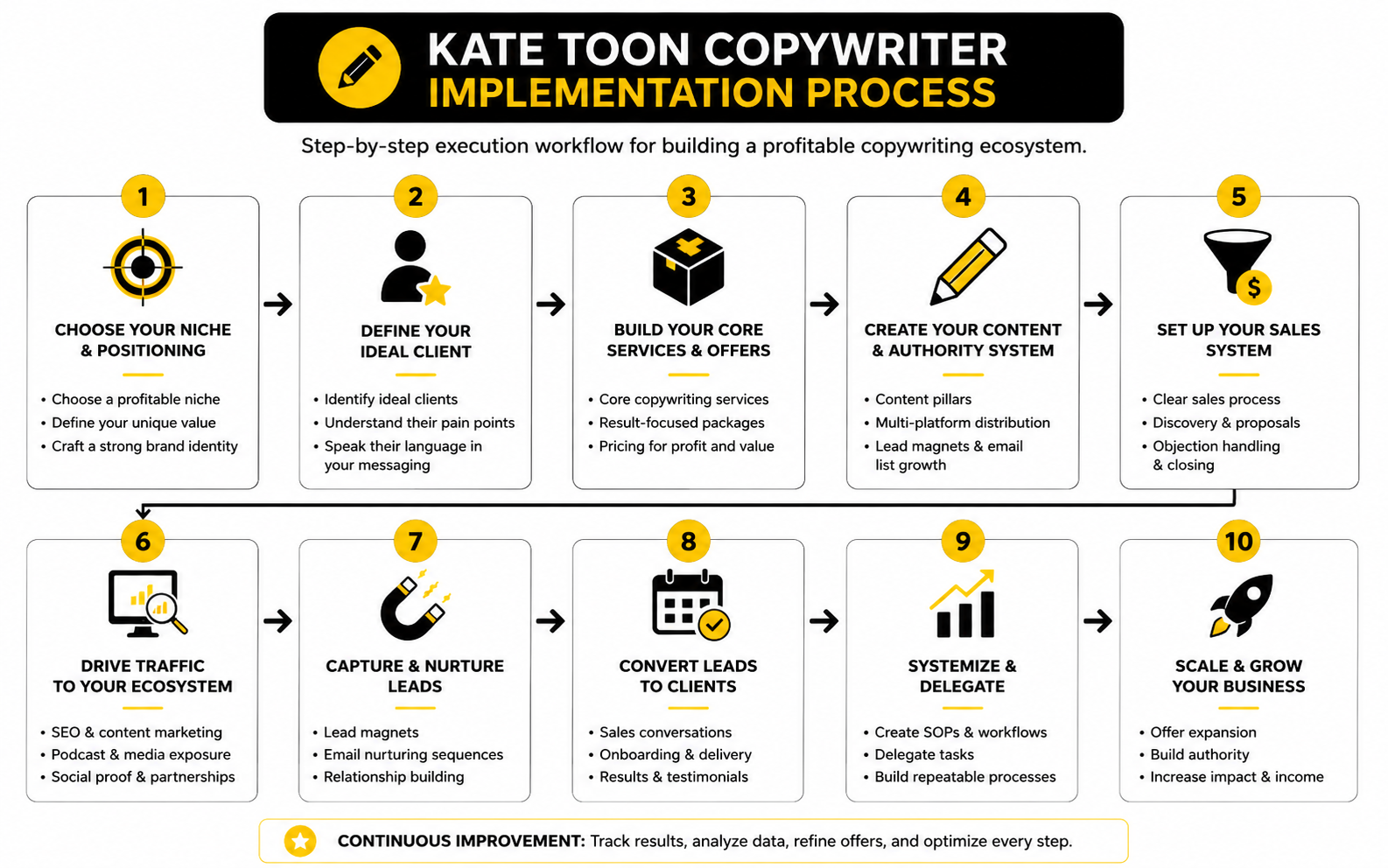
The key is not complexity. The key is sequence. Each step should answer the question your reader is already asking at that point in the journey.
A practical flow could look like this:
This is where a platform like GoHighLevel can be useful for service businesses that need CRM, forms, pipelines, follow-up, and campaign tracking in one place. A simpler creator might use an email tool and checkout page instead. The platform matters less than the logic of the journey.
Use Content to Pre-Sell the Method
Good content does not just attract traffic. It teaches people how to think. That is why content is such a powerful piece of the Kate Toon copywriter ecosystem.
The Recipe for SEO Success does not simply say “buy SEO training.” It creates a world where SEO feels teachable, practical, and less terrifying. The Kate Toon Show is positioned around building a successful, profitable, and enjoyable business using smart digital marketing and practical business advice through The Kate Toon Show podcast listing.
That is what strong content should do. It should make the reader more informed and more aligned with your point of view before they ever reach the sales page. By the time they are ready to buy, they should already understand the problem, the language, the stakes, and the method.
Separate Offers Without Splitting the Brand
A common fear for copywriters is that multiple offers will confuse the market. That can happen. But the bigger risk is not having enough structure around different audience needs.
Kate Toon’s ecosystem separates major themes into recognisable homes. SEO education lives under Recipe for SEO Success. Copywriter support lives under The Clever Copywriting School. Broader business, speaking, books, and media connect through her main Kate Toon brand.
That separation helps each audience feel seen. A copywriter does not need to dig through unrelated SEO pages to find copywriting resources. A business owner interested in SEO does not need to decode a pile of freelancer-focused training. The brand can expand because the structure keeps the experience clean.
Make the Personality Consistent Across the System
Execution is not only about funnels and formats. The tone has to travel across the whole system. If the homepage sounds warm and direct, but the sales emails sound stiff and desperate, the trust breaks.
Kate Toon’s public brand works because the personality carries across her sites, books, workshops, and podcasts. The language feels direct, human, and intentionally un-corporate. That consistency makes the ecosystem feel like one person’s point of view rather than a pile of disconnected marketing assets.
For your own business, this means documenting more than colours and fonts. Document how you explain things. Document phrases you use and phrases you avoid. Document how direct you want to be, how casual you can sound, and how much humour fits your market.
Keep the System Practical, Not Performative
The most important implementation lesson is this: do not build assets to look busy. Build assets to solve real decision points. A template should save someone time. A podcast should clarify thinking. A course should teach a defined outcome. A community should help people stay supported.
This is where the Kate Toon copywriter model is especially useful. The public ecosystem feels commercial, but it does not feel empty. There are real offers, real learning paths, and real audience groups behind the brand.
That is the standard. Not more content for the sake of content. Not more offers for the sake of looking bigger. A better ecosystem is built by asking one practical question again and again: what does the reader need next, and what is the simplest useful way to help them take that step?
Statistics and Data
Measurement is where a copywriting and SEO ecosystem stops being a nice-looking brand and starts becoming a business asset. This matters because the Kate Toon copywriter model is built around discoverability, trust, education, and offer movement. If you cannot measure those four things, you are guessing.
The mistake is treating analytics as a scoreboard for ego. Traffic is not automatically success. Followers are not automatically buyers. Podcast downloads are not automatically authority unless they move the right people closer to the right action.
The useful question is much sharper: what does each number tell you about attention, trust, intent, and revenue?
Measure Attention Before You Measure Sales
The first signal is attention. In a copywriting and SEO business, this usually means organic search impressions, search clicks, page views, podcast listens, email subscribers, social reach, and referral traffic. These numbers show whether the market is noticing the ideas you are putting out.
For a brand like Kate Toon’s, attention is spread across several surfaces: the main Kate Toon website, Recipe for SEO Success, The Clever Copywriting School, podcasts, books, workshops, and community pages. That spread is powerful, but it also means measurement needs to be organised. Otherwise, you get a messy pile of numbers that looks impressive but does not tell you what to do.
The right action is to separate attention by source and intent. A person searching “SEO copywriting course” is not in the same state of mind as someone listening to a broad business podcast episode. Both may be valuable, but they need different follow-up, different offers, and different expectations.
Track Trust, Not Just Traffic
Trust is harder to measure than traffic, but it is far more important. A visitor who reads three pages, joins an email list, attends a workshop, and replies to an email is more valuable than a thousand people who bounce after eight seconds. That is why copywriters should track depth, not just reach.
Useful trust signals include email signups, return visits, podcast subscribers, webinar attendance, course waitlist joins, replies, comments, job board activity, community participation, and clicks to deeper resources. These actions show that the audience is not just glancing at the brand. They are giving it more time.
This is especially important in SEO. The Recipe for SEO Success positions SEO as a roadmap that covers technical website health, content marketing, link building, and measurement. That last part matters because SEO is not finished when the page ranks. It is only useful when the ranking creates qualified movement.
Use Benchmarks Carefully
Benchmarks can help, but they can also make smart people do dumb things. A benchmark is a comparison point, not a business strategy. If your audience is small, specialised, and high-value, you may not need huge traffic to create strong revenue.
Current content and SEO research keeps pointing in the same direction: quality, usefulness, and trust are becoming more important than volume alone. The Content Marketing Institute’s 2025 B2B content marketing research highlights the behaviour of top-performing content teams, while Conductor’s State of SEO in 2025 frames SEO as a core channel for visibility, traffic, and business growth. The practical takeaway is not “publish more.” It is “publish what your audience can actually use.”
That matters for anyone analysing the Kate Toon copywriter model. Her ecosystem is not built on one viral post. It is built on many assets that answer practical questions for different audience segments. The benchmark to watch is not only traffic growth, but whether each asset is pulling the right people into the right next step.
Build a Simple Analytics System
The cleanest analytics system tracks the journey in layers. Each layer should answer one business question. If the data does not help you make a decision, it is probably noise.
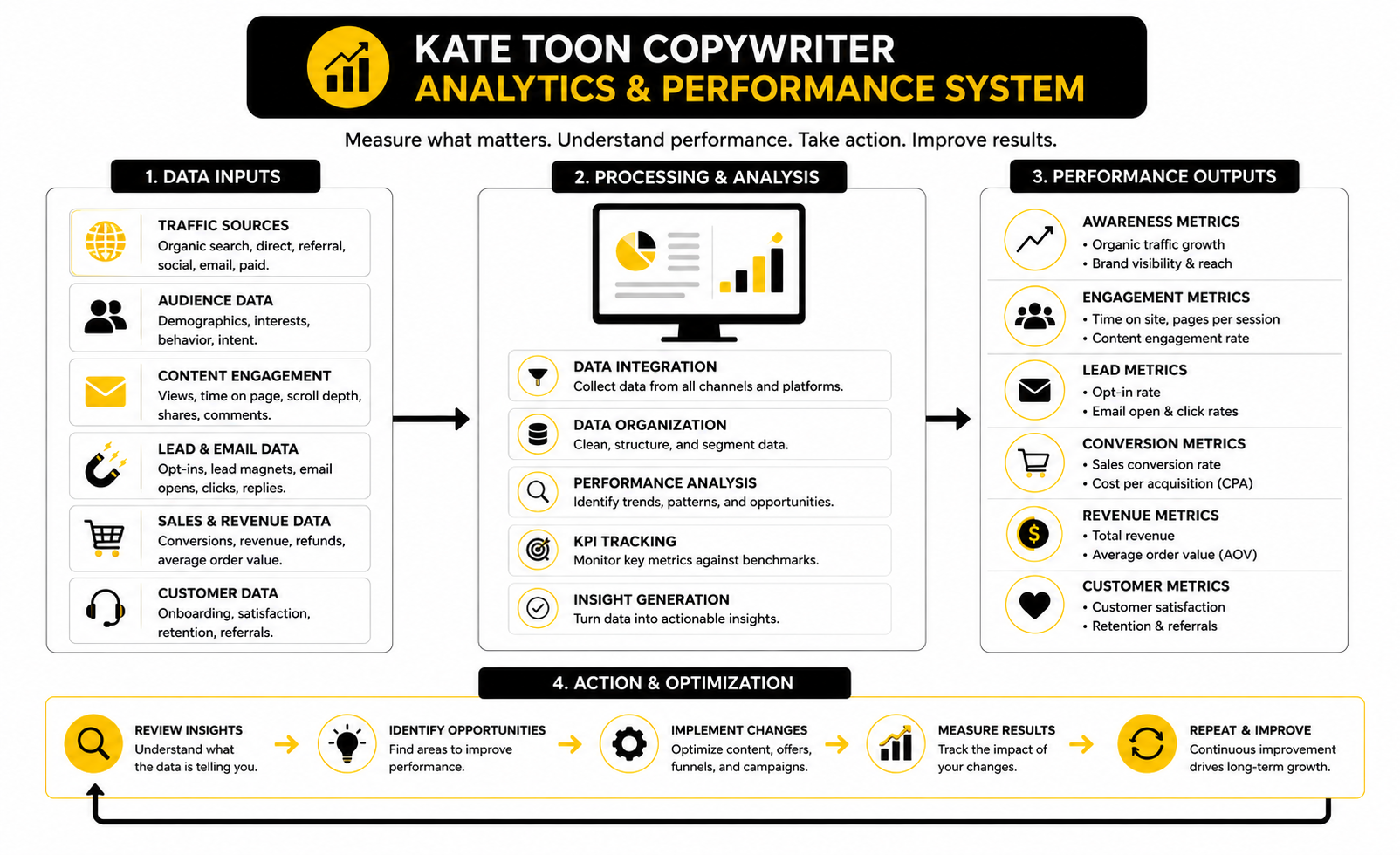
A practical measurement system looks like this:
This system keeps the focus where it belongs. A blog post with modest traffic but strong email signups may be more valuable than a high-traffic post with no buyer intent. A podcast episode that creates replies from ideal clients may be more useful than one that gets casual listens from people who will never buy.
Know Which Numbers Belong to Which Asset
Every asset in the ecosystem should have a job. A homepage should clarify positioning and move people to the right path. A blog post should answer search intent and create a relevant next step. A podcast should build familiarity and deepen trust. A workshop should convert interest into action.
This is why measurement needs context. You should not judge a top-of-funnel article by direct sales alone. You should not judge a sales page by page views alone. You should not judge an email sequence only by open rate if the real goal is booked calls, replies, or product purchases.
For a copywriter building a similar ecosystem, the simplest approach is to assign one primary metric to each asset. For example, a search article might be measured by qualified organic clicks and lead magnet conversions. A workshop page might be measured by registration rate. A course sales page might be measured by checkout conversion, refund rate, and buyer quality.
Watch for Performance Signals That Actually Matter
A useful analytics dashboard should make decisions easier. If it only makes you feel busy, it is failing. The strongest performance signals are the ones that tell you whether to improve the message, the offer, the traffic source, or the follow-up.
Good signals include:
These are not vanity metrics. They are clues. They tell you what the audience wants, what they believe, what they misunderstand, and where the business needs a clearer bridge.
Interpret the Data Like a Copywriter
A copywriter should not look at analytics like a spreadsheet robot. The job is to read behaviour. If people land on a page and leave quickly, the opening may not match the promise. If they read but do not click, the next step may be weak or poorly timed. If they click to an offer but do not buy, the offer may need clearer proof, sharper positioning, or a lower-friction entry point.
This is where copywriting and analytics become the same conversation. The numbers show where attention drops. The copy explains why. Then the next test gives you a cleaner answer.
That is also why the Kate Toon copywriter ecosystem is useful as a model. It shows that authority needs assets, but assets need measurement. Without measurement, you do not have an ecosystem. You have a content pile.
Professional Implementation for Copywriters and Service Businesses
By this point, the pattern is clear. The Kate Toon copywriter ecosystem is not just a content machine, a course business, or a personal brand. It is a strategic mix of expertise, audience trust, practical education, and commercial structure.
Part 5 is where the advice gets more serious. Building this kind of authority system sounds exciting when you look at the finished version. But the day-to-day reality includes tradeoffs, bottlenecks, positioning risks, offer confusion, operational drag, and the very real danger of becoming busy without becoming more profitable.
That is why implementation needs discipline. Not more ideas. Not more platforms. Discipline.
Do Not Scale Before the Positioning Is Sharp
The biggest mistake is trying to scale a fuzzy offer. If your audience does not understand what you do, more content will not fix it. More funnels will not fix it either. You will simply confuse more people at a faster speed.
The Kate Toon copywriter model works because the major themes are easy to understand. Copywriting. SEO. Digital products. Small business education. Her main site describes her as a digital marketing and SEO educator, copywriting coach, author, podcaster, and speaker through the Kate Toon website, while Recipe for SEO Success gives SEO its own focused learning path through The Recipe for SEO Success.
That separation is strategic. If you are a copywriter building your own ecosystem, you need to know which problem owns the centre of the business. Everything else should support that centre, not compete with it.
Choose the Right Kind of Leverage
Leverage is not always about creating a course. Sometimes the best leverage is a better diagnostic process, a premium audit, a stronger onboarding system, or a repeatable workshop. The point is to stop rebuilding the same thing from scratch every time.
Kate Toon’s public ecosystem includes books, workshops, templates, training, podcasts, communities, and programs. Her book Six Figures While You Sleep is positioned around turning services and skills into digital products, which fits naturally with the broader shift from custom client work into scalable expertise. But that does not mean every copywriter should rush into passive income mode.
The more carefully question is this: where does your expertise repeat? If the thinking repeats, productise the thinking. If the delivery repeats, systemise the delivery. If the questions repeat, turn them into content, templates, or training.
Protect the Brand From Offer Sprawl
A bigger ecosystem creates a bigger risk: offer sprawl. This happens when every good idea becomes a new product, every audience segment gets a new funnel, and every content channel gets a separate strategy. It feels productive, but it quietly weakens the brand.
The way to avoid this is to build offers around maturity stages. A beginner needs clarity. An intermediate buyer needs tools and structure. An advanced buyer needs feedback, implementation, or community. Those are different levels of help, not random products.
For a copywriter, a clean offer ladder might look like this:
This kind of ladder keeps the business understandable. More importantly, it helps the buyer self-select without needing a complicated sales conversation.
Be Careful With Personal Brand Dependency
A personality-led brand can be powerful. It can also become a trap. If every sale depends on the founder showing up, writing every email, hosting every call, recording every lesson, and answering every question, the business may look scalable from the outside while still being exhausting inside.
This is one of the hidden tradeoffs in any expert-led model. People buy because they trust the person. But if the person is the only delivery mechanism, growth becomes fragile. The brand needs systems, standards, support, and intellectual property that can survive beyond the founder’s daily energy.
That does not mean removing personality. It means separating the voice from the workload. Document the frameworks, create repeatable delivery assets, train support people where needed, and make sure the customer experience does not collapse when the founder takes a week off.
Build for Search Without Becoming a Search Robot
SEO is a major part of the Kate Toon copywriter brand, but the lesson is not to write robotic search content. The better lesson is to use search as a way to understand real demand. Search data shows the questions people are already asking, the language they use, and the problems they are ready to solve.
That matters because copywriters often write what they feel like saying instead of what buyers need to understand. Search can correct that. It forces you to meet the audience where they are, not where you wish they were.
But there is a line. If every article is written only to satisfy a keyword, the brand gets bland. The strongest approach combines search intent with a clear point of view, which is exactly why the Kate Toon copywriter model is more useful than a generic SEO checklist.
Decide What You Will Not Measure
Part 4 covered analytics, but advanced implementation also requires restraint. You cannot optimise everything. If you try, you will drown in dashboards and make tiny tweaks that do not change the business.
Pick the numbers that match the business model. A high-ticket copywriter may care more about qualified enquiries than newsletter growth. A course creator may care more about webinar attendance, sales page conversion, refunds, completion rates, and repeat buyers. A community builder may care more about activation, participation, retention, and member outcomes.
This is where many service businesses get distracted. They compare themselves against creators, agencies, influencers, and SaaS companies at the same time. That is madness. Measure the model you are actually building.
Use Tools Only After the Journey Is Clear
Technology can help, but it can also hide weak strategy. A CRM will not fix a vague offer. An email platform will not fix weak positioning. A funnel builder will not fix a product nobody wants.
Once the journey is clear, tools can make execution smoother. For example, GoHighLevel can fit service businesses that want CRM, follow-up, forms, pipelines, calendars, and campaign automation in one place. A funnel-focused business may prefer ClickFunnels when the main priority is building sales flows and checkout paths around specific offers.
The key is to choose software based on the buyer journey, not because the tool looks impressive. First define the path. Then choose the platform that supports it with the least friction.
Keep the Human Edge
As AI becomes more common in content, copywriters need to be sharper about what makes their work valuable. The answer is not simply “better writing.” It is judgment, positioning, empathy, research, structure, voice, and the ability to connect business goals with buyer psychology.
Kate Toon’s current ecosystem includes AI-related workshops and resources through her start here page, which shows how the brand is adapting without abandoning its core. That is the right mindset. New tools can support the work, but they should not erase the point of view.
For copywriters, this is essential. AI can produce words. Clients still need someone who can decide what should be said, what should be removed, what the audience needs to believe, and where the message fits inside the business. That is where the value moves.
Scale the Standard, Not Just the Output
The final advanced point is the one most people avoid. Scaling output is easy. Scaling quality is harder. Scaling trust is harder still.
If you want to build something inspired by the Kate Toon copywriter ecosystem, the goal is not to produce more for the sake of more. The goal is to scale a standard. Better explanations. Better offers. Better buyer journeys. Better support. Better proof. Better decisions.
That is the level where a copywriting business becomes more than client work. It becomes a platform for expertise. And when the platform is built carefully, every asset starts doing a job instead of just adding noise.
Key Takeaways and Final System
The Kate Toon copywriter model works because it is not built on one isolated tactic. It combines copywriting, SEO, digital education, media, community, and productised expertise into a system people can actually move through. That is the real lesson.
A copywriter who wants to build something similar should not start by copying the visible assets. Do not rush to launch a podcast, write a book, build a membership, and create six products at once. Start by understanding the logic underneath the ecosystem.
The final system looks like this:
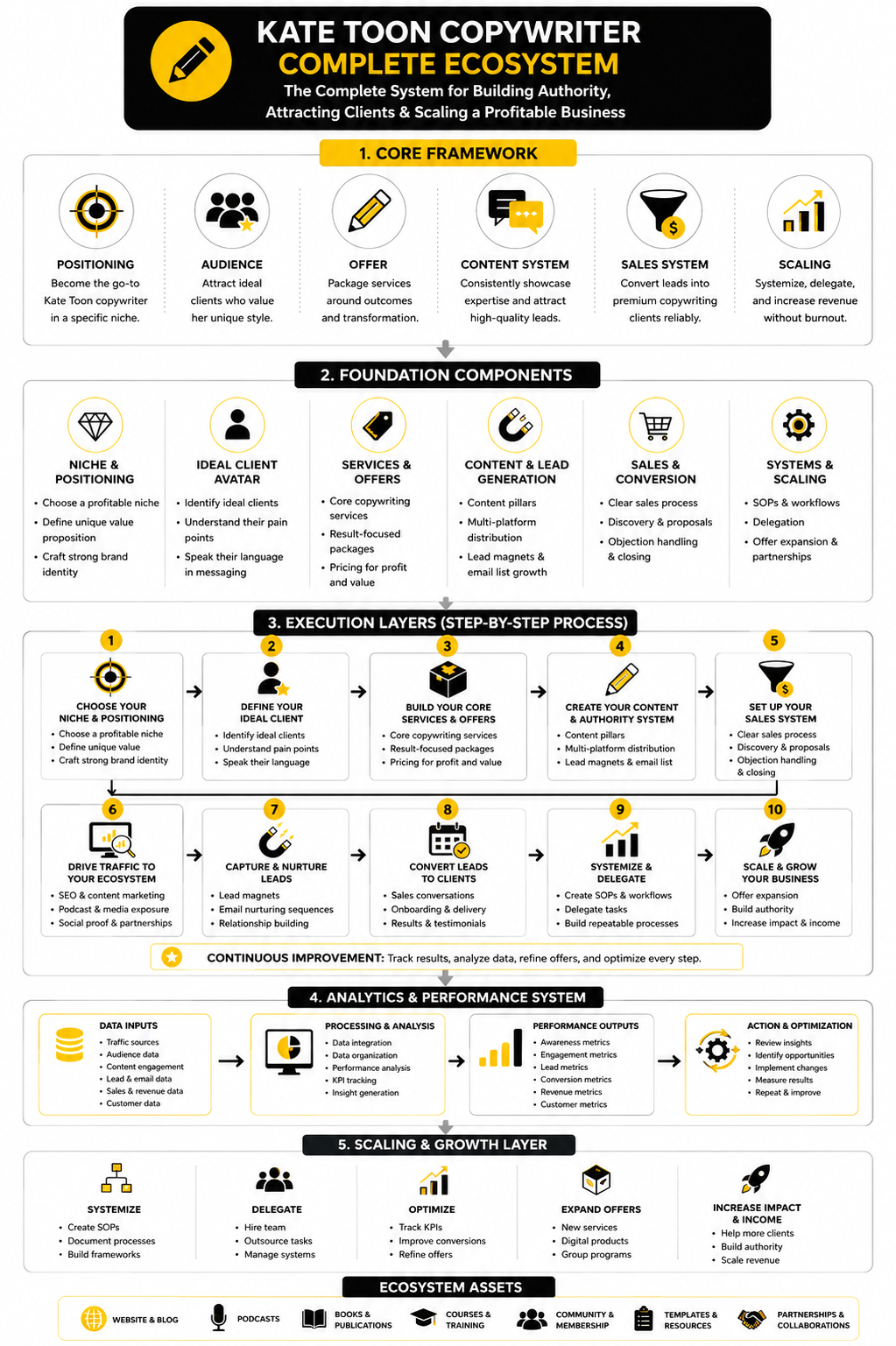
The key is coherence. Every part of the system should make the next part easier to understand. If an article attracts the wrong audience, fix the intent. If a lead magnet gets downloads but no buyers, fix the promise. If a sales page gets visits but no action, fix the offer, proof, or next step.
This is where the Kate Toon copywriter ecosystem becomes a useful model rather than just an interesting case study. It shows how a service skill can become a platform. Not overnight. Not magically. But through repeated, practical assets that turn expertise into trust.
Mistakes to Avoid
The first mistake is building too many disconnected offers. A copywriter does not need a course, a membership, a template shop, a group program, a podcast, and a certification before the core message is clear. More offers can create more revenue, but only when the buyer can understand the path.
The second mistake is treating SEO as a traffic hack. SEO should reveal what people need, how they describe their problems, and where they are in the decision process. When you use it only to chase volume, you attract readers who never become clients, customers, or serious subscribers.
The third mistake is hiding behind content because selling feels uncomfortable. Education is powerful, but at some point people need an invitation. A useful article should not pressure the reader, but it should give them a clear next step when they are ready.
The fourth mistake is copying someone else’s personality. Kate Toon’s public brand is memorable because it sounds like Kate Toon. Your brand needs the same level of honesty, but it does not need the same tone, humour, structure, or offer mix.
The fifth mistake is ignoring operations. If the business grows but delivery becomes chaotic, the brand starts leaking trust. Strong systems, clear onboarding, clean follow-up, and simple buyer journeys matter just as much as clever copy.
Who is Kate Toon?
Kate Toon is a copywriter, SEO educator, author, podcaster, speaker, and digital marketing educator. Her main website presents her broader business world, while her older copywriting site positions her as an experienced SEO copywriter and consultant through the Kate Toon Copywriter profile. Her brand now includes education, books, workshops, communities, podcasts, and digital products.
Why do people search for Kate Toon copywriter?
People usually search for Kate Toon copywriter because they want to understand her background in SEO copywriting, her business model, or her training resources. Some are looking for copywriting help, while others are studying how she built authority around copywriting and SEO. The search term is useful because it points to both the person and the business structure behind the brand.
Is Kate Toon still only a copywriter?
No, her public brand has expanded well beyond traditional copywriting services. Her current ecosystem includes digital marketing education, SEO training, copywriting resources, business books, podcasts, workshops, and community-driven programs through the Kate Toon start page. The copywriting foundation still matters, but it is now part of a wider authority platform.
What can copywriters learn from Kate Toon?
Copywriters can learn how to turn practical expertise into assets, offers, and audience trust. The biggest lesson is not to copy her exact products, but to study how the ecosystem fits together. A copywriter can use the same logic to build clearer positioning, better content, stronger offers, and a more intentional buyer journey.
What is The Clever Copywriting School?
The Clever Copywriting School is one of Kate Toon’s education and community properties for copywriters. Its start page includes copywriting courses, tools, templates, a directory, job posting options, and related business resources through The Clever Copywriting School. It works as a focused hub for people who want support around copywriting skills and copywriting business growth.
What is The Recipe for SEO Success?
The Recipe for SEO Success is Kate Toon’s SEO education brand. It includes SEO courses, checklists, podcasts, resources, and training pathways through The Recipe for SEO Success. It shows how a copywriter can build a separate but connected property around one valuable area of expertise.
Should every copywriter build a course or community?
No. A course or community only makes sense when there is repeatable demand, a clear outcome, and enough operational support to deliver a good experience. Some copywriters would be better served by creating a premium audit, a template pack, a workshop, or a stronger consulting offer first.
How should a copywriter measure an authority ecosystem?
A copywriter should measure the journey, not just the traffic. Useful signals include search visibility, qualified clicks, email signups, repeat visits, replies, offer page clicks, booked calls, purchases, retention, and referrals. The goal is to understand whether attention is turning into trust and whether trust is turning into action.
Is SEO still important for copywriters?
Yes, but not as a robotic keyword exercise. SEO helps copywriters understand what people are searching for, how they describe problems, and what content can support the buying journey. The best copywriting combines search intent with voice, positioning, persuasion, and useful structure.
Can AI replace the copywriter in this kind of model?
AI can help produce drafts, research ideas, summarise information, and speed up execution. It does not replace the strategic judgment required to position an offer, understand a buyer, choose what matters, and create a coherent business system. The more AI content floods the market, the more important human judgment, originality, and clear thinking become.
What is the biggest risk when building a Kate Toon-style ecosystem?
The biggest risk is building too much before the strategy is clear. A scattered ecosystem can drain time, confuse the audience, and create operational pressure without increasing profit. The safer path is to build one clear centre, one audience path, and one strong offer layer before expanding.
What is the simplest starting point for a copywriter?
Start with the problem you already solve repeatedly. Write one strong educational article around it, create one useful lead asset, and offer one paid next step that helps the reader move forward. Once that path works, improve it before adding more channels, offers, or automation.
Build a stronger local presence with BAAM AI
Turn your website, Google profile, social channels, and AI visibility into one growth engine
Most businesses do not need more random marketing activity. They need a consistent presence system that helps the right people find them, trust them, and take action. BAAM AI brings strategy, local SEO, website updates, Google Maps visibility, social content, AI-search readiness, media production, and reporting into one practical monthly engine.
If you want your marketing to keep working after the campaign ends, start with a free BAAM AI presence audit. See how your business shows up today and where the fastest visibility wins are at BAAM AI.