
BAAM AI Blog
Kajabi Email: The Practical Guide To Email Marketing, Automation, And Sales Funnels
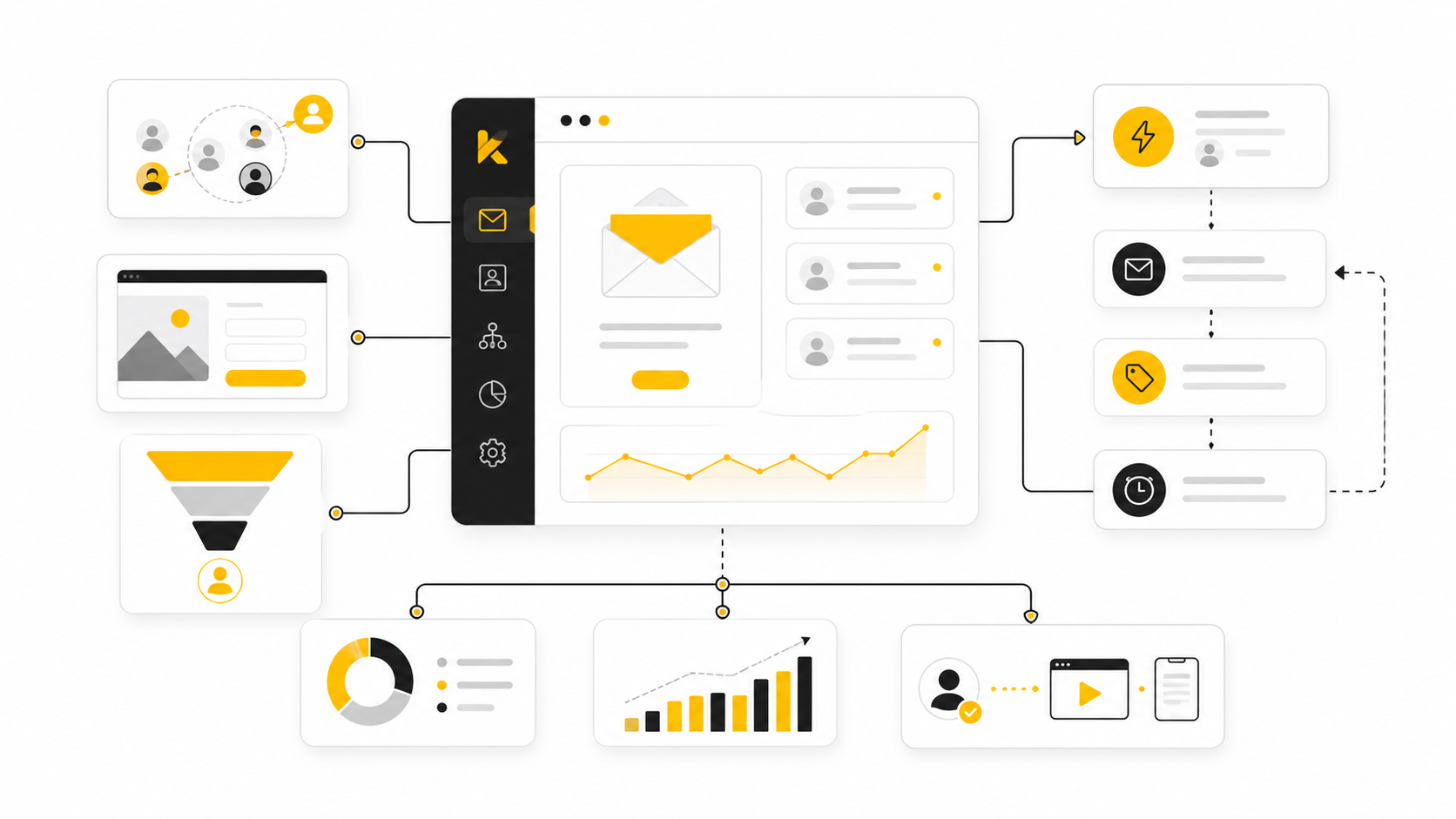
Kajabi email is not just a newsletter tool bolted onto a course platform. It sits inside the same system where your products, landing pages, checkout pages, offers, automations, memberships, and customer records...
Affiliate disclosure: this article may include compensated links. Recommendations should still be evaluated against your use case, budget, and current provider terms.
Should you choose this tool?
this tool is worth considering when the use case, budget, and implementation effort match what you actually need to do next.
teams that want a practical tool decision without reading another generic feature list
Check this toolKajabi email is not just a newsletter tool bolted onto a course platform. It sits inside the same system where your products, landing pages, checkout pages, offers, automations, memberships, and customer records already live. That matters because email marketing gets much easier when the platform knows what someone opted in for, what they bought, what they skipped, what lesson they completed, and which offer should come next.
The mistake most creators make is treating Kajabi email like a place to “send updates.” That is too small. A good Kajabi email setup should help you welcome new leads, segment subscribers, sell products, reduce buyer confusion, improve retention, and bring inactive contacts back before they disappear. Email still earns serious attention because lifecycle marketing continues to be one of the most reliable owned channels, with many marketing leaders reporting strong returns from email in the 2025 State of Email data.
This guide is built for creators, coaches, course sellers, consultants, and digital product businesses that want a practical system instead of random broadcasts. We will look at what Kajabi email does well, where it has limits, how to structure campaigns, and how to decide whether Kajabi should run your entire email strategy or only part of it. The goal is simple: build an email engine that supports the business you actually run.
this guide is split into six parts so each section can go deep without turning into a messy feature dump. The order follows the way a real Kajabi email system should be planned: strategy first, structure second, implementation third, then optimization and decision-making. Each part builds on the previous one, so the full article reads like one practical operating guide.
Why Kajabi Email Matters
Kajabi email matters because most knowledge businesses do not only need emails. They need emails connected to offers, checkout behavior, products, events, forms, tags, and customer progress. Kajabi’s own email system is designed around that connection, with email campaigns split into broadcasts and sequences rather than treating every message as a standalone newsletter.
That difference becomes important once your business has more than one product. A beginner lead does not need the same message as a paid member. A person who clicked a sales link but did not buy should not receive the same follow-up as someone who just purchased. When those behaviors live in the same platform as the email tool, your automations can react faster and with less manual stitching.
The bigger reason this matters is control. Social platforms can create reach, but they do not give you the same ownership over the relationship. Email gives creators a direct channel to people who have already raised their hand, and benchmark data continues to show that email engagement remains measurable through delivery, opens, clicks, and unsubscribe behavior, including the DMA’s 2025 email benchmarking report.
How Kajabi Email Fits Into Your Business
Kajabi email is best understood as part of a business system, not a separate email app. A visitor can opt in through a Kajabi form, receive a sequence, click into a landing page, purchase an offer, enter a product, and trigger follow-up automations from one account. That is the real appeal: fewer tools, fewer integrations, and fewer places where customer data can break.
This is especially useful for businesses where email is closely tied to product education. A course seller might use email to deliver a lead magnet, introduce the core problem, explain the course promise, send launch reminders, onboard new students, and later promote a higher-ticket offer. Kajabi supports this kind of flow because its automation system can be added across areas like forms, offers, funnels, courses, events, and email campaigns.
The tradeoff is that Kajabi email should not be judged the same way as a dedicated enterprise email platform. Its strength is business context. If you want deep ecommerce-style product feeds, large-scale deliverability operations, or extremely advanced behavioral branching, you may eventually compare it with a specialist tool. But for many knowledge businesses, having email connected directly to sales and product delivery is more valuable than having a separate tool with features they barely use.
The Kajabi Email Framework
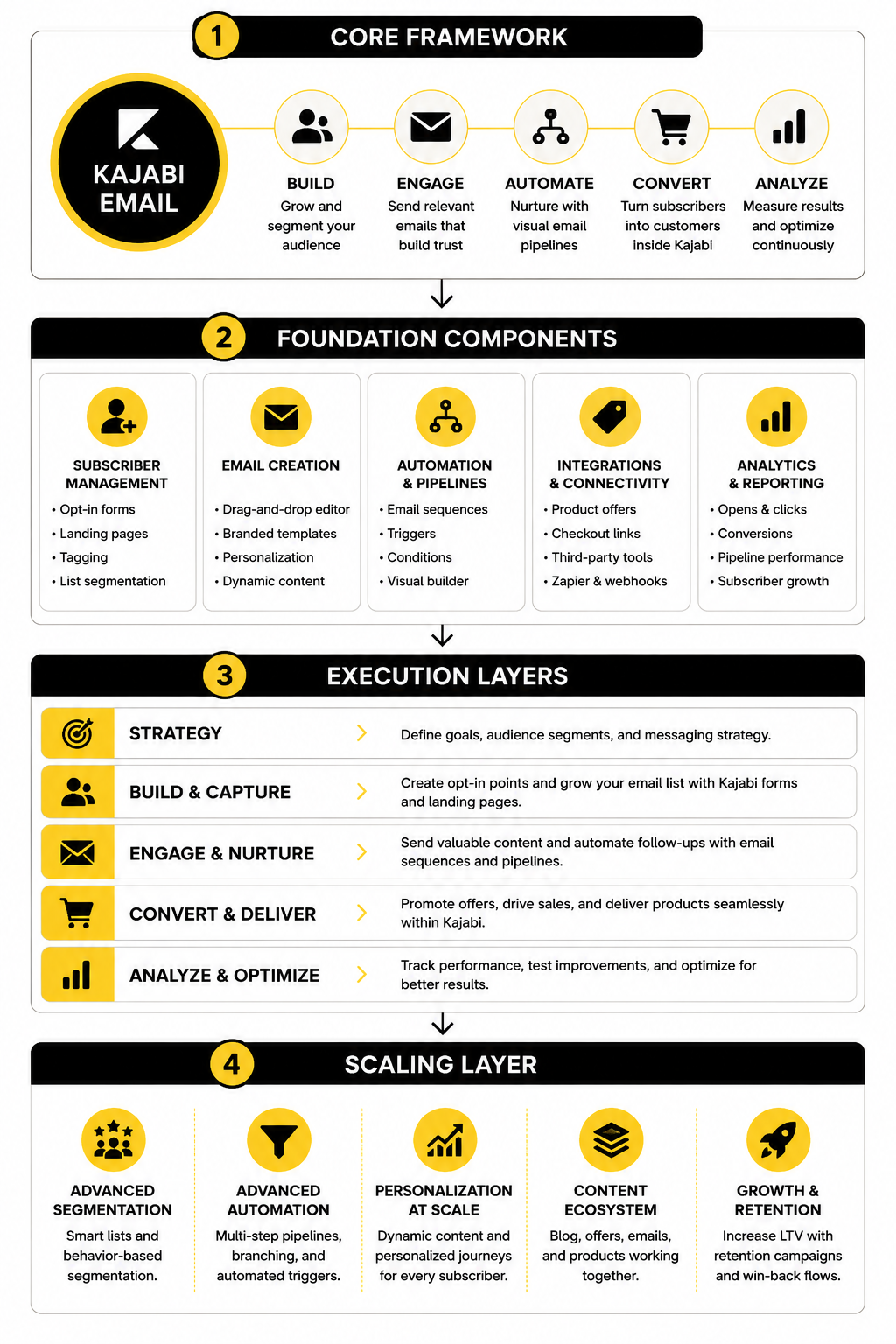
The simplest way to think about Kajabi email is as a four-layer framework: capture, nurture, convert, and retain. Capture brings people onto your list through forms, landing pages, lead magnets, events, or waitlists. Nurture turns that attention into trust through sequences, stories, education, and useful follow-up.
Convert is where email supports sales. That can mean launch emails, evergreen funnel emails, webinar follow-ups, cart-close reminders, consultation prompts, or direct product promotions. Kajabi’s broadcast and sequence structure helps separate one-time announcements from automated journeys, which is important because a launch campaign and a welcome sequence should not be built the same way.
Retain is the part many creators forget. After someone buys, email should reduce refund risk, improve product activation, invite members into the next step, and keep the relationship warm. Kajabi’s ability to connect emails with products, offers, and automations makes this retention layer more practical than a disconnected newsletter tool, especially when the business depends on repeat trust rather than one-off transactions.
What This Guide Will Help You Build
By the end of this full guide, you should be able to map a Kajabi email system before you start writing emails. That means knowing which emails belong in broadcasts, which belong in sequences, which automations should trigger them, and which segments deserve different messaging. This is where most of the money is made or lost, because the tool is only useful when the strategy is clear.
You will also understand how to think about deliverability. Kajabi’s help center explains that deliverability depends on sender reputation, recipient engagement, list quality, and authentication details like custom email domain setup and DMARC requirements in its deliverability guidance and custom email domain requirements. That matters because even the best email copy fails if the list is cold, unverified, or trained to ignore you.
Most importantly, this guide will help you make better implementation decisions. You will see when Kajabi email is enough, when you should keep the setup simple, and when a growing business may need a more specialized stack. The point is not to worship the tool. The point is to make email support the business model with less friction and more intent.
Core Components Of Kajabi Email
A strong Kajabi email system starts with the parts that control the relationship: contacts, forms, tags, segments, broadcasts, sequences, and automations. None of these pieces are complicated on their own. The leverage comes from how they work together.
Think of contacts as the record of the person, not just an email address. A contact can carry purchase history, tags, product access, form submissions, email activity, and automation triggers. That context is what makes Kajabi email useful for creators who sell education, coaching, memberships, downloads, communities, or service offers.
The practical goal is to stop sending the same message to everyone. Your email system should know who is new, who is warm, who bought, who did not buy, who needs onboarding, and who is ready for the next offer. Once that structure is in place, every campaign becomes easier to write because you are speaking to a specific person at a specific stage.
Contacts And Segmentation
Segmentation is where Kajabi email starts becoming a business tool instead of a basic sender. A clean segment helps you send relevant messages without manually sorting your list every time you launch something. You can group people by opt-in source, product ownership, tags, offer purchases, email behavior, or where they are in a sequence.
This matters because relevance protects attention. A subscriber who joined for a beginner lead magnet may not be ready for a premium coaching offer on day one. A paying member does not need another hard pitch for the product they already bought. Segmentation helps you respect the reader’s context, which usually leads to better clicks, fewer unsubscribes, and a healthier list over time.
The best approach is to keep segments simple at first. Start with obvious groups like leads, customers, active members, inactive subscribers, webinar registrants, and buyers by product. You can always add more detail later, but an overbuilt tagging system becomes a nightmare fast if you do not have a clear reason for every label.
Forms And Opt-In Paths
Forms are the front door of your Kajabi email system. They decide how someone enters your list, what they asked for, and which follow-up should happen next. A form connected to a lead magnet should trigger a different journey than a form used for a waitlist, a newsletter, a webinar, or a consultation request.
This is where many Kajabi users create confusion without realizing it. They make one general form, send every lead into one general sequence, and then wonder why the follow-up feels generic. The better move is to match each form to a clear intent. Someone who downloads a checklist needs education and context, while someone who joins a product waitlist may need urgency, proof, and launch timing.
You do not need dozens of opt-ins to make this work. You just need each opt-in to have a job. One form can build your main list, one can support a launch, one can segment interested buyers, and one can handle customer onboarding or event registration. Simple beats clever here.
Tags And Buyer Signals
Tags are useful when they describe behavior that should change what happens next. A good tag might show that someone registered for a workshop, clicked a sales link, purchased a product, requested a consultation, or showed interest in a specific topic. A bad tag is vague, duplicated, or added just because the system allows it.
The key is to use tags as decision points. If a subscriber clicks a link about a membership offer, that can signal interest. If they buy, the sales sequence should stop and the onboarding should begin. If they do not engage after several emails, they might need a lighter re-engagement path instead of more promotion.
Do not tag everything. That sounds productive, but it usually creates clutter. Tag the actions that help you personalize future emails, trigger automations, or measure real buyer intent. If a tag will never change what you send, it probably does not need to exist.
Broadcasts And Sequences
Kajabi email gives you two main campaign types: broadcasts and sequences. Broadcasts are for messages that go out once at a specific time, such as launch announcements, newsletters, event reminders, product updates, or seasonal promotions. Sequences are for automated email journeys that start when someone takes an action.
This distinction is important. A broadcast is timely. A sequence is evergreen. A launch reminder belongs in a broadcast because the timing matters to everyone receiving it, while a welcome series belongs in a sequence because each subscriber should receive it based on when they joined.
Most businesses need both. Broadcasts keep your audience current and engaged, while sequences create consistent follow-up without you rebuilding the same emails every week. The problem starts when creators use broadcasts for everything, because then every lead depends on manual sending instead of a predictable system.
Automations And Triggers
Automations are the connective tissue of Kajabi email. They let one action create the next step, such as submitting a form, receiving a tag, purchasing an offer, completing an event registration, or being added to a sequence. This is what turns a static list into a responsive customer journey.
A simple automation might subscribe a new lead to a welcome sequence after they submit a form. A more advanced setup might tag someone based on interest, remove them from a sales sequence after purchase, grant an offer, notify your team, or send a different follow-up based on behavior. The point is not to make the system complicated. The point is to remove manual work from moments that should happen every time.
The best Kajabi email automations are boring in a good way. They do not rely on fragile tricks. They follow clear logic: when this happens, do that, unless this other condition is true. That kind of setup is easier to test, easier to fix, and easier to scale.
How Kajabi Email Supports The Customer Journey
Kajabi email works best when it follows the customer journey from stranger to subscriber to buyer to repeat customer. That journey does not happen in one email. It happens through a series of small, intentional touchpoints that answer the reader’s next question at the right moment.
At the lead stage, your job is to build trust and create context. People need to understand the problem, why it matters, what options exist, and why your approach is credible. This is where educational sequences, newsletters, and useful follow-up do the heavy lifting.
At the buyer stage, the job changes. The reader already has interest, so your emails should make the offer clear, reduce hesitation, explain outcomes, handle objections, and show the next step. After purchase, the job changes again. Now your email system should help the customer get value quickly so they feel confident about the decision they just made.
Lead Nurture Emails
Lead nurture emails should make the subscriber more carefully and more confident. They should not feel like a pitch disguised as education. A useful nurture sequence introduces the core problem, reframes common mistakes, shows the cost of staying stuck, and points toward a better path.
For Kajabi email, this usually starts after a form submission. Someone downloads a resource, registers for training, joins a waitlist, or signs up for updates. The sequence that follows should connect the original reason they joined with the broader offer you eventually want them to consider.
A strong nurture flow does not need to be long. Five to seven emails can be enough if each message has a job. One email welcomes them, one delivers the promised resource, one builds context, one handles a common misconception, one introduces your method, and one creates a natural next step.
Sales Emails
Sales emails should be direct, but not desperate. The reader should understand what is being offered, who it is for, what problem it solves, what happens after they buy, and why now is a good time to act. If those points are unclear, more copy will not fix the campaign.
Kajabi email can support sales through both broadcasts and sequences. Broadcasts work well for launches, deadlines, limited enrollment periods, and live events. Sequences work well for evergreen funnels where every new lead receives a timed sales path after joining.
This is where offer clarity matters more than email tricks. A weak offer with clever subject lines is still weak. A strong offer with clear positioning, relevant timing, and a clean follow-up path usually performs better because the email is simply carrying a message that already makes sense.
Onboarding Emails
Onboarding emails are one of the most underrated parts of a Kajabi email system. After someone buys, they need reassurance, direction, and momentum. The first few emails after purchase can shape whether they log in, consume the product, trust the process, and stay engaged.
A good onboarding sequence should confirm the purchase, explain how to access the product, set expectations, point to the first action, and reduce confusion. It should not dump everything on the customer at once. The goal is to help them win early.
This is especially important for courses and memberships because the purchase is not the final outcome. The customer still has to use the product. Kajabi email can support that process by reminding people what to do next, guiding them through the first milestone, and making the experience feel more personal.
Retention And Re-Engagement Emails
Retention emails help customers stay connected after the first burst of excitement fades. These can include progress reminders, new content updates, member announcements, habit-building prompts, renewal reminders, or invitations into the next level of support. The goal is to keep the relationship active without overwhelming the inbox.
Re-engagement emails are for people who have gone quiet. They might have stopped opening, stopped clicking, or stopped logging in. The wrong move is to keep hammering them with the same messages. The better move is to acknowledge the gap, offer a useful reason to come back, and give them a clear choice.
This also protects deliverability. A list full of inactive subscribers can drag down performance because inbox providers pay attention to engagement signals. Kajabi email should not only help you send more. It should help you send to the right people with the right level of intent.
Professional Implementation
A good Kajabi email setup starts before you write the first subject line. The real work is mapping the journey, choosing the right triggers, cleaning up the contact structure, and deciding what each email is supposed to do. If you skip that part, you end up with a pile of emails instead of a system.
Implementation should feel boringly clear. A lead submits a form, receives the promised resource, gets a relevant nurture sequence, sees a logical offer, and moves into onboarding if they buy. That sounds simple because it should be simple. The sophistication is in making the path precise, not making it complicated.
Kajabi email gives you the core building blocks for this kind of setup: broadcasts, sequences, forms, tags, segments, and automations. Kajabi defines broadcasts as one-time emails and sequences as automated emails sent after a trigger, which is exactly the distinction you need when planning what should be manual and what should run every time someone takes an action through your site. The whole point is to build once, test carefully, and then let the system handle repeatable moments.
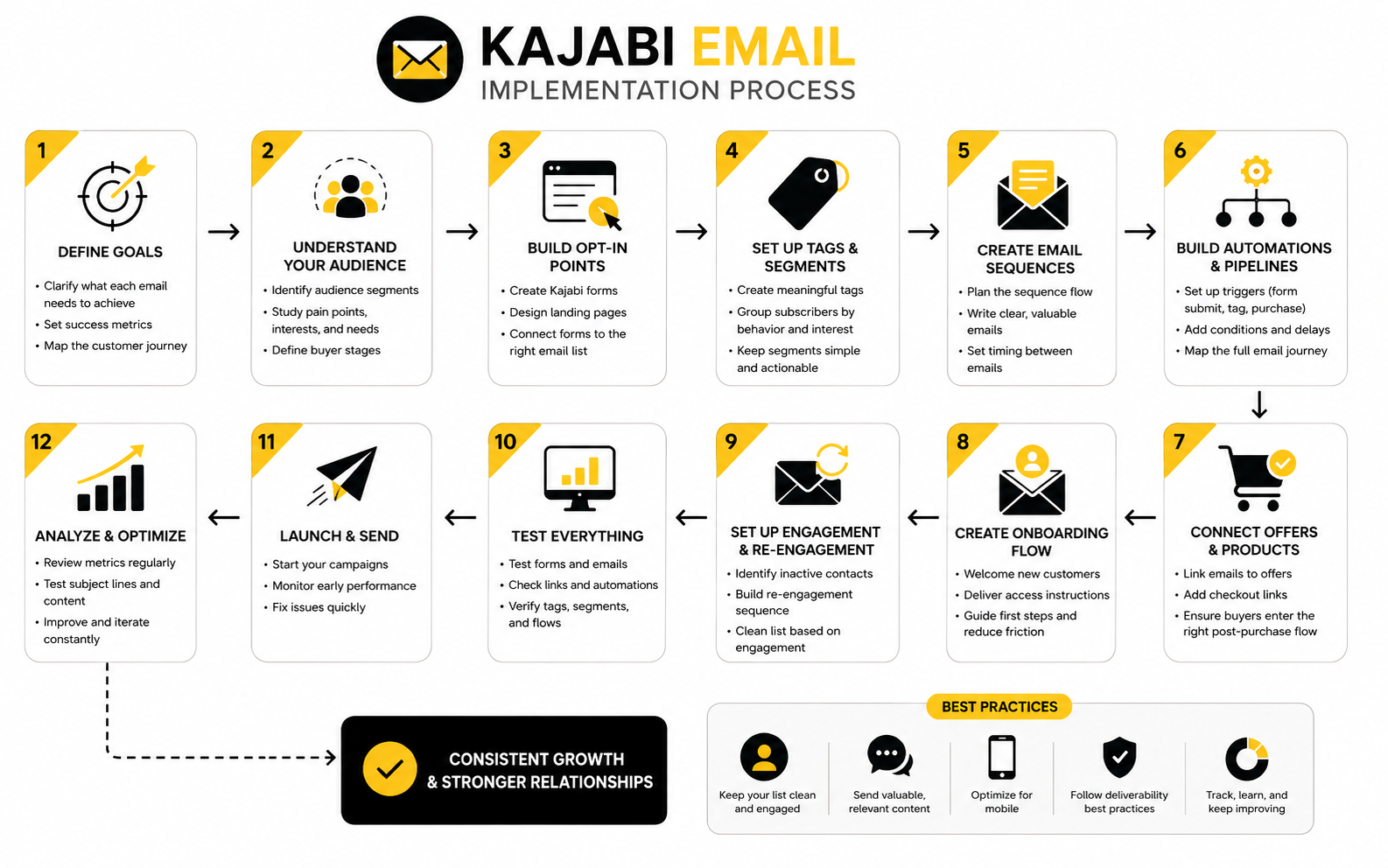
Step 1: Map The Email Journey Before Building Anything
Start with the customer path, not the platform menu. Write down how someone enters your world, what they should understand next, what offer they should eventually see, and what should happen after purchase. This stops you from creating random tags, random forms, and random sequences that look organized but do not actually move the business forward.
A simple journey map can be built around four stages: subscriber, engaged lead, buyer, and active customer. Each stage should have a clear entry point and a clear next step. For example, a subscriber might enter through a lead magnet form, become an engaged lead by clicking a topic-specific link, become a buyer through an offer purchase, and become an active customer by entering an onboarding sequence.
Do not try to map every possible behavior on day one. Start with the highest-value path in your business. If your main goal is selling one course, map the course path first. If your main goal is booking calls, map the call-booking path first. Kajabi email works better when the system reflects one clear commercial priority instead of ten half-built ideas.
Step 2: Create Clean Entry Points
Every form should have a reason to exist. A newsletter form, a lead magnet form, a webinar form, and a waitlist form should not all behave the same way. They may all add someone to your contact list, but the follow-up should match the intent behind the opt-in.
For each entry point, decide three things before building it. First, what did the person ask for? Second, what should they receive immediately? Third, what should Kajabi email do after that first delivery email? This is where the experience starts feeling intentional instead of automated for the sake of automation.
The cleanest setup is usually one form per meaningful promise. If the form promises a guide, the first email delivers the guide. If the form promises a live training, the first email confirms the registration and sets expectations. If the form promises a waitlist, the first email confirms their spot and explains what happens before the offer opens. Matching the first email to the promise is basic, but it is also where trust begins.
Step 3: Build Tags Around Decisions
Tags should support decisions, not decoration. Before creating a tag, ask what the tag will change. Will it start a sequence, stop a sequence, identify product interest, exclude a buyer from a promotion, or help you send a more relevant broadcast later? If the answer is no, the tag is probably clutter.
A practical Kajabi email tagging structure can stay lean. Use tags for source, interest, lifecycle stage, and important actions. Source tells you where the person came from. Interest tells you what topic or offer they care about. Lifecycle stage tells you whether they are a lead, customer, member, or inactive contact. Action tags mark behaviors that deserve follow-up.
This is not about creating a perfect taxonomy. It is about preventing chaos six months from now. When tags have clear naming rules, your broadcasts become easier to filter, your automations become easier to audit, and your future campaigns become faster to launch. Messy tags create hesitation. Clean tags create speed.
Step 4: Write Sequences By Job, Not By Length
A sequence should have one job. A welcome sequence welcomes and orients. A nurture sequence builds belief and context. A sales sequence presents an offer and handles hesitation. An onboarding sequence helps the buyer use what they purchased. When one sequence tries to do all of that, the message gets muddy.
The easiest way to write a sequence is to assign a purpose to every email before writing the copy. One email can deliver the asset. One can explain the mistake most people make. One can introduce your method. One can show the cost of waiting. One can make the offer. One can answer the strongest objection. That structure keeps the reader moving instead of receiving disconnected thoughts.
You also need to respect timing. Kajabi sequences can be scheduled relative to when a person subscribes to the sequence, so the timing should match the reader’s actual stage rather than your calendar. A new lead may need several days of context before a pitch. A webinar registrant may need tighter reminders. A new customer may need immediate onboarding within minutes of purchase.
Step 5: Use Broadcasts For Timely Messages
Broadcasts are not inferior to automations. They are just for a different job. Use them when the timing matters now: a launch announcement, a deadline reminder, a new podcast episode, a live workshop, a product update, or a weekly newsletter. These are moments where everyone in the selected audience receives the message at the same time.
The mistake is using broadcasts to manually recreate a journey that should be automated. If every new subscriber needs the same five orientation emails, that belongs in a sequence. If every buyer needs the same access and onboarding instructions, that belongs in a sequence. Broadcasts should add freshness on top of your system, not compensate for the fact that no system exists.
Segmentation still matters when sending broadcasts. A launch email should exclude people who already purchased that offer. A customer update should go only to the relevant customers. A beginner education email may not need to go to advanced buyers. Kajabi email becomes much more effective when each broadcast has a clear audience instead of blasting the full list by default.
Step 6: Connect Automations To Real Business Moments
Automations should fire when something meaningful happens. Form submissions, offer purchases, event registrations, product progress, and sequence completion are examples of moments where the next step should not depend on memory. Kajabi’s automation tools can add tags, subscribe contacts to sequences, and help connect actions across marketing and product experiences.
The strongest automations usually do one clear thing. When someone submits a form, subscribe them to the correct sequence. When someone purchases, remove them from the sales path and start onboarding. When someone completes a sequence, tag them so you know they finished that stage. Each action should make the contact record more useful and the customer experience more coherent.
Avoid fragile automation chains that only you understand. If an automation requires a flowchart and three private notes to explain, it is probably too complex for the current stage of the business. Build simple logic first, then improve it only when the data shows you need more nuance.
Step 7: Test The Full Path Like A Customer
Testing is where professional implementation separates itself from guesswork. Do not only preview the email. Submit the form yourself, receive the email, click the link, check the tag, confirm the sequence timing, purchase through a test path when possible, and verify that the buyer follow-up behaves correctly. This is tedious once. Fixing a broken launch while leads are coming in is tedious with consequences.
Use a checklist for every Kajabi email path you build. Confirm that the form works, the thank-you page makes sense, the first email arrives, the link goes to the right place, the tag is applied, the correct sequence starts, the wrong sequence does not start, and buyers are excluded from future sales pushes. These small checks prevent embarrassing mistakes.
Also test the reading experience. Open the emails on desktop and mobile. Check whether the first line makes sense in the inbox preview. Make sure the call to action is obvious. Remove anything that feels like filler. The best email system can still underperform if the actual message feels confusing, bloated, or disconnected from the promise that got the person to subscribe.
Step 8: Review Performance Without Overreacting
Once your Kajabi email system is live, review performance in patterns instead of panicking over one email. Look at delivery, opens, clicks, unsubscribes, purchases, replies, and downstream behavior. A single weak email may not mean the whole sequence is broken. A repeated drop-off at the same point usually means something needs attention.
Pay special attention to click behavior because clicks show stronger intent than opens. Opens can be affected by privacy features and inbox behavior, so they are useful but not perfect. Clicks, purchases, form submissions, and replies usually tell you more about whether the message moved someone forward.
Make changes one layer at a time. First fix the offer clarity. Then fix the audience. Then fix the email structure. Then fix subject lines and smaller copy details. If you change everything at once, you will not know what actually helped. Professional implementation is not about constant tinkering. It is about focused improvement.
Statistics And Data
Kajabi email measurement should not turn into a dashboard addiction. The point is not to stare at open rates every morning and emotionally react to every dip. The point is to understand whether your emails are reaching people, earning attention, creating action, and supporting revenue.
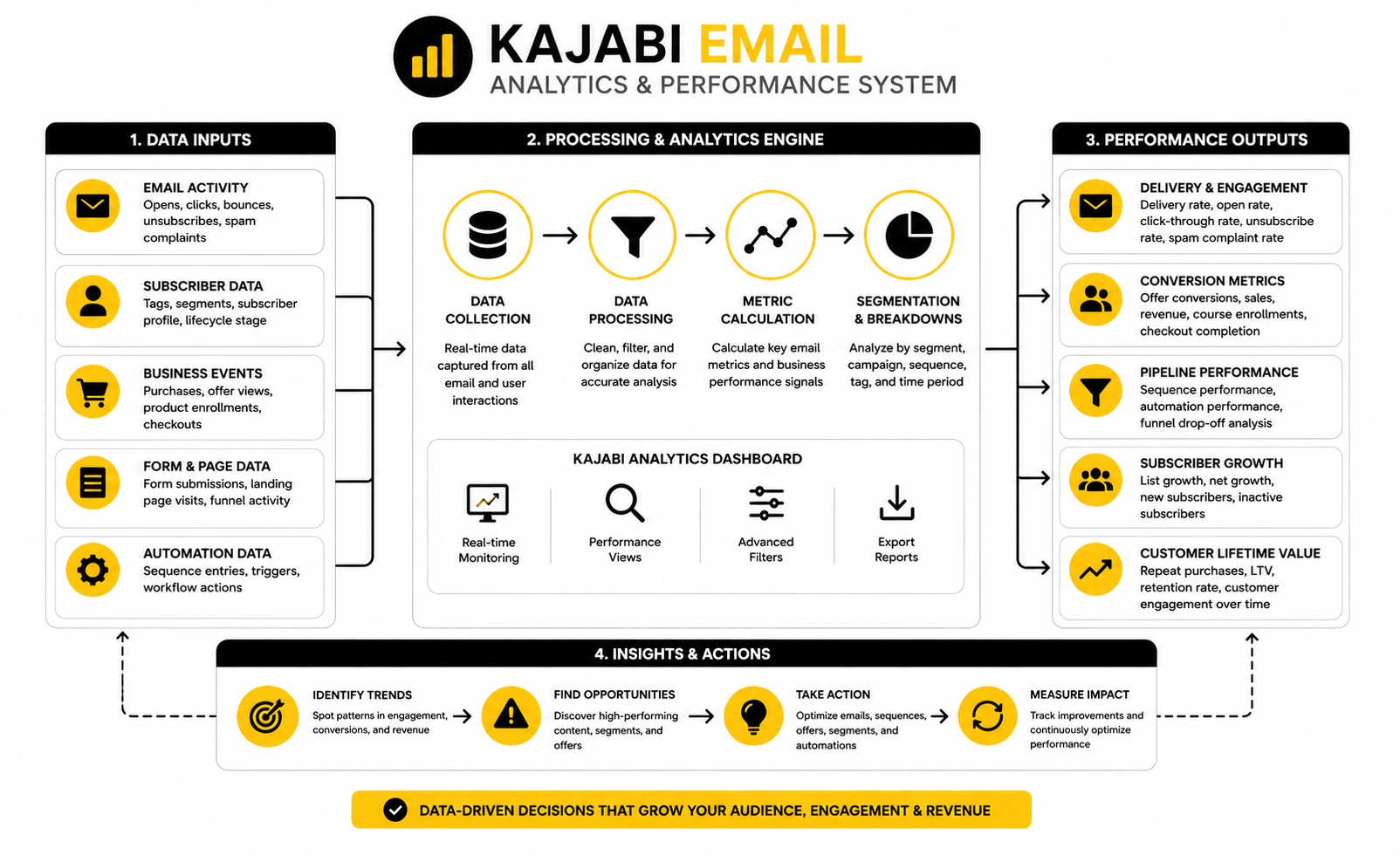
The clean way to read email performance is to separate activity metrics from business metrics. Activity metrics tell you what happened inside the inbox: delivery, opens, clicks, unsubscribes, spam complaints, and replies. Business metrics tell you whether the email helped the business: opt-ins, purchases, booked calls, course starts, renewals, upgrades, and customer retention.
This distinction matters because an email can look “good” and still fail commercially. A soft newsletter can get opens but drive no meaningful action. A sales email can get fewer opens but create more purchases. When you evaluate Kajabi email, always ask what the email was supposed to do before deciding whether the numbers are good.
The Metrics That Actually Matter
Delivery rate comes first because nothing else matters if the email does not reach the inbox. Industry reporting from the DMA’s 2025 Email Benchmarking Report showed delivery rates rising to 98% in 2024, which is useful as a broad benchmark but not a guarantee for your list. Your own delivery performance depends on list quality, authentication, sending behavior, engagement, and whether people actually want what you send.
Open rate is useful, but it is not the truth by itself. Privacy features and inbox behavior can affect open tracking, so opens should be treated as a directional signal rather than a final verdict. If opens fall across several emails, your subject lines, sender reputation, audience fit, or sending frequency may need attention.
Click rate is usually more practical than open rate because it shows active interest. The same DMA benchmark found unique click rates reaching 2.3%, which gives you a broad reference point for campaign engagement. For Kajabi email, clicks are especially important because they often show intent: interest in a product, a lesson, a webinar, a checkout page, or a consultation path.
What Benchmarks Should And Should Not Do
Benchmarks are helpful for orientation, not judgment. If your click rate is far below the market range, that gives you a reason to investigate. It does not automatically mean your copy is bad. It could mean the audience is cold, the offer is unclear, the segment is too broad, or the call to action is weak.
Broad email studies show that email can still produce strong returns, with many companies reporting ROI between 10:1 and 36:1 in Litmus State of Email research. That number is useful because it confirms why email deserves serious attention. But it does not mean every Kajabi email campaign will produce that return just because it was sent.
Use benchmarks as a mirror, not a weapon. Compare your welcome sequence to your other welcome sequences. Compare your launch emails to previous launch emails. Compare your buyer onboarding emails to the behavior they are supposed to create. Your internal trend line is often more valuable than an industry average because it reflects your audience, your offer, and your list quality.
How To Read Kajabi Email Analytics
Kajabi email analytics should be read in layers. Start with whether the email was delivered, then whether it was opened, then whether it earned clicks, then whether those clicks created the next business action. That flow prevents you from optimizing the wrong part of the system.
If delivery is weak, do not rewrite the offer first. Review sender authentication, list hygiene, spam complaints, and whether your contacts have recently engaged. Gmail’s sender guidance requires proper authentication and alignment for bulk senders, and Google also highlights the need to avoid unwanted mail and make unsubscribing easy in its email sender guidelines. Yahoo’s sender guidance also emphasizes authentication, low complaint rates, and easy unsubscribing in its sender best practices.
If opens are weak but delivery is stable, look at sender trust, subject lines, preview text, and timing. If clicks are weak despite healthy opens, the problem is usually inside the message: the promise is unclear, the offer is not relevant, the email has too many calls to action, or the segment is too broad. If clicks are strong but sales are weak, the email may be doing its job and the landing page, offer, checkout, pricing, or sales argument may need the work.
The Four-Layer Measurement System
A simple measurement system keeps you from guessing. You do not need a complex analytics stack to make better decisions with Kajabi email. You need a clear hierarchy of signals.
This order matters. If deliverability is broken, attention metrics become unreliable. If attention is weak, engagement will usually suffer. If engagement is strong but business results are weak, the issue is probably not the email alone. That is how you avoid making random edits that feel productive but do not fix the real bottleneck.
What A Healthy Kajabi Email Dashboard Should Show
A healthy dashboard should show whether each email has a job and whether it did that job. A welcome email should be judged by delivery, opens, clicks to the promised resource, and whether the subscriber continues into the sequence. A sales email should be judged by clicks to the offer, purchases, revenue, and whether buyers are properly removed from the promotion.
An onboarding email should be measured differently. The question is not “Did this sell?” The question is whether the customer logged in, started the product, understood the next step, and avoided confusion. If your onboarding emails reduce support questions and increase product activation, they are doing real work even if they are not directly creating new revenue.
A re-engagement email has another job again. It should identify who still wants to hear from you and who should be removed or suppressed from regular sending. That can feel uncomfortable because list size is a vanity metric. But a smaller engaged list is usually stronger than a larger list full of people who ignore everything.
The Numbers That Should Trigger Action
Data only matters when it changes behavior. If unsubscribe rates climb after every sales email, your audience may be receiving too many promotions, the offer may be misaligned, or your segmentation may be too broad. If clicks are concentrated on one topic, that is a signal to create more content, offers, or segmentation around that interest.
If a sequence loses engagement at the same email every time, inspect that email carefully. The topic may feel disconnected from the previous message. The timing may be too aggressive. The call to action may be too big for the reader’s current trust level. Do not rewrite the whole sequence before identifying the exact drop-off point.
If sales emails get clicks but few purchases, study the path after the click. The checkout page may create friction, the sales page may not answer the right objections, or the offer may need stronger positioning. Kajabi email can bring qualified attention to the page, but the page still has to convert that attention into a decision.
Why List Quality Beats List Size
A large list feels impressive, but list quality is what makes email profitable. People who opted in recently, clicked recently, bought recently, or replied recently are more valuable than old contacts who never engage. This is especially true for creators because trust and timing matter more than raw reach.
Mailbox providers look at engagement and complaint behavior, so keeping inactive or uninterested contacts forever can hurt more than it helps. Google’s bulk sender requirements, including authentication and easy unsubscribe expectations, made this even more important after the 2024 enforcement shift described in its sender guideline FAQ. The lesson is simple: permission is not just legal. It is operational.
For Kajabi email, list quality should shape how often you send, who receives promotions, and when you suppress inactive contacts. A clean list gives you clearer data. It also makes your campaigns easier to interpret because you are measuring real interest rather than dragging thousands of silent contacts into every average.
How To Improve Performance Without Guessing
Start by improving the audience before improving the copy. Send the right email to the right segment, and the message immediately has a better chance. A mediocre email to the correct audience often beats a polished email to the wrong one.
Then improve the promise. The subject line should make the email feel worth opening, but the body has to pay that off quickly. If the email promises a useful idea, deliver the idea. If it promises a product next step, make the next step obvious. Do not make people work to understand why you sent the message.
Finally, improve the call to action. One email should usually have one main action. That action might be reading a guide, watching a lesson, registering for a training, buying an offer, booking a call, or replying with a question. Too many choices weaken the signal and make the data harder to read. When the action is clear, the numbers become easier to trust.
Advanced Tradeoffs Before You Scale
Once the basics are working, Kajabi email becomes less about “can this send emails?” and more about whether the system still matches the business you are building. A solo creator selling one flagship course has different needs than a team running multiple offers, affiliates, webinars, coaching calls, and ongoing membership renewals. The right setup is the one that keeps the customer journey clear while giving the business enough control to grow.
The trap is assuming more automation automatically means a better email system. It does not. More automations can create more mistakes, more exclusions, more hidden logic, and more places where a contact gets stuck. Scaling Kajabi email properly means deciding which complexity is worth adding and which complexity is just making you feel busy.
This is also where you need to be honest about the role Kajabi plays in your stack. Kajabi is strongest when your email marketing is closely connected to digital products, offers, landing pages, checkout, and customer access. If your business becomes more CRM-heavy, agency-style, ecommerce-driven, or sales-team-led, you may eventually need extra tools around Kajabi rather than forcing Kajabi to behave like something it is not.
When Kajabi Email Is Enough
Kajabi email is usually enough when your business model is simple and the customer journey is easy to follow. If you sell courses, memberships, coaching programs, downloads, or workshops from one main brand, keeping email inside Kajabi can reduce tool clutter. You can build forms, sequences, broadcasts, offers, funnels, and automations without constantly passing data between platforms.
This matters because integrations often look easy until something breaks. A tag fails to sync, a buyer keeps receiving sales emails, a form sends people to the wrong list, or an automation fires twice. Keeping the core journey inside one platform can make the system easier to maintain, especially if you do not have a technical team.
Kajabi email is also a practical choice when speed matters more than extreme customization. You can launch a lead magnet, follow-up sequence, product offer, and onboarding flow without building a custom marketing architecture. For many creators, that is the correct tradeoff. A clean system that ships is better than a perfect system that never goes live.
When You May Need A Larger Marketing Stack
You may need a larger stack when the business needs deeper segmentation, more advanced reporting, high-volume sales operations, or complex multi-channel follow-up. For example, a business with a real sales pipeline may want stronger CRM workflows, task management, pipeline visibility, and SMS follow-up. In that case, a platform like GoHighLevel can make sense because it is built around CRM, automation, funnels, and agency-style client operations.
You may also need a different funnel tool if the main constraint is sales page testing, funnel variation, or direct-response campaign speed. A tool like ClickFunnels can fit businesses that care heavily about funnel building and offer experimentation. That does not make Kajabi weak. It simply means different platforms are optimized for different bottlenecks.
For budget-conscious creators who want funnels, courses, and email in a simpler all-in-one package, Systeme.io can be worth comparing. The decision should not be based on feature lists alone. It should be based on your business model, your team capacity, your reporting needs, and how much operational complexity you are willing to manage.
The Risk Of Over-Automation
Over-automation usually starts with good intentions. You want every click to trigger something, every segment to receive a different path, and every behavior to create a personalized experience. Then a few months later, nobody knows why someone received a specific email, which sequence they are in, or why a buyer is still getting pitch messages.
The fix is to design automations around major business moments, not every tiny behavior. A purchase should trigger onboarding. A form submission should trigger delivery and nurture. A meaningful product interest signal can trigger a relevant follow-up. But not every click needs a tag, and not every tag needs a sequence.
A good test is whether the automation would still make sense if you had to explain it to a new team member in two minutes. If it would take a private video, a spreadsheet, and a warning not to touch anything, the system is too fragile. Kajabi email should make the business easier to run, not turn into a machine everyone is afraid to edit.
The Risk Of Under-Segmentation
The opposite problem is sending everything to everyone. This is common because it feels simple. You write one broadcast, select the full list, and move on. The short-term convenience is real, but the long-term cost is audience fatigue.
Under-segmentation becomes obvious when customers receive promotions for products they already bought, beginners receive advanced offers too early, inactive contacts keep getting hard pitches, and loyal buyers get treated like cold leads. People notice. Even when they do not unsubscribe immediately, they start training themselves to ignore you.
You do not need hundreds of segments to fix this. Start with buyer exclusions, interest groups, lifecycle stage, and engagement level. Those few filters can dramatically improve relevance while keeping the system manageable. The goal is not perfect personalization. The goal is to avoid obviously irrelevant email.
Deliverability Gets More Important As You Grow
Deliverability is easy to ignore when the list is small. As the list grows, small problems become more expensive. A weak sender reputation, poor authentication, high complaints, or too many inactive contacts can quietly reduce the reach of every campaign you send.
Kajabi’s custom email domain guidance now emphasizes strict DMARC for custom sending domains, which is part of the broader industry move toward stronger sender authentication. Google and Yahoo have also pushed senders toward authenticated mail, low complaint rates, and easy unsubscribe experiences, so this is not just a Kajabi-specific concern. It is the direction email has been moving for years.
The practical move is simple: treat deliverability as maintenance, not an emergency. Keep your list clean, avoid importing low-quality contacts, send consistently, make unsubscribing easy, and do not hammer inactive people forever. If your Kajabi email performance drops suddenly, review deliverability and list quality before blaming the subject line.
Scaling Content Without Burning Out
A mature email system needs enough content to stay useful, but it does not need endless new ideas. The best way to scale is to build reusable campaign assets around your core business themes. Your welcome sequence, sales sequence, onboarding sequence, re-engagement sequence, and regular broadcasts should all support the same strategic message from different angles.
Repurposing helps. A strong lesson from a course can become a nurture email. A common coaching objection can become a sales email. A product update can become a customer retention email. A webinar question can become a newsletter topic. The source material already exists inside the business if you pay attention.
The important thing is to avoid turning every email into a heavy production. Some emails can be simple and direct. A useful insight, a clear next step, and a relevant link are often enough. Consistency matters, but consistency should not require you to reinvent the brand voice every week.
Scaling Offers Without Confusing The List
As the business grows, you may add more offers: a low-ticket product, a flagship course, a membership, private coaching, templates, workshops, or an affiliate recommendation. More offers can increase revenue, but they can also confuse subscribers if the email strategy does not explain how everything fits together.
Each offer should have a clear role. A low-ticket product might help a cold lead take the first step. A flagship course might solve the main transformation. A membership might support ongoing implementation. A coaching offer might serve people who want personal help. When the roles are clear, Kajabi email can guide people naturally instead of throwing random promotions at them.
This is where content sequencing matters. Do not promote five different things in the same breath. Use email to create a logical path from problem to solution. If a subscriber cannot tell which offer is right for them, the issue is not attention span. The issue is positioning.
Protecting The Customer Experience
Advanced email strategy is not only about revenue. It is also about reducing confusion, support requests, buyer hesitation, and churn. A good Kajabi email system should make customers feel guided before and after purchase. That experience becomes a competitive advantage because many creators still disappear after the checkout.
Customer emails should be written with the same care as sales emails. Access instructions should be clear. Expectations should be realistic. Next steps should be obvious. If the product requires effort, say that directly and help the customer build momentum.
This is especially important for memberships and courses because value is not delivered only at purchase. Value is realized when the customer participates, learns, implements, and sees progress. Kajabi email can keep that process moving, but only if the post-purchase experience is treated as a core part of the business rather than an afterthought.
The Expert-Level Rule: Simplify Before You Optimize
Before adding another tool, another segment, another automation, or another campaign, simplify what already exists. Remove dead tags. Audit old sequences. Exclude buyers properly. Update outdated links. Check that forms still trigger the right follow-up. Clean systems create cleaner data.
Then optimize the parts that matter most. Improve the sequence that every new lead receives. Improve the sales path for your main offer. Improve onboarding for the product that drives the most revenue. Improve re-engagement before list quality becomes a deliverability problem. Do not spend three hours tweaking an email that only ten people will ever see while your main welcome flow is unclear.
This is the mindset that separates operators from tool collectors. Kajabi email can absolutely support a serious creator business, but it performs best when the strategy is disciplined. Use the platform to make the journey clearer, the follow-up more consistent, and the customer experience stronger. That is where the real leverage is.
Kajabi Email FAQs And Final Recommendations
By this point, the pattern should be clear. Kajabi email is strongest when it is treated as part of the full customer system, not as a random broadcast tool. The real value comes from connecting opt-ins, tags, sequences, offers, products, onboarding, and retention into one clean journey.
The final decision is not whether Kajabi email is “good” in the abstract. The better question is whether it gives your business enough control without adding unnecessary complexity. For many creators, coaches, educators, and digital product sellers, the answer is yes. For more complex sales operations, it may still be useful, but it might need to sit beside a stronger CRM, funnel builder, or specialist email platform.
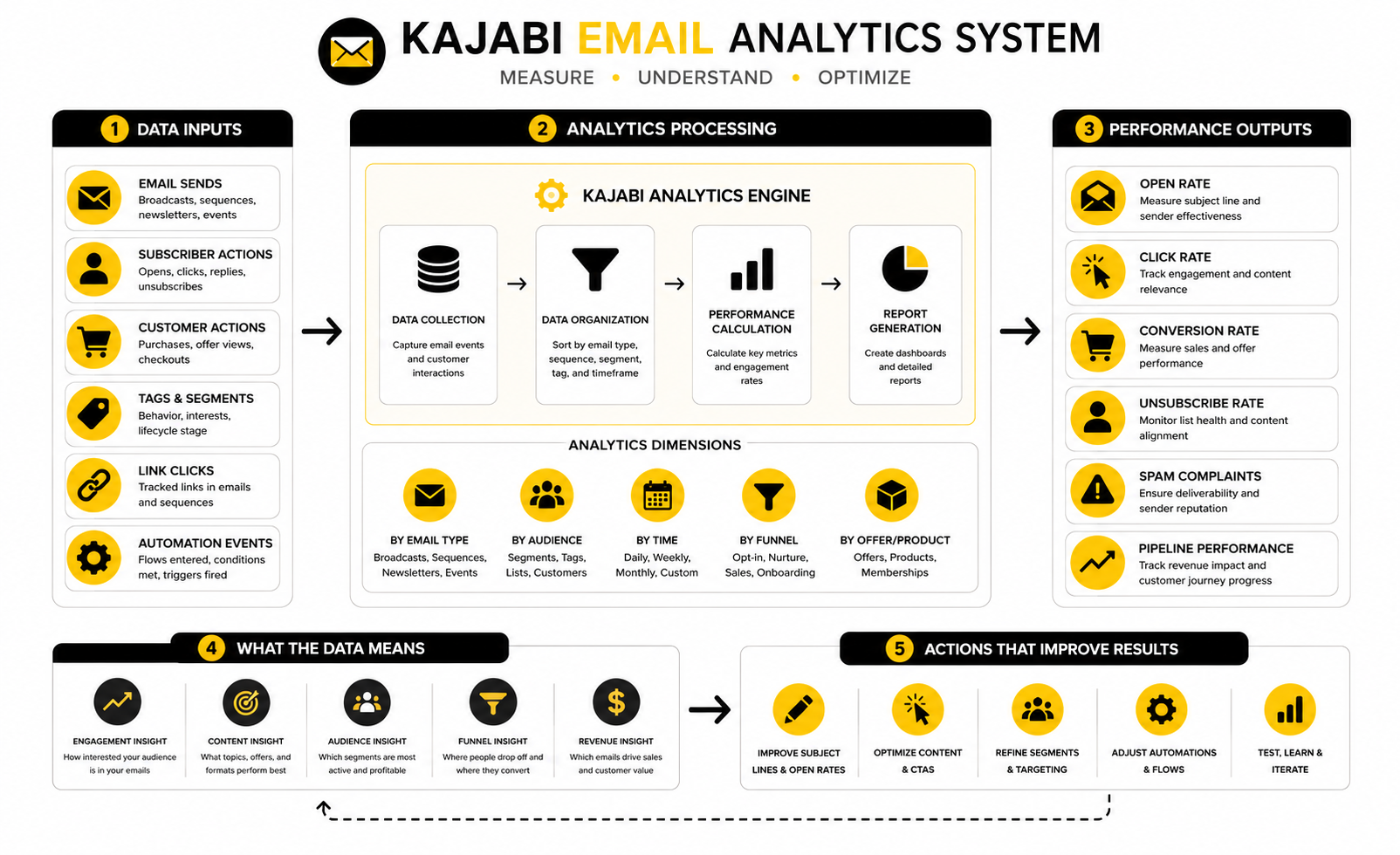
What Is Kajabi Email?
Kajabi email is Kajabi’s built-in email marketing system for sending broadcasts, automated sequences, newsletters, event emails, and customer follow-up. It connects with Kajabi’s forms, offers, products, funnels, contacts, and automations, which makes it useful for creators selling digital products from one platform. Instead of moving every lead and customer into a separate email tool immediately, you can manage a large part of the customer journey inside Kajabi.
Is Kajabi Email Good For Beginners?
Yes, Kajabi email can be a strong option for beginners because it removes a lot of technical setup. You do not need to connect a separate landing page tool, checkout tool, course platform, and email sender just to launch a basic funnel. The best beginner setup is simple: one opt-in form, one lead magnet, one welcome sequence, one offer, and one onboarding sequence.
Can Kajabi Email Replace Mailchimp, ConvertKit, Or ActiveCampaign?
Kajabi email can replace a separate email platform for many creators, especially when the business is centered around courses, coaching, memberships, and digital products. It may not replace every advanced feature in specialist email tools, especially if you need complex conditional branching, deep CRM scoring, advanced ecommerce automations, or large-scale deliverability operations. The practical answer is this: if your email strategy mainly supports Kajabi products and offers, keeping it inside Kajabi can be cleaner.
What Is The Difference Between Kajabi Broadcasts And Sequences?
Broadcasts are one-time emails sent to a selected audience at a specific time. Sequences are automated email series that subscribers receive based on when they enter the sequence. Use broadcasts for timely messages like launches, newsletters, deadline reminders, and product updates, and use sequences for repeatable journeys like welcome flows, nurture campaigns, sales funnels, and onboarding.
How Many Emails Should A Kajabi Welcome Sequence Have?
A Kajabi welcome sequence usually works well with five to seven emails, but the number matters less than the job of each message. The first email should deliver what was promised, then the following emails should build context, explain the problem, introduce your method, handle hesitation, and point to the next step. If an email does not help the reader move forward, remove it.
How Often Should I Send Kajabi Email Broadcasts?
A weekly broadcast is a strong baseline for many creator businesses. It is frequent enough to build familiarity without overwhelming most subscribers. If you are launching, running an event, or closing a cart, you may send more often for a short period, but the list should understand why the extra emails are happening.
Does Kajabi Email Include Analytics?
Yes, Kajabi includes email metrics for broadcasts, sequences, newsletters, and event emails. Kajabi’s email metrics cover signals like opens, clicks, unsubscribes, spam complaints, and customer activity tied to email engagement, while its click report helps you see which links subscribers clicked. Use those numbers to diagnose the customer journey instead of judging every email by one isolated metric.
What Metrics Matter Most In Kajabi Email?
The most useful Kajabi email metrics are delivery, opens, clicks, unsubscribes, spam complaints, purchases, and customer actions after the click. Opens show attention, but they are not perfect because privacy features can affect tracking. Clicks and downstream actions usually matter more because they show intent and movement toward the business goal.
How Do I Improve Kajabi Email Deliverability?
Start with the basics: use a properly authenticated sending domain, keep your list clean, avoid spammy sending patterns, make unsubscribing easy, and send emails people actually want. Kajabi’s custom email domain requirements emphasize strict DMARC, and Gmail’s sender guidance recommends authentication, low spam rates, and easy unsubscribe handling through its email sender guidelines. Deliverability is not one trick. It is the result of list quality, technical setup, and subscriber trust working together.
Should I Use Tags In Kajabi Email?
Yes, but only when the tag changes what happens next. Useful tags can identify source, interest, lifecycle stage, purchases, workshop registrations, or meaningful engagement. Avoid creating vague tags that never affect segmentation, automations, or reporting because they will make the account harder to manage later.
Can Kajabi Email Handle Sales Funnels?
Yes, Kajabi email can support sales funnels through forms, landing pages, sequences, broadcasts, offers, checkout, and automations. It works especially well for evergreen course funnels, launch campaigns, webinar follow-up, waitlists, and post-purchase onboarding. If your funnel strategy becomes highly complex or testing-heavy, you may compare it with a dedicated funnel platform like ClickFunnels, but Kajabi is often enough for a clean creator funnel.
Can I Use Kajabi Email For A Newsletter?
Yes, Kajabi can support newsletters, especially if the newsletter is connected to your broader product ecosystem. A newsletter can keep your audience warm, educate leads, announce new content, and create natural paths into offers. The key is to avoid sending a newsletter just to “stay consistent” and instead give each issue a clear purpose.
When Should I Not Use Kajabi Email Alone?
You may not want to use Kajabi email alone if your business needs advanced sales pipeline management, multi-step CRM workflows, complex SMS follow-up, or agency-level client automation. In that case, a tool like GoHighLevel may be a better fit for the CRM and follow-up layer. Kajabi can still remain the product and course hub while another platform handles more complex sales operations.
How Should I Clean A Kajabi Email List?
Start by identifying subscribers who have not opened, clicked, bought, replied, or engaged for a meaningful period. Send a re-engagement email that gives them a reason to stay and a clear way to opt out. Then suppress or remove contacts who remain inactive, because a smaller engaged list usually gives you cleaner data and stronger sending health than a large list full of silent contacts.
What Is The Best Kajabi Email Strategy For A Course Creator?
The best strategy is to build around the course journey. Use one clear opt-in to attract the right lead, one nurture sequence to build trust, one sales sequence or launch campaign to present the course, and one onboarding sequence to help buyers start strong. After that, use broadcasts and retention emails to support progress, collect feedback, and guide customers toward the next relevant offer.
What Should I Do Before Sending My First Kajabi Email Campaign?
Before sending, check the promise, audience, link, sender details, mobile layout, unsubscribe link, and automation behavior. Submit the form yourself, receive the email, click every link, and confirm that the right tags and sequences are applied. This small test prevents the most common mistakes, especially broken links, wrong segments, and buyers receiving messages they should not see.
Is Kajabi Email Worth It?
Kajabi email is worth it when your email strategy is closely tied to Kajabi products, offers, forms, landing pages, and customer access. It saves time by keeping the customer journey inside one ecosystem, and that can be more valuable than having a separate tool with advanced features you do not use. The best move is to build the simplest complete system first, measure the results, and only add tools when the business has outgrown the current setup.
Build a stronger local presence with BAAM AI
Turn your website, Google profile, social channels, and AI visibility into one growth engine
Most businesses do not need more random marketing activity. They need a consistent presence system that helps the right people find them, trust them, and take action. BAAM AI brings strategy, local SEO, website updates, Google Maps visibility, social content, AI-search readiness, media production, and reporting into one practical monthly engine.
If you want your marketing to keep working after the campaign ends, start with a free BAAM AI presence audit. See how your business shows up today and where the fastest visibility wins are at BAAM AI.