
BAAM AI Blog
Joseph Sugarman: The Copywriting System Behind Ads People Actually Read
Joseph Sugarman did not become famous because he wrote pretty sentences. He became famous because he understood something most marketers still miss: the job of copy is not to sound clever, but to keep the reader moving.
Joseph Sugarman did not become famous because he wrote pretty sentences. He became famous because he understood something most marketers still miss: the job of copy is not to sound clever, but to keep the reader moving.
That idea is simple, but it is not shallow. Sugarman built his reputation in direct-response advertising, mail-order marketing, consumer electronics, and later BluBlocker sunglasses. His work mattered because every ad had to do something measurable. It had to make someone read, believe, desire, and act.
Joseph Sugarman’s best-known books, including Advertising Secrets of the Written Word, helped turn his field-tested advertising process into a repeatable framework. He was not writing theory from a comfortable distance. He was writing from the world of print ads, catalog orders, infomercials, product positioning, and direct sales.
That is why studying Joseph Sugarman still matters. Modern marketers may use landing pages, email sequences, funnels, ads, webinars, and AI tools, but the psychology has not changed much. People still need a reason to pay attention, a reason to trust you, and a reason to act now.
Why Joseph Sugarman Still Matters
Joseph Sugarman’s career sits at an interesting point in marketing history. He worked in an era when a full-page print ad could either make money or fail publicly, and there was nowhere to hide behind vanity metrics. If the copy did not sell, the result showed up quickly in orders, returns, and cash flow.
That pressure shaped his writing style. Sugarman cared about curiosity, clarity, credibility, and momentum because those things affected response. His ads were often long, but they were not long for the sake of length. They were long because the reader needed enough information, emotion, and confidence to make a buying decision.
This is especially relevant now because many marketers confuse speed with persuasion. A short ad can work, but only when it carries enough force. A long landing page can work, but only when each line earns the next one. Sugarman’s real lesson is not “write long copy.” It is “create a buying environment where the next step feels natural.”
The Sugarman Copywriting Framework
Sugarman’s framework begins with the first sentence. He famously treated the first sentence as a tool with one job: get the reader to read the second sentence. From there, each sentence should pull the reader forward until the sales argument feels less like a pitch and more like a guided discovery.
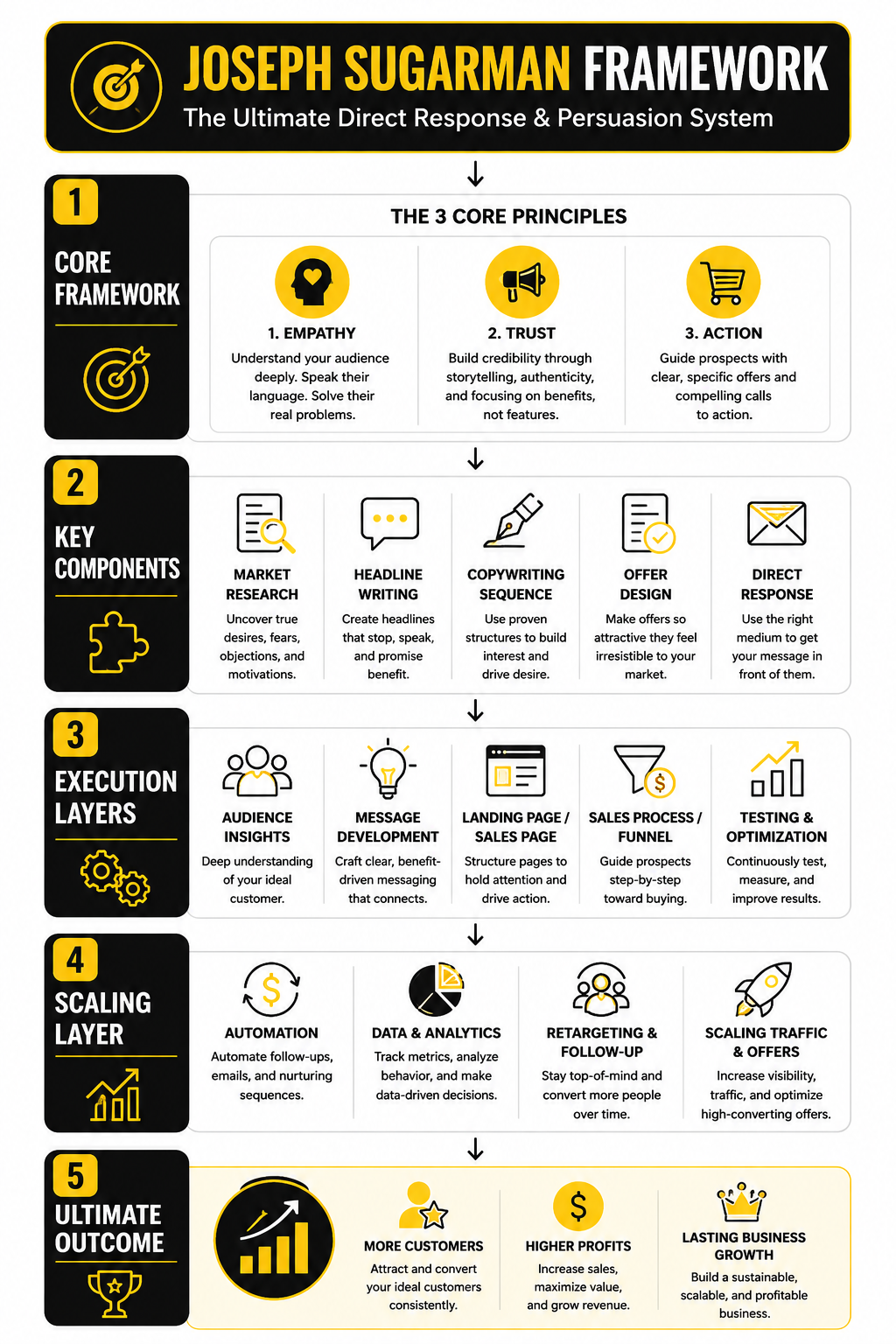
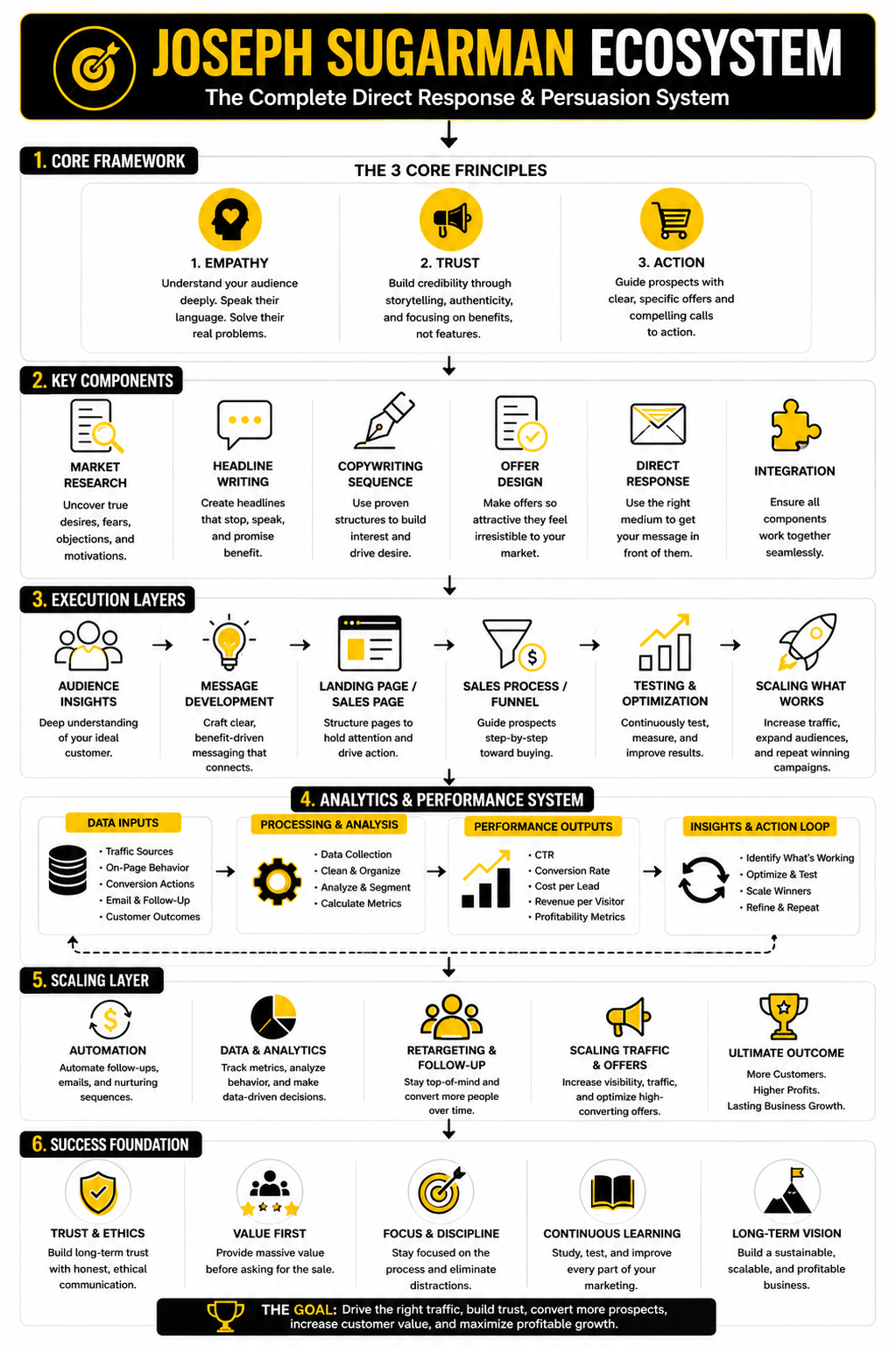
The framework is practical because it combines structure with psychology. You begin by creating curiosity, then you build trust, then you explain the product, then you handle resistance, then you make the offer feel obvious. It is not manipulation when done honestly. It is disciplined communication.
This is also where Sugarman differs from many modern copywriting summaries. His work is not just about hooks, formulas, or emotional triggers. Those matter, but they sit inside a larger system. The product, the market, the offer, the proof, the timing, and the reader’s internal conversation all have to work together.
The Six-Part Structure of this guide
this guide is split into six parts so each idea can build properly. Part 1 sets the foundation and gives you the full map. The later sections will go deeper into the actual mechanics behind Sugarman’s method and how to apply them without turning your copy into a cheap imitation of old direct-response ads.
Part 2 will cover why Joseph Sugarman still matters in modern marketing. That section will connect his direct-response background to today’s funnels, landing pages, email campaigns, and product-led offers. The goal is to show where his thinking still holds up and where marketers need to adapt it.
Part 3 will explain the Sugarman copywriting framework in detail. It will break down the flow from attention to action, including curiosity, the first sentence, slippery slide copy, buyer psychology, credibility, objections, and the final buying decision. This is where the method becomes more concrete.
Part 4 will focus on the core components of his method. That includes headlines, opening lines, product positioning, storytelling, emotional triggers, proof, value, and offer framing. Each component matters because weak copy usually fails from several small leaks, not one dramatic mistake.
Part 5 will cover professional implementation. This is where Sugarman’s ideas get translated into practical assets like sales pages, email sequences, ads, lead magnets, webinars, and ecommerce product pages. Tools can help here, but they should support the thinking rather than replace it. For example, a marketer building a funnel may use a platform like ClickFunnels or GoHighLevel, but the conversion logic still has to come from the message.
Part 6 will handle common mistakes, frequently asked questions, and final takeaways. That final section will make the article easier to use as a reference. It will also clarify what Joseph Sugarman’s work can teach you without pretending every tactic from his era should be copied blindly today.
Why Joseph Sugarman Still Matters
Joseph Sugarman still matters because he treated advertising as a disciplined sales conversation, not a decoration exercise. That distinction is important. A lot of modern marketing looks polished, but the message does not always move the reader from curiosity to confidence.
His background explains why his work feels different from ordinary brand copy. Sugarman built JS&A Group around direct-response marketing, selling products through print ads, catalogs, and mail-order systems where the copy had to generate measurable action. His later work with BluBlocker sunglasses pushed that same direct-response thinking into television, infomercials, and mass-market consumer attention.
That is the part worth studying. Joseph Sugarman was not just writing ads for awards. He was creating sales assets that had to survive contact with real buyers, real objections, real money, and real results.
He Understood Attention Before Attention Became Expensive
Today, every marketer talks about attention. Sugarman understood the problem decades earlier, when the battlefield was a magazine page, a newspaper spread, a catalog, or a television screen. His copy had to compete with everything else in the reader’s life, and it had to do that before retargeting pixels, automated follow-ups, and algorithmic ad delivery made second chances easier.
That is why his first-sentence philosophy still feels so useful. The first line does not need to explain everything. It needs to reduce friction enough for the reader to continue. Then the next line has to do the same thing again.
This is brutally relevant now. A landing page, email, ad, or sales funnel usually does not fail because the business lacks features. It fails because the reader stops caring before the offer becomes clear. Sugarman’s approach forces you to respect the reader’s attention at every step.
He Connected Product Education With Desire
One of Sugarman’s strengths was his ability to make product education feel interesting. He often sold products that needed explanation, including electronics, gadgets, and later BluBlocker sunglasses. That mattered because direct-response buyers were not always looking for those products before they saw the ad.
The job of the copy was not just to announce the product. It had to create context. It had to show why the product mattered, what made it different, and why buying it now made sense.
That lesson applies perfectly to modern offers. Software tools, AI products, coaching programs, ecommerce products, agencies, and B2B services often need education before conversion. If the reader does not understand the problem clearly, the offer feels optional. If the reader understands the problem deeply, the solution becomes much easier to sell.
He Made Long Copy Feel Natural
Sugarman is often associated with long-form copy, but that can be misleading. The point was not to make ads long. The point was to make the sales argument complete.
Good long copy works when the reader needs more information to make a decision. Bad long copy feels like someone is trying to overwhelm the reader with claims. Sugarman’s better ads worked because they moved through curiosity, explanation, proof, objection handling, and offer logic in a way that felt connected.
That is useful because many marketers still argue about short copy versus long copy as if length is the strategy. It is not. The real question is how much persuasion the reader needs before action feels safe, desirable, and timely.
He Treated Copy as Salesmanship, Not Content
Joseph Sugarman’s work belongs to a direct-response tradition where copy has a commercial job. That does not mean every sentence should scream “buy now.” It means every sentence should serve the buying journey.
This separates sales copy from general content. A blog post may educate. A brand campaign may build familiarity. A sales page, email sequence, or offer page has to do more than inform; it has to move the reader toward a decision.
That is where Sugarman’s thinking becomes practical. He gives marketers a way to evaluate copy by function. Does this line create curiosity? Does this paragraph build trust? Does this claim reduce doubt? Does this offer make the next step feel obvious?
His Ideas Still Fit Modern Funnels
Modern funnels are more technical than the systems Sugarman used, but the psychology is familiar. A funnel still needs attention, relevance, trust, desire, proof, urgency, and a clear next step. The tools changed. The buyer did not become a different species.
This is why his work still applies to landing pages, email campaigns, webinars, product pages, advertorials, lead magnets, and sales videos. A funnel builder can help you assemble the pages. An email platform can help you automate the follow-up. But the message still has to make people care.
That is the practical takeaway. Joseph Sugarman’s value is not nostalgia. His value is that he gives you a cleaner way to think about persuasion before you start blaming your traffic source, your funnel software, or your audience.
He Reminds Marketers to Sell With Clarity
Sugarman’s copy was often energetic, curious, and dramatic, but the underlying goal was clarity. The reader needed to understand what the product was, why it mattered, and why it was credible. Without that clarity, cleverness becomes a liability.
This matters even more now because marketing teams have more tools than ever. They can generate copy faster, launch pages faster, and test more variations faster. But speed does not fix weak thinking.
A strong Joseph Sugarman-style approach starts before the writing. You understand the product. You understand the prospect. You understand the objection. You understand the emotional reason someone might want the outcome. Then you write copy that makes the decision feel logical and human at the same time.
His Legacy Is a System, Not a Slogan
The reason Joseph Sugarman remains useful is not one quote, one ad, or one technique. It is the system behind the work. He looked at copy as a sequence of psychological steps, where each element had a job and each job supported the sale.
That is why his ideas are still worth studying carefully. You do not need to copy his exact tone. You do not need to recreate old print ads. You need to understand the movement inside the copy.
When you do, your marketing becomes less random. You stop asking, “Does this sound good?” and start asking, “Does this move the reader forward?” That one shift changes everything.
The Sugarman Copywriting Framework
Joseph Sugarman’s copywriting framework starts with a simple standard: every element must make the reader want to continue. That sounds basic until you try to apply it. Most weak copy does not fail because one sentence is terrible; it fails because too many sentences give the reader permission to leave.
This is why Sugarman’s work is so useful for modern marketing. He did not treat copy as a pile of tactics. He treated it as a sequence, where attention, curiosity, belief, desire, proof, and action all had to connect.
The framework becomes powerful when you stop asking, “What should I write?” and start asking, “What does the reader need to feel, understand, or believe next?” That question changes the whole process. It moves you away from random persuasion tricks and toward controlled momentum.
Start With the Reader’s Existing State
Before you write the first line, you need to know where the reader is mentally. Are they problem-aware, solution-aware, product-aware, or completely unaware? Are they skeptical because they have been burned before? Are they interested but overwhelmed by options?
Sugarman’s method works because it respects that starting point. You do not push the reader into a sales argument too early. You meet them where they are, then guide them toward a more useful way of seeing the product.
This matters because the same offer can need very different copy depending on the reader’s awareness. A warm prospect may only need clarity and a strong reason to act. A cold prospect may need curiosity, education, proof, and a bridge between their current frustration and your solution.
Define the Big Idea Before the Headline
A strong Joseph Sugarman-style ad does not begin with wordplay. It begins with a central idea that makes the product interesting. The headline and opening line are only effective when they are attached to a clear angle.
The big idea should answer a practical question: why should someone care about this now? Maybe the product solves a painful problem in a new way. Maybe it reveals a misunderstood benefit. Maybe it changes how the reader thinks about a familiar category.
Without that idea, the copy becomes a list of features. Features can help, but they rarely create momentum by themselves. The reader needs a reason to lean in before they are willing to absorb details.
Write the First Sentence to Lower Resistance
Sugarman’s famous first-sentence principle is not about being cute. It is about making the first step easy. The first sentence should feel so simple, relevant, or intriguing that reading it requires almost no effort.
That means you should not overload the opening with claims, jargon, or explanation. You are not trying to close the sale in sentence one. You are trying to open a loop that the reader wants to keep following.
A good first sentence can ask a sharp question, make a clean observation, introduce tension, or state a surprising truth. The exact format matters less than the effect. The reader should feel pulled forward, not pressured.
Build the Slippery Slide
The slippery slide is one of the most practical ideas associated with Joseph Sugarman. Each sentence should create enough curiosity, clarity, or emotional payoff to make the next sentence feel natural. When this works, the reader does not feel like they are being dragged through copy.
The slide is built through flow. You introduce an idea, resolve part of it, then open the next question. You make the reader feel understood, then show them something they had not fully considered. You keep the rhythm tight enough that attention does not leak out.
This does not mean every sentence needs to be short. It means every sentence needs a reason to exist. A longer paragraph can work if it deepens belief. A short line can fail if it adds nothing.
Turn Product Features Into Buying Reasons
A feature is what the product has. A buying reason is why the reader should care. Sugarman’s work often translated product details into a story of value, usefulness, novelty, status, convenience, or relief.
This is where many marketers lose the sale. They describe the tool, the service, or the product accurately, but they do not connect it to the buyer’s internal motivation. The reader understands what is being sold, but not why it matters enough to act.
The fix is simple, but not easy. For every feature, ask what it helps the buyer do, avoid, gain, save, prove, or feel. Then write that connection clearly. Do not make the reader do the emotional math alone.
Add Proof Where Doubt Naturally Appears
Proof should not be dumped into the copy randomly. It should appear when the reader starts wondering whether the claim is believable. That is how proof becomes part of the persuasion flow instead of a decorative credibility badge.
In a Sugarman-style process, every major claim creates a possible objection. If you say something is easier, the reader wonders compared to what. If you say it works quickly, the reader wonders for whom. If you say it is different, the reader wants to know why.
Good copy anticipates those doubts and answers them at the right time. That might mean a demonstration, a specific mechanism, a customer result, a guarantee, a comparison, or a simple explanation of why the product works. The point is not to overprove everything. The point is to remove the exact doubt that would stop the reader from moving forward.
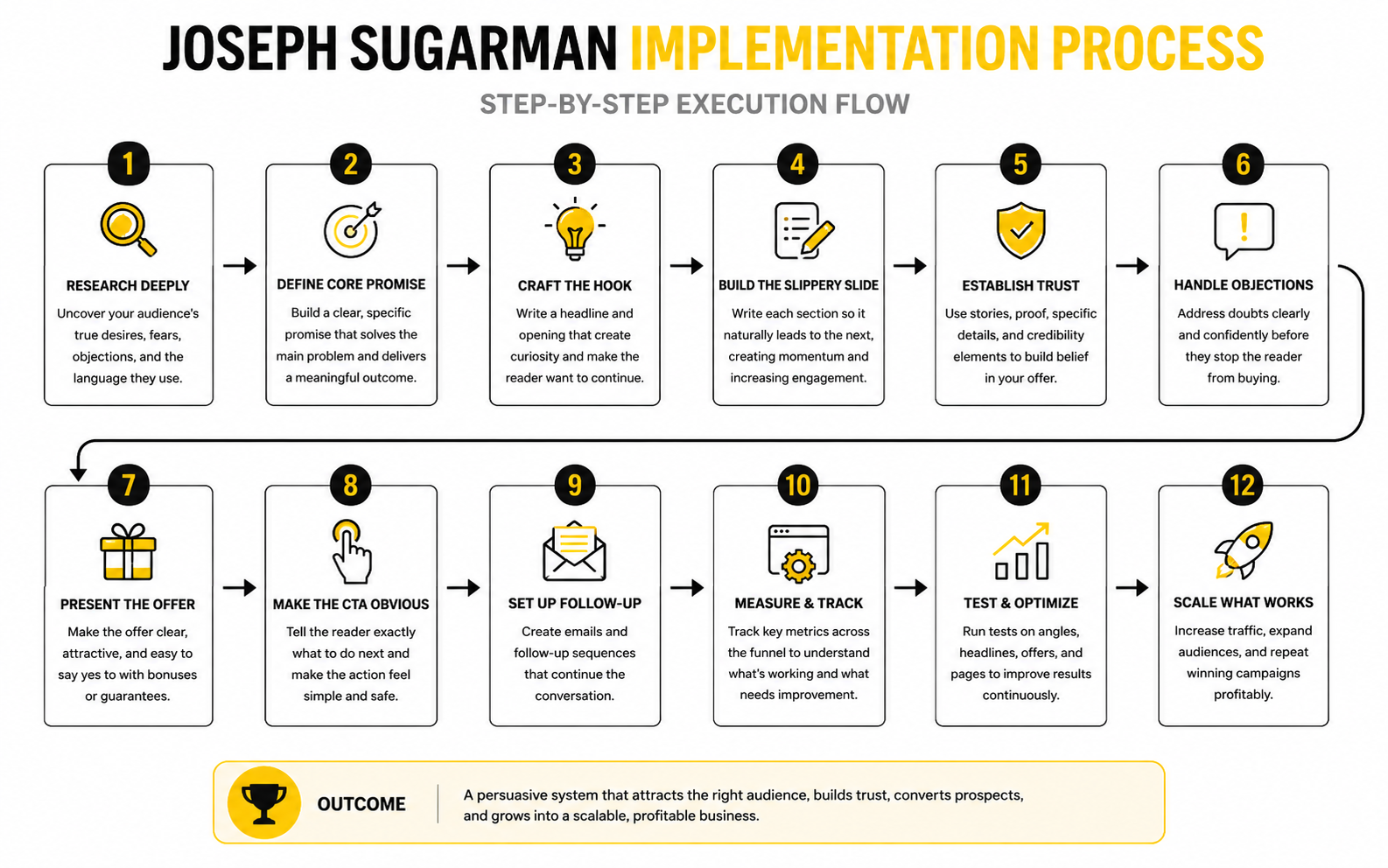
Use This Execution Process
A practical Joseph Sugarman-inspired process looks like this:
This process works because it gives each part of the copy a job. You are not just writing until the page feels full. You are designing a path from attention to decision.
It also makes editing much easier. Instead of asking whether the copy sounds good, you can ask whether each section is doing its job. If a paragraph does not create curiosity, deepen desire, clarify value, or reduce doubt, it probably needs to be cut or rewritten.
Make the Offer Feel Like the Next Logical Step
The offer should not appear as a sudden demand. It should feel like the natural conclusion of the argument. By the time the reader reaches it, they should understand the problem, believe the solution, and see why action makes sense.
This is where the framework becomes more than writing. The offer itself has to be strong. Clear pricing, useful bonuses, a real guarantee, simple next steps, and honest urgency can all support the decision when they are relevant.
Weak offers expose weak thinking. If the copy has to beg, hype, or pressure the reader at the end, the earlier sequence probably did not do enough work. Strong copy makes the close feel obvious.
Adapt the Framework to the Channel
Sugarman’s principles can work across channels, but the execution changes. A full sales page gives you space to build the complete argument. An email has to create enough interest to earn the click. A short ad may only need to sell the next step, not the whole product.
That distinction matters. You do not need to force a full direct-response structure into every asset. You need to know what the asset is responsible for.
A landing page may need the complete slippery slide from headline to checkout. An email sequence may spread the same persuasion arc across several messages. A funnel built with ClickFunnels, Systeme.io, or GoHighLevel still needs the same strategic discipline: each step should make the next step feel easier.
Edit for Momentum, Not Decoration
The final stage is editing. This is where Sugarman’s thinking becomes painfully useful. You look at every sentence and ask whether it earns its place.
Cut anything that exists only because it sounds impressive. Simplify anything that makes the reader work harder than necessary. Move proof closer to the claim it supports. Move objections before the reader silently uses them as a reason to leave.
The goal is not to make the copy shorter by default. The goal is to make it tighter. Sometimes that means cutting. Sometimes it means adding the missing explanation that helps the reader believe. Either way, the standard is the same: keep the reader moving.
Statistics and Data
Joseph Sugarman came from a world where copy had to prove itself. That is the mindset modern marketers need to borrow, not just the writing style. If you use Sugarman’s ideas but never measure what happens after the reader lands, clicks, scrolls, or buys, you are only guessing with better words.
The useful question is not whether the copy feels persuasive. The useful question is where the reader’s momentum breaks. Data helps you see whether the first line earned attention, whether the argument created enough desire, whether the proof reduced doubt, and whether the offer made action feel safe.
This is where measurement becomes practical. You are not collecting numbers to decorate a report. You are collecting signals that show you what to improve next.
Measure the Copy Like a Sales Conversation
A Joseph Sugarman-style sales page should be measured as a sequence, not as one flat asset. The headline creates the first decision. The opening pulls the reader into the body. The body builds belief. The offer turns belief into action.
That means one conversion rate is not enough. A page can have a weak headline, a strong middle, and a confusing offer. Or it can get attention easily but lose people when the claim becomes too vague.
The better approach is to track the journey. Look at where people arrive, how far they move, what they click, where they hesitate, and what they do after the call to action. That gives you a real diagnosis instead of a vague opinion.
The Metrics That Actually Matter
You do not need 40 metrics to judge copy. You need a small set of numbers that map to the persuasion path. Each metric should answer a specific question about the reader’s behavior.
The most useful signals usually include:
That last one matters more than many marketers admit. Copy that increases sales by exaggerating the outcome can hurt the business later. Sugarman’s direct-response mindset was commercial, but it was also grounded in product reality. Strong copy should increase desire without creating a gap between the promise and the experience.
Benchmarks Are a Starting Point, Not a Verdict
Benchmarks are useful when they help you ask better questions. They become dangerous when you treat them like universal truth. A conversion rate that looks weak in one market may be profitable in another if the customer value is high.
Landing page data makes this clear. Unbounce’s benchmark report analyzed more than 57 million conversions and 41,000 landing pages and reported a median conversion rate of 6.6% across industries. That number is useful, but only if you interpret it correctly.
A 4% conversion rate might be terrible for a low-ticket lead magnet with cheap traffic. The same 4% might be excellent for a high-ticket B2B offer where one qualified lead is worth thousands. The benchmark tells you where to look, not what to blindly believe.
Segment the Data Before You Rewrite the Copy
Never rewrite copy based on blended data alone. Blended data hides the truth. Mobile visitors, desktop visitors, cold traffic, warm email traffic, branded search, paid social, and retargeting audiences often behave differently.
Unbounce’s benchmark data also shows why this matters: mobile drove 83% of analyzed visits, while desktop still converted better in the sample. That does not mean desktop is always more valuable. It means you need to inspect device behavior before you decide the copy is the problem.
This is a very common mistake. A marketer sees weak page conversion and rewrites the offer. Then the real issue turns out to be mobile readability, slow load time, poor message match, or a CTA buried too far down the page. Data should help you isolate the problem before you touch the words.
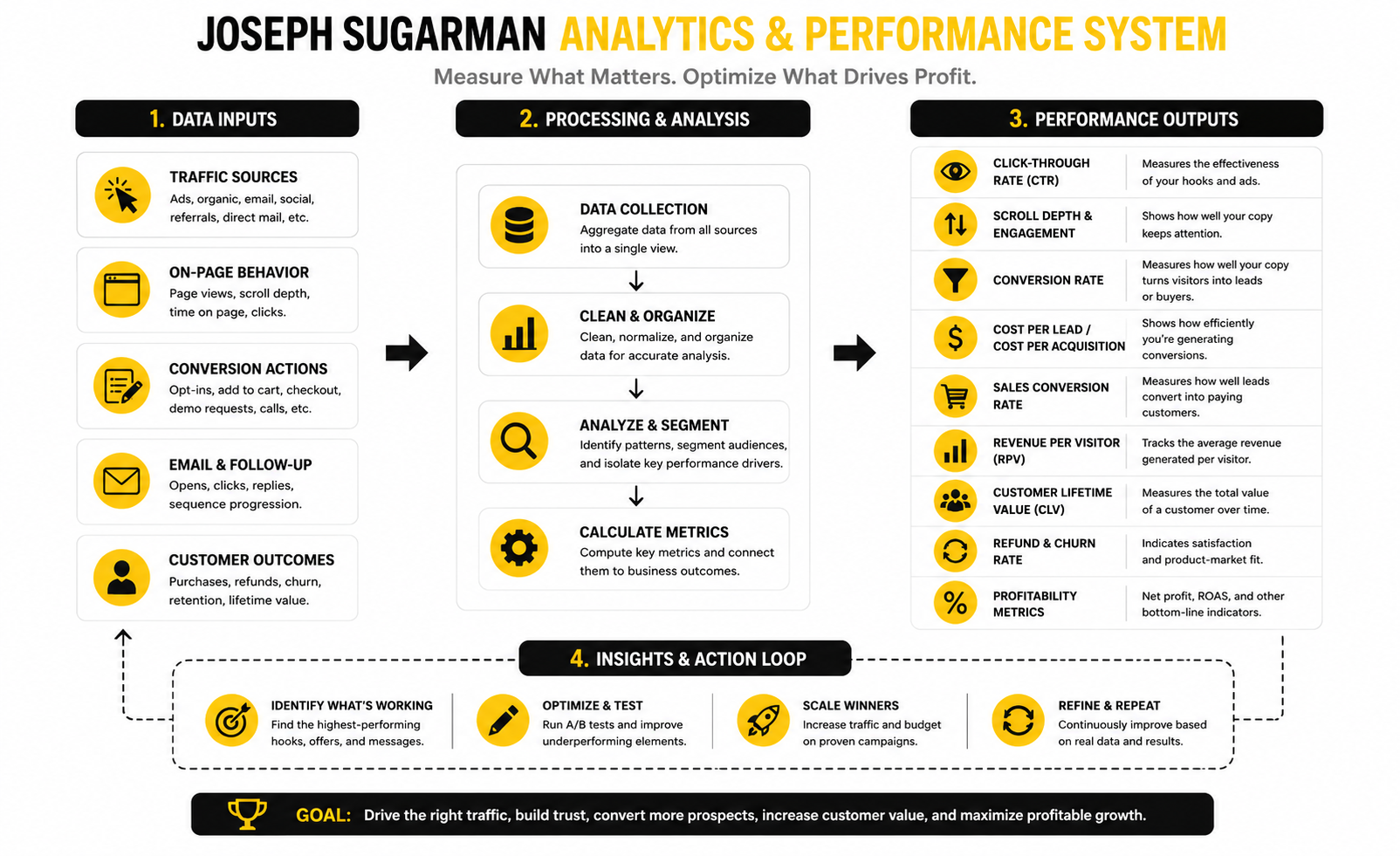
Build a Simple Analytics System
A practical measurement system should connect each part of the copy to a behavioral signal. This does not need to be complicated. It needs to be consistent.
Use this structure:
This system keeps you honest. It prevents you from blaming the headline when the offer is weak. It prevents you from blaming the offer when the traffic is wrong. Most importantly, it prevents random optimization.
Read Email Data as Buyer Intent
Sugarman’s ideas also translate well into email because every email has a mini persuasion sequence. The subject line earns attention. The opening earns the next sentence. The body creates enough interest to click. The landing page completes the argument.
Email benchmarks can help, but they need context. HubSpot’s benchmark roundup shows that B2B services email open rates can sit around 39.48% while click-through rates may be much lower, which is a useful reminder: opens are not the same as persuasion.
An open tells you the subject line and sender created enough curiosity or recognition. A click tells you the email created enough intent. A sale tells you the entire sequence worked. Do not celebrate opens if the reader never moves closer to buying.
Test Ideas, Not Tiny Wording Preferences
A/B testing fits naturally with a Joseph Sugarman approach because Sugarman treated copy as something that could be improved through response. But testing only works when the test is meaningful. Changing one adjective in a weak offer is not strategy.
A strong test compares real persuasion hypotheses. For example, you might test whether the market responds better to a curiosity-driven headline or a problem-focused headline. You might test whether proof should appear earlier. You might test whether the offer needs a stronger guarantee or a clearer mechanism.
A 2024 systematic review of A/B testing research covering 143 studies reinforces an important point: experimentation still needs human judgment, even when tools automate parts of the process. The tool can split traffic. It cannot decide whether your hypothesis makes strategic sense.
Watch for False Winners
A test result can look exciting and still be unreliable. Small samples create noise. Short testing windows can be distorted by day-of-week behavior, traffic mix, or campaign timing. A sudden lift can disappear when more visitors arrive.
This is why you should avoid calling a winner too early. A copy test should have enough traffic, enough conversions, and enough time to reflect normal buyer behavior. Otherwise, you may end up scaling the wrong message.
The action here is simple. Before testing, decide what metric matters, how much improvement is meaningful, and how much data you need before acting. That discipline protects you from chasing random spikes.
Use Revenue Metrics When Possible
Conversion rate is useful, but revenue is often more honest. A page that converts more visitors into lower-quality leads may look better in a dashboard and worse in the bank account. A page that converts fewer visitors but produces more qualified buyers may be the stronger asset.
This matters especially for funnels, agencies, SaaS, coaching, and high-ticket services. The goal is not just to get more people to click. The goal is to attract the right people and move them toward the right decision.
So measure deeper when you can. Track lead quality, booked calls, show-up rates, close rates, customer value, refunds, and retention. The copy should not only create action. It should create the kind of action the business can profitably fulfill.
Turn Data Into Copy Decisions
Good analytics should lead to specific copy decisions. If people bounce quickly, the opening may not match the traffic promise. If they scroll but do not click, the argument may be interesting but not urgent. If they click but do not buy, the offer, checkout, price framing, or proof may need work.
This is where Sugarman’s thinking becomes very practical. Every data problem points to a persuasion question. Why did attention drop? Why did belief stall? Why did desire fail to become action?
Do not rewrite everything at once. Fix the biggest bottleneck first. Then measure again. That is how copy becomes a business asset instead of a creative guessing game.
Use Tools to Support the System
The platform does not replace the message, but it can make measurement easier. If you are building sales pages and funnels, tools like ClickFunnels, Systeme.io, and GoHighLevel can help connect pages, forms, automations, and follow-up. That is useful because Sugarman-style copy usually works best when the whole path supports the same promise.
For email and lifecycle messaging, platforms like Brevo or Moosend can help you see how the sequence performs after the first click. That matters because a great sales argument often needs more than one touch.
The key is not to drown in software. Pick the tools that help you see the buying journey clearly. Then use the data to make sharper copy decisions.
What the Numbers Should Make You Do
The right data should push you toward action. If mobile visitors dominate but convert poorly, improve mobile structure before rewriting the whole page. If email opens are strong but clicks are weak, work on the body copy and the reason to click. If CTA clicks are strong but purchases are weak, inspect the offer, checkout, objections, and proof.
This is the practical interpretation layer most marketers skip. They collect numbers, stare at dashboards, and then make emotional decisions anyway. Do not do that.
Joseph Sugarman’s work reminds you that copy is a controlled path. Analytics shows you where that path is breaking. Put those two ideas together, and optimization becomes much simpler: find the leak, understand the psychology behind it, fix one thing, and measure again.
How to Apply Sugarman’s Ideas Professionally
At this stage, the real question is not whether Joseph Sugarman was a strong copywriter. That part is obvious. The real question is how to use his ideas professionally without sounding like you are imitating old direct-response advertising.
That distinction matters. Sugarman’s principles are durable, but the surface style is not always the thing to copy. The rhythm, curiosity, proof, objection handling, and buyer psychology still work, but the execution has to fit the market, the channel, and the buyer’s expectations.
Professional implementation starts with restraint. You are not trying to make every sentence dramatic. You are trying to make every sentence useful.
Match the Intensity to the Market
Some markets respond well to bold claims, emotional tension, and long-form education. Others demand calm authority, precision, and proof before personality. A Joseph Sugarman-inspired approach should flex to match the buyer’s level of sophistication.
A consumer gadget, impulse ecommerce product, or creator offer may have room for more curiosity and drama. A B2B service, legal-adjacent product, financial offer, or enterprise tool usually needs a more measured tone. The underlying copy structure can stay the same, but the volume changes.
This is where inexperienced copywriters get into trouble. They discover direct response, then turn every offer into a carnival barker pitch. That is not Sugarman’s lesson. The lesson is to understand what the buyer needs next and deliver it in the most persuasive credible form.
Do Not Confuse Curiosity With Confusion
Curiosity is powerful when it creates a useful open loop. Confusion is expensive because it makes the reader work too hard. The difference is simple: curiosity makes the reader want the answer, while confusion makes them doubt the page.
Joseph Sugarman often used curiosity to pull readers into the next sentence, but the copy still had to resolve itself. Each idea needed to become clearer as the reader continued. The goal was momentum, not mystery for its own sake.
That matters even more on modern pages. Readers can leave instantly, compare competitors in another tab, or ask an AI tool to summarize alternatives. If your copy withholds clarity for too long, curiosity turns into friction.
Protect Trust Before You Push Desire
The stronger the promise, the more trust you need. That is not optional. If the claim feels bigger than the proof, the copy may create attention, but it will also create resistance.
This is why advanced copywriting is less about adding hype and more about controlling belief. You can increase desire by sharpening the problem, showing a better mechanism, and making the outcome feel concrete. But if the reader does not believe the path, the desire collapses.
Use proof before pressure. Use specificity before urgency. Use clear expectation-setting before testimonials. The FTC’s endorsement guidance makes this especially important when testimonials could imply results that are not typical for the average customer, because advertisers need to avoid misleading impressions about what buyers can generally expect.
Keep the Mechanism Visible
A mechanism explains why the product works. It gives the reader a bridge between the claim and the outcome. Without it, even a true promise can feel thin.
Sugarman’s best lessons apply here because his copy often made ordinary product details feel meaningful. He did not just say a product was interesting. He gave the reader enough context to understand why it was different.
Modern offers need the same thing. An AI tool should explain what it automates and why that saves time. A landing page builder should explain how the page structure supports conversions. A coaching offer should explain the process, not just the dream outcome. The mechanism turns belief from “maybe” into “that makes sense.”
Scale the Message Without Diluting It
A strong sales argument can break when it gets spread across too many channels. The ad says one thing, the landing page says another, the emails shift tone, and the checkout page introduces new doubts. That is how otherwise good copy loses money.
Scaling a Sugarman-style message means protecting the core promise everywhere. The hook can change by channel, but the underlying idea should stay consistent. The proof can be adapted, but it should support the same belief.
This is especially important when teams get involved. A media buyer may want sharper hooks. A designer may want fewer words. A founder may want more features. A copy lead has to protect the buying journey so every asset still moves the reader in the same direction.
Build a Message Library
One of the best ways to scale copy is to create a message library. This is a simple internal document that stores the strongest angles, objections, proof points, customer language, claims, disclaimers, hooks, and offer explanations. It prevents every new campaign from starting from zero.
A useful message library should include:
This turns Joseph Sugarman’s thinking into an operating system. Instead of relying on one person to write well every time, the business builds a reusable persuasion base. That is how copy quality improves across campaigns, emails, pages, ads, and sales conversations.
Know When Long Copy Becomes a Liability
Long copy is useful when the reader needs education, proof, or emotional movement. It becomes a liability when the reader already wants the product and simply needs a clear path to act. More words are not automatically more persuasive.
The advanced move is to understand the buyer’s decision stage. Cold traffic may need more context. Warm traffic may need proof and offer clarity. Existing customers may only need a direct explanation of what is new and why it matters.
This is why a single “best” page length does not exist. The best length is the amount of copy needed to move the specific reader to the next decision without adding unnecessary friction. Anything beyond that is indulgence.
Use AI Carefully
AI can help with research organization, angle generation, first drafts, rewrite variations, and message testing ideas. But it should not replace the strategic thinking behind the copy. Sugarman’s method depends on understanding the buyer’s psychology, and that still requires human judgment.
The risk with AI-written copy is sameness. It often produces clean sentences that sound reasonable but lack tension, specificity, and lived understanding of the buyer. That kind of copy feels professional but does not move people.
Use AI like a junior assistant, not the strategist. Feed it real customer language, real objections, real product details, and clear positioning. Then edit the output with Sugarman’s standard: does this line make the next line more likely to be read?
Keep Compliance in the Workflow
Professional copywriting needs compliance built in early, not pasted on at the end. This is especially true for health, finance, income, legal, SaaS, and performance-based offers. If the copy depends on a claim you cannot substantiate, the copy is weak even if it converts.
This does not mean the writing has to become boring. It means the persuasion has to be grounded. Clear mechanisms, realistic expectations, qualified testimonials, and accurate comparisons can still sell strongly.
The best marketers do not see compliance as the enemy of conversion. They see it as a trust filter. It forces the offer to become clearer, more specific, and more defensible.
Align Copy With Delivery
The fastest way to destroy a strong campaign is to overpromise and underdeliver. A page can convert well for a few weeks and still damage the business if refunds, churn, complaints, or low-quality leads rise afterward. This is why measurement has to continue after the sale.
Joseph Sugarman’s direct-response world was immediate, but professional implementation today often has a longer feedback loop. You need to know whether the buyers you attract are satisfied, profitable, and aligned with the product. Otherwise, the copy may be creating the wrong demand.
This is where marketing and operations have to talk. Sales copy should reflect what the product can truly deliver. Customer success should report where expectations are mismatched. Product teams should notice what the market keeps asking for. Strong copy is not isolated from the business; it is connected to it.
Choose Tools Around the Buyer Journey
Tools are useful when they support the strategy. They are dangerous when they become the strategy. A funnel platform, email tool, chatbot, CRM, or page builder should make the buyer journey easier to execute and measure.
For example, a business running multi-step campaigns may use GoHighLevel to connect landing pages, pipelines, automations, and follow-up. An ecommerce team that needs flexible landing pages may use Replo to build product-focused experiences. A creator or small business may prefer Systeme.io when they want funnels, email, and digital product delivery in one place.
The point is not which tool sounds impressive. The point is whether the tool helps you preserve the persuasion path. If the software makes the message clearer, follow-up easier, and measurement cleaner, it supports the strategy. If it adds complexity without improving the buyer journey, it is just another distraction.
Create a Testing Roadmap
Advanced implementation needs a testing roadmap, not random experiments. Start with the highest-leverage parts of the buying journey. Usually that means the promise, the offer, the proof, the mechanism, and the first conversion step.
A practical roadmap might test:
This keeps testing strategic. You are not changing button text because a blog post told you to. You are testing the parts of the sales argument most likely to affect buyer belief and action.
Build for Longevity, Not Just Response
Sugarman’s world rewards response, and that is still important. But modern brands also need memory, trust, and repeatable positioning. The best copy does not just create a click; it teaches the market how to think about the product.
That is why expert-level implementation balances direct response with brand discipline. You want the urgency and clarity of sales copy without turning every message into a desperate pitch. You want measurable action without training your audience to only respond to hype or discounts.
The strongest use of Joseph Sugarman’s ideas is not imitation. It is translation. Take the psychology, sequencing, curiosity, and disciplined selling logic, then apply them in a way that fits your offer, your ethics, your audience, and your long-term business.
Common Mistakes When Using Sugarman’s Advice
Joseph Sugarman’s work is easy to admire and easy to misuse. That is the danger with any strong copywriting philosophy. People copy the visible style before they understand the thinking underneath it.
The goal is not to write like Joseph Sugarman word for word. The goal is to think like a disciplined direct-response marketer. That means respecting attention, building belief, proving the promise, and making the next step feel natural.
Before closing the full system, it is worth naming the mistakes that can weaken the method. These are the issues that show up when marketers borrow the tactics but skip the judgment.
Turning Curiosity Into Clickbait
Curiosity works when it leads somewhere useful. Clickbait works for a moment, then damages trust. The difference matters because Sugarman’s slippery slide depends on reward, not trickery.
If the headline creates a promise, the body has to pay it off. If the opening builds tension, the next section has to make the reader more carefully. If the hook raises a question, the copy should answer it in a way that makes the offer feel more credible.
Weak marketers use curiosity to hide a thin idea. Strong marketers use curiosity to reveal a strong one. That is a completely different game.
Writing Long Copy Without a Reason
Long copy is not a badge of seriousness. It is only useful when the buyer needs more explanation, more proof, or more emotional movement before acting. If the reader is already convinced, extra copy can slow the decision down.
This is where many people misunderstand Joseph Sugarman. They see long ads and assume the length created the sale. In reality, the length worked because each section had a job.
Do not add paragraphs because you think long-form copy is automatically persuasive. Add copy when it handles a real objection, clarifies a real benefit, strengthens a real claim, or makes the decision easier. Anything else is noise.
Using Psychological Triggers Without Product Truth
Sugarman discussed psychological triggers because buying decisions are emotional and logical at the same time. But triggers are not magic buttons. They work best when they amplify something true about the product, the market, or the offer.
Scarcity should be real. Urgency should be justified. Proof should be accurate. Testimonials should not imply outcomes the average buyer should not reasonably expect, and the FTC’s endorsement guidance makes clear that advertiser responsibility around endorsements and typical results cannot be treated casually.
The professional standard is simple. Do not use persuasion to compensate for a weak promise. Use persuasion to help the reader understand a strong promise faster.
Ignoring the Buyer’s Sophistication
A beginner buyer may need basic education. An experienced buyer may need differentiation. A skeptical buyer may need proof before they even consider the offer.
If you use the same copy approach for all three, you will lose people. The beginner may feel overwhelmed. The expert may feel patronized. The skeptic may feel pushed before trust exists.
Sugarman’s method works best when you adapt it to the buyer’s awareness and sophistication. The structure is flexible. The reader’s state decides how much context, proof, and explanation the copy needs.
Optimizing the Page While Ignoring the Offer
Sometimes the copy is not the problem. The offer is. No amount of slippery-slide writing will fully save a weak deal, unclear pricing, poor product-market fit, or a promise nobody cares about.
This is a painful but useful truth. Copy can make value visible, but it cannot create value where none exists. It can make a strong offer perform better, but it cannot turn a bad offer into a sustainable business.
So before rewriting everything, inspect the offer itself. Is the outcome desirable? Is the mechanism believable? Is the risk low enough? Is the next step clear? Is there a strong reason to choose this now instead of later?
Measuring Surface Metrics Instead of Business Outcomes
Clicks are useful, but they are not the finish line. Opens are useful, but they are not revenue. Scroll depth is useful, but it does not prove the reader believed the offer.
The professional move is to connect copy metrics to business outcomes. A headline that gets more clicks but produces weaker leads may not be an improvement. A page that lowers conversion slightly but increases customer quality may be a win.
This is where Sugarman’s direct-response mindset needs modern analytics. Measure the whole path. Then optimize for profitable action, not dashboard vanity.
Who was Joseph Sugarman?
Joseph Sugarman was an American direct-response copywriter, entrepreneur, and founder of JS&A Group and BluBlocker Corporation. He became known for long-form print advertising, mail-order marketing, product storytelling, and television selling. His book Advertising Secrets of the Written Word is still widely discussed by marketers because it explains copywriting as a disciplined sales process.
What is Joseph Sugarman best known for?
Joseph Sugarman is best known for direct-response advertising, JS&A Group, BluBlocker sunglasses, and his “slippery slide” approach to copywriting. His ads often combined curiosity, education, product detail, and a strong buying argument. He showed marketers how to make people want to keep reading until the offer felt like the next logical step.
What is the slippery slide in copywriting?
The slippery slide is the idea that every sentence should make the reader want to read the next sentence. It is not about rushing the reader. It is about removing friction, building curiosity, and creating a smooth flow from attention to action.
Why does Joseph Sugarman’s method still matter today?
Joseph Sugarman’s method still matters because the psychology behind buying has not changed as much as the channels have. People still need attention, clarity, trust, desire, proof, and a reason to act. Whether you are writing a print ad, landing page, email sequence, webinar script, or product page, the same persuasion path still matters.
Is Joseph Sugarman only useful for long-form copy?
No. His ideas are useful for short-form and long-form copy. The principle is not “make everything long.” The principle is “give the reader what they need to take the next step.” Sometimes that requires a full sales page. Sometimes it requires one sharp email or a short ad that sells the click.
What should beginners learn first from Joseph Sugarman?
Beginners should start with the first-sentence principle. Do not try to close the sale immediately. Write the headline and opening so the reader naturally wants to continue. Once that becomes a habit, study how to build belief, handle objections, and make the offer feel like a natural conclusion.
How is Joseph Sugarman different from other copywriters?
Joseph Sugarman stood out because he combined product education with entertainment and direct sales discipline. His copy often made unfamiliar products feel interesting before asking for the sale. That balance is rare because many copywriters either educate without selling or sell without creating enough understanding.
Can Sugarman’s ideas work for B2B marketing?
Yes, but the tone has to change. B2B buyers usually need more precision, proof, risk reduction, and internal justification. The same structure can still work: attract attention, frame the problem, explain the mechanism, prove the claim, handle objections, and present a clear next step.
Can Sugarman’s ideas work for ecommerce?
Yes. Ecommerce pages often fail because they list features without building desire. A Sugarman-style approach helps turn product details into buying reasons, especially for products that need explanation, demonstration, comparison, or emotional context.
How should I use Joseph Sugarman’s ideas in email marketing?
Use each email as a small sales conversation. The subject line earns the open, the first line earns the second line, the body builds one clear idea, and the call to action sells the next step. Do not try to cram the entire sales argument into every email unless the offer and audience require it.
What is the biggest mistake marketers make with Sugarman’s advice?
The biggest mistake is copying the surface style instead of the strategy. They write dramatic openings, long pages, and curiosity-heavy hooks without a strong product idea underneath. Sugarman’s real lesson is structure, buyer psychology, and disciplined momentum.
How do I know whether my copy is working?
You know by measuring the reader’s movement through the buying journey. Look at click-through rate, scroll depth, CTA clicks, lead quality, sales conversion, revenue per visitor, refunds, and retention. The best copy does not only generate action; it generates the right action.
Should I use AI to write Sugarman-style copy?
AI can help with drafting, variations, research organization, and editing, but it should not replace the strategy. Joseph Sugarman’s method depends on understanding the product, the buyer, the objection, and the emotional reason behind the decision. AI can support that work, but a human still needs to judge whether the copy is specific, credible, and commercially useful.
What is the safest way to apply direct-response tactics today?
The safest way is to combine persuasive structure with honest claims. Use real proof, clear mechanisms, accurate testimonials, and realistic expectations. Strong direct-response copy does not need deception. It needs clarity, relevance, belief, and a strong offer.
What is the main takeaway from Joseph Sugarman’s copywriting?
The main takeaway is that copy should create controlled momentum. Every line should help the reader continue, understand, believe, desire, or act. When you write with that standard, your copy becomes less random and far more useful.
Final Takeaways
Joseph Sugarman’s work remains valuable because it gives marketers a practical way to think about persuasion. He showed that great copy is not just clever language. It is a guided sequence that moves the reader from attention to trust to action.
The modern version of that lesson is simple. Use the psychology, not the costume. Keep the curiosity, the clarity, the proof, the buyer focus, and the disciplined flow. Leave behind anything that feels outdated, exaggerated, or mismatched to your audience.
The strongest copy does not shout louder than everyone else. It understands the reader better, explains the product more clearly, and makes the next step easier to take. That is the real Joseph Sugarman lesson.
Build a stronger local presence with BAAM AI
Turn your website, Google profile, social channels, and AI visibility into one growth engine
Most businesses do not need more random marketing activity. They need a consistent presence system that helps the right people find them, trust them, and take action. BAAM AI brings strategy, local SEO, website updates, Google Maps visibility, social content, AI-search readiness, media production, and reporting into one practical monthly engine.
If you want your marketing to keep working after the campaign ends, start with a free BAAM AI presence audit. See how your business shows up today and where the fastest visibility wins are at BAAM AI.