
BAAM AI Blog
Joseph Sugarman Copywriting: The Practical Framework Behind Ads That Make People Keep Reading
Joseph Sugarman copywriting is not about clever lines, hype, or stuffing a page with pressure tactics. It is about creating a smooth mental path from curiosity to trust, from trust to desire, and from desire to action.
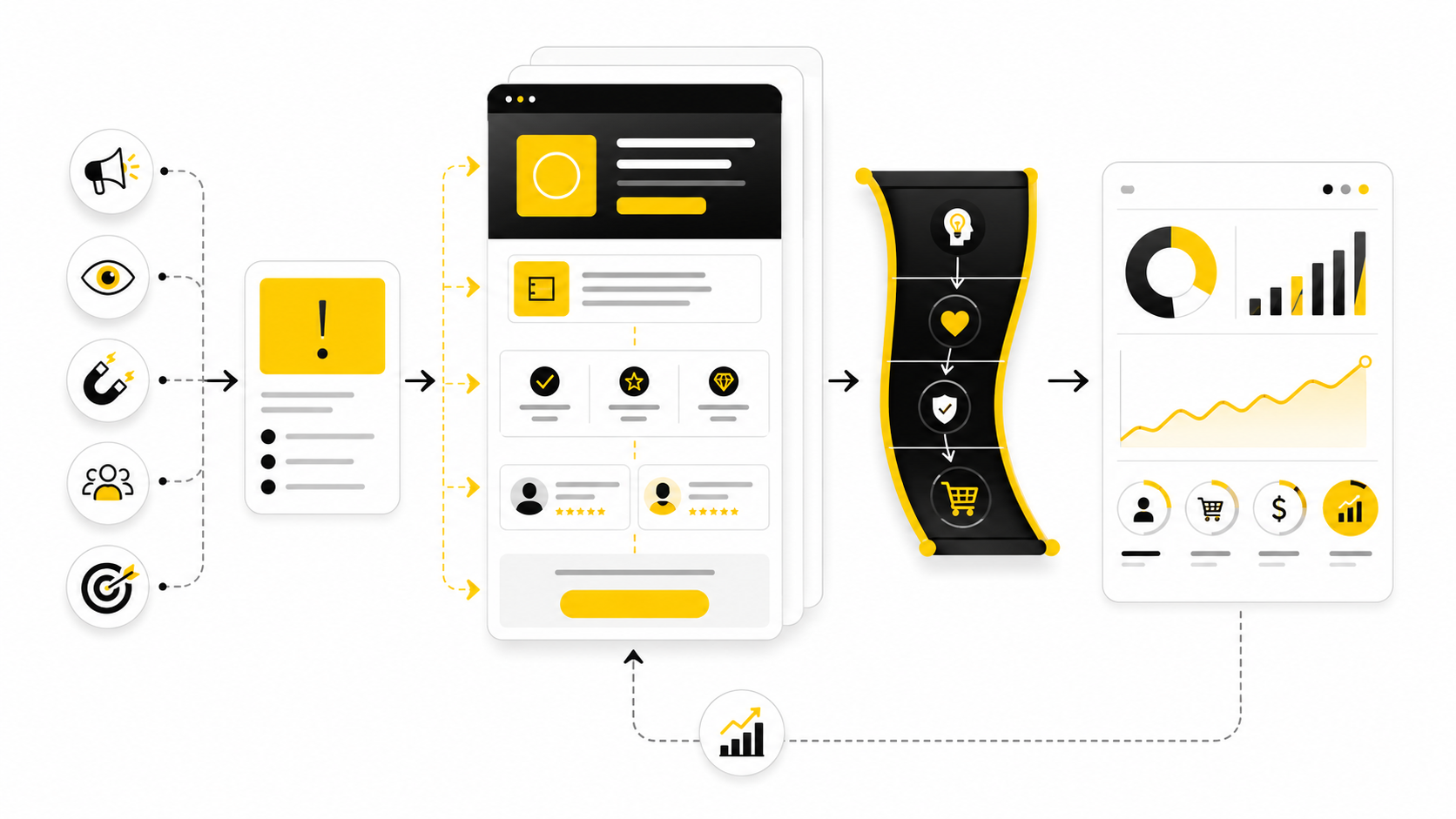
Joseph Sugarman copywriting is not about clever lines, hype, or stuffing a page with pressure tactics. It is about creating a smooth mental path from curiosity to trust, from trust to desire, and from desire to action.
That is why his work still matters. Sugarman built his reputation in direct response, where copy had to do more than sound good. It had to sell products, overcome skepticism, explain unfamiliar offers, and keep strangers reading long enough to make a buying decision.
His best-known ideas are simple on the surface but powerful in practice. The first sentence should make people read the second sentence. The copy should feel like a slippery slide. The product should be explained through benefits, emotion, logic, and credibility. And every element should reduce friction instead of adding more of it.
this guide breaks down Joseph Sugarman copywriting as a practical framework you can actually use. Not as nostalgia. Not as theory. As a way to write clearer landing pages, emails, ads, product descriptions, and sales pages in a world where attention is harder to earn than ever.
The Six-Part Structure of this guide
Part 2 will cover The Slippery Slide Framework. This is where we will look at openings, sentence flow, curiosity, transitions, and the practical mechanics that keep someone reading.
Part 3 will cover The Core Components of Sugarman-Style Copy. This section will break down headlines, leads, product explanations, proof, objections, offers, and calls to action in a way that can be applied to modern sales assets.
Part 4 will cover Psychological Triggers Without Manipulation. Sugarman wrote extensively about triggers, but the useful version is not about tricking people. It is about understanding why people pay attention, trust, desire, hesitate, and finally act.
Part 5 will cover Professional Implementation Across Funnels, Emails, and Landing Pages. This is where the framework becomes operational, especially for marketers building campaigns, automations, product pages, and conversion paths.
Part 6 will cover Common Mistakes, Practical Checklist, and FAQ. This final part will bring everything together with a usable review process and answer the questions readers usually have when they try to apply Joseph Sugarman copywriting to their own work.
Why Joseph Sugarman Copywriting Still Matters
Most copywriting advice today is too fragmented. One person tells you to write punchier headlines. Another tells you to add urgency. Someone else tells you to use a proven template, rewrite it with AI, and ship it before lunch. Some of that can help, but it misses the deeper point.
Sugarman’s approach worked because it treated copy as a complete buying experience. The headline, opening line, product explanation, proof, objections, offer, and close all had to work together. Nothing sat on the page just because it sounded persuasive.
That is the biggest lesson modern marketers can take from Joseph Sugarman copywriting. The goal is not to decorate an offer with stronger language. The goal is to move the reader through a sequence of thoughts that makes the buying decision feel natural.
This matters even more now because buyers are more skeptical. They have seen fake scarcity, exaggerated claims, AI-generated promises, and endless “secret framework” posts. When your copy feels forced, they leave. When it feels clear, specific, and emotionally honest, they keep going.
Sugarman understood that attention is earned one small commitment at a time. A reader does not decide to read a full sales page all at once. They decide to read the next sentence. Then the next paragraph. Then the next claim, the next proof point, and the next explanation.
That small-commitment idea is still one of the most practical principles in direct response. If the opening is confusing, the page dies early. If the story is interesting but the offer is vague, the page loses momentum. If the proof arrives too late, skepticism wins before the copy can do its job.
The Framework Overview
Joseph Sugarman copywriting can be understood as a flow, not a checklist. You are not simply adding a headline, a story, a benefit, and a call to action. You are arranging each element so the reader feels pulled forward.
The framework starts with curiosity. The opening has to create enough interest for the reader to continue, but it cannot be random curiosity. It must be connected to the product, the problem, or the desire that the offer eventually resolves.
Then comes momentum. Sugarman often described copy as a “slippery slide,” where each sentence makes the next sentence easier to read. This is not about writing short sentences only. It is about removing anything that causes the reader to stop, question, feel confused, or mentally back out.
After momentum comes education. Many offers fail because the buyer does not understand why the product matters. Sugarman’s style often slowed down just enough to explain the mechanism, the context, and the reason the product existed. That explanation made the pitch feel more credible.
Then the copy moves into desire. Features are translated into personal outcomes. The product is no longer just an object, service, tool, or program. It becomes a way to solve a real frustration, gain an advantage, avoid a mistake, or experience a better version of everyday life.
Finally, the framework closes with resolution. The reader should not feel pushed into action. They should feel that action is the next reasonable step after everything they have just learned. That is the difference between aggressive copy and persuasive copy.
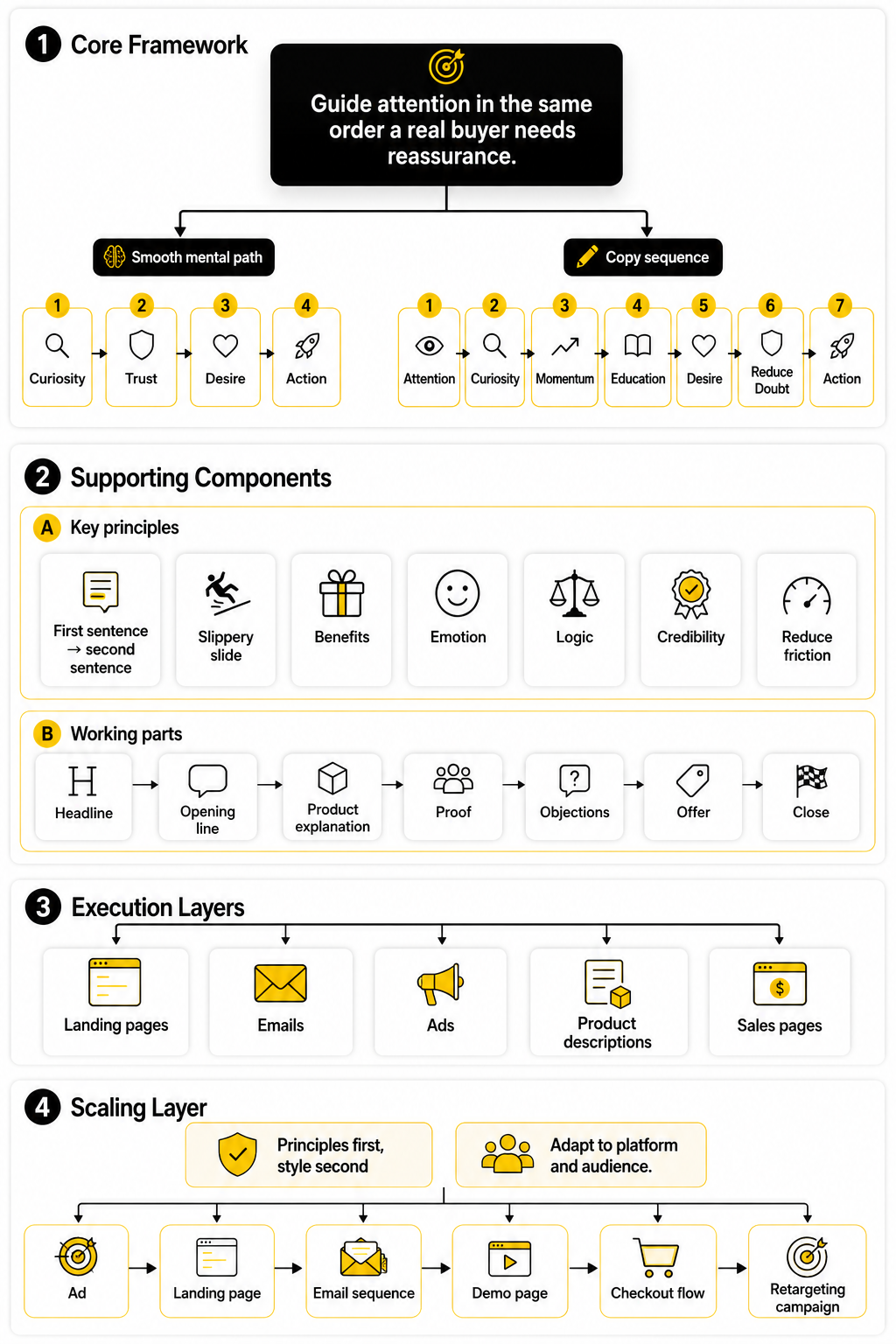
How to Read Sugarman Without Copying Him Blindly
A lot of marketers study legendary copywriters the wrong way. They look for surface patterns. They copy the tone, the long-form structure, the dramatic lead, or the old-school direct response rhythm without asking whether the market, product, channel, and buyer context are different.
That is a mistake. Joseph Sugarman copywriting should be studied for principles first and style second. The principles are durable. The exact execution needs to fit the platform and audience you are writing for now.
For example, a long print ad and a modern landing page do not behave exactly the same way. A print ad had to carry the whole sales argument inside one static asset. A modern funnel might spread that argument across an ad, landing page, email sequence, demo page, checkout flow, and retargeting campaign.
But the underlying job is still familiar. You still need a first line that earns attention. You still need a clear reason to keep reading. You still need proof. You still need to answer objections. You still need to make the offer feel specific, useful, and worth acting on now.
That is why Sugarman’s ideas translate well when used correctly. You are not trying to make your copy sound like it was written decades ago. You are using his thinking to make modern copy more coherent, more persuasive, and more respectful of the reader’s decision process.
The Central Idea Behind Joseph Sugarman Copywriting
The central idea is this: copy should guide attention in the same order a real buyer needs reassurance. That sounds obvious, but most copy does not do it.
Many pages start with claims before context. They push benefits before the reader understands the problem. They ask for action before trust has been built. They add testimonials without connecting them to specific objections. They explain features without showing why those features matter.
Sugarman’s approach is different because it respects sequence. First, get attention. Then create curiosity. Then build momentum. Then educate. Then intensify desire. Then reduce doubt. Then ask for action.
When that sequence works, the copy feels almost effortless to read. The reader is not being dragged through a pitch. They are being led through a series of clear thoughts that make the offer easier to understand and easier to trust.
This is also where the professional value comes in. If you write for clients, brands, SaaS companies, ecommerce stores, agencies, coaches, or service businesses, Sugarman’s framework helps you diagnose weak copy faster. You can see where the flow breaks. You can identify where skepticism enters. You can fix the page at the structural level instead of endlessly polishing sentences.
That is the standard for the rest of this guide. Not “write like Joseph Sugarman” in a nostalgic way. Use Joseph Sugarman copywriting to build sales messages that are clear, sequenced, credible, and hard to stop reading.
The Slippery Slide Framework
The most useful way to understand Joseph Sugarman copywriting is to stop thinking of a sales page as a set of blocks and start thinking of it as movement. The reader arrives with limited attention, limited trust, and plenty of reasons to leave. Your job is to make the next step feel easier than stopping.
That is the idea behind the slippery slide. Sugarman described copy as a sequence where the headline gets someone to read the first sentence, the first sentence gets them to read the second, and the rest of the copy keeps pulling them forward until the offer feels like the natural destination. Modern summaries of The Adweek Copywriting Handbook still highlight this as one of his central ideas because it changes how you judge every sentence.
A weak sentence does not merely sound dull. It creates friction. It gives the reader a tiny chance to pause, doubt, skim, or leave. That is why the slippery slide is not a writing trick. It is a discipline for protecting momentum.
The First Sentence Has One Job
The first sentence does not need to explain everything. It does not need to prove the whole offer. It does not need to carry the full weight of your positioning, product category, brand voice, and conversion strategy.
It has one job: get the second sentence read.
This is where many marketers make the page too heavy too early. They open with a broad claim, a corporate explanation, or a generic pain point the reader has seen a hundred times. The sentence might be technically correct, but it does not create motion.
A Sugarman-style opening is usually lighter. It creates curiosity without making the reader work too hard. It gives the mind a small open loop, a clear direction, or a reason to continue. The reader should feel, “Okay, I’ll read one more line.”
That sounds small, but it is everything. Online, people do not owe you attention. They give it in tiny increments. Joseph Sugarman copywriting works because it respects that reality instead of pretending the reader is already sold.
Curiosity Must Be Connected to the Sale
Curiosity is powerful, but random curiosity is dangerous. A strange opening can make people read a few more lines, but if it does not connect to the product, the problem, or the buying decision, it becomes a gimmick.
The slippery slide is not about tricking people into attention. It is about creating a path where curiosity slowly turns into understanding. The reader keeps going because each sentence reveals something useful, interesting, or emotionally relevant.
This is where the difference between clever copy and selling copy becomes obvious. Clever copy makes the writer look smart. Selling copy makes the reader feel understood. The first earns a nod. The second earns movement.
A strong opening might raise a question, challenge an assumption, point out a hidden cost, or frame the product in an unexpected way. But it still has to lead somewhere. If the curiosity does not eventually support the offer, the copy loses trust.
That is why Joseph Sugarman copywriting is more structured than it looks. The best lines feel natural, but they are not random. They are placed to move attention toward a specific conclusion.
Momentum Comes From Small Commitments
A reader rarely decides to read a full page in one big decision. They make dozens of small decisions. They read a line, then another. They scan a subheading. They pause at a bold phrase. They continue because nothing has given them a good reason to stop.
That is the practical heart of the slippery slide. Every sentence should create a small commitment that leads into the next one. The copy does not need to be breathless, but it does need to feel connected.
This is why transitions matter so much. A strong claim followed by an unrelated paragraph breaks the slide. A benefit followed by a sudden feature dump breaks the slide. A story that does not connect to the buyer’s problem breaks the slide.
Momentum is built through sequence. You introduce one thought, complete it enough to satisfy the reader, then open the next thought naturally. The page feels easy because the reader never has to ask, “Why am I being told this?”
Good copy is often less about adding more persuasion and more about removing unnecessary drag. Cut the sentence that explains too early. Move the proof closer to the claim it supports. Replace vague promises with concrete outcomes. Make each line earn its place.
The Reader Should Never Feel Lost
Confusion is one of the fastest ways to destroy conversion. It does not matter how good the offer is if the reader cannot quickly understand what is being sold, why it matters, and what they are supposed to do next.
Sugarman’s slippery slide depends on clarity. The reader can be curious, surprised, or emotionally engaged, but they should not be lost. There is a big difference.
Lost readers hesitate. Hesitant readers skim. Skimming readers miss the argument. Once the argument is missed, the call to action has to work much harder than it should.
This is especially important for complex offers. Software, coaching, consulting, financial products, health products, and technical services often need explanation before desire can build. If the page rushes into benefits without making the mechanism clear, the reader may like the promise but still not believe it.
A better approach is to explain just enough at each stage. Do not unload everything at once. Give the reader the next piece they need to keep moving. That is how you keep clarity and curiosity working together instead of fighting each other.
Subheadings Keep the Slide Alive
Subheadings are not decorations. They are recovery points. They help scanners re-enter the copy and help committed readers understand the structure of the argument.
In Joseph Sugarman copywriting, the page is designed to keep attention moving, and subheadings play a quiet but important role in that movement. They should not simply label sections. They should create enough interest to pull the reader into the next idea.
A weak subheading says what the section is about in the blandest possible way. A stronger one tells the reader why the section matters. It gives direction, tension, or a useful promise.
For example, “Features” is flat. “Why the Features Matter Before the Buyer Believes the Promise” creates a reason to keep reading. One labels the content. The other continues the sales argument.
This matters even more on landing pages and emails, where readers jump around. A good subheading lets the page stay persuasive even when the reader does not read every sentence in order. It preserves the slide for both readers and scanners.
The Slide Breaks When the Copy Gets Selfish
One of the easiest ways to break momentum is to make the copy too focused on the company. The reader does not care how proud the business is of its product. They care about what changes for them.
That does not mean the brand story has no place. It means the brand story has to serve the buyer’s decision. If the founder’s background explains credibility, use it. If the product development story helps the reader understand the mechanism, use it. If the company milestone does not help the buyer move forward, leave it out.
Selfish copy sounds like this: we built, we believe, we are proud, we offer, we help. Reader-focused copy sounds different. It speaks to the problem, the friction, the desired result, and the decision the reader is trying to make.
This is where Sugarman’s framework stays practical. The copy is not there to admire the business. It is there to make the reader’s next thought easier, clearer, and more persuasive.
When in doubt, ask a simple question: does this sentence help the reader continue toward a buying decision? If not, it probably does not belong on the slide.
How to Apply the Slippery Slide to Modern Copy
The slippery slide works across channels, but the execution changes depending on the asset. A landing page needs a visible structure. An email needs a faster opening. A product description needs clarity before persuasion. A long-form sales page needs rhythm, proof, and pacing.
For a landing page, start by checking the first screen. Does the headline create a clear reason to continue? Does the subheading make the offer easier to understand? Does the first section answer the most obvious question in the reader’s mind?
For an email, look at the opening two lines. They have to create enough interest to pull the reader into the body. If those lines feel generic, the email loses before the offer appears.
For a sales page, map the emotional sequence. The reader should move from recognition to curiosity, from curiosity to belief, from belief to desire, and from desire to action. If the page jumps from problem to price too quickly, the slide is too steep. If it explains endlessly without asking for action, the slide goes nowhere.
For funnel builders, this principle also applies beyond a single page. The ad creates the first slide. The landing page continues it. The checkout page should not interrupt it. The follow-up emails should extend it. Tools like ClickFunnels, systeme.io, or GoHighLevel can help build those paths, but the strategy still comes from the copy.
That is the point many people miss. Software can publish the funnel. It cannot decide the order of belief for you. Joseph Sugarman copywriting gives you a way to think through that order before you build the page.
A Simple Slippery Slide Review
Before moving into the core components of Sugarman-style copy, it helps to review the slide with a practical lens. You do not need to guess whether the copy flows. You can inspect it.
Read the first sentence and ask whether it earns the second. Then read the second and ask whether it earns the third. Keep going until you find the first place your attention drops.
That drop matters. It usually points to one of five problems:
Fixing those issues often improves the copy more than adding another testimonial, stronger urgency, or a bigger promise. Momentum is not created by shouting louder. It is created by making the next thought feel obvious.
That is why the slippery slide is the right place to start. Once the movement is clear, the individual components become much easier to improve. Headlines, leads, proof, objections, offers, and calls to action all work better when they are part of a controlled sequence instead of isolated pieces.
The Core Components of Sugarman-Style Copy
Once the slippery slide is working, the next question is simple: what actually goes into the copy? This is where Joseph Sugarman copywriting becomes more practical. You are no longer thinking only about flow. You are building the pieces that create that flow.
Sugarman’s method was not random creativity. His ads combined attention, environment, credibility, emotion, explanation, proof, and action. The exact wording changed from product to product, but the job of each component stayed consistent.
The easiest mistake is to treat these components as separate blocks. A headline is not just a headline. A lead is not just an opening. A feature is not just information. Each piece has to carry the reader one step closer to belief.
The Headline Creates the Buying Environment
The headline is not there to impress other copywriters. It is there to create the right buying environment in the reader’s mind. That means it has to attract the right person, set the right expectation, and make the next line feel worth reading.
In Joseph Sugarman copywriting, the headline works best when it creates a focused entrance into the offer. It can be curious, direct, surprising, benefit-driven, or problem-driven, but it cannot be disconnected from the sales argument. If the headline gets attention from the wrong people or creates a promise the body copy cannot support, it damages the page before the pitch even starts.
A strong headline should make the reader feel like the page is about something they already care about. Not because the copy shouts at them. Because it meets them at a point of desire, frustration, uncertainty, or opportunity.
The practical test is simple. After reading the headline, does the right buyer have a clear reason to continue? If the answer is no, the headline is not doing its job yet.
The Lead Turns Attention Into Momentum
The lead is where attention becomes movement. The reader has noticed the page, but they are not committed. They are still deciding whether this is worth their time.
This is why the lead should avoid heavy explanations too early. You do not need to unload the product, the company history, the full problem, and every benefit in the first few lines. You need to create a smooth entry into the argument.
A good lead often does one of four things. It identifies a problem the reader recognizes. It introduces a surprising angle. It opens a curiosity loop. Or it frames the offer in a way that makes the reader want the explanation.
The lead should feel easy to enter and hard to abandon. That is the standard. If the reader feels like they are being pushed into a pitch before they understand why they should care, the slide breaks.
The Product Explanation Builds Belief
Many marketers rush through the product explanation because they want to get to benefits faster. That is usually a mistake. Benefits matter, but a benefit without a believable mechanism often feels like a promise floating in the air.
Sugarman understood that readers need to understand what makes the product different. Not in a technical, overloaded way. In a clear, logical, buyer-friendly way that makes the promise feel possible.
This is where you explain the mechanism. What is different about the product? Why does it work? What problem does it solve that other options leave unresolved? What changed that makes this offer useful now?
The explanation should not feel like a manual. It should feel like clarity. When the reader understands the mechanism, they are more willing to believe the outcome.
For modern offers, this matters a lot. If you are selling software, explain the workflow. If you are selling a service, explain the process. If you are selling a course, explain the transformation path. If you are selling an ecommerce product, explain the design decision that makes the product better.
Features Need Translation
A feature is what the product has. A benefit is what the feature does for the buyer. A deeper benefit is why that outcome matters emotionally.
That translation is one of the most important parts of Joseph Sugarman copywriting. The reader does not automatically connect a product detail to a personal result. You have to make that connection for them.
For example, faster setup is not only about saving time. It can mean less frustration, less dependence on a developer, fewer delays before launch, and more confidence that the campaign will actually go live. The feature is small. The result is bigger.
This is especially useful when writing for tools, funnels, automations, and marketing systems. A platform like GoHighLevel is not persuasive merely because it has many features. The copy becomes persuasive when those features are translated into clearer operations, faster follow-up, fewer disconnected tools, and a more controlled customer journey.
The same principle applies to landing page tools like Replo, funnel builders like ClickFunnels, and email platforms like Brevo. The tool is not the point. The buyer’s improved situation is the point.
Proof Reduces the Reader’s Risk
Proof is not something you sprinkle in after the copy is finished. Proof is part of the persuasion structure. It reduces the reader’s sense of risk at the exact moments where doubt would naturally appear.
That timing matters. If you make a strong claim, proof should not be buried far below it. If you describe a mechanism, the copy should support why that mechanism is credible. If you promise a specific result, the reader needs a reason to believe the promise is more than ambition.
Proof can come from demonstrations, product details, customer evidence, third-party validation, credentials, guarantees, transparent limitations, or a clear explanation of the process. Not every offer needs every type. The right proof depends on the buyer’s skepticism.
This is where weak copy often falls apart. It makes a promise, then asks the reader to accept it on trust. Strong copy anticipates the doubt and answers it before it grows.
Joseph Sugarman copywriting is persuasive because it does not rely only on excitement. It gives the reader emotional reasons to want the offer and logical reasons to feel safe moving forward.
Objections Should Be Handled Before They Become Resistance
Every serious buyer has objections. They may not say them out loud, but they are there. Is this worth the money? Will it work for me? Is it too complicated? Can I trust this? What happens if I wait? What makes this different?
Bad copy avoids objections because it wants to stay positive. Good copy handles objections because it wants the sale to feel safe.
The key is to handle objections naturally inside the flow. You do not always need a section called “Objections.” Sometimes a simple paragraph, comparison, proof point, explanation, or guarantee is enough. The goal is to answer the question at the moment the reader is likely to ask it.
This is one of the reasons long-form copy can still work when it is written well. It gives you room to build belief, address hesitation, and make the offer feel less risky. The length is not the advantage. The completeness is.
If the reader reaches the call to action with unanswered objections, the button has to do too much work. That is not a button problem. That is a copy structure problem.
The Offer Must Feel Like a Clear Next Step
The offer is where the copy becomes concrete. Up to this point, the reader has been moving through attention, curiosity, explanation, desire, and proof. Now they need to know exactly what they get and why acting makes sense.
A strong offer is not just a product plus a price. It is the full value package. What is included? What outcome is it designed to create? What makes the timing reasonable? What reduces risk? What should the buyer expect after taking action?
This is where clarity beats cleverness. If the reader has to decode the offer, confidence drops. If the offer feels specific and easy to understand, action becomes easier.
The offer should also match the level of commitment being requested. A free trial, consultation, newsletter signup, software demo, product purchase, and high-ticket application all require different amounts of trust. The copy has to build enough belief for the size of the ask.
Sugarman’s framework helps because it forces you to think about the emotional journey before the conversion point. The offer should not feel like a sudden pitch. It should feel like the obvious next move.
The Call to Action Should Remove Friction
The call to action is not a magic phrase. It cannot rescue a weak argument. But when the copy has done its job, the call to action gives the reader a clean path forward.
A good CTA is specific, direct, and aligned with the offer. It tells the reader what action to take and what will happen next. That second part matters because uncertainty creates friction.
For example, “Get started” can work when the context is obvious. But “Start building your funnel” or “Create your free account” can be stronger when the reader needs clarity. The best CTA depends on what the buyer believes at that moment.
Do not make the CTA carry unnecessary pressure. If the page has built desire and reduced risk, the CTA can be straightforward. Pushy language often appears when the earlier copy failed to do enough work.
In Joseph Sugarman copywriting, the close is not separate from the rest of the page. It is the final step of the same slide.
A Practical Execution Process
At this stage, the framework becomes easier to use as a process. Instead of opening a blank document and trying to sound persuasive, build the copy in the order the buyer needs to be convinced.
Start with the buyer’s current state. What do they want? What are they frustrated by? What do they misunderstand? What are they afraid of wasting money on? Then map the path from that state to the action you want them to take.
The process should look like this:
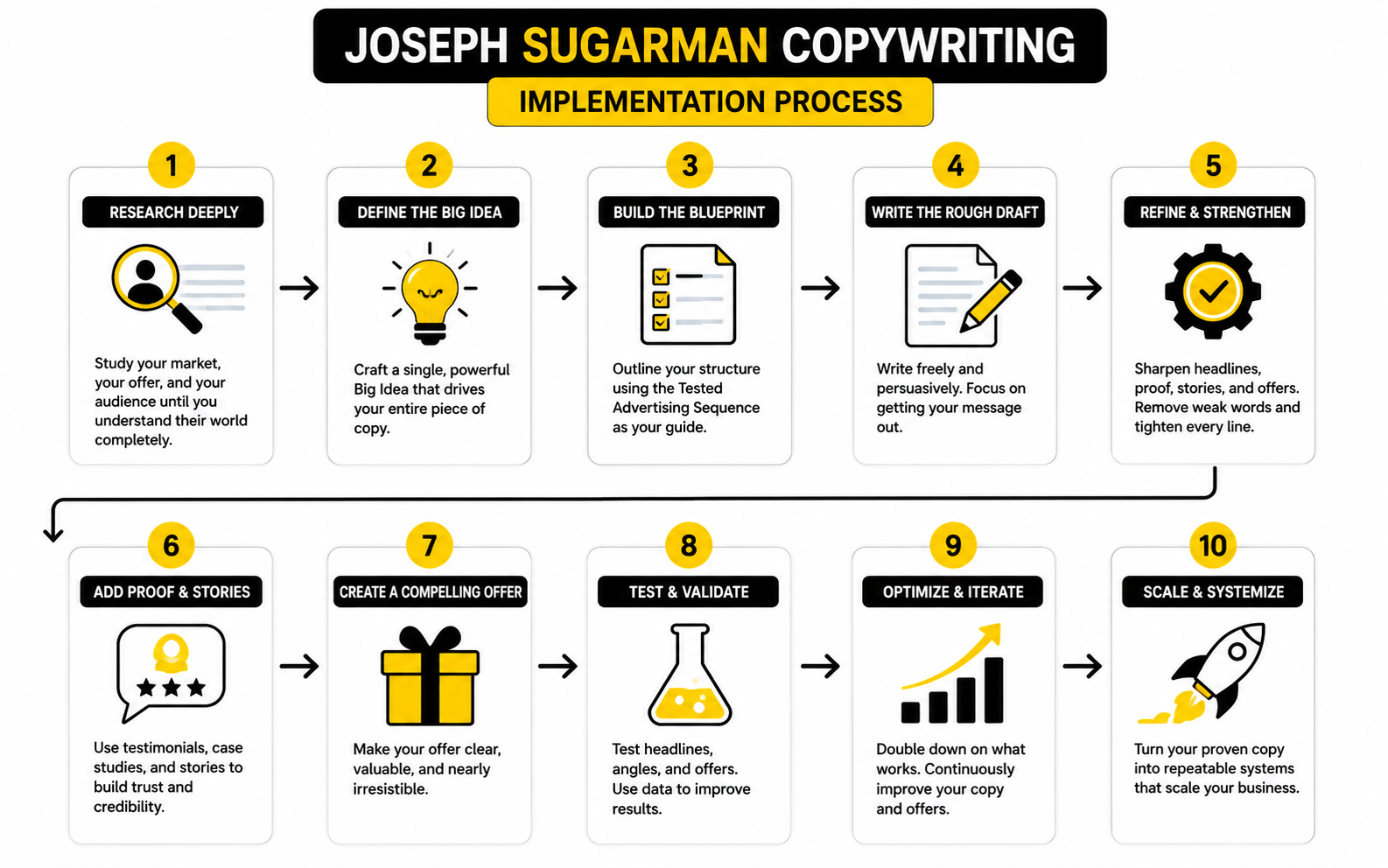
This process works because it separates strategy from sentence polishing. First, you decide what the copy must accomplish. Then you write. Then you edit for rhythm, clarity, and persuasion.
That order matters. If you start with clever lines, you may end up with copy that sounds good but does not sell. If you start with the buyer’s decision process, the final copy has a much better chance of feeling natural and persuasive.
The Component Review Before Publishing
Before you publish a page, email, ad, or funnel step, review each component with brutal honesty. Not harshly. Clearly. The copy either helps the reader move forward or it does not.
Ask whether the headline creates the right buying environment. Ask whether the lead turns attention into momentum. Ask whether the product explanation makes the promise easier to believe. Ask whether every feature has been translated into a result the buyer actually cares about.
Then look at proof and objections. Are you supporting the claims that matter most? Are you answering the doubts a serious buyer would naturally have? Are you making the action feel safer, clearer, and more worthwhile?
Finally, read the copy as one continuous experience. This is where Joseph Sugarman copywriting comes back to the slippery slide. The components are only useful if they work together. A strong headline cannot fix a confusing offer. A good guarantee cannot fix vague benefits. A clever CTA cannot fix weak belief.
When every component has a job and every job supports the next step, the copy starts to feel simple. That simplicity is the result of good structure. It is not an accident.
Statistics and Data
Data is where Joseph Sugarman copywriting stops being a writing preference and becomes a performance system. The slippery slide sounds creative, but it can be measured. If readers leave early, hesitate at the offer, ignore the CTA, or abandon the checkout, the copy is telling you where belief broke.
The mistake is treating analytics like a scoreboard only. Conversion rate goes up, people celebrate. Conversion rate goes down, people panic. That is not enough. Good measurement tells you why the copy is working or failing, not just whether the final number looks good.
This matters because copy is only one part of the buyer journey. A weak offer can make strong copy look bad. A slow page can hide a good message. A confusing checkout can destroy the momentum the sales page created. So the goal is not to worship one metric. The goal is to connect the numbers to the reader’s decision process.
Benchmarks Are Context, Not Targets
Benchmarks can be useful, but they are dangerous when used lazily. If a page converts at 2 percent, that number means different things depending on the offer, channel, traffic quality, price, audience temperature, and level of buyer intent. A cold traffic sales page and a branded search checkout page should not be judged by the same standard.
For ecommerce, broad benchmark sources often place average conversion rates in the low single digits, with Smart Insights noting that 2025 ecommerce conversion comparisons vary heavily by sector, device, and data source in its conversion rate benchmark analysis. That does not mean every page should aim for the same number. It means you need a realistic reference point before deciding whether the copy is the bottleneck.
Cart abandonment is another useful example. Baymard’s long-running checkout research tracks a large body of cart abandonment studies and shows how common abandonment is across ecommerce in its cart abandonment rate research. The action is not “write more aggressive urgency.” The action is to inspect what happens after desire has already been created. If people add to cart and leave, the issue may be price clarity, shipping, trust, checkout friction, payment options, or risk reversal.
Benchmarks should make you ask sharper questions. They should not make you blindly copy someone else’s conversion goal. Joseph Sugarman copywriting is about understanding the buying path, and benchmarks only help when they reveal where that path deserves closer inspection.
The Metrics That Actually Matter
The best measurement system follows the reader’s movement through the copy. You want to know where attention starts, where it fades, where trust increases, where objections appear, and where action breaks down. That gives you a much clearer picture than looking at final conversions alone.
Start with traffic quality. If the wrong audience lands on the page, the copy may look weak even when the message is clear. Look at source, campaign intent, keyword intent, audience segment, device, geography, and returning versus new visitors before judging the page.
Then look at engagement. Scroll depth, time on page, CTA clicks, form starts, video plays, product image interactions, and section-level behavior can show whether the slippery slide is working. If people leave before the product explanation, the opening may not be strong enough. If they read deeply but do not click, the offer or risk reversal may be weak.
Finally, look at conversion behavior. Purchases, bookings, trials, lead submissions, checkout completion, and revenue per visitor matter because they show whether persuasion turned into action. But those numbers only become useful when you connect them back to the earlier signals.
A clean measurement setup should track:
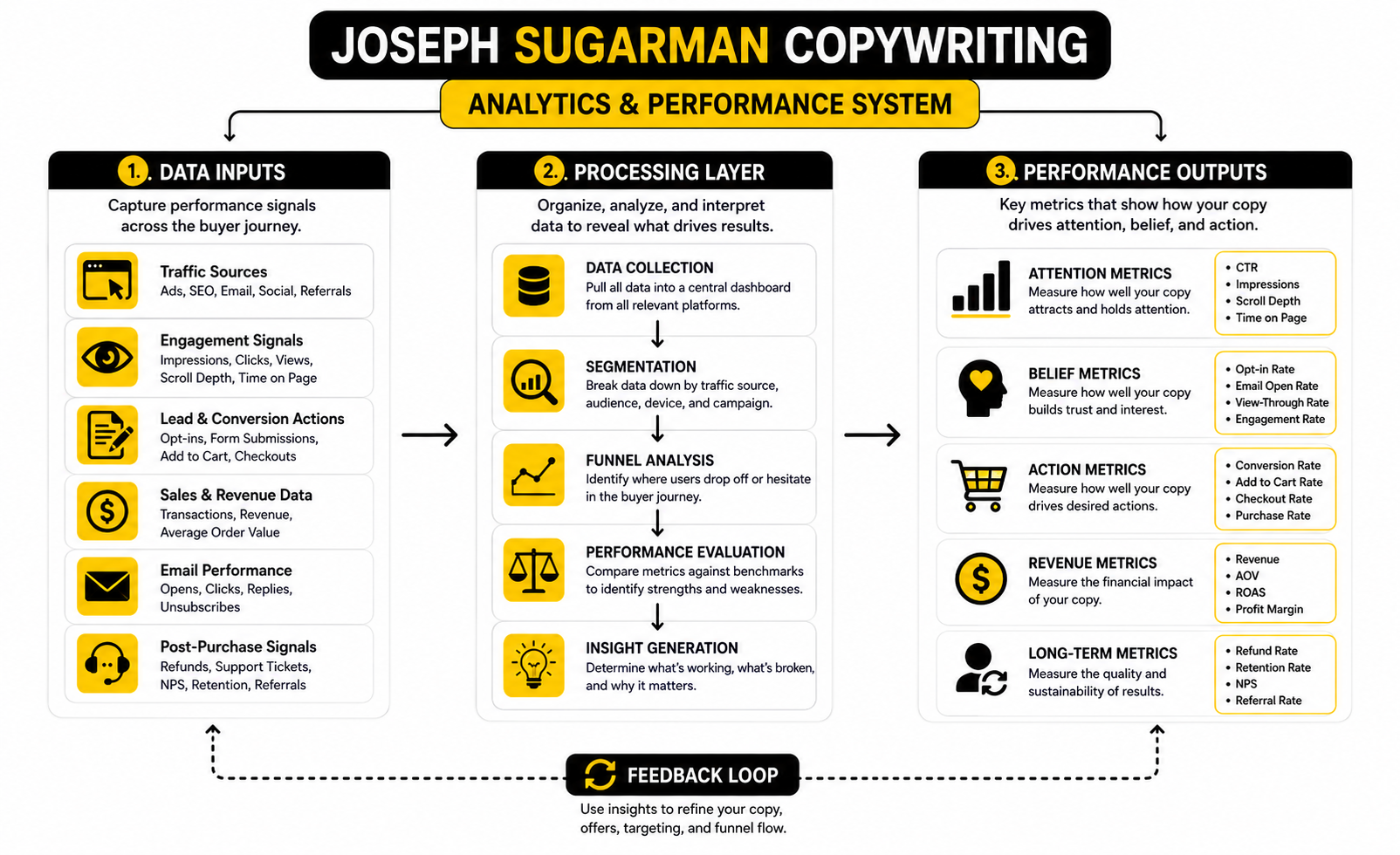
This is the point where analytics becomes practical. You are not collecting numbers to decorate a report. You are building a diagnostic system that shows where the reader stops believing, caring, understanding, or acting.
What Attention Metrics Tell You
Attention metrics show whether the reader is entering the slide. They do not prove the copy is persuasive yet, but they reveal whether the opening has enough pull to keep people moving. This includes bounce rate, engaged sessions, scroll depth, time on page, and early CTA interaction.
A high bounce rate can mean the headline is weak, but it can also mean the traffic source promised something different from the page. That is why you should compare the ad, email, search result, or social post against the landing page. If the message match is poor, readers feel misled before the copy has a chance.
Scroll depth is especially useful for long-form copy. If many readers stop before the proof section, the page may be asking for too much belief too early. If they reach the proof but do not continue to the offer, the proof may be too generic, too late, or disconnected from the claim it supports.
Time on page needs careful interpretation. More time is not always better. A reader may spend more time because the copy is engaging, or because the page is confusing. Pair time data with scroll behavior and click behavior before making decisions.
What Click Metrics Tell You
Click metrics show where interest becomes intent. A CTA click is not a sale, but it is a meaningful signal. It tells you the reader found enough value, trust, or curiosity to take the next step.
Low CTA clicks usually point to one of three problems. The reader does not understand the offer. The reader does not want the offer badly enough. Or the reader does not trust the next step. Each problem requires a different fix.
If the offer is unclear, improve the section that explains what the buyer gets. If desire is weak, sharpen the benefit translation and make the outcome more concrete. If trust is weak, add proof, risk reversal, specificity, or expectation-setting near the CTA.
Do not assume a new button color will solve a belief problem. It might help visibility, but it will not fix unclear positioning, weak proof, or vague value. Sugarman-style copy treats the CTA as the end of a persuasive sequence, not a design element floating on its own.
What Conversion Metrics Tell You
Conversion metrics show whether the copy and offer created enough confidence for action. This is where purchases, demo requests, bookings, signups, trials, and form completions matter. But again, the raw number is not the whole story.
A low conversion rate with low scroll depth suggests an attention or opening problem. A low conversion rate with strong scroll depth but weak CTA clicks suggests an offer, proof, or desire problem. A low conversion rate with strong CTA clicks but weak checkout or form completion suggests friction after the copy has already done some of its job.
This distinction is important. Too many marketers rewrite the whole page when only one section needs attention. Others change the offer when the real issue is that the reader never understood the mechanism. Good analytics prevents random changes.
For funnels, this becomes even more important. A tool like ClickFunnels, systeme.io, or GoHighLevel can help you track funnel steps, but the interpretation still comes from strategy. The platform can show where people drop. It cannot automatically tell you why they stopped believing.
Email Metrics Show a Different Part of the Slide
Email is a useful place to apply Joseph Sugarman copywriting because the slide begins before the main copy is even read. The sender name, subject line, preview text, first sentence, body, link placement, and landing page all work together. A break in any one of those pieces can weaken the whole sequence.
Open rate tells you whether the subject line and sender relationship earned enough attention. Click rate tells you whether the email body created enough interest to move someone forward. Reply rate can show whether the message felt personal, relevant, and worth engaging with.
Modern email benchmark reports vary by list type, industry, region, and methodology. MailerLite’s 2025 benchmarks draw on millions of campaigns and emphasize median performance across industries in its email marketing benchmark report. Brevo also highlights how widely email performance changes by industry and channel mix in its 2025 email benchmark coverage. The practical lesson is not to chase a universal open rate. The lesson is to compare your campaigns against your own baseline and the intent of your audience.
If opens are strong but clicks are weak, the subject line may be doing its job while the body fails to build desire. If clicks are strong but sales are weak, the landing page may not continue the same promise. If unsubscribes rise after aggressive subject lines, attention may be coming at the cost of trust.
The Right Way to Test Sugarman-Style Copy
Testing should not be random. You are not changing headlines, buttons, layouts, bullets, and offers all at once just to see what happens. That creates noise, not learning.
Start with a hypothesis tied to the reader’s decision process. For example, “Readers are leaving before the mechanism is clear,” or “CTA clicks are low because the offer feels vague,” or “Checkout starts are strong but completions are weak because risk is not addressed near the price.” Now the test has a purpose.
Then change one meaningful variable. Rewrite the lead to increase curiosity. Move proof closer to the claim. Clarify the mechanism. Strengthen the offer stack. Add a guarantee or expectation-setting paragraph. The point is to learn which part of the buying sequence was weak.
This is much more useful than testing tiny surface changes too early. Button text matters, but not as much as belief. Layout matters, but not as much as clarity. Urgency matters, but not as much as trust.
A practical testing sequence looks like this:
What the Data Should Make You Do
The value of analytics is action. If a number does not change what you do next, it is probably not a useful number for that moment. This is where many reports become bloated and useless.
If attention is weak, improve the headline, lead, message match, and first-screen clarity. If engagement is strong but clicks are weak, improve the offer, proof, and CTA context. If clicks are strong but conversions are weak, inspect the form, checkout, pricing explanation, guarantee, and post-click experience.
If email opens are weak, test the subject line, sender relationship, list segment, and timing. If clicks are weak, improve the body copy and make the next step feel more valuable. If replies are weak, reduce the broadcast feeling and make the message more specific to the reader’s situation.
That is the practical mindset. Each metric should point to a copy decision, a funnel decision, or an offer decision. Otherwise, you are just collecting dashboards.
The Danger of Optimizing the Wrong Thing
Not every lift is a real win. A curiosity-heavy headline may increase clicks while lowering conversions because it attracts the wrong readers. A stronger discount may increase purchases while lowering profit quality. A more aggressive urgency angle may increase short-term action while hurting trust.
This is why Joseph Sugarman copywriting should be measured by buyer movement, not isolated excitement. The copy should attract the right people, build the right belief, and lead to the right action. More attention is only useful when it creates better customers.
The same applies to AI-written copy, templates, and funnel hacks. They can increase output, but they can also create messaging that looks persuasive while saying very little. If the numbers show shallow engagement, weak CTA intent, or poor downstream conversion, the copy is probably creating attention without conviction.
Good measurement protects you from that. It keeps the focus on the reader’s actual behavior instead of the writer’s opinion.
Turning Data Back Into Better Copy
The final step is to turn the data back into language. Analytics tells you where the problem is. Copy fixes the problem by changing what the reader sees, understands, feels, and believes.
If readers leave early, write a sharper opening. If they do not understand the product, clarify the mechanism. If they hesitate at the offer, strengthen the value explanation. If they abandon checkout, reduce uncertainty and friction. If follow-up emails do not get clicks, rebuild the bridge between the original promise and the next step.
This is the loop that makes Sugarman’s framework modern. Write the slide. Measure where it breaks. Improve the section that caused the break. Then measure again.
That is how copy becomes a system instead of a guess.
Professional Implementation Across Funnels, Emails, and Landing Pages
Advanced Joseph Sugarman copywriting is not about making one page sound better. It is about keeping the buying argument consistent across every touchpoint. The ad, email, landing page, checkout page, follow-up sequence, demo script, and retargeting message should all feel like parts of the same conversation.
That is where many campaigns break. The ad creates one promise, the landing page explains another, the checkout page introduces friction, and the follow-up emails restart the argument from zero. The buyer does not experience that as a funnel. They experience it as confusion.
A professional implementation keeps the slide alive across the whole journey. Every asset has a job, and every job supports the next decision. That is the difference between writing copy and building a conversion system.
The Funnel Should Preserve the Original Promise
The first promise matters because it frames everything that follows. If someone clicks an ad because it promises a faster way to launch a campaign, the landing page should not open with a generic company overview. If an email promises a simpler way to follow up with leads, the page should not lead with every feature in the platform.
Message match is not a small detail. It is the bridge between attention and trust. When the buyer sees the same core idea carried from one step to the next, they feel oriented. When the message changes too much, they start asking whether they landed in the right place.
This is especially important when building funnels with tools like ClickFunnels, systeme.io, or GoHighLevel. These platforms make it easy to connect pages, forms, automations, and offers. But the technology only connects the steps mechanically. The copy has to connect them psychologically.
The practical rule is simple. Before publishing, read the ad, landing page, checkout page, and first follow-up email in order. If the promise drifts, fix the sequence before testing anything else.
Strategy Comes Before Templates
Templates can speed up execution, but they cannot replace thinking. A template tells you where a headline, proof section, offer stack, and CTA might go. It does not tell you what the buyer needs to believe before they act.
This is where Sugarman’s framework protects you from lazy funnel building. You are not filling boxes. You are designing belief. The structure should follow the buyer’s hesitation, not the template’s default layout.
For a simple lead magnet, the copy may only need a direct promise, a reason to trust it, and a low-friction opt-in. For a high-ticket service, the copy may need a deeper explanation, stronger credibility, qualification, risk reduction, and a more carefully framed next step. The asset changes because the decision changes.
The danger is using the same structure for every offer. A low-ticket impulse buy, SaaS trial, agency consultation, and coaching application are not the same persuasion problem. Joseph Sugarman copywriting gives you principles, but you still have to choose the right depth for the sale.
The Risk of Overwriting
One advanced problem is overwriting. This happens when the copywriter knows the framework, understands persuasion, and then tries to use every technique at once. The result is copy that feels heavy, theatrical, or strangely exhausting.
More persuasion is not always better. Sometimes the cleanest argument wins. The reader may only need one clear mechanism, one strong proof point, one meaningful objection handled, and one simple call to action.
Overwriting often shows up as repeated benefits, too many analogies, excessive urgency, unnecessary backstory, or dramatic claims that the offer cannot support. It may feel energetic to the writer, but it creates drag for the reader. The slide becomes crowded.
The fix is restraint. Keep the strongest idea. Cut the weaker echo. Let the product, proof, and offer breathe. Professional copy feels confident enough not to oversell.
The Risk of Underexplaining
The opposite problem is underexplaining. This happens when the copy is short, clean, and visually attractive, but the buyer does not have enough information to believe the offer. It looks modern, but it does not persuade.
Minimal copy can work when the audience already understands the category, trusts the brand, and knows what they want. It fails when the product is new, the promise is unfamiliar, the price is high, or the buyer has serious objections. In those cases, brevity can create doubt.
This is why “people do not read anymore” is a dangerous half-truth. People avoid boring, irrelevant, or confusing copy. But serious buyers will read when the information helps them make a better decision.
Baymard’s checkout and ecommerce research repeatedly shows how much friction can come from missing, unclear, or poorly timed information, especially around product details, forms, shipping, and checkout expectations in its checkout usability research. The copy lesson is direct: do not make buyers guess when they are close to action.
Good implementation finds the right level of explanation. Not short for the sake of short. Not long for the sake of long. Complete enough for the decision.
Scaling Sugarman-Style Copy Across a Team
Scaling copy is hard because persuasion is easy to dilute. One strong writer may understand the buyer, the mechanism, the offer, and the brand voice. Then the campaign expands, more people touch the assets, and the message becomes inconsistent.
The solution is not to create a huge style guide nobody reads. The solution is to document the buying argument. What is the core promise? What is the mechanism? What proof matters most? What objections must be handled? What words should be used consistently? What claims are off-limits?
A useful copy system should include:
This gives writers, designers, media buyers, email marketers, and sales teams the same foundation. The output can vary by channel, but the argument stays stable. That is how Joseph Sugarman copywriting scales without becoming a mess.
AI Can Assist, But It Cannot Own the Argument
AI can help with drafts, variations, summaries, outlines, rewrites, and research organization. Used well, it speeds up production. Used badly, it creates confident-sounding copy with weak thinking underneath.
The strategic danger is that AI often produces language that looks like marketing but lacks a real buyer argument. It may use benefits, urgency, social proof, and emotional phrasing, but still fail to answer the questions that drive the sale. That is not a style problem. It is a strategy problem.
Recent marketing discussions around AI keep coming back to the same point: AI can support output, but human judgment still has to protect positioning, originality, and trust. HubSpot’s 2025 AI marketing coverage frames AI as a productivity and content support layer rather than a replacement for strategic judgment in its AI content marketing analysis. NielsenIQ’s research on AI-generated ads also warns that poorly executed AI content can create discomfort and damage brand equity in its consumer research on AI-generated ads.
That is the right lens. Use AI to generate options. Do not let it decide what the buyer needs to believe. The persuasive sequence still needs a human operator who understands the market, offer, audience, and risk.
Compliance Is Part of Professional Copy
Direct response copy can be bold, but it cannot be reckless. The more persuasive the copy becomes, the more important accuracy becomes. Claims, testimonials, guarantees, comparisons, scarcity, earnings statements, health implications, and endorsements all need discipline.
The FTC’s endorsement guidance makes it clear that testimonials and endorsements can be misleading when they do not reflect typical expectations or when material connections are not properly disclosed in its advertising endorsement guidance. The eCFR version of the endorsement guides also ties the guidance to Section 5 of the FTC Act, which deals with deceptive advertising, in 16 CFR Part 255.
This matters for anyone applying Joseph Sugarman copywriting today. Persuasion does not excuse vague proof, inflated claims, fake urgency, or cherry-picked testimonials. If anything, strong copy should be more careful because it has more influence.
A professional copy process should include a claim review before launch. Highlight every measurable claim, comparison, testimonial, guarantee, and promise. Then confirm what evidence supports it. If the claim cannot be supported, rewrite it.
Brand Trust Is a Long-Term Conversion Asset
Sugarman-style copy is often discussed in terms of immediate response, but the deeper skill is trust-building. A sale today should not create regret tomorrow. A conversion lift is not impressive if it increases refunds, complaints, unsubscribes, or low-quality customers.
This is where strategic tradeoffs matter. You can make a headline more aggressive and get more clicks. You can make scarcity more intense and get more sales. You can make the promise bigger and get more opt-ins. But if the buyer experience does not match the expectation, the campaign is borrowing trust instead of building it.
Nielsen’s 2024 marketing report highlights the importance of full-funnel thinking and brand building, with its analysis noting that long-term impact can significantly change how media ROI is understood in the annual marketing report. For copywriters, the implication is practical. Do not judge the message only by the first conversion.
Better signals include refund rate, activation rate, show-up rate, sales call quality, repeat purchase, retention, customer satisfaction, and referral behavior. If those numbers weaken after a copy change, the copy may be attracting the wrong belief.
Advanced Segmentation Changes the Slide
Not every reader needs the same slippery slide. A cold visitor may need more context. A warm subscriber may need more specificity. A returning buyer may need a faster path to the offer. A skeptical enterprise buyer may need more proof, risk reduction, and implementation detail.
That means segmentation is not only a targeting decision. It is a copy decision. Different levels of awareness need different openings, objections, proof, and CTAs.
Cold audiences usually need the problem framed clearly before the offer is introduced. Warm audiences may already understand the problem and need a sharper reason to choose this solution now. Hot audiences may need less education and more clarity around pricing, terms, guarantee, and next step.
This is why one page often cannot do every job equally well. You may need separate landing pages, email paths, or sales angles for different segments. Tools like ManyChat, Brevo, and Moosend can help segment and automate follow-up, but the message logic still has to be designed carefully.
Segmentation should make the copy more relevant, not more complicated. The buyer should feel like the message meets them where they are.
When Sugarman’s Style Is the Wrong Fit
Joseph Sugarman copywriting is powerful, but it is not a license to use long-form direct response everywhere. Some situations require restraint. Some buyers want speed. Some offers need clarity more than persuasion. Some brands cannot support a highly emotional sales style without sounding off-brand.
A technical documentation page should not read like a dramatic sales letter. A checkout page should not restart the entire pitch. A pricing page should not hide basic details behind cleverness. A product comparison should not exaggerate differences just to create urgency.
The framework is useful because it helps you understand attention, belief, and action. But the execution should match the context. Sometimes the best application is a shorter lead, clearer proof, cleaner CTA, or better objection handling. Not a full long-form page.
Expert-level copywriting means knowing when to use pressure and when to remove it. It means knowing when to explain and when to simplify. It means understanding that the reader’s decision matters more than the writer’s favorite technique.
The Strategic Standard Before the Final Review
By this point, the article has moved from framework to components, from components to measurement, and from measurement to professional implementation. The standard is higher now. You are not just asking, “Does this copy sound good?” You are asking whether it creates the right belief in the right person at the right moment.
That is the real value of Joseph Sugarman copywriting. It gives you a disciplined way to think about persuasion without reducing the reader to a click. It helps you build momentum, but it also forces you to respect clarity, proof, context, and trust.
Before the final checklist, the strategic question is simple. Does the copy make the buying decision easier, safer, and more desirable without distorting the truth?
If the answer is yes, you are close. If the answer is no, the copy does not need more tricks. It needs better thinking.
Common Mistakes, Practical Checklist, and FAQ
By this stage, Joseph Sugarman copywriting should feel less like a collection of old direct response ideas and more like a complete operating system. You start with the reader’s attention. You build momentum. You explain the mechanism. You translate features into outcomes. You support the claims. You remove hesitation. You measure where the slide breaks and improve it.
That is the whole point. Copy is not just language. It is the structured management of attention, belief, desire, and action.
The final step is to make the framework easier to use without overcomplicating it. You do not need to become a vintage direct response scholar to write better pages, emails, or funnels. You need a repeatable way to spot weak thinking before it becomes weak copy.
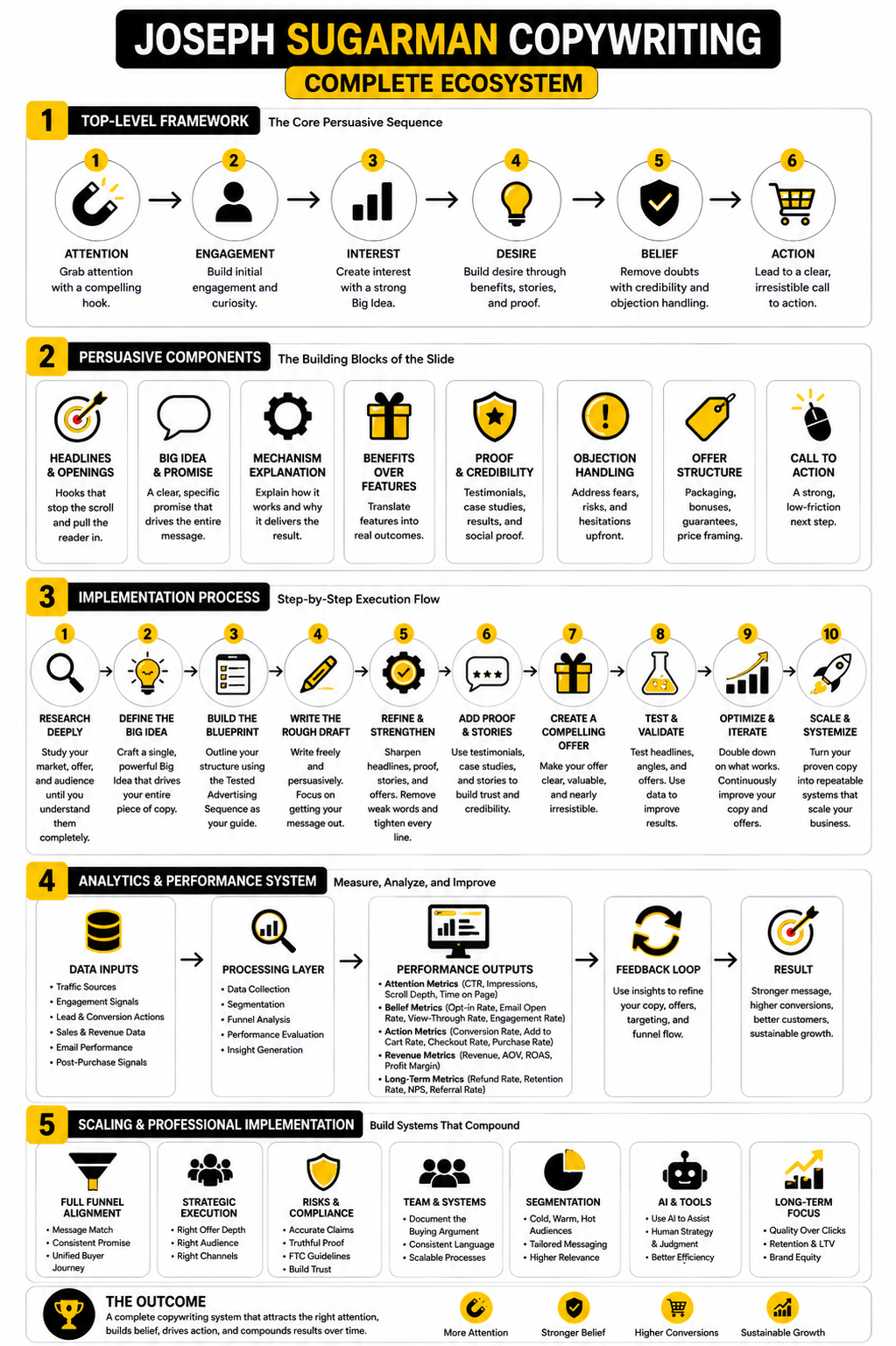
The Practical Sugarman Copywriting Checklist
Use this checklist before publishing any important sales asset. It works for landing pages, emails, funnel pages, product pages, webinar registrations, lead magnets, sales scripts, and offer pages. The wording can change by channel, but the decision sequence stays the same.
Mistakes That Weaken Sugarman-Style Copy
The first mistake is confusing curiosity with confusion. Curiosity makes the reader want to know more. Confusion makes the reader work too hard. If the opening is interesting but the reader cannot tell where the copy is going, the page loses trust.
The second mistake is making the copy too company-centered. The reader does not care how excited the company is about its product until they understand why the product matters to them. Brand credibility has a place, but it should support the buyer’s decision instead of interrupting it.
The third mistake is pushing urgency before belief. Urgency can help when the reader already wants the offer and understands the reason to act. Used too early, it feels like pressure covering up weak persuasion.
The fourth mistake is using proof too vaguely. A testimonial, logo, review, or result only helps when it supports a specific concern. If the proof does not answer a real doubt, it becomes decoration.
The fifth mistake is optimizing for clicks instead of customers. Strong copy should attract the right buyers, not just more attention. If the copy increases clicks but lowers trust, retention, show-up rate, or purchase quality, it is not really winning.
How to Keep the Framework Simple
The danger with any copywriting framework is that it can become too heavy. You start with a useful idea, then turn it into a 47-step writing ritual that makes every page feel impossible to finish. That is not the goal.
Keep Joseph Sugarman copywriting simple by focusing on the reader’s next belief. What does the reader need to believe before they can comfortably move forward? Then write the section that creates that belief.
At the beginning, they may need to believe the page is relevant. In the middle, they may need to believe the promise is possible. Near the offer, they may need to believe the risk is reasonable. At the CTA, they may need to believe the next step is clear and safe.
That is the whole game. One belief at a time. One sentence into the next. One decision made easier.
What is Joseph Sugarman copywriting?
Joseph Sugarman copywriting is a direct response approach built around attention, flow, product explanation, psychological triggers, proof, and action. It is best known for the “slippery slide” idea, where every sentence is designed to make the reader continue to the next one. The goal is not to sound clever. The goal is to guide the reader through a persuasive sequence that makes the buying decision feel natural.
Why is the slippery slide so important?
The slippery slide is important because readers do not commit to a full sales message immediately. They decide sentence by sentence whether to keep going. If the copy creates friction, confusion, or boredom, the reader leaves before the offer has a chance. A strong slide protects momentum from the headline to the CTA.
Is Joseph Sugarman copywriting still useful today?
Yes, because the principles are still relevant even when the channels have changed. People still need attention, clarity, trust, desire, proof, and a low-friction next step before they buy. The style may need to be modernized, but the underlying decision process still applies to landing pages, emails, ads, ecommerce pages, SaaS funnels, and sales pages.
Does Sugarman-style copy always need to be long-form?
No. Long-form copy is useful when the buyer needs more information, trust, proof, or objection handling before taking action. Short copy can work when the offer is simple, the audience is warm, the brand is trusted, or the decision is low-risk. The right length is the length needed to help the reader make the decision confidently.
What is the biggest mistake beginners make with this framework?
The biggest mistake is copying the style without understanding the structure. Beginners often try to write dramatic openings, big promises, and emotional closes without building a believable path between them. Joseph Sugarman copywriting works when the sequence is clear. Attention must lead to understanding, understanding must lead to belief, and belief must lead to action.
How do I know if my copy has a strong slippery slide?
Read the copy out loud from the first sentence to the final CTA. Notice the first place your attention drops, the first sentence that feels unnecessary, or the first section that makes you wonder why it is there. That is usually where the slide breaks. Strong copy feels connected, clear, and easy to continue reading.
How should I use psychological triggers without manipulating people?
Use psychological triggers to clarify value, reduce uncertainty, and help buyers make informed decisions. Do not use them to hide weak proof, fake urgency, or exaggerate outcomes. The ethical version of Joseph Sugarman copywriting respects the reader. It makes the truth more persuasive instead of making the offer sound better than it is.
What metrics should I track when testing this style of copy?
Track the metrics that show where the reader stops moving. For landing pages, look at scroll depth, CTA clicks, form starts, form completions, checkout starts, purchases, and revenue per visitor. For email, look at opens, clicks, replies, unsubscribes, and downstream conversions. The goal is not to collect random numbers. The goal is to identify where attention, belief, or action breaks.
Can AI write Sugarman-style copy?
AI can help draft, rewrite, summarize, generate variations, and speed up production. But it should not own the strategy. The persuasive argument still needs human judgment because the copy must understand the buyer, the offer, the market, the proof, and the risks. AI can create language. A skilled marketer still needs to decide what the reader must believe.
How do I apply this to landing pages?
Start with message match. Make sure the headline continues the promise from the ad, email, or search intent that brought the reader there. Then build the page around the buyer’s decision sequence: problem, promise, mechanism, benefits, proof, objections, offer, and CTA. Do not simply add sections because a template includes them. Add sections because the reader needs them.
How do I apply this to email marketing?
In email, the slippery slide starts with the sender name, subject line, and preview text. The first line must pull the reader into the body, and the body must make the click feel like a useful next step. Do not treat the email as a mini sales page every time. Sometimes its job is to create curiosity, deliver value, and move the reader to the next asset.
How do I apply this to ecommerce product pages?
For ecommerce, focus on clarity, desire, and risk reduction. Explain what the product is, why it is different, what the buyer experiences after using it, and what might make them hesitate. Product images, specifications, reviews, shipping information, guarantees, and FAQs all support the copy. The product page should not just describe the item. It should help the buyer feel ready to choose it.
How do I apply this to SaaS or software offers?
For SaaS, the mechanism matters. Buyers need to understand what the software does, how it fits into their workflow, what problem it removes, and why it is better than their current process. Strong SaaS copy translates features into operational outcomes like speed, control, visibility, automation, cost reduction, or better follow-up. The CTA should match the buyer’s readiness, whether that is a trial, demo, consultation, or product tour.
What is the difference between a feature and a benefit?
A feature is part of the product. A benefit is what that feature does for the buyer. A deeper benefit explains why that result matters in the buyer’s real life or business. For example, automation is a feature. Saving time is a benefit. Feeling confident that follow-up happens without manual chasing is a deeper benefit.
How often should I test my copy?
Test when you have enough traffic or meaningful data to learn something useful. Do not test just because you are bored with the page. Start with the biggest drop-off point, create a clear hypothesis, change one meaningful element, and measure whether the change improves the business outcome. Random testing creates noise. Strategic testing creates learning.
Should I use urgency in Sugarman-style copy?
Use urgency only when it is truthful and relevant. Real deadlines, limited capacity, expiring bonuses, seasonal timing, or practical reasons to act now can help buyers make a decision. Fake urgency damages trust. If the offer is not compelling without pressure, fix the offer and the belief sequence first.
How do I avoid sounding too salesy?
Sound less salesy by being clearer, more specific, and more honest. Remove exaggerated claims. Replace generic hype with concrete outcomes. Explain the mechanism. Address real objections. Strong copy does not need to shout when the argument is solid.
What should I do if my page gets attention but no sales?
Look for a belief gap. The opening may be interesting, but the product explanation may be weak. The benefits may sound appealing, but the proof may not be strong enough. The offer may be attractive, but the next step may feel risky or unclear. Attention without action usually means the copy created interest but did not create enough confidence.
What should I do if people click the CTA but do not finish?
Inspect the post-click experience. The checkout, form, calendar, pricing page, or application step may be adding friction. Clarify expectations, reduce unnecessary fields, explain costs earlier, strengthen guarantees, and make the next step feel safe. If the CTA gets clicks, some desire exists. The issue may be uncertainty after the click.
What is the fastest way to improve my copy today?
Find the first place the reader is likely to hesitate and fix that section. It might be a vague headline, an unsupported claim, a confusing offer, missing proof, or a weak CTA. Do not rewrite everything by default. Improve the part of the buying sequence that is most likely breaking momentum.
Final Thoughts
Joseph Sugarman copywriting lasts because it is built on reader behavior, not trends. The tools change. The platforms change. The speed of production changes. But people still need a reason to pay attention, a reason to believe, and a reason to act.
The framework is practical because it forces better thinking. You cannot hide behind clever words when the sequence is broken. You cannot rely on urgency when the promise is unclear. You cannot expect the CTA to perform when the copy has not built enough trust.
Use the framework with discipline. Write the slide. Support the claims. Respect the reader. Measure the breaks. Improve the system. That is how copy becomes more than words on a page.
Build a stronger local presence with BAAM AI
Turn your website, Google profile, social channels, and AI visibility into one growth engine
Most businesses do not need more random marketing activity. They need a consistent presence system that helps the right people find them, trust them, and take action. BAAM AI brings strategy, local SEO, website updates, Google Maps visibility, social content, AI-search readiness, media production, and reporting into one practical monthly engine.
If you want your marketing to keep working after the campaign ends, start with a free BAAM AI presence audit. See how your business shows up today and where the fastest visibility wins are at BAAM AI.