
BAAM AI Blog
Jonathan Mildenhall: The Brand Builder’s Guide To Culture, Creativity, And Commercial Growth
Jonathan Mildenhall is not interesting because he has held big marketing titles. Plenty of people have done that. He is interesting because his work keeps returning to the same hard question: how do you build a brand...

Jonathan Mildenhall is not interesting because he has held big marketing titles. Plenty of people have done that. He is interesting because his work keeps returning to the same hard question: how do you build a brand that earns cultural relevance, drives business growth, and still feels human?
That question followed him through Coca-Cola, where he helped push the company from traditional advertising toward content-led brand building. It followed him into Airbnb, where he became the company’s first chief marketing officer and helped turn “belonging” into a global brand idea. It followed him into TwentyFirstCenturyBrand, the consultancy he co-founded to help high-growth companies sharpen their purpose, positioning, and cultural role. And it followed him again when Rocket Companies named him its first group chief marketing officer in 2024.
The practical lesson is bigger than one marketer’s résumé. Jonathan Mildenhall’s career shows what modern brand leadership actually requires: creative taste, commercial discipline, cultural timing, and the courage to make the company’s values visible before the market forces the issue.
this guide breaks down the Jonathan Mildenhall playbook in six parts. The goal is not to worship a famous CMO. The goal is to understand what brand builders, founders, operators, and marketing teams can actually learn from his approach.
Why Jonathan Mildenhall Matters Now
Jonathan Mildenhall matters because brand building has become harder, not easier. Distribution is fragmented, attention is expensive, and most companies are competing in categories where functional advantages are copied quickly. In that kind of market, the brand cannot just be a wrapper around the product. It has to become part of the product’s economic engine.
That is why his career is useful to study. At Coca-Cola, he worked inside one of the world’s most iconic consumer brands and helped articulate a shift from campaign thinking to continuous storytelling. Harvard Business School later described Coca-Cola’s creative transformation as a case for understanding how the company’s Content 2020 principles worked and how they contributed to one of the company’s most recognized marketing eras.
At Airbnb, the challenge was different. The company was not just selling rooms or travel inventory. It had to build trust between strangers, explain a new behavior, and defend a brand promise that could be tested every time a guest arrived at a host’s door. Mildenhall’s work there showed how a company can use brand strategy to make an unfamiliar marketplace feel emotionally simple.
His move to Rocket Companies is also revealing. Rocket did not hire him merely to make ads. The company said his role was to create a unified voice across the Rocket businesses, with marketing and communications teams reporting directly to him. That is the modern CMO brief in plain English: align the story, sharpen the promise, and make the brand easier to understand across every customer touchpoint.
The Core Idea Behind His Work
The thread running through Jonathan Mildenhall’s work is that great brands do not start with media plans. They start with a point of view. The media plan matters, of course, but it is downstream from the deeper work: what the brand believes, where it has permission to speak, and how it can create value in culture without sounding opportunistic.
This is where many companies get stuck. They want cultural relevance, but they do not want the discipline that relevance requires. They copy campaign formats, borrow social causes, chase trends, and then wonder why the work feels thin.
Mildenhall’s career suggests a different order of operations. First, clarify the brand’s role in people’s lives. Then connect that role to business strategy. Then build creative systems that repeat the idea without making it boring. That is not glamorous work, but it is the work that makes bold creative decisions feel coherent instead of random.
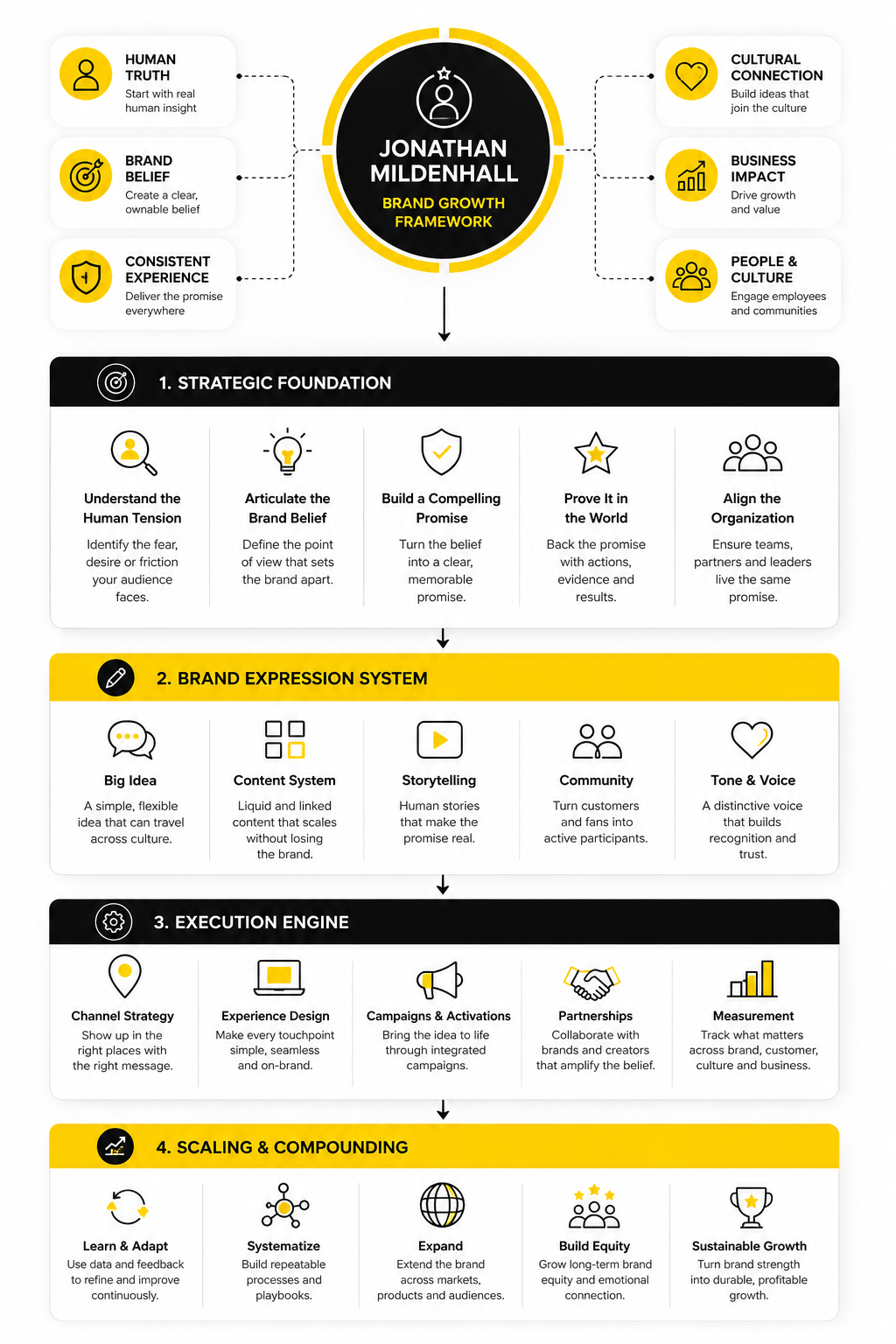
The Brand-Building Framework
A practical Jonathan Mildenhall-inspired framework starts with four connected questions. They are simple questions, but they are not easy ones. Most weak brand strategies fail because the team answers them with slogans instead of operational truth.
The first question keeps the brand from becoming self-centered. The second question keeps creativity tied to growth. The third question keeps the work relevant beyond the company’s own walls. The fourth question turns a brand idea into something a team can actually use.
This is the bridge between brand theory and professional implementation. A founder can use it before a positioning sprint. A CMO can use it before briefing agencies. A content team can use it before building a campaign calendar. And a growth team can use it before choosing tools, funnels, or automation, because performance marketing works better when the promise is clear before the traffic arrives.
What this guide Will Focus On
The rest of this guide will not treat Jonathan Mildenhall as a generic “marketing genius.” That kind of profile is not useful. Instead, it will look at the specific moves behind his career: how Coca-Cola shifted toward content excellence, how Airbnb used belonging as a strategic asset, how TwentyFirstCenturyBrand packaged brand thinking for high-growth companies, and how marketers can apply those lessons without pretending they have Coca-Cola’s budget or Airbnb’s cultural moment.
That last point matters. Most readers are not running global consumer brands. They are trying to make sharper positioning decisions, build trust faster, and create marketing that does not collapse into noise. The value of studying Jonathan Mildenhall is not that you can copy his campaigns. It is that you can learn the operating principles behind them.
Part 2 starts with Coca-Cola, because that is where many of the ideas now associated with Mildenhall became visible at global scale. It is also where the article gets into one of the most important shifts in modern marketing: the move from one-off creative excellence to always-on content excellence.
From Coca-Cola To Content-Led Brand Building
Before Jonathan Mildenhall became closely associated with Airbnb’s “belong anywhere” era, he helped shape one of the most important marketing shifts inside Coca-Cola. The company already had global reach, brand fame, and decades of advertising heritage. That was exactly what made the challenge interesting: Coca-Cola did not need awareness in the ordinary sense, but it did need a creative model built for a faster, more participatory media environment.
Mildenhall joined Coca-Cola in the mid-2000s after years in London advertising, and his role eventually centered on global advertising strategy, creative excellence, and content excellence. The language matters. This was not just about making better commercials. It was about moving from polished campaign bursts toward an operating system for stories, participation, and cultural relevance.
The best shorthand for that shift was Content 2020. The idea became widely discussed because it captured something many marketers could feel but had not yet organized properly: the old broadcast model was losing power, and brands needed content that could travel, adapt, and stay connected to a bigger strategy. The Harvard Business School case on Coca-Cola’s creative transformation describes Content 2020 as a way to understand the company’s principles and how they connected to one of Coke’s most celebrated creative periods.
The Move From Creative Excellence To Content Excellence
The phrase “creative excellence” sounds impressive, but it can also trap a team. It often implies a world where the job is to produce a few brilliant assets, launch them, and then move on. That model made sense when the main battleground was television, print, outdoor, and retail visibility. It made less sense once consumers, creators, communities, and platforms started shaping the life of a brand in real time.
Jonathan Mildenhall’s Coca-Cola work pushed toward a broader idea: content excellence. That meant the brand still needed great creative, but the creative had to be designed for movement. It had to be flexible enough to work across markets, strong enough to remain recognizable, and interesting enough for people to share, remix, discuss, or build around.
Marketing Week covered this shift when Mildenhall spoke about Coca-Cola’s Content 2020 strategy and the ambition to move from creative excellence to content excellence. The point was not that content should replace brand strategy. The point was that content had become the way brand strategy showed up repeatedly in public.
Liquid And Linked Thinking
One of the most useful ideas from this Coca-Cola era is “liquid and linked” content. “Liquid” means the idea is strong enough to spread. “Linked” means the idea still connects back to the brand, the business, and the wider strategic platform. That second part is crucial, because viral content without brand linkage is just rented attention.
This is where many teams get the lesson wrong. They hear “liquid” and start chasing memes, creator formats, or platform tricks. But Coca-Cola’s framework was not just about making shareable things. It was about building content that could move through culture while staying attached to a consistent brand idea.
The Harvard Business Publishing case on Coca-Cola: Liquid and Linked frames the company’s work as an effort to engage consumers beyond typical advertising, including campaigns such as Share a Coke. That distinction matters because it shows the real shift. The brand was not simply buying attention; it was trying to create assets, experiences, and stories that people could participate in.
Open Happiness As A Strategic Platform
Open Happiness was not just a tagline. It worked as a broad emotional platform that Coca-Cola could stretch across markets, formats, and cultural moments. That is why it became such a useful example of how a simple human idea can carry a large, complex brand.
The campaign also shows one of Jonathan Mildenhall’s recurring instincts: attach the brand to a universal emotional territory, then let the creative expressions vary. Happiness is broad, but that breadth was the advantage. It gave local teams room to adapt while keeping the brand’s center of gravity clear.
Rocket Companies later summarized Mildenhall’s Coca-Cola period by noting that his team created Open Happiness and that Coca-Cola was named Creative Marketer of the Year at Cannes Lions during his time leading marketing. That is not proof that every execution worked perfectly, and it should not be treated as magic. But it does show that the work combined creative reputation with business-facing relevance.
The 70-20-10 Discipline
The Coca-Cola content model is often associated with a 70-20-10 approach to creative investment. In simple terms, most effort goes toward proven work, a smaller share goes toward improving or extending what is working, and a final portion goes toward experimental ideas. The framework is useful because it gives creativity a portfolio structure instead of treating every decision like a one-shot gamble.
This is a practical lesson for modern teams. If every campaign is supposed to be safe, nothing learns. If every campaign is supposed to be revolutionary, the team burns out and the brand becomes inconsistent. A portfolio model creates space for both reliability and surprise.
That matters even more for smaller companies. You do not need Coca-Cola’s budget to apply the thinking. A lean team can use the same pattern by keeping its core offer pages, email sequences, and sales assets stable, while testing new hooks, creator partnerships, landing pages, or automated follow-ups around the edges. Tools like GoHighLevel can support that kind of disciplined execution when a team needs CRM, pipeline, automation, and campaign infrastructure in one place, but the tool only works when the brand idea and customer journey are already clear.
What Marketers Usually Miss About This Era
The shallow takeaway from Jonathan Mildenhall’s Coca-Cola period is “make better content.” That is not enough. Every brand says it wants better content, but most teams do not define what “better” means beyond more views, more engagement, or better-looking creative.
The stronger takeaway is that content must be connected to a strategic brand system. Coca-Cola’s Content 2020 thinking was valuable because it linked creative ambition, cultural participation, market adaptability, and business direction. It was not content for content’s sake.
This is also why Mildenhall’s later move to Airbnb makes sense. Coca-Cola taught the content lesson at global scale. Airbnb would test whether the same kind of brand discipline could help a much younger company turn trust, community, and belonging into a durable business story.
How Airbnb Turned Belonging Into A Business Asset
Airbnb gave Jonathan Mildenhall a very different kind of brand challenge from Coca-Cola. Coca-Cola was already globally famous. Airbnb was growing fast, but it was asking people to do something emotionally complicated: trust strangers, enter private homes, and believe that travel could feel more personal than a hotel stay.
That made the brand job bigger than awareness. Airbnb needed a promise that could make the behavior feel safe, desirable, and meaningful. “Belong Anywhere” worked because it translated a marketplace mechanic into a human idea.
The company was not simply saying, “Book a place to stay.” It was saying that a home could become a doorway into a city, a neighborhood, and a more connected version of travel. Airbnb’s later public filings described the company as a community built around connection and belonging, growing from two hosts welcoming three guests in 2007 into a platform with millions of hosts and hundreds of millions of guest arrivals by the time it became public.
The Implementation Problem Behind The Brand
The hard part was that belonging could not stay as a nice phrase on a campaign deck. If the product felt cold, unsafe, confusing, or inconsistent, the brand would collapse at the point of experience. That is the implementation problem every marketplace brand has to solve.
For Airbnb, the promise had to connect guests, hosts, design, policy, community standards, customer support, and marketing. The brand could not be separated from trust signals, host behavior, listing quality, booking confidence, and how the company handled problems. That is why the Airbnb era is such a useful case for understanding Jonathan Mildenhall’s approach: the idea had to travel beyond advertising.
DesignStudio’s work on the Airbnb brand described “Belong Anywhere” as a mission that gave the business a clear reason for what it did, not just a visual identity. That distinction matters. A logo can refresh how a company looks, but a mission changes how teams decide.
The Belong Anywhere Execution Process
A useful way to understand Airbnb’s implementation process is to break it into practical stages. These stages are not a perfect internal transcript of every decision inside the company. They are the visible pattern behind the work: research the emotional tension, define the brand role, codify the identity, build trust into the experience, and then express the idea through campaigns and community behavior.
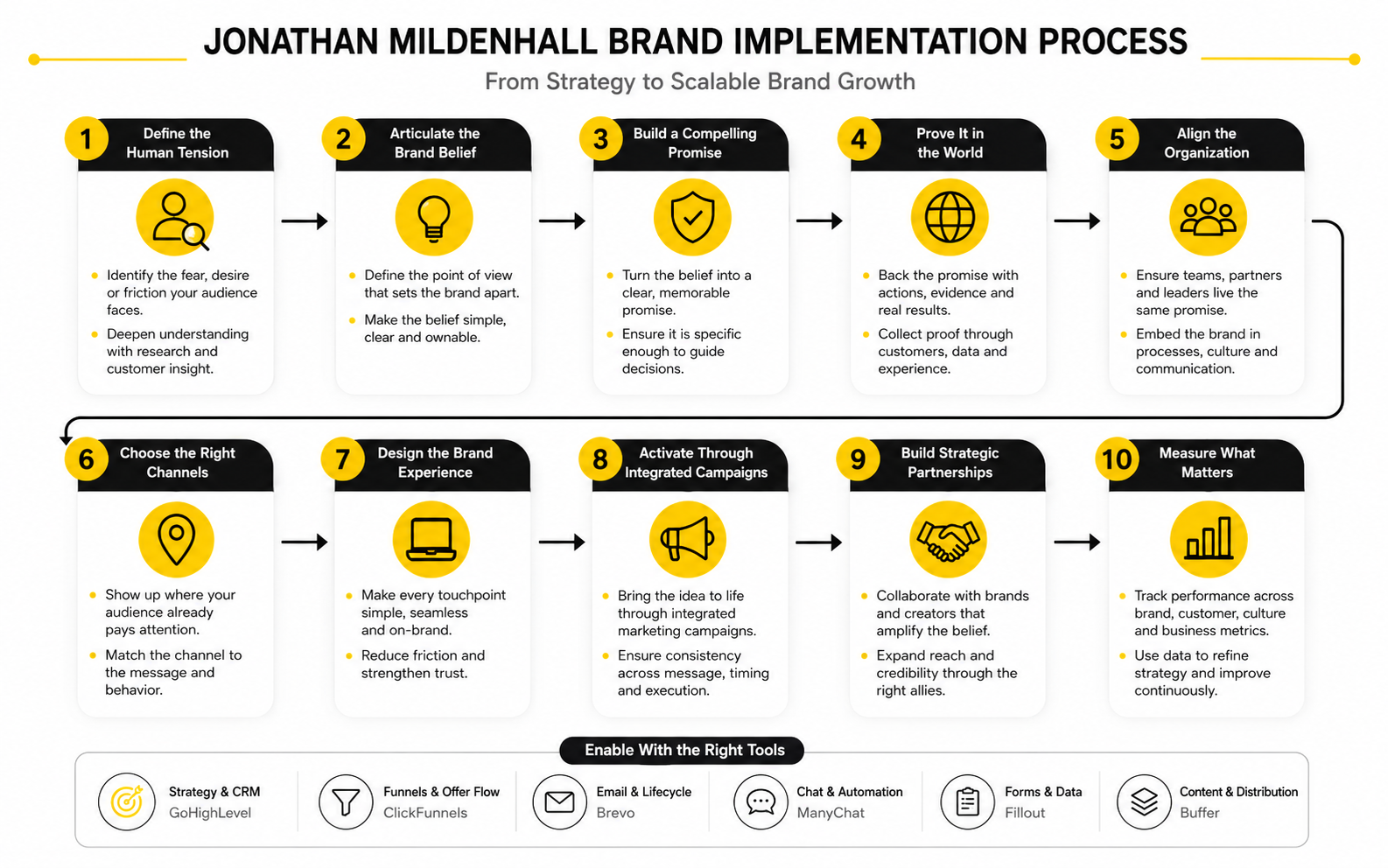
Why The Rebrand Was More Than A Logo
The Airbnb rebrand got attention because the Bélo was easy to talk about, debate, and mock. That kind of reaction is normal when a fast-growing company changes its visual identity in public. But the more important move was not the symbol itself; it was the attempt to make the company’s emotional territory more ownable.
Wired’s coverage of the redesign described a shift toward people and experiences rather than just places, with the product experience giving more prominence to hosts, relationships, and personal connection. That was the real strategic move. The brand was trying to make the marketplace feel less like a database of rooms and more like a community of people.
This is where Jonathan Mildenhall’s Coca-Cola experience carried over. At Coca-Cola, the task was to make content liquid and linked. At Airbnb, the task was to make belonging visible and usable. The company needed every major expression of the brand to point back to the same emotional center.
Trust Was The Commercial Foundation
Belonging sounds warm, but trust is the commercial foundation underneath it. Nobody books a stranger’s spare room because a brand purpose sounds poetic. They book when the emotional promise is supported by enough product evidence to make the decision feel reasonable.
That is why Airbnb’s trust layer mattered so much. Reviews, profiles, host standards, secure payments, guest support, and community expectations all helped translate the brand idea into user confidence. The marketing could open the door, but the operating system had to keep people walking through it.
Academic research on the evolution of trust in Airbnb examined how the platform changed branding and trust indicators over time, which is a useful reminder that trust is not one feature. It is a sequence of signals. The brand earns power when those signals reinforce the same promise repeatedly.
The Professional Lesson For Operators
The lesson is simple, but most teams skip it: do not launch a big brand promise until you know how the business will prove it. A promise like “belonging” needs evidence. A promise like “speed” needs evidence. A promise like “premium service” needs evidence.
For a founder or marketing team, the implementation process should start with the customer moment where belief is hardest. That might be the landing page, checkout, onboarding call, sales demo, customer support handoff, or first product experience. Brand strategy becomes useful when it improves that moment.
This is where practical execution tools can help, but only after the promise is clear. A service business using GoHighLevel can build follow-up systems, pipeline stages, reminders, and automated nurture around a sharper customer journey. An ecommerce or conversion-focused team using Replo can turn the brand promise into landing pages that match the offer, proof, and buyer intent. The tool is not the strategy. It is the place where the strategy either becomes concrete or disappears.
What Airbnb Shows About Brand Discipline
Airbnb’s brand work shows that a strong idea needs both emotional reach and operational discipline. “Belong Anywhere” was broad enough to inspire campaigns, but specific enough to shape the way the company talked about hosts, guests, cities, and travel. That balance is rare.
Jonathan Mildenhall’s role in this era is important because the work did not treat brand as decoration. It treated brand as a business asset that could align teams, simplify the market story, and make the company’s growth feel connected to a larger human promise. That is what separates serious brand building from nice-looking marketing.
The next step in the article is TwentyFirstCenturyBrand, because that is where these lessons become more formalized. After Coca-Cola and Airbnb, Mildenhall moved from leading brand inside companies to advising companies on how to build brand systems of their own.
The TwentyFirstCenturyBrand Framework
After Coca-Cola and Airbnb, Jonathan Mildenhall moved from operating inside famous brands to helping other companies build brand systems of their own. That shift matters because it turns his career into a more transferable model. It is one thing to build brand power with Coca-Cola’s scale or Airbnb’s cultural momentum; it is another thing to help younger companies understand what to measure before the brand is fully mature.
TwentyFirstCenturyBrand, the consultancy Mildenhall co-founded, describes its work around turning brands into engines of durable growth. The useful phrase is not just “brand.” It is “durable growth,” because that forces the conversation away from taste and toward value creation. Brand strategy has to improve the business, not just make the business sound more important.
The firm’s public positioning has repeatedly connected brand to four kinds of value: financial, consumer, cultural, and employee value. That is a smart measurement frame because it stops teams from pretending one metric can explain the whole brand. A company can have high awareness and weak employee belief. It can have short-term sales growth and low cultural relevance. It can have social buzz and no pricing power. The job is to read the full system.
Statistics And Data
The most useful data in a Jonathan Mildenhall-style brand system is not a random collection of dashboards. It is a small set of signals that tells you whether the brand is becoming more valuable in the market. That means the numbers must connect to decisions: what to keep, what to cut, what to scale, and what to fix.
Airbnb is a good example because the company’s public filings make the connection between brand and economics unusually clear. Airbnb’s 2024 Form 10-K states that it relies on the value of its brand and traffic to its platform to grow revenue, and that weak brand marketing or inefficient traffic acquisition could materially hurt the business. That is not soft language. It is a public-company reminder that brand demand, direct traffic, and trust are financial assets.
The same filing also says Airbnb expects its brand marketing, communications, and performance marketing strategy to help attract guests and hosts through direct and unpaid channels. That is the real measurement lesson. The goal of brand investment is not simply “people liked the campaign.” The goal is a healthier demand engine: more people searching for the brand, more people arriving directly, more people converting with less persuasion, and more customers returning because the promise was proven.
What The Numbers Should Actually Measure
The easiest mistake is to measure brand like a media campaign. Impressions, reach, video views, and clicks have their place, but they do not prove that the brand is stronger. They prove that distribution happened.
A better system measures whether the brand is moving through four layers. The first layer is attention, because nobody can choose a brand they never notice. The second layer is meaning, because attention without a remembered idea has weak commercial value. The third layer is behavior, because brand strength should eventually change what people search, click, buy, recommend, or repeat. The fourth layer is economics, because the business still has to see better growth, efficiency, retention, margin, or enterprise value.
That is why the TwentyFirstCenturyBrand lens is useful. Financial value keeps the team honest about business outcomes. Consumer value shows whether customers understand and prefer the brand. Cultural value shows whether the brand has relevance beyond its own channels. Employee value shows whether the inside of the company can actually deliver the outside promise.
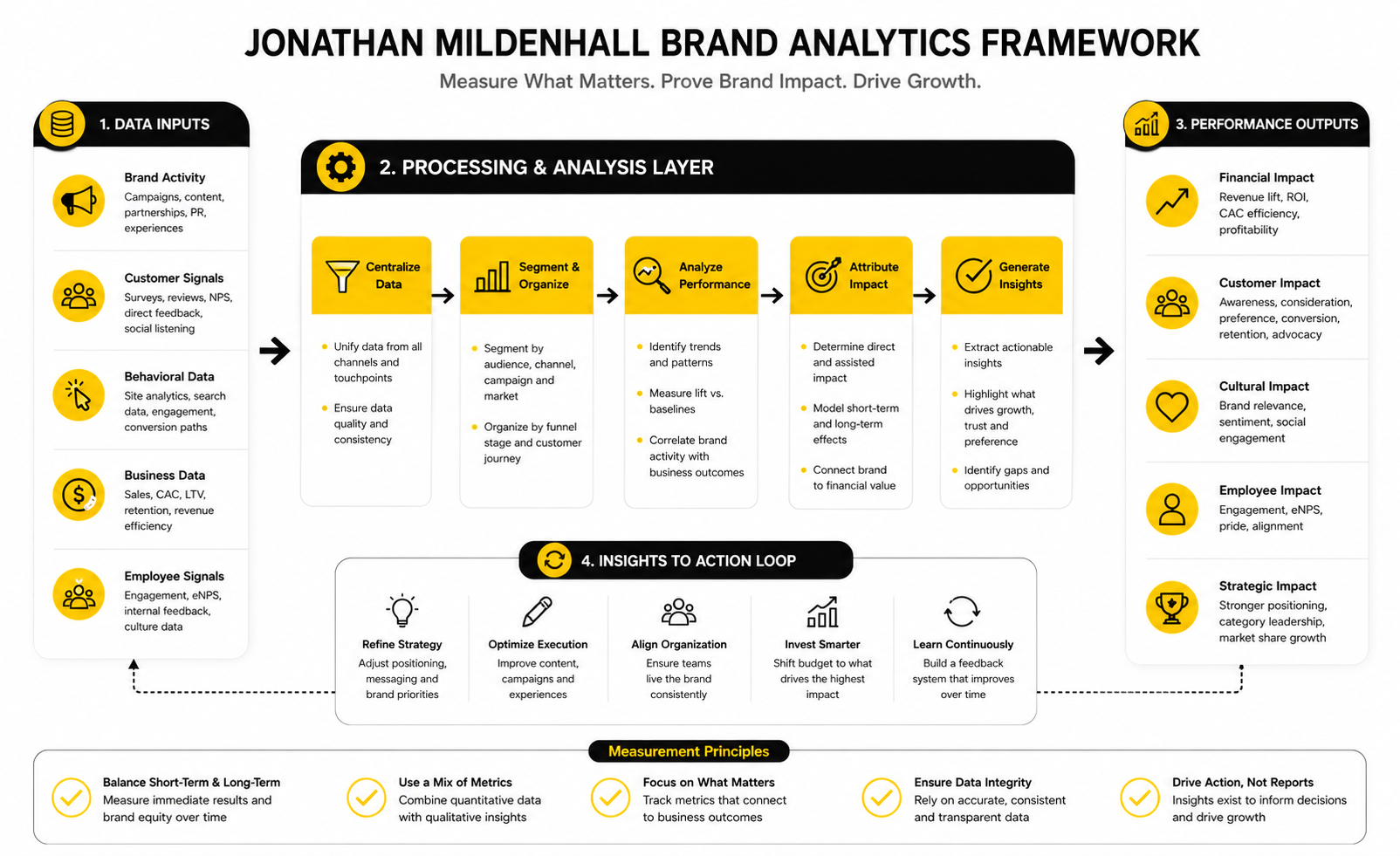
The Analytics System For Brand Growth
A practical analytics system should organize metrics by the role they play, not by the platform they came from. Platform dashboards are useful, but they are not strategy. Strategy comes from understanding how the signals connect.
For financial value, look at revenue growth, gross margin, customer acquisition cost, payback period, lifetime value, pricing power, repeat purchase, and direct traffic contribution. These metrics show whether the brand is making growth more efficient or simply adding cost. If brand investment rises but the company stays dependent on expensive paid acquisition, the strategy needs sharper diagnosis.
For consumer value, track awareness, consideration, preference, conversion rate, retention, referral behavior, review quality, and customer support friction. These metrics show whether people understand the promise and whether the experience supports it. A brand with rising awareness but flat consideration may have a clarity problem. A brand with strong conversion but poor retention may have an expectation problem.
For cultural value, measure branded search, share of search, earned media quality, creator adoption, community participation, sentiment, and the kind of conversations the brand is entering. The key is quality, not just volume. A spike in mentions can mean relevance, controversy, confusion, or backlash. The action depends on what people are actually saying.
For employee value, track internal understanding of the brand promise, employee engagement, hiring appeal, retention, and whether teams use the same language when describing the company. This is not fluffy HR work. If the people inside the company cannot explain the brand clearly, customers will feel that confusion through product, sales, support, and leadership communication.
Benchmarks That Matter More Than Vanity Metrics
Benchmarks are useful only when they help a team make a better decision. A startup should not compare its awareness to Coca-Cola. A marketplace should not judge itself by the same conversion pattern as a simple ecommerce store. A financial services company should not copy Airbnb’s community language just because it sounds warmer.
The better benchmark is movement against the right baseline. Is branded search growing faster than non-branded dependency? Is direct traffic becoming a larger share of acquisition? Are referrals increasing because people can explain the brand more easily? Are sales calls shorter because prospects already understand the category and the company’s role in it?
This is where recent effectiveness research supports the same practical point. WARC’s 2025 Multiplier Effect work argues that brand and performance marketing work best when they are integrated rather than managed as separate silos, and coverage of the report noted that a more balanced brand-performance mix can lift ROI versus over-investing in performance alone. The number matters less than the implication: if performance marketing is doing all the work, the brand is probably underbuilt.
How To Interpret Brand Performance Signals
A good measurement system should trigger action, not just reporting. If awareness is rising but conversion is not, the brand may be attracting attention from the wrong audience or failing to make the offer clear. The next move is not always more media. It may be sharper positioning, better landing pages, stronger proof, or a clearer product promise.
If conversion is strong but retention is weak, the promise may be selling more than the experience can deliver. That is dangerous because marketing can hide the problem for a while, but the customer base will eventually expose it. The right move is to tighten onboarding, support, product quality, expectation-setting, or customer success before scaling acquisition harder.
If branded search and direct traffic are rising while acquisition costs improve, the brand is probably creating demand instead of merely harvesting it. That is the signal every serious marketing team wants. It means the market is beginning to remember the company before the company pays to interrupt the market.
The Tools Only Matter After The Scoreboard Is Clear
Analytics tools, CRM systems, landing page builders, and automation platforms can make the system easier to run. They cannot decide what the system should mean. This is why measurement has to start with the brand hypothesis, not the dashboard.
A practical stack might use GoHighLevel to connect lead sources, pipeline movement, follow-up, and sales outcomes. A conversion team might use ClickFunnels to test offer flow and funnel performance once the message is clear. A content or social team might use Buffer to keep distribution consistent while watching which ideas earn repeated engagement.
But the tool is never the win. The win is knowing what signal you are trying to improve and why it matters to the business. That is the discipline behind a more mature brand system.
What The Data Means For The Jonathan Mildenhall Playbook
The Jonathan Mildenhall playbook is not anti-performance. It is anti-shallow-performance. It does not treat brand as a beautiful layer on top of growth, and it does not treat growth as a spreadsheet exercise with no emotional memory.
The data should prove whether the brand is making the business easier to choose. That is the whole point. Better brand should reduce confusion, increase trust, make demand more efficient, attract stronger employees, and give the company more room to move in culture.
This is why measurement belongs in the middle of the article, not at the end. If brand strategy cannot be measured, it becomes theater. If it is measured badly, it becomes short-term optimization in a nicer outfit. The useful path is harder but much more valuable: define the promise, operationalize it, measure the right signals, and then keep improving the system until the market starts repeating the idea back to you.
What Modern Marketers Can Apply From His Playbook
The advanced lesson from Jonathan Mildenhall is not “be more creative.” That advice is too vague to help anyone. The real lesson is to build a brand system that can survive scale, scrutiny, internal change, and performance pressure.
That is the part most teams underestimate. Early brand work often feels clean because a small leadership group can hold the idea in their heads. The trouble starts when the company grows, new teams join, more channels open, agencies get involved, investors ask for faster growth, and the original story starts bending in ten directions.
A serious brand system has to handle that pressure. It needs a clear point of view, a usable operating language, measurement discipline, and enough creative range to stay alive in culture. That is where the Jonathan Mildenhall playbook becomes most useful for founders, CMOs, and operators who are past the “let’s make a nicer website” stage.
The Tradeoff Between Consistency And Cultural Speed
Consistency is essential, but it can become a cage. A brand that repeats the same language forever becomes predictable. A brand that chases every trend becomes unrecognizable. The hard move is to stay strategically consistent while letting execution move with the moment.
This is one reason Coca-Cola’s “liquid and linked” thinking still matters. The idea can move, but it has to stay linked to the brand. That balance is harder now because culture moves through creators, short-form video, private communities, podcasts, newsletters, search behavior, and algorithmic feeds at the same time.
For a modern team, the answer is not to approve every post through a ten-person committee. The answer is to define what cannot change and what can. The promise, audience truth, strategic enemy, and tone principles should stay stable. Formats, hooks, examples, collaborations, and channel-specific execution should be allowed to adapt quickly.
The Risk Of Purpose Without Proof
Purpose-driven branding can be powerful, but it can also become empty very fast. Jonathan Mildenhall’s strongest work tied purpose to business behavior. Airbnb’s belonging idea mattered because the company had to operationalize trust, hosts, guest experience, and community standards around it.
The risk appears when a brand borrows moral or emotional language without changing anything meaningful inside the business. Customers notice the gap. Employees notice it even faster. The market may tolerate vague purpose for a campaign cycle, but it will punish inconsistency when the promise meets the actual experience.
That is why purpose should be treated like a debt the company agrees to repay. If the brand says it stands for simplicity, the product has to become simpler. If it says it stands for empowerment, the customer journey has to give people more control. If it says it stands for trust, the support model, pricing, policies, and onboarding must reduce fear instead of creating it.
Scaling The Brand Without Diluting It
The biggest scaling problem is not usually creativity. It is interpretation. As companies grow, more people need to make decisions on behalf of the brand, and every one of those decisions can sharpen or weaken the story.
A mature brand system gives teams decision rules, not just assets. A logo library is not enough. A tone guide is not enough. Even a polished positioning deck is not enough if it does not help people make tradeoffs under pressure.
A useful system should answer practical questions:
These questions are not decorative. They prevent brand drift. They also make the company faster because people do not have to restart the strategy conversation every time they write a campaign, build a landing page, respond to a customer, or brief a partner.
The Founder And CMO Relationship
TwentyFirstCenturyBrand’s public work often emphasizes the relationship between CEOs and CMOs, and that emphasis is correct. Brand cannot be delegated entirely to marketing. Marketing can express the brand, but leadership has to protect the strategic choices that make the brand believable.
This is especially important in growth-stage companies. A founder may care deeply about the mission but struggle to translate it into repeatable language. A CMO may understand the market but lack the authority to push product, hiring, sales, and customer experience into alignment. If those two roles are not connected, brand becomes a presentation rather than an operating system.
The best CEO-CMO relationship has productive tension. The CEO protects ambition and business direction. The CMO protects customer clarity, cultural relevance, and market expression. When that tension works, the brand gets sharper. When it fails, the company either becomes founder-centric and unclear, or marketing-led and disconnected from the real business.
When Brand And Performance Fight Each Other
Brand and performance usually fight when teams are measured on different clocks. Performance wants proof now. Brand needs memory over time. Both are valid, but they become destructive when one side pretends the other is unnecessary.
The more carefully move is to separate the role of each investment while forcing them to share the same strategic promise. Brand activity should increase future demand, improve recognition, and make the company easier to choose before a buyer is actively shopping. Performance activity should capture existing demand, test offers, and reveal which messages move people through the funnel.
Recent effectiveness work from WARC’s Multiplier Effect argues for integration rather than a false choice between brand and performance, with coverage of the report noting that a more balanced mix can lift revenue ROI while performance-only overinvestment can reduce it. The action is practical: do not let paid acquisition become the only growth engine, and do not let brand work become so abstract that it cannot help conversion.
The Expert-Level Move: Build A Brand That Lowers Friction
The most useful brand does not just make people admire the company. It lowers friction. It makes the category easier to understand, the offer easier to trust, the decision easier to justify, and the experience easier to remember.
That is what happened at Airbnb when belonging helped simplify an unfamiliar behavior. It is what Coca-Cola pursued when content became a repeatable way to keep the brand emotionally present. It is also the logic behind Mildenhall’s move into financial services with Rocket Companies, where trust, simplicity, and confidence are not cosmetic brand traits. They are central to the buying decision.
This is the advanced standard for applying the Jonathan Mildenhall playbook. Ask whether the brand reduces friction in the real customer journey. If it does not, the work is probably too theoretical.
Practical Guidance For Teams Ready To Scale
A growing company should not start by asking for a “brand refresh.” That usually leads to surface-level changes. Start with the business constraint. Then decide whether brand clarity, trust, cultural relevance, employee alignment, or demand efficiency is the real bottleneck.
If the bottleneck is clarity, rewrite the positioning before redesigning anything. If the bottleneck is trust, strengthen proof, reviews, guarantees, onboarding, and customer education. If the bottleneck is demand efficiency, connect brand and performance around one core promise instead of running separate campaigns that sound like different companies.
The execution stack should follow the strategy. A team using Brevo can keep email and lifecycle messaging aligned around the same promise. A team using ManyChat can make conversational marketing feel more personal without losing message discipline. A team using Fillout can turn intake, qualification, and feedback into structured customer insight instead of scattered data.
What To Avoid When Copying The Playbook
The worst way to study Jonathan Mildenhall is to copy the visible artifacts. Do not copy Airbnb’s belonging language. Do not copy Coca-Cola’s content framework word for word. Do not copy the tone of a global consumer brand if your market, product, and buyer psychology are different.
Copy the discipline instead. Start with the human tension. Connect it to the business model. Build a creative system that can flex across channels. Measure whether the brand is improving demand, trust, culture, and internal alignment.
That is the part worth taking seriously. The campaigns are history. The operating principles are still useful.
The Limits, Lessons, And Frequently Asked Questions
The Jonathan Mildenhall playbook is powerful because it connects creativity with commercial discipline. But it is not a shortcut. A company cannot borrow the language of belonging, happiness, culture, or purpose and expect the market to care.
The deeper lesson is more demanding. Brand has to be built as a system of belief, behavior, evidence, content, measurement, and leadership alignment. That is why Mildenhall’s work is most useful when you study the pattern behind the work, not the surface of the work.
A serious brand system has to answer one final question: what does the company make easier for customers, employees, partners, and the market to believe? When the answer is clear, the brand becomes easier to execute. When the answer is vague, the company ends up decorating confusion.
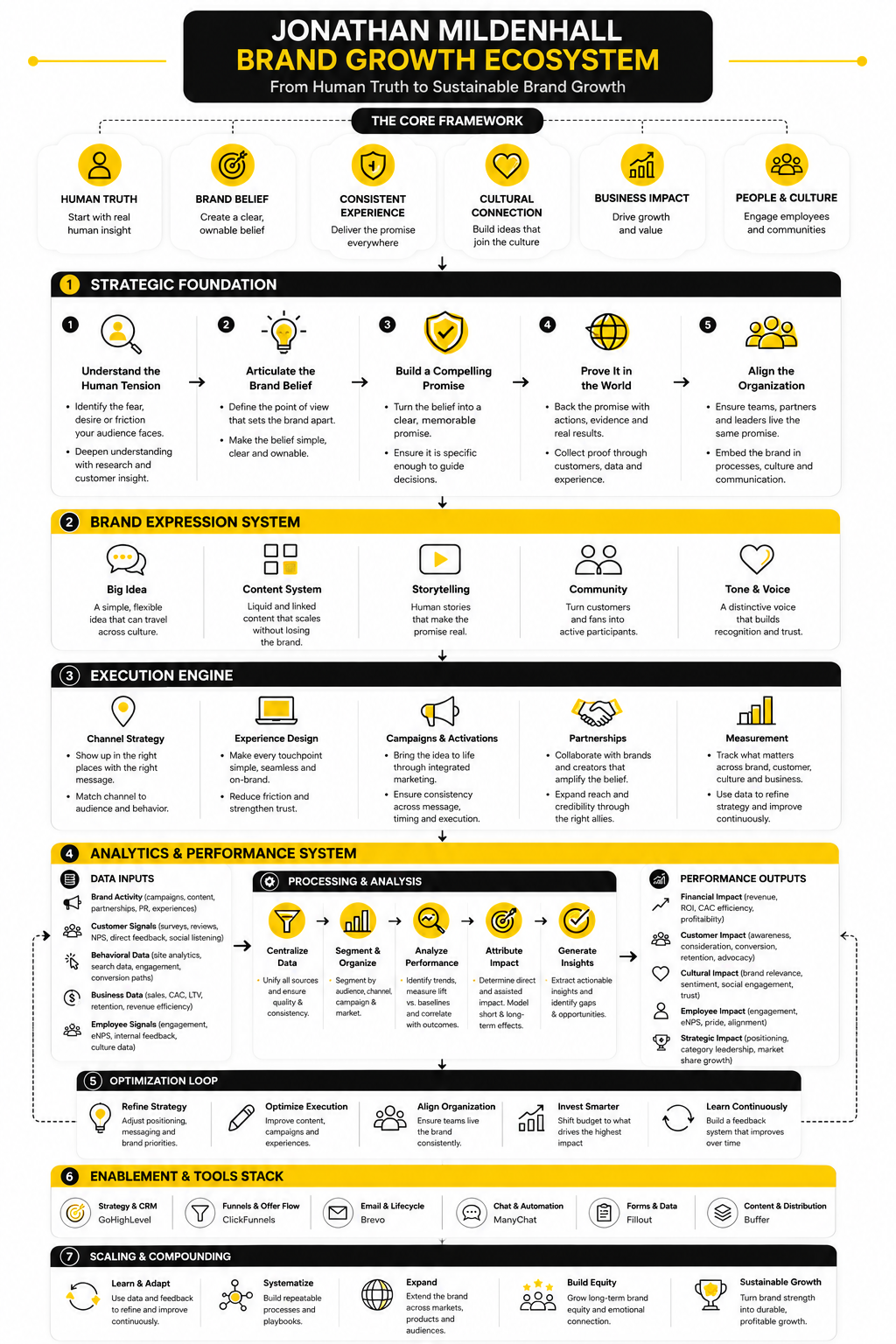
The Final Brand System
A complete brand system does not end with positioning. Positioning gives the company direction, but the real work begins when that direction has to shape decisions every week. That is where the best operators separate themselves from the teams that only talk about brand.
The final system has five connected layers. The first layer is the human tension the company understands. The second layer is the promise the company can credibly make. The third layer is the proof that makes the promise believable. The fourth layer is the creative system that makes the promise memorable. The fifth layer is the measurement system that shows whether the promise is actually improving the business.
This is the part worth remembering from Jonathan Mildenhall’s career. Coca-Cola showed the value of content that can move through culture while staying linked to the brand. Airbnb showed the value of turning a human promise into a marketplace advantage. TwentyFirstCenturyBrand showed that brand can be treated as a growth system across financial, consumer, cultural, and employee value.
Who is Jonathan Mildenhall?
Jonathan Mildenhall is a British marketing executive known for senior brand leadership roles at Coca-Cola, Airbnb, TwentyFirstCenturyBrand, and Rocket Companies. He became widely recognized for helping shape Coca-Cola’s content-led marketing era and for serving as Airbnb’s first chief marketing officer. In 2024, Rocket Companies appointed him as its first group chief marketing officer, giving him responsibility for a unified brand and marketing voice across the company.
Why is Jonathan Mildenhall important in marketing?
Jonathan Mildenhall is important because his career shows how brand strategy can connect culture, creativity, and business growth. His work is not just about memorable campaigns. It is about building a strategic system where purpose, content, product experience, and measurement support the same market promise.
What did Jonathan Mildenhall do at Coca-Cola?
At Coca-Cola, Jonathan Mildenhall helped push the company toward a more content-led model of brand building. This period is closely associated with the company’s Content 2020 thinking, which encouraged marketers to build ideas that could spread across culture while staying connected to the brand. The broader lesson is that content works best when it is not random output, but part of a disciplined brand system.
What does “liquid and linked” mean?
“Liquid and linked” describes content that is flexible enough to travel but still connected to the brand’s strategy. “Liquid” means the idea can move through culture, platforms, and communities. “Linked” means the idea still reinforces the brand, instead of becoming attention with no commercial value.
What did Jonathan Mildenhall do at Airbnb?
Jonathan Mildenhall served as Airbnb’s first chief marketing officer and helped build the company’s global brand around the idea of belonging. Airbnb’s challenge was not just awareness; it had to make people comfortable with trusting strangers and staying in homes rather than traditional hotels. The “Belong Anywhere” platform helped translate that behavior into a human, memorable, and strategically useful brand promise.
Why was “Belong Anywhere” effective?
“Belong Anywhere” was effective because it connected directly to the emotional barrier inside Airbnb’s business model. People did not only need listings; they needed confidence, trust, and a reason to see the experience as more meaningful than a transaction. The promise worked because it could shape marketing, product signals, host storytelling, and the broader community narrative.
What is TwentyFirstCenturyBrand?
TwentyFirstCenturyBrand is the brand consultancy Jonathan Mildenhall co-founded after Airbnb. The firm helps founders and leadership teams use brand to drive financial, consumer, cultural, and employee value. That frame is useful because it treats brand as a business growth system rather than just a campaign or identity project.
What can startups learn from Jonathan Mildenhall?
Startups can learn that brand should not be postponed until the company is already big. Early brand clarity helps a startup explain its category, attract customers, recruit talent, and make its product easier to trust. The practical move is to define the customer tension, sharpen the promise, prove it through experience, and then scale the message consistently.
Is brand more important than performance marketing?
Brand is not more important than performance marketing, and performance is not more important than brand. They do different jobs. Brand creates memory, trust, preference, and future demand, while performance marketing captures and converts demand that already exists.
How should companies measure brand strategy?
Companies should measure brand strategy through a mix of financial, customer, cultural, and employee signals. Financial signals include revenue efficiency, retention, direct traffic, and customer acquisition cost. Customer signals include awareness, consideration, preference, conversion, reviews, referrals, and repeat behavior.
What are the biggest risks when copying Jonathan Mildenhall’s approach?
The biggest risk is copying the visible language instead of the strategic discipline. A company should not copy Airbnb’s belonging message or Coca-Cola’s tone if those ideas do not fit its market. The more carefully move is to copy the method: understand the human tension, connect it to the business, build proof, create a flexible content system, and measure the right outcomes.
How does Jonathan Mildenhall’s Rocket Companies role fit the pattern?
The Rocket Companies role fits the pattern because financial services depends heavily on trust, clarity, and confidence. Rocket said the position was created to unify marketing and communications across its businesses, which matches the broader lesson of this guide. A strong brand is not just a campaign layer; it is a way to align multiple touchpoints around one clearer market promise.
What is the simplest way to apply this playbook?
The simplest way to apply the playbook is to start with the moment where the customer feels the most doubt. Find the fear, confusion, or hesitation that slows the decision. Then build the brand promise, proof, content, and customer journey around reducing that friction.
Build a stronger local presence with BAAM AI
Turn your website, Google profile, social channels, and AI visibility into one growth engine
Most businesses do not need more random marketing activity. They need a consistent presence system that helps the right people find them, trust them, and take action. BAAM AI brings strategy, local SEO, website updates, Google Maps visibility, social content, AI-search readiness, media production, and reporting into one practical monthly engine.
If you want your marketing to keep working after the campaign ends, start with a free BAAM AI presence audit. See how your business shows up today and where the fastest visibility wins are at BAAM AI.