
BAAM AI Blog
Jon Benson Copywriter: The Practical Guide To VSLs, Persuasion, And Modern Sales Copy
Jon Benson is usually talked about as the copywriter behind the video sales letter, or VSL. That is the simple version. The more useful version is this: he helped turn long-form direct response copy into a...

Jon Benson is usually talked about as the copywriter behind the video sales letter, or VSL. That is the simple version. The more useful version is this: he helped turn long-form direct response copy into a video-first selling format that marketers, course creators, supplement brands, coaches, and funnel builders still study today.
That matters because the modern buyer does not simply need “better words.” They need a reason to stop, listen, trust, and act. Benson’s work sits right in that gap between old-school sales letters and today’s AI-assisted funnels, where a strong message still beats a pretty page almost every time.
this guide breaks down the Jon Benson copywriter framework in a practical way. Not as fan worship. Not as recycled copywriting folklore. The goal is to understand what made his approach influential, how the VSL structure works, where it fits today, and how a professional marketer can use the principles without sounding manipulative or outdated.
Why Jon Benson Still Matters In Copywriting
Jon Benson is best known for popularizing the video sales letter format, and his own site describes him as the creator of the VSL and a pioneer in AI copywriting software through tools such as CopyPro and BNSN. The claims around total revenue influenced by his formulas vary by source, so the safest way to treat them is as brand claims rather than independent financial proof. What is clear is that Benson became closely associated with direct-response video scripts, long-form persuasion, and the shift from written sales letters to narrated sales presentations.
That shift still matters because video has become a normal part of buying behavior. Wyzowl’s recent video marketing research library continues to track how marketers use video for education, lead generation, and sales support, while broader marketing reports show that teams are under pressure to create more persuasive content across more channels. Copy is no longer just the text on a page. It is the hook, the script, the email, the ad, the landing page, the webinar opening, and the follow-up sequence.
Benson’s relevance is not that every business should copy his exact style. That would be lazy. His relevance is that he made marketers pay attention to sequence: what the prospect hears first, what objection gets handled next, when proof appears, when the offer is introduced, and how the close feels inevitable instead of random.
The Bigger Lesson Behind The Jon Benson Copywriter Keyword
When someone searches for “Jon Benson copywriter,” they are usually not looking for a generic biography. They want to understand why his name keeps showing up around VSLs, high-converting scripts, AI copy tools, and direct-response offers. That means the real topic is not only Jon Benson himself; it is the selling system behind his reputation.
His public positioning connects three ideas: persuasive copywriting, video sales letters, and AI-assisted execution. Benson’s product pages now lean heavily into ChatGPT-based copy systems, including products for headlines, emails, sales letters, bullets, and VSLs. That tells you something important about where the market has moved: the scarce skill is no longer typing words from scratch. The scarce skill is knowing what the words must accomplish.
That is why this topic is useful even if you never buy a Jon Benson product. A strong copywriter thinks in buyer psychology, message order, proof, objections, and offer clarity. Tools can speed up the draft, but they cannot rescue a weak argument.
Framework Overview
The Jon Benson copywriter framework can be understood as a persuasion sequence, not a magic script. At a high level, it starts by meeting the prospect inside a painful or urgent problem, then reframes that problem in a way that makes the current solution feel incomplete. From there, the copy builds belief, introduces a mechanism, proves the mechanism, presents the offer, and removes the friction around acting now.
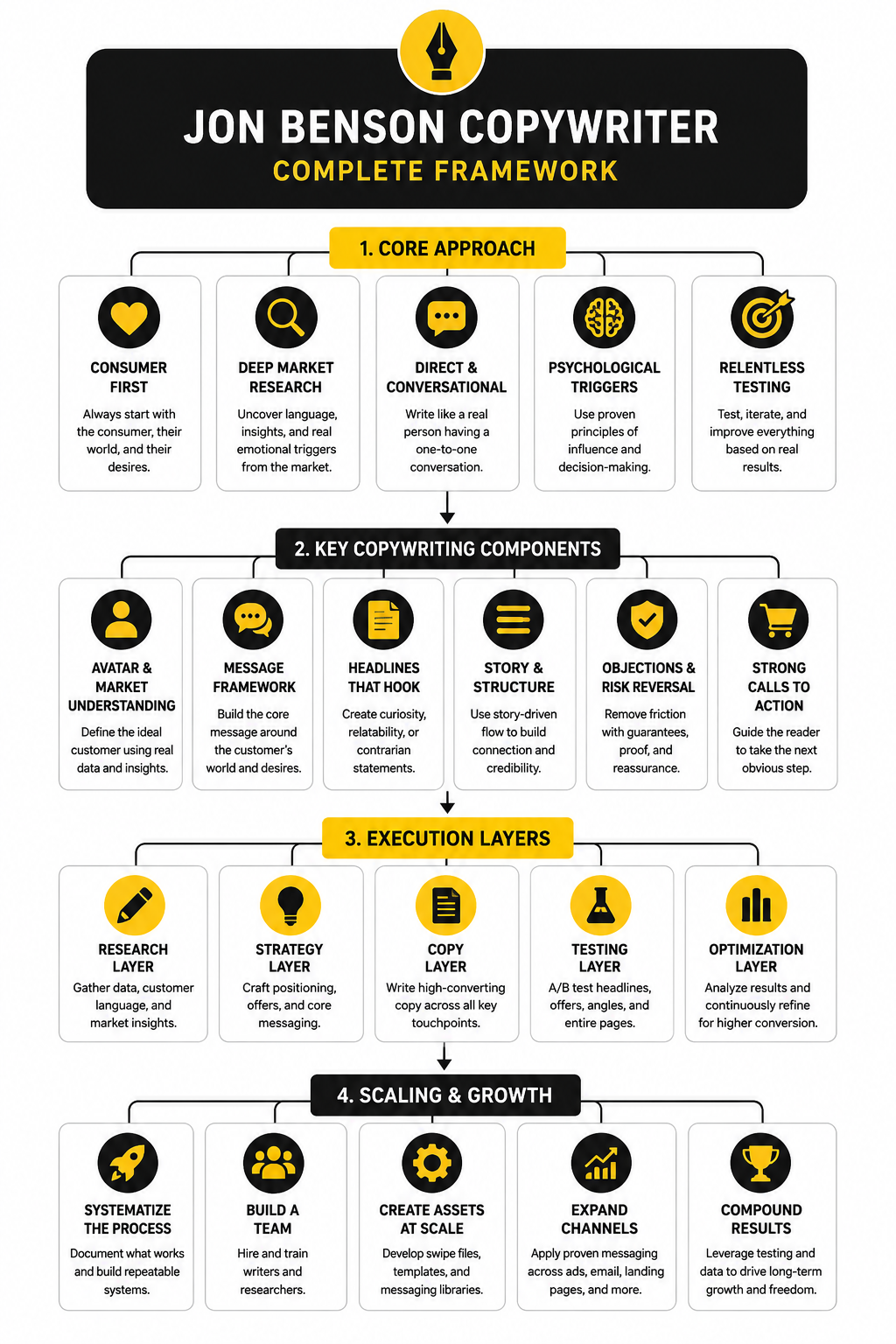
This is why VSLs became so powerful in direct response. A written page lets the reader skim, skip, and judge the offer out of order. A video sales letter controls the sequence more tightly, which gives the copywriter more influence over pacing, emotional build, and objection handling.
That does not mean video is automatically better than text. It means video can be stronger when the offer needs education, the market has skepticism, or the product requires a new way of thinking before the price makes sense. For simple ecommerce products, a clean landing page may be enough. For complex, expensive, or belief-heavy offers, a VSL-style structure can do the heavy lifting.
How The Six-Part Guide Will Build The Argument
This first part sets the foundation: who Benson is in the copywriting conversation and why his framework still deserves attention. The next part will go deeper into the VSL structure itself, especially the order of ideas that makes a sales argument easier to follow. That matters because most weak funnels do not fail from bad design first; they fail because the message has no spine.
After that, the article will break down the core components that show up again and again in Benson-style copy. We will cover hooks, problem framing, mechanism, proof, offer construction, urgency, and closing logic. Each component has a job, and when one is missing, the whole sales argument starts to wobble.
The later sections will move from theory into implementation. That includes how to use the framework professionally, how to adapt it for modern funnels, and how to avoid the biggest mistake beginners make: copying the surface drama of direct response without building the proof, empathy, and offer quality underneath it.
The VSL Framework That Made His Name
The reason Jon Benson became such a big name in copywriting is not just that he used video. Lots of marketers used video. The real difference was that he treated video like a controlled sales argument, where every line had a job and every section moved the prospect closer to a decision.
A strong VSL does not start with the product. It starts with the prospect’s current belief system. Before someone can buy, they usually need to believe the problem is real, the old way is broken, the new mechanism makes sense, the proof is credible, and the offer is worth acting on now.
That is the part many beginners miss when they study a Jon Benson copywriter approach. They see the long script, the dramatic hook, and the direct close. They miss the architecture underneath it.
The VSL Is A Sequence, Not A Script Template
A VSL works because it controls the order of persuasion. In a normal sales page, the reader can skim the headline, jump to the price, scan a testimonial, and leave before the argument has been made. In a video sales letter, the copywriter can slow the prospect down and build belief in the right order.
That order matters because most buyers do not reject an offer only because of price. They reject it because something in the argument feels incomplete. Maybe they do not understand why this solution is different. Maybe they do not trust the proof. Maybe they like the idea but do not feel enough urgency to act today.
Benson-style VSL thinking solves that by treating the script like a bridge. One side is the prospect’s current frustration. The other side is the desired outcome. The copy has to carry them across without asking them to jump too early.
The Hook Opens The Loop
The hook is not just a clever first line. It is the opening move that tells the viewer, “This is about you, and it is worth paying attention.” A weak hook talks about the company, the product, or the creator too soon.
A stronger hook points to a problem, a surprising mechanism, a costly mistake, or an outcome the prospect already wants. It creates tension without giving everything away immediately. That tension is useful because attention is earned before trust is built.
This is where many people misunderstand direct response copy. The hook is not there to trick people. It is there to make the right people realize the message is relevant enough to keep watching.
The Problem Must Feel Specific
Once the hook gets attention, the next job is to define the problem with precision. Generic pain is forgettable. Specific pain makes the prospect feel understood.
For example, “you are not getting enough leads” is broad. A sharper version would explore why the leads are not converting, why the follow-up breaks down, why the offer feels interchangeable, or why the funnel attracts curious people instead of buyers. That level of specificity makes the sales argument feel grounded.
This is one of the useful lessons behind the Jon Benson copywriter framework. The problem section is not filler before the pitch. It is where the copy proves it understands the buyer’s world better than the buyer expected.
The New Mechanism Creates Hope
A VSL needs more than pain. If all the copy does is describe the problem, it becomes exhausting. The prospect also needs a credible reason to believe a different outcome is possible.
That is where the new mechanism comes in. The mechanism explains why the offer works in a way the prospect has not fully tried before. It can be a method, process, formula, system, technology, framework, or insight that changes how the buyer understands the problem.
This matters because people are skeptical of repeated promises. They have already heard “get more leads,” “lose weight,” “save time,” “grow faster,” and “make more sales.” The mechanism gives the promise a spine.
Proof Makes The Mechanism Believable
Proof is where the VSL has to stop sounding interesting and start sounding credible. This can include demonstrations, customer outcomes, screenshots, expert credentials, product walkthroughs, research, before-and-after comparisons, or a clear explanation of why the process works. The right type of proof depends on the market and the offer.
The important point is that proof should match the claim. If the claim is about speed, show speed. If the claim is about simplicity, show the simple process. If the claim is about revenue, use verifiable business evidence instead of vague hype.
This is especially important in modern marketing because buyers are more exposed to funnels than ever. They can sense when proof is decorative. Real proof does not just decorate the page; it answers the objection forming in the prospect’s head.
The Offer Turns Belief Into A Decision
The offer section is where the copy shifts from education to action. By this point, the prospect should understand the problem, believe the mechanism, and see why the solution is relevant. Now the job is to make the buying decision feel clear.
A strong offer is not just the product plus a price. It includes the core deliverable, the bonuses, the guarantee, the onboarding path, the expected use case, and the reason to act now. Each piece should reduce friction instead of adding noise.
This is where tools like ClickFunnels, GoHighLevel, or Systeme.io can support the implementation, but they cannot replace the sales logic. A funnel platform can host the page, automate the follow-up, and process the checkout. It cannot make a weak offer feel compelling by itself.
The Close Removes The Final Friction
The close should not feel like a sudden push. If the VSL has done its job, the close feels like the natural next step. The prospect has already been guided through the reasoning, so the call to action simply tells them what to do next.
Good closing copy usually handles the last few doubts. It can clarify the guarantee, reinforce the cost of staying stuck, remind the viewer of the outcome, and make the next step feel safe. The tone should be confident, not desperate.
This is why Benson-style copy can feel intense when done poorly and persuasive when done well. The difference is respect for the buyer. Strong direct response does not bully someone into action; it helps a qualified prospect make a decision with fewer unanswered questions.
The Core Components Of Benson-Style Copy
By this point, the structure is clear: a VSL is not just a video with a pitch at the end. It is a guided buying argument. The next step is understanding the components that make that argument work in the real world.
When people study Jon Benson as a copywriter, they often look for the perfect formula. That is understandable, but it is also dangerous. A formula can help you organize the message, but the strength comes from how well each component matches the buyer, the offer, and the market.
Start With The Market Before You Write The Hook
The first practical step is not writing. It is diagnosis. Before you touch the headline, script, or funnel page, you need to know what the market already believes, what it has already tried, and what it no longer trusts.
This is where a lot of VSLs fail before the first word is written. The copywriter assumes the prospect needs motivation, when the real issue is skepticism. Or they assume the prospect needs education, when the real issue is urgency.
A useful starting point is to write down the buyer’s current state in plain language. What do they want? What have they tried? What feels unfair or frustrating? What would make them think, “Finally, someone gets it”?
Build The Message Around One Main Promise
A strong VSL needs one controlling promise. Not five. Not a messy list of benefits. One central outcome that the entire script supports.
That promise should be specific enough to create interest, but not so exaggerated that it destroys trust. If the promise feels unbelievable, the rest of the copy has to spend too much energy repairing credibility. If the promise feels too small, the prospect has no reason to keep watching.
The Jon Benson copywriter approach works best when the main promise is tied to a clear mechanism. The viewer should not only hear what is possible. They should understand why this way of getting it is different from the options they have already seen.
Turn The Mechanism Into A Simple Explanation
The mechanism is the engine of the pitch. It gives the prospect a reason to believe the promise can happen without relying on blind faith. This is where the copy moves from “here is what you want” to “here is why this can work.”
A mechanism does not need to be complicated. In fact, it is usually stronger when it can be explained simply. The prospect should be able to repeat the basic idea after hearing it once.
For a funnel offer, the mechanism might be a new conversion process. For a coaching offer, it might be a decision framework. For software, it might be an automation layer that removes manual work. The point is not to sound clever; the point is to make the solution feel logical.
Use Proof Where Doubt Naturally Appears
Proof should not be dumped into one section like a pile of testimonials. It should appear where the buyer is likely to doubt the claim. That is how proof becomes persuasive instead of decorative.
If the viewer doubts the problem is serious, show evidence that the old way is costing them something. If they doubt the method works, show a demonstration or credible result. If they doubt they can implement it, show the process in a way that feels achievable.
This is especially important when using AI or automation in the offer. Tools such as GoHighLevel AI, Chatbase, or ManyChat can make implementation faster, but the copy still needs to prove why the automation fits the buyer’s actual problem.
How To Apply The Framework Professionally
Professional implementation starts by turning the framework into a repeatable process. This keeps the copy from becoming a random mix of hooks, benefits, proof points, and urgency. It also makes the work easier to review because every section has a clear purpose.
The process below is not about copying Jon Benson word for word. That would create weak imitation. The goal is to use the same strategic discipline: understand the buyer, control the order of persuasion, and make each section earn its place.
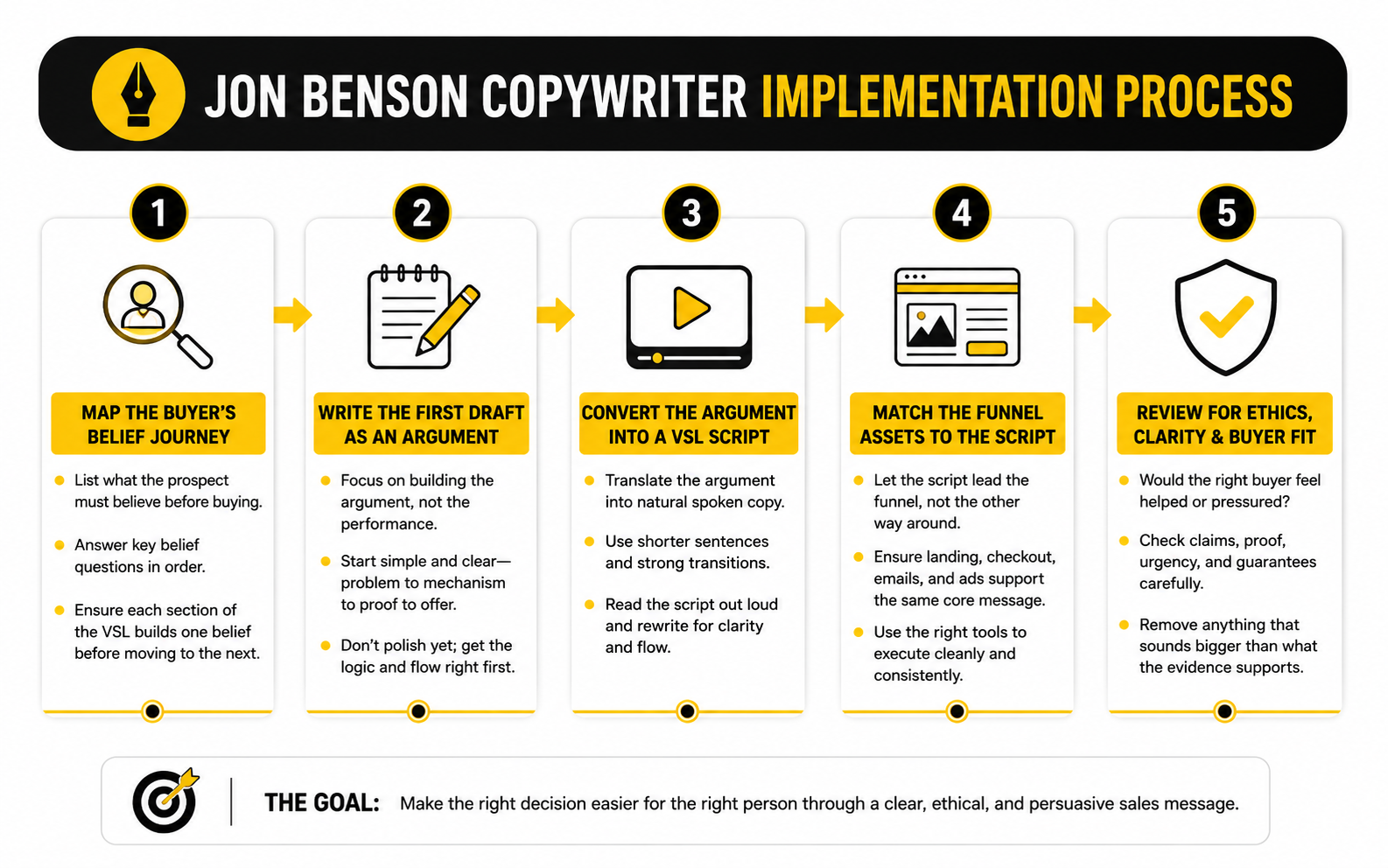
Step 1: Map The Buyer’s Belief Journey
Start by listing what the prospect must believe before buying. This is more useful than starting with features because belief is what moves the decision. If one belief is missing, the funnel will leak.
A simple belief map might include these questions:
This gives the copywriter a clean path. Each section of the VSL should build one belief before moving to the next. When the argument feels smooth, it is usually because the belief journey is in the right order.
Step 2: Write The First Draft As An Argument, Not A Performance
The first draft should be plain. Do not try to sound dramatic yet. Do not chase clever lines. Just build the argument from problem to mechanism to proof to offer.
This is where many copywriters make the work harder than it needs to be. They try to write the final version immediately, so they get stuck polishing sentences before the sales logic is even clear. That is backwards.
A better draft is simple and almost ugly. It says what the buyer needs to understand, in the order they need to understand it. Once the argument works, then you can sharpen the language.
Step 3: Convert The Argument Into A VSL Script
Once the argument is solid, turn it into spoken copy. This is a different skill from writing a sales page. A VSL script has to sound natural when read out loud.
Shorter sentences usually work better. Transitions matter more. Repetition can be useful, but only when it reinforces the point instead of padding the script.
Read the draft out loud and listen for friction. If a sentence sounds impressive on the page but awkward in the mouth, rewrite it. A VSL is heard before it is analyzed.
Step 4: Match The Funnel Assets To The Script
The script should lead the funnel, not the other way around. Once the VSL is clear, the landing page, checkout page, email follow-up, and retargeting ads should all support the same core message. This creates consistency instead of forcing the prospect to decode a different pitch on every step.
For simple builds, a platform like Systeme.io can help connect the page, email, and checkout without overcomplicating the setup. For agencies or more complex client operations, GoHighLevel can make sense because the CRM, automations, and pipeline tools live in one place. For dedicated funnel builders, ClickFunnels remains a natural fit when the priority is building sales flows quickly.
The tool choice should follow the strategy. Do not pick software first and then force the message into it. Pick the message, define the funnel path, and then choose the platform that makes execution clean.
Step 5: Review For Ethics, Clarity, And Buyer Fit
The final review should ask a blunt question: would the right buyer feel helped by this sales message, or pressured by it? That question matters. Direct response copy can be powerful, but power without restraint creates distrust.
Check the claims, proof, urgency, and guarantees carefully. Remove anything that sounds bigger than the evidence can support. Make sure the offer is clear enough that a buyer understands what they are getting before they act.
This is where professional copy separates itself from hype. The goal is not to squeeze a conversion from the wrong person. The goal is to make the right decision easier for the right person.
Statistics And Data That Actually Matter
Numbers can help you improve a VSL, but only if you know what the numbers are supposed to explain. A benchmark is not a verdict. It is a reference point that helps you decide whether the issue is traffic quality, message clarity, offer strength, funnel friction, or follow-up.
That distinction matters when studying the Jon Benson copywriter approach because a VSL is not measured like a normal blog post or simple landing page. You are not only asking, “Did people click?” You are asking whether the sales argument held attention, built belief, created intent, and moved the right people into action.
The wrong way to use data is to collect random stats and pretend they prove your funnel is good or bad. The right way is to connect each metric to a specific decision. If the number does not tell you what to fix next, it is just noise.
Start With The Conversion Context
A single conversion rate means very little without context. A VSL selling a $27 impulse product should not be judged the same way as a VSL selling a $5,000 coaching program. The buying decision is different, the proof requirement is different, and the follow-up sequence is different.
The Unbounce conversion benchmark report is useful because it shows how much performance varies by industry, traffic source, device, and conversion event. Its data set covers more than 57 million conversions and 41,000 landing pages, with a median conversion rate across industries of 6.6%. That does not mean your VSL page must hit 6.6% to be “good.” It means you need to compare your result against the type of offer, the source of traffic, and the value of the conversion.
This is especially important for high-ticket funnels. A lower opt-in rate can still be profitable if the lead quality is strong and the downstream sales process closes well. A higher opt-in rate can be useless if it attracts people who never watch, never book, never reply, or never buy.
Track The Funnel In Stages
A VSL funnel should be measured in stages because each stage reveals a different problem. If you only look at final sales, you will not know where the sales argument broke. That leads to random changes, and random changes are expensive.
A cleaner measurement system tracks the journey from traffic to page visit, from page visit to video engagement, from video engagement to click, from click to lead or checkout, and from lead to sale. This gives you a practical map of buyer behavior. It also prevents the classic mistake of rewriting the entire script when the real issue is the checkout page, the traffic source, or the follow-up.
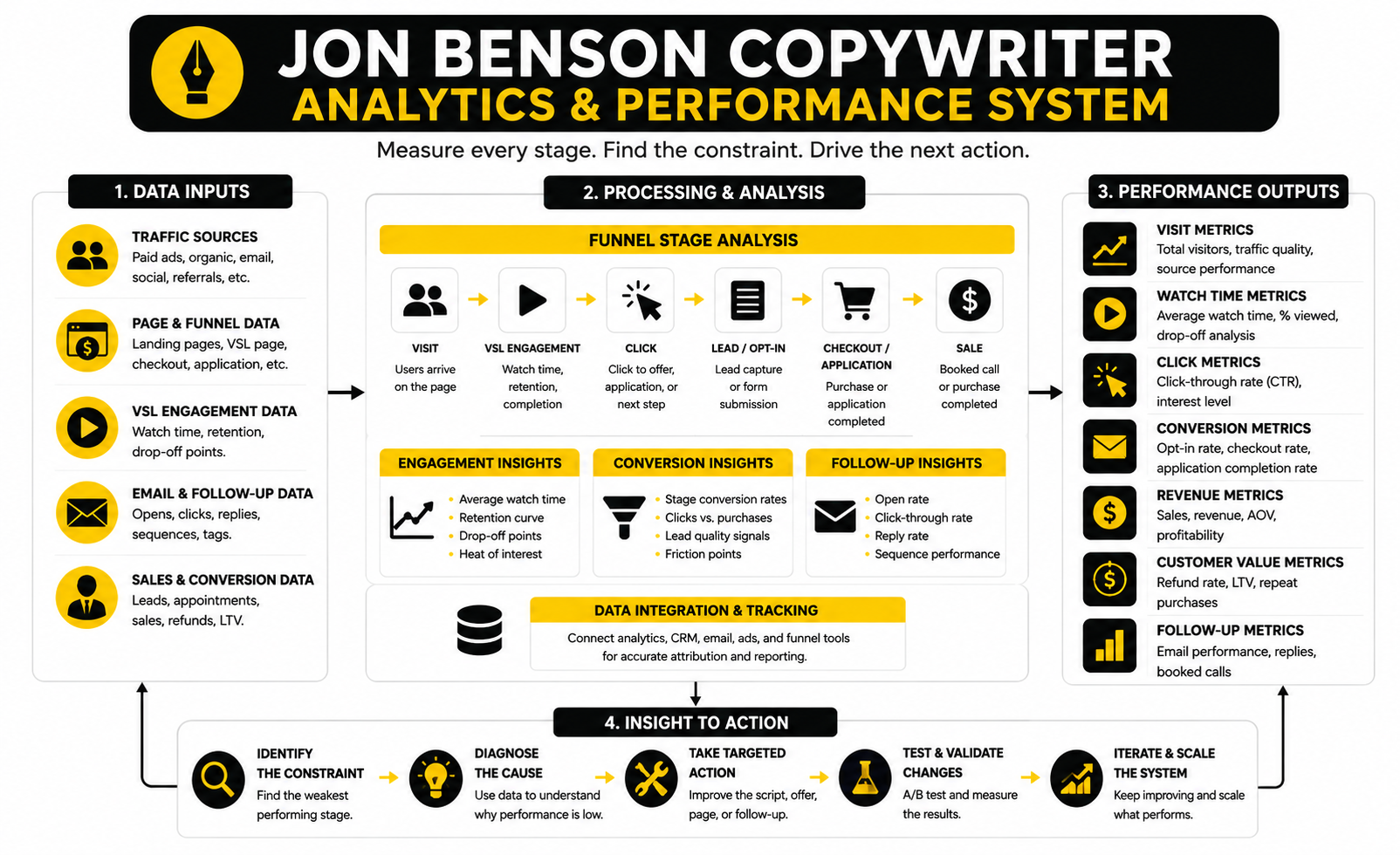
The goal is not to drown in dashboards. The goal is to isolate the constraint. Once you know which stage is weak, you can make a focused improvement instead of guessing.
Watch Time Shows Where Belief Breaks
For a VSL, watch time is one of the most important diagnostic signals. If viewers leave early, the hook or problem framing is probably weak. If they stay through the opening but drop before the offer, the mechanism may be unclear or the proof may not be strong enough.
Watch time should be read like a conversation. A sudden drop often means the viewer felt bored, confused, skeptical, or sold too early. A steady decline is normal, but a sharp fall tells you something specific happened in the script that lost people.
This is why the Jon Benson copywriter framework puts so much weight on sequence. The video does not only need good lines. It needs the right belief at the right moment, because every skipped belief creates friction later.
Clicks Reveal Intent, Not Trust
A click from the VSL to the offer, checkout, booking page, or application is a strong sign of interest. But it is not the same as trust. People click when they are curious; they buy when enough risk has been removed.
If clicks are strong but sales are weak, the issue usually sits after the video. The price may feel disconnected from the value. The checkout may introduce friction. The guarantee may be unclear. The application page may ask for too much too soon.
This is where funnel tools can help with clean tracking and follow-up. A platform like GoHighLevel can support pipelines, automations, and appointment tracking, while ClickFunnels can keep the page-to-checkout path simple. The tool is not the strategy, but good tracking makes the strategy easier to improve.
Email Performance Shows Follow-Up Quality
Many VSL funnels do not convert on the first visit. That is normal. The follow-up sequence often does the heavy lifting after the prospect has watched part of the video, clicked the offer, downloaded a lead magnet, or started an application.
Email benchmarks are useful here, but only when you interpret them carefully. Mailchimp’s email benchmark guidance frames open rate, click-through rate, and list quality as reference points for judging campaign performance, with its data suggesting an open-rate target around 34.23% while noting that results vary by industry. That number should not become a vanity target. It should help you spot whether your subject lines, list quality, and offer relevance are strong enough to earn attention.
The click-through rate is usually more revealing than the open rate. Opens can be distorted by privacy changes and inbox behavior. Clicks show whether the email gave the reader a reason to take the next step.
Benchmarks Should Drive Specific Actions
The best use of benchmarks is not bragging. It is prioritization. If your page conversion rate is far below your category benchmark, you may need better message match, a clearer offer, or a stronger first screen.
If your VSL watch time is weak, work on the hook, pacing, and early problem framing before changing the checkout. If your clicks are strong but purchases are weak, review the offer stack, guarantee, pricing explanation, and payment friction. If your email opens are fine but clicks are low, the problem is probably not the subject line; it is the body copy, call to action, or offer relevance.
This is the practical mindset behind performance copywriting. You do not optimize everything at once. You identify the weakest link, fix it, measure again, and keep moving.
Do Not Confuse More Data With Better Decisions
Modern marketing teams have more data than ever, but more data does not automatically create better judgment. The Salesforce State of Marketing report highlights a familiar gap: marketers know personalized, two-way engagement matters, but many are still not satisfied with how they use data to power those moments. That is the real challenge.
A VSL funnel does not need fifty metrics to improve. It needs a small set of metrics tied to buyer behavior. Attention, belief, intent, friction, and revenue are the main categories.
That is why a good measurement system should be simple enough to use every week. Track the numbers that explain the buyer journey. Ignore the numbers that only make the dashboard look impressive.
Common Mistakes When Studying Jon Benson’s Copywriting
The biggest mistake is treating Jon Benson copywriter material like a shortcut instead of a discipline. A VSL framework can give you order, pressure, rhythm, and persuasive momentum. It cannot save a bad offer, weak proof, poor targeting, or a product that does not deliver.
This matters more now because the market is saturated with funnel templates, AI prompts, and recycled direct-response scripts. Buyers have seen the same claims too many times. If your message sounds like a copy of a copy, the prospect feels it immediately.
Advanced copywriting is not about making the pitch louder. It is about making the argument tighter, more believable, and more aligned with the buyer’s actual decision process.
Do Not Copy The Tone Without The Strategy
A lot of beginners copy the dramatic tone of VSL copy and miss the strategy underneath. They use big promises, heavy curiosity, urgent language, and aggressive closes, but the message has no real mechanism. That creates noise instead of persuasion.
The tone only works when the logic is strong. If the problem is clear, the mechanism is credible, the proof is relevant, and the offer is valuable, direct language can feel confident. If those pieces are weak, the same language feels desperate.
This is why studying Benson-style copy should start with structure, not style. Before asking, “How can I make this sound more persuasive?” ask, “What does the buyer need to believe next?” That one question keeps the copy grounded.
Be Careful With Claims, Proof, And Testimonials
Direct response copy often relies on proof, but proof has to be handled carefully. Testimonials, screenshots, earnings examples, health claims, and before-and-after results can create serious trust issues when they are exaggerated or presented without context. The updated FTC Endorsement Guides make the standard clear: endorsements and testimonials must reflect honest experiences, and advertisers need proper support for the claims they communicate.
That does not mean you should avoid proof. It means you should use proof responsibly. Show what is real, explain what affects results, and avoid implying that an exceptional outcome is typical unless you can substantiate it.
This is especially important for offers in wealth, health, business growth, coaching, AI automation, and marketing services. Those categories can convert well, but they also attract skeptical buyers and regulatory attention. If the proof is sloppy, the short-term conversion bump is not worth the long-term risk.
Do Not Let AI Flatten The Message
AI can help you draft faster, organize research, generate headline angles, and turn a framework into usable copy. That is useful. But AI also tends to produce smooth, generic language unless the inputs are sharp.
This is a real scaling issue. When everyone can create a passable VSL draft in minutes, the advantage moves to people who understand the buyer better. The best prompt will not fix shallow market insight.
Use AI for speed, not strategy. Feed it customer language, objections, survey data, sales call notes, product specifics, and proof. Then edit like a human who actually cares whether the message is true, clear, and useful.
Know When A VSL Is The Wrong Format
Not every offer needs a VSL. This is a tradeoff many marketers ignore because VSLs feel more “serious” than simple pages. But a long sales video can hurt performance when the offer is simple, low-risk, or already understood.
A VSL makes the most sense when the buyer needs education before they can value the offer. It also helps when the product has a new mechanism, a complex transformation, a high price point, or a skeptical market. If the product is straightforward, the buyer may prefer a fast landing page, a product demo, or a short comparison page.
The format should match the decision. Do not force a 35-minute argument onto a buyer who only needs a clear benefit, a few proof points, and a frictionless checkout. Strategy beats format loyalty every time.
Scale The System, Not Just The Script
Scaling a VSL funnel is not only about buying more traffic. More traffic exposes every weakness faster. If the message is slightly unclear, the offer is underdeveloped, or the follow-up is thin, scaling simply makes the leak more expensive.
A professional system includes script testing, page testing, email follow-up, retargeting, sales team feedback, and offer iteration. The VSL is the centerpiece, but it is not the whole machine. Every step after the video has to continue the same argument.
This is where operational tools matter. A builder like ClickFunnels can keep funnel deployment fast, while GoHighLevel can support CRM workflows, booking, pipeline tracking, and automated follow-up. For lean operators who want a simpler all-in-one setup, Systeme.io can be enough to get the core funnel live without building a heavy tech stack.
Protect The Brand While You Push For Conversions
The strongest direct-response copy does not burn the brand to get the sale. That line matters. You can create urgency without fake scarcity, highlight pain without humiliating the buyer, and make a bold promise without stretching the truth.
Brand trust compounds. If the copy gets attention but creates regret after purchase, the business pays for it through refunds, poor reviews, lower referrals, and weaker lifetime value. That is not a copywriting win.
Modern search and content ecosystems also reward usefulness more than thin persuasion. Google’s guidance on people-first content is a reminder that useful, trustworthy material is not optional if you want long-term visibility. A VSL can sell the offer, but the broader content system has to support the buyer before and after the pitch.
Build A Testing Culture Without Losing The Core Message
Testing is useful, but random testing can destroy a strong message. Changing headlines, hooks, offers, proof, and pricing all at once gives you movement without learning. You may get a better result, but you will not know why.
A more carefully testing culture protects the core argument while improving one variable at a time. Test the hook against watch time. Test proof placement against click-through. Test the offer stack against checkout conversion. Test follow-up angles against booked calls or completed purchases.
This is how expert-level copy improves. You do not worship the first draft, and you do not panic after one bad result. You treat the funnel like a living sales argument and make it sharper with evidence.
Final Takeaways Before You Build The System
The practical value of studying Jon Benson as a copywriter is not that you get a script to copy. It is that you learn how to think through a sales argument with more discipline. That is the real asset.
A strong VSL is not built from hype. It is built from buyer insight, a clear promise, a believable mechanism, relevant proof, a clean offer, and follow-up that keeps the same message alive after the first visit. When those pieces work together, the funnel feels less like a pitch and more like a guided decision.
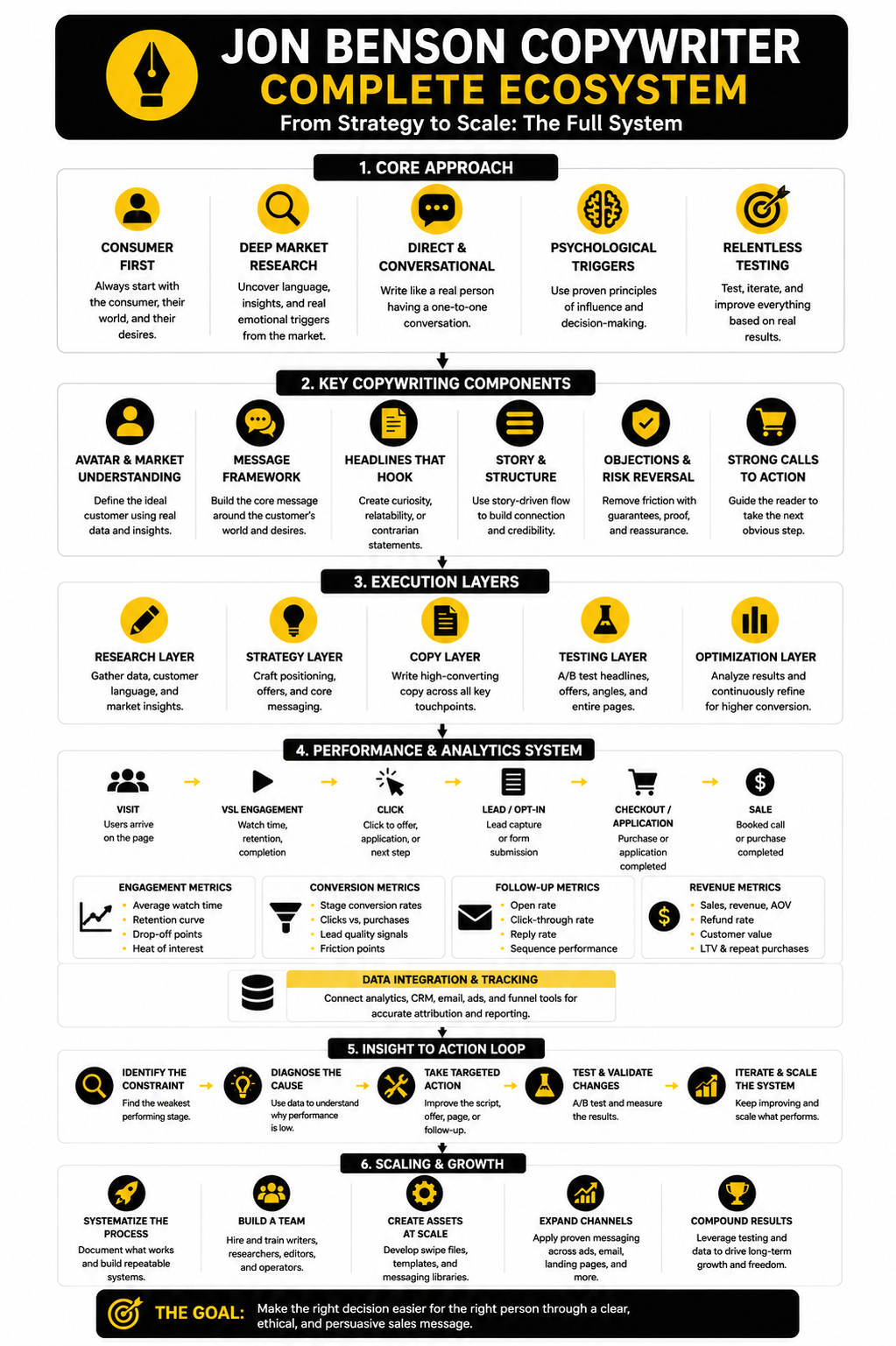
The modern version of this system is bigger than one video. It includes the landing page, the opt-in, the checkout or application flow, the CRM, the email sequence, retargeting, sales conversations, customer onboarding, and post-purchase proof. That is where the real leverage is.
Who is Jon Benson?
Jon Benson is a direct-response copywriter and marketer best known for his work around video sales letters. His own brand positions him as the creator of the VSL format and the founder behind copywriting tools such as CopyPro and BNSN. Whether you study him for VSLs, AI copywriting, or sales message structure, the useful lesson is the same: persuasive copy needs a controlled sequence.
Why is Jon Benson associated with video sales letters?
Jon Benson is associated with video sales letters because his public work and training heavily focus on turning long-form sales arguments into video-based scripts. The VSL format gives the copywriter more control over pacing, order, and belief-building than a skimmable page. That is why the Jon Benson copywriter topic often shows up when marketers research high-converting scripts and direct-response funnels.
Is a VSL still useful today?
Yes, a VSL can still be useful when the offer needs explanation, proof, or belief-building before someone buys. It is especially relevant for coaching, courses, software, health offers, financial education, B2B services, and high-ticket funnels. It is less useful when the product is simple, low-risk, and already understood by the buyer.
What makes Benson-style copy different from normal sales copy?
Benson-style copy is usually more sequence-driven than casual sales copy. It focuses on moving the prospect through a chain of beliefs before presenting the offer. The big idea is not just to describe benefits, but to control the order in which the buyer understands the problem, mechanism, proof, and decision.
Can beginners use the Jon Benson copywriter framework?
Beginners can use the framework, but they should avoid copying the surface style too aggressively. The best starting point is to map what the buyer needs to believe before purchasing. Once that belief journey is clear, the hook, problem section, proof, offer, and close become much easier to write.
What is the most important part of a VSL?
The most important part is the belief sequence. A strong hook matters, and proof matters, but the VSL fails if the buyer is asked to believe too much too soon. The script has to meet the prospect where they are, then move them one step at a time toward the offer.
How long should a VSL be?
A VSL should be as long as the decision requires, not as long as a template says. A simple offer may only need a short video. A complex, expensive, or unfamiliar offer may need a longer argument with more education, proof, and objection handling.
What metrics should I track for a VSL funnel?
Track the funnel in stages: page visits, video watch time, click-through rate, lead conversion, checkout or application completion, booked calls, sales, refunds, and follow-up performance. Watch time helps diagnose the script. Click-through shows interest. Sales and refunds reveal whether the offer and expectation-setting are strong enough.
Should I use AI to write a VSL?
AI can help draft, organize, and refine a VSL, but it should not replace strategy. The quality of the output depends on the quality of the inputs. Give AI real customer language, offer details, objections, proof, and positioning before expecting a useful script.
What tools help implement a VSL funnel?
The right tool depends on the funnel. ClickFunnels can be useful for fast funnel builds, GoHighLevel can support CRM, booking, pipelines, and automation, and Systeme.io can work well for leaner funnel setups. The software should support the strategy, not replace it.
What is the biggest mistake people make with VSL copy?
The biggest mistake is using big claims before building trust. A VSL can be direct, emotional, and urgent, but it still needs proof, clarity, and a real reason to believe. If the pitch feels bigger than the evidence, the buyer will feel the gap.
How do you make a VSL ethical?
Make the promise clear, support claims with real proof, explain what affects results, and avoid fake scarcity or exaggerated testimonials. Ethical direct response still sells hard, but it does not mislead the buyer. The goal is to help qualified prospects make a confident decision, not pressure the wrong people into buying.
Is the Jon Benson copywriter approach only for video?
No. The same persuasion structure can be used in sales pages, webinars, email sequences, ads, landing pages, sales calls, and product launches. The format changes, but the buyer still needs a clear problem, a believable mechanism, strong proof, and a simple next step.
When should you hire a professional copywriter instead of writing it yourself?
Hire a professional when the offer has real revenue potential, the funnel is complex, or the stakes are too high for guesswork. A skilled copywriter can diagnose the buyer journey, sharpen the positioning, structure the proof, and write the script in a way that supports the full sales system. If the offer is still unvalidated, start by clarifying the market and testing smaller messages first.
Build a stronger local presence with BAAM AI
Turn your website, Google profile, social channels, and AI visibility into one growth engine
Most businesses do not need more random marketing activity. They need a consistent presence system that helps the right people find them, trust them, and take action. BAAM AI brings strategy, local SEO, website updates, Google Maps visibility, social content, AI-search readiness, media production, and reporting into one practical monthly engine.
If you want your marketing to keep working after the campaign ends, start with a free BAAM AI presence audit. See how your business shows up today and where the fastest visibility wins are at BAAM AI.