
BAAM AI Blog
John McIntyre Copywriter: The Practical Guide To Email Copy That Sells Without Sounding Desperate
John McIntyre is best known in direct-response circles as “The Autoresponder Guy,” a copywriter associated with email sequences, autoresponders, and behavior-based campaigns. His public work connects copywriting with...
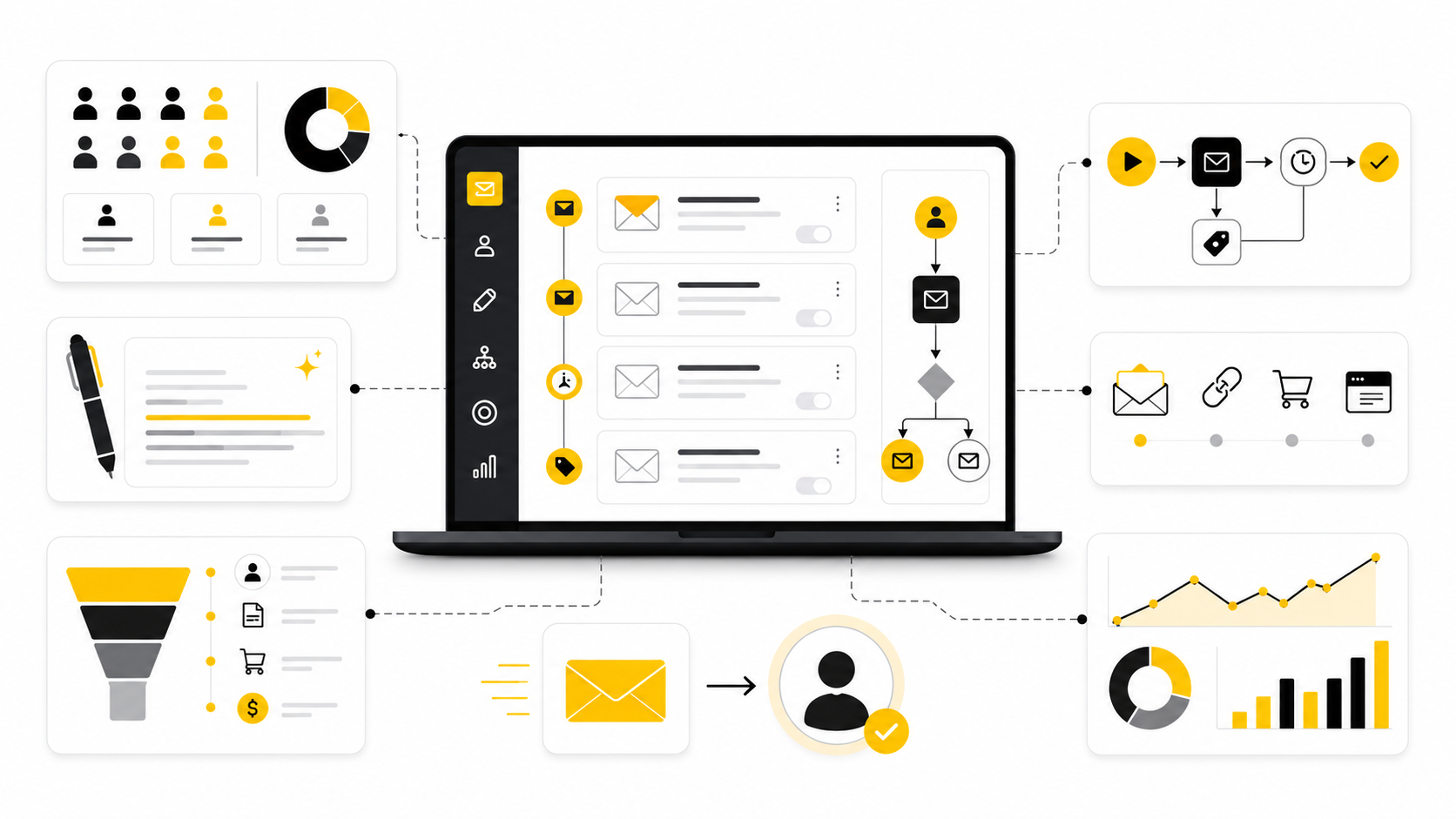
John McIntyre is best known in direct-response circles as “The Autoresponder Guy,” a copywriter associated with email sequences, autoresponders, and behavior-based campaigns. His public work connects copywriting with automation, which is why the phrase john mcintyre copywriter usually brings up people looking for one thing: how to write emails that sell consistently without turning every message into a hard pitch.
That distinction matters. A lot of copywriting advice focuses on one sales page, one ad, or one clever hook. McIntyre’s world is different because email copy lives inside a relationship. You are not only trying to get a click today; you are trying to build enough trust, relevance, and timing that the next click becomes easier.
You can see that theme across public references to his work, from his positioning as The Autoresponder Guy on Udemy to podcast appearances about behavior-based email campaigns and planning copy around customer segments and the buying cycle. The practical lesson is simple: better email copy does not come from louder words. It comes from understanding where the reader is, what they already believe, what they still doubt, and what needs to happen before they are ready to buy.
This guide is built as one continuous article split into six parts. Part 1 sets the foundation and gives you the map, while the later parts move into the actual framework, execution, examples, and implementation process. The goal is not to copy John McIntyre’s voice, but to understand the principles behind the type of email copywriting he is known for and apply them in a practical, modern way.
Why John McIntyre’s Copywriting Approach Still Matters
The reason John McIntyre’s name keeps coming up is not just because he wrote emails. It is because he became associated with a specific way of thinking about email: automated, relationship-driven, and sales-focused without relying on constant pressure. That makes his work relevant for freelancers, course creators, ecommerce brands, agencies, consultants, and anyone who needs email to do more than “send updates.”
Email is still one of the few marketing channels where the audience has invited you into a personal space. That makes the writing more sensitive than a landing page or an ad, because a bad email does not just fail to convert. It trains the reader to ignore you, unsubscribe, or mentally file your brand under “noise.”
McIntyre’s general approach is useful because it forces you to think in sequences instead of isolated messages. One email can create curiosity, another can handle objections, another can make the offer feel obvious, and another can bring back people who went cold. That is where email copy becomes a system rather than a guessing game.
The Big Idea Behind The Framework
At the center of this topic is a simple idea: email copy works best when it matches the reader’s stage of awareness. A cold subscriber who barely knows you needs a different message from a warm lead who has already watched a webinar, read three emails, and clicked a pricing page. Treating both people the same is one of the fastest ways to make your email marketing feel generic.
This is where autoresponder-style thinking becomes valuable. Instead of asking, “What should we send this week?” you ask, “What needs to happen next in the reader’s mind?” That shift changes everything because the email is no longer just content; it becomes a step in a larger persuasion process.
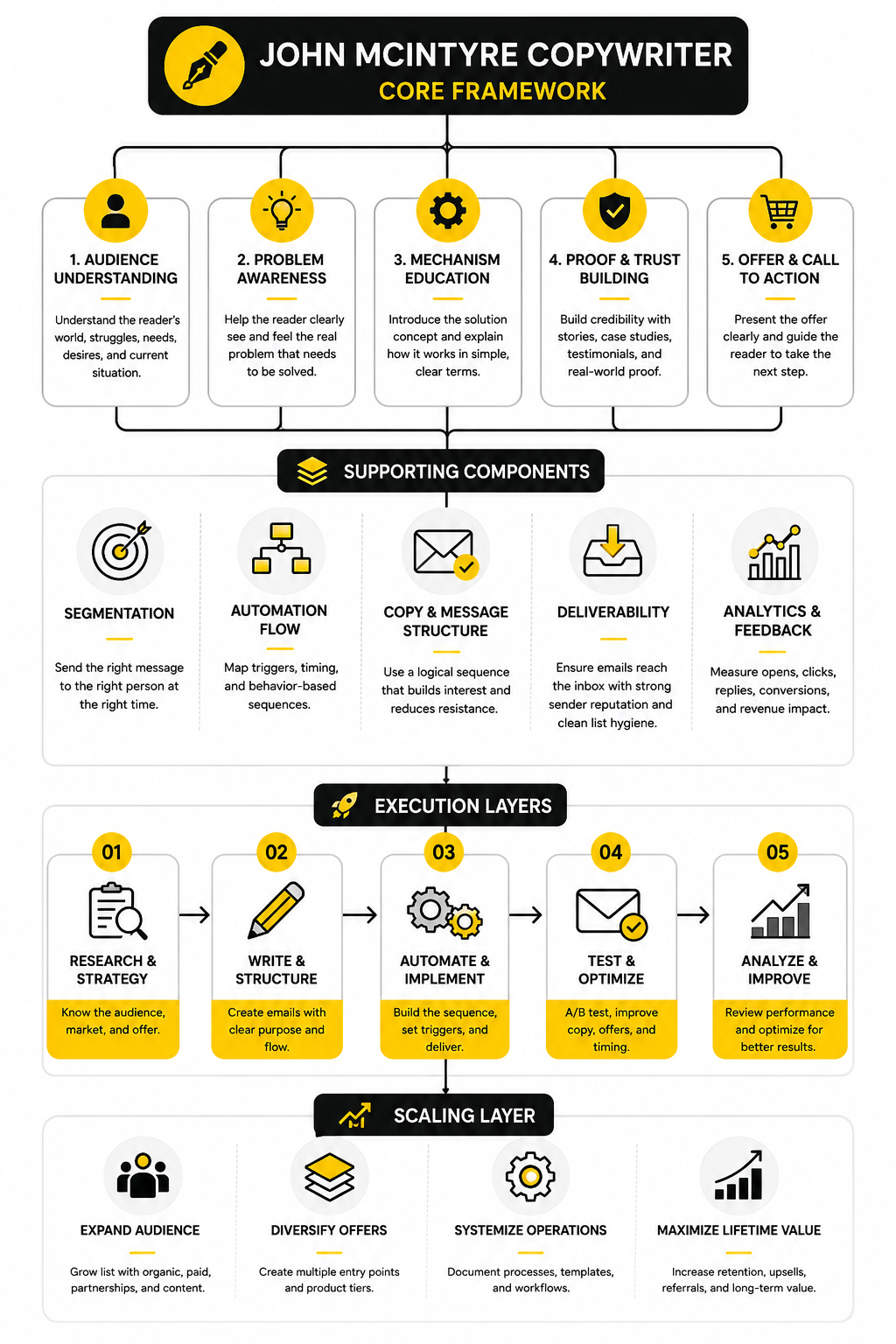
The framework we will use throughout this guide has four layers: reader context, message purpose, persuasion mechanism, and conversion path. Reader context tells you who is receiving the email and what they already believe. Message purpose defines what the email must accomplish. The persuasion mechanism gives the email its emotional and logical force. The conversion path makes the next action clear.
What This Guide Will Help You Build
By the end of the full article, you should be able to look at an email sequence and know why it is working or why it feels flat. You should be able to spot weak positioning, vague promises, missing objections, rushed CTAs, and messages that try to sell before the reader is ready. More importantly, you should be able to fix those problems without turning the copy into hype.
The focus is practical implementation. That means we will not treat copywriting as a collection of magic phrases or recycled templates. Templates can help, but only when the strategy underneath them is clear.
The real win is learning how to build emails that feel natural, focused, and commercially useful at the same time. That is the standard good email copy has to meet now. It has to respect the reader’s attention while still moving the business forward.
The Email Copywriting Framework Behind Autoresponder-Style Selling
The next logical step is understanding the structure behind this kind of email copy. When people search for john mcintyre copywriter, they are usually not looking for generic writing tips. They are looking for the deeper system behind emails that build trust, handle resistance, and move people toward a purchase without making the brand sound needy.
That system starts with sequence thinking. A single email can create a spike of attention, but a sequence creates momentum. John McIntyre’s public positioning as “The Autoresponder Guy” matters because it points to a bigger principle: email copy should not be treated as random broadcasts, but as a guided path from first contact to buying decision.
This is also why modern email marketing still rewards strategy more than volume. The strongest programs do not just send more emails; they send more relevant emails. Research from MoEngage analyzing billions of messages found that many brands still rely on shallow personalization, even though the bigger opportunity is using behavior and context to make the message feel genuinely relevant through more advanced personalization.
Start With The Reader’s Stage Of Awareness
Every email sequence should begin with one question: what does the reader already understand? If they already know they have a problem, you do not need to spend five emails convincing them the problem exists. If they are still skeptical, pushing a direct offer too early will feel abrupt.
This is where many email campaigns break. They treat every subscriber as if they are equally informed, equally motivated, and equally ready to act. That creates bland copy because the message has to be broad enough to cover everyone, which usually means it becomes sharp enough for no one.
A better approach is to map the reader’s stage before writing the message. Cold readers need clarity and relevance. Warm readers need proof and confidence. Hot readers need urgency, offer detail, and a reason to act now instead of later.
Match The Message To The Moment
John McIntyre’s copywriting reputation is closely tied to the idea of sending the right message at the right time. That idea shows up directly in discussions of his work, including his conversation on planning copy around the customer and buying cycle in The Active Marketer interview. The lesson is not complicated, but it is often ignored: timing changes what good copy looks like.
A welcome email should not read like a final deadline email. A cart recovery email should not read like a newsletter. A reactivation email should not pretend the subscriber has been paying attention for the last six months.
When the message matches the moment, the writing feels natural. You can be direct without sounding pushy because the email is responding to a real context. That is the difference between persuasion and interruption.
Build The Sequence Around One Clear Job Per Email
A strong autoresponder sequence does not ask every email to do everything. One message might create problem awareness. Another might explain the mechanism. Another might answer a common objection. Another might introduce proof, compare alternatives, or make the offer easier to say yes to.
This matters because confused emails create passive readers. When an email tries to educate, entertain, prove, pitch, overcome objections, and create urgency all at once, the message becomes heavy. The reader may understand the individual sentences, but they do not feel a clean reason to keep moving.
The fix is simple: assign one job to each email before writing it. If the job is to build trust, do not bury the reader in offer mechanics. If the job is to sell, do not hide the call to action under five unrelated ideas. Each email should earn the next step.
Use Behavior As A Signal, Not A Gimmick
Behavior-based email is powerful because it lets you respond to what people actually do. A click, reply, purchase, abandoned form, inactive period, or repeated visit to a pricing page can all tell you something useful. But the point is not to become creepy or overcomplicated; the point is to make the next email more relevant.
This is where automation and copywriting need to work together. Automation decides when a message is triggered. Copywriting decides what that message should mean to the person receiving it.
If someone clicks a case study, they may be looking for proof. If someone visits a checkout page and leaves, they may need reassurance, a clearer offer, or a better reason to finish. If someone opens multiple educational emails but never clicks, they may still be interested but not yet convinced.
Create A Persuasion Path Before Writing The Copy
Before writing a single subject line, map the persuasion path. This is the order in which beliefs need to change before someone can confidently buy. In many campaigns, the problem is not bad writing; it is that the emails are trying to create the wrong belief at the wrong time.
A simple persuasion path might look like this:
That structure gives the sequence direction. It also keeps the copy from becoming random. Every email has a reason to exist because every email moves one belief forward.
Make The Offer Feel Like The Natural Next Step
Good email copy does not make the offer appear out of nowhere. It makes the offer feel like the obvious next step after the reader has followed the argument. That is why the earlier emails matter so much.
If the sequence has already clarified the problem, explained the mechanism, built trust, and addressed the main doubts, the offer does not need to scream. It can be direct because the reader has been prepared. This is where understated copy often performs better than exaggerated copy.
For example, a service business might use email to help prospects diagnose why their current lead follow-up is leaking revenue. Once that belief is established, a platform like GoHighLevel can fit naturally as the next step for agencies or local businesses that need CRM, automation, pipeline tracking, and follow-up in one place. The link works only when the context is real; forced tool mentions weaken trust.
Keep The Copy Human Even When The System Is Automated
The best autoresponder emails do not feel like machines wrote them. They may be triggered automatically, but they still read like a person understands the reader’s situation. That is the standard every automated sequence should aim for.
This is especially important now because inboxes are crowded with obvious automation. Readers can feel when a company is simply dropping them into a generic funnel. They can also feel when the message is specific, useful, and written with actual intent.
That is why the john mcintyre copywriter topic is still relevant. The real lesson is not “write more emails.” The real lesson is to build a sequence where each message has a role, each role supports the next step, and the reader never feels like they are being pushed through a machine.
The Core Components Of High-Converting Email Copy
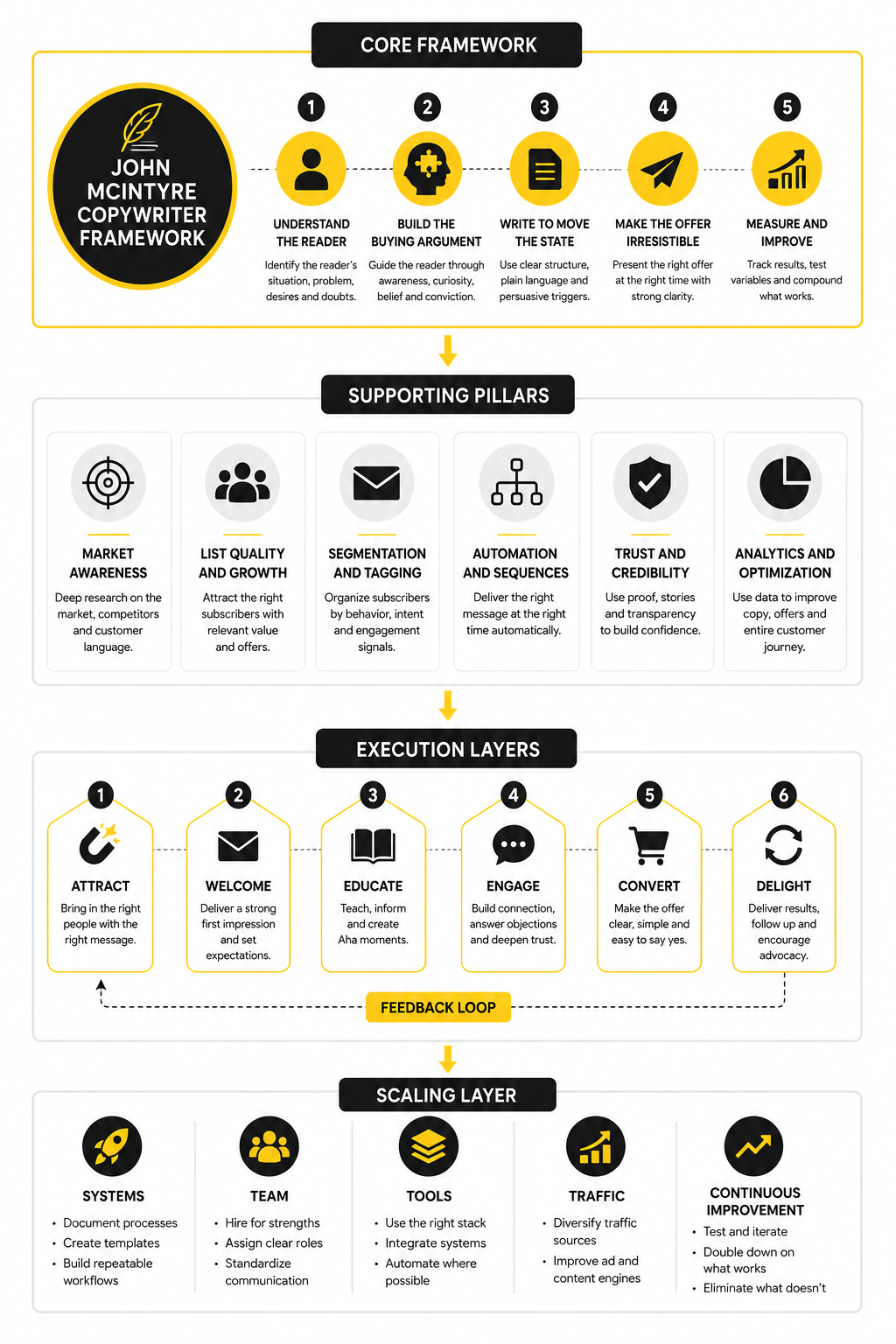
Once the sequence has a clear strategy, the next step is execution. This is where the work becomes more specific: subject lines, opening lines, hooks, proof, objections, CTAs, and follow-up logic. The reason the john mcintyre copywriter topic is useful here is that his public work points back to one core discipline: email copy should be built to move a reader through a decision, not just fill space in an autoresponder.
That means every email needs a job, but it also needs the right parts in the right order. A strong email is not just a clever subject line followed by a pitch. It is a small persuasion asset with a clear entry point, a useful idea, a believable reason to care, and a simple next step.
The best way to think about this is as a repeatable process. You are not trying to reinvent email every time you write. You are trying to assemble the right components based on the reader’s context, the stage of the sequence, and the specific belief you need to create.
Start With The Buyer’s Immediate Problem
Good email copy starts where the reader already is. Not where you wish they were. Not where your product team wants them to be. Where they actually are right now.
That usually means opening with a problem, frustration, desire, mistake, or moment the reader recognizes immediately. If the email begins too far away from the reader’s lived experience, the copy has to work twice as hard to recover attention. This is why vague openers like “In today’s fast-moving digital world” feel dead on arrival.
A better opener makes the reader feel understood quickly. For example, an agency owner does not need a long lecture about why leads matter. They may need a sharper observation about why booked calls keep slipping through the cracks after the first inquiry.
Turn The Hook Into A Specific Promise
The hook should not be drama for the sake of drama. It should create a reason to keep reading. That reason can be curiosity, relief, urgency, contrast, or the promise of a useful insight.
Weak hooks tease without substance. Strong hooks point toward a payoff the reader actually wants. They make the email feel worth the next thirty seconds.
This is especially important in autoresponder copy because every weak email trains the subscriber to pay less attention to the next one. If the sequence is going to sell later, the early emails need to build a pattern of usefulness. The reader should feel, “This person gets it,” before they ever feel, “This person wants my money.”
Build The Email Around One Belief Shift
Every sales email should create or strengthen one belief. Not five. Not twelve. One. This is where a lot of copy gets messy.
A belief shift could be simple: “I have been solving the wrong problem.” It could be practical: “Automation only works if the message is mapped to behavior.” It could be emotional: “This is not as complicated as I thought.” The important thing is that the email knows what it is trying to change in the reader’s mind.
This also keeps the call to action from feeling disconnected. If the email creates the belief that slow lead follow-up is costing sales, a CTA to review an automation system makes sense. If the email spends five paragraphs on brand storytelling and then suddenly asks for a demo booking, the jump feels forced.
Use Proof Without Overloading The Reader
Proof matters, but proof should not drown the email. In most emails, you do not need every statistic, testimonial, award, case study, and feature at once. You need the specific proof that supports the belief shift you are trying to create.
For email marketing, there is no shortage of evidence that the channel still matters. Litmus reports that 35% of companies see email ROI of 36:1 or higher, while Sinch Mailgun’s 2026 email research was summarized as showing that many teams still struggle to track ROI reliably despite email remaining central to business performance. That combination is useful because it tells a practical story: email can perform extremely well, but only when the system is built and measured properly.
The copywriter’s job is to choose proof that makes the argument easier to believe. If the reader is skeptical about the channel, use channel-level proof. If the reader believes in email but doubts your offer, use offer-level proof. If the reader doubts themselves, use proof that shows the path is achievable without making exaggerated promises.
Make The CTA Feel Like A Continuation
The call to action should feel like the next logical step, not a sudden demand. This is one of the most underrated parts of good email copy. A CTA is not just a button or a link; it is the moment where the reader decides whether the email was worth acting on.
The simplest way to improve CTAs is to connect them directly to the email’s core idea. If the email explains why agencies lose revenue through slow follow-up, the CTA might invite the reader to see how automated follow-up works inside GoHighLevel. If the email explains why a funnel needs a clearer offer path, the CTA might point readers toward ClickFunnels when a funnel builder genuinely fits the use case.
The mistake is forcing a tool into copy that has not earned the recommendation. Readers can feel that. The link should solve the tension the email just created.
A Practical Email Copy Process
The execution process does not need to be complicated. In fact, it works better when it is simple enough to repeat. This is the practical workflow to use when building an autoresponder-style email from scratch.
This process keeps the copy grounded. It also protects the email from becoming either too soft or too aggressive. You are not writing to impress other copywriters; you are writing to move a real person one step closer to a decision.
Write The Subject Line After The Email Has A Job
Subject lines are easier when the email already has a purpose. If you try to write the subject line first, you may end up chasing curiosity that does not match the actual message. That creates the kind of disconnect that gets opens but weakens trust.
A good subject line should reflect the email’s job. If the email diagnoses a mistake, the subject can point to the mistake. If the email introduces a new mechanism, the subject can tease the mechanism. If the email makes an offer, the subject should not pretend it is just a casual tip.
This does not mean every subject line has to be plain. Curiosity still works. But curiosity works best when the payoff is honest, specific, and connected to the email body.
Use Segmentation To Make The Copy Sharper
Segmentation makes copy easier because it narrows the audience. The more specific the audience, the more specific the message can be. That is why behavior-based email and copywriting fit together so well.
MoEngage analyzed 3.7 billion emails in its 2025 benchmark report and found that many emails still use only minimal personalization. That is a big gap because true relevance is not just using someone’s first name. It is changing the message based on what the person did, wanted, clicked, ignored, bought, or abandoned.
For example, someone who clicked a pricing link may need a very different email from someone who downloaded a beginner guide. One is likely closer to buying. The other may still need education. When both people receive the same generic nurture email, performance suffers because the message is not aligned with intent.
Keep Editing Until The Email Sounds Like One Person Talking To One Person
The final pass is not about making the email sound more “professional.” Usually, that makes it worse. The final pass is about making the email sound clear, human, and focused.
Read the email out loud. If a sentence sounds like something a brand committee would approve but no real person would say, rewrite it. If the CTA feels like a billboard, make it more direct and natural. If the opening takes too long to get to the point, cut it.
This is where the john mcintyre copywriter lesson becomes most practical. Automated email does not have to feel automated. When the structure is thoughtful and the copy is written like one person helping another person make a better decision, the sequence becomes far more persuasive without needing to shout.
Statistics And Data That Actually Matter
Measurement is where email copy stops being opinion and starts becoming a business system. This matters because a john mcintyre copywriter style sequence is not judged by whether the copy sounds clever. It is judged by whether the right people move from attention to trust to action.
That does not mean you should worship every metric in the dashboard. Open rates, click rates, replies, conversions, unsubscribes, spam complaints, revenue per recipient, and sales-qualified leads all tell you something different. The mistake is treating them as one big scoreboard instead of reading each number as a signal about a specific part of the sequence.
The point of data is not to make you write like a robot. The point is to show where the reader is getting stuck. Once you know where the friction is, you can fix the message, the offer, the timing, or the audience instead of guessing.
Open Rates Show Attention, Not Persuasion
Open rate tells you whether the subject line, sender name, timing, and audience match created enough curiosity or relevance to earn a look. That is useful, but it is not the same as persuasion. A high open rate with weak clicks can mean the subject line is doing its job while the email body is failing to continue the promise.
This is why open rate should be treated as a diagnostic metric, not a victory lap. If opens are low, look at sender trust, list quality, subject line clarity, and whether the topic feels timely. If opens are strong but clicks are poor, the problem is probably deeper in the email.
Modern open tracking also has technical limits because privacy changes can inflate or distort open data. So use open rate as a directional signal, not a perfect truth. The better question is not “Did they open?” but “Did the open lead to the next meaningful action?”
Clicks Show Relevance And Intent
Click rate is more useful than open rate because it shows active interest. A click means the reader found the message relevant enough to do something. That does not mean they are ready to buy, but it does mean the email created enough momentum to move them forward.
The key is understanding what kind of click happened. A click to a blog post is not the same as a click to a pricing page. A click to a case study is not the same as a click to book a call. Each link reveals a different level of intent.
This is where email analytics should feed the next message. Someone who clicks a comparison page may need proof. Someone who clicks pricing may need risk reversal. Someone who clicks a setup guide may need implementation support. If every click leads to the same follow-up, the system is leaving money on the table.
Conversions Show Whether The Sequence Earned The Ask
Conversion rate is where the sequence meets reality. It tells you whether the email did enough preparation for the reader to take the action you wanted. That action might be a purchase, demo booking, form submission, trial signup, consultation request, or reply.
A low conversion rate does not always mean the email copy is bad. The offer may be unclear. The landing page may not continue the same promise. The pricing may create friction. The traffic source may be attracting the wrong people.
This is why you should measure the whole path, not just the email. The email creates the click, but the page has to close the loop. If you are sending people from a strong email into a weak page, a builder like ClickFunnels can make sense when the real bottleneck is the offer path after the click.
Revenue Per Recipient Keeps You Honest
Revenue per recipient is one of the cleanest metrics because it connects email performance to business outcome. It keeps you from celebrating vanity numbers. A campaign with a smaller open rate can still win if it brings in more revenue from the right buyers.
This metric is especially useful when comparing segments. A smaller segment of high-intent leads may produce more revenue than a large general newsletter list. That tells you the copy is not simply about reach; it is about relevance and buying stage.
It also helps you avoid over-sending to the wrong people. If revenue per recipient drops while unsubscribes rise, the list may be getting tired. That is not a signal to shout louder. It is a signal to improve targeting, cadence, offer fit, or the value of the emails between promotions.
Benchmarks Are Context, Not The Goal
Benchmarks can help you spot obvious problems, but they should not become the strategy. MailerLite’s 2025 benchmark work covers more than 3.6 million campaigns from 181,000 approved accounts, which makes it useful for broad context. MoEngage’s 2025 report, based on billions of emails, also points to stronger performance from automated flows and more advanced personalization in email benchmark data.
But the benchmark is not your business. Your market, offer, price point, list source, sender reputation, and buying cycle all change what “good” looks like. A B2B consulting sequence, an ecommerce abandoned cart flow, and a creator newsletter should not be judged by the same standard.
Use benchmarks to ask better questions. If your open rate is far below your category, review list quality and subject relevance. If your clicks lag while opens are healthy, review the body copy and CTA. If clicks are strong but revenue is weak, the problem may be the offer or landing page.
Build A Simple Analytics System
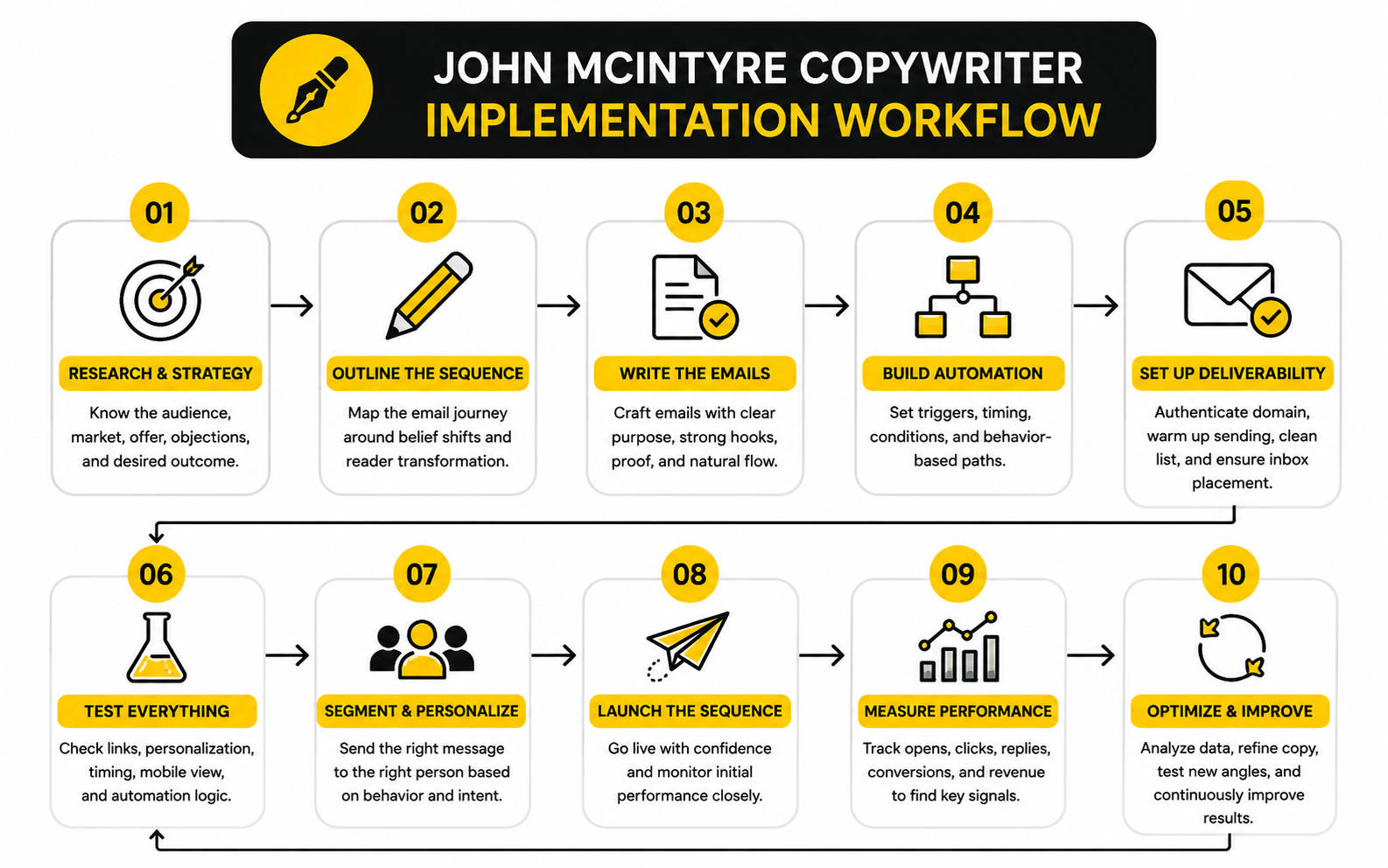
You do not need a complicated dashboard to improve email copy. You need a clean system that connects each metric to a decision. That is the difference between tracking numbers and using numbers.
A practical analytics system should answer five questions:
This gives the team a practical operating rhythm. Review the sequence by stage, not just by campaign. Look for the email where momentum drops, then decide whether the problem is attention, relevance, belief, friction, or timing.
Read Unsubscribes And Complaints As Trust Signals
Unsubscribes are not always bad. Some people should leave your list because they are not a fit, and a clean list usually performs better than a bloated one. But sudden spikes in unsubscribes or complaints are different.
A spike usually means the email violated expectations. Maybe the offer was too aggressive. Maybe the topic did not match why people subscribed. Maybe the frequency changed too quickly. Maybe the sequence made a promise at opt-in and then delivered something else.
This is why onboarding and expectation-setting matter. If people know what kind of emails they will receive, why they matter, and how often they will arrive, engagement has a stronger foundation. The copy does not have to fight confusion before it can persuade.
Measure By Sequence Stage
A welcome email should be measured differently from a deadline email. A reactivation email should be measured differently from a post-purchase email. When you measure every email the same way, you miss the real job each message is supposed to do.
For example, an early education email may have strong performance if it earns replies or clicks to deeper content. A sales email may have strong performance if it produces booked calls or purchases, even if the open rate is average. A reactivation email may have strong performance if it identifies who is still interested and removes who is not.
This stage-based view lines up with the deeper john mcintyre copywriter lesson: autoresponder copy is sequential. Each email should create the conditions for the next one. So the data should show whether that progression is happening.
Turn Data Into Better Copy Decisions
The most useful metrics lead directly to copy decisions. If people open but do not click, tighten the body and strengthen the bridge to the CTA. If people click but do not convert, align the landing page with the email’s promise. If people ignore the first few emails, rewrite the onboarding sequence around a sharper reader problem.
If people engage with proof-heavy emails but not concept-heavy emails, they may need more evidence and less theory. If they click implementation content, they may be asking, “How would this actually work for me?” In that case, the next email should make execution feel simpler.
For agencies and service businesses, this is where a CRM and automation platform such as GoHighLevel can be useful because performance is easier to interpret when email activity, pipeline movement, lead status, and follow-up live in one system. The tool is not the strategy. It simply makes the strategy easier to measure and improve.
Do Not Optimize The Soul Out Of The Email
Data should sharpen the copy, not flatten it. If every email becomes a test of tiny subject line tricks, the brand slowly loses its voice. That is not optimization. That is sanding off the parts that make people care.
The better approach is to use data to find friction, then use judgment to fix it. Numbers can show that the reader stopped moving. They cannot fully explain the emotional reason why. That part still requires copywriting skill.
So measure carefully, but write like a human. The best email systems use analytics to improve timing, targeting, and clarity while keeping the message conversational. That is the balance: practical data underneath, human copy on the surface.
Professional Implementation For Brands, Freelancers, And Agencies
At this stage, the conversation moves from writing better emails to running a better email system. That is the difference between a decent sequence and a serious revenue asset. A john mcintyre copywriter style approach only works at scale when the strategy, copy, automation, deliverability, and measurement all support each other.
The risk is that teams often improve one piece while ignoring the others. They write sharper emails but send them to weak segments. They build clever automations but never define the belief shift. They track performance but do not turn the data into decisions.
Professional implementation means the email program has an operating model. Someone owns the message. Someone owns the data. Someone owns the technical setup. Someone owns the offer path after the click.
Scale The System Without Losing The Voice
Scaling email usually creates one big problem: the more automated the system becomes, the less personal it starts to feel. This happens when teams create too many flows, too many templates, and too many generic branches without a strong voice underneath. The system gets bigger, but the copy gets thinner.
The solution is not to avoid automation. The solution is to define the voice before scaling the automation. Decide what the brand sounds like when it teaches, challenges, sells, apologizes, follows up, and reactivates a cold lead.
That voice should be documented in plain language. Not vague brand words like “innovative” or “friendly.” Use practical rules: how direct the copy should be, how much humor is allowed, which phrases sound off-brand, how CTAs should feel, and how the brand handles urgency without fake scarcity.
Protect Deliverability Before You Chase Volume
Deliverability is not glamorous, but it controls whether the copy gets a fair chance. If emails do not land in the inbox, the best subject line and strongest offer do not matter. This is why scaling email without technical discipline is dangerous.
Google’s sender guidance recommends setting up SPF, DKIM, and DMARC for sending domains and meeting minimum authentication requirements in its email sender guidelines. That is not a creative preference. It is part of the modern cost of sending email at scale.
The strategic tradeoff is simple. You can push volume aggressively and risk damaging sender reputation, or you can grow more carefully and protect long-term inbox placement. The second path is less exciting in the short term, but it is usually the more carefully business decision.
Segment By Intent, Not Just Demographics
Basic segmentation usually starts with surface-level details: role, industry, company size, location, or source. Those fields can be useful, but they do not always tell you what someone wants next. Intent is usually more valuable.
Intent shows up through behavior. Someone who watches a demo, clicks a pricing page, returns to a case study, replies to an email, abandons checkout, or attends a webinar is giving you a signal. The job is to respond to that signal with a message that makes sense.
This is where automation platforms become useful, but only when the strategy is clear. A CRM and automation setup like GoHighLevel can help agencies connect email activity with pipeline stages, missed opportunities, appointments, and follow-up. But the tool will not fix lazy thinking. You still need to decide what each behavior means and what message should follow.
Know When To Use Direct Response And When To Pull Back
Direct response copy is powerful because it asks for action. It makes the value clear, creates urgency, and removes ambiguity. But if every email is written like a launch deadline, the list eventually gets tired.
The advanced move is knowing when to press and when to pull back. Some emails should sell directly. Others should teach, diagnose, reframe, or build preference before the next offer. The sequence needs rhythm.
This is especially important for higher-ticket offers. A reader may need more trust, more proof, and more context before booking a call or making a serious buying decision. If the copy jumps too quickly into pressure, it can create resistance instead of momentum.
Design The Offer Path After The Email
Email does not operate in isolation. The click has to go somewhere, and that destination must continue the same argument. If the email creates one promise and the landing page introduces a different one, conversion drops because the reader has to reorient themselves.
This is a common scaling issue. The copywriter improves the email, but the landing page, booking page, checkout flow, or sales process still leaks attention. That makes the email look weaker than it really is.
For funnel-heavy campaigns, ClickFunnels can fit when the priority is building dedicated opt-in pages, sales pages, order forms, upsells, and campaign-specific paths. For simpler creators or solo operators, Systeme.io may fit when the goal is to combine email, funnels, and digital product delivery without adding too much operational complexity.
Build A Review Process Before Problems Show Up
Professional email teams need a review process that catches problems before subscribers do. This includes checking the promise, the offer, the segmentation, the links, the compliance language, the unsubscribe path, and the handoff after the click. It sounds basic, but basic misses are what hurt trust.
The review process should not be a committee that kills the copy. It should be a quality filter. The goal is to protect clarity, accuracy, compliance, and brand trust without making every email sound like legal approved it sentence by sentence.
A simple review checklist can prevent most issues:
Treat Compliance As Part Of The Customer Experience
Compliance is often treated like a legal chore, but it also affects trust. If people cannot easily unsubscribe, cancel, understand an offer, or control their preferences, they do not simply get annoyed. They lose confidence in the brand.
This became even more visible as regulators pushed harder on subscription and cancellation practices. The FTC finalized a rule intended to make cancellation as easy as signup for negative option programs, though later legal challenges changed the enforcement landscape; the broader lesson still stands because customers increasingly expect simple cancellation and transparent recurring terms through clearer subscription practices.
Email copy should never depend on confusion. If an offer requires hiding the terms, burying cancellation details, or making urgency feel more real than it is, the problem is not the email. The problem is the offer.
Manage AI Without Letting It Flatten The Strategy
AI can help with drafts, variations, research organization, subject line angles, and editing passes. Used well, it can speed up production. Used badly, it creates generic emails that sound smooth but say nothing.
The danger is that AI often produces plausible copy without strategic judgment. It may write a clean email, but it does not automatically know the reader’s stage, the offer’s real objections, the company’s proof, or the business model behind the sequence. That context has to come from the operator.
The best use of AI is as a production assistant, not the strategist. Give it the segment, belief shift, offer, proof, objections, voice rules, and CTA before asking for copy. Then edit like a human who understands the market.
Decide What Should Be Centralized And What Should Stay Flexible
As teams grow, they need consistency. But too much centralization can slow down learning. This is a real tradeoff for brands, agencies, and freelancers managing multiple campaigns.
Centralize the things that protect quality: voice rules, compliance standards, tracking structure, naming conventions, source-of-truth offers, proof libraries, and deliverability practices. Keep flexible the things that need testing: hooks, angles, sequence length, CTA phrasing, audience splits, and follow-up logic.
That balance lets the system scale without becoming rigid. The brand stays consistent, but the copy can still adapt to the market. That is how you keep email performance alive instead of turning the program into a dusty automation folder no one wants to touch.
Know The Risk Of Over-Optimization
There is a point where optimization becomes avoidance. Teams keep testing subject lines because it feels productive, while ignoring the harder question: is the offer strong enough? They tweak button copy while the audience, positioning, or sales process remains broken.
Expert-level email strategy requires honesty. Sometimes the copy is not the bottleneck. Sometimes the lead source is low quality. Sometimes the offer is unclear. Sometimes the product promise is not compelling enough. Sometimes the sales team is too slow to follow up.
That is why the john mcintyre copywriter framework should be seen as a system, not a bag of tricks. The copy matters, but it works best when the offer, audience, automation, and follow-up all support the same commercial goal. Email can do a lot, but it should not be forced to compensate for every weakness in the business.
Common Mistakes, Practical Fixes, And FAQ
The final piece is putting the whole system together. A strong email sequence is not just copy, automation, analytics, or tools. It is the way those pieces work together to move the right reader toward the right action at the right time.
That is why the john mcintyre copywriter topic is bigger than one person’s writing style. The useful lesson is the operating logic behind autoresponder-style selling: understand the reader, guide the belief shift, make the offer feel natural, and measure what happens next. When that system is clear, email becomes much easier to improve.
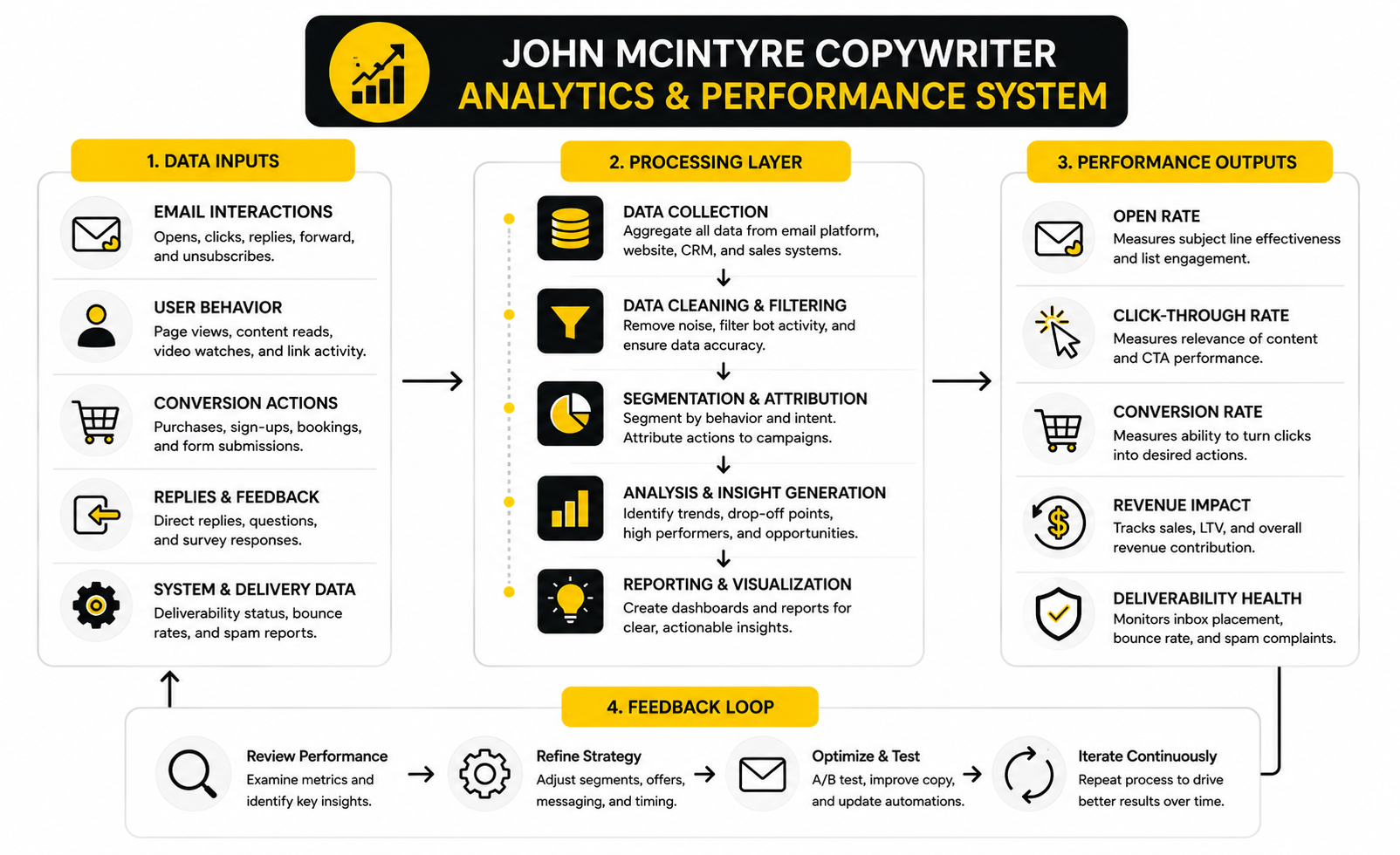
The Final System: Strategy, Copy, Automation, And Feedback
The complete system has four moving parts. Strategy defines who the sequence is for and what decision it should help them make. Copy turns that strategy into clear, human messages. Automation delivers those messages based on timing and behavior. Feedback shows where the reader engaged, hesitated, ignored, clicked, replied, or converted.
When one part is weak, the whole sequence suffers. Great copy sent to the wrong segment will underperform. Smart automation with vague messaging will feel robotic. Clean analytics without strategic interpretation will create busywork instead of better decisions.
The fix is to review the system as a whole. Do not ask only whether the email is well written. Ask whether the email is necessary, whether it appears at the right moment, whether it creates the right belief, whether the CTA makes sense, and whether the next step continues the same promise.
Common Mistakes That Weaken Email Sequences
The first common mistake is writing before strategy. This usually creates emails that sound fine but do not move the reader anywhere specific. The copy has tone, but no job.
The second mistake is selling too early. If the reader does not yet understand the problem, mechanism, proof, or offer logic, a hard pitch can create resistance. The stronger move is to build the buying argument in the right order.
The third mistake is over-automating without enough human judgment. Just because a platform can trigger twenty branches does not mean every branch deserves to exist. Complexity should make the experience more relevant, not just make the workflow look impressive.
The fourth mistake is optimizing the wrong metric. A subject line test may improve opens while the offer still fails. A landing page tweak may increase clicks while lead quality drops. Always connect optimization back to the business outcome that actually matters.
Practical Fixes Before You Rewrite Everything
Before rebuilding a full sequence, identify the biggest point of friction. If people are not opening, look at sender trust, list source, subject clarity, and timing. If people open but do not click, the body may not be creating enough relevance or desire.
If people click but do not convert, the issue may be the landing page, offer, pricing, proof, or sales handoff. This is where tools can help, but only after the diagnosis is clear. A funnel builder like ClickFunnels may help if the offer path after the email is the problem, while GoHighLevel may fit better when the bigger issue is CRM follow-up, pipeline visibility, or lead nurturing.
Start with the simplest useful fix. Rewrite the opening. Clarify the CTA. Split high-intent subscribers into a separate follow-up. Remove a weak email from the sequence. Improve the page after the click. Small fixes compound when they are aimed at the right bottleneck.
Who is John McIntyre in copywriting?
John McIntyre is widely known in email marketing circles as “The Autoresponder Guy.” His public work is associated with email copywriting, autoresponder sequences, behavior-based campaigns, and selling through automated follow-up. In practical terms, people search for john mcintyre copywriter because they want to understand how email copy can create sales without relying on random broadcasts.
What is the main lesson from John McIntyre’s copywriting approach?
The main lesson is to think in sequences, not isolated emails. Each email should have a clear job in the buying journey, whether that job is to build trust, explain the problem, introduce the mechanism, handle an objection, or make an offer. This makes email feel more natural because the reader is being guided instead of pushed.
Is this approach only for email copywriters?
No, it applies to founders, agencies, freelancers, coaches, consultants, ecommerce brands, course creators, and SaaS teams. Anyone who uses email to nurture leads or convert buyers can use the same principles. The core idea is simple: match the message to the reader’s stage and make the next step feel obvious.
What makes autoresponder copy different from regular newsletters?
Autoresponder copy is usually built around a planned sequence with a specific goal. A newsletter may inform, entertain, or maintain relationship, while an autoresponder often moves a subscriber through a structured path after a trigger such as signup, download, webinar registration, abandoned checkout, or inquiry. Both can be valuable, but the sequence needs tighter strategy because it is designed to create momentum.
How many emails should an autoresponder sequence have?
There is no perfect number. A simple offer may need three to five emails, while a higher-ticket service or complex product may need a longer sequence with more education, proof, and objection handling. The better question is how many belief shifts the reader needs before the offer feels like a reasonable next step.
What should the first email in a sequence do?
The first email should confirm the subscriber made a good decision by joining, clicking, downloading, registering, or requesting information. It should set expectations, create trust, and point toward the next useful step. It should not try to do everything at once.
What is the biggest mistake people make with email copy?
The biggest mistake is writing without knowing the email’s job. When the goal is unclear, the message becomes vague, bloated, or overly promotional. Good email copy starts with the reader’s context and one specific belief shift.
Should every email include a CTA?
Most emails should include some kind of next step, but the CTA does not always need to be a hard sales action. Sometimes the next step is reading a guide, watching a short explanation, replying with a question, checking a case study, or reviewing an offer. The CTA should match the stage of the sequence.
How do you know if an email sequence is working?
Look at the full path, not one metric. Opens show attention, clicks show relevance, conversions show whether the offer path works, replies show engagement, and revenue shows commercial impact. The best diagnosis comes from seeing where momentum drops between one step and the next.
Are templates useful for this kind of copywriting?
Templates can help, but they should not replace thinking. A template is useful when it gives structure to a clear strategy. It becomes dangerous when people paste in generic copy without understanding the reader, the offer, or the belief shift.
Can AI write email sequences like this?
AI can help draft, edit, brainstorm angles, and create variations, but it should not replace strategy. The strongest inputs still need to come from a human who understands the market, the offer, the proof, the objections, and the customer’s decision process. AI is useful as a production assistant, not as the owner of the persuasion strategy.
What tools are useful for implementing this system?
The right tool depends on the business model. Agencies and local-service businesses may prefer GoHighLevel because CRM, automation, appointments, pipeline management, and follow-up can live together. Funnel-heavy businesses may prefer ClickFunnels, while simpler digital-product businesses may consider Systeme.io when they want funnels, email, and product delivery in one place.
How should a freelancer use this guide?
A freelancer can use this guide as a service blueprint. Instead of selling “emails,” sell the outcome: a planned sequence that maps the buyer journey, handles objections, improves follow-up, and gives the client a repeatable asset. That is a much stronger offer than simply charging per email.
How should a business owner use this guide?
A business owner should use it to audit the current email system. Look at where leads enter, what they receive next, what action each email is supposed to drive, where people stop responding, and whether the offer path after the click is consistent. That will usually reveal the highest-leverage fix.
Is email copywriting still worth learning?
Yes, because email sits close to the buying decision. Social content can create awareness, ads can drive traffic, and SEO can capture demand, but email is often where trust, timing, and follow-up turn attention into revenue. The skill is not just writing nicer emails; it is understanding how people move toward a decision.
Build a stronger local presence with BAAM AI
Turn your website, Google profile, social channels, and AI visibility into one growth engine
Most businesses do not need more random marketing activity. They need a consistent presence system that helps the right people find them, trust them, and take action. BAAM AI brings strategy, local SEO, website updates, Google Maps visibility, social content, AI-search readiness, media production, and reporting into one practical monthly engine.
If you want your marketing to keep working after the campaign ends, start with a free BAAM AI presence audit. See how your business shows up today and where the fastest visibility wins are at BAAM AI.