
BAAM AI Blog
John Forde Copywriter: The Practical Guide To Studying His Direct Response Method
John Forde is not the kind of copywriter you study because he has a flashy personal brand. You study him because his work sits close to the engine room of direct response: research, positioning, lead selection, offer...

John Forde is not the kind of copywriter you study because he has a flashy personal brand. You study him because his work sits close to the engine room of direct response: research, positioning, lead selection, offer framing, and sales arguments that move readers toward a measurable action.
That matters because a lot of modern copywriting advice skips the hard part. It talks about hooks, formulas, AI prompts, swipe files, and “high-converting words,” but it often ignores the deeper decision underneath the copy: what does this market already believe, what does it badly want, and what kind of opening will make the reader care enough to continue?
John Forde’s name comes up often in that deeper conversation. His long-running Copywriter’s Roundtable says he has worked in direct-response copywriting for more than 23 years, especially in financial and health information publishing, and that his copy and mentoring have helped generate hundreds of millions of dollars and tens of thousands of subscriptions. His AWAI profile describes him as a copywriter who has written winning controls for more than 25 years, advised businesses on six continents, and co-authored Great Leads with Michael Masterson.
this guide is not going to pretend that studying one copywriter gives you a magic template. It will break down what makes the John Forde copywriter approach useful: the emphasis on research before writing, the discipline of choosing the right lead, the ability to match message to market awareness, and the professional standards behind copy that has to survive real-world testing.
Why John Forde Still Matters In Direct Response Copywriting
John Forde matters because his work represents a more serious version of copywriting than the one most beginners see online. He is associated with long-form direct response, sales letters, financial newsletters, health promotions, and information products where copy is not judged by applause. It is judged by response.
That alone makes his approach useful for marketers, founders, creators, and freelance copywriters. If your landing page, email sequence, advertorial, sales letter, webinar registration page, or funnel has to persuade strangers to act, you are dealing with the same core problem. You need to earn attention, build belief, handle resistance, and make the offer feel like a natural next step.
This is also why tools and platforms do not replace the underlying skill. A page builder, CRM, chatbot, or funnel platform can help you publish and automate the message, but it cannot decide the best strategic angle for a skeptical market. If you are building funnels, platforms like ClickFunnels, GoHighLevel, or Systeme.io can be useful, but the copy still has to do the persuasion.
The John Forde Framework For Better Sales Copy
The practical framework starts with a simple idea: the lead is not just the beginning of the copy. It is the strategic doorway into the entire sales argument. Great Leads, the book co-authored by Michael Masterson and John Forde, is built around the idea that different markets require different ways into the conversation, and that choosing the wrong opening can weaken everything that follows.
That is a much more useful way to think than “write a better hook.” A hook can be clever and still fail if it attracts the wrong reader, creates the wrong expectation, or makes a promise the rest of the promotion cannot support. A lead has to connect the reader’s current state of awareness with the product’s strongest believable promise.
The core framework looks like this:
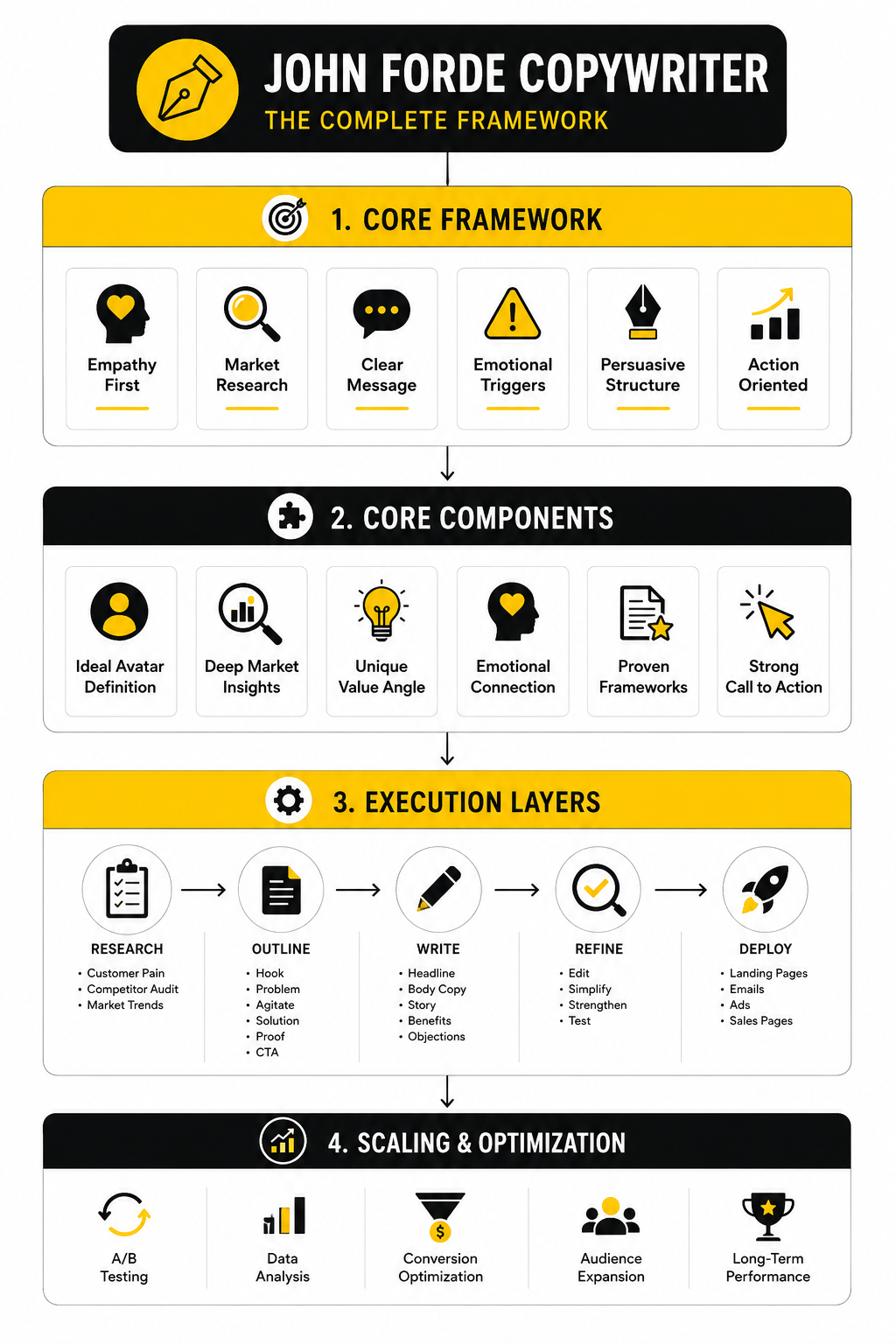
Core Components Of The John Forde Copywriter Approach
The first component is research. John Forde is repeatedly associated with research-heavy copywriting, and interviews with him often focus on how copy begins before drafting. That is the part many writers want to skip, but it is also where the strongest ideas usually appear.
The second component is lead selection. Great Leads is widely known for organizing sales-message openings into six lead types, giving copywriters a way to match the opening to the market instead of guessing. That matters because a product-aware reader and a problem-aware reader do not need the same opening.
The third component is structure. A strong sales message does not merely stack benefits and testimonials. It has to unfold in a sequence that makes the reader feel understood, shows them why the problem matters now, introduces a credible mechanism, proves the promise, and makes the offer feel timely.
The fourth component is professional restraint. Good direct-response copy can be energetic, emotional, and bold, but it still has to be grounded in a believable claim. That is especially important in markets like finance and health, where exaggerated promises can destroy trust and create compliance problems.
Professional Implementation
To apply this in a real business, start by separating copy production from copy strategy. Writing the page is not the first step. The first step is understanding the buyer, the market’s sophistication, the competitive claims, the proof assets, and the offer economics.
Then decide what the copy must accomplish at the top of the page or message. Cold traffic may need education and curiosity. Warm prospects may need differentiation. Existing subscribers may need a sharper reason to act now. That choice should shape the lead, not the other way around.
Finally, connect the copy to a system that can actually measure response. Email platforms such as Brevo, Moosend, and funnel systems like GoHighLevel are only useful when they let you test the real question: did the argument move the right people closer to buying?
The John Forde Framework For Better Sales Copy
The John Forde copywriter approach starts with a decision most writers make too late: what kind of conversation are we entering? Not every reader arrives with the same level of awareness, the same belief in the problem, or the same trust in the solution. That is why a strong direct-response message cannot begin with a random hook, even if the hook sounds clever.
A better way to think about the framework is this: the lead chooses the path into the reader’s existing thoughts. If the reader already wants the product, you can be direct. If the reader only feels a vague frustration, you need to open with a problem, story, secret, prediction, or mechanism that makes the issue feel urgent and solvable.
This is where John Forde’s work with Michael Masterson on Great Leads becomes practical. The book is known for organizing sales-message openings into six major lead types, but the bigger lesson is not just the list. The real lesson is that copy works better when the opening matches the reader’s awareness, sophistication, skepticism, and desire.
Start With Market Awareness
Market awareness is the first filter. A reader who already knows the product and trusts the category does not need the same amount of education as a reader who has never thought about the problem before. If you treat both readers the same, you either bore the warm prospect or confuse the cold one.
This idea connects closely with the classic direct-response principle that Eugene Schwartz popularized in Breakthrough Advertising: the message should match what the market already knows. A prospect can be completely unaware, problem-aware, solution-aware, product-aware, or ready to buy. Each stage requires a different level of explanation, proof, and emotional pressure.
For example, a product-aware reader may respond to a clear offer, a strong guarantee, and a specific reason to act now. A problem-aware reader may need a sharper explanation of why the problem keeps happening and why common fixes fail. A less-aware reader may need a more indirect opening that earns attention before the sales argument becomes obvious.
Match The Lead To The Reader
The lead is not decoration. It is the strategic entry point into the entire promotion. When people talk about a John Forde copywriter framework, this is usually the part they mean, because the lead determines the angle, the proof burden, and the emotional speed of the message.
A direct lead works when the reader is already close to buying. A promise lead works when the main benefit is both desirable and believable. A problem-solution lead works when the pain is already felt, but the reader needs a better way forward.
Other leads take a more indirect route. A secret lead can work when the market is tired of obvious claims. A story lead can work when emotional identification matters. A proclamation or prediction lead can work when a strong point of view creates curiosity and authority.
The mistake is using the lead type you personally like instead of the one the market needs. A dramatic story lead can feel powerful, but it may be too slow for a product-aware audience. A direct promise can feel efficient, but it may fail when the market is skeptical and needs a new mechanism before it believes the claim.
Build The Argument Around One Dominant Idea
Once the lead is chosen, the rest of the copy needs one dominant idea. Not five themes. Not a pile of benefits. One central argument that everything else supports.
This is where weak sales copy usually collapses. It starts with a good opening, then wanders into features, testimonials, founder stories, urgency, bonuses, and pricing without a clear spine. The reader may understand the product, but they do not feel the argument tightening.
A stronger message keeps returning to the same core belief. The problem is real. The old way is limited. The new mechanism makes the outcome possible. The offer gives the reader a practical way to act on that belief today.
That structure is especially important when using modern funnel tools. Whether the page is built in ClickFunnels, GoHighLevel, Systeme.io, or another platform, the software cannot create the strategic spine for you. It can publish the page, automate the follow-up, and track the numbers, but the persuasion still comes from the argument.
Use Proof Before Pressure
Strong direct-response copy does not rely on urgency too early. Pressure only works after belief is built. If the reader does not believe the promise, a deadline just makes the offer feel more suspicious.
The John Forde style of thinking pushes copywriters to build proof into the message before asking for action. That proof can come from a mechanism, a demonstration, a credible explanation, specific details, expert authority, real customer evidence, or a clear contrast with the alternatives. The point is not to dump proof everywhere. The point is to remove the exact doubts that would stop the reader from moving forward.
This is also why vague copy feels weak. “Save time” is not proof. “Get better results” is not proof. “Grow your business faster” is not proof. The more competitive the market, the more specific and grounded the proof has to be.
Keep The Reader Moving
A good sales message has momentum. Each section should answer the question the reader is likely asking at that moment. If the lead creates curiosity, the next section must reward it. If the copy introduces a bold claim, the next section must support it. If the offer appears, the reader should already understand why it matters.
This is practical, not theoretical. The reader is always deciding whether to continue. Every paragraph either increases trust, increases desire, reduces confusion, or loses attention.
That is why the best implementation of the John Forde copywriter method is not to copy his surface style. It is to copy the discipline underneath it. Start with the market, choose the right lead, build one strong argument, prove before you pressure, and keep the reader moving until the action feels obvious.
Research Before Writing: The Discipline Behind The Copy
The strongest lesson from the John Forde copywriter method is not that you need a better headline. It is that you need a better understanding of the buyer before the headline even exists. Research is where the copywriter finds the emotional pressure, the proof, the angle, the objections, and the language that will later make the copy feel sharp instead of generic.
This is where many writers get impatient. They want to open a blank document and start sounding persuasive. But direct-response copy does not become persuasive because the writer sounds confident. It becomes persuasive because the writer has found something true, specific, and valuable enough for the reader to care about.
Research is not about collecting endless notes either. That can become procrastination. The goal is to gather the raw material that helps you choose the right lead, build the right argument, and make the offer feel connected to a real need.
Start With The Buyer’s Current Belief
Before writing, ask what the reader already believes. Do they believe the problem is urgent? Do they believe the category works? Do they trust products like this? Do they think they have already tried everything?
These questions matter because copy is not written into silence. It lands inside a reader’s existing beliefs, frustrations, doubts, hopes, and assumptions. If the copy ignores those beliefs, the reader feels unseen, and once that happens, the rest of the argument becomes harder to sell.
A useful first pass looks like this:
This is not theory. It is the difference between copy that sounds like marketing and copy that sounds like it came from inside the reader’s head.
Study The Market Before The Product
Many copywriters begin with the product because it feels logical. They read the features, the deliverables, the pricing, the bonuses, and the guarantee. That information matters, but it is not the whole job.
The market tells you how the product should be framed. If every competitor is shouting the same promise, your copy needs a sharper mechanism or a more believable angle. If the market has been burned before, the copy needs to slow down and rebuild trust before pushing the offer.
This is why a John Forde copywriter approach fits serious direct response so well. It does not treat the offer as isolated. It treats the offer as one option inside a crowded market, where the reader is comparing claims, ignoring hype, and looking for a reason to believe this message over the others.
Build A Research File That Actually Helps
A good research file is not a messy folder of screenshots and random quotes. It should help you make decisions. If it does not help you choose the lead, sharpen the promise, strengthen the proof, or handle objections, it is probably noise.
The most useful research file usually includes:
That last point matters. Urgency should not be pasted on at the end. It should come from the situation, the opportunity, the cost of waiting, or the natural reason the offer matters now.
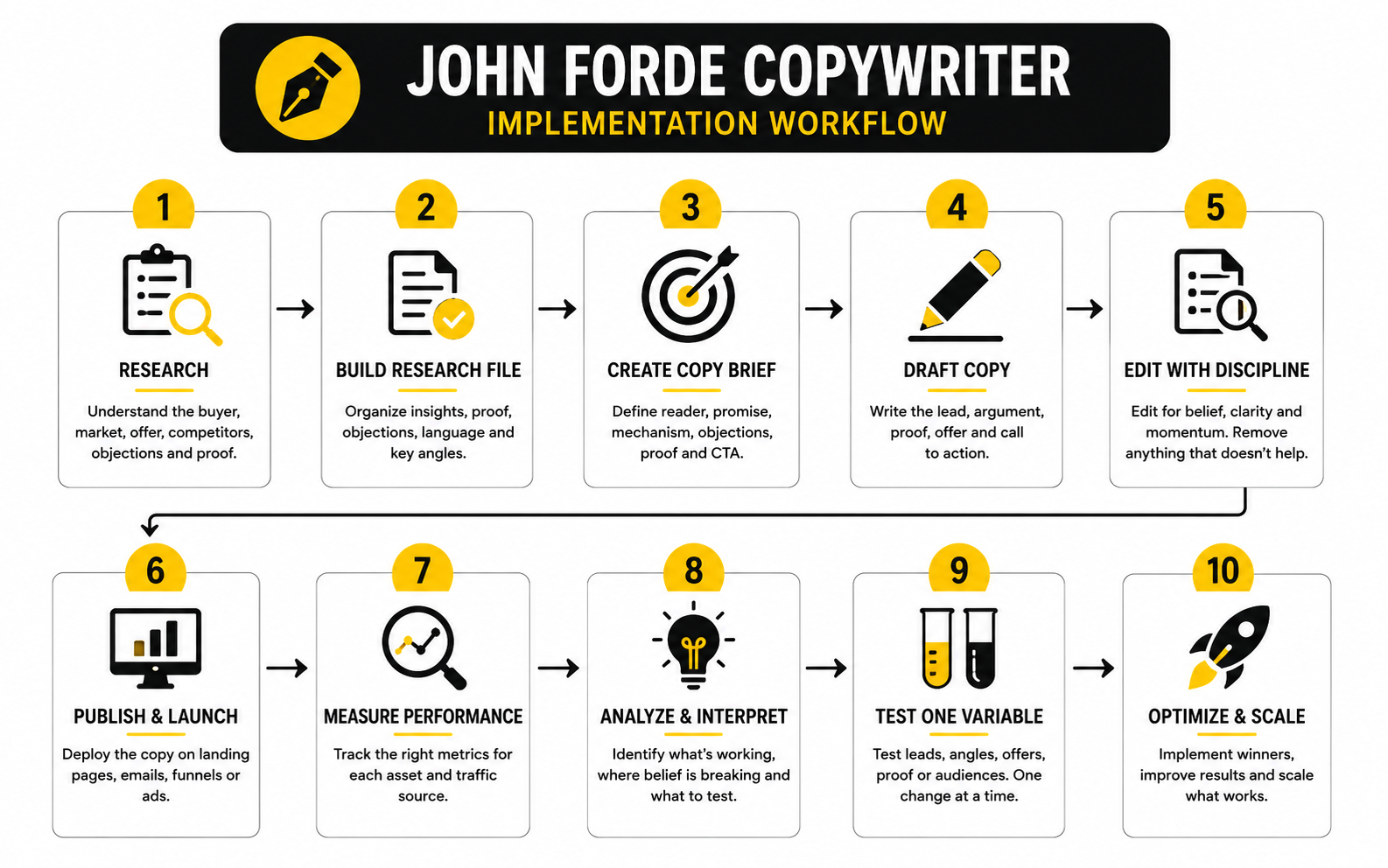
Turn Research Into A Working Copy Brief
Once the research is organized, turn it into a copy brief before drafting. This is the bridge between information and execution. Without it, you are still guessing.
A practical copy brief should answer these questions:
This brief keeps the writing focused. It also makes editing easier because you can judge every section against the strategy instead of relying on taste. If a paragraph does not support the main argument, increase belief, reduce friction, or move the reader forward, it probably needs to go.
Draft From The Argument, Not The Template
Templates can help, but they can also make copy lazy. A template gives you a sequence. It does not give you the argument. The argument has to come from the research.
This is especially important when writing funnel pages, email sequences, webinar pages, or advertorials. A tool like ClickFunnels can help you publish and test a sales flow, and GoHighLevel can help agencies manage follow-up, pipelines, and automation. But neither one replaces the thinking required to decide why the reader should believe you.
The better workflow is simple. Research first. Brief second. Draft third. Edit fourth. Test fifth. That order prevents the common mistake of polishing weak copy that was built on a vague strategy.
Edit For Belief, Clarity, And Momentum
The first draft is not supposed to be perfect. It is supposed to get the argument onto the page. The real improvement happens when you edit with discipline.
Start by editing for belief. Look for claims that sound bigger than the proof can support. Then edit for clarity. Remove clever lines that slow the reader down or make the promise harder to understand. Finally, edit for momentum. Every section should make the next section feel worth reading.
This is where professional copy starts to separate itself from amateur copy. Amateur copy often tries to impress the reader. Professional copy guides the reader. It knows what belief needs to be built next, and it removes anything that gets in the way.
Statistics And Data: Measuring Whether The Copy Is Working
A John Forde copywriter approach is not complete until the copy meets the numbers. Direct-response copy is not judged by how polished it sounds. It is judged by whether the right readers take the next step.
That does not mean you should dump every metric into a dashboard and call it analysis. Data is useful only when it helps you make a decision. The goal is to understand where the sales argument is gaining belief, where it is losing attention, and what should be tested next.
This is why measurement has to be built around the copy’s job. A lead should earn attention. The body copy should build belief. The offer section should create desire and reduce risk. The call to action should turn that desire into a measurable action.
The Metrics That Actually Matter
The first metric is not always the sale. In a longer funnel, the sale may happen after several touchpoints. That means the copy should be measured by the action it is responsible for, not by a random number pulled from the whole customer journey.
For a landing page, the main metric may be opt-in rate, checkout conversion, booked calls, trial starts, or purchases. For an email, it may be clicks, replies, booked appointments, or revenue per recipient. For an advertorial, it may be click-through to the offer, time on page, scroll depth, or the quality of visitors sent into the sales page.
Benchmarks can help, but only as context. Email benchmark data changes heavily by industry, list quality, offer type, and audience intent, which is why broad open-rate or click-rate averages should not be treated as universal targets. The more useful move is to compare your own segments, offers, and traffic sources over time.
Benchmarks Are Clues, Not Rules
A landing page conversion rate that looks weak in one market may be strong in another. Industry benchmark data often shows wide gaps across verticals, with legal, education, ecommerce, SaaS, and B2B lead generation behaving very differently. That means “good conversion rate” is not a single number.
The same is true with email. A high open rate can look exciting, but it does not prove the copy is profitable. It may only prove that the subject line created curiosity. If clicks, replies, booked calls, or purchases do not follow, the message may be attracting attention without building enough buying intent.
This is where copywriters need discipline. Do not optimize for the easiest number to improve. Optimize for the number that reflects the next real step in the sales argument.
Build A Simple Measurement System
A practical measurement system connects each part of the message to a specific behavior. You do not need a complicated analytics stack to start. You need clarity about what each page, email, or section is supposed to make the reader do.
The system can be simple:
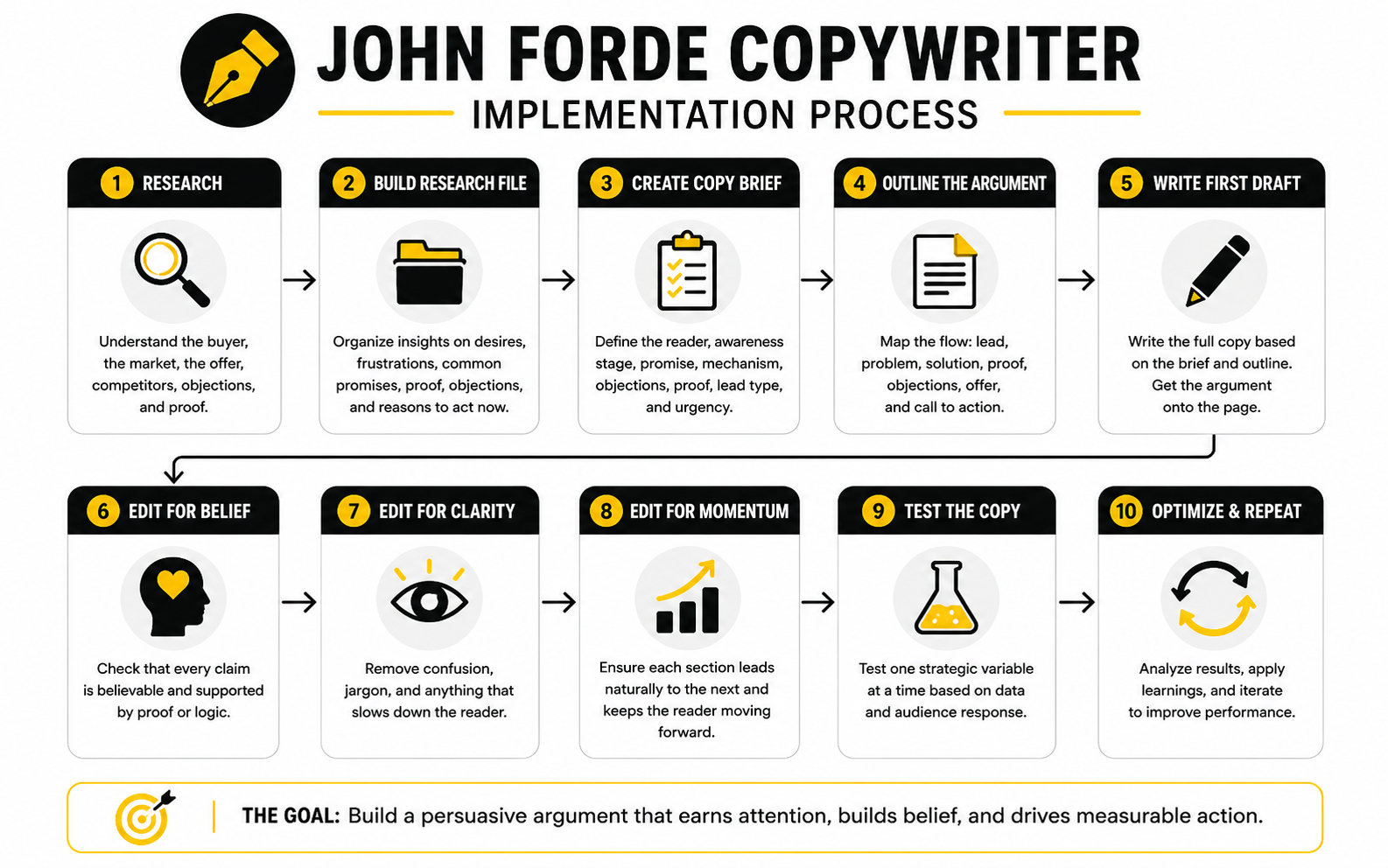
This keeps the data useful. If the lead is weak, you may see low scroll depth, low time on page, or poor continuation into the next step. If the body argument is weak, people may read but not click. If the offer is weak, you may see clicks without purchases or booked calls.
What Performance Signals Usually Mean
A low click-through rate often points to a weak bridge between attention and desire. The reader may understand the topic, but they do not feel enough reason to move forward. In that case, changing the button text is usually less important than improving the promise, mechanism, or proof.
A high click-through rate with low conversion on the next page often points to expectation mismatch. The first message may be creating curiosity that the next page does not satisfy. It may also mean the traffic is too broad, the offer is unclear, or the call to action asks for too much too soon.
A strong open rate with weak email clicks often means the subject line did its job, but the email body failed to convert attention into intent. This is common when writers over-focus on hooks and under-build the argument. A John Forde copywriter mindset would bring the attention back to belief: what must the reader believe before clicking feels natural?
A high bounce rate on a sales page can mean the lead is wrong for the traffic. It can also mean the page speed, design, or message match is broken. Do not assume the copy is the only issue, but do not hide behind design either. The first screen has to make the right reader feel they are in the right place.
Test The Strategic Variable First
The most useful tests are not tiny cosmetic tweaks. Button color, punctuation, and minor layout changes rarely fix a weak argument. Start by testing the strategic variable that could change the reader’s belief.
That usually means testing one of these:
This is where tools can help, but only if the thinking is already sound. Platforms like ClickFunnels, GoHighLevel, and Systeme.io can make funnel testing and follow-up easier. But the test still needs a strategic hypothesis, not a random change.
Read Data Like A Copywriter
Data tells you what happened. It does not automatically tell you why. That interpretation is where the copywriter’s judgment matters.
If people do not click, ask what belief is missing. If they click but do not buy, ask what expectation broke. If they buy once but do not continue, ask whether the promise matched the delivery. If one segment converts better than another, ask what that segment already believed before seeing the copy.
The point is not to worship analytics. The point is to use analytics to improve persuasion. Good numbers show you where the argument is working, and bad numbers show you where the reader stopped believing.
Turning Strategy Into Professional Copy
At this stage, the article has covered the big pieces: the market, the lead, the research file, the brief, and the measurement system. The next step is turning that into professional copy without losing the strategic discipline. This is where good copywriters become valuable, because the work becomes less about writing pretty lines and more about managing tradeoffs.
A John Forde copywriter mindset is useful here because it forces you to respect the whole sales environment. The copy has to attract attention, but not the wrong attention. It has to make a strong promise, but not an inflated one. It has to create urgency, but not pressure so aggressive that it weakens trust.
Professional copy lives in that tension. The better you get, the more you realize that every strong choice has a cost. A more dramatic lead may earn more attention, but it may also require more proof. A more direct offer may convert warm prospects faster, but it may underperform with colder traffic. A more curiosity-driven angle may increase clicks, but it can create disappointment if the next page does not pay off the curiosity honestly.
The Tradeoff Between Curiosity And Clarity
Curiosity is powerful, but it is easy to misuse. If the opening is too obvious, the reader may feel there is nothing new to learn. If the opening is too vague, the reader may not understand why the message matters.
The practical answer is not to choose curiosity or clarity. It is to make the reader curious about something specific. The reader should know the category of value being promised, even if they do not yet know the full mechanism, proof, or offer.
This is especially important in email, advertorials, and funnel entry points. A subject line or headline can create a click, but the next step has to feel like a natural continuation. When curiosity creates a mismatch, performance may look good at the top of the funnel and fall apart later.
The Risk Of Overwriting
A lot of copy fails because the writer keeps adding more. More claims. More metaphors. More proof. More urgency. More “voice.”
That usually happens when the core argument is not strong enough. Instead of sharpening the central idea, the copy gets louder. The reader feels the effort, and effort is not the same as persuasion.
Professional copy is often simpler than beginners expect. It does not mean the copy is short. It means every section has a job. The best long-form copy can run for thousands of words and still feel clean because the reader always knows why the next paragraph exists.
Compliance Is Part Of The Craft
If you write in finance, health, supplements, investing, coaching, income claims, or performance marketing, compliance is not a separate department that cleans things up later. It has to shape the copy from the start. The FTC’s health-product guidance says benefit and safety claims should be truthful, not misleading, and supported by science, while the SEC’s investment adviser marketing guidance places strict conditions around testimonials, endorsements, performance claims, and disclosures.
That matters because direct response often pushes toward stronger promises. Stronger promises can increase attention, but unsupported promises create risk. The copywriter’s job is to find the most compelling truthful claim, not the most aggressive claim that can be squeezed past review.
This is where research protects you. If a claim is backed by solid proof, the copy can be confident without becoming reckless. If the proof is weak, the message needs to be reframed, narrowed, qualified, or removed.
Scaling Copy Without Diluting The Message
Scaling creates a new problem. The first winning sales message may work because it is tightly matched to one audience, one promise, and one offer. When a team tries to scale it across ads, emails, landing pages, webinars, sales scripts, and follow-up sequences, the message can become watered down.
The fix is to create a message hierarchy before scaling. The team should know the main promise, the primary mechanism, the core proof, the strongest objection, the approved claims, and the language that must stay consistent. Without that hierarchy, every channel starts inventing its own version of the offer.
This is where automation platforms can help when they are used correctly. A business running multi-step follow-up inside GoHighLevel, list campaigns inside Brevo, or sales pages inside ClickFunnels still needs one clear argument underneath the entire customer journey. The platform should distribute the message, not fragment it.
When To Use AI In The Process
AI can speed up parts of the copy process, but it should not replace the strategic judgment. It can help summarize research, organize objections, create draft variations, turn a brief into first-pass copy, and pressure-test angles. That is useful.
The danger is letting AI create the strategy from shallow inputs. If the prompt is generic, the output will usually be generic too. It may sound polished, but it will miss the market’s real tension, the product’s strongest proof, and the buyer’s unspoken hesitation.
The better approach is to use AI after the research file and copy brief exist. Give it the positioning, reader awareness, proof assets, objections, prohibited claims, and offer details. Then treat the output as raw material, not finished copy.
Protect The Big Idea
Every strong promotion needs a big idea, but the big idea is not always loud. Sometimes it is a new mechanism. Sometimes it is a contrarian belief. Sometimes it is a fresh way to name a familiar pain. Sometimes it is a timing insight that makes the offer feel urgent now.
The risk is that the big idea gets buried under tactics. The team starts debating button copy, email timing, headline punctuation, or funnel layout before the main argument is clear. Those details matter later, but they cannot rescue a weak idea.
A John Forde copywriter approach keeps the big idea in view. The lead introduces it. The body proves it. The offer monetizes it. The follow-up reinforces it. When those pieces align, the copy feels less like a pitch and more like a clear path forward.
FAQ: John Forde, Great Leads, And Direct Response Copywriting
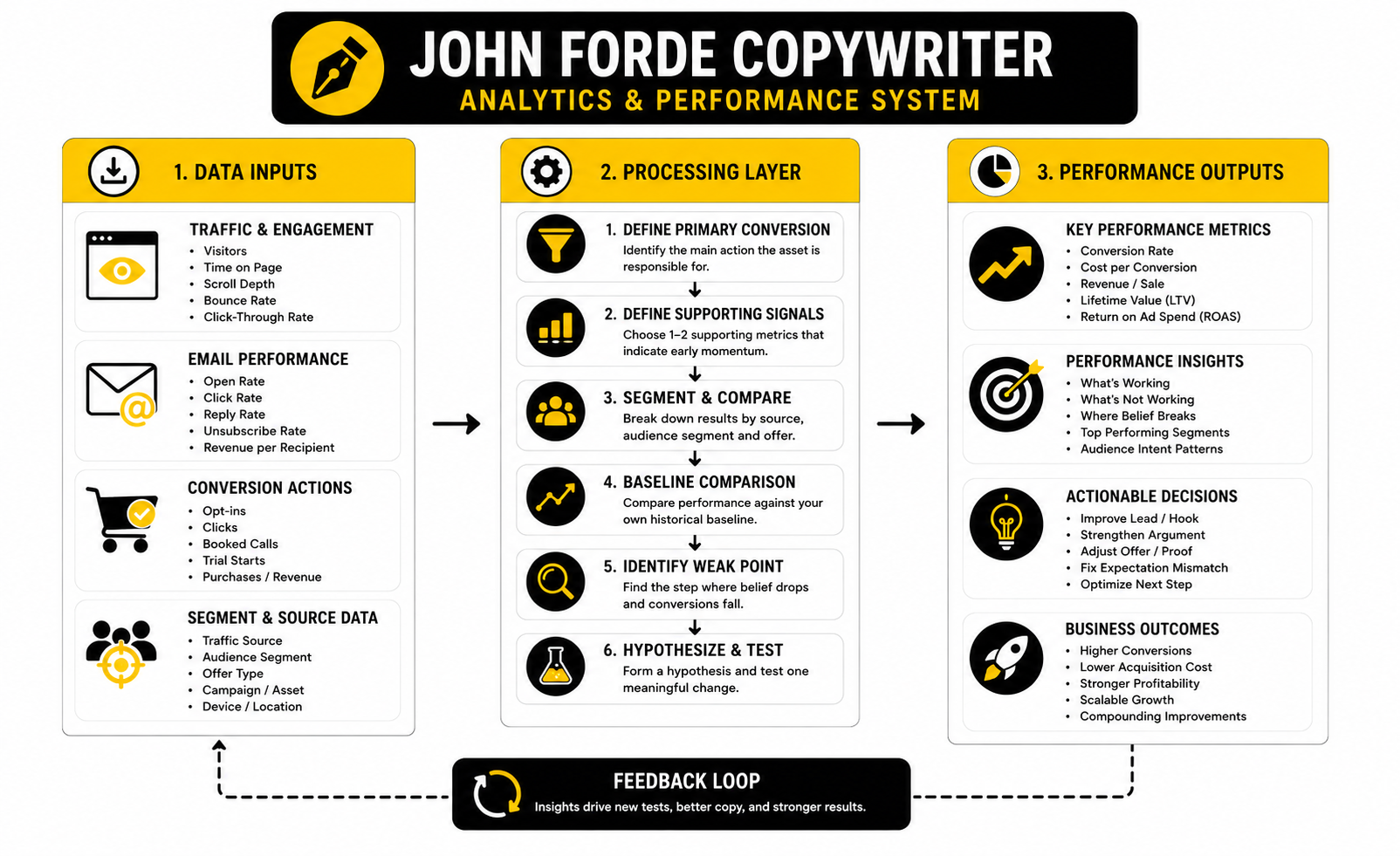
At the end of the process, the real value of studying John Forde is not that you get a fixed formula to copy. It is that you get a way to think more clearly before writing. That matters because serious copywriting is not just the act of putting persuasive words on a page.
It is a system. The research shapes the strategy. The strategy shapes the lead. The lead shapes the argument. The argument shapes the offer. The offer shapes the test. The test teaches you what the market actually believes.
Who Is John Forde?
John Forde is a direct-response copywriter, editor, teacher, and co-author of Great Leads with Michael Masterson. He is closely associated with long-form sales copy, financial publishing, health promotions, and the kind of persuasive writing that has to produce measurable action. His work is useful to study because it emphasizes research, market awareness, lead selection, proof, and strategic discipline.
Why Do Copywriters Study John Forde?
Copywriters study John Forde because his approach goes deeper than surface-level hooks and headline tricks. The John Forde copywriter method focuses on choosing the right way into the reader’s mind before drafting the message. That makes it especially useful for sales pages, advertorials, email campaigns, launch funnels, and long-form direct-response promotions.
What Is Great Leads?
Great Leads is a direct-response copywriting book by Michael Masterson and John Forde. It explains different ways to begin a sales message and shows why the lead should be chosen based on the reader’s awareness, skepticism, and relationship to the offer. The book is widely discussed because it gives copywriters a practical framework for matching the opening of a promotion to the market.
What Are The Six Lead Types In Great Leads?
The six lead types commonly associated with Great Leads are direct, promise, problem-solution, secret, proclamation, and story. Each one creates a different path into the sales argument. A direct lead is usually better for warmer prospects, while more indirect leads can work when the reader needs curiosity, context, or a new belief before the offer makes sense.
Is The John Forde Copywriter Approach Only For Long-Form Sales Letters?
No. The principles apply far beyond classic sales letters. The same thinking can improve landing pages, email sequences, webinar pages, video sales letters, advertorials, lead magnets, checkout pages, and follow-up campaigns. The format changes, but the core job stays the same: understand the reader, choose the right angle, build belief, and move the reader toward action.
How Does This Approach Help With Modern Funnels?
Modern funnels often fail because the tools are set up before the message is clear. A platform can handle pages, forms, automation, tagging, and follow-up, but it cannot decide the strongest sales argument by itself. If you use tools like ClickFunnels, Systeme.io, or GoHighLevel, the copy strategy still has to come first.
What Should You Research Before Writing Sales Copy?
Research should cover the buyer, the market, the offer, the competitors, the objections, and the proof. You want to know what the reader wants, what they have tried, what they doubt, what language they use, and what would make the product feel believable. The best research does not just fill a document. It helps you choose the lead, shape the promise, and decide what the reader must believe before buying.
How Do You Know Which Lead Type To Use?
Start with awareness. If the reader already understands the product and wants the outcome, a direct or promise-driven lead may work. If the reader is skeptical, unaware, or tired of common claims, a more indirect lead may be stronger because it gives you room to introduce a new mechanism, story, or insight before making the offer.
What Is The Biggest Mistake Beginners Make With This Framework?
The biggest mistake is treating the six lead types like templates instead of strategic choices. A beginner may pick a story lead because it sounds engaging or a secret lead because it feels exciting. A professional asks a better question: which opening gives this specific reader the best path toward belief?
How Should Copywriters Measure Whether The Copy Is Working?
Measure the action the copy is responsible for. For a landing page, that may be opt-ins, booked calls, purchases, or checkout conversion. For an email, it may be clicks, replies, appointments, or revenue per subscriber. The important part is to connect the metric to the job of the asset instead of chasing vanity numbers.
Does AI Replace This Kind Of Copywriting?
AI can help with drafting, summarizing research, generating variations, and organizing ideas, but it does not replace strategic judgment. The output is only as strong as the input. If the research, positioning, proof, and offer logic are weak, AI will usually create polished but generic copy.
Can This Approach Work For Agencies And Freelancers?
Yes, and it can be especially useful for agencies and freelancers because it gives the work a repeatable process. Instead of selling “copy,” you can sell research, strategy, funnel messaging, testing, and optimization. That positions you as a professional who improves revenue systems, not just someone who writes pages.
What Is The Best Way To Practice The John Forde Copywriter Method?
Practice by analyzing real promotions instead of only reading theory. Identify the lead type, the dominant promise, the mechanism, the proof, the objections, and the offer structure. Then write your own version for a different awareness level so you learn how the same product can require a different opening depending on the reader.
Should Every Sales Message Have One Big Idea?
Yes, if it wants to be memorable and persuasive. The big idea does not always need to be dramatic, but the message needs one clear strategic center. Without it, the copy becomes a list of benefits, proof points, urgency triggers, and bonuses instead of a focused argument.
What Makes This Approach Different From Basic Copywriting Formulas?
Basic formulas tell you what order to put things in. The John Forde copywriter approach helps you decide what the message should be about in the first place. That is the more valuable skill because structure only works when the underlying idea, proof, and market match are strong.
Build a stronger local presence with BAAM AI
Turn your website, Google profile, social channels, and AI visibility into one growth engine
Most businesses do not need more random marketing activity. They need a consistent presence system that helps the right people find them, trust them, and take action. BAAM AI brings strategy, local SEO, website updates, Google Maps visibility, social content, AI-search readiness, media production, and reporting into one practical monthly engine.
If you want your marketing to keep working after the campaign ends, start with a free BAAM AI presence audit. See how your business shows up today and where the fastest visibility wins are at BAAM AI.