
BAAM AI Blog
John E. Kennedy Copywriter: The Salesmanship-In-Print Framework Behind Persuasive Copy
Most people searching for the John E. Kennedy copywriter method are not looking for a museum piece. They want to understand why a copywriter from the early 1900s still shows up in serious conversations about offers...
Most people searching for the John E. Kennedy copywriter method are not looking for a museum piece. They want to understand why a copywriter from the early 1900s still shows up in serious conversations about offers, funnels, landing pages, email campaigns, and direct-response ads.
Kennedy’s famous idea was brutally simple: advertising is salesmanship in print. That phrase is widely tied to his work with Albert Lasker at Lord & Thomas, where Kennedy helped shift advertising away from vague cleverness and toward copy that gives people clear reasons to buy. The historical details are old, but the problem is not. Marketers still waste money when their copy attracts attention without moving the buyer closer to a decision.
The useful part of Kennedy’s thinking is not nostalgia. It is the discipline behind it. A good John E. Kennedy copywriter does not just write lines that sound persuasive; they build a reasoned sales argument that matches the buyer’s problem, explains the offer, handles doubt, and makes the next step feel logical.
this guide is structured as one guide split across six parts. Each part builds on the last, so the goal is not to repeat Kennedy’s famous phrase over and over. The goal is to turn it into a practical copywriting framework you can actually use in modern marketing.
The John E. Kennedy Copywriter Principle
The core principle is that copy should work like a capable salesperson would work in a real conversation. A salesperson does not win by being decorative, vague, or loud for the sake of it. They win by understanding the buyer, making a clear case, proving the value, and asking for the next step at the right moment.
That is why Kennedy’s definition still matters. “Salesmanship in print” forces copy to carry responsibility. It has to do more than create awareness; it has to explain why the offer deserves attention, why it is relevant now, and why the reader can trust the decision.
This is also where many modern campaigns break. They have attractive design, a polished brand voice, and plenty of activity across channels, but the actual argument is weak. Kennedy’s approach brings the focus back to the selling logic behind the words.
Why Reason-Why Copy Still Matters
Reason-why copy matters because buyers are more skeptical now, not less. They see more offers, more claims, more tools, more funnels, and more “limited-time” messages than any previous generation of customers. When everything looks optimized, the copy that explains the real reason to believe often becomes the difference.
The Kennedy approach does not mean emotion is irrelevant. It means emotion needs a structure that supports the buying decision instead of replacing it. A reader may feel urgency, curiosity, frustration, or desire, but they still need a believable reason to act.
This is especially important for marketers building automated funnels, SaaS offers, service pages, email sequences, and creator products. Automation can scale a message, but it cannot fix a weak sales argument. Tools like GoHighLevel, ClickFunnels, or Systeme.io can help deliver the message, but the copy still has to make the case.
The Salesmanship-In-Print Framework
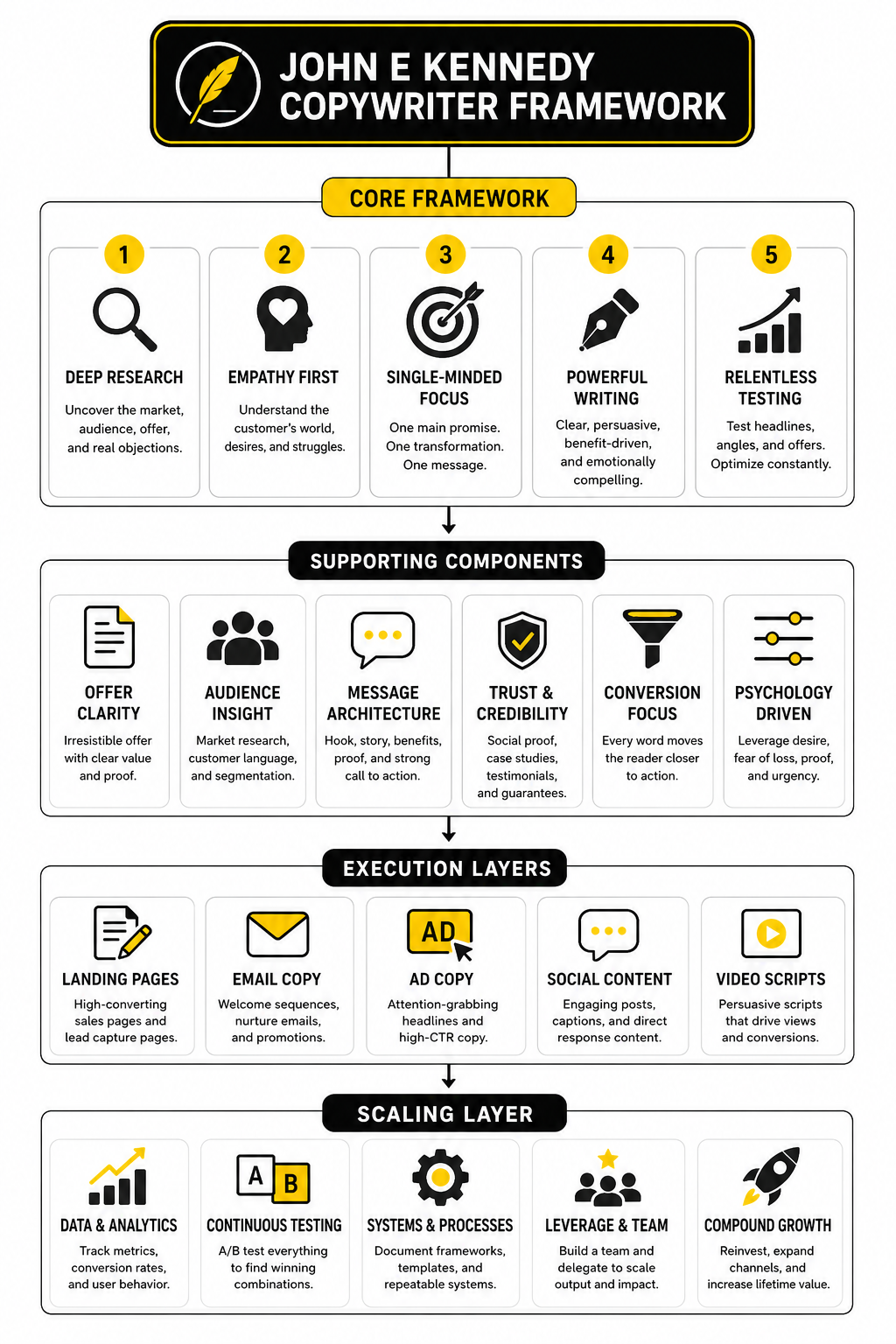
The framework starts with a simple question: what would a strong salesperson need to say if they were sitting across from this exact buyer? That question immediately changes the quality of the copy. It moves the writer away from slogans and toward buyer psychology, objection handling, proof, and decision clarity.
A Kennedy-style framework usually follows a natural selling path. First, identify the problem in a way the buyer recognizes. Then connect the problem to a specific promise, explain why the promise is believable, support it with proof, and guide the reader toward action.
This is not about making copy longer for no reason. It is about making the sales argument complete enough to carry the conversion. In later parts, this framework will become more practical, with each component broken down into how it works, where it belongs, and how to apply it without making the copy feel heavy or old-fashioned.
Core Components Of Kennedy-Style Copy
A John E. Kennedy copywriter does not start with wordplay. They start with the sales case. That case has to be clear enough that the reader understands what is being offered, why it matters, why it is believable, and what they should do next.
This is where Kennedy’s method feels very different from shallow “conversion copy” advice. It is not just about stronger verbs, shorter sentences, or louder calls to action. Those can help, but they are surface-level improvements if the underlying argument is weak.
The real work is building copy that can stand up to buyer resistance. People hesitate because they are busy, skeptical, distracted, unsure, or afraid of making the wrong decision. Kennedy-style copy respects that hesitation and answers it instead of pretending it does not exist.
The Buyer’s Problem
The first component is the problem the buyer already feels. Good copy does not invent pain out of nowhere. It names the issue in a way that makes the reader think, “Yes, that is exactly what is happening.”
This matters because vague problem statements create vague interest. If the reader only half-recognizes the problem, they will only half-care about the solution. A strong John E. Kennedy copywriter sharpens the problem until the offer feels relevant before the pitch even begins.
The mistake is to make the problem too broad. “You need more sales” is true for almost every business, but it is not specific enough to carry persuasive copy. “Your landing page gets traffic, but the offer is not giving visitors a clear enough reason to act” is much more useful because it points toward a real buying conversation.
The Specific Promise
Once the problem is clear, the copy needs a specific promise. This is not the same as hype. A promise is the meaningful outcome the reader can expect if the offer works as intended.
The promise should be easy to understand and hard to misinterpret. If the offer helps agencies capture, nurture, and convert leads, say that plainly. If the offer helps creators build a funnel without stitching together five separate tools, say that plainly too.
This is where tools can support the sales argument, but they should not replace it. A platform like GoHighLevel can be positioned around client acquisition, automation, and follow-up, while a funnel builder like ClickFunnels can be positioned around turning an offer into a focused conversion path. The copy still has to explain why that matters to the specific reader.
The Reason To Believe
The reason to believe is the heart of Kennedy-style copy. It answers the quiet question in the reader’s mind: “Why should I believe this will work?” Without that answer, the promise feels like marketing noise.
A reason to believe can come from the mechanism behind the product, the structure of the service, the experience of the team, the process being used, the proof available, or the constraints built into the offer. The point is not to pile on claims. The point is to make the main claim feel logical.
This is why “reason-why” copy is still so useful. It gives the reader something solid to hold onto. Instead of saying the product is better, the copy explains what makes it better, how it works, and why that difference matters in practice.
The Proof
Proof gives the sales argument weight. It can include testimonials, demonstrations, screenshots, documented results, product walkthroughs, public reviews, brand credibility, before-and-after comparisons, or clear process explanations. The best proof depends on the offer and the reader’s level of skepticism.
For a low-ticket digital product, simple proof may be enough. For a high-ticket service, the reader usually needs more confidence before acting. For software, proof often works best when it shows the product in use rather than just describing features.
The key is to use proof honestly. Do not fake results, inflate numbers, or turn weak evidence into a massive claim. Strong copy can sell aggressively without becoming sloppy, and that distinction matters.
The Offer
The offer is where the sales argument becomes concrete. It is not just the product or service. It is the full package of outcome, price, deliverables, bonuses, terms, urgency, guarantee, risk reversal, and next step.
A weak offer makes even good copy work too hard. If the reader cannot quickly understand what they get, why it is valuable, and why now is a reasonable time to act, the page will leak attention. A John E. Kennedy copywriter looks at the offer itself, not just the words wrapped around it.
This is especially important in funnels. You can build pages, automations, booking flows, and follow-up sequences with tools like Systeme.io, Brevo, or ManyChat, but the offer still has to feel clear and worth acting on. Better delivery does not rescue a confusing proposition.
The Call To Action
The call to action should feel like the natural next move, not a desperate interruption. If the copy has done its job, the reader should understand why clicking, booking, subscribing, replying, or buying makes sense. The call to action simply names that step clearly.
Weak calls to action often happen because the page has not built enough conviction. The writer tries to compensate with urgency, button text, or repeated prompts. That may create motion, but it does not create real persuasion.
A stronger approach is to make the decision feel obvious before the button appears. The problem is clear, the promise is specific, the proof supports the claim, and the offer feels worth considering. At that point, the call to action does not need to shout; it needs to be direct.
Professional Implementation Across Funnels
Implementation is where Kennedy’s idea stops being a quote and becomes a working system. A John E. Kennedy copywriter does not treat the landing page, email sequence, ad, checkout page, and follow-up messages as separate writing jobs. They treat them as one sales conversation spread across different moments.
That matters because buyers rarely move in a perfectly straight line. Some people arrive cold from an ad, some come from search, some click through from an email, and some return after thinking about the offer for days. The job of the copy is to keep the sales argument consistent while adapting the message to where the reader is in the decision.
Modern funnels make this easier to execute, but also easier to mess up. If each step says something slightly different, the buyer feels friction. If every step reinforces the same core promise, proof, and next action, the funnel starts to feel like a clear path instead of a pile of marketing assets.
Step 1: Clarify The Buying Conversation
Before writing anything, define the buying conversation. This means identifying who the reader is, what they already know, what they want, what they doubt, and what would make the next step feel safe. Without that, copy becomes guesswork dressed up as strategy.
A practical way to do this is to write the sales conversation in plain language first. What would you say if the buyer asked, “Why should I care?” What would you say if they asked, “Why should I believe you?” What would you say if they asked, “Why should I act now instead of later?”
This is where Kennedy’s method is still sharp. It forces the copywriter to stop hiding behind clever phrasing. If the sales logic does not sound convincing in normal language, it will not become convincing just because it is placed inside a funnel.
Step 2: Map The Message To The Funnel
Once the buying conversation is clear, map the message to each funnel step. The ad or top-of-funnel post usually earns attention by naming the problem or desired outcome. The landing page expands the promise, explains the mechanism, proves the claim, and presents the offer.
The follow-up sequence then handles what the first page could not fully resolve. That might include objections, comparison points, reminders, proof, use cases, or risk reversal. Strong follow-up does not repeat the same pitch every day; it keeps moving the buyer toward a more confident decision.
This is why funnel tools should be used as structure, not strategy. ClickFunnels can help you build the conversion path, GoHighLevel can help connect CRM, automation, and follow-up, and Systeme.io can help keep a simpler funnel stack lean. But the tool only performs well when the sales argument inside it is clear.
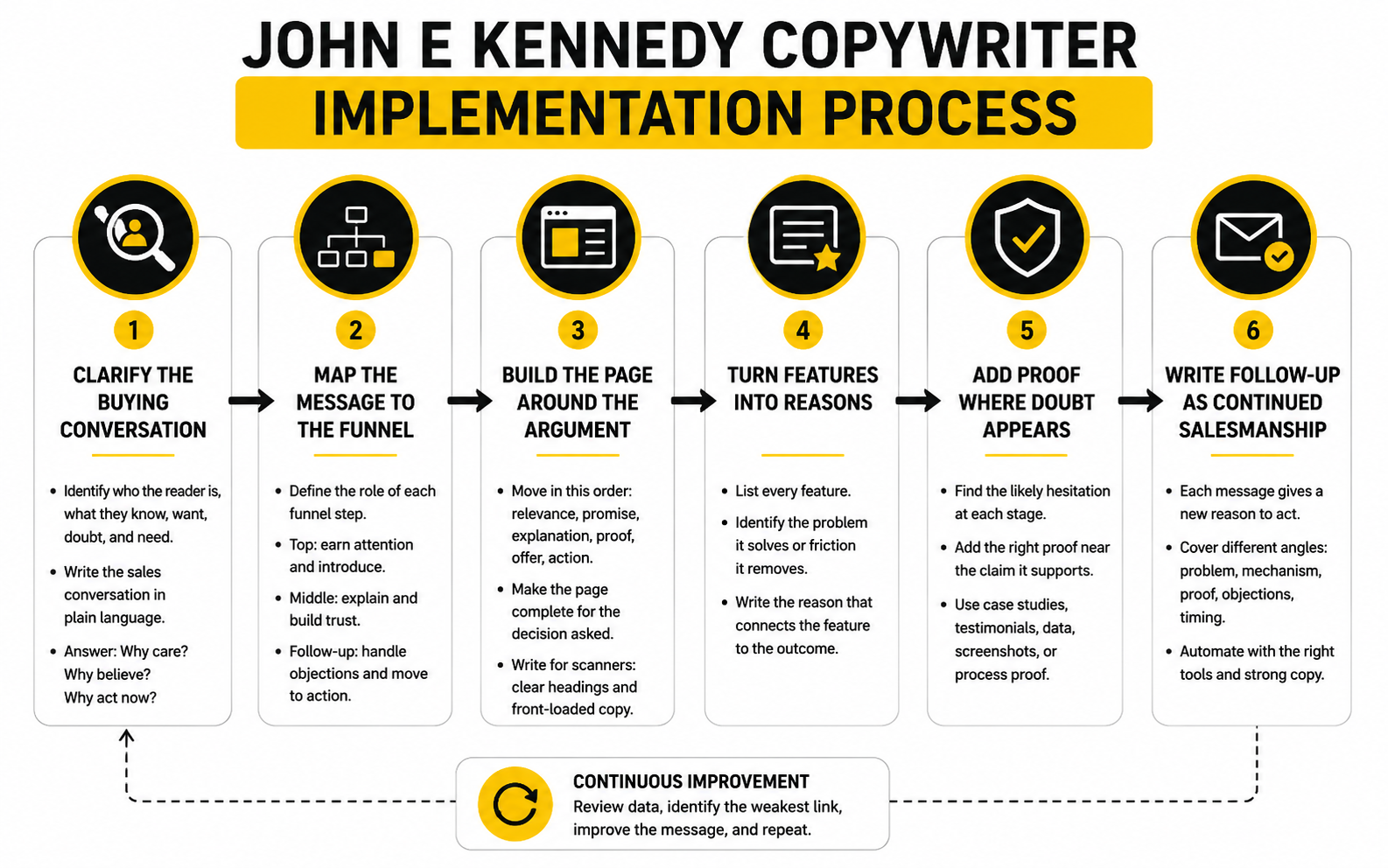
Step 3: Build The Page Around The Argument
A Kennedy-style landing page should not be built around random sections. It should be built around the order in which the reader needs information. The page should move from relevance, to promise, to explanation, to proof, to offer, to action.
That does not mean every page needs to be long. It means every page needs to be complete enough for the decision it is asking for. A free lead magnet may need a simple argument, while a high-ticket consultation page needs more context, more proof, and more objection handling.
The structure should also respect how people read online. Nielsen Norman Group’s eyetracking work shows that users often scan pages instead of reading every word, which makes clear headings, front-loaded paragraphs, and meaningful visual hierarchy important for comprehension. A strong John E. Kennedy copywriter writes for persuasion, but also formats the argument so the reader can actually follow it.
Step 4: Turn Features Into Reasons
Features are not persuasive until the reader understands why they matter. “Automated follow-up” is a feature. “Leads get a timely response even when your team is busy” is a reason. “Built-in calendar booking” is a feature. “Interested prospects can schedule before their motivation fades” is a reason.
This is one of the simplest ways to apply Kennedy’s reason-why thinking. For every feature, ask what business problem it solves, what friction it removes, or what outcome it makes easier. Then write the copy around that reason instead of leaving the feature to explain itself.
This works across almost every channel. On a landing page, it makes sections clearer. In an email, it gives the reader a practical reason to click. In a sales deck, it turns product details into buying logic.
Step 5: Add Proof Where Doubt Appears
Proof should appear at the moment the reader is likely to doubt the claim. If the page promises a faster setup, show what makes setup faster. If the copy claims the service is built for agencies, show agency-specific workflows, use cases, or client examples. If the offer says it reduces manual work, show the before-and-after process.
This is more effective than dumping testimonials into one section and hoping the reader connects the dots. Proof works best when it answers a specific hesitation. The reader should feel like the page understands the objection before they even finish forming it.
For software or funnel offers, practical proof can include walkthroughs, screenshots, templates, onboarding details, feature demonstrations, or transparent process breakdowns. For service businesses, proof often comes from case studies, methodology, client fit, delivery standards, and the credibility of the team. The format matters less than the job it performs.
Step 6: Write Follow-Up As Continued Salesmanship
Follow-up is not nagging. Done well, it is continued salesmanship. Each email, SMS, retargeting message, or chatbot flow should give the buyer another useful reason to understand the offer and take the next step.
This is where automation becomes powerful when the copy is disciplined. Brevo can support email campaigns, ManyChat can support conversational follow-up, and Buffer can help distribute content across social channels. But each message still needs to earn its place in the sales conversation.
A simple follow-up sequence can cover different angles without feeling repetitive. One message can clarify the problem, another can explain the mechanism, another can show proof, another can handle objections, and another can make the offer timely. That is much stronger than sending five versions of “just checking in.”
Statistics And Data That Actually Matter
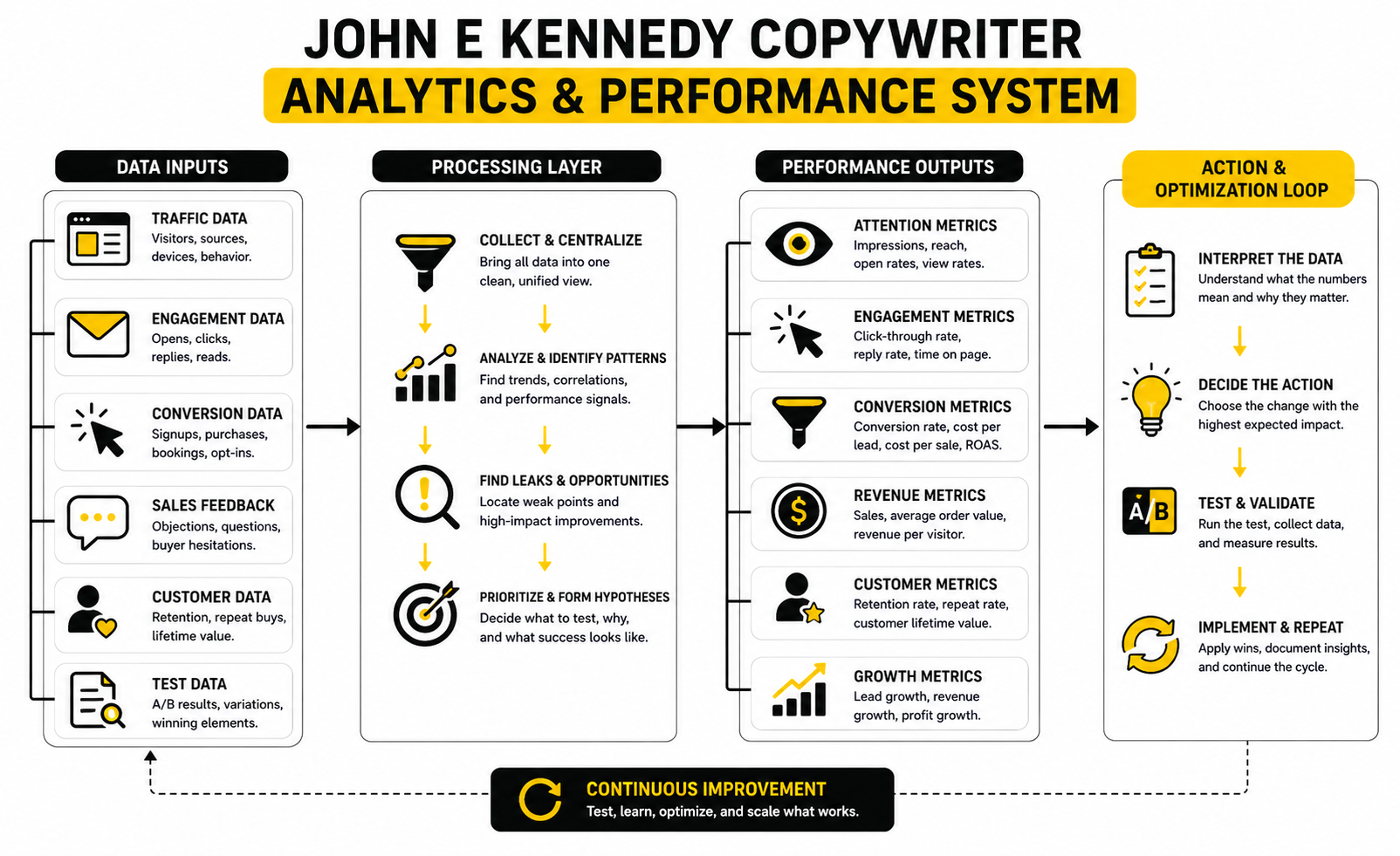
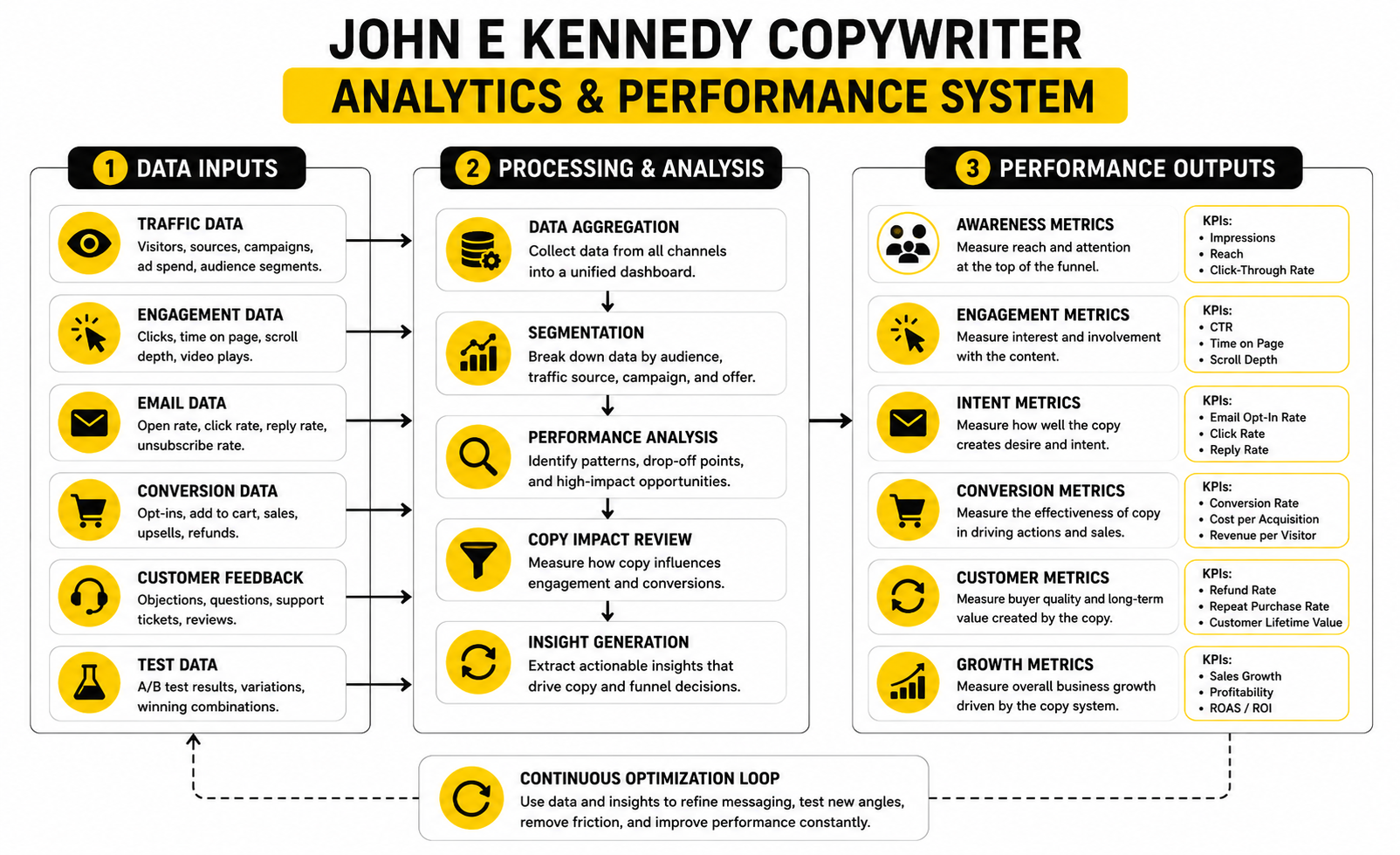
A Kennedy-style funnel should be measured by how well the sales argument moves people from attention to action. That sounds obvious, but a lot of marketers still judge copy by isolated numbers. They celebrate a high open rate, panic over a low click rate, or obsess over page conversion without asking what the metric actually says about the buyer’s decision.
The better approach is to read the numbers like feedback from the sales conversation. If people open but do not click, the initial promise may be interesting but the body copy may not create enough desire or clarity. If people click but do not convert, the next page may be creating friction, weakening the offer, or failing to answer the objection that matters most.
This is where a John E. Kennedy copywriter has an advantage. They are not only looking for “better metrics.” They are looking for the weak point in the argument. The number is only useful when it tells you what to fix.
Benchmarks Are Context, Not Targets
Benchmarks can help you avoid guessing, but they should never become the goal. A landing page in SaaS, legal services, ecommerce, coaching, and local services can have very different buying intent, traffic quality, price points, and sales cycles. That is why Unbounce’s conversion benchmark research separates performance by industry instead of pretending one universal conversion rate applies to everyone.
The same is true for email. MailerLite’s 2025 email benchmark data covers millions of campaigns and shows that performance changes by industry, region, and metric type. That is useful context, but it does not automatically tell you whether your copy is good or bad.
Use benchmarks as a range, not a verdict. If your numbers are far below the category norm, you probably have a real problem to investigate. If your numbers are close to the norm but revenue is weak, the issue may not be traffic or attention; it may be the offer, the proof, the sales path, or the audience match.
The Four Metrics That Reveal The Sales Argument
The most useful measurement system follows the buyer’s path. You want to see where attention becomes interest, where interest becomes intent, and where intent becomes action. That gives you a practical map instead of a random dashboard.
Start with these four signals:
Each metric answers a different question. Attention tells you whether the hook is relevant enough to earn a look. Engagement tells you whether the message is holding interest. Intent tells you whether the reader is considering action. Conversion tells you whether the offer, proof, and next step are strong enough to complete the decision.
What Low Attention Usually Means
Low attention usually means the first promise is not landing. In ads, that might be the angle, headline, creative, or audience targeting. In email, it might be the subject line, sender relationship, timing, or list quality.
Do not jump straight to cleverness. A low attention rate often means the copy is not speaking to the reader’s current problem in language they recognize. If the buyer does not see themselves in the first line, they will not stick around for the rest of the argument.
The fix is to make the opening more specific. Name the situation, the friction, or the desired outcome more clearly. A John E. Kennedy copywriter would not ask, “How can we make this sound more exciting?” They would ask, “What would make the right buyer immediately understand this is for them?”
What Low Engagement Usually Means
Low engagement means people gave you a chance, then lost momentum. They opened the email but did not click. They landed on the page but did not scroll. They watched the first few seconds but did not continue.
This usually points to a weak bridge between the hook and the sales argument. The opening may create curiosity, but the next section does not pay it off. Or the page may introduce the offer too early before the reader understands the problem, mechanism, or reason to believe.
This is where structure matters. Nielsen Norman Group’s research on web reading behavior found that users often scan pages rather than read every word, which means headings, paragraph openings, and section order carry a lot of weight. If the reader cannot quickly see the logic of the page, the copy may be persuasive in theory but hard to consume in practice.
What Low Intent Usually Means
Low intent means the reader understands the message but is not ready to move closer to the offer. They may like the idea, but they are not clicking the pricing page, starting the checkout, booking the call, or requesting the demo. This is one of the most important signals because it usually exposes a gap in the buying argument.
The issue may be weak proof. It may be a promise that sounds nice but not urgent. It may be unclear positioning, a missing mechanism, or a next step that feels too big for the reader’s current level of trust.
The action is not always to add more urgency. Often, the better move is to reduce perceived risk and increase decision clarity. Add stronger proof near the claim, explain the process more plainly, or offer a smaller next step for buyers who are interested but not ready to commit.
What Low Conversion Usually Means
Low conversion means the reader reached the decision point and stopped. That is serious because it usually happens after you have already earned attention, interest, and some level of intent. Something near the final decision is creating resistance.
The problem may be price framing, offer clarity, checkout friction, weak guarantee language, unclear deliverables, missing trust signals, or poor alignment between the traffic source and the page. For call-based funnels, it may also mean the booking page asks for too much too soon or fails to explain what happens after the call is scheduled.
This is where measurement has to connect with the actual user experience. Do not only look at the conversion rate. Review the page, the offer, the form, the checkout, the booking flow, the confirmation message, and the follow-up. The data points to the leak, but the copywriter still has to diagnose the cause.
How To Use Data Without Killing The Copy
Data should make the copy sharper, not colder. The goal is not to turn every page into a spreadsheet with buttons. The goal is to understand what buyers are doing so you can make the sales conversation clearer.
A practical review rhythm works well. Look at attention first, then engagement, then intent, then conversion. Fix the earliest major leak before rewriting everything downstream, because a checkout problem means something different when only the wrong people are reaching the checkout in the first place.
This is also why tools need to be chosen around visibility, not just convenience. GoHighLevel can help agencies track leads, conversations, appointments, and follow-up in one system. ClickFunnels can help teams see how people move through funnel steps. The useful question is not which tool looks more impressive; it is which setup helps you see where the sales argument is working and where it is breaking.
The Kennedy-Style Measurement Rule
The simplest rule is this: every metric should lead to a copy decision. If a number does not help you improve the promise, proof, offer, structure, or follow-up, it is probably not the number to obsess over right now.
A high open rate with weak sales is not a win. A beautiful landing page with low intent is not a win. A clever ad that attracts the wrong visitors is not a win either.
The real win is a measurable sales path where each step makes the next step more likely. That is Kennedy’s principle applied to modern analytics. Salesmanship in print becomes salesmanship you can diagnose, improve, and scale.
Advanced Strategy For Kennedy-Style Copy
At a basic level, Kennedy-style copy is about giving the reader a reason to buy. At a higher level, it is about deciding which reason matters most, which proof deserves attention, and which parts of the sales argument should be removed because they create drag. That is where experienced copywriters separate themselves from people who only follow templates.
A John E. Kennedy copywriter is not trying to say everything. They are trying to say the right thing in the right order with enough force to move the buyer forward. Sometimes that means writing more. Sometimes it means cutting half the page because the extra explanation weakens the main argument.
The advanced work is judgment. You have to know when the reader needs education, when they need proof, when they need urgency, when they need reassurance, and when they simply need a cleaner path to action. That judgment comes from research, sales context, customer feedback, and performance data working together.
The Tradeoff Between Clarity And Sophistication
Simple copy usually wins when the buyer is confused, cold, or moving quickly. The reader does not need a clever metaphor when they are still trying to understand what the offer does. They need clear positioning, a recognizable problem, and a next step that makes sense.
Sophisticated copy becomes useful when the market is already familiar with the category. If the reader has seen a dozen similar offers, basic claims will not be enough. The copy needs a sharper mechanism, stronger contrast, better proof, or a more specific point of view.
The danger is using sophistication to hide weak thinking. Complex language can make a page sound impressive while making the sales argument harder to follow. Kennedy’s principle cuts through that. If the copy would not help a salesperson explain the offer clearly, it probably does not belong on the page.
When To Lead With Pain And When To Lead With Desire
Pain-based copy works when the reader already feels a costly problem and wants relief. It is useful when the problem is urgent, visible, and emotionally active. In that case, naming the pain clearly can make the reader feel understood and ready to hear the solution.
Desire-based copy works better when the buyer is moving toward growth, status, freedom, speed, convenience, or a better version of their current situation. This is common in creator businesses, SaaS tools, ecommerce, consulting, and personal productivity offers. The buyer may not feel broken; they simply want a better outcome.
The mistake is forcing every offer into pain. Some readers do not want to be agitated. They want to see the upside, the opportunity, and the practical path forward. A strong John E. Kennedy copywriter chooses the emotional entry point based on the buyer’s real motivation, not a formula.
How To Handle Competitive Markets
In a competitive market, the copy cannot rely on category-level benefits. “Save time,” “get more leads,” “grow your business,” and “automate your workflow” are not enough when every competitor says the same thing. The copy has to explain what is different in a way the buyer actually cares about.
That difference can come from the audience served, the mechanism used, the speed of implementation, the depth of support, the pricing model, the risk reversal, the integrations, the workflow, or the philosophy behind the offer. The point is not to be different for decoration. The point is to make comparison easier for the buyer.
For example, GoHighLevel makes more sense when positioned around agencies, client management, and follow-up infrastructure. ClickFunnels makes more sense when positioned around funnel creation and conversion paths. Systeme.io makes more sense when positioned around simplicity and lean execution. The copy should make those strategic differences obvious instead of treating all tools as interchangeable.
The Risk Of Over-Optimization
Optimization becomes dangerous when every small metric change is treated like strategic truth. A button color test, subject line lift, or short-term conversion bump can be useful, but it does not always mean the sales argument is stronger. Sometimes it only means the page attracted more low-quality action.
A Kennedy-style approach keeps the bigger question in view. Did the copy attract the right buyers? Did it create better sales conversations? Did it increase qualified leads, paid customers, retention, or profit? If not, the surface metric may be misleading.
This matters even more when teams scale traffic. A page that works with warm traffic may fail with cold traffic because the copy assumes too much awareness. A follow-up sequence that works for inbound leads may feel aggressive when used after a low-intent download. Scaling exposes weak assumptions fast.
How To Use AI Without Losing The Sales Argument
AI can help speed up research, outlining, variation testing, repurposing, and first-draft development. It can also produce very polished copy that says almost nothing. That is the risk. Smooth language is not the same as persuasive logic.
A practical approach is to use AI for speed, not final judgment. Feed it customer research, offer details, objections, proof points, sales notes, and positioning decisions. Then review the output through Kennedy’s lens: does this give the buyer a clear reason to believe and act?
Tools like GoHighLevel AI, Chatbase, and Firecrawl can support automation, customer-facing flows, and research workflows. But none of them replace the core strategic decision: what is the strongest sales argument for this buyer at this moment?
Scaling The Message Across Channels
Scaling Kennedy-style copy means keeping the core argument consistent while adapting the format. The same message will not look identical in a landing page, email, ad, chatbot, booking page, and sales script. But the promise, proof, positioning, and next step should still feel aligned.
This is where many teams create their own conversion leaks. The ad promises one thing, the landing page emphasizes another, the email sequence changes the angle again, and the sales call opens with a completely different pitch. The buyer may not consciously identify the mismatch, but they feel the uncertainty.
A better system starts with one central message document. Define the buyer, problem, promise, mechanism, proof, objections, offer, and call to action. Then adapt that message for each channel. That keeps the campaign flexible without letting the sales argument fall apart.
The Expert Review Checklist
Before scaling any campaign, review the copy like a salesperson reviewing their pitch before walking into an important meeting. Do not only ask whether the writing sounds good. Ask whether it would move a real buyer closer to a decision.
Use this checklist:
This checklist is simple, but it is not shallow. It forces the copy to earn its place. If a section does not clarify, prove, differentiate, reduce risk, or move the reader forward, it is probably decoration.
The Strategic Standard
The highest standard is not “does this sound like good copy?” The highest standard is “does this help the right buyer make a confident decision?” That question changes how you write, edit, test, and scale.
A John E. Kennedy copywriter is ultimately a strategist, not just a wordsmith. They understand that copy is the visible part of a deeper sales system. The headline matters, but so does the offer. The proof matters, but so does placement. The call to action matters, but only after the reader has a reason to care.
That is the part worth carrying forward. Kennedy’s language came from an earlier advertising era, but the discipline still fits modern marketing perfectly. Clear reason, strong proof, focused offer, measurable action. Simple? Yes. Easy? Not always. Important? Absolutely.
FAQ: John E. Kennedy Copywriter Lessons
Who was John E. Kennedy?
John E. Kennedy was an advertising copywriter best known for defining advertising as salesmanship in print. His work influenced Albert Lasker, Lord & Thomas, and the broader shift toward direct-response advertising that gave buyers clear reasons to act. The phrase still matters because it keeps copy focused on persuasion, not decoration.
What does “salesmanship in print” mean?
“Salesmanship in print” means copy should do the job of a capable salesperson. It should identify the buyer’s problem, present a relevant promise, explain why the offer works, prove the claim, and make the next step clear. In modern marketing, that same idea applies to landing pages, emails, ads, checkout pages, sales scripts, and automated follow-up.
Why is John E. Kennedy important to copywriting?
Kennedy is important because he helped move advertising toward reasoned persuasion. Instead of treating ads as clever announcements, he treated them as selling tools. That mindset shaped direct-response copywriting and still gives marketers a practical standard: every line should help the buyer understand, believe, or act.
What is reason-why copywriting?
Reason-why copywriting gives the reader a clear explanation for why they should believe the claim and take action. It does not rely only on hype, urgency, or emotional pressure. It connects the promise to a believable mechanism, proof, and practical value.
How would a John E. Kennedy copywriter approach a landing page?
A John E. Kennedy copywriter would build the landing page around the sales argument. The page would open with relevance, explain the problem, present the promise, show why the offer works, support the claim with proof, reduce risk, and ask for the next step. The layout matters, but the persuasive sequence matters more.
Is Kennedy-style copy still useful for online funnels?
Yes, because online funnels still depend on buyer decisions. The channels have changed, but the reader still needs clarity, relevance, trust, and a reason to act. Whether the funnel is built in ClickFunnels, GoHighLevel, or Systeme.io, the copy still has to carry the sales conversation.
What is the biggest mistake marketers make with Kennedy’s idea?
The biggest mistake is reducing it to a quote. “Salesmanship in print” is not just a clever phrase. It is a standard for evaluating whether the copy is actually helping the right buyer make a confident decision.
Does Kennedy-style copy have to be long?
No. Kennedy-style copy has to be complete enough for the decision being asked. A simple email opt-in may need only a short explanation, while a high-ticket offer may need a longer page with more proof, more objection handling, and more context.
How do you know if the copy is working?
You know the copy is working when the right people move through the buying path with less friction. Look at attention, engagement, intent, and conversion together instead of judging one metric in isolation. The useful question is always, “Where is the sales argument breaking down?”
What metrics should a copywriter watch first?
A copywriter should start with the earliest meaningful leak. If people are not clicking or opening, the hook or audience match may be weak. If people engage but do not take action, the offer, proof, objection handling, or next step may need work.
Can AI write Kennedy-style copy?
AI can help create drafts, variations, outlines, research summaries, and follow-up ideas. But AI still needs a strong human strategy behind it. If the offer, buyer, proof, and sales argument are unclear, AI will usually make the copy smoother without making it more persuasive.
How does Kennedy-style copy apply to email marketing?
Email marketing is a natural fit because every email can continue the sales conversation. One email can clarify the problem, another can explain the mechanism, another can show proof, and another can answer objections. Platforms like Brevo, Moosend, and ManyChat can help deliver the sequence, but the logic of the message still matters most.
How does Kennedy-style copy apply to service businesses?
Service businesses need Kennedy-style copy because buyers often have more risk and more questions before committing. The copy should explain who the service is for, what problem it solves, how the process works, what proof supports the offer, and what happens after the prospect takes the next step. This reduces uncertainty and makes the sales conversation easier before a call ever happens.
What separates a good copywriter from a template user?
A template user follows a structure. A good copywriter understands why the structure works, when to change it, and what the buyer needs at each step. Kennedy-style copy rewards judgment, not just formatting.
What is the best way to practice this method?
Start by rewriting existing copy as a clear sales conversation. Identify the buyer, problem, promise, mechanism, proof, offer, objections, and next step. Then remove anything that does not make the decision clearer, safer, or more compelling.
Build a stronger local presence with BAAM AI
Turn your website, Google profile, social channels, and AI visibility into one growth engine
Most businesses do not need more random marketing activity. They need a consistent presence system that helps the right people find them, trust them, and take action. BAAM AI brings strategy, local SEO, website updates, Google Maps visibility, social content, AI-search readiness, media production, and reporting into one practical monthly engine.
If you want your marketing to keep working after the campaign ends, start with a free BAAM AI presence audit. See how your business shows up today and where the fastest visibility wins are at BAAM AI.