
BAAM AI Blog
John Carlton Sales Letters
are not famous because they sound polished. They are famous because they sound like a sharp salesperson sitting across from a skeptical prospect, finding the pain, naming the desire, and making the next step feel...
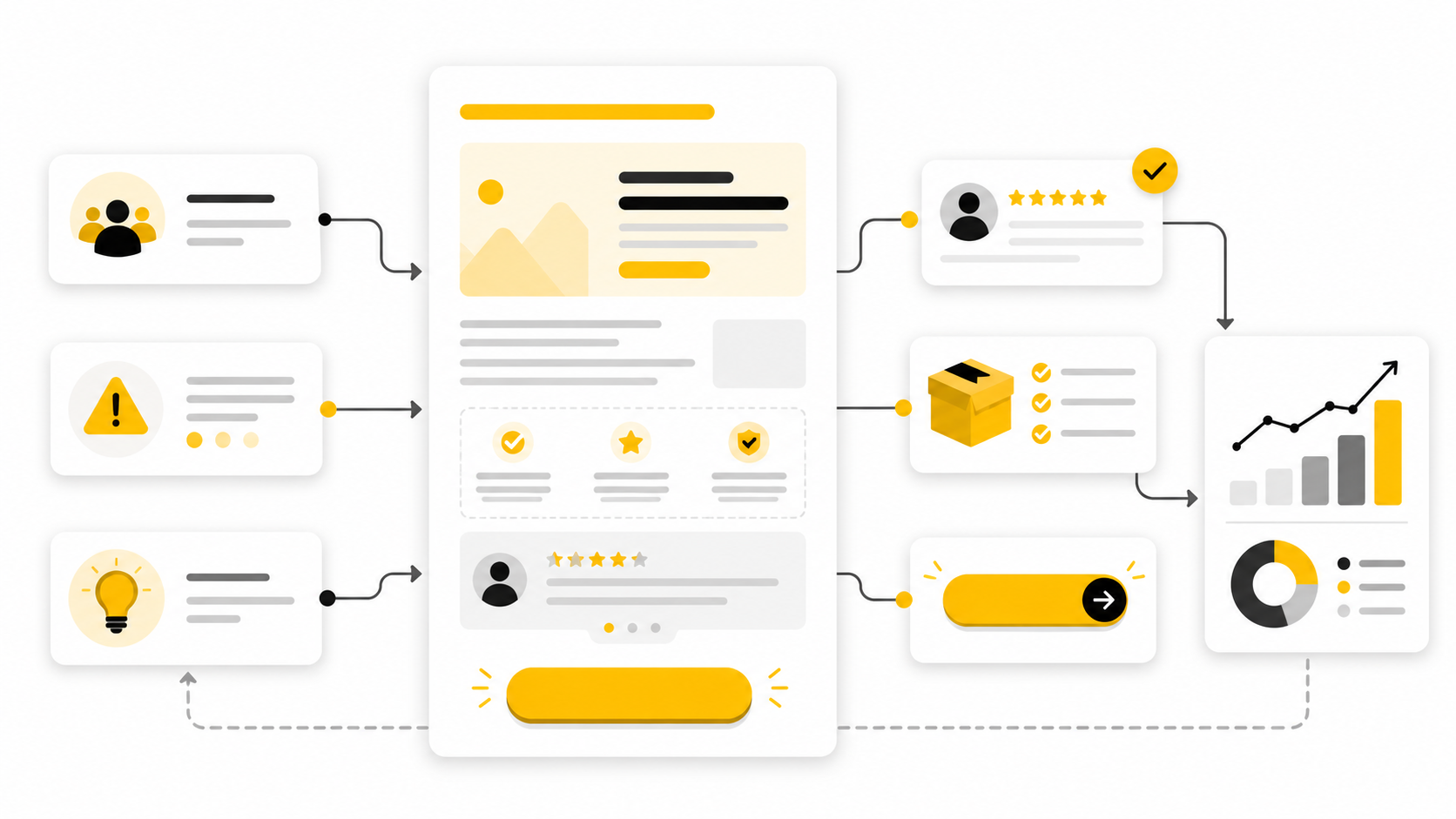
John Carlton sales letters are not famous because they sound polished. They are famous because they sound like a sharp salesperson sitting across from a skeptical prospect, finding the pain, naming the desire, and making the next step feel obvious.
That is the useful lesson here. Carlton’s work sits inside classic direct response copywriting, but the real value is not nostalgia, swipe files, or trying to imitate the surface-level attitude. The value is learning how his letters move from attention to tension, from tension to proof, and from proof to action without losing the reader.
Carlton’s own training materials describe the Simple Writing System as a process for creating “winning ads” and sales messages, while Marketing Rebel positions his work around practical direct response salesmanship rather than abstract branding theory. You can see that emphasis in the way his official materials frame copywriting as a repeatable selling system, not a creative writing exercise: Simple Writing System and Marketing Rebel.
this guide will break down John Carlton sales letters as a working system. The point is not to worship old ads or copy someone else’s voice. The point is to understand the structure underneath the writing so you can apply the thinking to modern landing pages, emails, funnels, offers, and campaigns.
The full article will continue across six parts using these section names:
Each part builds on the previous one. First, we establish why Carlton’s letters still get studied. Then we move into the framework, the components, the analysis process, and the modern implementation details that matter when the sales letter becomes a landing page, email sequence, webinar pitch, or paid traffic funnel.
Why John Carlton Sales Letters Still Matter
John Carlton sales letters still matter because they show copywriting as salesmanship under pressure. The best direct response copy does not merely describe a product. It enters a market conversation, identifies the emotional pressure behind the purchase, and gives the reader a reason to act now instead of “thinking about it.”
That matters even more online. Most modern marketers have more tools than ever, but many still struggle with the same old problem: their pages do not sell. They have nice design, clever headlines, testimonials, feature blocks, and automated follow-up, yet the message never fully connects the reader’s problem to the offer.
Carlton’s reputation comes from direct response advertising where the copy had to carry the sale. Marketing Rebel describes him as “The Most Ripped-Off Writer on the Web,” which is a colorful line, but the deeper point is more practical: his work became widely studied because the structure was easy to recognize and hard to fake. His “best ads” collection is presented around complete ads, backstories, and salesmanship lessons, not isolated headline tricks: John Carlton’s Best Ads.
The Difference Between Studying and Swiping
There is a clean way and a lazy way to study John Carlton sales letters. The lazy way is to grab a headline, borrow the attitude, and hope the market does not notice. The clean way is to ask why the argument works, what belief it changes, and how each section earns the reader’s next minute of attention.
That distinction matters because Carlton’s copy was built around specific markets, offers, and moments. A golf ad, a self-defense ad, or a business opportunity promotion does not automatically translate into your SaaS landing page or ecommerce funnel. What transfers is the logic: hook the right person, dramatize the problem, make the mechanism feel believable, prove the promise, and ask for action with confidence.
Swipe-file sites can be useful when they preserve historical examples, but they become dangerous when marketers treat them like templates. A good swipe file should train your eye, not replace your thinking. That is why resources like the John Carlton archive on Swiped.co are best used for structural study rather than copy-and-paste imitation: John Carlton swipe file archive.
The Practical Lens for this guide
this guide will treat John Carlton sales letters as a framework, not a museum exhibit. We will look at the persuasion architecture behind the letters and translate it into modern campaigns where the buyer may encounter your message through ads, email, social, landing pages, retargeting, and follow-up sequences. The format changes, but the sales problem stays brutally similar.
A modern sales letter may not look like a long printed letter anymore. It might be a landing page, a VSL page, a webinar registration page, a product page, or an email-driven offer. But if the copy has to persuade a skeptical prospect to take action, the core job is still direct response.
That is where Carlton’s work remains useful. It pushes you away from vague “brand voice” and toward sharper market thinking. The question becomes less “How do we sound clever?” and more “What does this person need to believe before buying, and how do we make that belief feel safe, urgent, and obvious?”
The Framework Behind Carlton-Style Sales Letters
The framework behind John Carlton sales letters is simple on the surface and demanding in practice. It starts with a hungry market, finds the pressure already sitting inside that market, and then builds a persuasive argument around one clear promise. That is why the letters feel direct without feeling random.
A weak sales letter tries to impress the reader. A strong one tries to enter the reader’s existing conversation and move it forward. Carlton-style copy does that by treating the reader as skeptical, busy, and emotionally invested in a specific outcome.
This is the big shift. You are not writing because you need to “fill a page.” You are writing because the prospect has a problem, the offer has a mechanism, and the letter must connect those two things in a way that feels believable.
Start With The Market, Not The Product
The first layer of the framework is market awareness. Before the headline, before the hook, and before the offer stack, you need to understand what the prospect already wants. Carlton-style sales writing works because it does not begin with “Here is what I made.” It begins closer to “Here is the problem you are already tired of dealing with.”
That distinction changes everything. Product-first copy usually sounds like a brochure because it talks about features, credentials, and internal advantages. Market-first copy sounds like a conversation because it reflects the reader’s frustration in language they already recognize.
For john carlton sales letters, this is one of the most important lessons to study. The power is not only in the phrasing. The power is in the diagnosis. The copy makes the reader feel understood before it asks the reader to believe anything.
Find The Emotional Pressure
A Carlton-style letter usually has a strong emotional center. That does not mean it becomes dramatic for the sake of drama. It means the copy identifies the real pressure behind the purchase: embarrassment, wasted effort, fear of missing a window, frustration with failed solutions, or desire for a cleaner path to the outcome.
This is where many modern landing pages go flat. They list benefits, but they do not show why those benefits matter right now. They say the product is faster, easier, more carefully, or more automated, but they never make the reader feel the cost of staying where they are.
Good sales copy makes inaction uncomfortable without becoming manipulative. It shows the reader what is already happening, what keeps repeating, and why the old approach is not enough. Then the offer enters as relief, not interruption.
Build Around One Dominant Promise
The next part of the framework is the dominant promise. A sales letter can contain many supporting benefits, but it needs one central promise that holds the whole argument together. Without that, the reader has to work too hard to understand why they should care.
This is where discipline matters. A messy offer tries to sell everything at once. A clean offer chooses the strongest buying reason and makes every section support it.
In john carlton sales letters, the promise often feels sharp because it is tied to a concrete desire. It is not vague motivation. It is a specific improvement the reader can picture, paired with a reason to believe that improvement is possible.
Make The Mechanism Feel Believable
A promise gets attention, but the mechanism earns belief. The mechanism explains why the offer can create the result and why the reader should trust this approach over everything else they have seen. Without a mechanism, even a great promise starts to sound like hype.
This is especially important in saturated markets. Prospects have already heard big claims. They have seen “easy,” “fast,” “proven,” and “secret” so many times that those words often create resistance instead of excitement.
A strong mechanism lowers that resistance. It gives the reader a mental model for why the offer works. The more competitive the market, the more important this becomes, because people rarely buy the claim alone. They buy the explanation that makes the claim feel safe.
Move The Reader Through Belief Stages
A strong sales letter does not throw every argument at the reader in a random order. It moves through belief stages. First, the reader needs to recognize the problem. Then they need to believe the problem can be solved. Then they need to believe this offer is a credible solution. Then they need to believe now is the right time to act.
That sequence is easy to understand and easy to ruin. If you present the offer before the pain is clear, the pitch feels premature. If you push urgency before trust exists, the copy feels aggressive. If you stack proof before the reader understands the promise, the proof has nothing to attach to.
This is why structure matters so much. Carlton-style copy is not just energetic writing. It is controlled persuasion. Each section has a job, and the order of those jobs affects how much resistance the reader feels.
The Framework In Plain English
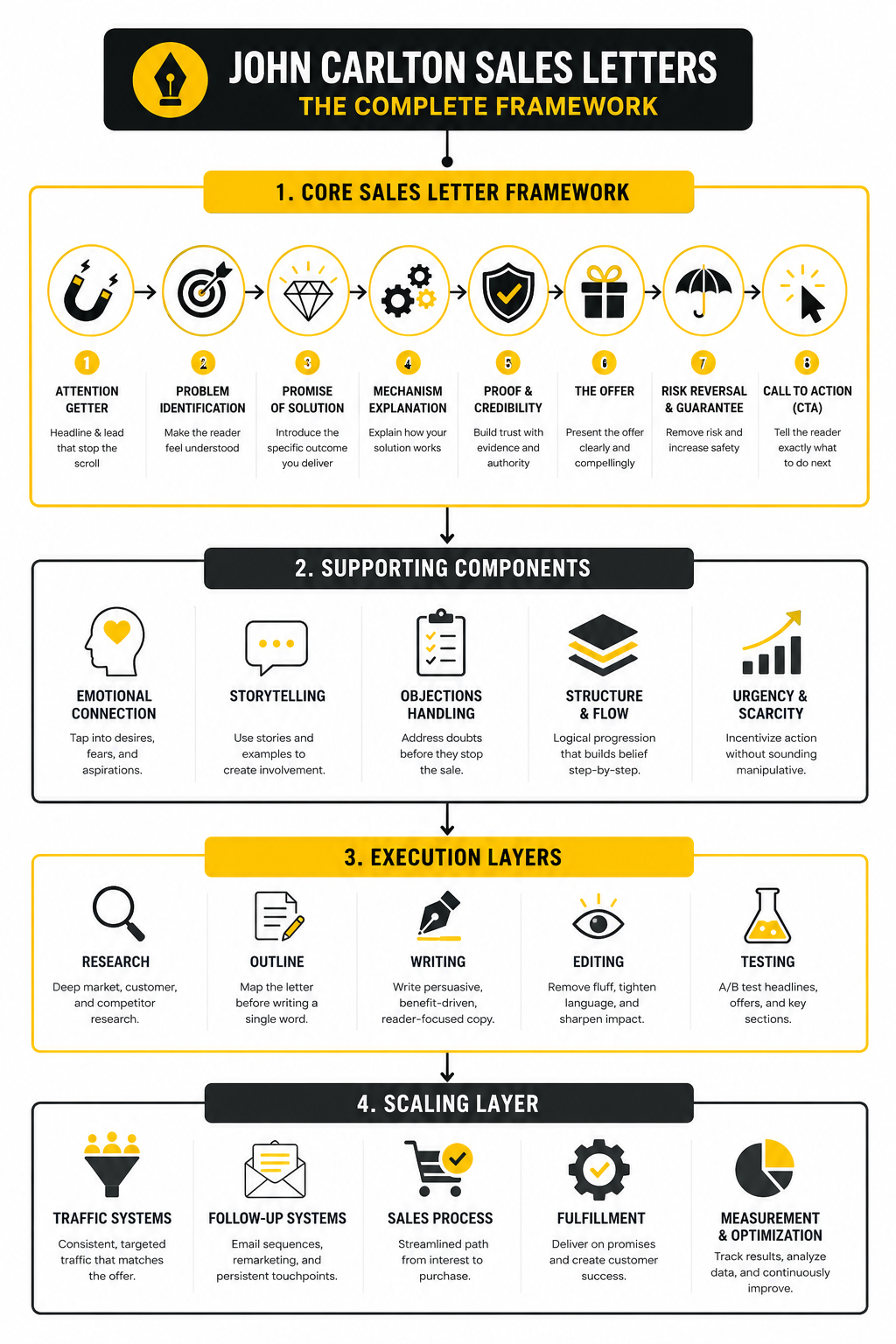
The framework can be reduced to a practical sequence. You identify the right reader, name the problem in their language, intensify the cost of leaving it unsolved, introduce the promise, explain the mechanism, prove the claim, present the offer, remove risk, and ask for action. That sounds basic, but basic is not the same as easy.
Most bad copy skips steps. It jumps from problem to price. Or from feature to call to action. Or from clever headline to vague benefit. The result is a sales page that feels busy but not persuasive.
A cleaner framework looks like this:
That sequence can become a long-form letter, a landing page, an email campaign, or a webinar pitch. The format can change. The persuasion logic should not.
Why This Framework Works In Modern Funnels
Modern funnels often separate the sales argument across multiple assets. An ad creates the first click. A landing page explains the promise. An email sequence handles objections. A checkout page closes the loop. The mistake is treating each asset as separate instead of making them all carry the same argument forward.
This is where the Carlton-style framework becomes useful for modern implementation. It gives you a spine. Your ad can focus on the market pain, your page can expand the mechanism, your emails can deepen proof and urgency, and your final call to action can feel like the next logical step.
Tools can help you build the funnel, but the message still has to do the selling. A platform like ClickFunnels can help structure pages and offer flows, while GoHighLevel can support follow-up, CRM, and automation. But neither one fixes weak positioning, vague promises, or copy that never earns belief.
The Simple Test For A Sales Letter Framework
A useful way to test your structure is to read only the first sentence of each section. If those sentences tell a logical story, the framework is probably working. If they feel disconnected, the reader will feel that too.
This test is brutal, but helpful. It shows whether the letter has a real argument or just a pile of persuasive parts. Headlines, bullets, testimonials, guarantees, and calls to action are useful only when they support the same central movement.
That is the lesson to carry into the next section. John Carlton sales letters are not powerful because they contain magic phrases. They are powerful because the parts work together. Next, we will break down those parts and look at the core components that make the structure persuasive.
The Core Components of a Persuasive Carlton-Style Letter
Once the framework is clear, the next job is execution. This is where John Carlton sales letters become useful as a practical model, because the writing is not just “strong.” It is built from specific components that each move the reader closer to a decision.
Think of the letter as a controlled sales conversation. The headline gets attention, the lead creates relevance, the body builds pressure and belief, the proof lowers skepticism, and the close asks for action without apologizing. When one piece is weak, the whole letter starts leaking persuasion.
The goal is not to make every sales page long. The goal is to make every part earn its place. If a paragraph does not clarify the problem, deepen desire, prove the mechanism, answer an objection, or push the reader toward action, it probably does not belong.
The Headline Has One Job
The headline is not there to summarize the product. It is there to stop the right reader and make them want the next line. That sounds obvious, but most weak headlines fail because they try to sound clever before they become useful.
A Carlton-style headline usually works because it points at a specific desire, problem, curiosity gap, or unexpected mechanism. It does not ask the reader to admire the writing. It asks the reader to recognize something they already care about.
This is why studying john carlton sales letters can sharpen your headline instincts. You start noticing that the best headlines are not decorations. They are filters. They attract the person who already has the problem and repel the person who was never going to buy anyway.
The Lead Turns Attention Into Involvement
Getting attention is not enough. The lead has to make the reader feel personally involved in the situation. This is where the copy shifts from “interesting” to “that’s me.”
A strong lead usually does one of three things. It dramatizes the pain, exposes a hidden problem, or introduces a new way of looking at the outcome. The point is to create momentum before the offer appears.
This matters because readers do not arrive with equal levels of belief. Some are problem-aware, some are solution-aware, and some are already comparing options. The lead has to meet them where they are and move them forward without making the pitch feel premature.
The Problem Must Feel Specific
Generic pain creates generic copy. Specific pain creates recognition. If the reader feels like you are describing their actual situation, resistance drops because the copy has earned attention.
This does not mean exaggerating the problem. It means naming the friction clearly. The delay, the wasted money, the failed attempts, the embarrassment, the missed opportunity, and the quiet frustration all matter more than a vague statement like “marketing is hard.”
Carlton-style copy often feels punchy because it does not float above the problem. It gets close to the moment where the prospect feels the cost. That is where the sales argument begins to gain weight.
The Promise Needs A Clear Shape
The promise is the reader’s reason to keep going. It tells them what could change if they accept the argument and take the next step. Without a clear promise, even good writing feels directionless.
A useful promise is concrete enough to picture but not so inflated that it triggers disbelief. This is where restraint matters. Big claims can create attention, but believable claims create movement.
For modern campaigns, this is especially important. If your promise is going into a landing page, email sequence, or funnel, the same core idea needs to stay consistent across every touchpoint. A builder like ClickFunnels can help you structure the pages, but the promise still has to be clear before the funnel can convert.
The Mechanism Explains Why It Works
The mechanism is the part many people skip. They make a promise, show a few benefits, and then wonder why the reader does not believe them. But a skeptical buyer needs to understand why this offer can create the result.
The mechanism can be a process, a method, a system, a discovery, a unique angle, or a different way of solving the problem. It gives the promise a backbone. It tells the reader, “This is not just a claim. There is a reason this should work.”
John Carlton’s own Simple Writing System is positioned around step-by-step salesmanship rather than abstract writing theory, which is why it fits the way his copy teaches. The official materials frame it as a practical system for writing sales messages, not as a creativity exercise: Simple Writing System.
A Practical Execution Process
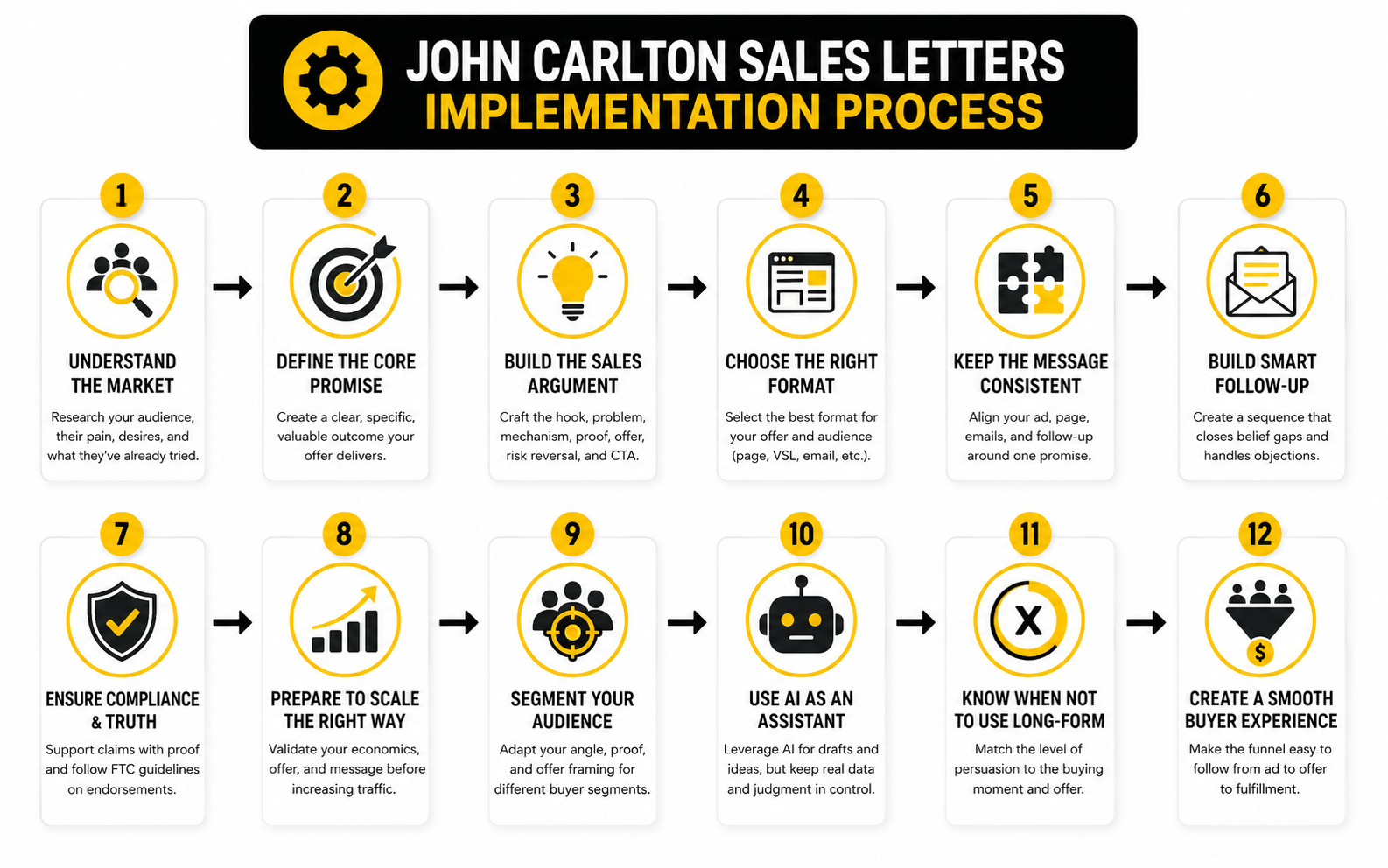
A useful implementation process keeps the copy from becoming random. Before writing the final draft, build the sales argument in plain language. Do not worry about style yet. Get the thinking right first.
Start by mapping the reader’s current belief. What do they already know? What are they skeptical about? What do they secretly want but hesitate to say out loud?
Then build the letter in this order:
That process is not flashy. Good. Flashy is usually where sales copy goes to die. The point is to make the argument clean enough that the reader never has to guess why they should care.
Proof Has To Sit Close To The Claim
Proof is strongest when it appears near the moment of doubt. If you make a claim and wait five sections to support it, the reader has already started resisting. The better move is to attach proof directly to the statement that needs belief.
Proof can take several forms. It can be a real customer result, a demonstration, a product walkthrough, a credible credential, a comparison, a guarantee, or a visible explanation of how the process works. The format matters less than the job it performs.
This is where many pages misuse testimonials. They dump a wall of praise onto the page and hope it creates trust. Better copy uses proof surgically. Each proof element should answer a specific doubt the reader is likely to have at that exact moment.
Bullets Should Create Desire, Not Clutter
Bullets are one of the easiest places to spot weak copy. Bad bullets list features. Good bullets create curiosity, sharpen value, and make the reader feel the usefulness of the offer before they buy.
A strong bullet usually does more than name what is included. It shows why that piece matters. It connects the feature to a payoff, a problem avoided, or a faster path to the desired result.
This is why Carlton-style bullets often feel alive. They do not sit there as inventory. They sell. Every bullet should make the offer feel heavier, more valuable, or harder to ignore.
Objections Should Be Handled Before The Close
A close cannot fix objections the body copy ignored. If the reader is still wondering whether the offer is credible, whether it fits their situation, whether it is worth the price, or whether they can trust the seller, the call to action has to work too hard. That is bad structure.
Handle objections as they naturally appear. If the promise sounds ambitious, explain the mechanism. If the mechanism sounds unusual, add proof. If the price creates hesitation, clarify the value and cost of inaction. If the reader worries about risk, make the guarantee or next step easy to understand.
This is not about pressure. It is about removing friction. The best close feels strong because the earlier sections already did their work.
The Close Should Feel Like The Next Logical Step
The close is where many writers suddenly become timid. They explain, prove, reassure, and then soften the ask until it feels weak. A direct response letter cannot do that.
A good close reminds the reader what is at stake, restates the promise, reduces the risk, and gives a clear next step. It does not introduce a brand-new argument at the last second. It completes the argument that has been building since the headline.
For modern funnels, that next step might be buying, booking, applying, starting a trial, joining a list, or watching a presentation. If the campaign needs follow-up after the first action, GoHighLevel can help manage pipeline, automation, and lead nurturing. But again, the tool only supports the sales process. The copy still has to make the decision feel obvious.
The Component Test
Before moving on, test each component by asking what job it performs. If the headline does not stop the right reader, rewrite it. If the lead does not create involvement, sharpen the problem. If the promise feels vague, make the outcome clearer. If the mechanism feels thin, explain why the offer works.
Then look at the letter as a whole. The components should not feel like separate blocks stacked on a page. They should feel like one persuasive conversation that keeps getting more believable as it moves.
That is the execution standard worth taking from John Carlton sales letters. Not the swagger. Not the old-school formatting. The real lesson is disciplined salesmanship: every line earns attention, every section builds belief, and every part points toward the action you want the reader to take.
How To Study John Carlton Sales Letters Without Copying Them
Studying John Carlton sales letters is not about finding a magic phrase and dropping it into your own page. That is the fastest way to create copy that sounds loud but does not sell. The more carefully approach is to study the structure, measure how your own version performs, and use the data to improve the sales argument.
This is where old-school direct response and modern analytics fit together nicely. Direct response gives you the discipline: one offer, one audience, one clear action. Analytics gives you the feedback loop: where people pay attention, where they hesitate, where they click, where they leave, and where the message loses force.
The point is not to turn copywriting into spreadsheet theater. The point is to stop guessing. If you are using Carlton-style thinking on a landing page, funnel, or email campaign, measurement tells you whether the argument is actually moving people toward action.
Statistics And Data
Benchmarks are useful only when they create better decisions. A conversion rate number by itself does not tell you much. It becomes useful when you compare it against traffic source, offer type, audience intent, page stage, price point, and the strength of the promise.
For example, the Unbounce Conversion Benchmark Report is based on more than 57 million conversions across more than 41,000 landing pages. That kind of data is helpful because it reminds you that conversion rate is contextual. A simple lead magnet page, a high-ticket application funnel, and a cold ecommerce product page should not be judged by the same expectation.
Email data needs the same discipline. Mailchimp’s email benchmark guidance frames open rates, click-through rates, and conversion rates as comparison points, not final answers. A high open rate with weak clicks often means the subject line created curiosity but the body did not carry the promise. A lower open rate with strong downstream sales may mean the list is smaller, warmer, and more qualified.
The Numbers That Actually Matter
The most useful metrics are the ones tied to a specific decision. If you are studying john carlton sales letters to improve your own copy, do not track everything just because a dashboard makes it available. Track the numbers that reveal where the sales argument is working or breaking.
For a sales page, start with these:
That last point matters. A page can increase conversions while damaging the business if it overpromises, attracts low-quality leads, or creates buyer regret. Good direct response is not just persuasive. It is precise.
What Each Signal Means
Scroll depth is not just a design metric. If a large percentage of readers leave before reaching the mechanism, proof, or offer, the problem may be the headline, lead, page speed, traffic mismatch, or the first visible promise. Do not immediately blame the button color. That is usually lazy optimization.
Click-through rate tells you whether the reader feels enough motivation to take the next step. If people scroll but do not click, the body may be interesting but not decisive. The copy may explain the problem well while failing to make the offer feel urgent, specific, or believable.
Conversion rate tells you whether the full path works. If clicks are strong but conversions are weak, the issue may be the form, checkout, price presentation, trust signals, guarantee, payment options, or the gap between the page promise and the final step. This is why you need to measure the whole path, not just the page.
Build A Measurement System Around The Sales Argument
A practical analytics setup should mirror the structure of the sales letter. You are not measuring random behavior. You are checking whether each stage of the argument did its job.
Start by mapping your page or funnel into persuasion stages:
Then attach a metric to each stage. Attention can be measured with bounce behavior and above-the-fold engagement. Relevance can be measured with scroll depth into the problem section. Belief can be measured with engagement around proof, video watch depth, or clicks after proof blocks. Desire can be measured with offer-section clicks. Risk reduction can be measured with checkout completion, form completion, refund rate, or sales-call quality.
How To Interpret Benchmarks Without Fooling Yourself
Benchmarks are not commandments. They are reference points. If your page converts below an industry benchmark, that does not automatically mean the copy is bad. It may mean the offer is expensive, the traffic is cold, the action requires trust, or the page is doing a more difficult job than the benchmark pages.
The reverse is also true. Beating a benchmark does not mean the copy is finished. If your conversion rate is high but average order value is low, lead quality is poor, or customer retention is weak, you may have optimized the wrong thing. The page is not supposed to win a dashboard contest. It is supposed to create profitable action.
This is where direct response thinking keeps you honest. The number that matters most is not always the easiest one to improve. A stronger headline may lift clicks. A clearer mechanism may lift qualified purchases. A more accurate promise may lower refunds even if front-end conversion stays the same.
Use Qualitative Data To Explain The Quantitative Data
Analytics tells you what happened. It rarely tells you why. That is why serious optimization combines quantitative data with qualitative review.
A tool like Microsoft Clarity can show heatmaps and session recordings, which helps you see where users click, scroll, rage-click, hesitate, or ignore key sections. That kind of behavior data is useful when you are trying to understand whether the reader is engaging with the copy or getting lost in the page. It does not replace conversion tracking, but it gives you clues that numbers alone cannot explain.
For broader research discipline, Nielsen Norman Group’s work on quantitative user research and UX research methods is useful because it separates measurement from interpretation. In plain English: do not treat one heatmap, one recording, or one angry support message as proof. Look for patterns before making changes.
Test One Sales Argument At A Time
The biggest testing mistake is changing too many things at once. If you rewrite the headline, restructure the offer, change the price, redesign the page, and add a new guarantee, you may improve performance, but you will not know why. That makes the next decision weaker.
A cleaner test isolates one part of the sales argument. Test a problem-focused headline against a mechanism-focused headline. Test a shorter lead against a more specific lead. Test proof before the offer against proof after the offer. Test a direct CTA against an application-style CTA.
Use proper sample size thinking before declaring a winner. Tools like the CXL A/B Test Calculator and Optimizely’s sample size calculator exist because small samples can lie. A test that “looks good” after 40 clicks can collapse once real traffic arrives.
Match The Metric To The Copy Change
Every copy change should have a hypothesis. Do not rewrite because you are bored. Rewrite because you believe a specific section is causing a specific problem.
If the first-screen bounce is high, test the headline, subheadline, hero message, or traffic match. If people read deep but do not click, test the offer framing, urgency, proof, or CTA. If people click but do not complete checkout, test checkout friction, risk reversal, payment clarity, or expectation match.
This is how john carlton sales letters should influence modern optimization. You are not just asking, “Does this sound better?” You are asking, “Which belief is weak, where does that weakness appear, and what change should strengthen it?”
Useful Benchmarks For Modern Sales Pages
Landing page benchmarks are best used as directional context. The Unbounce benchmark report is useful because it separates performance by industry and is built from a large landing page dataset. That helps prevent one of the most common mistakes: comparing your high-ticket consulting application page to a free download page.
Checkout benchmarks are especially important for ecommerce and low-ticket offers. Baymard’s research has long shown that cart abandonment is a major conversion leak, and a widely cited Baymard figure puts average cart abandonment around 70.19%. That number matters because it reminds you that the sales letter does not end at the CTA. If checkout creates surprise costs, forced account creation, trust concerns, or delivery confusion, the page can win the click and still lose the sale.
Email benchmarks are useful when the sales letter is split across a sequence. GetResponse’s email marketing benchmark report and Mailchimp’s benchmark guidance can help you interpret opens, clicks, and engagement by industry. But again, the useful question is not “Are we above average?” The useful question is “Which part of the email argument is weak?”
What To Do With The Data
Once you have the data, sort your actions by leverage. Do not start with tiny edits if the main promise is unclear. Do not obsess over button copy if the proof section is weak. Do not rebuild the entire funnel if one checkout step is causing the leak.
A practical priority order looks like this:
This is also where tools can support the process without replacing the thinking. GoHighLevel can help track leads, follow-up, pipelines, and campaign activity after the opt-in or booking. ClickFunnels can help build and test funnel pages. The tools are useful, but the decision-making still comes from understanding the sales argument.
The Real Measurement Standard
The real standard is not whether your copy feels like John Carlton’s voice. It is whether your message moves the right reader from skepticism to action. That movement should show up in the data, but it should also show up in lead quality, buyer fit, sales conversations, retention, and fewer confused prospects.
This is why measurement belongs in the same conversation as copywriting. Sales letters are not creative writing assignments. They are business assets. They either clarify desire, build belief, and produce action, or they do not.
When you study John Carlton sales letters through that lens, you stop looking for phrases to steal and start looking for decisions to improve. That is the better game. The next step is taking the framework, components, and measurement system into modern funnels and campaigns without losing the direct response discipline that made the original letters worth studying.
Professional Implementation For Modern Funnels And Campaigns
At this stage, the work becomes more strategic. You are no longer just studying John Carlton sales letters as examples of strong copy. You are deciding how to use the thinking behind them inside real campaigns where traffic quality, offer economics, compliance, automation, and follow-up all affect the result.
This is where a lot of marketers get sloppy. They take direct response intensity, plug it into a modern funnel, and forget that every part of the system has consequences. Strong copy can increase conversions, but if the offer is weak, the targeting is wrong, the proof is thin, or the follow-up is careless, the campaign still breaks.
Professional implementation means the sales argument and the business system support each other. The letter creates desire and belief. The funnel captures action. The follow-up reinforces the promise. The fulfillment experience proves the copy was telling the truth.
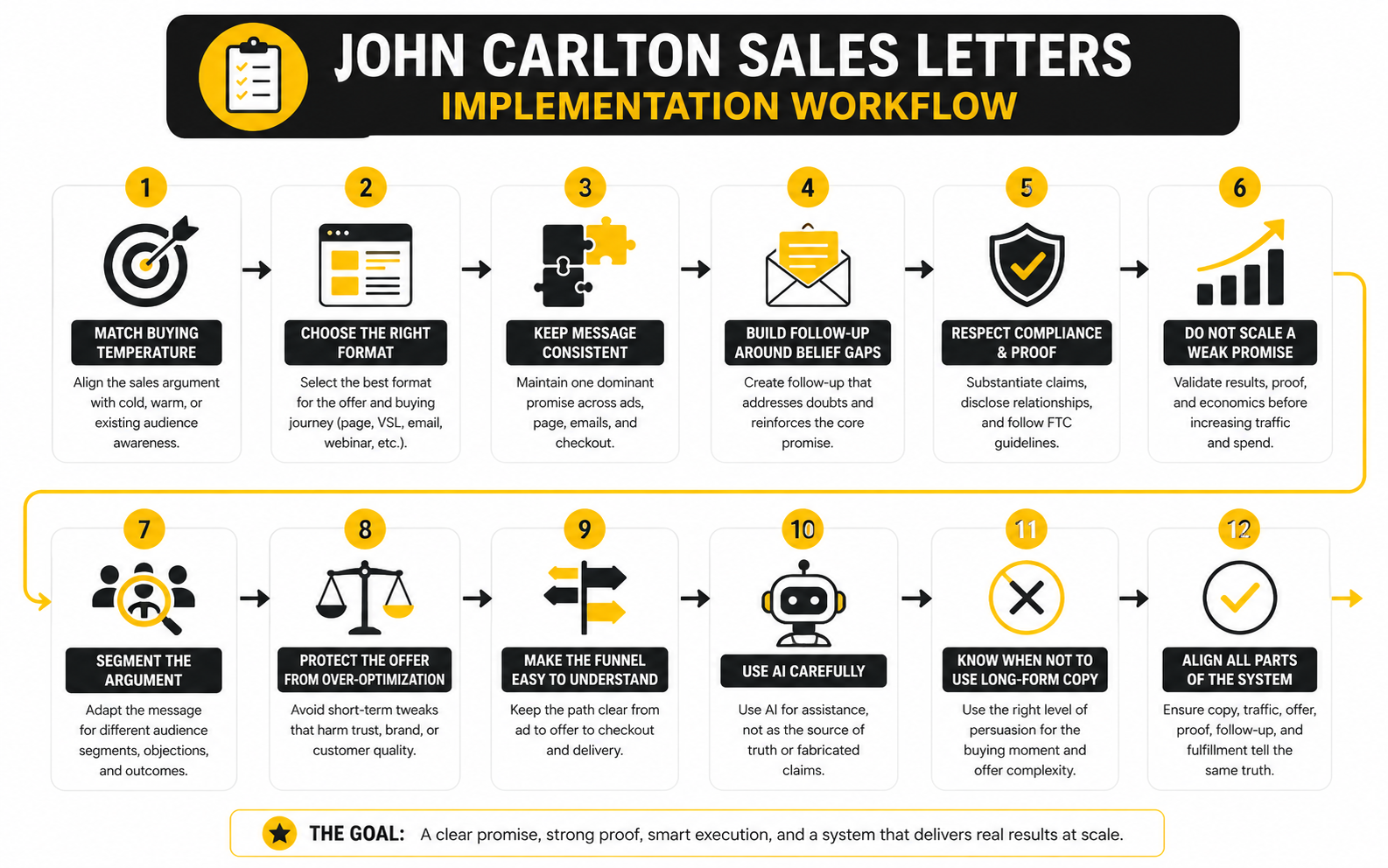
Match The Letter To The Buying Temperature
A cold prospect needs a different sales argument than a warm subscriber. This sounds basic, but it is one of the biggest reasons funnels underperform. The copy assumes too much trust too early.
Cold traffic usually needs more context, more problem education, and a stronger mechanism. Warm traffic may already understand the problem and need more proof, differentiation, or urgency. Existing customers may not need a long argument at all because the relationship has already done part of the selling.
That is why john carlton sales letters should not be copied into every environment unchanged. The structure has to match the reader’s awareness. The more skeptical or unfamiliar the audience is, the more carefully the copy must build the bridge from problem to promise.
Choose The Right Format For The Sales Argument
A classic sales letter is one format, not the only format. The same argument can become a landing page, VSL, webinar script, email sequence, advertorial, lead magnet bridge page, checkout page, or sales-call follow-up. The question is not “Which format looks most like old-school direct response?” The question is “Where does the buyer need persuasion?”
A high-ticket offer may need a page that qualifies the reader before asking for an application. A low-ticket product may need a shorter page with fast proof and simple checkout. A complex B2B offer may need a lead capture step, educational follow-up, and a sales conversation before the final decision.
This is the tradeoff. Longer copy can build more belief, but it can also create friction if the buyer is already ready. Shorter copy can feel cleaner, but it can fail when the claim needs explanation. The right length is not a word count. It is the amount of argument required to create action.
Keep The Message Consistent Across The Funnel
One of the easiest ways to lose conversions is to create message drift. The ad promises one thing. The landing page says something slightly different. The email follow-up changes the angle again. By the time the reader reaches the checkout or booking page, the original reason for clicking has gone blurry.
A professional funnel keeps one dominant promise alive across the whole path. The wording can change, but the core idea should not. If the ad leads with speed, the page should explain the speed mechanism. If the page leads with a unique process, the emails should reinforce that process. If the checkout promises simplicity, the product experience should feel simple.
This is why campaign mapping matters before writing. Write the argument once in plain English, then adapt it by channel. That prevents the funnel from becoming a collection of disconnected assets.
Build Follow-Up Around Belief Gaps
Most people do not buy the first time they see an offer. That does not always mean they are uninterested. It often means one belief is still missing.
Follow-up should not be random reminders. It should diagnose and close belief gaps. One email can deepen the problem. Another can explain the mechanism. Another can handle risk. Another can show proof. Another can make the cost of delay more obvious.
This is where marketing automation becomes useful when it supports the sales argument instead of replacing it. GoHighLevel can help manage CRM activity, follow-up sequences, pipelines, and campaign automation. Brevo and Moosend can also support email campaigns when the strategy is more list-driven. The tool choice matters less than the logic of the sequence.
Respect Compliance And Claim Substantiation
Direct response copy gets into trouble when persuasion outruns proof. This is not just an ethics issue. It is a business risk.
The FTC’s guidance on endorsements makes clear that compensated reviews, testimonials, and promotional relationships need proper disclosure, and the endorsement rules are tied to broader truth-in-advertising standards. The official FTC endorsement guidance and the current 16 CFR Part 255 endorsement guides are worth reviewing if your copy uses testimonials, influencer claims, expert endorsements, or customer results.
That matters when adapting john carlton sales letters for modern funnels. Old-school force does not excuse modern sloppiness. If you claim a result, support it. If a testimonial is atypical, avoid implying it is normal. If there is a material relationship, disclose it clearly. Strong copy does not need fake certainty.
Do Not Scale A Weak Promise
Scaling exposes weak messaging. When traffic is small, a campaign can survive on warm audiences, personal trust, or a few lucky conversions. When spend increases, the message has to persuade colder, less forgiving prospects.
This is where the promise gets tested. If the promise is too broad, paid traffic will make the weakness expensive. If the proof is too thin, larger audiences will push back harder. If the mechanism is unclear, more impressions will simply create more indifference.
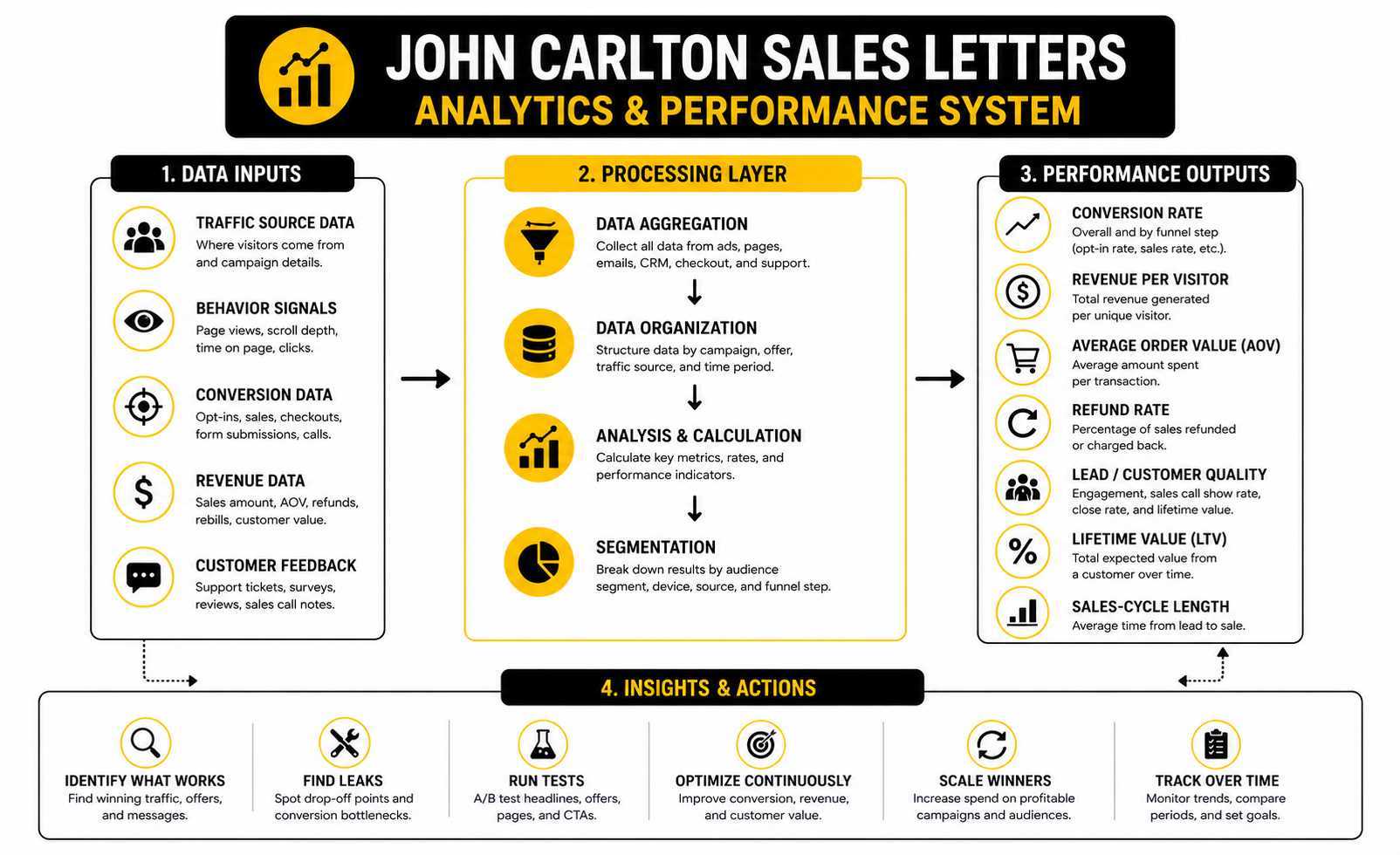
Before scaling, check the basic economics. You need to know cost per lead, cost per acquisition, average order value, gross margin, refund rate, lifetime value, and sales-cycle length. A sales letter that increases front-end conversions but attracts poor-fit customers can look good in the dashboard and still damage profit.
Segment The Argument By Audience
Advanced implementation often requires more than one version of the sales argument. Different audience segments may want the same product for different reasons. A founder, freelancer, agency owner, and marketing manager may all buy the same tool, but their objections and desired outcomes are not identical.
Segmentation does not mean rewriting everything from scratch. It means adjusting the entry point, proof, examples, offer framing, and call to action for the reader’s situation. The mechanism can stay consistent while the angle changes.
This becomes especially important with email and retargeting. A person who visited the pricing page needs a different message than someone who only read the first section of the landing page. A person who abandoned checkout needs different reassurance than someone who watched a webinar but never booked a call.
Protect The Offer From Over-Optimization
Optimization can make copy sharper, but it can also make it worse. If every decision is based on short-term clicks, you may gradually turn a strong offer into a louder, cheaper, more aggressive version of itself. That can lift immediate action while hurting brand trust and customer quality.
This is the risk with studying direct response legends too superficially. You see the punch, but miss the discipline. The goal is not to make the copy more extreme. The goal is to make the buying decision clearer, safer, and more compelling for the right person.
Use performance data, but keep strategic judgment in the room. If a test lifts opt-ins but lowers booked calls, question it. If a headline increases curiosity but attracts the wrong audience, question it. If urgency increases sales but creates support complaints, question it hard.
Make The Funnel Easier To Understand
A persuasive funnel should feel easy to follow. Not shallow. Easy. The reader should know what the offer is, who it is for, why it works, what happens next, and what action to take.
This matters because confusion kills momentum. If the page sells one thing, the checkout names another, the confirmation email gives vague instructions, and the follow-up uses a different promise, the buyer starts to doubt the decision. That doubt can show up as abandoned carts, missed calls, refund requests, or silent unsubscribes.
For ecommerce or creator offers, a funnel builder like ClickFunnels can help keep the path contained. For leaner launches, Systeme.io can cover basic funnel and email needs. The platform should make the sales argument easier to deploy, not more complicated to understand.
Use AI Carefully In The Copy Process
AI can help with research organization, angle exploration, outline development, draft variations, and repurposing. It can also produce confident nonsense, generic persuasion, and fake specificity if you let it drive the strategy. That is the danger.
A Carlton-style approach requires market understanding. AI can assist, but it cannot replace real customer interviews, sales-call notes, review mining, offer economics, and proof gathering. If the inputs are shallow, the output will usually sound polished and empty.
Use AI as a production assistant, not the source of truth. Let it help you generate headline variations after the promise is clear. Let it help restructure an email after the belief gap is known. Do not let it invent claims, testimonials, statistics, or customer stories.
Know When Not To Use Long-Form Direct Response
Long-form sales copy is powerful when the buyer needs education, belief, proof, or reassurance. It is unnecessary when the purchase is simple, low-risk, familiar, or already decided. More copy is not automatically more persuasion.
If the reader already knows the product category, trusts the brand, understands the price, and wants a fast transaction, forcing them through a heavy sales letter may create friction. In that case, clarity, speed, product details, reviews, and checkout simplicity may matter more than a long argument.
The expert move is choosing the right level of persuasion for the buying moment. Sometimes that means a full sales letter. Sometimes it means a short landing page. Sometimes it means a strong product page supported by email. The best copywriters do not worship format. They solve the selling problem.
The Advanced Standard
The advanced standard is simple: the copy, funnel, traffic, proof, offer, and follow-up should all tell the same truth. Not the same sentence. The same truth.
That is the professional lesson behind John Carlton sales letters. They show how powerful a clear sales argument can be when every section has a job and every claim pushes toward action. Modern implementation adds more moving parts, but it does not change the core discipline.
If the message is sharp, the proof is real, the offer is strong, and the system follows through, the campaign has a chance to scale cleanly. If one of those pieces is missing, stronger copy may only make the weakness visible faster. That sets up the final part: the common mistakes to avoid, the practical checklist to use before publishing, and the questions people usually ask when studying Carlton-style sales letters.
Common Mistakes To Avoid Before Publishing
The final danger with John Carlton sales letters is thinking the style matters more than the sales logic. It does not. The surface can look aggressive, punchy, or old-school, but the real value is in the way the message earns attention, builds belief, proves the promise, and asks for action.
Most weak versions fail because they copy the attitude without doing the research. They make bold claims without proof. They use urgency without a real reason. They write long because they think long copy is automatically more persuasive.
That is backwards. A serious sales letter should be as long as the buying decision requires and as tight as the reader deserves. Every section should either create relevance, increase desire, strengthen belief, reduce risk, or move the reader toward the next step.
The Biggest Mistakes In Carlton-Style Copy
The first mistake is writing before the market is understood. If you do not know what the buyer already believes, what they have already tried, and what they are tired of hearing, the copy will sound generic. You may still write energetic sentences, but they will not land with the right person.
The second mistake is making the promise bigger instead of making it clearer. More hype rarely fixes weak persuasion. A clearer promise, a sharper mechanism, and stronger proof usually do more for conversion than louder claims.
The third mistake is treating proof as decoration. Testimonials, credentials, demos, data, and guarantees should not be sprinkled around the page because they look good. They should appear where the reader is likely to doubt the claim, the mechanism, the price, or the next step.
A Practical Checklist Before You Publish
Use this checklist before sending traffic to a sales letter, funnel, or campaign inspired by John Carlton sales letters. It is intentionally simple. The goal is to catch the obvious leaks before they become expensive.
This checklist is not a creative constraint. It is quality control. Strong direct response copy can be bold, but it should never be careless.
The Final System
A complete Carlton-style system has four layers. First, there is market intelligence: the buyer, the pain, the desire, the objections, and the language they already use. Second, there is the sales argument: the hook, problem, promise, mechanism, proof, offer, risk reversal, and call to action.
Third, there is the campaign system around the copy. That includes traffic, landing pages, email follow-up, retargeting, sales calls, checkout, onboarding, and fulfillment. Fourth, there is measurement: conversion rate, lead quality, revenue per visitor, refunds, retention, and the qualitative feedback that explains the numbers.
This is the mature way to study John Carlton sales letters. Do not freeze them in time. Use them as training for sharper sales thinking, then adapt the principles to the campaign you are actually running.
What are John Carlton sales letters?
John Carlton sales letters are direct response sales messages written or taught by copywriter John Carlton, known for practical, hard-hitting salesmanship. They are studied because they show how to move a skeptical reader from attention to action using a clear promise, emotional relevance, proof, and a direct call to action. The useful lesson is not to copy the voice, but to understand the structure behind the persuasion.
Why do marketers still study John Carlton sales letters?
Marketers still study them because the core selling problem has not changed. Buyers still need to recognize the problem, believe the promise, trust the mechanism, and feel safe enough to act. Carlton’s official Simple Writing System materials position copywriting as a repeatable process for writing sales messages, which is why the work remains useful beyond the original formats: Simple Writing System.
Are John Carlton sales letters still relevant for modern landing pages?
Yes, but they should be adapted to the buying situation. A modern landing page may need shorter sections, mobile-friendly formatting, faster proof, and cleaner checkout flow. The underlying logic still applies because the page still has to create relevance, belief, desire, and action.
Should I copy John Carlton’s writing style?
No. Copying the style is the shallow move. You can study the structure, pacing, proof placement, and sales logic, but your own copy has to fit your market, offer, brand, and compliance requirements.
What is the most important part of a Carlton-style sales letter?
The most important part is the core sales argument. The headline matters, the lead matters, the proof matters, and the close matters, but they only work when they support one dominant promise. If the main argument is weak, stronger wording will not save the letter.
How long should a sales letter be?
A sales letter should be long enough to answer the buyer’s real questions and short enough to avoid wasting attention. Cold traffic, expensive offers, unfamiliar mechanisms, and skeptical markets usually need more explanation. Warm traffic, simple offers, and familiar products often need less.
What metrics should I track when testing a sales letter?
Track metrics that show where the argument is working or breaking. Useful signals include traffic source, scroll depth, click-through rate, conversion rate, checkout completion, revenue per visitor, refund rate, and lead quality. Landing page benchmark resources like the Unbounce Conversion Benchmark Report can provide context, but your own funnel economics matter more than any generic average.
How do I know if the copy problem is the headline, offer, or checkout?
Look at where the drop-off happens. If people leave immediately, the issue may be traffic mismatch, headline, first-screen promise, or page speed. If people scroll but do not click, the offer, proof, urgency, or call to action may be weak. If people click but do not complete the final step, the problem may be checkout friction, trust, price presentation, or expectation mismatch.
Can I use AI to write Carlton-style sales letters?
You can use AI to help organize research, draft variations, restructure sections, and generate headline options. You should not use it to invent claims, testimonials, statistics, customer stories, or proof. The strategy still needs real customer insight, offer clarity, and human judgment.
What is the biggest risk with direct response copy?
The biggest risk is letting persuasion outrun truth. Aggressive copy may create short-term conversions, but unsupported claims, unclear disclosures, or misleading testimonials can damage trust and create compliance risk. The FTC’s current endorsement rules explain how endorsements and testimonials are evaluated under advertising standards: 16 CFR Part 255.
Do John Carlton sales letters work for SaaS and B2B offers?
They can, but the execution needs to match the buying process. SaaS and B2B buyers often need clarity around use case, implementation, risk, integration, ROI, stakeholder approval, and support. The persuasion framework is useful, but the proof and mechanism usually need to be more practical and less theatrical.
What tools help implement a modern sales letter funnel?
The tool depends on the campaign. ClickFunnels can help build funnel pages and offer flows, while GoHighLevel can support CRM, follow-up, and automation. Email tools like Brevo or Moosend can help when the sales argument continues through a sequence.
How should I study old sales letters without copying them?
Break them down by function. Ask what the headline is doing, how the lead creates involvement, where the problem becomes specific, how the mechanism is explained, what proof supports the claim, and how the close reduces risk. Then apply that logic to your own offer in your own market.
What is the best final test before publishing?
Read the page as a skeptical buyer, not as the person who wrote it. Ask whether the promise is clear, the mechanism is believable, the proof is strong, the offer is understandable, and the next step feels safe. If any of those answers are weak, keep refining before sending serious traffic.
Build a stronger local presence with BAAM AI
Turn your website, Google profile, social channels, and AI visibility into one growth engine
Most businesses do not need more random marketing activity. They need a consistent presence system that helps the right people find them, trust them, and take action. BAAM AI brings strategy, local SEO, website updates, Google Maps visibility, social content, AI-search readiness, media production, and reporting into one practical monthly engine.
If you want your marketing to keep working after the campaign ends, start with a free BAAM AI presence audit. See how your business shows up today and where the fastest visibility wins are at BAAM AI.