
BAAM AI Blog
John Caples: The Copywriting System Behind Ads That Still Sell
John Caples is not famous because he wrote clever ads. He is famous because he treated advertising like a measurable business activity before that mindset became normal.
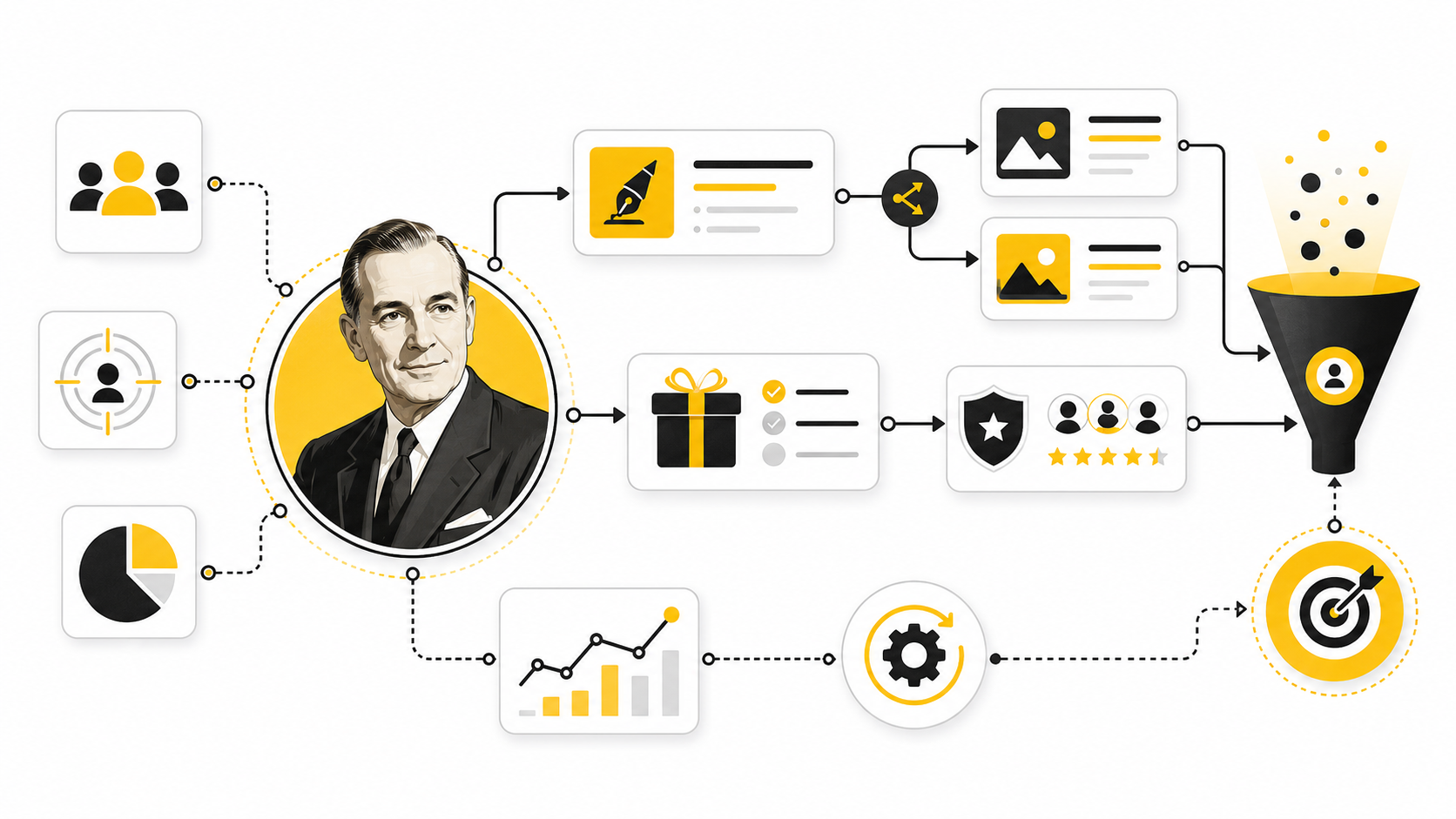
John Caples is not famous because he wrote clever ads. He is famous because he treated advertising like a measurable business activity before that mindset became normal.
That matters more now than most marketers realize. In a world where ad platforms, funnels, landing pages, email sequences, AI tools, and creative testing move fast, the core question has not changed: does the message make the right person take action?
Caples built his reputation on that question. His best-known ad, “They Laughed When I Sat Down at the Piano But When I Started to Play!”, became one of the most studied direct response ads in history because it did more than grab attention. It dramatized a desire, created curiosity, promised transformation, and moved readers toward a clear response.
The reason John Caples still belongs in a modern marketing conversation is simple. He gave copywriters a practical way to think: start with the reader’s self-interest, prove the promise, make the offer clear, and test what actually works.
Why John Caples Still Matters
John Caples worked in an advertising world that looked nothing like today’s marketing stack. There were no landing page builders, no automated email flows, no paid social dashboards, no AI copy tools, and no instant analytics panel showing conversion rates by creative variation. Yet his approach feels unusually current because it was built around testing, response, and reader psychology.
The Smithsonian’s archive of the John Caples Papers describes him as respected for developing innovative copy-testing techniques and lists major works including Tested Advertising Methods, Advertising for Immediate Sales, Making Ads Pay, and How To Make Your Advertising Make Money. That body of work is the reason his name still appears in serious copywriting training. He was not just writing ads; he was trying to understand why one ad pulled response while another disappeared.
This is the useful lesson for modern marketers. The channel changes, but the market still punishes vague messaging. A weak landing page headline, a generic email subject line, a soft offer, or a confusing funnel step can waste budget just as quickly today as a poor magazine ad did in Caples’ era.
The money at stake is bigger now. U.S. internet advertising revenue reached a record $259 billion in 2024, which means more brands are fighting for attention in measurable channels. When the environment gets more competitive, Caples’ discipline becomes more valuable, not less.
The Core Idea Behind His Work
The practical core of John Caples is this: advertising should be judged by response, not by how polished it looks in a meeting. That does not mean design, taste, or brand voice do not matter. It means they must support the sale instead of distracting from it.
Caples is closely associated with direct response because he cared about what the reader did next. Did they request the booklet? Did they send the coupon? Did they write in, call, buy, or take the next step? In modern terms, he was thinking about conversion long before conversion rate optimization became a normal marketing phrase.
That makes his thinking especially useful for online businesses. A funnel built in ClickFunnels, GoHighLevel, Systeme.io, or any other platform still needs the same fundamentals: a strong promise, a clear reason to care, credible proof, and a low-friction next step. Tools can publish the page, automate the follow-up, and track the numbers, but they cannot rescue a message that never connects.
The Framework Overview
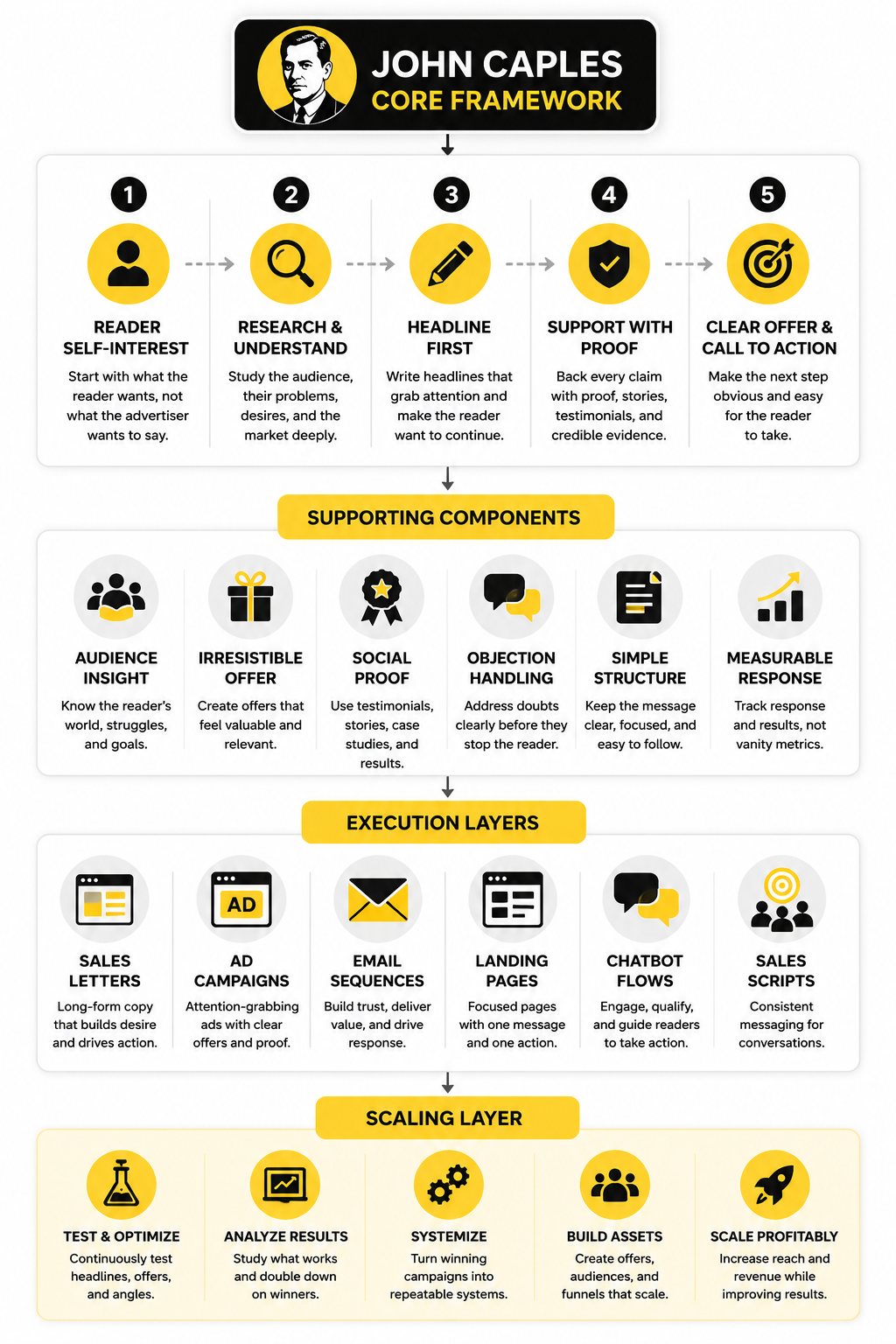
The John Caples framework starts with the reader, not the product. That is the first shift. Instead of asking, “What do we want to say?”, the better question is, “What does the reader already want, fear, doubt, or hope will happen?”
From there, the message needs a hook that creates immediate relevance. Caples favored headlines that appealed to self-interest, curiosity, news, or a strong benefit. The headline’s job was not to sound impressive; it was to earn the next few seconds of attention.
After attention comes belief. A strong ad needs proof, detail, specificity, and a reason the reader can trust the promise. This is where many modern campaigns fail, because they make large claims but do not give the reader enough substance to feel safe acting.
Finally, the message needs a response path. In Caples’ day, that might have been a coupon, order form, or mail-in request. Today it might be a landing page form, checkout page, webinar registration, chatbot flow through ManyChat, or automated follow-up inside a CRM.
Core Components of the Caples Approach
The first component is reader self-interest. Caples understood that people do not read ads because they want to admire a company’s writing. They read when they see something that connects to a personal desire, problem, ambition, or fear.
The second component is specificity. A general promise feels easy to ignore because it asks the reader to do too much work. A specific promise creates shape, tension, and believability.
The third component is proof. A claim without proof is just noise. Proof can come from demonstrations, concrete details, testimonials, comparisons, guarantees, data, or a credible explanation of how the result is achieved.
The fourth component is testing. This is where John Caples separates himself from purely literary copywriters. He wanted advertising decisions to be grounded in response, and that mindset maps directly to split testing headlines, offers, landing pages, email subject lines, creative angles, and follow-up sequences today.
Professional Implementation
Using John Caples professionally does not mean copying old mail-order ads word for word. That is usually the lazy move. The real value is applying his decision-making process to modern channels.
For example, a SaaS business can use Caples’ thinking to sharpen a homepage hero section. An ecommerce brand can use it to test product page headlines and offer framing. A coach, consultant, or agency can use it to build a stronger webinar registration page, sales page, or email sequence.
This is also where marketers need to be careful. Caples’ work is often reduced to “write better headlines,” but that is only one layer. The deeper system is about matching market desire, message, proof, and response mechanism into one coherent path.
That path is what the rest of this guide will build. First, we will break down the framework itself. Then we will move into headlines, proof, offers, testing, and the practical mistakes that make otherwise good campaigns underperform.
The John Caples Copywriting Framework
The John Caples framework is not a rigid template. It is a way of thinking through a selling message so the reader feels understood before they are asked to act. That distinction matters because most weak copy does not fail from a lack of words; it fails because the words are organized around the company instead of the buyer.
Caples pushed advertising toward a measurable standard. The Smithsonian archive of the John Caples Papers highlights his work in copy testing, direct marketing techniques, and books such as Tested Advertising Methods and Advertising for Immediate Sales. That tells you the center of gravity: the message must attract attention, create belief, and produce response.
Modern marketers can use the same framework across ads, landing pages, email sequences, webinars, sales pages, and follow-up automation. The format changes, but the buying psychology does not. A person still needs a reason to stop, care, trust, and move.
Start With the Reader’s Self-Interest
Caples believed the strongest advertising begins with what the reader already wants. Not what the company wants to announce. Not what the founder is proud of. Not what the internal team thinks sounds clever.
Reader self-interest is the point where the product meets a personal desire. That desire might be more income, less embarrassment, faster progress, better status, lower risk, more control, or relief from a problem that has become annoying enough to solve. When copy starts there, it immediately feels more relevant.
This is why the famous piano ad worked so well as a teaching example. The headline did not say, “Learn Piano by Mail With Our Proven Course.” It entered through a social moment: being doubted, then surprising everyone. That is stronger because it attaches the product to a human desire, not just a feature.
For practical work, this means the first draft should not begin with the offer. It should begin with the reader’s private conversation. What are they tired of? What result would make them feel proud? What problem would they pay to stop thinking about?
Turn the Product Into a Promise
A product is what the business sells. A promise is why the reader cares. John Caples understood that advertising needs to translate the product into a clear outcome before asking for attention.
This does not mean making wild claims. It means making the benefit concrete enough that the reader can instantly understand the point. “Email software” is a product category. “Send better follow-ups without manually chasing every lead” is closer to a promise.
The same logic applies to modern tools and funnels. If a business uses GoHighLevel, the reader does not care about the platform name by itself. They care that the system can help capture leads, follow up automatically, manage conversations, and keep revenue opportunities from slipping through the cracks.
Good copy makes that translation fast. It does not bury the outcome under technical language. It shows the reader what improves, what gets easier, or what becomes possible after they take the next step.
Build the Message Around One Dominant Appeal
One of the most useful Caples-style disciplines is choosing one dominant appeal. Weak copy often tries to sell everything at once. It promises speed, savings, status, security, simplicity, flexibility, innovation, and premium quality in the same section, which usually makes the message feel generic.
A dominant appeal gives the copy a spine. It tells the writer which proof matters, which objections to answer, which examples to include, and which details to cut. Without that decision, the page becomes a pile of claims instead of a persuasive argument.
The appeal should match the market’s strongest motivation. A busy agency owner may care more about saving time than exploring advanced features. A new creator may care more about looking professional without hiring a full team. A SaaS buyer may care more about reducing risk than chasing a flashy promise.
This is where practical research beats guessing. Read reviews, sales calls, support tickets, comments, customer interviews, and competitor complaints. The best appeal is often already sitting in the customer’s language.
Use Curiosity Without Becoming Vague
Caples used curiosity well because he tied it to a meaningful payoff. Curiosity alone is not enough. A mysterious headline may get attention, but if the reader cannot connect it to a useful benefit, the attention fades quickly.
The piano ad is a clean example because the curiosity has emotional direction. The reader wants to know what happened when the person started to play. But the curiosity also points toward the product’s promise: you can go from being underestimated to being admired.
Modern marketers often abuse curiosity by writing hooks that feel like bait. “You won’t believe what happened next” may earn a click, but it rarely builds trust if the landing page does not deliver. Caples-style curiosity works better because it opens a loop the offer can honestly close.
A good test is simple. After reading the hook, can the reader understand why the next sentence matters to them? If the answer is no, the copy is probably being clever instead of useful.
Make the Proof Fit the Promise
Proof is not decoration. It is the bridge between desire and action. Once the reader understands the promise, they immediately start asking whether it is real, whether it applies to them, and whether the risk is worth it.
Caples’ direct response mindset forces the writer to support the claim with substance. That could be a demonstration, a before-and-after comparison, a guarantee, a specific mechanism, a clear explanation, or credible evidence. The form depends on the offer, but the function is always the same: reduce doubt.
In today’s environment, proof matters even more because buyers are surrounded by claims. Digital advertising revenue reached a record $259 billion in 2024, which means readers are exposed to more offers, more angles, and more promises across more channels. A claim that sounded exciting ten years ago may now sound like noise unless it is backed by detail.
The proof should also match the stage of awareness. A cold audience may need more context and education. A warm lead may need comparison, urgency, or reassurance. A returning prospect may need a stronger reason to act now instead of saving the page for later.
Give the Reader a Clear Next Step
Direct response copy does not end with admiration. It ends with action. That is one of the biggest lessons from John Caples, and it is still where many modern campaigns lose money.
A clear next step removes friction. The reader should know exactly what to do, what happens after they do it, and why it is worth doing now. If the page asks them to book a call, start a trial, download a guide, join a webinar, or complete a form, the surrounding copy should make that step feel natural.
This is especially important when the offer sits inside a funnel. A landing page built with ClickFunnels or Systeme.io can look polished and still underperform if the call to action is vague. The technology can move the visitor through the process, but the copy must create the reason to continue.
The best next step feels like the obvious continuation of the promise. If the copy has built interest around saving time, the call to action should not suddenly shift into a generic “submit.” It should reinforce the outcome and keep the reader moving.
The Framework in Sequence
The Caples framework works best when the pieces are arranged in a logical order. You do not need to use the same layout every time, but you do need the same persuasive movement. Attention comes first, then relevance, then belief, then action.
A practical sequence looks like this:
This sequence is simple, but it is not shallow. Each step forces a decision. That is the point. Strong copy usually comes from sharper decisions, not from adding more adjectives.
The next part goes deeper into the most visible piece of the system: headlines and hooks. That is where John Caples became legendary, but the real lesson is not to copy his famous lines. The real lesson is to understand why those lines made people stop, lean in, and keep reading.
Headlines, Hooks, and Reader Self-Interest
This is where John Caples becomes most useful in daily marketing work. A headline is not a decorative sentence at the top of a page. It is the first filter between the reader’s problem and the offer.
Caples treated headlines as the most important part of the ad because they decide whether the rest of the message gets a chance. Google Books’ listing for Tested Advertising Methods shows entire sections built around “The Most Important Part of an Advertisement,” “What Kinds of Headlines Attract the Most Readers?,” and “Right and Wrong Methods of Writing Headlines,” which tells you how central this was to his method. The headline was not a finishing touch; it was the front door.
That same logic applies to landing pages, email subject lines, webinar titles, YouTube hooks, social ads, chatbot openers, and sales page leads. The reader is always asking the same private question: “Is this for me, and is it worth my attention?” A strong hook answers that before the reader has time to leave.
Write for the Desire Behind the Click
The beginner mistake is writing headlines around the thing being sold. The Caples move is writing around the desire that makes the thing valuable. That shift turns a flat product statement into something the reader can feel.
For example, “CRM Automation Platform” is technically clear, but it is not emotionally urgent. “Stop Losing Leads Because Nobody Followed Up” is more compelling because it points at a painful business problem. The reader can instantly understand what is at stake.
This does not mean every headline needs to sound dramatic. It means every headline should connect to a real motive. A founder may want more booked calls, a creator may want more consistent sales, and an agency may want cleaner client reporting without adding more admin work.
The best headline usually comes from listening before writing. Sales calls, customer reviews, support tickets, survey answers, Reddit threads, YouTube comments, and competitor complaints often reveal the exact language buyers already use. When the copy reflects that language, it feels less like marketing and more like recognition.
The Four Caples-Style Hook Angles
Caples is often remembered for curiosity, but his work was broader than that. The strongest hooks usually come from one of four angles: benefit, news, curiosity, or emotion. Each angle can work, but only when it fits the audience and the offer.
A benefit hook leads with the outcome the reader wants. It is direct, clear, and useful when the market already understands the problem. This works well for offers where the value is obvious but the buyer needs a reason to choose this solution.
A news hook makes the message feel timely. It works when something has changed: a new method, a new feature, a new rule, a new market shift, or a new opportunity. This is powerful because people pay attention when they believe old assumptions may no longer apply.
A curiosity hook opens a loop. It gives the reader enough information to care, but not so much that the tension disappears. The famous piano ad works here because the reader wants to know how someone went from being laughed at to impressing the room.
An emotional hook puts the reader inside a feeling. Embarrassment, relief, pride, frustration, fear of missing out, and ambition can all work when they are handled honestly. Caples did this well because the emotion served the offer instead of replacing it.
Turn a Raw Idea Into a Working Hook
A hook becomes useful when it is specific enough to test. This is where many marketers stay too vague. They brainstorm a few clever lines, pick the one that sounds best, and never force the idea through a real process.
A better process starts with the reader’s current state. What do they believe right now? What are they struggling with? What have they already tried? What result would feel meaningful enough to act on today?
Then you define the movement. The hook should suggest a shift from pain to relief, confusion to clarity, doubt to confidence, or effort to simplicity. That movement gives the headline energy because the reader can see a before and after.
Finally, you make the promise readable. Strong hooks usually use simple language, concrete outcomes, and a clear reason to keep going. If the reader has to decode the headline, the copy is already working too hard.
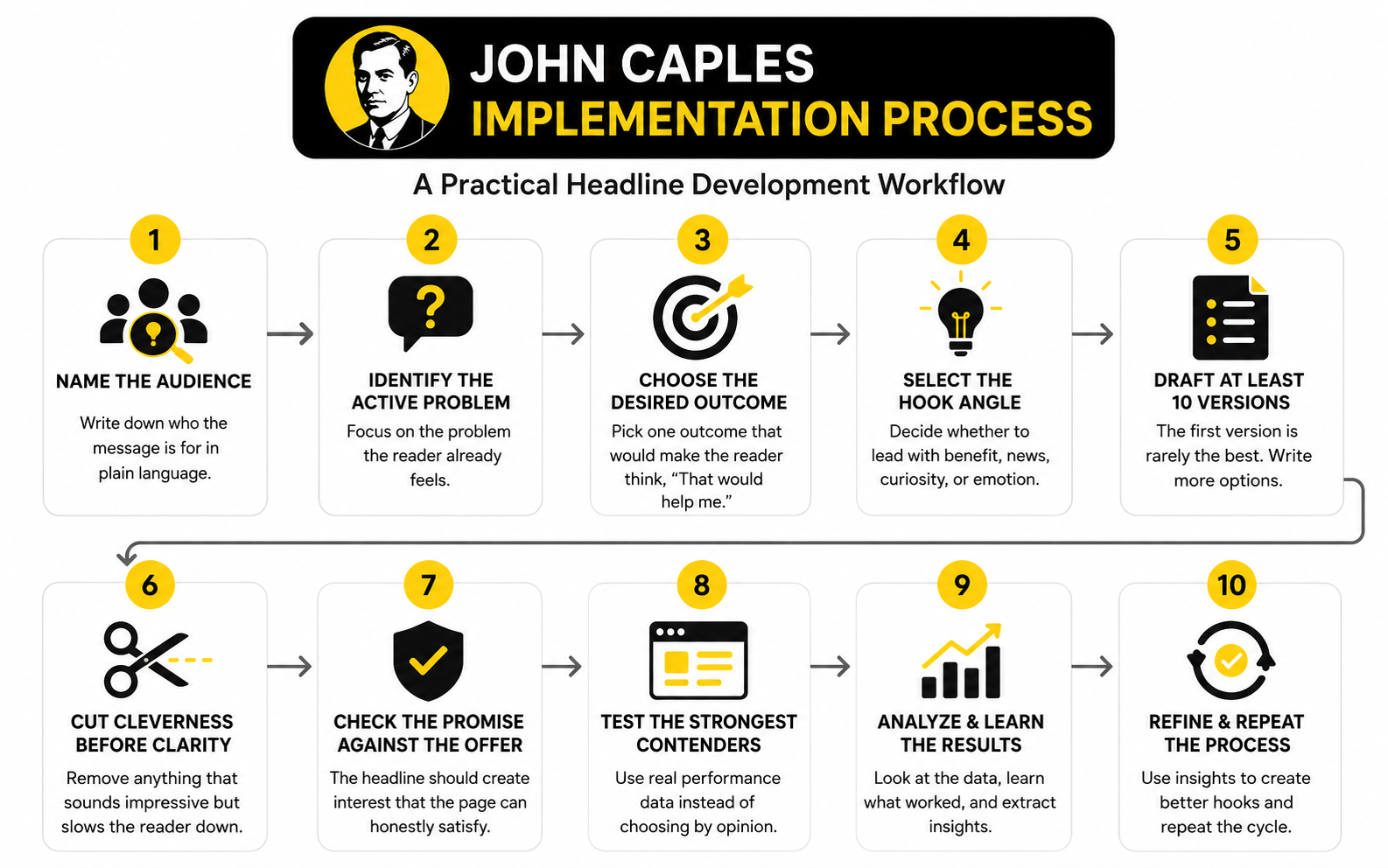
A Practical Headline Development Process
Use this process when you are writing a landing page, ad, email, or funnel step. It keeps the work grounded instead of turning headline writing into random wordplay. It also lines up with the John Caples habit of making copy testable.
This process is simple enough to use quickly, but it prevents the biggest mistakes. It stops you from writing to everyone. It stops you from leading with features too early. It also forces the hook to connect with the actual conversion goal.
What Makes a Hook Feel Credible
A hook needs tension, but it also needs restraint. If the promise sounds too big, the reader may keep reading out of curiosity, but trust starts leaking immediately. That is dangerous because attention without belief rarely converts.
Credibility often comes from specificity. “Get more leads” is broad. “Follow up with new leads before they go cold” is more believable because it describes a real operational moment. It gives the reader something concrete to picture.
Credibility also comes from matching the promise to the mechanism. If a page promotes ManyChat, the hook should connect naturally to conversations, automation, lead capture, or follow-up. If a page promotes Brevo, the hook should connect naturally to email marketing, customer communication, or campaign management.
The hook should never promise a miracle and then hand the reader a normal tool. That gap creates disappointment. Caples-style copy works because the headline, body, proof, and call to action are all pulling in the same direction.
How to Apply This to Modern Funnels
In a modern funnel, the hook does not live in one place. It starts in the ad, continues on the landing page, appears again in the form or checkout step, and often returns in the follow-up sequence. If those pieces do not match, the reader feels friction.
For example, a paid ad might promise faster lead response. The landing page should then explain how the system captures, routes, and follows up with leads. The email sequence should reinforce the same outcome instead of drifting into unrelated features.
This matters because each step either strengthens or weakens the original promise. A funnel built in ClickFunnels can move people through pages, upsells, and offers, but the message still needs continuity. A workflow inside GoHighLevel can automate the follow-up, but automation only multiplies the quality of the message you put into it.
The practical rule is this: repeat the core promise, but do not repeat the same words mechanically. Each step should advance the argument. The ad earns the click, the page builds belief, the call to action reduces hesitation, and the follow-up handles the objections that remain.
Common Hook Mistakes to Avoid
The first mistake is writing a headline that only the business cares about. “Introducing Our New Platform” may matter internally, but the reader wants to know what changes for them. Unless the announcement carries a clear benefit, it is not strong enough.
The second mistake is using curiosity without payoff. If the hook creates mystery, the body copy must resolve it in a satisfying way. Otherwise the reader feels tricked, and trust drops.
The third mistake is stacking too many promises into one headline. A headline that tries to sell speed, quality, ease, profit, automation, trust, and affordability at the same time usually sounds generic. One strong appeal beats six weak ones.
The fourth mistake is ignoring the stage of awareness. A cold audience may need a problem-based hook because they are not ready for the product yet. A warm audience may respond better to a direct outcome, comparison, or offer-driven message.
From Hook to Body Copy
A great hook creates momentum, but the next section must carry it. This is where the Caples method becomes more than headline writing. The body copy has to prove the promise, deepen desire, and remove the doubts that naturally appear after attention is won.
That means the opening lines after the headline should not wander. They should confirm relevance quickly and show the reader they are in the right place. If the headline promised relief from slow follow-up, the next section should talk about missed leads, delayed responses, and the cost of letting prospects cool off.
The transition into proof should feel natural. Once the reader thinks, “Yes, this is my problem,” the next question becomes, “Why should I believe this solution works?” That is where the next part of the article goes: proof, offers, and the direct response mechanics that turn attention into action.
Testing, Optimization, and Modern Funnel Execution
John Caples is useful because he does not let marketers hide behind taste. A headline can sound clever and still fail. A landing page can look beautiful and still confuse the buyer. An offer can feel exciting inside the business and still get ignored by the market.
This is why testing belongs near the center of the Caples mindset. The goal is not to test random details because analytics tools make it easy. The goal is to test the parts of the message that can meaningfully change response: the promise, the hook, the offer, the proof, the audience, and the next step.
That distinction is important. Testing button colors before testing the core appeal is usually just procrastination with a dashboard. Caples would push you toward the bigger question first: what message makes the right reader act?
What to Test First
The first thing to test is usually the dominant promise. If the main promise is wrong, every smaller optimization sits on weak ground. You can improve a page slightly with layout changes, but you will not rescue a message that sells the wrong outcome.
After the promise, test the headline and lead. This is the point where attention turns into engagement, so small differences can have real impact. A clear headline that speaks to an urgent problem will usually beat a polished line that sounds impressive but does not land.
Next, test the offer structure. This includes the lead magnet, trial, demo, webinar, consultation, bundle, guarantee, bonus, price framing, or urgency mechanism. In direct response, the offer is not a small detail; it is the bridge between interest and action.
Finally, test the proof. Some markets need testimonials. Others need demonstrations, comparisons, screenshots, guarantees, third-party validation, or a clearer explanation of the mechanism. When proof matches the buyer’s doubt, the copy gets stronger without needing to sound louder.
Avoid Tiny Tests That Waste Time
A common testing mistake is changing one minor element and expecting a major breakthrough. That can happen, but it is rare. Most meaningful lifts come from changing the reason people care, the level of trust they feel, or the friction they experience before taking action.
This is where marketers need discipline. If traffic is limited, do not split attention across ten small experiments. Focus on the biggest constraint in the funnel and test one meaningful change at a time.
Statistical confidence also matters. Tools and dashboards can make weak tests look more certain than they are. Good experimentation training emphasizes sample size, statistical significance, and the risk of mistaking random movement for real improvement, which is why resources like CXL’s A/B testing statistics training focus heavily on interpreting results instead of just launching tests.
The practical takeaway is simple. Do not call a winner too early. Do not change the test halfway through because the first few conversions look exciting. Do not build a whole strategy around a result that did not have enough data behind it.
Match the Test to the Funnel Stage
Different funnel stages need different tests. A cold ad needs to prove relevance fast. A landing page needs to deepen belief. A checkout page needs to reduce hesitation. A follow-up sequence needs to recover attention and answer objections.
If you treat every stage the same, the copy becomes blunt. You may over-explain in an ad where speed matters. Or you may under-explain on a sales page where the reader needs more proof before making a serious decision.
A Caples-style approach keeps the reader’s state of mind at the center. At the top of the funnel, the reader may not know you and may barely understand the problem. In the middle, they are comparing options. At the bottom, they are weighing risk, timing, price, and trust.
This is why message continuity matters so much. The ad, page, form, checkout, confirmation page, email, and retargeting message should feel like one argument. Not one repeated sentence, but one coherent path.
Scaling Without Diluting the Message
Scaling creates a new problem. The message that works for one audience segment may weaken when pushed into a broader market. More traffic does not automatically mean more profitable growth.
When campaigns scale, audiences become less familiar, less motivated, or less aware. That means the copy often needs more education, stronger proof, or a different entry point. The promise may stay the same, but the angle has to adapt.
This is especially true when moving from warm traffic to cold traffic. Warm prospects may respond to a direct offer because they already understand the brand or category. Cold prospects often need a sharper hook, a clearer problem setup, and a stronger reason to trust the next step.
Modern funnel tools can help manage that complexity. A business using GoHighLevel can segment leads, trigger follow-up based on behavior, and keep conversations organized. A business using ClickFunnels can build different funnel paths around different offers or awareness stages. But the tool only helps if the message strategy is clear first.
The Risk of Over-Optimizing
Optimization has a downside. If you chase every short-term lift, the campaign can become more aggressive, more confusing, or less trustworthy over time. This is how brands end up with copy that converts today but damages confidence tomorrow.
Caples cared about response, but that does not mean every response tactic is equally good. A misleading headline may get clicks. A fake urgency angle may create a temporary spike. A stretched promise may increase opt-ins while lowering lead quality.
That is not smart direct response. That is borrowing from future trust to inflate current numbers. Eventually, refunds, unsubscribes, complaints, low show-up rates, and poor sales conversations reveal the real cost.
The better standard is profitable response from the right people. That means the copy should attract buyers who are likely to benefit, understand the offer, and move forward with realistic expectations. Anything else creates noise inside the business.
Use Data Without Losing Judgment
Data tells you what happened. It does not automatically tell you why. This is where experienced marketers separate themselves from dashboard operators.
A headline may win because it is clearer. It may win because it attracts a broader but lower-quality audience. It may win because the traffic source changed. It may win because the sample was too small. Without judgment, the numbers can lead you in the wrong direction.
Use quantitative data to identify patterns, then use qualitative insight to explain them. Review session recordings, form responses, sales call notes, support questions, and customer objections. The most useful insight often appears where the numbers and customer language meet.
This is very close to the spirit of John Caples. He wanted advertising to be tested, but he was still a copywriter. The lesson is not “let the spreadsheet write the campaign.” The lesson is to combine measurable response with sharper human understanding.
Advanced Segmentation and Message Fit
As campaigns mature, one message rarely fits every buyer. Different segments may share the same product need but care about different outcomes. That is where segmentation becomes a copywriting advantage, not just a CRM feature.
A small business owner may want simplicity. An agency may want scalability. A creator may want speed. An enterprise buyer may want control, compliance, and proof that the solution will not create internal risk.
Each segment deserves a different entry point. The offer may stay similar, but the appeal, proof, examples, and objections should shift. This is where tools like Brevo or Moosend can support more carefully follow-up, because email performance improves when the message matches the subscriber’s actual situation.
Do not confuse personalization with simply inserting a first name. Real personalization changes relevance. It makes the reader feel like the message was built for their problem, their stage, and their reason to act.
When Automation Helps and When It Hurts
Automation is powerful when the message is already clear. It helps you follow up faster, route leads properly, send timely reminders, and keep prospects from falling through the cracks. That is valuable because many conversions are lost after the first click, not before it.
Automation hurts when it multiplies weak copy. If the emails are generic, the chatbot flow is confusing, or the SMS reminders feel pushy, the system does not become more persuasive. It just becomes more annoying at scale.
This is why the John Caples mindset should come before automation. Write the promise first. Clarify the proof. Map the objections. Then use automation to deliver the right message at the right moment.
A practical setup might include a landing page, a form, a segmented email sequence, a reminder flow, and a sales follow-up task. That can be simple or advanced depending on the business. What matters is that every automated touchpoint continues the same persuasive argument instead of restarting from scratch.
The Expert-Level Caples Standard
The expert-level standard is not “Did this copy sound good?” It is not even “Did this copy get clicks?” The better question is: did this message move the right people closer to a profitable decision?
That standard changes how you judge the work. A campaign with fewer leads but higher buyer intent may be better than a campaign with cheap leads who never convert. A longer page may outperform a short page if the buyer needs more proof. A calmer headline may beat a dramatic one if the market is skeptical.
John Caples gives marketers permission to be practical. Not boring. Not mechanical. Practical. The copy should earn attention, build belief, and create action that makes business sense.
That is why his work still holds up. It gives modern marketers a standard that survives platform changes. Test the message, respect the reader, prove the promise, and keep improving what the market actually responds to.
John Caples Lessons, Mistakes to Avoid, and FAQ
The final lesson from John Caples is not that every marketer should write like it is 1926. That would miss the point. The real lesson is that persuasion works best when it is specific, tested, reader-focused, and tied to a clear response.
Caples gives modern marketers a useful filter. If a headline does not connect to a real desire, it needs work. If a promise is not supported by proof, it needs work. If a campaign gets attention but does not move qualified buyers closer to action, it needs work.
That standard is strict, but it is also freeing. You do not need to guess forever. You can research the market, write around a real appeal, test the message, study the response, and keep improving.
Mistakes That Weaken Caples-Style Copy
The first mistake is copying the surface of old direct response ads without understanding the psychology underneath. A dramatic headline alone does not make an ad persuasive. The drama has to connect to a real desire, a believable promise, and a relevant offer.
The second mistake is treating formulas like magic. Formulas can help you think, but they cannot replace market understanding. If the reader does not care about the problem, even a technically correct headline will fall flat.
The third mistake is making claims that are too broad to believe. Modern buyers are exposed to constant promises, so vague hype gets filtered out quickly. Specificity, proof, and restraint often create more trust than loud language.
The fourth mistake is testing too late. Many teams build the whole funnel, write every email, design every page, and only then discover that the main appeal is weak. A better process tests the hook, promise, offer, and proof as early as possible.
How to Build a Caples-Inspired Marketing System
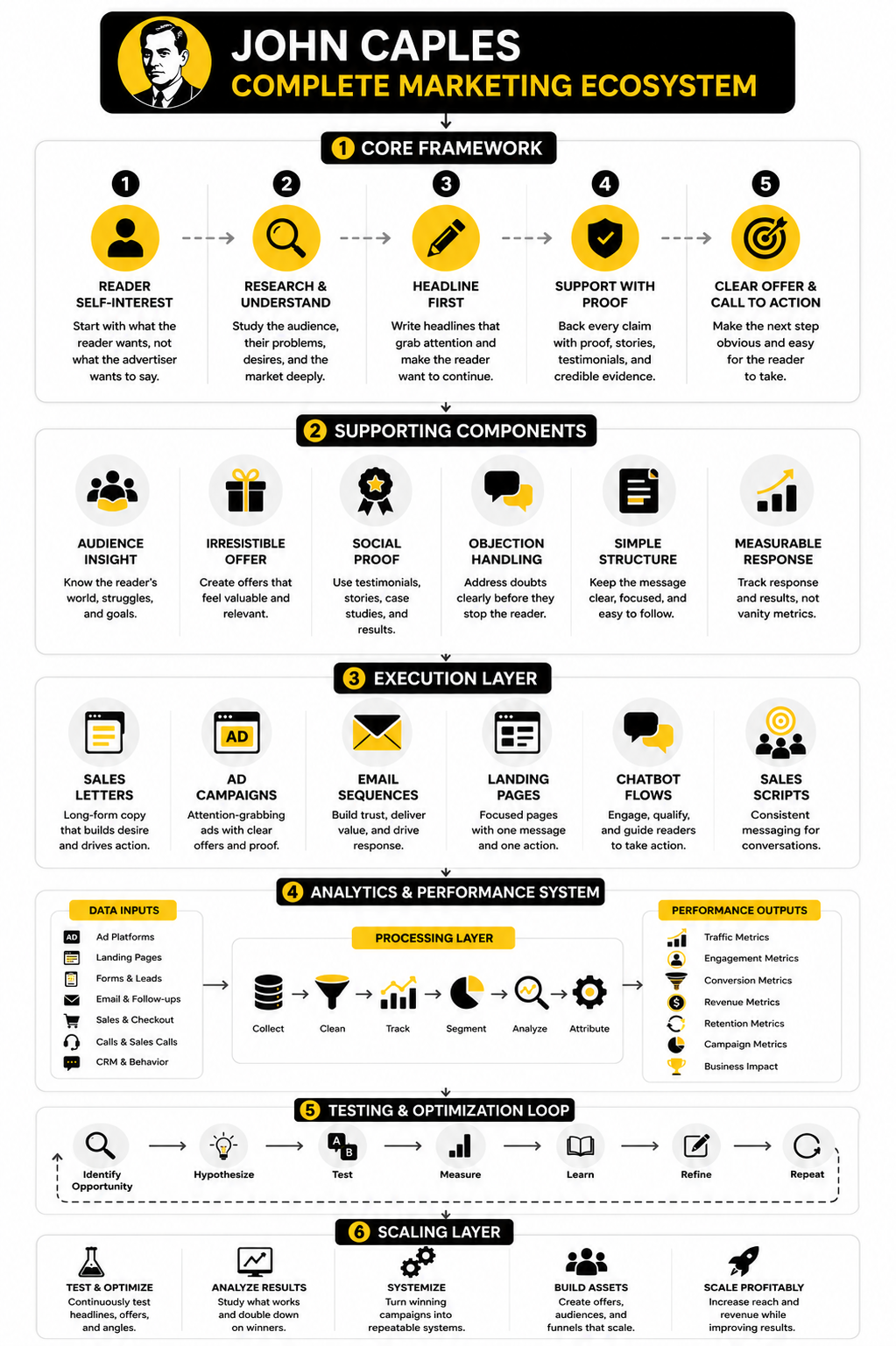
A Caples-inspired system starts before the copy is written. It begins with research into what the audience wants, what they fear, what they have tried, and what they no longer believe. That research becomes the raw material for stronger headlines, offers, proof, and follow-up.
The next layer is message architecture. This means choosing the main promise, the dominant appeal, the proof points, the objection path, and the conversion action before building the page or campaign. When those choices are clear, the copy becomes easier to write and much easier to test.
The final layer is execution. The message can live across ads, landing pages, emails, chatbot flows, sales scripts, webinar pages, and retargeting. Tools like GoHighLevel, ClickFunnels, Systeme.io, ManyChat, and Brevo can support that system, but the strategy still has to come first.
The Final Caples Standard
The best way to honor John Caples is not to quote him endlessly. It is to apply the standard he represented. Advertising should be judged by what it makes the right reader do.
That does not mean every campaign has to be aggressive. It means every campaign needs a job. A brand awareness campaign, lead generation funnel, product launch, email sequence, webinar registration page, or sales letter should be built around a measurable movement in the buyer’s mind.
The practical standard is simple: make the reader care, make the promise clear, make the proof strong, and make the next step obvious. Then test what happens. That is the difference between writing copy that sounds nice and building marketing that actually sells.
Who was John Caples?
John Caples was an American advertising executive, copywriter, author, and direct response pioneer. He is best known for his work in measurable advertising and for writing the famous headline “They Laughed When I Sat Down at the Piano But When I Started to Play!” His papers are preserved by the Smithsonian Institution, which documents his advertising work, speeches, lectures, client files, and books.
Why is John Caples important to copywriting?
John Caples is important because he treated advertising as something that should be tested and improved based on response. He helped move copywriting away from personal opinion and toward measurable performance. That makes his work highly relevant for modern landing pages, ads, email campaigns, sales funnels, and conversion-focused marketing.
What is John Caples best known for?
John Caples is best known for the U.S. School of Music ad with the headline “They Laughed When I Sat Down at the Piano But When I Started to Play!” The ad became famous because it used curiosity, emotion, transformation, and reader self-interest in one memorable opening. It remains one of the most studied direct response ads because the headline pulls the reader into a clear before-and-after story.
What is the main lesson from John Caples?
The main lesson is that advertising should begin with the reader’s self-interest. The copy should connect to what the reader wants, prove the promise, and lead naturally to a response. Caples’ work reminds marketers that cleverness is secondary to relevance, clarity, proof, and action.
What did John Caples teach about headlines?
John Caples taught that headlines are often the most important part of an advertisement because they determine whether the rest of the copy gets read. A strong headline should appeal to a real desire, problem, curiosity, or benefit. It should make the right person feel that the message is worth their attention.
How can marketers use John Caples today?
Marketers can use John Caples by applying his principles to modern channels. That includes writing better ad hooks, landing page headlines, email subject lines, webinar titles, lead magnet promises, chatbot openers, and sales page leads. The goal is not to imitate old ads, but to use the same discipline: reader first, promise clear, proof strong, response measured.
Is John Caples only useful for direct response copywriting?
John Caples is most closely associated with direct response, but his thinking is useful beyond classic sales letters. Any marketing that needs attention, belief, and action can benefit from his approach. Even brand campaigns become stronger when they understand the audience, sharpen the message, and avoid vague claims.
What is the difference between Caples-style copy and generic marketing copy?
Caples-style copy is built around response. It focuses on what the reader wants, what they need to believe, and what action they should take next. Generic marketing copy often focuses too much on the company, the product category, or polished language that does not create urgency or belief.
Why does reader self-interest matter so much?
Reader self-interest matters because people pay attention when they see something connected to their own goals, problems, fears, or desires. A company may care about its features, but the reader cares about the result those features create. Caples-style copy translates product details into meaningful outcomes.
How does testing fit into the John Caples method?
Testing is central to the John Caples method because it shows which message actually works. Instead of relying only on opinions, marketers can test headlines, offers, proof points, landing pages, emails, and calls to action. The purpose is not to test random details, but to learn which appeal creates better response from the right audience.
What should you test first in a Caples-style campaign?
Start with the dominant promise, because that is the foundation of the whole campaign. Then test the headline, lead, offer, proof, and call to action. Small design tests can help later, but they should not distract from the bigger message decisions that drive conversion.
What makes a John Caples headline effective?
A strong John Caples-style headline usually combines relevance with tension. It speaks to something the reader wants, creates curiosity or urgency, and points toward a believable payoff. It does not exist just to sound clever; it exists to make the right person keep reading.
Can AI write copy using John Caples principles?
AI can help draft, organize, and generate variations, but it still needs strategic direction. The marketer must provide the audience insight, offer context, proof, positioning, and testing discipline. AI can speed up the process, but it should not replace the hard work of understanding the buyer.
What is the biggest mistake people make when studying John Caples?
The biggest mistake is copying old headlines without understanding why they worked. The famous piano ad worked because it connected embarrassment, curiosity, aspiration, and transformation to a relevant offer. Copying the shape of the headline without matching the psychology usually produces weak imitation.
Is John Caples still relevant for funnels and automation?
Yes, because funnels and automation still depend on persuasive messages. A funnel builder can publish pages, and a CRM can send follow-ups, but neither can fix a weak promise. John Caples is still relevant because the buyer still needs a reason to stop, believe, and act.
Build a stronger local presence with BAAM AI
Turn your website, Google profile, social channels, and AI visibility into one growth engine
Most businesses do not need more random marketing activity. They need a consistent presence system that helps the right people find them, trust them, and take action. BAAM AI brings strategy, local SEO, website updates, Google Maps visibility, social content, AI-search readiness, media production, and reporting into one practical monthly engine.
If you want your marketing to keep working after the campaign ends, start with a free BAAM AI presence audit. See how your business shows up today and where the fastest visibility wins are at BAAM AI.