
BAAM AI Blog
Joe Sugarman: The Practical Copywriting Framework Behind Direct Response Selling
Joe Sugarman matters because he treated copywriting as a selling system, not a writing exercise. He built his reputation in direct response, mail order, long-form ads, catalogs, and television selling, where weak...

Joe Sugarman matters because he treated copywriting as a selling system, not a writing exercise. He built his reputation in direct response, mail order, long-form ads, catalogs, and television selling, where weak copy was punished immediately and strong copy produced measurable sales. That makes his work useful today, even if you sell through landing pages, email sequences, funnels, webinars, ads, or creator-led offers.
The useful thing about Joe Sugarman is not nostalgia. It is the way he connected curiosity, proof, product education, emotional momentum, and buying logic into one smooth persuasive path. His best-known ideas still work because they deal with how people pay attention, build trust, reduce doubt, and justify action.
this guide breaks down Joe Sugarman’s copywriting philosophy as a practical framework. Instead of treating his work as a list of clever tricks, we will look at the deeper structure behind it: how he opened loops, built desire, explained value, handled resistance, and made the next step feel natural.
Why Joe Sugarman Still Matters
Joe Sugarman became influential because he worked in environments where persuasion had to pay for itself. A print ad, catalog page, or infomercial did not have the luxury of vague branding language. It had to stop attention, keep the reader moving, explain the offer, and create enough confidence for someone to buy.
That pressure is exactly why his ideas still translate well to modern marketing. A landing page is not that different from a long-form ad when the reader is skeptical, distracted, and one click away from leaving. An email sequence is not that different from direct mail when each sentence has to earn the next one.
The biggest lesson is simple: copy is not decoration. Copy is the sales conversation when you are not in the room. Sugarman understood that every headline, sentence, proof point, and offer detail either increases momentum or creates friction.
The Big Idea Behind His Approach
Sugarman’s copywriting philosophy starts with movement. The job of the headline is to get the first sentence read, the job of the first sentence is to get the second sentence read, and the job of every sentence after that is to keep the reader sliding forward. This is the famous “slippery slide” idea, and it is one of the clearest ways to understand his work.
That does not mean writing hype. In fact, the stronger version of the idea is more disciplined: remove anything that causes the reader to stop, question, get confused, or feel pushed. Curiosity opens the door, but clarity keeps the reader inside.
This is why Sugarman-style copy often feels conversational even when it is selling hard. It does not begin by dumping features on the reader. It creates a reason to keep reading, then slowly connects the product to a desire, a problem, or a transformation the buyer already cares about.
Framework Overview
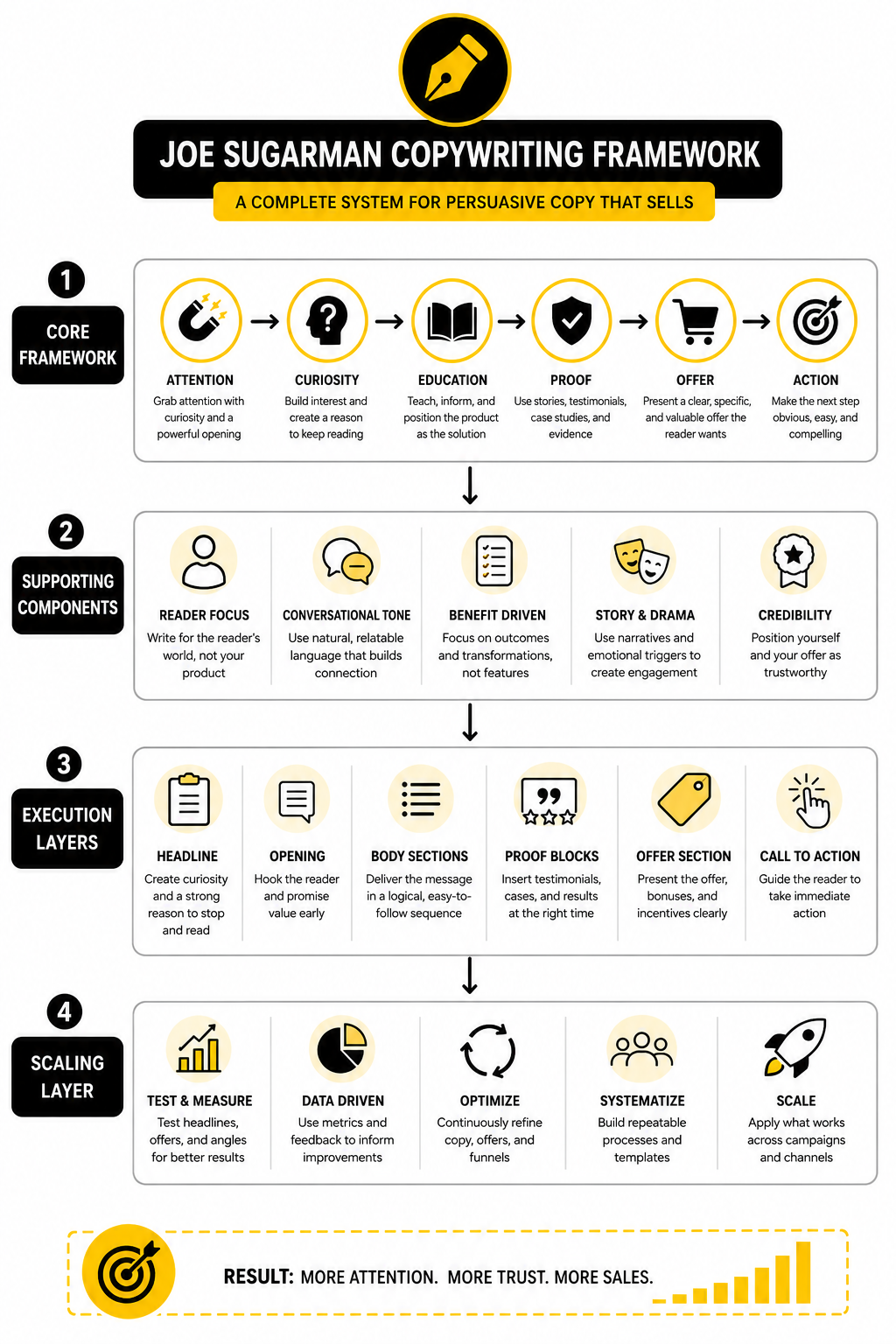
The framework here is built around four practical stages: attention, momentum, belief, and action. Attention gets the reader to stop. Momentum keeps them reading. Belief reduces doubt. Action makes the buying decision feel specific, safe, and worthwhile.
This structure is useful because most weak copy fails at one of those four stages. Some pages get attention but lose momentum because the writing becomes generic. Others explain the product well but never build enough belief for the reader to act.
Sugarman’s work helps because it treats persuasion as a sequence. You do not ask for the sale before the reader understands the value. You do not overload the reader with proof before they care. You guide them through the decision in the order their mind naturally wants to move.
Core Components We Will Build On
The first component is curiosity. Sugarman used curiosity to create forward motion, but the curiosity had to connect to the product. Empty curiosity gets clicks and attention, but it does not create trust or sales.
The second component is education. A strong offer often needs the reader to understand something before they can want it. That is especially true for unusual products, technical products, premium offers, or anything the buyer has not already decided they need.
The third component is emotional logic. People may feel desire before they explain it rationally, but they still need reasons that make the purchase feel justified. Sugarman’s style worked because it gave readers both: a reason to want and a reason to believe.
How this guide Will Use Joe Sugarman’s Ideas
this guide will not turn Joe Sugarman into a museum piece. The goal is to translate his principles into a working model for modern copywriters, founders, marketers, creators, and funnel builders. The examples and explanations will focus on decisions you can actually make when writing copy.
That means we will look at structure before style. Clever lines are useful only when the underlying sales argument is strong. A good phrase cannot save a weak offer, a confused page, or a message that does not match the buyer’s problem.
By the end, you should have a practical way to think through Sugarman-style copy from the first line to the final call to action. Not as a formula you blindly paste into every page, but as a decision-making framework for writing copy that keeps people reading, believing, and buying.
The Joe Sugarman Copywriting Mindset
Joe Sugarman did not approach copy as a place to sound clever. He approached it as a controlled selling environment where every line had a job. That mindset is why his work still feels useful: he cared less about sounding like a “writer” and more about moving a real buyer from curiosity to confidence.
His background also shaped that approach. Sugarman sold products directly through JS&A, built BluBlocker into a widely recognized direct-response brand, and wrote books such as The Adweek Copywriting Handbook to explain the thinking behind his ads. He was not just commenting on copy from the outside. He was writing in markets where the response told him very quickly whether the idea worked.
That is the first mindset shift. Copywriting is not about what you like. It is about what the buyer understands, feels, questions, believes, and finally does.
Copy Is a Buying Conversation
The easiest way to misunderstand Joe Sugarman is to reduce him to formulas. Yes, he had techniques. But the deeper lesson is that copy should feel like a guided conversation with a buyer who is curious but not yet convinced.
That buyer has silent questions. What is this? Why should I care? Is it different? Can I trust it? Is it worth the money? What happens if I wait? Strong copy answers those questions in a natural order instead of dumping everything on the page at once.
This is where many marketers go wrong. They start with the offer, the discount, the feature list, or the call to action before the reader has enough context to care. Sugarman’s mindset pushes you to slow down just enough to build desire, then speed up when the reader is ready to act.
Curiosity Has To Earn Trust
Curiosity is powerful, but it is not a license to trick people. Joe Sugarman used curiosity to pull readers forward, not to hide a weak offer. The point was to make the reader want the next sentence because the copy was opening a useful loop.
That distinction matters. A vague headline might get attention, but attention without trust is cheap. If the reader feels manipulated, the slide stops immediately.
Good curiosity is connected to the product, the problem, or the payoff. It makes the reader think, “I need to understand this.” Bad curiosity makes the reader think, “Fine, I clicked, but now I feel cheated.” One builds momentum. The other burns credibility.
Education Comes Before Persuasion
Sugarman often sold products that needed explanation. Consumer electronics, unusual gadgets, and BluBlocker sunglasses were not always products people already understood before seeing the ad. That meant the copy had to teach before it could close.
This is a huge lesson for modern offers. If your product is new, premium, technical, unfamiliar, or positioned differently from the category standard, you cannot assume the buyer already sees the value. You have to build the buying logic piece by piece.
Education does not mean turning the page into a manual. It means showing the reader what matters, why it matters, and how the product solves a problem in a way they can picture. Once the reader understands the mechanism, persuasion becomes much easier.
The Product Must Feel Interesting
A strong Sugarman-style ad makes the product feel worth exploring. That does not happen by stacking adjectives. It happens by finding the angle that makes the product feel alive.
Sometimes the angle is the origin of the product. Sometimes it is the technology behind it. Sometimes it is the contrast between what people assume and what is actually true. The job is to find the most interesting truthful path into the offer.
This is where research becomes practical. You look for details that create curiosity, remove doubt, or make the product easier to explain. A small product detail can become the hook if it reveals something the buyer did not know they cared about.
Emotion And Logic Work Together
Sugarman understood that buyers are not purely rational. They want, imagine, compare, doubt, justify, and protect themselves from regret. Good copy respects all of that.
Emotion creates movement. Logic gives the buyer permission to keep moving. If the copy is only emotional, it can feel exaggerated. If it is only logical, it can feel flat.
The strongest version combines both. You show the buyer why the product matters emotionally, then support that feeling with reasons, proof, specifics, and a clear offer. That balance is what makes direct-response copy feel persuasive without becoming desperate.
The Reader Should Never Feel Lost
One of the most practical parts of Sugarman’s mindset is clarity. The reader should always know where they are in the argument. They may be curious, surprised, skeptical, or interested, but they should not be confused.
Confusion is not a small problem. It breaks momentum because the reader has to stop and interpret the page instead of continuing through it. In direct response, that pause is dangerous.
So the copy has to do more than sound good. It has to sequence information cleanly. Each idea should prepare the reader for the next one, and each section should reduce friction instead of adding more work.
Selling Starts With Respect
The best way to use Joe Sugarman today is not to imitate the surface style of old print ads. It is to adopt the discipline underneath them. Respect the reader’s attention, intelligence, skepticism, and time.
That respect shows up in the writing. You do not overclaim. You do not force urgency where none exists. You do not bury the real offer under noise. You make the buying decision easier by making the value easier to understand.
This is the mindset that carries into the next section. Once you understand copy as a respectful buying conversation, the “slippery slide” becomes more than a catchy phrase. It becomes the structure that keeps the conversation moving.
The Slippery Slide Framework
The slippery slide is the most useful way to understand Joe Sugarman in practice. It turns copywriting into a sequence problem instead of a wordsmithing problem. Your job is not to impress the reader with one brilliant line. Your job is to make the next line feel easy, natural, and worth reading.
That sounds simple, but it changes how you write. You stop asking, “Does this sentence sound good?” and start asking, “Does this sentence move the reader forward?” That one shift removes a lot of weak copy because it forces every line to earn its place.
The slippery slide also protects you from one of the most common marketing mistakes: trying to close too early. If the reader is still trying to understand the product, a hard call to action feels pushy. If the reader already believes the offer, a slow explanation feels boring. The framework helps you match the copy to the reader’s current state.
Start With The First Sentence
In Sugarman’s world, the first sentence should be almost impossible not to read. It does not need to be dramatic. It needs to be simple, relevant, and connected to the thought already created by the headline.
This is why short first sentences often work so well. They reduce friction. They give the reader a quick win. They create the feeling that the page will be easy to continue.
A strong first sentence usually does one of three things. It confirms the reader is in the right place, opens a small curiosity gap, or states a sharp observation the reader already feels but has not clearly named. The goal is not to explain everything. The goal is to start movement.
Build Momentum Before You Build The Case
Once the reader starts moving, the copy has to protect that momentum. This is where many pages get heavy. They jump from a promising opening into dense claims, complicated features, or a wall of context the reader did not ask for yet.
Sugarman’s approach is more controlled. You give the reader one clear idea at a time. You let each idea create enough interest for the next one. You do not make them carry too much mental weight too early.
Momentum is not speed for the sake of speed. It is the feeling that every paragraph answers the question created by the paragraph before it. When that happens, the reader does not feel like they are being dragged through a pitch. They feel like they are following a useful train of thought.
Make The Execution Process Tangible
The slippery slide becomes practical when you turn it into a writing process. Do not start by polishing sentences. Start by mapping the reader’s movement from first awareness to final action.
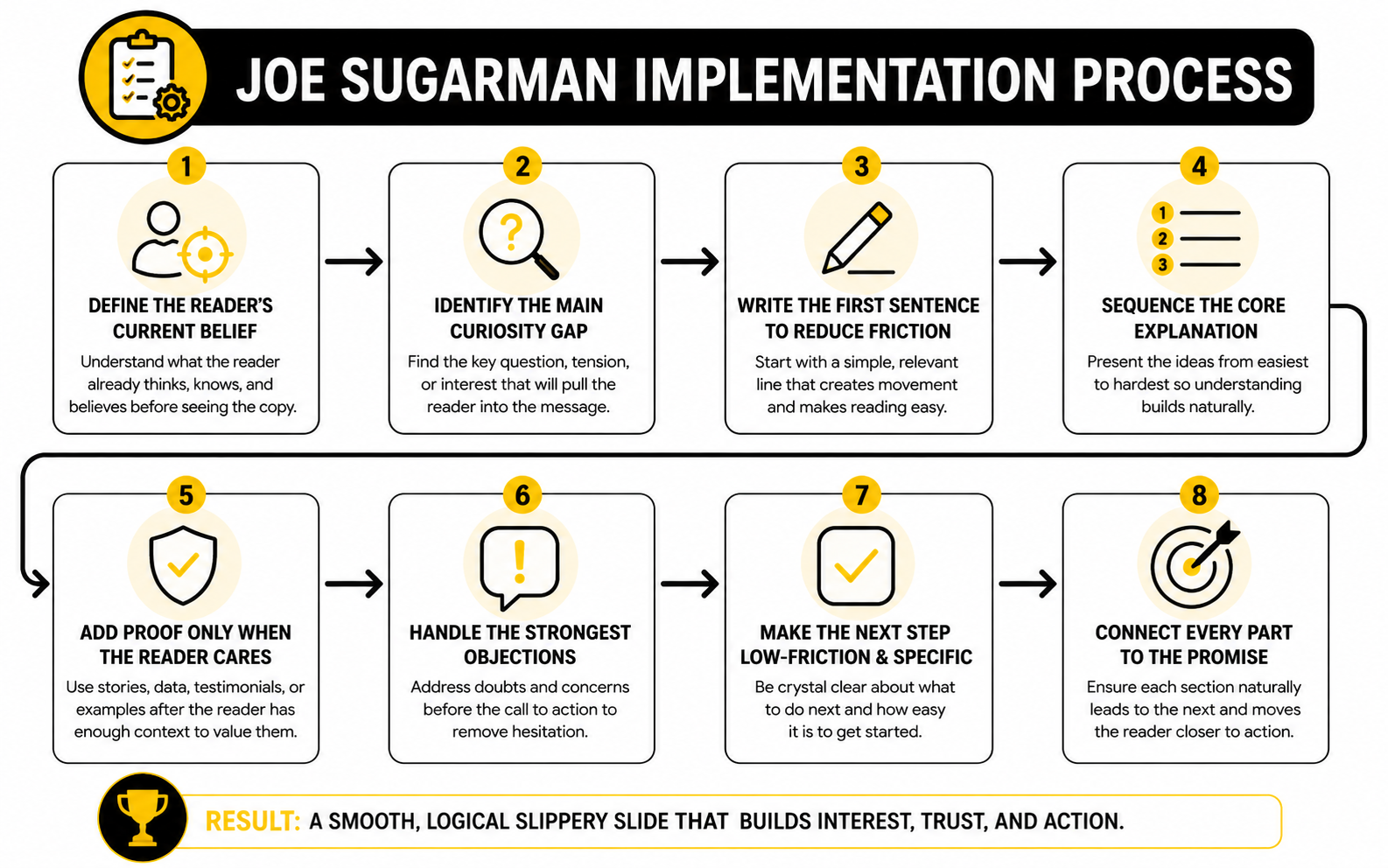
A simple execution process looks like this:
This process keeps you from writing disconnected sections. Each step has a job. Each job moves the reader closer to a buying decision without making the page feel like a stack of random persuasion tactics.
Control The Order Of Information
Order matters more than most people think. A strong proof point placed too early can be wasted because the reader does not yet understand why it matters. A product feature introduced too late can create confusion because the reader has already formed the wrong picture.
Joe Sugarman’s slippery slide works because it respects sequence. The copy introduces information in the order the buyer needs it, not in the order the business wants to brag about it. That is a big difference.
For example, the reader usually needs context before specs, benefits before technical detail, and reassurance before commitment. When the order is wrong, even true claims can feel unconvincing. When the order is right, the same claims feel obvious.
Use Open Loops Carefully
An open loop is a reason to keep reading. It can be a question, a surprising detail, a contrast, or a promise that the next section will make something clearer. Sugarman used this kind of momentum well because he understood that curiosity has to stay connected to payoff.
The danger is overusing it. If every paragraph tries to tease the next one, the copy starts to feel artificial. The reader can sense when they are being led around without receiving enough value.
A better approach is to alternate curiosity with resolution. Raise a question, answer it. Create tension, release it. Introduce a detail, explain why it matters. That rhythm keeps the slide smooth without making the reader feel manipulated.
Remove Friction At Every Turn
Friction is anything that makes the reader stop for the wrong reason. It can be a confusing sentence, an unsupported claim, a vague benefit, a sudden shift in tone, or a call to action that appears before trust has been built. Most friction is not obvious when you are writing because you already understand the offer.
The reader does not have that advantage. They are seeing the logic for the first time. So the copy needs to make the path clear without making the reader work too hard.
A practical way to find friction is to read the copy and ask where a skeptical buyer would pause. Would they ask, “What does that mean?” Would they wonder, “Why should I believe this?” Would they think, “Is this for me?” Those pauses are not always bad, but they need to be answered quickly.
Match The Slide To The Offer
Not every offer needs the same length or intensity. A simple low-cost product may need a short slide. A premium service, unfamiliar tool, or high-commitment funnel may need a longer one with more education, proof, and objection handling.
This is where modern marketers should be careful. Sugarman wrote long-form copy because the format often matched the selling challenge. The lesson is not “always write long.” The lesson is “write as much as the buying decision requires.”
If you are building a funnel, a tool like ClickFunnels can help structure the path from page to page, but the slide still has to exist inside the copy itself. Software can organize the journey. It cannot replace the thinking that makes each step persuasive.
End Each Section With Forward Pressure
Every section should close in a way that naturally points to the next one. That does not mean using cheesy teaser lines. It means making the next section feel like the logical answer to what the reader is now thinking.
If the section explains the problem, the next section should clarify the mechanism. If the section explains the mechanism, the next section should prove it. If the section proves it, the next section should make the decision easier.
This is the practical heart of the slippery slide. You are not writing isolated blocks. You are creating a continuous chain of attention, understanding, belief, and action. Done well, the reader reaches the call to action without feeling like the sale appeared out of nowhere.
Statistics and Data
A Joe Sugarman-style page should not be measured by whether the copy “sounds persuasive.” That is too vague. The real question is whether each part of the copy is doing its job: stopping attention, keeping momentum, building belief, reducing doubt, and producing action.
This is why analytics matter. They turn the slippery slide from a writing idea into a diagnostic system. If people arrive but do not read, the opening is weak. If they read but do not click, the belief or offer structure is weak. If they click but do not buy, the final decision environment may be creating friction.
The mistake is looking at one number and pretending it explains everything. Conversion rate matters, but it does not tell you where the copy is breaking. To improve the page, you need to connect each metric to a specific part of the buying journey.
Measure The Slide, Not Just The Sale
The first measurement layer is attention. This includes impressions, click-through rate, landing page visits, and the percentage of visitors who stay long enough to engage with the page. If this layer is weak, the headline, angle, ad promise, or opening message is probably not aligned with what the reader expected.
The second layer is momentum. This includes scroll depth, time on page, video watch depth, section engagement, and click behavior around important proof or offer sections. These metrics show whether the reader is still moving or quietly dropping out before the argument has been made.
The third layer is action. This includes opt-ins, form completions, purchases, booked calls, trial starts, cart starts, and checkout completion. These are the numbers most teams care about, but they become much more useful when you know which earlier stage influenced them.
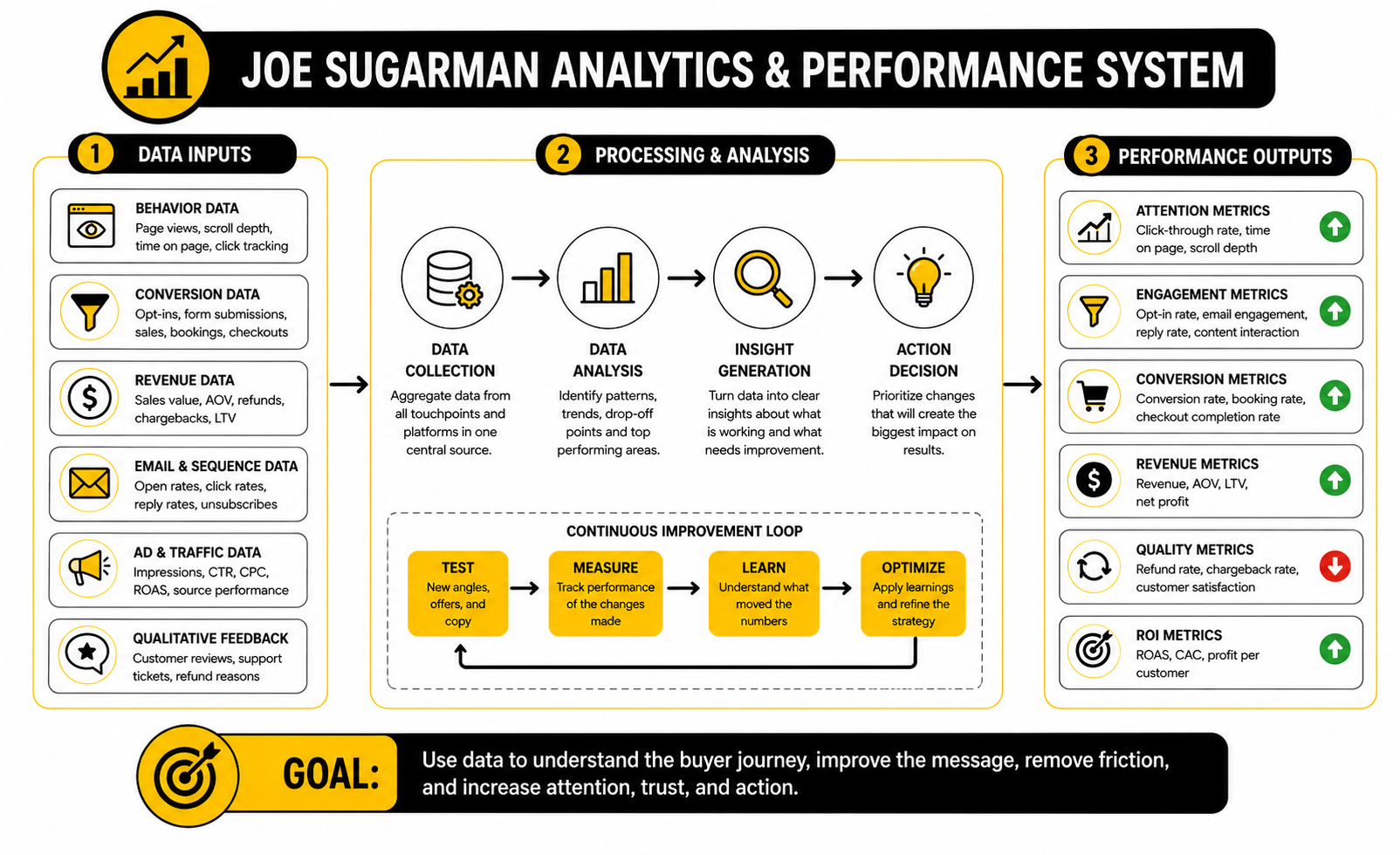
A simple measurement system should follow this order:
This is the practical version of the slippery slide. You are not just asking, “Did the page convert?” You are asking, “Where did the slide slow down, and why?”
Benchmarks Are Context, Not Targets
Benchmarks can be useful, but only if you treat them as context. A landing page for a $27 impulse product should not be judged the same way as a page selling a $5,000 consulting package. A cold traffic funnel should not be judged the same way as an email campaign going to warm subscribers.
This matters because weak teams use benchmarks as excuses or fantasies. If they are below average, they panic. If they are above average, they stop improving. Neither reaction is useful.
The better move is to compare performance against intent, traffic quality, offer complexity, price point, and buyer awareness. A lower conversion rate with higher average order value can be healthier than a higher conversion rate that attracts poor-fit buyers. The number only matters when you understand what kind of business result it creates.
What Each Signal Actually Means
A low click-through rate usually means the promise is not strong enough, the audience is wrong, or the message does not match the channel. It does not automatically mean the product is bad. It often means the first layer of the buying conversation is not giving people a strong enough reason to continue.
A low scroll depth usually points to a momentum problem. The opening may be too slow, the copy may become too abstract, or the reader may not see enough relevance early enough. In Sugarman terms, the first part of the slide is too dry.
A high click rate with low conversion often means the offer is interesting but the final decision environment is not strong enough. The reader may want the outcome but still feel uncertain about price, trust, risk, timing, or fit. That is where proof, guarantees, clearer next steps, and stronger objection handling become important.
Use Data To Find The Copy Problem
Data should guide the edit. If people leave before the product explanation, do not rewrite the guarantee first. If people reach the offer but do not act, do not obsess over the headline before checking the price framing, proof, urgency, and risk reversal.
This is where measurement becomes practical instead of decorative. Each number should point to a decision. Keep, cut, reorder, clarify, prove, simplify, or test.
For example, if visitors reach the pricing section but hesitate, the problem may be value framing. The copy may not have made the outcome feel expensive enough to justify the price. In that case, the fix is not louder urgency. The fix is a stronger bridge between the pain, the mechanism, the payoff, and the offer.
Test One Big Idea At A Time
Testing is powerful only when you know what you are testing. If you change the headline, offer, page layout, proof, call to action, and pricing all at once, you may improve the result, but you will not know why. That makes the next decision harder.
A cleaner approach is to test one meaningful idea at a time. Test the lead angle. Test the offer framing. Test the proof sequence. Test whether the page performs better when the mechanism is explained earlier. Each test should be tied to a specific hypothesis about the reader’s behavior.
This fits Joe Sugarman’s philosophy because the copy is a sequence. If you test randomly, you are not improving the sequence. You are guessing. If you test based on where the reader slows down, every experiment teaches you something useful.
Read Qualitative Signals Too
Numbers show what happened, but they rarely explain the whole reason. That is why qualitative feedback matters. Sales calls, support tickets, chat logs, refund reasons, checkout questions, and survey responses often reveal the exact words buyers use when they are confused or skeptical.
Those words are gold. They show you the objections your copy must answer. They show you which benefits feel real and which ones sound like marketing language. They also show you when your page is attracting the wrong type of buyer.
A practical copy review should include both analytics and buyer language. The analytics tell you where to look. The buyer language tells you what to rewrite.
Turn Measurement Into Better Copy
The point of measurement is not to build a prettier dashboard. The point is to make better copy decisions. Every metric should help you understand how the buyer is moving through attention, momentum, belief, and action.
If attention is weak, sharpen the hook and improve message match. If momentum is weak, simplify the sequence and remove friction. If belief is weak, add proof, specificity, and clearer explanation. If action is weak, improve the offer, reduce risk, and make the next step easier.
That is how you apply Joe Sugarman with modern analytics. You keep the human persuasion model, but you use data to see where the conversation breaks. Then you rewrite with a purpose instead of guessing.
How Professionals Apply The Framework Today
The advanced use of Joe Sugarman is not copying the rhythm of old direct-response ads. It is knowing when to use his principles, when to compress them, and when to adapt them to a different buying environment. A print ad, a landing page, a webinar, a checkout flow, and an email sequence can all use the slippery slide, but they do not all need the same amount of copy.
That is where professional judgment comes in. The framework gives you the structure, but the market decides the depth. A buyer who already understands the problem needs less education. A buyer seeing a new mechanism for the first time needs more context, more proof, and more careful sequencing.
So the real skill is not “write long copy.” The real skill is to diagnose the reader’s awareness level and match the copy to the decision they are actually making.
Match The Copy To Buyer Awareness
A highly aware buyer already knows the problem, the category, and often the competing solutions. For that reader, too much setup can feel slow. They need a sharper promise, a clear reason your offer is different, and enough proof to trust the next step.
A problem-aware buyer needs a different path. They feel the pain but may not understand the solution yet, so the copy has to explain the mechanism before pushing the offer. This is where Sugarman-style education becomes very useful because it turns interest into belief.
An unaware or lightly aware buyer needs even more care. You cannot force them into a sales argument before they recognize the relevance. The opening has to connect with a familiar frustration, observation, or desire before the product enters the conversation.
Balance Long-Form Persuasion With Modern Attention
Long-form copy still works when the buying decision requires it. But long copy only works when every section earns attention. Length is not the advantage. Sequence is the advantage.
Modern readers skim, compare, open multiple tabs, and leave when the page feels like work. That does not mean you should make every page short. It means your page must be scannable without becoming shallow.
Use headings that carry the argument forward. Use short paragraphs when the reader needs speed. Use proof, bullets, and examples where they reduce friction. The page should reward both the skimmer and the serious buyer.
Protect The Offer From Over-Optimization
Optimization can make copy better, but it can also make it worse. If you chase every short-term lift, you may end up with louder claims, more aggressive urgency, and weaker trust. That can increase clicks while damaging buyer quality.
This is a serious tradeoff. Direct response should be accountable, but it should not become reckless. The goal is not just to create action. The goal is to create the right action from the right buyer with expectations you can actually fulfill.
This is especially important when using testimonials, influencer proof, or customer results. The FTC’s endorsement guidance emphasizes that endorsements must reflect honest opinions and that material connections should be clearly disclosed. That matters because proof is powerful only when it is credible.
Scale The Message Without Flattening It
As campaigns grow, the copy often gets watered down. Teams turn a sharp sales argument into generic brand language because they want it to work across every channel. That usually makes it weaker everywhere.
A better approach is to keep the core persuasion architecture consistent while adapting the surface execution. The hook can change by channel. The proof can change by audience. The call to action can change by funnel stage. But the central buying logic should stay intact.
This is how you scale a Sugarman-style message without losing the slide. You define the main promise, the mechanism, the proof points, the objections, and the action path. Then each channel gets its own version of that same argument.
Build Funnels Around The Buying Sequence
A funnel should not be a random stack of pages and emails. It should move the buyer through the same persuasion path the copy is trying to create: attention, momentum, belief, and action. When the funnel and the copy follow different logic, the buyer feels the break.
For simple offers, a page and checkout may be enough. For higher-commitment offers, the funnel may need lead capture, nurture emails, a webinar, a booking page, reminders, and follow-up. The point is not to add complexity. The point is to give the buyer the right information at the right moment.
If you are building this kind of journey, GoHighLevel can make sense for agencies and service businesses that need funnels, CRM, follow-up, and automation in one place. The tool does not create the strategy for you, but it can help execute the sequence once the message is clear.
Keep Compliance In The Copy Review
Advanced copywriting is not just about persuasion. It is also about risk management. Claims, testimonials, comparisons, guarantees, urgency, and scarcity all need to be reviewed before they go live.
This is not a boring legal detail. It protects the economics of the campaign. A page that sells with exaggerated promises may create refunds, complaints, ad account issues, chargebacks, and long-term brand damage.
A practical review should ask simple questions. Can we prove this claim? Is this result typical or clearly explained? Is the guarantee written plainly? Is the urgency real? Are we making the buyer more confident or just more pressured?
Know When Not To Use The Full Slide
Some decisions do not need a full Sugarman-style sequence. If someone is already trying to reset a password, book a known appointment, or buy a familiar product, extra persuasion can get in the way. In those moments, clarity beats copy depth.
The same applies to checkout. Once the buyer is ready to complete the purchase, the page should reduce effort instead of restarting the pitch. Checkout usability research has repeatedly shown that friction in the checkout flow itself can cause abandonment, so this is where simplicity becomes part of persuasion.
That is a useful boundary. Use the slippery slide to build the decision. Once the decision is made, remove obstacles and let the buyer act.
Treat AI As A Drafting Assistant, Not The Strategist
AI can help write variations, summarize research, structure drafts, and create first-pass copy quickly. That is useful. But the strategy still has to come from a clear understanding of the buyer, the offer, the market, and the proof.
This is where many teams get lazy. They ask AI for “Sugarman-style copy” and get something that sounds persuasive but has no real sales logic underneath. That is not implementation. That is decoration at scale.
The better workflow is to define the slide first, then use AI to explore variations inside that structure. Give it the reader’s awareness level, the core promise, the mechanism, the proof, the objections, and the desired action. Then edit like a strategist, not like someone polishing random sentences.
Make The Framework Operational
The final professional step is turning the framework into a repeatable process. Do not keep it trapped inside one copywriter’s head. Build it into briefs, review checklists, analytics dashboards, and post-launch optimization routines.
A strong brief should define the reader’s current belief, the desired belief, the main objection, the proof available, and the action the page must drive. A strong review should check whether each section moves the reader forward. A strong optimization process should connect performance signals to specific copy decisions.
That is how Joe Sugarman becomes more than an inspiration. His ideas become an operating system for better marketing. Not louder marketing. Not trickier marketing. Better marketing that respects the reader and still sells with confidence.
Common Mistakes, Practical Takeaways, and FAQ
The final lesson from Joe Sugarman is that persuasive copy is not built from isolated tricks. It is built from a complete system: buyer understanding, curiosity, education, proof, sequencing, measurement, and a clean path to action. When one part of that system is weak, the whole sales conversation becomes harder.
That is why the best copy reviews are not just grammar checks. They ask whether the reader is being moved from one useful belief to the next. They ask whether the offer feels clear, credible, and worth acting on right now.
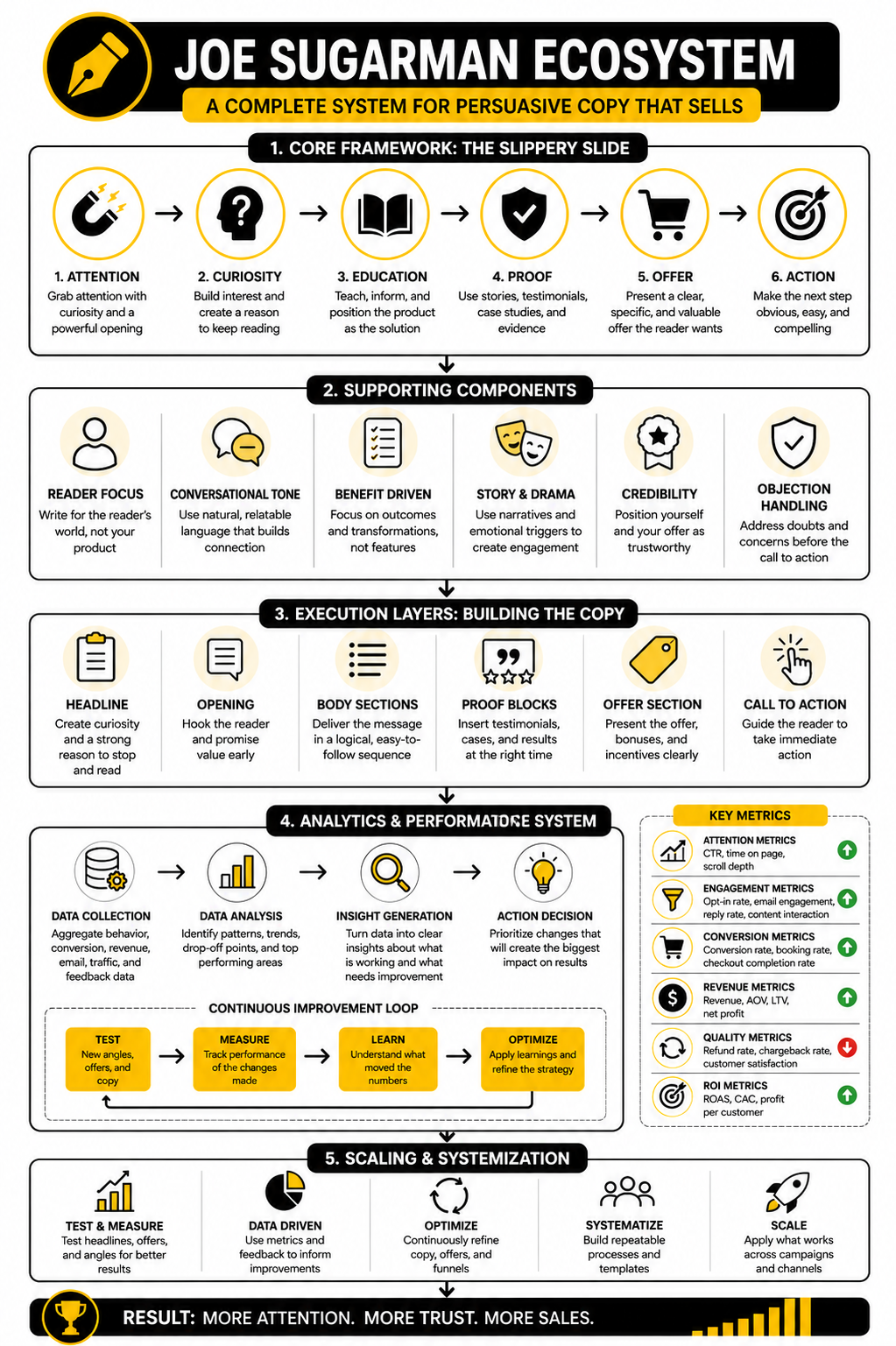
The goal is not to make every page sound like a classic direct-response ad. The goal is to use the thinking behind the work. Joe Sugarman gives you a way to write copy that earns attention, respects the reader, explains the product, and makes the buying decision easier.
The Biggest Mistakes To Avoid
The first mistake is using curiosity without payoff. If the headline creates interest but the page does not reward that interest quickly, the reader feels manipulated. Curiosity should open the door to a stronger explanation, not hide the fact that the offer is weak.
The second mistake is adding proof before the reader understands the value. Testimonials, screenshots, case studies, and credentials are useful only when they support a belief the reader is ready to evaluate. Proof without context often feels like noise.
The third mistake is treating long copy as automatically better copy. Sugarman’s lesson is not that every page should be long. The lesson is that copy should be as complete as the buying decision requires, and no longer than the reader’s attention can reasonably support.
Practical Takeaways For Better Copy
Start with the reader’s current belief. Before writing, define what they already know, what they misunderstand, what they want, and what they are afraid of risking. That gives the copy a real starting point instead of a generic opening.
Build the page as a sequence. Move from attention to context, from context to mechanism, from mechanism to proof, and from proof to action. When the sequence is clean, the reader does not feel rushed or lost.
Measure the weak points. If readers leave early, fix the opening and message match. If they read but do not click, improve belief and offer framing. If they click but do not convert, reduce final-step friction and strengthen risk reversal.
Who was Joe Sugarman?
Joe Sugarman was an American direct-response copywriter, entrepreneur, and founder associated with JS&A and BluBlocker. He became known for long-form print ads, mail-order selling, and direct-response marketing that had to produce measurable sales. His book The Adweek Copywriting Handbook remains one of the best-known resources connected to his copywriting philosophy.
What is Joe Sugarman best known for?
Joe Sugarman is best known for the slippery slide concept, his long-form advertisements, and his ability to sell unusual products through clear, curiosity-driven copy. He also helped build BluBlocker into a widely recognized direct-response brand, and the company’s own history connects him with blue light blocking sunglasses and JS&A-style selling. The practical value of his work is the way he combined curiosity, explanation, proof, and action into one continuous sales argument.
What is the slippery slide in copywriting?
The slippery slide is the idea that each line of copy should make the reader want to read the next line. It starts with the headline and first sentence, then continues through the page until the call to action feels like the natural next step. It is not about tricking people into reading. It is about removing friction so the buyer can move through the message smoothly.
Is Joe Sugarman’s copywriting style still relevant today?
Yes, but it should be adapted rather than copied blindly. The channels have changed, but buyers still need attention, clarity, trust, proof, and a reason to act. Sugarman’s principles work well for landing pages, email sequences, funnels, webinars, video sales letters, product pages, and creator-led offers when the buying decision needs explanation.
Does Sugarman-style copy always need to be long?
No. Long copy is useful when the product is unfamiliar, expensive, complex, or requires belief-building before action. Short copy is better when the buyer already understands the product and simply needs clarity, confidence, and a clean next step. The right length is determined by the buying decision, not by a copywriting rule.
How should beginners apply Joe Sugarman’s ideas?
Beginners should start by writing cleaner first sentences, improving section order, and making every paragraph answer a real buyer question. Do not start by trying to sound dramatic or clever. Start by making the page easier to read, easier to believe, and easier to act on.
What is the biggest lesson from Joe Sugarman?
The biggest lesson is that copy is a guided sales conversation. Every line should serve the reader’s movement from curiosity to confidence. If a sentence does not create clarity, desire, belief, or action, it probably does not belong.
How do you measure whether the slippery slide is working?
You measure it by looking at behavior across the page or funnel. Scroll depth, time on page, click-through rate, form completion, checkout completion, sales-call quality, and refund reasons all reveal different parts of the buyer journey. The key is not collecting more numbers. The key is connecting each signal to the specific part of the copy that may be helping or hurting momentum.
What is the difference between curiosity and clickbait?
Curiosity creates a useful reason to continue reading. Clickbait creates attention by overpromising, hiding the truth, or delaying payoff. Sugarman-style curiosity should always connect back to the product, the buyer’s problem, or the mechanism behind the offer.
How does proof fit into Sugarman-style copy?
Proof should appear when the reader understands what needs to be proven. If proof comes too early, it may feel random or self-congratulatory. If it comes too late, the reader may already be skeptical. The best proof supports the exact claim the reader is evaluating at that point in the sales conversation.
Can AI write copy in the style of Joe Sugarman?
AI can help draft, organize, and test variations, but it should not replace strategy. The weak version is asking for “Joe Sugarman-style copy” and accepting whatever sounds persuasive. The strong version is giving AI a clear brief with the buyer’s awareness level, offer promise, mechanism, proof, objections, and action goal, then editing the output with human judgment.
What tools help implement this kind of copywriting?
The tool depends on the job. A funnel builder like ClickFunnels can help structure sales pages and checkout paths, while GoHighLevel can help agencies and service businesses manage funnels, CRM, automation, and follow-up. The important thing is that the tool supports the buying sequence instead of replacing the thinking behind it.
What should professionals remember before publishing direct-response copy?
Professionals should review the offer, claims, proof, urgency, guarantee, and final action path before publishing. The FTC’s guidance on endorsements and testimonials is a useful reminder that proof must be honest, clear, and not misleading. Strong copy should increase confidence, not create pressure through claims the business cannot support.
Build a stronger local presence with BAAM AI
Turn your website, Google profile, social channels, and AI visibility into one growth engine
Most businesses do not need more random marketing activity. They need a consistent presence system that helps the right people find them, trust them, and take action. BAAM AI brings strategy, local SEO, website updates, Google Maps visibility, social content, AI-search readiness, media production, and reporting into one practical monthly engine.
If you want your marketing to keep working after the campaign ends, start with a free BAAM AI presence audit. See how your business shows up today and where the fastest visibility wins are at BAAM AI.