
BAAM AI Blog
Joe Sugarman Ads: The Practical Structure Behind Copy That Keeps People Reading
Most people study Joe Sugarman ads because they want better copywriting lines. That is useful, but it misses the bigger lesson. Sugarman’s best ads worked because every part of the message had a job: get attention...
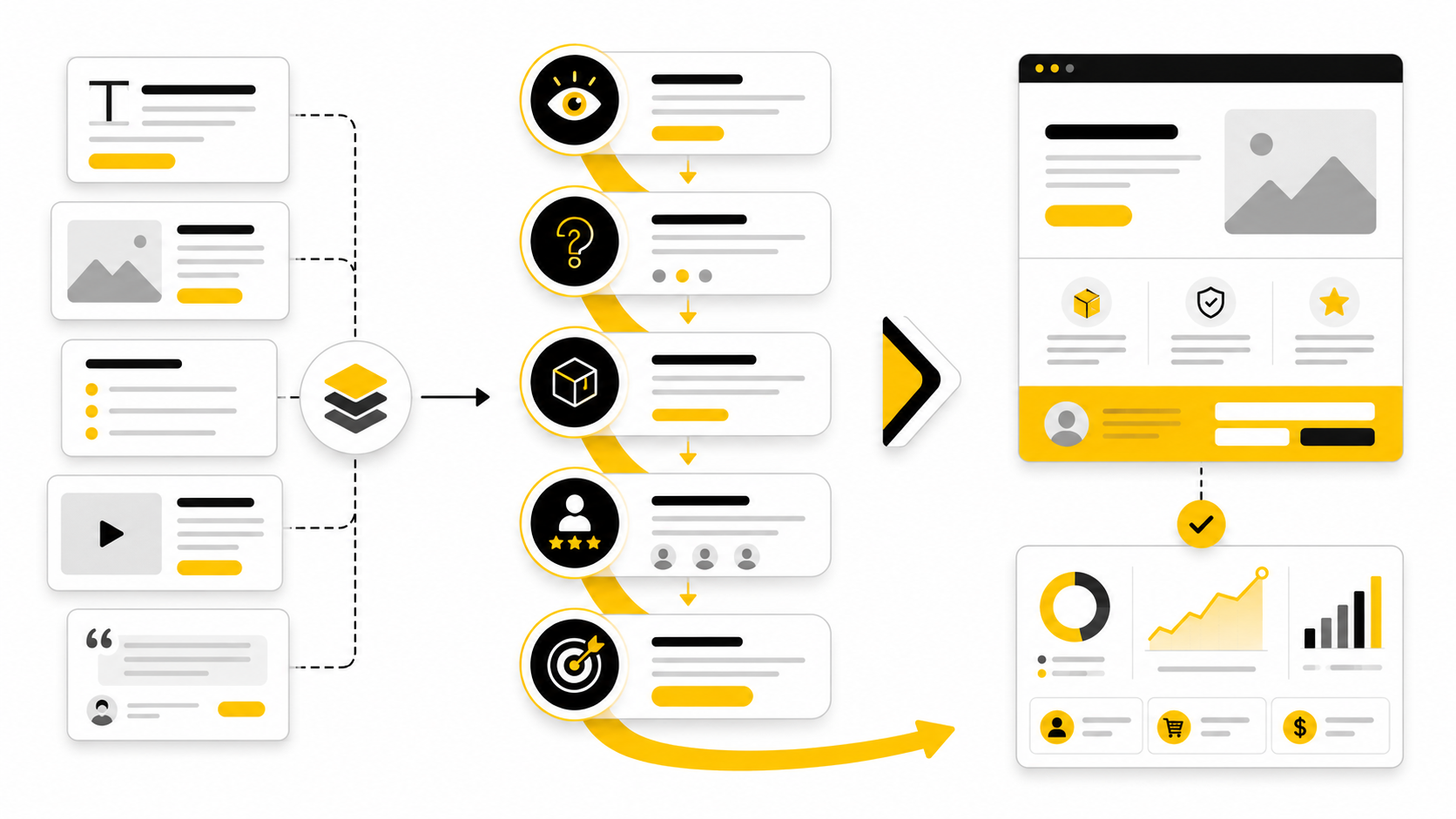
Most people study Joe Sugarman ads because they want better copywriting lines. That is useful, but it misses the bigger lesson. Sugarman’s best ads worked because every part of the message had a job: get attention, reduce resistance, build curiosity, make the product feel real, and move the reader toward a decision.
That matters even more now because attention is harder to keep. A landing page, email sequence, advertorial, product page, webinar registration page, and sales video all have the same basic problem Sugarman solved in print: the reader can leave at any second. The copy has to earn the next sentence.
Joe Sugarman was not just a copywriter writing clever ads from the outside. He founded JS&A Group, sold consumer electronics through direct-response advertising, and later became strongly associated with BluBlocker sunglasses. His books, including The Adweek Copywriting Handbook and Triggers, are still studied because they explain copy as a system, not as a bag of tricks.
The real value of studying Joe Sugarman ads is not to copy the old language. It is to understand why the structure worked, then apply the same thinking to modern offers without sounding dated, hypey, or fake. That is the goal of this guide.
Why Joe Sugarman Ads Still Matter
Joe Sugarman ads matter because they show what direct-response copy looks like when it is built around reader momentum. His work was rooted in a simple but demanding idea: the only purpose of the headline is to get the first sentence read, and the only purpose of the first sentence is to get the second sentence read. That idea became closely associated with his “slippery slide” concept, which describes copy that keeps pulling the reader forward until the offer feels natural.
This is not nostalgia. Modern marketers still face the same human problem Sugarman faced in print: people are skeptical, distracted, and protective of their attention. The channel changed, but the psychology did not.
Sugarman’s advantage was that he treated advertising as a complete selling environment. He did not separate headline, story, proof, product explanation, offer, and close into disconnected parts. He made them feel like one continuous conversation.
That is why studying Joe Sugarman ads is especially useful for people writing long-form landing pages, advertorials, cold email sequences, product pages, and direct-response video scripts. These formats live or die by continuity. If one section feels forced, the reader stops.
The Sugarman Framework
The Sugarman framework starts with attention, but it does not stop there. A lot of weak copy gets attention and then immediately loses trust. Sugarman’s better ads used curiosity to open the loop, then used explanation, involvement, specificity, and proof to keep the reader engaged.
At the center of the framework is flow. Each sentence should make the next sentence feel easy to read. Each section should answer the objection created by the previous section. Each product detail should connect to a benefit the buyer can actually feel.
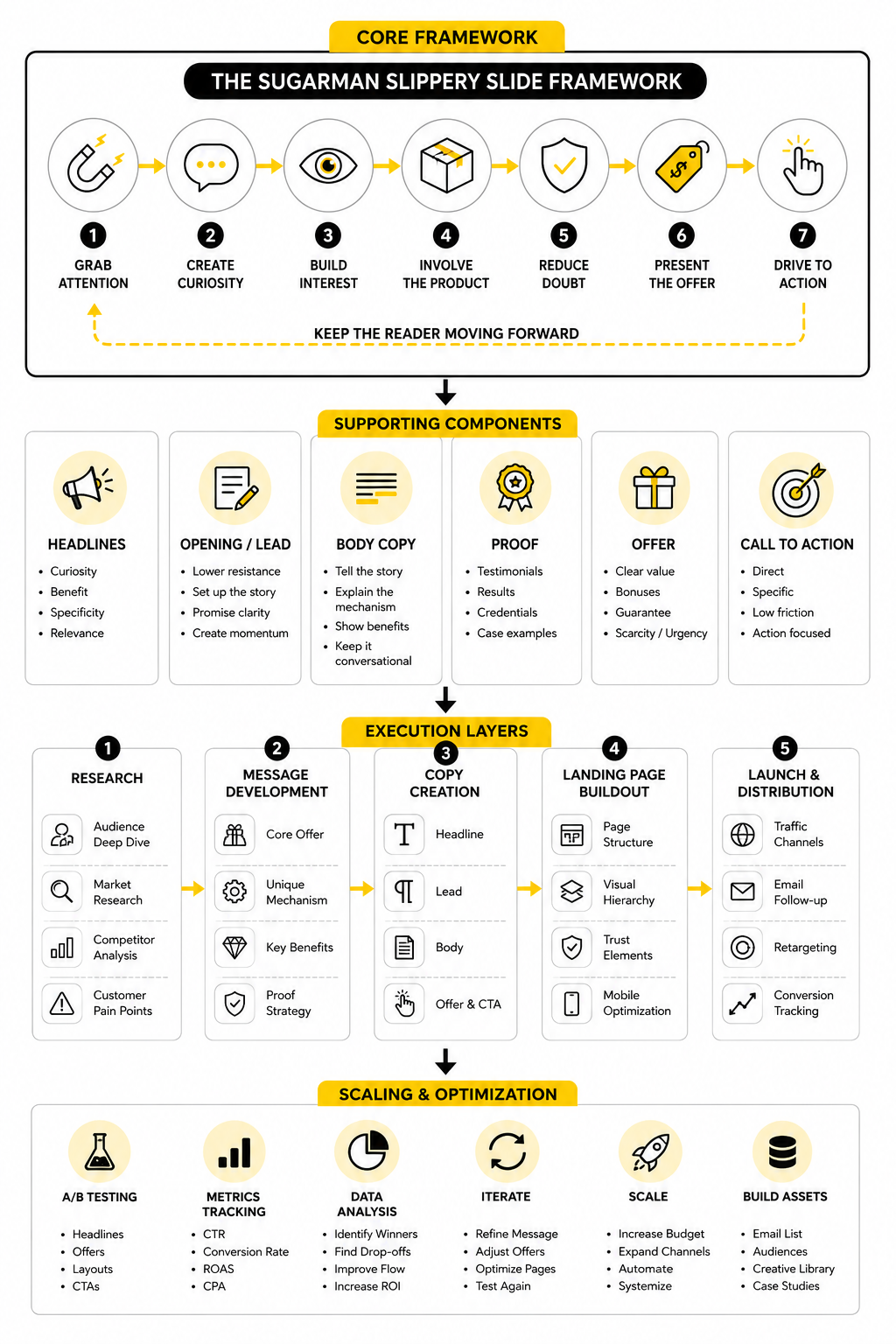
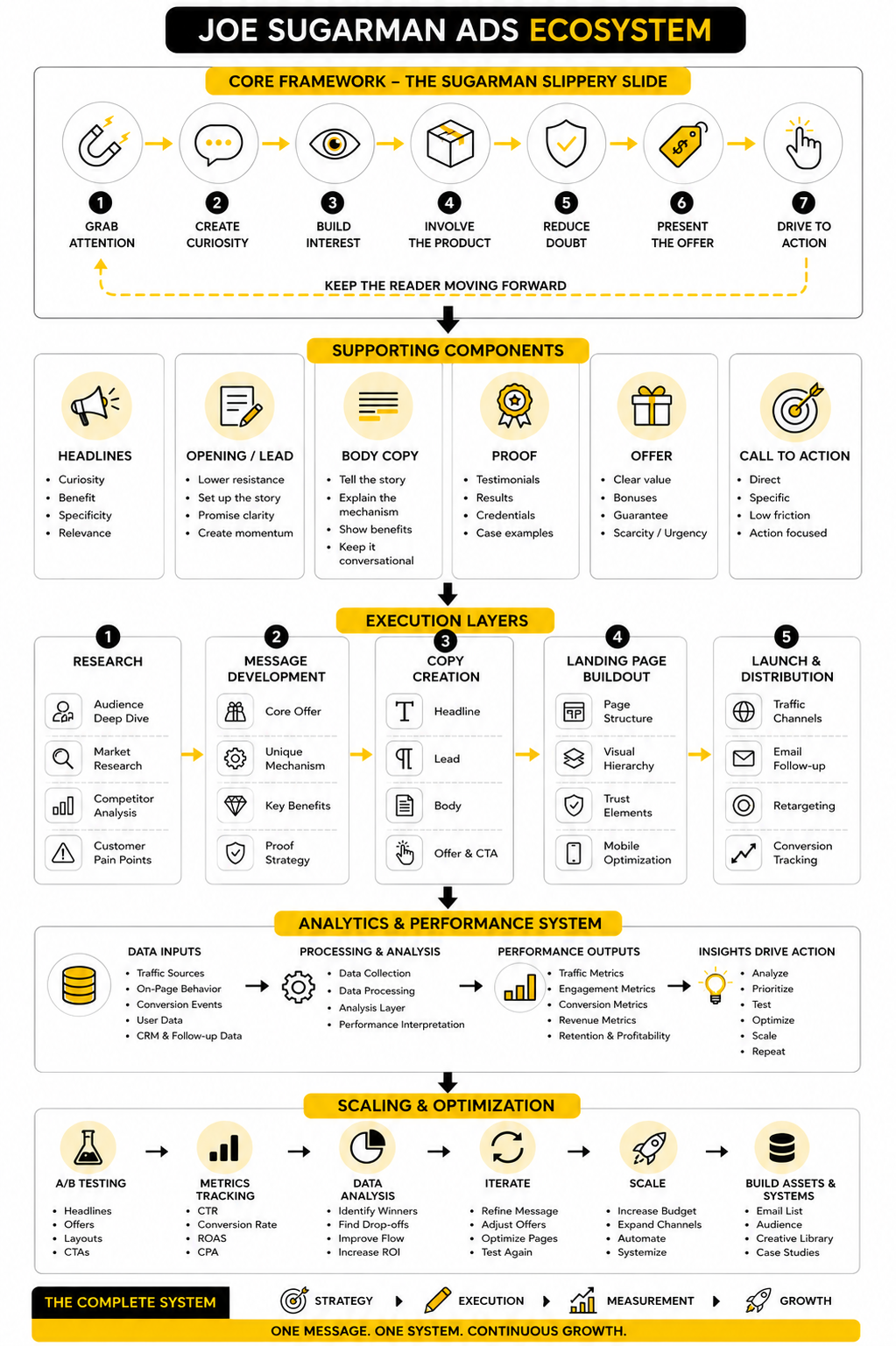
A practical version of the framework looks like this:
This structure is why Joe Sugarman ads often feel more like stories or demonstrations than traditional ads. He was not merely announcing a product. He was pulling the reader into a buying experience before asking for the order.
The Core Components Of A Joe Sugarman Ad
The first core component is the headline. Sugarman’s headlines often created tension by implying there was something unusual, new, or worth investigating. They did not try to explain everything at once, because a headline that explains everything often removes the reason to keep reading.
The second component is the lead. In Sugarman-style copy, the lead usually lowers friction instead of rushing into a hard pitch. It may begin with a surprising claim, a personal observation, a product discovery, or a strange detail that makes the reader want the full story.
The third component is involvement. This is where Sugarman’s work becomes more useful than generic copywriting advice. Instead of only telling the reader what the product does, the copy gets the reader to imagine using it, noticing it, holding it, comparing it, or experiencing the outcome.
The fourth component is a clear product logic. Sugarman ads often explain why the product exists, why it is different, and why the difference matters. This is important because curiosity without clarity becomes gimmicky.
The fifth component is proof. Proof can come from demonstration, authority, specificity, customer response, product history, or a believable explanation of the mechanism. The stronger the claim, the more proof the copy needs.
The sixth component is the close. A Sugarman-style close does not feel stapled onto the end. It works best when the reader has already accepted the product logic, imagined the result, and resolved the biggest objections before the offer appears.
What this guide Will Focus On
this guide will focus on structure, not worship. Joe Sugarman was influential, but the point is not to treat every old ad as perfect or to imitate every stylistic choice. The point is to extract the principles that still work and apply them with modern standards of clarity, proof, and buyer respect.
The next part will break down why Joe Sugarman ads still matter in more detail. We will look at the difference between attention and momentum, why long copy can still work, and why the “slippery slide” is more than a catchy metaphor.
After that, the article will move into the working framework. You will see how curiosity, involvement, product logic, proof, objections, and the final offer fit together. By the end, you should have a practical model you can use when writing ads, landing pages, emails, and funnels without sounding like you are copying a vintage mail-order ad.
Why Joe Sugarman Ads Still Matter
The reason Joe Sugarman ads still matter is simple: they were built for response, not applause. A clever line is nice, but Sugarman was trying to make people take action after reading a full message. That difference matters because most modern copy fails in the middle, not at the headline.
A headline may get the click. A bold promise may get the scroll. But the sale usually happens after the reader has moved through curiosity, clarity, proof, desire, and risk reduction without feeling pushed.
Sugarman understood that advertising is not just about saying something persuasive. It is about arranging ideas in the right order. That is why his work is still useful for landing pages, email funnels, webinar pages, advertorials, ecommerce product pages, and direct-response videos.
His reputation came from real commercial work, not theory. Joe Sugarman founded JS&A Group, became known for direct-response advertising, and later introduced BluBlocker sunglasses, a brand that still connects his name with long-form selling and product demonstration. His book The Adweek Copywriting Handbook remains useful because it explains how copy should move a reader, not just impress other marketers.
Attention Is Only The First Job
A lot of marketers obsess over attention because attention is visible. You can see clicks, views, opens, likes, and scroll depth. But attention alone does not mean the buyer is moving closer to trust.
Joe Sugarman ads worked because they treated attention as the doorway, not the destination. Once the reader entered, the copy had to keep lowering resistance. It had to make the next sentence feel easier than leaving.
That is a huge lesson for modern marketers. If your ad gets attention but the page feels disconnected, the campaign leaks. If your email subject line is strong but the body feels generic, the reader feels tricked. If your landing page opens with a big claim but never explains the mechanism, skepticism takes over.
Sugarman’s style reminds us that attention must be converted into momentum. The reader should not feel like they are being dragged through a pitch. They should feel like each sentence gives them a little more reason to continue.
The Slippery Slide Is A Structure, Not A Trick
The “slippery slide” is often repeated as if it means “write short sentences that make people keep reading.” That is only part of it. The deeper point is that every piece of copy must remove friction from the next piece.
In practical terms, the headline creates curiosity. The first sentence gives the reader an easy entry point. The lead creates enough tension or interest to continue. The body explains the product in a way that feels logical. The proof reduces doubt. The offer arrives after the reader already understands why it matters.
That structure is why the best Joe Sugarman ads feel smooth even when they are long. They do not rely on one huge persuasive moment. They build pressure gradually.
This is especially relevant now because people do not read marketing in a calm, focused environment. They skim. They compare. They open tabs. They get distracted by notifications. Copy that creates a smooth path has a better chance of surviving that environment.
Long Copy Still Works When The Reader Has A Reason To Continue
Long copy is not dead. Boring copy is dead. That distinction matters.
Sugarman’s work is useful because it shows why long copy can work when the offer needs explanation. A simple impulse product may not need a long argument, but a new, unusual, premium, technical, or high-friction product often does. The reader needs context before they feel ready to act.
This is why long-form pages still show up in serious direct-response marketing. A tool like ClickFunnels, for example, is often used to build funnels where the page has to educate, qualify, handle objections, and move people toward a specific conversion. The copy cannot just say “buy now” and hope the reader fills in the gaps.
The real question is not whether copy should be long or short. The real question is whether each line earns its place. Sugarman’s approach forces that discipline because every section has to pull its weight.
Buyer Involvement Makes The Product Feel Real
One of the strongest lessons from Joe Sugarman ads is the power of involvement. Instead of describing a product from a distance, his copy often made the reader mentally experience it. That is a very different skill from listing features.
A weak product description says what the thing is. A stronger one helps the reader picture what changes when they use it. The best version makes the product feel obvious, useful, and personally relevant before the offer appears.
This is why Sugarman’s BluBlocker advertising is still discussed. The product was not only positioned as sunglasses. It was explained through the experience of seeing differently, noticing contrast, and comparing the result with ordinary lenses. BluBlocker’s own history page describes Joe Sugarman as the founder who helped turn the product into a direct-response brand built around demonstration and consumer reaction through BluBlocker’s brand history.
That lesson applies directly to modern pages. If you sell software, do not only list features. Show the moment the user saves time, avoids a mistake, finishes faster, or looks better in front of a client. If you sell a service, do not only describe deliverables. Show the before-and-after state the buyer actually cares about.
The Copy Has To Explain The Mechanism
People are more skeptical now, but they were never passive. Buyers have always needed a reason to believe. Sugarman understood that a strong claim becomes more believable when the copy explains why the claim should be true.
That is the mechanism. It is the reason behind the promise. Without it, the copy feels like hype.
For example, “this will improve your results” is weak by itself. “This improves your results because it removes a specific bottleneck in your current process” is stronger. The buyer may still need proof, but now they have something to evaluate.
This is one of the biggest differences between amateur copy and professional copy. Amateur copy stacks promises. Professional copy explains causality.
That is also why modern marketers should be careful with AI-generated copy. A tool can produce polished claims quickly, but polished claims are not the same as persuasion. When using platforms like GoHighLevel AI or other automation tools, the marketer still has to supply the strategic thinking: the offer, the mechanism, the objections, and the proof.
Trust Comes From Specificity
Specificity is one of the quiet strengths of Joe Sugarman ads. Specific copy feels more grounded because it gives the reader something concrete to process. Vague copy asks the reader to trust the marketer too early.
This does not mean stuffing the page with random details. It means choosing details that clarify the product, sharpen the promise, or reduce doubt. A technical detail can help if it explains the benefit. A product origin detail can help if it makes the offer more believable. A usage detail can help if it lets the reader imagine the product in their life.
Modern copy often gets this wrong by using broad phrases like “save time,” “grow faster,” “boost productivity,” or “scale your business.” Those phrases can be true and still weak. They need context.
A better approach is to make the value visible. Say what gets easier. Say what disappears. Say what the buyer no longer has to manually fix, remember, chase, rebuild, or explain.
The Modern Lesson Is Discipline
The biggest lesson from Joe Sugarman ads is not that every brand should write like Joe Sugarman. They should not. Some old direct-response language would feel too heavy today, especially in markets where buyers are sophisticated.
The real lesson is discipline. Every claim needs a reason. Every section needs a job. Every transition needs to feel natural. Every proof point needs to answer a real doubt.
That is why Sugarman’s ideas still apply even when the format changes. A Facebook ad, email sequence, sales page, advertorial, webinar funnel, and ecommerce page all need the same underlying movement. The reader starts cold, distracted, or skeptical, and the copy has to guide them toward belief.
The next section will move from why this matters into the actual framework. That is where Joe Sugarman ads become more than inspiration. They become a practical model you can use when you need copy that keeps people reading and moves them toward a decision.
The Sugarman Framework
The Sugarman framework is useful because it gives you a way to build copy instead of guessing your way through a page. You are not trying to write one perfect paragraph. You are building a controlled path from attention to belief.
This is where Joe Sugarman ads become practical. They show that strong copy does not depend on pressure alone. It depends on sequence, and sequence is something you can plan before you write.
Think of the framework as a selling conversation with no wasted movement. The reader arrives with curiosity, doubt, distraction, and self-interest. Your job is to meet those conditions in the right order.
Start With The Reader’s Current State
Before writing anything, define what the reader already believes. This is the part many marketers skip, and it is why their copy feels disconnected. They write from the company’s excitement instead of the buyer’s reality.
A good Sugarman-style process starts with the reader’s current state. What do they already know about the problem? What have they tried? What do they secretly want? What would make them stop reading because it sounds too familiar, too vague, or too good to be true?
This matters because the opening cannot live in a fantasy world. If the buyer is skeptical, the copy should not sound wildly enthusiastic too early. If the buyer is problem-aware but solution-confused, the copy should create clarity before it asks for a decision.
Define The Hook Before The Headline
The hook is not just the headline. The hook is the reason the reader should care enough to continue. A headline is only the visible expression of that deeper idea.
In Joe Sugarman ads, the hook often came from an unusual product angle, a surprising mechanism, a counterintuitive observation, or a detail that made the product feel different. That is why the copy could keep moving. The headline did not have to carry the full burden by itself.
For modern copy, define the hook in one plain sentence before writing headlines. For example, “This tool helps agencies stop losing leads because it follows up automatically before the prospect goes cold.” That is not polished copy yet, but it gives you a strategic center. From there, you can write a headline, lead, proof section, and offer that all point in the same direction.
Build The First Sentence For Zero Resistance
The first sentence should be easy. Not impressive. Easy.
Sugarman was famous for emphasizing how important the first sentence is because it sets the reader’s pace. If the first sentence feels heavy, abstract, or overstuffed, the reader has to work too hard. If it feels natural, the reader keeps going almost automatically.
This does not mean every first sentence has to be short in a mechanical way. It means the first sentence should create no friction. It should feel like a small step into the conversation, not a wall of positioning language.
A practical rule is to write the first sentence after you know the hook but before you write the whole body. Ask yourself: would a distracted person keep reading this without effort? If the answer is no, simplify it.
Turn Product Features Into Reader Movement
Features are not the enemy. Lazy feature writing is the enemy.
A feature becomes useful when it moves the reader from where they are to where they want to be. That movement might be emotional, practical, financial, operational, or social. The copy has to make that movement visible.
For example, an automation feature is not persuasive simply because it exists. It becomes persuasive when the reader understands what no longer has to be done manually, what mistakes are avoided, what gets handled faster, and what that changes in the buyer’s day. If the product is part of a funnel, a platform like GoHighLevel only becomes compelling when the copy connects its capabilities to a concrete business outcome.
This is why Sugarman-style copy spends time with the product. It does not hide the details. It translates them.
Create A Logical Path Before You Draft
The easiest way to write messy copy is to start drafting before the structure is clear. You end up repeating benefits, adding proof too late, handling objections randomly, and forcing the offer at the end. The reader feels that disorder even if they cannot name it.
A better process is to map the logic first. This gives you the bones of the ad before you add voice, rhythm, and detail. It also helps you spot gaps before they become expensive problems on the page.
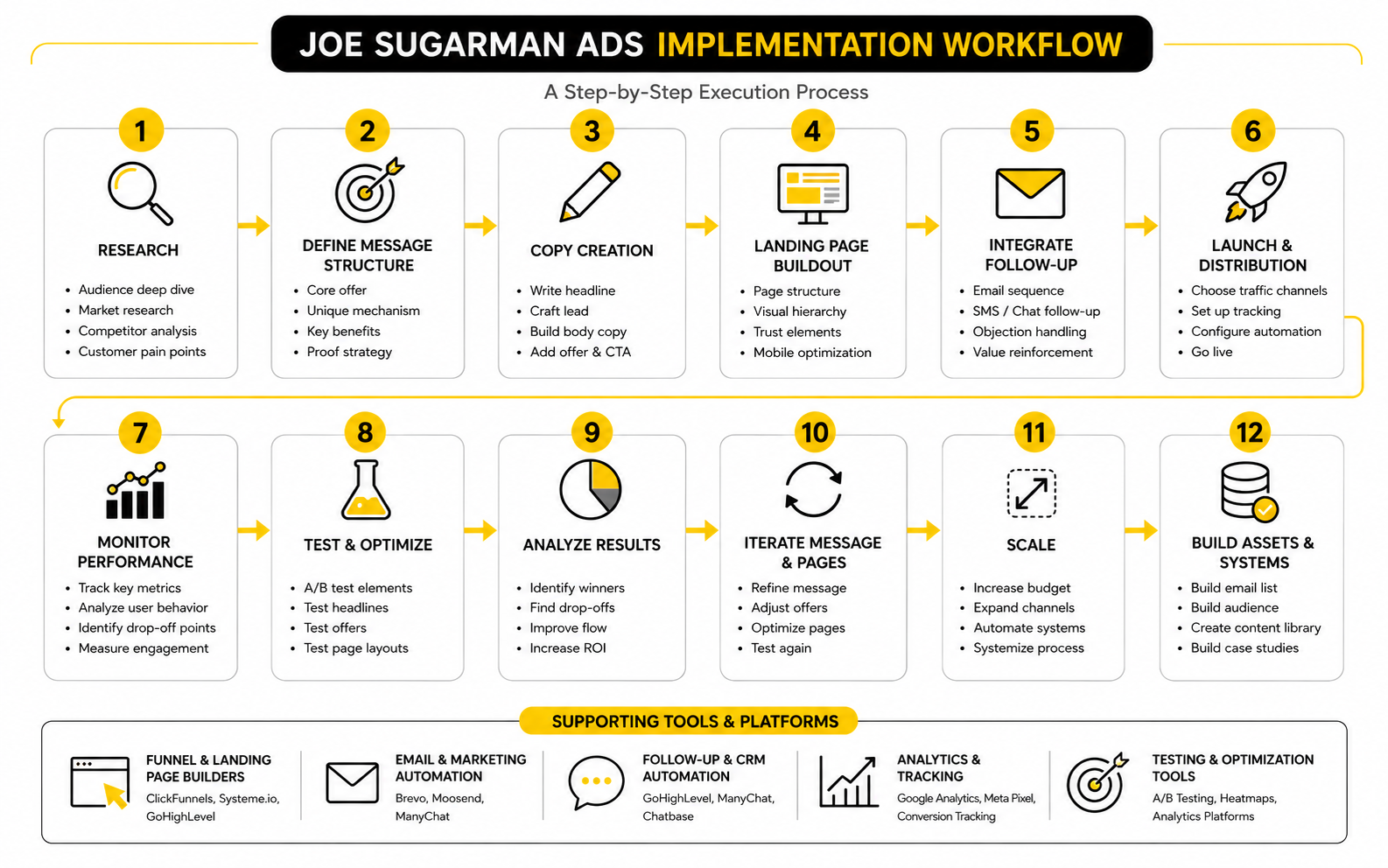
Use this process before writing the first full draft:
Write The Lead Like A Guided Entry
The lead is where many ads collapse. They get the headline right, then immediately start explaining too much. Or they try to be clever for too long and never get to the product.
A Sugarman-style lead should guide the reader into the argument. It can open with curiosity, but it has to begin creating clarity quickly. The reader should feel pulled forward, not tricked.
One practical way to write the lead is to move from observation to tension to promise. Start with something the reader recognizes. Show why it matters. Then make it clear that the product, idea, or offer will help resolve that tension.
This is useful for landing pages and email funnels because the lead sets expectations. If the lead is too broad, the body feels slow. If the lead is too aggressive, the body feels defensive. If the lead is focused, the rest of the copy has a natural runway.
Build Curiosity Without Creating Confusion
Curiosity is powerful, but it is easy to abuse. Bad copy creates curiosity by withholding basic information. Good copy creates curiosity by revealing enough to make the reader want the next piece.
Joe Sugarman ads often worked because the curiosity had direction. The reader was not just wondering, “What is this?” They were wondering, “How does this work?” or “Why have I not thought about it this way before?” That is a much stronger kind of curiosity.
In modern copy, this distinction matters. You can use curiosity in ads, emails, and landing pages, but you should not make the buyer feel manipulated. If the reader feels confused, they do not become more persuaded. They become more guarded.
Place Objections Inside The Flow
Objections should not be treated as an afterthought. They are part of the reader’s internal conversation. If you ignore them, the copy may sound positive, but it will not feel complete.
The best place to handle an objection is close to the moment it naturally appears. If you make a bold claim, support it quickly. If the product is expensive, explain the value before price becomes the only thing the reader sees. If the product requires a behavior change, show why the change is manageable.
This is one reason Joe Sugarman ads are worth studying carefully. They do not simply present benefits and then hope the reader forgets their doubts. They keep moving through doubt as part of the selling path.
For digital funnels, this is also where page structure matters. If you are building a long-form funnel in ClickFunnels or a leaner page in Systeme.io, the order of sections is not decoration. It determines when the reader receives the answer they need.
Draft For Flow, Then Edit For Force
The first draft should focus on flow. Do not try to make every sentence perfect while you are still figuring out the path. Get the reader from opening to offer with a clear sequence.
The second pass is where you strengthen the copy. Remove repeated claims. Replace vague benefits with specific outcomes. Cut sentences that explain what the reader already understands. Move proof closer to the claims it supports.
The final pass is where you check force. Does the headline create enough curiosity? Does the first sentence feel effortless? Does the lead make the reader want the body? Does each section create a reason to continue? Does the offer feel like a natural decision rather than a sudden demand?
That process is simple, but it is not casual. It is exactly where the discipline behind Joe Sugarman ads becomes useful. You are not trying to sound like Sugarman. You are trying to make every part of the copy perform a real job.
Statistics And Data: How To Measure Whether The Copy Is Working
Joe Sugarman ads were built for response, which means the copy should eventually be judged by behavior. Not by whether the founder likes it. Not by whether the headline sounds clever. Not by whether the page feels “on brand” in a meeting.
The numbers matter because they show where the reader loses momentum. If the headline gets attention but the page does not convert, the problem is probably not just traffic. If people reach the offer but do not act, the problem may be proof, risk, price framing, or the strength of the mechanism.
This is where the Sugarman approach becomes very modern. The “slippery slide” is not just a writing metaphor. It is also a measurement model. You are looking for the place where the slide stops being slippery.
Start With The Right Conversion Event
Before you judge the copy, define what action the page is supposed to produce. A sale, booked call, email opt-in, webinar registration, checkout start, product demo request, and free trial signup are not the same event. They have different levels of friction, so they should not be measured as if they are equal.
A low-friction lead magnet can convert higher because the reader gives less away. A paid offer or consultation request usually converts lower because the reader has to trust you more. That does not automatically mean the copy is worse. It means the decision is heavier.
This is why benchmark data needs context. The Unbounce Conversion Benchmark Report is useful because it separates performance across industries and landing page categories instead of pretending there is one universal “good” conversion rate. The action for you is simple: compare your page to the closest relevant intent, not to a random internet average.
Measure The Slide, Not Just The Sale
If you only measure final conversion rate, you are looking at the last frame of the movie. You know whether the reader acted, but you do not know where belief broke down. That makes optimization messy.
A better measurement system follows the reader through the page. You want to know whether the headline earns the first scroll, whether the lead keeps attention, whether the proof section gets seen, whether the offer is reached, and whether the call to action gets clicked. Each signal tells you something different.
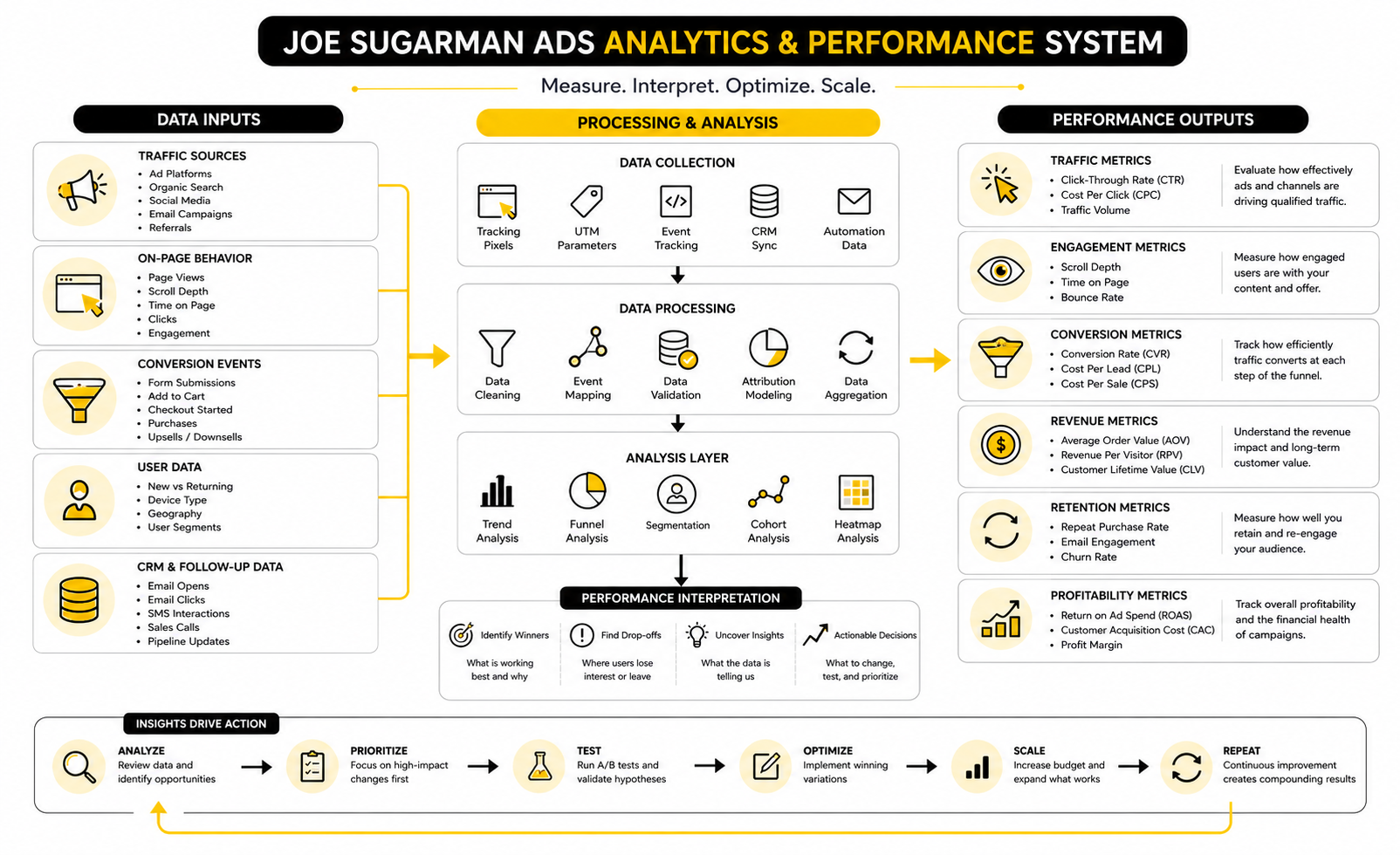
For a Sugarman-style page, track these signals in order:
Benchmarks Are A Starting Point, Not A Verdict
Benchmarks are useful when they stop you from guessing. They are dangerous when they make you lazy. A page can beat an industry average and still leave money on the table, while another page can sit below a broad benchmark but perform well for a difficult, high-ticket, niche offer.
For landing pages, industry medians can vary widely. Search Engine Land’s summary of Unbounce benchmark data notes that medians in the report ranged from 3.8% for SaaS to 12.3% for legal, which proves the point: the market, offer, and conversion event change the number dramatically. You should not judge a complicated B2B software demo page by the same standard as a local service lead form.
Email benchmarks have the same problem. HubSpot’s benchmark roundup shows that open rates and click-through rates can change heavily by industry, with examples such as B2B services open rates near 39.48% and SaaS click-through rates around 1.19%. The useful action is not to chase someone else’s number. It is to diagnose whether your subject line, opening, body, and CTA are each doing their job.
Read Metrics Like A Copywriter
A copywriter should not look at analytics like a dashboard operator. The numbers are clues about reader psychology. They show hesitation, curiosity, confusion, belief, and intent.
If the ad gets clicks but the page has low engagement, the promise may be mismatched. The reader expected one thing and got another. That is not a traffic problem first; it is a continuity problem.
If engagement is high but CTA clicks are low, the page may be interesting without being persuasive. This happens when the copy educates but does not sharpen the desire for action. The reader leaves more carefully, but not committed.
If CTA clicks are strong but final conversions are weak, the copy may have done its job and the friction may be happening after the click. The form may ask for too much. The checkout may feel risky. The calendar may create doubt. This is why full-funnel tools like GoHighLevel, ClickFunnels, or Systeme.io can be useful when you need to see how the page, follow-up, and conversion path work together.
Watch For Message Match
Message match is one of the most important performance signals in a Sugarman-style funnel. The promise in the ad, email, or search result must match the opening of the page. If the reader feels a switch, trust drops fast.
This matters because Joe Sugarman ads were continuous. The headline, first sentence, lead, body, proof, and offer felt connected. Modern funnels need the same continuity across channels.
If an email promises a specific insight, the landing page should immediately continue that idea. If a paid ad promises a faster way to solve a problem, the page should not open with generic brand positioning. If a social post creates curiosity around a mechanism, the page should explain that mechanism early.
A simple audit can reveal the issue. Put the ad headline, email subject line, landing page headline, first sentence, first CTA, and offer on one page. If they do not feel like one argument, the reader will feel the gap.
Use A/B Tests Carefully
A/B testing is useful, but only when the test is designed well. Testing random button colors while the offer is unclear is not optimization. It is avoidance.
Strong tests come from a real diagnosis. If scroll depth drops before the proof section, test a sharper lead or move proof earlier. If CTA clicks are low, test the offer framing. If clicks are high but conversions are low, test the next step after the CTA.
Statistical confidence also matters because small samples can lie. A testing guide like ExperimentHQ’s explanation of A/B testing statistics is useful because it explains why sample size, confidence intervals, and false positives affect the decisions you make from a test. The action is practical: do not declare a winner just because one version is ahead after a handful of conversions.
Separate Copy Problems From Offer Problems
Not every bad number is a copy problem. Sometimes the copy is clear and the offer is weak. Sometimes the offer is strong but the audience is wrong. Sometimes the audience is right but the page asks for too much too soon.
This distinction matters because copywriting can amplify value, but it cannot manufacture a market that does not care. If the mechanism is unclear, copy can fix that. If the proof is thin, copy can present what exists more clearly. If the offer is fundamentally not attractive, copy can only hide the weakness for a short time.
A clean measurement process helps you avoid blaming the wrong thing. If qualified traffic reads the page, reaches the offer, and still does not act, the issue may be value, price, guarantee, timing, or risk. That is bigger than rewriting a headline.
Build A Simple Optimization Routine
The best measurement routine is not complicated. It is consistent. You review the same core signals, identify the biggest leak, make one meaningful change, and measure again.
For a Sugarman-style page, the routine can be simple:
That last point matters. Do not rewrite the entire page every time performance dips. You will lose track of what changed. Fix the highest-leverage section first.
The Data Should Improve The Argument
The point of measurement is not to make copy colder. It is to make the argument sharper. Data shows you where the reader needs a better reason to continue.
If the opening fails, make the entry easier and the hook clearer. If the middle fails, improve the mechanism, proof, or involvement. If the close fails, improve the offer, risk reversal, urgency, or next step.
That is the practical connection between analytics and Joe Sugarman ads. Sugarman’s work teaches you how to create momentum. Measurement shows you where that momentum breaks. When you use both together, optimization becomes much less random.
How Professionals Apply Sugarman’s Ideas Today
Professional implementation is where Joe Sugarman ads separate serious copy from surface-level imitation. It is easy to say “write a slippery slide.” It is harder to build a funnel, landing page, email sequence, or advertorial where each piece keeps the buyer moving without exaggerating the offer.
The advanced move is to treat Sugarman’s principles as a strategy layer, not a style costume. You are not trying to sound like a vintage direct-response ad. You are using curiosity, sequence, proof, and involvement to make the buying decision clearer.
That distinction matters because modern buyers are more exposed to marketing. They have seen hype. They have seen fake urgency. They have seen testimonials used badly. So the copy has to be strong without becoming manipulative.
Adapt The Method To The Buyer’s Awareness Level
The same Sugarman-style structure will not work the same way for every audience. A cold audience needs more context. A warm audience may need more proof and differentiation. A hot audience may need a clearer offer, stronger guarantee, or easier next step.
This is one reason advanced copywriters spend so much time on awareness level before writing. If the buyer does not understand the problem yet, jumping straight into product features feels premature. If the buyer already knows the category well, over-explaining the basics feels slow.
The practical move is to match the copy length and order to the buyer’s state. Cold traffic often needs more education and involvement. Retargeting traffic may need sharper proof and objection handling. Existing leads may need a more direct path to the offer because they already understand the context.
Do Not Confuse Curiosity With Vagueness
Curiosity works when it opens a loop the reader wants closed. Vagueness fails because it hides the point. The difference is small in wording but huge in performance.
A strong curiosity angle makes the reader think, “I want to know how that works.” A vague angle makes them think, “What are they even talking about?” One creates movement. The other creates friction.
This matters even more when applying Joe Sugarman ads to search traffic. Someone searching for a specific solution does not want a mysterious opening that delays the answer. They want relevance first, then curiosity. Give them a reason to stay, but do not make them hunt for the topic they came for.
Balance Long Copy With Scan-Friendly Structure
Sugarman’s work proves that long copy can sell, but modern long copy has to be easier to scan. People often scan pages instead of reading every word, and Nielsen Norman Group’s classic usability research found that 79% of users scanned new pages while only 16% read word by word. That does not mean long copy is useless. It means long copy needs structure.
The page should reward both types of readers. The scanner should understand the argument from headings, bullets, proof blocks, and CTA sections. The deep reader should find enough substance in the paragraphs to build trust.
This is why headline hierarchy matters. Your headings should not be decorative. They should carry the logic of the argument. A busy buyer should be able to skim the headings and still understand why the offer matters.
Use Proof Without Creating Legal Or Trust Problems
Proof is powerful, but it has to be handled carefully. Modern advertising cannot treat testimonials, influencer claims, or customer results as decoration. The FTC’s endorsement guidance explains that endorsements and testimonials should reflect honest opinions and that material connections should be disclosed when they affect how people evaluate the message through the FTC’s advertising endorsement guidance.
That matters because aggressive copy often fails by overusing proof it cannot properly support. A dramatic testimonial may look persuasive in the short term, but if it creates an unrealistic impression, it can damage trust and create compliance risk. Serious marketers do not build funnels on proof they cannot defend.
The practical rule is simple. Use proof that is specific, relevant, and fair. If a result is unusual, do not present it as normal. If there is a relationship behind an endorsement, disclose it clearly. If a claim needs evidence, make sure the evidence exists before the copy goes live.
Keep The Mechanism Stronger Than The Hype
The mechanism is the reason the promise should be true. Advanced copy depends on it because sophisticated buyers do not respond well to empty confidence. They want to understand why your approach works.
A weak page says, “Get better results faster.” A stronger page explains what bottleneck gets removed, what process changes, what insight the buyer gains, or what hidden cost disappears. That explanation gives the reader something to believe beyond the claim itself.
This is especially important for software, coaching, agencies, and service businesses. The market is crowded, so big promises blur together. The mechanism is what makes the promise feel grounded.
For example, a funnel builder like ClickFunnels should not be positioned only as a page builder if the real buyer cares about turning attention into a customer journey. An automation platform like GoHighLevel should not be described only as a list of tools if the real value is keeping follow-up, pipelines, and client communication connected. The mechanism is what turns the tool from “software” into a believable solution.
Scale The Copy Without Diluting The Argument
Scaling creates a new problem. The first winning page may work because it has a strong, focused argument. Then the team starts creating more ads, more emails, more landing pages, more segments, and more variations. Slowly, the message gets diluted.
This happens when teams scale assets instead of scaling the underlying argument. They change headlines, creatives, hooks, and CTAs without preserving the core mechanism. The result is a campaign that looks active but feels inconsistent.
The fix is to document the message architecture. Write down the main promise, buyer awareness level, core mechanism, proof points, objections, prohibited claims, offer logic, and CTA language. Then every new asset can vary the angle without breaking the argument.
This is where a simple content and funnel system helps. A team using Systeme.io, GoHighLevel, or another funnel platform should not only duplicate pages. They should duplicate the strategic structure that made the page work.
Know When To Shorten The Copy
A Sugarman-inspired page does not always need to be long. Long copy is useful when the reader needs more context, proof, explanation, or risk reduction. It becomes a liability when the reader already has enough intent and the copy delays the next step.
This is a strategic tradeoff. If traffic comes from a high-intent search, the page may need clarity faster. If traffic comes from a cold social ad, the page may need more education. If traffic comes from an email sequence, the page may be able to get to the offer sooner because the relationship has already been warmed up.
The best copywriters do not defend length as a belief system. They choose length based on friction. More friction needs more explanation. Less friction needs fewer obstacles.
Protect The Brand While Selling Directly
Direct response and brand are often treated like enemies. They are not. The best version of Sugarman-style copy sells clearly without making the brand feel cheap.
The risk appears when marketers copy the pressure but not the thinking. They add exaggerated urgency, oversized claims, fake scarcity, and aggressive CTAs because they think that is what makes direct response work. It usually creates a short-term lift at the cost of long-term trust.
Strong direct-response copy can still sound polished, restrained, and premium. It can explain clearly, persuade confidently, and ask for action without shouting. That is the version worth building.
Use AI As A Drafting Assistant, Not The Strategist
AI can help with variations, outlines, rewrites, and speed. It can turn one idea into ten headline options. It can simplify complex copy. It can help repurpose a long page into emails, ads, and short-form content.
But AI should not be allowed to invent the strategy. It does not truly know the buyer’s hesitation, the product’s real proof, the offer economics, or the claims you are legally comfortable making. Those decisions need human judgment.
This matters because AI-generated copy often sounds smooth while saying very little. It may produce broad promises, generic benefits, and confident language without a real mechanism. That is the opposite of what makes Joe Sugarman ads useful.
A better workflow is to give AI the message architecture first. Feed it the audience, hook, proof, mechanism, objections, offer, tone, and compliance limits. Then use it to draft options. The thinking comes first.
Build Follow-Up Around The Same Argument
The sales page is rarely the whole persuasion system. The ad creates the first expectation. The page makes the main argument. The follow-up email, SMS, retargeting ad, chatbot, or sales call continues the same conversation.
This is where many funnels break. The page says one thing, the email says another, and the sales call opens with a third message. The buyer feels the inconsistency, even if they cannot explain it.
A Sugarman-style system keeps the argument continuous. The follow-up does not restart from zero. It expands the same mechanism, adds proof, answers objections, and makes the next step easier.
For ecommerce or creator-led businesses, tools like ManyChat can support this when the messaging is built around a clear buying path instead of random reminders. For email-heavy funnels, platforms like Brevo or Moosend can help manage follow-up, but the sequence still needs a coherent argument. Automation only multiplies what you put into it.
The Advanced Standard Is Clarity Under Pressure
The deeper you go with Joe Sugarman ads, the more you realize the standard is not cleverness. It is clarity under pressure. Can the copy stay clear when the product is complex, the buyer is skeptical, the market is crowded, and the offer requires commitment?
That is the expert-level challenge. Anyone can write a punchy headline. Fewer people can build a complete argument that holds together from first impression to final action.
The next and final part will bring this down to the mistakes, practical examples, and FAQ. That is where the framework becomes easier to apply without overthinking it. The goal is not to write copy that looks impressive in a document. The goal is to write copy that makes the reader understand, believe, and act.
Mistakes, Examples, And FAQ
The final mistake is treating Joe Sugarman ads like a template instead of a way of thinking. Templates can help, but they can also make copy stiff. Sugarman’s real lesson is not that every ad needs the same exact sequence, tone, or length.
The lesson is that the reader’s attention has to be earned one step at a time. The copy has to create curiosity, explain the mechanism, reduce doubt, and make the next action feel logical. When those pieces work together, the page feels less like a pitch and more like a guided decision.
That is why the best modern use of Sugarman’s ideas is a full system. The ad, landing page, follow-up, proof, offer, checkout, and retargeting should all support the same argument. If one part says something different, the momentum breaks.
Common Mistakes To Avoid
The first mistake is opening with too much hype. Big promises may create attention, but they also raise suspicion. If the copy cannot support the promise quickly, the reader starts looking for reasons not to believe it.
The second mistake is explaining the product before the reader understands why it matters. Product details are useful only when they connect to a problem, desire, or outcome the buyer already cares about. Otherwise, the copy feels like a brochure.
The third mistake is hiding the offer until too late. Long copy should build desire, not delay clarity. If the reader has to work too hard to understand what is being sold, the slide stops.
The fourth mistake is using proof randomly. Testimonials, credentials, results, screenshots, demonstrations, and guarantees should appear where doubt naturally appears. Proof is strongest when it answers the question the reader is already asking.
The fifth mistake is copying old direct-response language without adapting it. Some classic ads used a tone that would feel too heavy today. Modern buyers respond better when the copy is direct, specific, useful, and believable.
Practical Examples Of Sugarman-Style Thinking
A weak landing page might say, “Grow your business faster with our all-in-one platform.” That sounds fine, but it is too broad. The reader has heard it before, so there is no real hook.
A stronger Sugarman-style angle would identify the bottleneck first. It might explain that the real problem is not getting more leads, but losing interested prospects because follow-up is slow, scattered, or inconsistent. Now the product has a reason to exist.
A weak email might open with, “We are excited to announce our new solution.” The reader does not care yet. A stronger opening would start closer to the reader’s frustration, such as the moment a prospect fills out a form and then goes cold because nobody follows up fast enough.
A weak sales page might stack benefits with no mechanism. A stronger page would explain what changes in the process, why that change matters, and how the buyer can see the result in their own workflow. That is the practical difference between describing a product and selling an outcome.
How To Use This Without Sounding Like A Copywriter
The best copy usually does not sound like copy. It sounds like someone understands the problem clearly and can explain the path forward. That is the tone to aim for.
When you study Joe Sugarman ads, do not steal the surface moves. Do not force curiosity where clarity is needed. Do not add drama where the buyer wants precision. Do not stretch a simple offer into a long argument just because long copy once worked for another product.
Instead, use the principles quietly. Make the first line easy to read. Keep the sequence logical. Show the product in action. Explain the mechanism. Support claims with proof. Ask for the next step when the reader has enough reason to take it.
What are Joe Sugarman ads?
Joe Sugarman ads are direct-response advertisements associated with copywriter and entrepreneur Joseph Sugarman. They are known for strong opening lines, smooth reading flow, product involvement, curiosity, and a clear path toward action. The best way to study them is not to copy the old wording, but to understand how each sentence moves the reader forward.
Why are Joe Sugarman ads still studied today?
They are still studied because they show how persuasion works across a complete message. Modern marketers still need headlines, leads, proof, product explanation, objection handling, and strong offers. The channels changed, but the reader’s need for clarity and belief did not.
What is the slippery slide in copywriting?
The slippery slide is Sugarman’s idea that every element of copy should make the reader want to continue to the next one. The headline leads to the first sentence, the first sentence leads to the second, and the body keeps creating momentum until the offer feels natural. It is not a trick; it is a discipline for reducing friction.
Are Joe Sugarman ads only useful for long-form sales pages?
No. The same principles can improve short ads, emails, landing pages, product pages, video scripts, and follow-up sequences. The point is not length. The point is sequence, clarity, curiosity, proof, and reader momentum.
Should every sales page use long copy?
No. Long copy is useful when the buyer needs more education, proof, context, or risk reduction. If the buyer already understands the product and has strong intent, shorter copy may work better. The right length depends on the amount of friction in the buying decision.
What is the biggest lesson from Joe Sugarman’s copywriting?
The biggest lesson is that copy should be built as a connected path. Every sentence, section, proof point, and CTA should have a job. When the copy feels disconnected, the reader feels the friction and leaves.
How do I apply Sugarman’s ideas to a landing page?
Start by defining the reader’s current belief, the main hook, the product mechanism, the proof, the objections, and the offer. Then arrange those pieces in the order the reader needs them. A landing page builder like ClickFunnels or a funnel platform like Systeme.io can help you publish the page, but the strategy still has to come from the message.
How do I know if my copy has good flow?
Read the copy from the headline to the CTA and look for any moment where the reader has to work too hard. If a section repeats what was already said, cut it. If a claim appears without proof, support it. If the offer appears before the reader understands the value, rebuild the sequence.
What metrics should I track when testing Sugarman-style copy?
Track the whole path, not just the final conversion. Look at ad click-through rate, landing page engagement, scroll depth, CTA click rate, form completion, checkout completion, and final conversion rate. The goal is to find where momentum breaks.
Are testimonials important in Sugarman-style copy?
Yes, but only when they are credible and relevant. Testimonials should reduce a real doubt the reader has. They should also be honest, not misleading, and used responsibly, especially because the FTC says endorsements must reflect honest opinions and cannot be used to make claims the marketer could not legally make through its endorsement guidance.
Can AI write copy in the style of Joe Sugarman ads?
AI can help draft, rewrite, brainstorm, and repurpose copy, but it should not replace the strategy. The strongest results come when you give AI the audience, hook, mechanism, proof, objections, offer, and tone first. Without that input, AI often produces smooth but generic copy.
What makes a product mechanism strong?
A strong mechanism explains why the promise should be true. It shows what changes, what bottleneck gets removed, what process improves, or what hidden advantage the buyer gets. Without a mechanism, the copy depends too much on claims.
How do I avoid sounding manipulative?
Be specific, fair, and useful. Do not exaggerate results, fake urgency, hide important conditions, or use proof out of context. Strong copy can be persuasive without insulting the reader’s intelligence.
Can Joe Sugarman’s ideas work for B2B marketing?
Yes. In B2B, the same ideas often matter even more because the buying decision has more risk. The copy needs to explain the business problem, show the mechanism, support claims with proof, and make the next step feel safe. The tone may be more restrained, but the structure still applies.
What is the best way to study Joe Sugarman ads?
Study the sequence, not just the lines. Look at how the headline creates curiosity, how the lead lowers resistance, how the product is explained, where proof appears, and how the offer is introduced. Then apply the same thinking to your own market instead of copying the surface style.
Final Thoughts
Joe Sugarman ads are worth studying because they force you to respect the reader’s attention. They remind you that persuasion is not one clever headline or one hard CTA. It is a complete path from curiosity to belief to action.
The modern marketer’s job is to take that discipline and apply it with better tools, better measurement, stronger proof, and a more transparent tone. That is how you get the benefit of direct response without sounding dated or pushy.
Used well, the Sugarman framework gives you a simple standard for every piece of copy you write. Does this sentence make the next one easier to read? Does this section answer the reader’s real doubt? Does this offer feel like the logical next step? If the answer is yes, you are much closer to copy that actually works.
Build a stronger local presence with BAAM AI
Turn your website, Google profile, social channels, and AI visibility into one growth engine
Most businesses do not need more random marketing activity. They need a consistent presence system that helps the right people find them, trust them, and take action. BAAM AI brings strategy, local SEO, website updates, Google Maps visibility, social content, AI-search readiness, media production, and reporting into one practical monthly engine.
If you want your marketing to keep working after the campaign ends, start with a free BAAM AI presence audit. See how your business shows up today and where the fastest visibility wins are at BAAM AI.