
BAAM AI Blog
Jobdesk Copywriter: What the Role Really Covers and How to Do It Well
A jobdesk copywriter is not just someone who “writes captions” or “makes words sound nice.” The real job is to turn a business goal into clear, persuasive communication that moves people to act. That can mean writing...
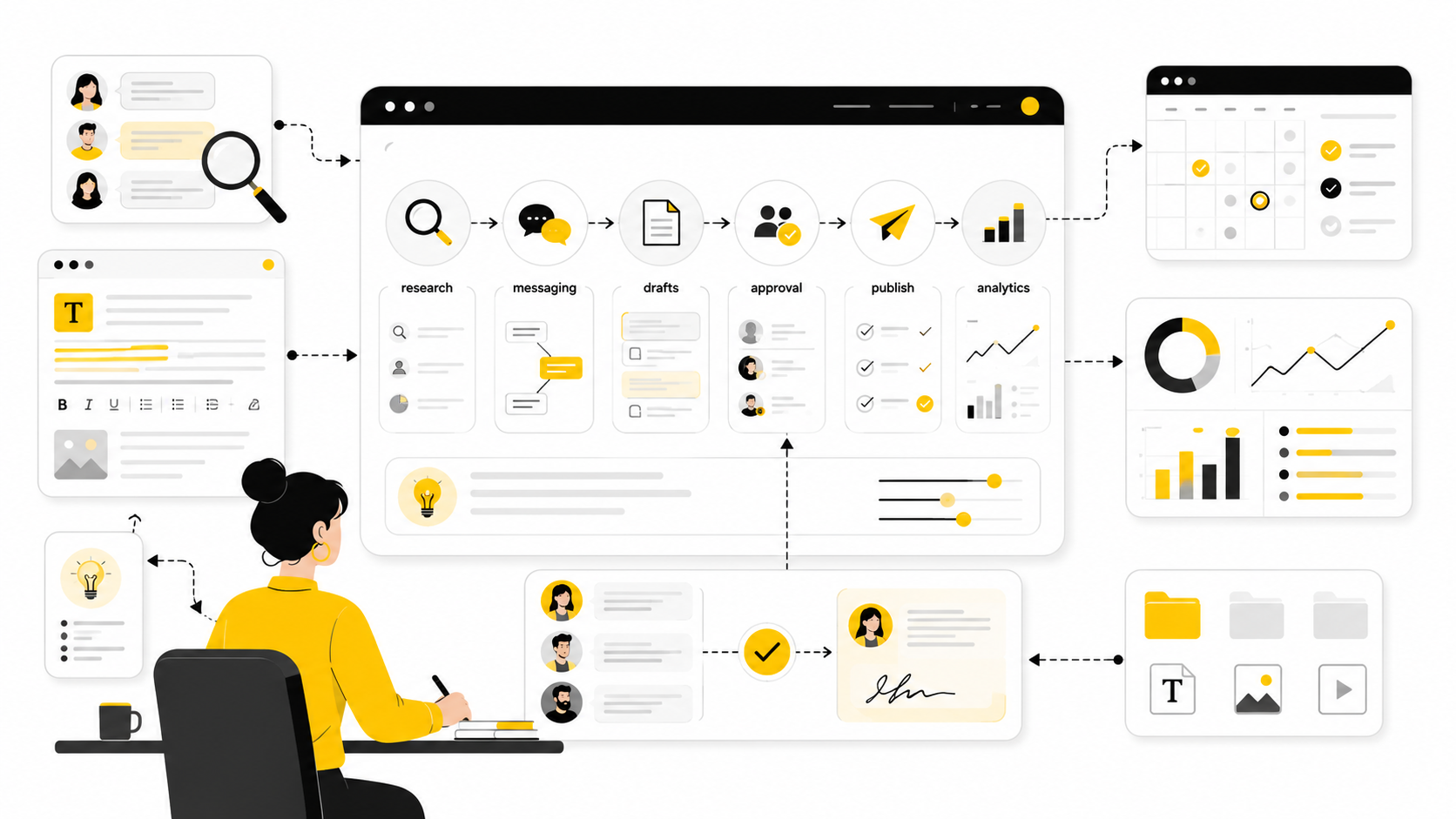
A jobdesk copywriter is not just someone who “writes captions” or “makes words sound nice.” The real job is to turn a business goal into clear, persuasive communication that moves people to act. That can mean writing ads, landing pages, product descriptions, emails, social posts, scripts, website copy, campaign concepts, or sales messages.
The reason this role matters is simple: companies do not grow from content alone. They grow when the right message reaches the right person at the right moment with a reason to care. That is why a strong copywriter needs more than grammar skills; they need research ability, customer understanding, marketing sense, and the discipline to test what actually works.
The demand is also changing. The U.S. Bureau of Labor Statistics projects writer and author employment to grow 4 percent from 2024 to 2034, while marketing manager roles are projected to grow 6 percent over the same period. At the same time, AI is reshaping daily marketing work, which means the modern jobdesk copywriter is becoming less about typing more words and more about producing sharper strategy, better angles, stronger offers, and cleaner execution.
this guide is structured as a practical guide, not a generic career definition. We will start with the role itself, then move into the skills, workflow, tools, portfolio, and professional implementation needed to actually do the job well. The full article is split into six parts so each section can go deep without repeating the same surface-level advice.
What a Jobdesk Copywriter Actually Does
A jobdesk copywriter covers the responsibilities, tasks, and expected output of a copywriter inside a business or marketing team. In simple terms, it explains what the copywriter is hired to do, what they are accountable for, and how their work supports sales, branding, lead generation, or customer engagement. It is different from a vague job title because it should describe the actual work: researching customers, developing angles, writing persuasive assets, editing drafts, collaborating with designers or marketers, and improving copy based on performance.
The role can look different depending on the company. In an ecommerce brand, the copywriter may focus on product pages, ads, emails, and landing pages. In a B2B company, the work may lean toward website copy, case studies, sales enablement, LinkedIn posts, lead magnets, and nurture emails.
A good jobdesk copywriter also understands that copy does not live alone. The words must fit the offer, the funnel, the audience, the platform, and the buying stage. That is why the best copywriters are not just “creative writers”; they are business communicators who know how to make a message useful, believable, and persuasive.
Why Copywriting Matters in Modern Marketing
Copywriting matters because most marketing assets depend on words before anything else works. A beautiful landing page with a weak headline will still lose people. A smart product with confusing positioning will still feel forgettable.
This is even more important now because audiences are surrounded by content all day. The Content Marketing Institute’s 2025 B2B research found that marketers are still dealing with pressure around strategy, content quality, AI adoption, and proving performance in a crowded market, based on its B2B Content Marketing Benchmarks, Budgets, and Trends. That means a copywriter’s job is not only to write, but to clarify why someone should stop, read, trust, click, sign up, book, buy, or reply.
AI has made this more obvious, not less. Anyone can generate a draft now, but not everyone can identify the right promise, the right objection, the right emotional trigger, or the right proof. The copywriter who can combine customer research, positioning, and conversion thinking will stay valuable because they are solving the real problem behind the words.
The Copywriter Framework
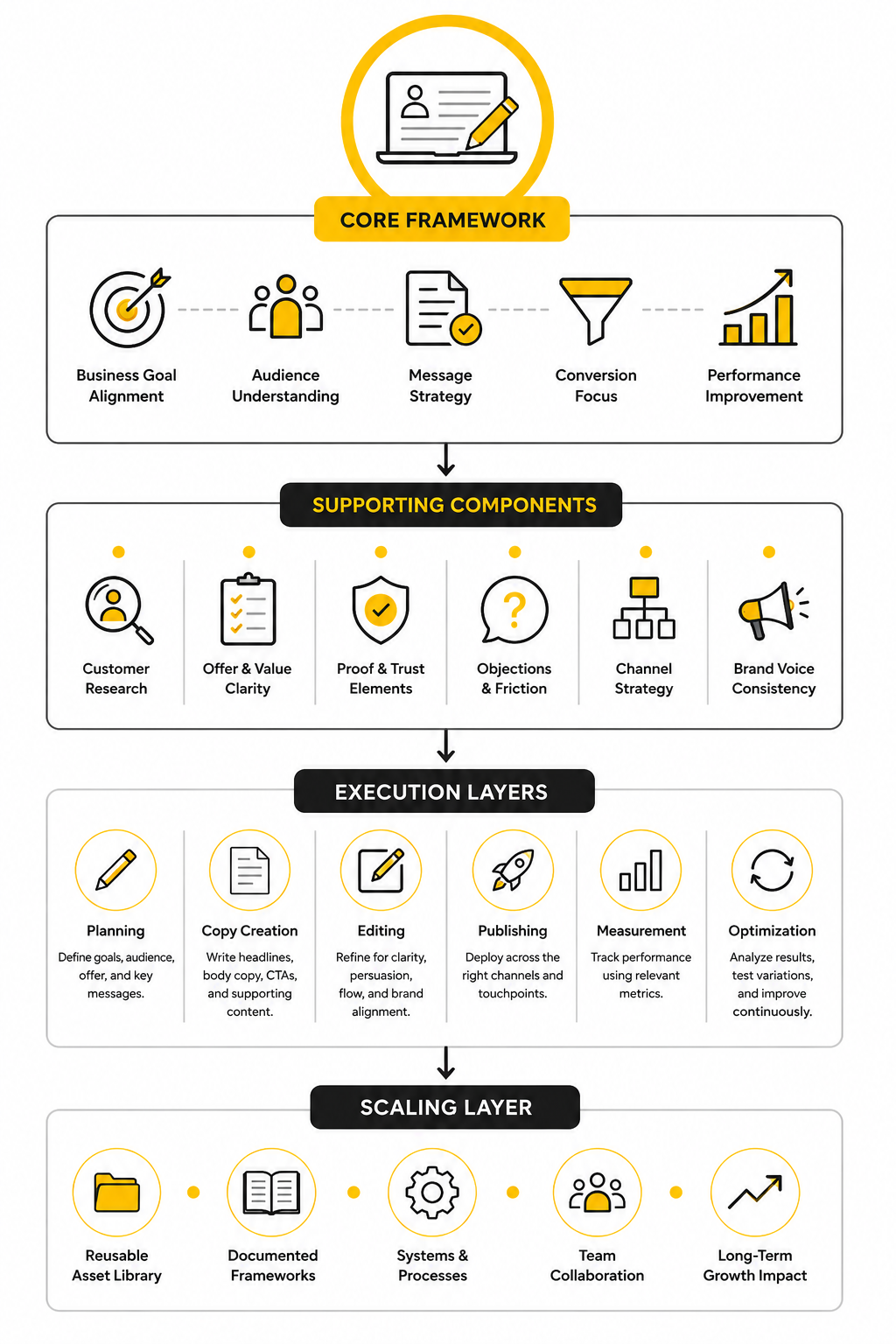
The easiest way to understand the jobdesk copywriter role is to see it as a five-part framework: research, message, offer, channel, and conversion. Research tells the copywriter who the audience is and what they care about. The message turns that understanding into a clear idea people can instantly grasp.
The offer is where many weak campaigns break. If the offer is unclear, boring, risky, or poorly explained, no amount of clever writing will save it. The copywriter has to make the value obvious and remove friction without exaggerating or making claims the business cannot support.
The channel changes how the copy should sound and function. A Google ad, landing page, welcome email, LinkedIn post, sales page, and chatbot flow all require different levels of context and persuasion. For example, a business using an automation platform like GoHighLevel needs copy that fits the whole customer journey, not just one isolated message.
Professional Implementation Starts With Clarity
A professional copywriter does not begin by asking, “What should I write?” They begin by asking what the business wants the reader to do and why the reader would care enough to do it. This single shift separates random content creation from serious copywriting.
Clear implementation also means knowing the limits of the role. A copywriter may contribute ideas to strategy, funnel structure, campaign angles, and messaging, but they still need input from product, sales, customer support, and leadership. Better information creates better copy.
The jobdesk copywriter role works best when expectations are specific. The company should know what assets are needed, who approves them, what audience they target, what proof can be used, and how performance will be measured. Without that clarity, copywriting becomes guesswork, and guesswork is expensive.
Why Copywriting Matters Beyond Nice Words
The biggest mistake companies make with copywriting is treating it like decoration. They build the offer, design the page, choose the platform, launch the campaign, and only then ask someone to “write the copy.” That is backwards, because the message affects almost every decision before launch.
A jobdesk copywriter should be involved early enough to shape how the product, offer, and campaign are explained. If the buyer does not understand the value quickly, the design cannot rescue the page. If the offer sounds generic, the ad budget only helps more people ignore it faster.
This matters even more in crowded markets. Content Marketing Institute’s 2025 B2B research shows that strong content teams are not just publishing more; they are paying closer attention to strategy, differentiation, and usefulness in a market where AI has made average content easier to produce. That is the point. When everyone can create content, clear thinking becomes the advantage.
The Copywriter Connects Business Goals to Buyer Motivation
A company usually cares about leads, sales, bookings, retention, upgrades, or brand trust. A buyer usually cares about solving a problem, avoiding a mistake, saving time, gaining status, reducing risk, or getting a better result. The copywriter sits between those two realities and makes the connection obvious.
That is why a strong jobdesk copywriter does not start with clever lines. They start with the customer’s current situation. What is frustrating them? What have they already tried? What would make them believe this solution is different enough to consider?
This is also why copywriting is not the same as general writing. General writing can explain. Copywriting has to persuade without sounding desperate, pushy, or fake. The copy should make the next step feel logical, not forced.
Copywriting Improves the Performance of Every Marketing Asset
A headline changes whether someone keeps reading. A call to action changes whether they click. A product description changes whether they feel confident enough to buy.
Small pieces of copy often carry a lot of weight. Nielsen Norman Group’s research on how people read online shows that users often scan pages instead of reading every word, which makes headings, opening lines, bullets, and link text extremely important. If the copy does not help people understand the page quickly, many will leave before they ever reach the best argument.
This applies across almost every channel. Landing pages need clear promises. Emails need strong subject lines and a reason to keep reading. Ads need fast relevance. Sales pages need proof, structure, and friction removal. Even a chatbot flow built with a tool like ManyChat depends on clear prompts, useful branching, and copy that feels natural enough for people to continue the conversation.
The Framework Starts With Research
Research is where professional copywriting begins. Not brainstorming. Not templates. Not opening a blank document and hoping something clever appears.
A jobdesk copywriter needs to understand the audience before writing for them. That includes customer pain points, buying triggers, objections, alternatives, language patterns, emotional drivers, and the specific outcome the audience wants. Without that, the copy becomes company-centered instead of customer-centered.
Good research can come from sales calls, support tickets, reviews, surveys, CRM notes, competitor pages, product demos, search intent, and customer interviews. The goal is not to collect endless information. The goal is to find the few insights that make the message sharper.
The Message Must Be Simple Before It Can Be Persuasive
A confusing message does not become persuasive just because it sounds polished. Before a copywriter worries about tone, rhythm, or style, they need to make the core idea simple. The reader should quickly understand what is being offered, who it is for, why it matters, and what to do next.
This is where many businesses overcomplicate their own marketing. They want to mention every feature, every use case, every benefit, and every internal priority at once. The result is copy that feels busy but not convincing.
A copywriter has to make choices. They need to decide which angle matters most for the audience and which details support that angle. Strong copy is not usually created by adding more; it is created by removing what gets in the way.
The Offer Gives the Copy Something Real to Sell
Copy cannot fix a weak offer. It can make a good offer easier to understand, more desirable, and less risky, but it cannot turn nothing into something. This is why offer clarity is one of the most important parts of the copywriter framework.
The offer includes the product, the promise, the price, the guarantee, the bonus, the urgency, the proof, and the expected outcome. A jobdesk copywriter should be able to look at those pieces and identify what is strong, what is unclear, and what might cause hesitation. That feedback is valuable because buyers rarely object to “the copy” directly; they object to what the copy reveals about the offer.
For funnel-based businesses, this becomes even more important. A tool like ClickFunnels can help build the pages and steps, but the funnel still needs a clear reason for people to move from one step to the next. The copywriter’s job is to make that movement feel natural.
The Channel Shapes the Writing
Copywriting does not work the same everywhere. A homepage needs instant clarity. A sales page needs depth. An email needs momentum. A social post needs a strong hook and a reason to engage.
The channel also changes how much context the reader has. Someone searching on Google may already be problem-aware. Someone scrolling Instagram may not even know they have the problem yet. Someone on an email list may already trust the brand but still need a reason to act today.
This is why a jobdesk copywriter needs channel awareness. They should not write a LinkedIn post like a landing page or an ad like a blog article. The message can stay consistent, but the structure has to match the environment.
Conversion Is the Final Test
Conversion does not always mean a sale. It can mean a click, reply, signup, booking, download, trial start, demo request, checkout, upgrade, or retention action. The key is that the copy has a job to do.
A professional copywriter should care about whether the copy works after it is published. That means looking at performance data, listening to customer feedback, and improving weak points instead of treating the first draft as final. The best copy often comes from iteration, not inspiration.
This is where the job becomes more strategic. A jobdesk copywriter who understands conversion can help diagnose problems in the funnel. If people click the ad but leave the page, the issue may be message match. If people read the page but do not act, the issue may be offer clarity, proof, risk, or call-to-action strength. That kind of thinking makes the copywriter far more valuable than someone who only delivers words.
Core Responsibilities and Skills Every Copywriter Needs
A jobdesk copywriter needs a wider skill set than most beginners expect. Writing is the visible output, but the job depends on research, positioning, editing, collaboration, and commercial judgment. If those pieces are weak, the final copy may sound polished while still failing to move the reader.
The core responsibility is to create copy that supports a real business objective. That could mean getting more demo bookings, improving landing page conversions, increasing email clicks, reducing confusion on a pricing page, or helping a product feel easier to understand. The task changes, but the standard stays the same: the copy should make the next action clearer and more compelling.
This is why the role belongs close to marketing, sales, product, and customer support. The copywriter needs access to what customers ask, what they fear, what they compare, and what makes them finally say yes. Without that input, even a talented writer is forced to guess.
Research Comes Before Writing
A professional copywriter should spend enough time understanding the market before drafting anything serious. That means looking at customer language, competitor positioning, sales objections, reviews, search intent, survey answers, and product details. The goal is not to collect random inspiration; the goal is to identify what the audience already believes and what they need to believe next.
This matters because customers rarely speak in the same language companies use internally. A team may describe a product as “an integrated revenue operations platform,” while the buyer may simply want fewer missed follow-ups and a cleaner sales pipeline. The copywriter’s job is to translate the internal value into external clarity.
Good research also prevents generic copy. If every competitor says “save time,” “grow faster,” and “all-in-one solution,” those claims stop meaning anything. A strong jobdesk copywriter looks for the sharper angle: the specific pain, the specific outcome, the specific proof, and the specific reason this offer is different.
Messaging Turns Research Into Direction
Research only becomes useful when it is turned into a clear message. The message is the main idea that guides the page, email, ad, or campaign. It decides what gets emphasized, what gets cut, and what the reader should remember.
A good message is simple enough to understand quickly but specific enough to feel relevant. It should answer the reader’s silent question: “Why should I care about this right now?” If that answer is weak, the copy will need too much explanation, and the reader will probably leave before the argument has a chance.
This is where copywriting becomes strategic. The jobdesk copywriter is not only choosing words; they are choosing the order of ideas. They are deciding whether the copy should lead with pain, outcome, proof, differentiation, urgency, or risk reduction.
The Execution Process Needs a Clear Sequence
Professional copywriting gets easier when the process is repeatable. That does not mean every project should sound the same. It means the copywriter follows a reliable path from business goal to finished asset instead of jumping straight into random drafts.
The process should protect the copy from common problems. It should stop the writer from creating pretty sentences before the offer is clear. It should also stop the team from reviewing copy based only on personal taste instead of whether it supports the objective.
A practical process makes the work easier for everyone involved. The copywriter knows what information to collect. The team knows when feedback is useful. The final asset has a better chance of being approved, launched, and improved without endless rewrites.
A Practical Copywriting Process
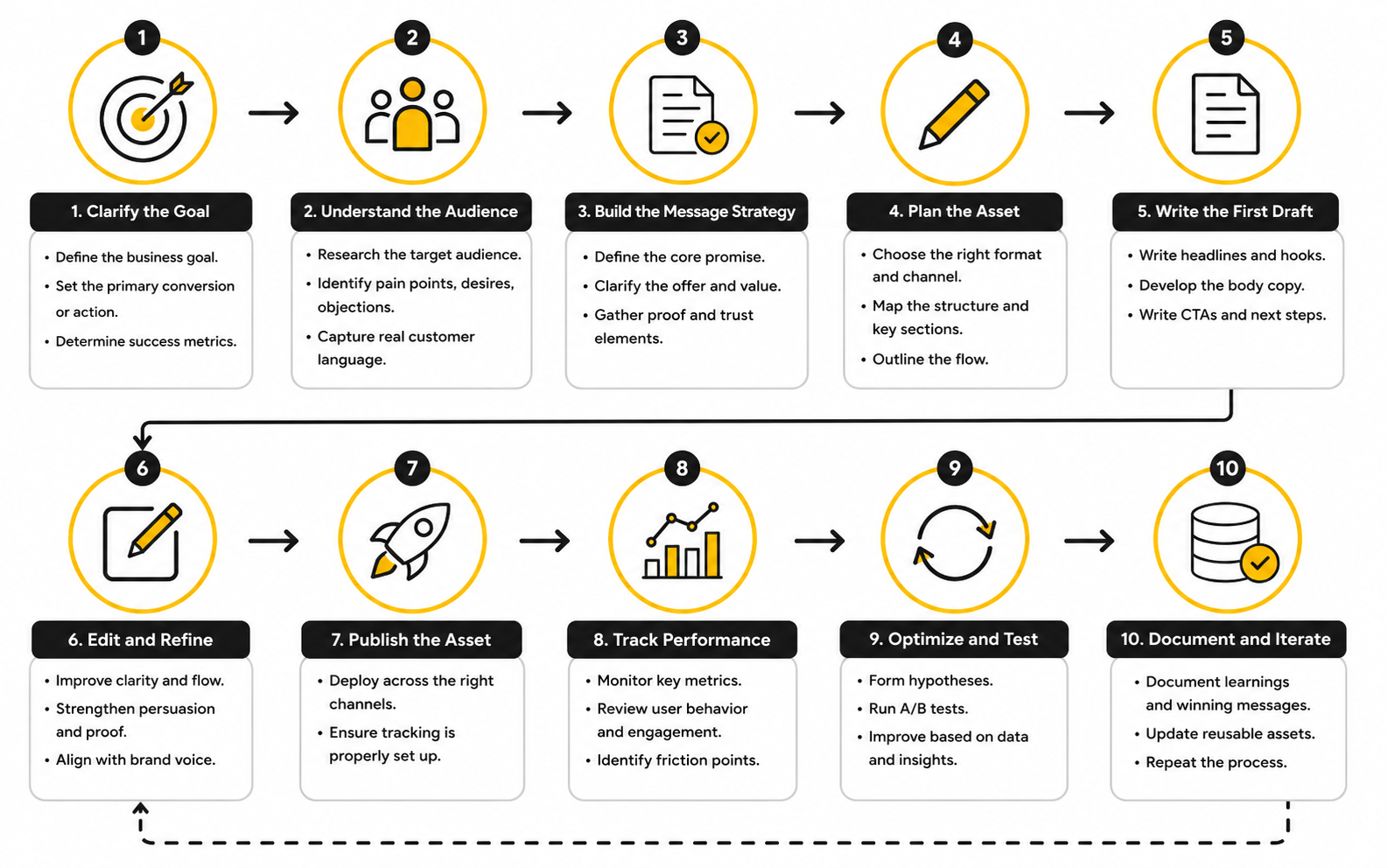
The first step is to define the job of the asset. A landing page may need to turn cold traffic into trial signups. An email may need to reactivate inactive subscribers. A product page may need to reduce hesitation before checkout.
The second step is to define the reader’s current awareness level. Some readers already know the problem and are comparing solutions. Others are only feeling the pain and need help naming it. The copy changes depending on where the reader is in that journey.
The third step is to clarify the offer. The copywriter should know what is being sold, who it is for, what result it promises, what proof supports it, what objections may appear, and what action the reader should take. If any of those answers are vague, the draft will probably be vague too.
The fourth step is to write the first complete version. This draft should focus on structure before polish. The headline, opening, argument flow, proof points, offer explanation, objection handling, and call to action matter more than finding the perfect sentence on the first pass.
The fifth step is to edit for clarity, persuasion, and speed. Nielsen Norman Group’s research on how users read on the web shows that people often scan instead of reading word by word, so the copy needs strong headings, clear sections, and useful front-loaded information. If the reader cannot understand the page by scanning it, the copy is making the buyer work too hard.
Briefing Is Where Better Copy Starts
A weak brief creates weak copy. If the copywriter receives only “write a landing page for this product,” they are missing the information needed to do the job properly. The brief should explain the audience, the offer, the goal, the channel, the proof, the objections, the desired action, and the approval process.
The best briefs also include context from sales and support. Sales teams know what prospects ask before buying. Support teams know where customers get confused after buying. Those insights are often more useful than internal brand language because they come from real conversations.
A jobdesk copywriter should be able to improve the brief, not just accept it. If important details are missing, they should ask for them before writing. That is not being difficult; that is protecting the quality of the final work.
Drafting Should Follow the Buyer’s Logic
A copy draft should not be organized around what the company wants to say first. It should be organized around what the buyer needs to understand next. That means the flow has to feel natural from the reader’s point of view.
For example, a reader may first need to recognize the problem, then understand the promise, then believe the mechanism, then see proof, then feel the risk is low enough to act. If the copy jumps straight into features before the reader cares, it creates friction. If it asks for action before trust is built, it feels premature.
This is especially important on landing pages and funnels. A platform like Replo can help teams build ecommerce landing pages quickly, but the page still needs copy that matches the buyer’s decision process. Speed is useful only when the message is strong enough to support the traffic.
Editing Is Where the Copy Gets Stronger
First drafts are rarely the best version. They usually contain extra words, soft claims, unclear transitions, and sections that matter more to the company than the reader. Editing is where the copy becomes tighter and more useful.
A strong edit checks for clarity first. Can the reader understand the main promise quickly? Can they see who it is for? Can they understand what happens after they click?
Then the edit checks persuasion. Does the copy show enough proof? Does it handle the most likely objections? Does it make the next step feel specific and low-friction?
Collaboration Keeps Copy Connected to Reality
Copywriting is not a solo performance inside a professional team. The copywriter needs feedback from people who understand the product, the customer, the offer, and the business goal. The challenge is making that feedback useful instead of chaotic.
The best feedback is specific. “This sounds off” is not very helpful. “This promise is too broad because customers usually care more about setup speed than total feature count” gives the copywriter something concrete to improve.
A jobdesk copywriter should also know when to defend the copy. Not every preference should become a revision. If a change makes the copy less clear, less customer-focused, or less persuasive, the writer should explain the tradeoff instead of silently weakening the asset.
Measurement Turns Copywriting Into a Business Function
Copy should be judged by more than whether the team likes it. The real question is whether it improves the outcome the asset was created for. That outcome might be conversion rate, click-through rate, reply rate, signup rate, demo-booking rate, checkout completion, or lead quality.
Measurement does not mean every sentence needs a dashboard. It means the copywriter should understand what success looks like before the asset goes live. When the goal is clear, the team can learn from performance instead of arguing from opinion.
This is where a jobdesk copywriter becomes more valuable over time. They can identify which messages perform, which objections block action, and which parts of the funnel need sharper copy. That learning compounds, and it turns copywriting from a one-off task into a repeatable growth asset.
Statistics and Data
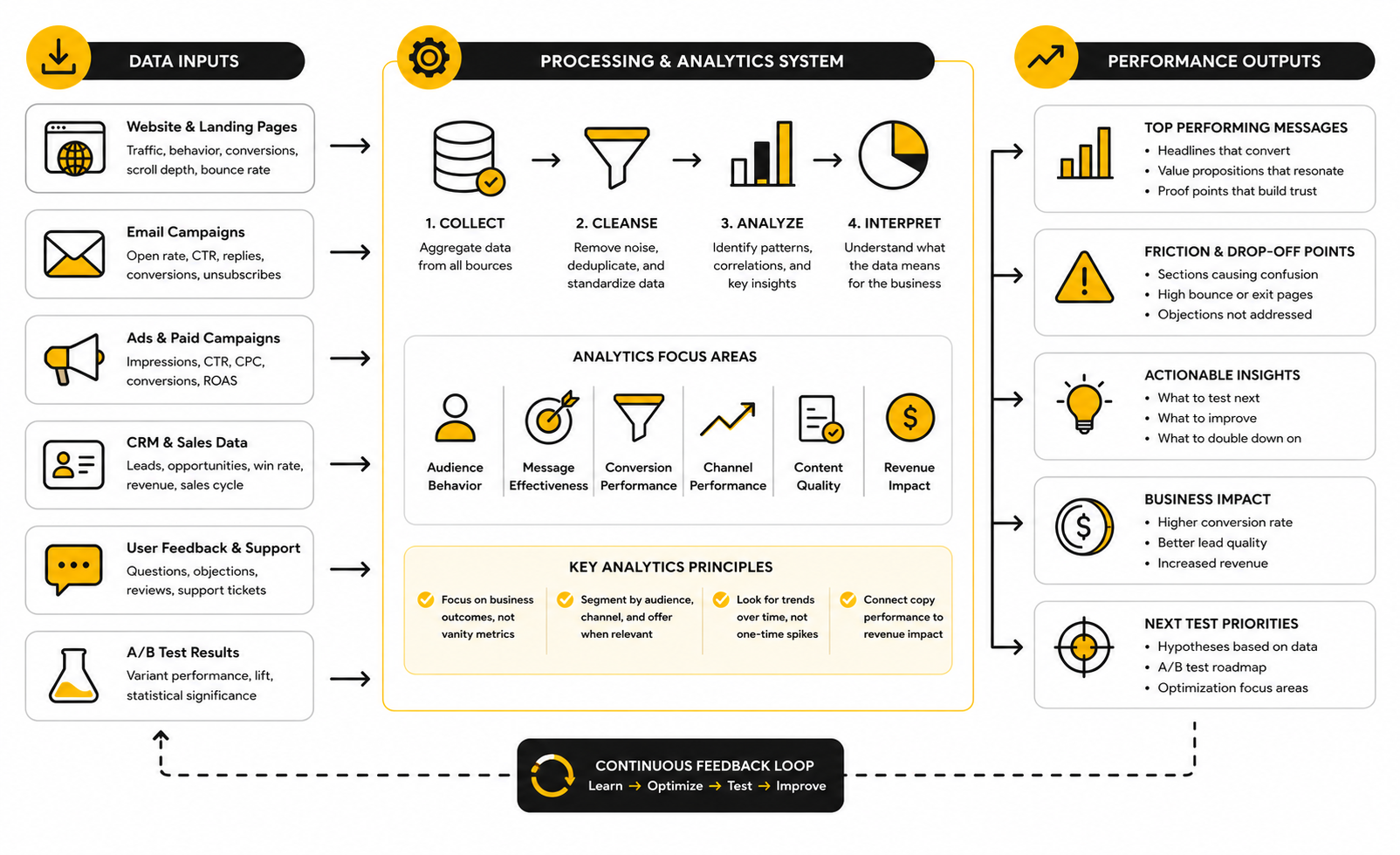
Measurement is where copywriting stops being a taste debate. Without data, one person likes the headline, another person hates it, and the loudest opinion usually wins. With data, the team can ask a better question: did the copy help the right person take the right action?
A jobdesk copywriter does not need to become a full-time analyst, but they do need to understand the numbers that show whether the message is working. That includes conversion rate, click-through rate, scroll depth, engagement rate, reply rate, lead quality, checkout completion, demo bookings, and unsubscribe rate. Each number tells part of the story, but none of them should be read alone.
The key is interpretation. A high click-through rate can look good until the landing page fails to convert. A low open rate can look bad until the few people who do open become high-quality buyers. Data is useful only when it helps the copywriter decide what to improve next.
Benchmarks Are Context, Not Targets
Benchmarks are helpful because they stop teams from judging performance in isolation. If a landing page converts at 4 percent, that may be weak in one industry and perfectly normal in another. Unbounce’s conversion benchmark report is useful because it is based on more than 57 million conversions across over 41,000 landing pages, which gives marketers a broader context than one campaign dashboard.
But benchmarks are not goals by themselves. They are reference points. A company with warm traffic, strong brand trust, and a simple offer should not settle for average results just because a benchmark says the page is “fine.”
The more carefully move is to compare performance against three things: industry context, past internal performance, and the quality of traffic. If the same page performs well for email traffic but badly for cold ads, the copy may not be the only issue. The traffic source, audience awareness, offer match, and page promise all need to be checked.
The Most Important Copy Metrics
A jobdesk copywriter should focus on metrics that match the asset’s job. A sales page should not be judged by time on page alone. An email should not be judged by opens alone. A chatbot sequence should not be judged only by how many people start it.
The most useful copy metrics usually fall into a few groups:
These groups matter because they show where the copy may be breaking. If attention is weak, the hook or headline may need work. If attention is strong but action is weak, the offer, proof, objection handling, or call to action may be the issue.
What the Numbers Actually Mean
A low conversion rate does not automatically mean the copy is bad. It may mean the offer is unclear, the traffic is poorly matched, the page is too slow, the form asks for too much, or the audience is not ready to act. The copywriter’s job is to diagnose the likely cause instead of rewriting everything blindly.
A high bounce rate can also be misunderstood. In Google Analytics 4, engagement rate and bounce rate are connected, and Google defines engagement around whether a session lasts longer than 10 seconds, has a key event, or includes at least two pageviews or screenviews through its GA4 engagement and bounce rate documentation. That means a short visit is not always bad, especially if the page answers a simple question quickly, but it is a warning sign on pages built for deeper persuasion.
Email metrics need the same caution. Mailchimp frames email benchmarks around KPIs such as open rate, click-through rate, and conversion rate because those numbers help businesses compare performance and identify weak spots in their campaigns through its email marketing benchmarks. Still, open rate alone is not enough because privacy changes, inbox behavior, list quality, and subject-line curiosity can distort what the number seems to mean.
Conversion Rate Shows Message and Offer Fit
Conversion rate is one of the clearest signals a copywriter can track, but it needs a clean definition. The team should know exactly what counts as a conversion before judging the copy. A newsletter signup, free trial, paid purchase, booked call, and quote request are all different actions with different levels of buyer commitment.
For landing pages, conversion rate often reveals how well the promise, proof, and call to action work together. If people arrive but do not act, the page may be failing to make the value feel specific enough. It may also be asking for too much too soon.
A jobdesk copywriter should look at conversion rate by traffic source whenever possible. Cold paid traffic, warm email traffic, organic search visitors, and returning users behave differently. If all traffic is averaged together, the data can hide the real problem.
Click-Through Rate Shows Whether the Next Step Feels Worth It
Click-through rate is useful because it shows whether the reader felt enough interest to continue. In an email, it can show whether the body copy delivered on the subject line. In an ad, it can show whether the angle matched the audience’s attention. On a website, it can show whether the call to action was visible, relevant, and convincing.
But a high click-through rate is not always a win. If people click because the copy overpromises, the next step will disappoint them. That can reduce lead quality, increase refunds, or create bad sales conversations.
The better question is not “did people click?” The better question is “did the right people click for the right reason?” A copywriter should care about the quality of the action, not just the volume of the action.
Scroll Depth and Engagement Reveal Where Interest Drops
Scroll depth can show whether people are reaching the parts of the page that carry the argument. If most visitors never reach the proof section, the page may be too slow to make its point. If people reach the pricing section and stop, the issue may be risk, value framing, or missing reassurance.
Engagement signals are especially useful when paired with qualitative review. The copywriter should read the page while looking at the data. Where does the page become repetitive? Where does the argument slow down? Where does the reader need proof but only gets another claim?
This is how data becomes practical. It does not tell the copywriter exactly what sentence to write. It points to the section where the copy needs sharper thinking.
Lead Quality Matters More Than Lead Volume
More leads are not always better. If the copy attracts people who cannot afford the offer, do not match the service, or misunderstand the promise, the campaign may look successful in marketing reports while creating problems for sales. That is a bad trade.
A jobdesk copywriter should pay attention to what happens after the conversion. Are leads booking calls and showing up? Are sales conversations smoother? Are buyers asking better questions? Are fewer people confused about what they are getting?
This is where CRM and funnel data become useful. A platform like GoHighLevel can help teams connect forms, pipelines, email follow-ups, and booking flows, but the copy still has to set accurate expectations before the lead enters the system. Better copy should improve both conversion and fit.
Testing Should Start With the Biggest Levers
A/B testing is useful, but only when the test has a clear reason. Changing one adjective in a button is usually not the first priority. The biggest gains normally come from testing the core promise, offer structure, headline, proof, audience angle, call to action, or page flow.
The test should be based on a hypothesis. For example, “We believe visitors are not converting because the page explains features before the outcome, so we will test an outcome-led headline and opening section.” That is much stronger than “Let’s try a new headline and see what happens.”
A practical testing order looks like this:
Reporting Should Lead to Decisions
A report is useless if it only lists numbers. The point of reporting is to decide what to keep, what to change, and what to test next. A copywriter should turn performance data into clear recommendations.
A simple reporting structure works best. Start with the goal, show the result, explain the likely meaning, and recommend the next action. That keeps the conversation focused on improvement instead of drowning the team in dashboards.
For example, if an email has strong opens but weak clicks, the next action may be to improve the body copy, offer clarity, or call to action. If a landing page has strong clicks from ads but weak form completions, the next action may be to reduce form friction or make the value exchange stronger. The jobdesk copywriter becomes more valuable when they can connect the number to the next move.
Tools, Portfolio, Career Growth, and Strategic Tradeoffs
A jobdesk copywriter becomes more valuable when they understand the systems around the copy. The words matter, but so do the tools, workflow, approval process, brand standards, legal limits, and performance feedback loop. At a beginner level, copywriting is about producing assets; at a professional level, it is about helping the business communicate better at scale.
This is where the role gets more interesting. The copywriter is no longer just asking, “What should this page say?” They are asking, “How does this message fit the customer journey, what risk does it create, how will it be measured, and how can the team reuse the strongest parts without making everything sound identical?” That is a more strategic job.
The tradeoff is that better copywriting requires more judgment. Templates, AI tools, swipe files, and frameworks can speed up production, but they cannot replace customer understanding. The copywriter still needs to know when to follow the formula and when the formula is making the message weaker.
AI Can Speed Up Drafting, But It Cannot Own the Strategy
AI has changed copywriting, and pretending otherwise is pointless. Drafting, summarizing research, generating angle variations, repurposing content, and creating first-pass outlines can all be faster now. The 2025 State of Marketing AI Report surveyed 1,882 respondents and reflects how deeply AI has moved into marketing workflows, especially around production and analysis.
But speed creates a new problem. If every team can publish more, the market gets noisier. IntelligenceBank’s 2025 content marketing research warns that simply increasing content output can lead to brand dilution and audience fatigue, which is exactly what happens when companies confuse volume with value.
This means the jobdesk copywriter should use AI as leverage, not as the brain of the operation. Let AI help with rough drafts, variations, summaries, and editing passes. Keep human judgment in charge of positioning, proof, promise, audience empathy, and final approval.
Brand Voice Is a System, Not a Mood
Many teams talk about brand voice as if it is just a personality. Friendly. Bold. Premium. Playful. Professional. That is too vague to be useful.
A working brand voice system should explain how the company sounds in different situations. A pricing page may need to be direct and reassuring. A social post may be sharper and more conversational. A support email may need to be calm, specific, and human.
The copywriter’s job is to keep the voice recognizable without making every asset sound copied and pasted. That takes restraint. If the brand voice becomes too rigid, it kills persuasion; if it becomes too loose, the company loses consistency.
Claims Need Proof Before They Need Polish
One of the biggest risks in copywriting is making claims the business cannot support. “Best,” “fastest,” “guaranteed,” “risk-free,” and “AI-powered” can all create problems if they are vague, exaggerated, or unsupported. This is especially true in markets where buyers are skeptical and regulators are paying attention.
The FTC’s business guidance on advertising and marketing emphasizes that companies need solid proof for objective claims, especially when those claims influence buying decisions. That should matter to every serious copywriter, because strong copy is not about saying whatever sounds persuasive. It is about making the strongest truthful claim the company can defend.
A jobdesk copywriter should keep a proof file for important assets. That file can include customer quotes, product data, review patterns, test results, analyst references, screenshots, demo notes, or internal performance numbers. The point is simple: if the copy makes a claim, the team should know where that claim comes from.
Scaling Copy Requires Reusable Messaging Assets
As companies grow, copywriting gets messy fast. Different teams write different versions of the same promise. Sales uses one explanation, ads use another, the website says something else, and customer success has to clean up the confusion later.
The solution is not to control every sentence. The solution is to build reusable messaging assets that help the team stay aligned. A strong copywriter can create message maps, offer summaries, objection banks, proof libraries, headline angles, audience segments, and approved value propositions.
This makes future work faster without turning the brand into a template factory. For example, a team using GoHighLevel for funnels, CRM, email, and automation can benefit from reusable messaging across landing pages, nurture flows, booking pages, and follow-up sequences. The copy still needs to fit each step, but the core promise should not change every time a new asset is created.
Advanced Copywriting Means Managing Tradeoffs
There is rarely one perfect version of a message. A shorter headline may be clearer but less specific. A longer page may answer more objections but create more friction. A stronger promise may increase conversions but attract less qualified leads if it is not framed carefully.
The jobdesk copywriter has to make these tradeoffs intentionally. They need to know when clarity matters more than cleverness, when proof matters more than emotion, and when reducing friction matters more than adding detail. This is where experience shows.
Good copy is not always the copy that gets the most attention. Sometimes the best copy quietly removes doubt, explains the offer, and makes the next step feel obvious. That may not look flashy in a portfolio, but it can matter a lot to revenue.
Portfolio Work Should Show Thinking, Not Just Screenshots
A copywriting portfolio should not only show finished assets. It should show the thinking behind the work. A hiring manager or client wants to know how the copywriter approached the problem, what constraints existed, what changed, and what the final asset was meant to accomplish.
This is especially important for a jobdesk copywriter who wants to move beyond basic writing tasks. The portfolio should prove that they can think commercially. That means showing research insights, message decisions, before-and-after improvements, campaign context, and performance signals where available.
A strong portfolio entry can include:
Career Growth Comes From Owning More of the Message
The easiest way for a copywriter to stay stuck is to only accept isolated writing tasks. “Write this email.” “Rewrite this headline.” “Make this sound better.” Those tasks are fine at the start, but they do not build much strategic authority.
Career growth comes from owning more of the message. That can mean leading landing page strategy, improving onboarding sequences, creating sales enablement copy, building positioning documents, developing campaign concepts, or helping the team understand customer language. The closer the work gets to revenue and decision-making, the more valuable the copywriter becomes.
The copywriter who can connect research, message, execution, and measurement will always have an advantage. They can write, but they can also explain why the copy should work. That combination is rare, and it is exactly what separates a replaceable writer from a serious marketing asset.
The Biggest Mistakes to Avoid
The first mistake is writing before understanding the audience. This usually creates copy that sounds polished but says nothing useful. It may please the internal team, but it does not help the buyer make a decision.
The second mistake is chasing cleverness at the expense of clarity. Clever copy can work when the audience already understands the context, but it fails quickly when the reader is confused. In most performance-focused assets, clear beats clever.
The third mistake is relying too heavily on AI without enough review. AI can produce confident-sounding copy that is generic, unsupported, or slightly wrong. A professional jobdesk copywriter treats AI output as a draft, not a source of truth.
The fourth mistake is ignoring what happens after launch. Copywriting is not finished when the document is approved. The real learning starts when people interact with the asset, and the best copywriters use that feedback to make the next version stronger.
The Final System: From Copy Tasks to Copy Infrastructure
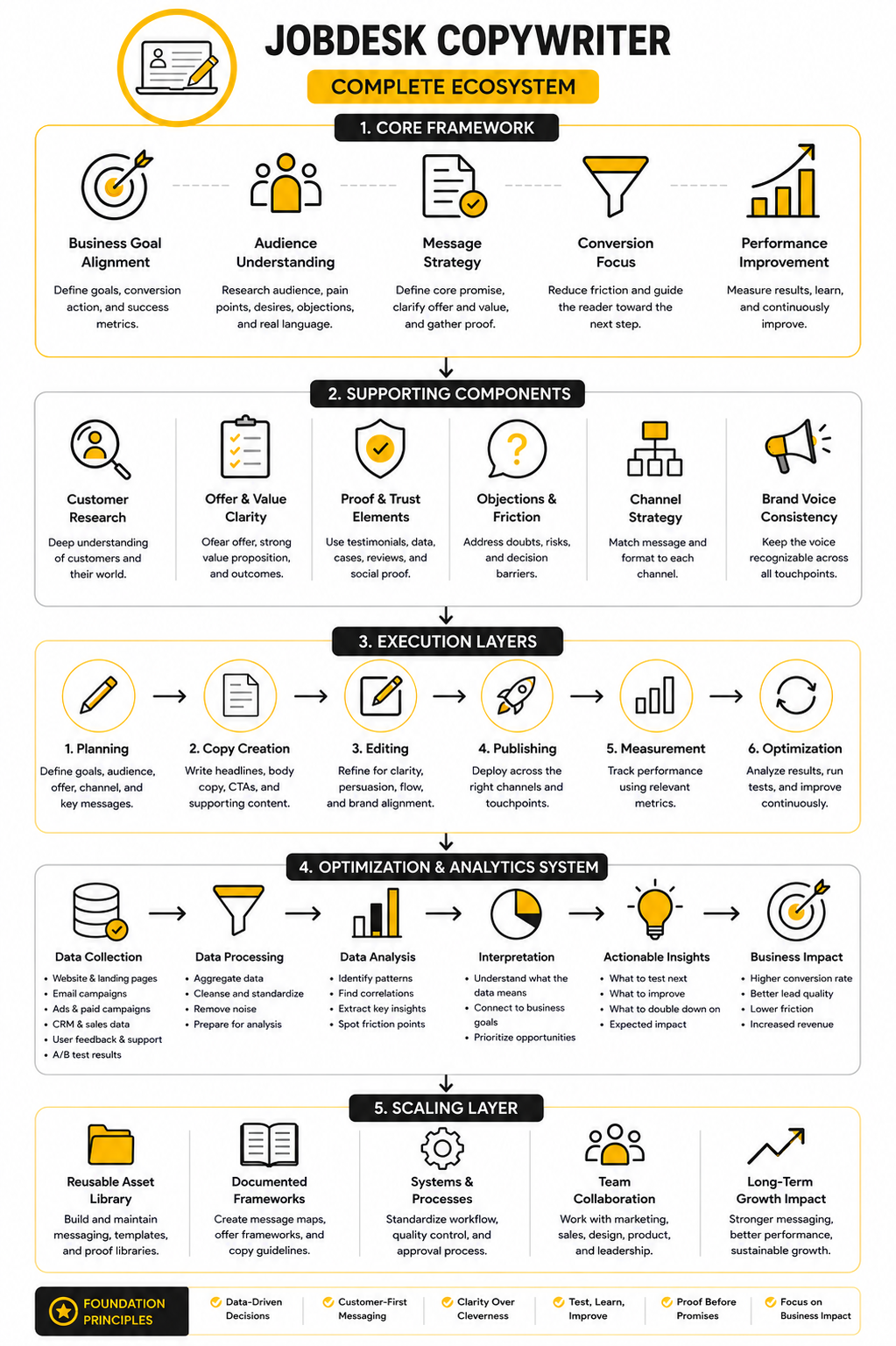
At this point, the role of a jobdesk copywriter should feel bigger than a list of writing tasks. The real value is not just producing a page, email, ad, or script. The real value is building a communication system that helps the business explain itself clearly again and again.
That system includes customer research, message strategy, offer clarity, channel-specific copy, performance review, testing, proof management, and reusable brand assets. When those pieces work together, copywriting becomes easier to scale. The team is not starting from zero every time; they are building from a stronger foundation.
This is how a copywriter becomes a serious growth partner. They help the company make better promises, support those promises with evidence, and guide buyers through decisions with less confusion. That is useful in any market, but it matters even more now because AI has made average content cheap and clear thinking more valuable.
How to Use This Guide in Real Work
The simplest way to use this guide is to turn it into a checklist for each copy project. Before writing, clarify the goal, audience, offer, channel, proof, objections, and conversion point. After publishing, review the numbers and decide what the next improvement should be.
For hiring, the same logic applies. A company should not only ask whether someone can write well. They should ask whether the copywriter can understand the buyer, build a message, work with other teams, use data, and improve the asset after launch.
For copywriters, the opportunity is clear. Do not position yourself as a person who “writes words.” Position yourself as someone who helps businesses convert customer understanding into better communication. That is more useful, more defensible, and much harder to replace.
What is a jobdesk copywriter?
A jobdesk copywriter is a copywriter whose responsibilities are clearly defined around business communication, marketing assets, and conversion-focused writing. The role usually includes research, messaging, drafting, editing, collaboration, and performance improvement. It is not just a creative writing role because the copy is expected to support measurable business outcomes.
What does a jobdesk copywriter do every day?
A jobdesk copywriter may research customers, write landing pages, draft emails, create ad copy, improve website sections, edit product messaging, review analytics, and work with marketing or sales teams. The exact day depends on the company and campaign priorities. The consistent part is turning business goals into clear copy that helps people take action.
Is copywriting still a good career with AI?
Yes, but the role is changing. AI can speed up drafts, outlines, research summaries, and variations, but it does not replace strategy, judgment, proof, positioning, or customer empathy. The 2025 State of Marketing AI Report surveyed 1,882 respondents and shows how deeply AI is entering marketing workflows, which makes strategic copywriting more important, not less.
What skills does a jobdesk copywriter need?
A strong jobdesk copywriter needs writing ability, customer research, editing, persuasion, offer understanding, channel awareness, and basic analytics. They also need collaboration skills because copy often depends on input from product, sales, design, and leadership. The best copywriters can explain not only what they wrote, but why the message should work.
How is copywriting different from content writing?
Copywriting is usually written to drive a specific action, such as a click, signup, purchase, reply, or booking. Content writing often focuses more on education, trust-building, search visibility, or audience development. The two overlap, but copywriting is more directly tied to persuasion and conversion.
What should be included in a copywriter job description?
A copywriter job description should include the main assets they will create, the audiences they will write for, the channels they will support, and the business goals behind the role. It should also mention research, editing, collaboration, performance review, and brand voice expectations. A vague job description attracts vague work.
What metrics should a copywriter track?
The most useful metrics depend on the asset. Emails may use click-through rate, replies, conversions, unsubscribes, and revenue per campaign. Landing pages may use conversion rate, scroll depth, bounce rate, form completion, lead quality, and sales outcomes.
How do you know if copy is working?
Copy is working when it helps the intended reader take the intended next step with the right expectations. That could mean more qualified leads, better demo bookings, higher checkout completion, stronger email engagement, or fewer objections in sales calls. The goal is not just more activity; the goal is better movement through the customer journey.
Can a beginner become a jobdesk copywriter?
Yes, but beginners need to practice more than clever wording. They should learn customer research, offer analysis, headline structure, landing page flow, email strategy, and basic performance interpretation. A beginner who can think clearly and revise based on feedback will improve much faster than someone who only collects templates.
What should a copywriting portfolio include?
A copywriting portfolio should include finished work and the thinking behind it. That means the business goal, audience, problem, strategy, final copy, and results where available. Even without big client results, a copywriter can show strong reasoning by explaining the choices behind each piece.
What tools should a copywriter learn?
A copywriter should learn tools that support research, writing, collaboration, publishing, and measurement. That can include docs, project management tools, analytics platforms, email tools, funnel builders, CRM systems, and AI writing assistants. For example, Brevo can support email marketing workflows, while ClickFunnels can support funnel building when the copy needs to move people through a defined sales path.
How should a copywriter use AI without sounding generic?
A copywriter should use AI for support, not final judgment. AI can help with rough drafts, variations, summaries, and editing prompts, but the copywriter still needs to check accuracy, sharpen the promise, add proof, and remove generic language. The final copy should sound like it came from customer understanding, not from a prompt.
What is the biggest mistake companies make with copywriters?
The biggest mistake is bringing the copywriter in too late. If the offer, audience, funnel, and proof are already unclear, the copywriter is forced to patch strategic problems with better sentences. Bring the copywriter in earlier, and the whole message gets stronger.
How can a copywriter become more strategic?
A copywriter becomes more strategic by owning more of the message before and after the draft. That means asking better questions, studying customer language, understanding the offer, reviewing performance, and recommending tests. The more they connect copy to business outcomes, the more valuable they become.
Build a stronger local presence with BAAM AI
Turn your website, Google profile, social channels, and AI visibility into one growth engine
Most businesses do not need more random marketing activity. They need a consistent presence system that helps the right people find them, trust them, and take action. BAAM AI brings strategy, local SEO, website updates, Google Maps visibility, social content, AI-search readiness, media production, and reporting into one practical monthly engine.
If you want your marketing to keep working after the campaign ends, start with a free BAAM AI presence audit. See how your business shows up today and where the fastest visibility wins are at BAAM AI.