
BAAM AI Blog
Joanna Wiebe: The Practical Guide To Conversion Copywriting
Joanna Wiebe is one of the clearest names to know if you care about copy that sells without sounding desperate. She is the founder of Copyhackers, the company says it was founded in 2011, and her work is tied closely...
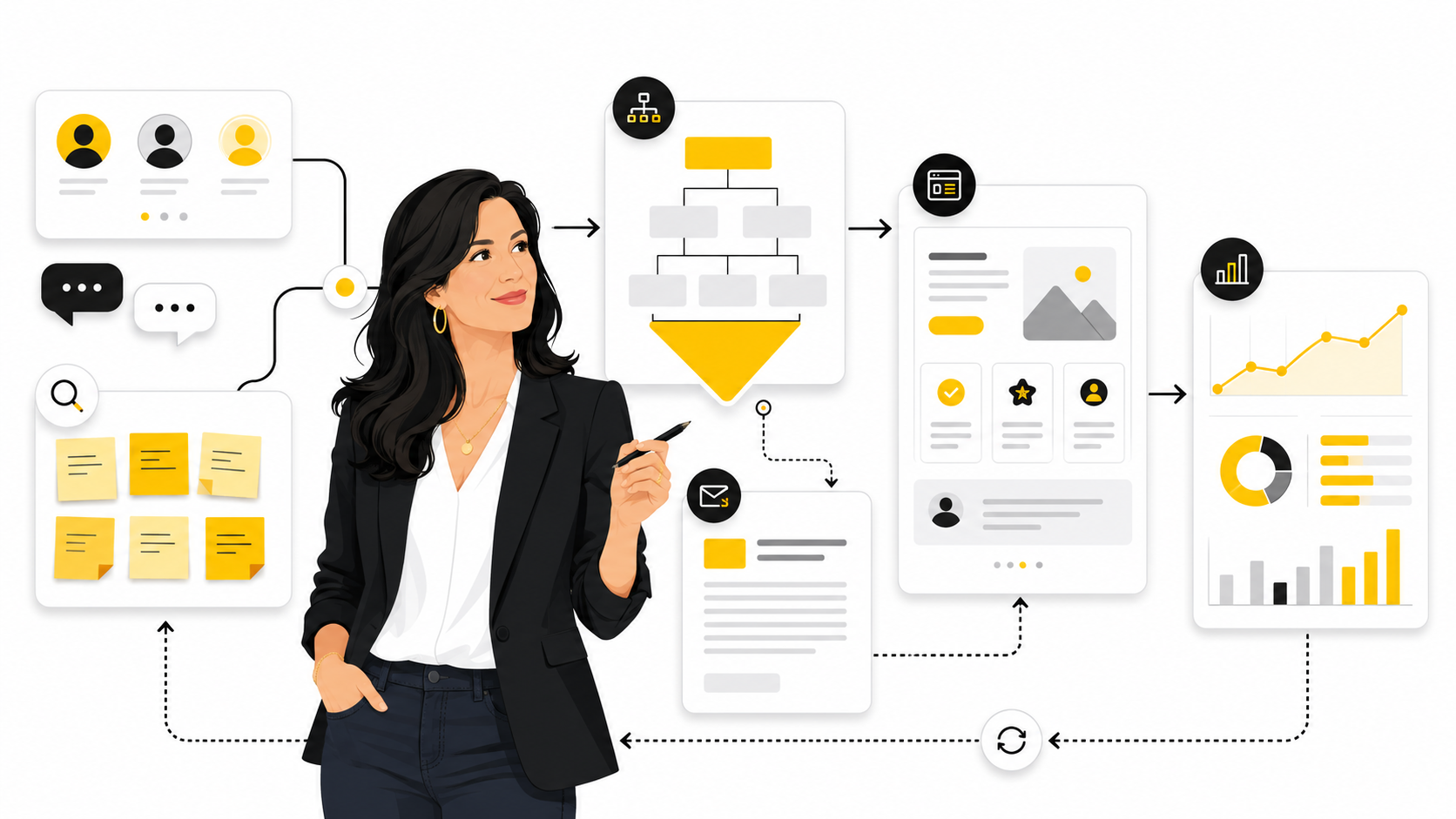
Joanna Wiebe is one of the clearest names to know if you care about copy that sells without sounding desperate. She is the founder of Copyhackers, the company says it was founded in 2011, and her work is tied closely to the idea of conversion copywriting: writing that uses customer research, positioning, persuasion, and testing to move people toward action.
That matters because most marketing copy still starts in the wrong place. It starts with what the company wants to say, not what the customer needs to hear. Joanna Wiebe’s approach flips that around: listen first, find the tension, use the customer’s own language, then shape the page, email, ad, or funnel around the decision the reader is already trying to make.
Why Joanna Wiebe Matters Now
Joanna Wiebe matters because conversion copywriting is not just “better words.” It is a different way to make marketing decisions. Instead of guessing what might sound persuasive, the work starts with evidence: customer interviews, surveys, reviews, support tickets, sales calls, competitor research, and behavioral data.
That difference is especially important now because AI has made average copy cheap. Anyone can generate a landing page, email sequence, or ad variation in seconds, but speed does not automatically create clarity. The teams that win will not be the teams with the most words; they will be the teams with the sharpest message, the best customer insight, and the strongest testing discipline.
This is where Joanna Wiebe’s work still feels practical rather than theoretical. Her public positioning as the “original conversion copywriter” is not only about personal branding; it points to a workflow where copy is treated as a measurable growth asset. Copyhackers describes its work around data-driven copy for tech companies, and that framing is useful because it keeps copy connected to revenue, conversion, and customer understanding rather than vague creativity.
The Real Problem Conversion Copywriting Solves
Most pages do not fail because the design is ugly or the offer is impossible to understand. They fail because the message does not match the reader’s stage of awareness, level of trust, objections, urgency, or desired outcome. The copy talks, but it does not meet the customer where the decision is happening.
That is a serious business problem because people skim, compare, hesitate, and abandon decisions fast. Nielsen Norman Group’s long-running web writing research has consistently found that users prefer copy that is concise, scannable, and objective rather than promotional, which is a good reminder that “clever” copy often loses to copy that helps people understand quickly. In ecommerce, Baymard’s checkout research tracks the average cart abandonment rate at about 70%, showing how much buyer intent can still disappear when friction, uncertainty, or weak messaging gets in the way.
Joanna Wiebe’s approach is useful because it gives marketers a way to diagnose that problem instead of decorating around it. The question is not “How do we make this sound more exciting?” The better question is “What does the customer need to believe, understand, feel, or stop worrying about before they can say yes?”
Framework Overview
The simplest way to understand Joanna Wiebe’s method is this: research before writing, structure before style, testing before opinion. That does not make copy boring. It makes copy more likely to connect because the message is built from what customers already care about.
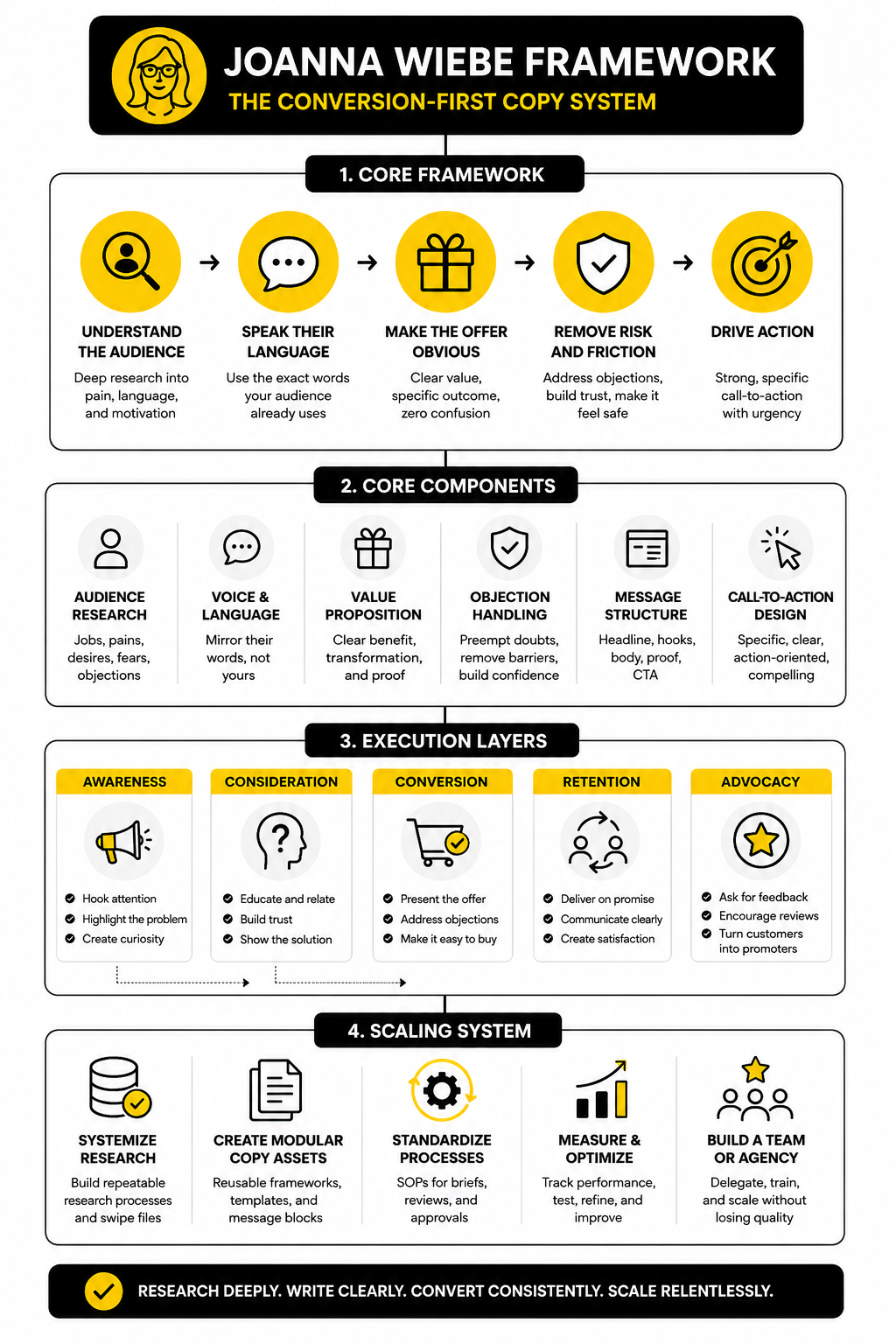
A practical conversion copywriting framework has four moving parts. First, you collect raw customer language so the message is grounded in reality. Second, you organize that language around pains, desires, objections, outcomes, triggers, and alternatives. Third, you turn those insights into copy for a specific asset, such as a homepage, landing page, email sequence, onboarding flow, or sales page. Fourth, you test, measure, and refine instead of treating the first draft as the final answer.
This is also why conversion copywriting works across different channels. A landing page and a nurture email do not look the same, but both need a clear promise, a believable reason to care, proof, objection handling, and a next step. The format changes; the underlying decision psychology stays surprisingly consistent.
Core Components
The first core component is voice of customer research. This means collecting the actual words people use when they describe their problem, desired outcome, hesitations, and buying criteria. CXL’s voice-of-customer guidance explains the value of reflecting customer language back to people, and that idea lines up closely with the research-first copywriting approach Joanna Wiebe is known for.
The second core component is message hierarchy. Not every insight deserves the headline. Strong copy ranks ideas by importance, starting with the message most likely to make the right reader stop, care, and keep reading.
The third core component is conversion structure. A page, email, or funnel needs flow: problem, promise, proof, mechanism, objection handling, action. Without structure, even good lines can feel random.
The fourth core component is proof. Proof can include testimonials, product evidence, demos, screenshots, data, third-party validation, founder credibility, customer outcomes, or clear explanations of how the product works. The point is not to overwhelm the reader; it is to reduce the risk of believing you.
The fifth core component is testing and iteration. Conversion copywriting does not end when the copy goes live. The live version becomes the control, and the next improvement should come from a stronger hypothesis, not a random rewrite.
Professional Implementation
A professional Joanna Wiebe-inspired workflow starts with the asset and the conversion goal. Are you improving a homepage, rewriting a sales page, fixing an email automation, launching a webinar funnel, or clarifying a SaaS product page? The answer matters because the research, copy structure, and success metric should match the job.
From there, the work becomes more disciplined than most teams expect. You gather customer language, sort the strongest patterns, identify the dominant stage of awareness, map the objections, then draft around the reader’s decision path. That is slower than opening a blank doc and “writing something,” but it usually saves time later because the first serious draft is based on evidence rather than internal opinion.
This is also where marketers should be careful with AI. AI can help summarize interviews, cluster survey responses, create draft variations, and speed up production, but it should not replace the thinking. The competitive advantage is not the tool; it is the quality of the inputs, the sharpness of the message, and the discipline to test what actually moves buyers.
The Conversion Copywriting Philosophy
The easiest way to misunderstand Joanna Wiebe is to think her work is about making copy sound punchier. It is not. The deeper idea is that copy should help the right person make a decision with less confusion, less doubt, and more confidence.
That is why conversion copywriting sits between research, positioning, psychology, and sales. It borrows from classic direct response, but it is not stuck in old-school hype. It uses the discipline of performance marketing, but it does not reduce humans to clicks on a dashboard.
The philosophy is simple: your customer already has words in their head before they land on your page. They already have a problem, a hope, a fear, a comparison, a hesitation, and a half-formed story about what they think they need. Your job is not to invent a message from scratch; your job is to find the message that is already alive in the market and shape it into a clear path forward.
Copy Is Not Decoration
Bad teams treat copy as the last layer. The product is built, the page is designed, the funnel is mapped, and then somebody asks for “some words” to fill the boxes. That is backwards.
Copy affects the offer, the page structure, the proof strategy, the sales argument, the onboarding experience, and the customer’s first impression of the brand. When copy is brought in too late, it usually becomes polish for a weak argument. When it is brought in early, it can expose gaps in positioning before those gaps become expensive traffic problems.
This is one reason Joanna Wiebe’s work resonates with serious marketers. The copywriter is not just a clever sentence person. The copywriter becomes the person asking, “What are we really promising, why should anyone believe it, and what would stop them from acting now?”
The Customer Decides What Matters
A company will usually describe its product from the inside out. It talks about features, workflows, integrations, dashboards, templates, automations, and internal advantages. The customer usually thinks from the outside in: “Will this solve my problem, will it work for me, and is it worth the risk?”
That gap is where weak copy happens. The business thinks it is being clear because it explained what the product does. The reader still leaves because the copy did not connect the product to the moment, pressure, or outcome that made them search in the first place.
Joanna Wiebe’s philosophy pushes the writer to respect the customer’s reality. Not in a fluffy way. In a practical way. The reader’s language, objections, awareness level, and buying context decide what the copy needs to say first.
Clarity Beats Cleverness
Clever copy can feel fun in a meeting. It can make a team laugh, sound different, and look creative in a screenshot. But cleverness becomes a problem when the reader has to work too hard to understand what is being offered.
This matters because people do not behave online like patient readers with unlimited attention. Nielsen Norman Group’s research on web reading found that people often scan pages instead of reading every word, and its classic writing-for-the-web study found major usability gains when content became concise, scannable, and objective rather than promotional. That does not mean every sentence must be dry. It means the message has to earn attention quickly.
The practical takeaway is blunt: do not make the reader decode your value proposition. Say what the thing is, who it is for, what changes after using it, and why they should believe you. Then you can add personality.
Persuasion Starts With Awareness
A cold reader, a problem-aware reader, and a product-aware reader do not need the same copy. This is one of the most useful ideas behind conversion copywriting because it prevents marketers from treating every page like every visitor is ready to buy. They are not.
A cold reader may need to understand the problem before they care about the solution. A problem-aware reader may need a new way to think about the problem. A solution-aware reader may need to know why this approach is better than the alternatives. A product-aware reader may only need proof, urgency, and a clean next step.
When you ignore awareness, you either over-explain to ready buyers or ask too much from people who are still early. Both mistakes cost conversions. The better move is to match the copy to the mental stage of the reader and move them one step forward.
The Offer And The Message Work Together
Strong copy cannot save a weak offer forever. It can clarify the offer, frame it better, and remove unnecessary friction, but it cannot manufacture real value out of nothing. That is why conversion copywriting often forces uncomfortable business questions.
Is the promise specific enough? Is the audience defined clearly enough? Is the outcome desirable enough? Is the proof strong enough? Is the next step low-friction enough for the reader’s current level of trust?
These questions matter because conversion is rarely about one magic headline. It is the result of message, offer, proof, timing, traffic quality, and user experience working together. Joanna Wiebe’s approach is useful because it does not isolate copy from the rest of the buying journey.
Why Research Comes Before Writing
Research is not a warm-up exercise. It is the source material. Without it, the copywriter is mostly guessing, even if the guesses sound polished.
This is where voice of customer work becomes essential. Customer interviews, review mining, survey responses, support conversations, sales notes, community discussions, and demo-call objections can all reveal the words people use when they are not being marketed to. Those words are often sharper than anything a team would invent internally.
The point is not to copy and paste customer comments blindly. The point is to find patterns. When the same fear, desire, objection, or comparison appears again and again, that is not noise. That is the market telling you what the copy needs to handle.
Conversion Copywriting Is Not Manipulation
There is a lazy version of persuasion that relies on pressure, fake scarcity, inflated promises, and emotional pushing. That is not the useful version. Serious conversion copywriting persuades by making the decision clearer.
The distinction matters. Manipulative copy tries to force action before the reader has enough trust. Good conversion copy helps the reader understand the offer, compare it to their current situation, believe the proof, and decide whether the next step makes sense.
This is why the Joanna Wiebe approach works well for brands that want performance without sounding cheap. You can be direct without being aggressive. You can sell without pretending every offer is life-changing. You can write with urgency while still respecting the reader’s intelligence.
The Best Copy Removes Friction
Friction is not only a checkout problem. It can show up in the headline, the offer, the order of information, the proof, the call to action, or the way objections are handled. Every unclear sentence adds a little resistance.
For ecommerce, the scale of friction is obvious: Baymard’s cart abandonment benchmark tracks an average abandonment rate around 70%, which means many people who show buying intent still do not finish. The causes are not all copy-related, of course. But messaging plays a role whenever shoppers hesitate because of unclear value, hidden costs, weak trust signals, vague returns, or uncertainty about the next step.
For SaaS, agencies, creators, and service businesses, the same principle applies. A person can want the outcome and still avoid the action if the page leaves too many questions open. Better copy reduces those open loops before they become exits.
The Working Standard For The Rest Of this guide
For the rest of this guide, Joanna Wiebe is useful as a standard, not just as a name. The standard is research-backed copy that understands the customer, presents a clear argument, and moves toward measurable action. That is what separates conversion copywriting from general brand writing.
This does not mean every sentence has to be optimized to death. It means every important asset should have a job. A homepage should orient and qualify. A landing page should focus attention. An email should move the reader to the next step. A checkout page should reduce doubt.
Once you see copy that way, the work gets sharper. You stop asking whether the line sounds nice and start asking whether it helps the reader believe, understand, trust, or act. That is the mindset shift that makes Joanna Wiebe’s work worth studying.
Voice Of Customer Research
This is where Joanna Wiebe’s approach becomes practical. You stop trying to “write better” from inside your own head and start building the copy from what customers already say, believe, fear, compare, and want. The goal is not to sound like the customer in a fake way; the goal is to understand the decision they are trying to make before you ask them to make it.
Voice of customer research is the raw material for conversion copywriting. It gives you the phrases, objections, triggers, emotional stakes, and buying criteria that should shape the message. Without it, you might still write something polished, but polished guessing is still guessing.
The best part is that this process does not need to be complicated. It needs to be consistent. You need enough real customer language to see patterns, enough judgment to separate useful signal from random noise, and enough discipline to let the evidence shape the copy.
Start With The Conversion Goal
Before collecting research, define the action the copy needs to support. A homepage does not have the same job as a checkout page. A sales email does not have the same job as an onboarding message.
For a homepage, the goal might be to help the right visitor understand what the product does and where to go next. For a landing page, the goal might be to turn a specific type of traffic into a lead, demo request, trial, or sale. For an email sequence, the goal might be to move someone from curiosity to trust before the offer appears.
This matters because research gets messy when the goal is vague. If you are improving a demo page, you should care deeply about objections, buying criteria, alternative solutions, and proof. If you are writing a welcome sequence, you may care more about motivation, expectations, anxieties, and what made someone subscribe in the first place.
Collect Customer Language From The Right Places
Strong research usually starts with places where people speak naturally. That includes reviews, testimonials, surveys, interviews, sales calls, support tickets, demo notes, cancellation reasons, community threads, and competitor reviews. Each source gives you a different angle on the customer’s thinking.
Reviews are useful because people often describe the before-and-after experience in plain language. Support tickets are useful because they show confusion, friction, and missing expectations. Sales calls are useful because they reveal the exact questions people ask before money changes hands.
Do not treat every source equally. A review from someone who bought and succeeded is different from a complaint by someone who was never the right fit. A sales objection from a qualified lead is different from a random comment on social media. The point is to collect broadly, then judge carefully.
Build A Research Repository
Once you start collecting customer language, put it somewhere you can actually use it. A messy folder of screenshots will not help much when you need to write under deadline. You want a simple repository that lets you sort patterns fast.
A basic spreadsheet works fine. Use columns for source, customer segment, quote, theme, emotion, stage of awareness, objection, desired outcome, and possible copy use. You do not need a perfect academic database; you need a working system that helps you find the strongest material when it is time to write.
This is also where teams can move faster with AI, as long as they stay careful. AI can summarize interviews, group survey answers, and surface repeated phrases, but a human still needs to decide what matters. The tool can organize the pile; it should not choose the strategy for you.
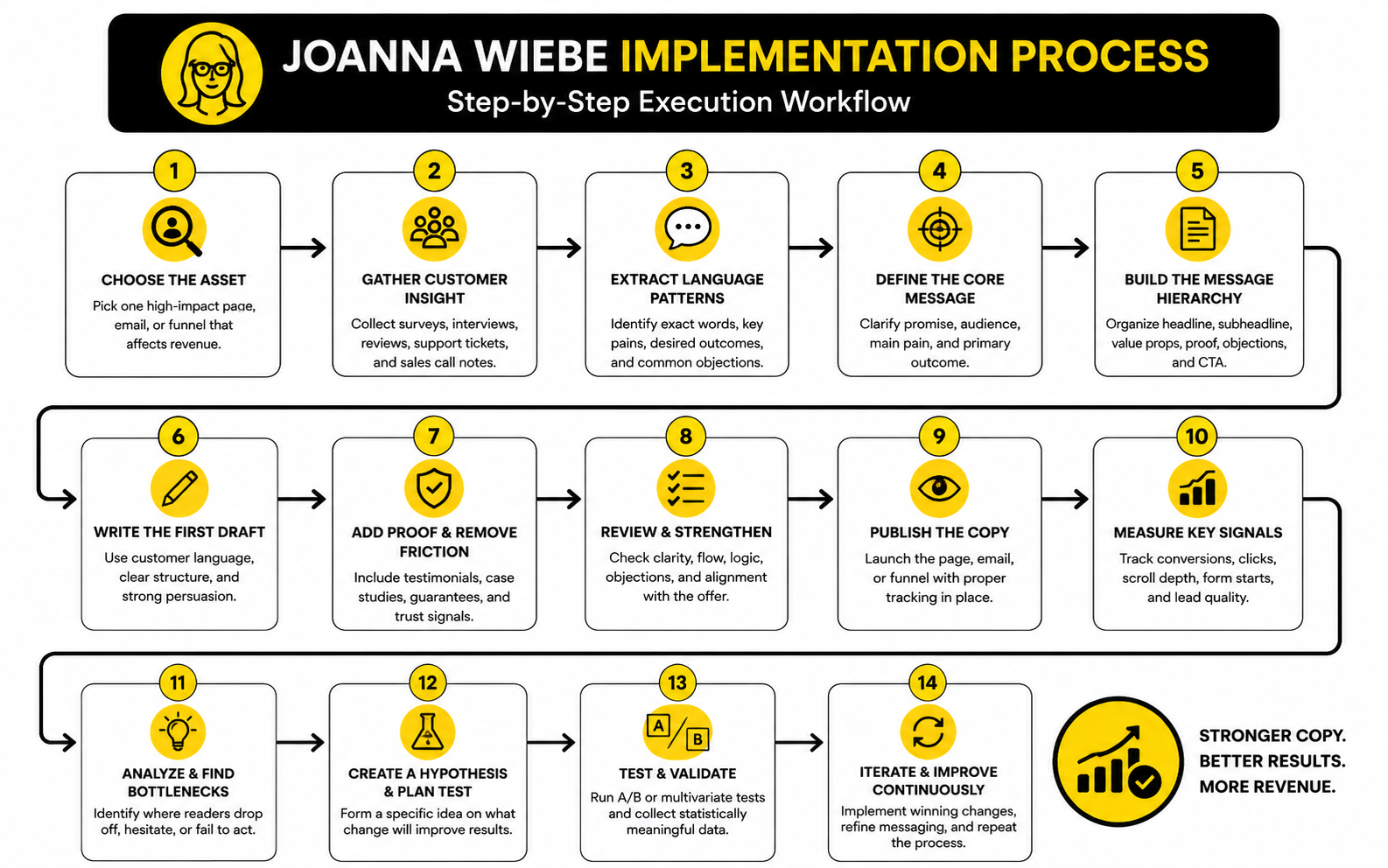
Use A Simple Voice Of Customer Process
A practical process keeps the work from turning into endless research. You are not trying to know every possible thing about the customer. You are trying to find the language and insight needed to improve one specific conversion moment.
This is the point where Joanna Wiebe’s method becomes more than a philosophy. It becomes a workflow. You are not waiting for inspiration; you are building a message from evidence.
Sort Research Into Useful Categories
Raw customer language is only useful when you can turn it into decisions. That means you need categories. Otherwise, you end up with a pile of interesting quotes and no clear direction.
Start with pain points. These are the problems people want to escape, the frustrations they repeat, and the costs of staying where they are. Then look for desired outcomes, which are the results people want in practical, emotional, and social terms.
Next, sort objections. These are the doubts that make people hesitate: price, trust, effort, time, complexity, risk, credibility, switching cost, or fear that the product will not work for their specific situation. Finally, capture triggers. These are the moments that push someone from passive interest into active searching.
Look For Repeated Language, Not Just Loud Language
One dramatic quote can tempt you into building the whole page around it. Be careful. A strong line is useful, but repeated patterns are more reliable than isolated intensity.
If ten customers describe the problem with similar words, you probably have something worth using. If several buyers mention the same comparison, that comparison may need to be handled directly in the copy. If cancellation feedback repeats the same expectation gap, your pre-sale copy may be attracting the wrong belief.
This is where the copywriter has to think like a strategist. You are not just collecting nice phrases. You are looking for the message the market keeps handing you.
Map The Reader’s Stage Of Awareness
After sorting the research, decide how aware the reader is when they reach the asset. This step changes everything. A person who already wants your product needs different copy from someone who barely understands the problem.
A problem-aware reader may need copy that names the pain clearly and reframes why the old way is not working. A solution-aware reader may need help comparing approaches. A product-aware reader may need proof, specificity, and a reason to act now.
This is why one “best” headline rarely exists in isolation. The best headline depends on traffic source, intent, market maturity, and reader awareness. The same product can need very different messages for paid search, cold social, referral traffic, and an email list.
Turn Research Into A Message Hierarchy
A message hierarchy decides what gets said first, second, third, and later. This is where many teams go wrong. They collect good research, then still structure the page around internal priorities.
The reader does not care which feature your team built first. The reader cares about the problem they have, the outcome they want, and the reason they should trust your solution. Your message hierarchy should reflect that reality.
A simple hierarchy might start with the primary outcome, then explain the mechanism, then show proof, then handle the biggest objection, then introduce the call to action. Another hierarchy might start with a painful problem, then introduce a new way forward, then position the product as the practical path. The right order depends on what the research shows.
Write The First Draft From The Research
When it is time to draft, do not open with a blank page and hope something smart appears. Start with your strongest research themes. Put the customer’s problem, desired outcome, objection, and proof points beside the asset you are writing.
For a landing page, draft the headline around the clearest promise or most urgent problem. Use the subheading to clarify who it is for and why it matters. Build the body around the sequence of belief the reader needs before they can take action.
For an email, start with the moment the reader is in. What did they just do? What do they already know? What would make the next click feel useful instead of forced? This is how conversion copywriting stays human while still being commercially focused.
Edit For Clarity Before Style
Once the first draft exists, edit in the right order. Do not start by making the sentences prettier. Start by making the argument clearer.
Ask whether the reader can understand the offer quickly. Ask whether the copy answers the most important objection before the call to action. Ask whether the proof is close enough to the claim it supports. Ask whether every section helps the reader move forward or simply adds noise.
Only after that should you tighten the language, improve rhythm, add personality, and sharpen transitions. Style matters, but style cannot fix a broken argument. Joanna Wiebe’s approach works because it treats clarity as the foundation and voice as the layer that makes the message feel alive.
Keep The Process Collaborative
Conversion copywriting works best when it is not trapped inside the marketing department. Sales hears objections. Support hears confusion. Product knows what users misunderstand. Founders often know the original strategic insight behind the offer.
A smart implementation process brings those people into the research and review cycle. Not to let everyone rewrite the copy by committee, because that usually ruins it. The goal is to gather insight early, then protect the final message from opinion-driven editing later.
This is where a research-backed draft is powerful. When someone says, “I don’t like that headline,” the conversation can move from taste to evidence. The better question becomes, “Does this reflect what our best customers actually care about, and does it support the conversion goal?”
Testing, Optimization, And Team Workflow
Once the copy is live, the work changes. You are no longer debating the draft in a document. You are watching how real people respond to the message, where they hesitate, what they click, what they ignore, and where the promise stops being strong enough to move them forward.
This is the part of the Joanna Wiebe approach that many teams skip. They do the research, write the page, publish it, and then move on. But conversion copywriting is not finished when the words go live; it becomes more useful when the first version creates data you can learn from.
The goal is not to chase tiny improvements forever. The goal is to understand which parts of the message are working, which parts are creating friction, and what the next smart test should be. That is how copy becomes a growth system instead of a one-time asset.
Statistics And Data
Data matters because it protects you from opinion. Without measurement, the loudest person in the room can win the copy debate. With measurement, the conversation gets more useful: did the new message attract better leads, improve form starts, reduce checkout hesitation, lift booked calls, or create higher-quality signups?
But numbers are not magic. A conversion rate is only useful when you know what conversion is being measured, where the traffic came from, how qualified that traffic was, and what the reader was expected to do. A 3% conversion rate can be strong for a high-ticket demo page and weak for a warm lead magnet page.
Benchmarks help, but they should not become your strategy. Unbounce’s conversion benchmark report is useful because it shows that landing page performance varies heavily by industry, traffic, and conversion goal, with its dataset covering more than 57 million conversions across over 41,000 landing pages. That should make one thing obvious: “good conversion rate” is not a universal number.
Measure The Decision, Not Just The Click
The most common analytics mistake is measuring only the final action. A purchase, booked call, signup, or form submission matters, obviously. But the final action rarely tells you where the copy helped or failed.
You need to measure the decision path. That means tracking the smaller signals that show whether the reader is moving closer to action. Examples include scroll depth, pricing page clicks, video starts, FAQ expansion, testimonial interaction, form starts, checkout starts, abandoned carts, email replies, and sales-call quality.
Google Analytics 4 treats important business actions as key events and conversions, which is useful because it pushes teams to define what success actually means before optimizing. A page view is not the same as intent. A button click is not the same as a qualified buyer. A demo request is not the same as a sales-ready opportunity.
Build A Simple Analytics System
A practical analytics system does not need to be complicated. It needs to answer a few essential questions clearly. Who arrived, what promise did they see, what did they do next, where did they stop, and what changed after the copy update?
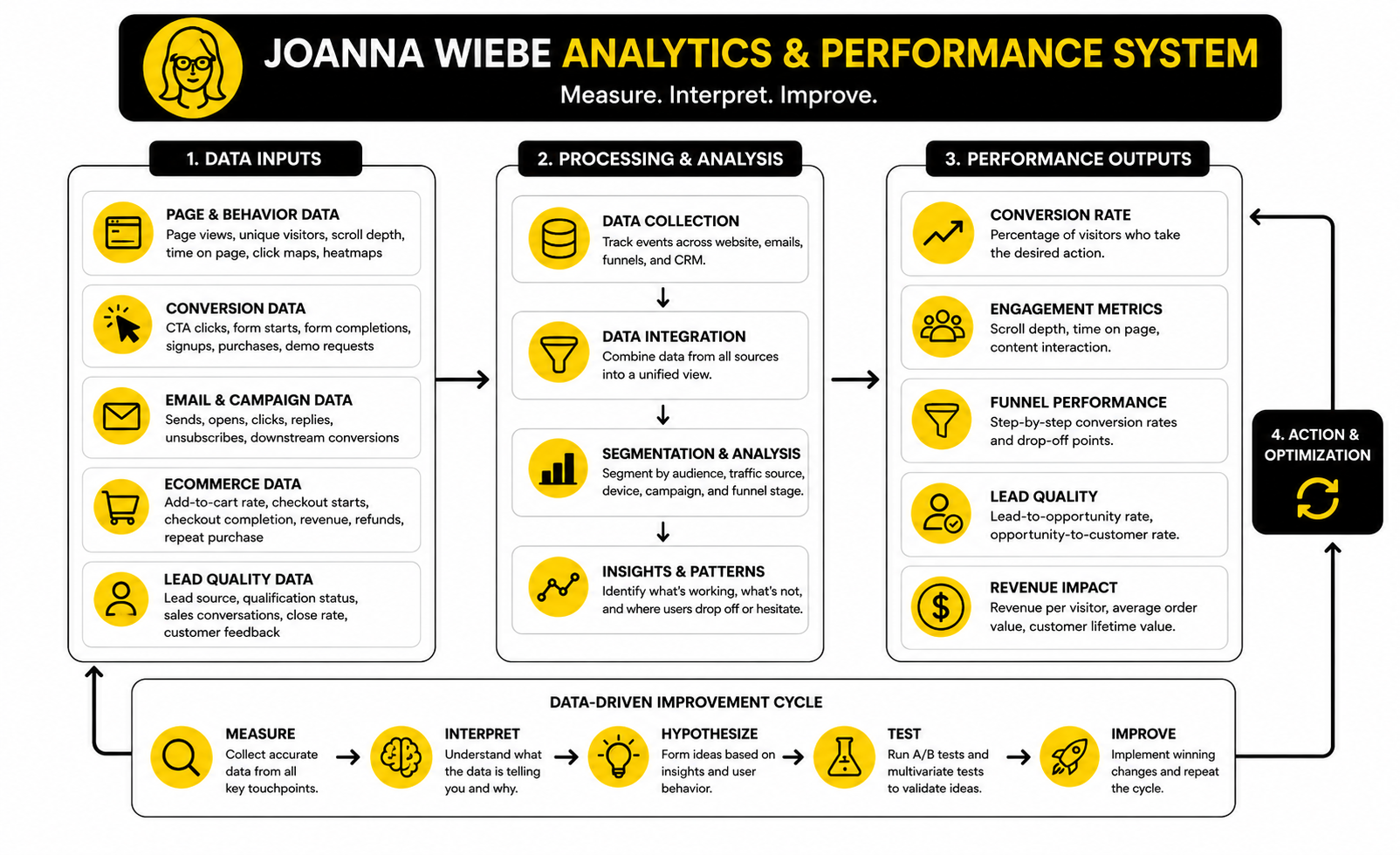
Start with one primary conversion goal for each asset. Then add supporting signals that explain movement toward or away from that goal. A landing page might track visits, CTA clicks, form starts, form completions, scroll depth, and lead quality. An email sequence might track deliverability, opens with caution, clicks, replies, unsubscribes, and the downstream action after the click.
Keep the system clean. If every event is treated as equally important, the data becomes noise. The point is to create a scoreboard that helps you make better copy decisions, not a dashboard that looks impressive and teaches you nothing.
Know Which Metrics Actually Matter
Different assets need different metrics. A homepage should not be judged the same way as a checkout page. A nurture email should not be judged the same way as a sales page.
For a landing page, watch conversion rate, CTA click rate, form-start rate, form-completion rate, scroll depth, and traffic-source performance. If people click the CTA but do not complete the form, the problem may be friction after interest. If they do not click at all, the problem may be the offer, headline, proof, or mismatch between ad and page.
For email, open rate can still give directional feedback, but privacy changes have made it less reliable as a standalone success metric. Click rate, reply rate, unsubscribe rate, and downstream conversion are often more useful. Mailchimp’s benchmark guidance frames open, click, and conversion metrics as tools for comparing campaign performance, but the action should always depend on your own list quality, offer, and intent.
For ecommerce, add-to-cart rate, checkout-start rate, checkout-completion rate, average order value, revenue per visitor, and cart abandonment matter more than generic engagement. Baymard’s long-running cart abandonment benchmark sits around seven abandoned carts for every ten carts created, which is a reminder that buyer intent can still leak badly near the finish line. When that happens, copy has to work with UX, pricing clarity, shipping clarity, trust signals, and return messaging.
Interpret Benchmarks Without Getting Lazy
Benchmarks are useful for orientation. They are terrible as excuses. If your landing page converts below an industry median, that does not automatically prove the copy is bad. Your traffic may be colder, the offer may require more trust, or the conversion event may be harder.
The reverse is also true. If your page beats a benchmark, that does not mean the copy is finished. You may still be underperforming against your own potential, especially if qualified traffic is leaving with the same unanswered objection.
Use benchmarks as a diagnostic starting point. Then compare against your own historical performance, traffic segments, campaign intent, and customer quality. The best question is not “Are we above average?” The better question is “What does this number reveal about the next bottleneck?”
Turn Data Into Copy Hypotheses
Data by itself does not tell you what to write. It tells you where to look. The copywriter still has to turn the signal into a hypothesis.
If scroll depth is low and CTA clicks are weak, the opening section may not be creating enough relevance. If people reach the pricing section but do not act, the page may need stronger proof, clearer value framing, or better risk reversal. If email clicks are strong but the landing page fails, the email is creating interest that the page does not satisfy.
A strong hypothesis sounds specific. Not “make the page better.” Something more useful: “Visitors from paid search are reaching the comparison section but not starting the form, so we will test a clearer objection-handling block that explains why this option is lower-risk than hiring an agency.” That kind of hypothesis connects behavior, copy, and action.
Test Big Levers Before Tiny Tweaks
Small copy tweaks can matter, but they are usually not the first place to start. Changing one button word is rarely as important as changing the promise, offer framing, proof strategy, audience match, or objection handling. Start with the levers that can realistically change the decision.
A serious test might compare two different value propositions. It might test a pain-led opening against an outcome-led opening. It might move proof higher on the page, rewrite the pricing explanation, or add a stronger comparison section for readers choosing between alternatives.
Tiny edits are useful after the main argument is working. Before that, they can become a distraction. If the page has a weak promise, unclear audience, and thin proof, changing “Get started” to “Start now” is not optimization. It is decoration.
Watch Quality, Not Just Quantity
More conversions are not always better. More low-quality leads can waste sales time, distort reporting, and make the marketing team look good while the business gets worse. This is why copy measurement should include quality signals.
For lead generation, track how many leads become qualified opportunities, booked calls, show-ups, proposals, customers, and retained customers. For SaaS, watch activation and retention after signup. For ecommerce, watch refunds, repeat purchase, customer support load, and revenue per visitor.
This is especially important when copy gets more aggressive. A stronger promise may lift form fills while attracting people with the wrong expectations. That is not a win. Good conversion copy should increase action from the right people, not create more noise for the team.
Create A Review Rhythm
Optimization works better when it has a rhythm. Do not review the numbers randomly when someone gets nervous. Set a schedule and decide in advance what you will evaluate.
A weekly review can catch obvious problems in traffic, tracking, or funnel performance. A monthly review can look at deeper copy patterns, segment differences, and test results. A quarterly review can revisit positioning, offer strength, customer research, and whether the market has shifted.
This rhythm keeps the team from overreacting to daily noise. It also prevents the opposite problem: leaving weak copy untouched for months because nobody owns the measurement. Conversion copywriting needs ownership after launch, not just during the draft.
Use Data To Protect The Customer’s Voice
The point of measurement is not to turn the whole article, funnel, or page into a robot. It is to protect the customer’s voice from internal politics. When the research says one thing and the data confirms it, the team has a stronger reason to stay focused.
That is the deeper value of Joanna Wiebe’s method. It gives you a way to combine what customers say with what customers do. Voice of customer research shows the language and emotional logic. Analytics shows where that logic creates movement or friction.
When both sides work together, copy becomes much easier to improve. You are no longer guessing from scratch. You are listening, publishing, measuring, learning, and tightening the message around what the market is already telling you.
Tools, Use Cases, And Expert Tradeoffs
At this stage, the process is clear: listen to customers, build the message, publish the asset, measure the response, and improve the copy based on what the market shows you. The advanced part is knowing where that process gets messy. Because it will.
Joanna Wiebe’s work is often discussed through copywriting, but the bigger lesson is operational. Strong conversion copy depends on how a team makes decisions, how it handles evidence, how it balances brand and performance, and how it scales messaging without flattening everything into generic content.
That is where good marketers separate themselves. They do not just ask, “What should the headline say?” They ask, “What kind of buying decision are we supporting, what risk does the customer feel, what proof do they need, and what should our team not automate away?”
AI Can Speed Up Copy, But It Cannot Replace Judgment
AI is useful for summarizing research, clustering survey responses, turning interview notes into themes, drafting variants, and pressure-testing different angles. That is real value. If you already have strong customer inputs, AI can help you move faster from raw material to usable copy.
But AI gets dangerous when it becomes the strategist. It can produce confident language without knowing whether the promise is true, whether the objection matters, whether the claim is differentiated, or whether the customer segment is even right. Copyhackers now positions its training around “messaging in a time of AI,” with the practical warning that AI should be treated as the tool, not the strategy.
Use AI like a production assistant, not like the person responsible for the message. Feed it real voice of customer data, clear positioning, offer constraints, and conversion goals. Then review everything with human judgment, because the risk is not that AI writes badly; the risk is that it writes something smooth, plausible, and wrong.
Brand Voice And Conversion Goals Need A Truce
Some teams treat brand voice and conversion copy as enemies. Brand people worry that performance copy will sound pushy. Growth people worry that brand copy will sound pretty but weak.
The better answer is not to pick a side. The better answer is to define what the brand should sound like while still making the buying decision easier. A strong brand voice can make the copy more memorable, but it should never hide the offer, bury the proof, or make the reader guess what to do next.
This is a tradeoff Joanna Wiebe’s approach helps solve. Research keeps the message grounded in what customers actually need to hear. Brand voice shapes how that message feels. Performance measurement shows whether the combination is helping the business or just pleasing the internal team.
More Personalization Is Not Always Better
Personalization sounds like an obvious win, but it can become messy fast. The more you personalize, the more segments, claims, proof points, pages, emails, and QA checks you have to manage. Without discipline, a personalization strategy turns into a maintenance problem.
The demand is real, though. McKinsey’s personalization research has found that 71% of consumers expect personalized interactions and 76% get frustrated when they do not get them. That does not mean every visitor needs a completely different funnel. It means people expect the experience to feel relevant to their intent, context, and needs.
Start with meaningful differences, not cosmetic ones. Segment by audience type, awareness level, pain point, buying stage, use case, or traffic intent. Do not personalize for the sake of feeling advanced. Personalize only when the message genuinely needs to change.
B2B Copy Must Support A Buying Group
B2B copy has a scaling problem because one reader is rarely the whole decision. A founder, department lead, finance person, technical evaluator, end user, and procurement stakeholder may all care about different things. The page has to serve the main buyer without ignoring the rest of the buying group.
This is why vague copy fails so badly in B2B. It gives everyone something soft to agree with, but nobody enough confidence to move forward. Gartner’s B2B buying research highlights that 75% of B2B buyers prefer a rep-free sales experience, while warning that fully self-service purchases can create more regret when buyers lack the right support.
That is a huge signal for copywriters. Your page, email, deck, and sales enablement assets need to do more than create interest. They need to help buyers explain the decision internally, compare alternatives, justify the risk, and feel confident that they are not walking into a mistake.
Scaling Copy Requires A Message System
One strong landing page is useful. A repeatable message system is better. Scaling conversion copy means creating reusable assets that keep the message consistent without forcing every writer to start from zero.
A message system can include:
This does not remove creativity. It removes waste. When a team has a message system, writers can spend less time rediscovering the basics and more time adapting the message to the asset, audience, and buying moment.
The Proof Library Is A Strategic Asset
Most teams underuse proof. They collect testimonials, logos, case studies, reviews, screenshots, and customer quotes, then scatter them randomly across the site. That makes proof look decorative instead of persuasive.
A better proof library tags each proof point by claim, audience, objection, funnel stage, product feature, and outcome. If the page claims speed, you need proof of speed near that claim. If the objection is trust, you need credibility proof before the reader is asked to act.
This is especially important when scaling across many pages or campaigns. The same testimonial will not work equally well everywhere. Proof is strongest when it answers the specific doubt the reader is feeling at that exact moment.
The Biggest Risk Is Over-Optimization
Optimization sounds good until it starts making the brand smaller. If every decision is based only on short-term conversion lift, teams can slowly remove distinctiveness, weaken positioning, and train themselves to chase the easiest click. That is not strategy.
A discount-heavy page may convert today and hurt perceived value tomorrow. A more aggressive headline may lift form fills and lower lead quality. A simplified promise may increase clicks while creating unrealistic expectations for sales and support.
Expert-level conversion work looks beyond the immediate number. It asks whether the copy attracts the right customer, sets the right expectation, protects trust, and supports long-term revenue. Conversion matters, but conversion without customer quality is a trap.
Use Funnel Tools Without Letting Them Shape The Strategy
Tools can help you publish faster, test cleaner, and manage campaigns with less friction. A funnel builder like ClickFunnels can be useful when you need to build sales pages, lead funnels, or offer flows quickly. An all-in-one platform like GoHighLevel can make sense for agencies and service businesses that need funnels, CRM, automations, and client management in one place.
But the tool is not the strategy. A weak offer inside a beautiful funnel is still a weak offer. A generic email sequence inside a powerful automation platform is still generic.
Use tools to execute the message, not to avoid the hard thinking. The strategic work is still customer research, positioning, offer clarity, proof, sequencing, and measurement. That is the part no software can fully do for you.
When To Hire, Train, Or Build Internally
There are three practical ways to bring Joanna Wiebe-style conversion copywriting into a business. You can hire an expert, train your team, or build a repeatable internal process. Each has tradeoffs.
Hiring an expert is useful when the stakes are high, the offer is complex, or the current page is clearly underperforming. Training the team is useful when copy touches many assets and you need better day-to-day judgment. Building internally is useful when messaging is central to the business and you want a long-term advantage.
The mistake is expecting one person to fix a broken system alone. A great copywriter can improve the message, but they still need access to customers, data, decision-makers, product truth, and implementation support. Without that, even strong copy gets trapped in politics.
Advanced Copywriting Is Really Decision Design
At the expert level, conversion copywriting becomes decision design. You are designing the path from problem to belief to action. The words matter because they shape how the reader understands the decision in front of them.
That is why Joanna Wiebe remains relevant beyond copywriting tactics. Her work points to a bigger discipline: using customer insight to make marketing clearer, more believable, and more useful. That is not a trend. That is the job.
The closer you get to the end of this guide, the more obvious the pattern becomes. Better copy is not louder. It is more precise. It knows who it is talking to, what they are trying to decide, what they need to believe, and what proof will help them move.
Bringing The Whole System Together
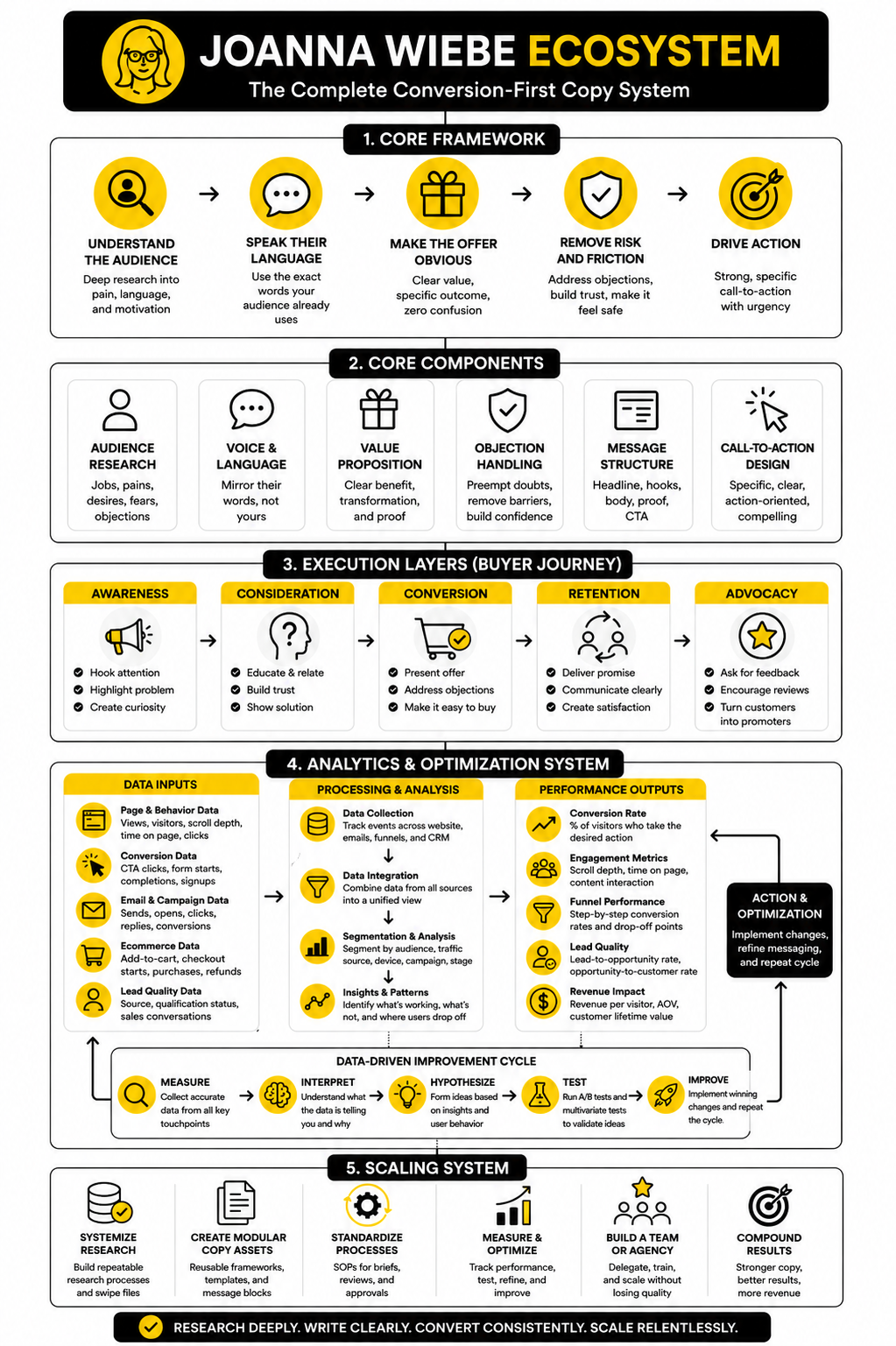
The strongest takeaway from Joanna Wiebe’s work is not that copywriters need better swipe files. It is that modern marketing needs a better messaging system. The copy, research, analytics, funnel, sales process, proof, and customer experience all need to support the same buyer decision.
That is why this approach works beyond one page or one campaign. A single headline can help, but a connected system is what compounds. When every asset is built from customer insight and measured against a real business outcome, copy stops being a creative afterthought and becomes part of how the company learns from the market.
This is also where teams need discipline. If the research says customers care about one problem, the funnel should not wander into five unrelated promises. If analytics show people hesitate around pricing, the answer is not always a louder CTA. Sometimes the answer is clearer value framing, stronger proof, better expectation-setting, or a lower-friction next step.
The Final Joanna Wiebe Takeaway
Joanna Wiebe is useful to study because her approach brings copywriting back to the buyer. Not the internal brainstorm. Not the founder’s favorite phrase. Not the trend everyone is copying this quarter.
The real work is to understand what the reader already believes, what they doubt, what they want, and what they need to see before they can move. That does not make copy formulaic. It makes copy responsible.
If you apply only one lesson from this guide, make it this: write from evidence, not ego. Start with the customer’s voice, shape it into a clear argument, support it with proof, and measure whether it helps the right people act. That is the practical standard.
Who Is Joanna Wiebe?
Joanna Wiebe is a conversion copywriter, speaker, trainer, and founder of Copyhackers. She is widely associated with conversion copywriting, a practical approach to writing marketing copy that is built around customer research, persuasion, testing, and measurable action. Her work is especially relevant for SaaS, ecommerce, agencies, consultants, creators, and growth teams that need copy to do more than sound nice.
What Is Joanna Wiebe Best Known For?
Joanna Wiebe is best known for popularizing conversion copywriting and building Copyhackers into a major education and training brand for marketers and copywriters. Her work focuses on using customer language, research, message hierarchy, and testing to improve pages, emails, funnels, and campaigns. The key idea is simple: copy should help the right buyer make a confident decision.
What Is Conversion Copywriting?
Conversion copywriting is copywriting designed to move a reader toward a specific business action. That action might be a signup, purchase, booked call, demo request, email click, trial start, or application. The difference is that conversion copywriting is not just expressive writing; it is research-backed messaging tied to a measurable outcome.
How Is Conversion Copywriting Different From Regular Copywriting?
Regular copywriting can include brand campaigns, ads, slogans, content, scripts, and general promotional writing. Conversion copywriting is more focused on decision-making and performance. It asks what the reader needs to believe, understand, trust, and overcome before they take the next step.
Why Does Voice Of Customer Research Matter?
Voice of customer research matters because it stops marketers from guessing. It captures how real people describe their problems, goals, fears, comparisons, and objections. When you use those patterns correctly, the copy feels more relevant because it reflects the reader’s actual buying context.
Does Joanna Wiebe’s Approach Still Matter In The AI Era?
Yes, and arguably more than before. AI can generate copy quickly, but fast copy is not automatically good copy. The Joanna Wiebe approach matters because it gives AI better inputs: customer research, positioning, proof, audience awareness, and a clear conversion goal.
Can AI Write Conversion Copy?
AI can help draft conversion copy, but it should not own the strategy. It can summarize interviews, organize customer language, generate variants, and help with first drafts. A skilled marketer still needs to check the promise, proof, logic, brand fit, customer insight, and ethical boundaries.
What Metrics Should Conversion Copywriters Track?
The right metrics depend on the asset. For landing pages, track conversion rate, CTA clicks, form starts, form completions, scroll depth, and lead quality. For email, track clicks, replies, unsubscribes, and downstream conversions. For ecommerce, track add-to-cart rate, checkout-start rate, checkout completion, revenue per visitor, refunds, and repeat purchase.
What Is The Biggest Mistake Teams Make With Conversion Copy?
The biggest mistake is writing before understanding the customer. Teams often start with what they want to say instead of what the customer needs to hear. That leads to vague claims, weak proof, buried value, and copy that sounds polished but fails to move the reader.
How Do You Start Using Joanna Wiebe’s Method?
Start with one important asset, not your entire website. Pick a page, email, or funnel that matters to revenue. Then collect customer language, identify the main objections and desired outcomes, rewrite the message around the reader’s decision path, and measure what changes.
Is Conversion Copywriting Only For Sales Pages?
No. Conversion copywriting applies to homepages, landing pages, product pages, onboarding emails, lifecycle emails, checkout pages, ads, sales decks, demo pages, pricing pages, and even customer retention campaigns. Any asset that helps someone decide can benefit from stronger conversion copy.
How Long Should Conversion Copy Be?
Copy should be as long as the decision requires and as short as the reader can tolerate. A simple low-risk offer may need only a short page or email. A complex, expensive, or unfamiliar offer usually needs more explanation, proof, objection handling, and comparison support.
What Makes A Good Conversion Copywriter?
A good conversion copywriter is not just good with words. They can research, listen, prioritize, structure an argument, understand buyer psychology, collaborate with teams, and interpret data. The writing matters, but the judgment behind the writing matters more.
Should Startups Hire A Conversion Copywriter Early?
Startups should involve conversion-focused messaging earlier than most do. A startup does not always need a full-time conversion copywriter right away, but it does need clear positioning, customer research, and copy that explains the offer without confusion. If paid traffic, demos, launches, or sales calls matter, the copy is already affecting revenue.
What Tools Help With Conversion Copywriting?
Useful tools depend on the workflow. Survey tools, call recording tools, analytics platforms, heatmap tools, email platforms, landing page builders, and CRM systems can all help. Platforms like GoHighLevel, ClickFunnels, Brevo, and ManyChat can support execution, but the strategy still has to come from customer insight.
Is Joanna Wiebe’s Approach Better For B2B Or B2C?
It works for both, but the emphasis changes. In B2B, the copy often needs to support a longer decision, multiple stakeholders, internal justification, and risk reduction. In B2C, the copy may need to handle desire, trust, timing, comparison, urgency, and purchase friction more directly.
How Do You Know If Your Copy Is Working?
Your copy is working when it helps the right people take the right next step with fewer doubts and better expectations. That should show up in both quantitative and qualitative signals. Look for improved conversions, better lead quality, stronger sales conversations, fewer repeated objections, and clearer customer feedback.
Build a stronger local presence with BAAM AI
Turn your website, Google profile, social channels, and AI visibility into one growth engine
Most businesses do not need more random marketing activity. They need a consistent presence system that helps the right people find them, trust them, and take action. BAAM AI brings strategy, local SEO, website updates, Google Maps visibility, social content, AI-search readiness, media production, and reporting into one practical monthly engine.
If you want your marketing to keep working after the campaign ends, start with a free BAAM AI presence audit. See how your business shows up today and where the fastest visibility wins are at BAAM AI.