
BAAM AI Blog
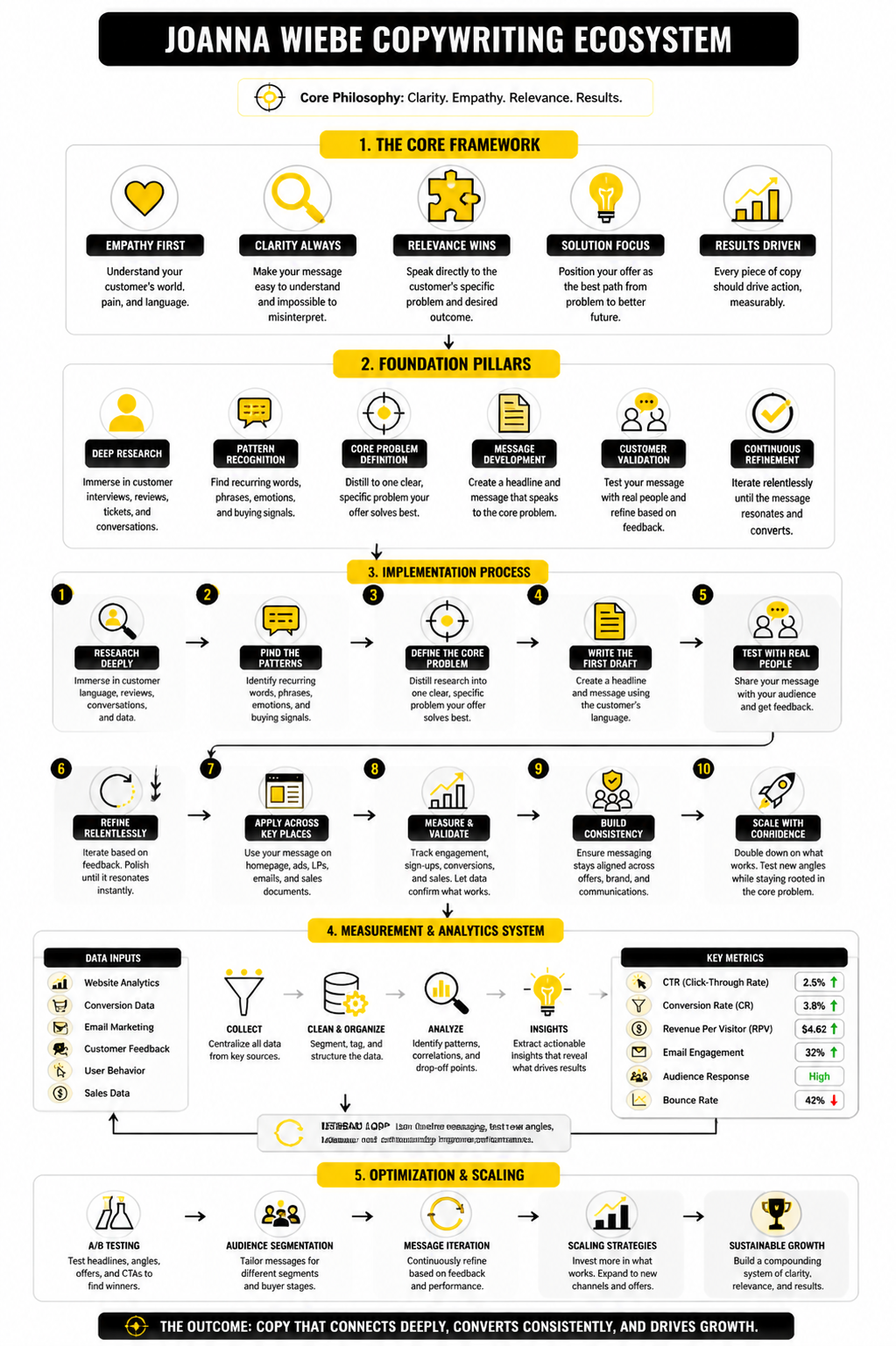
Joanna Wiebe: The Original Conversion Copywriter and Why Her Work Matters
Joanna Wiebe isn’t just a name in the world of marketing and writing - she’s widely recognised as the person who defined conversion copywriting and reshaped how brands use words to turn interest into action. For...

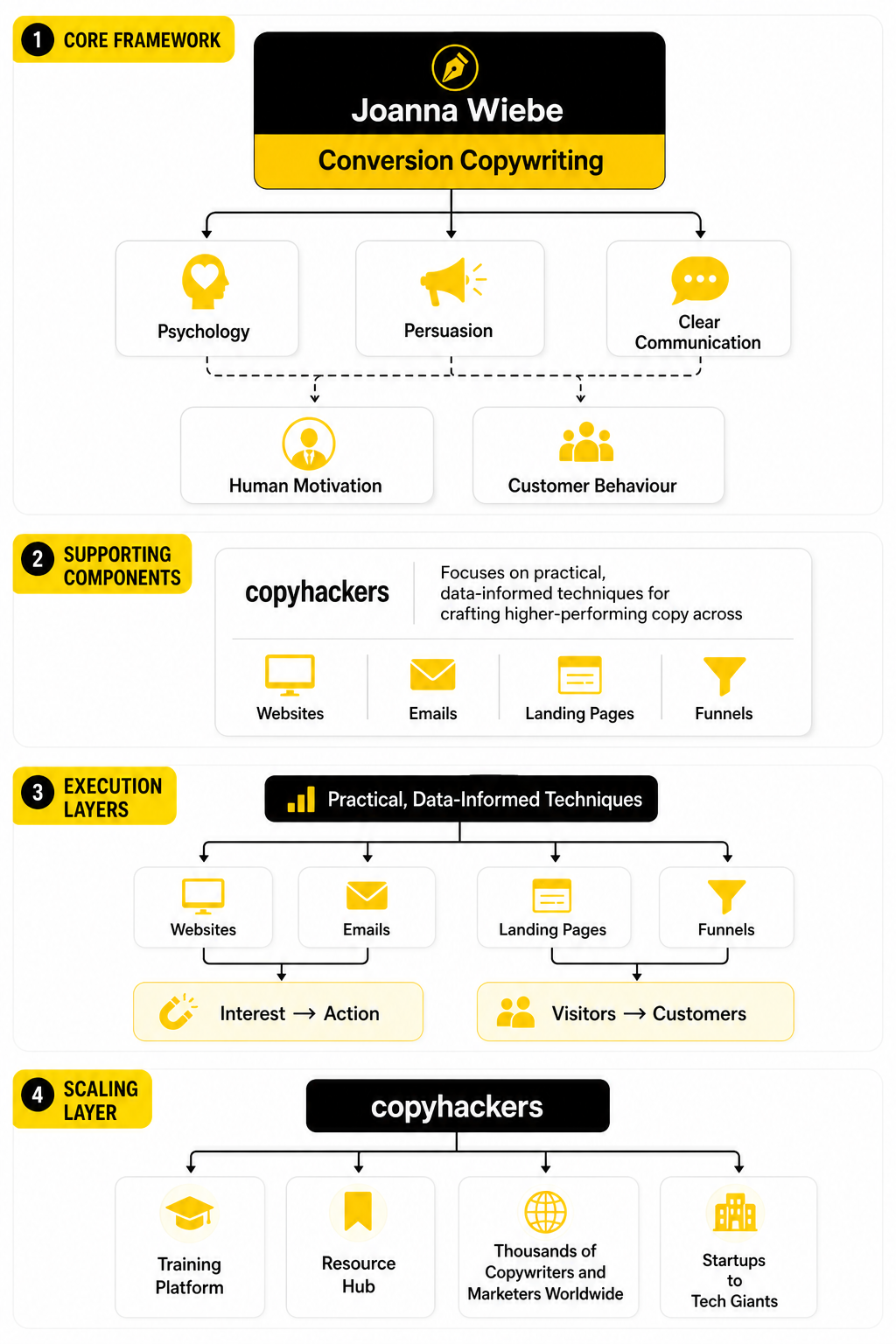
Joanna Wiebe isn’t just a name in the world of marketing and writing - she’s widely recognised as the person who defined conversion copywriting and reshaped how brands use words to turn interest into action. For nearly two decades, she’s helped businesses of all sizes—from startups to tech giants—write copy that doesn’t just sound good but converts visitors into customers. Her work sits at the intersection of psychology, persuasion, and clear communication, which makes her one of the most influential voices in digital marketing today.
Many marketers talk about writing compelling content, but Joanna’s message goes deeper: great copy starts with understanding human motivation and customer behaviour. Her philosophy isn’t about clever words; it’s about empathy‑driven messaging that moves people toward a decision.
Joanna also founded Copyhackers, the training platform and resource hub that has trained thousands of copywriters and marketers worldwide. Copyhackers focuses on practical, data‑informed techniques for crafting higher‑performing copy across websites, emails, landing pages, and funnels.
In the sections that follow, we’ll explore her journey, the frameworks she champions, and how professionals can apply her methods to their own work. But first, let’s visualise the key components of her approach.
Why Joanna Wiebe Matters in Modern Marketing
Joanna Wiebe isn’t just a successful copywriter - she’s the originator of conversion copywriting, a discipline now central to how modern digital businesses write words that sell. The term “conversion copywriting” itself was coined by her and popularised through the platform she founded, Copyhackers, where she and her team teach how to write copy that gets readers to take specific, measurable actions.
Conversion copywriting differs from traditional marketing writing because it’s not about sounding clever or witty; it’s about crafting words rooted in research, psychology, and measurable outcomes. In practice, that means writing landing pages, emails, and other content designed to turn visitors into leads, signups, or paying customers - not just entertain them.
What sets Joanna apart is her process‑driven approach. Instead of guessing what might work, conversion copywriting starts with structured research into audience needs, messaging priorities, and behavioural data before a single sentence is written. This emphasis on data and testing has helped companies like Shopify, Huel, and LaunchDarkly increase conversions and grow revenue through better copy.
As both a teacher and practitioner, Joanna has trained thousands of copywriters and marketing professionals worldwide. She’s spoken on international stages and shaped how modern marketers think about the intersection of words and business results.
Early Journey and Career Path
Joanna’s path into conversion copywriting wasn’t a straight line from the start - and that’s part of what makes her story useful for anyone considering this career. Early on, she worked in creative and agency writing roles, learning the fundamentals of marketing communication and sharpening her craft. During this time, she became deeply interested in how writing could be measured, tested, and improved based on real outcomes rather than subjective opinion.
Her turning point came as she moved into freelance work and began combining traditional copywriting techniques with conversion rate optimisation principles. This shift wasn’t just stylistic - it was methodological, focusing on research, testing, and analysis to shape messaging that genuinely moves audiences.
In 2011, Joanna founded Copyhackers to share and scale this approach. The platform grew into a respected training and resource hub for conversion copywriters, attracting professionals from startups and global brands alike. Her work there continues to evolve as the field of digital marketing changes, but her core focus remains the same: helping writers and marketers make words that convert into measurable business outcomes.
What Conversion Copywriting Really Is
At its core, Joanna’s definition of conversion copywriting is simple yet distinct: it’s writing that’s intentionally designed to get the reader to take a specific action. This might be clicking a button, signing up for a newsletter, starting a free trial, or making a purchase - and every word is chosen with that end goal in mind.
Unlike general creative writing, which may prioritise tone and style, conversion copywriting is data‑driven and structured around measurable business goals. It focuses on understanding the audience’s motivations, pain points, and decision‑making process, and then guiding them through a logical journey toward a desired action.
Joanna’s process typically involves three major phases:
This structured approach ensures that copy isn’t just well written, but effective and aligned with real audience behaviour and business objectives.
In the next part, we’ll break down the Copyhackers framework - the repeatable system Joanna teaches for building messaging that consistently converts.
The Copyhackers Framework Explained
Now that we’ve covered what conversion copywriting is and why Joanna Wiebe’s approach changed how marketers write online, let’s break down the actual framework and implementation process she teaches. Her methodology isn’t theoretical - it’s a repeatable, 3‑part process that ensures every piece of copy is built on insight, structure, and validation rather than guesswork.
The Three Core Stages
Joanna Wiebe’s conversion copywriting process revolves around three major stages that professional copywriters use on every project:
Each stage has clear goals and activities that shape what you write and why you write it that way - and that’s what makes this approach powerful in practice.
What Happens in Each Stage
This structure makes the process data‑driven and iterative, so each revision brings you closer to copy that reliably converts.
Implementing the Process Step by Step
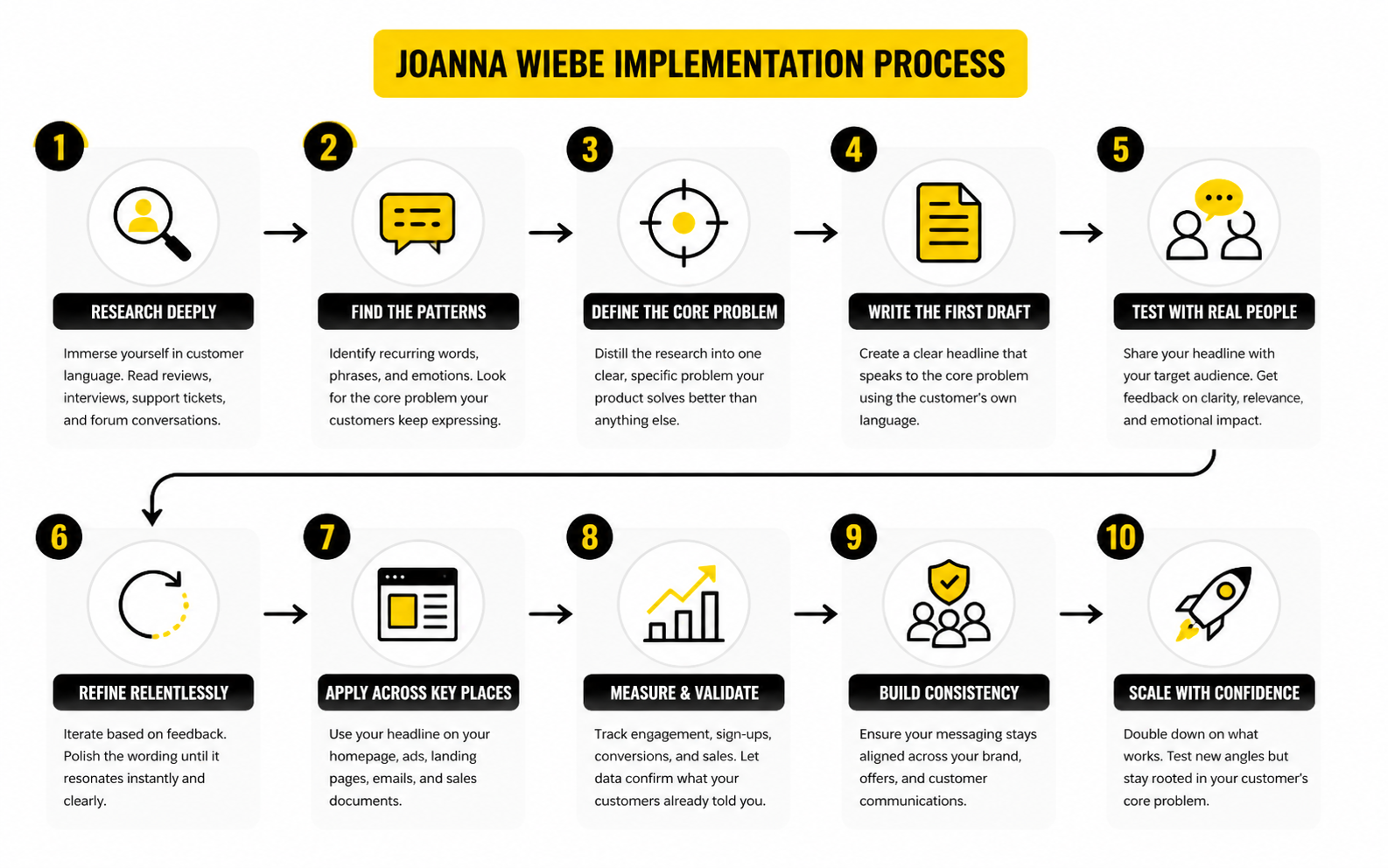
Below is a more tangible, step‑by‑step breakdown of how you'd implement Joanna Wiebe’s conversion copywriting process on a real project - whether you’re writing a landing page, email sequence, or homepage messaging.
1. Plan Your Research
Start by listing all data sources you can access:
Your aim here is to listen first, then write - actually capturing the language your audience uses. This ensures your copy reflects their real motivations and objections, not your assumptions.
2. Organise Insights Into a Messaging Hierarchy
Once you’ve gathered data, synthesise it into a messaging hierarchy - a prioritised list of what matters most to your audience.
This hierarchy becomes the foundation for your copy’s structure and helps you choose the right persuasion framework in the next stage.
3. Draft Using Frameworks
With your messaging hierarchy in hand:
Frameworks aren’t rigid templates; they’re blueprints that ensure clarity and flow.
4. Edit With “Conversion Eyes”
Joanna’s editing philosophy - often called “edit in the awesome” - focuses on tightening copy, checking it against core messages, and testing for clarity on different devices. Editing isn’t polishing - it’s optimising for persuasion.
5. Validate and Optimise
Before launching, test:
Collecting real behavioural data ensures you aren’t just guessing which version works better - you know.
Why This Process Works
The strength of Joanna Wiebe’s implementation approach is that it turns copywriting from an art into a measurable discipline. You stop trusting gut feelings and start trusting evidence from real users, which leads to better decisions and better outcomes.
In the next part of this guide, we’ll explore professional implementation ideas, including tools, templates, and practices top marketers use to apply Joanna’s framework across different types of copy.
Performance Metrics and Data for Conversion Copywriting
To really understand how Joanna Wiebe’s approach works in practice, you need more than just feelings about the copy. You need measurable data that shows whether your messaging is actually persuading visitors to act. In conversion copywriting, the emphasis is on using analytics and performance signals to drive decisions, not just report numbers.
Good metrics tell you what part of your copy is working, where people get stuck, and whether changes you make actually improve outcomes. They also help you avoid common traps like celebrating high engagement when there’s no real business impact - traffic without conversion is noise, not success.
Why Measurement Matters in Copy
Conversion copywriting is fundamentally data‑driven: you write with hypotheses about what will influence behaviour, and then you measure whether those hypotheses were right. Without metrics, all you have are opinions. With metrics, you have actionable insight. Monitoring performance helps you:
Core Conversion Metrics
These are the foundational numbers you should track whenever you launch or revise copy:
These metrics should be segmented by traffic source, device, and audience type (e.g., new vs returning visitors) because performance can vary greatly across different groups.
Putting Benchmarks in Perspective
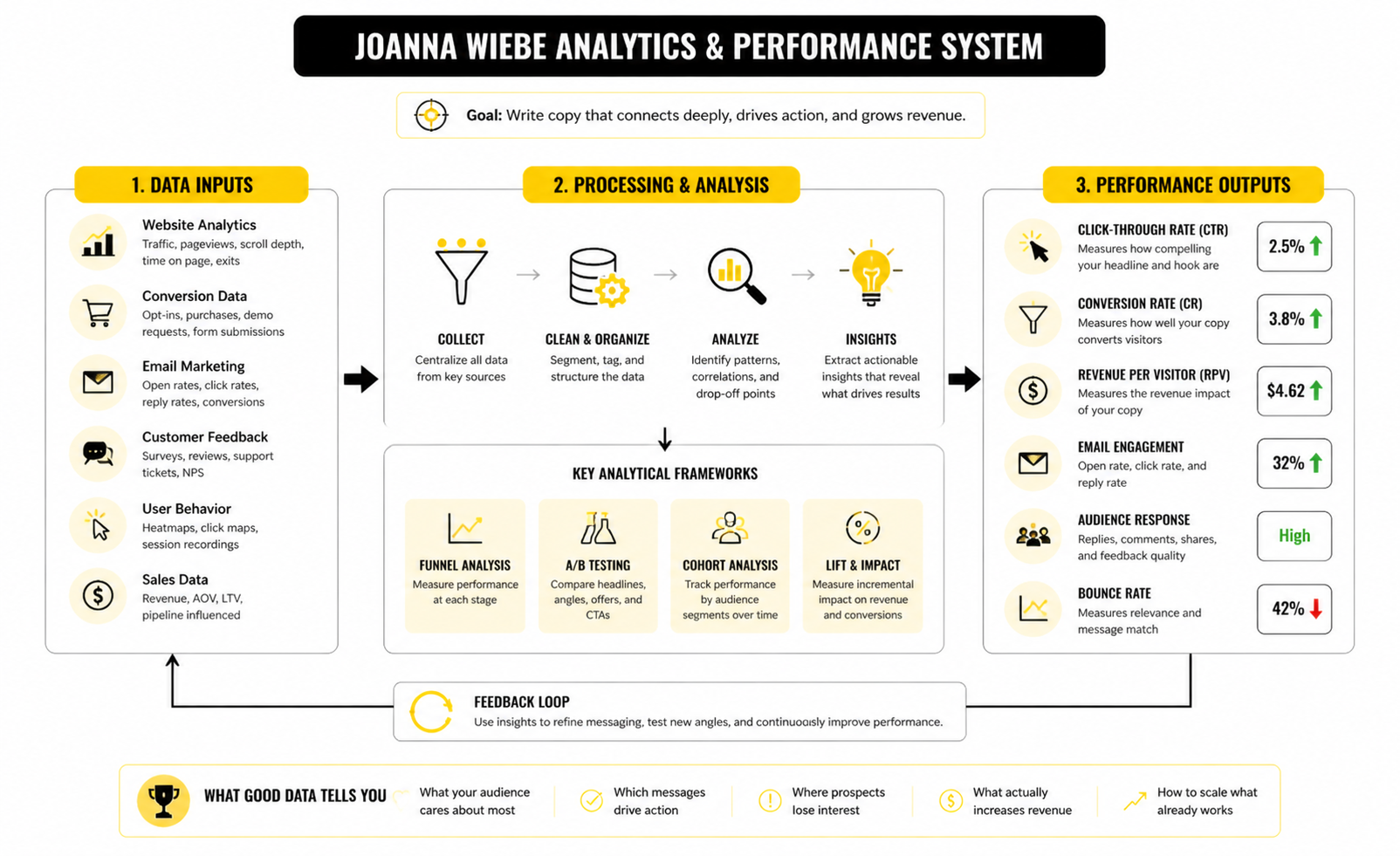
Just seeing a number - like a 3 % conversion rate - doesn’t tell you much unless you compare it to context. Benchmarks vary widely by funnel type, industry, and traffic intent. A 3 % sign‑up conversion might be excellent for cold traffic but underwhelming for warm, repeat visitors. What matters most is establishing your own baseline, then improving on it over time.
What the Numbers Actually Mean
When performance shifts, ask why, not just whether. Here’s how to interpret common signals:
Turning Insights Into Action
Metrics are most useful when they trigger decisions:
By framing your analytics around audience behaviour and business goals - not vanity numbers - you make the data meaningful. That’s why Joanna Wiebe’s conversion copywriting isn’t just about writing better words; it’s about measuring and optimizing the impact of those words in real environments.
In the next part, we’ll explore practical implementation ideas including tools, templates, and workflows that marketers and writers use to apply this data‑driven approach to their projects.
Advanced Guidance and Strategic Considerations
By the time you’ve internalised Joanna Wiebe’s core process - research, writing, and validation - you’re ready for advanced considerations that separate good conversion copy from elite conversion strategy. What works at the fundamentals doesn’t always scale smoothly to high‑stakes funnels, large audiences, or rapidly evolving markets. The next layer of expert practice is about tradeoffs, risks, scaling issues, and strategic nuance that seasons experienced practitioners.
Balancing Creativity with Rigour
One of the biggest strategic decisions in high‑level conversion copywriting is when to follow the framework and when to bend it. Joanna stresses that conversion copywriting is data‑driven and structured, but that doesn’t mean it must be rigidly formulaic for every single piece of content. At scale, creative risks - such as unconventional hooks or narrative structures - can differentiate your messaging from competitors, but they must be hypothesis‑driven and tested, not arbitrary. This is the difference between testing to learn versus testing to prove an ego point.
Tradeoffs: Short‑Term Gains vs Long‑Term Brand Equity
When organisations first adopt conversion‑focused language, the temptation is to optimise only for immediate lift - push for higher CTRs, urgency, or scarcity tactics everywhere. But seasoned strategists recognise that what converts today isn’t always what builds customer trust tomorrow. Risking brand equity for a conversion spike can harm customer lifetime value (CLV) and reputation over time. A mindful application of Joanna’s principles ensures you:
This strategic tradeoff between retail‑style conversion tactics and brand value preservation is something advanced teams actively monitor with segmentation and customer feedback loops.
Scaling Conversion Copy Across Channels
Applying Joanna Wiebe’s methods across multiple channels (web, email, ads, social) raises questions about consistency versus context. A landing page copy strategy that works in long‑form may not directly translate to short‑form social ads or inbox subject lines. Advanced practitioners solve this by:
In larger organisations these scaling efforts often involve playbooks and pattern libraries that encode learnings from past wins and failures.
Managing Risk and Uncertainty
Even with rigorous analytics, conversion copy carries inherent uncertainty. A variation that performs well in one test may flop with a different audience segment or at another time of year. Expert teams embrace experimental humility: they set clear hypothesis statements, guard against false positives, and treat every test as a learning opportunity, not just a potential win. This scientific mindset - central to Joanna’s philosophy - protects against chasing spurious uplift.
Integrating New Tools Without Losing Craft
The rise of AI and automation raises strategic questions about efficiency versus effectiveness in copy practice. Tools can generate drafts, suggest frameworks, and surface language patterns, but they don’t replace the human insight and contextual understanding that Joanna emphasises. While AI can accelerate early drafts or research summaries, experts still manually curate, refine, and test every change against real audience behaviour.
Structuring Teams and Workflows
At scale, conversion copy isn’t a solo act - it’s a cross‑functional discipline involving strategists, researchers, UX designers, and data analysts. Successful teams embed conversion copy review in the product development and marketing lifecycle, ensuring that messaging evolves with new features, audience insights, and competitive environments. Many advanced organisations also build internal scorecards and quality gates to maintain high copy standards across campaigns.
Beyond Tactics: Developing a Conversion Mindset
Finally, the biggest shift Joanna Wiebe encourages in advanced practitioners is a mindset change - from writing as craft to writing as business impact lever. At this level, copy isn’t an isolated deliverable; it’s a strategic input into pricing, product positioning, customer experience, and growth planning. This means:
Ultimately, this mindset - continuous, measurable, and aligned with organisational goals - is what elevates veteran copywriters into conversion strategists and reflects the ethos Joanna Wiebe has championed throughout her career.
1. Who is Joanna Wiebe and why is she important in marketing?
Joanna Wiebe is the founder of Copyhackers and the originator of conversion copywriting, a discipline focused on writing words that persuade readers to take specific actions. Her approach combines research, psychology, and measurable outcomes to improve conversion rates across digital channels. (copyhackers.com)
2. What exactly is conversion copywriting?
Conversion copywriting is the practice of writing content specifically designed to influence a target audience to take a defined action, such as signing up, purchasing, or clicking a CTA. It’s rooted in data, audience research, and structured frameworks rather than creative flair alone. (copyhackers.com)
3. How does Joanna Wiebe’s framework differ from traditional copywriting?
Traditional copywriting often focuses on creativity and brand tone. Joanna Wiebe’s framework is structured, research-driven, and iterative, emphasizing measurable business results over subjective appeal. (copyhackers.com)
4. What are the core stages of her copywriting process?
The process includes Research & Discovery, Writing and Wireframing, and Validation & Experimentation. Each stage ensures that the copy aligns with audience insights and is tested to optimize conversions. (copyhackers.com)
5. How can I measure the effectiveness of conversion copy?
Effectiveness is measured through metrics like conversion rate, click-through rate, form completion, and bounce rate. Monitoring these numbers helps identify friction points and areas for improvement while ensuring changes drive real business outcomes. (wizbrand.com)
6. Can her methods scale to multiple channels?
Yes. Joanna’s methodology can be adapted across websites, email campaigns, social ads, and landing pages. Key strategies include modular messaging, channel-specific frameworks, and cross-channel testing to maintain consistency and performance. (copyhackers.com)
7. What are common pitfalls when applying conversion copywriting?
Common mistakes include over-optimizing for immediate conversions at the expense of brand equity, neglecting audience research, and relying on assumptions instead of data-driven testing. Strategic tradeoffs should balance short-term gains with long-term customer trust. (copyhackers.com)
8. How do professionals validate their copy?
Validation involves A/B testing, user testing, and analytics review. Even high-performing copy must be tested against real users to ensure it consistently drives conversions and aligns with business goals. (copyhackers.com)
9. Is AI compatible with Joanna Wiebe’s approach?
AI can assist in generating drafts, summarizing research, and suggesting frameworks, but human insight remains essential. All messaging should be curated, refined, and tested against real audience behavior to maintain effectiveness. (businessofsoftware.org)
10. How can someone start learning her methods today?
Start by exploring Copyhackers for courses, templates, and guides. Combine study with practice, research-based drafting, and rigorous testing to build measurable conversion skills.
11. What advanced considerations should I keep in mind?
Focus on scaling copy without losing consistency, balancing creativity with structured frameworks, managing risk, and integrating data-driven decisions across teams. This mindset transforms copywriters into strategic marketers. (copyhackers.com)
12. How does audience research influence the final copy?
Audience insights determine messaging hierarchy, pain points, and key motivators. Copy that resonates is rooted in actual customer language, objections, and desires, not assumptions. (copyhackers.com)
Build a stronger local presence with BAAM AI
Turn your website, Google profile, social channels, and AI visibility into one growth engine
Most businesses do not need more random marketing activity. They need a consistent presence system that helps the right people find them, trust them, and take action. BAAM AI brings strategy, local SEO, website updates, Google Maps visibility, social content, AI-search readiness, media production, and reporting into one practical monthly engine.
If you want your marketing to keep working after the campaign ends, start with a free BAAM AI presence audit. See how your business shows up today and where the fastest visibility wins are at BAAM AI.