
BAAM AI Blog
Joanna Wiebe Copywriter: Why Her Approach Defines Modern Conversion Copywriting
Joanna Wiebe isn’t just a copywriter - she’s the person widely credited with inventing conversion copywriting, a form of persuasive writing focused on turning browsers into buyers through data‑informed messaging that...

Joanna Wiebe isn’t just a copywriter - she’s the person widely credited with inventing conversion copywriting, a form of persuasive writing focused on turning browsers into buyers through data‑informed messaging that actually moves revenue.
She founded Copyhackers in 2011, a training and consulting platform that has taught tens of thousands of marketers and writers how to research, structure, and measure copy that works.
this guide breaks down a clear framework for understanding Joanna’s impact and methods, and sets up the rest of the discussion. Below is the roadmap we’ll follow:
Why Conversion Copywriting Matters
Joanna Wiebe didn’t start as a copywriting guru - she stumbled into the field as a creative writer and realized early that most “good writing” doesn’t actually persuade people to take action.
Her insight was simple yet transformative: copy must do more than read well - it must convert. That idea became the heart of conversion copywriting, a discipline that blends psychology, customer understanding, and iterative testing to produce measurable business outcomes.
Conversion copywriting matters because it reframes writing from art to a repeatable strategy rooted in data and real customer language. In an era where attention is scarce and competition is fierce, this approach helps brands craft messaging that not only resonates - but sells.
Framework Overview
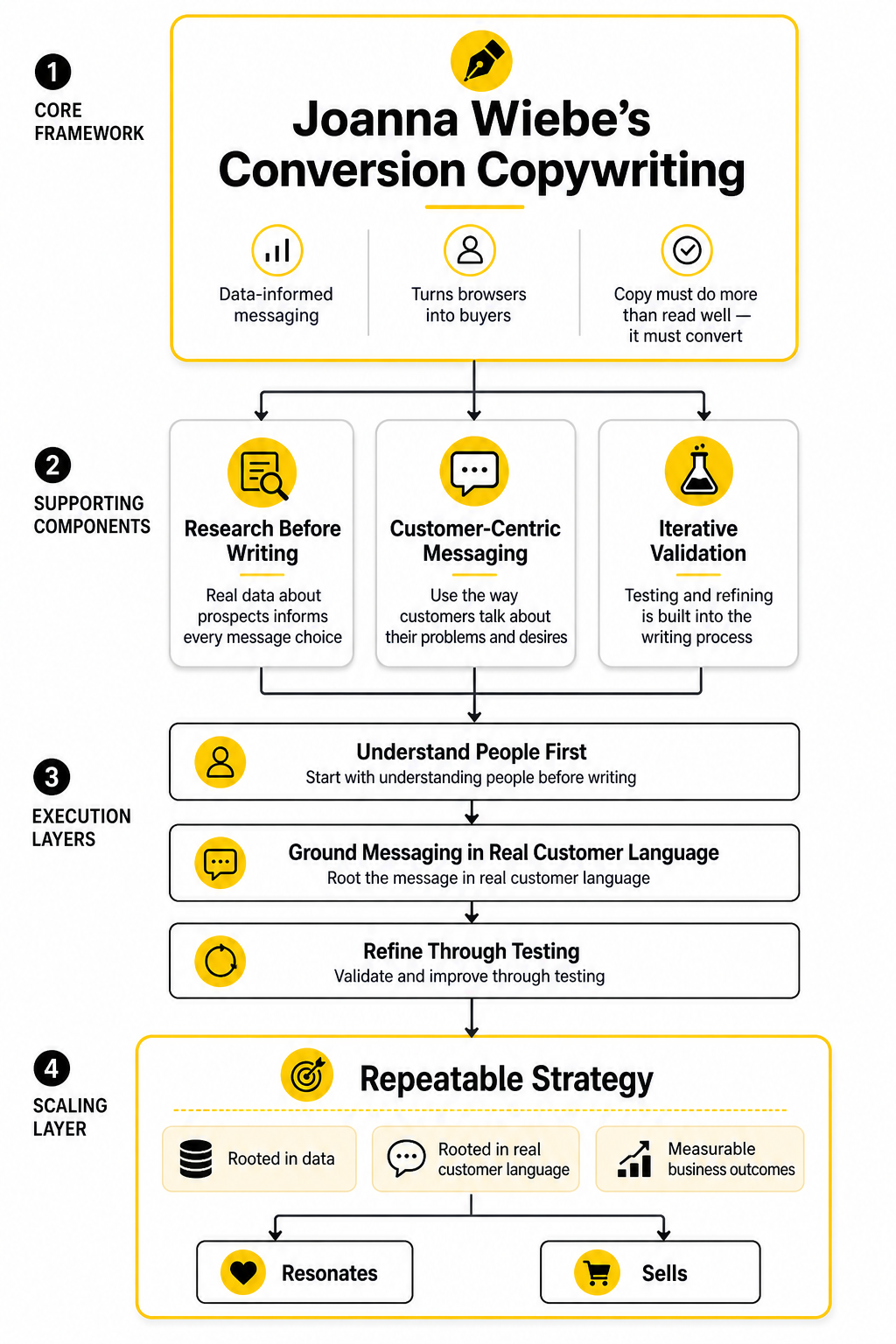
What sets Joanna Wiebe’s work apart is her structured approach to writing copy that converts. It starts with understanding people before penning a single word - a departure from traditional, intuition‑driven writing.
Her framework emphasizes a few core principles:
Across the rest of this guide, we’ll unpack each of these components and explain how top copywriters implement them to yield measurable lifts in conversions and sales.
Core Components of Joanna Wiebe’s Framework
To truly understand why Joanna Wiebe’s approach to copywriting has reshaped how professionals write for conversions, you need to look at the building blocks she emphasizes in her work. At the heart of her philosophy is the idea that effective copy is rooted in real data, not guesswork. That means every choice a writer makes flows from disciplined steps that prioritize the customer’s mindset.
Deep, Repeated Research Before Writing
Joanna teaches that the conversion copywriting process always begins with research and discovery, and this phase should take the most time of any part of the project. It’s not about brainstorming headlines first - it’s about gathering the exact words and concepts your ideal customer uses so your copy can mirror their perspective back to them.
This comprehensive research often includes:
Joanna emphasizes that if research isn’t the biggest part of your work, you’re likely doing it wrong - because this phase supplies the hierarchical messaging that drives conversions.
Customer‑Centric Message Hierarchies
Once research is done, Joanna’s framework turns messy data into a messaging hierarchy - a structured roadmap of what to say and in what order. This hierarchy ensures that the most persuasive elements come forward first, guiding prospects through a logical path from attention to action.
This isn’t an intuitive guess about what might work. It’s a carefully organized sequence based on real customer language, pain points, desires, and objections. Only after this mapping is complete do copywriters move into drafting actual words.
Writing With Conversion at the Core
With solid research and messaging hierarchy in place, Joanna’s method moves into writing, wireframing, and editing - but even here, the focus stays on persuasion, clarity, and relevance. Copy isn’t just polished for flow or cleverness; it’s crafted to stimulate desire and diminish hesitation in the prospect’s mind.
This phase often uses classic persuasive frameworks (like AIDA or PAS) and custom messaging matrices to bridge emotional triggers with logical benefits. The end result is copy that doesn’t just sound good, it sells.
Validation and Iterative Testing
The final core component Joanna champions is validation through testing. Even after writing is complete, the work isn’t done: conversion copywriters must validate and experiment to see what actually resonates with the audience.
This can include:
These validation steps turn copy from a hypothesis based on research into a proven performer in the real marketplace.
Together, these components - research, structured messaging, conversion‑focused writing, and validation testing - form a repeatable framework that professionals use to create copy that not only speaks well but sells well too.
How Professionals Apply Her Methods
Professional copywriters who adopt Joanna’s methodology don’t just churn out words faster - they work more carefully. They invest heavily up front in customer research so that every sentence they write is backed by real voice‑of‑customer insights.
In practice, this looks like:
Top practitioners often integrate these methods into their workflow using tools and systems that support customer insight capture, collaborative editing, and performance tracking - transforming copywriting from an art to a data‑informed discipline with measurable impact.
Professionals also view copywriting as part of a broader growth function, aligning closely with product teams, UX designers, and analytics specialists so that the messaging remains consistent across the customer journey.
By embedding these principles into every project, copywriters not only honor Joanna Wiebe’s framework - they deliver results that stakeholders can quantify and attribute.
How to Implement Joanna Wiebe’s Copywriting Process Step by Step
Now that we’ve covered the core components of Joanna Wiebe’s conversion copywriting framework, the next step is seeing how professionals actually put it into action. This implementation section turns abstract principles into a tangible, repeatable process you can follow in real projects. It’s the bridge between understanding the framework and doing the work in a structured, outcome‑oriented way.
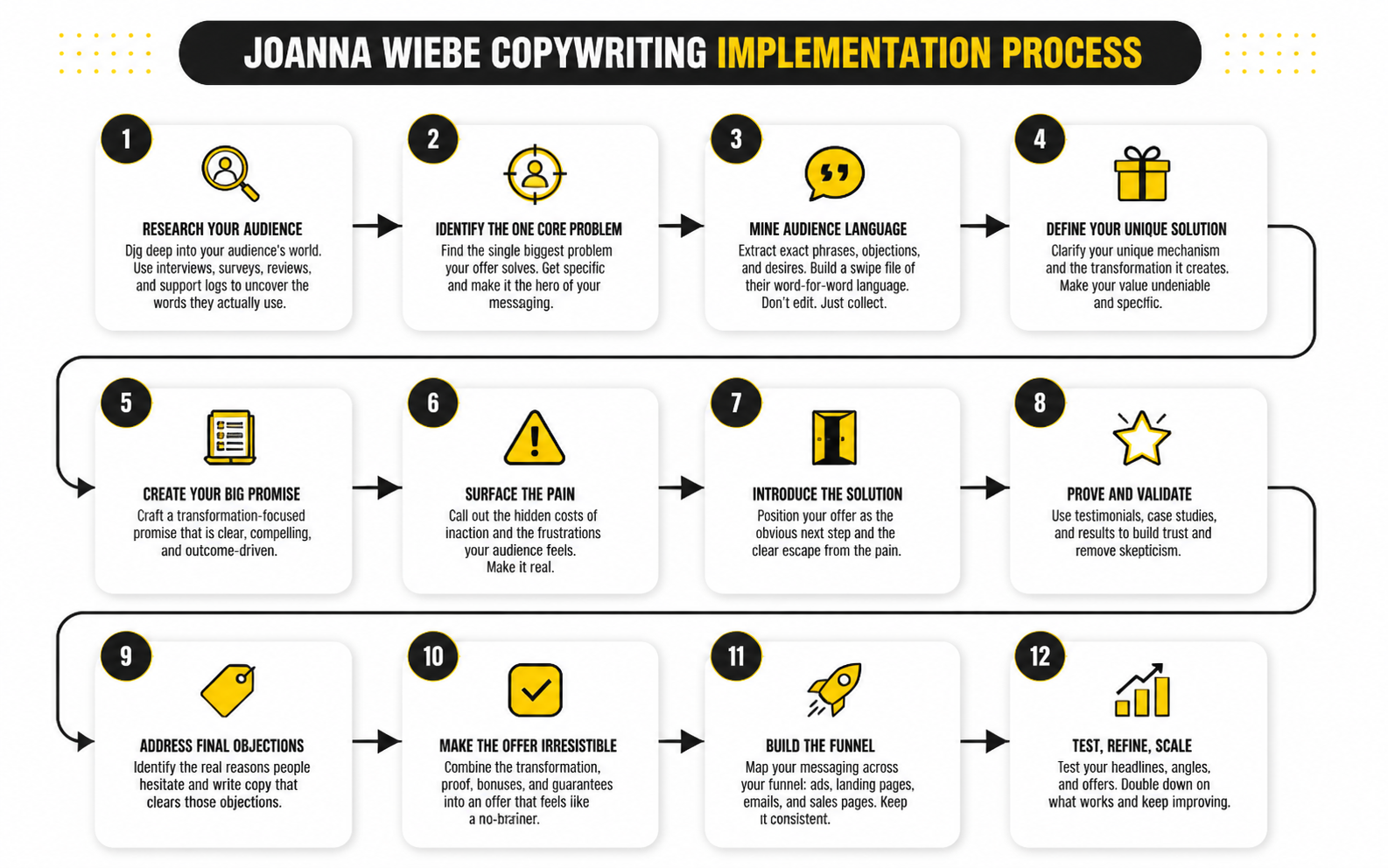
1. Plan the Research Phase
Before writing a single headline or sentence, begin by laying out a research plan. Top copywriters create a checklist that identifies:
This step isn’t optional. The quality of your research dictates how persuasive your final copy will be. Joanna Wiebe places research at the start of every project because you can’t write targeted copy without knowing what real prospects think and feel. (copyhackers.com)
2. Conduct Voice‑of‑Customer Research
With a research plan in hand, the next step is gathering real customer insights. This usually involves:
The goal is simple: collect the actual words your target audience uses so your copy mirrors their mindset. This increases resonance and reduces friction in the buying process. (copyhackers.com)
3. Build a Messaging Hierarchy
Once you have rich research data, organize it into a messaging hierarchy - a structured roadmap that determines what ideas to present first, second, and so on. This is where Joanna’s process gets tactical:
This hierarchy becomes your blueprint for all written materials, from landing pages to email sequences. Instead of writing by instinct, you write to a strategic map derived from actual customer insight. (copyhackers.com)
4. Draft Copy With Conversion in Mind
With a messaging hierarchy ready, begin drafting the copy. Here’s how professionals approach it:
This isn’t creative writing for its own sake - it’s strategic persuasion. Every sentence should have a purpose tied back to the messaging hierarchy established earlier. (copyhackers.com)
5. Edit for Clarity and Impact
After the first draft, the focus shifts to editing. But this isn’t just grammar and style - it’s a targeted refinement to boost clarity, relevance, and conversion potential:
The result is copy that reads easily and persuades effectively because it speaks exactly to what prospects care about most.
6. Validate Through Testing
Writing persuasive copy is important - proving its effectiveness is critical. Professionals use testing and validation to confirm which versions of their copy perform best. Common approaches include:
Testing turns subjective guesswork into objective optimization. Joanna Wiebe’s methodology embeds testing into the workflow so improvement becomes part of the process, not an afterthought. (copyhackers.com)
7. Iterate Based on Performance Data
Once you’ve launched your copy and gathered real performance metrics, use that data to iterate:
This cyclical refinement ensures your copy improves over time, adapting to real audience behavior rather than static assumptions.
This step‑by‑step implementation process follows the logic of Joanna Wiebe’s framework and shows how professionals transform research into revenue‑driving copy. From planning and research to testing and iteration, every stage has a clear purpose - making your work more strategic, measurable, and effective.
Measuring Success: Statistics and Data in Conversion Copywriting
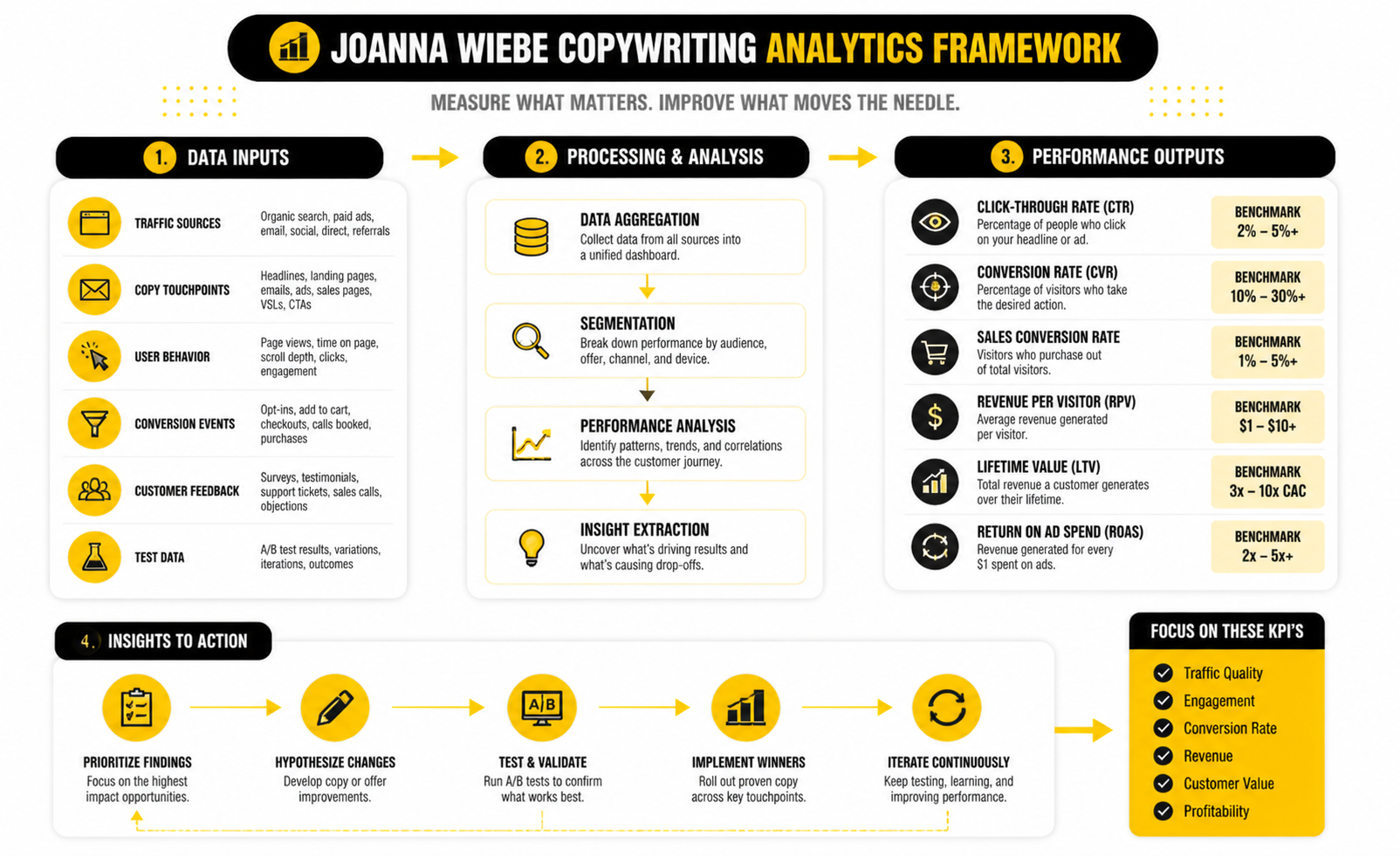
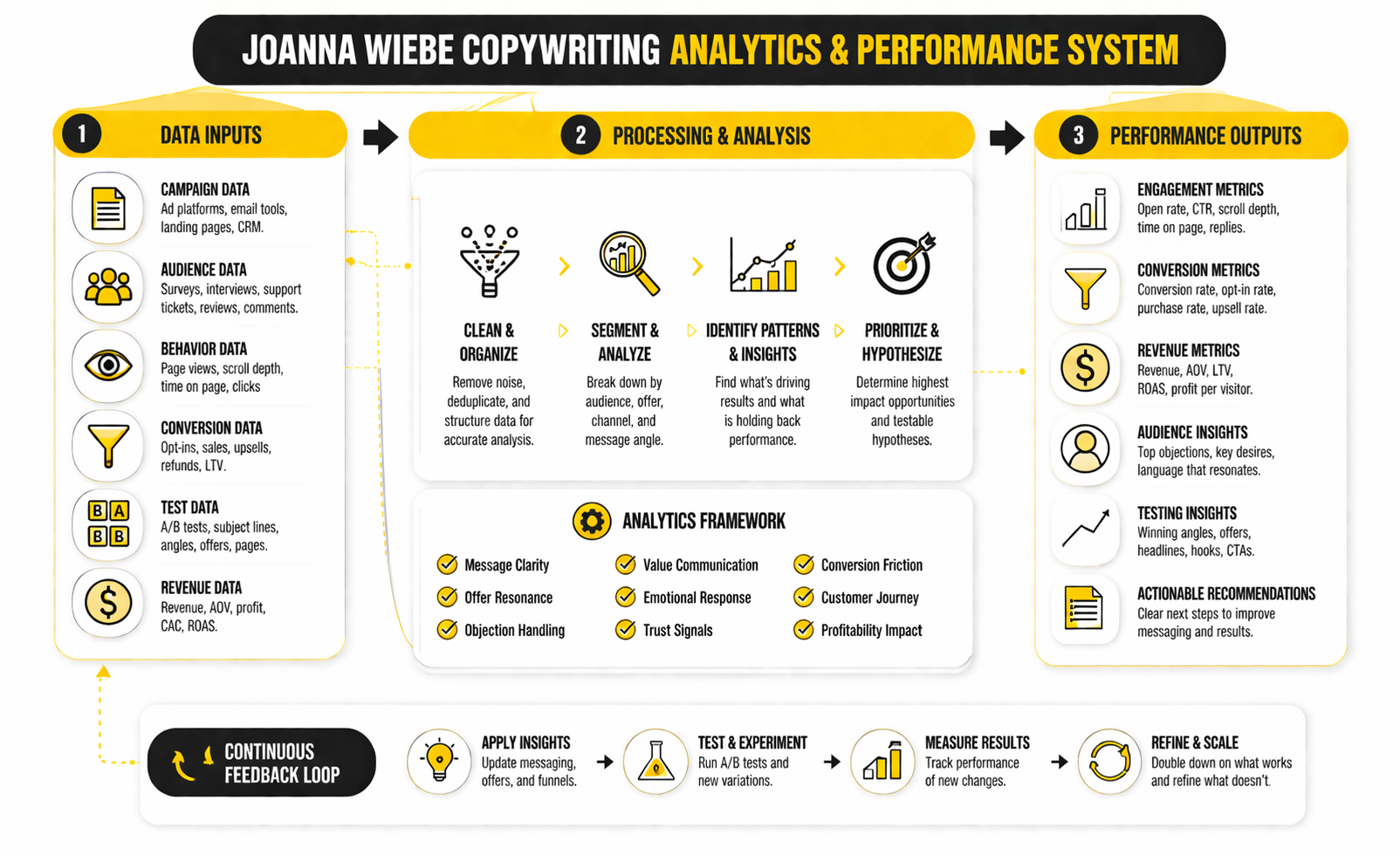
When you write copy in the style of Joanna Wiebe, the real proof isn’t in nice sentences - it’s in measurable performance signals. The data you collect after launch tells you whether your words are actually persuading people to take action, and by interpreting it correctly you can make targeted improvements rather than guessing at what might work.
Tracking these metrics isn’t about obsessing over numbers for their own sake. It’s about understanding what your audience is telling you through their behavior and using that feedback to refine your message and structure.
Why Data Matters in Copywriting
Good copy needs to do two things: capture attention and drive action. Metrics let you quantify both sides of that equation:
Without this context, you’re flying blind - you might think a headline is persuasive, but the data proves whether it actually moves people toward conversion.
Key Metrics Every Conversion Copywriter Watches
Here’s how professionals translate user behavior into insights they can act on:
Conversion Rate (CVR)
This is the single most important metric for conversion copywriting - the percentage of visitors who take your desired action (buy, sign up, download, etc.). If your CVR is low, it usually points to a mismatch between what your audience expects and what your copy delivers. Context matters a lot: average rates vary by industry and traffic source, and comparing against irrelevant benchmarks can mislead you.
Click‑Through Rate (CTR)
CTR measures how compelling your copy is at getting people to click. It’s especially valuable for headlines, email subject lines, and call‑to‑action text. A strong CTR signals your message resonates, while a weak one suggests the offer, framing, or CTA might need tweaking.
Bounce Rate and Time on Page
If visitors leave quickly without engaging, your copy might not be answering key questions or speaking to the right emotions. A high bounce rate paired with short time on page often points to attention problems - which rarely is a design issue alone and usually signals weak opening copy or unclear value.
Engagement Signals
For content beyond landing pages, metrics like social shares, comments, and even scroll depth can tell you how well your message resonates. High engagement often correlates with copy that connects emotionally or offers clear value.
Interpreting These Numbers - What They Really Tell You
Raw metrics are just percentages until you interpret them. Here’s how the best copywriters make sense of the data:
Using Data to Drive Action
Once you understand where your copy is underperforming, the data tells you what to fix. For example:
Data doesn’t replace creativity - it focuses it. The numbers don’t just tell you what’s happening, they tell you why it’s happening and where your next improvement will come from. That’s the essence of applying analytics to conversion copywriting in Joanna Wiebe’s methodological tradition.
Advanced Considerations and Strategic Challenges for Conversion Copywriters
Once you’ve mastered the core mechanics of Joanna Wiebe’s copywriting methodology, the next level of expertise is knowing when and how to adapt the process for complexity, scale, and strategic tradeoffs. Moving beyond basics means balancing data, creativity, organizational constraints, and long‑term value - not just writing persuasive words.
Balancing Personalization and Scalability
One of the biggest strategic tradeoffs in professional copywriting is how deeply to personalize versus how broadly to scale your messaging. Joanna’s framework pushes for intense voice‑of‑customer research to tailor copy around real customer language. That produces higher relevance, but:
Advanced practitioners manage this by prioritizing high‑value segments for deep personalization while using modular messaging elements that can be recombined to address adjacent segments. This hybrid approach preserves relevance where it matters most without blocking progress across the entire funnel.
Integrating Copy with Broader User Experience
In today’s digital environments, copy doesn’t live in isolation. Effective conversion copywriters collaborate with UX designers, product teams, and analytics specialists so messaging aligns with interaction flows, visual hierarchy, and functional expectations. Strategic challenges arise when:
The risk here is message friction - copy that persuades in isolation but leads to cognitive dissonance when the interface or experience falls short. Advanced practitioners use pre‑launch usability testing and cross‑functional walkthroughs to catch disconnects early, ensuring the copy and experience reinforce one another.
Ethical Considerations and Persuasion
Conversion copywriting is inherently persuasive, but there’s a boundary between ethical influence and manipulation. Joanna Wiebe’s teachings underscore empathy and clarity - not trickery. As you scale influence across channels, consider:
Professionals who ignore these questions may see short‑term lifts but risk brand distrust, churn, and regulatory scrutiny - especially in industries like finance, health, or privacy‑sensitive tech.
Working with Limited or Noisy Data
In mature organizations, copywriters often have rich analytics; in early‑stage companies, data may be sparse or inconsistent. Joanna’s framework still applies, but you need to adapt:
This flexible approach prevents “data paralysis” while preserving a commitment to evidence‑based messaging rather than gut feel.
Adapting to Automation and AI Tools
Tools that generate first drafts or suggest variations (including AI copy assistants) are becoming ubiquitous. They accelerate production, but also carry risks:
Advanced copywriters treat AI as a partner in execution - using it to draft variants or explore alternatives - while anchoring decisions in research and performance data. This ensures efficiency without sacrificing the depth of insight Joanna Wiebe’s methodology demands.
Scaling Across Channels and Formats
Copy that converts on a landing page may not translate directly to email, ads, or social content. Each channel has different attention patterns and user expectations. Strategic scaling requires:
This level of systematic scaling transforms isolated wins into sustained growth across the customer journey.
Mastering these advanced considerations ensures your application of Joanna Wiebe’s framework remains effective as complexity increases. Rather than just writing better copy, expert practitioners think strategically about how copy interacts with experience design, organizational goals, ethics, data maturity, and evolving technology. This broader lens is what separates tactical copywriters from strategic conversion architects.
What exactly is a conversion copywriter like Joanna Wiebe?
A conversion copywriter writes persuasive content specifically designed to drive measurable actions such as sales, leads, or signups. Unlike general copywriting, it blends psychology, customer research, and data interpretation to optimize messaging for results.
How does Joanna Wiebe’s approach differ from traditional copywriting?
Joanna Wiebe prioritizes voice‑of‑customer research and structured messaging hierarchies that come before drafting copy. Traditional copywriting often starts with writing first and optimizes later; her method flips that order to base writing on real customer insights first.
Do I need analytics to use Joanna Wiebe’s methodology?
Yes. Analytics help you interpret how real audiences are reacting to your copy. While initial research gives direction, performance data confirms whether your messaging is effective and shows where to refine it.
Can small businesses apply these practices without a big budget?
Absolutely. Many parts of the process rely on user interviews, surveys, and basic web analytics, which can be done with low‑cost tools or even manually. The key is focusing on customer language, not expensive software.
Is conversion copywriting only for landing pages?
No. While landing pages are a common application, the framework applies just as well to email sequences, ads, product pages, and even long‑form content that seeks to persuade and convert.
How long does it take to see results with this framework?
Results vary by channel and traffic volume. Some metrics improve within days of launch if tests run quickly, while deeper funnel improvements may take weeks of iteration as you refine based on performance data.
What’s the role of A/B testing in this process?
A/B testing validates whether specific changes to headlines, calls to action, or sections of copy genuinely improve performance. It takes subjective guesswork out of optimization and roots decisions in measurable outcomes.
Can AI tools help with conversion copywriting?
AI can help generate drafts and explore variants, but it can’t replace voice‑of‑customer research or strategic hierarchy planning. Use AI to accelerate drafts, but always anchor improvements in real customer data and test results.
How do I know if my copy is underperforming versus a broader marketing issue?
If engagement metrics like CTR, bounce rate, and time on page are weak, it usually points to messaging issues. If traffic volume or source quality is the problem, those show up in acquisition data. Comparing multiple signals helps you diagnose whether the copy itself needs work.
Is it worth hiring a professional conversion copywriter?
For businesses where messaging directly impacts revenue, experienced practitioners can accelerate results by applying tested frameworks, setting up accurate measurement, and avoiding common pitfalls that cost time and budget in trial‑and‑error approaches.
Build a stronger local presence with BAAM AI
Turn your website, Google profile, social channels, and AI visibility into one growth engine
Most businesses do not need more random marketing activity. They need a consistent presence system that helps the right people find them, trust them, and take action. BAAM AI brings strategy, local SEO, website updates, Google Maps visibility, social content, AI-search readiness, media production, and reporting into one practical monthly engine.
If you want your marketing to keep working after the campaign ends, start with a free BAAM AI presence audit. See how your business shows up today and where the fastest visibility wins are at BAAM AI.