
BAAM AI Blog
Joanna Wiebe Copywriter: The Practical Guide To Conversion Copywriting
Joanna Wiebe is not famous in copywriting because she writes clever lines. She is famous because she helped turn copywriting into a measurable, research-led growth discipline. Her own site says she “coined conversion...

Joanna Wiebe is not famous in copywriting because she writes clever lines. She is famous because she helped turn copywriting into a measurable, research-led growth discipline. Her own site says she “coined conversion copywriting,” and Copyhackers describes her work as messaging strategy and execution for growth-focused businesses.
That distinction matters. A Joanna Wiebe copywriter does not start with wordplay, brand adjectives, or a blank Google Doc. The work starts with customer language, conversion goals, offer clarity, objections, anxiety, proof, and a page or email that gives the reader enough confidence to act.
Copyhackers, founded by Joanna Wiebe in 2011, has built its positioning around helping startups and teams find high-converting messages in voice-of-customer data. That idea is now everywhere in modern conversion copywriting, but it still gets skipped by teams that want “better copy” without doing the research behind it. The result is predictable: polished copy that sounds good internally but fails when real buyers read it.
this guide breaks down what makes Joanna Wiebe’s approach useful, where it came from, and how professionals can apply it without turning it into a shallow formula. We will look at the strategy behind conversion copywriting, the research inputs that shape strong messaging, the page-level and email-level decisions that make copy perform, and the implementation standards that separate serious copy work from guesswork.
Why Joanna Wiebe Still Matters In Modern Copywriting
The reason Joanna Wiebe still matters is simple: most businesses do not have a writing problem first. They have a clarity problem, a research problem, or a persuasion problem hiding behind the writing. Conversion copywriting forces those problems into the open because the goal is not to sound impressive; the goal is to help the right reader understand why this offer matters now.
That is why her work has stayed relevant across SaaS, ecommerce, service businesses, creator offers, and B2B funnels. Shopify’s own overview of conversion copywriting frames it as copy built around customer research, pain points, value proposition, and a specific action, which is very close to the practical world Joanna Wiebe helped popularize. The market keeps changing, but buyers still need the same basic things before they convert: relevance, trust, proof, clarity, and momentum.
This is also why weak AI-generated copy is so easy to spot. It usually sounds fluent, but it does not know what the customer already tried, what they fear, what they secretly want, or what would make them believe. A strong Joanna Wiebe copywriter uses research to make the copy feel specific enough that the reader thinks, “That is exactly what I was trying to say.”
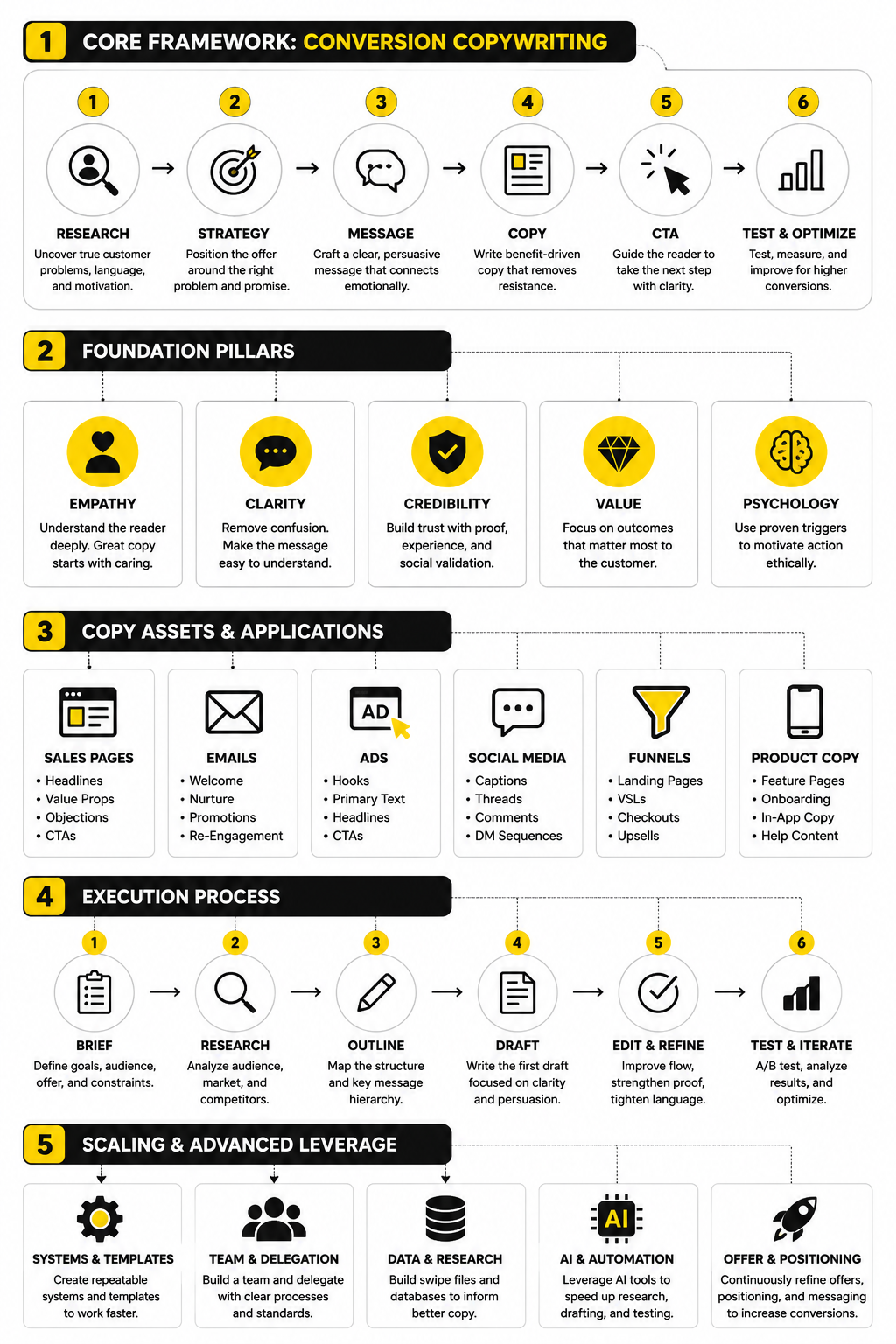
The Conversion Copywriting Framework
The practical value of Joanna Wiebe’s work is that it gives copywriting a process. Not a vibe. Not a brainstorming session. A process.
That process starts with the idea that copy is not invented from scratch. It is assembled from evidence. A serious Joanna Wiebe copywriter studies the market, the customer, the offer, the page goal, the reader’s stage of awareness, and the emotional pressure behind the buying decision before writing the first headline.
This is where conversion copywriting separates itself from general content writing. Content writing can educate, entertain, or explain. Conversion copywriting has a sharper job: move a specific reader toward a specific action with the least possible confusion and the strongest possible reason to continue.
Start With The Reader’s Stage Of Awareness
A strong page does not speak to every reader in the same way. Someone who already knows they need a landing page builder does not need the same message as someone who is still wondering why their offer is not converting. That is why awareness level matters so much in a Joanna Wiebe copywriter workflow.
At the simplest level, your reader may be unaware, problem-aware, solution-aware, product-aware, or most-aware. The more aware they are, the more direct your copy can be. The less aware they are, the more work the copy has to do to name the problem, frame the pain, and connect the reader’s current situation to a believable next step.
This is one of the biggest reasons generic landing pages underperform. They jump straight into features when the reader is still trying to understand the cost of staying where they are. Or they spend 900 words explaining the problem to a reader who is already ready to compare options. Good conversion copy meets the reader where they actually are.
Clarify The One Action The Copy Must Drive
Conversion copywriting gets weaker when the page tries to do too many jobs at once. A homepage can support multiple paths, but a landing page, sales page, email, or ad usually needs one dominant action. The copy should make that action feel natural, low-friction, and worth taking now.
That does not mean every page needs aggressive selling. Sometimes the right action is booking a demo, starting a free trial, joining a waitlist, downloading a lead magnet, replying to an email, or clicking through to a pricing page. The point is that the copy has to know what it is moving the reader toward.
This is especially important when teams build funnels. If you are using a tool like ClickFunnels, GoHighLevel, or Systeme.io, the platform can help you publish the funnel, but it cannot decide the persuasion logic for you. The sequence still needs a clean message, a clear offer, and a reason for each click.
Build The Message Before Writing The Page
One of the most useful lessons from Joanna Wiebe’s approach is that the message comes before the format. A landing page is not a design container waiting to be filled with words. An email is not a subject line plus a few persuasive paragraphs. A sales page is not a stack of sections copied from a template.
The message is the core argument. It explains why this offer matters, who it is for, what changes after the reader acts, what objections might stop them, and what proof makes the promise believable. Once that message is clear, the page structure becomes much easier to build.
This is why experienced copywriters spend so much time on research and positioning. They are not delaying the writing. They are reducing the chance that the final copy will be polished but wrong. In conversion work, wrong-but-polished is expensive.
Use Research To Replace Guessing
The conversion copywriting framework depends on research because the customer already has the raw material you need. They describe the pain in their own words. They reveal the objections. They compare alternatives. They explain what finally made them trust a solution.
That language is more valuable than internal brainstorming because customers do not speak like marketing teams. They are usually more specific, more emotional, and more practical. They talk about missed deadlines, wasted budget, embarrassing reporting calls, confusing tools, slow approvals, and the quiet frustration of knowing something should be working better than it is.
A Joanna Wiebe copywriter looks for those patterns and turns them into usable messaging. Not by copying customer quotes blindly, but by finding the phrases, themes, anxieties, and desired outcomes that show up repeatedly. That is where the copy starts to feel real.
Match The Offer To The Moment
The same offer can fail or convert depending on when and how it appears. A cold visitor may not be ready for a sales call. A warm lead who has read three case studies may not need another educational email. A returning visitor on a pricing page may need reassurance, comparison help, or a clear next step.
This is why conversion copywriting is not just about the page in isolation. The page sits inside a journey. The message before the click shapes what the reader expects after the click, and the next step has to feel like a continuation instead of a bait-and-switch.
For ecommerce and landing-page teams, this is where tools like Replo can be useful because they make it easier to build and test dedicated page experiences. But again, the tool is not the strategy. The strategy is knowing what the visitor needs to believe at that exact moment.
Turn The Framework Into A Working Draft
Once the research, awareness level, action, message, and offer moment are clear, the first draft becomes less mysterious. You are no longer asking, “What should I write?” You are asking, “What does this reader need to understand, believe, feel, and do next?”
That shift matters. It keeps the copy focused on the reader instead of the writer. It also makes editing easier because every line can be judged against a real job: does this line increase clarity, trust, desire, urgency, or action?
This is the heart of the framework. A Joanna Wiebe copywriter does not win by being louder than everyone else. The win comes from being more precise, more customer-led, and more disciplined about connecting the message to the conversion goal.
Voice-Of-Customer Research And Message Mining
This is where the Joanna Wiebe copywriter process becomes practical. You stop guessing what the market cares about and start collecting the language people already use when they talk about the problem, the product, the alternative, and the outcome they want. That sounds simple, but it changes everything.
Voice-of-customer research is not just “customer feedback.” It is the raw material for positioning, headlines, objections, proof points, email angles, and page structure. Copyhackers has long described its work around helping startups find high-converting messages in voice-of-customer data, and that is the useful lens here: the best copy is usually hiding in what real buyers already said.
The goal is not to paste random customer quotes into your page. The goal is to find patterns. When the same frustration, fear, comparison, or desired result appears again and again, you are no longer looking at an isolated comment. You are looking at message-market fit.
Start With The Right Research Inputs
A strong research process pulls from more than one source. Customer interviews show motivation and emotional context. Surveys help you spot patterns at a larger scale. Reviews, sales calls, support tickets, demo notes, chat logs, cancellation feedback, and competitor reviews reveal the words people use when nobody from marketing is telling them what to say.
This matters because each source has a different kind of honesty. A sales call shows what prospects need to believe before buying. A support ticket shows what customers struggle with after they buy. A competitor review shows what the market expected, what disappointed them, and what they still want.
Do not treat all research as equal. A vague compliment is weak. A specific line about a costly problem, a failed alternative, or the moment someone decided to buy is much stronger. The more concrete the language, the more useful it becomes for conversion copy.
Mine For Repeated Customer Language
Message mining is the disciplined part of the process. You collect the raw language, tag it, sort it, and look for phrases that reveal what the reader actually cares about. This is where a Joanna Wiebe copywriter starts to see the page before writing it.
Useful tags usually include pain points, desired outcomes, objections, triggers, alternatives, anxieties, proof needs, feature requests, buying criteria, and memorable phrases. The point is not to create a pretty spreadsheet. The point is to make the customer’s thinking visible so the final copy can follow the buyer’s logic instead of the company’s internal assumptions.
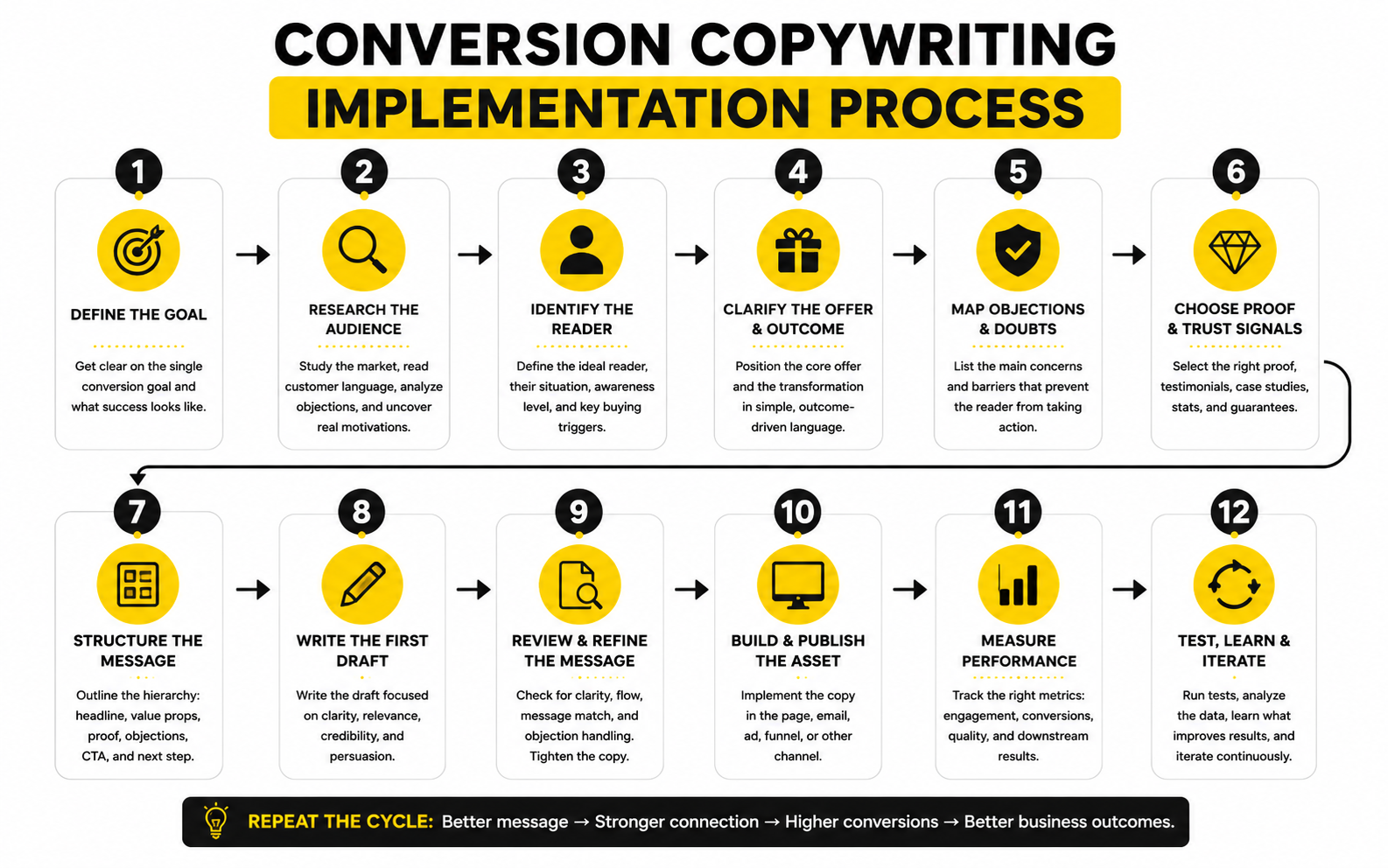
A simple message-mining workflow can look like this:
Separate Problems From Symptoms
One of the easiest mistakes is treating symptoms as the real problem. A customer might say they need “better email marketing,” but the deeper problem may be weak follow-up, poor lead quality, no segmentation, unclear offers, or a sales process that depends too much on manual work. If you only write to the surface-level symptom, your copy sounds generic.
This is why research needs interpretation. You are listening for what the customer says, but you are also looking for the pressure behind it. A buyer who complains about low conversions may really be worried about wasted ad spend, a failed launch, investor expectations, or looking unprepared in front of their team.
The copy becomes stronger when it connects the surface problem to the real cost of inaction. Not through exaggeration. Through clarity. When the reader sees that you understand what the problem is actually doing to their business, the offer becomes more relevant.
Turn Objections Into Copy Assets
Objections are not interruptions to the sale. They are part of the sale. A good conversion page does not hide from doubt; it handles doubt before the reader uses it as a reason to leave.
The most useful objections usually fall into a few buckets. The reader may doubt the promise, doubt the price, doubt their own ability to implement, doubt the timing, doubt the company, or doubt whether the product is really different from the alternatives. Each one needs a different kind of answer.
A Joanna Wiebe copywriter does not respond to those doubts with hype. The copy needs proof, specificity, contrast, process clarity, risk reduction, or a better explanation of value. If the reader is thinking, “This sounds good, but will it work for someone like me?” the answer should not be louder copy. It should be evidence that makes the next step feel safer.
Build A Message Hierarchy Before Drafting
Once the research is organized, the next move is building a message hierarchy. This is the order of importance behind the copy. It decides what goes first, what supports the main idea, what needs proof, and what can be cut.
The top of the hierarchy is usually the core promise. Under that sit the main pains, desired outcomes, proof points, differentiators, objections, and calls to action. This keeps the page from becoming a pile of disconnected benefits.
The message hierarchy is especially useful when teams disagree. Without it, everyone argues from preference. With it, the discussion becomes more grounded: which message is most relevant to the reader’s awareness level, buying stage, and conversion goal?
Write From The Research, Not Around It
Research should not disappear once writing starts. It should shape the headline, subhead, section order, proof blocks, FAQs, CTA language, and even what gets removed. The page should feel like a natural answer to the strongest themes found in the research.
This does not mean the copy has to sound messy or overly literal. Customer language often needs tightening. The job is to preserve the truth of what people said while making the final message clearer, sharper, and easier to act on.
That is the practical difference between research-led copy and generic copy. Generic copy says what the company wants to say. Research-led conversion copy says what the reader needs to hear in order to move forward with confidence.
Statistics And Data That Actually Improve The Copy
Measurement is where conversion copywriting gets honest. A Joanna Wiebe copywriter can have a strong research process, a sharp message hierarchy, and a clean draft, but the market still gets the final vote. The numbers show whether the copy is creating clarity, reducing doubt, and moving the right people to the next step.
The danger is treating benchmarks like commandments. A SaaS landing page, an ecommerce product page, a webinar registration page, and a high-ticket agency funnel should not be judged by the same conversion rate. Unbounce’s conversion benchmark report is useful because it shows performance by industry and page type, which is exactly how benchmarks should be used: as context, not as a universal target.
This is the right mindset. Data should not make you panic. It should tell you where to look next.
Conversion Rate Is A Signal, Not The Whole Story
Conversion rate is usually the first number people watch, but it is not always the most useful number by itself. A page converting at 12% might look strong until you realize the leads are low quality, unqualified, or unlikely to buy. A page converting at 3% might be doing its job perfectly if it is selling a complex, expensive, high-consideration offer to a narrow audience.
This is why the conversion goal must be defined before the copy is judged. A demo request, checkout, quiz completion, webinar registration, email opt-in, booked call, and free trial signup all carry different levels of intent. The closer the action is to revenue, the more carefully you need to evaluate lead quality alongside conversion volume.
A practical Joanna Wiebe copywriter looks at conversion rate as one part of a bigger picture. The real question is not “Did more people click?” The better question is “Did the right people move forward with more confidence?”
Benchmarks Help You Find The Right Problem
Benchmarks are useful when they help you diagnose, not when they become vanity comparisons. If your landing page sits far below the range for your category, the copy may be unclear, the offer may be weak, the traffic may be mismatched, or the page may be asking for too much too soon. The number does not tell you the answer automatically, but it tells you the investigation is worth doing.
For ecommerce, cart abandonment is a good example. Baymard’s large-scale cart abandonment research continues to show that most carts are abandoned, and the reasons often involve extra costs, account creation, delivery concerns, checkout friction, and trust issues. That does not mean the fix is “write a better headline.” It means the copy, UX, pricing clarity, shipping language, trust signals, and checkout flow need to work together.
Email benchmarks need the same restraint. HubSpot’s email benchmark overview shows that opens, clicks, unsubscribes, and bounce rates vary heavily by industry and list type. So a low click-through rate might be a copy problem, but it might also be a list quality problem, segmentation problem, deliverability problem, or offer problem.
The Measurement System Should Follow The Reader Journey
You need a simple measurement system before you start rewriting. Otherwise, every weak number becomes a copy problem, and every strong number becomes a reason to stop improving. Neither reaction is useful.
The cleanest setup is to track the journey in layers. First, look at the traffic source and intent. Then look at the page or email engagement. Then look at the conversion event. Finally, look at the quality of what happened after the conversion.
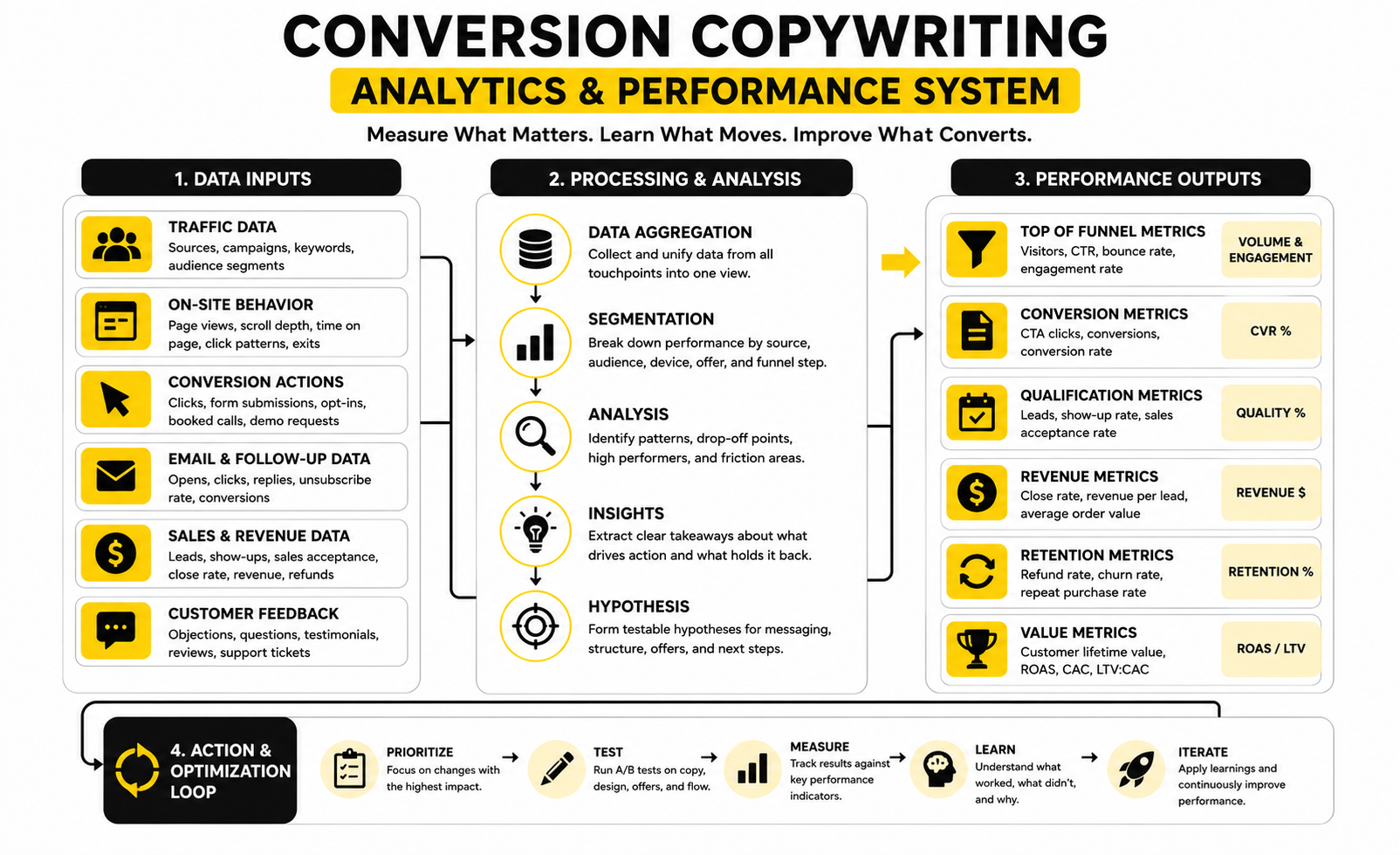
A practical measurement flow looks like this:
This is where the execution becomes tangible. You are not “optimizing copy” in the abstract. You are finding the point where the reader loses confidence, gets confused, feels risk, or fails to see enough value to continue.
Page Data Shows Where The Message Breaks
Landing page analytics can reveal where the copy is failing, but you have to interpret the behavior carefully. A high bounce rate from cold traffic may mean the opening message is not matching the ad or search intent. Weak scroll depth may mean the above-the-fold section is not creating enough reason to continue. Heavy engagement with no conversions may mean the reader is interested but unconvinced.
This is where qualitative research and analytics need to sit next to each other. Analytics tells you what happened. Research helps explain why it happened. If people scroll to the pricing section and leave, the issue may be price, but it may also be insufficient proof, unclear value, poor plan comparison, missing risk reversal, or a CTA that feels too demanding.
A Joanna Wiebe copywriter does not rewrite randomly after seeing weak numbers. They form a hypothesis. For example, “Visitors understand the feature, but they do not believe the outcome,” or “Prospects want the offer, but the implementation section does not reduce enough risk.” That hypothesis guides the next copy test.
Email Data Reveals Attention And Intent
Email performance needs a different lens because the reader is not sitting on a page. They are moving through an inbox full of competing priorities. Subject lines affect opens, but opens alone do not prove the message worked. Clicks, replies, booked calls, purchases, and downstream revenue matter more.
Email data is most useful when it is tied to the role of the email in the sequence. A welcome email should build trust and orient the reader. A nurture email should increase desire or resolve a belief gap. A sales email should make the next step feel relevant and timely. A reactivation email should give people a reason to care again.
Automation adds another layer. MoEngage’s 2025 email benchmark report highlights the performance role of personalized offers, product recommendations, and automated customer flows. That matters because email copy usually performs better when timing, segmentation, and intent are aligned, not when every subscriber gets the same message at the same moment.
The Best Tests Come From Strong Hypotheses
A/B testing is not a magic button. Testing a random headline against another random headline only tells you which random idea performed better in that traffic sample. The better approach is testing a clear persuasion hypothesis based on research and data.
Useful tests are usually built around one of these questions:
This is how measurement connects back to the Joanna Wiebe copywriter process. The data does not replace research. It sharpens it. Every test should teach you something about the reader, the offer, the message, or the moment.
What To Do When The Numbers Look Bad
Bad numbers are not the enemy. Vague numbers are the enemy. If a page is underperforming, the first move is not to rewrite everything. The first move is to isolate the likely point of failure.
Start with message match. If the ad, search result, or email promises one thing and the page opens with something else, fix that first. Then check clarity. If the reader cannot understand the offer, audience, outcome, and next step within a few seconds, the copy is making them work too hard.
After that, look at proof, objections, and friction. A reader may want the outcome but still feel unsure about implementation, price, trust, timing, or fit. Strong conversion copy does not ignore those doubts. It handles them in the order the reader is most likely to feel them.
What To Do When The Numbers Look Good
Good numbers can be dangerous because they make teams lazy. A strong conversion rate does not automatically mean the copy is finished. It may mean the traffic is warm, the offer is urgent, the audience is small, or the page is working well enough despite obvious gaps.
When the numbers look good, look downstream. Are converted leads showing up? Are they qualified? Are trials activating? Are buyers retaining? Are customers using the product or requesting refunds? A page that creates more conversions but worse customers is not an improvement.
This is where performance copy becomes a business asset instead of a campaign asset. The goal is not to win one test. The goal is to keep tightening the connection between what the reader needs, what the offer delivers, and what the business can profitably support.
Professional Implementation Across Pages, Emails, And Funnels
Advanced conversion copywriting is not about making one page sound better. It is about making the whole customer journey feel consistent, credible, and easy to move through. That is where a Joanna Wiebe copywriter has to think beyond the draft and start thinking like a growth strategist.
The message has to survive across ads, landing pages, emails, sales calls, onboarding flows, and retention campaigns. If each touchpoint says something slightly different, the reader has to keep rebuilding trust from scratch. That creates friction, and friction is expensive.
This is why professional implementation needs rules. Not rigid scripts, but shared message decisions that keep the team aligned. The offer promise, proof points, objections, audience language, CTA logic, and product positioning should not change every time a new asset is created.
The Tradeoff Between Clarity And Creativity
Good copy needs energy, but clarity wins first. A clever headline that makes the team smile can still fail if the reader has to work too hard to understand what is being offered. In performance copy, confusion is not a style choice. It is a conversion leak.
That does not mean every line has to be plain or boring. The best copy often feels sharp because it says something true in a way the reader has not heard before. But the creative layer should sit on top of a clear message, not replace it.
This is the tradeoff professional copywriters have to manage. You want distinction, but not at the cost of comprehension. You want personality, but not at the cost of proof. You want emotional pull, but not at the cost of a believable next step.
The Risk Of Over-Optimizing One Metric
Once analytics enter the conversation, teams can become obsessed with the easiest metric to improve. That might be clicks, opt-ins, free trial signups, webinar registrations, or booked calls. The problem is that easy gains can create hidden losses later in the funnel.
A stronger CTA can increase clicks while reducing lead quality. A more aggressive promise can increase opt-ins while increasing refunds. A shorter form can increase volume while sending more unqualified prospects to sales. This is not a win if the business pays for it later.
The better move is to define the success chain before optimizing. For a booked-call funnel, that may mean landing page conversion, show-up rate, sales acceptance, close rate, and customer fit. For a SaaS trial, it may mean signup, activation, product usage, upgrade, and retention. The copy should help the whole chain, not just the first number.
Scaling Copy Without Losing The Message
Scaling is where many teams break their own messaging. The original sales page works, so they turn it into ads, emails, webinar slides, retargeting copy, social posts, and nurture sequences. Then every channel gets edited by a different person until the original insight disappears.
The fix is a message system. Keep a shared source of truth that includes the core promise, audience segments, objections, approved claims, proof assets, competitor contrasts, CTA language, and phrases pulled from voice-of-customer research. This lets the team move faster without inventing new positioning every week.
This is also where AI can help if you use it carefully. AI can turn approved messaging into draft variations, summarize research, cluster objections, and adapt copy for different formats. But it should not replace the strategic judgment behind the message. McKinsey’s work on personalization points to better data, decisioning, design, distribution, and measurement as the foundation of stronger customer experiences, which is the useful lesson here: better outputs depend on better inputs.
Advanced Segmentation Changes The Copy Strategy
A single message can work when the audience is narrow. But as traffic sources, buyer types, and use cases expand, one generic page starts doing too much. Different readers may share the same broad problem while caring about completely different outcomes.
A founder may care about speed and revenue. A marketing manager may care about reporting and campaign performance. A sales leader may care about lead quality. A finance buyer may care about cost, risk, and operational control. If the copy treats all of them as the same person, the message becomes too soft to persuade anyone deeply.
This is where segmentation becomes a strategic decision, not just a CRM setting. You may need different landing pages, email paths, demo angles, proof points, or comparison pages for different segments. Tools like GoHighLevel, Brevo, and ManyChat can support segmentation and follow-up, but the real leverage still comes from knowing what each segment needs to believe.
Proof Needs To Match The Promise
Proof is not decoration. It is the bridge between the claim and the reader’s willingness to act. The bigger the promise, the stronger and more specific the proof needs to be.
A testimonial can help, but only if it answers a real doubt. A case study can help, but only if the reader can see enough context to trust the result. Logos can help, but only if they signal relevance. Numbers can help, but only if they are honest, explainable, and tied to the offer.
A Joanna Wiebe copywriter should choose proof based on the objection it resolves. If the reader doubts whether the product works, show outcomes. If they doubt whether it works for their type of business, show fit. If they doubt implementation, show process. If they doubt the company, show credibility and consistency.
When Long Copy Works And When It Hurts
Long copy is not automatically better. Short copy is not automatically cleaner. The right length depends on awareness, risk, complexity, price, urgency, and how much the reader already believes before arriving.
Longer copy tends to earn its place when the offer is expensive, unfamiliar, high-risk, or belief-heavy. The reader needs more context, more proof, more objection handling, and more reassurance. Shorter copy can work when the reader is already warm, the offer is simple, the next step is low-risk, or the value is obvious.
The mistake is deciding length before understanding the buying decision. If the reader needs confidence, cutting the page can remove the exact material that would have helped them act. If the reader is ready, adding more explanation can slow them down.
Brand Voice Should Not Fight Conversion
Brand voice matters, but it should support persuasion instead of competing with it. A brand can be bold, calm, technical, playful, premium, rebellious, or plainspoken and still convert. The issue is not the voice itself. The issue is whether the voice makes the message easier or harder to believe.
Some teams hide weak positioning behind brand voice. They say the copy needs to sound more “elevated,” “fresh,” or “human,” when the real problem is that the offer is unclear. Others flatten strong copy because they are afraid of sounding too direct. Both moves can weaken performance.
The practical rule is simple: keep the voice, but protect the message. If a brand phrase makes the reader more confident, keep it. If it creates distance, ambiguity, or unnecessary cleverness, cut it. Conversion copy does not need to sound generic to perform, but it does need to respect the reader’s attention.
The Copywriter’s Role Gets More Strategic At Higher Levels
At a beginner level, copywriting looks like writing headlines, pages, and emails. At a higher level, the work becomes diagnosis. Why is the page underperforming? Why do prospects hesitate? Why does the offer sound similar to competitors? Why are leads converting but not buying?
That is why the best conversion copywriters ask harder questions before they write. They look at the funnel, the research, the sales conversations, the product promise, the traffic source, the proof, and the reader’s decision stage. The final words matter, but the thinking behind the words matters more.
This is the part many people miss when they search for Joanna Wiebe copywriter advice. The visible output is copy. The real asset is judgment. The more complex the funnel, the more that judgment matters.
Mistakes, Tools, FAQs, And How To Apply The Method
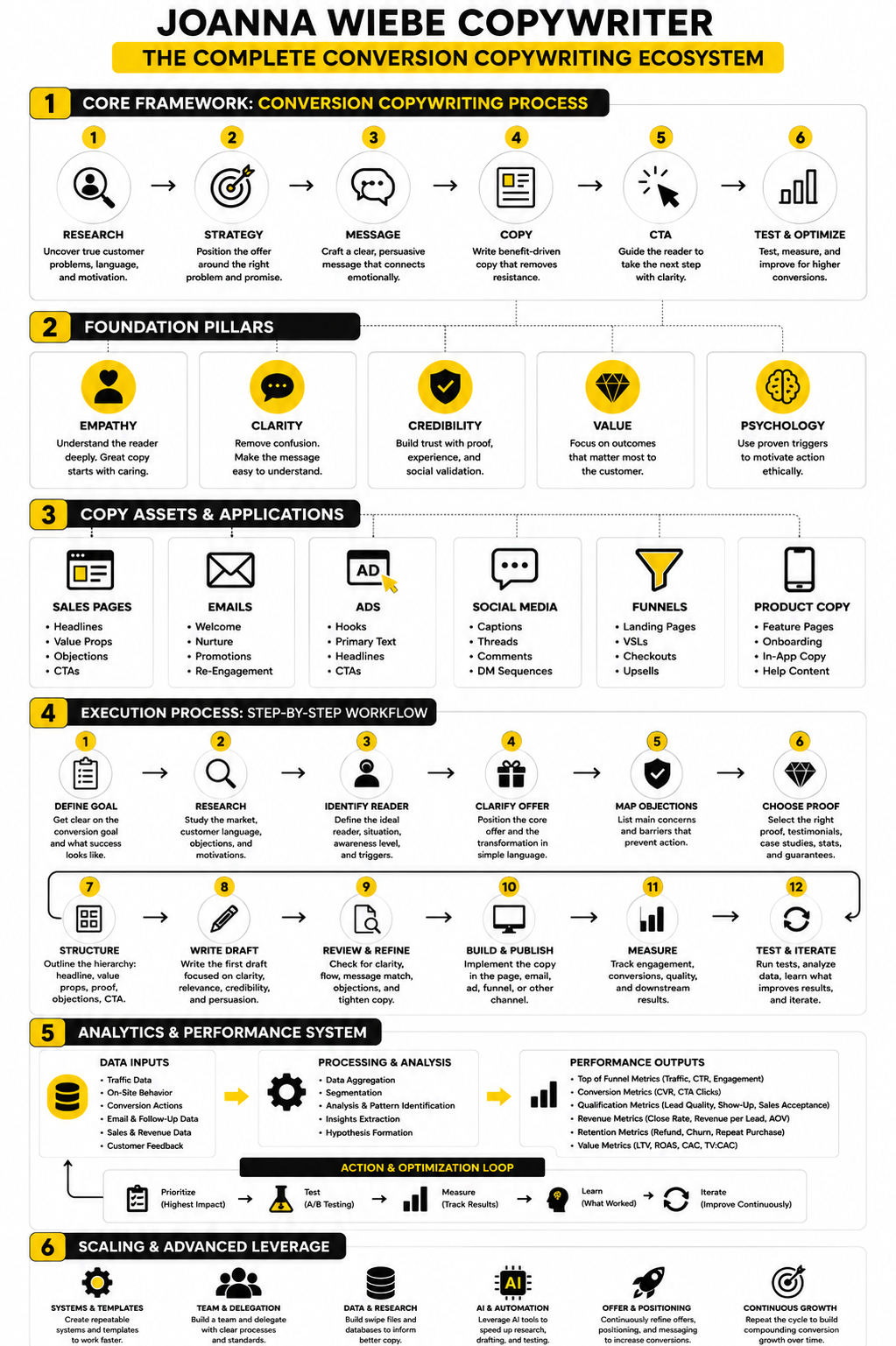
By this point, the pattern should be clear. A Joanna Wiebe copywriter does not treat copy as decoration. The work connects research, strategy, execution, measurement, and iteration into one system that helps the right reader make a confident decision.
That system is powerful, but it is also easy to misuse. People hear “voice of customer” and paste customer quotes everywhere. They hear “conversion” and make the copy pushier. They hear “testing” and start changing button text before they have fixed the offer, audience, or message match.
The better approach is calmer and more useful. Build the ecosystem first. Know who the copy is for, what they need to believe, what proof they need, what action they should take, and how you will know whether the copy is working.
Common Mistakes To Avoid
The first mistake is writing before the research is clear. This usually produces copy that sounds competent but generic. It may describe the product accurately, but it does not reflect the emotional or practical reasons the reader is looking for a solution now.
The second mistake is confusing persuasion with pressure. Strong conversion copy does not need to bully the reader. It earns momentum by making the offer easier to understand, easier to trust, and easier to act on.
The third mistake is treating frameworks like templates. A framework can help you think, but it cannot replace judgment. If the page structure ignores the reader’s awareness level, the offer complexity, or the objections found in research, the copy will feel mechanical.
The fourth mistake is measuring only the first conversion. More opt-ins, clicks, or booked calls can look exciting while quietly hurting sales quality. Professional copywriting has to care about what happens after the click.
The fifth mistake is letting tools drive the strategy. Funnels, landing page builders, AI assistants, email platforms, and chat automation can all help execution. But none of them can decide the message that makes your audience care.
Who Is Joanna Wiebe?
Joanna Wiebe is a copywriter, founder of Copyhackers, and one of the best-known names in conversion copywriting. Her own site says she coined the term conversion copywriting, and Copyhackers describes her as the original conversion copywriter. For readers studying serious performance copy, her work is useful because it connects customer research, persuasion, messaging, and measurable business outcomes.
What Does A Joanna Wiebe Copywriter Actually Do?
A Joanna Wiebe copywriter uses research to write copy that helps a specific audience take a specific action. That can include landing pages, sales pages, emails, onboarding flows, ads, website messaging, and funnel copy. The important part is that the writing is not based on guesses or clever phrasing alone; it is built from customer language, offer strategy, objections, proof, and conversion goals.
What Is Conversion Copywriting?
Conversion copywriting is copy designed to move the reader toward a meaningful action. Copyhackers defines conversion copywriting as copy that moves readers toward “yes” using voice-of-customer data, frameworks, formulas, and proven persuasion techniques. In practical terms, it means every section has a job: clarify the offer, build trust, handle doubt, increase desire, or make the next step feel obvious.
Is Conversion Copywriting Only For Landing Pages?
No, landing pages are only one use case. The same principles apply to email sequences, product pages, pricing pages, sales pages, onboarding flows, ads, lead magnets, checkout flows, and even sales enablement assets. Anywhere the reader has to make a decision, conversion copywriting can improve the quality of that decision path.
Why Is Voice-Of-Customer Research So Important?
Voice-of-customer research helps you understand how buyers describe their own problems, goals, fears, and buying criteria. That matters because customers usually speak with more specificity than marketing teams do. When you use that research well, the copy feels more relevant because it reflects the reader’s actual thinking instead of the company’s internal language.
Does A Joanna Wiebe Copywriter Copy Customer Quotes Directly?
Sometimes a customer phrase can inspire a headline, subhead, email angle, or proof block, but direct copying is not the whole method. The real skill is pattern recognition. A copywriter studies repeated phrases, strong emotions, objections, desired outcomes, and buying triggers, then turns those patterns into clearer messaging.
How Is This Different From Regular Copywriting?
Regular copywriting can include brand campaigns, slogans, social posts, content, ads, and general promotional writing. Conversion copywriting is narrower and more accountable. It focuses on moving a defined reader toward a defined action while using research, structure, persuasion, and measurement to improve performance.
Can AI Replace A Conversion Copywriter?
AI can help with drafting, summarizing research, creating variations, organizing themes, and speeding up execution. It cannot replace the strategic judgment needed to choose the right message, interpret customer psychology, understand the offer, or decide what should be tested next. Used well, AI is an assistant. Used lazily, it produces fluent copy that often misses the real buying reason.
What Metrics Should You Track?
Track the metrics that match the job of the asset. For a landing page, that may include traffic source, bounce rate, scroll depth, CTA clicks, form completions, booked calls, qualified leads, and downstream revenue. For email, that may include deliverability, opens, clicks, replies, conversions, unsubscribes, and revenue per subscriber.
What Is A Good Conversion Rate?
There is no universal good conversion rate. A simple lead magnet, a high-ticket booked call, a SaaS trial, and an ecommerce checkout all have different levels of friction and intent. Benchmarks are useful for context, but your best standard is whether the page produces qualified action profitably and consistently.
How Long Should Conversion Copy Be?
The copy should be as long as the decision requires and as short as clarity allows. A low-risk, familiar offer may need very little copy. A high-risk, expensive, unfamiliar, or belief-heavy offer usually needs more explanation, proof, objection handling, and reassurance.
What Tools Help With Conversion Copywriting?
Useful tools depend on the workflow. Landing page and funnel tools like ClickFunnels, GoHighLevel, Systeme.io, and Replo can help with publishing and testing. Email and automation tools like Brevo, Moosend, and ManyChat can support follow-up, segmentation, and customer journeys. The tool only helps if the message is already clear.
How Do You Start Applying Joanna Wiebe’s Method?
Start with one conversion asset, not the whole business. Pick a landing page, sales email, product page, or funnel step that matters. Then collect customer language, identify the reader’s awareness level, define the one action, map the biggest objections, choose the proof, write the draft, and measure the result.
What Should A Beginner Copywriter Learn First?
A beginner should learn research before tricks. Headlines, hooks, formulas, and CTAs matter, but they work better when they come from real customer insight. If you can understand the reader better than your competitors do, the copy gets easier and the final message becomes much harder to ignore.
When Should A Business Hire A Specialist?
Hire a specialist when the offer is valuable enough that weak messaging is costing real money. That usually means paid traffic is active, sales calls are happening, launches matter, email revenue matters, or the team cannot clearly explain why buyers choose them. A strong conversion copywriter can help diagnose the message, not just rewrite the page.
What Is The Biggest Takeaway From This Guide?
The biggest takeaway is that conversion copywriting is a business process, not a writing mood. The words matter, but the research, strategy, proof, measurement, and iteration behind the words matter more. That is why the Joanna Wiebe copywriter approach remains useful: it gives teams a practical way to turn customer understanding into copy that performs.
Build a stronger local presence with BAAM AI
Turn your website, Google profile, social channels, and AI visibility into one growth engine
Most businesses do not need more random marketing activity. They need a consistent presence system that helps the right people find them, trust them, and take action. BAAM AI brings strategy, local SEO, website updates, Google Maps visibility, social content, AI-search readiness, media production, and reporting into one practical monthly engine.
If you want your marketing to keep working after the campaign ends, start with a free BAAM AI presence audit. See how your business shows up today and where the fastest visibility wins are at BAAM AI.