
BAAM AI Blog
Jay Abraham Copywriting: The Practical Framework Behind Stronger Offers, Sharper Messaging, and More Profitable Marketing
Jay Abraham copywriting is not really about clever lines. It is about seeing the business behind the words before you write the words. That is the part most marketers skip, and it is also why their copy sounds busy...
Jay Abraham copywriting is not really about clever lines. It is about seeing the business behind the words before you write the words. That is the part most marketers skip, and it is also why their copy sounds busy but does not move people.
Jay Abraham built his reputation around finding hidden growth inside existing businesses, not just creating louder ads. His official site describes his work as influencing more than $75 billion in documented revenue growth across 10,000+ companies, which matters because his copywriting ideas are tied to strategy, offer design, customer value, and risk reduction rather than isolated writing tricks: Jay Abraham’s business growth work.
That is why this guide will not treat Jay Abraham copywriting as a swipe-file exercise. We will use it as a practical operating system for better marketing. The goal is simple: understand the buyer more deeply, make the offer more valuable, remove more friction, and communicate with the authority of someone who genuinely wants the customer to win.
this guide is split into six parts so the ideas build in the right order. Jay Abraham’s approach only works when the strategy, market insight, offer, copy, and implementation all support each other. Read it like a working framework, not a list of random copywriting tips.
Why Jay Abraham Copywriting Still Matters
The market is noisier than ever, but buyers are not asking for more noise. They are asking for relevance, clarity, proof, and confidence before they give a business their attention. That is exactly where Jay Abraham’s thinking still feels modern, because it pushes copywriters to stop “pitching harder” and start increasing the customer’s advantage.
Modern research keeps pointing in the same direction. McKinsey found that 71% of consumers expect personalized interactions and 76% get frustrated when that does not happen, which is another way of saying generic copy is no longer just weak; it actively costs trust: McKinsey on personalization expectations. Nielsen’s 2025 marketing research also emphasizes the need to balance short-term performance with long-term brand clarity, which fits Abraham’s approach because strong direct response should not destroy positioning while chasing conversions: Nielsen 2025 Annual Marketing Report.
The key shift is this: copy is not the starting point. The starting point is the customer’s desired outcome, the business’s hidden assets, the offer’s real value, and the risks stopping the buyer from acting. Once those pieces are clear, the copy becomes much easier to write and much harder for competitors to imitate.
Framework Overview
Jay Abraham copywriting works best when you treat it as a business growth framework with copy as the visible layer. The words on the page matter, but they are only as strong as the thinking underneath them. Weak strategy creates weak copy, even when the sentences sound polished.
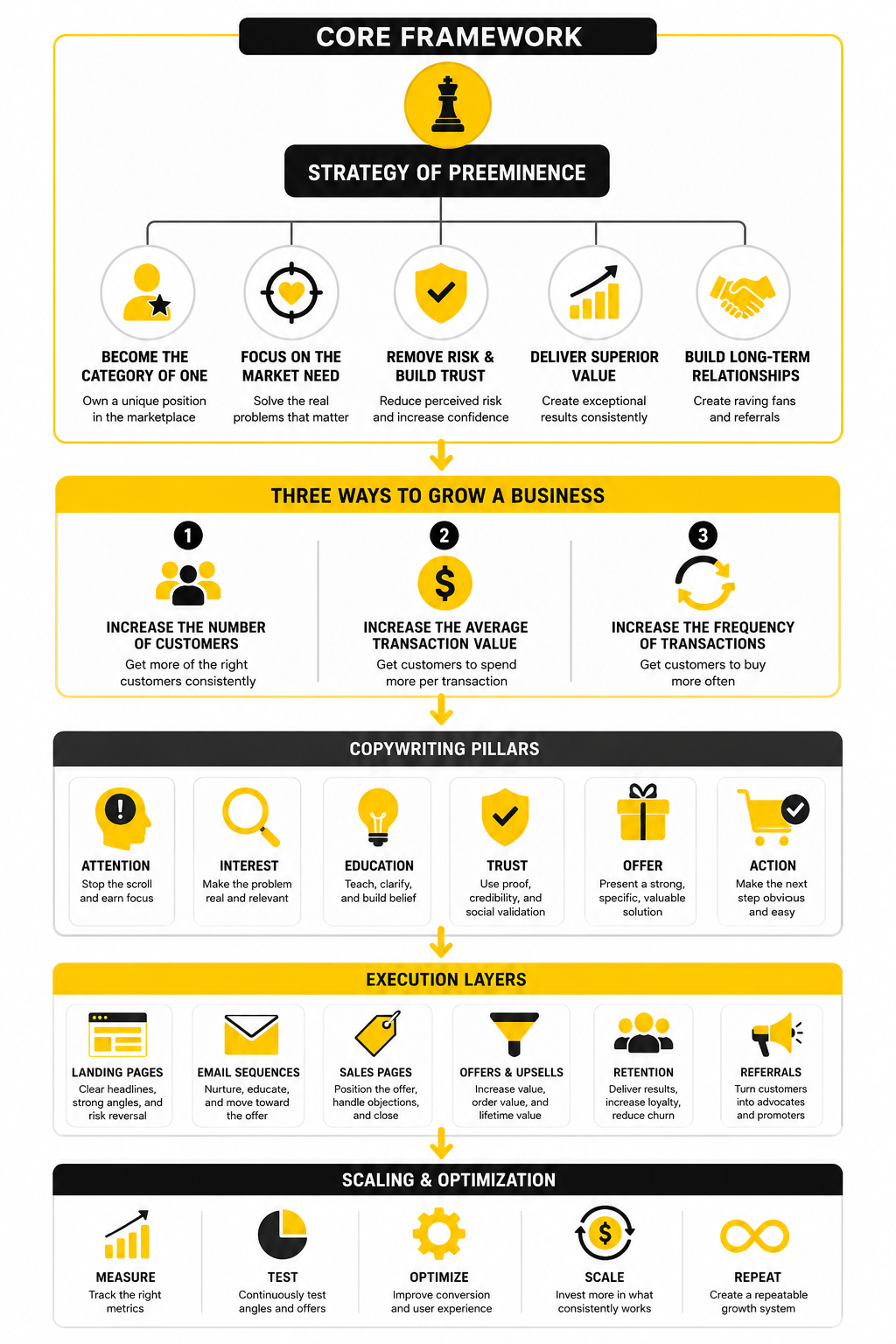
At a high level, the framework starts with preeminence, which means positioning yourself as a trusted advisor rather than a desperate seller. Jay Abraham’s own material describes the Strategy of Preeminence as the foundation of his philosophy and a different way of looking at the relationship between a business and its marketplace: Jay Abraham on Preeminence. That shift changes everything because the copy no longer asks, “How do we get the sale?” It asks, “How do we help the buyer make the best decision?”
From there, the framework moves into practical growth levers. You identify the buyer’s real problem, sharpen the value proposition, improve the offer, reduce risk, increase lifetime value, and communicate the result in plain language. The copy then becomes a bridge between what the customer already wants and what the business can credibly deliver.
Core Components
The first component is market understanding. You need to know what the buyer wants, what they have already tried, what they fear, what they misunderstand, and what would make the decision feel obvious. Without that, the copy ends up describing the product instead of entering the customer’s world.
The second component is offer architecture. Jay Abraham’s broader marketing work repeatedly comes back to finding overlooked assets and underused opportunities inside a business, which is also the heart of his book Getting Everything You Can Out of All You’ve Got: Jay Abraham’s book overview. In copywriting terms, that means you are not just writing a better headline; you are often improving what the headline has to sell.
The third component is risk reversal. Buyers hesitate because they fear wasting money, making the wrong choice, looking foolish, losing time, or being disappointed again. Strong copy does not ignore those fears. It deals with them directly, honestly, and confidently.
The fourth component is preemptive trust. Edelman’s 2025 brand trust research shows how strongly consumers now look to brands they trust for stability in uncertain environments: Edelman 2025 Brand Trust report. That makes Abraham’s advisory posture even more important, because the best copy does not merely persuade; it reassures the buyer that someone competent is thinking on their behalf.
Professional Implementation
Professionals should use Jay Abraham copywriting as a diagnostic process before treating it as a writing process. Start by asking what the business is under-communicating, what value it has not packaged clearly, what objections remain unresolved, and what risk the customer still feels. Those answers usually reveal the copy angles faster than staring at a blank page.
The practical workflow is simple but demanding. Research the market, map the buyer’s current belief system, define the strongest outcome, strengthen the offer, remove friction, and only then write the page, email, ad, or script. This is slower than grabbing a template, but it produces copy that sounds specific because it is specific.
That is the difference between keyword-stuffed content and useful marketing. The keyword jay abraham copywriting belongs naturally in this conversation because his approach is not about decorating a sales page with better phrases. It is about building a stronger argument for action, then expressing that argument with clarity, empathy, proof, and strategic intent.
The Strategy of Preeminence
The next logical piece of Jay Abraham copywriting is preeminence. Not as a buzzword. Not as a motivational slogan. As the operating philosophy behind the copy.
Preeminence means you do not position yourself as a seller trying to extract a transaction. You position yourself as a trusted advisor who is deeply invested in helping the buyer make the best decision. Jay Abraham describes the Strategy of Preeminence as the foundation of his work and as a new way of looking at the relationship a business has with its marketplace: Jay Abraham on preeminence.
That one shift changes the tone of everything you write. The copy becomes less needy, less exaggerated, and less obsessed with forcing urgency. It becomes clearer, more useful, and more confident because the business is no longer trying to win a click at any cost. It is trying to earn trust before asking for action.
From Pitching to Advising
Most bad copy sounds like it was written by someone trying to close too early. It jumps straight into claims, benefits, bonuses, discounts, scarcity, and pressure before the reader feels understood. That is why it creates resistance instead of momentum.
Jay Abraham copywriting starts from a different place. It asks what the buyer is trying to achieve, what they are afraid of, what tradeoffs they are weighing, and what they would need to believe before moving forward. The copywriter’s job is not to decorate the product. The job is to guide the buyer through a decision with more clarity than they had before arriving.
This is especially important in markets where buyers are skeptical. Edelman’s 2025 trust research shows a broad trust problem across institutions, with the study covering 33,000 respondents across 28 countries: Edelman 2025 Trust Barometer. In that kind of environment, hype is expensive. It may get attention, but it also triggers doubt, and doubt slows the sale.
The Buyer Has to Feel Protected
Preeminence is powerful because it makes the buyer feel protected. That does not mean the copy becomes soft. It means the copy proves the business is willing to tell the truth, set expectations properly, and help the reader avoid a poor decision.
This is where a lot of marketers get uncomfortable. They think strong copy means pushing only the positive side. But professional copy often gets stronger when it admits who the offer is not for, what the buyer should consider first, and where the product has limits.
That kind of honesty creates a different emotional response. The reader stops feeling hunted and starts feeling helped. Once that happens, the sales argument has room to breathe.
The Preeminent Copywriting Mindset
A preeminent copywriter thinks beyond the page. They are not only asking, “What headline will convert?” They are asking, “What would make this offer more obviously valuable to the right person?”
That question leads to better marketing decisions. It may reveal that the page needs clearer proof, a stronger guarantee, a better onboarding promise, a more specific use case, or a more realistic explanation of the result. Sometimes the biggest copy improvement is not a new sentence. It is a better offer structure.
This is why Jay Abraham copywriting cannot be separated from business strategy. The copy expresses the business model, the offer, the customer insight, and the trust mechanism behind the sale. When those pieces are weak, even beautiful writing becomes cosmetic.
Seeing the Customer’s Lifetime Value Differently
Preeminence also changes how you think about the customer after the first sale. A seller sees a conversion. An advisor sees the beginning of a relationship.
That distinction matters because copy that is built only for the first transaction often overpromises. It may increase short-term sales, but it creates refunds, churn, bad reviews, and weaker referrals. A preeminent business writes in a way that the customer can still respect after buying.
This connects directly to one of Abraham’s broader business principles: the best growth is often hidden inside existing relationships, existing customers, and existing assets. His work on business growth repeatedly emphasizes leverage, referral strategy, repeat purchasing, and deeper value creation rather than only chasing new leads: Jay Abraham on growing a business. For copywriters, that means the words should not just win today’s order. They should protect tomorrow’s trust.
What Preeminence Looks Like on the Page
On a sales page, preeminence shows up as specificity. The copy explains the customer’s situation in a way that feels accurate, not generic. It gives the reader the sense that the business has seen this problem before and knows how to help.
In an email, preeminence shows up as useful thinking before the pitch. The message does not waste time pretending to be personal while saying nothing. It gives the reader a sharper way to understand their problem, then connects that insight to the offer naturally.
In an ad, preeminence shows up as restraint. The ad can still be direct, but it does not need cartoonish promises or fake urgency. It earns the click by naming a real problem, making a believable promise, and giving the right person a reason to learn more.
The Language of a Trusted Advisor
Trusted advisor copy uses plain language. It does not hide behind jargon, inflated claims, or complicated positioning. It explains the result, the mechanism, the fit, the risk, and the next step in a way that makes the buyer feel more carefully.
That does not mean the writing becomes boring. In fact, it often becomes more persuasive because it removes the fog. Clear copy has more force than clever copy when the buyer is making a real decision.
The tone should feel calm, useful, and certain. Not passive. Not timid. Just grounded. You are not begging the reader to believe you. You are showing them why the offer makes sense.
How to Apply Preeminence Before Writing
Before writing any piece of copy, ask what would genuinely serve the buyer. This sounds simple, but it forces better thinking. It prevents the copy from becoming a list of self-serving claims.
A useful pre-writing process looks like this:
This process makes the copy cleaner because it removes weak angles early. You are not trying to sound persuasive after the fact. You are building the persuasion into the strategy before the writing starts.
Why This Matters More in Modern Funnels
Modern funnels often make the mistake of automating pressure instead of automating value. They send more messages, add more retargeting, stack more countdowns, and create more touchpoints, but the core argument stays thin. That is not a funnel problem. That is a strategy problem.
A preeminent funnel does something different. It uses each touchpoint to deepen understanding, increase confidence, and reduce decision risk. The landing page, emails, webinar, sales call, checkout page, and follow-up sequence all work together to make the buyer feel guided.
That is where Jay Abraham copywriting becomes especially useful today. It gives marketers a way to write stronger funnel copy without sounding desperate. The goal is not just to get attention. The goal is to become the obvious choice for the right buyer.
The Three Ways to Grow a Business
Once the preeminent mindset is in place, the next step is execution. Jay Abraham’s best-known growth framework is simple: there are only three ways to grow a business. You can increase the number of customers, increase the average transaction value, or increase how often customers buy.
That sounds almost too basic until you apply it properly. Most businesses obsess over the first lever and ignore the other two. They want more leads, more traffic, more attention, and more new buyers, but they do not fully optimize the value already sitting inside the business.
This is where Jay Abraham copywriting becomes more than messaging. The copy has to support the growth lever you are actually trying to pull. A campaign designed to bring in new buyers should not read the same way as a campaign designed to increase order value or reactivate past customers.
Lever 1: Increase the Number of Customers
The first lever is customer acquisition. This is the one most marketers understand because it is visible, measurable, and easy to attach to ads, landing pages, webinars, lead magnets, and sales calls. More qualified people enter the business, and revenue has a chance to grow.
But the word qualified matters. Preeminent copy does not chase everyone. It attracts the right buyer by making the problem, promise, mechanism, and fit extremely clear before the person takes the next step.
That is why acquisition copy should not be vague. It should name the audience, identify the pain, clarify the desired outcome, and give the reader a reason to believe the offer is relevant now. If the copy brings in the wrong people, the business pays for it later through low conversion, poor retention, weak referrals, and support issues.
Lever 2: Increase the Average Transaction Value
The second lever is average transaction value. This is where the business earns more from each purchase by improving the offer, bundling value, adding premium options, creating order bumps, or making the next logical upgrade obvious. Done well, this does not feel like pressure. It feels like the customer is being shown the fuller solution.
Copy plays a major role here because buyers need to understand why the higher-value option exists. They need to see the practical difference between the basic version and the better version. They also need to feel that the upgrade protects them from a future problem, saves time, improves implementation, or increases the likelihood of the result.
This is where sloppy upsell copy fails. It says, “Buy more.” Strong Jay Abraham copywriting says, “Here is the next piece that helps you get the outcome with less friction.” That difference is huge.
Lever 3: Increase Purchase Frequency
The third lever is purchase frequency. This means getting customers to come back more often, continue using the product, renew, upgrade, refer, or buy complementary offers. It is not about squeezing people. It is about serving the relationship after the first transaction.
This lever is often the most underused because businesses treat customers as finished once they buy. That is expensive. Bain’s long-standing customer loyalty research shows that improving retention by just 5% can increase profits by 25% to 95%, which is why post-purchase copy is not a minor detail: Bain on customer loyalty economics.
The copy after the sale should help the customer succeed faster. It should reinforce the decision, reduce buyer’s remorse, guide usage, introduce the next milestone, and make the customer feel supported. When the post-purchase experience is strong, selling again becomes a continuation of value instead of a cold restart.
Turning the Three Levers Into a Copywriting Process
The practical mistake is trying to write copy before choosing the growth lever. A business owner says, “We need better copy,” but that is too vague. Better for what? More new buyers, larger orders, more repeat purchases, higher retention, better referrals, or stronger onboarding?
The answer changes the entire message. Acquisition copy needs sharper positioning and stronger initial trust. Average transaction value copy needs clearer value stacking and better contrast between options. Purchase frequency copy needs better customer education, timing, and lifecycle messaging.
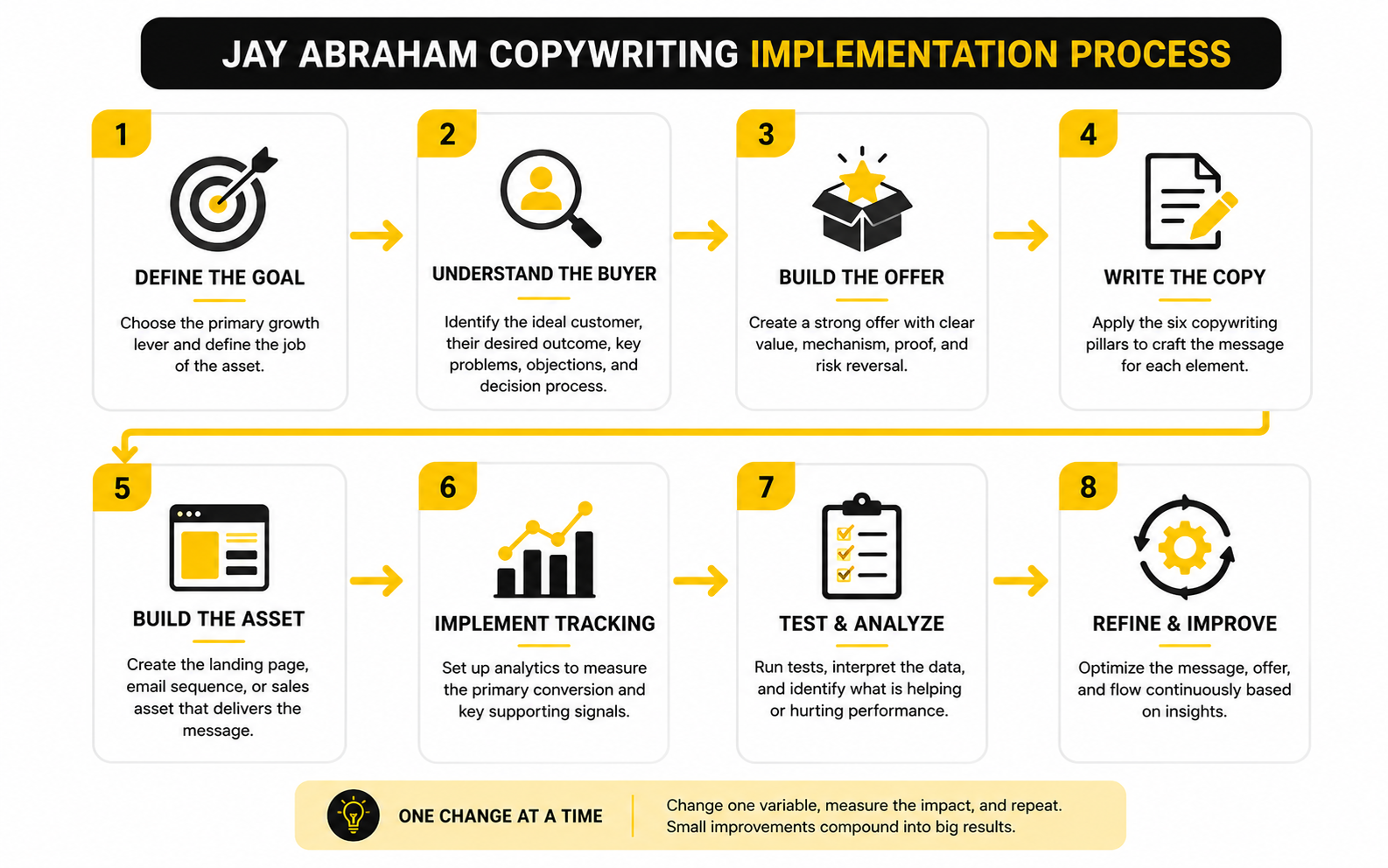
A useful implementation process looks like this:
This keeps the work grounded. You are no longer “improving copy” in some abstract way. You are improving a specific business outcome through a specific customer action.
How to Diagnose the Right Lever
Start with the numbers. If traffic is low but conversion is strong, the business may need acquisition copy that opens a new market or makes the existing promise more visible. If traffic is strong but order value is weak, the business may need better offer copy, comparison copy, or upgrade logic.
If customers buy once and disappear, the issue is probably not the front-end headline. It may be onboarding, education, retention messaging, product usage, or the absence of a natural next offer. In that case, writing another acquisition campaign is like pouring water into a leaky bucket.
The right lever is usually obvious when you look at the customer journey honestly. Where does momentum stall? Where does belief weaken? Where does the customer stop seeing the next step? That is where the copy and offer need work.
Applying the Framework to a Funnel
In a funnel, each stage should map to one of the three growth levers. The ad and landing page usually support customer acquisition. The checkout page, order bump, upsell, and offer stack usually support average transaction value. The onboarding emails, nurture sequences, renewal campaigns, and referral prompts usually support purchase frequency.
This is why a funnel tool is only useful when the strategy is clear. A platform like ClickFunnels can help build the pages and steps, but it cannot decide the strategic job of each message for you. The same is true for broader CRM and automation systems like GoHighLevel, where the power comes from matching the workflow to the customer journey instead of just adding more automation.
The best implementation is not complicated for the sake of being complicated. It is clean. Each message has one job, each offer has one reason to exist, and each step helps the buyer move with more confidence.
The Copy Audit Behind the Process
A strong copy audit should review the business through all three growth levers. Do not only ask whether the headline is strong. Ask whether the business is communicating enough value at every stage of the relationship.
For acquisition, check whether the copy makes the buyer feel understood quickly. For average transaction value, check whether the copy explains why the bigger solution is the more carefully choice. For purchase frequency, check whether the copy gives customers a reason to continue, expand, or return.
This is the practical strength of Jay Abraham copywriting. It forces you to connect words to economics. When the copy improves the right lever, growth becomes less random and far easier to diagnose.
Building Offers People Feel Safe Saying Yes To
The three growth levers give the copy a business target. Now the offer has to carry the weight. If the offer feels unclear, risky, overpriced, incomplete, or hard to act on, the copy will struggle no matter how polished it sounds.
This is where many marketers misread the data. They see low conversion and assume the headline is weak. Sometimes that is true, but often the real issue is that the buyer does not feel safe enough to move forward.
Jay Abraham copywriting is useful here because it treats resistance as information. If people are clicking but not buying, the market is not necessarily rejecting the product. It may be rejecting the way the offer is framed, proven, packaged, or de-risked.
Statistics and Data That Actually Matter
Data should not be used to decorate the article or impress the reader. It should help you make better decisions. The point is not to collect more numbers. The point is to understand what the numbers are trying to tell you.
Landing page benchmarks are a good example. Unbounce’s conversion benchmark data is built from 57 million conversions across more than 41,000 landing pages, and it shows that performance varies heavily by industry: Unbounce conversion benchmarks. That means a “good” conversion rate is not a universal number. A page can look weak compared with a broad average and still be strong for its category, traffic source, price point, and buying cycle.
Email benchmarks create the same problem. MailerLite’s 2025 benchmark report uses data from 3.6 million campaigns sent by 181,000 approved accounts, which is useful because it gives marketers a wider reference point across industries and regions: MailerLite email marketing benchmarks. But an open rate does not pay the bills by itself. The more important question is whether the right people are opening, clicking, trusting, buying, and staying.
What the Numbers Mean in a Jay Abraham Copywriting System
The first number to study is not always conversion rate. It depends on the job of the asset. An ad needs to earn qualified attention. A landing page needs to turn that attention into belief and action. An email sequence needs to deepen trust and move the right person to the next step.
This is why surface metrics can lie. A high click-through rate may mean the hook is strong, but it may also mean the promise is too broad or curiosity-driven. A lower click-through rate with better downstream conversion can be healthier because the message is filtering for buyers who actually match the offer.
The same logic applies to Jay Abraham copywriting across a full funnel. You are not optimizing isolated numbers. You are optimizing the relationship between promise, expectation, action, and customer value.
The Measurement System
A useful analytics system should connect each metric to one of the three growth levers from the previous part. If the goal is more customers, you track qualified traffic, opt-ins, calls booked, trials started, and first purchases. If the goal is higher average transaction value, you track order value, upgrade rate, bundle uptake, and checkout completion.
If the goal is more purchase frequency, you track repeat purchases, renewal rate, product usage, email engagement after purchase, referral activity, and churn. These numbers tell you whether the copy is helping customers continue the journey or only pushing them through the first door.
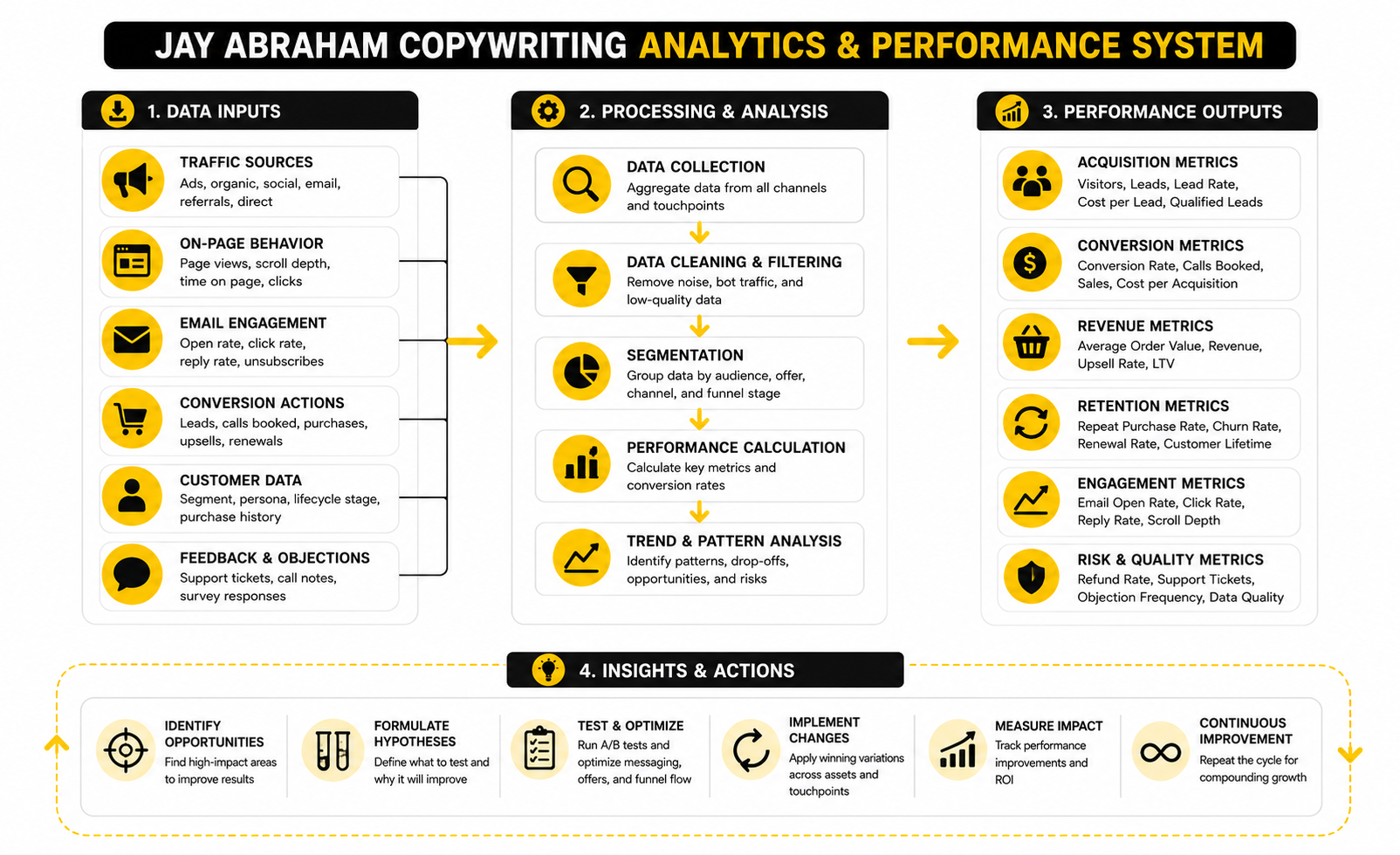
The cleanest setup is simple:
This keeps measurement practical. You are not drowning in dashboards. You are using data to decide what to fix next.
Acquisition Signals
For acquisition, the most important question is whether your copy is attracting the right people. Traffic volume alone does not answer that. A campaign can bring more visitors while reducing lead quality, sales call quality, close rate, and long-term value.
The useful signals are the ones that show intent. Look at lead quality, form completion rate, booked-call rate, show-up rate, first-purchase rate, and the percentage of buyers who match the ideal customer profile. If those numbers are weak, the copy may be creating curiosity without creating commitment.
This is also where message-market fit becomes visible. If people click but do not continue, the hook may be disconnected from the offer. If they opt in but never buy, the lead magnet may be attracting learners instead of buyers. If they book calls but do not close, the promise may be too broad, too early, or aimed at the wrong level of buyer.
Offer Value Signals
For average transaction value, the key question is whether customers understand the bigger opportunity. If they only buy the cheapest option, it may not mean they are price-sensitive. It may mean the copy has not explained why the premium option is meaningfully different.
Useful signals include average order value, upsell take rate, order bump acceptance, plan mix, bundle adoption, and refund rate by offer tier. A higher order value is not automatically good if refunds rise or customers feel misled. The number has to be interpreted with customer experience in mind.
This is where the trusted advisor mindset matters. The upgrade copy should help the buyer choose the level of support that fits their goal. It should not shame them, pressure them, or make the basic offer feel useless.
Retention and Repeat Purchase Signals
For purchase frequency, the main question is whether the customer continues to experience value after the first conversion. If repeat purchases are weak, the problem may be poor onboarding, unclear next steps, weak usage habits, or no natural continuation offer. The copy after the sale has to solve those problems.
Strong post-purchase measurement looks at activation, time to first meaningful outcome, repeat purchase rate, renewal rate, referral rate, support tickets, refund requests, and churn. Bain’s customer loyalty research is still relevant because it shows how small retention improvements can create large profit gains, with a 5% increase in retention associated with profit increases of 25% to 95%: Bain on loyalty economics. That does not mean every business will see the same range, but it does show why retention copy deserves serious attention.
Email is especially important here because it carries the relationship between buying moments. A platform like Brevo can help manage campaigns and automation, but the strategic question remains the same. Are the messages helping the customer make progress, or are they just filling the calendar?
Benchmarks Are Reference Points, Not Goals
Benchmarks are useful only when they create context. They are dangerous when they become the goal. A benchmark can tell you whether a number looks unusually high or low, but it cannot tell you whether your offer is positioned correctly, whether your traffic is qualified, or whether your buyer is making a complex decision.
For example, a low conversion rate may be perfectly acceptable for a high-ticket B2B offer if the leads are valuable and close well later. A high conversion rate may be a warning sign if the offer is underpriced, oversimplified, or attracting customers who churn quickly. The number does not matter without the economics behind it.
That is why Jay Abraham copywriting should always connect analytics to customer value. Do not ask, “Is this metric good?” Ask, “What does this metric reveal about the buyer’s belief, risk, desire, and next action?”
Turning Data Into Better Copy
The best copy improvements usually come from interpreting patterns. If people stop at the pricing section, the offer may need stronger value framing, better comparison, or clearer risk reversal. If people read the page but do not click, the call to action may not feel like the natural next step.
If emails get opened but not clicked, the subject line is doing its job, but the body may not be building enough desire or urgency. If people click the email but do not convert on the page, the email promise and landing page promise may not match closely enough. That mismatch is common, and it quietly kills performance.
Make changes based on one hypothesis at a time. Rewrite the offer section, strengthen proof, clarify the mechanism, improve the guarantee, adjust the call to action, or segment the audience. Then measure whether the change improved the specific lever you were targeting.
The Data Discipline That Protects the Brand
Good measurement protects the brand from panic. Without it, teams overreact to weak numbers, copy competitors, add discounts, or increase pressure when the real issue is unclear positioning. That is how brands train buyers to wait, doubt, and compare.
With better measurement, the business can stay calm. It can see whether the issue is traffic quality, offer clarity, proof, risk, pricing, timing, or customer fit. Then it can improve the right thing instead of randomly rewriting everything.
That discipline is the professional edge. Jay Abraham copywriting is not about making every sentence louder. It is about making every part of the marketing system more intelligent, more trusted, and more economically useful.
Turning Strategy Into Copy That Sells
At this stage, the work becomes more advanced because the easy advice is no longer enough. “Write a better headline” is not a strategy. “Add urgency” is not a strategy. “Use a proven template” is not a strategy either.
The real question is whether the copy can carry a mature business argument without becoming heavy, boring, or manipulative. Jay Abraham copywriting works because it keeps the customer’s self-interest at the center while still protecting the economics of the business. That balance is where the best copy lives.
The offer has to feel valuable, the proof has to feel believable, the mechanism has to feel clear, and the next step has to feel safe. Miss one of those pieces, and the reader may still like the message while doing nothing. That is the painful part. Good copy is not copy people admire. Good copy moves the right buyer forward.
The Strategic Tradeoff Between Clarity and Curiosity
Curiosity gets attention, but clarity earns action. This is one of the biggest tradeoffs in modern copywriting. A curiosity-driven hook can increase clicks, but it can also attract people who are interested in the idea and not committed to the outcome.
That is why the stronger move is usually specific curiosity. The copy should create enough tension to make the reader continue, but it should not hide the basic promise. If the reader has to guess what the offer is, who it is for, or why it matters, the copy is making them work too hard.
This matters even more in paid funnels because every vague click has a cost. If the ad creates one expectation and the landing page creates another, the data will usually expose it through weak conversion, poor lead quality, or low sales-call intent. A Jay Abraham copywriting approach keeps the promise consistent from first touch to final decision.
The Risk of Over-Persuasion
There is a point where copy stops helping and starts cornering the buyer. Too much urgency, too many bonuses, too many emotional triggers, and too many exaggerated claims can make the offer feel less credible. The reader may not say that out loud, but they feel it.
Gartner’s 2025 personalization research is a useful warning here because it found that negative personalized marketing experiences made customers 3.2 times more likely to regret a purchase and 44% less likely to buy again: Gartner on personalization and customer regret. The deeper point is simple. When marketing feels invasive, misaligned, or overly engineered, it can damage the relationship after the sale.
That is why preeminence has to govern persuasion. You can be direct. You can sell hard when the offer genuinely deserves it. But the copy should never create a sale the customer will regret after the emotional pressure fades.
Scaling Without Losing the Human Edge
Scaling copy is tricky because the more systems you add, the easier it is to sound generic. Teams create templates, automate campaigns, use AI drafts, reuse hooks, and build repeatable funnel assets. That can increase speed, but it can also flatten the voice until every message sounds like every other message.
The solution is not to reject systems. The solution is to make the system preserve customer insight. Every reusable asset should still be built around a specific buyer, a specific problem, a specific belief gap, and a specific decision moment.
This is where modern tools can help if they are used carefully. A funnel builder, CRM, email platform, chatbot, or scheduling tool can support the process, but it cannot replace judgment. For example, GoHighLevel can centralize funnels, automation, CRM, and follow-up, but the quality of the system still depends on the strategy behind the messages.
Advanced Segmentation Without Making the Copy Weird
Segmentation should make copy feel more relevant, not more creepy. That line matters. A message that reflects the buyer’s situation feels helpful. A message that exposes too much tracking or makes assumptions too aggressively can feel uncomfortable.
McKinsey’s personalization work emphasizes that stronger personalization depends on better data, decisioning, design, distribution, and measurement rather than isolated tactics: McKinsey on personalized marketing systems. That is the right way to think about segmentation. It is not just inserting a name or changing a headline. It is designing a better decision path for different buyer groups.
In practical terms, segment by meaningful differences. A new visitor needs different copy than a warm subscriber. A first-time buyer needs different follow-up than a repeat customer. A founder buying for speed needs different proof than a marketing manager buying for internal approval.
The Proof Problem
Advanced copy usually fails because the proof is too thin. The promise may be strong, the structure may be clean, and the offer may be attractive, but the reader still does not believe enough to act. That is not a wording problem. It is a proof problem.
Proof has to match the level of risk. A low-cost impulse purchase may need light reassurance. A high-ticket offer, complex software, or agency service needs stronger proof, clearer process, better objection handling, and a more complete explanation of what happens after purchase.
This is where marketers should be careful with vague social proof. “Trusted by thousands” may help, but it is often not enough. Stronger proof shows the mechanism, the context, the before-and-after state, the constraints, the implementation path, and the reason the result is believable.
Copy That Survives Internal Review
In B2B and higher-ticket markets, the first reader is often not the only decision-maker. They may need to forward the page, explain the offer to a boss, justify the spend, compare alternatives, or build internal confidence. That means the copy has to sell twice.
The first sale is emotional and personal. The buyer wants to feel that the problem is understood and the solution is worth exploring. The second sale is rational and social. The buyer needs language, proof, and structure they can use to defend the decision.
This is why clear positioning beats clever wording in serious markets. If the copy cannot be repeated inside a meeting, it is probably too vague. The best message gives the buyer a simple way to explain why this option, why now, and why it is safer than doing nothing.
Avoiding the Scaling Trap
The scaling trap happens when a business finds one message that works and then forces it everywhere. The hook gets reused in every ad. The promise gets repeated in every email. The offer angle gets stretched across audiences that do not share the same pain.
At first, this looks efficient. Then performance starts to decay. The market gets tired, the message loses precision, and the team keeps increasing pressure instead of refreshing the insight.
A better approach is to scale the underlying principle, not just the surface wording. Keep the core strategic argument consistent, but adapt the angle to the audience, awareness level, buying stage, and channel. That is how Jay Abraham copywriting stays alive instead of becoming a script.
The Role of AI in Jay Abraham Copywriting
AI can speed up research synthesis, angle generation, outline development, and first drafts. It can also produce confident-sounding generic copy at scale. That second outcome is the risk.
The more AI content floods the market, the more buyers notice sameness. Nielsen’s 2025 marketing report highlights the need for clarity, balanced performance and brand-building, and better measurement in a chaotic environment: Nielsen 2025 Annual Marketing Report. In that environment, copy that sounds merely competent is not enough.
Use AI as leverage, not as the strategist. Feed it real customer language, real objections, real proof, real offer details, and real positioning decisions. Then edit like a human who understands the buyer and has standards.
The Expert Standard
The expert standard is simple: every line should either increase understanding, increase trust, increase desire, reduce risk, or move the buyer to the next useful step. If a sentence does none of those things, it is probably decoration. Cut it.
This does not mean the copy has to be short. Some offers need depth. Some buyers need education. Some decisions require more proof, more comparison, and more context before the action feels safe.
The real standard is relevance. Long copy works when every section earns its place. Short copy works when the buyer already has enough belief. Jay Abraham copywriting is not about length. It is about matching the message to the decision the customer is actually making.
Applying Jay Abraham Copywriting in Modern Funnels
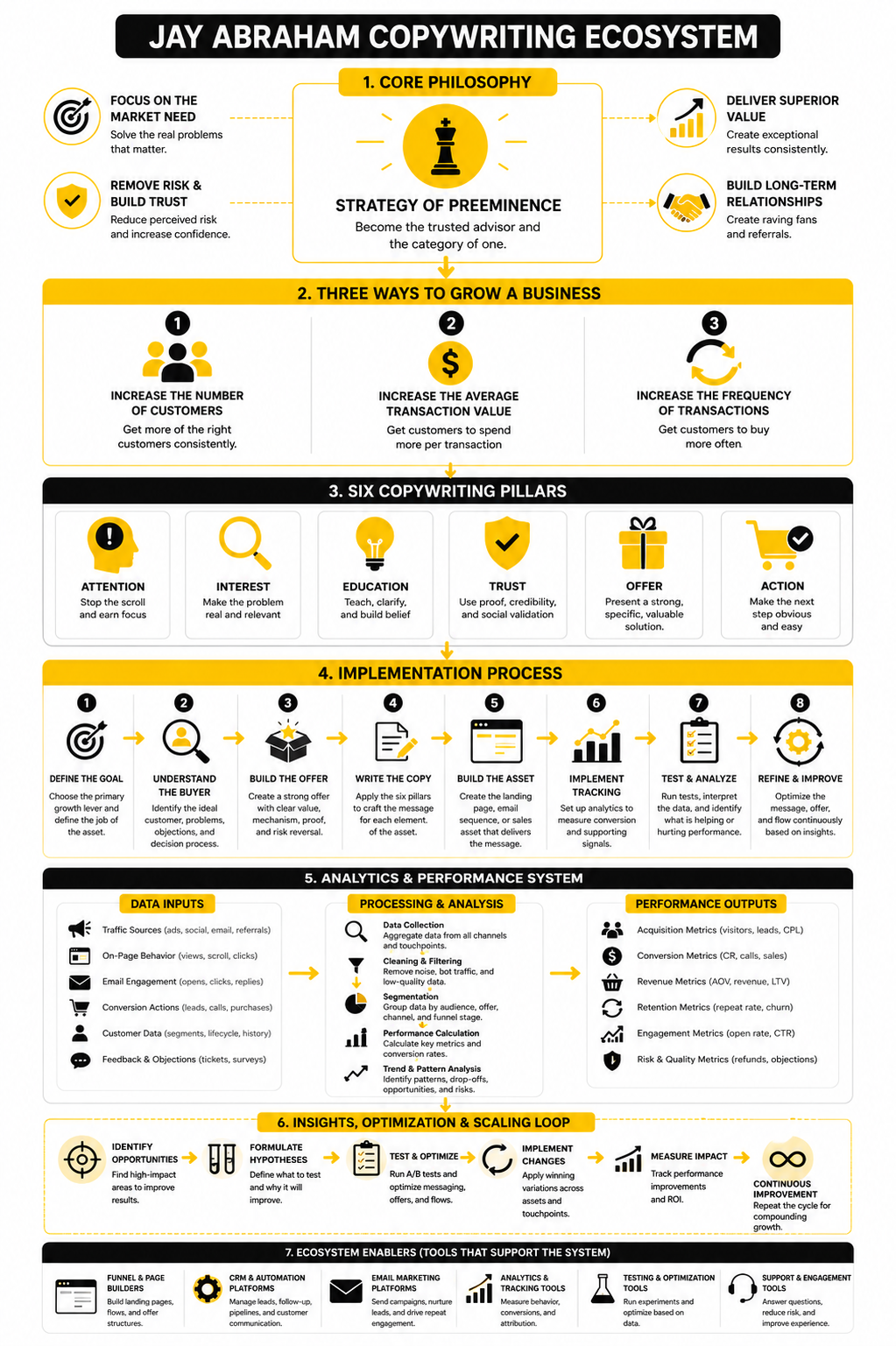
The final step is turning the framework into a working marketing ecosystem. Not a random page. Not a disconnected email sequence. Not a pile of automation that sends messages because the software can.
A strong funnel should feel like one continuous decision path. The buyer moves from attention to understanding, from understanding to trust, from trust to action, and from action to continued value. Jay Abraham copywriting fits this perfectly because it treats every touchpoint as part of the customer relationship, not just another place to push a pitch.
This is the point where the whole article comes together. Preeminence guides the tone. The three growth levers guide the business objective. Measurement guides the next improvement. Advanced copy decisions protect the brand while still increasing revenue.
The Final System
The final system starts with the buyer’s desired outcome and works backward. What do they need to believe before they act? What proof would make that belief easier? What risk still feels unresolved? What next step would feel useful instead of forced?
From there, every asset has a job. The ad earns qualified attention. The landing page builds belief. The lead magnet or sales asset deepens the conversation. The follow-up sequence answers the next objections. The checkout page reduces friction. The post-purchase experience reinforces the decision and opens the next relationship moment.
This is why Jay Abraham copywriting should never be treated as a set of isolated writing tricks. It is a way to think through the whole revenue system. When the system is aligned, the copy feels natural because each message arrives at the right time with the right purpose.
Building the Ecosystem Without Overcomplicating It
A simple ecosystem usually beats a complicated one. Most businesses do not need more pages, more automations, more lead magnets, or more offers. They need a cleaner path from problem to solution.
Start with one core customer journey. Map the exact sequence from first contact to first purchase, then from first purchase to the next meaningful result. Look for the places where trust drops, clarity weakens, or the buyer feels exposed.
Only add tools when they support that journey. A funnel builder can help create the path, an email platform can help maintain the relationship, a CRM can help track movement, and a chatbot can help answer common questions. But the tool should serve the strategy, never replace it.
A Practical Stack for Implementation
For direct-response funnels, a platform like ClickFunnels can make sense when the priority is quickly building pages, offers, upsells, and sales paths. The strategic work still comes first, but the platform can help turn the structure into something usable. That is valuable when speed of testing matters.
For agencies, local businesses, consultants, and service providers that need CRM, pipelines, automation, and follow-up in one place, GoHighLevel is often a more complete operational fit. It can support the full journey from lead capture to sales follow-up and client communication. Again, the software is not the strategy, but it can help execute the strategy with less friction.
For email-heavy journeys, tools like Brevo or Moosend can help manage campaigns and nurturing. The important part is not the number of emails. The important part is whether each message increases confidence, reduces confusion, and moves the right customer toward the right next step.
What is Jay Abraham copywriting?
Jay Abraham copywriting is a strategic approach to persuasion built around customer value, preeminence, offer strength, risk reduction, and business growth. It is not just about writing punchier headlines or sharper calls to action. It is about understanding the business model and the buyer deeply enough that the copy becomes a natural extension of a stronger strategy.
Why is Jay Abraham’s copywriting approach different?
The difference is that the copy does not start with the product. It starts with the customer’s desired outcome, the hidden value inside the business, and the obstacles stopping the buyer from acting. That makes the copy feel more advisory, more specific, and more useful than standard sales writing.
What is the Strategy of Preeminence?
The Strategy of Preeminence is Jay Abraham’s philosophy of becoming the trusted advisor to your market rather than just another seller. His own material describes it as the foundation of his business philosophy and a new way to look at your relationship with the marketplace: Jay Abraham on the Strategy of Preeminence. In copywriting, that means the message should help the buyer make a better decision, not just pressure them into a transaction.
What are Jay Abraham’s three ways to grow a business?
Jay Abraham’s three growth levers are increasing the number of customers, increasing the average transaction value, and increasing how often customers buy. His official material frames this as a way to create geometric growth rather than only chasing more leads: Jay Abraham on the three ways to grow a business. For copywriters, each lever requires a different message, offer, and measurement system.
How do I use Jay Abraham copywriting on a landing page?
Start by defining the page’s job. If the page is for acquisition, the copy should quickly prove relevance, clarify the promise, and make the next step feel safe. If the page is for a higher-value offer, it should explain the larger opportunity, show why the offer is worth more, and reduce the perceived risk of choosing the bigger solution.
How do I use Jay Abraham copywriting in email marketing?
Use email to deepen trust over time instead of constantly pitching. A strong email sequence should educate the buyer, clarify the problem, build belief in the mechanism, answer objections, and make the next step feel natural. The best email copy feels like guidance from someone who understands the reader’s situation, not a scheduled blast from a company trying to hit a quota.
Does Jay Abraham copywriting work for ecommerce?
Yes, but it should be adapted to the buying context. Ecommerce copy can use the same principles by making the product value clearer, reducing purchase risk, improving bundles, strengthening post-purchase communication, and increasing repeat buying. The biggest mistake is treating ecommerce copy as only product descriptions and discounts when the real opportunity is often offer design and customer relationship building.
Does Jay Abraham copywriting work for B2B?
It works especially well in B2B because B2B buyers usually need more trust, more proof, and more internal justification before they act. The copy has to help the first reader understand the value and also give them language they can repeat to other decision-makers. That means clear positioning, credible proof, and a strong business case matter more than clever phrasing.
What metrics should I track when applying this framework?
Track the metrics that match the growth lever you are trying to improve. For acquisition, watch qualified leads, conversion rate, booked calls, and first purchases. For average transaction value, watch order value, upsell acceptance, plan mix, and refund rate. For purchase frequency, watch repeat purchases, renewal rate, product usage, referral activity, and churn.
What is the biggest mistake people make with Jay Abraham copywriting?
The biggest mistake is copying the language without adopting the thinking. People talk about preeminence, risk reversal, and growth levers, but then write copy that still feels self-centered, vague, or overly aggressive. The framework only works when the business genuinely tries to create more value for the buyer.
How does risk reversal fit into Jay Abraham copywriting?
Risk reversal removes or reduces the fear that stops a buyer from acting. That could mean a guarantee, a clearer onboarding process, a trial, a better cancellation policy, stronger proof, or more transparent expectations. The point is not to create a gimmick. The point is to make the buyer feel protected enough to move forward.
Should beginners study Jay Abraham copywriting?
Yes, but beginners should study the strategic principles before chasing templates. The most useful lessons are customer understanding, offer improvement, preeminence, lifetime value, referral thinking, and risk reduction. Once those are clear, formulas and templates become more useful because you know what they are supposed to accomplish.
Can AI help with Jay Abraham copywriting?
AI can help organize research, generate angles, draft variations, and pressure-test messaging. But it should not replace strategy, customer insight, or editorial judgment. The best use of AI is to speed up the mechanical parts while a human keeps the message specific, ethical, and tied to a real business objective.
How do I know if my copy is becoming too aggressive?
Your copy is probably too aggressive if it creates pressure without increasing clarity. Watch for exaggerated urgency, unsupported claims, excessive bonuses, manipulative personalization, and promises that the customer may regret believing. Strong copy should make the right buyer more confident, not cornered.
What is the simplest way to start using this framework today?
Pick one page, email sequence, or offer and ask three questions. What does the buyer really want? What risk is stopping them from acting? What business lever is this asset supposed to improve? Those answers will immediately make the copy more focused.
Build a stronger local presence with BAAM AI
Turn your website, Google profile, social channels, and AI visibility into one growth engine
Most businesses do not need more random marketing activity. They need a consistent presence system that helps the right people find them, trust them, and take action. BAAM AI brings strategy, local SEO, website updates, Google Maps visibility, social content, AI-search readiness, media production, and reporting into one practical monthly engine.
If you want your marketing to keep working after the campaign ends, start with a free BAAM AI presence audit. See how your business shows up today and where the fastest visibility wins are at BAAM AI.