
BAAM AI Blog
Jay Abraham Copywriting: The Practical Framework Behind Persuasive, Trust-Based Selling
Jay Abraham copywriting is not really about clever words. It is about seeing the customer more clearly than your competitors do, then using that insight to make the buying decision feel obvious, safe, and valuable.

Jay Abraham copywriting is not really about clever words. It is about seeing the customer more clearly than your competitors do, then using that insight to make the buying decision feel obvious, safe, and valuable.
That matters because most copy fails before the first sentence is written. The offer is vague, the market is poorly understood, the promise is too generic, or the business is trying to persuade people before it has earned the right to be believed.
Jay Abraham’s broader work has always sat at the intersection of direct response, strategy, positioning, and customer value. His official biography describes more than four decades of work across thousands of companies and industries, which is why his copywriting ideas are better understood as business strategy expressed through words, not just headline formulas or sales page tricks: Jay Abraham’s background.
Why Jay Abraham Copywriting Still Matters
Jay Abraham copywriting still matters because buyers are more skeptical, more distracted, and more educated than they were in the old direct-response era. The old trick of shouting a bigger promise does not work as well when people can compare alternatives, read reviews, ask AI, and leave the page in seconds. Strong copy now has to carry proof, relevance, empathy, and strategic clarity at the same time.
Trust is not a soft issue anymore. The 2025 Edelman Trust Barometer shows why businesses cannot assume people will automatically believe institutional claims, executive claims, or promotional messages. In that environment, copy that feels self-serving creates resistance, while copy that demonstrates understanding lowers friction.
This is where Abraham’s thinking becomes useful. Instead of treating copy as pressure, the better approach is to treat it as guidance. You are not trying to overpower the reader; you are helping them understand the real cost of inaction, the value of a better path, and the reason your offer is the most sensible next step.
The Strategy Behind the Words
The most important idea behind Jay Abraham copywriting is that the copywriter should not start with language. The copywriter should start with leverage. What does the business already have, what does the market already want, what has the customer already tried, and what hidden value is not being communicated clearly enough?
That is why Abraham’s work often connects copywriting with positioning, referrals, risk reversal, lifetime value, and strategic partnerships. A headline can improve response, but a stronger offer, a better guarantee, a more precise market angle, or a sharper value proposition can change the economics of the entire campaign. Copy is the visible layer, but strategy is the machine underneath it.
This also explains why weak businesses often want copy to do impossible work. They ask for “high-converting copy” when the offer is unclear, the audience is too broad, or the buying journey has no trust-building mechanism. Abraham-style copywriting forces the harder question first: why should this specific person believe this specific promise from this specific business right now?
The Jay Abraham Copywriting Framework
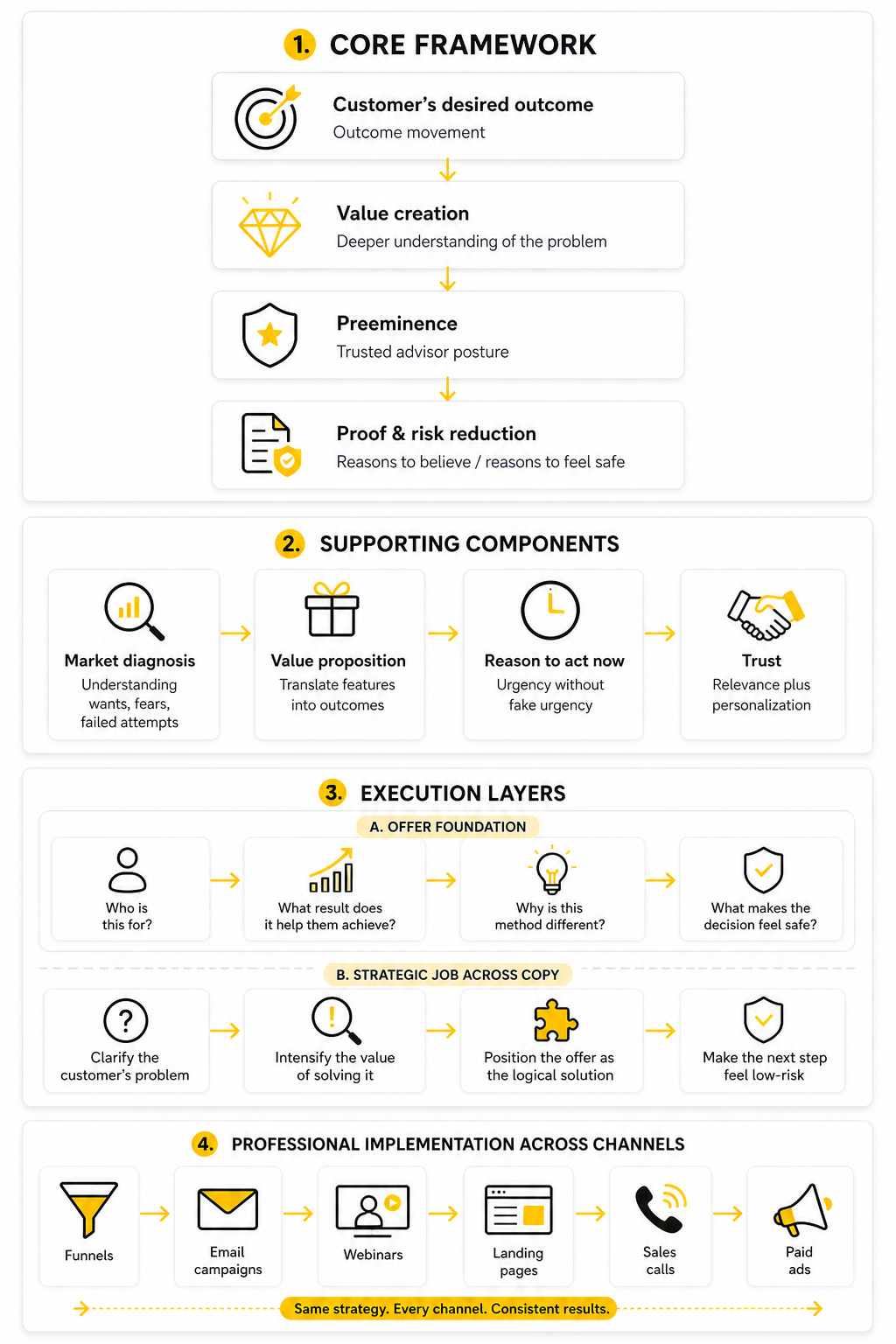
A practical Jay Abraham copywriting framework starts with the customer’s desired outcome, not the product. People do not buy coaching, software, consulting, newsletters, courses, funnels, or services for their own sake. They buy movement from a current state they do not want into a future state they do want.
The second layer is value creation. Your copy has to show that you understand the customer’s problem at a deeper level than the customer expected. This is where specificity matters, because broad claims like “grow faster” or “save time” rarely create conviction unless they are tied to a real situation, a real constraint, and a real consequence.
The third layer is preeminence, which is one of Abraham’s most recognizable ideas. His material on the Strategy of Preeminence frames the business as a trusted advisor that protects the client’s best interest, rather than a seller trying to extract a transaction. In copywriting, that means the message should make the reader feel understood before it asks them to act.
The fourth layer is proof and risk reduction. Buyers need reasons to believe, but they also need reasons to feel safe. That can come from demonstrations, transparent comparisons, guarantees, credible testimonials, clear process explanations, or simply copy that refuses to exaggerate what the offer can do.
Core Components of Persuasive Copy
The first core component is market diagnosis. Before writing, you need to know what the reader wants, what they fear, what they have already tried, what they misunderstand, and what they secretly hope is possible. Without that diagnosis, even polished copy becomes decorative.
The second component is a value proposition that makes the reader’s choice easier. Good copy does not just describe features; it translates those features into a more desirable business or life outcome. That translation is essential because customers are not always buying the thing you think you are selling.
The third component is a strong reason to act now without fake urgency. This is where many marketers get lazy. Real urgency comes from timing, opportunity cost, limited capacity, changing market conditions, or the compounding cost of staying stuck.
The fourth component is trust. Modern buyers expect relevance and personalization, and McKinsey’s research on personalized marketing notes that 71% of consumers expect personalized interactions while 76% get frustrated when they do not receive them. That does not mean every piece of copy needs creepy personalization; it means the message should feel clearly built for the reader’s situation.
Professional Implementation Starts With the Offer
Professional implementation of Jay Abraham copywriting starts by improving the offer before polishing the words. A stronger offer gives the copywriter more truth to work with. A weak offer forces the copywriter into hype, and hype is usually what happens when the underlying value is not clear enough.
The offer should answer four questions before any serious copy is written. Who is this for, what result does it help them achieve, why is this method different, and what makes the decision feel safe? If those answers are vague, the copy will be vague too.
This is also why Abraham-style copywriting works well across funnels, email campaigns, webinars, landing pages, sales calls, and paid ads. The channel changes, but the strategic job stays the same. The copy must clarify the customer’s problem, intensify the value of solving it, position the offer as the logical solution, and make the next step feel low-risk.
The Jay Abraham Copywriting Framework
A useful Jay Abraham copywriting framework starts with one uncomfortable truth: the market does not care how good your product is until it sees why that product matters. That means the first job of the copy is not to impress the reader. The first job is to enter the conversation already happening in the reader’s mind and make them feel, almost instantly, that you understand the situation.
This is why Abraham-style copy should begin with diagnosis before persuasion. You are not just asking, “What do we sell?” You are asking, “What is the buyer trying to escape, what outcome are they chasing, what have they already tried, and what would make them believe this is finally different?” That is where strong copy starts to sound human instead of manufactured.
The framework is simple, but not shallow. You clarify the customer’s desired result, identify the hidden value inside the offer, remove unnecessary risk, and communicate the next step in a way that feels natural. When those pieces line up, copy stops feeling like pressure and starts feeling like leadership.
Start With the Customer’s Desired Outcome
Most businesses describe what they do from the inside out. They talk about their product, their process, their features, their platform, their credentials, and their experience. The reader is quietly asking a different question: “What changes for me if I say yes?”
Jay Abraham copywriting works better when the copy answers that question early. A consultant is not only selling advice. A SaaS company is not only selling software. An agency is not only selling campaigns. Each one is selling a movement from confusion to clarity, from wasted effort to better leverage, or from inconsistent results to a more predictable system.
This is where many landing pages and emails lose people. They explain the mechanism before they make the outcome desirable. The copy should first show that the business understands the buyer’s world, then explain how the offer helps them move forward with less guesswork.
Identify the Gap Between Where They Are and Where They Want to Be
The gap is the emotional and economic distance between the customer’s current state and desired state. Good copy makes that gap visible without exaggerating it. It helps the reader recognize the cost of staying where they are, while still giving them confidence that improvement is realistic.
For example, a business owner may not wake up thinking, “I need better direct response copy.” They may wake up frustrated that leads are expensive, sales calls are inconsistent, referrals are unpredictable, or prospects keep comparing them to cheaper alternatives. The copy has to connect the surface-level symptom to the deeper strategic problem.
This is important because people rarely buy when they only understand the product. They buy when they understand the problem more clearly than they did before. When your message sharpens that understanding, the offer becomes easier to evaluate.
Translate Features Into Strategic Value
Features matter, but only after they are translated into value. A guarantee is not just a guarantee; it reduces perceived risk. A proven process is not just a process; it gives the buyer confidence that the result is not random. A fast implementation timeline is not just speed; it may protect the buyer from months of lost momentum.
This translation is one of the most practical parts of Jay Abraham copywriting. You are constantly asking, “So what?” If the offer includes templates, so what? If the platform includes automation, so what? If the service includes strategy calls, so what? The answer should always connect back to a meaningful business outcome.
This is also where weak copy becomes obvious. If a feature cannot be connected to a clear benefit, it may not deserve much space in the sales message. The goal is not to list everything the offer includes. The goal is to make the value feel concrete enough that the reader can picture using it.
Make Risk Reversal Part of the Message
Risk reversal is one of the strongest bridges between interest and action. People may want the outcome, believe the promise, and still hesitate because they are afraid of wasting money, time, reputation, or internal political capital. The copy has to deal with that hesitation directly.
This does not always mean a bold refund guarantee. Risk reversal can also come from proof, onboarding clarity, transparent expectations, examples of fit and non-fit, or a smaller first step that lets the buyer test the relationship. The point is to remove the feeling that the customer is carrying all the risk alone.
This matters even more in markets where buyers have been burned before. In ecommerce, friction can show up brutally fast, and Baymard’s long-running checkout research puts the average cart abandonment rate at 70.19%. Not all of that is about copy, of course, but the lesson is obvious: when uncertainty, friction, or surprise enters the decision, people leave.
The Strategy Behind the Words
The words are only the final expression of the strategy. Before writing the headline, subject line, hook, or call to action, you need to know what strategic job the copy is supposed to perform. Is it supposed to create demand, capture demand, revive dormant leads, increase average order value, reduce objections, or reposition the offer against competitors?
This distinction matters because different jobs require different copy. A cold audience needs context and trust. A warm lead may need comparison and proof. A past buyer may need a reason to expand the relationship. Using the same message everywhere is not efficient; it is lazy.
Abraham’s broader strategic approach is useful here because it pushes you to look beyond the page. Sometimes the best copy improvement is a better lead magnet, a better guarantee, a better referral angle, a better follow-up sequence, or a more specific offer. The sentence matters, but the system around the sentence matters too.
Position the Business as a Trusted Advisor
The Strategy of Preeminence is powerful because it changes the posture of the copy. Instead of sounding like a vendor trying to win the sale, the business sounds like an advisor trying to protect the buyer’s best interest. That shift can change the entire tone of a campaign.
A trusted advisor does not hide trade-offs. A trusted advisor does not pretend every prospect is a perfect fit. A trusted advisor educates the reader enough to make a better decision, even before asking for the sale. That is why preeminence is not just a branding idea; it is a copywriting discipline.
This approach fits the modern trust environment. Nielsen’s trust research found that 88% of global respondents trust recommendations from people they know more than any other channel, which reinforces a practical point: buyers lean toward sources that feel credible, familiar, and safe. Your copy cannot fully replicate personal trust, but it can avoid sounding like the kind of marketing people instinctively resist.
Use Education Before Persuasion
Education is not filler. Done properly, it is persuasion with more respect for the reader. When you teach the buyer how to think about the problem, you help them see why your offer is valuable without forcing the conclusion.
This works especially well when the customer is comparing options. If your copy gives them a sharper buying framework, you become part of how they evaluate the market. That is a much stronger position than simply saying, “We are better,” because now the reader has a reason to believe your criteria matter.
The key is to educate toward the decision, not away from it. Random educational content can create attention but no action. Strategic education clarifies the problem, reframes the stakes, introduces the mechanism, and makes the next step feel like the natural continuation of what the reader just learned.
Build the Case One Layer at a Time
Strong copy does not dump every argument on the reader at once. It builds the case in layers. First, it shows relevance. Then it creates clarity. Then it introduces value. Then it handles doubt. Then it asks for action.
That order matters because persuasion has momentum. If the reader does not feel understood, proof feels premature. If the offer is unclear, urgency feels manipulative. If the risk is unresolved, the call to action feels uncomfortable.
This is why the best Jay Abraham copywriting feels strategic instead of noisy. Each section earns the right to move to the next one. By the time the reader reaches the offer, they should not feel ambushed; they should feel like the conclusion has been carefully built in front of them.
Core Components of Persuasive Copy
Core components are where Jay Abraham copywriting becomes practical. This is the point where strategy has to turn into a working message, not just a good theory. If the framework is right but the execution is vague, the reader still will not move.
The goal is not to make every piece of copy longer. The goal is to make every part of the message earn its place. A short ad, a landing page, a sales letter, an email sequence, or a webinar script can all use the same underlying process if the thinking is clear.
Define the Market Before You Define the Message
The market decides what matters. Not the founder, not the copywriter, not the marketing team, and not the person with the strongest opinion in the meeting. Before you write the copy, you need to understand what the buyer already believes, what they doubt, what they want, and what they are tired of hearing.
This is where research has to become specific. You are looking for the buyer’s language, the objections they repeat, the comparisons they make, the promises they ignore, and the moments that push them to act. That gives the copy a real foundation instead of a list of assumptions.
A useful market diagnosis should answer these questions:
These answers shape the angle. If the buyer is unaware, the copy may need education. If the buyer is comparing solutions, the copy may need positioning. If the buyer is interested but hesitant, the copy may need proof, risk reversal, and a clearer next step.
Build the Offer Around the Buyer’s Real Motivation
A strong offer is not just a bundle of deliverables. It is a packaged path to a result the buyer already wants. The more clearly the offer reflects the buyer’s real motivation, the less the copy has to beg for attention.
This is where businesses often make the wrong move. They add more bonuses, more features, more calls, more templates, and more noise when the real issue is that the offer does not feel like the cleanest route to the desired outcome. More stuff does not automatically mean more value.
The offer should feel like a logical answer to a specific problem. If someone wants more qualified leads, the copy should not bury that outcome under generic phrases like “full-service growth solutions.” If someone wants to turn scattered follow-up into a reliable sales pipeline, a platform like GoHighLevel can fit naturally when the copy connects automation, CRM, booking, and follow-up to that specific business outcome.
Write the Promise With Precision
The promise is the central commitment of the copy. It tells the reader what meaningful improvement they can expect if they continue paying attention. A weak promise is either too broad to believe or too small to care about.
Precision does not mean reckless specificity. It means the promise should be concrete enough that the reader understands the outcome, the context, and the type of buyer it is meant for. “Get more sales” is generic. “Turn more unconverted leads into booked conversations without rebuilding your entire funnel” is stronger because it gives the reader a clearer picture of the change.
This matters because buyers do not respond to copy in a vacuum. They compare your promise against their past disappointments, competing offers, internal constraints, and the cost of doing nothing. The more precise the promise, the easier it is for the reader to decide whether the message is relevant.
Turn Proof Into a Buying Argument
Proof should not be sprinkled randomly across the page. It should answer the specific doubts that might stop the buyer from moving forward. That means proof has to be placed where resistance naturally appears.
If the reader doubts the method, show the mechanism. If they doubt the result, show credible outcomes. If they doubt their own ability to implement, show the process. If they doubt the company, show experience, transparency, third-party validation, or visible customer evidence.
This is why raw testimonials are not always enough. A vague testimonial that says “great service” may feel nice, but it does not always reduce a serious objection. Strong proof supports the exact argument the copy is making at that moment.
Professional Implementation Across Funnels, Emails, Ads, and Offers
Professional implementation is where the copy becomes a system. Jay Abraham copywriting is especially useful here because it does not treat each asset as an isolated piece of content. The ad, landing page, email sequence, sales call, checkout page, and follow-up all need to carry the same strategic message.
This is important because buyers rarely convert from one touchpoint alone. They move through a chain of impressions, questions, comparisons, and small decisions. If each step says something different, trust leaks out of the funnel.
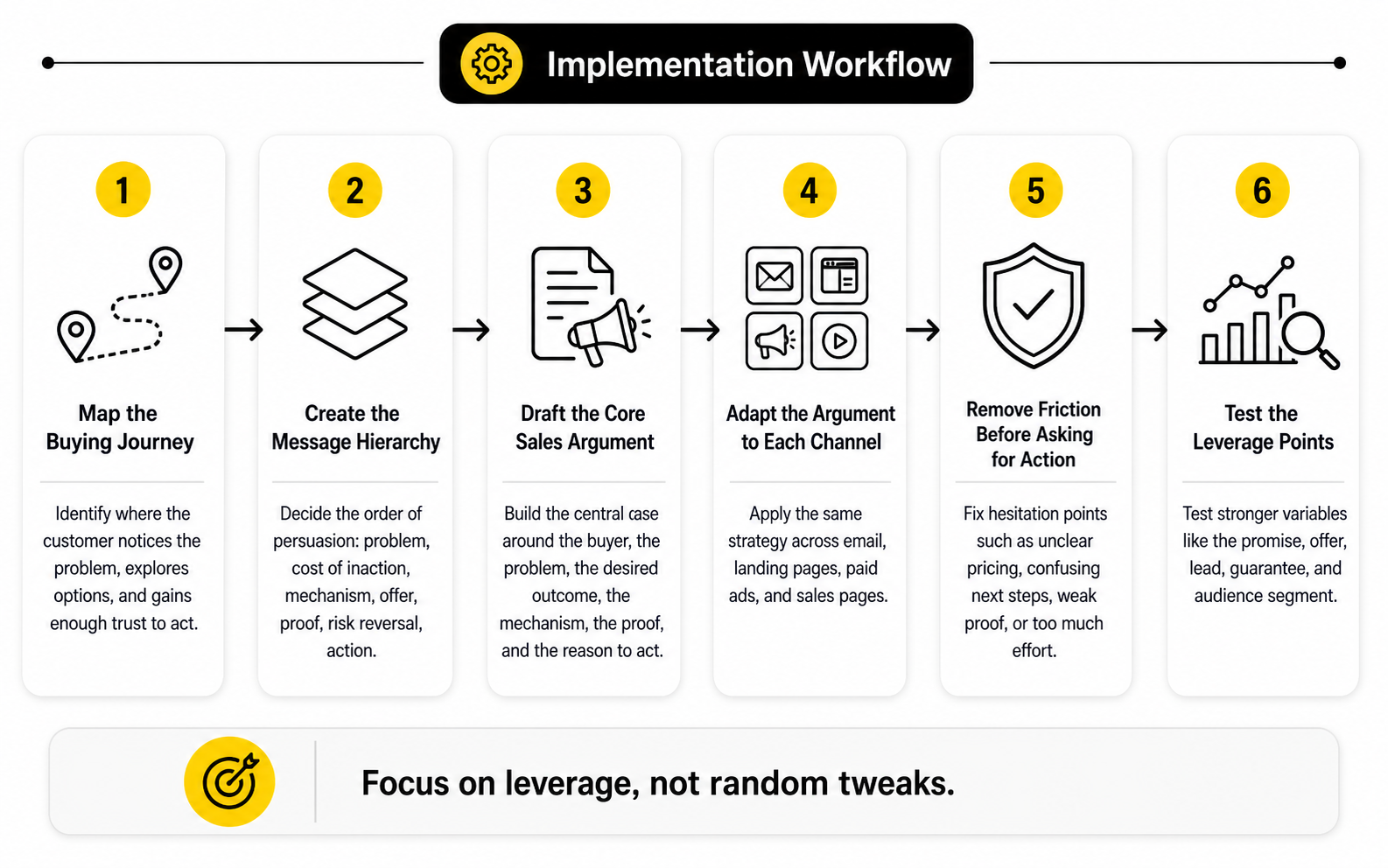
The execution process should be simple enough to use, but serious enough to prevent lazy copy. The point is not to create a massive document nobody reads. The point is to create a clear path from market insight to published message.
Step 1: Map the Buying Journey
Start by mapping the real buying journey. Where does the customer first notice the problem? Where do they look for options? What do they need to believe before they book a call, start a trial, request a quote, join a list, or buy?
This mapping protects you from writing the wrong message for the wrong stage. A cold ad should not assume the same level of trust as a sales page sent to warm leads. A checkout page should not introduce a brand-new argument when the buyer needs reassurance and clarity.
This is also where funnel tools can help, but only if the strategy comes first. A platform like ClickFunnels can be useful for building structured sales paths, but the funnel will only work if each step answers the buyer’s next real question. Tools amplify strategy; they do not replace it.
Step 2: Create the Message Hierarchy
The message hierarchy decides what the reader needs to understand first, second, third, and fourth. This is not just an outline. It is the order of persuasion.
A simple hierarchy might start with the painful problem, then the cost of ignoring it, then the new mechanism, then the offer, then proof, then risk reversal, then action. Another campaign might begin with a timely opportunity, then explain why most people miss it, then introduce the offer as the cleanest way to act. The right order depends on the market’s awareness and sophistication.
This is where many pages get messy. They put testimonials before the reader understands the promise, features before the buyer cares, or urgency before trust has been built. The message hierarchy keeps the copy from becoming a pile of good points in a bad order.
Step 3: Draft the Core Sales Argument
The core sales argument is the cleanest version of why the buyer should act. It should be simple enough that the team can repeat it without reading the whole page. If your team cannot explain the argument clearly, the customer probably cannot either.
A strong sales argument usually includes the buyer, the problem, the desired outcome, the mechanism, the proof, and the reason to act. It does not need to be clever. It needs to be clear, believable, and specific enough to guide every asset in the campaign.
Once this argument is written, it becomes the spine of the copy. Ads can pull from it. Emails can expand it. Landing pages can structure around it. Sales teams can use it to keep conversations consistent.
Step 4: Adapt the Argument to Each Channel
A good argument should stay consistent, but the expression should change by channel. An email can be more conversational. A landing page needs more structure. A paid ad needs sharper compression. A sales page can carry more proof and objection handling.
This is where implementation becomes disciplined. You are not copying and pasting the same paragraph everywhere. You are adapting the same strategic idea to the buyer’s mindset in that channel.
For example, an email may lead with a painful observation and invite a click. A landing page may expand that observation into a full buying case. A retargeting ad may focus on one unresolved objection. The copy feels connected because the strategy is connected.
Step 5: Remove Friction Before Asking for Action
Friction is anything that makes the reader pause for the wrong reason. It can be unclear pricing, a confusing next step, a vague guarantee, weak proof, slow page flow, too many form fields, or a claim that sounds bigger than the evidence can support. Friction does not always look dramatic, but it quietly kills momentum.
Baymard’s checkout research has long shown how costly friction can be, with the average cart abandonment rate sitting around 70% across its benchmarked research. That number is not only a checkout lesson. It is a reminder that people who show interest can still disappear when the experience creates doubt, surprise, or unnecessary effort.
Before publishing, read the copy like a skeptical buyer. Ask where you would hesitate, what feels unclear, what sounds inflated, what needs proof, and what the next step requires from you. Then fix those points before you spend more money driving traffic.
Step 6: Test the Leverage Points
Testing should focus on leverage, not random tweaks. Changing a button color is usually less important than testing a clearer promise, a stronger offer, a different lead, a better guarantee, or a more relevant audience segment. The best tests come from a strategic hypothesis.
A useful testing question sounds like this: “Would more people act if they understood the cost of inaction earlier?” Another might be: “Would qualified leads convert better if the page clarified who this is not for?” These questions create better tests because they come from buyer psychology, not guesswork.
This is also where direct response discipline matters. Track the numbers that connect to business outcomes, not vanity metrics alone. Opens, clicks, watch time, and page views are useful only when they help you understand movement toward revenue, pipeline, booked calls, or qualified demand.
Statistics and Performance Signals
Statistics only matter when they tell you what to improve. Random benchmarks can make a campaign look better or worse than it really is, especially when the offer, traffic source, buying stage, and conversion goal are not the same. The point of measurement in Jay Abraham copywriting is not to collect numbers; it is to find leverage.
A 3% conversion rate can be excellent for a high-ticket consultation funnel and weak for a simple lead magnet. A 40% email open rate can look strong, but it may not mean much if the clicks are poor and the revenue is flat. A long sales page can have lower click-through than a short page and still produce better buyers because it filters out people who were never serious.
That is the mindset you need here. Measure the behavior, interpret the meaning, then improve the weakest part of the buying argument. The number is not the answer. The number is the clue.
Benchmarks Are Context, Not Goals
Benchmarks are useful because they stop you from guessing. They help you understand whether your current performance is roughly normal, unusually weak, or worth studying more closely. But they become dangerous when marketers treat them as universal targets.
Landing page performance is a good example. Unbounce’s conversion benchmark data shows that “good” depends heavily on the industry, offer, and conversion event, with broad advice like a universal 10% conversion rate being too simplistic for serious analysis: landing page conversion benchmarks. A page that converts at 5% might be weak for a free checklist, solid for a paid offer, or outstanding for an expensive B2B sales call.
Email benchmarks need the same careful reading. MailerLite’s 2025 benchmark report is based on more than 3.6 million campaigns from 181,000 approved accounts, which makes it useful for directional comparison across opens, clicks, click-to-open rates, and unsubscribes: email marketing benchmarks. But even there, the right action depends on the list quality, offer type, subject line, segment, sending frequency, and what the email is supposed to accomplish.
Measure the Whole Argument, Not One Isolated Metric
Jay Abraham copywriting should be measured as a chain of persuasion. The reader sees a promise, decides whether it is relevant, looks for proof, evaluates risk, and then decides whether to act. If you only measure the final conversion, you may miss where the argument is actually breaking.
A weak click-through rate from an email may mean the subject line attracted the wrong people. It may mean the opening did not connect. It may mean the offer was not compelling enough. Or it may mean the call to action appeared before the reader had enough reason to care.
The same is true on a sales page. Low scroll depth can suggest the lead is not creating enough momentum. High scroll depth with low conversion can suggest interest without enough trust or urgency. High add-to-cart with low purchase completion can suggest friction, surprise, unclear risk reversal, or a mismatch between the promise and the final step.
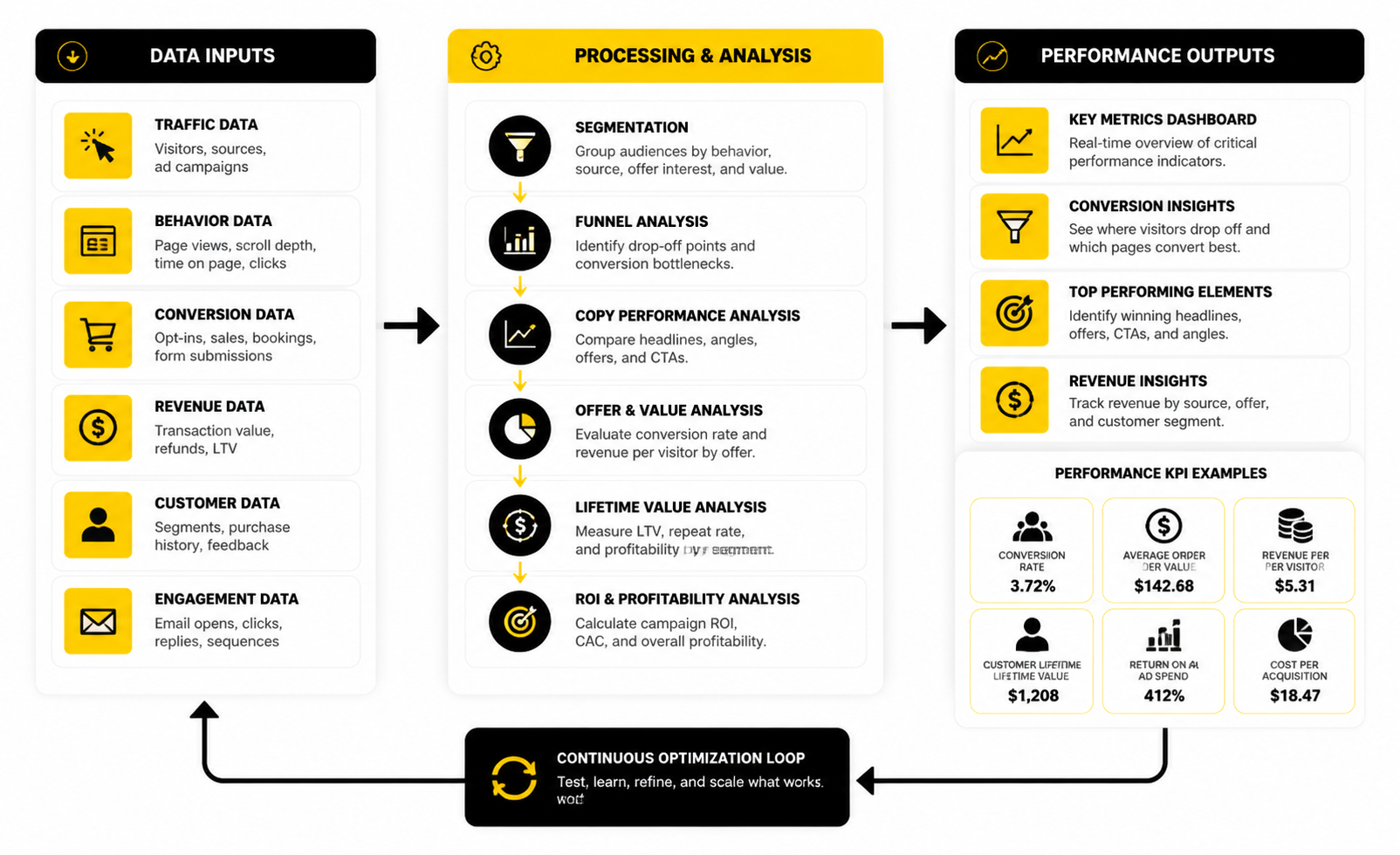
A practical analytics system should separate the buying journey into stages:
This is how you avoid shallow optimization. You do not just ask, “How do we get more clicks?” You ask, “Which part of the decision is not strong enough yet?” That question leads to better tests.
What Email Metrics Actually Mean
Email metrics are easy to misread. Opens can be distorted by privacy features, inbox behavior, and subject-line curiosity that does not translate into real intent. Clicks are usually more useful, but even clicks can be misleading if the email attracts the wrong segment or sends people to a page that does not continue the same argument.
Click-to-open rate is often a better signal of message fit because it shows how many openers were motivated enough to take the next step. If opens are strong but clicks are weak, the subject line may be creating curiosity without enough alignment. If clicks are strong but conversions are weak, the landing page may not be carrying the same promise forward.
This is where the copy process becomes practical. You can test a different subject line when attention is the problem. You can rewrite the first 100 words when relevance is the problem. You can strengthen proof, clarify the offer, or reduce risk when the click happens but the sale does not.
A tool like Brevo can help teams track campaigns and segments, but the platform cannot decide what the numbers mean. That is the strategist’s job. The tool shows behavior; the copywriter has to diagnose intent.
What Landing Page Metrics Actually Mean
Landing page analytics should tell you where belief breaks. A visitor who leaves immediately may not see relevance. A visitor who reads deeply but does not act may see relevance but not enough value, proof, or safety. A visitor who starts the form but does not finish may be reacting to friction at the point of commitment.
The first metric to review is conversion rate, but it should never be reviewed alone. Pair it with traffic source, device type, scroll depth, click behavior, form starts, checkout starts, and qualified lead rate. Otherwise, you may optimize for more conversions while accidentally reducing lead quality.
Mobile performance deserves special attention because many campaigns are now mobile-first whether marketers planned for it or not. Reporting on Unbounce’s benchmark findings noted that mobile can drive the majority of visits while desktop still converts better in many cases, which is a strong reminder to inspect the mobile experience before blaming the offer or the audience: mobile landing page conversion gap. If the copy is persuasive but the page is painful to use, the numbers will punish you anyway.
What Funnel Metrics Actually Mean
A funnel should be measured by movement, not just isolated wins. You want to know how many people move from awareness to interest, from interest to trust, from trust to action, and from action to profitable customer. This is where Abraham’s strategic view matters because the real win may come from improving the relationship between steps.
For example, a page may convert fewer leads after you make the copy more specific, but the sales team may close more deals because the leads are better qualified. That is not a failure. That is the copy doing a better job of filtering.
The opposite can also happen. A broad promise may increase opt-ins and reduce revenue quality at the same time. This is why professional measurement should connect copy performance to pipeline, average order value, retention, referral behavior, and lifetime value whenever possible.
The Metrics That Deserve the Most Attention
The right metrics depend on the campaign, but some signals are especially useful for copywriting decisions. These are the numbers that usually reveal whether the message is doing its job.
These numbers should not be dumped into a dashboard nobody uses. They should be tied to decisions. If qualified conversion rate is weak, sharpen the promise and audience fit. If form completion is weak, reduce friction or increase reassurance. If churn is high, revisit whether the copy is overpromising or attracting the wrong customer.
Data Should Improve the Message, Not Flatten It
The danger with analytics is that teams start writing for the dashboard instead of the buyer. They chase higher opens, more clicks, cheaper leads, and prettier charts without asking whether those numbers represent stronger demand. That is how you end up with clever subject lines, weak sales pages, and leads that never buy.
Good data makes Jay Abraham copywriting sharper. It shows where the buyer hesitates, where the message loses momentum, and where the offer is not being understood. It helps you decide whether to change the hook, the proof, the mechanism, the risk reversal, or the offer itself.
The best copywriters do not worship benchmarks. They use benchmarks as starting points, then let real customer behavior guide the next improvement. That is the practical balance: respect the data, but never forget that the data is only measuring human decisions.
Advanced Considerations Before You Scale
Advanced Jay Abraham copywriting is less about adding more persuasion and more about knowing what not to do. Once a campaign starts working, the temptation is to push harder, broaden the audience, automate more follow-up, and squeeze every stage for extra conversion. That can work, but it can also weaken the very trust that made the message convert in the first place.
Scaling creates pressure. More traffic means more people with different levels of awareness. More automation means more chances for the message to feel generic. More aggressive offers can increase short-term sales while creating long-term disappointment if the promise gets too far ahead of the customer experience.
This is where discipline matters. The copy should still protect the buyer’s best interest, even when the business is optimizing for growth. That is not just a moral point. It is a strategic advantage because trust compounds while hype burns out.
The Biggest Risk Is Overpromising
Overpromising usually starts quietly. A headline gets slightly bigger. A guarantee gets slightly more dramatic. A case study gets framed in a way that makes an exceptional result sound more normal than it is. Each change may feel small, but together they can turn strong copy into a liability.
The danger is not only refunds or complaints. The bigger danger is attracting the wrong buyers. If the copy promises speed to people who need depth, simplicity to people with complex problems, or certainty where there is only probability, the business may increase conversions while lowering customer quality.
The Federal Trade Commission’s guidance on endorsements and testimonials is a useful reminder here because unrepresentative claims can mislead people when the typical experience is not made clear. Even outside strict compliance, the principle is practical. If the buyer’s expectation is wrong, the sale is already damaged.
Specificity Beats Aggression
Aggressive copy tries to make the reader feel urgency through volume. Specific copy creates urgency through clarity. There is a big difference.
A vague claim like “transform your business fast” forces the reader to either believe the hype or reject it. A specific claim explains what changes, for whom, under what conditions, and why the offer is a sensible path. That gives serious buyers something to evaluate instead of something to doubt.
This is especially important in sophisticated markets. When buyers have seen dozens of similar promises, louder copy does not feel more persuasive. It feels familiar. The sharper move is to say something more precise, more useful, and more connected to the buyer’s real situation.
Scaling Requires Message Segmentation
A message that works for one audience segment may fail when you push it to another. New prospects may need more education. Returning leads may need a stronger reason to act. Past buyers may respond better to expansion, implementation help, or a higher-level outcome.
This is why scaling Jay Abraham copywriting requires segmentation. You are not simply writing more copy. You are matching the right argument to the right stage of awareness.
At a practical level, that means separating audiences by behavior and intent. Someone who clicked a pricing page is different from someone who downloaded a guide six months ago. Someone who abandoned a checkout is different from someone who watched a webinar but never booked a call. A CRM and automation system like GoHighLevel can help organize those follow-up paths, but the segmentation logic has to come from the business strategy.
Automation Should Still Feel Human
Automation becomes dangerous when it turns real buyer behavior into robotic follow-up. A prospect does not want to feel like they have been dropped into a machine. They want the next message to make sense based on what they just did, what they likely need, and what would help them decide.
This is where copywriters need to think beyond single assets. The first email after an opt-in should not feel disconnected from the page that earned the opt-in. The reminder email before a call should reinforce why the call matters. The post-webinar follow-up should continue the same argument, not restart from zero.
Good automation feels like continuity. Bad automation feels like pressure. The difference usually comes down to whether the business is using behavior to help the buyer or simply using behavior to chase the buyer.
AI Can Help With Drafting, But Not With Judgment
AI can speed up research organization, outline variations, first drafts, headline exploration, and repurposing. That is useful. But it should not replace the strategic judgment behind Jay Abraham copywriting.
The risk with AI-generated copy is sameness. It often produces clean sentences that sound plausible but do not carry enough market insight, proof, or strategic tension. The result can look professional while saying almost nothing new.
The better use of AI is as a production assistant, not the strategist. Let it help you brainstorm angles, compress ideas, summarize customer language, or create variations for testing. But the offer logic, proof standards, risk reversal, customer diagnosis, and final claims still need human judgment.
SEO Copy Must Not Become Search-Engine Theater
SEO can bring qualified traffic, but keyword-driven copy can also flatten the message. When the writer becomes too focused on inserting terms, the copy starts sounding like it was written for a crawler instead of a buyer. That is a fast way to weaken trust.
Google’s guidance on spam policies for web search makes it clear that scaled, unoriginal, manipulative content can create ranking risk. But even before ranking risk, there is reader risk. People can feel when an article is padded.
For this keyword, the phrase jay abraham copywriting should appear naturally where it helps the reader understand the topic. It should not be forced into every heading, every paragraph, or every transition. The best SEO copy still reads like a useful article written for a real person with a real problem.
The Offer Has to Survive More Scrutiny at Scale
Small campaigns can sometimes get away with rough edges because the audience is warm, referred, or already predisposed to trust the business. Scale removes that advantage. Colder traffic asks harder questions.
That means the offer needs more clarity as the audience broadens. The copy should explain who the offer is for, who it is not for, what the buyer gets, what they should not expect, and what has to be true for the offer to work. This may feel less exciting than a huge promise, but it creates better-fit buyers.
A funnel builder like ClickFunnels can help structure the sales path, especially when offers need dedicated pages, upsells, or follow-up journeys. But at scale, the funnel structure is only as strong as the truth inside it. If the offer is unclear, the funnel just moves confusion faster.
Short-Term Conversion Can Fight Long-Term Value
Not every conversion improvement is actually good. A more dramatic claim may increase opt-ins but reduce sales call quality. A heavier discount may increase purchases but train buyers to wait. A more urgent campaign may lift revenue this week while making the brand feel less trustworthy next month.
This is the tradeoff many marketers ignore. Copy should not be judged only by immediate response. It should also be judged by customer quality, retention, referrals, reviews, support burden, and the gap between expectation and reality.
That is why Abraham-style thinking is so useful. It keeps the copy connected to business economics. The goal is not merely to win the click. The goal is to create a customer relationship that is profitable, ethical, and likely to grow.
Expert-Level Copy Protects the Relationship
The best copy does more than convert. It sets the relationship up correctly. It attracts the right people, filters out poor-fit buyers, frames the value honestly, and makes the next step feel like progress instead of pressure.
That requires restraint. You have to know when to make the promise sharper and when to make the qualification stronger. You have to know when to add proof and when to remove noise. You have to know when a campaign needs better words and when it needs a better offer.
This is the advanced layer of Jay Abraham copywriting. It is not just persuasion. It is stewardship of attention, trust, and customer value. When you treat those as assets, your copy becomes harder to copy because the strategy underneath it is stronger.
What is Jay Abraham copywriting?
Jay Abraham copywriting is a strategic approach to persuasion that connects direct response writing with business strategy. It is not just about headlines, hooks, or emotional triggers. It is about understanding the buyer, clarifying the offer, reducing risk, and communicating value in a way that makes the next step feel logical.
The phrase is useful because Abraham’s work goes beyond copy tactics. His ideas around preeminence, risk reversal, lifetime value, referral systems, and value creation all affect how persuasive copy should be written. The copy becomes stronger because the business thinking underneath it is stronger.
Why is Jay Abraham copywriting different from normal copywriting?
Most copywriting advice focuses on the visible parts of the message: the headline, the lead, the offer stack, the CTA, and the closing argument. Those pieces matter, but Jay Abraham copywriting starts earlier. It asks whether the business has the right market, the right offer, the right strategic angle, and the right trust mechanism before trying to polish the words.
That difference matters because copy cannot fix every business problem. If the offer is weak, the market is wrong, or the promise is not believable, better writing may only create a temporary lift. Strategic copy improves the message and the economics behind the message.
What is the Strategy of Preeminence?
The Strategy of Preeminence is Abraham’s idea that a business should position itself as the most trusted advisor to its market, not merely another seller. The business should act as if it has a fiduciary-like responsibility to protect the customer’s best interest. That changes the tone, structure, and intent of the copy.
In practical terms, this means the copy should educate, clarify, and guide before it asks for action. It should not hide risks, exaggerate outcomes, or push poor-fit buyers into the offer. When done well, preeminence makes the business feel safer and more credible.
How do you apply Jay Abraham copywriting to a landing page?
Start by identifying the buyer’s real situation and the decision they need to make. Then write the page around a clear progression: problem, cost of inaction, desired outcome, unique mechanism, proof, risk reversal, and next step. The page should feel like it is helping the reader think more clearly, not just pushing them toward a button.
The biggest mistake is starting with features too early. A landing page should first make the reader care about the outcome and trust the reason your offer can help. Once that foundation is in place, features become evidence instead of clutter.
How do you apply it to email marketing?
Email is where Jay Abraham copywriting becomes especially useful because trust is built over time. Each email should have one clear job: create awareness, deepen desire, answer an objection, show proof, invite a next step, or re-engage a stalled lead. When every email tries to do everything, the sequence becomes noisy.
The best email sequences feel like a guided conversation. The first message should connect with the reader’s current problem. The next messages should sharpen the opportunity, show why the usual approach fails, explain the better mechanism, and make the offer feel like the natural next move.
How do you apply it to ads?
Ads need a sharper entry point because the audience has less patience. The copy has to create relevance quickly without sounding like every other advertiser in the feed. That usually means leading with a specific problem, belief, frustration, or opportunity the market already recognizes.
The mistake is trying to close the entire sale inside the ad. In most campaigns, the ad should earn the click by opening the right conversation. The landing page, email sequence, webinar, or sales call can then build the deeper argument.
What metrics matter most for Jay Abraham copywriting?
The most useful metrics are the ones that show where the buying argument is breaking. That includes qualified conversion rate, click-to-open rate, scroll depth, form completion, checkout abandonment, sales call show rate, close rate, refund rate, churn rate, and lifetime value. Each metric points to a different kind of friction.
Do not treat benchmarks as universal targets. A low conversion rate may be fine if the leads are highly qualified and profitable. A high conversion rate may be dangerous if the copy attracts poor-fit buyers who refund, churn, or never become valuable customers.
Can AI write Jay Abraham-style copy?
AI can help draft, organize, summarize, and generate variations, but it cannot replace strategic judgment. The strongest Jay Abraham-style copy depends on market insight, offer design, proof standards, risk reduction, and an honest understanding of the buyer’s situation. Those are not just writing tasks.
AI is most useful when you already know the strategy. It can help turn research into angles, expand outlines, create email variations, or simplify copy. But the final message still needs a human strategist to check whether the claims are true, the offer is clear, and the promise is responsible.
Is Jay Abraham copywriting only for long-form sales letters?
No. The principles work in short-form and long-form copy because the underlying job is the same. You still need relevance, value, proof, risk reduction, and a clear next step. The only difference is how much of the argument each format can carry.
A short ad may only express the hook and promise. A landing page may carry the full argument. A sales letter may go deeper into story, proof, objections, and risk reversal. The format changes, but the strategic logic stays consistent.
What is risk reversal in copywriting?
Risk reversal means reducing the buyer’s fear of making a bad decision. It can be a guarantee, trial, audit, consultation, transparent refund policy, clear onboarding process, proof of results, or an honest explanation of who the offer is not for. The purpose is to make the next step feel safer.
This is important because many buyers are not only asking, “Will this work?” They are also asking, “What happens if I am wrong?” Strong copy answers both questions before the reader has to ask them out loud.
How do you avoid making the copy sound hypey?
Hype usually appears when the promise is bigger than the proof. To avoid it, make the copy more specific, not louder. Explain who the offer is for, what it helps them do, why the mechanism works, what proof supports the claim, and what expectations are realistic.
You can still write with energy. Direct copy does not have to be boring. But confidence should come from clarity, evidence, and strategic insight, not from inflated language.
What is the biggest mistake businesses make with Jay Abraham copywriting?
The biggest mistake is treating it like a style instead of a strategy. They try to sound persuasive without improving the offer, the positioning, the proof, the follow-up, or the buying experience. That misses the point.
The real power comes from connecting copy to value creation. Better words matter, but better leverage matters more. When the business gives the copywriter a stronger offer, clearer positioning, and better proof, the writing has something real to work with.
How should beginners start using Jay Abraham copywriting?
Start by rewriting one existing offer page or email sequence through the buyer’s eyes. Do not begin by trying to sound clever. Begin by asking what the buyer wants, what they fear, what they distrust, what they need to believe, and what would make the decision easier.
Then improve one layer at a time. Clarify the promise, strengthen the proof, reduce risk, remove unnecessary friction, and make the next step obvious. That simple process will usually beat random headline tweaks.
Does this approach work for agencies and freelancers?
Yes, and it is especially useful for service providers because trust is a major part of the sale. Agencies, consultants, freelancers, and fractional marketers are often selling judgment, process, reliability, and business impact, not just deliverables. The copy has to make those invisible qualities easier to believe.
For service businesses, Abraham-style copy should explain the problem clearly, show the cost of the wrong approach, position the service as a safer path, and make the working relationship feel concrete. The buyer should understand not just what you do, but why your way of doing it reduces risk.
Final Takeaways
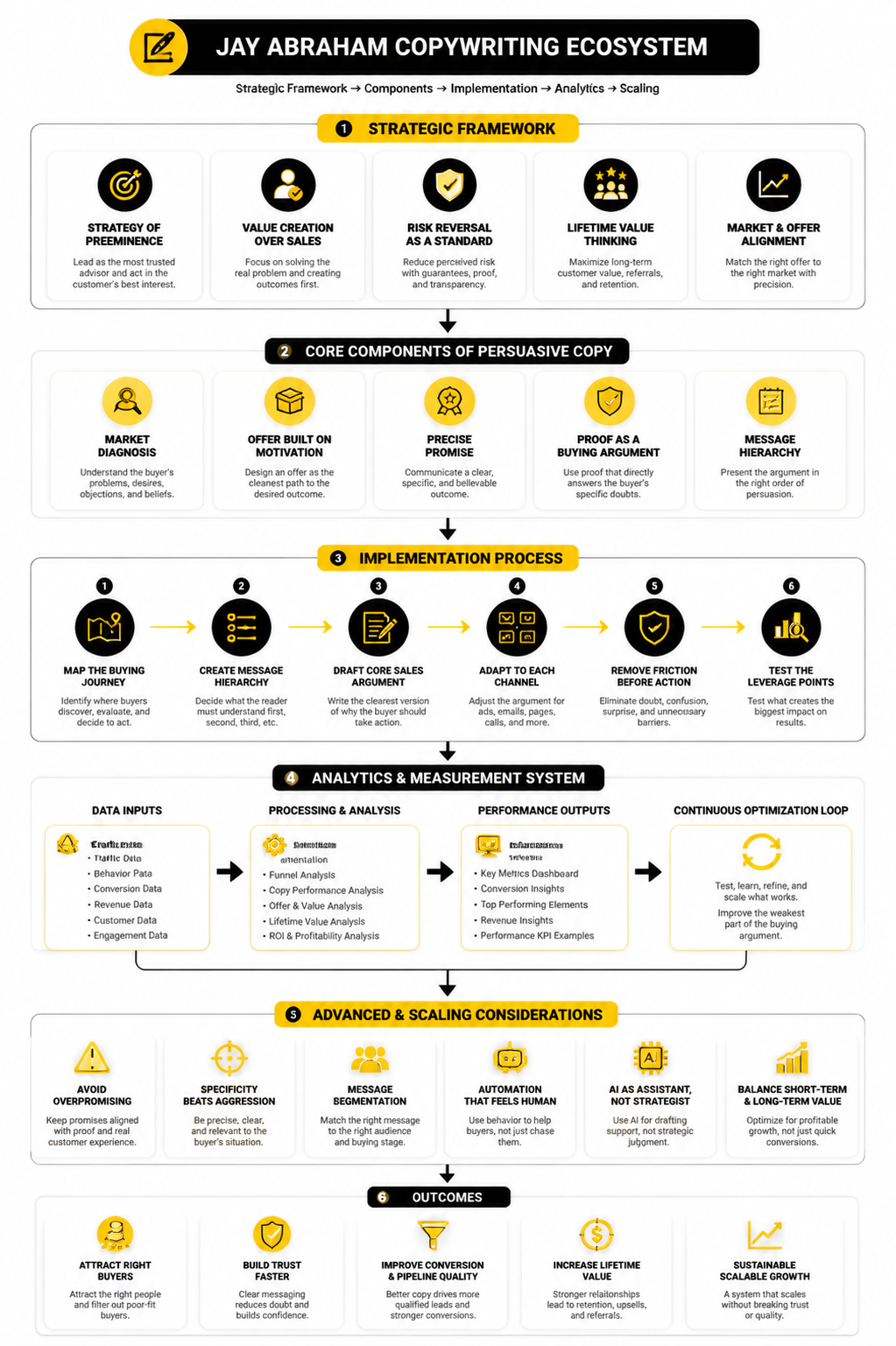
Jay Abraham copywriting works because it forces you to think before you write. It pushes you to understand the buyer, improve the offer, clarify the value, reduce the risk, and communicate with the posture of a trusted advisor. That is more demanding than writing a clever headline, but it is also far more useful.
The practical lesson is simple. Do not ask copy to compensate for weak strategy. Strengthen the offer, sharpen the market insight, build the buying argument, and measure where belief breaks. Then write copy that helps the right person make a better decision.
When you do that, copy becomes more than conversion language. It becomes a business asset. It improves how the market understands you, how buyers evaluate you, and how confidently the right customers move forward.
Build a stronger local presence with BAAM AI
Turn your website, Google profile, social channels, and AI visibility into one growth engine
Most businesses do not need more random marketing activity. They need a consistent presence system that helps the right people find them, trust them, and take action. BAAM AI brings strategy, local SEO, website updates, Google Maps visibility, social content, AI-search readiness, media production, and reporting into one practical monthly engine.
If you want your marketing to keep working after the campaign ends, start with a free BAAM AI presence audit. See how your business shows up today and where the fastest visibility wins are at BAAM AI.