
BAAM AI Blog
Jacob McMillen Website Copywriting: A Practical Framework For Writing Pages That Sell
Most website copy fails for a simple reason: it tries to sound impressive before it tries to be useful.
Most website copy fails for a simple reason: it tries to sound impressive before it tries to be useful.
That is the problem Jacob McMillen keeps coming back to in his approach to website copywriting. His work is not about clever lines, branding fluff, or stuffing a homepage with every benefit a business can think of. It is about understanding what the visitor needs to believe, what they are comparing you against, and what has to be said on the page before they feel ready to take action.
That matters because website copy is not decoration. It is the sales conversation your business has when you are not in the room. If the headline is vague, the offer is unclear, the proof is weak, or the call to action feels premature, the page quietly loses people who might have become leads, subscribers, customers, or clients.
this guide breaks down Jacob McMillen’s website copywriting approach into a practical framework you can actually use. We will look at why it works, how the structure fits together, what each page section needs to accomplish, and how to implement the process professionally without turning your website into a bloated sales letter.
Here is the six-part structure the full article will follow:
The Website Copywriting Problem Jacob McMillen Solves
Most businesses do not have a traffic problem first. They have a message problem first.
They send visitors to a homepage, service page, landing page, or sales page and assume the visitor will connect the dots. But the visitor is distracted, skeptical, and usually comparing several options at once. If the page does not quickly explain who it helps, what outcome it creates, why the offer is credible, and what the next step should be, the visitor leaves.
Jacob McMillen’s website copywriting process is useful because it treats copy as a guided decision path. The job is not to write something that sounds like “good copy.” The job is to move the right person from confusion to clarity, from hesitation to trust, and from passive interest to a specific next action.
That is a much higher standard than simply writing a catchy headline. A page can sound polished and still fail because it does not answer the reader’s real objections. A page can include testimonials and still fail because the proof is disconnected from the claim being made. A page can have a beautiful design and still fail because the message is generic.
Why This Approach Fits Modern Website Copywriting
Modern buyers do more research, compare more alternatives, and tolerate less friction than they used to. They do not want to decode your positioning. They want the page to make the value obvious.
That is why Jacob McMillen’s approach fits especially well for service businesses, SaaS companies, consultants, agencies, creators, and B2B brands. These businesses often sell something that requires explanation. The offer is not always instantly obvious, and the buyer often needs a mix of clarity, proof, differentiation, and reassurance before they are ready to act.
Good website copy gives that buyer a clean path. It does not dump every feature onto the page. It chooses the right message for the right moment and puts each section in the order the reader needs it.
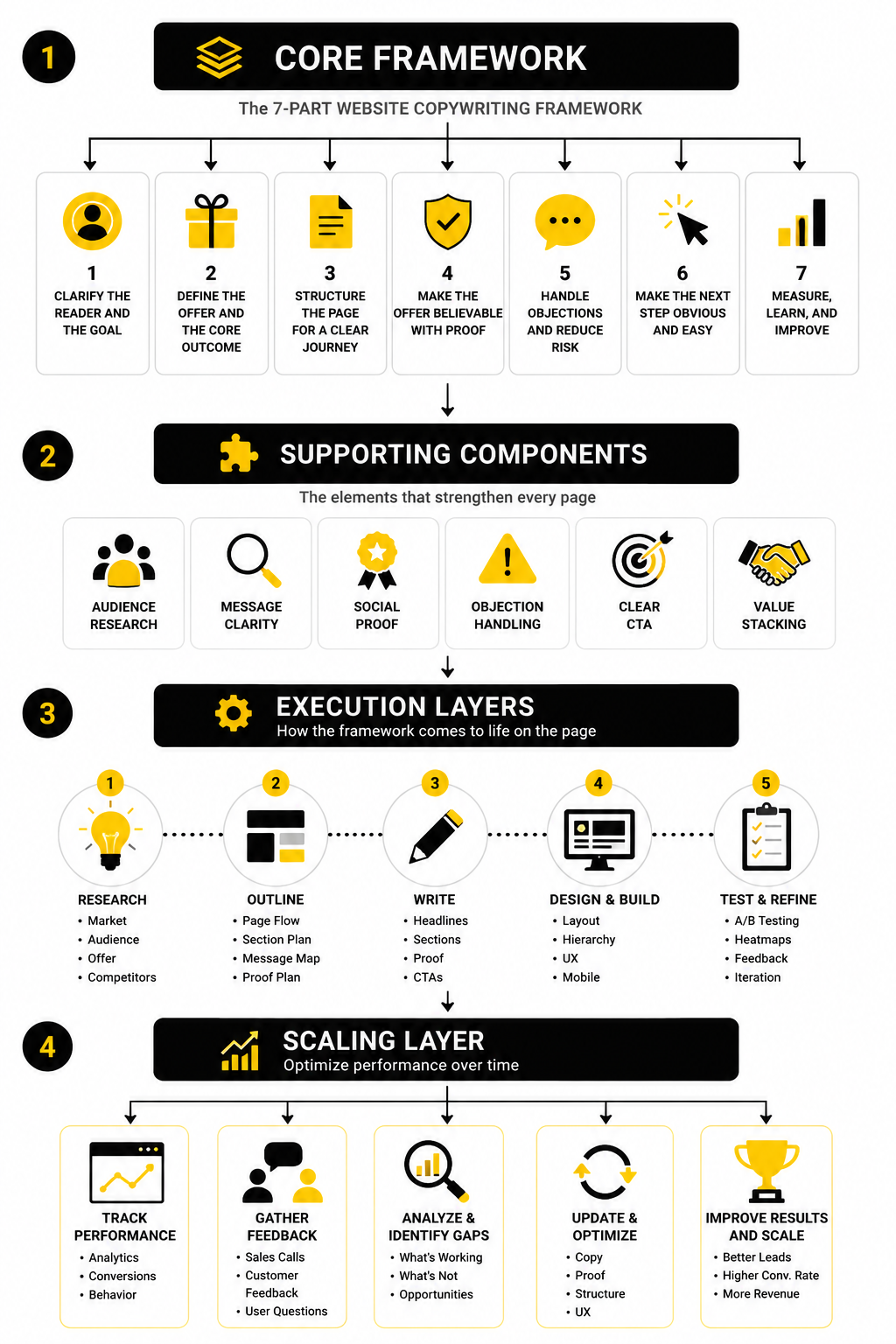
The framework matters because copywriting is not just writing. It is strategy expressed through words. When the strategy is weak, the copy becomes vague. When the strategy is strong, the writing becomes easier, sharper, and more persuasive.
How The Rest Of this guide Will Build The Framework
The next section will look at why website copywriting matters beyond surface-level branding. This is where we will separate “nice sounding copy” from copy that actually supports revenue, lead generation, positioning, and sales conversations.
After that, we will break down the full Jacob McMillen website copywriting framework in practical terms. We will look at the sequence behind strong pages, including audience research, value proposition, page structure, proof, objections, and calls to action.
Then we will go deeper into the core components that make the framework work. Headlines, subheadings, problem framing, benefits, features, testimonials, authority signals, FAQs, and CTAs all have jobs to do. When each component does its job, the page feels natural instead of pushy.
Finally, we will cover professional implementation. That includes how to use the framework for a homepage, service page, SaaS page, landing page, or creator offer without blindly copying a template. The goal is not to imitate Jacob McMillen’s voice. The goal is to understand the underlying structure well enough to write stronger copy for your own business or clients.
Why Website Copywriting Matters More Than Clever Branding
Branding helps people recognize you. Website copy helps them understand why they should care.
That distinction matters because a lot of businesses confuse “sounding premium” with being persuasive. They polish the tone, soften the message, and add abstract language that feels safe in a brand deck but does very little for a real visitor trying to make a decision. The result is a page that looks professional and still leaves the reader thinking, “Okay, but what do you actually do for me?”
This is where the Jacob McMillen website copywriting approach becomes practical. It pushes the page away from vague positioning and toward clear sales communication. The copy has to explain the offer, name the problem, show the outcome, support the claims, and make the next step feel obvious.
That does not mean the copy should be aggressive. It means the copy should be useful. A useful page respects the reader’s time by answering the questions they already have instead of making them dig through buzzwords, founder language, or internal company logic.
The Visitor Is Not Reading The Page Like You Are
You read your website from the inside out. Your visitor reads it from the outside in.
You already know the offer, the backstory, the service details, the product logic, and why the business exists. The visitor does not. They land on the page with limited attention, limited context, and a specific question in their head: “Is this for me, and is it worth my time?”
That is why structure matters so much. Nielsen Norman Group’s eye-tracking research on the F-shaped scanning pattern shows that people often scan web pages quickly instead of reading every word from top to bottom. They look for signals, headings, phrases, and proof points that tell them whether to keep going.
This changes how you should think about copy. The page cannot depend on one brilliant paragraph buried halfway down. It needs a strong hierarchy where the headline, subheadings, bullets, proof, and calls to action all work together.
Good website copy is not just written. It is arranged.
Clear Copy Reduces Decision Friction
A confused visitor does not usually complain. They just leave.
That is the quiet danger of weak website copy. It does not always look broken from the business side. The page can have traffic, nice design, and decent brand visuals, but if the message creates friction, the visitor silently moves on to a competitor that explains the value faster.
Friction usually comes from small moments of uncertainty. The reader wonders whether the service fits their situation. They wonder what happens after they book a call. They wonder whether the company has worked with people like them before. They wonder why the offer costs more, takes longer, or sounds different from the alternatives.
Jacob McMillen’s copywriting style is useful because it treats those questions as part of the page, not as interruptions. A strong page does not avoid objections. It handles them before they become exit points.
That is especially important for higher-ticket services, B2B offers, SaaS products, and consulting businesses. These are not impulse purchases. The visitor needs to trust the logic of the offer before they trust the call to action.
Branding Creates Attention, But Copy Creates Understanding
A strong brand can make a business memorable, but memorability alone does not create action.
People can like your visuals, enjoy your tone, and still have no idea whether they should buy, subscribe, book, or inquire. That is why copy has to carry more weight than most businesses give it. It is the part of the page that turns attention into understanding.
The best website copy makes the reader feel oriented. It tells them where they are, what the offer is, who it is for, what result it helps create, and why the business is credible. Each section gives the reader another reason to continue.
This is also where clever copy can become a liability. Cleverness often asks the reader to do extra work. Clarity removes work.
That does not mean the writing should be boring. It means the personality should support the message instead of competing with it. The reader should never have to decode a headline before they can understand the offer.
Website Copy Supports The Entire Sales System
Website copy is not isolated from the rest of the business. It affects ads, email, SEO, sales calls, onboarding, referrals, and retargeting.
When the website message is clear, every other channel gets easier. Ads can promise the same outcome the page explains. Email campaigns can reinforce the same positioning. Sales calls can continue the same conversation instead of restarting from scratch. Even referrals become easier because people can describe what you do in plain language.
This is why website copy should be treated as a core business asset, not a one-time writing task. If the message is weak, paid traffic becomes more expensive, sales calls become less efficient, and follow-up campaigns have to work harder. If the message is strong, the whole funnel becomes cleaner.
Tools can help with implementation, but they cannot fix unclear thinking. A funnel builder like ClickFunnels, a CRM and automation platform like GoHighLevel, or an email platform like Brevo can make execution faster. But the words still need to make the offer obvious, credible, and compelling.
That is the part many businesses skip. They build the funnel before they clarify the message. Then they wonder why the system feels heavy.
Why This Matters Even More For B2B And Service Businesses
B2B and service buyers are usually not looking for entertainment. They are looking for confidence.
They need to know that the business understands their problem, can handle the complexity, and has a process that makes sense. Gartner’s research on the B2B buying journey notes that many buyers want digital self-service, but self-service buying can also increase regret when the experience does not give them enough confidence. That is exactly where strong website copy earns its place.
The page has to do more than attract attention. It has to help the buyer make sense of the decision. It should frame the problem, explain the stakes, compare the old way with the better way, and make the next step feel like a logical move rather than a leap.
This is why Jacob McMillen website copywriting principles are especially useful for complex offers. The more explanation the buyer needs, the more important structure becomes. You cannot rely on a pretty homepage to carry a serious decision.
The Real Job Is To Make The Right Buyer Feel Understood
Persuasive copy is not about pressuring people. It is about making the right people feel accurately understood.
That starts with language. The best copy uses the customer’s world, not the company’s internal vocabulary. It names the problem in a way the reader recognizes. It describes the desired outcome without exaggerating. It explains the offer without hiding behind jargon.
When that happens, the reader relaxes. They feel like the page was written for someone in their situation. They are more willing to keep reading because the business has already demonstrated understanding before asking for action.
This is the foundation for the framework that comes next. Before we talk about sections, headlines, proof, and calls to action, the principle has to be clear: website copy matters because it is the bridge between what the business sells and what the buyer needs to believe.
The next step is building that bridge intentionally.
The Jacob McMillen Website Copywriting Framework
The most useful thing about Jacob McMillen’s website copywriting approach is that it does not treat the page like a blank canvas.
That is where a lot of writers get stuck. They open a document, try to create the perfect headline, and then keep rewriting the same opening section because they have not made the strategic decisions yet. The better process is to figure out the message before polishing the sentences.
Jacob’s public guide to website copywriting frames the work as a step-by-step process for planning the page, writing persuasive copy, and turning the finished page into more leads, subscribers, and sales. That sequence matters. Planning comes before writing because copy that starts with research and structure almost always beats copy that starts with wordplay.
The framework can be simplified into four practical stages:
Each stage removes guesswork. Instead of asking, “What should this page say?” you ask better questions. What is the visitor trying to solve? What do they need to believe before they act? What proof would make the claim credible? What next step feels natural at this stage of awareness?
Start With The Page Goal
Every page needs one main job.
That sounds obvious, but it is where many websites become messy. A homepage tries to explain the company, promote three services, collect newsletter subscribers, push a lead magnet, book calls, show culture, and summarize the founder’s story all at once. The result is not a stronger page. It is a page with no clear priority.
Before writing, define what the page is supposed to do. A homepage might need to route different visitors to the right offer. A service page might need to qualify leads and drive consultation requests. A landing page might need to convert one specific traffic source into one specific action. A SaaS page might need to show the product’s value quickly enough that the visitor starts a trial or books a demo.
This decision shapes everything that follows. The headline, proof, section order, and call to action should all support the same primary goal. If a section does not help the reader move toward that goal, it probably does not belong on the page.
Define The Reader Before Defining The Message
Strong copy starts by identifying the reader’s situation, not the company’s talking points.
The writer needs to know what the reader already understands, what they are frustrated by, what alternatives they have tried, and what would make them trust the offer. This is not just demographic research. It is decision research. You are trying to understand the mental state the visitor brings to the page.
A practical version of this research can include:
This is where the Jacob McMillen website copywriting process becomes especially useful for service businesses and B2B offers. The copy is not written from what the business wants to say. It is written from the overlap between what the business can credibly deliver and what the reader already cares about.
That overlap is the message.
Build The Page Around The Buyer’s Decision Path
A website page is not just a collection of sections. It is a sequence.
The visitor usually needs clarity before proof, proof before action, and action before commitment. If the page asks for a call before explaining the outcome, it feels premature. If it piles on features before naming the problem, it feels disconnected. If it gives social proof without a clear claim, the proof has nothing to support.
A strong page usually moves through a decision path like this:
This does not mean every page needs the same template. It means the page should follow the reader’s psychology. A cold visitor may need more context. A warm referral may need less education and more proof. A high-ticket buyer may need more reassurance. A low-friction signup page may need speed and clarity above everything else.
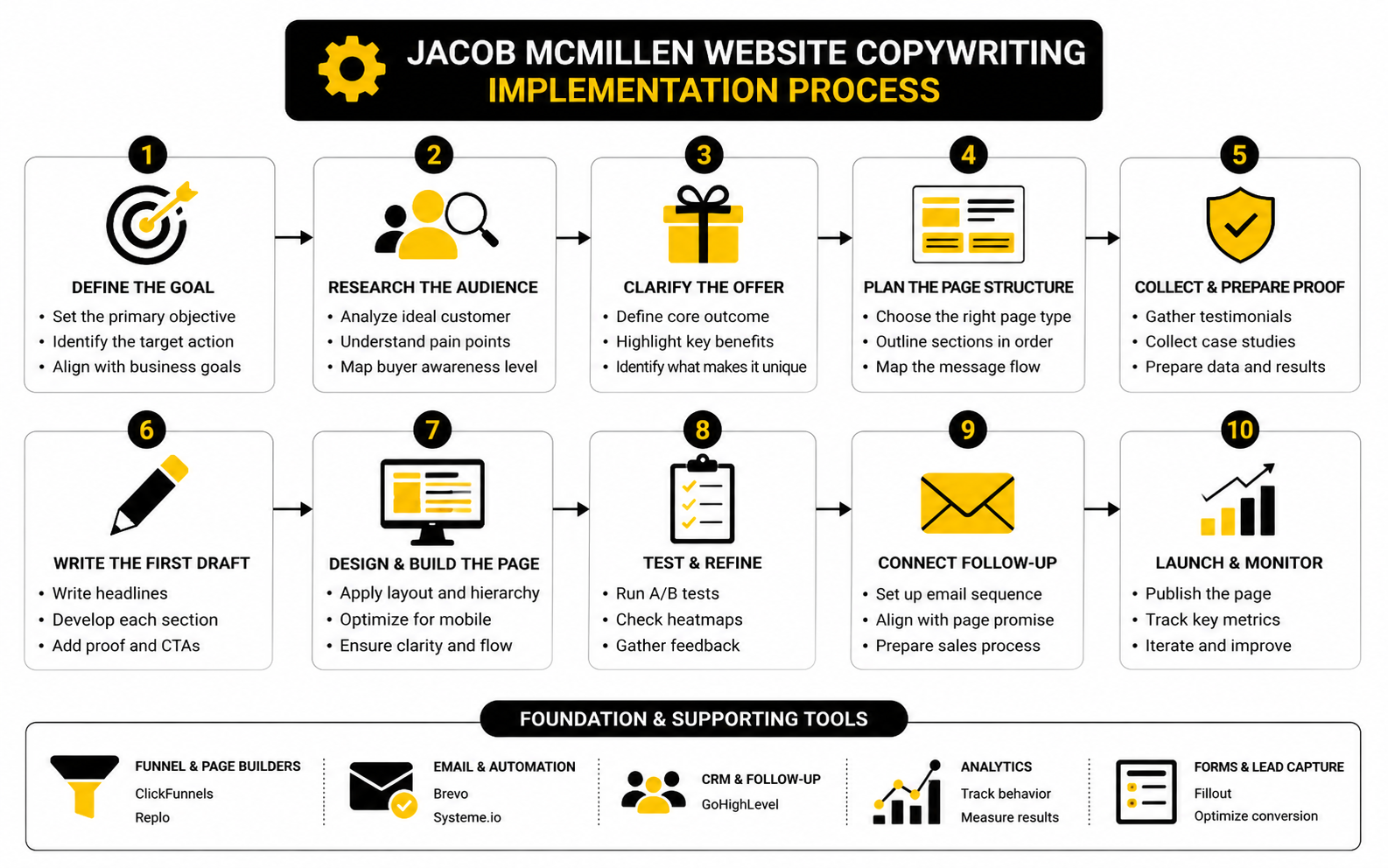
The point is not to copy a structure blindly. The point is to make the structure serve the buying decision.
Turn Research Into Page Sections
Research is only useful if it becomes copy.
This is where many teams overcomplicate the process. They collect customer quotes, competitor notes, analytics screenshots, and sales insights, but the final page still sounds generic. The missing step is translation: turning raw research into section-level decisions.
For example, if customers keep saying they are tired of agencies that overpromise and disappear, the page should not simply say “reliable service.” It should include copy that explains the communication process, sets expectations, and shows how the business keeps the client informed. If prospects keep asking whether the service works for their industry, the page should include proof or positioning that answers that concern directly.
This is why the framework works well when the writer creates a message map before drafting. A simple message map can include:
Once those pieces are clear, the page becomes easier to write. You are not inventing copy from scratch. You are arranging the strongest ideas in the order the reader needs them.
Write The First Draft For Clarity, Not Perfection
The first draft should not be treated like the final version.
Its job is to get the structure and message onto the page. The headline can be improved later. The rhythm can be tightened later. The language can be sharpened later. What matters first is whether the page makes sense from top to bottom.
A good first draft should answer the basic questions clearly. Who is this for? What does it help them achieve? Why does the problem matter? How does the offer work? Why should the reader believe it? What should they do next?
Once those answers are on the page, editing becomes much easier. You can cut weak sections, strengthen transitions, replace vague claims with specific language, and make the copy sound more natural. You can also spot where the page is asking the reader to make a leap without enough support.
This is the practical difference between writing copy and decorating a page with words. The first draft builds the argument. The edit makes the argument sharper.
Match The Call To Action To The Reader’s Readiness
The call to action should match the reader’s level of commitment.
For a simple product, “Start free trial” might be enough. For a complex service, “Book a strategy call” may work better if the page has already created trust. For a colder audience, a lower-friction step like a guide, audit, checklist, or short diagnostic can make more sense.
This is also where the tool stack should support the strategy instead of driving it. If the page is designed to generate qualified calls, a scheduling tool like Cal.com can make the next step easier. If the page needs to capture and nurture leads, an automation platform like GoHighLevel can help connect the form, CRM, follow-up, and pipeline. If the offer is built around a simple funnel, Systeme.io can be a practical option for getting the page and email flow live without making the setup overly complex.
But the CTA itself still has to be earned. A button cannot rescue a page that never made the offer clear. The copy has to create enough confidence that the next step feels like the obvious move.
Refine The Page Like A Sales Conversation
Editing website copy is not just about grammar.
It is about pressure-testing the sales conversation. If a real prospect were sitting across from you, would this page answer their questions in the right order? Would it make them feel understood? Would it give them enough proof? Would it make the next step feel simple instead of risky?
This is the mindset behind strong implementation. You read the page as the buyer, not the business. You look for vague claims, unsupported promises, awkward transitions, and sections that feel internally important but externally irrelevant.
A useful editing pass can focus on five questions:
If the answer is no, the solution is rarely to add more words. Usually, the solution is to make better choices. Cut the filler. Move the proof closer to the claim. Replace abstract language with concrete outcomes. Make the CTA more specific.
That is the real implementation lesson. Jacob McMillen website copywriting is not about writing louder. It is about making the page clearer, more useful, and more persuasive one decision at a time.
Statistics And Data
Measurement is where website copy stops being a debate about opinions.
Without data, every copy review turns into personal preference. One person likes a shorter headline. Another wants more emotion. Someone else wants to add three more features because they feel important internally. Data does not remove judgment, but it gives the team a better question: what is the page actually doing with real visitors?
This is important when applying the Jacob McMillen website copywriting framework because the framework is not supposed to end when the page is published. The first version is a strategic draft in the market. The real improvement comes from watching how people respond, finding the weak points, and tightening the message based on evidence.
The Metrics That Actually Matter
The main mistake is tracking too many numbers and understanding too few of them.
A website page can produce endless data: sessions, scroll depth, bounce rate, time on page, clicks, form starts, form completions, booked calls, trial starts, checkout starts, purchases, and assisted conversions. All of those can be useful, but they are not equally important. The right metric depends on the job of the page.
For a homepage, the key signal is often whether visitors move to the right next page. For a service page, the key signal might be qualified inquiry rate. For a landing page, it could be lead conversion rate from a specific traffic source. For a SaaS page, it might be trial starts, demo requests, or product-qualified signups.
This is why “conversion rate” alone can be misleading. A page that gets fewer leads but better-fit leads may be doing its job. A page that increases form submissions while lowering close rate may simply be attracting the wrong people. Measurement has to connect copy performance to business quality, not just raw activity.
Benchmarks Are Useful, But They Are Not The Goal
Benchmarks help you understand whether a page is wildly underperforming, but they should not become the target.
For example, Unbounce’s conversion benchmark data is based on more than 57 million conversions across more than 41,000 landing pages, which makes it useful for seeing how performance can vary by industry. MarketingProfs summarized 2024 landing page benchmark data showing a 6.6% median conversion rate across pages studied, with SaaS landing pages at 3.8% and financial services at 8.4%. Those numbers are helpful context, but they do not tell you what your page should convert at.
The reason is simple: traffic quality changes everything. A warm email audience can convert dramatically differently from cold paid traffic. A branded search visitor behaves differently from someone who clicked a broad informational article. A high-ticket consulting offer cannot be judged the same way as a free checklist or low-cost product.
Use benchmarks as a diagnostic tool, not a scoreboard. If your page is far below the normal range for similar offers and traffic sources, something may be broken in the message, offer, trust, page experience, or audience targeting. If your page is above average but sales quality is poor, the copy may be over-attracting the wrong segment.
What Performance Signals Tell You About The Copy
Good analytics should point to a copy decision.
If people land on the page and leave quickly, the issue may be message mismatch. The headline might not match the ad, search intent, or referral promise that brought them there. It might also be too vague, too clever, or too slow to explain the value.
If visitors scroll but do not click, the issue may be belief. They are interested enough to keep reading, but the page has not given them enough proof, urgency, clarity, or confidence to act. That usually means the argument is incomplete.
If visitors click the CTA but do not complete the form, the issue may be friction. The form might ask for too much too soon, the next step might feel unclear, or the promise before the click might not match the experience after the click. Baymard’s checkout research shows that the average large ecommerce site has 32 unique checkout improvements available and potential for a 35% conversion rate lift through better checkout UX, which is a useful reminder that persuasion can break after the copy has done its job.
The point is not to stare at dashboards. The point is to translate behavior into a better hypothesis.
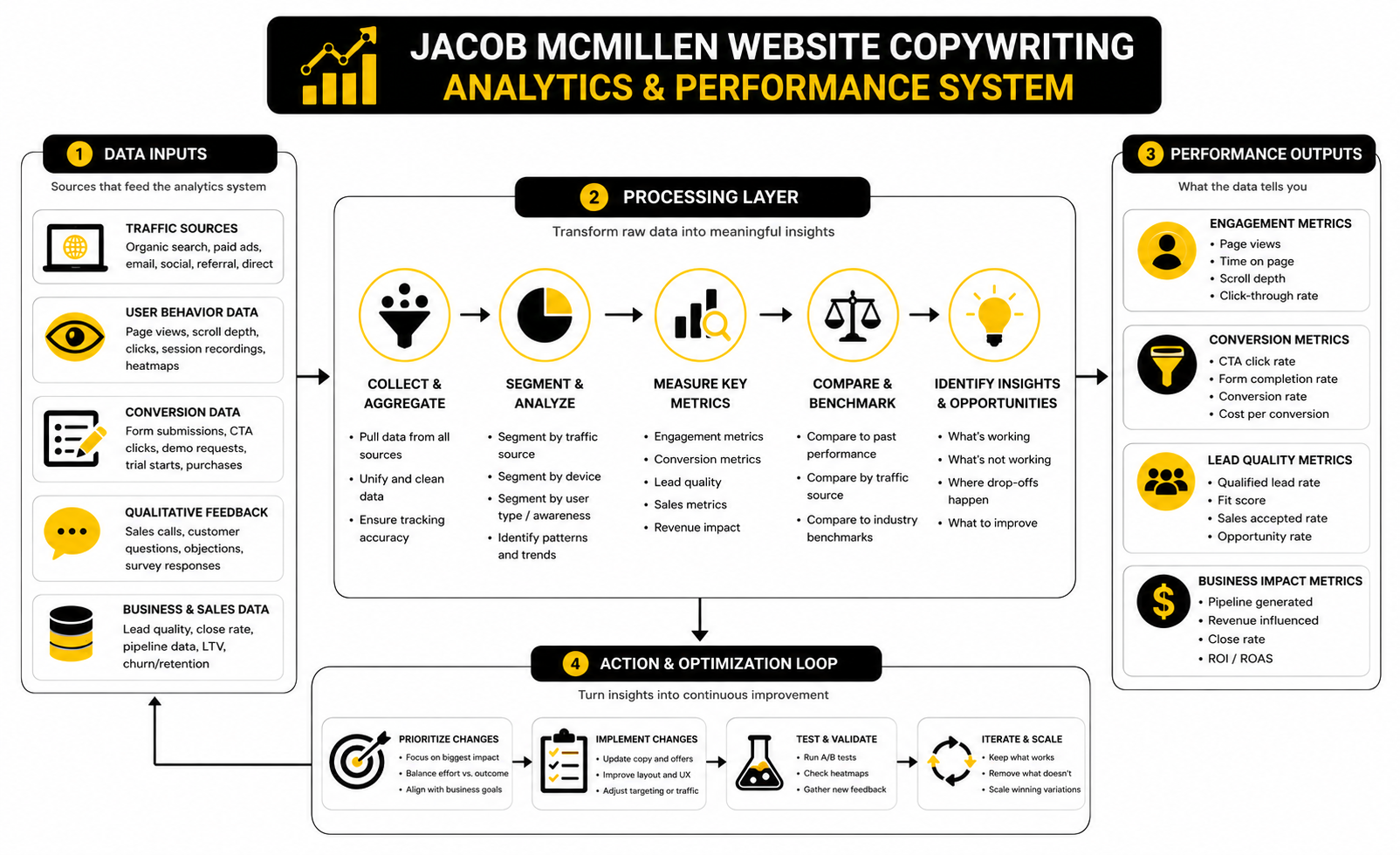
A practical analytics system should connect the number to the action. Low hero engagement means test clearer positioning. Weak CTA clicks mean test the offer framing or button context. High form abandonment means simplify the step or explain what happens next. Strong leads but weak close rate means revisit qualification and expectation-setting in the copy.
Track The Page Like A Funnel, Not A Poster
A website page is not a static poster. It is part of a journey.
That means you should measure the page in stages. First, did the visitor stay long enough to understand the promise? Second, did they engage with the sections that build belief? Third, did they click toward the next step? Fourth, did they complete that next step? Fifth, did that action create real business value?
This kind of measurement is especially useful for service pages and B2B pages because the conversion does not end at the form submission. A booked call is not a win if the prospect is unqualified. A lead magnet opt-in is not a win if no one engages with the follow-up. A demo request is not a win if the visitor misunderstood the product.
A simple funnel view might look like this:
This keeps the copy tied to revenue instead of vanity metrics. It also prevents the team from optimizing the wrong thing. More clicks are not automatically better. Better movement from the right people is better.
Use Qualitative Data To Explain The Numbers
Analytics tells you what happened. Qualitative research helps explain why.
This is where session recordings, heatmaps, surveys, customer interviews, and sales feedback become valuable. If visitors keep abandoning a pricing section, the number alone does not tell you whether the price is too high, the value is unclear, the comparison is weak, or the offer is attracting the wrong audience. You need context.
Nielsen Norman Group’s eye-tracking work on how people read online reinforces the same practical lesson from a different angle: people scan, compare, and look for cues that help them decide whether a page contains what they need. That means unclear headings, buried proof, and vague section openers can quietly damage performance even when the copy sounds good in a document.
Qualitative data helps you find those moments. A prospect saying “I was not sure what happens after I book” is more useful than ten internal opinions about the CTA. A sales note showing repeated confusion about deliverables is a signal to clarify the offer section. A support question that keeps appearing after signup may mean the page created the wrong expectation.
Measure Message Match Across The Whole Journey
Copy performance depends heavily on what happened before the visitor arrived.
If an ad promises one outcome and the landing page opens with a different angle, conversion will suffer. If an SEO article attracts beginners but the service page speaks to advanced buyers, the page may look weak when the real problem is audience mismatch. If an email builds urgency and the page feels generic, the reader loses momentum.
That is why message match should be measured across the full path. The promise in the traffic source should connect naturally to the headline. The headline should connect naturally to the offer. The offer should connect naturally to the proof. The CTA should connect naturally to the next step.
For teams using tools like GoHighLevel, ClickFunnels, or Systeme.io, this is where funnel tracking becomes genuinely useful. The tool should not just show that people converted or dropped off. It should help you see where the message stopped matching the reader’s expectation.
Turn The Data Into Copy Improvements
The goal is not to collect more data. The goal is to make better copy decisions.
Start by identifying the biggest leak in the journey. If the top of the page is weak, fix the positioning before rewriting the testimonial section. If the CTA gets clicks but the form loses people, fix the next step before changing the headline. If leads are coming in but sales calls are poor, refine the copy to qualify more clearly.
Then make one meaningful change at a time. Change the hero promise. Reorder the proof. Clarify the offer mechanism. Add a stronger objection-handling section. Tighten the CTA language. Do not rewrite the entire page and then pretend you know which change worked.
This is where the Jacob McMillen website copywriting process becomes a loop instead of a checklist. Research shapes the first version. Analytics reveals behavior. Qualitative feedback explains the behavior. Editing turns that insight into a stronger page.
That is how copy improves in the real world. Not by chasing random stats, and not by copying someone else’s benchmark, but by making the page more aligned with how your actual buyers decide.
How To Implement The Framework Professionally
At a beginner level, website copywriting is about getting words on the page.
At a professional level, it is about making the right tradeoffs. You have to balance clarity with depth, persuasion with trust, conversion with qualification, and SEO with usefulness. This is where the Jacob McMillen website copywriting framework becomes less of a checklist and more of a decision system.
The page is not supposed to say everything. It is supposed to say the right things in the right order for the right buyer. That means advanced implementation is mostly about restraint, prioritization, and knowing what not to include.
Do Not Let SEO Dilute The Sales Message
SEO can bring the visitor to the page, but it cannot close the gap between interest and action.
The risk is that teams write for the keyword first and the buyer second. They add semantically related phrases, expand sections to hit a target word count, and force in questions that make the page longer without making it more convincing. That kind of copy may look optimized, but it often feels bloated.
Google’s guidance on helpful, reliable, people-first content is a useful reminder here. The page should help a real person achieve a real goal. For a commercial page, that means answering the buyer’s decision questions clearly, not just satisfying a content brief.
Use the primary keyword naturally, but do not let it control the structure. A page about Jacob McMillen website copywriting should still read like a serious explanation of the framework, not a phrase-matching exercise. The keyword should support the topic. It should never become the topic.
Match Depth To Buyer Awareness
Not every visitor needs the same amount of explanation.
A cold visitor may need more context before they understand why the offer matters. A warm referral may already trust the source and only need to understand the process, fit, and next step. A highly aware visitor may simply need proof, pricing context, and a clear CTA.
This is where many pages go wrong. They either explain too much to people who are already ready, or they ask for action too quickly from people who still need education. Both mistakes create friction.
A practical way to handle this is to write the page around awareness level:
This does not mean creating four different pages every time. It means understanding who the page is mainly serving. Once you know that, the section order becomes much easier to decide.
Use Proof Strategically, Not Decoratively
Proof is not something you sprinkle on the page to make it look credible.
Proof should support the exact claim being made at that moment. If the copy says the service improves lead quality, the proof should speak to lead quality. If the copy says onboarding is simple, the proof should reduce concern about implementation. If the copy says the offer works for a specific market, the proof should come from that market when possible.
This matters because generic proof is easy to ignore. A testimonial that says “great experience” may be nice, but it does not answer a serious buyer’s question. A specific testimonial, clear result, recognizable client, detailed use case, or process explanation creates more confidence because it reduces uncertainty.
For complex B2B decisions, this is not optional. Gartner’s B2B buying research notes that 75% of B2B buyers prefer a rep-free sales experience, while self-service digital purchases can also increase regret when the buyer lacks enough support. That tension is exactly why website copy needs stronger proof, clearer guidance, and better expectation-setting.
The page has to help the buyer feel confident before a salesperson, founder, or consultant ever enters the conversation.
Know When To Qualify Harder
More leads are not always better.
If the page attracts people who cannot afford the offer, do not understand the service, or expect the wrong outcome, the copy is creating work instead of revenue. This is a common scaling issue. The business celebrates higher conversion rates, then realizes the sales team is spending more time filtering bad-fit leads.
Professional copy qualifies without sounding arrogant. It can clarify who the offer is for, who it is not for, what stage the buyer should be at, what results are realistic, and what kind of commitment is required. That kind of copy may reduce raw form submissions, but it can improve the quality of conversations.
This is especially important for agencies, consultants, coaches, SaaS demos, and high-ticket services. The page should not make every visitor feel equally welcome. It should make the right visitor feel understood and the wrong visitor realize they are not the best fit.
That is not a weakness. That is positioning.
Balance Conversion With Trust
There is a difference between persuasive copy and manipulative copy.
Persuasive copy makes the decision clearer. Manipulative copy pushes urgency, emotion, and fear beyond what the offer can honestly support. It may create short-term conversions, but it damages trust, increases refunds, creates poor-fit customers, and weakens the brand over time.
This is why strong website copy needs clean boundaries. Do not exaggerate outcomes. Do not imply guarantees you cannot support. Do not hide important conditions. Do not create fake scarcity. Do not use testimonials in a way that suggests typical results if they are not typical.
Trust is not soft. It is a conversion asset. TrustRadius’s 2024 B2B research highlights how trust and transparency have become central to buyer decision-making, which lines up with what good copywriters already know from sales conversations. Buyers do not just want a strong promise. They want a promise they can believe.
Scale The Message Without Making Every Page Sound The Same
As a business grows, the copy system has to scale.
That creates a new problem. The homepage, service pages, landing pages, emails, ads, and sales materials all need message consistency, but they should not all sound identical. Repeating the same headline formula everywhere makes the brand feel mechanical. Changing the message completely on every page makes the funnel feel fragmented.
The solution is to separate message strategy from copy execution. The strategy defines the core promise, audience, objections, proof, positioning, and offer language. The execution adapts those ideas to the context of each page.
A homepage should orient. A service page should persuade. A landing page should focus. A comparison page should differentiate. A case study should prove. An email sequence should continue the conversation. Each asset has a different job, but the underlying message should feel like it comes from the same business.
This is where tools can help if the strategy is already clear. A CRM and automation system like GoHighLevel can keep follow-up aligned with the page promise. A landing page platform like Replo can help ecommerce teams move faster on page testing and offer presentation. A simple form tool like Fillout can support better qualification when the page needs more context before a call.
But again, tools only scale the system you give them. If the message is unclear, automation just spreads unclear messaging faster.
Build A Copy Review Process That Protects The Strategy
The hardest part of professional implementation is not writing the page.
It is protecting the page from unfocused feedback. Everyone has opinions about copy because everyone can read. That does not mean every suggestion improves the sales argument.
A good copy review process separates strategic feedback from preference feedback. Strategic feedback asks whether the page is accurate, clear, credible, and aligned with the buyer. Preference feedback asks whether someone personally likes a word, phrase, or tone choice.
Before approving a page, review it through a few practical filters:
This keeps the conversation grounded. Instead of asking, “Do we like this?” the team asks, “Will this help the right buyer move forward with more confidence?”
Treat The Page As A Living Sales Asset
A strong website page is never truly finished.
Markets shift. Competitors reposition. Buyers become more skeptical. Offers change. New proof becomes available. Sales calls reveal better language. Analytics shows where people hesitate. The page should evolve as the business learns.
That does not mean rewriting everything every month. It means maintaining the page like a sales asset. Refresh the proof. Tighten the positioning. Remove claims that no longer fit. Add objection handling when patterns show up in sales calls. Improve the CTA when the next step changes.
This is the expert-level shift. The Jacob McMillen website copywriting framework is not just a way to write a better first draft. It is a way to keep improving the conversation between the business and the buyer.
When you treat copy this way, the page becomes more than a marketing asset. It becomes a compressed version of your best sales thinking, available to every visitor before they ever talk to you.
Common Mistakes, Practical Fixes, And FAQ
By this point, the pattern should be clear.
The Jacob McMillen website copywriting approach works because it treats the page as a structured sales conversation, not a writing exercise. The page has to identify the reader, clarify the value, build belief, handle hesitation, and make the next step obvious. When those pieces work together, the website stops sounding like a brochure and starts functioning like an asset.
The final layer is the ecosystem around the page. Copy does not live alone. It connects to traffic, analytics, forms, follow-up, sales calls, onboarding, and customer experience. If one piece breaks, the page can still underperform even when the copy itself is strong.
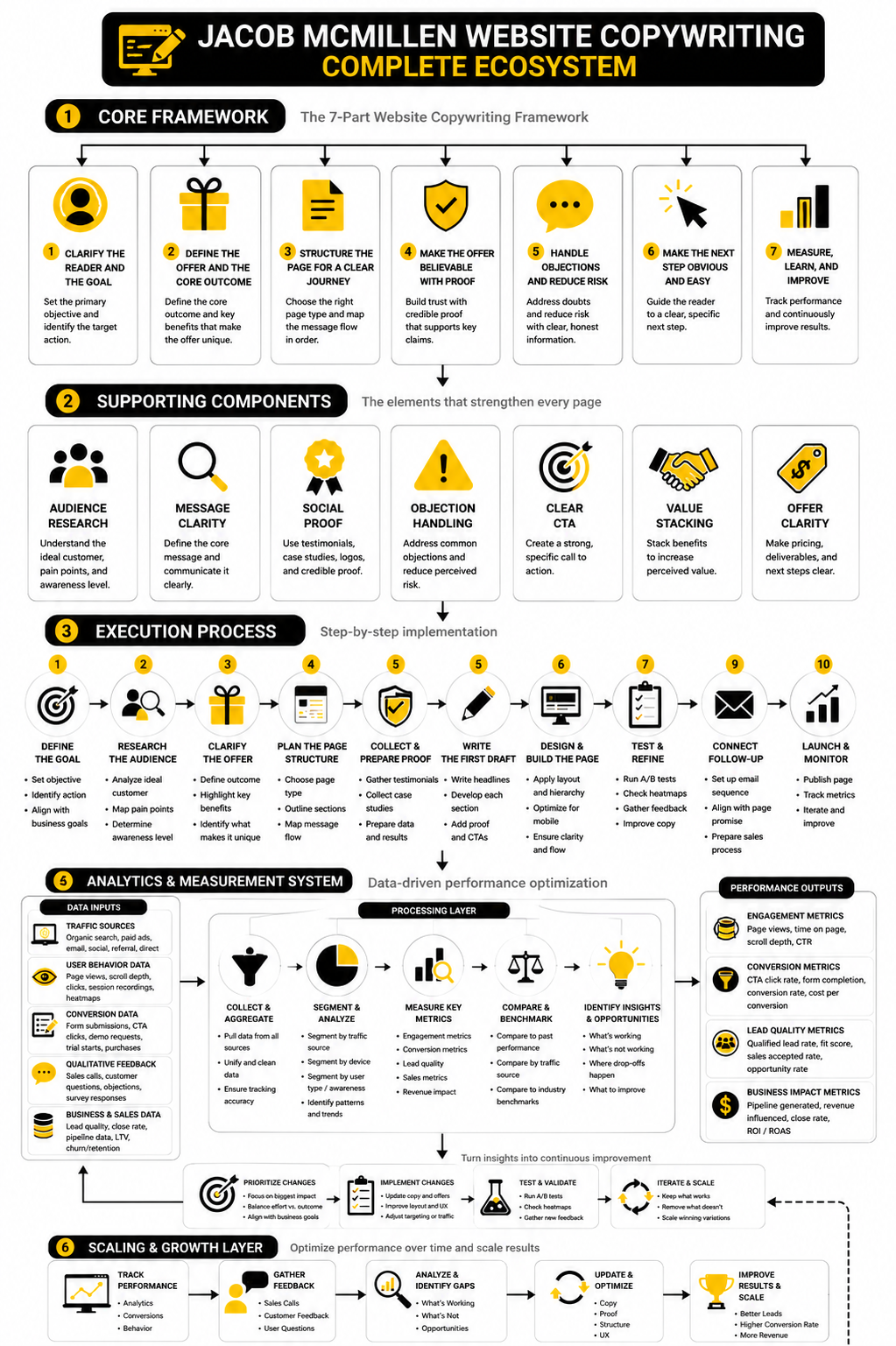
That is why the best implementation is not “write the page once and move on.” It is a system. You build the page, measure the behavior, listen to the sales feedback, update the message, and keep tightening the path from visitor to customer.
Mistake 1: Writing For The Business Instead Of The Buyer
The most common mistake is writing from the company’s perspective.
The business wants to talk about its process, values, features, background, and internal advantages. Some of that may matter, but only after the reader understands why it matters to them. If the copy starts with the company too early, the visitor has to translate everything into their own situation.
The fix is to rewrite every major section from the buyer’s point of view. Instead of asking, “What do we want to say?” ask, “What does the reader need to understand here?” That one shift changes the entire page.
Mistake 2: Making The Hero Section Too Clever
The hero section is not the place to be mysterious.
A clever headline can work when the brand is already known or the offer is instantly obvious. For most businesses, cleverness creates friction. The visitor should understand the core promise, audience, and next step within a few seconds.
The fix is to make the hero section brutally clear before making it stylish. A strong hero usually explains who the offer helps, what outcome it supports, and why the reader should keep going. Once that is clear, you can add personality without sacrificing comprehension.
Mistake 3: Treating Testimonials Like Decoration
Testimonials often get placed wherever the design has space.
That weakens their impact. Proof should appear near the claim it supports. If the page says the process is simple, use proof about implementation. If it says the offer improves lead quality, use proof about lead quality. If it says the service is strategic, use proof that shows strategic thinking.
The fix is to map proof to objections. Every testimonial, case study, logo, credential, or data point should reduce a specific doubt. If it does not reduce doubt, it may still be nice, but it is not doing enough work.
Mistake 4: Asking For The Sale Too Early
A call to action is not persuasive just because it is visible.
If the page has not created enough trust, the CTA feels like pressure. If the reader still does not understand the offer, the CTA feels premature. If the next step sounds vague, the CTA creates more uncertainty instead of reducing it.
The fix is to earn the action before asking for it. Explain the offer, show the proof, reduce the risk, and make the next step specific. For a complex service, “Book a call” is stronger when the copy also explains what happens on the call and who it is for.
Mistake 5: Optimizing For More Leads Instead Of Better Leads
More conversions can be a bad thing if the wrong people are converting.
This is one of the biggest scaling problems in website copywriting. A page can increase form submissions while lowering lead quality, wasting sales time, and making the business think marketing is working when it is actually creating noise. That is why conversion rate must be interpreted with lead quality, close rate, and customer fit.
The fix is to qualify intentionally. Be clear about who the offer is for, what stage they should be in, and what kind of problem the offer is built to solve. Strong copy attracts and filters at the same time.
Mistake 6: Separating Copy From The Follow-Up System
The website page sets expectations.
If the follow-up email, sales call, checkout flow, or onboarding experience says something different, trust drops. This is especially important when the page is part of a funnel. The promise on the page should connect cleanly to the form, confirmation page, email sequence, and sales conversation.
The fix is to review the full journey, not just the page. Tools like GoHighLevel, ClickFunnels, Systeme.io, and Brevo can help connect the pieces, but the message still has to stay consistent from the first click to the final decision.
Mistake 7: Copying The Framework Without Understanding The Strategy
Templates are useful, but they are not strategy.
A homepage framework, landing page formula, or service page outline can give you structure. It cannot tell you what your buyer already believes, what objections matter most, or what proof will be convincing in your market. That work still has to be done.
The fix is to use frameworks as thinking tools, not as scripts. The Jacob McMillen website copywriting framework is valuable because it gives you a logical sequence. The quality comes from how well you adapt that sequence to the offer, market, traffic source, and buyer awareness level.
What Is Jacob McMillen Website Copywriting?
Jacob McMillen website copywriting refers to the practical approach taught in Jacob McMillen’s public guide to website copywriting. The core idea is to write website pages that guide readers toward action through clear positioning, structured messaging, strong proof, and focused calls to action. It is less about clever wording and more about building a page that helps the right visitor make a confident decision.
Is Jacob McMillen’s Website Copywriting Framework Only For Freelance Copywriters?
No, it is useful for freelancers, founders, marketers, agencies, consultants, and in-house teams.
Freelance copywriters can use it to plan and write better client pages. Business owners can use it to clarify their own messaging before hiring help. Marketing teams can use it to create a consistent page structure across campaigns, offers, and funnel assets.
What Makes This Approach Different From Generic Copywriting Advice?
Generic copywriting advice often focuses on headlines, formulas, emotional triggers, and conversion tricks.
The stronger part of Jacob McMillen’s approach is the sequence behind the writing. It starts with the goal of the page, the reader’s decision process, the offer, the structure, and the proof. That makes the final copy feel more grounded because it is built from strategy instead of random tactics.
Can This Framework Be Used For A Homepage?
Yes, but a homepage needs a slightly different application.
A homepage usually has to orient multiple types of visitors and route them toward the right next step. That means the copy should clarify the business, communicate the core value, highlight the main offers, show credibility, and help people choose where to go next. It should not try to do the full job of every service page at once.
Can This Framework Be Used For Landing Pages?
Yes, landing pages are one of the clearest use cases.
A landing page should usually focus on one audience, one offer, one traffic source, and one primary action. That makes the copy easier to structure because every section can support the same conversion goal. If the page is connected to paid traffic, email, or a campaign, message match becomes especially important.
How Long Should Website Copy Be?
Website copy should be as long as necessary to create clarity and confidence, but not longer.
A simple offer with warm traffic may need a short page. A complex service, high-ticket offer, or B2B product may need more explanation, proof, and objection handling. The right question is not “How many words should this be?” The right question is “What does the reader need before they can take the next step?”
How Do You Know If Website Copy Is Working?
You know it is working when the right visitors are moving forward and the business results improve.
That may mean better CTA clicks, more qualified inquiries, higher demo completion, stronger sales calls, improved close rate, or better customer fit. Raw conversion rate matters, but it should not be judged alone. A page that produces fewer but better leads can be more valuable than a page that produces more low-quality submissions.
What Should Be Measured After Publishing New Website Copy?
Start with the page’s main job.
For a service page, measure qualified inquiries, booked calls, and lead quality. For a landing page, measure conversion rate by traffic source, CTA clicks, and form completion. For a SaaS page, measure demo requests, trial starts, activation quality, or product-qualified leads. Then use qualitative signals like sales feedback, customer questions, and session behavior to understand why the numbers are moving.
What Is The Biggest Website Copywriting Mistake?
The biggest mistake is making the reader work too hard.
If the visitor has to decode the offer, hunt for proof, guess what happens next, or translate vague benefits into real outcomes, the copy is creating friction. Strong website copy makes the decision easier. It does not just sound better.
Should SEO Keywords Be Included In Website Copy?
Yes, but they should be used naturally.
The primary keyword should help search engines and readers understand the topic of the page, but it should not control every sentence. Google’s documentation on people-first content emphasizes usefulness over search-engine-first writing. Good SEO copy still has to serve the reader first.
Can AI Write Website Copy Using This Framework?
AI can help with drafts, outlines, variations, and editing, but it should not replace strategy.
The quality still depends on the inputs. If the positioning, audience, offer, proof, and objections are unclear, AI will usually produce polished generic copy. The best use is to feed AI a clear strategy, then use human judgment to refine accuracy, tone, differentiation, and persuasion.
How Often Should Website Copy Be Updated?
Website copy should be reviewed whenever the offer, market, traffic source, or sales feedback changes.
For many businesses, a quarterly review is enough. For active campaigns, paid traffic pages, SaaS funnels, or fast-changing offers, reviews may need to happen more often. The goal is not constant rewriting. The goal is keeping the page aligned with what buyers currently need to believe.
Build a stronger local presence with BAAM AI
Turn your website, Google profile, social channels, and AI visibility into one growth engine
Most businesses do not need more random marketing activity. They need a consistent presence system that helps the right people find them, trust them, and take action. BAAM AI brings strategy, local SEO, website updates, Google Maps visibility, social content, AI-search readiness, media production, and reporting into one practical monthly engine.
If you want your marketing to keep working after the campaign ends, start with a free BAAM AI presence audit. See how your business shows up today and where the fastest visibility wins are at BAAM AI.