
BAAM AI Blog
Jacob McMillen Copywriter: What His Approach Teaches About Writing That Sells
Search for “jacob mcmillen copywriter” and you are not just looking for another freelance writer profile. You are usually trying to understand why his name keeps showing up around direct-response copywriting...

Search for “jacob mcmillen copywriter” and you are not just looking for another freelance writer profile. You are usually trying to understand why his name keeps showing up around direct-response copywriting, freelance writing, longform content, and practical client acquisition. That makes this topic useful for two types of readers: business owners who want better copy, and writers who want to understand what professional copywriting actually looks like in the real world.
Jacob McMillen presents himself as a website copywriter, content strategist, email marketing expert, and freelancing coach through his own site, where he focuses on helping businesses improve messaging and helping writers build profitable freelance careers. His public positioning is interesting because it blends three things that are often taught separately: persuasive copy, SEO-driven content, and the business side of selling writing services. That combination is why his work is worth studying beyond the surface-level question of “is he a good copywriter?”
The bigger lesson is simple: copywriting is not just clever wording. Strong copy connects buyer pain, clear positioning, persuasive structure, and a believable next step. That is also why research from Nielsen Norman Group still matters here: people rarely read web pages word for word, so copy has to be scannable, specific, and useful fast, not just “well written.”
Jacob McMillen Copywriter: Why His Approach Matters
Jacob McMillen matters because his public work sits at the intersection of copywriting, content marketing, and freelance business building. On his own site, he describes his focus as website copywriting, content strategy, email marketing, and helping freelancers make money through writing. That positioning is broader than “I write landing pages,” and it reflects how modern copywriting usually works in practice.
A business rarely needs words in isolation. It needs messaging that clarifies the offer, content that attracts the right people, and conversion copy that turns attention into action. That is why studying a copywriter like Jacob McMillen is useful: his work gives us a practical lens for seeing how the pieces connect.
It also matters because the market has become noisier. AI has made it easier to produce average content at scale, which means the value of a good copywriter shifts toward judgment, positioning, research, voice, and conversion strategy. The copywriter who can diagnose the real buying problem is more valuable than the writer who can simply produce more words.
The Jacob McMillen Copywriting Framework
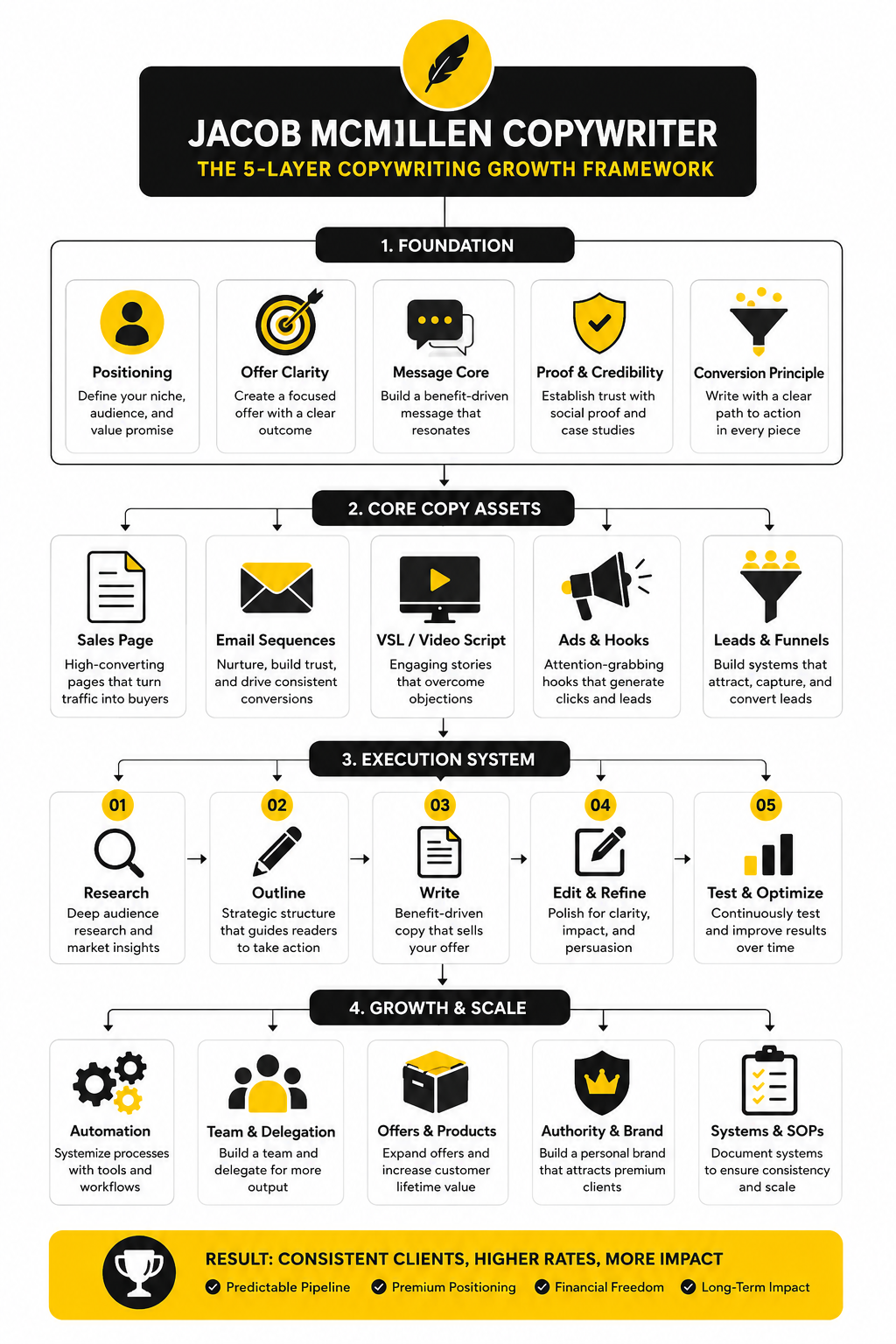
The useful way to study Jacob McMillen is not to treat him like a celebrity copywriter. It is to extract the working framework behind the public positioning, the course topics, the blog content, and the way he talks about copywriting. That framework can be simplified into four practical layers: market understanding, offer clarity, persuasive structure, and business execution.
Market understanding comes first because copy is only persuasive when it reflects what the buyer already cares about. Offer clarity comes next because even beautiful writing fails when the reader cannot understand what is being sold, who it is for, and why it matters now. Persuasive structure then turns that raw material into pages, emails, content, and campaigns that move the reader forward.
The final layer is business execution, and this is where Jacob McMillen’s positioning becomes especially relevant for freelancers. He does not only talk about writing deliverables; he also talks about landing clients, building authority, and turning copywriting into a business. That matters because the professional copywriter is not paid merely to “write”; the professional copywriter is paid to solve a business communication problem.
Why This Framework Fits Modern Copywriting
Modern copywriting has to work across more surfaces than it used to. A prospect might find a brand through search, skim a blog post, read a landing page, check a few emails, compare alternatives, and then finally book a call or buy. The copywriter’s job is to keep the message consistent across that whole path.
That is why Jacob McMillen’s mix of direct-response copywriting and longform content is relevant. Direct-response thinking helps the writer stay focused on action, while content strategy helps the brand earn attention before the buyer is ready to convert. When those two disciplines work together, copy stops feeling like a single page and starts functioning like a system.
This is also where many businesses get stuck. They hire one person for SEO content, another person for emails, another person for landing pages, and nobody owns the core message. A stronger approach starts with positioning, then adapts that message into the right format for each channel.
Research Comes Before Writing
The first serious lesson from studying Jacob McMillen as a copywriter is that writing is not the first step. Research is. His website copywriting guide frames the process around planning the page before writing the page, which is exactly how professional copy gets stronger than generic “benefit-driven” fluff.
This matters because most weak copy is not weak because the sentences are ugly. It is weak because the writer does not understand the buyer, the buying stage, the offer, or the objections blocking the sale. Once those pieces are clear, the actual writing becomes much easier.
For a business owner, this means you should not hire a copywriter only to “make the page sound better.” You want someone who can clarify the page’s job, identify what the reader needs to believe, and structure the message around that goal. That is the difference between decoration and strategy.
What Good Copy Research Looks Like
Good copy research starts with the customer’s real language. That includes sales calls, reviews, testimonials, surveys, support tickets, competitor pages, and objections heard by the sales team. The point is not to collect random quotes; the point is to understand what the market already thinks before the brand starts talking.
A Jacob McMillen copywriter-style approach would not begin with a blank page and a clever headline. It would begin by asking what the buyer wants, what they have tried, why those options failed, and what would make this offer feel like the obvious next step. That is how copy becomes specific without becoming pushy.
The best pages usually sound simple because the hard work happened before the draft. The writer removed confusion, ordered the argument, and made the buyer feel understood. That does not happen by accident.
Why Buyer Awareness Changes the Message
A reader who already knows they need a copywriter does not need the same message as someone who is still wondering why their website is not converting. One buyer needs proof, process, and confidence. The other needs education, diagnosis, and a reason to care.
This is why the same copywriting framework cannot be applied mechanically to every page. A homepage, service page, blog post, email sequence, and landing page all serve different moments in the buyer journey. The copy has to respect that context.
Jacob McMillen’s public work reflects this split because he writes about website copy, email copy, content strategy, and freelance positioning as connected but distinct skills. His website copywriting guide focuses on planning and conversion, while his email copywriting guide deals with attention, sequences, and response. Same discipline, different environment.
Positioning Is the Center of the Framework
Positioning is where copywriting becomes business strategy. Before the page can persuade anyone, the reader has to understand who the offer is for and why it is different from the alternatives. Without that clarity, even technically polished copy feels forgettable.
This is especially important in crowded markets like SaaS, agencies, coaching, ecommerce, and professional services. Buyers are not comparing your offer against nothing. They are comparing it against competitors, internal solutions, doing nothing, and whatever tool or service they already use.
That is why a strong copywriter does not simply ask, “What do you want to say?” A strong copywriter asks, “What needs to be true in the reader’s mind before they are ready to act?” That question forces the copy to carry a real argument instead of a list of claims.
The Offer Must Be Easy to Understand
A confused offer makes every other part of the page work harder. The headline has to overexplain. The body copy has to patch holes. The call to action has to push harder because the reader still does not fully know what they are getting.
Clear offers are easier to sell because the reader can quickly answer three questions: what is this, who is it for, and why should I care? If those answers are buried, the page loses momentum. If they are obvious, the rest of the copy can focus on proof, trust, and action.
This is where copywriters earn their money. They turn messy expertise into a simple buying argument. They make the offer easier to understand without making it feel basic.
The Reader Should See the Problem Clearly
Before someone cares about the solution, they need to recognize the problem. This does not mean exaggerating pain or manufacturing fear. It means naming the real friction the reader is already experiencing.
For example, a business owner might think their website problem is “we need better wording.” The deeper problem might be that visitors do not understand the offer, the page gives no compelling reason to act now, or the proof does not match the promise. Better wording helps only after the real issue is named.
This is why a Jacob McMillen copywriter analysis should focus less on isolated copy tricks and more on diagnosis. The best copy does not just describe the product. It helps the reader understand their own situation more clearly than they did before.
Structure Turns Research Into Persuasion
Once the research and positioning are clear, structure does the heavy lifting. Structure decides what the reader sees first, what gets explained next, when proof appears, and how objections are handled. Without structure, copy becomes a pile of useful points in the wrong order.
Web writing makes this even more important because people scan. Nielsen Norman Group’s classic usability research found that 79 percent of test users scanned new pages while only 16 percent read word by word. That means your headings, opening lines, bullets, and page flow are not cosmetic; they are the reading experience for most users.
This is one reason Jacob McMillen’s longform guides work as useful models. They are not just long for the sake of being long. They use headings, direct promises, practical sequencing, and clear sections to help the reader move through a complex topic without feeling lost.
A Strong Page Has One Main Job
Every page needs a primary job. A service page might need to generate qualified calls. A blog post might need to educate search visitors and move them toward a related offer. An email might need to earn a click, start a conversation, or create urgency around a decision.
When the page has too many jobs, the copy becomes scattered. It tries to build awareness, explain the offer, prove credibility, answer every objection, and ask for three different actions at the same time. That usually creates friction instead of momentum.
A more professional approach is to define the conversion goal early and then build the page around it. The copy can still educate, entertain, and build trust, but every section should support the main movement. If a section does not help the reader take the next logical step, it probably does not belong.
Proof Should Match the Promise
Proof is not just a testimonial block near the bottom of the page. It should be connected to the specific claims being made. If the page promises speed, show evidence of speed. If it promises strategic depth, show experience, process, examples, or credible third-party validation.
This is where vague copy breaks down. Claims like “high-quality,” “results-driven,” and “conversion-focused” are easy to write and hard to believe. Readers have seen them everywhere, so they stop carrying weight.
Better proof is concrete. It shows what changed, what was delivered, who benefited, or why the writer is qualified to make the claim. Jacob McMillen’s own portfolio page positions his work around B2B, SaaS, content systems, competitive keywords, and experience across many funnels, which gives the reader a more specific basis for trust than a generic “I write great copy” claim.
Research, Positioning, and the Offer
At this point, the framework becomes practical. You are not just studying Jacob McMillen as a copywriter because his site ranks for copywriting terms or because he has written large guides. You are studying the process behind copy that can move a reader from vague interest to a clear next step.
That process starts with research, but it does not stop there. Research gives you the raw material. Positioning decides what matters. The offer turns that positioning into something the reader can understand, evaluate, and act on.
Most copy fails because one of those three pieces is missing. The writer gathers information but never finds the sharp angle. Or the positioning sounds clear internally but means nothing to the buyer. Or the offer is useful, but the page explains it in a way that makes the reader work too hard.
The Implementation Process
A practical copywriting process should feel boring in the best possible way. It should reduce guesswork. It should make the final draft feel inevitable because every decision was built on what the buyer needs to understand before saying yes.
A Jacob McMillen copywriter-style process can be broken into a simple working sequence. This is not about copying his exact workflow. It is about using the same professional logic: understand the reader, define the page’s job, clarify the offer, structure the argument, then write and refine.
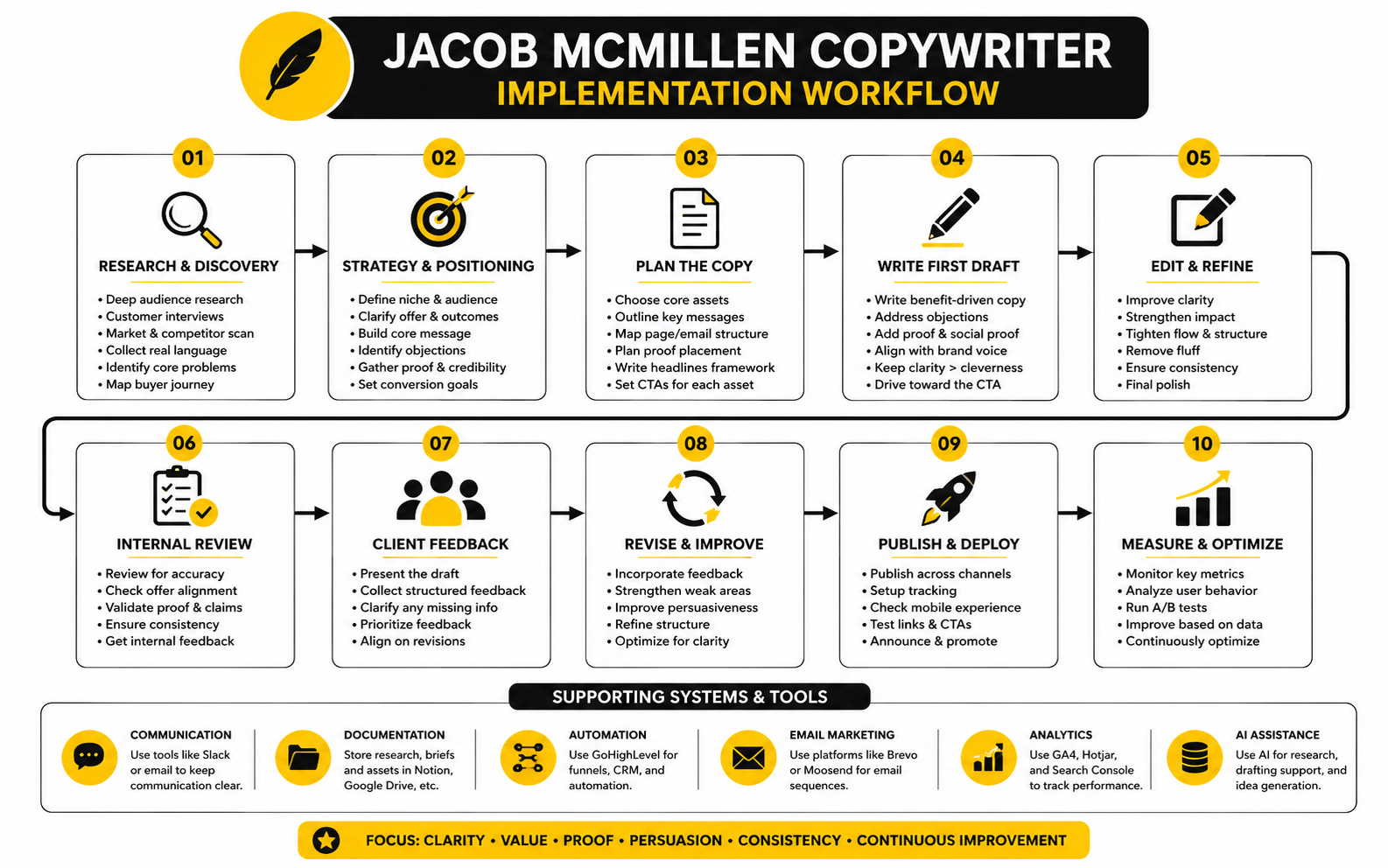
This sequence matters because it keeps the writer from jumping straight into wordsmithing. That is the trap. When you write too early, you usually end up polishing the wrong message.
Step 1: Identify the Business Goal
The first question is not “what should the copy say?” The first question is “what business outcome should this copy support?” A homepage, sales page, service page, nurture email, cold email, and SEO article can all use persuasive writing, but they are not trying to accomplish the same job.
For a service page, the goal might be qualified calls. For an email sequence, it might be replies, clicks, trial signups, or booked demos. For a longform article, the goal might be to capture search demand and move readers toward a related offer without making the content feel like a thin sales pitch.
Once the business goal is clear, the writer can make better decisions. The headline, structure, proof, examples, and call to action all have a job to do. Without that goal, the page becomes a collection of nice-sounding sections instead of a focused conversion asset.
Step 2: Define the Target Reader
The target reader should be defined by context, not just demographics. “Small business owner” is not enough. “Agency owner stuck between referrals and scalable lead generation” is much more useful because it points to a real situation, a real frustration, and a real desired outcome.
This is where many brands get lazy. They define the audience in broad categories, then wonder why the copy sounds generic. Specific copy comes from a specific understanding of what the reader is trying to solve right now.
A strong reader definition should answer practical questions. What triggered the search? What alternatives are they considering? What would make them skeptical? What would make them feel understood? Those answers shape the entire message.
Step 3: Collect Customer Language
Customer language is one of the fastest ways to make copy sound alive. Real buyers describe problems differently than companies describe products. The company talks about features, methodology, and deliverables; the buyer talks about frustration, risk, confusion, wasted time, and the outcome they wish they already had.
This does not mean copying customer quotes blindly. It means using them to understand patterns. If several customers describe the same pain in similar words, that language probably belongs somewhere in the copy.
For a business studying Jacob McMillen’s approach, this is a critical takeaway. Professional copywriting is not about sounding fancy. It is about making the reader feel, “Yes, that is exactly what I have been dealing with.”
Turning Research Into Page Structure
Once the research is done, the next step is structure. Structure decides the order of persuasion. It tells the reader what to notice first, what to believe next, and why the offer is worth considering.
A simple page structure usually works better than a clever one. Start with the problem or desired outcome, clarify the offer, explain why the current situation is costing the reader, show how the solution works, prove credibility, handle objections, and give a clear next step. That flow is not flashy, but it matches how people make decisions.
The real skill is knowing what to emphasize. A newer brand may need more trust-building. A complex product may need more education. A competitive offer may need sharper differentiation. The structure should reflect the buying situation, not a template pulled from a swipe file.
The Opening Must Create Immediate Relevance
The opening section has to answer the reader’s silent question: “Is this for me?” If the answer is unclear, the reader leaves mentally even if they stay physically on the page. This is why vague hero sections are so expensive.
A strong opening does not need to be dramatic. It needs to be precise. It should identify the reader, name the outcome or problem, and make the next step feel worth reading.
For example, “We help businesses grow” is too broad to carry much weight. “Turn your underperforming service page into a clearer sales asset for qualified leads” gives the reader something concrete to evaluate. The second version may not be perfect, but it has direction.
The Body Must Build Belief
After the opening, the body copy has one main job: build belief. The reader needs to believe the problem is real, the offer is relevant, the approach makes sense, and the provider can deliver. If any of those beliefs are missing, the call to action becomes weaker.
This is where proof, explanation, and specificity work together. Proof without explanation can feel random. Explanation without proof can feel theoretical. Specificity makes both more believable because it shows the writer understands the real buying context.
A Jacob McMillen copywriter analysis should pay attention to this balance. His public guides often combine practical instruction with positioning around experience, process, and results. That combination matters because readers need both education and confidence.
The Close Must Reduce Friction
The close is not just the final call to action. It is the moment where the reader decides whether acting feels simple, safe, and worthwhile. If the page has built interest but the next step feels vague or risky, momentum drops.
A good close reminds the reader what they are moving toward. It should make the action feel natural, not forced. That could mean booking a call, starting a trial, downloading a resource, joining a newsletter, or reading the next related article.
The key is alignment. The call to action should match the reader’s level of awareness and the size of the decision. Asking for a purchase too early can feel aggressive, while asking for a weak action after a strong sales argument can waste intent.
Applying the Process to Email Copy
Email copy uses the same strategic foundation, but the execution changes. The inbox is more personal, more crowded, and more interruptive than a website. That means the copy has to earn attention quickly and respect the reader’s time.
A good email usually has one core idea. Not five announcements. Not a full sales page squeezed into a message. One idea, one reason to care, and one next step.
This is where copywriters often overcomplicate things. They try to make every email persuasive from every possible angle. Strong email sequences work because each message does a specific job in the broader journey.
Subject Lines Need a Real Reason to Open
A subject line should create curiosity, relevance, or urgency without tricking the reader. Cheap curiosity can get the open, but it damages trust when the email does not deliver. That tradeoff is rarely worth it.
The better approach is to make the subject line specific enough to attract the right reader. If the email is about fixing a weak service page, the subject should not pretend it is about a mystery breakthrough. It should signal the value clearly.
This is especially important for brands that rely on long-term trust. You are not trying to win a single open at any cost. You are training the reader to believe your emails are worth their attention.
Each Email Should Move One Step Forward
A sequence works best when each email moves the reader one step forward. One email can diagnose the problem. Another can explain the cost of ignoring it. Another can show the method. Another can answer objections. Another can invite the reader to act.
This gives the sequence breathing room. The reader does not feel like every message is trying to close the sale immediately. Instead, the argument builds naturally.
That is also how good content and copy work together. Content creates understanding. Copy turns understanding into action. When the two are aligned, the buyer journey feels smoother and less forced.
Applying the Process to Longform Content
Longform content is where Jacob McMillen’s work becomes especially useful to study. His public guides are not short opinion posts. They are structured, search-focused, practical resources designed to capture demand and keep the reader moving.
This is a different skill from writing a punchy sales page, but it still uses copywriting thinking. The article needs a strong promise, clear structure, useful sections, and a path toward the next step. It has to satisfy the search intent while also supporting the business behind the content.
That is the balance many brands miss. They either publish content that ranks but does not sell, or sales content that does not deserve to rank. Strong longform content does both: it helps the reader solve the immediate problem and makes the brand a more credible option.
Search Intent Shapes the Article
Search intent tells you what the reader came to accomplish. Someone searching for “jacob mcmillen copywriter” might want a profile, a review, examples of his work, or lessons from his approach. A good article has to satisfy that intent without becoming a shallow biography.
That means the article should answer the obvious questions, then go deeper. Who is he? What does he write about? What can writers and business owners learn from his approach? How can the same principles be applied without copying him?
This is how SEO content becomes genuinely useful. It does not just repeat the keyword. It understands the reason behind the search.
The Article Still Needs a Business Purpose
Helpful content should still have a business purpose. That does not make it manipulative. It makes it sustainable. A business invests in content because it wants attention, trust, leads, customers, or authority.
The key is to make the next step relevant. If a reader is learning about copywriting systems, a practical tool, funnel builder, email platform, or CRM may fit later in the article when implementation becomes the problem. For example, a team that wants to build and manage funnels after clarifying its messaging may reasonably compare platforms like GoHighLevel, ClickFunnels, or Systeme.io.
But the tool should never become the point too early. The message comes first. The system supports the message. Get that order wrong and you end up automating weak copy instead of improving the customer journey.
Statistics and Data
Measurement is where copywriting stops being a preference contest. Without data, the loudest opinion in the room usually wins. With data, the discussion gets cleaner: what did people see, what did they do next, where did they hesitate, and what should change because of it?
That is the right way to evaluate a Jacob McMillen copywriter-style process. You are not measuring whether a sentence sounds clever. You are measuring whether the message helps the right reader understand the offer, trust the argument, and take the next logical step.
The important part is interpretation. A conversion rate, click-through rate, scroll depth, or reply rate means very little by itself. It only becomes useful when you connect it to the page’s goal, the traffic source, the buyer’s awareness level, and the quality of the offer.
What the Numbers Actually Tell You
A landing page with a 3% conversion rate might be weak, normal, or excellent depending on the market, offer, and conversion event. A SaaS demo request from cold traffic is not the same as an email opt-in from a warm audience. Treating those numbers the same leads to bad decisions.
That is why benchmarks should be used as context, not commandments. Unbounce’s conversion benchmark data is useful because it separates industries and shows that median landing page conversion rates can vary widely by category, with SaaS landing pages sitting much lower than categories like legal. The lesson is not “copy this benchmark.” The lesson is “compare your page against the right situation.”
Email metrics work the same way. A strong open rate does not prove the email made money, and a low click rate does not always mean the copy failed. The better question is whether each email did the job it was supposed to do in the sequence.
Traffic Quality Changes Everything
Before judging copy, look at the traffic. A page receiving visitors from a high-intent search query will usually behave differently than a page receiving broad social traffic. The same copy can look brilliant in one channel and mediocre in another.
This is especially relevant for longform content. Someone searching for “jacob mcmillen copywriter” likely has a specific intent, but that intent may vary. They might want to learn about Jacob, compare his approach, find his services, or understand copywriting strategy through his example.
That means performance should be segmented. Organic traffic, referral traffic, paid traffic, email traffic, and returning visitors should not all be thrown into one messy average. Averages can hide the exact insight you need.
Conversion Events Are Not Equal
A newsletter signup, free consultation request, demo booking, paid purchase, and agency inquiry are completely different conversion events. One requires light commitment. Another requires trust, budget, timing, and internal approval.
This is why “what is a good conversion rate?” is often the wrong question. A better question is, “What conversion rate is reasonable for this offer, at this stage, from this traffic source, with this level of buyer intent?” That gives you a real basis for optimization.
For example, if a service page gets plenty of clicks to the contact form but few completed submissions, the problem may not be the headline. The form may ask too much, the next step may feel unclear, or the reader may need more reassurance before reaching out. Data should point you toward the bottleneck, not just trigger random rewrites.
The Analytics System
A practical analytics system for copywriting does not need to be complicated. It needs to track the path from attention to action. That means you should know how people arrive, what they engage with, where they drop off, and which actions create business value.
The basic system has four layers: acquisition, engagement, conversion, and quality. Acquisition shows where visitors came from. Engagement shows whether the message held their attention. Conversion shows whether they acted. Quality shows whether those actions turned into real revenue, pipeline, replies, or qualified conversations.
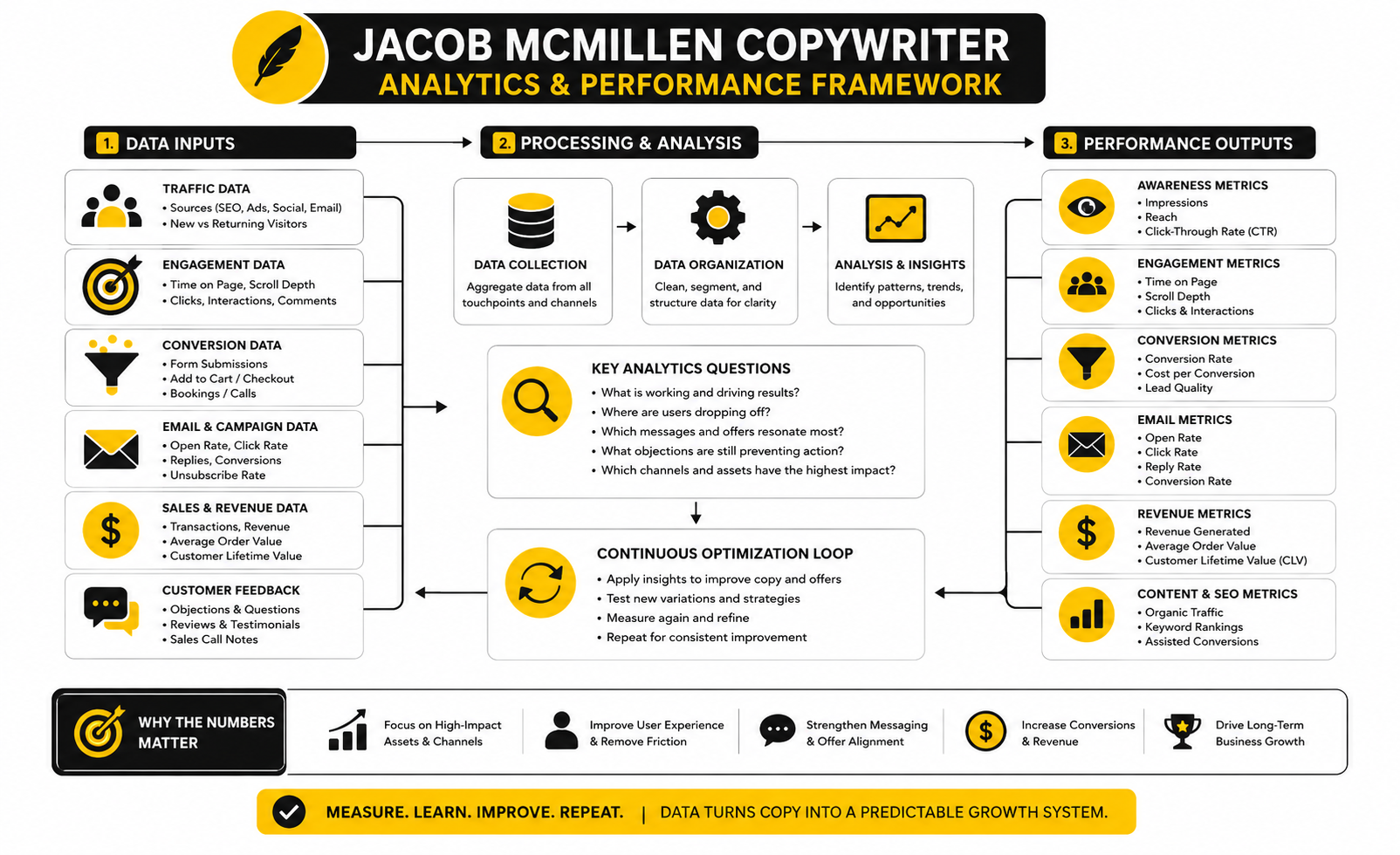
This is where teams often make a mistake. They measure the easiest numbers instead of the most useful numbers. Pageviews are easy to report, but they do not prove the copy is working. Qualified leads, booked calls, reply quality, assisted conversions, and pipeline influence are harder to track, but they tell you much more.
Acquisition Metrics Show Whether the Right People Arrive
Acquisition metrics answer the first question: are the right people reaching this asset? If the answer is no, the copy may be judged unfairly. Even a strong page will struggle when the audience is wrong.
For SEO content, look at impressions, rankings, organic clicks, and the actual queries bringing people in. If the article ranks for irrelevant searches, the page may attract readers who were never likely to convert. That is not only a copy issue; it is a search intent issue.
For paid traffic, look at audience, keyword, campaign promise, and ad-to-page alignment. If the ad creates one expectation and the landing page delivers another, performance drops. The fix may be tighter message match, not a complete page rewrite.
Engagement Metrics Show Whether the Message Holds Attention
Engagement metrics help you understand whether readers are staying with the argument. Scroll depth, time on page, click maps, section-level engagement, and video or form interactions can all show where attention rises or falls. These signals are not perfect, but they are useful when interpreted carefully.
Nielsen Norman Group’s web usability research found that 79% of users scanned new pages while only 16% read word for word. That is why headings, bullets, short paragraphs, and clear section order matter so much. They are not decoration; they are how many readers experience the page.
If users drop before the offer is clear, the opening may be too slow. If they reach the pricing or contact section but do not act, the page may need stronger proof, better objection handling, or a clearer next step. Engagement data helps you decide where to look.
Conversion Metrics Show Whether the Page Creates Action
Conversion metrics tell you whether the copy moved the reader to the intended next step. This could be a booked call, product purchase, free trial, opt-in, reply, webinar registration, or checkout completion. The right conversion metric depends entirely on the asset.
For a landing page, the main metric might be form submissions or checkout starts. For an email, it might be clicks, replies, or purchases. For a longform article, it might be internal clicks to a service page, lead magnet signups, or assisted conversions over time.
Do not optimize every page for the same conversion. Some pages should convert directly. Others should educate, qualify, and move the reader deeper into the funnel. A copywriter who understands this will avoid forcing hard CTAs into content that should be building trust.
Benchmarks Should Guide, Not Control
Benchmarks are useful because they stop you from operating in a vacuum. They can show whether your numbers are obviously low, unusually strong, or somewhere in the normal range. But benchmarks should never replace judgment.
Email is a good example. HubSpot’s industry benchmark roundup shows that open rates, click-through rates, and unsubscribe rates vary significantly across sectors, with different categories producing very different engagement patterns. That makes a single universal “good open rate” almost useless.
The better move is to benchmark against yourself first. Compare current performance to past campaigns, similar offers, similar traffic sources, and similar buyer stages. External benchmarks give context, but internal benchmarks show whether your copy is actually improving.
Open Rates Are Not the Whole Email Story
Open rates can help diagnose subject lines, sender trust, and audience interest. They are not enough to prove the email worked. An email can get opened because the subject line is interesting, then fail because the body copy does not deliver.
Click-through rate adds another layer, but it still needs context. A high click rate from unqualified readers may not matter. A lower click rate from decision-makers who book calls or buy may be far more valuable.
For email copy, the strongest measurement usually combines opens, clicks, replies, conversions, unsubscribes, and revenue. That gives you a fuller picture of trust and action. If the copy gets clicks but also drives unsubscribes, the message may be creating short-term curiosity at the cost of long-term list quality.
Conversion Rates Need Segmentation
Conversion rates should be segmented by source, device, campaign, and intent. Mobile visitors may behave differently than desktop visitors. Brand-aware traffic may convert differently than cold traffic. Search visitors from a comparison query may be much closer to buying than visitors from a broad educational post.
This matters because one blended conversion rate can hide several different problems. Maybe paid traffic is underperforming because the targeting is wrong. Maybe organic traffic is converting well but does not have enough volume. Maybe mobile users are interested but the form is annoying.
Once you segment the data, the next action becomes clearer. You might rewrite the hero section, simplify the CTA, add proof near the decision point, split a long form into two steps, or create a different page for a different awareness level. Measurement should lead to specific action.
Performance Signals That Matter for Copy
The most useful copywriting metrics are the ones that reveal friction. Where does the reader lose interest? Where do they hesitate? Where do they act? Where do they act but fail to become a good lead or customer?
A Jacob McMillen copywriter-inspired measurement approach would look beyond surface metrics. The goal is not just more traffic or prettier engagement charts. The goal is clearer messaging that produces better business outcomes.
That means the copy should be judged by both behavior and quality. Did the page attract the right readers? Did it answer their real questions? Did it make the offer easier to understand? Did it produce leads, customers, or conversations that are actually worth having?
Strong Signals
Strong signals show that the copy is doing its job. They do not always mean the page is finished, but they suggest the message is moving in the right direction. These are the signals worth watching closely.
These signals matter because they connect copy to buyer readiness. You are not just looking for more activity. You are looking for better movement through the decision process.
Weak Signals
Weak signals show that the copy may be attracting attention without creating clarity. This is common when a page has a decent headline but weak proof, or when an article ranks but does not connect to a meaningful next step. The numbers may look acceptable at a glance, but the business impact stays thin.
These signals should not trigger panic. They should trigger diagnosis. The right response is to find the friction point and fix that specific issue instead of rewriting everything from scratch.
What to Do With the Data
Data should create decisions. If it only creates reports, it is not helping enough. Every metric should lead to a question, and every question should lead to a possible action.
If the page gets traffic but no engagement, improve the opening. If readers engage but do not convert, strengthen proof and the CTA. If leads convert but are low quality, sharpen positioning and qualification. If emails get opens but no clicks, tighten the body copy and make the next step more relevant.
This is also where tools can help, but only after the strategy is clear. A funnel builder like ClickFunnels, an agency CRM like GoHighLevel, or an email platform like Brevo can support measurement and follow-up. But the tool cannot rescue unclear positioning or a weak offer.
Build a Simple Testing Rhythm
Testing does not need to be complicated at the beginning. Pick one important asset, identify the biggest friction point, make one meaningful change, and measure the result. Then repeat.
The mistake is testing tiny wording changes before the big message is clear. Button color, microcopy, and punctuation do not matter much if the page fails to explain why the offer matters. Start with the major conversion levers first.
A practical testing rhythm might focus on one of these areas at a time: headline clarity, offer framing, proof placement, CTA strength, objection handling, or form friction. That keeps the process focused. It also makes the results easier to interpret.
Measure Quality, Not Just Quantity
More leads are not always better. More clicks are not always better. More traffic is not always better. The real question is whether the copy attracts and moves the right people.
This is especially important for service businesses and consultants. A page that doubles inquiries but fills the calendar with poor-fit calls may create more work without more profit. Better copy should improve qualification, not just volume.
That is why the strongest analytics loop includes feedback from sales conversations, onboarding, support, and customer success. The numbers show what happened. The human feedback explains why it happened. Together, they give you the insight needed to improve the next version.
Professional Implementation for Freelancers and Brands
The advanced lesson is that copywriting only creates leverage when it is implemented inside a real business system. A strong page matters. A strong email sequence matters. A strong article matters. But none of those assets can carry the entire business alone.
This is where the Jacob McMillen copywriter model becomes useful beyond copy technique. His public work connects copywriting with content strategy, SEO, email, freelancing, and AI-assisted production, which reflects the reality of modern marketing. The writer who understands the full system can make better decisions than the writer who only edits sentences.
For freelancers, this means becoming more than a pair of hands. For brands, it means hiring and managing copywriters as strategic partners, not just content vendors. That shift changes the quality of the work, the expectations around results, and the way copy gets measured over time.
The Biggest Strategic Tradeoff Is Depth Versus Speed
Every serious copy project has a tradeoff between depth and speed. Deep research usually creates stronger messaging, but it takes time. Fast production gets assets live sooner, but it can create thin copy if the strategy is not already clear.
The right balance depends on the situation. A new offer, new audience, or high-ticket service needs more strategic depth because the cost of being wrong is higher. A mature brand with clear positioning and existing customer research can usually move faster because the foundation already exists.
This is why templates can help, but they cannot replace judgment. A template can give the writer structure. It cannot decide which objection matters most, which promise is believable, or which proof belongs near the call to action. That is the human work.
AI Changes the Workflow, Not the Responsibility
AI has made writing faster, but it has not removed the need for strategy. Jacob McMillen’s own site now positions AI-assisted copywriting as part of his training, which makes sense in the current market. The practical opportunity is not to let AI replace thinking; it is to use AI to accelerate research organization, draft exploration, and iteration.
The risk is obvious. If a weak strategist uses AI, they can produce weak copy faster. If a strong strategist uses AI, they can test angles, organize customer language, and create more variations without losing the underlying message.
That distinction matters. AI can help create blog posts, sales pages, email sequences, and scripts, but the copywriter is still responsible for truth, accuracy, positioning, audience fit, and final judgment. The machine can produce options. The professional decides what belongs in front of the buyer.
Scaling Copy Without Losing Quality
Scaling copy is not just hiring more writers or publishing more content. It is creating a system that preserves the message as output increases. Without that system, volume usually creates inconsistency.
This is especially painful for brands with multiple channels. The website says one thing, the emails say another, the sales team explains the offer differently, and the content strategy attracts people who are not a fit. The result is not just messy marketing. It is a confusing customer journey.
A stronger system starts with shared messaging assets. That includes positioning notes, customer language, objection maps, proof libraries, offer explanations, voice guidelines, and conversion goals for each asset type. When those pieces exist, copy can scale without becoming random.
Build a Message Library Before Building More Pages
A message library is one of the most underrated assets in copywriting. It keeps the strongest language, strongest proof, and strongest objections in one place so every future page starts from better raw material. This is how a brand avoids relearning the same lessons on every project.
The library should include real phrases from customers, recurring sales objections, competitive differentiators, best-performing headlines, proof points, testimonials, and approved explanations of the offer. It should also include what not to say. Bad positioning spreads quickly when nobody documents the boundaries.
For a freelancer, this is also a way to become more valuable. Instead of delivering only a final draft, you can deliver reusable messaging intelligence. That makes the client’s next page, next email, and next campaign easier to create.
Create Channel-Specific Rules
A message can stay consistent while the execution changes by channel. A homepage needs fast orientation. A sales page needs deeper persuasion. An SEO article needs to satisfy search intent. An email needs one focused idea. A social post needs immediate relevance.
The mistake is forcing the same copy into every format. That creates stiff, unnatural marketing. A better approach is to keep the core promise consistent while adapting the angle, length, proof, and call to action to the channel.
This is where brands should define channel-specific rules. What counts as a strong blog introduction? How should emails open? When should a case study be used? What claims require proof? These rules make quality easier to maintain as more people touch the copy.
The Risks of Copywriting Without Strategy
Copywriting without strategy creates the illusion of progress. New pages get published. Emails go out. Ads launch. Reports fill up with activity. But the underlying message stays unclear.
The danger is that teams often mistake production for improvement. They think they need more copy when they actually need sharper positioning. They think they need a better CTA when the real issue is that the offer does not feel urgent or differentiated.
This is why a Jacob McMillen copywriter-style analysis should keep returning to fundamentals. The best copy does not rescue a vague strategy. It exposes it. If the offer, audience, and proof are weak, the draft will usually reveal the problem quickly.
Risk 1: Optimizing the Wrong Asset
Not every asset deserves the same attention. Some pages are central to revenue. Others are supporting pieces. If you spend weeks perfecting a low-traffic page while the main service page leaks qualified leads, you are improving the wrong thing.
This is where analytics from the previous section should guide priorities. Look for the pages, emails, and journeys that have the highest business impact. Then focus your best copywriting effort there first.
For most businesses, that means starting with the homepage, core service pages, key landing pages, highest-intent SEO content, and follow-up emails connected to sales. These assets influence decisions directly. Improve them before obsessing over secondary content.
Risk 2: Confusing Voice With Message
Brand voice matters, but it is not the same as the message. Voice is how the brand sounds. Message is what the reader needs to understand and believe. You need both, but message comes first.
A brand can sound friendly, bold, premium, witty, or direct and still fail to communicate the offer. This happens when teams spend too much time debating tone and not enough time clarifying the buying argument. A polished sentence is still weak if it does not move the reader forward.
The practical rule is simple. First, make the message clear. Then make it sound like the brand. If you reverse that order, you can end up with copy that is on-brand but ineffective.
Risk 3: Letting SEO Flatten the Copy
SEO can be a powerful growth channel, but it can also make copy worse when used carelessly. Keyword research should guide the topic and search intent. It should not force awkward phrases into every heading and paragraph.
This is especially relevant for the keyword “jacob mcmillen copywriter.” The phrase matters because it reflects what people search, but the article still has to read naturally. Repeating it too often would make the page worse, not better.
Good SEO copy uses the primary keyword as a signal, not a crutch. It answers the searcher’s question, covers related subtopics, and keeps the reader engaged. Search visibility gets the click. Copy quality earns the trust after the click.
Advanced Guidance for Freelance Copywriters
Freelancers can take a lot from Jacob McMillen’s public positioning. He does not present copywriting as a mysterious creative gift. He frames it as a business skill that can be learned, packaged, and sold through clear deliverables.
That is a healthier model for most writers. You do not need to become a guru. You need to solve valuable problems, communicate your process, and make it easy for clients to understand why your work matters.
The more advanced move is to stop selling “copy” as a commodity. Sell outcomes, systems, and decision support. A business does not really want 1,500 words for a landing page. It wants a clearer path from visitor attention to qualified action.
Specialization Makes Selling Easier
Generalist copywriters can succeed, but specialization makes trust easier to build. When you understand a market, you understand the buyer’s objections, vocabulary, decision process, and common offer structures. That shortens the learning curve and improves the work.
Specialization does not always mean choosing one tiny niche forever. It can mean specializing by deliverable, industry, audience, or business model. For example, a writer might focus on SaaS website copy, ecommerce email flows, B2B case studies, or SEO content for service businesses.
The point is to become easier to remember and easier to refer. “I write copy” is forgettable. “I help B2B SaaS companies turn technical product pages into clearer demo-driving assets” is much easier for the right client to understand.
Process Is Part of the Product
Clients are not only buying the final copy. They are buying confidence that the project will be handled well. A clear process reduces uncertainty before the work even begins.
That process should explain what the copywriter needs, what research will happen, what will be delivered, how revisions work, and how success will be judged. This makes the engagement feel professional. It also protects the copywriter from endless subjective feedback.
A strong process can become a sales advantage. When a prospect sees that you have a structured way to understand their business and turn that into persuasive copy, you stop sounding like a risky creative hire. You start sounding like someone who can lead the project.
Advanced Guidance for Brands
Brands should treat copywriting as a strategic function, not a final-stage polish task. If the copywriter is brought in only after the offer, page structure, funnel, and campaign strategy are already locked, the writer may have very little room to improve the outcome. That is a waste.
Bring copywriters into the process earlier. Let them see customer research, sales call notes, analytics, objections, and previous campaign results. The more context they have, the more useful their recommendations become.
This does not mean every copywriter should control the entire marketing strategy. It means copywriters should have enough strategic access to make the words accurate, persuasive, and aligned with the buyer journey. Good copy needs context.
Give Copywriters Real Inputs
A copywriter cannot create strong proof from nothing. They need customer outcomes, product details, testimonials, differentiators, objections, and access to people who understand the buyer. If the brand cannot provide those inputs, the copy will often stay generic.
Before hiring a copywriter, gather the essentials. Pull customer reviews. Record sales objections. List competitor claims. Document the offer. Identify the strongest proof. Clarify what the reader should do next.
This preparation saves time and improves the final draft. It also helps the brand notice gaps in its own strategy. Sometimes the copywriter’s questions reveal that the offer is not as clear internally as the team thought.
Judge the Work Against the Brief
Feedback should be tied to the brief, not personal taste. “I do not like this sentence” is less useful than “this does not match the target buyer’s awareness level” or “this claim needs stronger proof.” Strategic feedback produces better revisions.
The brief should define the audience, goal, offer, key messages, proof points, objections, voice, and primary CTA. Without that shared reference, feedback becomes subjective and slow. Everyone edits from their own assumptions.
This is where brands can immediately improve their copy process. Create better briefs. Give better inputs. Review against agreed goals. You will get stronger work from almost any competent copywriter.
When to Hire a Copywriter Versus Build Internally
Hiring a copywriter makes sense when the message affects revenue, trust, positioning, or conversion. That includes core website pages, launch campaigns, sales pages, email sequences, high-value SEO content, and repositioning projects. These are not places to wing it.
Building internally can make sense when the team already has strong messaging, a clear voice, and enough marketing skill to execute consistently. Internal writers often know the product deeply. External copywriters often bring sharper perspective and stronger conversion instincts.
The best setup is often a blend. Use an expert copywriter to build the foundation, refine positioning, and create high-impact assets. Then use internal teams to maintain, adapt, and expand the system.
Hire for Judgment, Not Just Writing Samples
Writing samples are useful, but they do not tell the whole story. A beautiful sample may have been shaped by a strong strategist, editor, or brand team. A plain sample may have performed well because it solved the right business problem.
When hiring, look for judgment. Ask how the copywriter approaches research, handles unclear offers, prioritizes objections, and measures success. Ask what they would need from your team before writing.
A strong copywriter should be able to explain why the copy is structured a certain way. They should not hide behind taste or vague creativity. The best professionals can defend the strategy without becoming precious about the wording.
Build Internal Standards After the Project
Once a major copy project is complete, do not let the learning disappear. Turn the best decisions into internal standards. Document the message, the proof, the CTA logic, and the voice patterns that worked.
This is how one copywriting project becomes a long-term asset. The next writer, marketer, or salesperson can build from the same foundation instead of starting over. That compounds the value of the original work.
A good implementation system should leave the business more carefully after every campaign. The page matters. The learning matters more.
FAQs and Final Takeaways
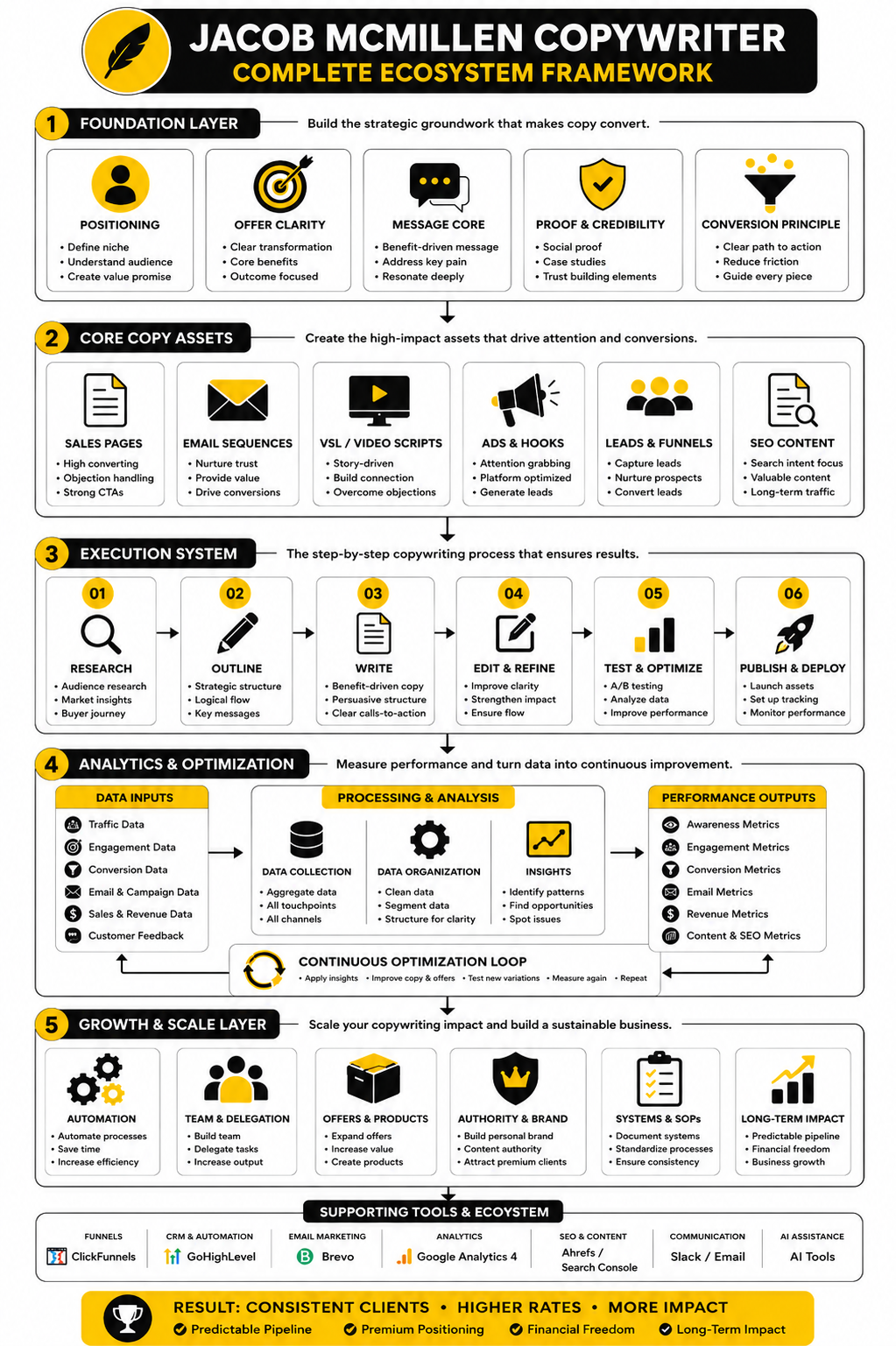
A useful way to close this guide is to bring the whole system together. Jacob McMillen’s copywriting work is not worth studying because every business should copy his exact style. It is worth studying because it shows how modern copywriting blends research, positioning, content, email, SEO, AI-assisted workflows, and business execution.
That is the ecosystem. The words matter, but the system around the words matters more. If the message is clear, the offer is strong, the process is organized, and the measurement loop is honest, copy becomes a business asset instead of another marketing task.
Who is Jacob McMillen?
Jacob McMillen is a website copywriter, content strategist, email marketing expert, and freelancing coach. His public work focuses on helping businesses improve messaging and helping writers build profitable freelance careers. He is also known for writing detailed copywriting and content guides that explain the process behind practical marketing assets.
Why do people search for “jacob mcmillen copywriter”?
People usually search for “jacob mcmillen copywriter” because they want to understand his work, evaluate his copywriting advice, or learn from his approach to writing and freelancing. The search has both informational and professional intent. Some readers want a profile, while others want a usable framework they can apply to their own website, emails, or freelance business.
What makes Jacob McMillen’s copywriting approach useful?
The useful part is the connection between strategy and execution. His public content does not treat copywriting as clever lines alone; it ties copy to positioning, buyer understanding, SEO content, email, and business outcomes. That makes the approach practical for people who need copy to support real marketing goals.
Is Jacob McMillen mainly a website copywriter?
Website copywriting is a major part of his positioning, but it is not the whole picture. His own site also frames him around content strategy, email marketing, AI-assisted copywriting, and freelance training. That wider mix is important because modern copy rarely lives on one page by itself.
What can freelancers learn from Jacob McMillen?
Freelancers can learn that copywriting is easier to sell when it is attached to a clear business problem. Instead of selling “words,” a freelancer can sell clearer positioning, better landing pages, stronger email sequences, or content that supports revenue. The more specific the problem, the easier it is for clients to understand the value.
What can business owners learn from this approach?
Business owners can learn to stop treating copy as decoration. Better copy starts with better inputs: customer language, objections, proof, offer clarity, and a clear next step. When those inputs are missing, even a talented copywriter has to spend time uncovering what the business should have already documented.
How should a brand measure copywriting performance?
A brand should measure copywriting based on the job of the asset. A service page might be judged by qualified inquiries, a landing page by conversion rate, an email by replies or clicks, and a longform article by search traffic, engaged readers, and assisted conversions. The point is not to chase every metric; the point is to connect the copy to the business outcome it was created to support.
Are copywriting benchmarks reliable?
Benchmarks are useful as context, but they should not control your decisions. A conversion rate or click-through rate only means something when you understand the offer, audience, traffic source, and buying stage. Internal benchmarks often matter more because they show whether your own messaging is improving over time.
Should copywriters use AI?
Copywriters should use AI when it helps them work faster without weakening judgment. AI can help organize research, explore angles, draft variations, and speed up repetitive tasks. But the copywriter still owns the strategy, accuracy, voice, positioning, and final decision on what the buyer should see.
Does SEO copywriting still need persuasive writing?
Yes, and this is where many brands get it wrong. SEO can bring the reader to the page, but persuasive writing keeps them there and moves them forward. A page that ranks but does not build trust, answer objections, or create a logical next step is only doing half the job.
What is the biggest mistake people make when studying copywriters?
The biggest mistake is copying surface style instead of understanding the strategy underneath. A headline format, email structure, or landing page layout only works when it fits the audience, offer, and buying context. The more carefully move is to study how the copywriter thinks, not just how the copy looks.
Should businesses hire a specialist or a generalist copywriter?
It depends on the project. A specialist is usually better when the offer is complex, the industry has specific buyer objections, or the copy is tied directly to revenue. A generalist can still be useful for broader content needs, but high-stakes pages usually benefit from someone who understands the category and the conversion goal.
What is the best first step for improving website copy?
Start by clarifying the offer and the reader. Before rewriting a page, identify who the page is for, what they want, what they are skeptical about, and what action the page should drive. Once that is clear, the structure and wording become much easier to improve.
How do tools fit into a copywriting system?
Tools support the system, but they are not the system. A funnel platform like ClickFunnels, a CRM and automation platform like GoHighLevel, or an email platform like Brevo can help publish, automate, and measure campaigns. But the tool only works well when the message, offer, and buyer journey are already clear.
Build a stronger local presence with BAAM AI
Turn your website, Google profile, social channels, and AI visibility into one growth engine
Most businesses do not need more random marketing activity. They need a consistent presence system that helps the right people find them, trust them, and take action. BAAM AI brings strategy, local SEO, website updates, Google Maps visibility, social content, AI-search readiness, media production, and reporting into one practical monthly engine.
If you want your marketing to keep working after the campaign ends, start with a free BAAM AI presence audit. See how your business shows up today and where the fastest visibility wins are at BAAM AI.