
BAAM AI Blog
Jacob McMillen Copywriter: The Practical Guide To His Framework, Style, And Lessons For Modern Writers
Search for Jacob McMillen copywriter and you are not looking for another generic writing portfolio. You are usually trying to understand why his name keeps showing up around freelance copywriting, website copy...

Search for Jacob McMillen copywriter and you are not looking for another generic writing portfolio. You are usually trying to understand why his name keeps showing up around freelance copywriting, website copy, longform SEO content, and the business side of becoming a paid writer.
That matters because copywriting has changed. AI made mediocre writing easier to produce, but it also made strategic writing more valuable. The writers who win now are not the ones who can simply “write words.” They are the ones who can understand the customer, shape a clear offer, build trust, and connect copy to measurable business outcomes.
Jacob McMillen’s public positioning sits right in that overlap. His own site describes him as a website copywriter, content strategist, and email marketing expert who helps businesses optimize, startups find their voice, and freelancers build profitable writing businesses through practical skill development. His training pages also emphasize website copy, email copy, and longform blog content as core deliverables rather than treating copywriting as one vague creative skill.
this guide breaks down Jacob McMillen’s approach without turning it into fan worship. The goal is simple: understand what makes his copywriting framework useful, where it fits in the current market, and what a serious writer or business owner can actually take from it.
The full article will continue across these six parts:
Why Jacob McMillen’s Copywriting Approach Matters Now
The reason Jacob McMillen is worth studying is not just that he is a copywriter. It is that his public work connects three things many writers keep separate: writing skill, marketing strategy, and freelance business execution. That combination is far more useful than another list of “power words” or headline formulas.
The market is pushing writers in that direction anyway. Content Marketing Institute’s 2025 B2B research notes that many marketers are still struggling with strategy, measurement, and scalable content operations, not just content production. HubSpot’s 2025 AI coverage also shows content creation as one of the most common AI use cases, which means basic drafting is becoming less defensible as a standalone service.
That is the uncomfortable part. A writer who only sells words is easier to replace, compare, and negotiate down. A writer who understands positioning, funnels, SEO, email, and customer psychology is solving a business problem, not just filling a blank page.
Jacob McMillen’s public materials lean into that reality. His copywriting course page frames the core skill set around website copy, email copy, and blog content, while his portfolio positions him around longform content, AI-assisted writing, and KPI-focused content marketing. That is a practical signal for anyone studying his model: the opportunity is not “be clever with language.” The opportunity is to become useful inside a revenue system.
The Six-Part Framework For Understanding His Work
A clean way to understand the Jacob McMillen copywriter model is to view it as a six-part progression. First, there is the market reality: businesses need clear messaging, trust-building content, and conversion-focused copy. Second, there is the foundation: persuasive writing based on customer insight, offer clarity, and structured communication.
Third, there is website copy. This is where positioning becomes visible, because a homepage, service page, or landing page has to explain who the offer is for, why it matters, and what the reader should do next. Fourth, there is longform content, where authority, SEO, and education work together to attract people before they are ready to buy.
Fifth, there is the freelance business layer. Jacob’s own public story repeatedly emphasizes the journey from low-paid writing work to a more serious writing business, including his claim of moving from low article rates to a much higher monthly income on his site’s freelance writing materials. Sixth, there is implementation, because none of this matters if a writer cannot turn the ideas into repeatable client work, better sales conversations, stronger deliverables, and clearer positioning.
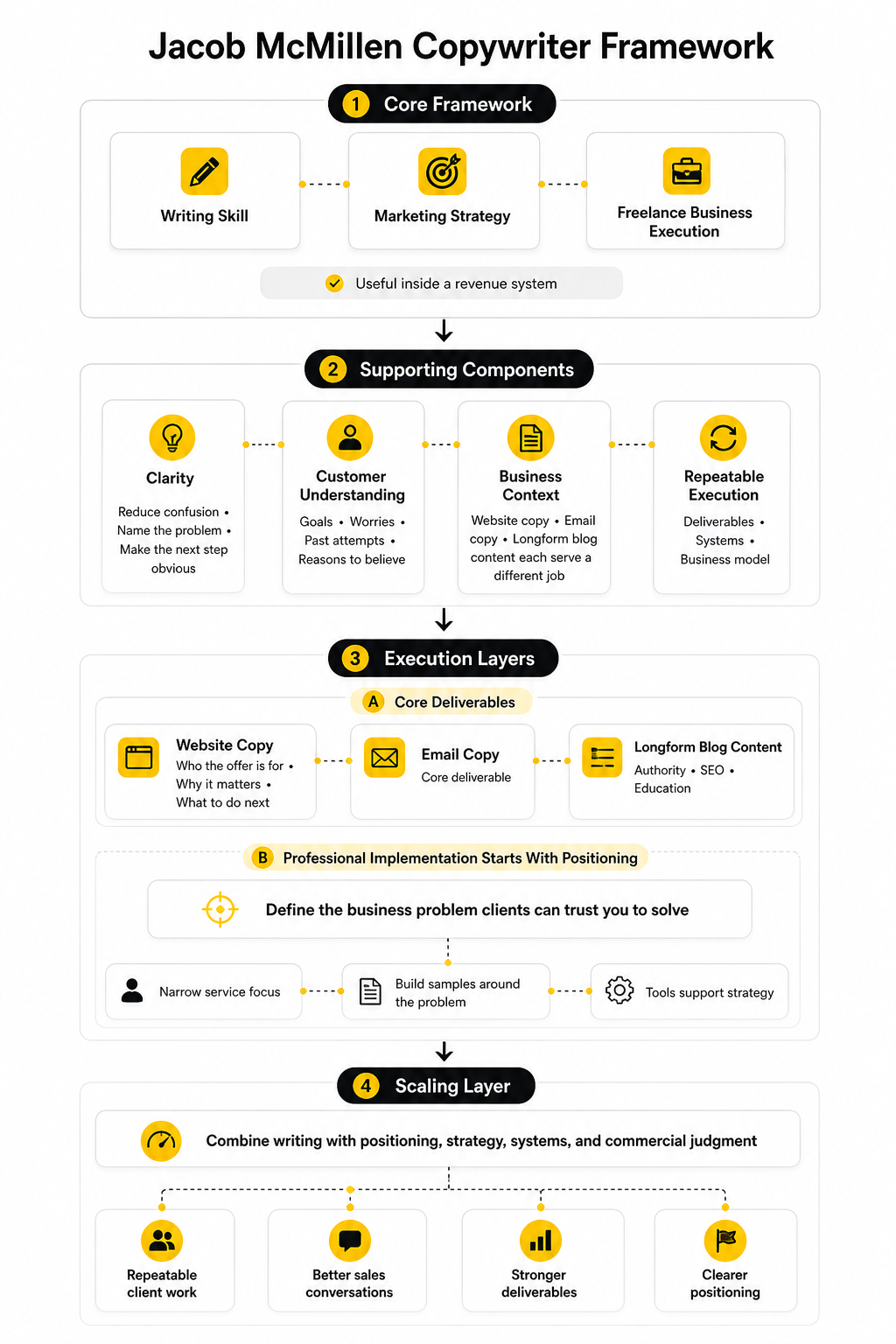
This structure also keeps the article grounded. We are not going to pretend that one copywriter has a magic formula for everyone. We are going to look at the parts of the model that are useful, testable, and applicable to real writing work.
The Core Components Behind The Model
The first component is clarity. Strong copy does not make the reader work hard to understand the offer. It reduces confusion, names the problem clearly, and makes the next step feel obvious.
The second component is customer understanding. Good copy is not built around what the writer wants to say. It is built around what the buyer already cares about, what they are worried about, what they have tried before, and what would make them believe the offer is worth attention.
The third component is business context. A website page, email sequence, and SEO article do not do the same job. A serious copywriter needs to understand where each asset sits in the customer journey, because a page meant to convert warm traffic should not sound like a beginner’s guide, and an educational article should not read like a desperate sales pitch.
The fourth component is repeatable execution. This is where Jacob McMillen’s positioning becomes especially relevant for freelance writers. His public training is not framed as “be more creative and hope clients notice.” It is framed around building deliverables, systems, and a business model that can support consistent paid work.
Professional Implementation Starts With Positioning
For a working writer, the practical takeaway is clear: do not start by asking, “How do I sound like Jacob McMillen?” That is the wrong question. Start by asking, “What business problem do I want clients to trust me with?”
A beginner might answer that question with “blog posts,” but a stronger answer would be more specific. For example, a writer could focus on longform SEO content for B2B SaaS companies, landing page copy for service businesses, email nurture sequences for course creators, or website messaging for consultants. The tighter the problem, the easier it becomes to build samples, explain value, and price the work properly.
This is also where tools can help, but only if they support the strategy. A freelancer building funnels for clients might eventually use platforms like ClickFunnels, GoHighLevel, or systeme.io when the project genuinely calls for funnel pages, CRM automation, or simple campaign infrastructure. But the tool is never the strategy. The writer still has to understand the offer, the audience, the buying journey, and the message.
That is the bigger lesson behind studying Jacob McMillen as a copywriter. The surface-level takeaway is that he writes website copy, content, and emails. The deeper takeaway is that modern copywriting rewards people who can combine writing with positioning, strategy, systems, and commercial judgment.
The Foundation Of His Copywriting Framework
The strongest way to study Jacob McMillen as a copywriter is to stop looking for a single clever trick. His public training does not frame copywriting as a bag of isolated hacks. It frames it as a process: understand the business, understand the buyer, structure the message, and deliver the asset in a way that can actually be sold as a service.
That distinction matters. A beginner often thinks copywriting starts with the sentence. A professional knows it starts before the sentence, with the offer, the audience, the traffic source, the buying stage, and the action the reader needs to take next.
Jacob’s own copywriting course positioning focuses on three commercial writing services: website copy, email copy, and longform blog content. That is a useful foundation because those three formats cover a large part of the modern online customer journey. Website copy helps convert attention, email copy helps nurture and sell, and longform content helps attract qualified readers before they are ready to buy.
Copywriting Starts With The Reader’s Problem
The first layer of the framework is simple: the reader does not care about the writer. They care about their own problem, their own goal, and the cost of staying where they are. Copy that ignores this becomes decorative, even if it sounds polished.
This is why strong copy usually begins with a practical understanding of the customer’s pain, desire, objections, and decision criteria. You are not trying to impress the reader with your vocabulary. You are trying to make them feel understood quickly enough that they keep reading.
That fits the way people behave online. Nielsen Norman Group’s research on web reading found that people rarely read every word on a page and are far more likely to scan for useful information. That makes clarity a business skill, not a style preference.
The Offer Has To Be Clear Before The Copy Can Work
A weak offer cannot be saved by clever writing for long. You can make it sound better, but you cannot permanently hide confusion, poor positioning, or a vague outcome. This is where a serious copywriter has to think like a strategist, not just a writer.
The offer needs to answer basic questions in a way the buyer can understand. Who is this for? What problem does it solve? Why is this solution different from the alternatives? What happens after someone takes the next step?
When those answers are clear, the copy has something solid to work with. When they are missing, the writer ends up stretching, exaggerating, or stuffing the page with generic claims. That is usually where bad copy starts.
The Message Needs A Logical Path
Good copy does not just say persuasive things. It moves the reader through a sequence. The reader starts with a problem, meets a possible solution, gets reasons to believe, sees the next step, and feels less risk in moving forward.
This is one reason the Jacob McMillen copywriter model is useful for newer writers. It encourages them to think in terms of assets and systems, not random phrases. A homepage, service page, blog post, and email sequence each need a different path because the reader’s intent is different in each situation.
A website visitor might be comparing providers. An email subscriber might already trust the brand but need a reason to act now. A blog reader might still be learning the problem and may not be ready for a direct pitch yet.
The Core Components Of Persuasive Copy
A practical copywriting framework needs components that can be repeated. Creativity matters, but repeatability is what turns writing into a client service. Without a repeatable method, every project feels like starting from zero.
The core components usually look like this:
None of these components work well in isolation. Proof without clarity feels scattered. Structure without insight feels mechanical. A call to action without trust feels pushy.
Why This Framework Works For Freelancers
Freelancers need more than writing talent. They need a way to explain what they do, sell it, deliver it, and improve it over time. That is where the foundation behind Jacob McMillen’s approach becomes especially practical.
A freelancer who says “I write copy” sounds replaceable. A freelancer who says “I help B2B service companies rewrite their website messaging so visitors understand the offer and take the next step” sounds much easier to hire. The second version gives the client a business reason to care.
This is also why Jacob’s public brand blends copywriting with freelance business education. The skill and the business model support each other. Better positioning helps the writer sell better projects, and better projects give the writer more room to do strategic work.
Where AI Fits Into The Foundation
AI does not remove the need for copywriting fundamentals. It raises the penalty for not having them. If everyone can generate a decent first draft, the valuable skill becomes knowing what the draft should say, what it should not say, and how it should be shaped for a specific business goal.
HubSpot’s 2025 AI content coverage notes that content creation is one of the most common AI use cases among marketers. That means the average client is becoming more exposed to fast, cheap, acceptable writing. The writer’s advantage has to move higher up the value chain.
This is where the foundation matters. AI can help with research organization, outlining, variation, editing, and production speed. But it cannot replace judgment about the offer, the buyer, the funnel, the competitive angle, or the credibility of a claim.
The Practical Workflow Behind Strong Copy
A professional workflow starts with discovery. Before writing, the copywriter needs to understand the business model, the buyer, the current conversion problem, and the role of the asset being created. Skipping this step is how writers end up producing copy that sounds fine but does not solve anything.
The next step is message strategy. This includes identifying the primary promise, the supporting proof, the objections to address, and the order in which the reader needs to see the information. Only after that does drafting become useful.
Then comes revision. Real copywriting is not just drafting once and polishing grammar. It is tightening the argument, removing unnecessary friction, improving clarity, strengthening proof, and making sure every section earns its place.
The Difference Between Writing And Copywriting
Writing can inform, entertain, explain, or express. Copywriting has a commercial job. It needs to move a specific audience toward a specific action while maintaining trust.
That does not mean every sentence should be aggressive. In fact, strong copy often feels calm because it is clear. It respects the reader’s intelligence and gives them enough information to make a confident decision.
This is why the best copywriters are not just wordsmiths. They are translators between the business and the buyer. They turn internal value into external language the market can understand.
What To Take From Jacob McMillen’s Foundation
The main takeaway is not to copy Jacob’s voice. The main takeaway is to copy the discipline behind the work. Start with the reader, clarify the offer, structure the message, and connect every asset to a real business purpose.
For writers, this creates a better path than chasing random tactics. For business owners, it creates a better way to evaluate copy before publishing it. The question is not “Does this sound good?” The question is “Will the right reader understand, believe, and act?”
That foundation sets up the next major section: website copy. Because once the strategy is clear, the website is often where the quality of the messaging gets exposed first.
Website Copy, Positioning, And Conversion Strategy
This is where the framework becomes concrete. A website is usually the first place a business discovers whether its messaging is clear or just internally familiar. If visitors cannot understand the offer quickly, the design, branding, and clever copy do not matter nearly as much as the business wants them to.
That is why the Jacob McMillen copywriter approach is useful to study at this stage. His public website copywriting material is built around planning the page before writing it, not trying to improvise persuasive language after the fact. The process starts with the business case, then moves into the page structure, then into the actual copy.
Website copy has one brutal job: help the right visitor make the next decision. Sometimes that decision is booking a call. Sometimes it is starting a trial, joining a list, requesting a demo, reading a deeper page, or comparing options. The page has to know which decision it is supporting.
Start With The Page’s Actual Job
Every page needs a job before it needs a headline. A homepage is not a sales page. A service page is not an about page. A landing page is not a blog post with a button at the bottom.
This sounds obvious, but it is where many businesses make their first mistake. They try to make one page explain everything, persuade everyone, answer every objection, tell the founder story, show every feature, and close the sale immediately. The result is usually a page that feels busy but not convincing.
A serious copywriter pushes back on that. The first question should be, “What is this page supposed to help the reader do?” Once that is clear, the rest of the page becomes much easier to structure.
Clarify The Reader’s Stage Of Awareness
The reader’s awareness level changes the entire page. Someone who already knows the problem and is comparing providers needs different copy than someone who is still trying to understand why their current situation is not working. Treating those two visitors the same is lazy strategy.
A warm visitor can handle direct claims, proof, pricing context, and a clear call to action. A colder visitor may need more education, more framing, and a stronger explanation of why the problem matters now. The copy has to meet the reader where they are instead of forcing them into the company’s preferred sales pitch.
This is where the Jacob McMillen copywriter model connects with practical conversion work. Good copy is not just “more persuasive.” It is more appropriate to the reader’s current state of mind.
Build The Page Around One Core Promise
A strong website page needs a central promise. Not a vague slogan. Not a clever brand line. A real promise that tells the reader what meaningful outcome the business helps create.
For a service business, that promise might be tied to leads, efficiency, better positioning, reduced workload, or a more predictable system. For a SaaS company, it might be tied to speed, visibility, automation, team alignment, or cost reduction. The exact promise depends on the market, but the page should not make the visitor guess.
Once the promise is clear, every major section should support it. The hero section introduces it. The problem section makes it relevant. The solution section explains it. The proof section makes it believable. The call to action turns it into a next step.
Turn Research Into Page Structure
Research is not something you do so you can feel professional. Research gives you the raw material for the page. It tells you what the buyer cares about, what language they already use, what objections they bring with them, and what proof they need before they trust the offer.
The research phase should look at customer interviews, testimonials, sales calls, support tickets, reviews, competitor pages, and the company’s own sales process. You are looking for repeated patterns. One complaint might be noise, but repeated complaints are messaging fuel.
Then the page structure becomes more grounded. Instead of guessing which sections to include, the copywriter can build the page around real buyer questions. That is how website copy starts to feel specific instead of generic.
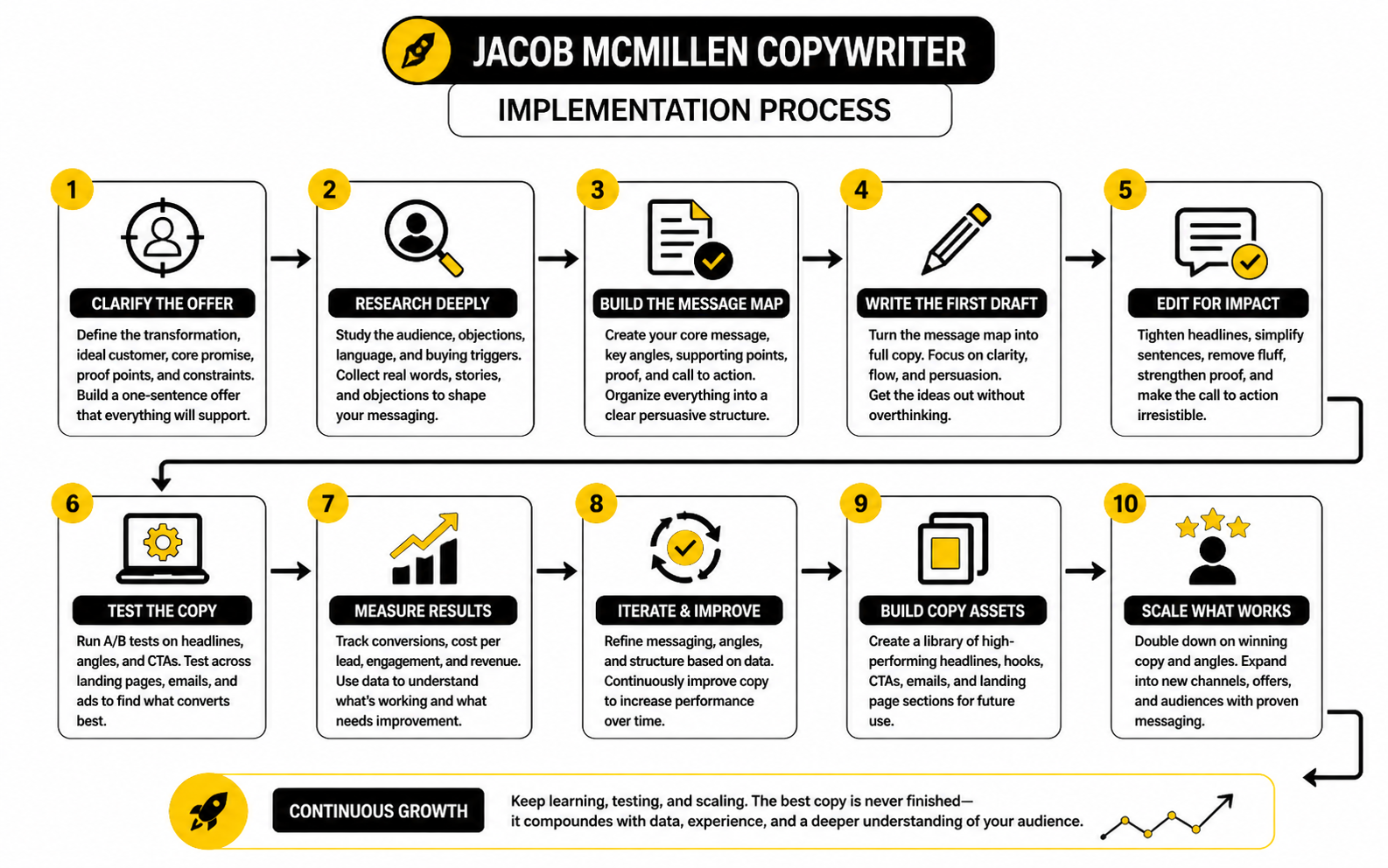
A Practical Website Copy Process
A practical implementation process does not need to be complicated. It needs to be repeatable. The more repeatable the process, the easier it is for a writer to deliver consistent work and for a business owner to evaluate whether the page is ready.
A clean process looks like this:
This process also protects the writer from over-relying on inspiration. You are not waiting to feel creative. You are building a page from the business problem outward.
The Hero Section Has To Do More Than Sound Good
The hero section is where many pages fail fastest. It often gets treated like a branding exercise, but the reader is usually asking more practical questions. What is this? Is it for me? Why should I keep reading?
A strong hero section should make the offer understandable quickly. It should give the reader a reason to care and a reason to continue. It does not need to say everything, but it does need to remove the biggest initial confusion.
This is why vague hero copy is so expensive. Lines like “Scale more carefully with next-generation solutions” might sound polished in a meeting, but they do not help the reader make a decision. Clear beats clever almost every time.
The Body Copy Should Handle Friction In Order
Once the hero section earns attention, the body of the page has to keep reducing friction. That means the sections should not be arranged randomly. Each section should answer the next question forming in the reader’s mind.
A simple sequence might move from problem to solution, then from solution to benefits, then from benefits to proof, then from proof to process, then from process to action. Another page might need comparison, pricing explanation, use cases, or objections earlier. The right structure depends on the reader and the offer.
This is where professional judgment matters. Templates can help, but templates cannot decide which objection is most important or which proof point belongs above the fold. That is the copywriter’s job.
Proof Makes The Promise Believable
A promise without proof is just a claim. Proof does not always have to be a dramatic case study, but it does need to make the reader feel safer. Testimonials, examples, numbers, recognizable clients, screenshots, process details, and specific deliverables can all reduce doubt when used honestly.
The key is to match the proof to the level of risk. A low-cost product might only need social proof and a clear guarantee. A high-ticket B2B service may need deeper evidence, a credible process, strong positioning, and a clear explanation of what happens after the first call.
Bad proof feels pasted on. Good proof answers the exact doubt the reader is having at that moment. That is why placement matters as much as the proof itself.
Calls To Action Should Match Intent
A call to action is not just a button label. It is the point where the page asks the reader to move. If the ask feels too aggressive for the reader’s awareness level, the page creates resistance instead of momentum.
For warm traffic, a direct call like booking a consultation or starting a trial may work well. For colder traffic, the better next step might be downloading a resource, watching a walkthrough, joining an email list, or viewing a comparison. The CTA should match the relationship.
This is also where funnel tools can become useful when the strategy is already clear. A business building focused landing pages might use a platform like ClickFunnels, while an agency managing client follow-up might prefer GoHighLevel. The important part is that the tool supports the page strategy instead of replacing it.
Website Copy Needs To Connect With The Funnel
A page does not operate in isolation. The traffic source affects expectations, the offer affects urgency, and the follow-up system affects whether leads turn into revenue. Copy that ignores the funnel can still sound good, but it often underperforms.
For example, a page receiving search traffic may need stronger education and clearer context. A page receiving email traffic can usually assume more familiarity and move faster. A page receiving paid traffic must align tightly with the ad promise or the visitor feels misled.
This is why implementation matters so much. The copywriter should understand what happens before the visitor lands on the page and what happens after they take action. That wider view turns website copy from a standalone deliverable into part of a revenue process.
The Real Standard For Good Website Copy
The real standard is not whether the business likes the copy. The standard is whether the right reader understands the offer, believes the promise, and feels enough trust to take the next step. That is a higher bar, but it is also a much more useful one.
This is the mindset worth taking from Jacob McMillen’s website copywriting approach. Start with the reader, build from the offer, structure the page intentionally, and write in a way that serves the conversion goal without sounding desperate. Practical, clear, and commercially useful.
That naturally leads into longform content. Because once the website can convert the right visitor, the next question becomes how to attract more of those visitors in the first place.
Longform Content, SEO, And Authority Building
Once the website can explain the offer clearly, the next question is traffic quality. A strong page does not matter much if the right people never reach it. This is where longform content becomes more than “writing blog posts” and turns into a visibility system.
The Jacob McMillen copywriter model is especially relevant here because his public portfolio positions longform content as a business asset, not just an editorial task. His portfolio describes work across SaaS, B2B, funnels, and content systems, with a focus on measurable growth rather than publishing for the sake of publishing. That is the correct lens for this section.
Longform content should help a business become findable, useful, and trusted before the buyer is ready to speak with sales. That means the article has to answer real questions, match search intent, support the buying journey, and connect naturally to the next commercial step.
Statistics And Data
Data matters because it keeps content strategy honest. Without measurement, a business can mistake activity for progress. Publishing more articles, rewriting more pages, or sending more emails does not automatically mean the copy is doing useful work.
The current benchmark landscape makes this obvious. The 2025 B2B content marketing research from Content Marketing Institute and MarketingProfs shows that top-performing marketers are more likely to have a documented strategy, measure performance, and align content with business goals. That is the difference between content as a habit and content as a system.
Email and web benchmarks tell the same story from another angle. MailerLite’s 2025 benchmark report covers millions of campaigns and shows how open rates, click rates, click-to-open rates, and unsubscribe rates vary by industry and region. Databox’s 2025 content benchmarks track metrics like sessions, engagement rate, average session duration, conversions, search position, CTR, and leads across connected analytics sources. Those numbers are useful only when they are interpreted against intent, audience, and offer strength.
Benchmarks Are Starting Points, Not Goals
A benchmark is not a target by itself. It is a comparison point that helps you ask better questions. If your numbers are below the benchmark, the answer is not always “write better copy.” It might be weak traffic quality, poor offer fit, slow page speed, unclear targeting, low trust, or a mismatch between promise and landing page.
This is where many people misuse data. They see a low conversion rate and immediately rewrite the CTA. But the CTA might not be the real problem. The reader may not believe the promise, understand the offer, see enough proof, or feel enough urgency to take the next step.
A serious copywriter uses benchmarks as diagnostic tools. The number points to the area that needs investigation. It does not replace judgment.
The Metrics That Actually Matter
The right metrics depend on the asset. A blog article, landing page, homepage, email sequence, and sales page should not be measured the same way. Each one has a different job in the funnel.
For longform SEO content, useful metrics include qualified organic sessions, keyword movement, search impressions, click-through rate, engaged time, assisted conversions, internal link clicks, and leads influenced. For website copy, useful metrics include conversion rate, scroll depth, CTA clicks, form completion, demo requests, trial starts, and sales-qualified leads. For email copy, useful metrics include deliverability, open rate, click rate, reply rate, unsubscribe rate, and revenue per subscriber.
The key is to connect the metric to the job of the asset. A top-of-funnel article might be successful if it earns qualified visibility and moves readers deeper into the site. A landing page is successful only if it turns the right traffic into the right action.
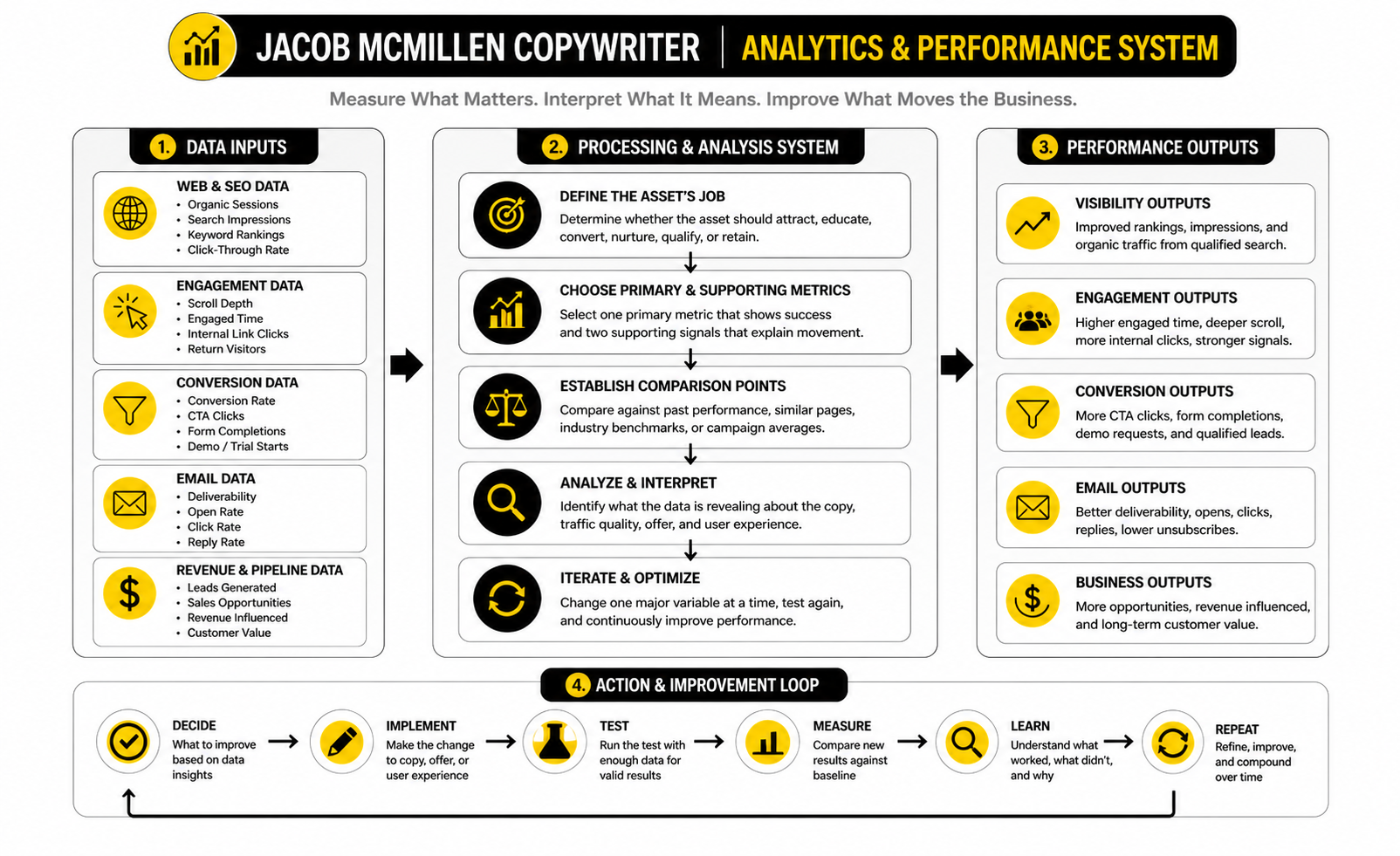
A Simple Analytics System For Copy
The practical measurement system should be simple enough to use consistently. Complexity feels impressive, but it often creates avoidance. The goal is not to build a dashboard nobody checks.
A useful system looks like this:
This is the kind of process that separates professional implementation from random tweaking. It turns copy into something that can be improved, not just approved.
What Performance Signals Reveal About The Copy
Different performance problems point to different copy issues. Low impressions on SEO content may suggest the topic, search intent, authority, or indexing strategy is off. High impressions with low clicks may suggest the title, meta description, angle, or search result promise is not compelling enough.
High traffic with low engagement usually means the page is attracting the wrong readers or failing to satisfy the intent quickly. Strong engagement with weak conversions may mean the content is useful but the next step is unclear, unconvincing, or poorly matched to the reader’s stage. High CTA clicks with low form completion may point to friction in the form, offer, or follow-up expectation.
This is why data interpretation matters more than data collection. The numbers do not simply tell you what to do. They tell you where to look.
How To Measure Longform Content Without Fooling Yourself
Longform content often takes longer to evaluate than a paid landing page. Search visibility can take time, internal links can influence performance across the site, and a reader may return later through another channel before converting. Judging the article only by immediate leads can understate its value.
A better approach is to separate leading and lagging indicators. Leading indicators include indexing, impressions, keyword movement, scroll depth, engaged time, and internal clicks. Lagging indicators include assisted conversions, demo requests, email signups, sales opportunities, and revenue influenced.
This matters because a new article can be doing the right early work before it produces obvious revenue. At the same time, traffic alone is not enough. If an article attracts readers who never move closer to the business, the strategy still needs work.
How To Measure Website Copy Without Overreacting
Website copy should be measured with more discipline because page changes can affect revenue directly. A business should not rewrite a core landing page every time a stakeholder gets bored. It should look at the page’s role, traffic source, sample size, and conversion path before making changes.
For example, a page with low conversion but strong qualified traffic might need clearer proof, a sharper offer, or a lower-friction next step. A page with weak traffic quality might need better targeting before the copy can be judged fairly. A page with strong CTA clicks but poor sales outcomes might be generating curiosity instead of qualified intent.
The point is simple: conversion rate is not the whole story. A higher conversion rate with worse lead quality can hurt the business. A lower conversion rate with better-qualified leads can be an improvement.
How To Measure Email Copy In Context
Email copy has its own measurement traps. Open rate can be affected by subject lines, sender reputation, Apple Mail Privacy Protection, list quality, and deliverability. Click rate can be affected by offer strength, segmentation, timing, and how much trust the list already has.
That means email performance should be interpreted in layers. Deliverability comes first because emails that do not land cannot convert. Engagement comes next because opens, clicks, replies, and unsubscribes show whether the message is earning attention or creating fatigue.
Revenue and pipeline impact come after that. A campaign with modest clicks can still be valuable if the clicks are highly qualified. A campaign with strong opens but no action may simply be entertaining the list without moving the business forward.
The Action Behind The Numbers
The purpose of measurement is action. If the data does not help you decide what to improve, simplify the system until it does. You do not need twenty KPIs for one page.
For SEO content, the action might be refreshing the title, expanding a section, adding internal links, improving the intro, or building supporting articles. For website copy, the action might be clarifying the hero section, moving proof higher, strengthening the offer, or changing the next step. For email, the action might be segmenting the list, improving the offer, tightening the lead, or changing the sequence timing.
This is the practical standard worth applying to Jacob McMillen’s copywriting model. The writing should not just sound persuasive. It should create signals that can be measured, interpreted, and improved.
Data Should Make The Writer More Strategic
The best copywriters are not afraid of analytics. They use data to sharpen their thinking. They still care about language, but they also care about whether the language is doing its job.
That is the deeper lesson of this part of the article. Copywriting, content strategy, SEO, and email are not separate islands. They are parts of a system that should attract the right people, make the offer clearer, build trust, and move qualified buyers forward.
When you study Jacob McMillen as a copywriter, do not just study the words. Study the business logic behind the words. That is where the real leverage is.
Freelance Business Lessons From Jacob McMillen’s Model
The advanced lesson is that copywriting skill is only one part of the business. A writer can be good at the craft and still struggle if they cannot choose a market, package the work, price the value, manage delivery, and create demand. This is where studying Jacob McMillen as a copywriter becomes useful beyond the writing itself.
His public positioning is not just “I write copy.” It combines website copywriting, content strategy, email marketing, freelance education, and longform SEO training into a clear business ecosystem. That matters because the market rewards writers who can connect their work to outcomes clients already care about.
The tradeoff is that this kind of positioning requires discipline. You cannot be everything to everyone and still sound like the obvious choice. At some point, a serious freelancer has to decide what type of problem they want to be known for solving.
The First Strategic Tradeoff Is Specialization
Specialization makes marketing easier, but it also feels risky at first. A generalist can say yes to more projects, which feels safer when cash flow is inconsistent. A specialist says no more often, but the right prospects usually understand the value faster.
The Jacob McMillen copywriter model points toward specialization without making the mistake of becoming too narrow too early. Website copy, email copy, and longform SEO content are broad enough to serve real business demand, but specific enough to become recognizable services. That is the balance most freelance writers should aim for.
A bad niche traps you in work you do not want. A good niche gives your marketing a sharper message, your samples a clearer direction, and your sales calls a stronger reason to exist. The goal is not to sound fancy. The goal is to become easier to hire.
Pricing Should Follow Business Value
Pricing by the word is usually the weakest way to sell serious copywriting. It rewards volume instead of thinking. It also makes the client compare you against cheaper writers, AI tools, and content mills instead of evaluating the business value of the asset.
Better pricing starts by understanding what the work supports. A homepage rewrite for a business with steady qualified traffic has a different value than a one-off article for a small blog with no distribution. An email sequence tied to a launch has a different value than a basic newsletter draft.
This does not mean every writer should immediately charge premium rates. It means the pricing logic should mature as the service matures. The more your work affects leads, sales, retention, positioning, or pipeline, the less sense it makes to price it like a commodity.
The Risk Of Overpromising Results
There is a fine line between confidence and hype. Copy can influence conversions, but it does not control every variable. Traffic quality, offer strength, brand trust, pricing, product-market fit, sales follow-up, and timing all affect the final result.
This is one reason professional copywriters should be careful with guarantees. Promising a specific revenue number from copy alone can sound compelling, but it often ignores the rest of the system. A more credible promise focuses on the quality of the process, the strategic thinking, the deliverables, and the specific improvements the writer can reasonably control.
Clients respect confidence, but sophisticated clients respect precision more. Say what the copy is designed to improve. Say what inputs you need. Say what depends on the rest of the funnel. That makes you sound more professional, not less.
Scaling Requires Systems, Not Just More Clients
A freelance writing business can break when it grows. More clients mean more calls, more revisions, more research, more admin, and more context switching. Without systems, growth turns into stress fast.
The solution is not only to raise rates. The solution is to standardize how work moves from inquiry to proposal, discovery, research, outline, draft, revision, handoff, and follow-up. A writer who has a repeatable process can take on better projects without reinventing the business every time.
This is also where simple infrastructure matters. Scheduling tools, intake forms, CRM notes, proposal templates, project boards, and email follow-up systems reduce mental load. A solo copywriter does not need a bloated tech stack, but they do need enough structure to prevent every project from becoming chaos.
AI Creates Leverage And New Risk
AI can help a copywriter move faster, but it can also make the work worse if the writer stops thinking. The danger is not simply that AI produces bad sentences. The bigger danger is that it produces plausible copy that skips the hard strategic work.
Ahrefs’ 2025 AI content research found that accuracy and misinformation remain major concerns in AI-assisted content workflows. That should make serious writers more careful, not more afraid. AI is useful for organizing research, generating variations, summarizing inputs, and accelerating drafts, but it still needs a human strategist checking the argument, claims, voice, and commercial logic.
The practical standard is simple. Use AI to remove bottlenecks, not responsibility. If the final copy contains weak positioning, fake authority, unsupported claims, or generic language, the client will not blame the tool. They will blame the writer.
Authority Is Built Before The Sales Call
A strong freelance business does not rely only on cold outreach or referrals. Those can work, but authority makes every channel easier. When prospects can see how you think before they speak with you, the sales conversation starts from a stronger place.
This is one area where Jacob McMillen’s model is very instructive. His public site includes guides, portfolio positioning, training pages, and service-oriented content that all reinforce the same broad idea: he understands copywriting as both a craft and a business. That repeated positioning compounds over time.
Freelancers can apply the same principle without copying the exact format. Publish useful breakdowns. Show your process. Explain how you think about website sections, email sequences, SEO articles, offers, and buyer objections. Authority is not built by saying “I’m an expert.” It is built by making your thinking visible.
The Client Fit Problem Gets Bigger As You Grow
Better positioning attracts better clients, but it also forces better filtering. Not every client with a budget is a good client. Some want strategy but will not share information. Some want conversion gains but refuse to change the offer. Some want premium outcomes while treating the writer like a pair of hands.
A mature copywriter learns to spot these issues early. The discovery call should reveal whether the client understands the project, has realistic expectations, can provide useful inputs, and is willing to make decisions. If those pieces are missing, the project may become difficult no matter how good the writer is.
This is not about being arrogant. It is about protecting the work. Strong copy requires access, context, feedback, and alignment. Without those, the copywriter is guessing.
Productized Services Can Help, But They Can Also Flatten Strategy
Productized services are attractive because they make buying easier. A fixed package for a homepage rewrite, email sequence, landing page, or content strategy can reduce friction and speed up sales. It also helps the freelancer avoid custom-scoping every inquiry from scratch.
The risk is that productization can become too rigid. If every client gets the same structure regardless of their funnel, audience, offer, or traffic source, the service becomes a template with nicer branding. That may be efficient, but it is not always strategic.
The better approach is to productize the process, not the thinking. Keep the discovery, research, structure, drafting, and revision workflow consistent. Then adapt the actual messaging to the business in front of you.
Tools Should Support The Business Model
A copywriter does not need to become a software operator for every client. But understanding common marketing tools makes the writer more useful, especially when the copy has to live inside funnels, email systems, landing pages, or CRM workflows. The writer does not have to build everything, but they should understand how the message will be used.
For funnel-heavy projects, platforms like ClickFunnels or systeme.io can make sense when the client needs landing pages, opt-ins, and sales flows. For agencies or service businesses that need lead management, automation, and follow-up in one place, GoHighLevel can fit the workflow better. The tool choice should follow the operating model, not the other way around.
This matters because copy rarely lives alone anymore. A headline sits inside a page. A page sits inside a funnel. A funnel connects to email, CRM, sales calls, reporting, and follow-up. The more a writer understands that ecosystem, the more strategic the work becomes.
The Biggest Mistake Is Staying At The Task Level
The easiest way to stay underpaid is to sell tasks forever. Write this page. Draft this email. Produce this guide. Edit this sequence. Those tasks can be valuable, but they are easier to compare and replace when they are disconnected from strategy.
The better move is to understand the business problem behind the task. Why does the page need to be rewritten? Why is the email sequence underperforming? Why does the content program exist? Why should this audience believe this offer now?
That shift changes the conversation. You are no longer just the person who writes. You are the person who helps turn unclear value into a clear message that supports growth. That is much harder to commoditize.
The Expert-Level Standard
At the expert level, copywriting is not about sounding persuasive. It is about making better decisions with language. Which promise should lead? Which objection needs to be handled first? Which proof belongs higher? Which CTA matches the reader’s intent? Which claim should be removed because it cannot be supported?
This is the standard serious writers should take from the Jacob McMillen copywriter model. The work is practical, commercial, and strategic. It sits at the intersection of audience understanding, offer clarity, content systems, and freelance business discipline.
That sets up the final part naturally. Once the strategy, implementation, measurement, and scaling issues are clear, the last step is knowing which tools to use, which mistakes to avoid, and which questions matter most before applying the model yourself.
Tools, Implementation, Mistakes To Avoid, And FAQ
The final step is turning the ideas into a working system. Not a perfect system. Not a bloated agency machine. A practical system that helps a writer or business owner use copy, content, email, analytics, and positioning together instead of treating them as separate tasks.
That is the big thread running through this guide. Studying Jacob McMillen as a copywriter is useful because his public work sits at the intersection of writing, strategy, SEO, email, and freelance business building. The practical takeaway is not to copy his exact business, but to understand the kind of system that makes modern copywriting more valuable.
A strong system has five layers: positioning, research, copy assets, distribution, and measurement. If one layer is missing, the rest of the work becomes weaker. Great writing with poor distribution gets ignored, great traffic with weak copy leaks revenue, and great analytics without action becomes dashboard theater.
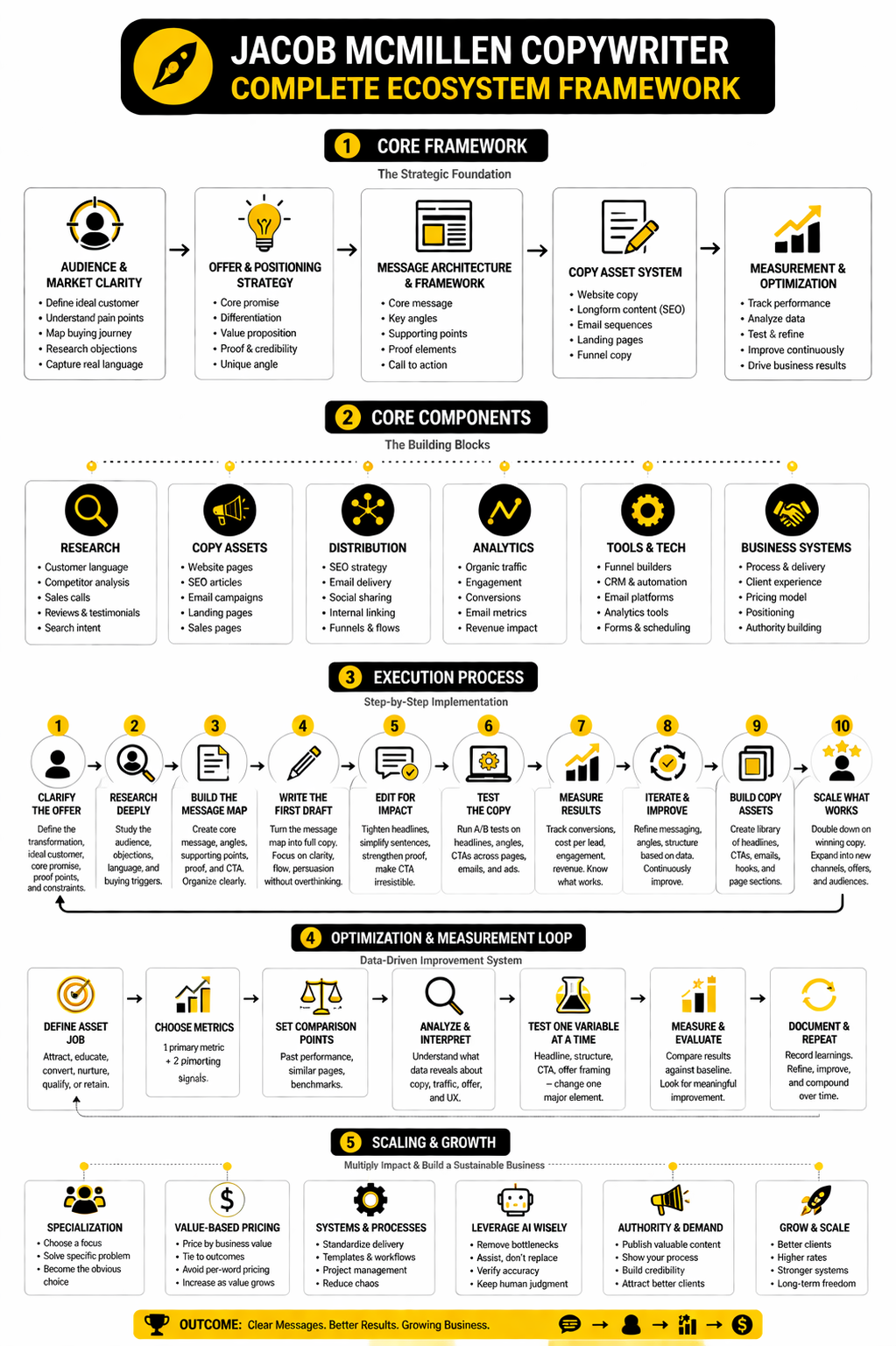
The Final Copywriting Ecosystem
A serious copywriting ecosystem starts with positioning. The business needs to know who it serves, what problem it solves, and why the offer matters now. Without that, every page, email, article, and funnel asset has to carry too much confusion.
The next layer is research. This includes customer language, competitor analysis, sales objections, search intent, testimonials, call transcripts, reviews, and support conversations. Research gives the copywriter specific material instead of forcing them to rely on generic persuasion.
Then come the assets. Website copy converts, longform content attracts and educates, email nurtures and sells, and landing pages focus attention around a specific action. Tools like ClickFunnels, systeme.io, and GoHighLevel can support that system when the business needs funnel pages, automation, CRM workflows, or lead follow-up, but they should never replace strategic thinking.
The Biggest Mistakes To Avoid
The first mistake is writing before the offer is clear. This is the fastest way to create copy that sounds busy but does not move the reader. If the promise, audience, and next step are vague, the copywriter should fix the strategy before polishing sentences.
The second mistake is treating AI output as finished copy. AI can help draft, organize, and speed up production, but it can also produce generic claims, weak positioning, and unsupported statements. A professional writer still has to check the logic, evidence, tone, audience fit, and commercial purpose.
The third mistake is measuring everything and learning nothing. A business does not need endless dashboards to improve copy. It needs a clear primary metric, a few useful supporting signals, enough data to make a reasonable decision, and the discipline to change one major variable at a time.
How To Apply The Model Without Copying It
Use the Jacob McMillen copywriter model as a reference point, not a script. The useful lesson is that copywriting can be packaged as a strategic business service. That does not mean every writer should sell the same course, target the same clients, or write in the same voice.
Start with your own strongest intersection. Maybe that is B2B SaaS landing pages, ecommerce email flows, local service websites, founder-led thought leadership, SEO content for technical products, or funnel copy for coaches and consultants. The narrower your first serious focus, the easier it becomes to build proof and explain your value.
Then create a repeatable delivery process. Define how you research, outline, draft, revise, hand off, and measure the work. That process becomes part of what clients are buying, because it reduces uncertainty and makes the project feel safer.
Who is Jacob McMillen?
Jacob McMillen is a professional copywriter, content strategist, and freelance writing educator. His public website describes him as a website copywriter, content strategist, and email marketing expert who helps businesses optimize, startups find their voice, and freelancers build stronger writing businesses. He is also known for training writers through his copywriting and longform SEO courses.
Why do people search for Jacob McMillen copywriter?
People usually search for Jacob McMillen copywriter because they want to understand his writing services, portfolio, copywriting course, freelance business advice, or content strategy approach. His name appears in conversations around website copy, SEO content, email marketing, and freelance writing because his public brand combines those areas. That makes him a useful reference point for writers who want to move beyond basic content production.
What is the main lesson from Jacob McMillen’s copywriting approach?
The main lesson is that copywriting works best when it is connected to strategy. The writing should be based on the reader, the offer, the business model, the funnel, and the action the reader needs to take next. Good copy is not just clever wording; it is structured communication designed to help the right person make a decision.
Is Jacob McMillen only a website copywriter?
No. His public positioning includes website copywriting, content strategy, email marketing, longform SEO content, and freelance writing education. Website copy is a major part of the model, but the bigger picture is broader. He connects copywriting with content systems, client acquisition, and freelance business growth.
What can beginner copywriters learn from his model?
Beginner copywriters can learn that skills and business positioning have to develop together. It is not enough to say you write copy. You need to understand who you help, what problem you solve, what deliverables you offer, and how those deliverables support business outcomes.
What can business owners learn from this approach?
Business owners can learn to judge copy by clarity, trust, and action rather than personal taste. A page should help the right reader understand the offer, believe the promise, and know what to do next. If the copy sounds polished but does not answer buyer questions, it still needs work.
How does SEO fit into the Jacob McMillen copywriter model?
SEO fits through longform content and authority building. The goal is not just to rank articles, but to attract qualified readers, answer real search intent, and move those readers toward the business. SEO content becomes more valuable when it supports the full buying journey instead of chasing traffic for its own sake.
How should copywriters measure performance?
Copywriters should measure performance based on the job of the asset. A landing page might be judged by conversion rate, lead quality, and CTA clicks. A blog post might be judged by qualified organic traffic, search visibility, internal clicks, and assisted conversions. An email sequence might be judged by deliverability, clicks, replies, unsubscribes, and revenue influence.
Can AI replace this kind of copywriting?
AI can replace some basic drafting tasks, but it does not replace strategic judgment. The writer still needs to understand positioning, customer psychology, offer strength, funnel context, proof, and measurement. AI is useful when it speeds up the process, but dangerous when it becomes a substitute for thinking.
What is the biggest mistake freelance copywriters make?
The biggest mistake is staying at the task level forever. If a writer only sells words, they are easier to compare with cheaper writers and AI tools. The better move is to sell clearer messaging, better positioning, stronger conversion assets, and a more reliable process.
Should freelancers specialize in one type of copywriting?
Yes, but specialization should be practical. A writer does not need to choose a tiny niche immediately, but they should move toward a clear service, market, or problem. Specialization makes outreach easier, referrals clearer, samples more relevant, and pricing stronger.
What tools should copywriters understand?
Copywriters should understand the tools their work lives inside, even if they are not full technical implementers. Funnel builders, CRM systems, email platforms, analytics tools, form tools, and scheduling tools all affect how copy performs. The point is not to become a software expert; the point is to understand how the copy fits into the business system.
Is a copywriting course necessary to become good?
A course can help, but it is not magic. The real growth comes from practicing the fundamentals, studying real markets, writing for real offers, getting feedback, and learning from performance data. A strong course can shorten the learning curve, but it cannot replace doing the work.
How should someone start applying this guide today?
Start by choosing one asset and one business problem. Rewrite a service page, improve an email sequence, outline a longform article, or clarify a landing page. Then define the goal, research the reader, structure the message, draft the copy, and decide how performance will be measured.
Build a stronger local presence with BAAM AI
Turn your website, Google profile, social channels, and AI visibility into one growth engine
Most businesses do not need more random marketing activity. They need a consistent presence system that helps the right people find them, trust them, and take action. BAAM AI brings strategy, local SEO, website updates, Google Maps visibility, social content, AI-search readiness, media production, and reporting into one practical monthly engine.
If you want your marketing to keep working after the campaign ends, start with a free BAAM AI presence audit. See how your business shows up today and where the fastest visibility wins are at BAAM AI.